

A Novel Two-Stage Integrated Model for Supplier Selection of Green Fresh Product




 , and
, and
Abstract
1. Introduction
2. Literature Review
2.1. Fresh Product Supply Chain (SC)
2.2. Supplier Selection Criteria
2.3. Supplier Selection Methods
3. The Novel Integrated Two-Stage Multi-Criteria Decision Making (MCDM) Method
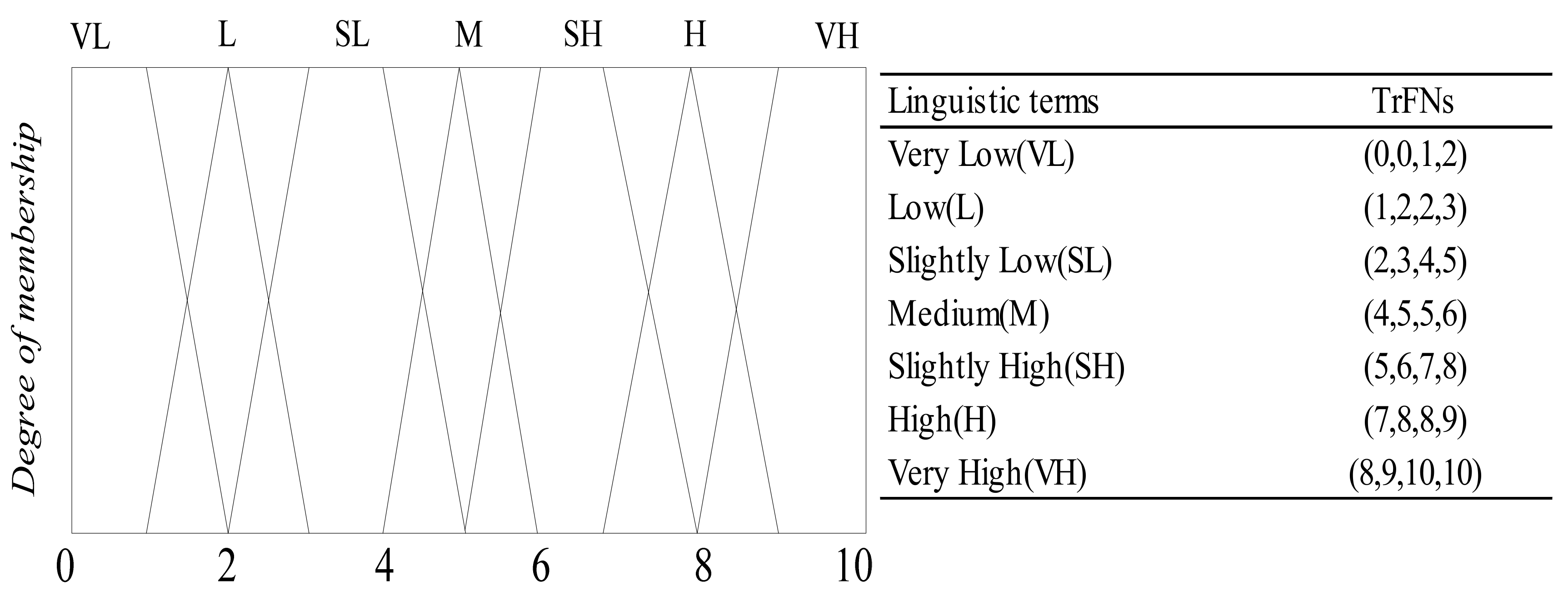
3.1. Fuzzy Set Theory
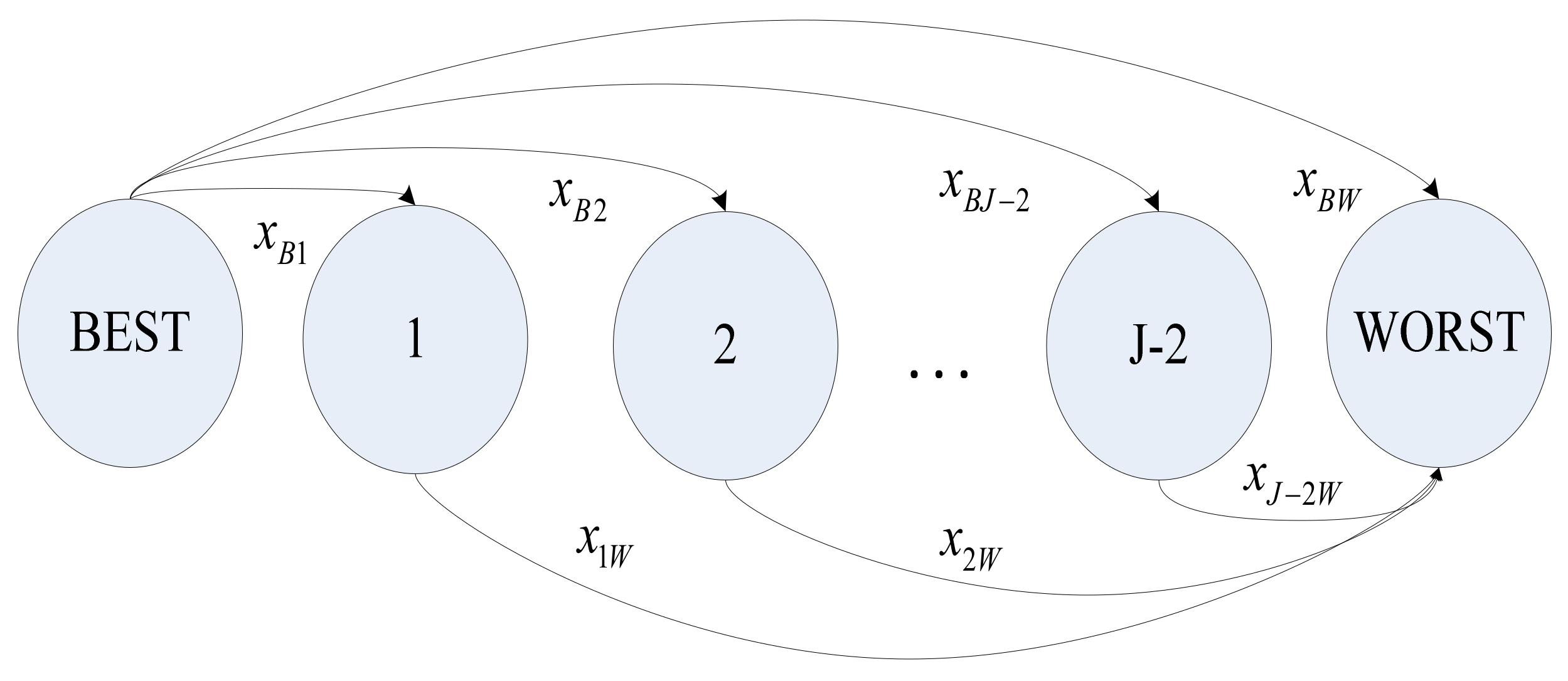
3.2. Fuzzy Best-Worst Method and Subjective Weights
3.3. Shannon Entropy and Objective Weights
3.4. Multi-Objective Optimization by Ratio Analysis Plus the Full Multiplicative Form (MULTIMOORA) and Supplier Ranking
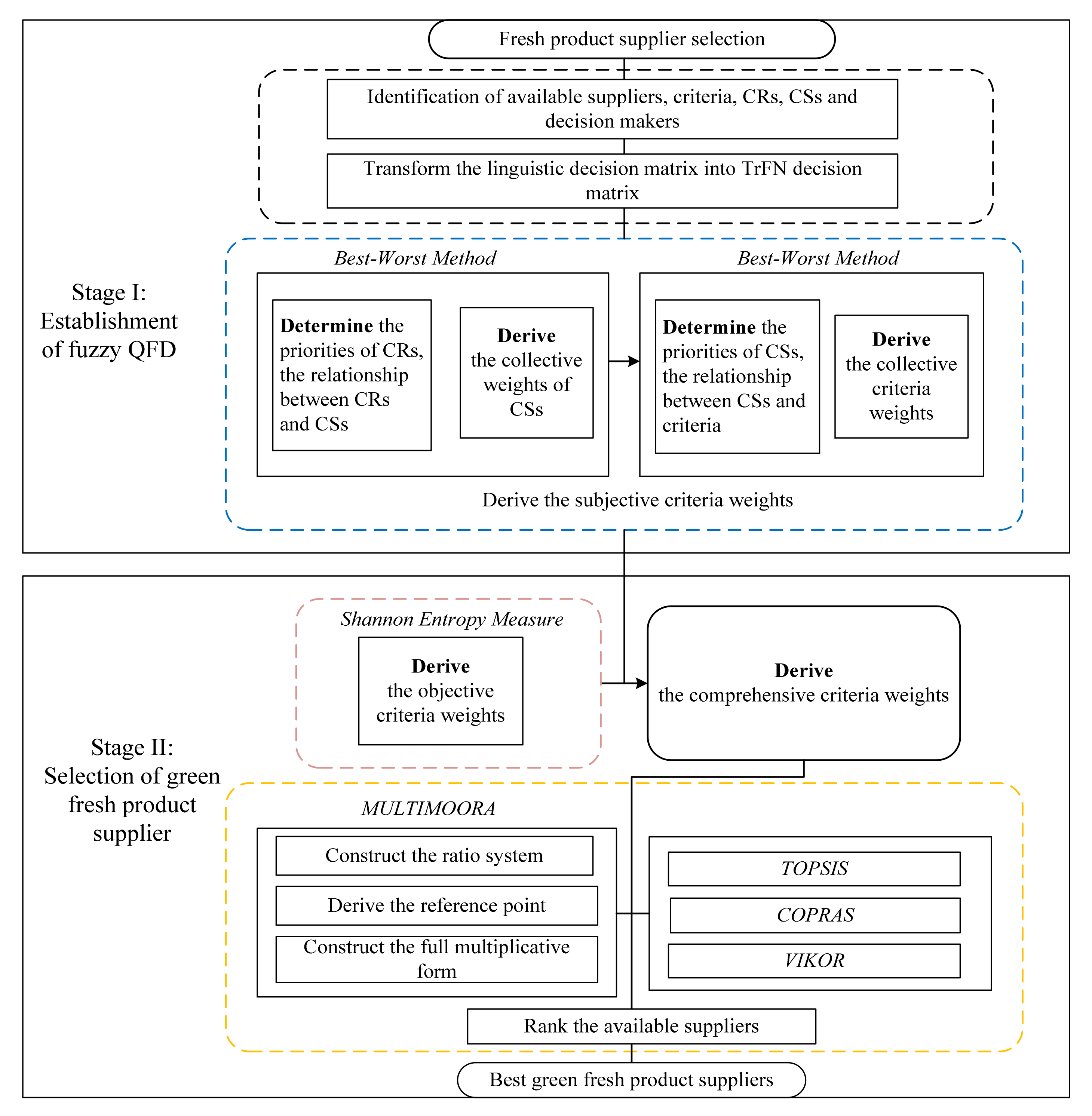
3.5. The Proposed Integrated Two-Stage MCDM Method
4. Case Study
5. Results and Discussion
6. Managerial Implications
7. Conclusions
Author Contributions
Funding
Acknowledgments
Conflicts of Interest
References
- Chatterjee, K.; Pamucar, D.; Zavadskas, E.K. Evaluating the performance of suppliers based on using the R’AMATEL-MAIRCA method for green supply chain implementation in electronics industry. J. Clean. Prod. 2018, 184, 101–129. [Google Scholar] [CrossRef] [Scilit]
- Hsu, C.W.; Hu, A.H. Applying hazardous substance management to supplier selection using analytic network process. J. Clean. Prod. 2009, 17, 255–264. [Google Scholar] [CrossRef] [Scilit]
- Mathiyazhagan, K.; Govindan, K.; Noorulhaq, A.; Geng, Y. An ISM approach for the barrier analysis in implementing green supply chain management. J. Clean. Prod. 2013, 47, 283–297. [Google Scholar] [CrossRef] [Scilit]
- Fallahpour, A.; Olugu, E.U.; Musa, S.N.; Wong, K.Y.; Noori, S. A decision support model for sustainable supplier selection in sustainable supply chain management. Comput. Ind. Eng. 2017, 105, 391–410. [Google Scholar] [CrossRef] [Scilit]
- Wilhelm, M.; Blome, C.; Wieck, E.; Xiao, C.Y. Implementing sustainability in multi-tier supply chains: Strategies and contingencies in managing sub-suppliers. Int. J. Prod. Econ. 2016, 182, 196–212. [Google Scholar] [CrossRef] [Scilit]
- Wilhelm, M.M.; Blome, C.; Bhakoo, V.; Paulraj, A. Sustainability in multi-tier supply chains: Understanding the double agency role of the first-tier supplier. J. Oper. Manag. 2016, 41, 42–60. [Google Scholar] [CrossRef] [Scilit]
- Mishra, D.; Gunasekaran, A.; Papadopoulos, T.; Hazen, B. Green supply chain performance measures: A review and bibliometric analysis. Sustain. Prod. Consum. 2017, 10, 85–99. [Google Scholar] [CrossRef] [Scilit]
- Kazemi, N.; Olugu, E.U.; Abdul-Rashid, S.H.; Ghazilla, R.A.R. A fuzzy EOQ model with backorders and forgetting effect on fuzzy parameters: An empirical study. Comput. Ind. Eng. 2016, 96, 140–148. [Google Scholar] [CrossRef] [Scilit]
- Amin, S.H.; Razmi, J. An integrated fuzzy model for supplier management: A case study of ISP selection and evaluation. Expert Syst. Appl. 2009, 36, 8639–8648. [Google Scholar] [CrossRef] [Scilit]
- Liu, F.H.F.; Hai, H.L. The voting analytic hierarchy process method for selecting supplier. Int. J. Prod. Econ. 2005, 97, 308–317. [Google Scholar] [CrossRef] [Scilit]
- Chai, J.; Ngai, E.W.T. Multi-perspective strategic supplier selection in uncertain environments. Int. J. Prod. Econ. 2014, 166, 215–225. [Google Scholar] [CrossRef] [Scilit]
- Liao, Z.; Rittscher, J. A multi-objective supplier selection model under stochastic demand conditions. Int. J. Prod. Econ. 2007, 105, 150–159. [Google Scholar] [CrossRef] [Scilit]
- Turki, S.; Didukh, S.; Sauvey, C.; Rezg, N. Optimization and Analysis of a Manufacturing-Remanufacturing-Transport-Warehousing System within a Closed-Loop Supply Chain. Sustainability 2017, 9, 561. [Google Scholar] [CrossRef] [Scilit]
- Son, D.; Kim, S.; Park, H.; Jeong, B. Closed-Loop Supply Chain Planning Model of Rare Metals. Sustainability 2018, 10, 1061. [Google Scholar] [CrossRef] [Scilit]
- Huang, Y.; Wang, Z. Dual-Recycling Channel Decision in a Closed-Loop Supply Chain with Cost Disruptions. Sustainability 2017, 9, 2004. [Google Scholar] [CrossRef] [Scilit]
- Govindan, K.; Rajendran, S.; Sarkis, J.; Murugesan, P. Multi criteria decision making approaches for green supplier evaluation and selection: A literature review. J. Clean. Prod. 2015, 98, 66–83. [Google Scholar] [CrossRef] [Scilit]
- Hu, H.; Zhang, Y.; Zhen, L. A two-stage decomposition method on fresh product distribution problem. Int. J. Prod. Res. 2017, 55, 4729–4752. [Google Scholar] [CrossRef] [Scilit]
- Wang, C.; Chen, X. Joint order and pricing decisions for fresh produce with put option contracts. J. Oper. Res. Soc. 2018, 69, 474–484. [Google Scholar] [CrossRef] [Scilit]
- Banaeian, N.; Mobli, H.; Fahimnia, B.; Nielsen, I.E.; Omid, M. Green supplier selection using fuzzy group decision making methods: A case study from the agri-food industry. Comput. Oper. Res. 2018, 89, 337–347. [Google Scholar] [CrossRef] [Scilit]
- Blome, C.; Hollos, D.; Paulraj, A. Green procurement and green supplier development: Antecedents and effects on supplier performance. Int. J. Prod. Res. 2014, 52, 32–49. [Google Scholar] [CrossRef] [Scilit]
- Sivasamy, K.; Arumugam, C.; Devadasan, S.R.; Murugesh, R.; Thilak, V.M.M. Advanced models of quality function deployment: A literature review. Qual. Quant. 2016, 50, 1399–1414. [Google Scholar] [CrossRef] [Scilit]
- Goyal, S.K.; Giri, B.C. Recent trends in modeling of deteriorating inventory. Eur. J. Oper. Res. 2001, 134, 1–16. [Google Scholar] [CrossRef] [Scilit]
- Bakker, M.; Riezebos, J. Review of inventory systems with deterioration since 2001. Eur. J. Oper. Res. 2012, 221, 275–284. [Google Scholar] [CrossRef] [Scilit]
- Ghoreishi, M.; Mirzazadeh, A.; Weber, G.W. Optimal pricing and ordering policy for non-instantaneous deteriorating items under inflation and customer returns. Optimization 2014, 63, 1785–1804. [Google Scholar] [CrossRef] [Scilit]
- Chang, H.L.; Rhee, B.D.; Cheng, T.C.E. Quality uncertainty and quality-compensation contract for supply chain coordination. Eur. J. Oper. Res. 2013, 228, 582–591. [Google Scholar]
- Calvo, E.; Albéniz, V.M.D. Sourcing strategies and supplier incentives for short-life-cycle goods. Manag. Sci. 2016, 62, 436–455. [Google Scholar] [CrossRef] [Scilit]
- Kumar, S.; Rajput, U.S. Fuzzy Inventory Model for Deteriorating Items with Time Dependent Demand and Partial Backlogging. Appl. Math. 2015, 6, 496–509. [Google Scholar] [CrossRef]
- Samir, O.; Jean-Pierre, K.; Ali, G. Production and Replacement Policies for a Deteriorating Manufacturing System under Random Demand and Quality. Eur. J. Oper. Res. 2018, 264, 623–636. [Google Scholar]
- Chai, J.; Liu, J.N.K.; Ngai, E.W.T. Application of decision-making techniques in supplier selection: A systematic review of literature. Expert Syst. Appl. 2013, 40, 3872–3885. [Google Scholar] [CrossRef] [Scilit]
- Grimm, J.H.; Hofstetter, J.S.; Sarkis, J. Critical factors for sub-supplier management: A sustainable food supply chains perspective. Int. J. Prod. Econ. 2014, 152, 159–173. [Google Scholar] [CrossRef] [Scilit]
- Kumar, S.; Luthra, S.; Govindan, K.; Kumar, N.; Haleem, A. Barriers in green lean six sigma product development process: An ISM approach. Prod. Plan. Control 2016, 27, 604–620. [Google Scholar] [CrossRef] [Scilit]
- Rostamzadeh, R.; Govindan, K.; Esmaeili, A.; Sabaghi, M. Application of fuzzy VIKOR for evaluation of green supply chain management practices. Ecol. Indic. 2015, 49, 188–203. [Google Scholar] [CrossRef] [Scilit]
- Kumar, A.; Jain, V.; Kumar, S. A comprehensive environment friendly approach for supplier selection. Omega 2014, 42, 109–123. [Google Scholar] [CrossRef] [Scilit]
- Weber, C.A.; Current, J.R.; Benton, W.C. Vendor selection criteria and methods. Eur. J. Oper. Res. 1991, 50, 2–18. [Google Scholar] [CrossRef] [Scilit]
- Akman, G. Evaluating suppliers to include green supplier development programs via fuzzy c-means and VIKOR methods. Comput. Ind. Eng. 2015, 86, 69–82. [Google Scholar] [CrossRef] [Scilit]
- Sarkis, J.; Dhavale, D.G. Supplier selection for sustainable operations: A triple-bottom-line approach using a Bayesian framework. Int. J. Prod. Econ. 2015, 166, 177–191. [Google Scholar] [CrossRef] [Scilit]
- Grimm, J.H.; Hofstetter, J.S.; Sarkis, J. Exploring sub-suppliers’ compliance with corporate sustainability standards. J. Clean. Prod. 2016, 112, 1971–1984. [Google Scholar] [CrossRef] [Scilit]
- Trapp, A.C.; Sarkis, J. Identifying Robust portfolios of suppliers: A sustainability selection and development perspective. J. Clean. Prod. 2016, 112, 2088–2100. [Google Scholar] [CrossRef] [Scilit]
- Nguyen, H.T.; Dawal, S.Z.M.; Nukman, Y.; Aoyama, H. A hybrid approach for fuzzy multi-attribute decision making in machine tool selection with consideration of the interactions of attributes. Expert Syst. Appl. 2014, 41, 3078–3090. [Google Scholar] [CrossRef] [Scilit]
- Dey, P.K.; Bhattacharya, A.; Ho, W. Strategic supplier performance evaluation: A case-based action research of a UK manufacturing organization. Int. J. Prod. Econ. 2015, 166, 192–214. [Google Scholar] [CrossRef] [Scilit]
- Lam, J.S.L. Designing a sustainable maritime supply chain: A hybrid QFD–ANP approach. Transp. Res. Part E-log. 2015, 78, 70–81. [Google Scholar] [CrossRef] [Scilit]
- Kannan, D.; Khodaverdi, R.; Olfat, L.; Jafarian, A.; Diabat, A. Integrated fuzzy multi criteria decision making method and multi-objective programming approach for supplier selection and order allocation in a green supply chain. J. Clean. Prod. 2013, 47, 355–367. [Google Scholar] [CrossRef] [Scilit]
- Kim, J.; Hwang, Y.; Park, K. An assessment of the recycling potential of materials based on environmental and economic factors; Case study in South Korea. J. Clean. Prod. 2009, 17, 1264–1271. [Google Scholar] [CrossRef] [Scilit]
- Lam, J.S.L.; Lai, K. Developing environmental sustainability by ANP-QFD approach: The case of shipping operations. J. Clean. Prod. 2015, 105, 275–284. [Google Scholar] [CrossRef] [Scilit]
- Chowdhury, M.M.H.; Quaddus, M.A. A multi-phased QFD based optimization approach to sustainable service design. Int. J. Prod. Econ. 2016, 171, 165–178. [Google Scholar] [CrossRef] [Scilit]
- Bhatia, S.M.; Sharma, A.K. Fuzzy quality function deployment and software engineering—A literature review. Softw. Eng. Technol. 2014, 6, 159–168. [Google Scholar]
- Rezaei, J. Best-worst multi-criteria decision-making method. Omega 2015, 53, 49–57. [Google Scholar] [CrossRef] [Scilit]
- Ahmad, W.N.K.W.; Rezaei, J.; Sadaghiani, S.; Tavasszy, L.A. Evaluation of the external forces affecting the sustainability of oil and gas supply chain using Best Worst Method. J. Clean. Prod. 2017, 153, 242–252. [Google Scholar] [CrossRef] [Scilit]
- Pamučar, D.; Petrović, I.; Ćirović, G. Modification of the Best–Worst and MABAC methods: A novel approach based on interval-valued fuzzy-rough numbers. Expert Syst. Appl. 2018, 91, 89–106. [Google Scholar] [CrossRef] [Scilit]
- Guo, S.; Zhao, H. Fuzzy best-worst multi-criteria decision-making method and its applications. Knowl. Based Syst. 2017, 121, 23–31. [Google Scholar] [CrossRef] [Scilit]
- Wang, T.C.; Lee, H.D. Developing a fuzzy TOPSIS approach based on subjective weights and objective weights. Expert Syst. Appl. 2009, 36, 8980–8985. [Google Scholar] [CrossRef] [Scilit]
- Zhang, S.; Liu, S. A GRA-based intuitionistic fuzzy multi-criteria group decision making method for personnel selection. Expert Syst. Appl. 2011, 38, 11401–11405. [Google Scholar] [CrossRef] [Scilit]
- Zouggari, A.; Benyoucef, L. Simulation based fuzzy TOPSIS approach for group multi-criteria supplier selection problem. Eng. Appl. Artif. Intell. 2012, 25, 507–519. [Google Scholar] [CrossRef] [Scilit]
- Chang, T.H. Fuzzy VIKOR method: A case study of the hospital service evaluation in Taiwan. Inf. Sci. 2014, 271, 196–212. [Google Scholar] [CrossRef] [Scilit]
- Tsai, S.B.; Chien, M.F.; Xue, Y.; Li, L.; Jiang, X.; Chen, Q.; Zhou, J.; Wang, L. Using the fuzzy DEMATEL to determine environmental performance: A case of printed circuit board industry in Taiwan. PLoS ONE 2015, 10, e0129153. [Google Scholar] [CrossRef] [Scilit] [PubMed]
- You, X.Y.; You, J.X.; Liu, H.C.; Zhen, L. Group multi-criteria supplier selection using an extended VIKOR method with interval 2-tuple linguistic information. Expert Syst. Appl. 2015, 42, 1906–1916. [Google Scholar] [CrossRef] [Scilit]
- Zhao, R.; Su, H.; Chen, X.; Yu, Y. Commercially Available Materials Selection in Sustainable Design: An Integrated Multi-Attribute Decision Making Approach. Sustainability 2016, 8, 79. [Google Scholar] [CrossRef] [Scilit]
- Baležentis, A.; Baležentis, T.; Brauers, W.K.M. MULTIMOORA-FG: A Multi-Objective Decision Making Method for Linguistic Reasoning with an Application to Personnel Selection. Informatica 2011, 2, 173–190. [Google Scholar]
- Li, Z.H. An Extension of the MULTIMOORA Method for Multiple Criteria Group Decision Making Based upon Hesitant Fuzzy Sets. J. Appl. Math. 2014, 2014, 1–16. [Google Scholar] [CrossRef] [Scilit]
- Ceballos, B.; Lamata, M.T.; Pelta, D.A. Fuzzy Multi criteria Decision-Making Methods: A Comparative Analysis. Int. J. Intell. Syst. 2017, 32, 722–738. [Google Scholar] [CrossRef] [Scilit]
- Liu, H.C.; Fan, X.J.; Li, P.; Chen, Y.Z. Evaluating the risk of failure modes with extended MULTIMOORA method under fuzzy environment. Eng. Appl. Artif. Intell. 2014, 34, 168–177. [Google Scholar] [CrossRef] [Scilit]
- Zhao, H.; You, J.X.; Liu, H.C. Failure mode and effect analysis using MULTIMOORA method with continuous weighted entropy under interval-valued intuitionistic fuzzy environment. Soft Comput. 2017, 21, 5355–5367. [Google Scholar] [CrossRef] [Scilit]
- Senthil, S.; Srirangacharyulu, B.; Ramesh, A. A robust hybrid multi-criteria decision making methodology for contractor evaluation and selection in third-party reverse logistics. Expert Syst. Appl. 2014, 41, 50–58. [Google Scholar] [CrossRef] [Scilit]
- Zadeh, L.A. A New Frontier in Computation-Computation with Information Described in Natural Language. Int. J. Comput. Commun. 2007, 3, 5–6. [Google Scholar]
- Liu, H.C.; Liu, L.; Liu, N.; Mao, L.X. Risk evaluation in failure mode and effects analysis with extended VIKOR method under fuzzy environment. Expert Syst. Appl. 2012, 39, 12926–12934. [Google Scholar] [CrossRef] [Scilit]
- Shemshadi, A.; Shirazi, H.; Toreihi, M.; Tarokh, M.J. A fuzzy VIKOR method for supplier selection based on entropy measure for objective weighting. Expert Syst. Appl. 2011, 38, 12160–12167. [Google Scholar] [CrossRef] [Scilit]
- Kanapeckiene, L.; Kaklauskas, A.; Zavadskas, E.K.; Seniut, M. Integrated knowledge management model and system for construction projects. Eng. Appl. Artif. Intell. 2010, 23, 1200–1215. [Google Scholar] [CrossRef] [Scilit]
- Yao, J.S.; Wu, K. Ranking fuzzy numbers based on decomposition principle and signed distance. Fuzzy Set Syst. 2000, 116, 275–288. [Google Scholar] [CrossRef] [Scilit]
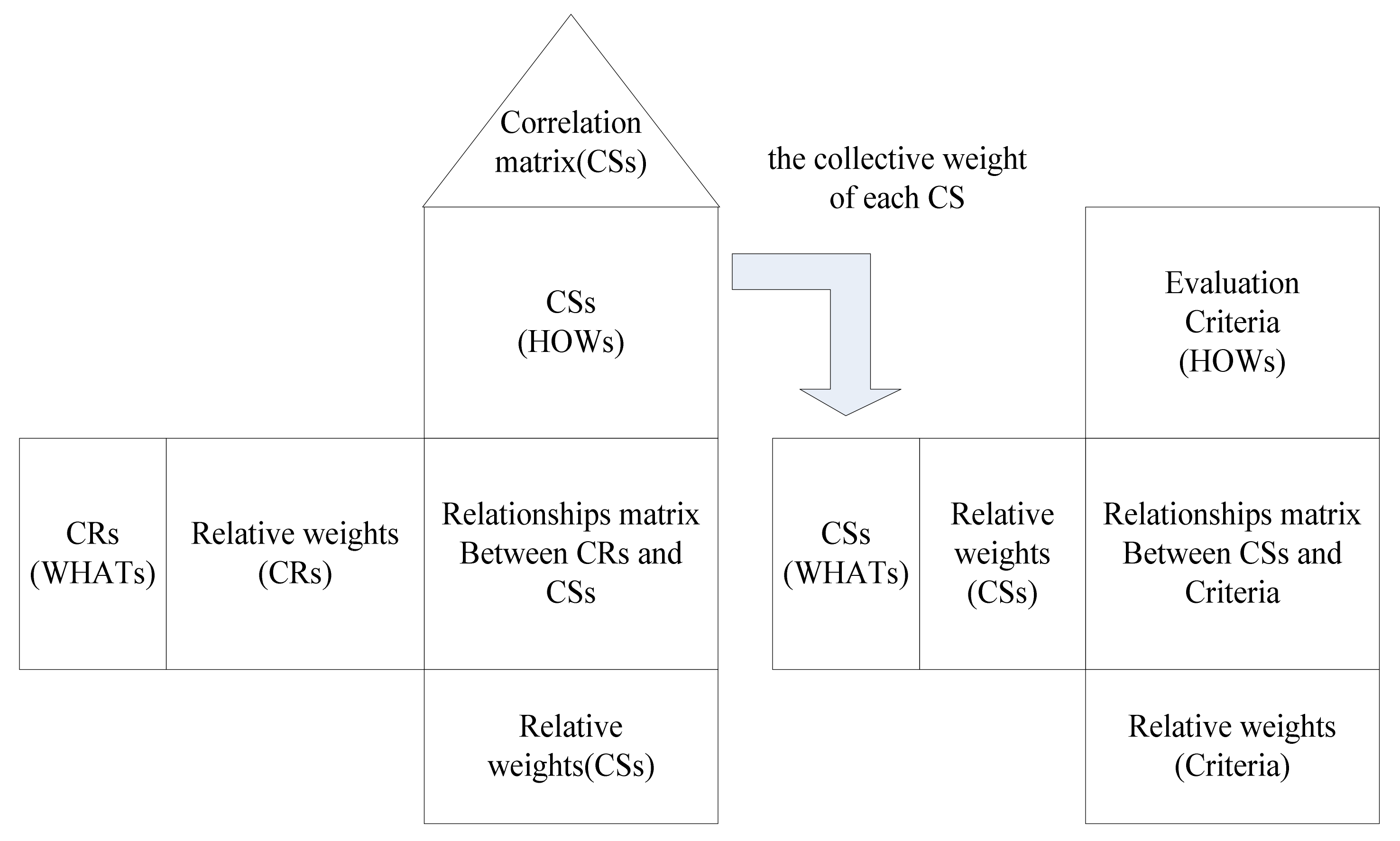
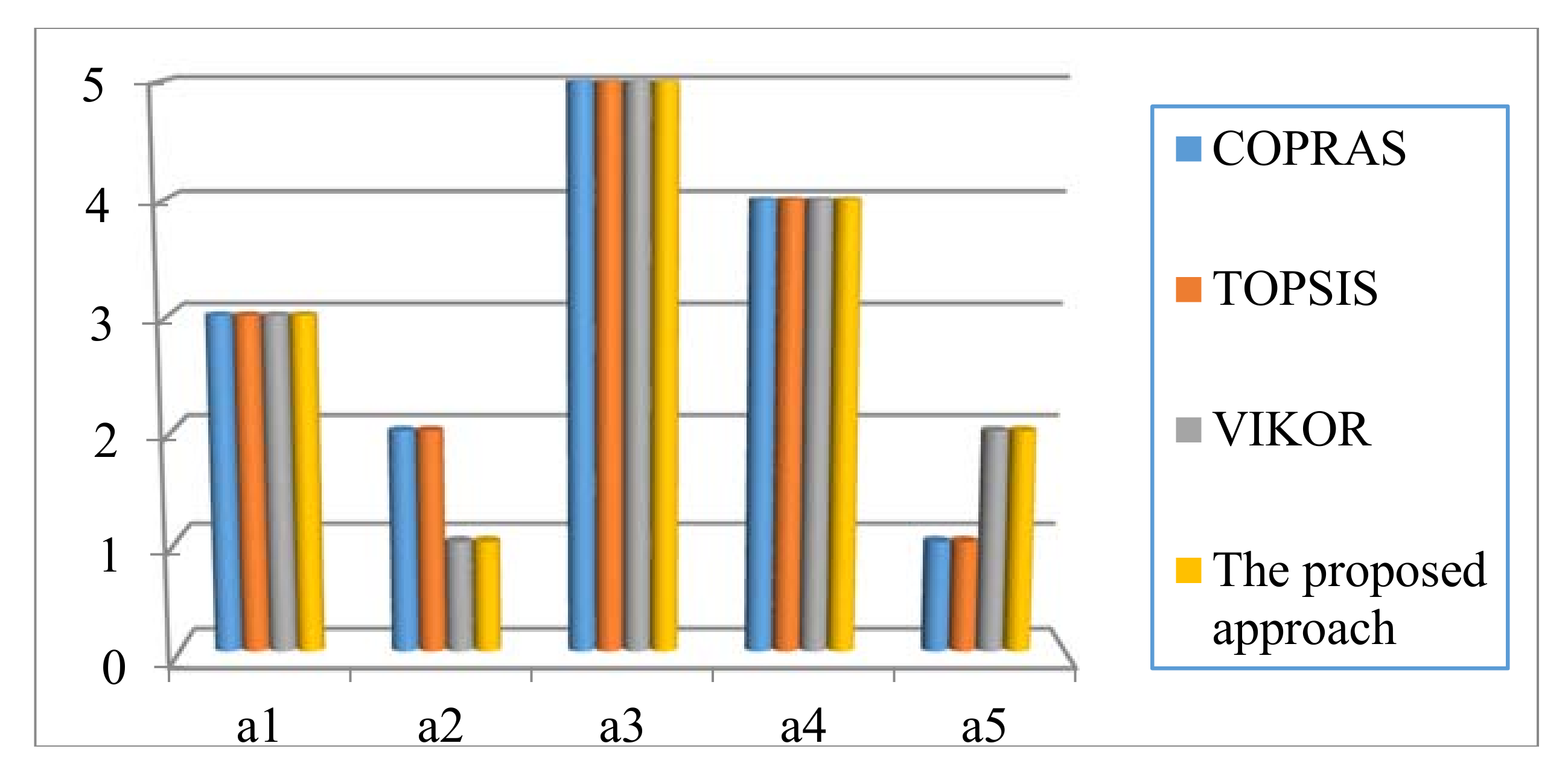
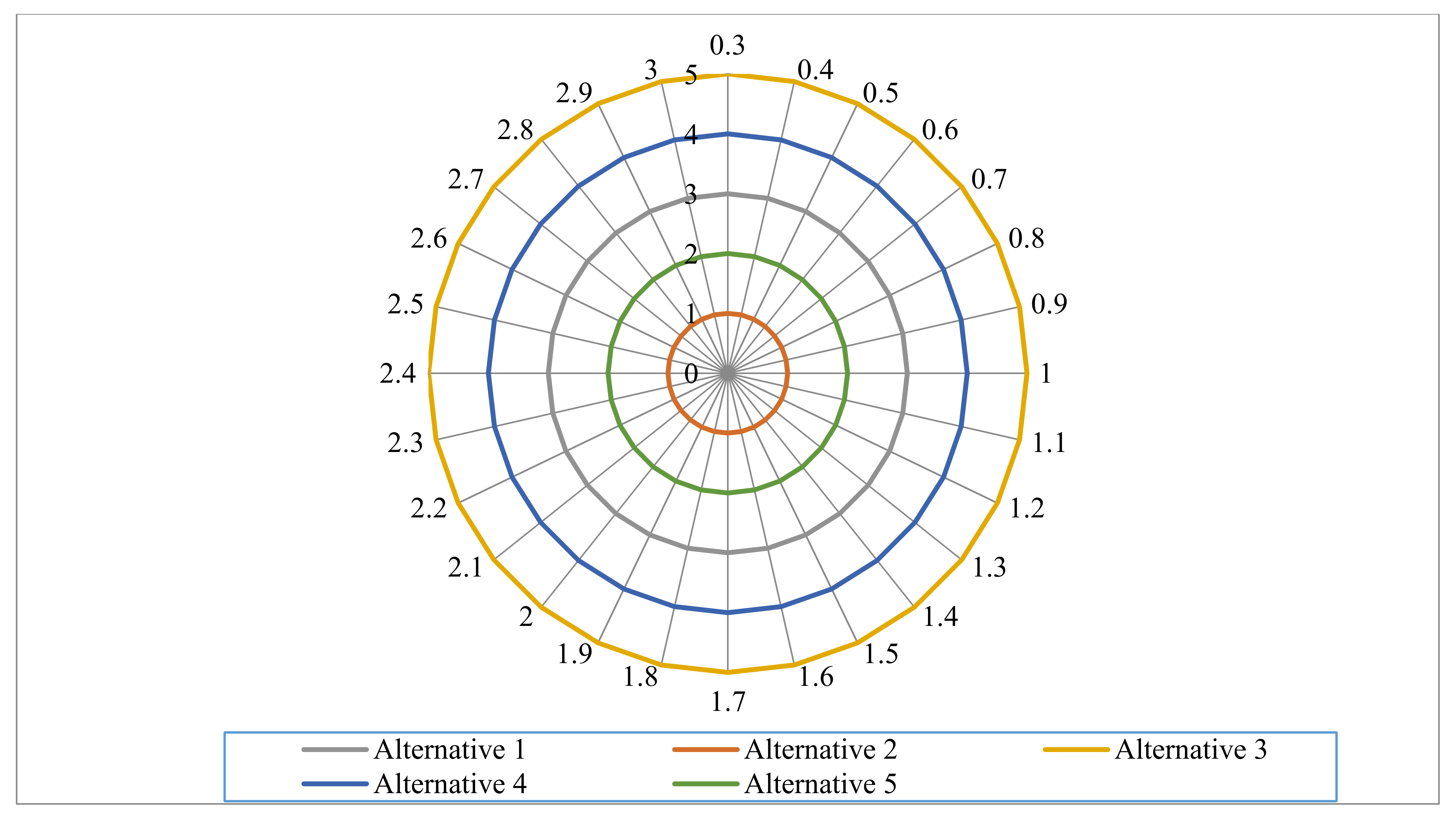

| Linguistic Terms | EI (Equally Important) | WI (Weakly Important) | FI (Fairly Important) | I (Important) | VI (Very Important) | AI (Absolutely Important) |
|---|---|---|---|---|---|---|
| TrFNs | (1,1,1,1) | (2/3,1,3/2,2) | (3/2,2,5/2,3) | (5/2,3,7/2,4) | (7/2,4,9/2,5) | (9/2,5,11/2,6) |
| CI | 3.00 | 3.80 | 5.29 | 6.69 | 8.04 | 9.35 |
| CRs | CSs | Criteria | |||
|---|---|---|---|---|---|
| Q | Quality | FS | Financial stability | QA | Quality Adaptation |
| TSS | Test Standard of Security | ENMS | Environmental Management Systems | P | Price |
| P | Price | WDP | Waste Disposal Program | ENRC | Energy and Natural Resource Consumption |
| CRN | Corporate Reputation | MC | Management Commitment | DS | Delivery Speed |
| CPS | Capability of Product Supply | QCS | Quality Control Systems | GD | Green Design |
| SCR | Sufficiency of Consumer Response | M | Manufacturing | RRR | Re-use and Recycle Rate |
| F | Facility | PP | Production Planning | ||
| RL | Reverse Logistics |
| DM1 | TSS | SCR | MC | RL |
| DM2 | TSS | CPS | MC | F |
| DM3 | TSS | SCR | MC | F |
| DM4 | TSS | CPS | MC | F |
| Best | Q | TSS | P | CRN | CPS | SCR | Best | FS | EMS | WDP | MC | QCS | M | F | RL | |
|---|---|---|---|---|---|---|---|---|---|---|---|---|---|---|---|---|
| DM1 | TSS | WI | EI | FI | I | VI | AI | MC | WI | FI | FI | EI | I | I | VI | AI |
| DM2 | TSS | WI | EI | WI | FI | AI | VI | MC | WI | WI | WI | EI | I | FI | AI | VI |
| DM3 | TSS | FI | EI | WI | FI | VI | AI | MC | WI | FI | FI | EI | I | FI | AI | VI |
| DM4 | TSS | FI | EI | WI | I | AI | VI | MC | FI | WI | WI | EI | VI | FI | AI | VI |
| Worst | Q | TSS | P | CRN | CPS | SCR | Worst | FS | EMS | WDP | MC | QCS | M | F | RL | |
|---|---|---|---|---|---|---|---|---|---|---|---|---|---|---|---|---|
| DM1 | SCR | I | AI | VI | FI | WI | EI | RL | AI | I | WI | VI | WI | I | WI | EI |
| DM2 | CPS | I | AI | VI | WI | EI | FI | F | VI | I | FI | AI | WI | FI | EI | WI |
| DM3 | SCR | VI | AI | I | FI | WI | EI | F | I | VI | WI | AI | FI | FI | EI | FI |
| DM4 | CPS | VI | AI | VI | FI | EI | WI | F | VI | I | FI | AI | WI | FI | EI | WI |
| FS | EMS | WDP | MC | QCS | M | F | RL | |||||||||||||||||||||||||
|---|---|---|---|---|---|---|---|---|---|---|---|---|---|---|---|---|---|---|---|---|---|---|---|---|---|---|---|---|---|---|---|---|
| DM1 | DM2 | DM3 | DM4 | DM1 | DM2 | DM3 | DM4 | DM1 | DM2 | DM3 | DM4 | DM1 | DM2 | DM3 | DM4 | DM1 | DM2 | DM3 | DM4 | DM1 | DM2 | DM3 | DM4 | DM1 | DM2 | DM3 | DM4 | DM1 | DM2 | DM3 | DM4 | |
| Q | H | SH | SH | H | VL | L | VL | SL | L | L | VL | L | H | VH | VH | H | VH | VH | H | VH | H | H | H | VH | SH | SH | H | SH | M | SH | SL | SL |
| TSS | L | VL | VL | VL | H | H | H | VH | VL | VL | VL | VL | H | VH | H | H | H | VH | H | SH | SH | H | H | H | SL | SL | L | SL | SL | L | L | VL |
| P | H | VH | VH | VH | L | L | VL | L | SH | H | H | H | H | VH | SH | H | H | M | H | H | SH | M | SH | H | H | H | VH | SH | M | SH | SH | M |
| CR | VH | H | VH | H | L | L | L | VL | SH | H | SH | H | H | SH | SH | SH | M | SH | H | H | L | VL | VL | VL | ||||||||
| CPS | SH | VH | H | VH | VL | L | VL | L | M | M | SH | SH | L | L | VL | VL | SL | SL | M | M | VL | L | VL | L | ||||||||
| SCR | SL | L | L | L | H | SH | H | H | L | SL | L | L | VL | VL | VL | L | VL | L | VL | VL | ||||||||||||
| FS | EMS | WDP | MC | QCS | M | F | RL | |||||||||||||||||||||||||
|---|---|---|---|---|---|---|---|---|---|---|---|---|---|---|---|---|---|---|---|---|---|---|---|---|---|---|---|---|---|---|---|---|
| DM1 | DM2 | DM3 | DM4 | DM1 | DM2 | DM3 | DM4 | DM1 | DM2 | DM3 | DM4 | DM1 | DM2 | DM3 | DM4 | DM1 | DM2 | DM3 | DM4 | DM1 | DM2 | DM3 | DM4 | DM1 | DM2 | DM3 | DM4 | DM1 | DM2 | DM3 | DM4 | |
| QD | L | VL | VL | VL | SH | SH | H | SH | H | H | SH | H | SH | M | SH | SH | VL | L | VL | VL | VL | VL | VL | VL | VL | VL | L | VL | ||||
| P | VH | VH | VH | H | VL | VL | VL | VL | SL | SL | SL | SL | ||||||||||||||||||||
| ENRC | VL | VL | VL | L | SL | SL | L | L | SH | H | H | SH | SL | M | SH | L | SL | SL | M | SL | ||||||||||||
| DS | SH | SH | H | H | SL | M | SH | L | SL | SL | M | SL | ||||||||||||||||||||
| GD | H | M | SH | M | VH | H | H | SH | ||||||||||||||||||||||||
| RRR | SH | H | H | SH | SH | M | SH | M | L | L | VL | VL | SL | L | SL | SL | SL | M | H | SH | VH | VH | VH | VH | ||||||||
| PP | H | M | H | SL | SL | SH | H | L | SH | H | SH | H | ||||||||||||||||||||
| DM1 | DM2 | DM3 | DM4 | DM1 | DM2 | DM3 | DM4 | DM1 | DM2 | DM3 | DM4 | DM1 | DM2 | DM3 | DM4 | DM1 | DM2 | DM3 | DM4 | |
|---|---|---|---|---|---|---|---|---|---|---|---|---|---|---|---|---|---|---|---|---|
| QD | SH | SL | SH | SH | H | H | H | H | SH | SH | SH | SH | SL | M | SL | SH | M | H | SH | SH |
| P | 3 | 2 | 3.5 | 2.5 | 2.5 | |||||||||||||||
| ENRC | M | M | M | SL | SL | L | SL | VL | H | M | SH | SL | SH | SH | M | M | M | SH | M | SH |
| DS | 100 | 80 | 115 | 90 | 100 | |||||||||||||||
| GD | SH | SH | SH | H | SH | M | H | SH | SL | SL | SH | M | H | VH | VH | H | H | H | VH | H |
| RRR | 85% | 90% | 95% | 97% | 92% | |||||||||||||||
| PP | SH | M | SL | SH | M | SH | SH | SL | SL | SH | SH | M | SL | SL | M | SL | SL | M | SL | SH |
| QD | P | ENRC | DS | GD | RRR | PP | |
|---|---|---|---|---|---|---|---|
| 0.2129 | 0.1341 | 0.1828 | 0.0737 | 0.1781 | 0.1420 | 0.0763 | |
| 0.1346 | 0.1545 | 0.1241 | 0.1563 | 0.1404 | 0.1576 | 0.1325 | |
| 0.1738 | 0.1443 | 0.1535 | 0.1150 | 0.1593 | 0.1498 | 0.1044 |
| S(RSi) | Ranking | RPi | Ranking | S(MFi) | Ranking | Final Ranking | |
|---|---|---|---|---|---|---|---|
| 3.3708 | 3 | 1.6309 | 3 | 1.0165 | 3 | 3 | |
| 4.4770 | 1 | 1.1696 | 5 | 1.2188 | 1 | 1 | |
| 2.9621 | 5 | 1.9039 | 1 | 0.9648 | 5 | 5 | |
| 3.2914 | 4 | 1.5916 | 4 | 0.9936 | 4 | 4 | |
| 3.6141 | 2 | 1.6409 | 2 | 1.0381 | 2 | 2 |
© 2018 by the authors. Licensee MDPI, Basel, Switzerland. This article is an open access article distributed under the terms and conditions of the Creative Commons Attribution (CC BY) license (http://creativecommons.org/licenses/by/4.0/).
Share and Cite
Liu, A.; Xiao, Y.; Ji, X.; Wang, K.; Tsai, S.-B.; Lu, H.; Cheng, J.; Lai, X.; Wang, J. A Novel Two-Stage Integrated Model for Supplier Selection of Green Fresh Product. Sustainability 2018, 10, 2371. https://doi.org/10.3390/su10072371
Liu A, Xiao Y, Ji X, Wang K, Tsai S-B, Lu H, Cheng J, Lai X, Wang J. A Novel Two-Stage Integrated Model for Supplier Selection of Green Fresh Product. Sustainability. 2018; 10(7):2371. https://doi.org/10.3390/su10072371
Chicago/Turabian StyleLiu, Aijun, Yaxuan Xiao, Xiaohui Ji, Kai Wang, Sang-Bing Tsai, Hui Lu, Jinshi Cheng, Xinjun Lai, and Jiangtao Wang. 2018. "A Novel Two-Stage Integrated Model for Supplier Selection of Green Fresh Product" Sustainability 10, no. 7: 2371. https://doi.org/10.3390/su10072371
APA StyleLiu, A., Xiao, Y., Ji, X., Wang, K., Tsai, S.-B., Lu, H., Cheng, J., Lai, X., & Wang, J. (2018). A Novel Two-Stage Integrated Model for Supplier Selection of Green Fresh Product. Sustainability, 10(7), 2371. https://doi.org/10.3390/su10072371

