
Digital Interventions for Palliative Care Education for Nursing Students: A Systematic Review

 ,
,  , and
, and 
Abstract
1. Introduction
2. Materials and Methods
2.1. Review Protocol
2.2. Search Strategy
2.3. Inclusion and Exclusion Criteria
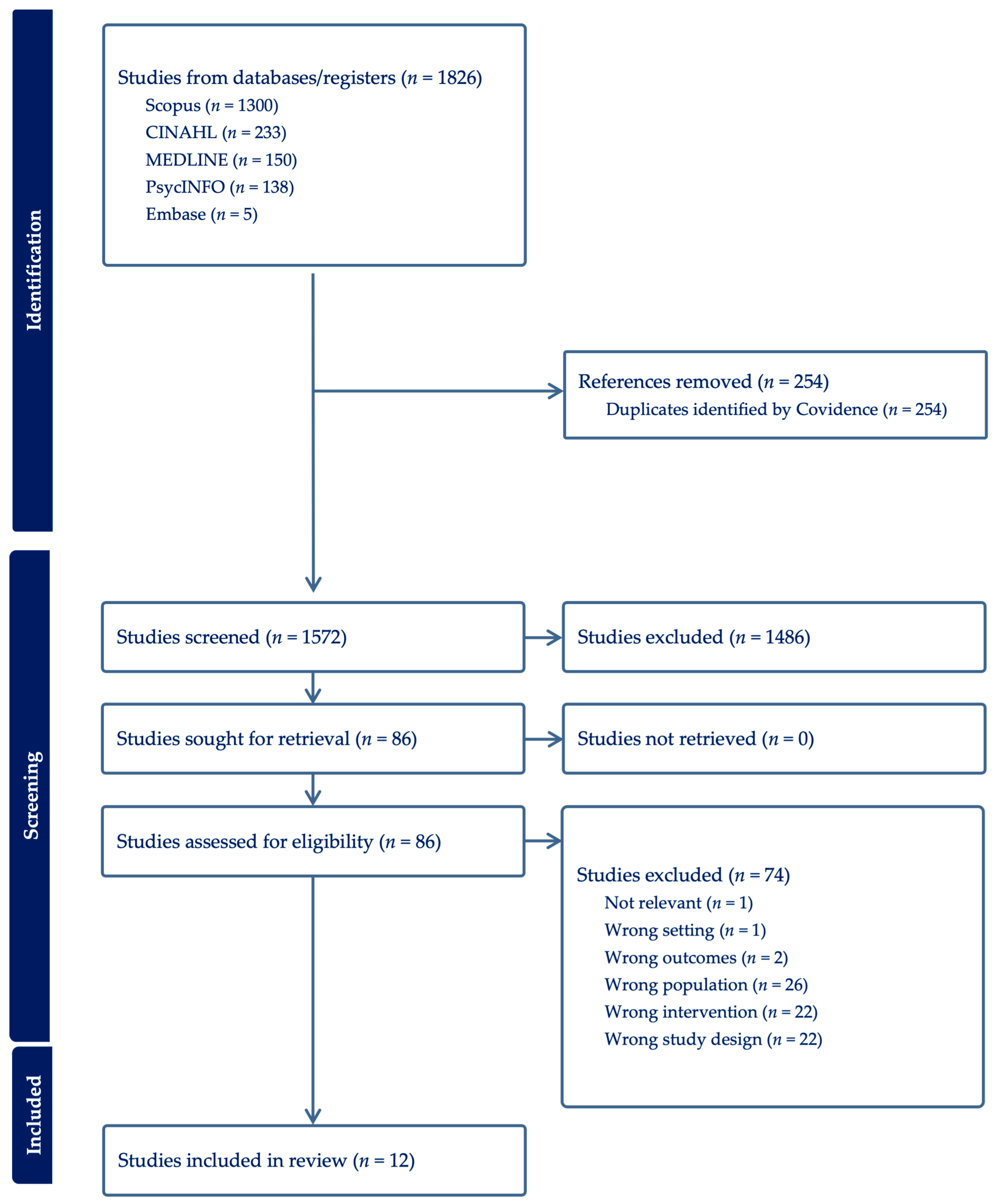
2.4. Screening and Study Selection
2.5. Data Extraction
2.6. Quality Appraisal
2.7. Data Synthesis
2.8. Characteristics of Interventions and Participants
3. Results
3.1. Study Characteristics
3.2. Study Results
3.2.1. Theme One: Knowledge
3.2.2. Theme Two: Confidence
3.2.3. Theme Three: Practice
3.2.4. Theme Four: Acceptability and Implementation
4. Discussion
5. Conclusions
Supplementary Materials
Author Contributions
Funding
Institutional Review Board Statement
Informed Consent Statement
Data Availability Statement
Public Involvement Statement
Guidelines and Standards Statement
Use of Artificial Intelligence
Conflicts of Interest
Abbreviations
| EAPC | European Association for Palliative Care |
| IAHPC | International Association for Hospice and Palliative Care |
| WHO | World Health Organization |
| PRISMA | Preferred Reporting Items for Systematic Reviews and Meta-Analyses |
| OSF | Open Science Framework |
| MeSH | Medical Subject Headings |
| MMAT | Mixed Methods Appraisal Tool |
| MOOC | Massive Open Online Course |
| VR | Virtual Reality |
| SRPCP | Scale of Self-Reported Palliative Care Practices |
| FATCOD | Frommelt Attitude Toward Care of the Dying |
| DAP-R | Death Attitudes Profile–Revised |
| PCPS | Palliative Care Self-Reported Practices Scale |
| EOL | End of Life |
| MAiD | Medical Assistance in Dying |
| PC | Palliative Care |
References
- Ziwei, K.; Mengjiao, C.; Yongjie, Z.; Mengqi, Z.; Yeqin, Y. Optimizing palliative care education through undergraduate nursing students’ perceptions: Application of importance-performance analysis and Borich needs assessment model. Nurse Educ. Today 2023, 122, 105719. [Google Scholar] [CrossRef]
- Moir, C.; Roberts, R.; Martz, K.; Perry, J.; Tivis, L. Communicating with patients and their families about palliative and end-of-life care: Comfort and educational needs of nurses. Int. J. Palliat. Nurs. 2015, 21, 109–112. [Google Scholar] [CrossRef] [PubMed]
- Hussain, F.A. Psychological challenges for nurses working in palliative care and recommendations for self-care. Br. J. Nurs. 2021, 30, 484–489. [Google Scholar] [CrossRef]
- Kudubes, A.A.; Bektas, M. The effect of web-based pediatric palliative care education on the palliative care knowledge level and practices of nursing students. Perspect. Psychiatr. Care 2020, 56, 533–540. [Google Scholar] [CrossRef] [PubMed]
- Li, D. The Shift to Online Classes During the COVID-19 Pandemic: Benefits, Challenges, and Required Improvements from the Students’ Perspective. Electron. J. E-Learn. 2022, 20, 1–18. [Google Scholar] [CrossRef]
- Hökkä, M.; Rajala, M.; Kaakinen, P.; Lehto, J.T.; Pesonen, H.-M. The effect of teaching methods in palliative care education for undergraduate nursing and medical students: A systematic review. Int. J. Palliat. Nurs. 2022, 28, 245–253. [Google Scholar] [CrossRef]
- George, P.P.; Papachristou, N.; Belisario, J.M.; Wang, W.; A Wark, P.; Cotic, Z.; Rasmussen, K.; Sluiter, R.; Riboli-Sasco, E.; Car, L.T.; et al. Online eLearning for undergraduates in health professions: A systematic review of the impact on knowledge, skills, attitudes and satisfaction. J. Glob. Health 2014, 4, 010406. [Google Scholar] [CrossRef]
- Price, D.M.; Strodtman, L.; Brough, E.; Lonn, S.; Luo, A. Digital Storytelling: An Innovative Technological Approach to Nursing Education. Nurse Educ. 2015, 40, 66–70. [Google Scholar] [CrossRef]
- Aty, Y.M.V.B.; Tat, F.; Blasius, G.; Irfan, I.; Selasa, P.; Nurwela, T.S. Effect of Education Using Animation on the Ability to Develop Personal Skills for Early Stroke Detection and Initial Treatment at Home. Ianna J. Interdiscip. Stud. 2025, 7, 721–733. Available online: https://iannajournalofinterdisciplinarystudies.com/index.php/1/article/view/552 (accessed on 10 October 2025).
- Stacey, G.; Hardy, P. Challenging the shock of reality through digital storytelling. Nurse Educ. Pract. 2011, 11, 159–164. [Google Scholar] [CrossRef]
- Robin, B.R. The Educational Uses of Digital Storytelling. In Proceedings of the Society for Information Technology and Teacher Education International Conference 2006, Orlando, FL, USA, 21 March 2006; Crawford, C., Carlsen, R., McFerrin, K., Price, J., Weber, R., Willis, D., Eds.; AACE: Chesapeake, VA, USA, 2006; pp. 709–716. [Google Scholar]
- Cook, D.A.; Levinson, A.J.; Garside, S.; Dupras, D.M.; Erwin, P.J.; Montori, V.M. Internet-based learning in the health professions: A meta-analysis. JAMA 2008, 300, 1181–1196. [Google Scholar] [CrossRef]
- Nadolny, L.; Valai, A.; Cherrez, N.J.; Elrick, D.; Lovett, A.; Nowatzke, M. Examining the characteristics of game-based learning: A content analysis and design framework. Comput. Educ. 2020, 156, 103936. [Google Scholar] [CrossRef]
- Lu, A.S.; Kharrazi, H. A State-of-the-Art Systematic Content Analysis of Games for Health. Games Health J. 2018, 7, 1–15. [Google Scholar] [CrossRef]
- van Gaalen, A.E.J.; Brouwer, J.; Schönrock-Adema, J.; Bouwkamp-Timmer, T.; Jaarsma, A.D.C.; Georgiadis, J.R. Gamification of health professions education: A systematic review. Adv. Health Sci. Educ. Theory Pract. 2021, 26, 683–711. [Google Scholar] [CrossRef]
- Pannese, L.; Morosini, D. Serious Games to support Reflection in the HealthCare Sector. Int. J. Serious Games 2014, 1, 5–14. [Google Scholar] [CrossRef]
- Plass, J.L.; Homer, B.D.; Mayer, R.E.; Kinzer, C.K. Theoretical foundations of game-based and playful learning. In Handbook of Game-Based Learning; The MIT Press: Cambridge, MA, USA, 2020; pp. 3–24. [Google Scholar]
- Kasar, K.S. Palliative Care Practices and Self-Efficacy of Students Taking Online Palliative Care Course: Quasi-Experimental Study. J. Educ. Res. Nurs. 2023, 20, 226–231. [Google Scholar] [CrossRef]
- Page, M.J.; McKenzie, J.E.; Bossuyt, P.M.; Boutron, I.; Hoffmann, T.C.; Mulrow, C.D.; Shamseer, L.; Tetzlaff, J.M.; Akl, E.A.; Brennan, S.E.; et al. The PRISMA 2020 statement: An updated guideline for reporting systematic reviews. BMJ 2021, 372, n71. [Google Scholar] [CrossRef]
- Aromataris, E.; Riitano, D. Constructing a search strategy and searching for evidence. A guide to the literature search for a systematic review. Am. J. Nurs. 2014, 114, 49–56. [Google Scholar] [CrossRef] [PubMed]
- Stern, C.; Jordan, Z.; McArthur, A. Developing the Review Question and Inclusion Criteria. Am. J. Nurs. 2014, 114, 53–56. [Google Scholar] [CrossRef]
- Moher, D.; Liberati, A.; Tetzlaff, J.; Altman, D.G. Preferred Reporting Items for Systematic Reviews and Meta-Analyses: The PRISMA Statement. PLoS Med. 2009, 6, e1000097. [Google Scholar] [CrossRef]
- Gusenbauer, M.; Haddaway, N.R. Which academic search systems are suitable for systematic reviews or meta-analyses? Evaluating retrieval qualities of Google Scholar, PubMed, and 26 other resources. Res. Synth. Methods 2020, 11, 181–217. [Google Scholar] [CrossRef]
- Littell, J.H.; Corcoran, J.; Pillai, V. Systematic Reviews and Meta-Analysis; Oxford University Press: Oxford, UK, 2008. [Google Scholar]
- Higgins, J.P.T.; Thomas, J.; Chandler, J.; Cumpston, M.; Li, T.; Page, M.J.; Welch, V.; Flemyng, E. (Eds.) Cochrane Handbook for Systematic Reviews of Interventions; Cochrane: Oxford, UK, 2024. [Google Scholar]
- Hong, Q.N.; Fàbregues, S.; Bartlett, G.; Boardman, F.; Cargo, M.; Dagenais, P.; Gagnon, M.-P.; Griffiths, F.; Nicolau, B.; O’cAthain, A.; et al. The Mixed Methods Appraisal Tool (MMAT) version 2018 for information professionals and researchers. Educ. Inf. 2018, 34, 285–291. [Google Scholar] [CrossRef]
- Thomas, T.H.; Sivakumar, V.; Babichenko, D.; Grieve, V.L.B.; Klem, M.L. Mapping Behavioral Health Serious Game Interventions for Adults With Chronic Illness: Scoping Review. JMIR Serious Games 2020, 8, e18687. [Google Scholar] [CrossRef]
- Laurillard, D. Teaching as a Design Science: Building Pedagogical Patterns for Learning and Technology; Routledge: London, UK, 2012; pp. 448–450. ISBN -10: 041580387X. [Google Scholar]
- Popay, J.; Roberts, H.; Sowden, A.; Petticrew, M.; Arai, L.; Rodgers, M.; Britten, N.; Roen, K.; Duffy, S. Guidance on the Conduct of Narrative Synthesis in Systematic Reviews: A Product from the ESRC Methods Programme; Lancaster University: Lancaster, UK, 2006. [Google Scholar]
- Conner, N.E.; Loerzel, V.W.P.; Uddin, N. Nursing Student End-of-Life Care Attitudes After an Online Death and Dying Course. J. Hosp. Palliat. Nurs. 2014, 16, 374–382. [Google Scholar] [CrossRef]
- Mazanec, P.; Ferrell, B.; Malloy, P.; Virani, R. Educating Associate Degree Nursing Students in Primary Palliative Care Using Online-E-Learning. Teach. Learn. Nurs. 2019, 14, 58–64. [Google Scholar] [CrossRef]
- Zhang, L.; Huang, Y.-L.; Wu, X.-Q.; Liu, C.-Y.; Zhang, X.-L.; Yang, X.-Y.; Lai, H.-M.; Fu, J.; Yang, M.-F. The impact of virtual clinical simulation on nursing students’ palliative care knowledge, ability, and attitudes: A mixed methods study. Nurse Educ. Today 2024, 132, 106037. [Google Scholar] [CrossRef]
- Shrestha, S.; Dahlke, S.; Butler, J.I.; Hunter, K.; Fox, M.T.; Davidson, S.; Chasteen, A.L.; Martin, L.S.; Moody, E. Nursing Students’ Perceptions of a Palliative Care E-Learning Module: An Exploratory Cross-Sectional Study. Teach. Learn. Nurs. 2024, 19, e734–e738. [Google Scholar] [CrossRef]
- Lewis-Pierre, L.; McKay, M.; Sanko, J.; Gattamorta, K.; Azaiza, K. Comparing Educational Outcomes of Online Module-Based Technology with and without Simulation on Attitudes Toward Care of the Dying in Second Semester BSN Students. J. Palliat. Care 2019, 34, 218–223. [Google Scholar] [CrossRef]
- Jeon, Y.; Choi, H.; Lee, U.; Kim, H. Technology-based interactive communication simulation addressing challenging communication situations for nursing students. J. Prof. Nurs. 2024, 53, 71–79. [Google Scholar] [CrossRef] [PubMed]
- Flood, L.S. Use of Virtual Reality Simulations to Embody a Patient: Exploring the Impact on Nursing Students’ Confidence, Feelings, and Perceptions. Nurse Educ. 2024, 49, 36–40. [Google Scholar] [CrossRef] [PubMed]
- Wittenberg, E.; Goldsmith, J.V.; Williams, Y.; Lee, A. Caring for Family Caregivers: A Pilot Test of an Online COMFORT™ SM Communication Training Module for Undergraduate Nursing Students. J. Cancer Educ. 2020, 35, 138–143. [Google Scholar] [CrossRef] [PubMed]
- Ellman, M.S.; Schulman-Green, D.; Blatt, L.; Asher, S.; Viveiros, D.; Clark, J.; Bia, M. Using Online Learning and Interactive Simulation To Teach Spiritual and Cultural Aspects of Palliative Care to Interprofessional Students. J. Palliat. Med. 2012, 15, 1240–1247. [Google Scholar] [CrossRef]
- Alhowaymel, F.M.; Saleh, M.S.M.; Taref, N.N.; Abd-Elhamid, Z.N.; Abaoud, A.F.; Alenezi, A.; Fathi, R.H.; Elsabahy, H.E.S. Empowering future nurses: Enhancing self-efficacy, satisfaction, and academic achievement through talent management educational intervention. BMC Nurs. 2025, 24, 875. [Google Scholar] [CrossRef] [PubMed]
- Koukourikos, K.; Tsaloglidou, A.; Kourkouta, L.; Papathanasiou, I.V.; Iliadis, C.; Fratzana, A.; Panagiotou, A. Simulation in Clinical Nursing Education. Acta Inform. Med. 2021, 29, 15–20. [Google Scholar] [CrossRef] [PubMed]
- Yahya, L.B.; Naciri, A.; Radid, M.; Chemsi, G. Immersive simulation in nursing and midwifery education: A systematic review. J. Educ. Eval. Health Prof. 2024, 21, 19. [Google Scholar] [CrossRef]
- Sugarman, L. Experiential Learning—Experience as the Source of Learning and Development—Kolb, D.A.; Wiley: Hoboken, NJ, USA, 1987; pp. 359–360. [Google Scholar]
- Padilha, J.M.; Machado, P.P.; Ribeiro, A.; Ramos, J.; Costa, P. Clinical virtual simulation in nursing education: Randomized controlled trial. J. Med. Internet Res. 2019, 21, e11529. [Google Scholar] [CrossRef]
- Mitchell, K.M.; McMillan, D.E.; Lobchuk, M.M.; Nickel, N.C. Writing activities and the hidden curriculum in nursing education. Nurs. Inq. 2021, 28, e12407. [Google Scholar] [CrossRef]
- Bandura, A. Self-efficacy: Toward a unifying theory of behavioral change. Adv. Behav. Res. Ther. 1978, 1, 139–161. [Google Scholar] [CrossRef]
- Arguedas, M.; Daradoumis, T.; Caballe, S.; Conesa, J.; Ortega-Ochoa, E. Exploring the Impact of Affective Pedagogical Agents: Enhancing Emotional Engagement in Higher Education. Computers 2025, 14, 542. [Google Scholar] [CrossRef]
- Mann, K.; Gordon, J.; Macleod, A. Reflection and Reflective Practice in Health Professions Education: A Systematic Review. Adv. Health Sci. Educ. Theory Pract. 2007, 14, 595–621. [Google Scholar] [CrossRef]
- Callinan, J. Barriers and facilitators to e-learning in palliative care. Int. J. Palliat. Nurs. 2020, 26, 394–402. [Google Scholar] [CrossRef] [PubMed]
- Kong, C.; Liu, Y.; Arifani, Y.; Siripala, W.; Suryanti, S. Influential Factors on Job Burnout among China’s Nursing College Faculties: The Mediating Role of Psychological Capital. Ianna J. Interdiscip. Stud. 2025, 7, 569–579. Available online: https://www.iannajournalofinterdisciplinarystudies.com/index.php/1/article/view/505 (accessed on 10 October 2025).
- Shrestha, S.; Dahlke, S.; Butler, J.I.; Hunter, K.; Fox, M.T.; Davidson, S.; Chasteen, A.L.; Moody, E. Nursing Students’ Perceptions on a Pain Management E-Learning Module: An Exploratory Quantitative Study. Pain Manag. Nurs. 2024, 25, e138–e143. [Google Scholar] [CrossRef] [PubMed]


| Database | Description |
|---|---|
| MEDLINE (Ovid) | A comprehensive source of life sciences and biomedical bibliographic information. It covers a wide range of topics, including nursing, with extensive coverage of medical, clinical, and healthcare-related research. Articles from 1946 to present. |
| Embase | A biomedical and pharmacological database. It offers extensive coverage of drug and pharmaceutical research, as well as biomedical literature, making it highly relevant for nursing and healthcare topics. Articles from 1974 to present. |
| Cumulative Index to Nursing and Allied Health Literature (CINAHL) | Provides indexing for journals from the fields of nursing and allied health. It is a key resource for nursing professionals, offering extensive literature on patient care, nursing practices, and healthcare management. Articles from 1937 to present. |
| PsycINFO | A database of abstracts and citations in the field of psychology. It includes literature on psychological aspects of healthcare and nursing, making it a valuable resource for understanding the psychological elements of patient care. Articles from 1806 to present. |
| Key Terms | MeSH Terms |
|---|---|
| Digital or web-based | Digital technology OR internet-based intervention OR Digital Learning OR E-Learning OR Online Learning OR Web-Based Learning OR Online Education OR Remote Teaching OR Remote Learning OR Mobile Learning OR Virtual Learning OR Serious Game OR serious games OR serious gam * OR Gamification OR Podcast OR Web-Based App OR Web-Based Application OR Web-Based Applications OR App OR MOOC |
| AND | |
| Nursing students Education | Nursing Education OR nursing Educational OR Nur * Education OR Nur * Educational OR Nursing OR Nurse OR Nurses Nursing Student OR students nursing OR Nur * stud * OR stud * Nur * OR Baccalaureate Nursing OR Bachelor nursing OR Undergraduate nursing OR pre-registration Nursing OR Baccalaureate Nur * OR Bachelor Nur * OR Undergraduate Nur * OR pre-registration Nur * OR student Nurse OR Stud * Nur * OR Nurses OR Nursing OR Nur * |
| AND | |
| Palliative care | Palliative care OR End-of-life care OR Hospice care OR EoLC OR PC OR Comfort care OR Supportive care OR Palliation OR advance care planning OR palliative OR symptom management OR end of life OR end of life decision making |
| Theme | Quantitative Findings | Qualitative Findings | Included Studies |
|---|---|---|---|
| Knowledge | Significant post-intervention improvements in palliative care knowledge, including symptom management, communication, ethics, and end-of-life decision-making (p < 0.05 to p < 0.001 across studies). | Students reported deeper understanding of palliative care concepts, improved ability to link theory to practice, and greater awareness of holistic and person-centered care. Digital storytelling and simulation were perceived as particularly effective for conceptual learning. | Akdeniz & Bektas [4]; Conner et al. [30]; Mazanec et al. [31]; Zhang et al. [32]; Shrestha et al. [33]; Price et al. [8] |
| Confidence/Self-efficacy | Statistically significant increases in self-efficacy, confidence in communication, and preparedness for end-of-life care following online courses, simulations, and VR interventions. | Students described reduced fear, increased emotional readiness, and growing confidence when engaging with dying patients and families. Repeated practice and emotionally immersive experiences were viewed as central to confidence building. | Kasar [18]; Lewis-Pierre et al. [34]; Zhang et al. [32]; Jeon et al. [35]; Flood [36] |
| Practice | Improvements in self-reported palliative care practices, communication performance scores, and decision-making abilities following digital and simulation-based interventions. | Qualitative data highlighted enhanced empathy, reflective practice, ethical sensitivity, and perceived readiness to translate learning into clinical practice. Simulations functioned as a safe space to rehearse complex behaviors. | Akdeniz & Bektas [4]; Wittenberg et al. [37]; Ellman et al. [38]; Zhang et al. [32]; Jeon et al. [35]; Flood [36] |
| Acceptability and Implementation | High levels of satisfaction, perceived usefulness, and acceptability of digital palliative care education across diverse formats (modules, simulations, VR). | Students valued flexibility, psychological safety, and engagement. Barriers included technological limitations, limited realism, emotional fatigue, and need for structured debriefing and faculty support. | Mazanec et al. [31]; Price et al. [8]; Shrestha et al. [33]; Zhang et al. [32]; Flood [36]; Ellman et al. [38] |
| Author | Year | Country | Study Aim | Study Design | Sample | Intervention | Data Collection/Analysis | Key Findings | Limitations |
|---|---|---|---|---|---|---|---|---|---|
| Akdeniz and Bektas [4] | 2020 | Turkey | To investigate the effect of web-based pediatric palliative care education on nursing students’ knowledge level and practices related to palliative care. | Quantitative quasi-experimental study | Third-year nursing students enrolled in a pediatric nursing course, with 265 participants (133 control; 132 intervention). | A web-based pediatric palliative care education program consisting of eight modules. | Nursing Student Information Form: collected demographic data and baseline knowledge. Palliative Care Knowledge Level Form: measured knowledge about pediatric palliative care. Scale of Self-Reported Palliative Care Practices (SRPCP): evaluated self-reported practices in palliative care. Data analysis: mean and percentage calculations, t-tests, regression analysis, and power and effect size calculations. Analysis focused on the pretest and posttest differences between the intervention and control groups. | A significant increase in the knowledge and practices of nursing students who received web-based pediatric palliative care education compared to the control group (p < 0.05). The intervention group showed statistically significant improvements in their total knowledge scores and self-reported palliative care practices, particularly in subscales related to care during the death stage, patient and family-centered care, pain management, and communication (p < 0.05). The web-based education program explained 9.6% of the increase in knowledge level and 36% of the increase in self-reported palliative care practices. | The study did not use random sampling, limiting the generalizability of the findings. The research was conducted at a single university, potentially affecting the broader applicability of the results. The study did not evaluate the long-term retention of the knowledge and skills acquired through the web-based program. |
| Conner er al. [30] | 2014 | USA | To evaluate the impact of an online death and dying course on nursing students’ attitudes and feelings about caring for patients at the end of life. | Quantitative quasi-experimental study | 123 baccalaureate nursing students (58 in the intervention group and 65 in the control group). | A 16-week online elective course on death and dying, designed to familiarize students with basic end-of-life (EOL). The course included asynchronous assignments, discussions, reflective activities. | Frommelt Attitude Toward Care of the Dying (FATCOD) scale. Death Attitudes Profile-Revised (DAP-R). Data Analysis: Descriptive statistics. Paired and independent t-tests. Covariance analysis. Regression analysis. | The online death and dying course significantly improved nursing students’ attitudes towards caring for the dying and acceptance of death. Post-intervention Death Attitudes Profile-Revised scores on the death avoidance and approach acceptance subscales predicted post-intervention FATCOD scores. | Lack of control over the content discussed in the control group. Use of a convenience sample that may limit generalizability. The small number of prelicensure students made meaningful comparisons difficult |
| Ellman et al. [38] | 2012 | USA | To create, implement, and evaluate an interprofessional educational program that combines online learning with live interactive simulation to teach spiritual, cultural, and interprofessional aspects of palliative care to students in medicine, nursing, chaplaincy, and social work. | Mixed Methods | Medical, nursing, chaplaincy, and social work students, with 217 completing the online component and 309 submitting post-workshop evaluations. | The program had two components: Online Learning Module: a case-based module that presented a clinical case of a patient with end-stage metastatic breast cancer. Interactive Simulation Workshop: a live 90 min workshop using small group discussions and role-playing scenarios to promote interprofessional collaboration. | Content Analysis: free-text responses to reflection questions during the online module. Post-Workshop Questionnaire: evaluating students’ perceptions of program quality, educational objectives, and usefulness for future professional work. Data analysis: Quantitative analysis: descriptive statistics for Likert-scale items; nonparametric tests (Kruskal–Wallis and Mann–Whitney U tests) to compare scores among different professional groups. Qualitative Analysis: content analysis of free-text responses and open-ended comments from the post-workshop questionnaire. | The program met its educational objectives, with mean responses for all groups exceeding 4 on a 5-point scale. Students valued the program’s ability to enhance understanding of the spiritual and cultural aspects of palliative care and interprofessional collaboration. Medical students rated some aspects of the program lower than nursing and divinity students, possibly due to differences in expectations or less familiarity with interprofessional education. Qualitative data indicated that students appreciated the diversity of professional perspectives and the opportunity for collaborative learning. | The evaluation relied on self-reported measures without assessing higher-level learning outcomes or behavior change. Uneven representation of different professional groups limited generalizability. The study was conducted in a single institution, which may affect its transferability to other educational settings. |
| Kasar [18] | 2023 | Turkey | To examine the palliative care practices and self-efficacy status of nursing students taking an online palliative care course. | Quantitative quasi-experimental study | 46 nursing students enrolled in the spring term of the 2020–2021 academic year. | An online elective palliative care course conducted over 14 weeks, covering topics such as the concept of palliative care, symptom management, and end-of-life care. | Student Introduction Form: to capture demographic data and perceptions of palliative care. Palliative Care Self-Reported Practices Scale (PCPS): to assess how students implement palliative care recommendations. General Self-Efficacy Scale: to measure the students’ self-efficacy. Data analyses: Descriptive statistics for individual characteristics. Wilcoxon signed-ranks test for PCPS data (not normally distributed). Paired sample t-test for General Self-Efficacy Scale (normally distributed). Cronbach’s alpha coefficients were calculated for internal consistency | The online palliative care course significantly improved the students’ self-efficacy and palliative care practices. The mean score on the General Self-Efficacy Scale increased from 63.41 before the course to 68.60 after the course, showing a statistically significant improvement (p < 0.05). The mean score on the Palliative Care Self-Reported Practices Scale increased from 69.43 to 81.19, indicating a significant improvement in palliative care practices (p < 0.05). A strong positive correlation was found between palliative care practices and self-efficacy after the course (r = 0.402, p < 0.05). | The study was conducted in a single institution with a small sample size, limiting the generalizability of the findings. The lack of a control group limits the ability to compare the effects of the intervention to standard or alternative teaching methods. |
| Mazanec et al. [31] | 2019 | USA | To develop and implement an innovative online nursing curriculum that prepares associate degree nursing students with essential primary palliative care skills. | Quantitative non-experimental studies | More than 12,000 associate degree nursing students across the United States. | An online e-learning curriculum called ELNEC-Undergraduate, consisting of six one-hour modules. | Student evaluations: Nine questions at the end of each module, using a Likert scale to measure the ease of use, relevance, and impact on clinical practice. Faculty survey: Feedback collected from faculty involved in using the curriculum. Data analysis: Descriptive statistics to analyze student and faculty evaluations. Qualitative insights from open-ended responses to understand the impact on clinical practice and teaching experience | The online curriculum was positively received by both students and faculty, with over 98% of student responses indicating that the modules were relevant and helpful. Faculty appreciated the flexibility and accessibility of the online format, particularly in rural settings where traditional learning methods are less feasible. The curriculum enabled students to gain confidence and competence in primary palliative care skills without requiring extensive modifications to existing syllabi or courses. | Limited generalizability due to the use of a convenience sample. Faculty concerns about time constraints and the cost of the curriculum were noted, though efforts are being made to address these issues. |
| Price et al. [8] | 2015 | USA | To investigate the impact of using digital stories to promote a deeper understanding of palliative care concepts among nursing students. | Mixed Methods | 134 fourth-year nursing students | Students created 5 min digital stories using VoiceThread technology, synthesizing and applying knowledge about palliative care. The project involved the creation, sharing, and peer feedback of digital stories. | Pre- and post-intervention surveys assessing student perceptions of palliative care competencies and their engagement in the course. Focus group discussions for qualitative feedback on the digital storytelling process and its impact. Data analysis: Descriptive statistics to analyze survey data. Thematic content analysis of focus group transcripts using a grounded theory approach to identify key themes. | Digital storytelling enhanced students’ understanding of the personal and complex nature of palliative care. Students found the digital stories emotionally powerful and effective in increasing their depth of understanding of palliative and end-of-life care concepts. The use of digital storytelling encouraged creativity, promoted affective learning, and helped students engage with complex topics in a personal and meaningful way. Peer feedback and sharing were valued by students, although ranking peer stories was less favored. | The study’s generalizability is limited by the use of a small, convenience sample from a single university. Lack of control over contextual and confounding variables, such as previous experience with palliative care or technology. Possible researcher bias in focus group responses, although efforts were made to minimize this by using a researcher unfamiliar with the students. |
| Wittenberg et al. [37] | 2018 | USA | To assess the impact of an online communication training module, developed for undergraduate nursing students, on attitudes, knowledge, and behaviors regarding communication with family caregivers of cancer patients. | Quantitative quasi-experimental study | Undergraduate nursing students, totaling 128 participants (76 from the University of Memphis and 52 from California State University, Los Angeles). | An online educational module derived from the COM-FORT™ SM communication curriculum, specifically tailored to ad-dress communication with family caregivers of cancer patients. | Pre- and Post-Module Surveys: 10-item surveys measuring attitudes, knowledge, and behavior towards communication with caregivers. Open-Ended Questions: included within the module to capture qualitative data on communication knowledge and behavior. Data analysis: Paired Samples t-test: assessed pre- and post-module differences in attitudes, knowledge, and behavior. Qualitative Coding: open-ended responses were coded. | A significant increase in students’ communication knowledge, attitudes, and behaviors was observed post-module (p < 0.001). The module effectively improved students’ ability to engage with different caregiver types, particularly the Carrier and Manager types. First and fourth-year nursing students showed the greatest gains in attitude, knowledge, and behavior changes. Students demonstrated mastery of communication skills in response to case study scenarios, with 40–56% achieving a mastery level of 2 or higher. | The study lacked a formal course evaluation, limiting the assessment of the module’s effectiveness. Implementation differences between the two nursing programs make comparison challenging and affect reliability. Generalizability is limited due to content variations in nurse communication and cancer care across different programs. |
| Lewis-Pierre et al. [34] | 2019 | USA | To explore the impact of two educational approaches online module only and online module plus simulation on nursing students’ attitudes towards caring for patients at the end of life (EOL). | Mixed Methods | Accelerated BSN students in their second semester, totaling 136 participants (71 completed the online module only; 65 completed the module plus simulation). | Online Module: the EOL module covered cultural and religious implications, common fears and concerns of dying patients, signs and symptoms of pain, strategies to manage distressing symptoms, communication techniques, roles of interdisciplinary team members, and the nurse’s role in EOL care. Simulation: A two-part hybrid simulation scenario involving a high-fidelity manikin and a standardized patient (SP). | Frommelt Attitude Toward Care of the Dying Scale version-B (FATCOD-B): Open-ended qualitative questions to explore deeper insights into the students’ experiences and attitudes. Data analysis: Quantitative Analysis: mixed analysis of variance (ANOVA). Qualitative Analysis: thematic analysis was conducted to interpret the open-ended responses. | Both groups showed significant improvement in attitudes towards care of the dying, as indicated by the FATCOD-B scores (p = 0.007). The simulation experience was reported to have a more significant impact on students’ attitudes compared to the online module alone, with simulation participants expressing greater confidence and comfort in EOL care. Qualitative data indicated that participants valued the experiential learning provided by the simulation, which was seen as more impactful in preparing them for future practice. | The study did not explore the long-term retention of changes in attitudes, which could differ based on the type of educational intervention. Limited generalizability due to the use of a convenience sample from a single academic institution. Lack of comparison with traditional classroom-based EOL education. |
| Zhang et al. [32] | 2024 | China | To develop a virtual clinical simulation education system and assess its impact on enhancing nursing students’ knowledge, ability, and attitudes toward palliative care. | Mixed Methods | 76 Third year nursing students. | A virtual clinical simulation education system designed using the Uni-ty3D game engine and accessible through an online learning platform. The system included three modules: Basic Knowledge Module: Practice Theater Module: Test & Quiz Module: | Pre- and Post-Tests: assessed knowledge, ability, and attitudes using three questionnaires: Nurses’ Palliative Care Knowledge Scale Undergraduate Nursing Students’ Palliative Care Ability Assessment Questionnaire. Chinese version of the Frommelt Attitudes Toward Care of the Dying Scale (FATCOD-B) Focus Group Interviews: Conducted to gather qualitative insights on students’ perceptions and experiences. Data analysis: Quantitative Analysis: Paired t-tests to compare pre-test and post-test scores for knowledge, ability, and attitudes. Qualitative Analysis: Thematic analysis of focus group interviews to identify key themes regarding the value, usability, and areas for improvement of the virtual clinical simulation. | Significant improvements were observed in students’ palliative care knowledge, ability, and attitudes post-intervention (p < 0.001). Students positively evaluated the virtual clinical simulation’s usefulness and usability, citing its value in enhancing knowledge, communication skills, and clinical decision-making abilities. Four key themes emerged from the focus groups: the educational value of the system, its role as a supplement to clinical practice, the enjoyment and accessibility of learning, and the technical challenges encountered. | Limited by a small sample size and the use of a single-group pre-test/post-test design. The system’s lack of realism in simulating non-verbal aspects such as facial expressions and emotional reactions reduced immersion. The study did not employ a more rigorous experimental design, such as a randomized controlled trial, to evaluate the effectiveness of the virtual simulation comprehensively. |
| Shrestha et al. [33] | 2024 | Canada | To examine nursing students’ perceptions of a palliative care e-learning module and determine its acceptability. | Cross-sectional survey | Third-year undergraduate nursing students, with 195 respondents out of 249 (78.3% response rate). | A 90 min asynchronous e-learning module covering palliative care, hospice, and medical assistance in dying (MAiD), including videos, evolving case study, and knowledge checks. | Feedback survey with four 5-point Likert items + one open-ended question. Descriptive statistics (mean, SD, frequency). Content analysis for qualitative responses. | Students reported enhanced knowledge, confidence, and positive perceptions toward working with palliative patients. Most found the module enjoyable and well-organized; suggested more content on MAiD and communication. | Cross-sectional design limits causality. Conducted at a single university in Western Canada; limited generalizability. Voluntary participation may introduce bias. |
| Jeon et al. [35] | 2024 | South Korea | To evaluate whether a technology-based interactive simulation improves nursing students’ communication skills when handling end-of-life care with grieving caregivers. | Randomized Controlled Trial | Third- and fourth-year undergraduate nursing students, with 80 students exposed to the end-of-life scenario (approximately 40 interventions; 40 control). | End-of-Life Case Only: Simulation involving a 70-year-old patient with terminal colon cancer who dies in hospital. Students observed and practiced communication with a grieving caregiver and coordination with senior nurses for post-death procedures. | Self-reported scales and rater-assessed communication performance—measured pre, post, and 4-week follow-up. Statistical methods included t-tests and generalized estimating equation (GEE) models. | Students exposed to the EOL simulation showed significant improvement in compassion and therapeutic communication toward grieving caregivers compared to control. Confidence in handling death-related conversations increased. | EOL simulation was only one of two scenarios in the intervention, so its isolated effect cannot be fully separated from the general program. Conducted in a single cultural context (Korea)—limits generalizability. |
| Flood [36] | 2024 | USA | To explore whether embodying a terminally ill patient at end-of-life using immersive VR changes students’ confidence, emotional responses, and perceptions toward hospice and EOL communication. | Quasi-experimental pre/post | Bachelor of Science in Nursing students, with 32 students completing the end-of-life simulation. | EOL VR Scenario Only: Students embodied “Clay”, a 66-year-old hospice patient with stage IV lung cancer, progressing through final months → final weeks → final minutes → im-mediate post-death care by staff. VR delivered via Oculus Rift (Embodied Labs). | Pre/post confidence scales (1–10), Likert items on hospice perception, checklist of emotions be-fore vs. after simulation, open-ended qualitative responses. Wilcox-on signed-rank & McNemar’s tests. | Confidence in providing care in last months, weeks, and final minutes of life increased significantly. Positive perceptions of hospice improved. Negative emotions like fear and sadness decreased; positive emotions like peacefulness, empowerment increased. 93% reported it would change how they discuss end-of-life with patients. | Small convenience sample from one university. No control group for comparison. No debriefing provided post-simulation, which may limit reflective learning. Some emotional distress or cybersickness reported. |
Disclaimer/Publisher’s Note: The statements, opinions and data contained in all publications are solely those of the individual author(s) and contributor(s) and not of MDPI and/or the editor(s). MDPI and/or the editor(s) disclaim responsibility for any injury to people or property resulting from any ideas, methods, instructions or products referred to in the content. |
© 2026 by the authors. Licensee MDPI, Basel, Switzerland. This article is an open access article distributed under the terms and conditions of the Creative Commons Attribution (CC BY) license.
Share and Cite
Alanazi, A.; Mitchell, G.; Al Halaiqa, F.N.; Khraim, F.; Craig, S. Digital Interventions for Palliative Care Education for Nursing Students: A Systematic Review. Nurs. Rep. 2026, 16, 16. https://doi.org/10.3390/nursrep16010016
Alanazi A, Mitchell G, Al Halaiqa FN, Khraim F, Craig S. Digital Interventions for Palliative Care Education for Nursing Students: A Systematic Review. Nursing Reports. 2026; 16(1):16. https://doi.org/10.3390/nursrep16010016
Chicago/Turabian StyleAlanazi, Abdulelah, Gary Mitchell, Fadwa Naji Al Halaiqa, Fadi Khraim, and Stephanie Craig. 2026. "Digital Interventions for Palliative Care Education for Nursing Students: A Systematic Review" Nursing Reports 16, no. 1: 16. https://doi.org/10.3390/nursrep16010016
APA StyleAlanazi, A., Mitchell, G., Al Halaiqa, F. N., Khraim, F., & Craig, S. (2026). Digital Interventions for Palliative Care Education for Nursing Students: A Systematic Review. Nursing Reports, 16(1), 16. https://doi.org/10.3390/nursrep16010016