


Abstract
Globally, coffee-based agroforestry systems are recognized for their capacity to integrate agricultural production with biodiversity conservation, particularly in tropical landscapes under intense anthropogenic pressure. However, significant knowledge gaps remain regarding floristic composition, arboreal structure, and the ecological importance of woody species in Andean agroforestry systems of the Peruvian Amazon, especially along altitudinal gradients. The objective of this study was to characterize the diversity, floristic composition, arboreal structure, and ecological value of woody species in coffee-based agroforestry systems in the Department of Amazonas, Peru. Forest inventories were conducted in twelve one-hectare plots, recording dasometric variables, estimating diversity indices, analyzing floristic affinity, and calculating the Importance Value Index of species. A total of 57 tree species belonging to 41 genera and 25 families were recorded, with moderate diversity levels and a marked dominance of species from the Fabaceae family. The structure showed a predominance of young individuals, concentrated in low and intermediate diameter and height classes, and a moderate shade cover suitable for coffee cultivation. The species with the highest ecological and productive value were Pinus tecunumanii, Colubrina glandulosa, Clitoria juninensis, Inga edulis, and Inga mendozana, which perform key functions related to shade provision and soil fertility. These results are transferable to other coffee agroforestry systems in tropical montane regions and provide relevant evidence for sustainable forest management, biodiversity conservation, and productive optimization, issues of international interest in the agricultural and agroforestry sectors.
1. Introduction
Peru ranks fourth globally in tropical forest extent, which covers approximately 60% of its national territory. These ecosystems, whose goods and services are generated within Indigenous territories, are major centers of biodiversity and play a fundamental role in climate and environmental stabilization [1].
Agroforestry systems (AFS) promote multifunctional agriculture by enabling increased and diversified productivity while providing a wide range of environmental services. Collectively, these services improve managed areas and encourage a partial return toward the original state of ecosystems prior to human intervention [2]. These systems combine perennial woody plants with herbaceous crops, livestock, or forage within the same plot, allowing more efficient resource use than monocultures through the structural and functional diversification of components. In addition, they provide specific habitats, refuges for epigeic organisms, microclimatic heterogeneity, buffering capacity, and improved soil moisture [3]. Agroforestry systems thus promote multiple environmental services that enhance intervened areas while supporting multifunctional agriculture that contributes to production diversification and yield increases [2].
Tree composition and structure in agroforestry systems play a crucial role in shaping both ecological and economic benefits. Tree species diversity can influence soil fertility, microclimate regulation, and the provision of habitats for local fauna [4].
In Peru, numerous Permanent Plots (PPs) have been established in montane forests to study woody flora; however, no permanent plots currently exist in coffee-based agroforestry systems in the Amazonas region. The first permanent plots in montane forests in the region were established in 2020 [5]), and at present, four permanent plots are located in San Carlos (Bongará), the Pampas del Burro Private Conservation Area (Bongará), Lonya Grande (Utcubamba), and Nuevo Seasmi (Condorcanqui).
Coffee production is highly relevant in Peru, with more than one million people directly involved in activities such as planting, processing, and marketing, and approximately 30% of the Amazonian population linked to the supply chain. Coffee cultivation is common in Junín, Cajamarca, San Martín, Cusco, and Amazonas, as well as in lower-elevation regions such as Puno, Pasco, Ayacucho, and Huancavelica, and its fruits are highly valued. Peru is recognized as one of the leading coffee-producing countries, and the diversity of brands reflects the strength of the coffee value chain [6]. According to [7], Amazonas recorded a total production of 38,893 tons of parchment coffee, with an average yield of 705 kg ha−1 and a total harvested area of 55,174 ha.
Over the past five years, coffee has increasingly become a high-value commodity and an important production niche in North America and Europe. One of the key beneficial factors for long-term coffee production is shade management. Consequently, agricultural research institutions have focused on identifying environmentally sound practices and assessing associated benefits, including increased diversity, risk reduction, crop longevity, soil conservation, and carbon sequestration. In addition, Peru is the second-largest producer of certified organic coffee, and the market for sustainably produced coffee continues to grow [8].
Coffee-based agroforestry systems are among the most extensively studied production models worldwide due to their capacity to reconcile agricultural production with biodiversity conservation and the maintenance of ecosystem services in tropical landscapes. A global meta-analysis has shown that agroforestry systems maintain higher biodiversity levels and ecosystem service provision than intensive agricultural monocultures in tropical regions [9]. In tropical regions of Latin America, Africa, and Southeast Asia, these systems have been shown to increase structural heterogeneity, enhance carbon retention, improve soil fertility, and sustain diverse plant and animal communities compared to simplified agricultural systems. These findings are supported by recent studies documenting biodiversity and carbon storage benefits in shaded coffee plantations [10,11].
Recent global research has focused on quantifying tree diversity, vertical and diameter structure, and the functional roles of woody species associated with coffee, highlighting the importance of leguminous and multipurpose tree species in shade provision, nutrient cycling, and microclimatic regulation. This emphasis reflects evidence that shade management practices and tree species composition strongly influence the delivery of multiple ecosystem services in coffee agroforestry systems and other tropical crops [12]. Comparative studies have also demonstrated that floristic composition and agroforestry structure vary markedly along altitudinal gradients, management histories, and land-use intensity, directly affecting biodiversity and coffee productivity. These patterns have been documented in studies examining how arboreal attributes and shade diversity respond to environmental and management factors in traditional and modern coffee systems [13].
Despite significant advances in global knowledge, important information gaps persist in Andean–Amazonian regions, particularly regarding integrated studies of tree diversity, structure, and ecological functions in coffee agroforestry systems using permanent plots and replicated designs along altitudinal gradients. Existing research on carbon stocks and other ecosystem services is often exploratory and does not fully address these structural and compositional aspects across sets of permanent plots spanning elevational gradients [14,15]. Notably, there is a lack of permanent-plot-based studies that simultaneously integrate diversity, floristic composition, arboreal structure, and ecological importance of species in coffee agroforestry systems along altitudinal gradients. This limitation constrains understanding of biodiversity patterns and functional responses of tree components, and these gaps have been explicitly identified in recent reviews of agroforestry research in the Amazon biome [16]. In the Peruvian Amazon, available studies remain fragmented and frequently lack detailed structural analyses and ecological indicators comparable to those used in international research, limiting result extrapolation and the development of evidence-based management strategies. This is evident in the limited number of publications that quantify carbon stocks or ecological parameters without integrated approaches to tree composition and structure in shaded coffee systems [14].
Additionally, little is known about the relative ecological importance of dominant tree species in these systems, as measured through integrative indices that account for abundance, frequency, and dominance, or about the relationship between tree structure, shade cover, and the productive sustainability of coffee in tropical montane landscapes. This knowledge gap persists despite evidence linking shade tree diversity and structure to ecosystem services such as microclimate regulation, soil fertility, and carbon sequestration, which in turn influence crop productivity and stability under variable management and environmental conditions [17,18]. These gaps are particularly critical under climate change scenarios, where the resilience of agroforestry systems largely depends on their structural and functional diversity. Consequently, shaded agroforestry practices are increasingly proposed as nature-based solutions to mitigate and adapt coffee cultivation to adverse climatic conditions through microclimate regulation and the enhancement of key ecosystem services [19,20].
With this expectation, the purpose of this research was to establish vegetation plots across different altitudinal ranges in coffee plantations under agroforestry systems, inventorying all plant species with a diameter at breast height ≥ 10 cm, in order to understand the floristic diversity of these coffee agroforestry plots. The main objective was to identify the diversity and floristic composition of agroforestry systems within 1-ha study plots.
2. Materials and Methods
2.1. Study Area
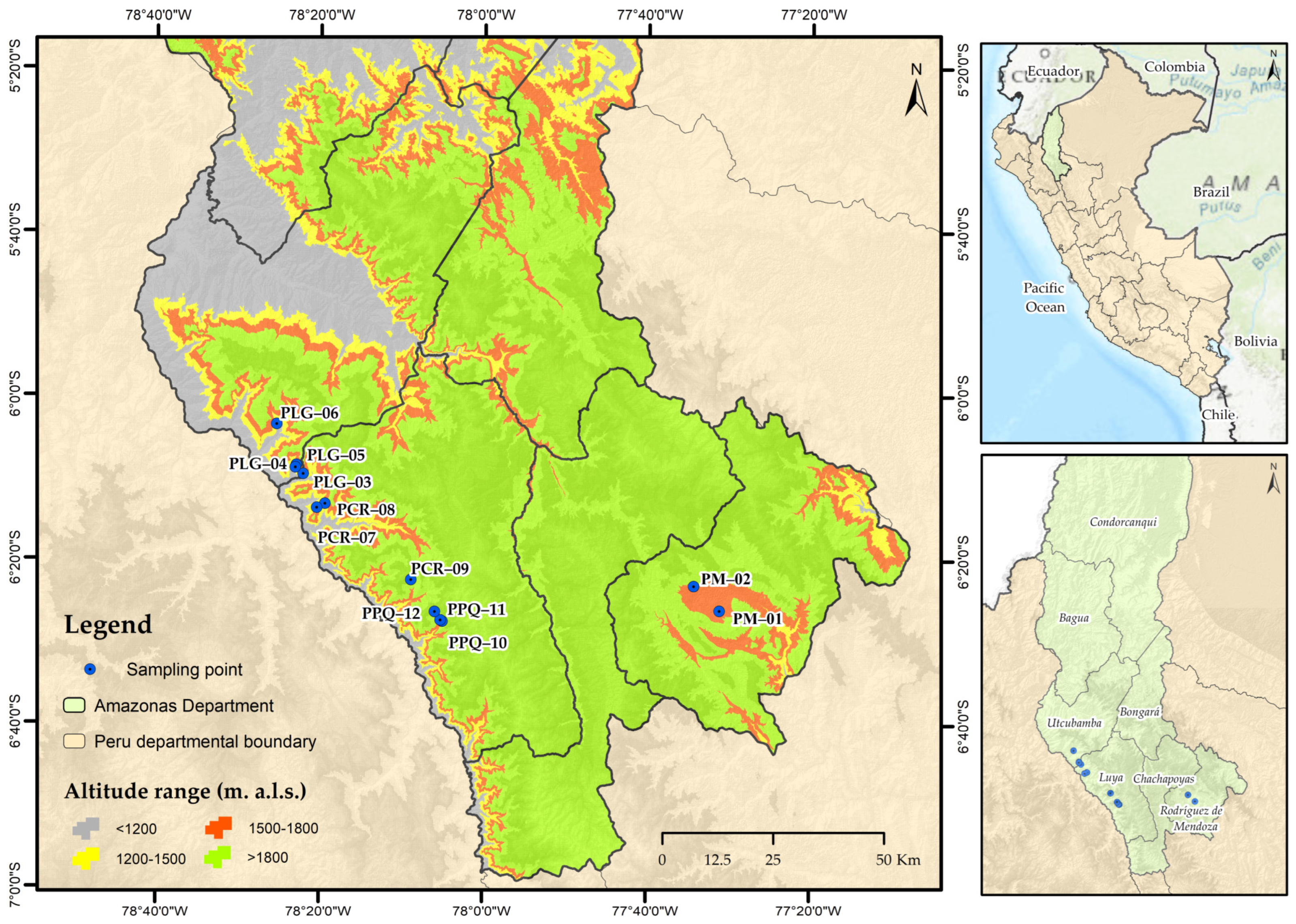
The study was conducted in 12 permanent 1-ha plots located in the districts of Camporredondo and Pisuquia (Luya Province), Lonya Grande (Utcubamba Province), and Huambo (Rodríguez de Mendoza Province), Amazonas Department, northeastern Peruvian Amazon. These areas are characterized by favorable climatic conditions and complex topography that support coffee production and harbor forests with high species diversity and endemism (Figure 1, Table 1).
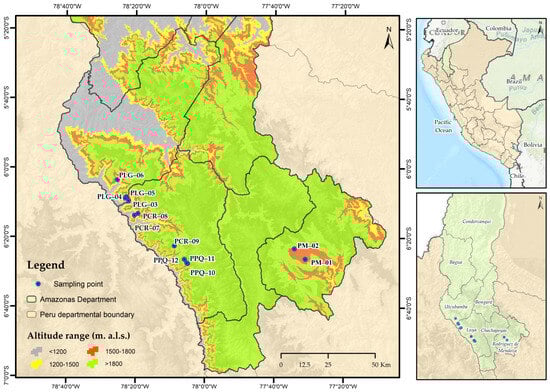
Figure 1.
Location of the study area in the provinces of Luya, Utcubamba, and Rodríguez de Mendoza in the department of Amazonas, northeastern jungle of Peru.

Table 1.
Location of the 12 plots studied in the department of Amazonas, northeastern jungle of Peru.
2.2. Plot Selection and Establishment
Twelve square plots of 1 ha (100 m × 100 m) were established within agroforestry systems combining coffee plantations older than three years with forest tree species. Plots were distributed across three altitudinal gradients: 1200–1500 m.a.s.l. (four plots in Utcubamba Province), 1500–1800 m.a.s.l. (two plots in Luya Province and two in Rodríguez de Mendoza Province), and 1800–2000 m.a.s.l. (four plots in Luya Province) (Table 1).
Each plot was subdivided into 25 subplots of 400 m2 (20 m × 20 m). Plot establishment and measurements followed the methodology proposed by the Amazon Forest Inventory Network (RAINFOR), recording all tree individuals with diameter at breast height (DBH) ≥ 10 cm [21].
2.3. Botanical Sampling and Identification
Dasometric data were collected for all individuals using a measuring tape (Lima, PE) to record stem circumference at breast height (CBH). Measurements were taken for each stem with a diameter at breast height (DBH) greater than 10 cm, standardizing breast height at 1.30 m above ground level, as is customary in comparable studies. For each censused tree, total height was also measured using a hypsometer (Tokyo, Japan). Botanical samples (leaves, flowers, and/or fruits) were collected, pressed, and deposited at the KUELAP Herbarium of the National University Toribio Rodríguez de Mendoza (UNTRM), Amazonas.
The scientific procedure for plant species identification, particularly for groups of tropical tree species, was based on the integration of multiple complementary sources of information and analytical approaches. These included a review of specialized taxonomic literature; comparative analyses based on diagnostic morphological characters; examination and analysis of characters in type specimens; study of well-curated herbarium specimens; the use of taxonomic identification keys; and the assignment of a valid scientific name.
2.4. Data Analysis
Field data collected from the 12 evaluated plots were processed using Microsoft Excel (Microsoft Corporation, Redmond, WA, USA), where variables related to alpha diversity—such as individual abundance and species richness—were determined. Simpson’s diversity index (1 − D) and Fisher’s alpha (α) were calculated using the software PAST 4.11 (Natural History Museum, University of Oslo, Oslo, Norway) [22].
Floristic composition was assessed by identifying the species, genera, and families with the highest individual abundance. The Importance Value Index (IVI) of forest species [23] was calculated based on species abundance, frequency, and basal area. Structural variables were determined according to diameter and height class distributions of all individuals in each of the 12 evaluated plots.
Shade percentage was calculated using the number of individuals per hectare and the canopy cover provided by tree crown diameter, applying the following formula:
where
Shade percentage (%S) = N × 0.7854 × (Dc)2
N = number of trees per hectare;
Dc = mean crown diameter (m).
Simpson’s Index
where
D = Simpson’s Index;
S = Total number of species.
Fisher’s Diversity Index
where
S = Total number of species;
α = Fisher diversity index;
N = Total number of individuals.
Importance Value Index (IVI)
where
IVI = RA + RD+ RF
RA = relative abundance calculated as the number of individuals per species per hectare;
RD = relative dominance defined as the basal area per species per hectare;
RF = relative frequency (per ha) estimated as the proportion of plots in an agroforestry system where the species occurred at least once.
3. Results
3.1. Tree Abundance and Diversity
Tree abundance ranged from 83 to 148 individuals ha−1. The highest abundances were recorded in plots PM-01 (148 individuals) and PLG-03 (127), whereas PLG-05 showed the lowest abundance (83). Species richness ranged from 10 to 17 species ha−1, with PM-02 and PLG-06 exhibiting the highest richness (17 species). The number of genera ranged from 6 to 16, and families from 3 to 12, with PM-02 showing the highest taxonomic richness (Table 2).
Table 2.
Results of abundance and diversity in 12 permanent plots located in the department of Amazonas (Peru).
Simpson diversity index values ranged from 0.63 to 0.85, while Fisher’s alpha ranged from 2.42 to 6.24 across the 12 plots (Table 2).
3.2. Floristic Composition
A total of 57 tree species belonging to 41 genera and 25 families were recorded. The most abundant species were Clitoria juninensis, Inga edulis, Inga mendozana, Colubrina glandulosa, Inga paraensis, Inga vera, Erythrina ulei, and Pinus tecunumanii.
The most abundant genera were Inga, Clitoria, Erythrina, Colubrina, and Pinus, while Fabaceae, Rhamnaceae, and Pinaceae were the dominant families.
3.3. Importance Value Index (IVI)
Species with the highest IVI values included Pinus tecunumanii, Colubrina glandulosa, Piptadenia gonoacantha, Clitoria juninensis, Inga edulis, Inga mendozana, Inga paraensis, Erythrina amazonica, and Erythrina ulei (Table 3).
Table 3.
Forest species with the highest Importance Value Index (IVI) in the 12 plots evaluated in the department of Amazonas, Peru. IVI (Importance Value Index = % relative abundance + % relative frequency + % relative dominance).
3.4. Structural Analysis and Shade
Most individuals were concentrated in the 10–19.99 cm and 20–29.99 cm DBH classes, indicating young and regenerating stands. Height distributions were dominated by individuals between 5 and 14.9 m. Shade percentages ranged from 7% to 14%, reflecting variation in crown size rather than tree density alone.
4. Discussion
Tree abundance and species richness values recorded in this study fall within the range reported for coffee-based agroforestry systems in northeastern Peru [8], although they are considerably lower than those observed in natural Amazonian forests [24,25,26]. This reduction is expected due to management practices inherent to agroforestry systems; nevertheless, these systems retain substantial tree diversity and contribute to biodiversity conservation [4].
The dominance of Clitoria juninensis, an endemic species, highlights the conservation value of these agroforestry systems. The prevalence of Inga species and Fabaceae reflects their ecological importance in nitrogen fixation, soil fertility improvement, and shade provision for coffee crops, consistent with reports from other Latin American coffee agroforestry systems [8,27,28,29,30,31]. The agroforestry systems studied were selected based on area (1 ha), age (older than 3 years), diameter at breast height (DBH) ≥ 10 cm, and the presence of coffee crops associated with forest species. These areas have a mixed origin, comprising species typical of coffee-based agroforestry systems (Inga spp., Erythrina spp., Colubrina glandulosa, and Pinus tecunumanii), with a combination of trees planted for shade and remnant trees. The planted species included Colubrina glandulosa, Persea americana, Inga oerstediana, Inga edulis, Inga vera, and Erythrina edulis, whereas remnant trees included Solanum grandiflorum, Piptadenia gonoacantha, Clitoria juninensis, and Inga mendozana.
The predominance of small diameter and intermediate height classes suggests active regeneration and sustained growth, ensuring long-term system sustainability. Shade levels observed are sufficient to regulate microclimate, enhance coffee productivity, and support ecosystem services [27,32,33].
In Peru, open access databases derived from research projects and international cooperation initiatives document specific agroforestry experiences, particularly those associated with perennial crops such as coffee and cacao [12], as well as detailed studies on the composition and structure of cacao-based agroforestry systems in Andean contexts [34]. These sources provide in-depth information on floristic composition, structural arrangements, and management practices, thereby strengthening their internal validity. Nevertheless, their spatial coverage is limited and their national representativeness remains low, which constrains their extrapolation potential and hinders comparisons across the country’s agroecological regions, as evidenced in the present study.
Overall, open data sources on agroforestry systems in Peru constitute a valuable yet fragmented foundation, a condition that recent reviews on digital technologies and agroforestry systems identify as a key methodological challenge for integrating biophysical and socioeconomic data in complex land-use systems [35]. Similarly, the global systematic literature highlights the thematic and geographic dispersion of agroforestry studies that rely on open data [36]. However, the main limitations are associated with the low thematic resolution of many open datasets and their limited capacity to capture the structural and functional diversity of agroforestry systems [35]. Addressing these constraints requires the development of more refined classification protocols, the integration of multiple open data sources, and the strengthening of collaborative data initiatives that enable a more accurate representation of the country’s agroforestry complexity, a recommendation consistently emphasized in studies examining the integration of remote sensing, sensor-based, and socioeconomic data for complex agricultural systems [37].
5. Conclusions
The results of this study confirm that coffee-based agroforestry systems in the Andean–Amazonian region of Peru maintain moderate levels of tree diversity and structurally complex stands that support key ecological functions, despite having lower richness and abundance than natural tropical forests. The dominance of Fabaceae and multipurpose shade species such as Inga, Clitoria, Erythrina, and Colubrina aligns with patterns reported in coffee agroforestry systems across Latin America, Africa, and Southeast Asia, where nitrogen-fixing and fast-growing trees play a central role in sustaining soil fertility, microclimate regulation, and crop productivity.
At a global scale, these findings support previous syntheses demonstrating that agroforestry systems outperform simplified monocultures in biodiversity conservation and ecosystem service delivery. Importantly, this study contributes novel permanent-plot-based evidence from an underrepresented Andean–Amazonian context, addressing a recognized gap in international agroforestry research. By integrating diversity, floristic composition, structure, and ecological importance along altitudinal gradients, the results provide a robust empirical basis for sustainable forest management, biodiversity conservation, and climate-resilient coffee production, with relevance beyond Peru to tropical montane agroforestry systems worldwide.
Agroforestry systems exhibited tree abundances ranging from 83 to 148 individuals per hectare and species richness between 10 and 17 species per hectare. Although these values are lower than those reported for natural forests due to the integration of trees with coffee crops, they nevertheless maintain significant plant diversity.
The genera Inga, Clitoria, Erythrina, and Colubrina, together with the families Fabaceae and Rhamnaceae, constitute the floristic backbone of agroforestry systems in the Amazonas region, highlighting their central role in structural organization, ecological functioning, and local use for timber and soil enhancement.
Most individuals were concentrated in diameter classes between 10 and 29.99 cm and height classes between 5 and 14.9 m, indicating continuous growth and regeneration processes. The predominance of young trees suggests a favorable demographic structure that supports the long-term sustainability of coffee-based agroforestry systems.
Author Contributions
Conceptualization, J.Z.L. and E.P.; methodology, E.P.; software, J.G.; validation, N.H. and G.M.-M.; formal analysis, R.Y.R.; investigation, E.C.C.; resources, E.P.; data curation, O.G.; writing—original draft preparation, J.Z.L.; writing—review and editing, E.P.; visualization, C.A.A.G.; supervision, M.O.-C.; project administration, R.Y.R.; funding acquisition, R.Y.R. All authors have read and agreed to the published version of the manuscript.
Funding
This research received no funding.
Data Availability Statement
The original contributions presented in this study are included in the article. Further inquiries can be directed to the corresponding author.
Conflicts of Interest
The authors declare no conflicts of interest.
References
- Díaz, C.; Carmen, M. Línea de Base del Sector Café en el Perú; Programa de las Naciones Unidas para el Desarrollo (PNUD): Lima, Peru, 2017. [Google Scholar]
- MINAGRI. Sistemas Agorforestales. Minist. Desarro. Agrar. Riego 2021, 5, 248–253. [Google Scholar]
- Fahad, S.; Chavan, S.B.; Chichaghare, A.R.; Uthappa, A.R.; Kumar, M.; Kakade, V.; Pradhan, A.; Jinger, D.; Rawale, G.; Yadav, D.K.; et al. Agroforestry Systems for Soil Health Improvement and Maintenance. Sustainability 2022, 14, 14877. [Google Scholar] [CrossRef]
- Moguel, P.; Toledo, V.M. Biodiversity Conservation in Traditional Coffee Systems of Mexico. Conserv. Biol. 1999, 13, 11–21. [Google Scholar] [CrossRef]
- Añazco, B.; Rivera, R.; Pariente, E. Diversidad y composición florística de un área de bosque montano, San Carlos, Bongará, Amazonas. Arnaldoa 2021, 28, 441–445. [Google Scholar]
- Cámara de Café Perú. Café 2.0 Climáticamente Inteligente; Solidaridad—NORAD: Lima, Peru, 2016. [Google Scholar]
- Ministerio de Agricultura y Riego (MINAGRI). Anuario Estadístico de Producción Agrícola 2017; Sistema Integrado de Estadística Agraria: Lima, Peru, 2017.
- Sarmiento, J. Diversidad Arbórea de Sistemas Agroforestales en Fincas de Café Cuenca Indoche y Tonchima, Soritor, Moyobamba, Perú. Master’s Thesis, Universidad Nacional Agraria La Molina, La Molina, Peru, 2021. [Google Scholar]
- De Beenhouwer, M.; Aerts, R.; Honnay, O. A global meta-analysis of the biodiversity and ecosystem service benefits of coffee and cacao agroforestry. Agric. Ecosyst. Environ. 2013, 175, 1–7. [Google Scholar] [CrossRef]
- Mayorga, I.; Vargas de Mendonça, J.L.; Hajian-Forooshani, Z.; Lugo-Perez, J.; Perfecto, I. Tradeoffs and synergies among ecosystem services, biodiversity conservation, and food production in coffee agroforestry. Front. For. Glob. Change 2022, 5, 690164. [Google Scholar] [CrossRef]
- Jezeer, R.E.; Santos, M.J.; Verweij, P.A.; Boot, R.G.A.; Clough, Y. Benefits for multiple ecosystem services in Peruvian coffee agroforestry systems without reducing yield. Ecosyst. Serv. 2019, 40, 101033. [Google Scholar] [CrossRef]
- Isaac, M.E.; Gagliardi, S.; Ordoñez, J.C.; Sauvadet, M. Shade Tree Trait Diversity and Functions in Agroforestry Systems: A Review of Which Traits Matter. J. Appl. Ecol. 2024, 61, 1159–1173. [Google Scholar] [CrossRef]
- Manson, S.; Nekaris, K.A.I.; Nijman, V.; Campera, M. Effect of Shade on Biodiversity within Coffee Farms: A Meta-Analysis. Sci. Total Environ. 2024, 914, 169882. [Google Scholar] [CrossRef]
- Salgado Veramendi, N.; Romero-Chavez, L.E.; Huerto Pajuelo, E.S.; Ibarra Porras, C.d.C.; Cunyas-Camayo, J.M.; Aldava Pardave, U.; Vallejos-Torres, G.; Solórzano Acosta, R. Carbon Storage in Coffee Agroforestry Systems: Role of Native and Introduced Shade Trees in the Central Peruvian Amazon. Agriculture 2025, 15, 1415. [Google Scholar] [CrossRef]
- Vallejos-Torres, G.; Gaona-Jimenez, N.; Pichis-García, R.; Ordoñez, L.; García-Gonzales, P.; Quinteros, A.; Lozano, A.; Saavedra-Ramírez, J.; Tuesta-Hidalgo, J.C.; Reategui, K.; et al. Carbon reserves in coffee agroforestry in the Peruvian Amazon. Front. Plant Sci. 2024, 15, 1410418. [Google Scholar] [CrossRef] [PubMed]
- Pauletto, D.; Arco-Verde, M.F.; Silva, I.C.; Lopes, L.S.d.S.; Araújo, A.J.C.; Lucas, F.C.A.; dos Santos, S.F.; Vieira, T.A.; Dias, C.T.d.S.; Martorano, L.G. Adoption and Diversity of Agroforestry Systems in the Amazon Biome: A Scoping Review of Composition, Dynamics and Knowledge Gaps. Land 2025, 14, 524. [Google Scholar] [CrossRef]
- Nesper, M.; Kueffer, C.; Krishnan, S.; Kushalappa, C.G.; Ghazoul, J. Shade tree diversity enhances coffee production and quality in agroforestry systems in the Western Ghats. Agric. Ecosyst. Environ. 2017, 247, 172–181. [Google Scholar] [CrossRef]
- Tesfa, E.; Gudesho, G.; Wubie, M.; Awoke, A. Shade tree diversity, structure, and regeneration dynamics in the Sheko semi-forest coffee agro ecosystem, southwest Ethiopia. BMC Ecol. Evol. 2025, 25, 132. [Google Scholar] [CrossRef]
- Koutouleas, A.; Sarzynski, T.; Bordeaux, M.; Bosselmann, A.S.; Campa, C.; Etienne, H.; Turreira-García, N.; Rigal, C.; Vaast, P.; Ramalho, J.C.; et al. Shaded-Coffee: A Nature-Based Strategy for Coffee Production Under Climate Change? A Review. Front. Sustain. Food Syst. 2022, 6, 877476. [Google Scholar] [CrossRef]
- Bracken, P.; Burgess, P.J.; Girkin, N.T. Opportunities for enhancing the climate resilience of coffee production through improved crop, soil and water management. Agroecol. Sustain. Food Syst. 2023, 47, 1125–1157. [Google Scholar] [CrossRef]
- Phillips, O.L.; Baker, T.; Feldpausch, T.; Brienen, R. Manual de Campo para la Remedición y Establecimiento de Parcelas; Red Amazónica de Inventarios Forestales (RAINFOR): Leeds, UK, 2016. [Google Scholar]
- Hammer, Ø.; Harper, D.A.T.; Ryan, P.D. PAST: Paleontological Statistics Software Package for Education and Data Analysis. Palaeontol. Electron. 2001, 4, 1–9. [Google Scholar]
- Curtis, J.T.; McIntosh, R.P. An Upland Forest Continuum in the Prairie–Forest Border Region of Wisconsin. Ecology 1951, 32, 476–496. [Google Scholar] [CrossRef]
- Nebel, G.; Kvist, L.P.; Vanclay, J.K.; Christensen, H.; Freitas, L.; Ruiz, J. Estructura y Composición Florística del Bosque de la Llanura Aluvial en la Amazonía Peruana: I. El Bosque Alto. Folia Amaz. 2000, 10, 91–149. [Google Scholar] [CrossRef]
- Pallqui, N.C.; Monteagudo, A.; Phillips, O.L.; Lopez-Gonzales, G.; Cruz, L.; Galiano, W.; Chavez, W.; Vásquez, R. Dinámica, Biomasa Aérea y Composición Florística en Parcelas Permanentes de la Reserva Nacional Tambopata, Madre de Dios, Perú. Rev. Peru. Biol. 2014, 21, 235–242. [Google Scholar] [CrossRef]
- Giacomotti, J.; Reynel, C.; Fernandez-Hilario, R.; Revilla, I.; Palacios-Ramos, S.; Terreros-Camac, S.; Daza, A.; Linares-Palomino, R. Diversidad y Composición Florística en un Gradiente Altitudinal en Chanchamayo, Selva Central del Perú. Folia Amaz. 2021, 30, 1–14. [Google Scholar] [CrossRef]
- García Mayoral, L.E.; Valdez Hernández, J.I.; Luna Cavazos, M.; López Morgado, R. Structure and Diversity of Arboreal Vegetation in Coffee Agroforestry Systems in Sierra de Atoyac, Veracruz. Madera Bosques 2015, 21, 69–82. [Google Scholar]
- Zapata-Arango, P.C. Composición y Estructura del Dosel de Sombra en Sistemas Agroforestales con Café de Tres Municipios de Cundinamarca, Colombia. Ciênc. Florest. 2019, 29, 685–697. [Google Scholar] [CrossRef]
- Celi-Delgado, L.; Aguirre-Mendoza, Z. Caracterización de los Sistemas Agroforestales Tradicionales de la Parroquia Zumba, Cantón Chinchipe, Ecuador. Cienc. Lat. Rev. Cient. Multidiscip. 2022, 6, 814–837. [Google Scholar] [CrossRef]
- López, G.; Arellanos, E. Diversidad Arbórea en Sistemas Cafetaleros en la Provincia de Rodríguez de Mendoza. Rev. Cient. Pakamuros 2022, 10, 82–93. [Google Scholar] [CrossRef]
- Melendres, R. Diversidad de Especies Arbóreas Asociadas a Sistemas Agroforestales con Coffea arabica en Dos Pisos Altitudinales en la Provincia de San Ignacio, Cajamarca, Perú. Undergraduate Thesis, Universidad Nacional Toribio Rodríguez de Mendoza de Amazonas, Chachapoyas, Peru, 2025. [Google Scholar]
- Villarreyna, R.; Avelino, J.; Cerda, R. Ecosystem-Based Adaptation: Effect of Shade Trees on Ecosystem Services in Coffee Plantations. Agron. Mesoam. 2020, 31, 499–516. [Google Scholar] [CrossRef]
- Encalada-Córdova, M.; Benavidez-Silva, C.; Urgiles-Gómez, N.; Chamba-Caillagua, K. Sistemas Agroforestales Cafetaleros: Aproximaciones para la Caracterización de Sombra y Microclima en Loja, Ecuador. Agron. Mesoam. 2025, 36, 4ssgm196. [Google Scholar] [CrossRef]
- Villanueva-González, C.E.; Ruiz-Chután, J.A.; Kalousova, M.; Moya, R.W.; Villanueva, C.; Lojka, B. Botanical diversity, structure and composition in cocoa agroforest systems in Alta Verapaz, Guatemala. Sci. Agropecu. 2023, 14, 223–234. [Google Scholar] [CrossRef]
- Pippi, L. Use of Digital Technologies into Agroforestry Systems: A Review on Advanced Sensing, Case Studies, Knowledge Gaps and Future Perspectives. Agronomy 2025, 15, 2671. [Google Scholar] [CrossRef]
- Sharma, U. A Global Review of Agroforestry Research and Policy Directions: Addressing ecological and socioeconomic challenges through systematic review and bibliometric analysis. For. Policy Econ. 2025, 181, 103639. [Google Scholar] [CrossRef]
- Fuentes-Peñailillo, F.; del Campo-Hitschfeld, M.L.; Gutter, K.; Torres-Quezada, E. Data-Driven Integration of Remote Sensing, Agro-Meteorology, and Wireless Sensor Networks for Crop Water Demand Estimation: Tools Towards Sustainable Irrigation in High-Value Fruit Crops. Agronomy 2025, 15, 2122. [Google Scholar] [CrossRef]
Disclaimer/Publisher’s Note: The statements, opinions and data contained in all publications are solely those of the individual author(s) and contributor(s) and not of MDPI and/or the editor(s). MDPI and/or the editor(s) disclaim responsibility for any injury to people or property resulting from any ideas, methods, instructions or products referred to in the content. |
© 2026 by the authors. Licensee MDPI, Basel, Switzerland. This article is an open access article distributed under the terms and conditions of the Creative Commons Attribution (CC BY) license.