
Regulatory Mechanisms of Fumonisin Biosynthesis and Applications in Food Safety and Biotechnology

Abstract
1. Introduction
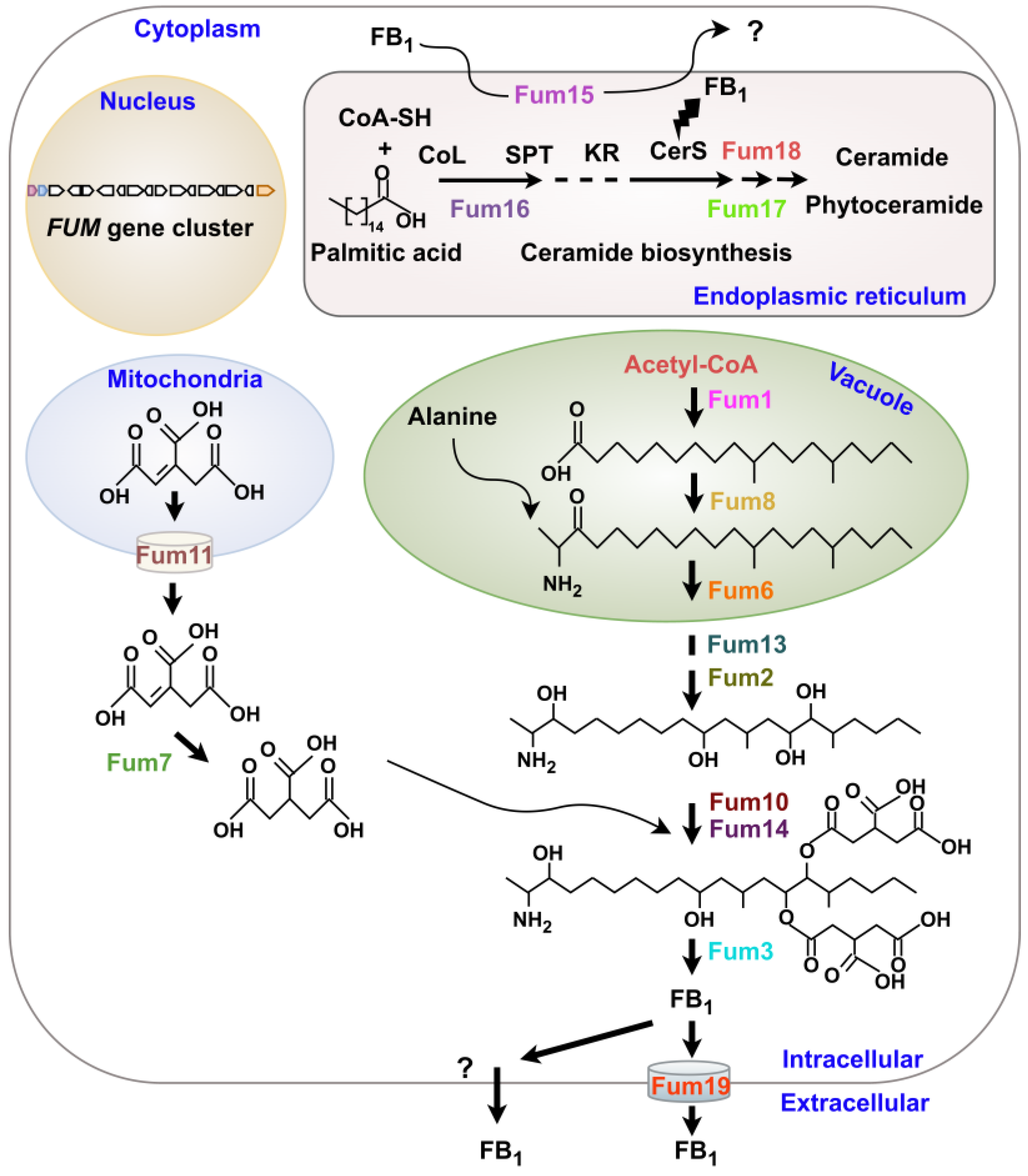
2. Fumonisin Biosynthetic Pathway
2.1. The Fumonisin Gene Cluster
2.2. Enzymatic Cascade Leading to Fumonisin Synthesis
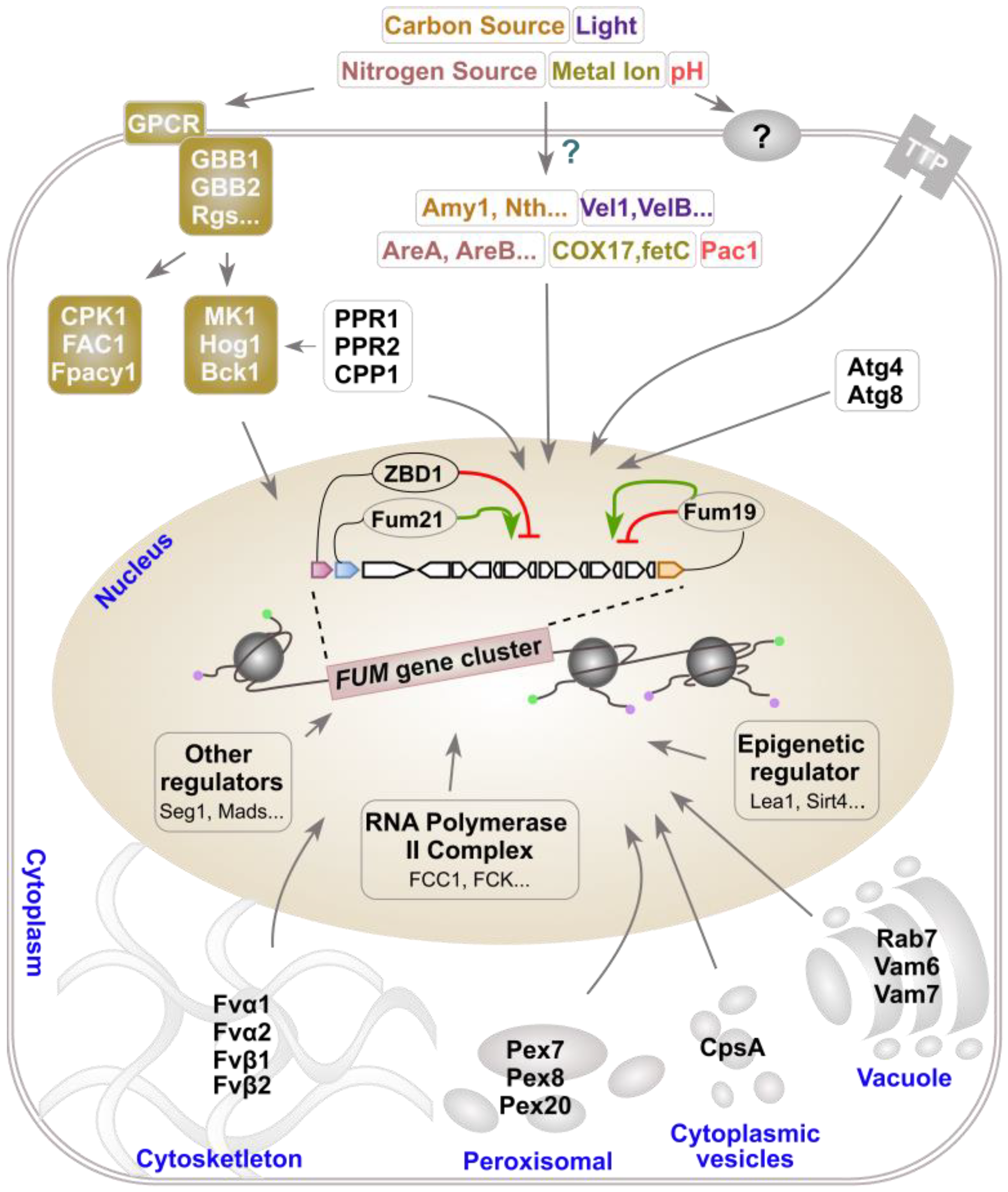
3. Regulatory Mechanisms of Fumonisin Biosynthesis
3.1. Fumonisin Cluster Regulators
3.2. General Regulatory Responses to Environmental Factors
3.2.1. Carbon Sources
3.2.2. Nitrogen Sources
3.2.3. pH Conditions
3.2.4. Light
3.2.5. Oxidative Stress
3.2.6. Metal Ions
3.3. Cell Signaling
3.3.1. G Protein Signaling Pathway
3.3.2. cAMP Signaling Pathway
3.3.3. MAPK Signaling Pathway
3.4. RNA Polymerase II Complex
3.5. Post-Translational Modification and Enzyme Activity Regulation
3.5.1. Histone Methylation
3.5.2. Histone Acetylation
3.5.3. Phosphorylation Modification
3.5.4. Glycosylation Modification
3.6. Cellular Structure and Functional Components
3.7. Other Regulators
4. Applications
4.1. Species-Specific Markers
4.2. Predicting the Fumonisin Production
4.3. Manegement of Fumonisin Contamination
4.4. Engineering High-Yield Fumonisin-Producing Strains
4.5. Novel Metabolite Discovery
4.6. Enzyme Engineering
5. Conclusions and Perspectives
Supplementary Materials
Author Contributions
Funding
Institutional Review Board Statement
Informed Consent Statement
Data Availability Statement
Acknowledgments
Conflicts of Interest
References
- Rheeder, J.P.; Marasas, W.F.; Vismer, H.F. Production of fumonisin analogs by Fusarium species. Appl. Environ. Microbiol. 2002, 68, 2101–2105. [Google Scholar] [CrossRef]
- Susca, A.; Proctor, R.H.; Butchko, R.A.; Haidukowski, M.; Stea, G.; Logrieco, A.; Moretti, A. Variation in the fumonisin biosynthetic gene cluster in fumonisin-producing and nonproducing black aspergilli. Fungal Genet. Biol. 2014, 73, 39–52. [Google Scholar] [CrossRef] [PubMed]
- Alexander, N.J.; Proctor, R.H.; McCormick, S.P. Genes, gene clusters, and biosynthesis of trichothecenes and fumonisins in Fusarium. Toxin Rev. 2009, 28, 198–215. [Google Scholar] [CrossRef]
- Bryła, M.; Roszko, M.; Szymczyk, K.; Jędrzejczak, R.; Obiedziński, M.W.; Sękul, J. Fumonisins in plant-origin food and fodder—A review. Food Addit. Contam. A 2013, 30, 1626–1640. [Google Scholar] [CrossRef] [PubMed]
- Biscoto, G.L.; Salvato, L.A.; Alvarenga, É.R.; Dias, R.R.S.; Pinheiro, G.R.G.; Rodrigues, M.P.; Pinto, P.N.; Freitas, R.P.; Keller, K.M. Mycotoxins in Cattle Feed and Feed Ingredients in Brazil: A Five-Year Survey. Toxins 2022, 14, 552. [Google Scholar] [CrossRef]
- Akello, J.; Ortega-Beltran, A.; Katati, B.; Atehnkeng, J.; Augusto, J.; Mwila, C.M.; Mahuku, G.; Chikoye, D.; Bandyopadhyay, R. Prevalence of Aflatoxin- and Fumonisin-Producing Fungi Associated with Cereal Crops Grown in Zimbabwe and Their Associated Risks in a Climate Change Scenario. Foods 2021, 10, 287. [Google Scholar] [CrossRef]
- Hao, W.; Guan, S.; Li, A.; Wang, J.; An, G.; Hofstetter, U.; Schatzmayr, G. Mycotoxin Occurrence in Feeds and Raw Materials in China: A Five-Year Investigation. Toxins 2023, 15, 63. [Google Scholar] [CrossRef]
- Li, T.; Li, J.; Wang, J.; Xue, K.S.; Su, X.; Qu, H.; Duan, X.; Jiang, Y. The occurrence and management of fumonisin contamination across the food production and supply chains. J. Adv. Res. 2024, 60, 13–26. [Google Scholar] [CrossRef]
- Anumudu, C.K.; Ekwueme, C.T.; Uhegwu, C.C.; Ejileugha, C.; Augustine, J.; Okolo, C.A.; Onyeaka, H. A Review of the Mycotoxin Family of Fumonisins, Their Biosynthesis, Metabolism, Methods of Detection and Effects on Humans and Animals. Int. J. Mol. Sci. 2025, 26, 184. [Google Scholar] [CrossRef]
- IARC Working Group on the Evaluation of Carcinogenic Risks to Humans. IARC monographs on the evaluation of carcinogenic risks to humans. Ingested nitrate and nitrite, and cyanobacterial peptide toxins. IARC Monogr. Eval. Carcinog. Risks Hum. 2010, 94, 1–412.
- EFSA—European Food Safety Authority. Opinion of the scientific committee on a request from EFSA related to a harmonised approach for risk assessment of substances which are both genotoxic and carcinogenic. EFSA J. 2007, 3, 282. [Google Scholar] [CrossRef]
- Deepa, N.; Achar, P.N.; Sreenivasa, M.Y. Current Perspectives of Biocontrol Agents for Management of Fusarium verticillioides and Its Fumonisin in Cereals-A Review. J. Fungi 2021, 7, 776. [Google Scholar] [CrossRef]
- Li, T.; Su, X.; Qu, H.; Duan, X.; Jiang, Y. Biosynthesis, regulation, and biological significance of fumonisins in fungi: Current status and prospects. Crit. Rev. Microbiol. 2022, 48, 450–462. [Google Scholar] [CrossRef] [PubMed]
- Gil-Serna, J.; Vazquez, C.; Patino, B. Genetic regulation of aflatoxin, ochratoxin A, trichothecene, and fumonisin biosynthesis: A review. Int. Microbiol. 2020, 23, 89–96. [Google Scholar] [CrossRef]
- Lyu, H.N.; Liu, H.W.; Keller, N.P.; Yin, W.B. Harnessing diverse transcriptional regulators for natural product discovery in fungi. Nat. Prod. Rep. 2020, 37, 6–16. [Google Scholar] [CrossRef]
- Yao, G.; Chen, W.; Sun, J.; Wang, X.; Wang, H.; Meng, T.; Zhang, L.; Guo, L. Gapless genome assembly of Fusarium verticillioides, a filamentous fungus threatening plant and human health. Sci. Data 2023, 10, 229. [Google Scholar] [CrossRef]
- Janevska, S.; Ferling, I.; Jojić, K.; Rautschek, J.; Hoefgen, S.; Proctor, R.H.; Hillmann, F. Self-Protection against the Sphingolipid Biosynthesis Inhibitor Fumonisin B(1) Is Conferred by a FUM Cluster-Encoded Ceramide Synthase. mBio 2020, 11, e00455-20. [Google Scholar] [CrossRef]
- Proctor, R.H.; Busman, M.; Seo, J.A.; Lee, Y.W.; Plattner, R.D. A fumonisin biosynthetic gene cluster in Fusarium oxysporum strain O–1890 and the genetic basis for B versus C fumonisin production. Fungal Genet. Biol. 2008, 45, 1016–1026. [Google Scholar] [CrossRef]
- Sultana, S.; Suga, H. Genetic Background of Variable Fumonisin Production in the Fusarium fujikuroi Species Complex. Rev. Agric. Sci. 2021, 9, 43–55. [Google Scholar] [CrossRef]
- Khaldi, N.; Wolfe, K.H. Evolutionary Origins of the Fumonisin Secondary Metabolite Gene Cluster in Fusarium verticillioides and Aspergillus niger. Int. J. Evol. Biol. 2011, 2011, 423821. [Google Scholar] [CrossRef]
- Gerber, R.; Lou, L.; Du, L. A PLP-dependent polyketide chain releasing mechanism in the biosynthesis of mycotoxin fumonisins in Fusarium verticillioides. J. Am. Chem. Soc. 2009, 131, 3148–3149. [Google Scholar] [CrossRef] [PubMed]
- Desjardins, A.E.; Munkvold, G.P.; Plattner, R.D.; Proctor, R.H. FUM1—A gene required for fumonisin biosynthesis but not for maize ear rot and ear infection by Gibberella moniliformis in field tests. Mol. Plant. Microbe Interact. 2002, 15, 1157–1164. [Google Scholar] [CrossRef] [PubMed]
- Proctor, R.H.; Desjardins, A.E.; Plattner, R.D.; Hohn, T.M. A polyketide synthase gene required for biosynthesis of fumonisin mycotoxins in Gibberella fujikuroi mating population A. Fungal Genet. Biol. 1999, 27, 100–112. [Google Scholar] [CrossRef] [PubMed]
- Zhu, X.; Yu, F.; Bojja, R.S.; Zaleta-Rivera, K.; Du, L. Functional replacement of the ketosynthase domain of FUM1 for the biosynthesis of fumonisins, a group of fungal reduced polyketides. J. Ind. Microbiol. Biotechnol. 2006, 33, 859–868. [Google Scholar] [CrossRef]
- Bojja, R.S.; Cerny, R.L.; Proctor, R.H.; Du, L. Determining the biosynthetic sequence in the early steps of the fumonisin pathway by use of three gene-disruption mutants of Fusarium verticillioides. J. Agric. Food Chem. 2004, 52, 2855–2860. [Google Scholar] [CrossRef]
- Seo, J.A.; Proctor, R.H.; Plattner, R.D. Characterization of four clustered and coregulated genes associated with fumonisin biosynthesis in Fusarium verticillioides. Fungal Genet. Biol. 2001, 34, 155–165. [Google Scholar] [CrossRef]
- Butchko, R.A.; Plattner, R.D.; Proctor, R.H. FUM13 encodes a short chain dehydrogenase/reductase required for C–3 carbonyl reduction during fumonisin biosynthesis in Gibberella moniliformis. J. Agric. Food Chem. 2003, 51, 3000–3006. [Google Scholar] [CrossRef]
- Yi, H.; Bojja, R.S.; Fu, J.; Du, L. Direct evidence for the function of FUM13 in 3–ketoreduction of mycotoxin fumonisins in Fusarium verticillioides. J. Agric. Food Chem. 2005, 53, 5456–5460. [Google Scholar] [CrossRef]
- Yan, H.; Zhou, Z.; Zhang, H.; Shim, W.B. Vacuole Proteins with Optimized Microtubule Assembly Is Required for Fum1 Protein Localization and Fumonisin Biosynthesis in Mycotoxigenic Fungus Fusarium verticillioides. J. Fungi 2023, 9, 268. [Google Scholar] [CrossRef]
- Proctor, R.H.; Plattner, R.D.; Desjardins, A.E.; Busman, M.; Butchko, R.A. Fumonisin production in the maize pathogen Fusarium verticillioides: Genetic basis of naturally occurring chemical variation. J. Agric. Food Chem. 2006, 54, 2424–2430. [Google Scholar] [CrossRef]
- Butchko, R.A.; Plattner, R.D.; Proctor, R.H. Deletion analysis of FUM genes involved in tricarballylic ester formation during fumonisin biosynthesis. J. Agric. Food Chem. 2006, 54, 9398–9404. [Google Scholar] [CrossRef]
- Zaleta-Rivera, K.; Xu, C.; Yu, F.; Butchko, R.A.; Proctor, R.H.; Hidalgo-Lara, M.E.; Raza, A.; Dussault, P.H.; Du, L. A bidomain nonribosomal peptide synthetase encoded by FUM14 catalyzes the formation of tricarballylic esters in the biosynthesis of fumonisins. Biochemistry 2006, 45, 2561–2569. [Google Scholar] [CrossRef] [PubMed]
- Ding, Y.; Bojja, R.S.; Du, L. Fum3p, a 2-ketoglutarate-dependent dioxygenase required for C–5 hydroxylation of fumonisins in Fusarium verticillioides. Appl. Environ. Microbiol. 2004, 70, 1931–1934. [Google Scholar] [CrossRef] [PubMed]
- Aerts, D.; Hauer, E.E.; Ohm, R.A.; Arentshorst, M.; Teertstra, W.R.; Phippen, C.; Ram, A.F.J.; Frisvad, J.C.; Wösten, H.A.B. The FlbA-regulated predicted transcription factor Fum21 of Aspergillus niger is involved in fumonisin production. Antonie Leeuwenhoek 2018, 111, 311–322. [Google Scholar] [CrossRef]
- Brown, D.W.; Butchko, R.A.; Busman, M.; Proctor, R.H. The Fusarium verticillioides FUM gene cluster encodes a Zn(II)2Cys6 protein that affects FUM gene expression and fumonisin production. Eukaryot. Cell 2007, 6, 1210–1218. [Google Scholar] [CrossRef] [PubMed]
- Proctor, R.H.; Brown, D.W.; Plattner, R.D.; Desjardins, A.E. Co-expression of 15 contiguous genes delineates a fumonisin biosynthetic gene cluster in Gibberella moniliformis. Fungal Genet. Biol. 2003, 38, 237–249. [Google Scholar] [CrossRef]
- Gherlone, F.; Jojić, K.; Huang, Y.; Hoefgen, S.; Valiante, V.; Janevska, S. The palmitoyl-CoA ligase Fum16 is part of a Fusarium verticillioides fumonisin subcluster involved in self-protection. mBio 2025, 16, e0268124. [Google Scholar] [CrossRef]
- Sun, L.; Chen, X.; Gao, J.; Zhao, Y.; Liu, L.; Hou, Y.; Wang, L.; Huang, S. Effects of Disruption of Five FUM Genes on Fumonisin Biosynthesis and Pathogenicity in Fusarium proliferatum. Toxins 2019, 11, 327. [Google Scholar] [CrossRef]
- Gao, M.; Glenn, A.E. Pyrrocidine, a molecular off switch for fumonisin biosynthesis. PLoS Pathog. 2020, 16, e1008595. [Google Scholar] [CrossRef]
- Caceres, I.; Khoury, A.A.; Khoury, R.E.; Lorber, S. Aflatoxin Biosynthesis and Genetic Regulation: A Review. Toxins 2020, 12, 150. [Google Scholar] [CrossRef]
- Wu, Y.; Li, T.; Gong, L.; Wang, Y.; Jiang, Y. Effects of Different Carbon Sources on Fumonisin Production and FUM Gene Expression by Fusarium proliferatum. Toxins 2019, 11, 289. [Google Scholar] [CrossRef]
- Bluhm, B.H.; Woloshuk, C.P. Amylopectin induces fumonisin B1 production by Fusarium verticillioides during colonization of maize kernels. Mol. Plant. Microbe Interact. 2005, 18, 1333–1339. [Google Scholar] [CrossRef] [PubMed]
- Kim, H.; Smith, J.E.; Ridenour, J.B.; Woloshuk, C.P.; Bluhm, B.H. HXK1 regulates carbon catabolism, sporulation, fumonisin B1 production and pathogenesis in Fusarium verticillioides. Microbiology 2011, 157, 2658–2669. [Google Scholar] [CrossRef] [PubMed]
- Zhao, B.; Li, J.; Zhou, L.; Liu, W.; Geng, S.; Zhao, Y.; Hou, Z.; Zhao, R.; Liu, Y.; Dong, J. Validamycin A Inhibited FB1 Biosynthesis by the Target FvNth in Fusarium verticillioides. J. Agric. Food Chem. 2024, 72, 15487–15497. [Google Scholar] [CrossRef] [PubMed]
- Bluhm, B.H.; Kim, H.; Butchko, R.A.; Woloshuk, C.P. Involvement of ZFR1 of Fusarium verticillioides in kernel colonization and the regulation of FST1, a putative sugar transporter gene required for fumonisin biosynthesis on maize kernels. Mol. Plant Pathol. 2008, 9, 203–211. [Google Scholar] [CrossRef]
- Flaherty, J.E.; Woloshuk, C.P. Regulation of fumonisin biosynthesis in Fusarium verticillioides by a zinc binuclear cluster-type gene, ZFR1. Appl. Environ. Microbiol. 2004, 70, 2653–2659. [Google Scholar] [CrossRef]
- Kim, H.; Woloshuk, C.P. Functional characterization of fst1 in Fusarium verticillioides during colonization of maize kernels. Mol. Plant. Microbe Interact. 2011, 24, 18–24. [Google Scholar] [CrossRef]
- Oh, M.; Son, H.; Choi, G.J.; Lee, C.; Kim, J.C.; Kim, H.; Lee, Y.W. Transcription factor ART1 mediates starch hydrolysis and mycotoxin production in Fusarium graminearum and F. verticillioides. Mol. Plant Pathol. 2016, 17, 755–768. [Google Scholar] [CrossRef]
- Malapi-Wight, M.; Smith, J.; Campbell, J.; Bluhm, B.H.; Shim, W.B. Sda1, a Cys2-His2 zinc finger transcription factor, is involved in polyol metabolism and fumonisin B1 production in Fusarium verticillioides. PLoS ONE 2013, 8, e67656. [Google Scholar] [CrossRef]
- Rösler, S.M.; Sieber, C.M.; Humpf, H.U.; Tudzynski, B. Interplay between pathway-specific and global regulation of the fumonisin gene cluster in the rice pathogen Fusarium fujikuroi. Appl. Microbiol. Biotechnol. 2016, 100, 5869–5882. [Google Scholar] [CrossRef]
- Michielse, C.B.; Studt, L.; Janevska, S.; Sieber, C.M.; Arndt, B.; Espino, J.J.; Humpf, H.U.; Güldener, U.; Tudzynski, B. The global regulator FfSge1 is required for expression of secondary metabolite gene clusters but not for pathogenicity in Fusarium fujikuroi. Environ. Microbiol. 2015, 17, 2690–2708. [Google Scholar] [CrossRef] [PubMed]
- Lei, S.; Xu, C.; Qianya, Z.; Tianlei, Z.; Qian, Y.; Lianmeng, L.; Shiwen, H.; Ling, W. Effects of Nitrogen-Regulating Gene AreA on Growth, Pathogenicity, and Fumonisin Synthesis of Fusarium proliferatum. Rice Sci. 2024, 31, 10–13. [Google Scholar] [CrossRef]
- Kim, H.; Woloshuk, C.P. Role of AREA, a regulator of nitrogen metabolism, during colonization of maize kernels and fumonisin biosynthesis in Fusarium verticillioides. Fungal Genet. Biol. 2008, 45, 947–953. [Google Scholar] [CrossRef] [PubMed]
- Ridenour, J.B.; Bluhm, B.H. The novel fungal-specific gene FUG1 has a role in pathogenicity and fumonisin biosynthesis in Fusarium verticillioides. Mol. Plant Pathol. 2017, 18, 513–528. [Google Scholar] [CrossRef]
- Luo, Z.; Ren, H.; Mousa, J.J.; Rangel, D.E.; Zhang, Y.; Bruner, S.D.; Keyhani, N.O. The PacC transcription factor regulates secondary metabolite production and stress response, but has only minor effects on virulence in the insect pathogenic fungus Beauveria bassiana. Environ. Microbiol. 2017, 19, 788–802. [Google Scholar] [CrossRef]
- Li, B.; Chen, Y.; Tian, S. Function of pH-dependent transcription factor PacC in regulating development, pathogenicity, and mycotoxin biosynthesis of phytopathogenic fungi. FEBS J. 2022, 289, 1723–1730. [Google Scholar] [CrossRef]
- Tilburn, J.; Sarkar, S.; Widdick, D.A.; Espeso, E.A.; Orejas, M.; Mungroo, J.; Peñalva, M.A.; Arst, H.N., Jr. The Aspergillus PacC zinc finger transcription factor mediates regulation of both acid- and alkaline-expressed genes by ambient pH. EMBO J. 1995, 14, 779–790. [Google Scholar] [CrossRef]
- Flaherty, J.E.; Pirttilä, A.M.; Bluhm, B.H.; Woloshuk, C.P. PAC1, a pH-regulatory gene from Fusarium verticillioides. Appl. Environ. Microbiol. 2003, 69, 5222–5227. [Google Scholar] [CrossRef]
- Keller, S.E.; Sullivan, T.M.; Chirtel, S. Factors affecting the growth of Fusarium proliferatum and the production of fumonisin B1: Oxygen and pH. J. Ind. Microbiol. Biotechnol. 1997, 19, 305–309. [Google Scholar] [CrossRef]
- Li, T.; Gong, L.; Wang, Y.; Chen, F.; Gupta, V.K.; Jian, Q.; Duan, X.; Jiang, Y. Proteomics analysis of Fusarium proliferatum under various initial pH during fumonisin production. J. Proteom. 2017, 164, 59–72. [Google Scholar] [CrossRef]
- Ment, D.; Alkan, N.; Luria, N.; Bi, F.C.; Reuveni, E.; Fluhr, R.; Prusky, D. A Role of AREB in the Regulation of PACC-Dependent Acid-Expressed-Genes and Pathogenicity of Colletotrichum gloeosporioides. Mol. Plant. Microbe Interact. 2015, 28, 154–166. [Google Scholar] [CrossRef] [PubMed]
- Bayram, O.; Krappmann, S.; Ni, M.; Bok, J.W.; Helmstaedt, K.; Valerius, O.; Braus-Stromeyer, S.; Kwon, N.J.; Keller, N.P.; Yu, J.H.; et al. VelB/VeA/LaeA complex coordinates light signal with fungal development and secondary metabolism. Science 2008, 320, 1504–1506. [Google Scholar] [CrossRef] [PubMed]
- Fanelli, F.; Geisen, R.; Schmidt-Heydt, M.; Logrieco, A.F.; Mulè, G. Light regulation of mycotoxin biosynthesis: New perspectives for food safety. World Mycotoxin J. 2016, 9, 129–146. [Google Scholar] [CrossRef]
- Fanelli, F.; Schmidt-Heydt, M.; Haidukowski, M.; Geisen, R.; Logrieco, A.; Mulè, G. Influence of light on growth, fumonisin biosynthesis and FUM1 gene expression by Fusarium proliferatum. Int. J. Food Microbiol. 2012, 153, 148–153. [Google Scholar] [CrossRef]
- Matić, S.; Spadaro, D.; Prelle, A.; Gullino, M.L.; Garibaldi, A. Light affects fumonisin production in strains of Fusarium fujikuroi, Fusarium proliferatum, and Fusarium verticillioides isolated from rice. Int. J. Food Microbiol. 2013, 166, 515–523. [Google Scholar] [CrossRef]
- Fanelli, F.; Schmidt-Heydt, M.; Haidukowski, M.; Susca, A.; Geisen, R.; Logrieco, A.; Mulè, G. Influence of light on growth, conidiation and fumonisin production by Fusarium verticillioides. Fungal Biol. 2012, 116, 241–248. [Google Scholar] [CrossRef]
- Li, S.; Myung, K.; Guse, D.; Donkin, B.; Proctor, R.H.; Grayburn, W.S.; Calvo, A.M. FvVE1 regulates filamentous growth, the ratio of microconidia to macroconidia and cell wall formation in Fusarium verticillioides. Mol. Microbiol. 2006, 62, 1418–1432. [Google Scholar] [CrossRef]
- Myung, K.; Li, S.; Butchko, R.A.; Busman, M.; Proctor, R.H.; Abbas, H.K.; Calvo, A.M. FvVE1 regulates biosynthesis of the mycotoxins fumonisins and fusarins in Fusarium verticillioides. J. Agric. Food Chem. 2009, 57, 5089–5094. [Google Scholar] [CrossRef]
- Lan, N.; Zhang, H.; Hu, C.; Wang, W.; Calvo, A.M.; Harris, S.D.; Chen, S.; Li, S. Coordinated and distinct functions of velvet proteins in Fusarium verticillioides. Eukaryot. Cell 2014, 13, 909–918. [Google Scholar] [CrossRef]
- Wiemann, P.; Brown, D.W.; Kleigrewe, K.; Bok, J.W.; Keller, N.P.; Humpf, H.U.; Tudzynski, B. FfVel1 and FfLae1, components of a velvet-like complex in Fusarium fujikuroi, affect differentiation, secondary metabolism and virulence. Mol. Microbiol. 2010, 77, 972–994. [Google Scholar] [CrossRef]
- Ferrigo, D.; Raiola, A.; Bogialli, S.; Bortolini, C.; Tapparo, A.; Causin, R. In Vitro Production of Fumonisins by Fusarium verticillioides under Oxidative Stress Induced by H2O2. J. Agric. Food Chem. 2015, 63, 4879–4885. [Google Scholar] [CrossRef] [PubMed]
- Shim, W.B.; Woloshuk, C.P. Regulation of fumonisin B(1) biosynthesis and conidiation in Fusarium verticillioides by a cyclin-like (C-type) gene, FCC1. Appl. Environ. Microbiol. 2001, 67, 1607–1612. [Google Scholar] [CrossRef] [PubMed]
- Wang, L.; Li, W.; Ge, S.; Sheng, Z.; Hu, S.; Jiao, G.; Shao, G.; Xie, L.; Tang, S.; Hu, P. The Role of FpfetC from Fusarium proliferatum in Iron Acquisition, Fumonisin B1 Production, and Virulence. Int. J. Mol. Sci. 2025, 26, 2883. [Google Scholar] [CrossRef] [PubMed]
- Mao, X.; Wu, Z.; Chen, F.; Zhou, M.; Hou, Y. FfCOX17 is Involved in Fumonisins Production, Growth, Asexual Reproduction, and Fungicide Sensitivity in Fusarium fujikuroi. Toxins 2022, 14, 427. [Google Scholar] [CrossRef]
- Yang, Y.; Huang, P.; Ma, Y.; Jiang, R.; Jiang, C.; Wang, G. Insights into intracellular signaling network in Fusarium species. Int. J. Biol. Macromol. 2022, 222, 1007–1014. [Google Scholar] [CrossRef]
- Alkhayyat, F.; Yu, J.H. Upstream regulation of mycotoxin biosynthesis. Adv. Appl. Microbiol. 2014, 86, 251–278. [Google Scholar] [CrossRef]
- Yan, H.; Shim, W.B. Characterization of non-canonical G beta-like protein FvGbb2 and its relationship with heterotrimeric G proteins in Fusarium verticillioides. Environ. Microbiol. 2020, 22, 615–628. [Google Scholar] [CrossRef]
- Sagaram, U.S.; Shim, W.B. Fusarium verticillioides GBB1, a gene encoding heterotrimeric G protein beta subunit, is associated with fumonisin B biosynthesis and hyphal development but not with fungal virulence. Mol. Plant Pathol. 2007, 8, 375–384. [Google Scholar] [CrossRef]
- Mukherjee, M.; Kim, J.E.; Park, Y.S.; Kolomiets, M.V.; Shim, W.B. Regulators of G-protein signalling in Fusarium verticillioides mediate differential host-pathogen responses on nonviable versus viable maize kernels. Mol. Plant Pathol. 2011, 12, 479–491. [Google Scholar] [CrossRef]
- Yan, H.; Zhou, Z.; Shim, W.B. Two regulators of G-protein signaling (RGS) proteins FlbA1 and FlbA2 differentially regulate fumonisin B1 biosynthesis in Fusarium verticillioides. Curr. Genet. 2021, 67, 305–315. [Google Scholar] [CrossRef]
- Sagaram, U.S.; Butchko, R.A.; Shim, W.B. The putative monomeric G-protein GBP1 is negatively associated with fumonisin B production in Fusarium verticillioides. Mol. Plant Pathol. 2006, 7, 381–389. [Google Scholar] [CrossRef]
- Yan, H.; Huang, J.; Zhang, H.; Shim, W.B. A Rab GTPase protein FvSec4 is necessary for fumonisin B1 biosynthesis and virulence in Fusarium verticillioides. Curr. Genet. 2020, 66, 205–216. [Google Scholar] [CrossRef] [PubMed]
- Zhang, H.; Kim, M.S.; Huang, J.; Yan, H.; Yang, T.; Song, L.; Yu, W.; Shim, W.B. Transcriptome analysis of maize pathogen Fusarium verticillioides revealed FvLcp1, a secreted protein with type-D fungal LysM and chitin-binding domains, that plays important roles in pathogenesis and mycotoxin production. Microbiol. Res. 2022, 265, 127195. [Google Scholar] [CrossRef]
- D’Souza, C.A.; Heitman, J. Conserved cAMP signaling cascades regulate fungal development and virulence. FEMS Microbiol. Rev. 2001, 25, 349–364. [Google Scholar] [CrossRef] [PubMed]
- Choi, Y.E.; Xu, J.R. The cAMP signaling pathway in Fusarium verticillioides is important for conidiation, plant infection, and stress responses but not fumonisin production. Mol. Plant. Microbe Interact. 2010, 23, 522–533. [Google Scholar] [CrossRef] [PubMed]
- Kohut, G.; Oláh, B.; Adám, A.L.; García-Martínez, J.; Hornok, L. Adenylyl cyclase regulates heavy metal sensitivity, bikaverin production and plant tissue colonization in Fusarium proliferatum. J. Basic Microbiol. 2010, 50, 59–71. [Google Scholar] [CrossRef]
- Nagygyörgy, E.D.; Hornok, L.; Adám, A.L. Role of MAP Kinase Signaling in Secondary Metabolism and Adaptation to Abiotic/Fungicide Stress in Fusarium. In Fungicides—Beneficial and Harmful Aspects; Thajuddin, N., Ed.; InTech: London, UK, 2011; pp. 167–178. ISBN 978-953-307-451-1. [Google Scholar] [CrossRef]
- Zhang, Y.; Choi, Y.E.; Zou, X.; Xu, J.R. The FvMK1 mitogen-activated protein kinase gene regulates conidiation, pathogenesis, and fumonisin production in Fusarium verticillioides. Fungal Genet. Biol. 2011, 48, 71–79. [Google Scholar] [CrossRef]
- Zhang, C.; Wang, J.; Tao, H.; Dang, X.; Wang, Y.; Chen, M.; Zhai, Z.; Yu, W.; Xu, L.; Shim, W.B.; et al. FvBck1, a component of cell wall integrity MAP kinase pathway, is required for virulence and oxidative stress response in sugarcane Pokkah Boeng pathogen. Front. Microbiol. 2015, 6, 1096. [Google Scholar] [CrossRef]
- Ortiz, C.S.; Shim, W.B. The role of MADS-box transcription factors in secondary metabolism and sexual development in the maize pathogen Fusarium verticillioides. Microbiology 2013, 159, 2259–2268. [Google Scholar] [CrossRef]
- Adám, A.L.; Kohut, G.; Hornok, L. Fphog1, a HOG-type MAP kinase gene, is involved in multistress response in Fusarium proliferatum. J. Basic Microbiol. 2008, 48, 151–159. [Google Scholar] [CrossRef]
- Kohut, G.; Adám, A.L.; Fazekas, B.; Hornok, L. N-starvation stress induced FUM gene expression and fumonisin production is mediated via the HOG-type MAPK pathway in Fusarium proliferatum. Int. J. Food Microbiol. 2009, 130, 65–69. [Google Scholar] [CrossRef] [PubMed]
- Xia, H.; Xia, X.; Guo, M.; Liu, W.; Tang, G. The MAP kinase FvHog1 regulates FB1 synthesis and Ca2+ homeostasis in Fusarium verticillioides. J. Hazard. Mater. 2024, 473, 134682. [Google Scholar] [CrossRef] [PubMed]
- Szabó, Z.; Pákozdi, K.; Murvai, K.; Pusztahelyi, T.; Kecskeméti, Á.; Gáspár, A.; Logrieco, A.F.; Emri, T.; Ádám, A.L.; Leiter, É.; et al. FvatfA regulates growth, stress tolerance as well as mycotoxin and pigment productions in Fusarium verticillioides. Appl. Microbiol. Biotechnol. 2020, 104, 7879–7899. [Google Scholar] [CrossRef] [PubMed]
- Lewis, B.A.; Reinberg, D. The mediator coactivator complex: Functional and physical roles in transcriptional regulation. J. Cell Sci. 2003, 116, 3667–3675. [Google Scholar] [CrossRef]
- Bluhm, B.H.; Woloshuk, C.P. Fck1, a C-type cyclin-dependent kinase, interacts with Fcc1 to regulate development and secondary metabolism in Fusarium verticillioides. Fungal Genet. Biol. 2006, 43, 146–154. [Google Scholar] [CrossRef]
- Zhou, Z.; Yan, H.; Kim, M.S.; Shim, W.B. Distinct Function of Mediator Subunits in Fungal Development, Stress Response, and Secondary Metabolism in Maize Pathogen Fusarium verticillioides. Phytopathology 2022, 112, 1730–1738. [Google Scholar] [CrossRef]
- Zhou, Z.; Liu, J.; Zhang, J.; Yan, H. Characterization of Fusarium verticillioides Med1 LxxLL Motif Involved in Fumonisin Biosynthesis. Toxins 2023, 15, 652. [Google Scholar] [CrossRef]
- Hou, X.; Liu, L.; Xu, D.; Lai, D. Involvement of LaeA and Velvet Proteins in Regulating the Production of Mycotoxins and Other Fungal Secondary Metabolites. J. Fungi 2024, 10, 561. [Google Scholar] [CrossRef]
- Butchko, R.A.; Brown, D.W.; Busman, M.; Tudzynski, B.; Wiemann, P. Lae1 regulates expression of multiple secondary metabolite gene clusters in Fusarium verticillioides. Fungal Genet. Biol. 2012, 49, 602–612. [Google Scholar] [CrossRef]
- Niehaus, E.M.; Rindermann, L.; Janevska, S.; Münsterkötter, M.; Güldener, U.; Tudzynski, B. Analysis of the global regulator Lae1 uncovers a connection between Lae1 and the histone acetyltransferase HAT1 in Fusarium fujikuroi. Appl. Microbiol. Biotechnol. 2018, 102, 279–295. [Google Scholar] [CrossRef]
- Gu, Q.; Tahir, H.A.; Zhang, H.; Huang, H.; Ji, T.; Sun, X.; Wu, L.; Wu, H.; Gao, X. Involvement of FvSet1 in Fumonisin B1 Biosynthesis, Vegetative Growth, Fungal Virulence, and Environmental Stress Responses in Fusarium verticillioides. Toxins 2017, 9, 43. [Google Scholar] [CrossRef] [PubMed]
- Janevska, S.; Güldener, U.; Sulyok, M.; Tudzynski, B.; Studt, L. Set1 and Kdm5 are antagonists for H3K4 methylation and regulators of the major conidiation-specific transcription factor gene ABA1 in Fusarium fujikuroi. Environ. Microbiol. 2018, 20, 3343–3362. [Google Scholar] [CrossRef] [PubMed]
- Gu, Q.; Wang, Z.; Sun, X.; Ji, T.; Huang, H.; Yang, Y.; Zhang, H.; Tahir, H.A.S.; Wu, L.; Wu, H.; et al. FvSet2 regulates fungal growth, pathogenicity, and secondary metabolism in Fusarium verticillioides. Fungal Genet. Biol. 2017, 107, 24–30. [Google Scholar] [CrossRef] [PubMed]
- Janevska, S.; Baumann, L.; Sieber, C.M.K. Elucidation of the Two H3K36me3 Histone Methyltransferases Set2 and Ash1 in Fusarium fujikuroi Unravels Their Different Chromosomal Targets and a Major Impact of Ash1 on Genome Stability. Genetics 2018, 208, 153–171. [Google Scholar] [CrossRef]
- Yu, W.; Wang, J.; Wang, M.; Wen, G.; Liang, J.; Chen, X.; Lu, G.; Wang, Z.; Huang, J. Regulation of Fumonisin B1 Production and Pathogenicity in Fusarium verticillioides by Histone Deacetylases. Agronomy 2024, 14, 2196. [Google Scholar] [CrossRef]
- Gu, Q.; Ji, T.; Sun, X.; Huang, H.; Zhang, H.; Lu, X.; Wu, L.; Huo, R.; Wu, H.; Gao, X. Histone H3 lysine 9 methyltransferase FvDim5 regulates fungal development, pathogenicity and osmotic stress responses in Fusarium verticillioides. FEMS Microbiol. Lett. 2017, 364, fnx184. [Google Scholar] [CrossRef]
- Studt, L.; Rösler, S.M.; Burkhardt, I.; Arndt, B.; Freitag, M.; Humpf, H.U.; Dickschat, J.S.; Tudzynski, B. Knock-down of the methyltransferase Kmt6 relieves H3K27me3 and results in induction of cryptic and otherwise silent secondary metabolite gene clusters in Fusarium fujikuroi. Environ. Microbiol. 2016, 18, 4037–4054. [Google Scholar] [CrossRef]
- Connolly, L.R.; Smith, K.M.; Freitag, M. The Fusarium graminearum histone H3K27 methyltransferase KMT6 regulates development and expression of secondary metabolite gene clusters. PLoS Genet. 2013, 9, e1003916. [Google Scholar] [CrossRef]
- Hou, X.; Liu, L.; Li, Y.; Wang, P.; Pan, X.; Xu, D.; Lai, D. Regulation of Histone Acetylation Modification on Biosynthesis of Secondary Metabolites in Fungi. Int. J. Mol. Sci. 2024, 26, 25. [Google Scholar] [CrossRef]
- Visentin, I.; Montis, V.; Döll, K.; Alabouvette, C.; Tamietti, G.; Karlovsky, P.; Cardinale, F. Transcription of genes in the biosynthetic pathway for fumonisin mycotoxins is epigenetically and differentially regulated in the fungal maize pathogen Fusarium verticillioides. Eukaryot. Cell 2012, 11, 252–259. [Google Scholar] [CrossRef]
- Li, X.; Pan, L.; Wang, B.; Pan, L. The Histone Deacetylases HosA and HdaA Affect the Phenotype and Transcriptomic and Metabolic Profiles of Aspergillus niger. Toxins 2019, 11, 520. [Google Scholar] [CrossRef]
- Studt, L.; Schmidt, F.J.; Jahn, L.; Sieber, C.M.; Connolly, L.R.; Niehaus, E.M.; Freitag, M.; Humpf, H.U.; Tudzynski, B. Two histone deacetylases, FfHda1 and FfHda2, are important for Fusarium fujikuroi secondary metabolism and virulence. Appl. Environ. Microbiol. 2013, 79, 7719–7734. [Google Scholar] [CrossRef] [PubMed]
- Rösler, S.M.; Kramer, K.; Finkemeier, I.; Humpf, H.U.; Tudzynski, B. The SAGA complex in the rice pathogen Fusarium fujikuroi: Structure and functional characterization. Mol. Microbiol. 2016, 102, 951–974. [Google Scholar] [CrossRef] [PubMed]
- Virshup, D.M. Protein phosphatase 2A: A panoply of enzymes. Curr. Opin. Cell Biol. 2000, 12, 180–185. [Google Scholar] [CrossRef] [PubMed]
- Choi, Y.E.; Shim, W.B. Functional characterization of Fusarium verticillioides CPP1, a gene encoding a putative protein phosphatase 2A catalytic subunit. Microbiology 2008, 154, 326–336. [Google Scholar] [CrossRef][Green Version]
- Shin, J.H.; Kim, J.E.; Malapi-Wight, M.; Choi, Y.E.; Shaw, B.D.; Shim, W.B. Protein phosphatase 2A regulatory subunits perform distinct functional roles in the maize pathogen Fusarium verticillioides. Mol. Plant Pathol. 2013, 14, 518–529. [Google Scholar] [CrossRef]
- Deng, Q.; Wu, H. Glycosyltransferase FvCpsA Regulates Fumonisin Biosynthesis and Virulence in Fusarium verticillioides. Toxins 2021, 13, 718. [Google Scholar] [CrossRef]
- Feng, X.; Ramamoorthy, V.; Pandit, S.S.; Prieto, A.; Espeso, E.A.; Calvo, A.M. cpsA regulates mycotoxin production, morphogenesis and cell wall biosynthesis in the fungus Aspergillus nidulans. Mol. Microbiol. 2017, 105, 13682. [Google Scholar] [CrossRef]
- Liu, J.; Zhang, J.; Yan, H.; Yi, T.; Shim, W.B.; Zhou, Z. FvVam6 is associated with fungal development and fumonisin biosynthesis via vacuole morphology regulation in Fusarium verticillioides. J. Integr. Agric. 2024, 37, 4. [Google Scholar] [CrossRef]
- Zhao, B.; Liu, J.; Zhao, Y.; Geng, S.; Zhao, R.; Li, J.; Cao, Z.; Liu, Y. FvOshC Is a Key Global Regulatory Target in Fusarium verticillioides for Fumonisin Biosynthesis and Disease Control. J. Agric. Food Chem. 2024, 72, 15463–15473. [Google Scholar] [CrossRef]
- Lin, M.; Abubakar, Y.S.; Wei, L.; Wang, J.; Lu, X.; Lu, G.; Wang, Z.; Zhou, J.; Yu, W. Fusarium verticillioides Pex7/20 mediates peroxisomal PTS2 pathway import, pathogenicity, and fumonisin B1 biosynthesis. Appl. Microbiol. Biotechnol. 2022, 106, 6595–6609. [Google Scholar] [CrossRef] [PubMed]
- Yu, W.; Lin, M.; Peng, M.; Yan, H.; Wang, J.; Zhou, J.; Lu, G.; Wang, Z.; Shim, W.B. Fusarium verticillioides FvPex8 Is a Key Component of the Peroxisomal Docking/Translocation Module That Serves Important Roles in Fumonisin Biosynthesis but Not in Virulence. Mol. Plant Microbe Interact. 2021, 34, 803–814. [Google Scholar] [CrossRef] [PubMed]
- Wang, L.; Zhai, W. Tangeretin Suppresses Fumonisin Production by Modulating an NmrA- and HSCARG-like Protein in Fusarium verticillioides. J. Fungi 2025, 11, 313. [Google Scholar] [CrossRef]
- Wang, Y.; Liu, X.; Xu, Y.; Gu, Y.; Zhang, X.; Zhang, M.; Wen, W.; Lee, Y.W.; Shi, J.; Mohamed, S.R.; et al. The autophagy-related proteins FvAtg4 and FvAtg8 are involved in virulence and fumonisin biosynthesis in Fusarium verticillioides. Virulence 2022, 13, 764–780. [Google Scholar] [CrossRef] [PubMed]
- Scala, V.; Giorni, P.; Cirlini, M.; Ludovici, M.; Visentin, I.; Cardinale, F.; Fabbri, A.A.; Fanelli, C.; Reverberi, M.; Battilani, P.; et al. LDS1-produced oxylipins are negative regulators of growth, conidiation and fumonisin synthesis in the fungal maize pathogen Fusarium verticillioides. Front. microbiol. 2014, 5, 669. [Google Scholar] [CrossRef]
- Qu, Q.; Liu, N.; Su, Q.; Liu, X.; Jia, H.; Liu, Y.; Sun, M.; Cao, Z.; Dong, J. MicroRNAs involved in the trans-kingdom gene regulation in the interaction of maize kernels and Fusarium verticillioides. Int. J. Biol. Macromol. 2023, 242, 125046. [Google Scholar] [CrossRef]
- Brown, D.W.; Busman, M.; Proctor, R.H. Fusarium verticillioides SGE1 is required for full virulence and regulates expression of protein effector and secondary metabolite biosynthetic genes. Mol. Plant Microbe Interact. 2014, 27, 809–823. [Google Scholar] [CrossRef]
- Niehaus, E.M.; Schumacher, J.; Burkhardt, I.; Rabe, P.; Spitzer, E.; Münsterkötter, M.; Güldener, U.; Sieber, C.M.K.; Dickschat, J.S.; Tudzynski, B. The GATA-Type Transcription Factor Csm1 Regulates Conidiation and Secondary Metabolism in Fusarium fujikuroi. Front. Microbiol. 2017, 8, 1175. [Google Scholar] [CrossRef]
- Peng, M.; Wang, J.; Lu, X.; Wang, M.; Wen, G.; Wu, C.; Lu, G.; Wang, Z.; Shim, W.B.; Yu, W. Functional analysis of cutinase transcription factors in Fusarium verticillioides. Phytopathol. Res. 2024, 6, 48. [Google Scholar] [CrossRef]
- Ridenour, J.B.; Smith, J.E.; Bluhm, B.H. The HAP Complex Governs Fumonisin Biosynthesis and Maize Kernel Pathogenesis in Fusarium verticillioides. J. Food Prot. 2016, 79, 1498–1507. [Google Scholar] [CrossRef]
- Guo, L.; Wenner, N.; Kuldau, G.A. FvSO regulates vegetative hyphal fusion, asexual growth, fumonisin B1 production, and virulence in Fusarium verticillioides. Fungal Biol. 2015, 119, 1158–1169. [Google Scholar] [CrossRef]
- Rath, M.; Crenshaw, N.J.; Lofton, L.W.; Glenn, A.E.; Gold, S.E. FvSTUA is a Key Regulator of Sporulation, Toxin Synthesis, and Virulence in Fusarium verticillioides. Mol. Plant Microbe Interact. 2020, 33, 958–971. [Google Scholar] [CrossRef] [PubMed]
- Beccari, G.; Stępień, Ł.; Onofri, A.; Lattanzio, V.M.T.; Ciasca, B.; Fatah, S.I.A.; Valente, F.; Urbaniak, M.; Covarelli, L. In Vitro Fumonisin Biosynthesis and Genetic Structure of Fusarium verticillioides Strains from Five Mediterranean Countries. Microorganisms 2020, 8, 241. [Google Scholar] [CrossRef] [PubMed]
- Stępień, L.; Koczyk, G.; Waśkiewicz, A. FUM cluster divergence in fumonisins-producing Fusarium species. Fungal Biol. 2011, 115, 112–123. [Google Scholar] [CrossRef] [PubMed]
- Stępień, L.; Koczyk, G.; Waśkiewicz, A. Genetic and phenotypic variation of Fusarium proliferatum isolates from different host species. J. Appl. Genet. 2011, 52, 487–496. [Google Scholar] [CrossRef]
- Proctor, R.H.; McCormick, S.P.; Alexander, N.J.; Desjardins, A.E. Evidence that a secondary metabolic biosynthetic gene cluster has grown by gene relocation during evolution of the filamentous fungus Fusarium. Mol. Microbiol. 2009, 74, 1128–1142. [Google Scholar] [CrossRef]
- Proctor, R.H.; Van Hove, F.; Susca, A.; Stea, G.; Busman, M.; van der Lee, T.; Waalwijk, C.; Moretti, A.; Ward, T.J. Birth, death and horizontal transfer of the fumonisin biosynthetic gene cluster during the evolutionary diversification of Fusarium. Mol. Microbiol. 2013, 90, 290–306. [Google Scholar] [CrossRef]
- González-Jaén, M.T.; Mirete, S.; Patiño, B.; López-Errasquín, E.; Vázquez, C. Genetic Markers for the Analysis of Variability and for Production of Specific Diagnostic Sequences in Fumonisin-Producing Strains of Fusarium verticillioides. Eur. J. Plant Pathol. 2004, 110, 525–532. [Google Scholar] [CrossRef]
- Baird, R.; Abbas, H.K.; Windham, G.; Williams, P.; Baird, S.; Ma, P.; Kelley, R.; Hawkins, L.; Scruggs, M. Identification of select fumonisin forming Fusarium species using PCR applications of the polyketide synthase gene and its relationship to fumonisin production in vitro. Int. J. Mol. Sci. 2008, 9, 554–570. [Google Scholar] [CrossRef]
- Waśkiewicz, A.; Stępień, L.; Wilman, K.; Kachlicki, P. Diversity of pea-associated F. proliferatum and F. verticillioides populations revealed by FUM1 sequence analysis and fumonisin biosynthesis. Toxins 2013, 5, 488–503. [Google Scholar] [CrossRef]
- Kolawole, O.; Meneely, J.; Petchkongkaew, A.; Elliott, C. A review of mycotoxin biosynthetic pathways: Associated genes and their expressions under the influence of climatic factors. Fungal Biol. Rev. 2021, 37, 8–26. [Google Scholar] [CrossRef]
- López-Errasquín, E.; Vázquez, C.; Jiménez, M.; González-Jaén, M.T. Real-Time RT-PCR assay to quantify the expression of fum1 and fum19 genes from the Fumonisin-producing Fusarium verticillioides. J. Microbiol. Methods 2007, 68, 312–317. [Google Scholar] [CrossRef] [PubMed]
- Jurado, M.; Marín, P.; Callejas, C.; Moretti, A.; Vázquez, C.; González-Jaén, M.T. Genetic variability and Fumonisin production by Fusarium proliferatum. Food Microbiol. 2010, 27, 50–57. [Google Scholar] [CrossRef] [PubMed]
- Cendoya, E.; Pinson-Gadais, L.; Farnochi, M.C.; Ramirez, M.L.; Chéreau, S.; Marcheguay, G.; Ducos, C.; Barreau, C.; Richard-Forget, F. Abiotic conditions leading to FUM gene expression and fumonisin accumulation by Fusarium proliferatum strains grown on a wheat-based substrate. Int. J. Food Microbiol. 2017, 253, 12–19. [Google Scholar] [CrossRef] [PubMed]
- Fanelli, F.; Iversen, A.; Logrieco, A.F.; Mulè, G. Relationship between fumonisin production and FUM gene expression in Fusarium verticillioides under different environmental conditions. Food Addit. Contam. A 2013, 30, 365–371. [Google Scholar] [CrossRef]
- Lilly, M.; Rheeder, J.P.; Proctor, R.H.; Gelderblom, W.C.A. FUM gene expression and variation in fumonisin production of clonal isolates of Fusarium verticillioides MRC 826. World Mycotoxin J. 2021, 14, 121–138. [Google Scholar] [CrossRef]
- Johnson, E.T.; Proctor, R.H.; Dunlap, C.A.; Busman, M. Reducing production of fumonisin mycotoxins in Fusarium verticillioides by RNA interference. Mycotoxin Res. 2018, 34, 29–37. [Google Scholar] [CrossRef]
- Gilbert, M.K.; Majumdar, R.; Rajasekaran, K.; Chen, Z.Y.; Wei, Q.; Sickler, C.M.; Lebar, M.D.; Cary, J.W.; Frame, B.R.; Wang, K. RNA interference-based silencing of the alpha-amylase (amy1) gene in Aspergillus flavus decreases fungal growth and aflatoxin production in maize kernels. Planta 2018, 247, 1465–1473. [Google Scholar] [CrossRef]
- Zhao, J.H.; Liu, Q.Y.; Xie, Z.M.; Guo, H.S. Exploring the challenges of RNAi-based strategies for crop protection. Biotechnol. Adv. 2024, 2, 23. [Google Scholar] [CrossRef]
- Liu, W.; An, C.; Shu, X.; Meng, X.; Yao, Y.; Zhang, J.; Chen, F.; Xiang, H.; Yang, S.; Gao, X.; et al. A Dual-Plasmid CRISPR/Cas System for Mycotoxin Elimination in Polykaryotic Industrial Fungi. ACS Synth. Biol. 2020, 9, 2087–2095. [Google Scholar] [CrossRef]
- Pathak, P.; Helsley, R.N.; Brown, A.L.; Buffa, J.A.; Choucair, I.; Nemet, I.; Gogonea, C.B.; Gogonea, V.; Wang, Z.; Garcia-Garcia, J.C.; et al. Small molecule inhibition of gut microbial choline trimethylamine lyase activity alters host cholesterol and bile acid metabolism. Am. J. Physiol. 2020, 318, H1474–H1486. [Google Scholar] [CrossRef] [PubMed]
- Zhao, Y.; Jolly, S.; Benvegnu, S.; Jones, E.Y.; Fish, P.V. Small-molecule inhibitors of carboxylesterase Notum. Future Med. Chem. 2021, 13, 1001–1015. [Google Scholar] [CrossRef] [PubMed]
- Linhares, B.M.; Grembecka, J.; Cierpicki, T. Targeting epigenetic protein-protein interactions with small-molecule inhibitors. Future Med. Chem. 2020, 12, 1305–1326. [Google Scholar] [CrossRef] [PubMed]
- Guo, W.; Zheng, H.; Yang, J.; Rao, Q.; Zhao, Z. Simultaneous preparation and characterization of three high-purity type B fumonisins from maize culture. Anal. Methods 2016, 8, 2737–2742. [Google Scholar] [CrossRef]
- Fan, J.; Wei, P.L.; Li, Y.; Zhang, S.; Ren, Z.; Li, W.; Yin, W.B. Developing filamentous fungal chassis for natural product production. Bioresour. Technol. 2025, 415, 131703. [Google Scholar] [CrossRef]
- Cen, Y.K.; Lin, J.G.; Wang, Y.L.; Wang, J.Y.; Liu, Z.Q.; Zheng, Y.G. The Gibberellin Producer Fusarium fujikuroi: Methods and Technologies in the Current Toolkit. Front. Bioeng. Biotechnol. 2020, 8, 232. [Google Scholar] [CrossRef]
- Bergmann, S.; Schümann, J.; Scherlach, K.; Lange, C.; Brakhage, A.A.; Hertweck, C. Genomics-driven discovery of PKS-NRPS hybrid metabolites from Aspergillus nidulans. Nat. Chem. Biol. 2007, 3, 213–217. [Google Scholar] [CrossRef]
- Zabala, A.O.; Xu, W.; Chooi, Y.H.; Tang, Y. Characterization of a silent azaphilone gene cluster from Aspergillus niger ATCC 1015 reveals a hydroxylation-mediated pyran-ring formation. Chem. Biol. 2012, 19, 1049–1059. [Google Scholar] [CrossRef]
- Jiang, T.; Wang, M.; Li, L.; Si, J.; Song, B.; Zhou, C.; Yu, M.; Wang, X.; Zhang, Y.; Ding, G.; et al. Overexpression of the Global Regulator LaeA in Chaetomium globosum Leads to the Biosynthesis of Chaetoglobosin Z. Indian J. Nat. Prod. 2016, 79, 2487–2494. [Google Scholar] [CrossRef]
- Mao, X.M.; Xu, W.; Li, D.; Yin, W.B.; Chooi, Y.H.; Li, Y.Q.; Tang, Y.; Hu, Y. Epigenetic genome mining of an endophytic fungus leads to the pleiotropic biosynthesis of natural products. Angew. Chem. 2015, 54, 7592–7596. [Google Scholar] [CrossRef]
- Henke, M.T.; Soukup, A.A.; Goering, A.W.; McClure, R.A.; Thomson, R.J.; Keller, N.P.; Kelleher, N.L. New Aspercryptins, Lipopeptide Natural Products, Revealed by HDAC Inhibition in Aspergillus nidulans. ACS Chem. Biol. 2016, 11, 2117–2123. [Google Scholar] [CrossRef] [PubMed]
- Victorino da Silva Amatto, I.; Gonsales da Rosa-Garzon, N.; Antônio de Oliveira Simões, F.; Santiago, F.; Pereira da Silva Leite, N.; Raspante Martins, J.; Cabral, H. Enzyme engineering and its industrial applications. Biotechnol. Appl. Biochem. 2022, 69, 389–409. [Google Scholar] [CrossRef] [PubMed]
- Behrendorff, J.B.Y.H. Reductive Cytochrome P450 Reactions and Their Potential Role in Bioremediation. Front. Microbiol. 2021, 12, 649273. [Google Scholar] [CrossRef] [PubMed]
- Harford-Cross, C.F.; Carmichael, A.B.; Allan, F.K.; England, P.A.; Rouch, D.A.; Wong, L.L. Protein engineering of cytochrome p450(cam) (CYP101) for the oxidation of polycyclic aromatic hydrocarbons. Protein Eng. 2000, 13, 121–128. [Google Scholar] [CrossRef]
- Qiao, L.; Luo, Z.; Chen, H.; Zhang, P.; Wang, A.; Sheldon, R.A. Engineering ketoreductases for the enantioselective synthesis of chiral alcohols. Chem. Commun. 2023, 59, 7518–7533. [Google Scholar] [CrossRef]
- Zhang, J. Emerging Trends in multi-omics data integration: Challenges and future directions. Comput. Mol. Biol. 2024, 14, 64–75. [Google Scholar] [CrossRef]
- Demirel, H.C.; Arici, M.K.; Tuncbag, N. Computational approaches leveraging integrated connections of multi-omic data toward clinical applications. Mol. Omics 2022, 18, 7–18. [Google Scholar] [CrossRef]
- Turanli, B.; Karagoz, K.; Gulfidan, G.; Sinha, R.; Mardinoglu, A.; Arga, K.Y. A Network-Based Cancer Drug Discovery: From Integrated Multi-Omics Approaches to Precision Medicine. Curr. Pharm. Des. 2018, 24, 3778–3790. [Google Scholar] [CrossRef]
- Gong, X.; Zhang, J.; Gan, Q.; Teng, Y.; Hou, J.; Lyu, Y.; Liu, Z.; Wu, Z.; Dai, R.; Zou, Y.; et al. Advancing microbial production through artificial intelligence-aided biology. Biotechnol. Adv. 2024, 74, 108399. [Google Scholar] [CrossRef]


Disclaimer/Publisher’s Note: The statements, opinions and data contained in all publications are solely those of the individual author(s) and contributor(s) and not of MDPI and/or the editor(s). MDPI and/or the editor(s) disclaim responsibility for any injury to people or property resulting from any ideas, methods, instructions or products referred to in the content. |
© 2025 by the authors. Licensee MDPI, Basel, Switzerland. This article is an open access article distributed under the terms and conditions of the Creative Commons Attribution (CC BY) license.
Share and Cite
Fan, L.; Lei, Y.; Qi, Z.; Zhang, H.; Tian, L.; Tang, F. Regulatory Mechanisms of Fumonisin Biosynthesis and Applications in Food Safety and Biotechnology. Microbiol. Res. 2026, 17, 4. https://doi.org/10.3390/microbiolres17010004
Fan L, Lei Y, Qi Z, Zhang H, Tian L, Tang F. Regulatory Mechanisms of Fumonisin Biosynthesis and Applications in Food Safety and Biotechnology. Microbiology Research. 2026; 17(1):4. https://doi.org/10.3390/microbiolres17010004
Chicago/Turabian StyleFan, Lei, Yuqing Lei, Zhihui Qi, Haiyang Zhang, Lin Tian, and Fang Tang. 2026. "Regulatory Mechanisms of Fumonisin Biosynthesis and Applications in Food Safety and Biotechnology" Microbiology Research 17, no. 1: 4. https://doi.org/10.3390/microbiolres17010004
APA StyleFan, L., Lei, Y., Qi, Z., Zhang, H., Tian, L., & Tang, F. (2026). Regulatory Mechanisms of Fumonisin Biosynthesis and Applications in Food Safety and Biotechnology. Microbiology Research, 17(1), 4. https://doi.org/10.3390/microbiolres17010004