
Article

Ureaplasma Species and Human Papillomavirus Coinfection and Associated Factors Among South African Adolescent Girls and Young Women

by
Sinazo Kondlo
1 and
Zizipho Z. A. Mbulawa
1,2,*
1
Department of Laboratory Medicine and Pathology, Walter Sisulu University, Mthatha 5100, South Africa
2
National Health Laboratory Service, Nelson Mandela Academic Hospital, Mthatha 5100, South Africa
*
Author to whom correspondence should be addressed.
Microbiol. Res. 2026, 17(1), 3; https://doi.org/10.3390/microbiolres17010003
Submission received: 8 October 2025 / Revised: 20 November 2025 / Accepted: 10 December 2025 / Published: 23 December 2025

Abstract

Ureaplasma species are associated with various reproductive health issues, while human papillomavirus (HPV) is associated with cervical, vaginal and vulvar cancers. Data on the association between Ureaplasma species and HPV are limited in South Africa. This study investigated the prevalence of Ureaplasma urealyticum (U. urealyticum), Ureaplasma parvum (U. parvum), and HPV coinfection and their associated factors, among adolescent girls and young women (AGYW) in the Eastern Cape Province, South Africa. A total of 214 participants were retrospectively recruited, and secondary data on HPV, U. urealyticum, U. parvum, demographics, and sexual behavior were used. HPV was detected using the Roche Linear Array HPV Genotyping Test, while U. urealyticum and U. parvum were detected using Allplex™ sexually transmitted infection (STI) essential Assay. Statistical analyses were performed using GraphPad Prism Version 8.0.1.244. The prevalence of U. urealyticum was 43.9% (94/214) and increased significantly with age (p = 0.036, R2 = 0.8497); while U. parvum prevalence was 68.7% (147/214) and was not influenced by age. Having four to six lifetime sexual partners (PR: 1.77, 95% CI: 1.04–3.00, p = 0.043) was associated with increased risk of U. urealyticum. A proportion of 36.3% (77/212) had HPV-U. urealyticum coinfection and its risk was increased among those with 3–6 lifetime sexual partners (PR: 1.59, 95% CI: 1.10–2.53, p = 0.017), 2–4 new partners past three months (PR: 2.14, 95% CI: 1.19–2.42, p = 0.021); vaginal sexual intercourse frequency past 1-month (2–3 vaginal intercourse: PR: 1.54, 95% CI: 1.06–2.53, p = 0.037; 4–10 vaginal intercourse: PR: 1.91, 95% CI: 1.83–1.91, p = 0.005) and alcohol consumption (PR: 1.85, 95% CI: 1.20–3.28, p = 0.004). U. urealyticum positives had a significantly higher risk of HPV types targeted by Cervarix® HPV vaccine than negatives (PR: 2.56, 95% CI: 1.23–5.37, p = 0.013), Gardasil®4 (PR: 2.16, 95% CI: 1.25–3.75, p = 0.006) and Gardasil®9 (PR: 1.70, 95% CI: 1.25–2.32, p = 0.001). AGYW of Eastern Cape Province, South Africa had high prevalence of U. urealyticum-HPV and U. parvum-HPV coinfections. Ureaplasma species coinfection was associated with HPV prevalence and distribution of genotypes. The U. urealyticum prevalence and its coinfection with HPV were associated with sexual behavior. Data from this study could contribute to the design of sexual health and STI interventions and could serve as a baseline for future epidemiological studies, which include ongoing surveillance of HPV genotype prevalence to evaluate the impact and effectiveness of HPV vaccination programs in the population.

1. Introduction

Ureaplasma species, specifically, Ureaplasma parvum (U. parvum) and Ureaplasma urealyticum (U. urealyticum), are among the smallest and simplest self-replicating bacteria [1], characterized by a limited metabolic capacity due to their reduced genomes. These organisms can exist as both intracellular and extracellular pathogens, relying on their hosts for survival in the urogenital and respiratory tracts [1,2]. While these bacteria are commonly asymptomatic commensals [3], they have been implicated in various reproductive health outcomes, including pelvic inflammation, ectopic pregnancy, cervicitis, infertility [2,4], spontaneous abortion, preterm delivery, stillbirth, and miscarriage [5]. Their role in the pathogenesis of these conditions is associated with both direct tissue invasion and modulation of the local immune response [6]. While U. urealyticum has been more strongly associated with symptomatic urogenital infections and sexually transmitted infections (STIs), U. parvum is generally considered a common organism that is not harmful [7]. Epidemiological studies indicate that the prevalence of these species varies with demographic and geographic factors [5,7,8,9,10]. However, limited information exists regarding their distribution and clinical implications among adolescent girls and young women (AGYW) in the Eastern Cape Province, South Africa. Onywera et al. previously reported the prevalence of U. urealyticum and U. parvum among AGYW in the Eastern Cape Province [11]; however, associated factors were not investigated or reported. The current report therefore aims to explore the factors associated with U. urealyticum and U. parvum, as well as their co-occurrence with human papillomavirus (HPV).
Among women, persistent ano-genital infection with HPV is associated with the development of genital warts, cancers of the cervix, anus, vagina, and vulva [12,13]. The burden of HPV and cervical cancer is high in South Africa, particularly in the Eastern Cape Province, where cervical cancer is the second most common cancer [13]. School-based HPV vaccination and cervical cancer screening through HPV testing and cytology are current strategies used for HPV and cervical cancer prevention in South Africa [14,15].
U. urealyticum has been reported to influence HPV persistence, modulate immune response, and contribute to the early stages of cervical cancer development [16,17,18]. Given the high burden of Ureaplasma species, HPV, and cervical cancer in South Africa, AGYW are disproportionately vulnerable to these infections [5]. This underscores the urgency of understanding the association of U. urealyticum and U. parvum with HPV and associated factors. Therefore, this study aimed to determine the prevalence of U. urealyticum, U. parvum, and HPV coinfection, as well as their associated factors among adolescent girls and young women, AGYW, in the Eastern Cape Province, South Africa, and further investigate the effect of U. urealyticum and U. parvum on HPV prevalence and genotype distribution.

2. Materials and Methods

2.1. Study Design and Participants

This is a retrospective cross-sectional study involving adolescent girls and young women (AGYW) who previously participated in the HPV Education Intervention Study [19]. Participants were originally recruited from two no-fee-paying high schools in Chris Hani District Municipality, Eastern Cape Province, between April and May 2019. All study procedures were conducted at the nearest primary care facilities. The main study recruited females who were aged ≥ 15 years and sexually experienced.

2.2. Data Collection

Details of data collection for the main study are presented elsewhere [19]. In the present study, retrospectively recruited AGYW provided self-collected vaginal specimens, which were collected using the Evalyn® Brush (Rovers® Medical Devices B.V., Oss, the Netherlands) according to the information leaflet. Participant collected specimens by gently inserting the white brush into the vagina as far as it can reach, followed by five rotations while either standing or squatting. For the main study, nucleic acid was extracted from each self-collected specimen using the MagNA Pure Compact (Roche Molecular Systems, Inc., Branchburg, NJ, USA) and MagNA Pure Compact Nucleic Acid Isolation Kit (Roche Molecular Systems, Inc., Branchburg, NJ, USA). U. urealyticum and U. parvum were detected using the Allplex™ STI Essential Assay (Seegene Inc., Seoul, Republic of Korea) following the manufacturer’s instructions. All assays were performed on a real-time PCR instrument, and results were examined using CFX96TM Real-time PCR Detection System (Bio-Rad, Hercules, CA, USA), CFX ManagerTM Software-IVD v1.6, and CFX96TM Dx System (Bio-Rad, Hercules, CA, USA)—CFX ManagerTM Dx Software v3.1 (Bio-Rad, Hercules, CA, USA). Data interpretation was completed using Seegene Viewer Software version 3 (Seegene Inc., Seoul, Republic of Korea) in accordance with the manufacturer’s instructions. HPV was detected using Roche Linear Array HPV Geno-typing Test (Roche Molecular Systems, Inc., Branchburg, NJ, USA) that targets 37 HPV genotypes (HPV-6, -11, -16, -18, -26, -31, -33, -35, -39, -40, -42, -52, -53, -54, -55, -56, -58, -59, -61, -62, -64, -66, -67, -68, -69, -70, -71, -72, -73, -81, -82, -83, -84, -IS39, and -CP6108 (-89)). A total of 214 AGYW (age 15–24 years) with U. urealyticum, U. parvum, and HPV data were retrospectively recruited from the main study reported by Onywera et al. and Mbulawa et al. [11,19], respectively. Additional data extracted from the parent study included sexual behaviors, contraceptive use, smoking habits, HIV status, and alcohol consumption. HIV status was confirmed on the day of recruitment using an HIV rapid test.

2.3. Statistical Analysis

Data were coded and captured in Microsoft Excel 2016 (Microsoft Corporation, Seattle, WA, USA). Statistical analyses were conducted using GraphPad Prism software version 8.0.1.244. Spearman’s rank correlation coefficient (R2) was applied to evaluate the strength and direction of associations between continuous variables. Descriptive statistics (median and interquartile range (IQR)) were used to summarise the data. The Mann–Whitney U test was used to compare medians between two independent groups. Fisher’s exact and the prevalence ratios (PR) were used to compare the variables between groups. PRs with their corresponding 95% Confidence Intervals (CIs) and p-values were computed and tabulated. Statistical significance was set at p-value ≤ 0.05.

3. Results

3.1. Prevalence of U. urealyticum and U. parvum by Age Group Among AGYW

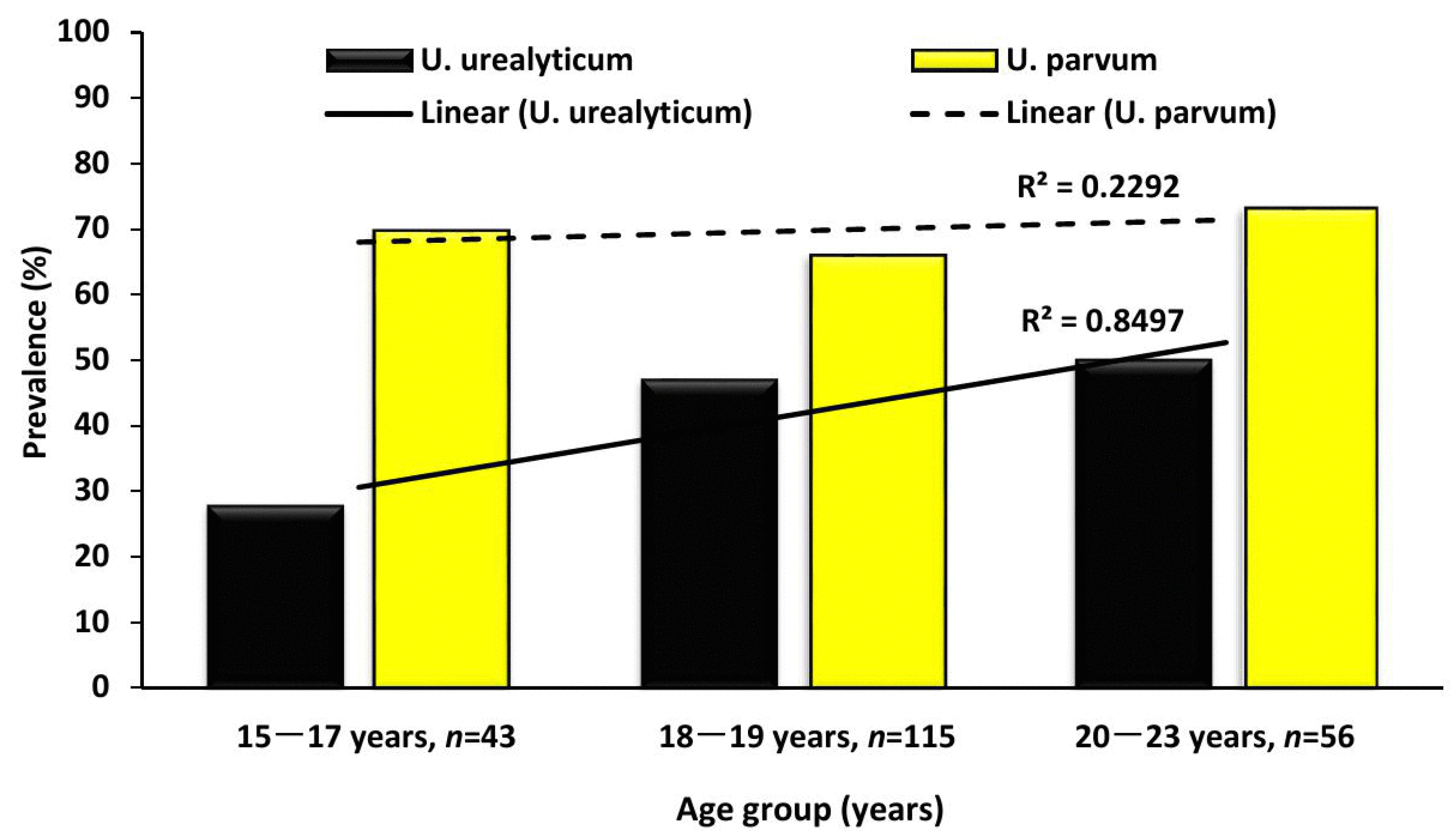
A detailed description of the study participants has been reported previously by Mbulawa et al. [19] and Onywera et al. [11]. In the present analysis, a total of 214 AGYW were retrospectively recruited, with a median age of 18 years (IQR: 18–20 years). U. urealyticum was detected in 43.9% (94/214) of participants, while U. parvum was detected in 68.7% (147/214). The prevalence of U. urealyticum increased with age (p = 0.036, Spearman’s rank correlation coefficient (R2) = 0.8497), while U. parvum was not associated with age (p = 0.652, R2 = 0.2292, Figure 1). A proportion of 26.6% (57/214) had both U. urealyticum and U. parvum, while 42.1% (90/214) had U. parvum only, 17.3% (37/214) had U. urealyticum only, and 14.0% (30/214) were negative for both U. urealyticum and U. parvum.

3.2. Factors Associated with U. urealyticum and U. parvum

When compared with AGYW aged 15–17 years, the prevalence of U. urealyticum was significantly higher among those aged 18–19 years (PR: 1.68, 95% CI: 1.00–2.83, p = 0.046) and 20–23 years (PR: 1.79, 95% CI: 1.04–3.10, p = 0.038). Having 2–3 lifetime sexual partners (PR:1.65, 95% CI: 1.08–2.68, p=0.026) or 4–6 lifetime sexual partners (PR:1.77, 95% CI: 1.04–3.00, p = 0.043) was associated with increased U. urealyticum prevalence compared with having one lifetime sexual partner. Reporting a new sexual partner within the past three months was also associated with increased risk of U. urealyticum (PR: 1.81, 95% CI: 1.01–3.23, p = 0.032). AGYW reporting 4–10 vaginal sexual encounters in the past one month had a 58% higher prevalence of U. urealyticum than those reporting none; however, this difference was not statistically significant. Other characteristics, including the level of education, smoking habits, sexual debut, alcohol use, pregnancy, contraception, and condom use, were not significantly associated with U. urealyticum among AGYW (Table 1). None of the investigated factors was associated with U. parvum among Eastern Cape AGYW.

3.3. U. urealyticum, U. parvum, and HPV Co-Infection Among AGYW

Among AGYW, a proportion of 36.3% (77/212) were co-infected with HPV and U. urealyticum, 39.6% (84/212) were infected with HPV only, 7.5% (16/212) were infected with U. urealyticum only, and 16.5% (35/212) were U. urealyticum and HPV co-negative. The concentration of U. urealyticum, as indicated by the cycle threshold (Ct) value, did not differ between the HPV infected and uninfected participants (median Ct: 27.02 vs. 26.35, p = 0.775). Being U. urealyticum positive was associated with an increased risk of HPV infection compared with being HPV positive among U. urealyticum positive individuals (PR: 1.73, 95% CI: 1.44–2.10, p < 0.0001).
For U. parvum, 52.7% (116/212) of AGYW were co-infected with HPV, 21.2% (45/212) were HPV positive only, 14.6% (31/212) were U. parvum positive only, and 9.4% (20/212) were U. parvum and HPV co-negative. The concentration of U. parvum did not differ between the HPV infected and uninfected AGYW. There was no increased risk of being HPV infected among U. parvum positives than to be U. parvum positive among HPV positive individuals (PR: 1.10, 95% CI: 0.96–1.25, p = 0.186).
The majority of AGYW were co-infected with U. parvum/U. urealyticum and HPV (68.4%, 145/212), followed by U. parvum/U. urealyticum only (17.9%, 38/212), HPV only (7.5%, 16/212), and negative for both bacteria and HPV (6.1%, 13/212). HPV positive AGYW were more likely to be positive for U. parvum/U. urealyticum (90.1%, 145/161) than HPV negative (74.5%, 38/51; PR: 1.21, 1.05–1.48, p = 0.009). Similarly, participants positive for U. parvum/U. urealyticum were more likely to be HPV positive (79.2%, 145/183) than those negative for U. parvum/U. urealyticum (55.2%, 16/29; PR: 1.44, 95% CI: 1.09–2.12, p = 0.009). Multiple HPV infections were common among U. urealyticum-positive participants (p = 0.012) and U. parvum-/U. urealyticum-positive participants (p = 0.002) than negatives. In addition, infection with HR-HPV types and probable HR/LR HPV types were common among the U. parvum-/U. urealyticum-positives than the negatives (p = 0.040, Table 2).
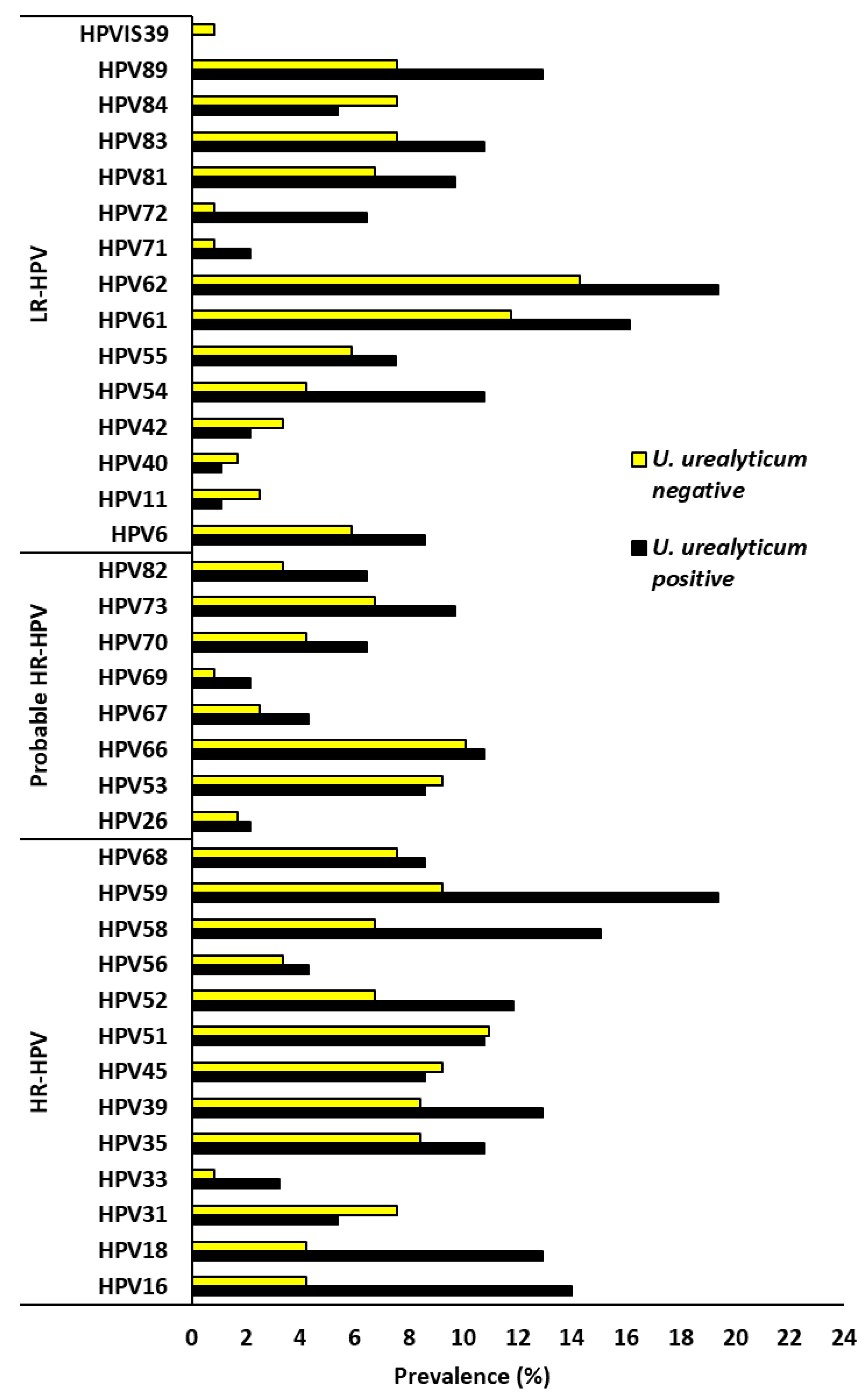
The overall HPV genotype distribution according to U. urealyticum positive and negative status is presented in Figure 2. The prevalence of all the HR-HPV types was higher among U. urealyticum-positive AGYW compared with the negatives. In contrast, several LR-HPV and probable HR-HPV types were more prevalent among U. urealyticum-negative AGYW than the positives; specifically, HPV-11, -40, -42, -53, and -84 (Figure 2). Among U. urealyticum-positive AGYW, the five most dominant HPV types were HPV-59 and -62 (19.4% each), HPV-61 (16.1%), HPV-58 (15.1%), HPV-16 (14.0%), and HPV-89, -18, and -39 (12.9% each). In U. urealyticum-negative AGYW, the distribution of the five most dominant HPV types varied, with HPV-62 (14.3%), HPV-61 (11.8%), HPV-51 (10.9%), HPV-66 (10.1%), and HPV-45, -53, and -59 (9.2% each, Figure 2).
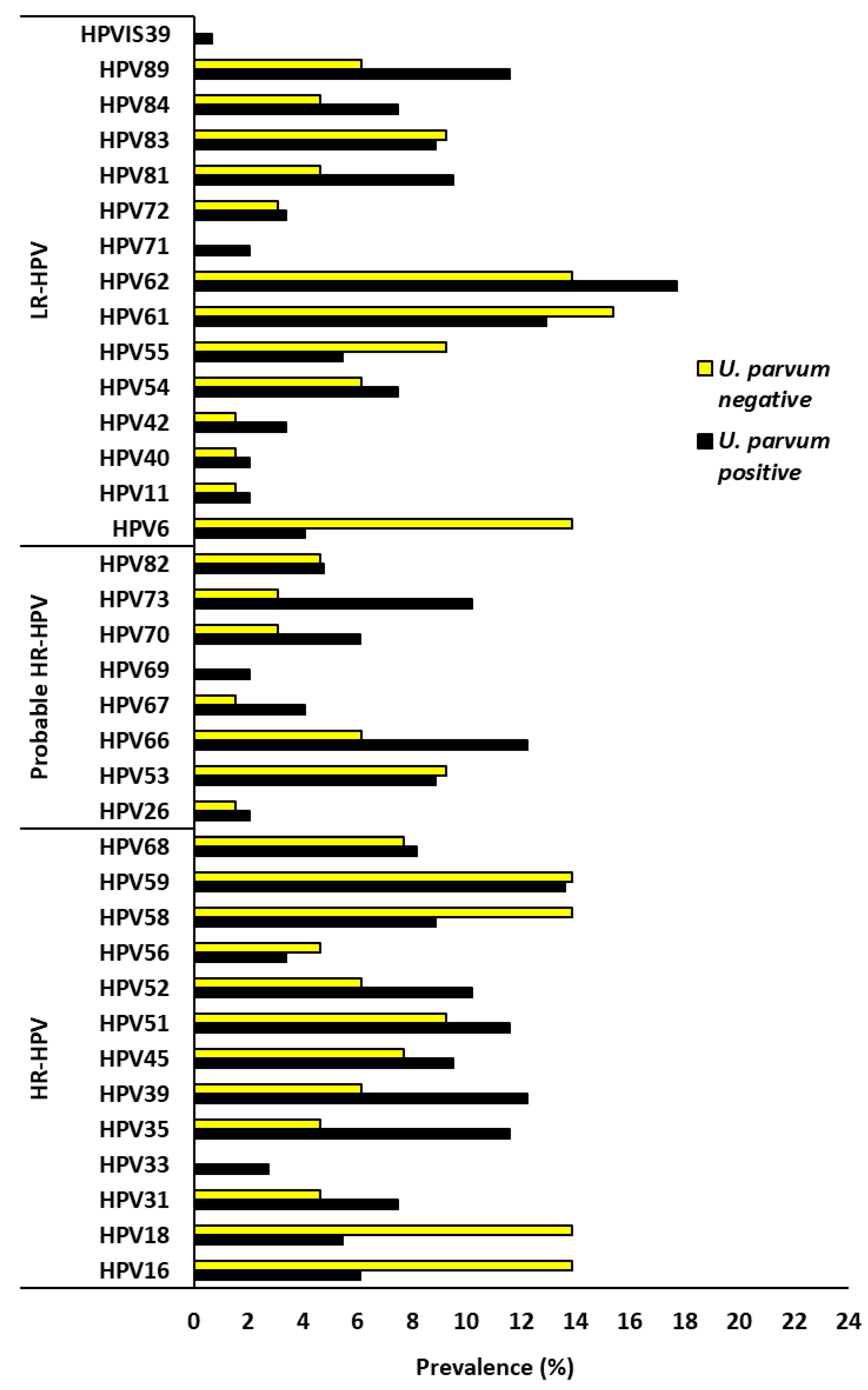
The overall HPV genotype distribution according to U. parvum positive and negative status is presented in Figure 3. The prevalence of several HPV types was higher among U. parvum-negative AGYW compared with positives; specifically, HPV-6, -16, -18, -53, -55, -58, -59, -61, and -83 (Figure 3). Among U. parvum-positive AGYW, the five most dominant HPV types were HPV-62 (17.7%), HPV-59 (13.6%), HPV-61 (12.9%), HPV-66 and -39 (12.2%), and HPV-35, -51, and -89 (11.6% each). In contrast, among U. parvum-negative AGYW, the five most dominant HPV were HPV-61 (15.4%), HPV-6, 16, -18, -58, -59, and -62 (13.8% each), HPV-51, -53, -55 and -83 (9.2% each), HPV-45 and -68 (7.7%) and HPV-39, -52, -54 and -66 (6.2% each, Figure 3).

3.4. Impact of Ureaplasma urealyticum and Ureaplasma parvum on HPV Types Targeted by Current HPV Vaccines

U. urealyticum-positive AGYW had a significantly higher risk of HPV types targeted by the Cervarix® (GlaxoSmithKline Biologicals S.A., Rixensart, Belgium) HPV vaccine (HPV-16 and/or -18) compared with U. urealyticum-negative AGYW (PR: 2.56, 95% CI: 1.23–5.37, p = 0.013). Similarly, the risk was higher for HPV types targeted by the Gardasil®4 HPV vaccine (HPV-6, -11, -16 and/or -18; PR: 2.16, 95% CI: 1.25–3.75, p = 0.006) and Gardasil®9 HPV vaccine (HPV-6, -11, -16, -18, -31, -33, -45, -52 and/or -58; PR: 1.70, 95% CI: 1.25–2.32, p = 0.001). In addition, U. urealyticum-positive AGYW had more than a two-fold increased risk of HPV-16 (PR: 3.33), HPV-18 (PR: 3.07), HPV-33 (PR: 3.84), and HPV-58 infections (PR: 2.24, Table 3).
In contrast, U. parvum-positive AGYW had a lower risk of HPV types targeted by the Cervarix® HPV vaccine (HPV-16 and/or -18) than U. parvum-negative AGYW (PR: 0.48, 95% CI: 0.24–0.95, p = 0.044). No statistically significance difference observed for HPV types targeted by the Gardasil®4 (Merck Sharp & Dohme LLC, West Point, PA, USA) HPV vaccine (HPV-6, -11, -16 and/or -18; PR: 0.64, 95% CI: 0.38–1.09, p = 0.103) and Gardasil®9 HPV vaccine (HPV-6, -11, -16, -18, -31, -33, -45, -52 and/or -58; PR: 1.10, 95% CI: 0.80–1.56, p = 0.654). In addition, U. parvum-positive AGYW had a significantly lower risk of HPV-6 infection (PR: 0.29, 95% CI: 0.11–0.77, p = 0.018).

3.5. Factors Associated with Ureaplasma urealyticum and HPV Co-Infection Among AGYW

To investigate factors associated with U. urealyticum and HPV coinfection, only participants who were U. urealyticum and HPV co-infected and co-negative were included in the analysis. AGYW aged 18–19 years had a higher prevalence of U. urealyticum and HPV coinfection compared with those aged 15–17 years (PR: 1.54, 95% CI: 1.05–2.57, p = 0.037). The risk of U. urealyticum and HPV coinfection increased with the number of lifetime sexual partners; two lifetime sexual partners (PR: 1.56, 95% CI: 1:0.8–2.49, p = 0.031) and 3–6 lifetime sexual partners (PR: 1.59, 95% CI: 1.10–2.53, p = 0.017). An increasing number of new sexual partners in the past 3 months was also associated with U. urealyticum and HPV coinfection (two partners: PR: 1.96, 95% CI: 1.19–3.99, p = 0.005; 2–4 partners: PR: 2.14, 95% CI: 1.19–2.42, p = 0.021). It was interesting to note that the increasing frequency of vaginal sexual intercourse in the past 1-month was associated with U. urealyticum and HPV coinfection (2–3 vaginal intercourse: PR: 1.54, 95% CI: 1.06–2.53, p = 0.037; 4–10 vaginal intercourse: PR: 1.91, 95% CI: 1.83–1.91, p = 0.005). AGYW who reported ever consuming alcohol had a higher risk of U. urealyticum and HPV coinfection (PR: 1.85, 95% CI: 1.20–3.28, p = 0.004, Table 4).
When AGYW with either U. urealyticum or HPV were also included in the investigation of factors associated with U. urealyticum and HPV coinfection, an increasing number of sexual partners in the past 3 months was associated with U. urealyticum and HPV co-infection (1 partner: PR: 1.56, 95% CI: 0.93–2.71, p = 0.025; 2–4 partners: PR: 2.56, 95% CI: 1.16–5.87, p = 0.024). Additionally, engaging in vaginal sexual intercourse 4–10 times in the past 1-month was associated with co-infection (PR: 2.08, 95% CI: 1.10–3.92, p = 0.035, Table 4).

4. Discussion

According to our knowledge, this is the first study to report on U. urealyticum, U. parvum, and HPV co-infection among AGYW in the Eastern Cape, South Africa, and to explore the potential association of U. urealyticum and U. parvum with HPV genotype distribution. A high burden of U. urealyticum and U. parvum colonization was observed among South African AGYW. These findings are consistent with previous reports from sub-Saharan Africa and other low- and middle-income countries, where Ureaplasma species prevalence among sexually active young women often exceeds 40% [5,20,21]. The consistently higher prevalence of U. parvum compared with U. urealyticum across all age groups in this study aligns with global epidemiological patterns, where U. parvum is more predominant and is considered a commensal organism of the female genital tract. In contrast, U. urealyticum prevalence tends to increase with age among adolescents and young adults, likely reflecting cumulative sexual exposure and behavioral risk factors [22,23]. An increasing number of new sexual partners in the past three months and over a lifetime was associated with U. urealyticum and its coinfection with HPV, highlighting the influence of sexual behavior on the acquisition of both pathogens [9,24]. This age-related trend underscores adolescence and early adulthood as a critical period for sexual health interventions aimed at reducing the acquisition and transmission of genital infections.
The high prevalence of Ureaplasma species, particularly U. urealyticum, and its coinfection with HPV among AGYW in the Eastern Cape, has important public health implications. Although the pathogenicity of U. urealyticum and U. parvum is controversial, these organisms have been implicated in adverse reproductive outcomes, including pelvic inflammatory disease, infertility, bacterial vaginosis, and preterm birth [22,25]. Ureaplasma species and HPV may increase reproductive system damage, potentially complicating conception and the maintenance of a healthy pregnancy [21,25,26]. Therefore, the high prevalence of Ureaplasma species and HPV coinfection could pose a future reproductive health challenge for the AGYW who desire to become pregnant and have healthy children in the future.
Persistent high-risk HPV infection is strongly associated with the development of cervical, vaginal, and vulvar cancers [27]; the burden of cervical HPV infection and related cancers is high in South Africa [13,28]. Although U. urealyticum may not be directly cause cervical squamous intraepithelial lesions and cervical cancer, it may contribute indirectly by inducing inflammation, suppressing local immune responses, and disrupting the normal vaginal microbiota. These effects can increase HPV acquisition, reduce HPV clearance, prolong HPV persistence, and create a genital environment conducive to the development and progress of cervical squamous intraepithelial lesions [9,17,29,30]. U. urealyticum may also reduce the abundance of protective Lactobacillus crispatus at the genital tract, potentially leading to the production of carcinogenic metabolites and further promoting carcinogenesis [31,32,33,34]. The asymptomatic nature of Ureaplasma infections complicates its diagnosis and timely treatment, while antimicrobial resistance and the absence of standardized treatment guidelines present additional clinical challenges [35]. However, prevention, early detection, and effective management of Ureaplasma infections and HPV could reduce the indicated undesired health outcomes, particularly in high-burden settings like South Africa. The HPV genotype distribution shift among women coinfected with Ureaplasma species has been reported [10,24]. This was also observed among the HPV types targeted by the current commercial HPV vaccines. The high prevalence of Ureaplasma species and their HPV coinfection may challenge the HPV and cervical cancer prevention and therapeutic strategies.
The use of molecular-based methods to detect U. urealyticum, U. parvum, and HPV represents a major strength of the study. However, several limitations should be acknowledged. The cross-sectional design precludes causal inferences, and reliance on self-reported sexual behavior, which may be affected by social desirability bias. Additional limitations include the use of self-collected specimens, the relatively small sample size, and the homogeneity of the study population, which may restrict the generalizability of the findings. The study did not assess clinical symptoms or antimicrobial susceptibility, which could provide further insight into the clinical relevance and management of these infections. Despite these limitations, the data generated remains important for the Eastern Cape Province and South Africa. It is acknowledged that the study population is not a representative of the whole Eastern Cape Province or South African AGYW; therefore, data generalization may not apply.

5. Conclusions

In conclusion, a high prevalence of U. urealyticum and U. parvum and their coinfection with HPV was observed among adolescent girls and young women in the Eastern Cape Province. The association of U. urealyticum with increased prevalence of HPV genotypes targeted by current vaccines highlights the importance of considering bacterial coinfections in HPV epidemiology. Sexual behavior factors were significantly associated with infection risk, emphasizing the need for targeted sexual health education and integrated STI screening programs. Data from this study could contribute to the design of sexual health and STI interventions and could serve as a baseline for future epidemiological studies, which include ongoing surveillance of HPV genotype prevalence to evaluate the impact and effectiveness of HPV vaccination programs in the population.
Large-scale observational and longitudinal studies are needed to clarify the natural history and clinical impact of Ureaplasma species in adolescent girls and young women in sub-Saharan Africa. Such studies would also establish causal relationships and elucidate the biological mechanisms underlying interactions between U. urealyticum and HPV. Data generated from this study will contribute to the limited U. urealyticum, U. parvum, and HPV coinfection data among South African adolescent girls and young women.

Author Contributions

Conceptualization, Z.Z.A.M.; methodology, Z.Z.A.M.; software, Z.Z.A.M. and S.K.; validation, Z.Z.A.M.; formal analysis, S.K. and Z.Z.A.M.; investigation, S.K. and Z.Z.A.M.; resources, Z.Z.A.M.; data curation, Z.Z.A.M.; writing—original draft preparation, S.K. and Z.Z.A.M.; writing—review and editing, S.K. and Z.Z.A.M.; visualization, Z.Z.A.M.; supervision, Z.Z.A.M.; project administration, Z.Z.A.M.; funding acquisition, Z.Z.A.M. All authors have read and agreed to the published version of the manuscript.

Funding

This research was supported by the South African Medical Research Council (SAMRC) through Self-Initiated Research (SIR) Grants Programme (SIR: 384709) and the National Health Laboratory Service Research Trust. The content and findings reported/illustrated are the sole deduction, view and responsibility of the researcher and do not reflect the official position and sentiments of the SAMRC.

Institutional Review Board Statement

Permission to conduct this research in the Eastern Cape was granted by the University of Cape Town Human Research Ethics Committee (HREC: 369/2015), Walter Sisulu University Human Research Ethics Committee (HREC: 044/2020), and the Eastern Cape Department of Health Research [EC_2016RP29_562], approval date is 1 December 2024.. The Provincial Departments of Health and Education in the Eastern Cape granted the investigators permission to conduct this study. Participation in the study was voluntary, and written informed consent and parental assent were obtained for participants under 18 years of age.

Informed Consent Statement

Informed consent was obtained from all subjects involved in the study.

Data Availability Statement

The original contributions presented in this study are included in the article. Further inquiries can be directed to the corresponding author.

Acknowledgments

We acknowledge the study participants, the Office of the Department of Education’s Social Support Service, and the Department of Health, Ngcobo sub-district.

Conflicts of Interest

The authors declare no conflicts of interest. The funders had no role in the design of the study; in the collection, analyses, or interpretation of data; in the writing of the manuscript; or in the decision to publish the results.

Abbreviations

The following abbreviations are used in this manuscript:
AGYWAdolescent Girls and Young Women
CIConfidence Interval
HIVHuman Immunodeficiency Virus
HPVHuman Papillomavirus
HRHigh Risk
HSVHerpes Simplex Virus
LRLow Risk
PCRPolymerase Chain Reaction
PRPrevalence Ratio
STISexually Transmitted Infection
UPUreaplasma parvum
UUUreaplasma urealyticum
WHOWorld Health Organization

References

  1. Dawood, A.; Algharib, S.A.; Zhao, G.; Zhu, T.; Qi, M.; Delai, K.; Hao, Z.; Marawan, M.A.; Shirani, I.; Guo, A. Mycoplasmas as host pantropic and specific pathogens: Clinical implications, gene transfer, virulence factors, and future perspectives. Front. Cell. Infect. Microbiol. 2022, 12, 855731. [Google Scholar]
  2. Fernández-Huerta, M.; Barberá, M.J.; Serra-Pladevall, J.; Esperalba, J.; Martínez-Gómez, X.; Centeno, C.; Pich, O.Q.; Pumarola, T.; Espasa, M. Mycoplasma genitalium and antimicrobial resistance in Europe: A comprehensive review. Int. J. STD AIDS 2020, 31, 190–197. [Google Scholar] [CrossRef]
  3. Lobão, T.N.; Campos, G.; Selis, N.; Amorim, A.T.; Souza, S.; Mafra, S.; Pereira, L.; Dos Santos, D.; Figueiredo, T.; Marques, L. Ureaplasma urealyticum and U. parvum in sexually active women attending public health clinics in Brazil. Epidemiol. Infect. 2017, 145, 2341–2351. [Google Scholar] [CrossRef] [PubMed]
  4. Silwedel, C.; Laube, M.; Speer, C.P.; Glaser, K. The role of Ureaplasma species in prenatal and postnatal morbidity of Preterm infants: Current concepts. Neonatology 2024, 121, 627–635. [Google Scholar] [CrossRef] [PubMed]
  5. Mukavhanyedzi, D.; Rukasha, I. Sexually transmitted pathogens in asymptomatic women at Rethabile clinic, Limpopo, South Africa. South. Afr. J. Infect. Dis. 2024, 39, 618. [Google Scholar] [CrossRef] [PubMed]
  6. Zidi, S.; Almawi, W.Y.; Abassi, S. Genital mycoplasma infections: A hidden factor in cervical cancer progression? A systematic review and meta-analysis. BMC Infect. Dis. 2025, 25, 1120. [Google Scholar] [CrossRef] [PubMed]
  7. Matos, M.S.; Silva, M.C.A.T.d.; Brito, M.B.; Gonçalves, A.K. Clinical and uterine cervix characteristics of women with Mycoplasma and Ureaplasma in genital discharge. Rev. Da Assoc. Médica Bras. 2024, 70, e20240045. [Google Scholar] [CrossRef]
  8. Cutoiu, A.; Boda, D. Prevalence of Ureaplasma urealyticum, Mycoplasma hominis and Chlamydia trachomatis in symptomatic and asymptomatic patients. Biomed. Rep. 2023, 19, 74. [Google Scholar] [CrossRef]
  9. Li, Y.; Liao, Z.; Wang, Q.; He, W.; Deng, Y.; Liu, C. Prevalence of Chlamydia trachomatis, Neisseria gonorrhoeae, and Ureaplasma urealyticum infections in males and females of childbearing age in Chengdu, China. Front. Cell. Infect. Microbiol. 2025, 15, 1566163. [Google Scholar]
  10. Taku, O.; Brink, A.; Meiring, T.L.; Phohlo, K.; Businge, C.B.; Mbulawa, Z.Z.; Williamson, A.-L. Detection of sexually transmitted pathogens and co-infection with human papillomavirus in women residing in rural Eastern Cape, South Africa. PeerJ 2021, 9, e10793. [Google Scholar] [CrossRef]
  11. Onywera, H.; Mabunda, S.A.; Williamson, A.-L.; Mbulawa, Z.Z. Microbiological and behavioral determinants of genital HPV infections among adolescent girls and young women warrant the need for targeted policy interventions to reduce HPV risk. Front. Reprod. Health 2022, 4, 887736. [Google Scholar] [CrossRef]
  12. Bray, F.; Laversanne, M.; Sung, H.; Ferlay, J.; Siegel, R.L.; Soerjomataram, I.; Jemal, A. Global cancer statistics 2022: GLOBOCAN estimates of incidence and mortality worldwide for 36 cancers in 185 countries. CA A Cancer J. Clin. 2024, 74, 229–263. [Google Scholar] [CrossRef] [PubMed]
  13. Bruni, L.; Albero, G.; Serrano, B.; Mena, M.; Collado, J.J.; Gómez, D.; Muñoz, J.; Bosch, F.; de Sanjosé, S. ICO/IARC Information Centre on HPV and Cancer (HPV Information Centre). Human Papillomavirus and Related Diseases in South Africa. Summ. Rep. 2023. Available online: https://hpvcentre.net/statistics/reports/ZAF.pdf (accessed on 8 November 2025).
  14. Delany-Moretlwe, S.; Kelley, K.F.; James, S.; Scorgie, F.; Subedar, H.; Dlamini, N.R.; Pillay, Y.; Naidoo, N.; Chikandiwa, A.; Rees, H. Human papillomavirus vaccine introduction in South Africa: Implementation lessons from an evaluation of the national school-based vaccination campaign. Glob. Health Sci. Pract. 2018, 6, 425–438. [Google Scholar] [CrossRef] [PubMed]
  15. Botha, M.; Mabenge, M.; Makua, M.; Mbodi, M.; Rogers, L.; Sebitloane, M.; Smith, T.; Van der Merwe, F.; Williamson, A.; Whittaker, J. Cervical Cancer Screening Guidelines for South Africa. Afr. J. Obstet. Gynaecol. 2023, 1, 27–31. [Google Scholar]
  16. Noma, I.H.Y.; Shinobu-Mesquita, C.S.; Suehiro, T.T.; Morelli, F.; De Souza, M.V.F.; Damke, E.; Da Silva, V.R.S.; Consolaro, M.E.L. Association of Righ-Risk Human Papillomavirus and Ureaplasma parvum Co-Infections with Increased Risk of Low-Grade Squamous Intraepithelial Cervical Lesions. Asian Pac. J. Cancer Prev. 2021, 22, 1239–1246. [Google Scholar] [CrossRef]
  17. Mardhia, M.; Yasmon, A.; Indarti, J.; Rachmadi, L. Role of Ureaplasma urealyticum and Ureaplasma parvum as Risk Factors for Cervical Dysplasia with Human Papillomavirus. J. Pure Appl. Microbiol. 2023, 17, 1691–1699. [Google Scholar] [CrossRef]
  18. Ye, H.; Song, T.; Zeng, X.; Li, L.; Hou, M.; Xi, M. Association between genital mycoplasmas infection and human papillomavirus infection, abnormal cervical cytopathology, and cervical cancer: A systematic review and meta-analysis. Arch. Gynecol. Obstet. 2018, 297, 1377–1387. [Google Scholar] [CrossRef]
  19. Mbulawa, Z.Z.A.; Somdyala, N.I.; Mabunda, S.A.; Williamson, A.-L. High human papillomavirus prevalence among females attending high school in the Eastern Cape Province of South Africa. PLoS ONE 2021, 16, e0253074. [Google Scholar] [CrossRef]
  20. Urszula, K.; Joanna, E.; Marek, E.; Beata, M.; Magdalena, S.B. Colonization of the lower urogenital tract with Ureaplasma parvum can cause asymptomatic infection of the upper reproductive system in women: A preliminary study. Arch. Gynecol. Obstet. 2014, 289, 1129–1134. [Google Scholar] [CrossRef]
  21. Moodley, C.; Tootla, H.; Amien, I.; Engel, M.E. Evaluating the utility of the Allplex STI Essential Assay to determine the occurrence of urogenital sexually transmitted infections among symptomatic and asymptomatic patients in Cape Town, South Africa. PLoS ONE 2023, 18, e0292534. [Google Scholar] [CrossRef]
  22. Sprong, K.E.; Mabenge, M.; Wright, C.A.; Govender, S. Ureaplasma species and preterm birth: Current perspectives. Crit. Rev. Microbiol. 2020, 46, 169–181. [Google Scholar] [CrossRef] [PubMed]
  23. Rak, K.; Kiecka, A.; Białecka, J.; Kawalec, A.; Krzyściak, P.; Białecka, A. Retrospective analysis of the ureaplasma spp. Prevalence with reference to other genital tract infections in women of reproductive age. Pol. J. Microbiol. 2022, 71, 509. [Google Scholar] [CrossRef] [PubMed]
  24. Choi, S.H.; Jin, H.; Lee, K.E. Prevalence of sexually transmitted pathogen coinfections in high risk-human papillomaviruses infected women in Busan. Biomed. Sci. Lett. 2019, 25, 390–397. [Google Scholar] [CrossRef]
  25. Liu, W.; Yang, T.; Kong, Y.; Xie, X.; Ruan, Z. Ureaplasma infections: Update on epidemiology, antimicrobial resistance, and pathogenesis. Crit. Rev. Microbiol. 2025, 51, 317–347. [Google Scholar] [CrossRef]
  26. Ardekani, O.S.; Letafati, A.; Dehkordi, S.E.; Farahani, A.V.; Bahari, M.; Mahdavi, B.; Ariamand, N.; Taghvaei, M.; Kohkalani, M.; Pirkooh, A.A. From infection to infertility: A review of the role of human papillomavirus-induced oxidative stress on reproductive health and infertility. Eur. J. Med. Res. 2025, 30, 339. [Google Scholar] [CrossRef]
  27. Cruz-Gregorio, A.; Aranda-Rivera, A.K.; Pedraza-Chaverri, J. Human papillomavirus-related cancers and mitochondria. Virus Res. 2020, 286, 198016. [Google Scholar] [CrossRef]
  28. Dhokotera, T.; Asangbeh, S.; Bohlius, J.; Singh, E.; Egger, M.; Rohner, E.; Ncayiyana, J.; Clifford, G.M.; Olago, V.; Sengayi-Muchengeti, M. Cervical cancer in women living in South Africa: A record linkage study of the National Health Laboratory Service and the National Cancer Registry. Ecancermedicalscience 2022, 16, 1348. [Google Scholar] [CrossRef]
  29. Zheng, M.; Zhao, H.; Di, J.; Lin, G.; Lin, Y.; Lin, X.; Zheng, M. Association of human papillomavirus infection with other microbial pathogens in gynecology. Zhonghua Fu Chan Ke Za Zhi 2010, 45, 424–428. [Google Scholar]
  30. Zhang, W.; Ge, Y.; Shi, N.; Guo, C.; Ruan, J.; Alalawy, A.I.; Yao, L.; Liu, G.; Liu, B.; 30. Insight into the Complex Interaction between Vaginal Microbiome, Metabolome, and Host Gene Expression in Cervical Cancer Progression. Metabolome Host Gene Expr. Cerv. Cancer Progress 2024. [Google Scholar] [CrossRef]
  31. Mitra, A.; MacIntyre, D.A.; Lee, Y.S.; Smith, A.; Marchesi, J.R.; Lehne, B.; Bhatia, R.; Lyons, D.; Paraskevaidis, E.; Li, J.V.; et al. Cervical intraepithelial neoplasia disease progression is associated with increased vaginal microbiome diversity. Sci. Rep. 2015, 5, 16865. [Google Scholar] [CrossRef]
  32. Vimal, J.; Himal, I.; Kannan, S. Role of microbial dysbiosis in carcinogenesis & cancer therapies. Indian J. Med. Res. 2020, 152, 553–561. [Google Scholar]
  33. Kyrgiou, M.; Mitra, A.; Moscicki, A.-B. Does the vaginal microbiota play a role in the development of cervical cancer? Transl. Res. 2017, 179, 168–182. [Google Scholar] [CrossRef]
  34. Farag, M.A.E.; Morad, A.W.A.; Azzazi, A.; Fayed, S.M.; Eldin, A.K.Z. Association between genital mycoplasma and cervical squamous cell atypia. Middle East Fertil. Soc. J. 2013, 18, 241–245. [Google Scholar] [CrossRef]
  35. Abavisani, M.; Keikha, M. Global analysis on the mutations associated with multidrug-resistant urogenital mycoplasmas and ureaplasmas infection: A systematic review and meta-analysis. Ann. Clin. Microbiol. Antimicrob. 2023, 22, 70. [Google Scholar] [CrossRef]
Figure 1. Age-stratified prevalence of Ureaplasma urealyticum and Ureaplasma parvum among Eastern Cape adolescent girls and young women.
Microbiolres 17 00003 g001
Figure 2. Prevalence of human papillomavirus (HPV) genotype distribution according to Ureaplasma urealyticum status among adolescent girls and young women of Eastern Cape Province, South Africa.
Microbiolres 17 00003 g002
Figure 3. Prevalence of human papillomavirus (HPV) genotype distribution according to Ureaplasma parvum status among adolescent girls and young women of Eastern Cape Province, South Africa.
Microbiolres 17 00003 g003
Table 1. Factors associated with Ureaplasma urealyticum among adolescent girls and young women of Eastern Cape Province, South Africa.
CharacteristicsTotalU. urealyticumPR (95% CI)p-Value
Nn%
Age (years)
15–17 years431227.9Reference
18–19 years1155447.01.68 (1.00–2.83)0.046
20–23 years562850.01.79 (1.04–3.10)0.038
Ever smoke
No1778145.8Reference
Yes371335.10.77 (0.47–1.17)0.277
Sexual debut, years
≤15 years854148.2Reference
16–17 years1295240.30.84 (0.61–1.13)0.263
Number of lifetime sexual partnersΣ
1501530.0Reference
2–31175849.61.65 (1.08–2.68)0.026
4–6341852.91.77 (1.04–3.00)0.043
Number of new sexual partners past 3 monthsΣ
033927.3Reference
11427049.31.81 (1.01–3.23)0.032
2–4261246.21.69 (0.84–3.39)0.174
Frequency of vaginal sexual intercourse past 1 month
0441534.1Reference
1552443.61.28 (0.77–2.13)0.409
2–3783848.71.43 (0.89–2.29)0.132
4–10261453.81.58 (0.92–2.72)0.135
Ever consumed alcohol Σ
No391333.3Reference
Yes1758146.31.39 (0.91–2.30)0.157
Drunk during last sexual intercourseΣ
No1898545.0Reference
Yes12650.01.11 (0.62–2.00)0.772
Ever pregnant Σ
No1677041.9Reference
Yes472451.11.22 (0.85–1.66)0.319
Currently on contraception Σ
No642640.6Reference
Yes1366547.81.18 (0.83–1.66)0.365
Condom use during last intercourse Σ
No1245947.6Reference
Yes773241.60.87 (0.63–1.21)0.467
Σ: Some participants are non-responders in this section. Therefore, the total number of participants decreased from the original 214. Reference: Comparator group. The p-value bolded indicates significance. PR: Prevalence Ratios.
Table 2. Effect of Ureaplasma urealyticum and Ureaplasma parvum on human papillomavirus prevalence among adolescent girls and young women of Eastern Cape Province.
U. urealyticumU. parvumU. urealyticum or parvum
Positive
% (n/93)
Negative
% (n/119)
p-ValuePositive
% (n/147)
Negative
% (n/65)
p-ValuePositive
% (n/183)
Negative
% (n/29)
p-Value
HPV infection82.8 (77)70.6 (84)0.05278.9 (116)69.2 (45)0.16379.2 (145)55.2 (16)0.009
Multiple HPV infection67.7 (63)50.4 (60)0.01262.6 (92)47.7 (31)0.05062.3 (114)31.0 (9)0.002
1 HPV type15.1 (14)20.2 (24)0.37116.3 (24)21.5 (14)0.43716.9 (31)24.1 (7)0.433
2 HPV types14.0 (13)16.0 (19)0.84714.3 (21)15.4 (10)0.83513.7 (25)17.2 (5)0.573
3 HPV types17.2 (16)10.9 (13)0.22816.3 (24)9.2 (6)0.20415.3 (28)3.4 (1)0.141
4–10 HPV types36.6 (34)23.5 (28)0.04832.0 (47)23.1 (15)0.25232.8 (60)10.3 (3)0.015
HR-HPV66.7 (62)55.5 (66)0.12061.9 (91)56.9 (37)0.54463.4 (116)41.4 (12)0.040
Probable HR/LR-HPV69.9 (65)56.3 (67)0.04768.0 (100)53.8 (35)0.06367.2 (123)37.9 (11)0.003
HR-HPV: High-risk human papillomavirus, LR-HPV: Low-risk human papillomavirus. The p-value bolded indicates significance.
Table 3. The association of Ureaplasma urealyticum and Ureaplasma parvum on human papillomavirus types targeted by current commercial human papillomavirus vaccines.
Ureaplasma urealyticum Ureaplasma parvum
HPV Vaccine/Type % (n)PR (95% CI)p-Value % (n)PR (95% CI)p-Value
Cervarix®UU neg7.6 (9/119)Reference UP neg20.0 (13/65)Reference
Cervarix®UU pos19.4 (18/93)2.56 (1.23–5.37)0.013 UP pos9.5 (14/147)0.48 (0.24–0.95)0.044
Gardasil4®UU neg13.4 (16/119)Reference UP neg27.7 (18/65)Reference
Gardasil4®UU pos29.0 (27/93)2.16 (1.25–3.75)0.006 UP pos17.7 (26/147)0.64 (0.38–1.09)0.103
Gardasil9®UU neg33.6 (40/119)Reference UP neg41.5 (27/65)Reference
Gardasil9®UU pos57.0 (53/93)1.70 (1.25–2.32)0.001 UP pos45.6 (67/147)1.10 (0.80–1.56)0.654
HPV6UU neg5.6 (7/119)Reference UP neg13.8 (9/65)Reference
HPV6UU pos8.6 (8/93)1.46 (0.57–3.75)0.591 UP pos4.1 (6/147)0.29 (0.11–0.77)0.018
HPV11UU neg2.5 (3/119)Reference UP neg1.5 (1/65)Reference
HPV11UU pos1.1 (1/93)0.43 (0.06–2.92)0.633 UP pos2.0 (3/147)1.33 (0.20–9.20)>0.999
HPV16UU neg4.2 (5/119)Reference UP neg13.8 (9/65)Reference
HPV16UU pos14.0 (13/93)3.33 (1.28–8.71)0.013 UP pos6.1 (9/147)0.44 (0.19–1.04)0.105
HPV18UU neg4.2 (5/119)Reference UP neg13.8 (9/65)Reference
HPV18UU pos12.9 (12/93)3.07 (1.17–8.13)0.024 UP pos5.4 (8/147)0.39 (0.16–0.95)0.053
HPV31UU neg7.6 (9/119)Reference UP neg4.6 (3/65)Reference
HPV31UU pos5.4 (5/93)0.71 (0.26–1.95)0.588 UP pos7.5 (11/147)1.62 (0.51–5.31)0.558
HPV33UU neg0.9 (1/119)Reference UP neg0.0 (0/65)
HPV33UU pos3.2 (3/93)3.84 (0.56–26.56)0.323 UP pos2.7 (4/147)
HPV45UU neg9.2 (11/119)Reference UP neg7.7 (5/65)Reference
HPV45UU pos8.6 (8/93)1.28 (0.59–2.76)0.651 UP pos9.5 (14/147)1.24 (0.49–3.22)0.798
HPV52UU neg6.7 (8/119)Reference UP neg6.2 (4/65)Reference
HPV52UU pos11.8 (11/93)1.76 (0.76–4.10)0.230 UP pos10.2 (15/147)1.66 (0.61–4.65)0.440
HPV58UU neg6.7 (8/119)Reference UP neg13.8 (9/65)Reference
HPV58UU pos15.1 (14/93)2.24 (1.01–5.02)0.068 UP pos8.8 (13/147)0.64 (0.30–1.41)0.329
Cervarix® HPV vaccine: HPV-16 and/or -18. Gardasil®4 HPV types: HPV-6, -11, -16, and/or -18. Gardasil®9 HPV types: HPV-6, -11, -16, -18, -31, -33, -45, -52, and/or -58. UU: Ureaplasma urealyticum; UP: Ureaplasma parvum; pos: positive; neg: Negative. Reference: Comparator group. The p-value bolded indicates significance. PR: Prevalence Ratios.
Table 4. Factors among Ureaplasma urealyticum and human papillomavirus co-infected and uninfected adolescent girls and young women of Eastern Cape Province, South Africa.
CharacteristicsTotalUU-HPV Co-InfectedPR (95% CI)p-Value
NN%
Age
15–17231147.8Reference
18–19614573.81.54 (1.05–2.57)0.037
20–23282175.01.57 (1.01–2.65)0.080
Ever smoke
No956568.4Reference
Yes171270.61.03 (0.67–1.35)>0.999
Sexual debut, years
≤15 years533464.2Reference
16–17 years584272.41.13 (0.87–1.48)0.415
Number of lifetime sexual partnersΣ
1261350.0Reference
2413278.01.56 (1.08–2.49)0.031
3–6393179.51.59 (1.10–2.53)0.017
Number of new sexual partners past 3 months; median (IQR)Σ
015640.0Reference
1745878.41.96 (1.19–3.99)0.005
2–4141285.72.14 (1.19–2.42)0.021
Frequency of vaginal sexual intercourse in the past 1 month
0211152.4Reference
1291965.51.25 (0.79–2.13)0.393
2–3413380.51.54 (1.06–2.53)0.037
4–101313100.01.91 (1.83–1.91)0.005
Ever consumed alcohol Σ
No22940.9Reference
Yes906875.61.85 (1.20–3.28)0.004
Drunk during last sexual intercourse Σ
No947074.5Reference
Yes9666.70.90 (0.47–1.23)0.694
Ever pregnant Σ
No835667.5Reference
Yes292172.41.07 (0.78–1.37)0.816
Currently on contraception Σ
No292172.4Reference
Yes755674.71.03 (0.82–1.41)0.808
Condom use during last intercourse Σ
No654975.4Reference
Yes382771.10.94 (0.71–1.19)0.649
UU: Ureaplasma urealyticum. Σ: Some participants are non-responders in this section. The p-value bolded indicates significance. Reference: Comparator group. PR: Prevalence Ratios.
Disclaimer/Publisher’s Note: The statements, opinions and data contained in all publications are solely those of the individual author(s) and contributor(s) and not of MDPI and/or the editor(s). MDPI and/or the editor(s) disclaim responsibility for any injury to people or property resulting from any ideas, methods, instructions or products referred to in the content.