


Abstract
Matricaria pubescens (Desf.), a medicinal plant belonging to the Asteraceae family, is traditionally used in southeastern Morocco but remains insufficiently studied. In this study, samples collected from the Zagora region (Morocco) were subjected to the preparation of aqueous, methanolic, and petroleum ether extracts, followed by qualitative phytochemical screening. Total phenolic, flavonoid, and condensed tannin contents were quantified. Antioxidant activity was assessed using DPPH, RPC, and ABTS assays, whereas antimicrobial activity was evaluated against eight bacterial and fungal species, including antibiotic-resistant strains, using disc diffusion and microdilution techniques. Qualitative analysis revealed the presence of alkaloids, polyphenols, flavonoids, tannins, sterols, and sesquiterpenes, with notable variation across extracts. The aqueous (AqE) and methanol–water (MT-H2O) extracts were particularly rich in phenolics and flavonoids, recording 9.15 ± 0.29 mg GAE/g DW and 17.1 ± 0.55 mg QE/g DW, respectively. Antioxidant assays showed strong activity, with IC50 values ranging from 3.15 to 5.48 µg/mL (DPPH) and 9.10 to 14.40 µg/mL (ABTS). The MT-H2O extract also displayed potent antimicrobial effects against eight microbial species (bacteria and fungi), with minimum inhibitory concentrations between 0.93 and 30 mg/mL, except for Pseudomonas aeruginosa. These findings highlight the untapped potential of M. pubescens from Zagora as a source of antioxidant and anti-resistance agents, providing new insights for green medicine and future pharmacological research.
1. Introduction
The use of plants by humans dates back millennia and encompasses various sectors, including pharmacology, cosmetics, and nutrition [1]. Medicinal plants play a central role in the discovery of new pharmacologically relevant molecules, which are essential for the development of next-generation drugs [2]. According to estimates by the World Health Organization, medicinal plants constitute the primary source of healthcare for approximately 80% of the global population [3]. Due to their rich content of bioactive compounds, they exhibit a wide range of therapeutic properties, including anti-inflammatory, antiviral, analgesic, antimalarial, and anticancer activities [4]. Since their discovery, antibiotics have been extensively used in human and veterinary medicine, leading to the development of multiple classes of natural, semi-synthetic, and synthetic, that act selectively against specific bacteria through various mechanisms of action [5]. However, since the 1950s, the widespread use of antimicrobials has dramatically increased selective pressure, fostering the rapid emergence and dissemination of antibiotic-resistant bacteria. Typically, resistant strains appeared within three to five years following the clinical introduction of a new agent. This phenomenon is particularly evident for broad-spectrum antimicrobials such as tetracyclines, aminoglycosides, macrolides, and β-lactams, which are widely used across human and veterinary medicine, horticulture, and aquaculture [6]. Among the most alarming pathogens for public health are members of the Enterobacteriaceae, Pseudomonadaceae, and Acinetobacter families, which frequently exhibit resistance to commonly used antibiotics [7]. In this context, the search for effective natural antimicrobial agents has become imperative to counteract the growing spread of antibiotic resistance [8].
Matricaria pubescens (Desf.), belonging to the Asteraceae family and the genus Matricaria, which includes approximately 130 species [9], is endemic to the arid environments of North Africa [10,11]. Traditionally, this species has been used to treat gastrointestinal disorders, gallstones, and dysmenorrhea. It is also known for its effectiveness in alleviating cough, eye diseases, kidney disorders, rheumatism, pain relief, and scorpion stings. Moreover, its antiseptic properties have been well documented [12,13,14]. The phytochemical profile of M. pubescens is characterized by a remarkable richness and diversity of bioactive compounds. Among the most prominent are essential oils, flavonoids, phenolic acids, coumarins, and saponins [15]. These secondary metabolites are considered to be responsible for the various therapeutic effects attributed to this plant, particularly its antioxidant and antibacterial activities [16]. Although previous studies have investigated the phytochemical composition and biological activities of M. pubescens, several gaps remain. Specifically, comparative analyses of extracts obtained using different solvents, evaluation of bioactive compound content, and assessment of activity against clinically relevant antibiotic-resistant strains have not been systematically addressed, particularly for Moroccan populations.
In this context, our study aims to provide new insights into the pharmacological potential of M. pubescens from southeastern Morocco by characterizing its phytochemical profile and evaluating its antioxidant potential and antimicrobial effects, particularly against antibiotic-resistant microorganisms associated with nosocomial infections. Therefore, this study aims to provide novel insights into the pharmacological potential of M. pubescens by evaluating its phytochemical composition, antioxidant activity, and antimicrobial effects, including on antibiotic-resistant bacterial strains.
2. Materials and Methods
2.1. Plant Material
M. pubescens (Desf.), a herbaceous species belonging to the Asteraceae family, is native to North African flora and well adapted to the arid and semi-arid ecosystems of the Sahara. Locally referred to as “El Ouazouaza,” the plant is traditionally used for various therapeutic purposes. Aerial parts of M. pubescens were harvested during the flowering stage (April–May 2024) from Tamegroute located in the province of Zagora (Latitude: 30.250028, Longitude: −5.679229; Altitude: 654 m), southeastern Morocco. The collected specimens were shade-dried at ambient temperature to prevent degradation of bioactive compounds. Once dried, the plant material was ground into a fine powder using an electric grinder and stored in clean paper bags under dry, dark conditions at 4 °C until extraction.
2.2. Extract Preparation
Two extraction techniques were employed to obtain crude extracts from the plant material:
- Aqueous Decoction: 5 g of powdered herbal material were boiled in 500 mL of distilled water for 15 min. The decoction was then filtered, and the filtrate was evaporated to dryness [17].
- Organic Solvent Maceration: 50 g of powdered plant material was immersed in 500 mL of either methanol–water (70:30, v/v) or petroleum ether–water (70:30, v/v). The mixtures were kept at room temperature (estimated at 25 ± 2 °C) and shielded from light for 48 h while being continuously stirred at around 50 rpm. After filtering the resultant mixes, a rotary evaporator (BUCHI Rotavapor R-210 characterized by V-700 vacuum pump, Flawil, Switzerland) was used to concentrate the filtrates to dryness at 40 °C and reduced pressure. After that, the dried extracts were kept at −20 °C until they could be examined further [18].
2.3. Determination of Extraction Yield
The extraction yield (%) of the crude extracts was evaluated based on the subsequent equation:
where the mass of dry extract refers to the weight obtained after complete solvent evaporation, and the initial mass corresponds to the amount of plant powder used in the extraction [19].
Extraction yield = (Mass of dry extract (g)/Initial mass of plant material (g)) × 100
2.4. Phytochemical Analysis of Matricaria pubescens Extracts
2.4.1. Preliminary Phytochemical Screening
A preliminary phytochemical selection was directed to recognize the major classes of secondary metabolites present in the three different extracts (aqueous, methanolic, and petroleum ether) obtained from the aerial parts of M. pubescens. The following phytochemical groups were tested: polyphenols, saponins, alkaloids, flavonoids, tannins, quinones, anthraquinones, phytosterols, sesquiterpenes, and terpenes [20,21,22,23,24,25].
2.4.2. Quantitative Phytochemical Assays
- ➢
- Total Phenolic Content (TPC)
The Folin–Ciocalteu colorimetric technique was exploited to verify the total phenolic content. At 765 nm, absorbance was assessed with a UV-Vis spectrophotometer (UV-6300PC). Milligrams of gallic acid equivalents per gram of dry extract were used to express the results [26].
- ➢
- Condensed Tannin Content (TC)
Condensed tannins were quantified spectrophotometrically at 500 nm, built on the vanillin–HCl method illustrated by Xu and Chang [27]. The findings were expressed as milligrams of catechin counterparts per gram of dry matter.
- ➢
- Total Flavonoid Content (TFC)
The colorimetric technique with aluminum chloride was used to determine the total flavonoid concentration. The absorbance at 510 nm was measured. Quercetin equivalents in milligrams per gram of dry matter were used to express the results [28].
2.5. Antioxidant Activity
The antioxidant potential of the extracts was evaluated employing multiple complementary assays to investigate different mechanisms of antioxidant action. A series of concentrations (200, 100, 50, 25, 12.5, 6.25, 3.125, and 1.562 μg/mL) was tested for each extract (aqueous, hydro-methanolic, and petroleum ether-aqueous). All experimentations were executed in triplicate, and the effects were expressed as percentage inhibition (% inhibition, PI) and half-maximal inhibitory concentration (IC50). The antioxidant potential of butylated hydroxytoluene (BHT) was also assessed as an indication standard and related to that of the plant extracts.
2.5.1. Radical Scavenging Assay (DPPH)
The free radical scavenging ability of M. pubescens extracts was established by applying the stable radical 2,2-diphenyl-1-picrylhydrazyl (DPPH), corresponding to the method depicted by Von Gadow et al. [29]. The absorbance of the reaction mixtures was determined at 517 nm. The percentage of DPPH inhibition was calculated to estimate antioxidant efficiency.
2.5.2. Reducing Power Capacity (RPC)
Using Oyaizu’s approach [30], the reducing power was assessed by their capacity to convert ferric ions (Fe3+) to ferrous ions (Fe2+). At 700 nm, the absorbance of the reaction mixture was measured. Stronger reducing power and hence more antioxidant potential are indicated by higher absorption.
2.5.3. ABTS Radical Cation Decolorization Assay
Using the methodology of Li et al. [26], the ABTS (2,2′-azino-bis (3-ethylbenzothiazoline-6-sulfonic acid)) radical scavenging activity was evaluated. The measurement of absorbance took place at 734 nm. When compared to BHT, the antioxidant capability was represented as a percentage of ABTS radical inhibition.
2.6. Evaluation of Antimicrobial Activity
2.6.1. Microbial Strains
Eight microbial species were tested, including six bacterial strains: Pseudomonas aeruginosa (ATCC 9027), Bacillus subtilis subsp. spizizenii (ATCC 6633), Salmonella abony (NCTC 6017), Escherichia coli (ATCC 8739), Staphylococcus aureus (ATCC 6538), and Klebsiella pneumoniae. Two fungal strains were also included: Trichophyton rubrum and Candida albicans (ATCC 10231).
2.6.2. Antimicrobial Activity
Two methods were employed to assess the antimicrobial potential of M. pubescens extracts:
- ➢
- Disc Diffusion Method
The disc diffusion assay was used to assess the antimicrobial activity of fungal strains on Sabouraud agar and of bacterial strains on Mueller-Hinton agar. The inoculated agar plates were covered with sterile paper discs (6 mm in diameter) impregnated with 7 µL of extracts (30 mg/mL prepared in 10% DMSO solution). To guarantee uniform diffusion of the extract into the agar medium, the Petri dishes were kept at 4 °C for 30 min before incubation (37 °C for 24 h for bacteria and 30 °C for 48 h for fungi). The sizes of the inhibitory zones were measured following incubation. All tests were conducted in triplicate [31].
Control treatments included:
- Negative control: 10% DMSO.
- Positive control: Fluconazole (at 25 µg/disc) for fungi and Imipenem (at 10 µg/disc) for bacteria.
Microbial sensitivity was interpreted according to the classification proposed by Ponce et al. [32]:
- Not sensitive: inhibition zone diameter < 8 mm.
- Sensitive: 9–14 mm.
- Very sensitive: 15–19 mm.
- ➢
- Broth Microdilution Method
In sterile 96-well flat-bottom microplates, the broth microdilution method was used to determine the Minimum Inhibitory Concentration (MIC) and Minimum Fungicidal Concentration (MFC). The effectiveness of the methanolic extract in the disc diffusion test led to its selection.
A stock solution (30 mg/mL) was prepared in 10% DMSO. 100 µL of this solution was added to the first well containing 100 µL of appropriate growth medium (Mueller-Hinton broth for bacteria and Sabouraud broth for fungi). A two-fold serial dilution was performed across the wells, ranging from 30 mg/mL to 0.234 mg/mL. Subsequently, 30 µL of microbial suspension was added to each well.
The following controls were included:
- Negative control: medium + microorganism + DMSO.
- Positive control: medium + microorganism + Imipenem or Fluconazole.
- Growth control: medium + microorganism (no extract).
After incubation (37 °C for 24 h for bacteria and 30 °C for 48 h for fungi), 10 µL of 0.01% resazurin solution was added to each well, followed by a further 4 h incubation. The MIC and MFC was defined as the lowest concentration that inhibited microbial growth, indicated by the absence of a colour change [33].
2.7. Statistical Analysis
Data and studied parameters were organized in Excel sheets. Further, the normality of the data was tested. Experimental data were analyzed using SPSS software (version 23.0 for Windows). One-way analysis of variance (ANOVA one way) was performed, followed by Fisher’s Least Significant Difference (LSD) test to compare the means. Statistical significance was set at p < 0.05.
3. Results
3.1. Yield of Crude Extracts from M. pubescens
As shown in Table 1, the extraction yield varied significantly depending on the solvent system used. The aqueous extract exhibited the highest yield (16%), indicating that water was the most efficient solvent for recovering extractable phytochemicals from the aerial parts of M. pubescens. The methanol–water mixture (70:30, v/v) resulted in a slightly lower yield (12%). In contrast, the petroleum ether–water extract (70:30, v/v) yielded only 3.5%, highlighting its limited efficacy due to its non-polar nature.
Table 1.
Yield (%) of crude extracts from the aerial parts of M. pubescens.
3.2. Phytochemical Screening
Qualitative phytochemical analysis (Table 2) revealed differential distribution of secondary metabolites across the extracts. Alkaloids and polyphenols were moderately present in both the aqueous (AqE) and methanol–water (MT-H2O) extracts, while weakly present in the petroleum ether–water extract (PE-H2O). Flavonoids were strongly expressed in MT-H2O, moderately in AqE, and weakly in PE-H2O. Tannins showed weak presence in AqE and MT-H2O but were moderately present in PE-H2O. Quinones and anthraquinones were absent in all extracts. Saponins were detected only in MT-H2O. Phytosterols, sesquiterpenes, and terpenoids were strongly expressed in MT-H2O and PE-H2O but weakly detected in AqE.
Table 2.
Phytochemical screening of M. pubescens extracts.
3.3. Quantification of Bioactive Compounds
3.3.1. Total Phenolic Content
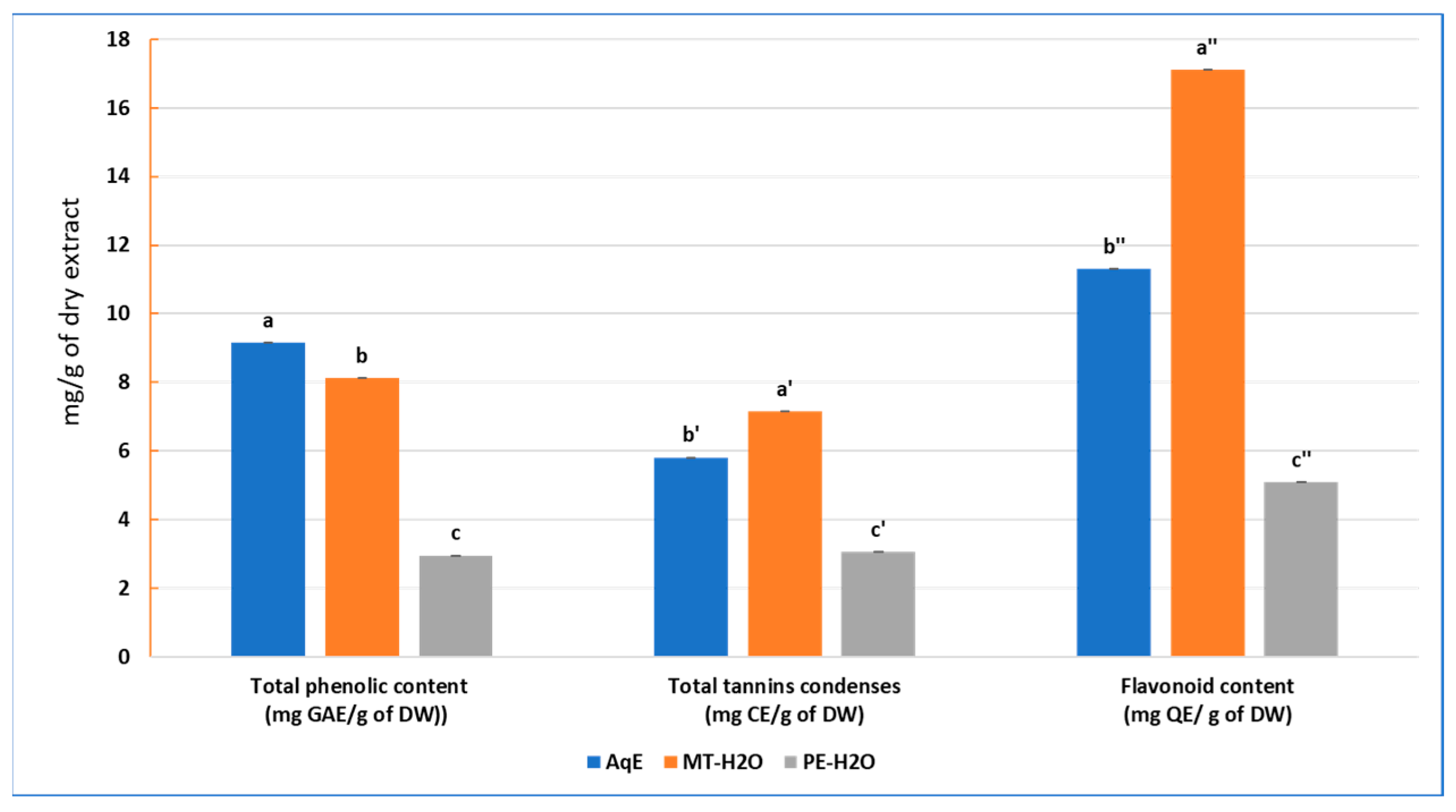
The aqueous extract (AqE) exhibited the highest total phenolic content with 9.15 ± 0.29 mg GAE/g DW, followed by the MT-H2O at 8.12 ± 0.36 mg GAE/g DW. The petroleum ether–aqueous extract (PE-H2O) displayed the lowest value at 4.95 ± 0.11 mg GAE/g DW (Figure 1).
Figure 1.
Analyzing the amounts of phenolic, condensed tannin, and flavonoid in various M. pubescens extracts. Means ± SE sharing similar letters within the same parameter are statistically non-significant at p < 0.05 (LSD).
3.3.2. Condensed Tannins Content
The highest content of condensed tannins was observed in MT-H2O (7.14 ± 0.11 mg CE/g DW), followed by PE-H2O (3.05 ± 0.17 mg CE/g DW), while the lowest value was recorded in AqE (5.81 ± 0.35 mg CE/g DW) (Figure 1).
3.3.3. Total Flavonoid Content
The MT-H2O had the highest flavonoid content (17.1 ± 0.55 mg QE/g DW), followed by the aqueous extract (AqE) at 11.3 ± 0.27 mg QE/g DW. The petroleum ether extract (PE-H2O) had the lowest flavonoid content (5.08 ± 0.31 mg QE/g DW) (Figure 1).
3.3.4. Antioxidant Activity of M. pubescens Extracts
The MT-H2O had the greatest antioxidant ability across all examined extracts, as indicated by the lowest IC50 values throughout the three experiments, according to the antioxidant activity results shown in Table 3.
Table 3.
Antioxidant activity of M. pubescens extracts.
DPPH Radical Scavenging Assay
The IC50 values revealed that MT-H2O had the highest antioxidant activity (3.15 ± 0.04 µg/mL), followed by the aqueous extract (AqE) at 3.82 ± 0.03 µg/mL, and finally the PE-H2O) with the weakest activity (5.48 ± 0.07 µg/mL).
Although MT-H2O demonstrated the best scavenging activity among the plant extracts, it was still less potent than the synthetic antioxidant standard BHT, which exhibited a much lower IC50 value (0.04 ± 0.001 µg/mL).
ABTS Radical Cation Scavenging Assay
This assay evaluates the ability of the extracts to neutralize the ABTS•+ radical cation.
The IC50 values indicated that MT-H2O had the strongest antioxidant activity (7.32 ± 0.06 µg/mL), followed by AqE (9.25 ± 0.10 µg/mL), and PE-H2O with the weakest effect (11.27 ± 0.09 µg/mL). Again, the synthetic antioxidant BHT outperformed all plant extracts, with an IC50 of 0.21 ± 0.002 µg/mL.
Ferric Reducing Power Assay
The Ferric Reducing Power assay measures the ability of the extracts to donate electrons, reducing Fe3+ to Fe2+, and thus reflects their reducing capacity. The MT-H2O showed the highest reducing power (IC50 = 9.1 ± 0.06 µg/mL), followed by AqE (12.23 ± 0.12 µg/mL), while PE-H2O had the lowest activity (13.4 ± 0.08 µg/mL). The BHT standard displayed significantly greater reducing power than all tested extracts, with an IC50 of 2.41 ± 0.13 µg/mL.
3.3.5. Antimicrobial Activity
Disc Diffusion Assay on Agar Medium
The tested M. pubescens extracts, except the petroleum ether extract, demonstrated inhibitory activity against both Gram-positive and Gram-negative bacteria, as well as the yeast and fungal strains. Inhibition zone diameters varied depending on the microbial strain and the type of extract (Table 4). Regarding the antimicrobial potential of extracts from the Zagora site. no inhibitory effect was observed for the PE-H2O extract. Conversely, the hydro-methanolic extract showed the highest efficacy. especially against B. subtilis and S. aureus (Gram-positive), with inhibition zones of 32 mm and 30 mm, respectively. It also exhibited moderate activity against Gram-negative bacteria, with inhibition zones of 10 mm for E. coli and 8 mm for S. abony but was ineffective against P. aeruginosa and K. pneumoniae. On fungal strains, this extract produced inhibition zones of 12 mm for C. albicans and 17 mm for T. rubrum. The aqueous extract exhibited notable antibacterial activity against B. subtilis (12 mm), moderate activity against S. aureus and S. abony (10 mm and 8 mm, respectively), and antifungal effects against C. albicans and T. rubrum, each with an inhibition zone of 10 mm. However, Gram-negative strains were completely resistant to this extract. As shown in Table 4, the non-polar extract (PE-H2O) showed no antimicrobial activity against any of the tested strains.
Table 4.
Disc diffusion assay of M. pubescens extracts against microbial strains.
According to the results of this assay and the sensitivity criteria described by Ponce et al. [32], the susceptibility of the microorganisms to M. pubescens extracts can be interpreted as follows:
- Non-sensitive strains include all those exposed to the petroleum ether extract. Pseudomonas aeruginosa (for all extracts). and Salmonella abony (for PE-H2O and aqueous extracts).
- Sensitive strains include B. subtilis, S. aureus, C. albicans, and T. rubrum for the aqueous extract. and E. coli and C. albicans for the hydro-methanolic extract.
- Highly sensitive strains were limited to B. subtilis, S. aureus, and T. rubrum, in response to the MT-H2O extract.
Minimum Inhibitory Concentration (MIC) and Minimum Fungicidal Concentration (MFC) of M. pubescens
According to the results presented in Table 5, the hydro-methanolic extract exhibited MIC values ranging from 0.93 to 30 mg/mL. S. aureus and B. subtilis subsp. spizizenii showed the highest sensitivity. with identical MICs of 0.93 mg/mL. These were followed by E. coli with an MIC of 7.5 mg/mL. Furthermore. S. abony and K. pneumoniae showed MIC values of 15 mg/mL each. In contrast, P. aeruginosa was the most resistant strain, with the highest MIC recorded at 30 mg/mL. Regarding fungal strains, the results revealed that both C. albicans and T. rubrum exhibited identical MFC values of 7.5 mg/mL.
Table 5.
Minimum Inhibitory Concentration (MIC) and Minimum Fungicidal Concentration (MFC) of the hydro-methanolic extract of M. pubescens (expressed in mg/mL).
4. Discussion
The growing interest in medicinal and aromatic plants is largely due to their abundance of bioactive secondary metabolites, which possess well-recognized therapeutic properties. These natural compounds, produced by plants in response to biotic and abiotic stresses, play crucial roles in defence mechanisms and have demonstrated antioxidant, antimicrobial, anti-inflammatory, and anticancer activities [34,35]. Among such plants, M. pubescens, endemic to the Maghreb, has traditionally been used to treat various ailments. This species is particularly notable for its relatively underexplored chemical composition and biological potential. While previous studies have investigated the chemical composition and biological activities of M. pubescens, the present study provides novel insights by focusing on Moroccan populations collected from the Zagora region, which remain underexplored. The results obtained indicate that the extraction yield of M. pubescens is strongly dependent on the polarity of the solvent used. Water gave the highest yield (16%), which aligns with previous findings for other species in the Matricaria genus. such as M. chamomilla, where water and hydroalcoholic mixtures efficiently extract polar metabolites such as phenolic compounds and flavonoids [36]. Conversely, petroleum ether, a non-polar solvent. gave the lowest yield (<4%), which can be explained by its limited ability to solubilize hydrophilic compounds [37]. Furthermore, it is well established that the extraction and purification of phytochemical and antioxidant compounds depend on multiple factors, including duration, temperature, solvent concentration, and especially the polarity of the solvent used [38]. The phytochemical screening of secondary metabolites confirmed that M. pubescens is rich in bioactive compounds. particularly phenolic compounds and flavonoids. These findings are consistent with previous studies by Dalila et al. [39] and Makhloufi et al. [40], which reported the presence of sterols, steroids, tannins, saponins, flavonoids, and triterpenoid heterosides, but the absence of alkaloids, coumarins, and anthocyanins. However, in contrast to these reports, our analyses revealed the presence of alkaloids, which may be attributed to ecological, climatic, or methodological variations. Moreover, the concentration and detection of secondary metabolites varied significantly depending on the solvent used for extraction. This observation supports the conclusions of Nawaz et al. [37], who highlighted that solvent polarity strongly influences the profile of extracted compounds, and no single solvent can extract all phytochemical constituents from plant material. In addition, the solubility of polyphenol classes varies with solvent polarity: flavonoids are generally more soluble in polar solvents, while non-polar solvents favour the extraction of other polyphenolic compounds. This solubility variability may not only explain the differences in extraction yields but also influence the biological activity, particularly antioxidant activity of the obtained extracts [41]. Based on IC50 values obtained from the three antioxidant assays (DPPH, RPC, and ABTS), the effectiveness of the aerial part extracts of M. pubescens followed the order: MT-H2O > H2O > PE-H2O. The MT-H2O) showed the strongest antioxidant potential, likely due to the wide diversity and high content of chemical compounds it contained, particularly phenolics, Flavonoids, alkaloids, and other secondary metabolites identified in this study. These results agree with previous studies that demonstrated considerable antioxidant properties in this species collected from Algeria [16]. Similarly, other studies have attributed the strong antioxidant potential of hydroalcoholic extracts to their richness in polyphenolic compounds, especially flavonoids and flavonols, and to potential synergistic effects between these molecules [42,43]. In line with this, Shahidi et Ambigaipalan [44] emphasized that total phenolic content is a key factor in determining the antioxidant properties of plant extracts. The antimicrobial activity of M. pubescens extracts was evaluated against eight pathogenic strains using the agar disc diffusion method. Inhibition zones observed around the discs suggested that the tested extracts exerted inhibitory effects. Aqueous and hydro-methanolic extracts demonstrated significant antimicrobial activity against most of the tested microorganisms, except for Pseudomonas aeruginosa and Klebsiella pneumoniae, which appeared to be resistant. The petroleum ether extract showed no antimicrobial effect. These variations can be attributed to the solvent’s polarity and the chemical composition of the extracts, which directly affect the quantity and quality of bioactive metabolites. The methanolic extract, in particular, exhibited strong antibacterial and antifungal activity. The MIC and MFC values, ranged from 0.93 to 30 mg/mL for bacterial strains and 7.5 mg/mL for both fungal strains. In general, Gram-positive bacteria (Bacillus subtilis and Staphylococcus aureus) were more sensitive than Gram-negative bacteria, which is consistent with the findings of Dalila et al. [39], who reported moderate antimicrobial activity of M. pubescens extracts, especially against Gram-positive strains (MIC between 10 and 20 mg/mL). According to Muanda et al. [45], this activity could be attributed to the presence of phenolic compounds, which are known for their antimicrobial properties. As noted by De Rossi et al. [46], phenolic compounds can act through several mechanisms. including enzyme inhibition, interaction with microbial membranes, competition with essential substrates, or sequestration of metal ions required for microbial growth. Moreover, Nisa et al. [47] noted that the absence of antimicrobial activity at low concentrations may be due to insufficient levels of active compounds, which could explain the lack of inhibitory effects observed in certain strains or the inactivity of the petroleum ether extract. Finally, the phytochemical diversity revealed in this study supports the hypothesis that flavonoids and phenolic compounds are primarily responsible for the antimicrobial activity of the extracts. These molecules are capable of disrupting microbial membrane integrity, altering permeability, interfering with intracellular functions [48], and penetrating cells to inhibit metabolic pathways, DNA/RNA synthesis, and protein biosynthesis [49]. The results confirm that the bioactive properties of extracts of this plant provide empirical evidence supporting its traditional use, particularly in the treatment of digestive, genitourinary, and respiratory disorders [12,50,51]. This consistency between biological activity and empirical use highlights the pharmacological potential of this plant species.
5. Conclusions
The present study provides important information regarding the phytochemical profile and bioactive potential of Matricaria pubescens (Desf.), an endemic species of North Africa from the Asteraceae family. collected in southeastern Morocco. Qualitative and quantitative analyses revealed a diverse array of secondary metabolites, including alkaloids, polyphenols, flavonoids, tannins, saponins, sterols, sesquiterpenes, and terpenoids, while quinones and anthraquinones were not detected. The richness in these bioactive compounds correlates with the strong antioxidant and antimicrobial activities observed, particularly against pathogenic strains known for their resistance to conventional antibiotics. These results reveal the health-promoting properties of M. pubescens as a therapeutic agent and validate its traditional use. Further studies, including isolation and characterization of individual compounds, as well as in vivo evaluations, are recommended to fully explore its pharmacological applications.
Author Contributions
E.A. and J.I. did the conceptualization, investigation, methodology, software, visualization, and writing—original draft. S.K. and B.I. did the methodology, writing—review editing. A.-E.-M.M., E.M., E.-H.A. and L.N. did Supervision and validation. All authors have read and agreed to the published version of the manuscript.
Funding
This research received no external funding.
Institutional Review Board Statement
Not applicable.
Informed Consent Statement
Not applicable.
Data Availability Statement
The data used to support the findings of this study are included in this article.
Acknowledgments
The authors express their gratitude to the Faculty of Sciences and Technologies, Errachidia, Moulay Ismaïl University of Meknes, Morocco, for its valuable resources and unwavering support.
Conflicts of Interest
Authors do not have any conflicts of interest to declare.
References
- Roosta, R.A.; Moghaddasi, R.; Hosseini, S.S. Export target markets of medicinal and aromatic plants. J. Appl. Res. Med. Aromat. Plants 2017, 7, 84–88. [Google Scholar] [CrossRef] [Scilit]
- Aware, C.B.; Patil, D.N.; Suryawanshi, S.S.; Mali, P.R.; Rane, M.R.; Gurav, R.G.; Jadhav, J.P. Natural bioactive products as promising therapeutics: A review of natural product-based drug development. S. Afr. J. Bot. 2022, 151, 512–528. [Google Scholar] [CrossRef] [Scilit]
- Napagoda, M.; Wijesundara, D. Medicinal plants as sources of novel therapeutics: The history, present, and future. Chem. Nat. Prod. Phytochem. Pharm. Med. Plants 2022, 3, 4–18. [Google Scholar]
- Aye, M.M.; Aung, H.T.; Sein, M.M.; Armijos, C. A review on the phytochemistry, medicinal properties and pharmacological activities of 15 selected Myanmar medicinal plants. Molecules 2019, 24, 293. [Google Scholar] [CrossRef] [Scilit]
- Muteeb, G.; Rehman, M.T.; Shahwan, M.; Aatif, M. Origin of antibiotics and antibiotic resistance, and their impacts on drug development: A narrative review. Pharmaceuticals 2023, 16, 1615. [Google Scholar] [CrossRef] [Scilit]
- Rana, M.S.; Hur, S.J. Antibiotics in livestock and their effects on human health: Mini review. Resour. Sci. Res. 2022, 4, 12–20. [Google Scholar] [CrossRef] [Scilit]
- Chaudhary, A.S. A review of global initiatives to fight antibiotic resistance and recent antibiotics’ discovery. Acta Pharm. Sin. B 2016, 6, 552–556. [Google Scholar] [CrossRef] [Scilit]
- Rudramurthy, G.R.; Swamy, M.K.; Sinniah, U.R.; Ghasemzadeh, A. Nanoparticles: Alternatives against drug-resistant pathogenic microbes. Molecules 2016, 21, 836. [Google Scholar] [CrossRef] [Scilit]
- Maiza, K.; de La Perrière, R.B.; Hammiche, V. Pharmacopée traditionnelle saharienne: Sahara septentrional. In Proceedings of the 2nd European Symposium on Ethnopharmacology and the 11th International Conference on Ethnomedicine, Heidelberg, Germany, 24–27 March 1993; ORSTOM: Marseille, France; pp. 24–27. [Google Scholar]
- Ozenda, P. Flore et Végétation du Sahara, 3rd ed.; CNRS: Paris, France, 1991; p. 662.
- Maiza, K.; Hammiche, V.; Maiza Benabdesselam, F. Traditional medicine in North Sahara: The “Deffi”. Life Sci. Leafl. 2011, 6, 551–560. [Google Scholar]
- Ben-Moussa, M.T.B.; Hadef, Y.; Bouncer, H.; Oudjehih, M.; Beichi, F.; Aouidane, S.; Benaldjia, H. Enquête ethnobotanique sur Matricaria pubescens (Desf.) Schultz (Asteraceae) auprès de la population des régions sud-est d’Algérie. Thérapeutique 2020, 35, 1–17. [Google Scholar]
- Taibi, K.; Abderrahim, L.A.; Boussaid, M.; Taibi, F.; Achir, M.; Souana, K.; Benaissa, T.; Farhi, K.H.; Naamani, F.Z.; Said, K.N. Unraveling the ethnopharmacological potential of medicinal plants used in Algerian traditional medicine for urinary diseases. Eur. J. Integr. Med. 2021, 4, 101333. [Google Scholar] [CrossRef] [Scilit]
- Elhasnaoui, A.; Janah, I.; El-Haidani, A.; Lahrach, N. Medicinal knowledge and ethnopharmacological applications of Matricaria pubescens (Desf.) Sch.Bip in the Draa-Tafilalet region, Morocco. Ethnobot. Res. Appl. 2025, 30, 1–9. [Google Scholar] [CrossRef] [Scilit]
- Elhasnaoui, A.; Janah, M.; Ait Tastift, M.; El-Haidani, A.; Lahrach, N. Comprehensive review on Matricaria pubescens: Traditional uses, chemical composition, and pharmacological potential. Sci. Afr. 2025, 29, e02865. [Google Scholar] [CrossRef] [Scilit]
- Metrouh-Amir, H.; Duarte, C.M.; Maiza, F. Solvent effect on total phenolic contents, antioxidant, and antibacterial activities of Matricaria pubescens. Ind. Crops Prod. 2015, 67, 249–256. [Google Scholar] [CrossRef] [Scilit]
- Sqalli, H.; El Ouarti, A.; Ennabili, A.; Ibnsouda, S.; Farah, A.; Haggoud, A.; Houari, A.; Iraqui, M. Évaluation de l’effet antimycobactérien de plantes du centre-nord du Maroc. Bull. Pharm. Sci. 2007, 146, 271–288. [Google Scholar]
- Durazzo, A.; Lucarini, M.; Souto, E.B.; Cicala, C.; Caiazzo, E.; Izzo, A.A.; Novellino, E.; Santini, A. Polyphenols: A concise overview on the chemistry, occurrence, and human health. Phytother. Res. 2019, 33, 2221–2243. [Google Scholar] [CrossRef] [Scilit]
- Bimakr, M.; Rahman, R.A.; Taip, F.S.; Ganjloo, A.; Salleh, L.M.; Selamat, J.; Hamid, A.; Zaidul, I.S.M. Comparison of different extraction methods for the extraction of major bioactive flavonoid compounds from spearmint (Mentha spicata L.) leaves. Food Bioprod. Process. 2011, 89, 67–72. [Google Scholar] [CrossRef] [Scilit]
- Bolliger, H.R.; Brenner, M.; Gänshirt, H.; Mangold, H.K.; Seiler, H.; Stahl, E.; Waldi, D. Spray reagents for thin-layer chromatography. In Thin-Layer Chromatography: A Laboratory Handbook; Stahl, E., Ed.; Springer: Berlin/Heidelberg, Germany, 1965; pp. 483–502. [Google Scholar]
- Finar, I.L. Stereochemistry and Chemistry of Natural Products, 2nd ed.; Longman: Singapore, 1986; p. 682. [Google Scholar]
- Evans, W.C.; Trease, G.E. Trease and Evans’ Pharmacognosy, 14th ed.; W.B. Saunders: London, UK, 1996. [Google Scholar]
- Kokate, C.K. Practical Pharmacognosy; Vallabh Prakashan Publication: New Delhi, India, 1999; p. 115. [Google Scholar]
- Bruneton, J. Pharmacognosie—Phytochimie, Plantes Médicinales, 4th ed.; Revue et Augmentée; Lavoisier, Tec & Doc—Éditions Médicales Internationales: Paris, France, 2009; p. 1288. [Google Scholar]
- Chaouche, T.; Haddouchi, F.; Bekkara, F.A. Phytochemical study of roots and leaves of the plant Echium pycnanthum Pomel. Der Pharm. Lett. 2011, 3, 1–4. [Google Scholar]
- Li, H.B.; Wong, C.C.; Cheng, K.W.; Chen, F. Antioxidant properties in vitro and total phenolic contents in methanol extracts from medicinal plants. LWT Food Sci. Technol. 2008, 41, 385–390. [Google Scholar] [CrossRef] [Scilit]
- Xu, B.J.; Chang, S.K. A comparative study on phenolic profiles and antioxidant activities of legumes as affected by extraction solvents. J. Food Sci. 2007, 72, S159–S166. [Google Scholar] [CrossRef] [Scilit]
- Ayyobi, N.; Fattahi, M. Induction effects of colchicine and chitosan on rosmarinic acid production in hairy root cultures of Zarrin-Giah (Dracocephalum kotschyi Boiss). Iran. J. Biol. 2017, 30, 1–13. [Google Scholar]
- Von Gadow, A.; Joubert, E.; Hansmann, C.F. Comparison of the antioxidant activity of aspalathin with that of other plant phenols of rooibos tea (Aspalathus linearis), α-tocopherol, BHT, and BHA. J. Agric. Food Chem. 1997, 45, 632–638. [Google Scholar] [CrossRef] [Scilit]
- Oyaizu, M. Studies on products of browning reaction: Antioxidative activities of products of browning reaction prepared from glucosamine. Jpn. J. Nutr. Diet. 1986, 44, 307–315. [Google Scholar] [CrossRef] [Scilit]
- Boussaada, O.; Ammar, S.; Saidana, D.; Chriaa, J.; Chraif, I.; Daami, M.; Helal, A.N.; Mighri, Z. Chemical composition and antimicrobial activity of volatile components from capitula and aerial parts of Rhaponticum acaule DC growing wild in Tunisia. Microbiol. Res. 2008, 163, 87–95. [Google Scholar] [CrossRef] [Scilit] [PubMed]
- Ponce, A.G.; Fritz, R.; Del Valle, C.; Roura, S.I. Antimicrobial activity of essential oils on the native microflora of organic Swiss chard. LWT Food Sci. Technol. 2003, 36, 679–684. [Google Scholar] [CrossRef] [Scilit]
- Mann, C.M.; Markham, J.L. A new method for determining the minimum inhibitory concentration of essential oils. J. Appl. Microbiol. 1998, 84, 538–544. [Google Scholar] [CrossRef] [Scilit]
- Yeshi, K.; Crayn, D.; Ritmejerytė, E.; Wangchuk, P. Plant secondary metabolites produced in response to abiotic stresses have potential application in pharmaceutical product development. Molecules 2022, 27, 313. [Google Scholar] [CrossRef] [Scilit]
- Hilal, B.; Khan, M.M.; Fariduddin, Q. Recent advancements in deciphering the therapeutic properties of plant secondary metabolites: Phenolics, terpenes, and alkaloids. Plant Physiol. Biochem. 2024, 211, 108674. [Google Scholar] [CrossRef] [Scilit] [PubMed]
- Temerdashev, Z.A.; Chubukina, T.K.; Vinitskaya, E.A.; Kiseleva, N.V. Chromatographic assessment of the concentration of phenolic compounds in wild chamomile (Matricaria chamomilla L.) extracts obtained under various extraction conditions. J. Anal. Chem. 2023, 78, 497–506. [Google Scholar] [CrossRef] [Scilit]
- Nawaz, H.; Shad, M.A.; Rehman, N.; Andaleeb, H.; Ullah, N. Effect of solvent polarity on extraction yield and antioxidant properties of phytochemicals from bean (Phaseolus vulgaris) seeds. Braz. J. Pharm. Sci. 2020, 56, e17129. [Google Scholar] [CrossRef] [Scilit]
- Hosseini, H.; Bolourian, S.; Yaghoubi Hamgini, E.; Ghanuni Mahababadi, E. Optimization of heat- and ultrasound-assisted extraction of polyphenols from dried rosemary leaves using response surface methodology. J. Food Process Preserv. 2018, 42, e13778. [Google Scholar] [CrossRef] [Scilit]
- Dalila, G.; Abdelkader, A.; Reda, B.A.; Moufida, H.; Djamila, M. Phytochemical screening and evaluation of antibacterial and antifungal properties of extracts of Matricaria pubescens (Desf) growing in southwest Algeria. Egypt. Acad. J. Biol. Sci. C Physiol. Mol. Biol. 2022, 14, 511–515. [Google Scholar] [CrossRef] [Scilit]
- Makhloufi, A.; Moussaoui, A.; Lazouni, H.A. Antibacterial activities of essential oil and crude extracts from Matricaria pubescens (Desf.) growing wild in Bechar, southwest of Algeria. J. Med. Plant Res. 2012, 6, 3124–3128. [Google Scholar]
- Palaiogiannis, D.; Chatzimitakos, T.; Athanasiadis, V.; Bozinou, E.; Makris, D.P.; Lalas, S.I. Successive solvent extraction of polyphenols and flavonoids from Cistus creticus L. leaves. Oxygen 2023, 3, 274–286. [Google Scholar] [CrossRef] [Scilit]
- Vermerris, W.; Nicholson, R. Isolation and identification of phenolic compounds: A practical guide. In Phenolic Compound Biochemistry; Springer: Dordrecht, The Netherlands, 2006; pp. 151–196. [Google Scholar]
- González-Montelongo, R.; Lobo, M.G.; González, M. Antioxidant activity in banana peel extracts: Testing extraction conditions and related bioactive compounds. Food Chem. 2010, 119, 1030–1039. [Google Scholar] [CrossRef] [Scilit]
- Shahidi, F.; Ambigaipalan, P. Phenolics and polyphenolics in foods, beverages and spices: Antioxidant activity and health effects—A review. J. Funct. Foods 2015, 18, 820–897. [Google Scholar] [CrossRef] [Scilit]
- Muanda, F.N. Identification de Polyphénols, Evaluation de Leur Activité Antioxydante et Etude de Leurs Propriétés Biologiques. Ph.D. Thesis, Université Paul Verlaine-Metz, Metz, France, 2010. [Google Scholar]
- De Rossi, L.; Rocchetti, G.; Lucini, L.; Rebecchi, A. Antimicrobial potential of polyphenols: Mechanisms of action and microbial responses—A narrative review. Antioxidants 2025, 14, 200. [Google Scholar] [CrossRef] [Scilit]
- Nisa, L.; Landis, B.N.; Giger, R.; Leuchter, I. Pharyngolaryngeal involvement by varicella-zoster virus. J. Voice 2013, 27, 636–641. [Google Scholar] [CrossRef] [Scilit] [PubMed]
- Oulahal, N.; Degraeve, P. Phenolic-rich plant extracts with antimicrobial activity: An alternative to food preservatives and biocides? Front. Microbiol. 2022, 12, 753518. [Google Scholar] [CrossRef] [Scilit]
- Górniak, I.; Bartoszewski, R.; Króliczewski, J. Comprehensive review of antimicrobial activities of plant flavonoids. Phytochem. Rev. 2019, 18, 241–272. [Google Scholar] [CrossRef] [Scilit]
- Elhasnaoui, A.; Janah, I.; Amssayef, A.; Haidani, A.; Lahrach, N. Ethnopharmacological survey of medicinal plants used in traditional treatment of respiratory system disorders in the Southeast region of Morocco. Plant Sci. Today 2024, 11. [Google Scholar] [CrossRef] [Scilit]
- Elhasnaoui, A.; Janah, I.; El Bouny, H.E.; Amssayef, A.; Haidani, A.; Lahrach, N. Medicinal plants used in the treatment of urogenital disorders in the Drâa-Tafilalet region of Southeastern Morocco: An ethnobotanical survey. Sci. Afr. 2024, 26, e02464. [Google Scholar] [CrossRef] [Scilit]


Disclaimer/Publisher’s Note: The statements, opinions and data contained in all publications are solely those of the individual author(s) and contributor(s) and not of MDPI and/or the editor(s). MDPI and/or the editor(s) disclaim responsibility for any injury to people or property resulting from any ideas, methods, instructions or products referred to in the content. |
© 2025 by the authors. Licensee MDPI, Basel, Switzerland. This article is an open access article distributed under the terms and conditions of the Creative Commons Attribution (CC BY) license (https://creativecommons.org/licenses/by/4.0/).