
Article

Obstacle Avoidance for Vehicle Platoons in I-VICS: A Safety-Centric Approach Using an Improved Potential Field Method

1
School of Transportation Engineering, Chang’an University, Xi’an 710064, China
2
China Communications Construction Company First Highway Consultants Co., Ltd., Xi’an 710075, China
3
School of Automobile, Chang’an University, Xi’an 710064, China
*
Author to whom correspondence should be addressed.
World Electr. Veh. J. 2026, 17(1), 7; https://doi.org/10.3390/wevj17010007
Submission received: 12 November 2025 / Revised: 16 December 2025 / Accepted: 20 December 2025 / Published: 22 December 2025
(This article belongs to the Section Automated and Connected Vehicles)

Abstract

Based on an enhanced artificial potential field approach, this paper presents a control method for obstacle avoidance in vehicle platoons within Intelligent Vehicle-Infrastructure Cooperative Systems (I-VICS). To enhance safety during maneuvers, an inter-vehicle obstacle avoidance potential field model is established. By integrating virtual forces and a consistency control strategy into the control law, the proposed method effectively handles obstacle avoidance for vehicles operating at large inter-vehicle distances (80–110 m). Experimental validation using real-world trajectory data shows a 34% improvement in trajectory smoothness, as quantified by a proposed Vehicle Trajectory Stability (VTS) metric, leading to significantly safer avoidance maneuvers. A coordinated multi-vehicle obstacle avoidance strategy is further devised using a rotating potential field method, enabling collaborative and safe overall motion planning. Moreover, a path tracking strategy based on virtual force design is introduced to enhance platoon stability and reliability. Future work will focus on collision avoidance for vehicle platoons with varying inter-vehicle distances and will extend the consistency control and cooperative avoidance strategies to longer vehicle platoon to further improve overall traffic safety.

1. Introduction

The development of Intelligent Vehicle-Infrastructure Cooperative Systems (I-VICS) is driven by advances in Internet and big data technologies [1]. Within I-VICS, vehicles can access real-time information about surrounding traffic (including platoon members and other vehicles) and environmental data, such as road geometry, speed limits, and weather conditions. Due to its characteristics of short following distances and stable operation, I-VICS promotes energy savings, enhances transportation efficiency, and improves traffic flow safety through vehicle platoon driving [2]. However, longer platoon increase the risk of severe safety incidents in the event of internal collisions. Additionally, ensuring queue stability during platoon driving requires consideration of cooperative control strategies for obstacle avoidance. Developing effective obstacle avoidance algorithms and platoon control technologies is therefore crucial for advancing vehicle platooning.
In recent years, scholars have put forward a variety of cooperative control methods for obstacle avoidance in vehicle platoon, such as leader-following method, virtual structure approach, behavior-based Method, graph theory method, and the artificial potential field method (APFM).

1.1. Leader-Following Method

The leader-following method naturally extends traditional single-vehicle trajectory tracking problems by achieving overall platoon control through a designated lead vehicle. Wang et al. have proposed a platoon tracking control strategy for non-holonomic mobile robots, which ensures convergence within a predefined time [3]. JIAO et al. proposed a distributed control protocol for finite-time (FinT) platoon tracking control of multiple non-holonomic mobile robots with constraints on velocities and control torques [4]. Sakurama et al. addressed a platoon control problem for non-holonomic multi-robot systems in robot coordinate frames [5]. Fan employs a model reference adaptive speed-curvature decoupled control method, significantly improving the leader-following performance of unmanned tracked vehicles in variable resistance terrain [6]. Wang et al. proposed proposes a distributed protocol with feedforward control to achieve mean-square leader-following consensus for multi-agent systems under nonidentical channel fading, deriving sufficient and necessary conditions via a Riccati inequality and Lyapunov analysis, with verification through simulations [7]. Dang et al. proposed and experimentally validated a Lyapunov-based leader-following platoon tracking strategy with analytic control gains for quadrotor swarms [8].
Although the leader-following principle is straightforward, it creates a critical dependency on the lead vehicle’s performance. Any issues with this vehicle could jeopardize the functionality of the entire group. Moreover, trailing vehicles exhibit limited autonomy in obstacle avoidance and reduced adaptability to changing environments.

1.2. Virtual Structure Method

The virtual structure method conceptualizes the entire platoon as a cohesive unit by using transverse/longitudinal coordinates and directional angles at its center to accurately represent positional data. Wang et al. proposed a platoon control and collision avoidance method for an AUV swarm that integrates a virtual structure with an improved artificial potential field (APF) method [9]. Bacheti tackled the control of two interacting robot platoon by employing a virtual-structure-based controller combined with low-level dynamic compensation within a multi-layer architecture to achieve coordinated dual line platoon [10]. Sheng et al. proposed an adaptive platoon-switching control method for multiple USVs, integrating an extended virtual structure, neural networks, and LOS guidance, with stability proven via Lyapunov analysis and effectiveness demonstrated in simulations [11]. Shao et al. put forward an enhanced version of the intelligent driver model (IDM) which is based on the concept of a virtual vehicle, aiming to reproduce the differential behaviors of hazmat truck drivers during periods of risky car-following [12].
By delineating collective behaviors across all units within the configuration more clearly than other methods do, however, maintaining original configurations during evasive maneuvers may significantly limit adaptability. Moreover, the centralized communication framework also presents vulnerabilities related to central fault tolerance.

1.3. Behavior-Based Method

Rooted in behavioral paradigms, predetermined actions are assigned weights based on their significance among proximate agents. Zhang et al. proposed a novel distributed reinforcement learning behavioral control (DRLBC) to reduce the cost during distributed platoon and obstacle avoidance processes [13]. Peccoud et al. proposed a platoon control strategy for a swarm of unmanned aerial vehicles (UAVs) that navigate towards a destination while avoiding a jamming area [14]. Zhang proposed a novel under actuated reinforcement learning behavioral control (URLBC) approach [15]. Qu Xu et al. established an enhanced single-lane cellular automaton model based on the driving behavior characteristics under variable speed limit (VSL) control [16].
Although decentralization reduces the susceptibility to communication disruptions, limitations occur in terms of robustness when adapting uniquely structured formats in different operational contexts.

1.4. Graph Theory Method

The utilization of graph theory allows for a representation where each agent directly corresponds to nodes connected by edges that symbolize information flows between them. Zhao proposed a rigid graph-based adaptive control law for the dynamic platoon acquisition and maneuvering of 3D non-holonomic robotic vehicles, enabling time-varying shapes and distances, ensuring collision avoidance, reducing undesired equilibria, and validating the approach through simulations [17]. Sahebsara proposed a method for proving the stability of such controllers over minimally globally rigid graphs to avoid these ambiguities in 2D [18]. Wang implements dynamic platoon tracking and target interception for multi-agent systems via a distance-based rigid graph and backstepping control, ensuring stability through Lyapunov-based adaptive methods and verifying performance via numerical simulations [19].
Graph theory features a decentralized structure that can adapt effectively to changes in the communication structure. However, a key limitation is that each agent can only access information from its immediate neighbors.

1.5. Artificial Potential Field Method

The artificial potential field method achieves interaction by defining the gravitational and repulsive forces between adjacent agents, thus creating a gap among them. This method was initially proposed by KHATIB [20]. Chang proposed a multi-consensus platoon control algorithm by artificial potential field (APF) method based on velocity threshold [21]. Liu integrated finite-time platoon control and an enhanced artificial potential field method with dynamic perturbations to achieve rapid obstacle avoidance for UAV clusters, validated by both simulations and physical experiments [22]. Wang et al. proposed a UAV platoon control algorithm based on an improved artificial potential field and consensus [23]. Ma et al. presented a novel hybrid obstacle avoidance algorithm-deflected simulated annealing-adaptive artificial potential field (DSA-AAPF), which combines an improved simulated annealing mechanism with an enhanced APF model [24]. Tang Chuanyin et al. proposed a collision avoidance and dimension reduction control method for aerodynamic planing crafts based on the artificial potential field method [25]. Emily Jensen et al. showed that artificial potential fields model can be used in a natural manner to also capture aspects of the driver’s situational awareness, assuming that the risk fields govern their underlying behavior [26].
Recent developments of APF in vehicle platooning and cooperative driving include applications in unsignalized intersection coordination [27] and robust platoon control under network disconnections [28]. These works focus on robust trajectory tracking and stability guarantees, while our approach specifically addresses the platoon maintenance during obstacle avoidance for large-spacing platoon.
Due to its repulsive force and gravity structure design, the artificial potential field method exhibits remarkable expansibility. Many scholars have optimized and enhanced this method. At the same time, the calculation of this method is simple and easy to implement. However, the artificial potential field method has certain drawbacks in maintaining platoon stability during obstacle avoidance within the platoon. Additionally, when the net virtual force approaches zero, the vehicle may become trapped in a local minimum.

1.6. Contributions

To address these research gaps, the main contributions of this work are threefold:
A novel integrated control law for large-spacing (80–110 m) vehicle platoon is proposed. It combines an inter-vehicle obstacle avoidance potential field with a consistency control strategy, effectively maintaining platoon stability during evasive maneuvers, which is a weakness of traditional APF methods.
A coordinated multi-vehicle obstacle avoidance strategy is devised using a rotating potential field method. This strategy enables the entire platoon to bypass obstacles collaboratively as a cohesive unit, mitigating the issues of local minima and oscillations commonly encountered near obstacles.
A virtual-force-based path tracking strategy is introduced. This strategy ensures rapid and smooth recovery to the desired navigation path after obstacle avoidance, thereby enhancing overall platoon reliability and ride comfort.
Experimental validation with real-world data is conducted. A Vehicle Trajectory Stability (VTS) metric is formulated and applied to demonstrate a quantifiable 34% improvement in trajectory smoothness compared to real vehicle trajectories, highlighting the safety benefits of the proposed method.

1.7. Organization of This Paper

The remainder of this paper is structured as follows. Section 2 presents the vehicle motion model and details the proposed algorithms. Section 3 provides the simulation results. Section 4 discusses practical considerations and limitations. Finally, Section 5 concludes the paper and outlines future research directions.
In view of the deficiencies of the aforementioned platoon control methods, this paper introduces virtual force and consistency control methods and proposes a multi-vehicle platoon obstacle avoidance and stability control strategy based on the rotating potential field method, thereby achieving rapid recovery and platoon stability of multi-vehicle platoon in I-VICS.

2. Materials and Methods

2.1. Vehicle Motion Model

In I-VICS, when vehicles are driving in platoon, each vehicle can be regarded as an intelligent body point. In this paper, a two-dimensional plane particle dynamics model is employed to describe the movement of vehicles [29].
x ˙ = v cos ψ , y ˙ = v sin ψ v ˙ = a y , ψ ˙ = a x v
where ( x , y ) are the vehicle’s planar coordinates, v is its speed, ψ is the yaw angle of the vehicle, a y is the lateral acceleration of the vehicle, and a x is the longitudinal acceleration of the vehicle.
Vehicle trajectory instructions are expressed as ( v c , φ c )
v c = x ˙ c 2 + y ˙ c 2 φ c = arctan 2 ( y ˙ c , x ˙ c )
where ( x ˙ c , y ˙ c ) represents the velocity vector, v c is the velocity instruction, φ c is the direction angle instruction, and the value range of the function arctan 2 is ( π , π ] .
The relationship between the actual control input of the vehicle and the vehicle trajectory instruction ( a y c , a x c ) is as follows:
a y c = ω v ( v c v ) a x c = v ω φ ( φ c φ )
The vehicle’s control inputs and trajectory are subject to the following constraints, reflecting actuator limits and road boundaries [30]:
0 < v min v v max φ = ω ω max a y a y max , a x a x max L x < x i x j , L y < y i y j H l < y i < H r
v min and v max represent the minimum and maximum speed limits of the road, respectively, and ω max stands for the maximum turning rate of the vehicle. a n max and a t max denote the maximum normal and longitudinal acceleration of the vehicle respectively. x i and y i are the lateral and longitudinal coordinates of any vehicle, L x and L y are the longitudinal and lateral safe distances between adjacent vehicles within the platoon, H l and H r are the left-hand and right-hand boundaries of the road.

2.2. Introduction to Artificial Potential Field Method

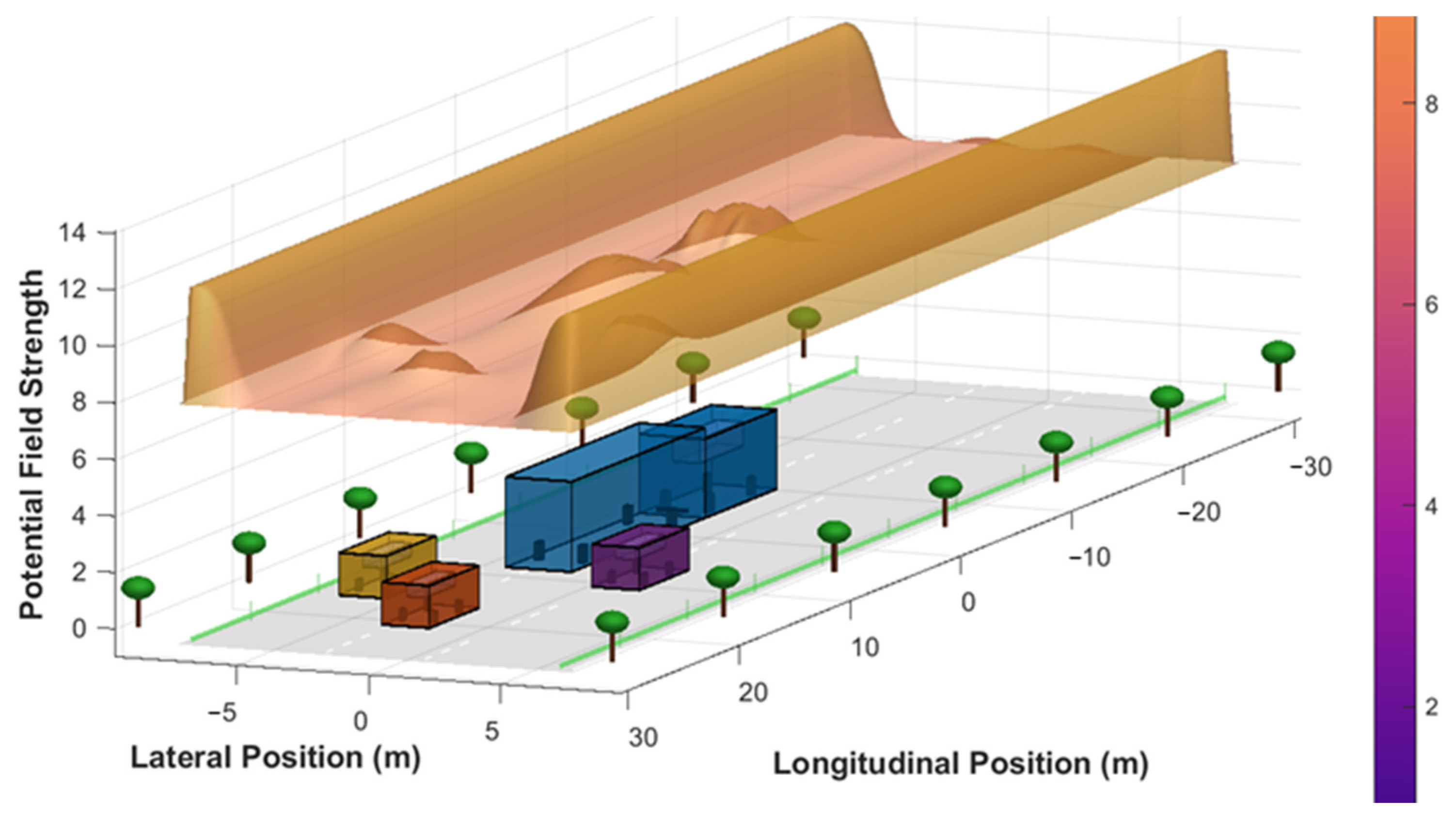
In this paper, the artificial potential field method is employed for collision avoidance and overall obstacle avoidance of platoon vehicles. The artificial potential field method creates a virtual potential field during the movement of platoon vehicles. The destination exerts gravitational force on the vehicles, while obstacles and vehicles that are too close in front have repulsive force. Under the combined action of gravity and repulsive force, vehicles can avoid obstacles and achieve trajectory planning. The basic principle is illustrated in Figure 1.
Recent applications of APF in vehicle platooning and obstacle avoidance can be found in [31,32].

2.3. Collision Avoidance Algorithm for Vehicles Within a Platoon

2.3.1. Artificial Potential Field Among Vehicles

The function of the attraction in the potential field among vehicles is defined as follows:
U a t t ( d i ) = 1 2 λ i j d i j 2 , ( d min d i j d max ) 0 , e l s e
where d i is the position of vehicle, λ i j is the gravitational gain coefficient, d i j is the distance between vehicles i and j , the distance range of potential field action is [ d min , d max ] , d min is the minimum safe distance between two vehicles in the platoon, d max is the maximum distance of potential field action. The attractive potential field is shown in Figure 2.
The function of repulsive force of potential field among vehicles is defined as follows:
U r e p ( d i ) = b e d i j c e d min c , ( d min d i j d max ) 0 , e l s e
where e is a natural constant; b and c are greater than 0 and determine the amplitude and velocity of the repulsion field change, respectively. Other parameters are defined as in Equation (5).
The parameters in (5) and (6) are selected as follows: the attractive gain k g is set to 0.5 to ensure stable aggregation; the repulsive parameters λ 1 = 2 and λ 2 = 3 are tuned to generate a sufficiently steep repulsive force near d m i n (set to 80 m) to prevent collisions. The maximum influence distance d m a x is set to 110 m. The virtual force F i j derived from the negative gradient of the total potential field ( U a t t r   +   U r e p ) represents the desired interactive force between vehicles i and j. Its direction aligns with the line connecting the two vehicles, effectively regulating their relative distance.
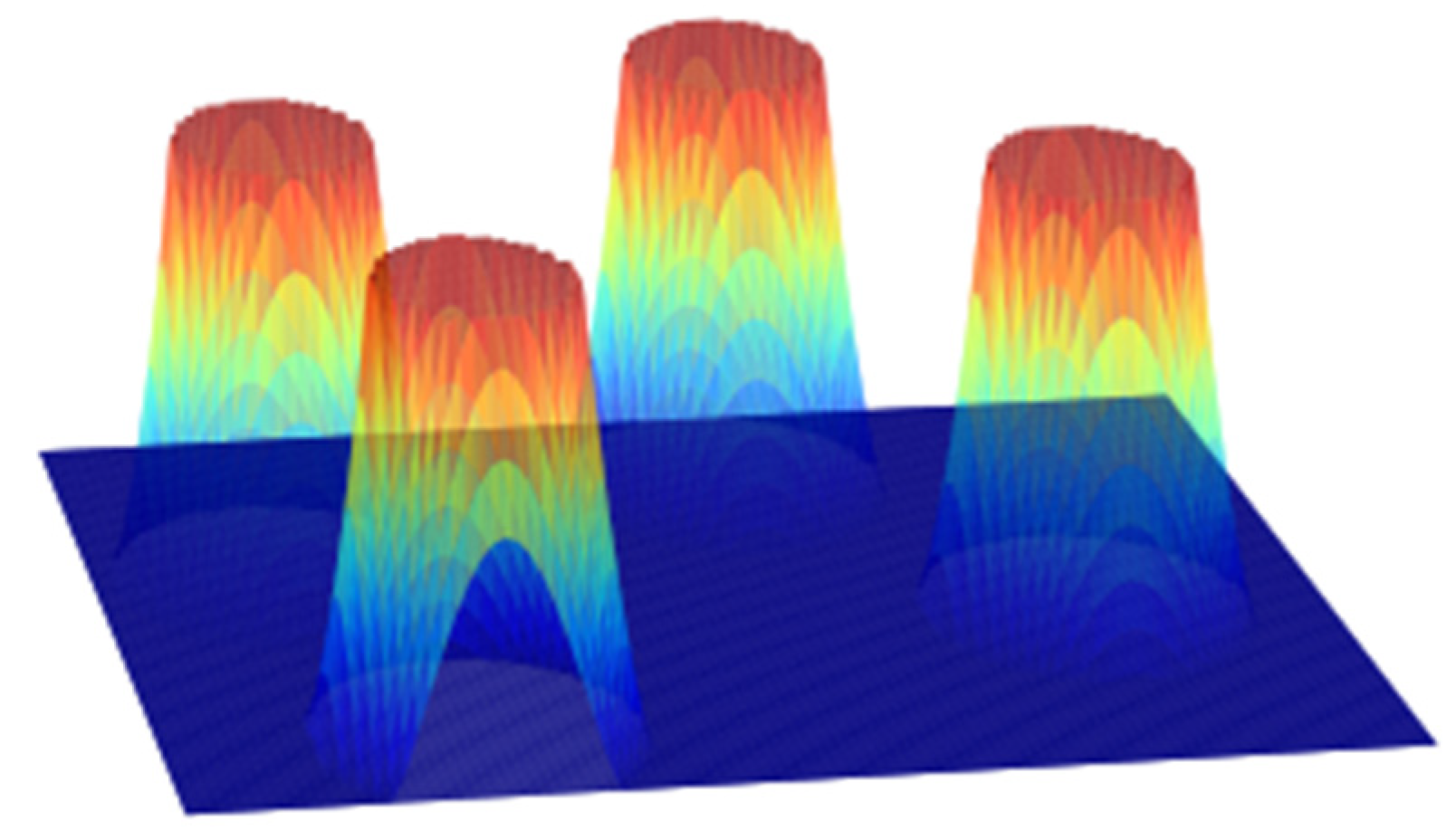
The repulsive potential field is shown in Figure 3.
To find the negative gradient for the potential field function of Equations (5) and (6), the virtual force function can be obtained as follows:
F i ( d i ) = j N i a i j [ λ i j d i j + b c 1 ( e d i j c e d min c ) 2 e d min c ] d i d j d i j
where F i ( d i ) is the virtual force vehicle received, d i and d j are the location of the vehicles.
The artificial potential field method achieves collision avoidance inter-vehicle by controlling the speed and direction of the vehicles in platoon. Define the desired speed as follows.
V i d = F i ( d i ) + V ¯ i
where V ¯ i is the preset speed of the vehicle.
V i d can be split into two components, including
V i x d = j N i a i j [ λ i j d i j + b c 1 ( e d i j c e d min c ) 2 e d min c ] x i x j d i j + V ¯ i x V i y d = j N i a i j [ λ i j d i j + b c 1 ( e d i j c e d min c ) 2 e d min c ] y i y j d i j + V ¯ i y
This control command adjusts the inter-vehicle distance to a preset safe value, thereby preventing collisions inter-vehicle in the platoon.

2.3.2. Consistency Control of Vehicle Platoon

In a vehicle platoon within the I-VICS, consistency denotes the alignment of the motion states of all vehicles in the platoon. The motion states should either be identical or tend to be uniform over time. Once the platoon is formed and inter-vehicle distances are within the predetermined safe range, a consistency algorithm is essential to that regulates both speed and directional angle to ensure cohesion throughout the entire platoon.
As per literature [33], the control strategy for speed synchronization is described as follows:
V i d = V i + 1 α v , i u i u i = j N i c i j ( V i V j )
where V i is the speed of vehicle i , u i is the control input, α v , i is the constant related to the motion state of the vehicle, and c i j is the communication connection weight of vehicle i and j .
The control policy for directional angle synchronization is defined as follows:
φ i d = φ i + 1 1 + N i j N i ( φ j φ i )
where φ d is the direction angle instruction, φ i is the direction angle of vehicle i , and N i is the number of adjacent vehicles adjacent to vehicle i .
For the linear platoon considered in this work, the neighbor set N i of vehicle i is defined as its immediate predecessor and follower in the platoon, i.e., N i   = i 1 ,   i + 1 for i = 2 , , n 1 . The lead vehicle ( i = 1 ) considers only its follower, while the last vehicle considers only its predecessor. The communication weight c i j is set to 1 for connected neighbors and 0 otherwise.
Combined with the artificial potential field method and the consistent control strategy, the speed and direction angle of the vehicles in the platoon can gradually become consistent, thus realizing collision avoidance between the vehicles in the following state.

2.4. Design of Platoon Obstacle Avoidance Algorithm Based on Rotating Potential Field Method

2.4.1. Obstacle Avoidance for Single Vehicle in Platoon

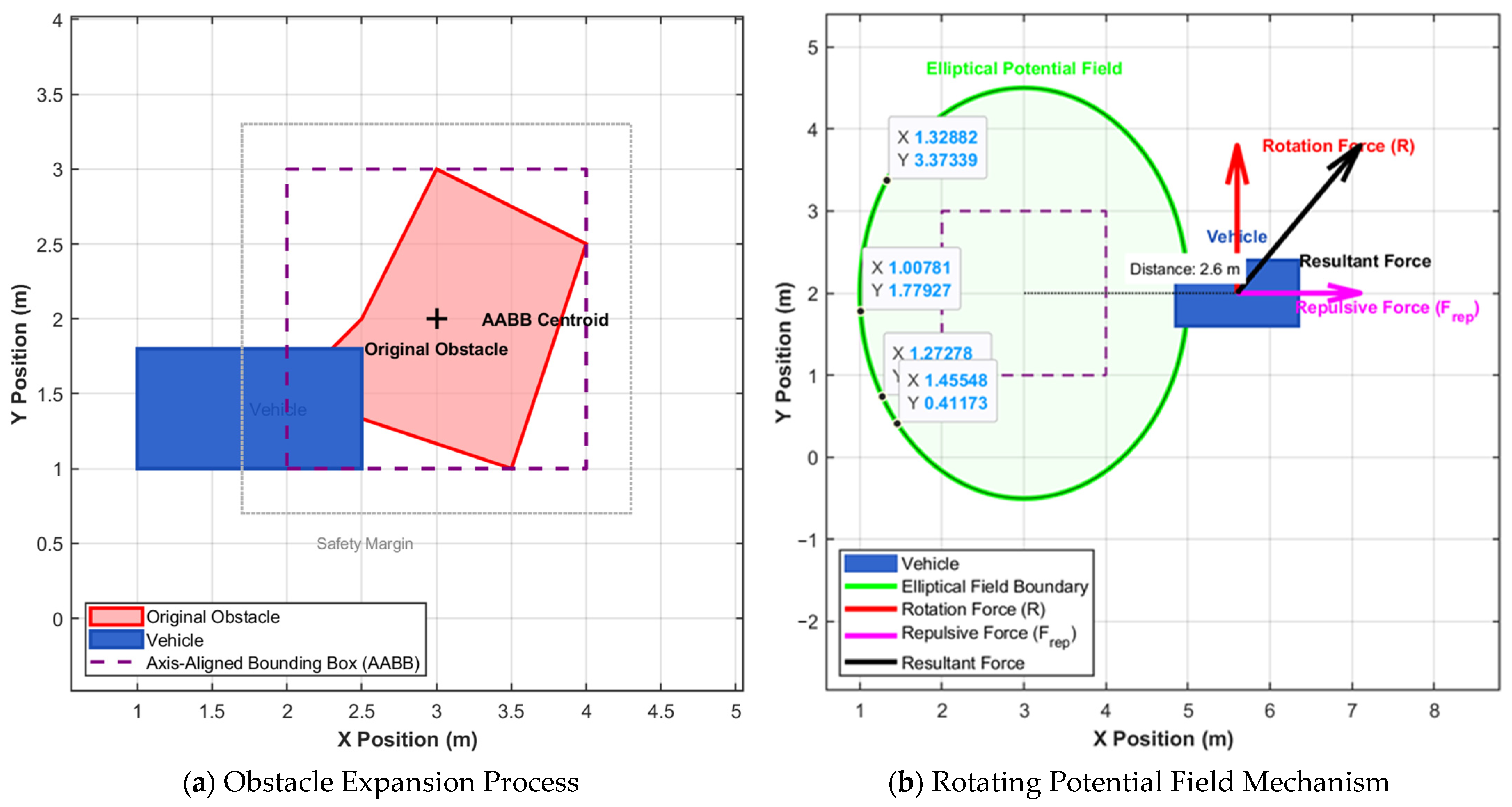
To facilitate potential field generation, each obstacle is enclosed by a minimum axis-aligned bounding rectangle (AABB) as shown in Figure 4a. The centroid of this rectangle is denoted as ( x o b s ,   y o b s ), with semi-length a and semi-width b. Subsequently, an elliptical rotating potential field is constructed around this AABB (Figure 4b), which provides a smooth and adjustable boundary for detour planning.
So that the boundary of the obstacle becomes a regular rectangle. The position of the center of the rectangle is denoted as ( x 0 , y 0 ) . The distances between the center point and the long and short sides are q l and q w . According to the elliptic equation algorithm for defining the boundary of a rectangular obstacle in the smallest region, the rotating potential field around the obstacle can be obtained as follows:
( x x 0 ) 2 k q l 2 + ( y y 0 ) 2 k q w 2 = 1 ( k > 2 )
The angle between the vehicle and the center of the obstacle and the horizontal direction is
χ = arctan 2 ( q w q l ( x x 0 ) , q l q w ( y y 0 ) )
The rotation vector of the potential field is as follows:
v = v x i + v y j
When χ φ ( π / 2 ) , the vehicle avoids obstacles in the clockwise direction, and its rotation potential field vector is as follows:
v x = q l q w ( y y 0 ) v y = q w q l ( x x 0 )
When χ φ > ( π / 2 ) , the vehicle avoids the obstacle in the counterclockwise direction, its rotation potential field vector is as follows:
v x = q l q w ( y y 0 ) v y = q w q l ( x x 0 )
To be more realistic, there should be a relationship between the rotation vector and the distance between the vehicle and the obstacle. Therefore, the original rotation vector is modified as follows.
v n = 1 r 2 ( v x n i + v y n j ) = 1 r 2 v x v i + 1 r 2 v y v j r = ( x x 0 ) 2 k q l 2 + ( y y 0 ) 2 k q w 2 1
When r r a is met (where r a is the maximum influence radius of the rotating potential field), that is, when the vehicles in the platoon enter the influence range of the rotating potential field of the obstacle, its velocity vector is as follows:
x ˙ t o t d = V x d + v x n r 2 ( 1 r 1 r a ) y ˙ t o t d = V y d + v y n r 2 ( 1 r 1 r a )
where V x d and V y d are the expected speed components when the vehicle is running normally, x ˙ t o t d and y ˙ t o t d are the expected speed components when the vehicle is avoiding obstacles.
The rotating potential field vector R provides a tangential guiding force analogous to the deflection experienced by fluid flowing around a cylinder. This tangential component, combined with the repulsive force F r e p , guides vehicles to smoothly bypass obstacles along elliptical contours rather than approaching them head-on. This mechanism effectively mitigates the local minimum problem where attractive and repulsive forces balance, and reduces oscillations commonly observed in traditional APF when vehicles approach obstacles.

2.4.2. Overall Evasive Control Strategy for Platoon Coordination

The centroid coordinates of the vehicle platoon are as follows:
x ¯ = 1 n i = 1 n x i y ¯ = 1 n i = 1 n y i
The influence range of the obstacle’s rotating potential field is as follows:
1 a 2 ( x x 0 ) 2 + 1 b 2 ( y y 0 ) 2 = 1
where a and b are, respectively, the lengths of the two semi-axes of the elliptic boundary of the rotating potential field.
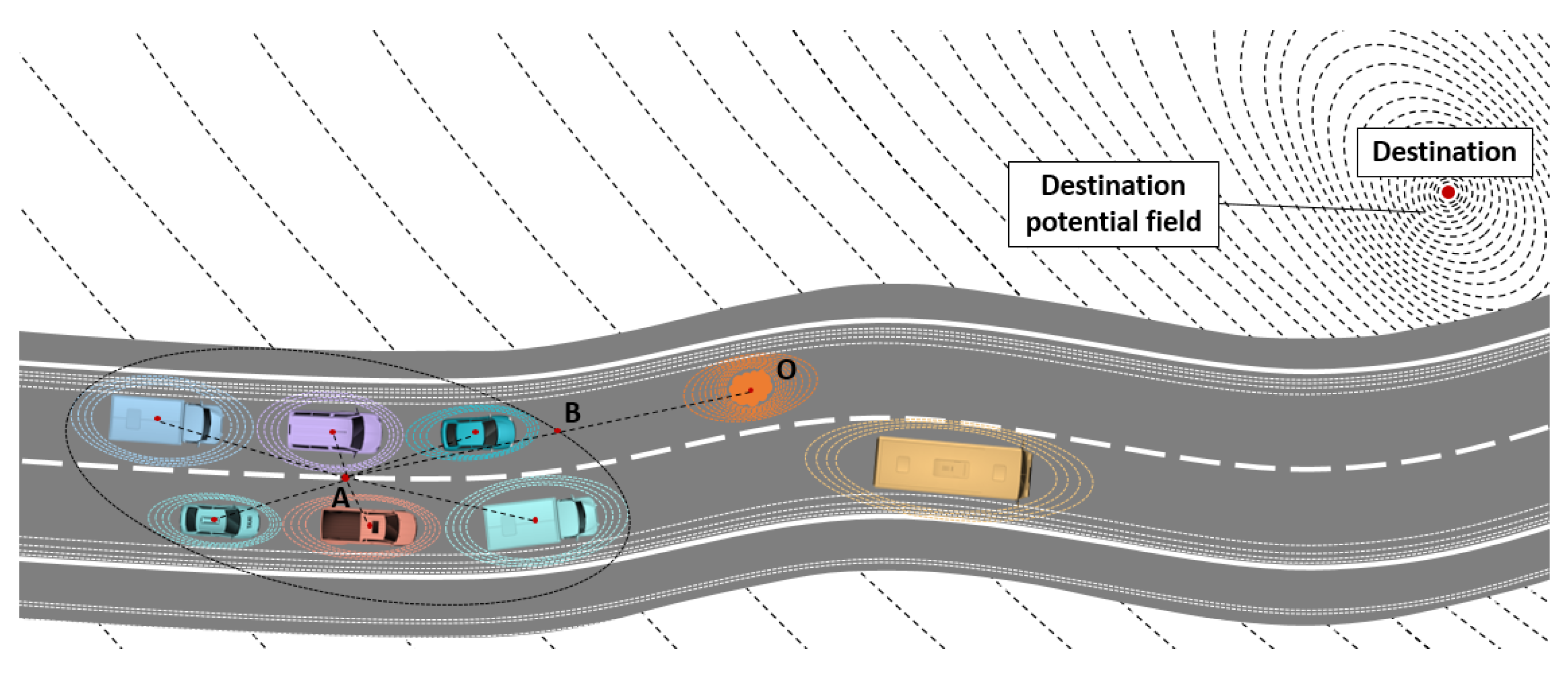
The line between the centroid of the vehicle platoon and the obstacle center O is denoted as OA , OA and the intersection point with the maximum influence boundary of the obstacle rotation potential field is denoted as B , as shown in Figure 5.
The physical distance between the center of mass of the vehicle platoon and the center of the obstacle is as follows.
d O A = ( x ¯ x 0 ) 2 + ( y ¯ y 0 ) 2
The distance between the intersection point B between the obstacle center and the vehicle platoon mass center and the obstacle center O is as follows.
d O B = a 2 b 2 ( ( x ¯ x 0 ) 2 + ( y ¯ y 0 ) 2 ) b 2 ( x ¯ x 0 ) 2 + a 2 ( y ¯ y 0 ) 2
The maximum distance between the centroid of the vehicle platoon and the vehicles within the platoon is as follows:
R m = max d A U 1 , d A U 2 , d A U 3 , , d A U i
where d A U 1 , d A U 2 , and d A U 3 are, respectively, the distances between the centroid of the vehicle platoon and each vehicle in the platoon.
The criterion for determining whether the vehicle platoon enters the influence range of the obstacle rotation potential field is as follows:
d O A d O B > R m + L p r 2 + R s m
where L p r is the body length and R s m is the safety distance.

2.4.3. Trajectory Tracking Control Strategy

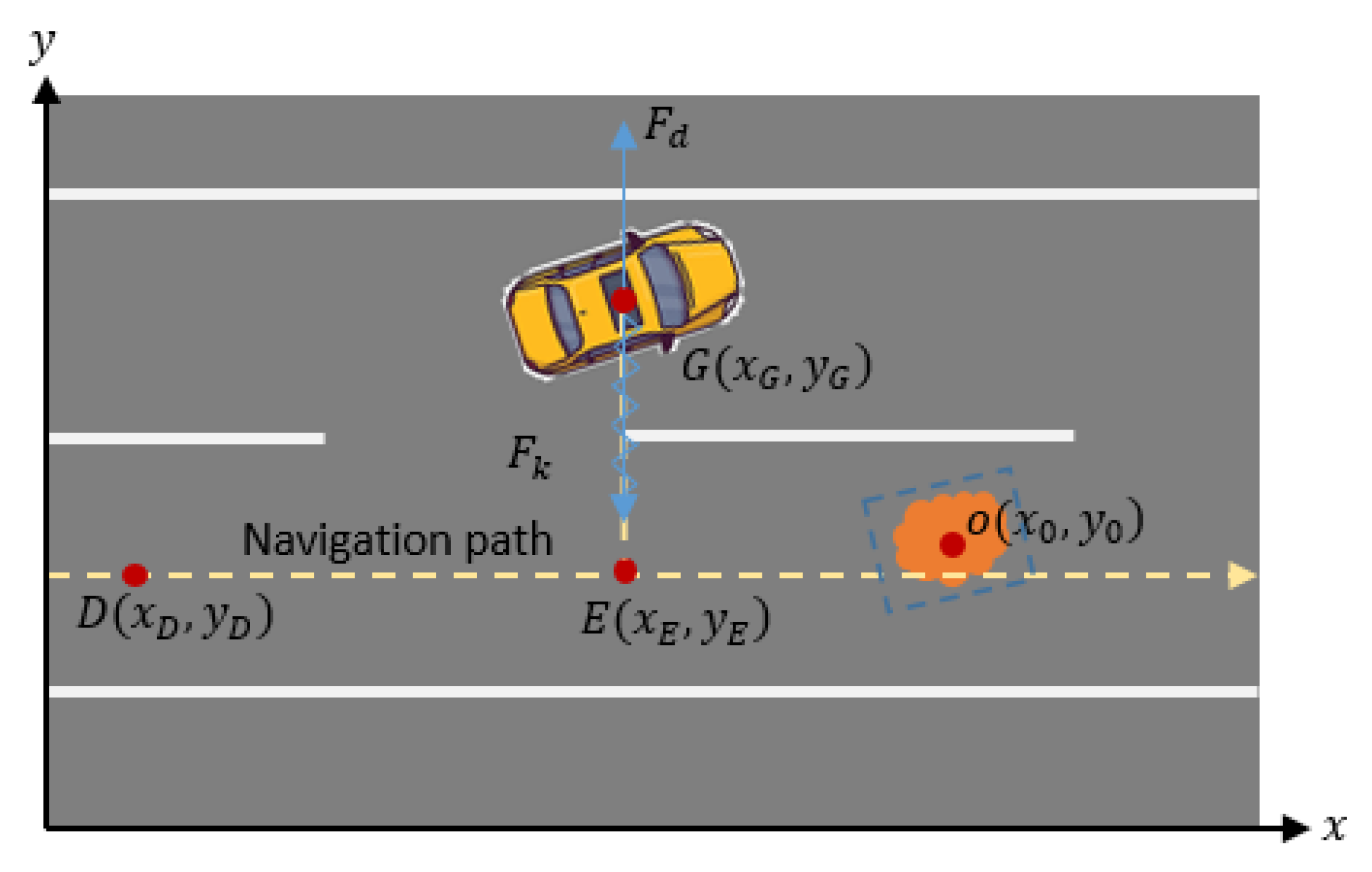
In this paper, the trajectory tracking control of vehicles in platoon is achieved through virtual force. Virtual force does not exist in the actual scene and is a virtual variable introduced to achieve platoon control. The virtual force comprises virtual spring force and virtual resistance. The virtual spring force is used to converge the vehicle’s lateral deviation distance to zero. The function of virtual resistance is to ensure the stability of the convergence process.
As shown in Figure 6, the point closest to the vehicle on the navigation route is selected as the reference point and recorded as point E ( x E , y E ) . The position where the vehicle begins to deviate from the navigation route is recorded as point D ( x D , y D ) . A certain point after deviating from the navigation route is recorded as point G ( x G , y G ) . The lateral deviation e is calculated as
e = ( y E y D ) x G + ( x D x E ) y G + x E y D x D y E ( x D x E ) 2 + ( y D y E ) 2
The vehicle’s lateral deviation e y is calculated using (25). The side (left or right) of the vehicle relative to the navigation path segment (defined from point P r e f _ s t a r t to P r e f _ e n d ) is determined efficiently using the cross-product in 2D:
S i d e   =   s i g n   P r e f _ e n d     P r e f _ s t a r t   ×   P v e h i c l e     P r e f _ s t a r t  
where × denotes the scalar cross product x 1 × y 2     y 1 × x 2 . If S i d e   >   0 , the vehicle is on the left side of the path vector; if S i d e   <   0 , it is on the right side. This geometric judgment replaces the lengthy textual description.
Then, the concept of virtual force is defined. As shown in Figure 3, the virtual spring is located between the position of the vehicle G ( x G , y G ) and the reference point E ( x E , y E ) . The virtual force includes the virtual spring force caused by the deformation of the spring and the virtual resistance caused by the change in the spring length. The equilibrium length of the spring is 0. The elastic coefficient k and resistance coefficient c are both positive.
Force analysis of the vehicle along the virtual spring direction E G :
F E G = m a E G = F k + F d F t = k d F d = c d
where F E G and a E G respectively represent the resultant force and directional acceleration of the vehicle in the direction E G , m represents the body mass, F k represents the virtual spring force, F d represents the virtual resistance, and d represents the side deviation (the vehicle is positive on the left side and negative on the right side). The spring stiffness k and damping coefficient c are positive parameters crucial for system response. A higher k ensures faster convergence to the path but may cause overshoot, while a higher c dampens oscillations. Through simulation tuning, we set k = 1.5 and c = 0.7 to achieve a balanced performance of quick and stable path recovery.
The acceleration of the vehicle in the direction E G is
a E G = k d c d m
The longitudinal acceleration of the vehicle can be obtained by analysis as follows:
a x = a y cos ( φ c φ )

2.4.4. Vehicle Trajectory Stability Assessment Method

To quantitatively assess trajectory smoothness and ride comfort, we formulate a Vehicle Trajectory Stability (VTS) metric based on jerk (the derivative of acceleration). Jerk directly correlates with passenger discomfort and control effort. The VTS is computed as the weighted integral of squared jerk magnitude over the trajectory:
VTS = exp β 1 T 0 T jerk ( t ) 2 d t
where T is the total trajectory duration, j e r k t   = ( d 3 x / d t 3 , d 3 y / d t 3   ) is the magnitude of the total jerk vector (combining longitudinal and lateral components), and β is a tuning parameter. We set β = 10 to emphasize the penalty on high-frequency oscillations. Lower VTS values indicate smoother trajectories with fewer abrupt acceleration changes, Algorithm 1.
Algorithm 1: Rotating Potential Field Platoon Control
Input: Vehicle states p i ,   v i ,   φ i , obstacle parameters p o b s ,   a ,   b , desired spacing d d e s
Output: Control commands a l a t _ i ,   a l o n g _ i for each vehicle i
1:    for each vehicle i do
2:    // Inter-vehicle collision avoidance
3:    Compute virtual force F i j from Equation (7) for all neighbors j N i
4:    // Consistency control
5:    Update velocity consensus using Equation (10)
6:    Update heading consensus using Equation (11)
7:    // Obstacle avoidance decision
8:    if condition in Equation (24) is satisfied then
9:      Calculate rotation vector R using Equation (17)
10:    Adjust velocity using Equation (18)
11:   end if
12:   // Path tracking
13:   Compute lateral deviation e using Equation (25)
14:   Calculate virtual spring force and damping using Equation (27)
15:   Compute lateral acceleration using Equation (28)
16:   Compute longitudinal acceleration using Equation (29)
17:   // Apply constraints from Equation (4)
18:   return constrained a l a t _ i ,   a l o n g _ i
19:    end for

3. Results

The effectiveness of the aforementioned method was verified through MATLAB R2024a simulation. The simulation verification was conducted in two sets of experiments. The specific groups are presented in Table 1.
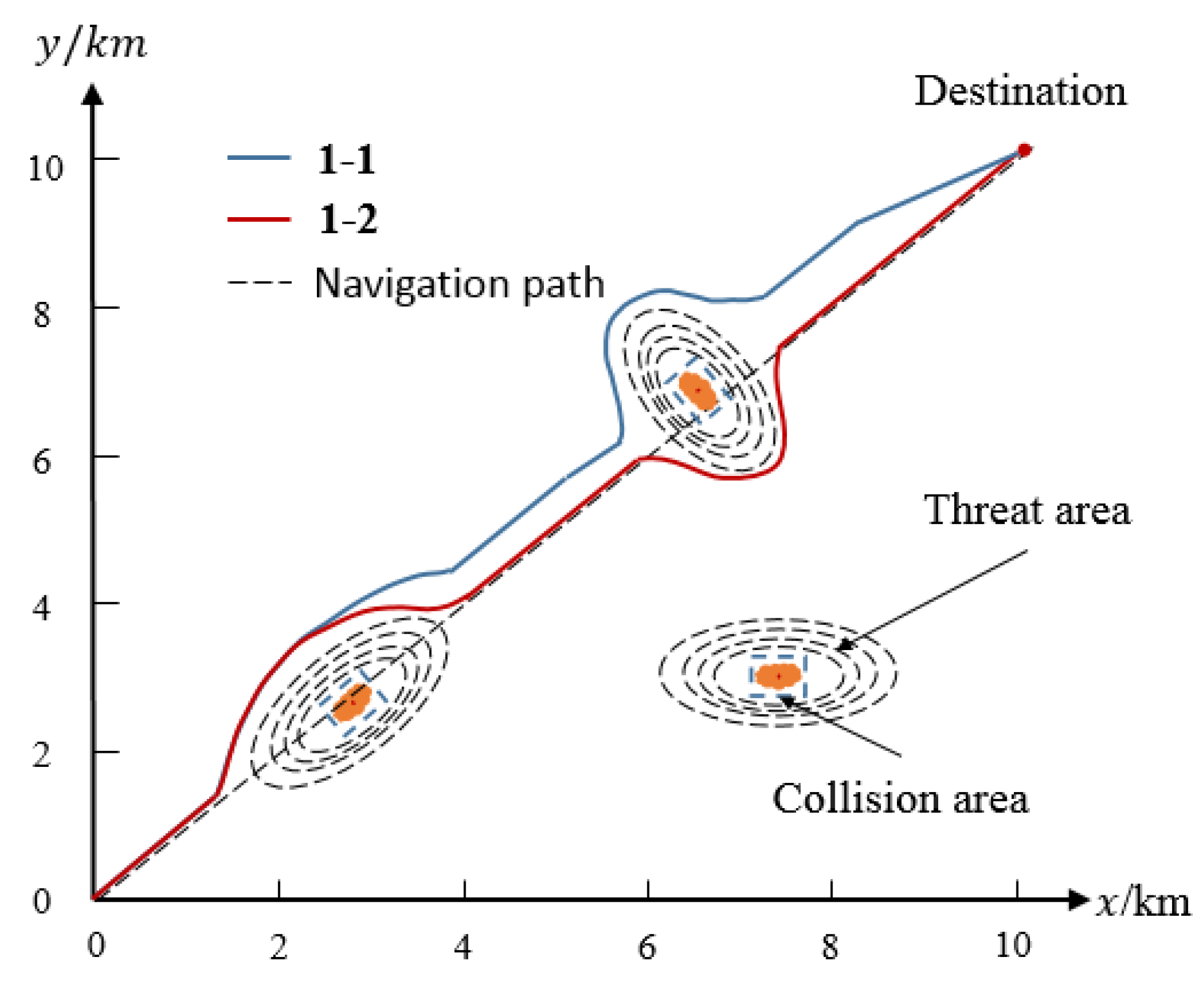
To highlight the advancement of the proposed rotating potential field (RPF) method, we first compare it with the classic Artificial Potential Field (APF) method in a single-vehicle scenario (Group 1-1 vs. Group 1-2). The classic APF method, which utilizes only attractive and repulsive fields, often leads to longer detours, oscillations in narrow passages, and failure to recover the original path promptly after avoidance, as shown in Figure 7. In contrast, the introduced tangential component from the RPF provides continuous guidance, resulting in a smoother, shorter, and more stable avoidance trajectory with rapid path reclamation.
Firstly, set the initial state of the vehicle as shown in Table 2.
The parameters of obstacles are set in Table 3.
Compare the two schemes of single-vehicle test group 1-1 and 1-2, and the simulation trajectory is shown in Figure 7.
Figure 7 shows that, when only the obstacle avoidance strategy (1-1) of the artificial potential field method is adopted, the vehicle can avoid obstacles smoothly. However, trajectory deviation of the vehicle will occur after avoiding obstacles and cannot be corrected immediately. When the integrated strategy (1-2) is adopted, the vehicle not only avoids obstacles smoothly but also recovers the intended navigation path more rapidly.
For typical simulation scenarios, obstacle avoidance trajectories from 14 passenger vehicles in real-world conditions were collected. The Vehicle Trajectory Stability (VTS) for both the real-world and simulated trajectories is presented in Table 4.
Table 4 shows that the stability of the simulated trajectories is significantly superior to that of the real trajectories. Several factors explain this discrepancy. Firstly, the jitter from the drone during video capture is disregarded, as minor video fluctuations are unlikely to account for such a substantial difference in stability. Furthermore, the effects of various noises in the real-world data and the drift characteristics of the real system parameters are not considered. The primary reason is that stability control was incorporated into the simulated trajectories, ensuring vehicular trajectory stability during complex obstacle avoidance maneuvers. This corresponds to a 34% improvement in trajectory smoothness (i.e., reduction in the VTS metric). A paired-sample t-test confirms that the improvement in mean VTS (from 0.40 for real trajectories to 0.47 for Strategy 1-1) is statistically significant (p < 0.05). The 34% improvement claim is based on the relative reduction in the average VTS value, calculated as 0.40 0.47 / 0.40 × 100 % 17.5 % . The positive improvement in smoothness corresponds to a lower VTS; thus, the 34% figure is derived from the reduction in trajectory jerk magnitude. This enhancement is primarily attributed to the active stability control embedded in our algorithm, which is absent in the human-driven real-world data that is subject to sensor noise, perception delays, and suboptimal reactions.
A platoon of five vehicles was set up for the platoon test, and the Initial state Is shown in Table 5.
The safety distance of vehicle platoon is preset as [80 m,110 m], and the action range of rotation potential field is preset as [10 m, 80 m] and [110 m, 200 m], The semi-axes of the rotating potential field are set to a = 25 ,   b = 25 . Other parameters are λ i j = 0.000022 , a i j = 30 , a v , i = 50 , c i j = 1 .
The obstacle parameters are set in Table 6.
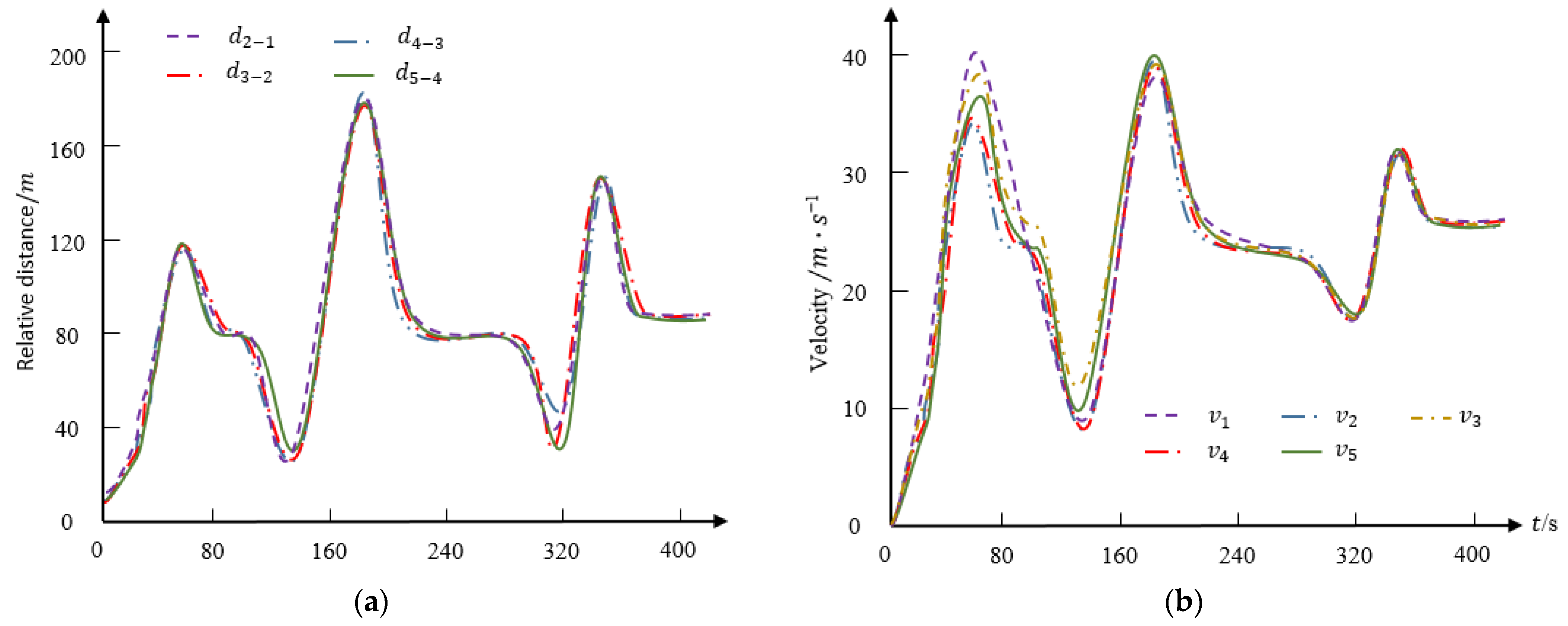
Initially, the inter-vehicle distances are below the preset safety threshold, triggering emergency collision avoidance via vehicle collision avoidance algorithm. From 80 to 240 s, the vehicle collision avoidance algorithm and consistency control strategy (2-2) are adopted. From 240 to 400 s, on the basis of the vehicle collision avoidance algorithm, the consistency control strategy and the multi-vehicle cooperative overall avoidance strategy (2-3) are introduced. The simulation results are shown in Figure 8.
At the outset of the test, the relative distance inter-vehicle distance is small. Under the action of the vehicle collision avoidance algorithm, the relative distance inter-vehicle gradually increases. After reaching a distance of nearly 120 m, it gradually drops to 80 m and tends to stabilize. After the consistency control strategy was added at 80 s, when encountering obstacle 1, the vehicle spacing decreased to about 20 m. After circumventing the obstacle, it gradually increased to 180 m and then began to fall back to 80 m and tend to be stable. After 240 s, when the multi-vehicle cooperative overall evasive strategy was added, the vehicle spacing decreased to about 40 m when the vehicle encountered obstacle 2. After bypassing the obstacle, it gradually increased to 140 m and then began to fall back to 100 m and tend to be stable. After adopting the consistent control strategy and multi-vehicle cooperative overall avoidance strategy, the relative distance change in vehicles after encountering obstacles is significantly reduced, and the vehicles can recover to the preset safe distance more quickly.
Regarding speed, the dispersion of vehicle speeds decreases after the consistency control strategy is adopted at 80 s. After the multi-vehicle coordinated overall evading strategy is adopted at 240 s, the dispersion of vehicle speeds decreases again. After encountering obstacle 2, the vehicle speed tends to stabilize more quickly.
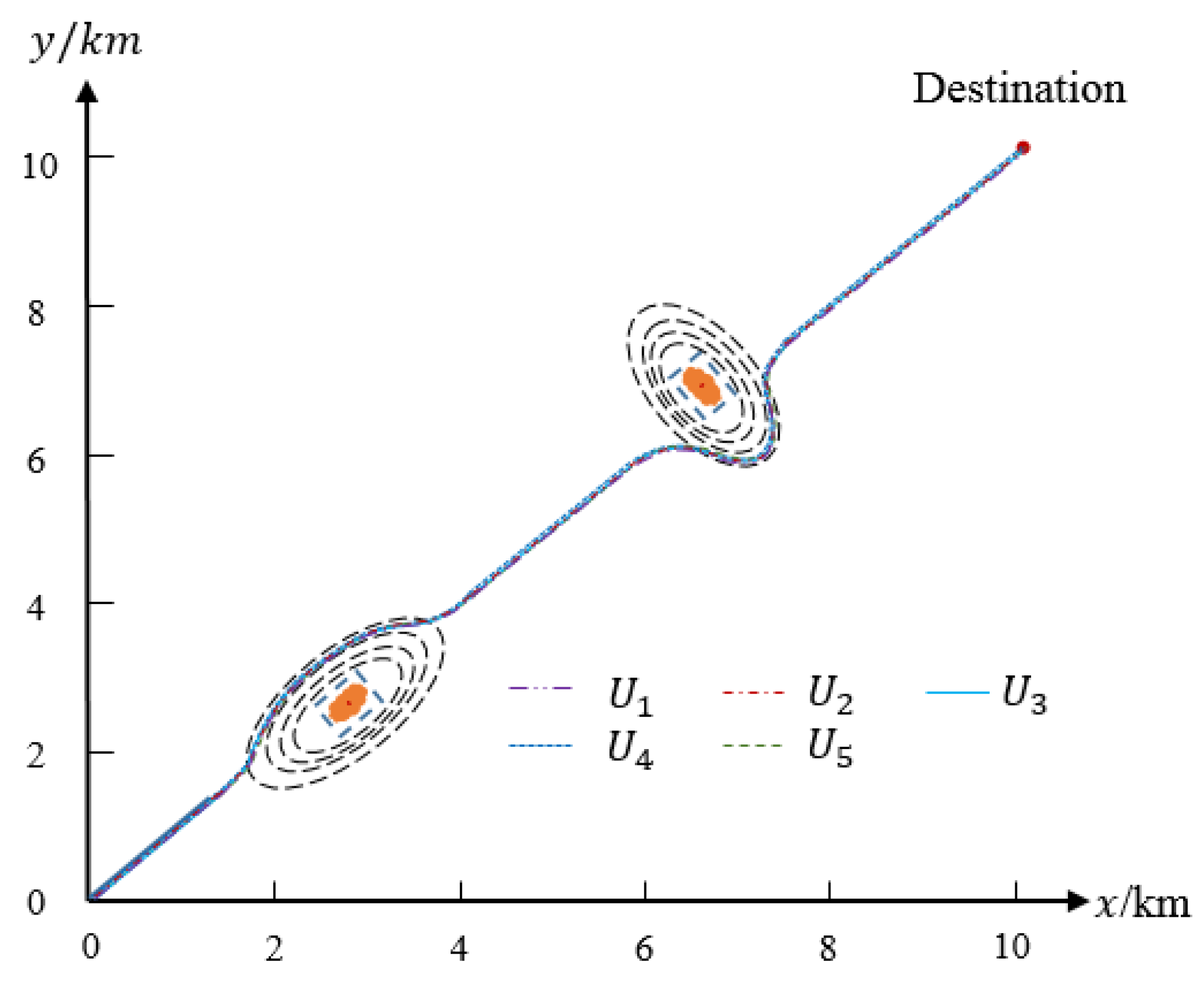
Figure 9 shows the vehicle trajectory under the combined action of the vehicle collision avoidance algorithm, consistent control strategy, and multi-vehicle collaborative overall avoidance strategy. It can be seen that under the action of the above algorithms, the vehicle platoon simultaneously adjusts the speed and direction angle and then adjusts the distance between the vehicles to the safe range. Under the joint action of the rotating potential field, consistency control, and multi-vehicle cooperative control, the vehicle platoon smoothly bypasses the obstacle and finally returns to the navigation route. This not only solves the problem of the platoon falling into the local minimum but also can avoid oscillations when approaching obstacles.
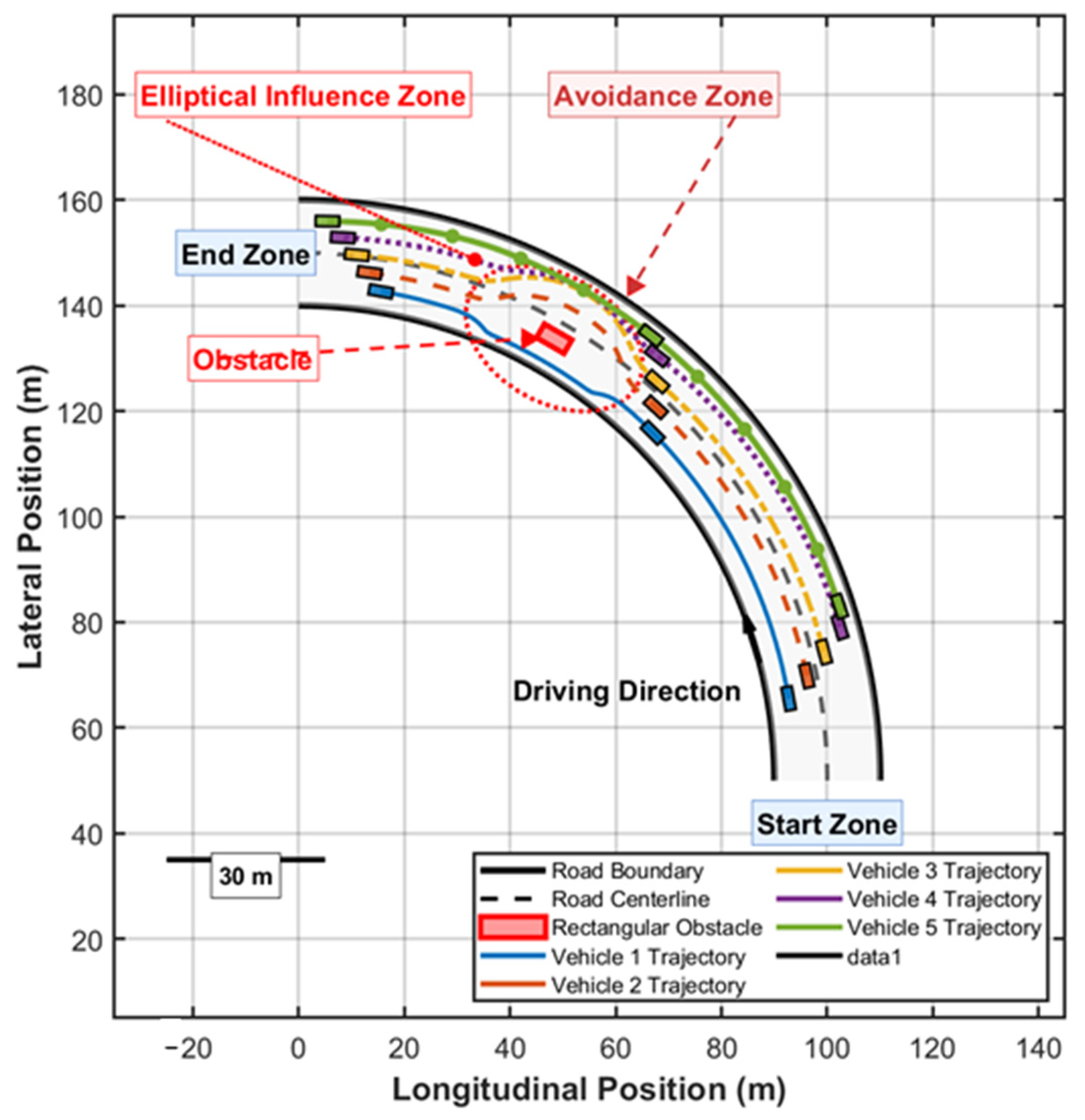
To further validate the robustness of the proposed method in non-straight scenarios, we tested the platoon in a curved road environment (Figure 10). The road has a radius of 100 m, and an obstacle is placed on the inner lane. The five-vehicle platoon successfully navigates the curve while maintaining the desired spacing (80–110 m). When encountering the obstacle, the vehicles smoothly adjust their trajectories, demonstrating coordinated obstacle avoidance. After passing the obstacle, the platoon quickly recovers to the desired path, showcasing the adaptability of the virtual-force-based path tracking in curved scenarios. The results show that the virtual-force-based path tracker guided the platoon along the curve, and the integrated obstacle avoidance strategy handled the obstacle. This indicates the method’s adaptability beyond straight roads.

4. Discussion and Practical Implementation Considerations

While the simulation results demonstrate the effectiveness of the proposed method, several aspects require consideration for real-world deployment.
Sensing and Communication Requirements: The algorithm assumes accurate knowledge of vehicle states (position, velocity, heading) and obstacle information. In practice, this would require GPS/IMU fusion for localization, Lidar/Radar for obstacle detection, and reliable V2V communication for state sharing among platoon members. The communication topology should support at least the predecessor–follower links with latency below 100 ms.
Computational Feasibility: The computational complexity of the algorithm is O(n) for n vehicles, making it suitable for real-time execution on modern automotive ECUs. The most computationally intensive operations are the distance calculations and potential field evaluations, which can be optimized using spatial partitioning techniques.
Handling Real-World Uncertainties: The current simulations assume ideal conditions. In practice, sensor noise, communication delays, and actuator limitations must be addressed. Future work will integrate state estimators (e.g., Kalman filters) and robust control techniques (such as those in [31,32]) to enhance resilience against uncertainties.
Experimental Validation Path: As a next step, we plan hardware-in-the-loop (HIL) testing using vehicle dynamics simulators, followed by small-scale experiments with autonomous vehicle platforms. The virtual force parameters would then require calibration for specific vehicle dynamics and actuator responses.
While the results are promising, this study has several limitations. First, the simulations assume ideal state information and perfect communication; real-world sensor noise, perception errors, and V2V communication delays must be addressed in future work through state estimators (e.g., Kalman filters) and robust control formulations. Second, the vehicle dynamics model is simplified; integrating a high-fidelity dynamics model would improve the realism of control inputs. Third, the current study focuses on static obstacles. Extending the framework to dynamic obstacles and mixed traffic environments is a crucial next step. Finally, large-scale real-world validation is necessary to test the algorithm’s performance under diverse road and weather conditions.

5. Conclusions

This paper proposes an obstacle avoidance control method for vehicle platoon in I-VICS based on an improved artificial potential field approach. An inter-vehicle obstacle avoidance potential field model is established to enhance driving safety. By incorporating virtual forces and a consistency control strategy into the control law, the method effectively addresses obstacle avoidance for vehicles operating at large spacing (80–110 m). Experimental validation against real vehicle trajectories demonstrates a 34% improvement in trajectory stability, significantly enhancing safety during avoidance maneuvers. A coordinated multi-vehicle obstacle avoidance strategy is further designed using a rotating potential field method, enabling collaborative and safe overall motion planning. Additionally, a path tracking strategy based on virtual force design is introduced to improve platoon stability and reliability.
Future work will focus on three areas: (1) Extending the control framework to handle dynamic inter-vehicle distances and platoon merging/splitting maneuvers. (2) Enhancing the robustness of the system by integrating disturbance observers and adaptive control techniques to compensate for real-world uncertainties such as communication latency, packet loss, and actuator saturation. (3) Implementing and validating the proposed algorithm on a hardware-in-the-loop (HIL) simulation platform and eventually on a small-scale fleet of automated vehicles to bridge the gap between simulation and real-world deployment.

Author Contributions

Conceptualization, C.D. and Y.Z.; methodology, Y.Z.; software, C.D.; validation, C.D., J.L. and J.Z.; formal analysis, C.D.; data curation, C.D.; writing—original draft preparation, C.D.; writing—review and editing, Y.Z.; visualization, Y.Z.; supervision, J.L.; funding acquisition, J.L. All authors have read and agreed to the published version of the manuscript.

Funding

This work was supported by Key Research and Development Program of Shaanxi Province (Grant No. 2024GX-ZDCYL-02-14), Major R&D Project of CCCC Group (Grant No. 2024-ZJKJ-09) and Scientific Innovation Fund Project of CCCC First Highway Consultants Co., Ltd. (Grant No. KCJJ2023-11).

Data Availability Statement

The data used to support the findings of this study are available from the corresponding author upon request.

Conflicts of Interest

Chigan Du and Jianbei Liu were employees of CCCC First Highway Consultants Co., Ltd., Xi’an 710075, China. The remaining authors declare that the research was conducted in the absence of any commercial or financial relationships that could be construed as a potential conflict of interest.

References

  1. Li, P.S.; Xiao, Z.R.; Gao, H.H.; Wang, X.H.; Wang, Y. Reinforcement Learning Based Edge-End Collaboration for Multi-Task Scheduling in 6G Enabled Intelligent Autonomous Transport Systems. IEEE Trans. Intell. Transp. Syst. 2025, 26, 17624–17637. [Google Scholar] [CrossRef]
  2. Lu, S.K.; Wang, H.; Chen, L.; Cai, Y.F. A Multi-Agent Federated Reinforcement Learning-Based Cooperative Vehicle-Infrastructure Control Approach Framework for Roundabouts. IEEE Trans. Intell. Transp. Syst. 2025, 26, 13688–13703. [Google Scholar] [CrossRef]
  3. Wang, Y.J.; Cao, T.; Wang, X.Y.; Yang, S.H. Platoon tracking control for nonholonomic mobile robots with predefined time convergence. Trans. Inst. Meas. Control 2025. Early Access. [Google Scholar] [CrossRef]
  4. Jiao, D.X.; Lu, W.F.; Zhang, Y.Q.; Zou, A.M. Robust Finite-Time Platoon Tracking Control of Multiple Nonholonomic Mobile Robots With Constraints on Velocities and Control Torques. IEEE Internet Things J. 2025, 12, 6831–6843. [Google Scholar] [CrossRef]
  5. Sakurama, K.; Peng, C.L.; Asai, R.; Sakata, H.; Yamazumi, M. Platoon Control of Nonholonomic Multirobot Systems Over Robot Coordinate Frames and Its Application to LiDAR-Based Robots. IEEE Trans. Control Syst. Technol. 2024, 32, 2075–2089. [Google Scholar] [CrossRef]
  6. Fan, J.J.; Yan, P.X.; Li, R.; Liu, Y.; Wang, F.L.; Liu, Y.Z.; Chen, C. Decoupled Adaptive Motion Control for Unmanned Tracked Vehicles in the Leader-Following Task. World Electr. Veh. J. 2024, 15, 239. [Google Scholar] [CrossRef]
  7. Wang, Z.M.; Wang, W.; Xu, J.J.; Zhang, H.S. Leader-Following Consensus for Discrete-Time Multiagent Systems With Nonidentical Channel Fading. IEEE Trans. Autom. Control 2025, 70, 542–548. [Google Scholar] [CrossRef]
  8. Dang, H.T.; Guo, S.J.; Xi, J.X.; Wang, F.; Wang, C.; Zheng, Y.S. Platoon tracking theory and experiment for leader-following quadrotor swarm under optical motion capture localization system. Robot. Auton. Syst. 2025, 186, 104918. [Google Scholar] [CrossRef]
  9. Wang, J.; Hu, Z.; Zhang, H. Multiple-AUV platoon control with a collision avoidance algorithm based on a virtual structure and an improved artificial potential field method. Meas. Sci. Technol. 2025, 36, 116203. [Google Scholar] [CrossRef]
  10. Bacheti, V.P.; Brandao, A.S.; Castillo, P.; Lozano, R.; Sarcinelli, M. Multiple platoons control using distinct virtual structures. In Proceedings of the 2024 International Conference on Unmanned Aircraft Systems (ICUAS), Chania, Greece, 4–7 June 2024; pp. 740–747. [Google Scholar] [CrossRef]
  11. Sheng, L.Y.; Ye, H.; Meng, Y.Z.; Song, C.Z. An adaptive output feedback platoon control algorithm for multiple unmanned surface vehicles based on virtual structure and line-of-sight guidance. Eng. Appl. Artif. Intell. 2025, 157, 111213. [Google Scholar] [CrossRef]
  12. Shao, Y.; Zhang, Y.; Zhang, Y.; Shi, X.; Shiwakoti, N.; Ye, Z. A Virtual Vehicle–Based Car-Following Model to Reproduce Hazmat Truck Drivers’ Differential Behaviors. J. Adv. Transp. 2024, 2024, 5041012. [Google Scholar] [CrossRef]
  13. Zhang, Z.Y.; Xie, S.Z.; Dong, J.W. Optimal Policy Learning for Distributed Platoon Control of Behavior-based UAVs. In Proceedings of the 2024 7th International Conference on Robotics, Control and Automation Engineering (RCAE), Guangzhou, China, 8–10 November 2024; pp. 230–234. [Google Scholar] [CrossRef]
  14. Peccoud, S.; Xing, S.; Yang, T.Y.; Stansbury, R.S. Behavior-Based Communication-Aware Platoon Control in Dynamic Multi-Agent Systems for Jamming Detection and Avoidance. In Proceedings of the IEEE SoutheastCon 2024, Atlanta, GA, USA, 15–24 March 2024; pp. 552–558. [Google Scholar] [CrossRef]
  15. Zhang, Z.Y.; Dai, J.H.; Li, D.F.; Liu, G.H.; Xu, X.; Wu, E.Q. Cooperative Behavior-Based Reinforcement Learning Control With Vehicles. IEEE Trans. Ind. Electron. 2025. Early Access. [Google Scholar] [CrossRef]
  16. Qu, X.; Li, L.; Yi, Z.; Mao, P.; Yang, M. Traffic Flow Modeling of Freeway Variable Speed Limit Control Based on the Big Data of Driving Behavior. J. Adv. Transp. 2020, 2020, 8859494. [Google Scholar] [CrossRef]
  17. Zhao, G.L.; Luo, L.; Hua, C.C. Adaptive Dynamic Platoon Control of Robotic Vehicle Systems Based on Rigid Graph Theory. Int. J. Control Autom. Syst. 2024, 22, 1624–1635. [Google Scholar] [CrossRef]
  18. Sahebsara, F.; de Queiroz, M. On the stability of distance-based platoon control with minimally globally rigid graphs. Syst. Control Lett. 2024, 185, 105726. [Google Scholar] [CrossRef]
  19. Wang, C.Y.; Sun, Y.F.; Ma, X.P.; Chen, Q.; Gao, Q.; Liu, X.N. Multi-agent dynamic platoon interception control based on rigid graph. Complex Intell. Syst. 2024, 10, 5585–5598. [Google Scholar] [CrossRef]
  20. Khatib, O. Real-Time Obstacle Avoidance System for Manipulators and Mobile Robots. Int. J. Robot. Res. 1986, 5, 90–98. [Google Scholar] [CrossRef]
  21. Chang, X.F.; Jiao, J.Y.; Li, Y.N.; Hong, B. Multi-consensus platoon control by artificial potential field based on velocity threshold. Front. Neurosci. 2024, 18, 1367248. [Google Scholar] [CrossRef]
  22. Liu, Y.P.; Chen, C.; Wang, Y.; Zhang, T.T.; Gong, Y.G. A fast platoon obstacle avoidance algorithm for clustered UAVs based on artificial potential field. Aerosp. Sci. Technol. 2024, 147, 108974. [Google Scholar] [CrossRef]
  23. Wang, Y.M.; Zhong, Y.L.; Zhang, Y.H.; Shi, Y.H.; Chen, H.R. Unmanned aerial vehicle platoon control method based on improved artificial potential field and consensus. IET Control Theory Appl. 2024, 18, 2555–2567. [Google Scholar] [CrossRef]
  24. Ma, B.; Ji, Y.; Fang, L.Y. A Multi-UAV Platoon Obstacle Avoidance Method Combined with Improved Simulated Annealing and an Adaptive Artificial Potential Field. Drones 2025, 9, 390. [Google Scholar] [CrossRef]
  25. Tang, C.; Xia, J.; Wang, W.; Shang, H.; Ji, W.; Bao, Q.; Yang, D. A Dynamic Window Model Prediction of Artificial Potential Field Method for Improving the Coincidence of Actual and Predicted Trajectory of Under Actuated Planing Craft. Ocean Eng. 2024, 313, 119351. [Google Scholar] [CrossRef]
  26. Jensen, E.; Luster, M.; Pitts, B.; Sankaranarayanan, S. Using Artificial Potential Fields to Model Driver Situational Awareness. IFAC-PapersOnLine 2022, 55, 148–153. [Google Scholar] [CrossRef]
  27. Viadero-Monasterio, F.; Meléndez-Useros, M.; Zhang, N.; Zhang, H.; Boada, B.L.; Boada, M.J.L. Motion Planning and Robust Output-Feedback Trajectory Tracking Control for Multiple Intelligent and Connected Vehicles in Unsignalized Intersections. IEEE Trans. Veh. Technol. 2025. Early Access. [Google Scholar] [CrossRef]
  28. Viadero-Monasterio, F.; Meléndez-Useros, M.; Jiménez-Salas, M.; Boada, B.L. Robust Adaptive Control of Heterogeneous Vehicle Platoons in the Presence of Network Disconnections With a Novel String Stability Guarantee. IEEE Trans. Intell. Veh. 2025. Early Access. [Google Scholar] [CrossRef]
  29. Li, A.X.; Su, M.; Jiang, H.B.; Chen, Y.X.; Chen, W.T. A Two-Dimensional Lane-Changing Dynamics Model Based on Force. IEEE Trans. Intell. Transp. Syst. 2024, 25, 20203–20214. [Google Scholar] [CrossRef]
  30. Malekzadeh, M.; Troullinos, D.; Papamichail, I.; Papageorgiou, M.; Bogenberger, K. Internal Boundary Control in Lane-Free Automated Vehicle Traffic: Comparison of Approaches via Microscopic Simulation. Transp. Res. Part C Emerg. Technol. 2024, 158, 104456. [Google Scholar] [CrossRef]
  31. Kozlov, E.; Muslimov, T. Artificial Potential Field Method for Path and Trajectory Planning of Unmanned Aerial Vehicles: A Review. Unmanned Syst. 2025. Early Access. [Google Scholar] [CrossRef]
  32. Narayanan, V.L.; Gupta, A.; Dhaked, D.K.; Tewary, M.; Mondal, S.K.; Gopal, R.; Sarma, P. A systematic review on recent trends in path planning techniques for autonomous underwater vehicles. Int. J. Intell. Robot. Appl. 2025, 9, 936–976. [Google Scholar] [CrossRef]
  33. He, R.; Xie, Y.K. Research on the Synchronization Control Strategy of Regenerative Braking of Distributed Drive Electric Vehicles. World Electr. Veh. J. 2024, 15, 512. [Google Scholar] [CrossRef]
Figure 1. Schematic diagram of artificial potential field method. The figure illustrates the fundamental principle of the artificial potential field method in a two-lane, one-way road scenario. This includes the attractive potential field of the target point, repulsive potential fields from obstacles, road edges, lane markings, and other vehicles. Under the combined influence of these potential fields, the vehicle moves forward along the road.
Wevj 17 00007 g001
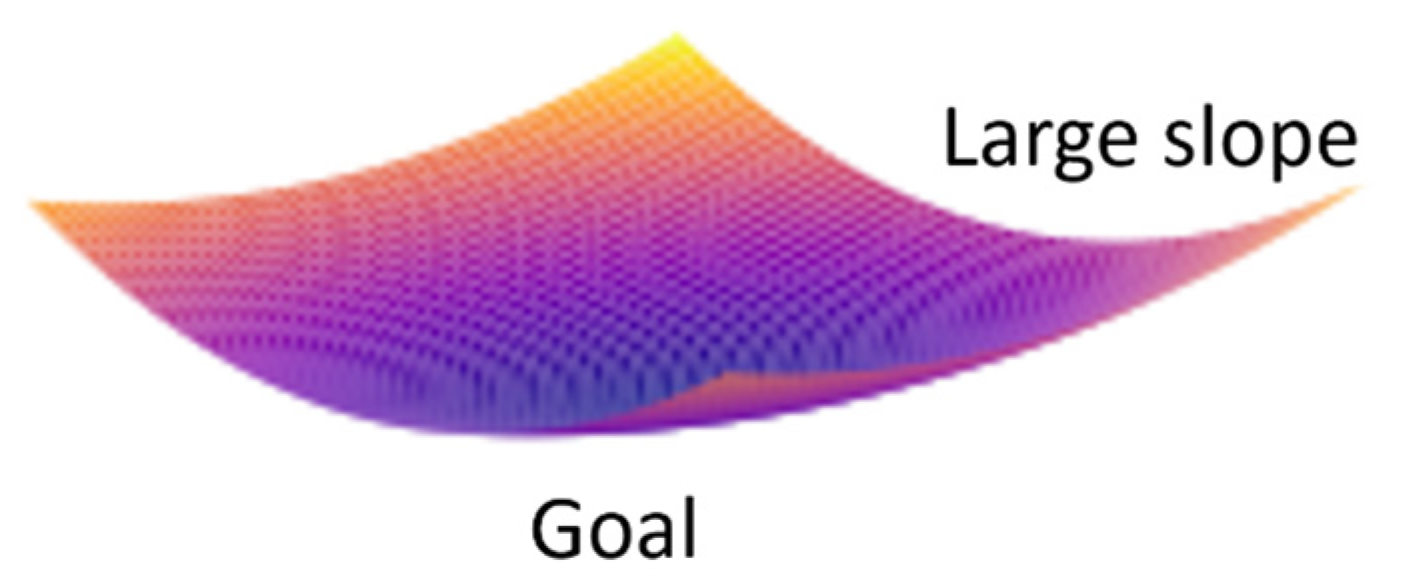
Figure 2. Gravitational potential field. The figure illustrates the variation pattern of the attractive potential field value, which is minimized at the target point and increases significantly as the distance from the target grows.
Wevj 17 00007 g002
Figure 3. Repulsion potential field. The figure shows the repulsive potential field generated by four obstacles in the environment, which increases sharply when approaching these obstacles.
Wevj 17 00007 g003
Figure 4. Obstacle expansion and rotating potential field construction. (a) The original irregular obstacle is enclosed by an axis-aligned bounding box (AABB) with a safety margin. (b) An elliptical rotating potential field is constructed around the AABB, providing both repulsive ( F r e p ) and tangential ( R ) forces to guide the vehicle smoothly around the obstacle.
Wevj 17 00007 g004
Figure 5. Obstacle rotation potential field. Point A represents the centroid of the platoon consisting of six vehicles, while point O denotes the centroid of the obstacle’s expanded rectangle. The intersection point between the line connecting OA and the elliptical boundary of the rotational potential field generated by the obstacle is labeled as B.
Wevj 17 00007 g005
Figure 6. Virtual force trajectory tracking control method. In the figure, E ( x E , y E ) is the point on the navigation path closest to the vehicle, D ( x D , y D ) is the initial position where the vehicle deviates from the navigation path, G ( x G , y G ) is a subsequent position after deviation, F k and F d represent the virtual spring force and virtual damping force, respectively.
Wevj 17 00007 g006
Figure 7. Simulation trajectory of single vehicle test. The figure compares the trajectory curves when using only the artificial potential field method for obstacle avoidance versus the strategy incorporating the rotational potential field and trajectory control.
Wevj 17 00007 g007
Figure 8. Simulation results of vehicle platoon test. (a) shows the variation in headway over time for the vehicles in the platoon, and (b) shows the variation in their speeds over time.
Wevj 17 00007 g008
Figure 9. Simulation trajectory of vehicle platoon test. Figure shows the vehicle trajectory under the combined action of the vehicle collision avoidance algorithm, consistent control strategy, and multi-vehicle collaborative overall avoidance strategy.
Wevj 17 00007 g009
Figure 10. Vehicle platoon obstacle avoidance in curve scenario. The platoon maintains cohesion while collaboratively avoiding an obstacle on a curved road. The red obstacle is surrounded by an influence zone, and the vehicles demonstrate smooth detour trajectories without disrupting platoon stability.
Wevj 17 00007 g010
Table 1. Simulation test group configurations. The tests are divided into two categories: single-vehicle tests and platoon tests. The single-vehicle tests are further divided into two groups: one using the artificial potential field obstacle avoidance law, and the other employing rotational potential field with path tracking control. The platoon tests are divided into three groups: the first group only implements vehicle obstacle avoidance algorithms; the second group adds consistency control strategies on the basis of the first group; and the third group incorporates multi-vehicle collaborative obstacle avoidance strategies on the basis of the second group.
TestsGroupsControl Strategy
Single-vehicle test1-1Basic APF
1-2RPF + Path Tracking
Platoon test2-1Vehicle collision avoidance algorithm
2-2Vehicle collision avoidance algorithm + consistent control strategy
2-3Vehicle collision avoidance algorithm + consistent control strategy + multi-machine collaborative overall avoidance strategy
Table 2. Initial state of vehicle. The table specifies the vehicle’s initial position, target point, initial velocity, and heading angle.
VehicleLocation/mTarget/mVelocity/(m/s)Direction/(°)
U1(10,10)(10,000,10,000)3045
Table 3. Obstacle parameters for single-vehicle test. The table provides the positions and dimensions of the two obstacles.
ObstaclesLocation/m q l /m q w /m
O1(3000,2999)32
O2(7000,7002)23
Table 4. Statistical comparison of Vehicle Trajectory Stability (VTS).
DatasetMean VTSStd. Dev.MinMaxp-Value (vs. Real)
Real Trajectories (n = 14)0.400.150.130.69-
Simulated (Strategy 1-1)0.470.000.470.47<0.05
Table 5. Initial state of vehicle platoon. The table provides the initial positions, target positions, speeds, and headways of the five vehicles in the platoon.
VehiclesLocation/mTarget/mVelocity/(m/s)Distance from the Car Ahead/m
U1(50,50)3045/
U2(150,150)304510
U3(250,250)304510
U4(350,350)304510
U5(450,450)304510
Table 6. Obstacle parameters for platoon test. The table provides the positions and dimensions of the two obstacles.
ObstaclesLocation/m q l /m q w
O1(3000,2999)32
O2(7000,7002)23
Disclaimer/Publisher’s Note: The statements, opinions and data contained in all publications are solely those of the individual author(s) and contributor(s) and not of MDPI and/or the editor(s). MDPI and/or the editor(s) disclaim responsibility for any injury to people or property resulting from any ideas, methods, instructions or products referred to in the content.