Author Contributions
Conceptualization, R.G.-M., P.R. and Á.L.; methodology, R.G.-M.; software, R.G.-M. and M.A.-G.; validation, R.G.-M., Á.L. and M.O.; formal analysis, P.R.; investigation, R.G.-M.; resources, Á.L.; data curation, R.G.-M.; writing—original draft preparation, R.G.-M.; writing—review and editing, R.G.-M., P.R. and Á.L.; visualization, R.G.-M.; supervision, M.O., P.R. and Á.L.; project administration, P.R. and Á.L.; funding acquisition, P.R. and Á.L. All authors have read and agreed to the published version of the manuscript.
Figure 1.
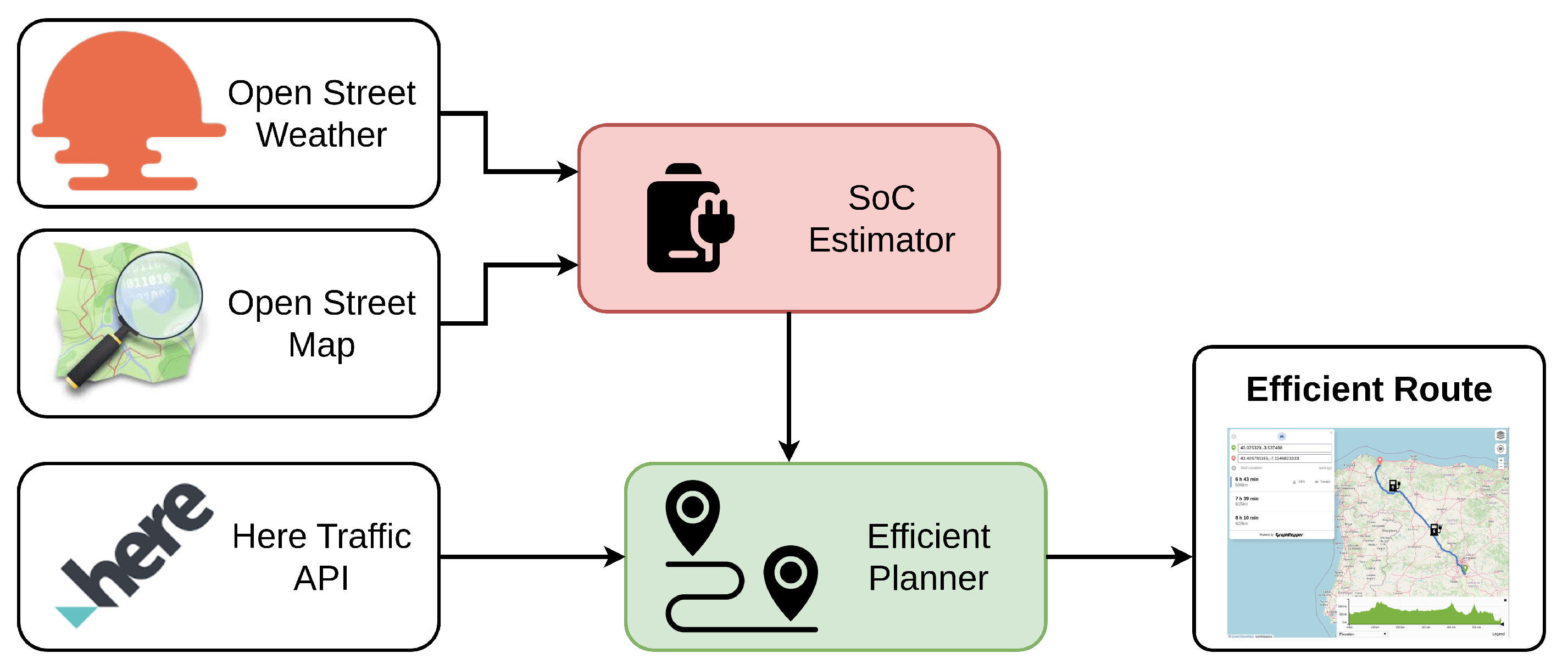
Overall architecture of the proposed energy-optimal routing framework. The end-to-end model is fed with weather and map information to produce the energy estimation. The planner then calculates a cost for each edge and node, considering this estimation together with the road network and traffic conditions, resulting in an efficient route.
Figure 1.
Overall architecture of the proposed energy-optimal routing framework. The end-to-end model is fed with weather and map information to produce the energy estimation. The planner then calculates a cost for each edge and node, considering this estimation together with the road network and traffic conditions, resulting in an efficient route.
Figure 2.
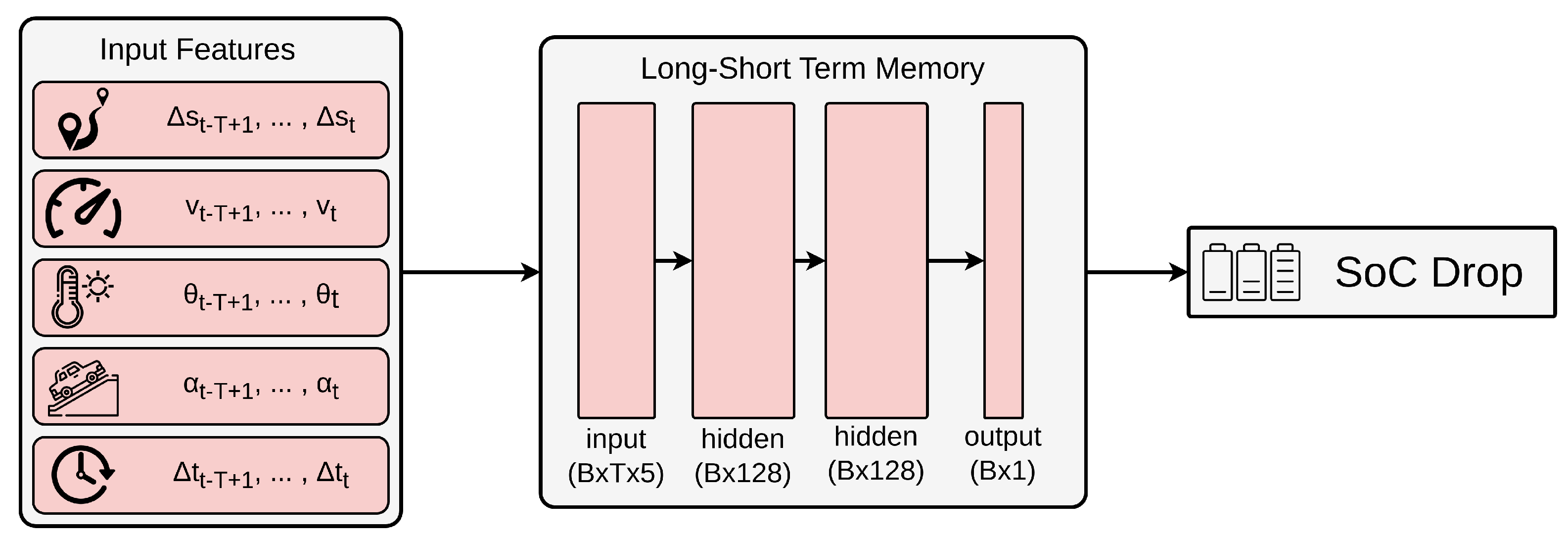
Schematic of the proposed LSTM-based architecture. Input sequences include distance, velocity, temperature, road inclination, and time increment features, arranged in a tensor of shape . These are processed by the LSTM and a fully connected layer to predict the SoC drop.
Figure 2.
Schematic of the proposed LSTM-based architecture. Input sequences include distance, velocity, temperature, road inclination, and time increment features, arranged in a tensor of shape . These are processed by the LSTM and a fully connected layer to predict the SoC drop.
Figure 3.
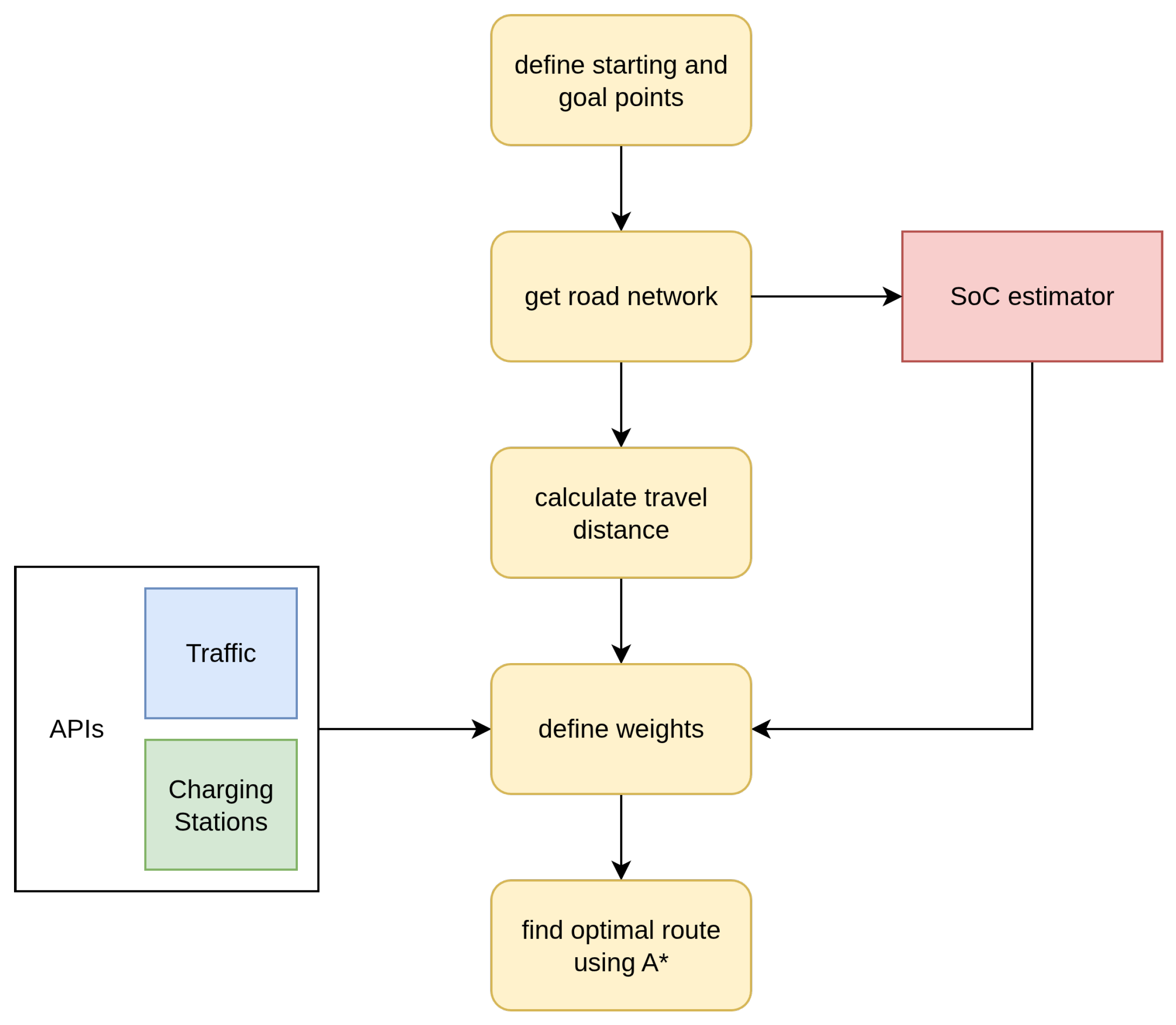
System flowchart illustrating the interaction between static map data, dynamic information, the consumption model, and the route planner.
Figure 3.
System flowchart illustrating the interaction between static map data, dynamic information, the consumption model, and the route planner.
Figure 4.
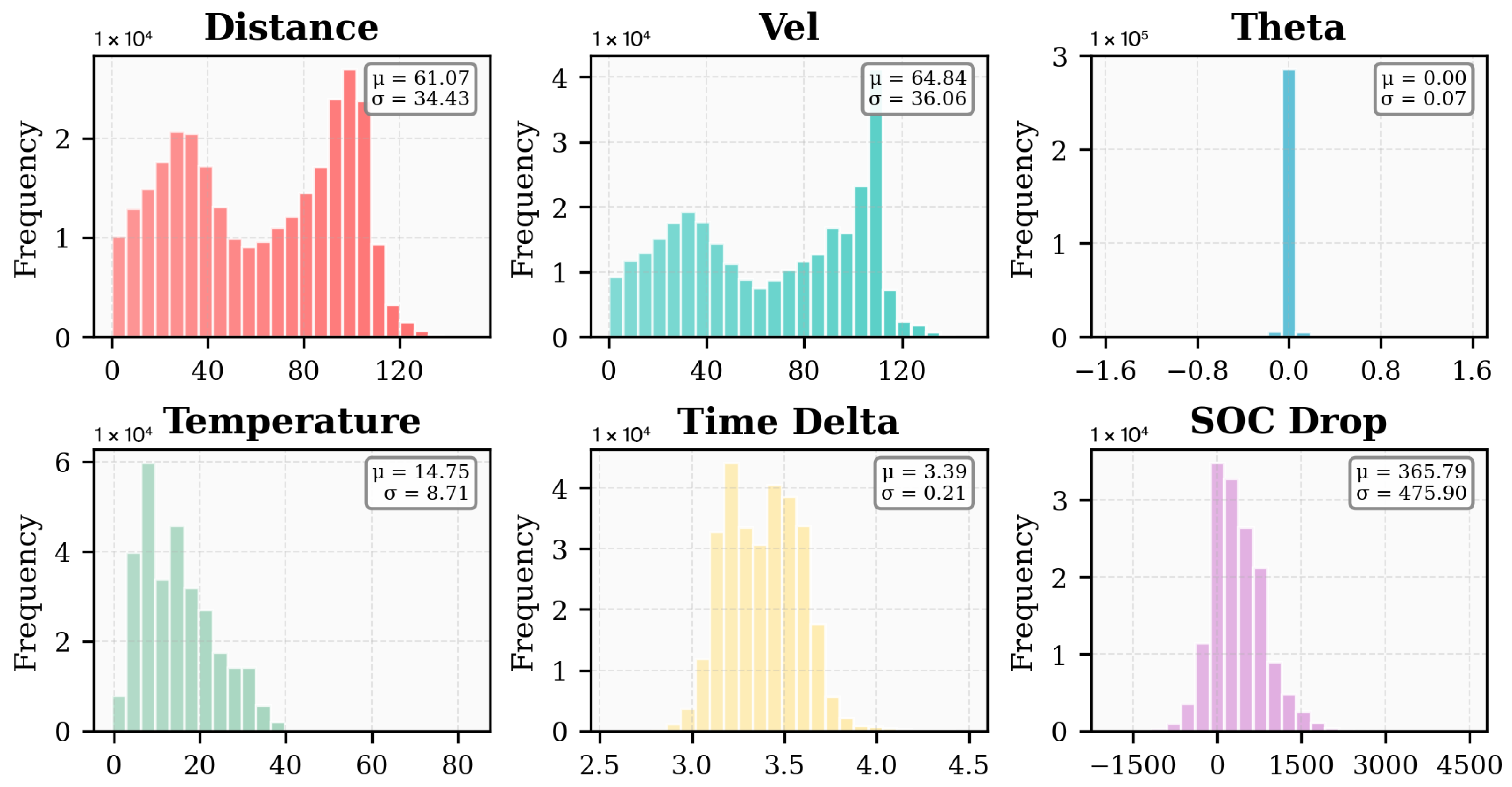
Overview of the dataset structure. The histograms display the frequency distribution for six parameters used for model training: Distance (in km), Temperature (in °C), the road inclination, Time Increment (in seconds), and the target variable, SOC Drop. The mean () and standard deviation () are presented for each variable.
Figure 4.
Overview of the dataset structure. The histograms display the frequency distribution for six parameters used for model training: Distance (in km), Temperature (in °C), the road inclination, Time Increment (in seconds), and the target variable, SOC Drop. The mean () and standard deviation () are presented for each variable.
Figure 5.
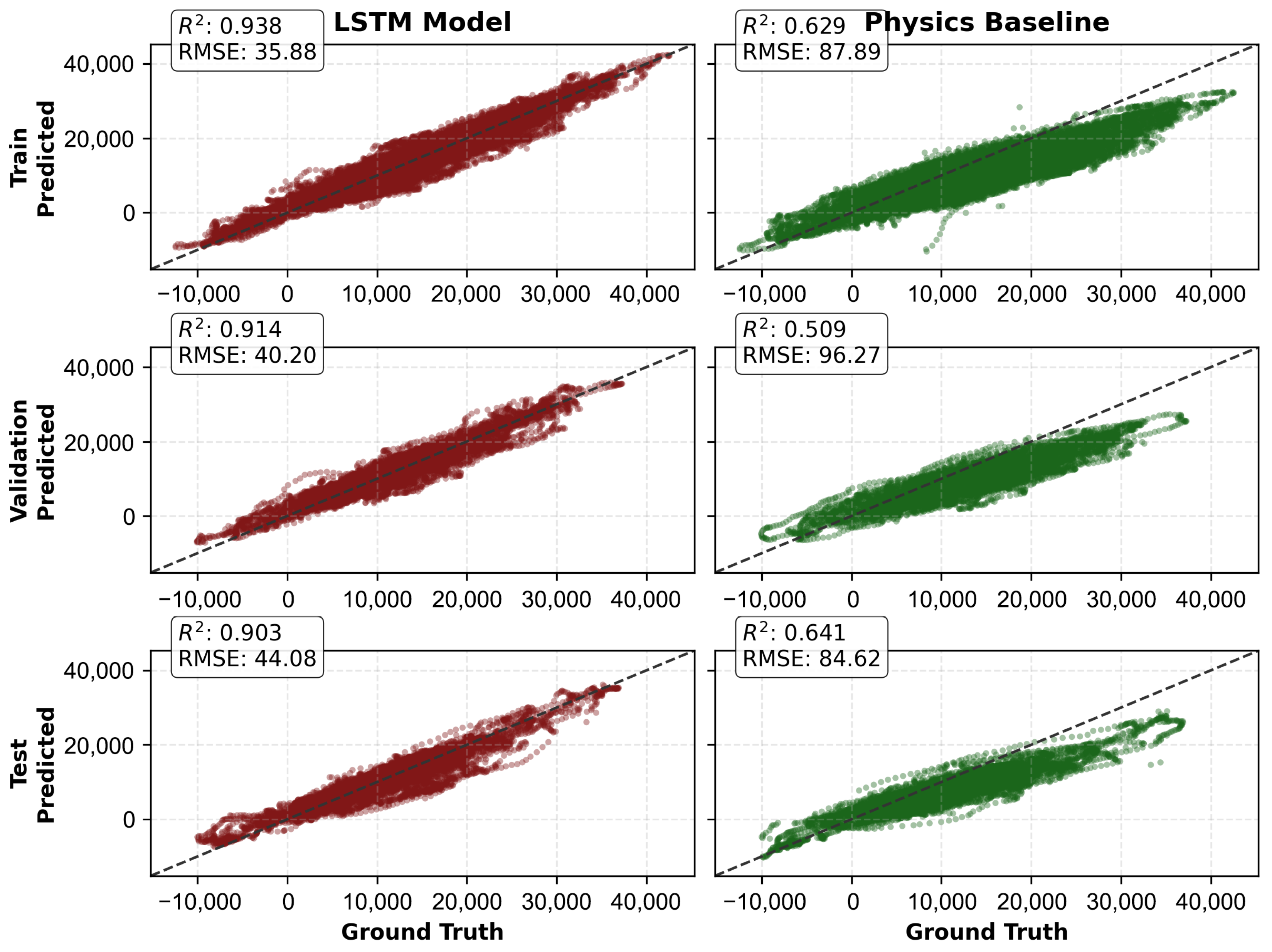
Comparison of predicted versus true SoC drops across the dataset splits: Training (top), Validation (middle), and Test (bottom). In each row, the learned estimator is compared against the analytical formula. The dashed line represents the ideal reference. The model demonstrates consistent generalization, maintaining tight clustering around the diagonal even on the unseen test data.
Figure 5.
Comparison of predicted versus true SoC drops across the dataset splits: Training (top), Validation (middle), and Test (bottom). In each row, the learned estimator is compared against the analytical formula. The dashed line represents the ideal reference. The model demonstrates consistent generalization, maintaining tight clustering around the diagonal even on the unseen test data.
Figure 6.
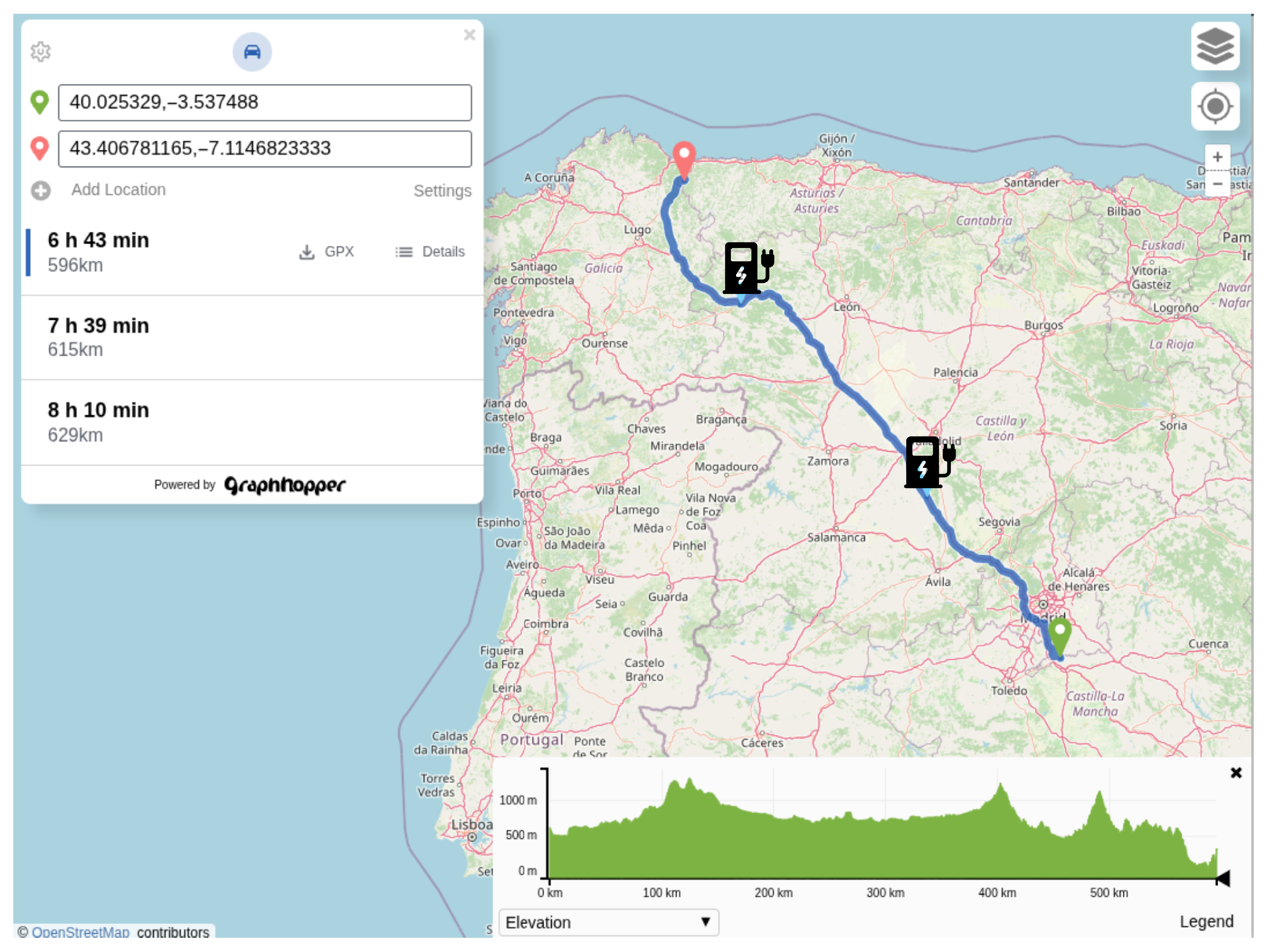
The route generated by the efficient planner. The initial point in Madrid and the goal point in Galicia. The black icons correspond with the charging stations.
Figure 6.
The route generated by the efficient planner. The initial point in Madrid and the goal point in Galicia. The black icons correspond with the charging stations.
Figure 7.
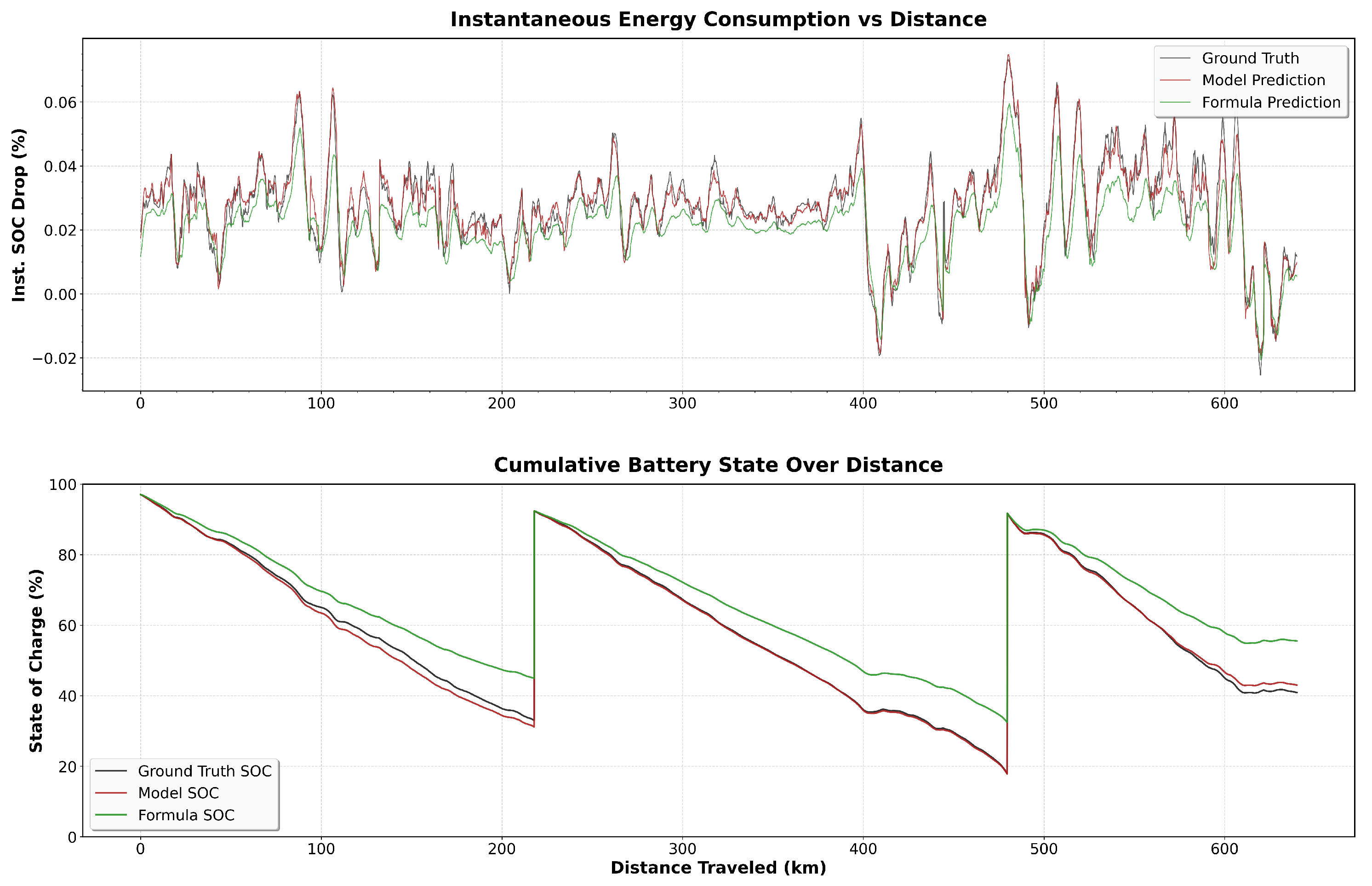
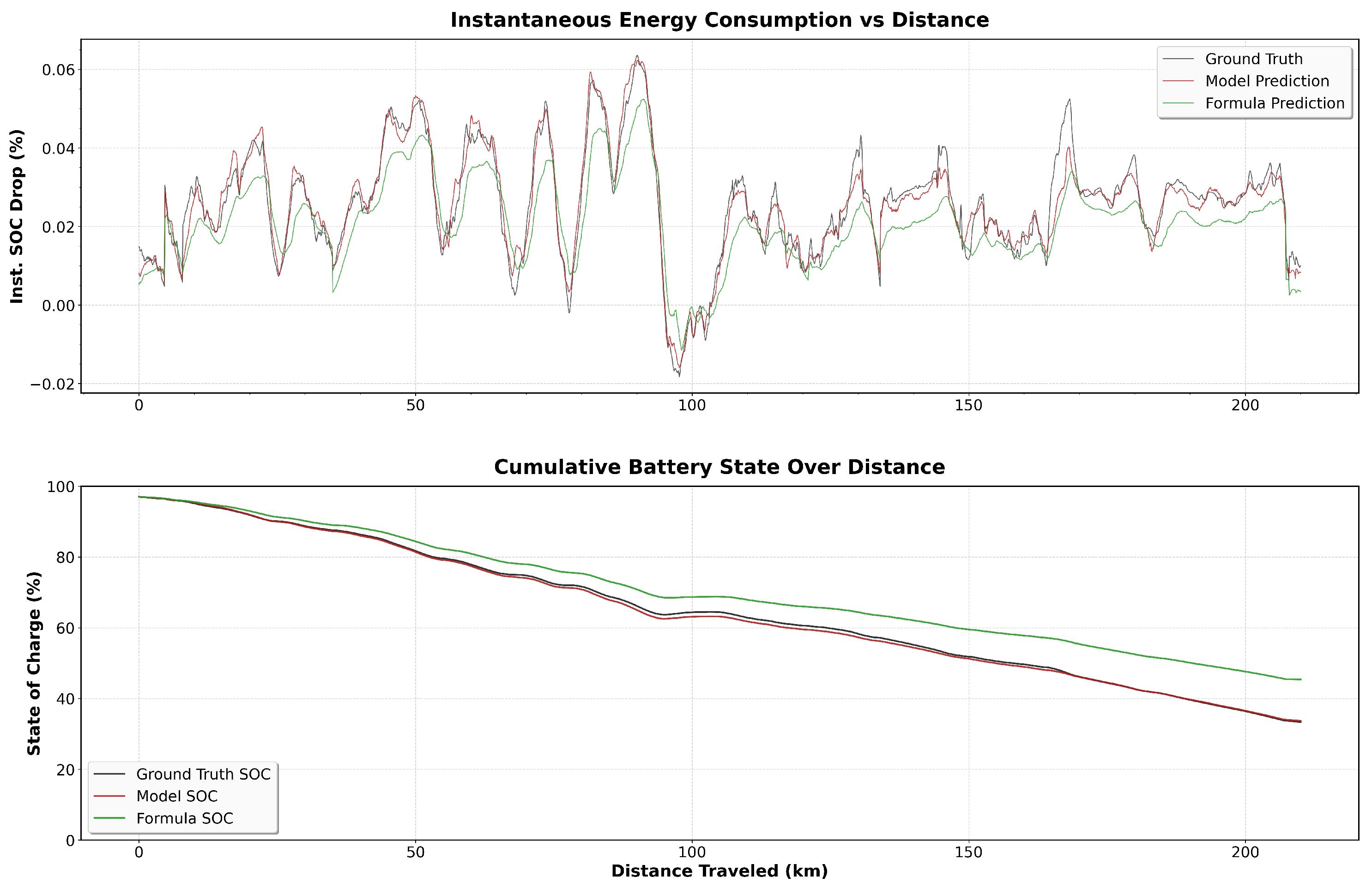
Comparison for the Madrid–Galicia route. The black line represents the actual SoC, the red line is the proposed model’s prediction, and the green line is the formula prediction.
Figure 7.
Comparison for the Madrid–Galicia route. The black line represents the actual SoC, the red line is the proposed model’s prediction, and the green line is the formula prediction.
Figure 8.
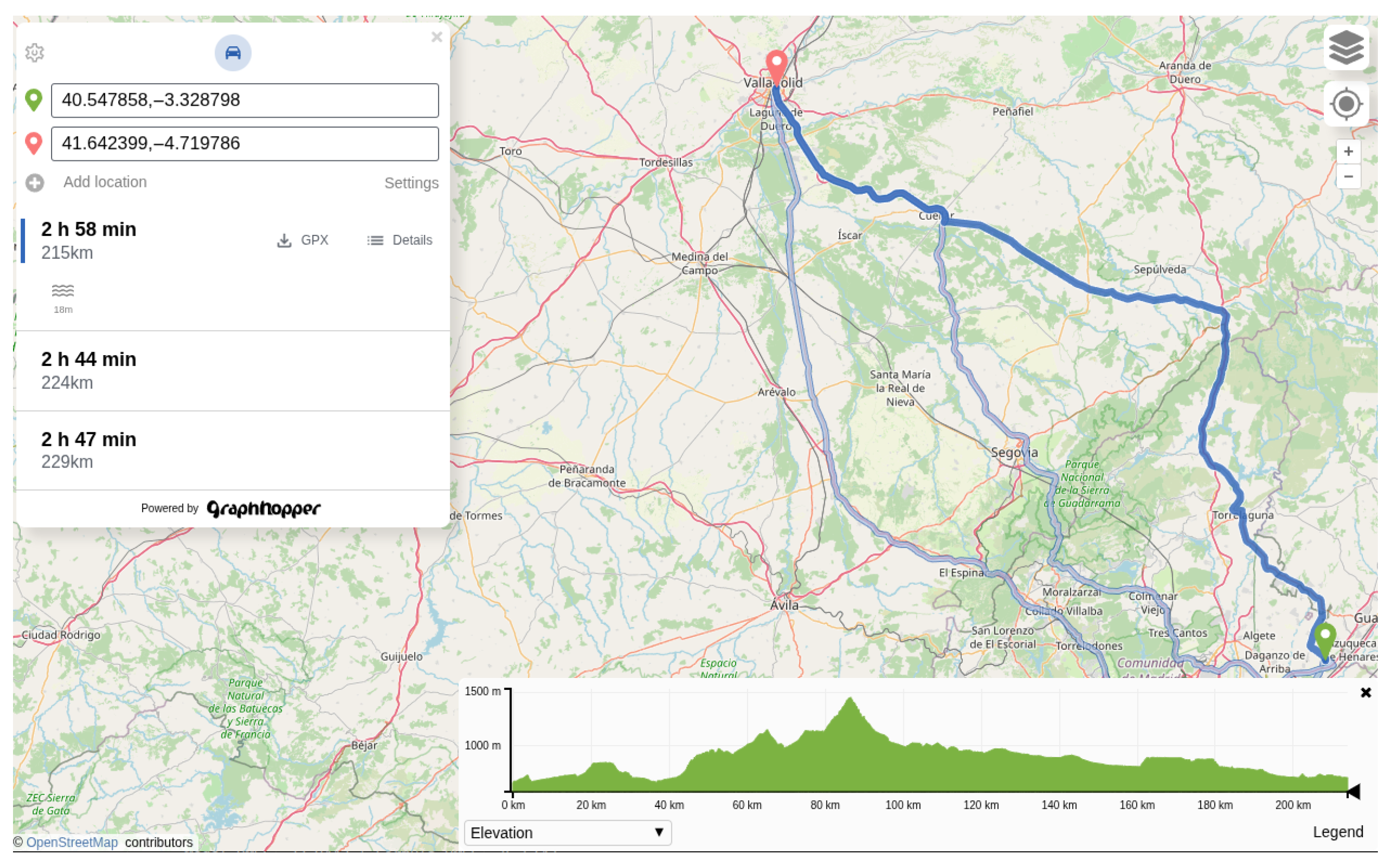
Route computed by the optimized planner, starting in Madrid and ending in Valladolid.
Figure 8.
Route computed by the optimized planner, starting in Madrid and ending in Valladolid.
Figure 9.
Comparison for the Madrid–Valladolid route. The black line represents the actual SoC, the red line is the proposed model’s prediction, and the green line is the formula prediction.
Figure 9.
Comparison for the Madrid–Valladolid route. The black line represents the actual SoC, the red line is the proposed model’s prediction, and the green line is the formula prediction.
Table 1.
System parameters, cost function weights, and operational constraints used in the experimental validation.
Table 1.
System parameters, cost function weights, and operational constraints used in the experimental validation.
| Category | Parameter | Symbol | Value |
|---|
| Cost Function | Distance Weight | | 1.0 |
| SoC Drop Weight | | 50.0 |
| Traffic/Node Penalty | | 10.0 |
| Planner | Heuristic Efficiency | | 5.0 km/%SoC |
| Charging Penalty | | −500 (Reward) |
| Model & Data | LSTM Sequence Length | T | 50 samples |
| Sampling Rate | | 4 s |
| Traffic Update Rate | | 5 min |
| Weather Update Rate | | 10 min |
Table 2.
Performance of the learned SoC estimator for different sequence lengths. The best-performing configuration (50 samples) is highlighted.
Table 2.
Performance of the learned SoC estimator for different sequence lengths. The best-performing configuration (50 samples) is highlighted.
| Samples | MSE | RMSE | |
|---|
| 100 | 0.1493 | 42.59 | 0.8540 |
| 50 | 0.0695 | 36.83 | 0.9374 |
| 20 | 0.1165 | 57.88 | 0.8959 |
| 10 | 0.1965 | 83.55 | 0.8162 |
| 5 | 0.2345 | 100.01 | 0.7721 |
| 1 | 0.5585 | 183.51 | 0.4217 |
Table 3.
Comparison between the best model (50 samples) and the analytical baseline formula. The top result is shown in bold.
Table 3.
Comparison between the best model (50 samples) and the analytical baseline formula. The top result is shown in bold.
| Method | RMSE | | Improvement |
|---|
| Model (50 samples) | 36.83 | 0.9374 | RMSE: +59.91%, : +0.327 |
| Formula (baseline) | 91.88 | 0.6104 | – |
Table 4.
Quantitative comparison of SoC prediction accuracy across all real-world scenarios.
Table 4.
Quantitative comparison of SoC prediction accuracy across all real-world scenarios.
| Route Case Study | Distance | Mean Absolute Error (MAE %) |
|---|
| Proposed Model | Baseline Formula |
|---|
| Madrid–Galicia | 640 km | 1.8 | 21.4 |
| Madrid–Valladolid | 210 km | 1.2 | 15.6 |
| Alcalá de Henares–Madrid | 35 km | 0.7 | 5.8 |
| Meco–Alcalá de Henares | 12 km | 0.4 | 3.2 |
| Madrid–Torrejón de Ardoz | 25 km | 0.6 | 4.9 |
| Urban Madrid | 18 km | 0.5 | 4.1 |
| Interurban Henares Loop | 45 km | 1.1 | 7.5 |
| Average | – | 0.90 | 8.92 |
Table 5.
Quantitative benchmark of the proposed planner versus ABRP across all test scenarios. Metrics include Total Trip Time and SoC Prediction Accuracy (MAE).
Table 5.
Quantitative benchmark of the proposed planner versus ABRP across all test scenarios. Metrics include Total Trip Time and SoC Prediction Accuracy (MAE).
| Route | Distance | Total Trip Time | SoC MAE (%) |
|---|
| Ours | ABRP | Ours | ABRP |
|---|
| Long-Range |
| Madrid–Galicia | 640 km | 6 h 15 m | 6 h 12 m | 1.8 | 3.5 |
| Madrid–Valladolid | 210 km | 2 h 18 m | 2 h 15 m | 1.2 | 3.1 |
| Short-Range (Urban/Interurban) |
| Alcalá–Madrid | 35 km | 32 min | 30 min | 0.7 | 2.8 |
| Meco–Alcalá | 12 km | 18 min | 17 min | 0.4 | 2.5 |
| Madrid–Torrejón | 25 km | 24 min | 23 min | 0.6 | 2.9 |
| Urban Madrid | 18 km | 28 min | 26 min | 0.5 | 3.2 |
| Interurban Henares Loop | 45 km | 42 min | 40 min | 1.1 | 3.0 |
| Average | – | – | – | 0.90 | 3.00 |
Table 6.
Feature comparison of EV routing planners.
Table 6.
Feature comparison of EV routing planners.
| Feature | Ours | Google | ABRP | HERE EV |
|---|
| SoC Estimation Available | Yes | No | Yes | No |
| Travel Time Optimization | Balanced | High | Moderate | High |
| Route Personalization | Dynamic | None | None | None |
Table 7.
Nomenclature of variables and parameters.
Table 7.
Nomenclature of variables and parameters.
| Symbol | Unit | Description |
|---|
| Physics-Based Model |
| N | Total driving force acting on the vehicle |
| N | Rolling, aerodynamic, and gradient resistance forces |
| m | kg | Vehicle mass (Leaf: ≈1580 kg) |
| g | m/s2 | Gravitational acceleration (9.81 m/s2) |
| - | Rolling resistance coefficient |
| rad | Road inclination angle |
| kg/m3 | Air density |
| - | Aerodynamic drag coefficient |
| A | m2 | Vehicle frontal area |
| v | m/s | Instantaneous vehicle velocity |
| W | Instantaneous power demand |
| kWh | Total battery energy and mechanical energy |
| - | Efficiencies of battery discharge, inverter, and motor |
| Learning-Based Model |
| - | Input feature vector at time t |
| m | Distance traveled between samples |
| °C | Ambient temperature |
| s | Time interval between samples |
| T | - | Sequence length (Time steps) |
| % | Ground truth and Predicted SoC drop |
| Planner & Optimization |
| - | Weight (cost) of edge connecting nodes i and j |
| % | Predicted energy consumption for edge |
| - | Penalty or reward associated with node j |
| - | Weighting factors for distance, energy, and penalties |
| - | A* cost functions: total, accumulated, and heuristic |




 ,
,