


Abstract
The global electricity demand from electric vehicles (EVs) increased by 3631% over the last decade, from 2600 gigawatt hours (GWh) in 2013 to 97,000 GWh in 2023. The global electricity demand from EVs will rise to 710,000 GWh by 2030. These EVs will depend on smart grids (SGs) for their charging requirements. Like EVs, SGs are a booming market. In 2021, SG technologies were valued at USD 43.1 billion and are projected to reach USD 103.4 billion by 2026. As EVs become more prevalent, they introduce additional complexity to the SG landscape, with EVs not only consuming energy, but also potentially supplying it back to the grid through vehicle-to-grid (V2G) technologies. The entry of numerous independent sellers and buyers, including EV owners, into the market will lead to intense competition, resulting in rapid fluctuations in electricity prices and constant energy transactions to maximize profit for both buyers and sellers. Blockchain technology will play a crucial role in securing data publishing and transactions in this evolving scenario, ensuring transparent and efficient interactions between EVs and the grid. This survey paper explores key research challenges from an engineering design perspective of SG operation, such as the potential for voltage instability due to the integration of numerous EVs and distributed microgrids with fluctuating generation capacities and load demands. This paper also delves into the need for a synergistic balance to optimize the energy supply and demand equation. Additionally, it discusses policies and incentives that may be enforced by national electricity carriers to maintain grid reliability and manage the influx of EVs. Furthermore, this paper addresses emerging issues of SG technology providing primary charging infrastructure for EVs, such as incentivizing green energy, the technical difficulties in integrating diverse hetero-microgrids based on HVAC and HVDC technologies, challenges related to the speed of energy transaction processing during fluctuating prices, and vulnerabilities concerning cyber-attacks on blockchain-based SG architectures. Finally, future trends are discussed, including the impact of increased EV penetration on SGs, advancements in V2G technologies, load-shaping techniques, dynamic pricing mechanisms, and AI-based stability enhancement measures in the context of widespread SG adoption.
1. Introduction
The smart grid (SG) is the next-generation electrical grid, which, through an integrated smart sensor framework, can coordinate the integration of electrical energy through several decentralized energy generation plants and manage its distribution to consumers as per demand. Smart sensors manage energy metering, i.e., units of electricity produced by the distributed generation plant that is being consumed by users on the grid. It is worth noting that, besides the traditional roles of electricity producers and electricity consumers on the grid, there is also a third hybrid entity called “prosumer”; prosumers can selectively supply the grid with electrical energy when producing surplus energy after meeting their own domestic needs or consume energy from the grid when energy demand exceeds its production capacity. The increasing global demand for energy and the urgent need for sustainable practices have spurred significant interest in SG technologies [1,2,3,4], especially with the rise in the adoption of electric vehicles (EVs) and renewable energy generation. The data show that global electricity demand from EVs increased by 3631% over the last decade, from 2600 gigawatt hours (GWh) in 2013 to 97,000 GWh in 2023. The global electricity demand from EVs will rise to 710,000 GWh by 2030 [5]. SGs promise greater efficiency, reliability, and integration of various renewable energy sources (RESs) [2]. However, significant challenges remain, particularly in managing the intermittent nature of renewables, ensuring grid stability with fluctuating supply and demand equation, especially with the rise in the EV consumer market that is still emerging, and securely handling energy transactions [3,4]. In 2021, SG technologies were valued at USD 43.1 billion and are projected to reach USD 103.4 billion by 2026 [3]. Recently, many consumers have also become producers, known as “prosumers”, through the installation of small green-energy generators at their premises, such as solar or wind power. This allows them to meet their own energy demands and sell surplus electricity back to the grid. This concept extends to microgrids [2,3,4,5,6], which can be viewed as miniature models of the national grid with their own generation, transmission, and distribution networks. Microgrids may operate independently (in islanded mode) [2] when their generation capacity matches their load, but when their capacity exceeds the target load, they can connect to the national grid, thus meeting their own energy needs and selling surplus electricity. Microgrids may typically be small electricity-generation plants using renewable energy, e.g., solar, wind farms, or fossil fuels.
With the growing use of EVs and their potential to act as mobile energy storage units, new challenges and opportunities arise within SGs [7]. EVs can significantly contribute to grid stability by storing and supplying energy when needed. As EVs become more prevalent, managing their integration into the grid and optimizing their use for energy transactions become crucial. Other independent power projects (IPPs) have also begun electricity generation using conventional (thermal) or green technologies (solar and wind). These projects can supply electricity to the national grid, breaking the traditional model of a single, monopolized national grid and introducing a dynamic electricity market akin to a financial stock market, where competition drives rapid fluctuations in electricity prices. In this emerging scenario, blockchain technology [6,8,9,10,11] offers a robust solution for secure data publishing and executing transactions. Blockchain provides a reliable framework for financial transactions, preventing fraud and ensuring secure data distribution and publishing.
The blockchain’s potential extends to the EV sector, where it can facilitate secure and transparent transactions for energy trading, including EV charging and discharging activities. By integrating blockchain, the industry can ensure that energy transactions involving EVs are secure and efficiently managed, enhancing the overall reliability and stability of the grid. Figure 1 presents an overview of the roles that various producers, consumers, and prosumers (a combination of the two) play within the SG scenario, highlighting how blockchain technology can facilitate secure transactions among them.
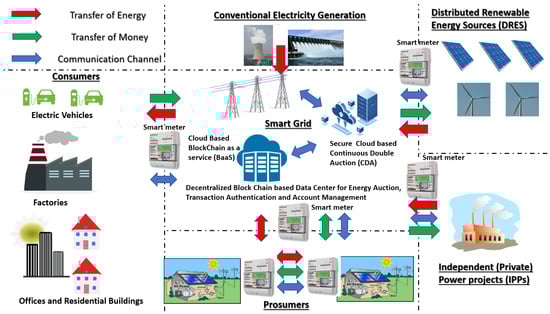
Figure 1.
How different producers, consumers, and prosumers (combination) fit in the SG scenario and how blockchain can help them with secure transactions.
The new SG paradigm promises increased flexibility and reliability for the national grid by enabling distributed energy generation and providing attractive energy buying options for consumers through careful planning. However, several technical challenges still impede widespread SG deployment. A primary challenge is the instability associated with distributed energy generation from renewable sources like wind and solar, which contrasts with more stable energy sources, such as thermal and nuclear power. These fluctuations can lead to overall SG instability if not managed effectively. Additionally, the rise in EVs, while beneficial due to their low carbon footprint, introduces fluctuating and unpredictable loads in different parts of the network. This requires careful planning to ensure that the SG remains disruption-free and reliable.
Another technical challenge is managing the synchronization of operating parameters, such as voltages and frequencies, with the national grid. This issue is exacerbated when DC sources, like solar power, are part of the energy distribution, necessitating complex algorithms to convert DC to AC and match the grid’s frequency. The presence of multiple energy sellers and the integration of EVs also raise concerns about prioritizing energy sellers if their combined generation exceeds the total load demand.
Unwanted oscillations can occur when buyers rapidly shift their energy purchases to cheaper sellers, driving up prices and causing frequent changes in buyer behavior. Machine learning (ML) and artificial intelligence (AI) algorithms are expected to address these issues by managing and balancing distributed energy generation and consumption. Cyber-attacks pose a significant threat to the secure operation of SGs. With a decentralized architecture, there is an increased risk of malicious attacks disrupting SG operations.
This survey paper addresses key research challenges from an engineering design perspective of SG operation, including: (a) potential voltage instability in the SG caused by distributed renewable energy sources (DRES) and EVs, leading to rapid fluctuations in generation capacity and load demand; (b) the need for a synergistic balance to optimize the energy supply and demand equation, including incentives for green energy producers/consumers; (c) the challenge of national electricity carriers maintaining regulatory control over small market players while ensuring grid reliability; (d) integration issues with diverse microgrids using HVAC and HVDC technologies; (e) challenges related to the processing speed of energy transactions amid fluctuating prices and cyber-attacks on blockchain-based SG architectures; and (f) future trends such as increased EV penetration, which will drive advancements in vehicle-to-grid (V2G) technologies, innovative load-shaping solutions, and dynamic energy pricing models. Additionally, this paper explores how AI-based techniques can stabilize SGs, particularly with extensive blockchain technology integration.
The remainder of this paper is structured as follows: Section 2 discusses the related work and recent developments. Section 3 discusses the concept and modalities of using parallel sources for SGs. Section 4 discusses the method of blockchain and smart contract-based technology for a multi-buyer seller environment. Section 5 discusses the role of blockchain in the SG network. Section 6 discusses the technological barriers and current challenges in SG operations after the integration of the EV industry. Section 7 discusses the future trends in next-generation SGs after the integration of the EV market. Finally, Section 8 concludes this paper. The roadmap of this paper is also depicted in Figure 2. Table 1 shows the list of acronyms used in this paper.
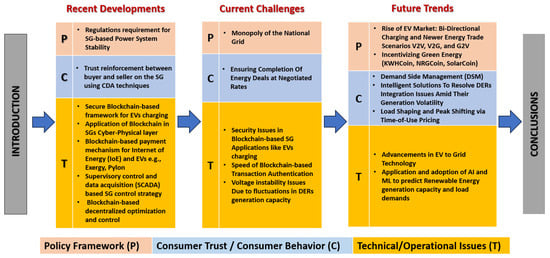
Figure 2.
Roadmap of this paper.

Table 1.
List of acronyms.
2. Related Work
The integration of blockchain technology into SG systems presents a promising solution for enabling fair and decentralized energy trading, particularly in the era of EVs. Hussain et al. [4], in their work, emphasized the significance of the energy internet (EI) revolving around SG, drawing its parallel with the legacy internet, where conventional routing and packets are replaced with energy routing and packets. The EI is an integration of conventional distributed energy resources (DERs), distributed renewable energy resources (DRERs), distributed energy-storage devices (DESDs), real-time energy monitoring, information sharing, real-time pricing, and energy transactions. EVs, with their inherent energy storage capabilities and potential for bidirectional energy flow in the V2G mode, represent both a significant disruption and an opportunity within this ecosystem. Musleh et al. [6] and Li et al. [8] make a case for blockchain applications in SG’s cyber-physical layer. They presented a comprehensive framework with individual blockchains for sensors, microgrids, EVs, energy trading, and cyber security. In their seminal work, Mollah et al. [9] presented a thorough survey paper on the above topic covering various aspects of blockchain-based SGs. Similarly, Li et al. [10] addressed energy trading issues over the Industrial Internet of Things (IIoT). They concluded that security analysis on a real-world dataset confirmed that their proposed energy blockchain and credit-based payment scheme was meeting the security needs of IIoT. Gai et al. [11] considered the security issues of permissioned blockchain networks for SG applications and proposed an architecture based on a smart contract that met the security of the smart grid infrastructure and the privacy of stakeholders.
Mollah et al. [9] also presented several practically implemented prototype systems utilizing blockchain-based SG technology, such as KWHcoin [12], NRGcoin [13], and Solarcoin [14], etc., which reward customers for using green energy. The growing adoption of EVs further amplifies this push toward a more sustainable energy landscape. EVs, with their ability to not only consume, but also potentially supply energy back to the grid, represent a critical component of this evolving scenario. Several other blockchain-based SG platforms offer a favorable environment for purchasing energy from various stakeholders, including EV owners. These platforms facilitate energy transactions and ensure transparency, security, and efficiency in the process. Most notable of these include Exergy [15] and Pylon [16]. Exergy [15] is the first practical system implemented to link a microgrid through a blockchain-based energy trading platform. Similarly, Pylon [16] is a practically implemented blockchain-based platform for several energy providers, including small prosumers and potential EV owners utilizing V2G technology to make their information available to other energy stakeholders and make buying/selling decisions accordingly.
Hassan et al. [17] and Wang et al. [18] extensively discussed the scenario of energy trading in the blockchain-based SG network. They optimized the robustness issues of the conventional power systems focused on ‘long-distance, one-way energy transmission’ by catering to distributed bidirectional energy management, improving the system efficiency and stability, and allowing for more players (prosumers/IPPs) to enter the energy market.
Bielecki et al. [19] and Feng et al. [20] conducted comprehensive surveys on the intricacies of a blockchain-based payment system for managing energy trading on the EI. They introduced the concept of a cryptocurrency-based payment system with fungible tokens (FTs) and non-fungible tokens (NFTs). Blockchain technology and smart contracts allow for automatic and instant cash flows and the implementation of reward rules for specific desired activities on the SG.
Danzi et al. [21] highlighted the problem of DER operating power levels. The DERs can optimize their revenue by producing power at maximum capacity. However, when consumption on the grid is lower, this surplus power may lead to higher voltages on the grid. To solve this problem, the authors proposed a solution in which a subset of the DERs produced lower power levels (lower than available capacity), thus sacrificing their revenue in solving the high voltage problem. Blockchain mechanisms can be used to store a smart contract to create trust between the DERs so that this subset selection is performed each time using a special proportional-fairness algorithm. Another related study by Wang et al. [22] addressed a similar problem in which they developed an optimization model and blockchain-based architecture to manage the operation of crowdsourced energy systems (CESs) with peer-to-peer (P2P) energy trading transactions (ETTs). They present a two-phase operation that focuses on the day-ahead scheduling of generation and controllable DERs, and on hour-ahead or real-time operation of distribution networks. The developed approach supports seamless P2P energy trading between individual prosumers and/or the utility. A multi-agent deep reinforcement learning approach was proposed by Wang et al. [23] to optimize the P2P energy trading and demand-side management (DSM) strategies to improve the maximum cost savings for households and achieve savings of up to 14.03% compared with other state-of-the-art deep reinforcement learning methods. Munsing et al. [24] presented another blockchain-based decentralized optimization and control procedure in which loads are scheduled from a mix of batteries, shapable loads, and deferrable loads on an electricity distribution network. Fu et al. [25] and Sharma et al. [26] also discussed a collaborative optimization algorithm for SGs.
Mrabet et al. [27] exhaustively explored the issue of cyber security and a potential attack on a blockchain-based SG system. Naderi and Arash [28,29] investigated the potential cybersecurity risks associated with false data injection attacks for EVs connected to SGs. They concluded from their study that any interruption of a small part of the SG network could potentially result in higher instability, leading to the shutdown of the entire system at times. Karanfil et al. [30] designed and implemented a security monitoring platform for microgrids based on ML for anomaly detection in real-time, whereas Rahiminejad et al. [31] proposed an innovative recovery framework to support the power-side resilience (PsR) and cyber-side resilience (CsR). The developed metric captures load, available reserve capacity, available line capacity, and reliability, and determines the physical-side resilience and the possible damage to the system. Su et al. [32] presented a safe blockchain-based framework for the secure charging of EVs. Gunduz and Das [33] studied various attack scenarios and their potential solution for SG cyber–physical systems (CPS). Musleh et al. [34] applied a spatio-temporal signal processing approach to detect false data injection attacks (FDIA) in power distribution systems in SGs.
Li et al. [35], Liu et al. [36], and Gai et al. [11] assessed the security issues of blockchains that could potentially be used in an SG application. They investigated the security vulnerabilities of the blockchain system that have been practically exploited, as evidenced by attacks on the BitCoin (BTC) network from 2009 to 2017. Conti et al. [37] also investigated security vulnerabilities related to BTC. Moreover, Wan et al. [38] researched the impact of network latency on blockchain security. They concluded that networks with heterogeneous latency profiles must monitor fairness amongst nodes and, based on that, must preclude some nodes from being miners.
Gao et al. [39] discussed the trust issue between grid service providers and regular consumers, proposing a secure blockchain-based mechanism called grid monitoring. This mechanism offers verifiable provider-centric and consumer-centric information on regular energy consumption and applicable tariff rates to create trust between consumers and providers. The authors also presented comprehensive layer-based architecture with semantics for the systems, which guaranteed transparency, provenance, and immutability.
Kumar et al. [40] presented another study in which they considered the security issues of energy monitoring in SG networks. Similarly, Liang et al. [41] fused blockchain security with attribute-based access control (ABAC) to prevent unauthorized data access over the SG with favorable results.
Several other researchers have focused on the dynamic load management of EV charging and other related concerns, such as security and privacy. Lopes et al. [42] showed that uncoordinated EV charging, for even 10% of the total EVs, can give rise to unacceptable levels of instability in the grid.
Rassaei et al. [43] modeled the statistical patterns of EV owner charging and load optimization for the grid by utilizing V2G capability, where an EV adjusts its charging rate or returns stored energy to the system. The authors found that it was possible to accommodate a large number of EVs using their proposed algorithm without causing instability in the SG and that the algorithm performance further improved with V2G capability in the system.
Sayed et al. [44] presented an attacker’s perspective and proposed a strategy for dynamic load-altering by manipulating EV charging to destabilize the grid using the feedback control theory. In a similar survey, Habib et al. [45] also described bidirectional charging as a means to tackle the issue of massive EV deployment. Knirsch et al. [46] addressed privacy concerns and dynamic charging tariffs through their blockchain-based smart contract publishing. Their study served as an honest and verifiable record of current electricity tariffs on individual charging stations and customers’ bidding processes without revealing their location data for privacy.
Quite recently, Rastogi et al. [47], Chen et al. [48], and Rimal et al. [49] also considered the problems of EV charging from the electric grid as they become ubiquitous. The proposed algorithms optimized the EV charging behaviors, reduced the costs associated with charging, and effectively balanced the regional load profiles of the grids. On the other hand, Zeadally et al. [50] and Qazi et al. [51] considered the communications plane of autonomous, connected vehicles for vehicle-to-vehicle (V2V), vehicle-to-renewable (V2R), and renewable-to-vehicle (R2V) communication scenarios. The authors argued that EVs will use similar communication technologies to communicate with centralized and roadside equipment, e.g., 802.11bd (for DSRC) and 5G-NR V2X (for C-V2X), to transmit their current battery levels and the intended destination of travel, so that the system can calculate the best optimum charging schedule for their commute.
Huang et al. [52] discussed reliable wireless technologies for smart metering applications in blockchain-based SGs. Espinoza et al. [53], Mak and So [54], Gupta C.R. et al. [55], and Jakaria et al. [56] discussed the integration of supervisory control and data acquisition (SCADA) technology with SG. Moreover, Jakaria et al. [56] highlighted various factors for its successful integration, like real-time performance reporting by sensors for safeguarding against cyber-attacks, for which resilient network infrastructure is required. They proposed a hybrid system using legacy message forwarding and software-defined networking (SDN) switches. The detailed literature review presented in this section is also summarized in Table 2.
Table 2.
Summary of the contributions of other researchers.
3. Smart Grid (SG) Architecture: How Multiple Power Sources like EVs Can Inject Energy into the Nationally Deployed Grid and Distribution Networks
The conventional idea in electrical energy is that a source, such as a battery or a generator, can supply current to drive electrical loads if a closed circuit is formed between the battery’s terminals and the electrical load. Multiple batteries can be attached to the primary battery to increase the load capacity. The same principle applies to SG, but with some variations. The notable differences are that (a) the energy sources to be parallelized may not be physically sitting next to each other, and (b) the energy sources may be heterogeneous, like pure AC or converted AC (usually using inverter technology from real-time DC generation systems, such as solar farms), or when the energy from green technologies, such as wind and solar, is pre-stored in batteries. Unlike the traditional power grid, where energy flows one-way from centralized sources, the SG, empowered by EVs, enables a two-way exchange of electricity. So, during the day, an EV charges using clean energy from the workplace’s solar array. Later, as evening demand peaks, the parked EV intelligently sends stored energy back to the grid, supporting its stability and reducing reliance on fossil fuels. This concept is typically referred to as V2G technology [42,43,44,47,48,49], which turns millions of EVs into mobile energy-storage units, supporting grid resilience and accelerating the transition to RES. However, this dynamic energy ecosystem presents new challenges. Coordinating the charging and discharging of millions of EVs, alongside the fluctuating output of solar and wind power, requires a sophisticated, decentralized control system. This is where the SG, with its intelligent communication and control infrastructure, comes into play, coordinating this complex energy exchange and unlocking the full potential of EVs as cornerstones of a sustainable energy future.
Running multiple DC voltage sources is easier than connecting them in parallel with the primary (original) voltage sources. However, when it comes to running two or more AC voltage sources in parallel, things get a little tricky. We have varying sinusoidal voltages with AC sources, and each AC generator could have as many as three different voltage sources, termed as three-phase AC supply. When a second generator is to be connected in parallel with a running system. The following steps must be followed:
- The field current in the second generator should be modified so that its terminal voltage aligns with the line voltage of the initial generator;
- The phase sequence of the second generator should be compared with that of the already running system;
- Ensure that the phase angles of both AC sources are equal;
- Subsequently, the frequency of the oncoming generator is fine-tuned to be marginally higher than that of the active system. This adjustment allows it to initiate as a generator that provides energy, rather than act as a motor that consumes it. Then, a synchroscope is used to match the systems until they are exactly in phase. In a large system, a computer is used for this purpose.
The interconnection of distributed AC generation units or DRES to a large power grid often results in a negligible impact on the grid, regardless of the actions taken by the generator or RES operator. For instance, the connection of a single generator to the expansive US power grid is unlikely to yield any observable changes in the overall grid frequency, given the grid’s immense scale.
The concept of an infinite-bus can be idealized as a power system so vast that its voltage and frequency remain constant, regardless of the real and reactive power drawn or supplied. To analyze the behavior of a generator connected to such a large system, one can examine a setup with a generator and an infinite-bus operating in parallel to supply a load, as illustrated in Figure 3.
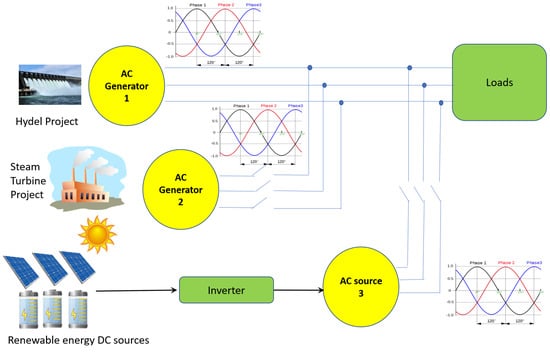
Figure 3.
Transmission line of grid as an infinite bus on which multiple three-phase AC energy sources can be connected.
When multiple generators or a generator and a large power system, such as an electrical grid, are connected in parallel, the frequencies and terminal voltages of all the interconnected machines must be equivalent, since their output conductors are coupled. Consequently, their power–frequency graphs can be depicted adjacently with a shared vertical axis, as depicted in Figure 4a,b, respectively.
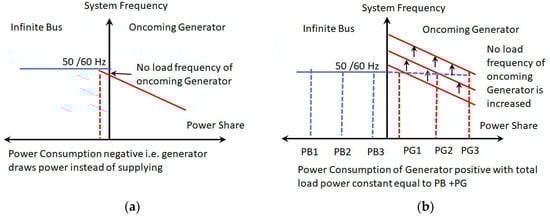
Figure 4.
(a) Oncoming generator receiving power from the bus when its no-load frequency is less than the system frequency (50/60 Hz); (b) oncoming generator sharing the greater load as the no-load frequency is increased.
Under this scenario, the generator will effectively be operating in a floating mode, supplying a negligible amount of power. This situation is illustrated in Figure 4a. Conversely, if the generator had been connected to the grid at a slightly lower frequency than the system’s operating frequency, it would begin drawing power from the grid, rather than delivering it, thereby behaving as a motor, rather than a generator. In this case, the generator frequency is slightly increased, as shown in Figure 4b. Once the generator has been connected, the no-load frequency of the generator is increased. The system’s frequency remains constant (the frequency of an infinite-bus cannot be altered), resulting in an increase in the power supplied by the generator. In this case, the load supplied by the bus will decrease, and the load shared by the oncoming generator will increase. When paralleling is completed, the power supplied by the new generator becomes as per the desired value.
Chen et al. [79] suggested that the grid and distributed energy source should pre-negotiate the load and frequency requirements of the SG system in the blockchain-based trading framework.
Connecting DC systems based on DRES to the grid follows a similar process, with the addition of an extra inverter module to convert the DC power into AC power.
Different countries have introduced schemes to remunerate market participants for their available capacity through capacity markets, aiming to ensure resource adequacy and supply reliability. These capacity costs are determined based on the price of providing necessary energy when required, with long-term considerations in mind. For instance, the 15-year capacity market agreement for new generators in the United Kingdom incentivizes market participants to make new investments with an eye toward long-term supply security. Initially, capacity markets were proposed for conventional generation power plants, which produce a constant and predictable amount of energy. Supply flexibility is essential and could be encouraged through capacity measures in future power systems, which would be distinguished by a high percentage of variable renewable energy (VRE). Additionally, improving demand-side flexibility by shifting consumer consumption from peak to off-peak times in response to price signals could further enhance the system.
New market participants should be permitted to participate in a capacity adequacy process based on their business capability. Demand response and other flexible capacities, including battery storage technologies (when exporting energy to the grid), EVs, and interconnections, could improve the system’s dependability during periods of supply shortfall.
4. Smart Grid (SG) Software Components: A Tutorial on Cloud-Based Blockchain, Distributed Ledger Technology, and Smart Contracts
Blockchain is the bloodline of modern decentralized financial transaction tracking, and it uses the cloud computing platform to generate irrevocable transaction certificates through distributed ledger technology (DLT). The first study to propose blockchain-based BTC [93] foresaw financial transactions solely using a P2P-based distributed framework, enabling electronic cash flow through online payments to be sent directly from one party to another without going through a financial institution. Digital signatures employing efficient cryptography techniques provide part of the solution, but the main benefits are lost if a trusted third party is still required to prevent double-spending. Double spending is defined as the customer initiating two quick transactions so that the account does not reflect an updated financial state while the second transaction is made. This problem is resolved using a P2P network, as shown in Figure 5. The P2P network timestamps transactions by hashing them into a contiguous chain of hash-based proof-of-work (PoW), called DLT, endorsed by majority node approval. On endorsement of the transaction establishing proof of authenticity, the prosumer or DRES will be awarded financial remuneration in the form of digital currency. This DLT forms an immutable record that cannot be changed without redoing the PoW and again obtaining majority vote approval. This is theoretically possible only if 51% of the participating blockchain nodes are compromised by an attack. The incentive for nodes is carrying out transaction block validation through PoW calculation. Smart contracts are automated computer programs running on the blockchain that conclude a transaction based on pre-agreed conditions and notify all participants through broadcast communication.
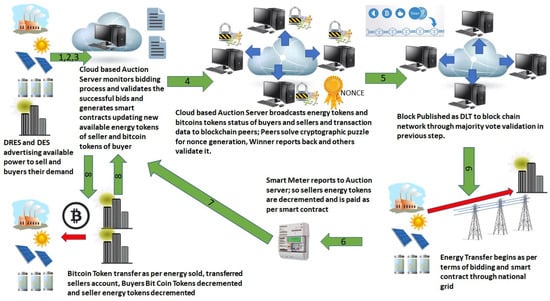
Figure 5.
SG Operation in which multiple energy providers can negotiate energy deals and transfer power over the grid.
Since then, researchers have proposed blockchain-based architecture for several other applications besides the popular digital currency platform (BitCoin) [93]; these include the art trading platform [94], and SG [1,2,3,6,7], among others.
The Brooklyn Microgrid project is an example of an application of the microgrid system adopting blockchain. A network of residents is connected through a microgrid and adopts DERs through PV systems. A mobile application was developed for participants to access the local energy marketplace and choose to sell excess solar energy to the marketplace or continue to net metering [95,96].
5. Working Operation of Blockchain in Smart Grid (SG)
The integration of blockchain into the SG allows the energy players (producers, consumers, and prosumers) to maintain transactions in the decentralized system through mutual consensus and trust, as depicted in Figure 5. The various stages of the energy transaction are outlined below:
Step-1: Different private sector energy sources (both green and conventional fossil-fuel-based) contact decentralized cloud-based energy auction services advertising their energy capacity with digital signature proof.
Step-2: The decentralized cloud-based energy continuous double auction (CDA) updates the current energy costings based on the continuous change in supply and demand equations. It also matches buyers and sellers with each other.
Step-3: After the buyer and seller commit to an energy deal at specified prices and other terms and conditions, the transaction agreements will be digitally verified by both the buyer and seller before an official transaction record is created to be authenticated and verified by the decentralized blockchain network.
Step-4: Transactions are performed through fungible energy and BTC tokens being assigned to the energy seller and buyer, respectively. The decentralized blockchain network will verify these transactions through a cryptographic puzzle-based nonce generation to authenticate the sub-transaction happening on the SG network. The nonce is difficult to compute, requiring significant computing resources to provide evidence of PoW, but it is very easy to verify by other nodes on the blockchain network.
Step-5: The blockchain and smart contracts will store the transaction history in the blockchain using DLT and securely distribute it to all nodes through specialized broadcast mechanisms. The blockchain ensures the immutability of smart contracts and transaction data by preventing records from being modified or deleted. Smart contracts will guarantee the completion of transactions between generators and consumers, providing assurance that producers will always deliver the electricity once a consumer has made the required payment.
Step-6: Energy transfer starts/continues between the distributed energy source and the transmission line. Smart meters continuously log the amount of energy injected into the system from the seller.
Step-7: The smart contract-based automated computer program in the cloud-based auction service will automatically keep the update of energy transfer from seller and buyer financial tokens and again publish these transactions after cryptographic verification to the blockchain network to avoid problems such as duplicate spending.
Step-8: The smart contract-based automated computer program will also maintain a record of FT (debit/credit) to update account management in the decentralized energy auction trading.
Steps 4–8 will be continually performed until energy transfers received by the cloud-based auction service have been successfully terminated and no new requests have been received. The above blockchain-based SG framework provides immutability and traceability, which is good for auditing or solving a transaction dispute. The authentication and immutability aspect of the blockchain, e.g., the Ethereum blockchain [97], runs on the PoW consensus mechanism. In this mechanism, blocks of transactions are verified by miners around the world in exchange for a reward (e.g., BTCs).
How blockchain can prevent a fraudulent transaction is depicted in Figure 6. Seller Sx initially has 100 energy units, and Buyer Bx has 500 BTC tokens. The seller, Sx, agrees to sell 10 energy units to Buyer Bx, which will cost 100 BTC tokens. The remaining energy units left with Seller Sx (=90) and the remaining BTC tokens left with Buyer Bx (=400) are updated by the smart contract application, and the transaction record and updated state of seller Sx energy units and buyer Bx BTC tokens are reflected too. This block (Block-1, as shown in Figure 6) is cryptographically verified by the miners in the BTC network and verified through the federated consensus mechanism as an authentic transaction.
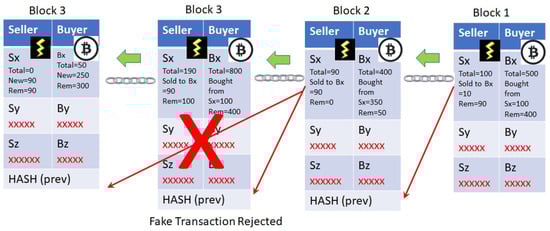
Figure 6.
Blockchain records the SG transactions in a sequential manner. Wrong or fraudulent transactions are rejected.
The verified cryptographic signature is sent to the next block (Block-2) as proof of authentication of the previous transaction in Block-1. The transaction recorded in Block-2 includes another deal between the same buyer and seller, Seller Sx and Buyer By, which sees that the energy tokens of the seller are completely exhausted, and the remaining BTC tokens of the buyer are just 50. A fraudulent transaction between the same buyer and seller, as shown in Figure 6 in Block-3, will be rejected as solving its cryptographic puzzle with a verifiable answer (hash) is impossible to compute given its link with previous Block-2. When a certain mandatory number of peers fail to verify Block-3, it will be rejected by the network. The new transaction will first see Seller Sx announce with verifiable claims of more energy units, and Buyer Bx announces with a verifiable claim of more BTC tokens, after which any further transactions involving Buyer Bx and Seller Sx could be verified and endorsed by the BTC network, as in new Block-3.
Current research indicates that, in order to successfully propagate a fake (fraudulent) block on the blockchain network, the adversary will have computing power equivalent to at least 51% of the entire hashing (mining) power of all participating nodes on the blockchain network [98].
6. Technological Barriers and Current Challenges in Smart Grid (SG) Operation After Integration of EV Industry
Although SG architecture is based on previously available and implemented technologies such as blockchain, distributed energy generation, RES, IoT, and cloud computing, their synergy within SG applications, particularly with the integration of EVs, introduces new implementation challenges. These challenges require innovative solutions. In this context, we outline several research challenges that are specific to the integration of EVs into the SG ecosystem.
6.1. How National Grid May Still Hold Monopoly over Players in the EVs Energy Market
The national electric supply of any country has preferential dominance over the electrical energy sector. This is due to the reason that DES and DRES rely upon the physical infrastructure of the national grid to support the sale of their electrical energy to potential customers. DRES will likely emerge as a smaller player in the EV market in comparison; DRES would be the preferred energy generation option for the EV industry, given that its primary aim is to reduce the carbon footprint. The national SG will only seek their fair contribution when the national grid faces a shortfall, such as an increased gap between demand and supply during very hot or very cold weather. This could potentially hinder the financial benefits to DRES. However, on a national level, one advantage of this, as mentioned by Agung and Handyani [57], is that government-owned plants in the national grid can interfere with the price of electricity. When the price of electricity increases due to an increased gap between demand and supply, the government plant can sell its electricity at a lower price to lower the market price by obtaining increased contributions for DRES and other smaller IPPs. Colak et al. [99] considered the impact of SG on the national grid.
To promote free price formation in wholesale energy markets, including the occurrence of negative prices and price spikes, it is essential to eliminate price limitations. Negative prices are observed when power generation is highly inflexible and demand is low, while price spikes occur during periods of extremely high demand and relatively low generation. For example, Denmark has implemented negative pricing to facilitate the integration of wind power by incentivizing wind turbines to reduce output when there is an excess of wind power [100].
Zhao et al. [101] presented a novel distributed energy trading mechanism based on reputation. This system not only verifies transactions, but also monitors the reputation of potential buyers/sellers by considering their past history of defaults. Such a mechanism can foster trust between buyers/sellers in a decentralized trading platform.
6.2. Ensuring Completion of Energy Deals at Negotiated Rates for EV Consumers
Using blockchain to verify financial transactions when buying merchandise is a lot different than buying or selling energy on the internet. Energy transfer can be time-consuming; for instance, selling 1 MWh of power to an EV charging station(s) may take several hours to complete within a day. This situation presents various potential issues, including fluctuations in energy rates during the transfer due to rapid changes in digital currency values used by these platforms. Smart contracts would require additional temporal information regarding the commencement and conclusion of energy transfers based on the initial agreement between the energy seller and buyer. Agung and Handyani [57] have raised similar pertinent questions in their research paper. While this might not be a critical issue in smaller private blockchains, it could pose challenges in large national public blockchains where energy prices are solely determined by supply and demand and highly susceptible to speculation. For example, Ethereum-based digital cryptocurrency reached a price of USD 1432.88 on 13 January 2018, before dropping to USD 477.49 on 13 June that same year [57,97]. This condition is not desirable for an SG application, as energy price fluctuations in the midst of energy transfers may result in disputes. The only solution for such a problem is if blockchain-based payments are not linked with digital currency, but fiat currency. For example, the Tether cryptocurrency platform maintains a peg to the USD through the implementation of a proof-of-reserves system. This mechanism only generates Tether tokens in exchange for fiat currency.
6.3. Speed of Blockchain-Based Transaction Authentication for EV Consumers
Although the proposed blockchain-based system can manage transactions in the SG, there are some issues regarding its speed of execution. Current blockchain mechanisms, like the Ethereum blockchain, can currently only handle up to fifteen transactions per second. This is due to the heavy processing involved in solving cryptographic puzzles for ‘nonce’ calculation in a trustworthy decentralized authentication mechanism. This limitation will have to be revisited if implemented in a full-scale SG catering to the needs of EV consumers. Calvagna et al. [102] considered the pertinent problem of renewable energy instability in the blockchain-based SG framework. They tested whether the blockchain can scale to implement real-time power modulation commands through smart contracts on the scale of a few seconds to a few minutes, which will be necessitated in view of the highly volatile EV market.
6.4. Security and Its Underlying Energy Consumption Issues in Blockchain-Based SG Applications for the EV Market
Public blockchains pose a challenge in maintaining the privacy of energy market participants, including EV owners, as all transactions and account balances are publicly visible. For instance, a publicly accessible web resource listing Ethereum account information and their balance (Etherscan) [57] can compromise the privacy of these EV market players and end-users. To address this, a government-based organization could maintain a mapping between account addresses and owners’ identities. However, this approach raises the risk of malicious actors targeting wealthy accounts and tracking their owners. An alternative solution is to implement a hybrid blockchain architecture, which separates transaction records from owner identities. In a hybrid model, participation remains open, but block validation and hosting are restricted to a set of trusted nodes, enhancing the network’s security [103].
Another security concern is that the resource-intensive PoW consensus mechanism contrasts with the carbon footprint reduction potential of EVs. In a public blockchain, individuals with high-performance computing equipment could potentially dominate the system. A potential research direction is to explore consensus mechanisms that consider a node’s overall system contribution when selecting eligible block validators, such as the proof-of-importance approach.
Two important terms in cyber-attacks on SGs are jamming attacks and false data attacks. Jamming attacks involve occupying the channel and interfering with the broadcast communication reception, while false data attacks impact the control center’s computations. It was reported that a large-scale cyber-attack on the London energy network could cost up to GBP 111 million every day [104]. Cyber-attacks have been carried out regularly on energy or power network providers, with at least one cyber-attack affecting 75% of energy firms in the past year. AI models can be utilized to identify these cyber threats by examining erroneous data and enabling preemptive measures before they affect energy systems. Between accounts and fraudsters, passwords act as a barrier, while AI technology offers biometric authentication for secure and dependable energy operations. Various schemes have been proposed to develop AI applications to detect cyber-attack threats on the SG, including improving the cyber-physical security of IoTs, transient energy-based screening technology, wide-area monitoring protection, and protecting the industrial control system. Wide-area monitoring entails conveying specific local information to a remote site while also using system-wide data to prevent widespread disruption and lessen the likelihood of potential catastrophic outages [105]. We believe that future cyber security algorithms for EV applications in SG must consider privacy and computational costs as the foremost concerns while being robust to cyber threats. Alternate mining algorithms replacing proof of work (PoW) may be employed, such as proof of stake and proof of capacity.
6.5. Exacerbation of Voltage Instability Issues in SGs by Volatile Energy Demands of EV Market
Along with the advanced control and automation in the electrical grid provided by SG comes the potential for instability, which can cause serious problems. The intermittent nature of various RESs relying on renewable energy (solar and wind) necessitates the criticality of overcoming instability. Voltage instability problems are also compounded by a sudden increase or decrease in electrical load, such as one due to EV consumers. In SG, voltage instability can occur due to an incorrect configuration of the automated systems or faulty programming. The possible reasons for voltage instability in SG include:
- A sudden increase or decrease in the electrical load due to a spike in consumer demand or a disruption in the electric supply;
- Incorrect configuration of the automated systems and controls, such as the use of inverters and storage systems;
- Faulty programming of the automated systems;
- Poor placement of devices within the grid, such as transformers and capacitors.
Voltage instability can have a severe effect on the power supply in the SG. The most noticeable effect is a sudden drop in voltage, which can cause power outages and disruption. In addition, some devices can be permanently damaged due to sudden changes in voltage levels.
To reduce the risk of voltage instability in SGs, a number of solutions have been proposed, including ensuring the correct configuration of the automated systems and controls, reducing the load on the grid when demand is high, e.g., from EV consumers, through structured tariffs or when disruption is expected, implementing proper programming of the automated systems, and properly placing devices in the grid, to ensure an even distribution of voltage [106].
7. Future Trends in Next-Generation Smart Grids (SGs) After the Integration of EV Market
SG technology has already sparked new research questions that need to be addressed as its widespread deployment begins. These questions will increasingly involve the integration of EVs into the system alongside the idiosyncrasies of various participants. For instance, incentivizing green energy remains crucial, despite the volatile nature of renewable energy sources (RESs), which can disrupt SG operations. Similarly, the burgeoning EV market introduces load fluctuations that could vary unpredictably and have largely been explored through simulations without incorporating real-world data on user behavior patterns. Ensuring transparent energy transactions is another challenge that is essential for building trust among EV owners, energy buyers, and sellers in the EV industry. These participants aim to maximize their profits while optimizing grid stability and performance. Several futuristic problems are anticipated as blockchain technology becomes more widely adopted across different countries. Many of these issues will necessitate complex algorithms to address multi-player optimization problems, potentially using game theory-like approaches to effectively integrate EVs into the SG.
7.1. Intelligent Solutions to Resolve DER Integration Issues Amid Their Generation Volatility Keeping SG Stable for Expanding EV Consumers
SG supports increasing the integration of DERs and adopting a decentralized approach to complement centralized generation. DERs facilitate meeting the ever-increasing demand and power delivery to intermittent on-grid EV consumers and rural communities. However, stabilizing the SG is crucial to mitigate the instability introduced by DERs. This can be achieved through algorithms that analyze data from the grid and determine the best way to control the input from DERs, as well as dynamically varying EV loads. By managing the power flow from DERs, the grid can be made more stable, allowing it to operate without disruption. SG stabilization also enables the grid to absorb sudden fluctuations in energy production, thus avoiding voltage and frequency fluctuations.
SG stabilization technology further enhances the grid’s responsiveness to sudden changes in energy demand, which is a common scenario among EV consumers. This technology can identify areas of high energy demand and automatically adjust the energy flow from DERs to meet EV charging demands. This helps to ensure the grid’s stability and reduces the risk of blackouts and power surges. SG stabilization, with contributions from DERs, utilizes a combination of algorithms and technologies, such as linear programming, optimal power flow, and fuzzy logic. The technologies used include sensors, remote control systems, load forecasting, and demand response. Sensors monitor the power flow from DERs, while remote control systems manage their input. Additionally, load forecasting predicts future energy demand, and demand response systems adjust the DER output to meet EV charging in real-time based on changes in demand.
Another benefit of SG stabilization is its ability to proactively manage DERs. This technology can shift the input from DERs to match the grid’s demand from randomly fluctuating EV loads. The transition from load-following to generation-following supports the integration of renewable energy sources (RES) into the grid. DERs offer many benefits, such as being closer to demand, which reduces the need for upgrading transmission and distribution networks. This proximity to demand also enhances efficiency by minimizing power loss in transmission.
As SGs transition to decentralized generation models through DERs, to meet fluctuating load demands due to EVs, they require a platform to enable energy trading. Blockchain technology could be a solution, providing a secure, trusted P2P platform for data and energy transactions, as well as a faster decentralized framework [107]. Despite the potential advantages of blockchain, challenges related to integrating a high penetration of DERs persist. These challenges include the curtailment of DERs due to the physical constraints of power systems and unit commitment problems [108,109,110,111]. For example, if a photovoltaic (PV) system’s output suddenly decreases, other DERs need to compensate for the reduced generation. While blockchain could facilitate better management and trading of DERs, these operational challenges will remain. Nevertheless, blockchain offers benefits such as decentralization and improved DER management in real-time to meet EV demand response with matching generation capacity, market pricing, peak load shaving, and support for ancillary services [107].
Fan et al. [112] proposed a framework for P2P energy trading using blockchain technology. Their simulation study confirmed the system’s capability to handle energy transactions effectively and efficiently within the Alberta electricity wholesale market.
7.2. Intelligent Solutions for Demand-Side Management (DSM) of the EV Market in SG
Demand-side management (DSM) is an actively researched field in the area of SG. The idea is for customers to vary their load profiles for the mutual benefit of the grid and themselves. Thus, its global objectives are electricity cost minimization, minimizing customer discomfort, maximizing the usage of local energy generation, minimizing peak demand, and minimizing the peak-to-average energy ratio (PAER). Many optimization algorithms have been proposed to tackle this problem [113]. For non-flexible loads, a fuzzy controller and integer linear programming technique have been applied [114]. Genetic algorithms for multi-objective optimization have been applied to situations to meet the different needs of residential and industrial customers. For optimum switching of flexible loads for highly fluctuating energy prices when integrating large-scale fluctuating RESs like solar and wind, a multistage stochastic mixed-integer linear programming (SMILP) is proposed [115]. The clonal selection algorithm (CSA) is also proposed for optimal day-ahead load scheduling for large-scale integration of PV plants by the projection of anticipated load and generated energy forecasting [116]. For the rapidly fluctuating load demands of the emerging EV market, several strategies, like covariance matrix adaption evolution strategy (CMAES)-based optimization algorithms, are proposed to maximize the EV charging capacity while minimizing the cost for owners and EV battery providers [117]. Currently, the problem could be tackled by ensuring consumers’ acceptance and participation in DSM programs, as shown by a simulation study [118].
7.3. Rise of EV Market: Bi-Directional Charging and Newer Energy Trade Scenarios V2V, V2G, and G2V
The number of EVs on the roads is increasing; for instance, 16.5 million EVs in 2021 were estimated to be on the roads, which is triple the amount in 2018 [119]. These EVs are considered an added demand on existing power system components, and they might have an adverse impact on the grid. The study in [120] showed that increasing EVs penetration could lead to higher short-circuit currents, off-limits voltage levels, and a shortened lifespan of the equipment. Also, the study demonstrated how fast charging of EVs caused higher losses and voltage drops when compared with regular charging. Nevertheless, with the increasing number of EVs and their potential to be used for energy trading and bidirectional energy exchange, blockchain could be the framework to automate the energy trade.
The energy trade could be V2V, V2G, or G2V. These energy trade scenarios are depicted in Figure 7a,b, respectively. Figure 7a shows the V2G and G2V charging scenarios for EVs where bi-directional energy trade can happen between the SG and Smart Homes. Figure 7b highlights both the static and dynamic EV wireless charging solutions and shows that V2V wireless charging can also happen under static wireless charging. Nevertheless, it is important to note that creating such an environment using the blockchain introduces new challenges.
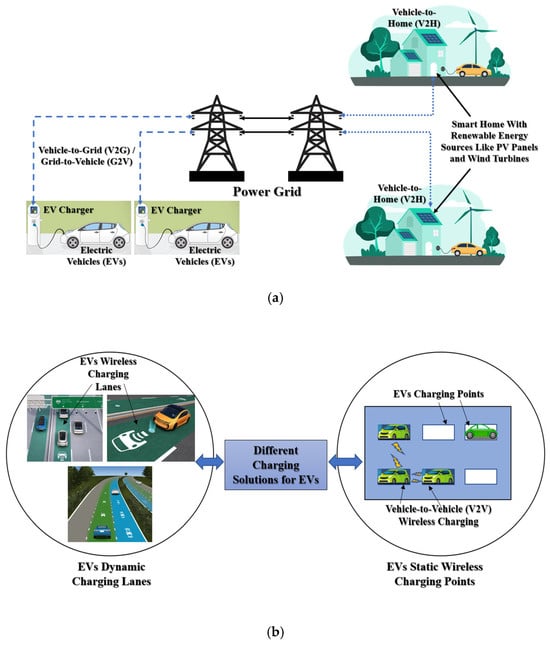
Figure 7.
(a) V2G and G2V charging scenarios for EVs where bi-directional energy trade can happen between the SG and smart home, (b) static and dynamic wireless charging of EVs, and also V2V wireless charging between EVs.
Namely, the scalability of blockchain data, interoperability between different blockchain platforms, privacy, data protection, and confidentiality are the key challenges in implementing P2P for EV energy trade [121,122]. Firstly, scalability is a challenge correlated with the number of EVs. As more EVs are connected, real-time processing and communication through the chains are required. Blockchain platforms are capable of a few transactions per second (TPS); for instance, BTC is capable of 4 TPS [123].
This is a very low number compared with credit card platform rates. Hence, a higher rate is needed to adopt more EV penetration in the SG using the blockchain. Secondly, interoperability is needed for EVs to share data across heterogeneous blockchain platforms. The work in [122,124] argues that existing platforms do follow a defined standard. The wide adoption of blockchain for EVs is highly dependent on assuring interoperability across all platforms. In addition, security is important as there will be a large number of trades between EVs and other EVs or the SG.
Even though blockchain favors security at the expense of scalability, security performance needs to be assessed. Reference [125] discusses different security issues encountered in utilizing IoT and blockchain, such as inherently vulnerable particularities, programming vulnerabilities, and attacks against smart contracts. Introducing a lightweight model to increase scalability could hinder security, and this is a challenge faced in implementing it for EVs. Finally, privacy, data protection, and confidentiality are crucial requirements for the successful implementation of blockchain for EV applications.
Compliance with regulations is indeed mandatory. According to reference [122], regulations like the general data protection regulation (GDPR) are intended to limit accessibility to authorized users only. Due to the immutability of blockchain technology, which means that it cannot be erased even by authorized users, there may be a risk of compromising privacy and confidentiality. This could make blockchain non-compliant with data privacy regulations, such as GDPR [125].
7.4. Advancements in Vehicle-to-Grid (V2G) Technologies for EVs
V2G capabilities are put forth to allow EVs to support the demand-side auxiliary services. EV batteries are made to be able to quickly charge for drivers’ convenience when necessary and quickly discharge during rapid acceleration and other situations that call for a power surge. In order to support the grid through peak shaving and load balancing, they can engage in supply ramping and power regulation [126]. EVs can help to balance out swings in renewable energy. Many issues have to be considered besides cybersecurity when considering EVs for supporting energy market schemes, including degradation brought on by frequent charging and discharging cycles and the impact of EV owners’ behavior on grid reliability, because their main concerns would be driving their cars, rather than meeting grid needs [127].
7.5. Load Shaping and Peak Shifting via Time-of-Use (ToU) Pricing to Meet Fluctuating EV Loads
Time-of-use (ToU) pricing is adopted in various regions to incentivize load shaping and peak shifting. Seventeen European countries, in addition to the USA and India, have adopted different forms of ToU tariffs. These forms include:
- Static ToU pricing applies to all low-voltage consumers in Italy who do not select a supplier from the liberalized market, with different rates for day and night usage.
- Real-time pricing, which includes different forms such as dynamic real-time pricing (e.g., hourly pricing), has been adopted in countries like Spain, the UK, and Estonia. Other dynamic pricing forms based on monthly averages are utilized in countries like Denmark, Norway, and Sweden.
- Variable peak pricing, which is a hybrid of static and dynamic prices by means of pre-defined pricing, except at peak demand during the day, when real-time prices apply.
- Critical peak pricing, which is a hybrid of static and dynamic pricing by means of pre-defined pricing all year, except for a maximum of 22 days where the highest wholesale prices occur, and is adopted in countries like Lithuania, Romania, and France.
Figure 8 presents graphical representations of the different forms of ToU tariffs [128]. How pricing strategies could be integrated with blockchain-based SG architecture without causing disputes is a current challenge that will be resolved in the future. Such tariff rates would be necessitated for the stable operation of blockchain-based SG electricity trading operations in the presence of a highly dynamic EV consumer market.
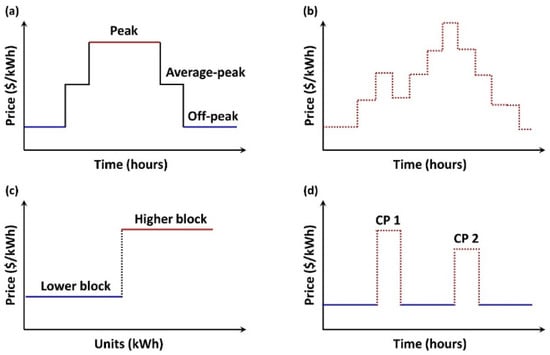
Figure 8.
Types of ToU tariff source. (a) Normal ToU; (b) real-time pricing (RTP); (c) inclining block rate (IBR); and (d) critical peak pricing (CPP). Reprinted from Ref. [128].
7.6. Incentivising Green Energy for EVs
The blockchain records all transaction history, and if a device capable of detecting how the electricity was generated is included in the SG metering system, pricing can be adjusted based on this condition. This promotes green energy and limits electricity generated from dirtier sources. The EV market should be given incentives to use green energy for EV charging, given that their primary aim is the reduction of carbon footprints. Several pilot projects, e.g., Greeneum [62], provide a decentralized blockchain-based SG application to incentivize green energy production. It has AI algorithms to guide organizations to become carbon-neutral through the efficient generation and utilization of green energy. This will, however, require government-based subsidies to keep the price of green energy lower, especially if it is offered entirely by the private sector. For example, Tether, a blockchain-based SG platform, uses a proof-of-reserves, which then creates tokens only in exchange for fiat money. This system can provide buyer and seller security, but cannot forbid people from selling cheap electricity produced by dirty mechanisms, e.g., using fossil fuels instead of renewable resources. People, including the burgeoning EV market, will tend to buy cheaper electricity, regardless of its source, if proper incentives are not given. In comparison, Green energy is cheaper to produce than conventional fossil-fuel-based energy generation, but requires initial large investments and expensive maintenance and future upgradation costs, thus increasing its price until the project achieves break-even condition.
7.7. Application of Artificial Intelligence (AI) to SG Technology for EV Market
Hossain et al. [89] and Diaba and Elmusrati [90] explored the application of big data and deep learning (DL) in SG applications to predict solar and wind power generation, as well as load demand, facilitating more informed decisions for power generation optimization. A similar survey was carried out by Rigas et al. [129], focusing on EV charging issues. Given the intermittent nature of renewable energy sources, optimizing EV charging is crucial to balance the load distribution on the SG while ensuring that no EV owner is left without power. El Ghanam et al. [77] conducted a simulation-based study on EV charging scenarios for dynamic wireless charging (DWC) lanes in Dubai and Sharjah, employing various mixed-integer non-linear programming optimization algorithms to enhance load balancing and prevent overloads. Their approach resulted in a 44% reduction in PAER compared with using a shortest-distance algorithm for assigning EVs to charging stations. Esenogho et al. [81] investigated the application of AI algorithms for 5G-powered SG applications. The high data speeds of 5G networks are critical for supporting massive IoT (mIoT), which is necessary for transmitting the substantial data required by AI algorithms [130]. These algorithms enable effective load forecasting, real-time fault management, and grid stability assessment. Refaat et al. [80] addressed how AI could stabilize the SG amidst volatile power generation from renewable energy sources. Greeneum [62], a decentralized P2P blockchain system for green energy, uses AI algorithms to reward carbon-neutral businesses and blockchain for smart contract generation and sharing. AI algorithms are also utilized as third-party platforms for predicting energy prices; Karasu et al. [88] recently researched predicting Bitcoin values using time-series data and applying two popular ML algorithms: support vector machine (SVM) and linear regression (LR). Pilz and Al-Fagih [82] and Zhang et al. [83] employed game theory approaches for optimizing energy trading.
One controversial aspect of blockchain in SG applications is the computationally intensive consensus mechanism, such as PoW, which consumes significant power at miner nodes. Chibi et al. [131] proposed a novel green PoW (GPoW) mechanism that uses ML and Markov decision processes to reduce the number of miners competing based on their historical win/lose records, thereby decreasing the energy consumption of the consensus mechanism.
7.8. Oscillatory Load Behavior on SG Technology Due to Selfish User-Incentivized EV Transportation Schedules
The gradual rise in the EV market, including private EV users as well as EV-based public transport options (buses and taxis), will present important design and implementation challenges for SG management as consumers strategize their transportation schedules according to beneficial tariffs for EV charging, putting strain on existing DSM algorithms [132,133,134,135,136,137]. Also, their charging demands would be dependent on their driving style and available time for partial/complete charging [138,139,140]. ML algorithms [141] could particularly assist EV owners in selfishly optimizing EV distance range and battery management according to user preference for a particular charging station on their route. For example, EV owners could choose to charge from charging stations located at their offices during the day as compared with their homes according to their work schedules and tariff variation according to place-of-use and ToU. As a result, this would result in spikes in tariff rates in central business district (CBD) areas as compared with residential suburbs due to increased demand during specific times of day. An increase in the tariff rate due to increased demand in CBD areas would prompt EV users to opt for selling surplus energy at CBD locations instead of buying and choosing an alternative charging option at some sub-urban location or en route to their homes. As a result, the demand for CBD energy would again go down, lowering the tariff rates. This would often result in a complex selfish relationship between smart grid and EV users, giving rise to oscillatory behavior causing rapid cyclic fluctuations in demands and tariffs, which could be managed using a combination of centralized and decentralized scheduling algorithms at EV charging stations [142,143,144].
8. Conclusions
This paper provides a comprehensive review of the existing research literature and the latest developments in blockchain-based smart grid (SG) architecture, with a particular emphasis on the integration of electric vehicles (EVs). It begins by outlining the essential components of a working SG system model before shifting to the primary focus: identifying the technological barriers and current challenges, and exploring future trends in this evolving domain.
The article offers an in-depth analysis of the current implementation challenges associated with SG architecture, highlighting issues such as privacy concerns for participants, including EV owners, and the need to enhance blockchain transaction speeds to handle the rapid fluctuations in energy prices caused by the dynamic energy contributions from EVs. Balancing security and transaction speed is critical to the successful application of blockchain technology on a national scale within the energy market. Another significant challenge is managing the diverse objectives of EV owners alongside traditional energy sellers and buyers, while ensuring the stability of the national grid. This involves considering the extent of regulatory control national grid operators are prepared to cede to enable a more decentralized energy market inclusive of EVs.
Future research directions highlighted in this paper include addressing the challenges brought by new EV entrants into the decentralized energy market, such as unpredictable user behavior and fluctuating energy consumption patterns. Additionally, the need to incentivize green energy sources remains crucial, despite the volatility of renewable energy sources (RESs), which can impact SG operations. A critical area for future research is developing mechanisms to reinforce the trust of energy traders, including EV participants, in an environment where government policies might continue to exert monopolistic control over the grid, potentially hindering true decentralization.
Addressing these challenges will likely involve formulating complex multi-player optimization problems. Solutions will require the application of advanced technologies, such as big data and artificial intelligence (AI), essential for the efficient operation of decentralized energy markets and the integration of EVs. Future work should focus on developing robust AI-based algorithms for load forecasting, dynamic pricing, and real-time grid management, particularly in the context of EVs. Furthermore, enhancing cybersecurity measures to protect the integrity and reliability of blockchain-based transactions in SG systems will be paramount.
In conclusion, as discussed in this paper, while the path to fully realizing the potential of blockchain-enabled SGs in the context of EV integration is filled with challenges, the opportunities for innovation and improvement are vast. Continued interdisciplinary research and collaboration will be crucial in overcoming these obstacles and advancing the next generation of SG technologies and EV integration.
Author Contributions
Conceptualization, S.Q. and B.A.K.; methodology, A.A. (Abdullah Alamri) and A.A. (Abdulrahman AlKassem); formal analysis, S.Q., B.A.K., A.A. (Abdullah Alamri) and A.A. (Abdulrahman AlKassem); investigation, S.Q. and A.A. (Abdullah Alamri); resources, B.A.K. and A.A. (Abdulrahman AlKassem); writing—original draft preparation, S.Q. and B.A.K.; writing—review and editing, B.A.K., A.A. (Abdullah Alamri) and A.A. (Abdulrahman AlKassem); visualization, S.Q. and A.A. (Abdulrahman AlKassem); project administration, S.Q. and B.A.K. All authors have read and agreed to the published version of the manuscript.
Funding
This research received no external funding.
Data Availability Statement
No new data were created or analyzed in this study. Data sharing is not applicable to this article.
Conflicts of Interest
The authors declare no conflicts of interest.
References
- Aoudia, M.; Alaraj, M.B.M.; Abu Waraga, O.; Mokhamed, T.; Abu Talib, M.; Bettayeb, M.; Nasir, Q.; Ghenai, C. Toward better blockchain-enabled energy trading between electric vehicles and smart grids in Internet of Things environments: A survey. Front. Energy Res. 2024, 12, 1393084. [Google Scholar] [CrossRef]
- Adnan, M.; Ahmed, I.; Iqbal, S. Load flow balancing in super smart grids: A review of technical challenges, possible solutions and future trends from European perspective. Comput. Electr. Eng. 2024, 117, 109265. [Google Scholar] [CrossRef]
- Smart Grid Market. Available online: https://www.marketsandmarkets.com/Market-Reports/smart-grid-market-208777577.html (accessed on 8 December 2023).
- Hussain, S.M.S.; Nadeem, F.; Aftab, M.A.; Ali, I.; Ustun, T.S. The Emerging Energy Internet: Architecture, Benefits, Challenges, and Future Prospects. Electronics 2019, 8, 1037. [Google Scholar] [CrossRef]
- Jacobs, F. EVs Will Push Up Global Electricity Demand by 630% by 2030. Available online: https://www.globalfleet.com/en/technology-and-innovation/global/features/evs-will-push-global-electricity-demand-630-2030?a=FJA05&t%5B0%5D=Electricity&t%5B1%5D=EVs&curl=1#:~:text=That%20data%20shows%20that%20global,to%2097%2C000%20GWh%20in%202023 (accessed on 10 October 2024).
- Musleh, A.S.; Yao, G.; Muyeen, S.M. Blockchain Applications in Smart Grid–Review and Frameworks. IEEE Access 2019, 7, 86746–86757. [Google Scholar] [CrossRef]
- İnci, M.; Çelik, Ö.; Lashab, A.; Bayındır, K.Ç.; Vasquez, J.C.; Guerrero, J.M. Power System Integration of Electric Vehicles: A Review on Impacts and Contributions to the Smart Grid. Appl. Sci. 2024, 14, 2246. [Google Scholar] [CrossRef]
- Li, D.; Guo, Q.; Bai, D.; Zhang, W. Research and Implementation on the Operation and Transaction System Based on Blockchain Technology for Virtual Power Plant. In Proceedings of the 2022 International Conference on Blockchain Technology and Information Security (ICBCTIS), Huaihua, China, 15–17 July 2022; pp. 165–170. [Google Scholar] [CrossRef]
- Mollah, M.B.; Zhao, J.; Niyato, D.; Lam, K.Y.; Zhang, X.; Ghias, A.M.; Koh, L.H.; Yang, L. Blockchain for Future Smart Grid: A Comprehensive Survey. IEEE Internet Things J. 2021, 8, 18–43. [Google Scholar] [CrossRef]
- Li, Z.; Kang, J.; Yu, R.; Ye, D.; Deng, Q.; Zhang, Y. Consortium Blockchain for Secure Energy Trading in Industrial Internet of Things. IEEE Trans. Ind. Inform. 2018, 14, 3690–3700. [Google Scholar] [CrossRef]
- Gai, K.; Wu, Y.; Zhu, L.; Xu, L.; Zhang, Y. Permissioned Blockchain and Edge Computing Empowered Privacy-Preserving Smart Grid Networks. IEEE Internet Things J. 2019, 6, 7992–8004. [Google Scholar] [CrossRef]
- KWHCoin [White Paper]. Available online: https://ww1.prweb.com/prfiles/2018/01/19/15109995/KWHCoin-White-Paper-REVISED.pdf (accessed on 1 December 2023).
- Mihaylov, M.; Jurado, S.; Avellana, N.; Van Moffaert, K.; de Abril, I.M.; Nowe, A. NRGcoin: Virtual currency for trading of renewable energy in smart grids. In Proceedings of the 11th International Conference on the European Energy Market (EEM14), Krakow, Poland, 28–30 May 2014; pp. 1–6. [Google Scholar] [CrossRef]
- SolarCoin [White Paper]. Available online: https://www.allcryptowhitepapers.com/solarcoin-whitepaper/ (accessed on 1 December 2023).
- Orsini, L.; Collins, B.; Webb, M.; Montgomery, C.; Conte, B.; Adamson, M.; Heitmann, P.; Kessler, S.; Brown, M. Exergy-Technical [White Paper]. Available online: https://www.truevaluemetrics.org/DBpdfs/Initiatives/Exergy/Exergy-2018-Business-Whitepaper-v10.pdf (accessed on 2 February 2024).
- Pylon Network. The Energy Blockchain Platform [White Paper]. Available online: https://pylon-network.org/wp-content/uploads/2019/02/WhitePaper_PYLON_v2_ENGLISH-1.pdf (accessed on 12 February 2024).
- Ul Hassan, N.; Yuen, C.; Niyato, D. Blockchain Technologies for Smart Energy Systems: Fundamentals, Challenges, and Solutions. IEEE Ind. Electron. Mag. 2019, 13, 106–118. [Google Scholar] [CrossRef]
- Wang, N.; Zhou, X.; Lu, X.; Guan, Z.; Wu, L.; Du, X.; Guizani, M. When Energy Trading Meets Blockchain in Electrical Power System: The State of the Art. Appl. Sci. 2019, 9, 1561. [Google Scholar] [CrossRef]
- Bielecki, S.; Skoczkowski, T.; Sobczak, L.; Wołowicz, M. Electricity Usage Settlement System Based on a Cryptocurrency Instrument. Energies 2022, 15, 7003. [Google Scholar] [CrossRef]
- Feng, H.; Shaffer, J.L.; Yu, L.; Xu, R.; Chen, Y.; Ma, X. A Sustainable Energy-Tailored Transaction Mechanism for Smart Grids Based on Block Chains. In Proceedings of the 10th Renewable Power Generation Conference (RPG 2021), Online Conference, 14–15 October 2021; pp. 605–609. [Google Scholar] [CrossRef]
- Danzi, P.; Angjelichinoski, M.; Stefanovic, C.; Popovski, P. Distributed proportional-fairness control in microgrids via blockchain smart contracts. In Proceedings of the 2017 IEEE International Conference on Smart Grid Communications (SmartGridComm), Dresden, German, 23–27 October 2017; pp. 45–51. [Google Scholar] [CrossRef]
- Wang, S.; Taha, A.F.; Wang, J.; Kvaternik, K.; Hahn, A. Energy Crowdsourcing and Peer-to-Peer Energy Trading in Blockchain-Enabled Smart Grids. IEEE Trans. Syst. Man Cybern, Syst. 2019, 49, 1612–1623. [Google Scholar] [CrossRef]
- Wang, J.; Li, L.; Zhang, J. Deep reinforcement learning for energy trading and load scheduling in residential peer-to-peer energy trading market. Int. J. Electr. Power Energy Syst. 2023, 147, 108885. [Google Scholar] [CrossRef]
- Munsing, E.; Mather, J.; Moura, S. Blockchains for decentralized optimization of energy resources in microgrid networks. In Proceedings of the 2017 IEEE Conference on Control Technology and Applications (CCTA), Maui, HI, USA, 27–30 August 2017; pp. 2164–2171. [Google Scholar] [CrossRef]
- Fu, X.; Wang, H.; Wang, Z. Research on Block-Chain-Based Intelligent Transaction and Collaborative Scheduling Strategies for Large Grid. IEEE Access 2020, 8, 151866–151877. [Google Scholar] [CrossRef]
- Sharma, P.; Senapati, R.; Swetapadma, A. Mathematical Modeling for Matching the Prosumers in Decentralized Energy Trading System. In Proceedings of the 2022 11th International Conference on Renewable Energy Research and Application (ICRERA), Istanbul, Turkey, 18–21 September 2022; pp. 502–507. [Google Scholar] [CrossRef]
- Mrabet, Z.E.; Kaabouch, N.; Ghazi, H.E.; Ghazi, H.E. Cyber-security in smart grid: Survey and challenges. Comput. Electr. Eng. 2018, 67, 469–482. [Google Scholar] [CrossRef]
- Naderi, E.; Asrari, A.; Fajri, P. False Data Injection Cyberattacks Targeting Electric Vehicles in Smart Power Distribution Systems. In Proceedings of the 2024 IEEE Transportation Electrification Conference and Expo (ITEC), Chicago, IL, USA, 19 June 2024. [Google Scholar] [CrossRef]
- Naderi, E.; Asrari, A. Integrated Power and Transportation Systems Targeted by False Data Injection Cyberattacks in a Smart Distribution Network. In Electric Transportation Systems in Smart Power Grids; CRC Press: Boca Raton, FL, USA, 2022. [Google Scholar] [CrossRef]
- Karanfil, M.; Rebbah, D.E.; Debbabi, M.; Kassouf, M.; Ghafouri, M.; Youssef, E.N.S.; Hanna, A. Detection of Microgrid Cyberattacks using Network and System Management. IEEE Trans. Smart Grid 2022, 14, 2390–2405. [Google Scholar] [CrossRef]
- Rahiminejad, A.; Plotnek, J.; Atallah, R.; Dubois, M.A.; Malatrait, D.; Ghafouri, M.; Mohammadi, A.; Debbabi, M. A resilience-based recovery scheme for smart grid restoration following cyberattacks to substations. Int. J. Electr. Power Energy Syst. 2023, 145, 108610. [Google Scholar] [CrossRef]
- Su, Z.; Wang, Y.; Xu, Q.; Fei, M.; Tian, Y.-C.; Zhang, N. A Secure Charging Scheme for Electric Vehicles With Smart Communities in Energy Blockchain. IEEE Internet Things J. 2019, 6, 4601–4613. [Google Scholar] [CrossRef]
- Gunduz, M.Z.; Das, R. Cyber-security on smart grid: Threats and potential solutions. Comput. Netw. 2020, 169, 107094. [Google Scholar] [CrossRef]
- Musleh, A.S.; Chen, G.; Dong, Z.Y.; Wang, C.; Chen, S. Spatio-temporal data-driven detection of false data injection attacks in power distribution systems. Int. J. Electr. Power Energy Syst. 2023, 145, 108612. [Google Scholar] [CrossRef]
- Li, X.; Jiang, P.; Chen, T.; Luo, X.; Wen, Q. A survey on the security of blockchain systems. Future Gener. Comput. Syst. 2020, 107, 841–853. [Google Scholar] [CrossRef]
- Liu, D.; Li, D.; Liu, X.; Ma, L.; Yu, H.; Zhang, H. Research on a Cross-Domain Authentication Scheme Based on Consortium Blockchain in V2G Networks of Smart Grid. In Proceedings of the 2018 2nd IEEE Conference on Energy Internet and Energy System Integration (EI2), Beijing, China, 20–22 October 2018; pp. 1–5. [Google Scholar] [CrossRef]
- Conti, M.; Kumar, E.S.; Lal, C.; Ruj, S. A Survey on Security and Privacy Issues of Bitcoin. IEEE Commun. Surv. Tutor. 2018, 20, 3416–3452. [Google Scholar] [CrossRef]
- Wan, L.; Eyers, D.; Zhang, H. Evaluating the Impact of Network Latency on the Safety of Blockchain Transactions. In Proceedings of the 2019 IEEE International Conference on Blockchain (Blockchain), Atlanta, GA, USA, 14–17 July 2019; pp. 194–201. [Google Scholar] [CrossRef]
- Gao, J.; Asamoah, K.O.; Sifah, E.B.; Smahi, A.; Xia, Q.; Xia, H.; Zhang, X.; Dong, G. GridMonitoring: Secured Sovereign Blockchain Based Monitoring on Smart Grid. IEEE Access 2018, 6, 9917–9925. [Google Scholar] [CrossRef]
- Kumar, P.; Lin, Y.; Bai, G.; Paverd, A.; Dong, J.S.; Martin, A. Smart Grid Metering Networks: A Survey on Security, Privacy and Open Research Issues. IEEE Commun. Surv. Tutor. 2019, 21, 2886–2927. [Google Scholar] [CrossRef]
- Liang, X.; An, N.; Li, D.; Zhang, Q.; Wang, R. A Blockchain and ABAC Based Data Access Control Scheme in Smart Grid. In Proceedings of the 2022 International Conference on Blockchain Technology and Information Security (ICBCTIS), Huaihua, China, 15–17 July 2022; pp. 52–55. [Google Scholar] [CrossRef]
- Lopes, J.A.P.; Soares, F.J.; Almeida, P.M.R. Integration of Electric Vehicles in the Electric Power System. Proc. IEEE 2011, 99, 168–183. [Google Scholar] [CrossRef]
- Rassaei, F.; Soh, W.-S.; Chua, K.-C. A Statistical modelling and analysis of residential electric vehicles’ charging demand in smart grids. In Proceedings of the 2015 IEEE Power & Energy Society Innovative Smart Grid Technologies Conference (ISGT), Washington, DC, USA, 18–20 February 2015; pp. 1–5. [Google Scholar] [CrossRef]
- Sayed, M.A.; Ghafouri, M.; Debbabi, M.; Assi, C. Dynamic Load Altering EV Attacks Against Power Grid Frequency Control. In Proceedings of the 2022 IEEE Power & Energy Society General Meeting (PESGM), Denver, CO, USA, 17–21 July 2022; pp. 1–5. [Google Scholar] [CrossRef]
- Habib, S.; Khan, M.M.; Abbas, F.; Sang, L.; Shahid, M.U.; Tang, H. A Comprehensive Study of Implemented International Standards, Technical Challenges, Impacts and Prospects for Electric Vehicles. IEEE Access 2018, 6, 13866–13890. [Google Scholar] [CrossRef]
- Knirsch, F.; Unterweger, A.; Engel, D. Privacy-preserving blockchain-based electric vehicle charging with dynamic tariff decisions. Comput. Sci. Res. Dev. 2018, 33, 71–79. [Google Scholar] [CrossRef]
- Rastogi, S.K.; Sankar, A.; Manglik, K.; Mishra, S.K.; Mohanty, S.P. Toward the Vision of All-Electric Vehicles in a Decade [Energy and Security]. IEEE Consum. Electron. Mag. 2019, 8, 103–107. [Google Scholar] [CrossRef]
- Chen, X.; Wang, H.; Wu, F.; Wu, Y.; Gonzalez, M.C.; Zhang, J. Multimicrogrid Load Balancing Through EV Charging Networks. IEEE Internet Things J. 2022, 9, 5019–5026. [Google Scholar] [CrossRef]
- Rimal, B.P.; Kong, C.; Poudel, B.; Wang, Y.; Shahi, P. Smart Electric Vehicle Charging in the Era of Internet of Vehicles, Emerging Trends, and Open Issues. Energies 2022, 15, 1908. [Google Scholar] [CrossRef]
- Zeadally, S.; Javed, M.A.; Hamida, E.B. Vehicular Communications for ITS: Standardization and Challenges. IEEE Comm. Stand. Mag. 2020, 4, 11–17. [Google Scholar] [CrossRef]
- Qazi, S.; Sabir, F.; Khawaja, B.A.; Atif, S.M.; Mustaqim, M. Why is Internet of Autonomous Vehicles not as Plug and Play as We Think ? Lessons to Be Learnt From Present Internet and Future Directions. IEEE Access 2020, 8, 133015–133033. [Google Scholar] [CrossRef]
- Huang, Z.; Suankaewmanee, K.; Kang, J.; Niyato, D.; Sin, N.P. Development of Reliable Wireless Communication System for Secure Blockchain-based Energy Trading. In Proceedings of the 2019 16th International Joint Conference on Computer Science and Software Engineering (JCSSE), Chonburi, Thailand, 10–12 July 2019; pp. 126–130. [Google Scholar] [CrossRef]
- Espinoza, F.; Mar, M.; Ramirez, E.; Noel, J. Control of real power in a synchronous machine using a SCADA system in a smart grid. In Proceedings of the 2016 IEEE ANDESCON, Arequipa, Peru, 19–21 October 2016; pp. 1–4. [Google Scholar] [CrossRef]
- Mak, S.T.; So, E. Integration of PMU, SCADA, AMI to accomplish expanded functional capabilities of Smart Grid. In Proceedings of the 29th Conference on Precision Electromagnetic Measurements (CPEM 2014), Rio de Janeiro, Brazil, 24–29 August 2014; pp. 68–69. [Google Scholar] [CrossRef]
- Gupta, P.C.R.; Ramesh, A.; Satvik, D.; Nagasundari, S.; Honnavalli, P.B. Simulation of SCADA System for Advanced Metering Infrastructure in Smart Grid. In Proceedings of the 2020 International Conference on Smart Electronics and Communication (ICOSEC), Trichy, India, 10–12 September 2020; pp. 1071–1077. [Google Scholar] [CrossRef]
- Jakaria, A.H.M.; Rahman, M.A.; Gokhale, A. Resiliency-Aware Deployment of SDN in Smart Grid SCADA: A Formal Synthesis Model. IEEE Trans. Netw. Serv. Manag. 2021, 18, 1430–1444. [Google Scholar] [CrossRef]
- Agung, A.A.G.; Handayani, R. Blockchain for smart grid. J. King Saud Univ.—Comput. Inf. Sci. 2022, 34, 666–675. [Google Scholar] [CrossRef]
- Orazgaliyev, D.; Lukpanov, Y.; Ukaegbu, I.A.; Sivanand Kumar Nunna, H.S.V. Towards the Application of Blockchain technology for Smart Grids in Kazakhstan. In Proceedings of the 2019 21st International Conference on Advanced Communication Technology (ICACT), PyeongChang, Republic of Korea, 17–20 February 2019; pp. 273–278. [Google Scholar] [CrossRef]
- Raza, M.A.; Aman, M.M.; Abro, A.G.; Tunio, M.A.; Khatri, K.L.; Shahid, M. Challenges and potentials of implementing a smart grid for Pakistan’s electric network. Energy Strategy Rev. 2022, 43, 100941. [Google Scholar] [CrossRef]
- Guo, Y.; Wan, Z.; Cheng, X. When blockchain meets smart grids: A comprehensive survey. High-Confid. Comput. 2022, 2, 100059. [Google Scholar] [CrossRef]
- Cao, Y.-N.; Wang, Y.; Ding, Y.; Guo, Z.; Wu, Q.; Liang, H. Blockchain-empowered security and privacy protection technologies for smart grid. Comput. Stand. Interfaces 2023, 85, 103708. [Google Scholar] [CrossRef]
- Introducing Greeneum: A Blockchain Powered, Decentralized Platform Built to Incentivize Green Energy Production. Available online: https://aithority.com/technology/blockchain/introducing-greeneum-a-blockchain-powered-decentralized-platform-built-to-incentivize-green-energy-production/ (accessed on 23 April 2018).
- Hasan, M.K.; Habib, A.A.; Shukur, Z.; Ibrahim, F.; Islam, S.; Razzaque, M.A. Review on cyber-physical and cyber-security system in smart grid: Standards, protocols, constraints, and recommendations. J. Netw. Comput. Appl. 2023, 209, 103540. [Google Scholar] [CrossRef]
- Wen, Z.; Li, Y.; Zheng, Y.; Yang, Y. Virtual Power Plant Trading Strategy Based on Block-chain to Satisfy Clean Energy Partiality. In Proceedings of the 2020 IEEE 4th Conference on Energy Internet and Energy System Integration (EI2), Wuhan, China, 30 October–1 November 2020; pp. 3004–3010. [Google Scholar] [CrossRef]
- Zhang, N.; Hu, Z.; Dai, D.; Dang, S.; Yao, M.; Zhou, Y. Unit Commitment Model in Smart Grid Environment Considering Carbon Emissions Trading. IEEE Trans. Smart Grid 2016, 7, 420–427. [Google Scholar] [CrossRef]
- Oad, A.; Ahmad, H.G.; Talpur, M.S.H.; Zhao, C.; Pervez, A. Green smart grid predictive analysis to integrate sustainable energy of emerging V2G in smart city technologies. Optik 2023, 272, 170146. [Google Scholar] [CrossRef]
- Cui, G.; Shi, K.; Qin, Y.; Liu, L.; Qi, B.; Li, B. Application of block chain in multi-level demand response reliable mechanism. In Proceedings of the 2017 3rd International Conference on Information Management (ICIM), Chengdu, China, 21–23 April 2017; pp. 337–341. [Google Scholar] [CrossRef]
- Babayomi, O.; Zhang, Z.; Dragicevic, T.; Hu, J.; Rodriguez, J. Smart grid evolution: Predictive control of distributed energy resources—A review. Int. J. Electr. Power Energy Syst. 2023, 147, 108812. [Google Scholar] [CrossRef]
- Paula, A.D.O.; Meneguette, R.I.; Giuntini, F.T.; Peixoto, M.L.; Gonçalves, V.P.; Rocha Filho, G.P. STRAYER: A Smart Grid adapted automation architecture against cyberattacks. J. Inf. Secur. Appl. 2022, 67, 103195. [Google Scholar] [CrossRef]
- Zielinska, A.; Skowron, M.; Bien, A. The concept of the blockchain technology model use to settle the charging process of an electric vehicle. In Proceedings of the 2019 Applications of Electromagnetics in Modern Engineering and Medicine (PTZE), Janow Podlaski, Poland, 9–12 June 2019; pp. 271–274. [Google Scholar] [CrossRef]
- Kong, P.Y. Autonomous Robot-Like Mobile Chargers for Electric Vehicles at Public Parking Facilities. IEEE Trans. Smart Grid 2019, 10, 5952–5963. [Google Scholar] [CrossRef]
- Zhou, X.; Sun, Y.; Tu, F.; Su, H. Intelligent Substation Online Monitoring System Based on Block Chain Technology. In Proceedings of the 2022 IEEE International Conference on Mechatronics and Automation (ICMA), Guilin, China, 7–10 August 2022; pp. 18–23. [Google Scholar] [CrossRef]
- Ma, Y.; Qiu, J.; Sun, X.; Tao, Y. A Multi-Stage Information Protection Scheme for CDA-Based Energy Trading Market in Smart Grids. IEEE Trans. Smart Grid 2022, 13, 2305–2317. [Google Scholar] [CrossRef]
- Akkad, A.; Wills, G.; Rezazadeh, A. An information security model for an IoT-enabled Smart Grid in the Saudi energy sector. Comput. Electr. Eng. 2023, 105, 108491. [Google Scholar] [CrossRef]
- Park, K.; Moon, I. Multi-agent deep reinforcement learning approach for EV charging scheduling in a smart grid. Appl. Energy 2022, 328, 120111. [Google Scholar] [CrossRef]
- Ullah, Z.; Mokryani, G.; Khan, B.; Khan, I.; Mehmood, C.A.; Ali, S.M. Smart Grid Block-Chain (BC) Conceptual Framework: Bi-Directional Models for Renewable Energy District and Utility. In Proceedings of the 2019 15th International Conference on Emerging Technologies (ICET), Peshawar, Pakistan, 2–3 December 2019; pp. 1–5. [Google Scholar] [CrossRef]
- ElGhanam, E.; Sharf, H.; Odeh, Y.; Hassan, M.S.; Osman, A.H. On the Coordination of Charging Demand of Electric Vehicles in a Network of Dynamic Wireless Charging Systems. IEEE Access 2022, 10, 62879–62892. [Google Scholar] [CrossRef]
- Guo, S.; Wang, K.; Li, Y.; Yan, Z.; Xia, X. An Electric Vehicle Charging Transaction Model Based on Blockchain. In Proceedings of the 2022 International Conference on Blockchain Technology and Information Security (ICBCTIS), Huaihua City, China, 15–17 July 2022; pp. 147–150. [Google Scholar] [CrossRef]
- Chen, R.; Sun, H.; Zhang, B.; Xue, Z. Load and Frequency Regulation Power Market Trading Model based on Block Chain. In Proceedings of the 2021 IEEE Sustainable Power and Energy Conference (iSPEC), Nanjing, China, 25–27 December 2021; pp. 4031–4036. [Google Scholar] [CrossRef]
- Refaat, S.S.; Ellabban, O.; Bayhan, S.; Abu-Rub, H.; Blaabjerg, F.; Begovic, M.M. Smart Grid and Enabling Technologies, 1st ed.; Wiley: New York, NY, USA, 2021. [Google Scholar] [CrossRef]
- Esenogho, E.; Djouani, K.; Kurien, A.M. Integrating Artificial Intelligence Internet of Things and 5G for Next-Generation Smartgrid: A Survey of Trends Challenges and Prospect. IEEE Access 2022, 10, 4794–4831. [Google Scholar] [CrossRef]
- Pilz, M.; Al-Fagih, L. Recent Advances in Local Energy Trading in the Smart Grid Based on Game-Theoretic Approaches. IEEE Trans. Smart Grid 2019, 10, 1363–1371. [Google Scholar] [CrossRef]
- Zhang, B.; Jiang, C.; Yu, J.L.; Han, Z. A Contract Game for Direct Energy Trading in Smart Grid. IEEE Trans. Smart Grid 2018, 9, 2873–2884. [Google Scholar] [CrossRef]
- Panthi, M.; Kanti Das, T. Intelligent Intrusion Detection Scheme for Smart Power-Grid Using Optimized Ensemble Learning on Selected Features. Int. J. Crit. Infrastruct. Prot. 2022, 39, 100567. [Google Scholar] [CrossRef]
- Sivarajan, S.; Sundarsingh Jebaseelan, S.D. Efficient adaptive deep neural network model for securing demand side management in IoT enabled smart grid. Renew. Energy Focus 2022, 42, 277–284. [Google Scholar] [CrossRef]
- Pop, C.B.; Cioara, T.; Anghel, I.; Antal, M.; Chifu, V.R.; Antal, C.; Salomie, I. Review of bio-inspired optimization applications in renewable-powered smart grids: Emerging population-based metaheuristics. Energy Rep. 2022, 8, 11769–11798. [Google Scholar] [CrossRef]
- Zhang, L.; Jiang, C.; Pang, A. Black-box attacks and defense for DNN-based power quality classification in smart grid. Energy Rep. 2022, 8, 12203–12214. [Google Scholar] [CrossRef]
- Karasu, S.; Altan, A.; Sarac, Z.; Hacioglu, R. Prediction of Bitcoin prices with machine learning methods using time series data. In Proceedings of the 2018 26th Signal Processing and Communications Applications Conference (SIU), Izmir, Turkey, 2–5 May 2018; pp. 1–4. [Google Scholar] [CrossRef]
- Hossain, E.; Khan, I.; Un-Noor, F.; Sikander, S.S.; Sunny, S.H. Application of Big Data and Machine Learning in Smart Grid, and Associated Security Concerns: A Review. IEEE Access 2019, 7, 13960–13988. [Google Scholar] [CrossRef]
- Diaba, S.Y.; Elmusrati, M. Proposed algorithm for smart grid DDoS detection based on deep learning. Neural Netw. 2022, 159, 175–184. [Google Scholar] [CrossRef]
- Mostafa, N.; Ramadan, H.S.M.; Elfarouk, O. Renewable energy management in smart grids by using big data analytics and machine learning. Mach. Learn. Appl. 2022, 9, 100363. [Google Scholar] [CrossRef]
- Haq, E.U.; Pei, C.; Zhang, R.; Jianjun, H.; Ahmad, F. Electricity-theft detection for smart grid security using smart meter data: A deep-CNN based approach. Energy Rep. 2023, 9, 634–643. [Google Scholar] [CrossRef]
- Nakamoto, S. Bitcoin [WhitePaper]. Available online: https://www.ussc.gov/sites/default/files/pdf/training/annual-national-training-seminar/2018/Emerging_Tech_Bitcoin_Crypto.pdf (accessed on 5 April 2024).
- Wang, Z.; Yang, L.; Wang, Q.; Liu, D.; Xu, Z.; Liu, S. ArtChain: Blockchain-Enabled Platform for Art Marketplace. In Proceedings of the 2019 IEEE International Conference on Blockchain, Atlanta, GA, USA, 14–17 July 2019; pp. 447–454. [Google Scholar] [CrossRef]
- Orsini, L.; Kessler, S.; Wei, J.; Field, H. How the Brooklyn Microgrid and TransActive Grid are paving the way to next-gen energy markets. In The Energy Internet; Elsevier: Amsterdam, The Netherlands, 2019; pp. 223–239. [Google Scholar] [CrossRef]
- Zia, M.F.; Benbouzid, M.; Elbouchikhi, E.; Muyeen, S.M.; Techato, K.; Guerrero, J.M. Microgrid Transactive Energy: Review, Architectures, Distributed Ledger Technologies, and Market Analysis. IEEE Access 2020, 8, 19410–19432. [Google Scholar] [CrossRef]
- Ethereum. Available online: https://ethereum.org/en/ (accessed on 5 April 2024).
- Nahar, P. What Are 51% Attacks in Cryptocurrencies? Economic Times. Available online: https://economictimes.indiatimes.com/markets/cryptocurrency/what-are-51-attacks-in-cryptocurrencies/articleshow/85802504.cms?from=mdr (accessed on 31 August 2021).
- Colak, I.; Bayindir, R.; Sagiroglu, S. The Effects of the Smart Grid System on the National Grids. In Proceedings of the 2020 8th International Conference on Smart Grid (icSmartGrid), Paris, France, 17–19 June 2020; pp. 122–126. [Google Scholar] [CrossRef]
- Increasing Time Granularity in Electricity Markets Innovation Landscape Brief. 2019. Available online: https://www.irena.org/-/media/Files/IRENA/Agency/Publication/2019/Feb/IRENA_Increasing_time_granularity_2019.pdf (accessed on 5 April 2024).
- Zhao, C.; Han, D.; Li, C.; Wang, H. A Blockchain Consensus Mechanism to Optimize Reputation-Based Distributed Energy Trading in Urban Energy System. IEEE Access 2024, 12, 53698–53712. [Google Scholar] [CrossRef]
- Calvagna, A.; Marotta, G.; Pappalardo, G.; Tramontana, E. A Blockchain-Based Real-Time Power Balancing Service for Trustless Renewable Energy Grids. Future Internet 2024, 16, 149. [Google Scholar] [CrossRef]
- Jo, B.; Khan, R.; Lee, Y.-S. Hybrid Blockchain and Internet-of-Things Network for Underground Structure Health Monitoring. Sensors 2018, 18, 4268. [Google Scholar] [CrossRef] [PubMed]
- Oughton, E.J.; Ralph, D.; Pant, R.; Leverett, E.; Copic, J.; Thacker, S.; Dada, R.; Ruffle, S.; Tuveson, M.; Hall, J.W. Stochastic Counterfactual Risk Analysis for the Vulnerability Assessment of Cyber-Physical Attacks on Electricity Distribution Infrastructure Networks. Risk Anal. 2019, 39, 2012–2031. [Google Scholar] [CrossRef] [PubMed]
- Ahmad, T.; Zhang, D.; Huang, C.; Zhang, H.; Dai, N.; Song, Y.; Chen, H. Artificial intelligence in sustainable energy industry: Status Quo, challenges and opportunities. J. Clean. Prod. 2021, 289, 125834. [Google Scholar] [CrossRef]
- Khalili, M.; Ali Dashtaki, M.; Nasab, M.A.; Reza Hanif, H.; Padmanaban, S.; Khan, B. Optimal instantaneous prediction of voltage instability due to transient faults in power networks taking into account the dynamic effect of generators. Cogent Eng. 2022, 9, 2072568. [Google Scholar] [CrossRef]
- Cantillo-Luna, S.; Moreno-Chuquen, R.; Chamorro, H.R.; Sood, V.K.; Badsha, S.; Konstantinou, C. Blockchain for Distributed Energy Resources Management and Integration. IEEE Access 2022, 10, 68598–68617. [Google Scholar] [CrossRef]
- Alamri, A.; AlKassem, A.; Draou, A. Composite Demand-Based Energy Storage Sizing for an Isolated Microgrid System. Sustainability 2023, 15, 1517. [Google Scholar] [CrossRef]
- Ostrowski, J.; Anjos, M.F.; Vannelli, A. Tight Mixed Integer Linear Programming Formulations for the Unit Commitment Problem. IEEE Trans. Power Syst. 2012, 27, 39–46. [Google Scholar] [CrossRef]
- Atakan, S.; Lulli, G.; Sen, S. A State Transition MIP Formulation for the Unit Commitment Problem. IEEE Trans. Power Syst. 2018, 33, 736–748. [Google Scholar] [CrossRef]
- Baker, K.; Hug, G.; Li, X. Energy Storage Sizing Taking Into Account Forecast Uncertainties and Receding Horizon Operation. IEEE Trans. Sustain. Energy 2017, 8, 331–340. [Google Scholar] [CrossRef]
- Fan, C.; Khazaei, H.; Musilek, P. BPET: A Unified Blockchain-Based Framework for Peer-to-Peer Energy Trading. Future Internet 2024, 16, 162. [Google Scholar] [CrossRef]
- Nasir, T.; Bukhari, S.S.H.; Raza, S.; Munir, H.M.; Abrar, M.; Muqeet, H.A.U.; Bhatti, K.L.; Ro, J.S.; Masroor, R. Recent Challenges and Methodologies in Smart Grid Demand Side Management: State-of-the-Art Literature Review. Math. Probl. Eng. 2021, 2021, 5821301. [Google Scholar] [CrossRef]
- Abid, A.H.; Hasan, A. An approach for demand side management of non-flexible load in academic buildings. In Proceedings of the 2018 15th International Conference on Smart Cities: Improving Quality of Life Using ICT & IoT (HONET-ICT), Islamabad, Pakistan, 8–10 October 2018; pp. 26–28. [Google Scholar] [CrossRef]
- Bohlayer, M.; Fleschutz, M.; Braun, M.; Zottl, G. Demand Side Management and the Participation in Consecutive Energy Markets—A Multistage Stochastic Optimization Approach. In Proceedings of the 2018 15th International Conference on the European Energy Market (EEM), Lodz, Poland, 27–29 June 2018; pp. 1–5. [Google Scholar] [CrossRef]
- Elyas, S.H.; Sadeghian, H.; Alwan, H.O.; Wang, Z. Optimized household demand management with local solar PV generation. In Proceedings of the 2017 North American Power Symposium (NAPS), Morgantown, WV, USA, 17–19 September 2017; pp. 1–6. [Google Scholar] [CrossRef]
- Zhang, L.; Zhou, S.; An, J.; Kang, Q. Demand-Side Management Optimization in Electric Vehicles Battery Swapping Service. IEEE Access 2019, 7, 95224–95232. [Google Scholar] [CrossRef]
- Naja, R.; Soni, A.; Carletti, C. Electric Vehicles Energy Management for Vehicle-to-Grid 6G-Based Smart Grid Networks. J. Sens. Actuator Netw. 2023, 12, 79. [Google Scholar] [CrossRef]
- Global EV Outlook 2022 Securing Supplies for an Electric Future. Available online: https://iea.blob.core.windows.net/assets/ad8fb04c-4f75-42fc-973a-6e54c8a4449a/GlobalElectricVehicleOutlook2022.pdf (accessed on 23 April 2018).
- Dulău, L.I.; Bică, D. Effects of Electric Vehicles on Power Networks. Procedia Manuf. 2020, 46, 370–377. [Google Scholar] [CrossRef]
- Appasani, B.; Mishra, S.K.; Jha, A.V.; Mishra, S.K.; Enescu, F.M.; Sorlei, I.S.; Bîrleanu, F.G.; Takorabet, N.; Thounthong, P.; Bizon, N. Blockchain-Enabled Smart Grid Applications: Architecture, Challenges, and Solutions. Sustainability 2022, 14, 8801. [Google Scholar] [CrossRef]
- Al-Saif, N.; Ahmad, R.W.; Salah, K.; Yaqoob, I.; Jayaraman, R.; Omar, M. Blockchain for Electric Vehicles Energy Trading: Requirements, Opportunities, and Challenges. IEEE Access 2021, 9, 156947–156961. [Google Scholar] [CrossRef]
- Habib, G.; Sharma, S.; Ibrahim, S.; Ahmad, I.; Qureshi, S.; Ishfaq, M. Blockchain Technology: Benefits, Challenges, Applications, and Integration of Blockchain Technology with Cloud Computing. Future Internet 2022, 14, 341. [Google Scholar] [CrossRef]
- Hardjono, T.; Lipton, A.; Pentland, A. Toward an Interoperability Architecture for Blockchain Autonomous Systems. IEEE Trans. Eng. Manag. 2020, 67, 1298–1309. [Google Scholar] [CrossRef]
- Peng, K.; Li, M.; Huang, H.; Wang, C.; Wan, S.; Choo, K.-K.R. “Security Challenges and Opportunities for Smart Contracts in Internet of Things: A Survey. IEEE Internet Things J. 2021, 8, 12004–12020. [Google Scholar] [CrossRef]
- Abdul Kader, M.O.; Akindeji, K.T.; Sharma, G. Application of PHEVs Influence on Frequency Regulation of a Two Area Power System. In Proceedings of the 2022 10th International Conference on Smart Grid (icSmartGrid), Istanbul, Turkey, 27–29 June 2022; pp. 23–28. [Google Scholar] [CrossRef]
- Kennel, F.; Gorges, D.; Liu, S. Energy Management for Smart Grids With Electric Vehicles Based on Hierarchical MPC. IEEE Trans. Ind. Inf. 2013, 9, 1528–1537. [Google Scholar] [CrossRef]
- Silva, B.N.; Khan, M.; Han, K. Futuristic Sustainable Energy Management in Smart Environments: A Review of Peak Load Shaving and Demand Response Strategies, Challenges, and Opportunities. Sustainability 2020, 12, 5561. [Google Scholar] [CrossRef]
- Rigas, E.S.; Ramchurn, S.D.; Bassiliades, N. Managing Electric Vehicles in the Smart Grid Using Artificial Intelligence: A Survey. IEEE Trans. Intell. Transport. Syst. 2015, 16, 1619–1635. [Google Scholar] [CrossRef]
- Shafique, K.; Khawaja, B.A.; Sabir, F.; Qazi, S.; Mustaqim, M. Internet of Things (IoT) for Next-Generation Smart Systems: A Review of Current Challenges, Future Trends and Prospects for Emerging 5G-IoT Scenarios. IEEE Access 2020, 8, 23022–23040. [Google Scholar] [CrossRef]
- Chibi, N.T.; Oualhaj, O.A.; Fihri, W.F.; Ghazi, H.E. A Novel Approach Based on Machine Learning, Blockchain, and Decision Process for Securing Smart Grid. IEEE Access 2024, 12, 33190–33199. [Google Scholar] [CrossRef]
- Wang, L.; Ding, Y.; Chen, Z.; Su, Z.; Zhuang, Y. Heuristic Algorithms for Heterogeneous and Multi-Trip Electric Vehicle Routing Problem with Pickup and Delivery. World Electr. Veh. J. 2024, 15, 69. [Google Scholar] [CrossRef]
- Wang, Z.; Liu, L.; Ran, L. Research on Strategy of Large-Scale Electric Vehicle Charging Scheduling System in Smart Community. In Proceedings of the 2023 7th International Conference on Electronic Information Technology and Computer Engineering. ACM, Xiamen, China, 20–22 October 2023. [Google Scholar] [CrossRef]
- Han, Y.L. Research on Charging Strategy of Electric Vehicles Considering Bilateral Benefits. In Proceedings of the 2023 6th International Conference on Big Data Technologies (ICBDT ‘23), Qingdao, China, 22–24 September 2023; pp. 206–210. [Google Scholar] [CrossRef]
- Suanpang, P.; Jamjuntr, P. Optimizing Electric Vehicle Charging Recommendation in Smart Cities: A Multi-Agent Reinforcement Learning Approach. World Electr. Veh. J. 2024, 15, 67. [Google Scholar] [CrossRef]
- Kurukuru, V.S.B.; Khan, M.A.; Singh, R. Electric Vehicle Charging/Discharging Models for Estimation of Load Profile in Grid Environments. Electr. Power Compon. Syst. 2022, 51, 279–295. [Google Scholar] [CrossRef]
- Mohammed, A.; Saif, O.; Abo-Adma, M.; Fahmy, A.A. Strategies and sustainability in fast charging station deployment for electric vehicles. Sci. Rep. 2024, 14, 283. [Google Scholar] [CrossRef]
- Hesami, S.; Vafaeipour, M.; De Cauwer, C.; Rombaut, E.; Vanhaverbeke, L.; Coosemans, T. Proactive Eco-Driving Control of an Autonomous Electric Vehicle in Presence of Signalized Intersections and Preceding Vehicles. In Proceedings of the 2023 IEEE Vehicle Power and Propulsion Conference (VPPC), Milan, Italy, 24–27 October 2023; pp. 1–6. [Google Scholar] [CrossRef]
- Husam Shaheen, I.; Ghamgeen Rashed, I.; Yang, B.; Yang, J. Optimal electric vehicle charging and discharging scheduling using metaheuristic algorithms: V2G approach for cost reduction and grid support. J. Energy Storage 2024, 90 Pt A, 111816. [Google Scholar] [CrossRef]
- Sultan, V.; Aryal, A.; Chang, H.; Kral, J. Integration of EVs into the Smart Grid: A Systematic Literature Review. Energy Inform. 2022, 5, 65. [Google Scholar] [CrossRef]
- Boudmen, K.; Eddaoudi, Z.; Aarab, Z.; Rahmani, M.D. Electric vehicles, the future of transportation powered by machine learning: A brief review. Energy Inf. 2024, 7, 80. [Google Scholar] [CrossRef]
- Bhatti, A.R.; Tamoor, M.; Liaqat, R.; Rasool, A.; Salam, Z.; Ali, A.; Sherefa, A. Electric vehicle charging stations and the employed energy management schemes: A classification based comparative survey. Discov. Appl. Sci. 2024, 6, 503. [Google Scholar] [CrossRef]
- Amir, M.; Zaheeruddin, H.A.; Bakhsh, F.I.; Kurukuru, V.B.; Sedighizadeh, M. Intelligent energy management scheme-based coordinated control for reducing peak load in grid-connected photovoltaic-powered electric vehicle charging stations. IET Gener. Trans. Distrib. 2024, 18, 1205–1222. [Google Scholar] [CrossRef]
- Rehman, S.; Mohammed, A.B.; Alhems, L.M.; Alsulaiman, F.A. Smart car parks with EV charging for academic campus. Clean. Energy Syst. 2024, 8, 100121. [Google Scholar] [CrossRef]
Disclaimer/Publisher’s Note: The statements, opinions and data contained in all publications are solely those of the individual author(s) and contributor(s) and not of MDPI and/or the editor(s). MDPI and/or the editor(s) disclaim responsibility for any injury to people or property resulting from any ideas, methods, instructions or products referred to in the content. |
© 2024 by the authors. Published by MDPI on behalf of the World Electric Vehicle Association. Licensee MDPI, Basel, Switzerland. This article is an open access article distributed under the terms and conditions of the Creative Commons Attribution (CC BY) license (https://creativecommons.org/licenses/by/4.0/).