Abstract
Earthquake disasters often cause communication base stations to fail, severely hindering rescue operations and information transmission. While traditional air-ground collaborative emergency communication systems can rapidly restore communications, they still face challenges such as the “time gap” caused by the endurance limitations of unmanned aerial vehicle (UAV) and the “spatial blind spots” resulting from the uncertainty of road disruptions. These issues reduce the continuity and reliability of system services. To address the robustness of air-ground platform coordinated deployment and path planning under uncertain road disruptions, this paper proposes a two-stage distributionally robust deployment and path planning (DRDPRP) method for fixed-wing UAV and ground unmanned vehicles (UGVs) in post-disaster emergency communications. This method constructs a distributionally robust uncertainty set based on a probabilistic distance metric to characterize road disruption risks. It establishes a two-stage distributionally robust optimization model to jointly optimize the deployment and paths of fixed-wing UAV and UGVs. Concurrently, it employs the Column and Constraint Generation (C&CG) algorithm as the solution framework, combined with branch-and-bound and local optimization strategies to enhance computational efficiency. Simulation results demonstrate that this method generates more robust collaborative deployment plans under road disruption uncertainties, thereby enhancing the continuity and reliability of post-disaster emergency communication systems.
1. Introduction
Urban earthquakes and their secondary disasters such as landslides and collapses often result in the destruction of base stations, power outages, and transmission link disruptions. This causes widespread communication paralysis in affected areas during the initial post-disaster phase, thereby impacting disaster reporting, rescue coordination, and emergency command efficiency [1,2]. Traditional communication networks, reliant on fixed infrastructure, typically exhibit “vulnerability and slow recovery” under disaster impacts, struggling to meet the rapid, flexible, and sustained communication service demands post-disaster [3,4]. Consequently, establishing air-ground collaborative emergency communication networks using aerial and ground mobile platforms has become a critical research direction for disaster-resilient networks and future emergency communication systems [5].
Research on air-ground collaborative emergency communications has primarily focused on platform coordination and resource allocation, path planning, and coverage enhancement. Extensive work has been conducted on rotorcraft UAVs and ground platforms as the foundational architecture, improving post-disaster communication coverage and service efficiency through bandwidth and power allocation, trajectory coordination, and system scheduling [6,7,8,9,10]. For instance, within disaster relief networks, researchers have explored integrated air-ground positioning and communication [6], bandwidth game-theoretic allocation [7], joint air-ground trajectory planning [8], multiple UAVs and ground-based recharging coordination for coverage [9], and trajectory optimization using distributed federated deep reinforcement learning [10]. These studies provide a crucial foundation for the collaborative deployment and online optimization of emergency networks. However, most still implicitly assume ground road accessibility is “known and stable,” thereby underestimating the direct impact of sudden road disruptions on the operational feasibility and service continuity of ground platforms during disasters.
At the communication system and network optimization level, UAVs are often modeled as airborne base stations or relays for coverage enhancement, relay forwarding, and broadcast communications. Optimization targets typically focus on metrics such as energy consumption, throughput, coverage quality, or connection stability [11,12,13,14]. Concurrently, other studies explore deployment strategies and coverage enhancement schemes for air-ground heterogeneous platforms, providing candidate architectures for post-disaster network reconstruction [15]. It is crucial to emphasize that post-disaster communication restoration is not a short-term task. Rotorcraft UAVs excel in hovering and precise maneuvering but are often constrained by endurance limitations during large-scale, long-duration operations. In contrast, fixed-wing UAV offer advantages such as extended flight times, greater range, and high-efficiency wide-area cruising, making them well-suited for wide-area coverage and cross-region relay tasks [15,16,17,18,19]. However, fixed-wing platforms must satisfy kinematic constraints such as minimum turning radius during planning. Ignoring these constraints may result in unfeasible planning solutions or compromised coverage effectiveness [17,18,19]. Therefore, integrating the executable trajectory constraints of fixed-wing platforms with the stationary coverage mechanisms of ground platforms into a unified collaborative planning framework is a critical step toward achieving “wide-area continuous service.”
More importantly, post-disaster environments are characterized by significant uncertainty. Existing robust uncertainty optimization studies primarily focus on factors such as demand uncertainty, travel time uncertainty, or user location errors. These approaches enhance plan stability and reduce overall costs through robust optimization or two-stage models [20,21,22]. However, compared to these uncertainties, road disruptions caused by secondary disasters accompanying earthquakes exhibit suddenness and spatial heterogeneity. This transforms the accessibility of ground-based unmanned vehicles from “certain” to “probabilistic,” directly determining whether they can reach and remain to form ground communication nodes. Consequently, it fundamentally impacts network service continuity. Therefore, under conditions of incomplete post-disaster information and the difficulty of precisely estimating road disruption probabilities, handling the uncertainty of road disruption probabilities in a controllably conservative manner and forming computable, implementable collaborative planning schemes represent key challenges in the research of air-ground collaborative emergency networks.
To address this, this paper proposes a robust deployment and path planning method for UGVs and fixed-wing UAV in emergency communications. By constructing a probabilistic distance uncertainty set based on historical outage data, a two-stage distributed robust optimization model is established. This model aims to minimize the total system cost under worst-case scenarios, thereby achieving coordinated deployment and path planning. The main contributions of this paper are as follows:
- (1)
- An air-ground collaborative emergency communication system based on fixed-wing UAV is proposed: This paper introduces an innovative air-ground collaborative emergency communication solution that integrates fixed-wing UAV with UGVs to achieve a long-duration, wide-area coverage air-ground collaborative emergency communication system. Against the backdrop of continuously growing post-disaster communication demands, this system provides extensive cruise coverage and stationary communication services, ensuring continuity of post-disaster communications.
- (2)
- Considering the impact of road disruption probability uncertainty on UGV accessibility and service continuity: By constructing a reference distribution of road disruptions using historical data, this study proposes a probabilistic distance uncertainty set based on three-class probability distance metrics and introduces a tolerance parameter. Based on this, a two-stage distributed robust optimization model is developed to ensure service performance under the worst-case scenario within the uncertainty set, providing robust decision support for collaborative deployment and path planning in complex post-disaster environments.
- (3)
- Simulation Results Analysis: The simulation results validate the effectiveness of the proposed model. Compared with traditional deterministic models and stochastic programming models, the proposed model achieves effective coverage of disaster victims at a relatively low overall cost when accounting for the uncertainty of road disruption probabilities. It maintains stable performance across multiple scenarios and varying parameter settings. This model significantly enhances the service continuity and reliability of air-ground collaborative emergency communication systems in post-disaster environments.
2. System Models and Problem Formulation
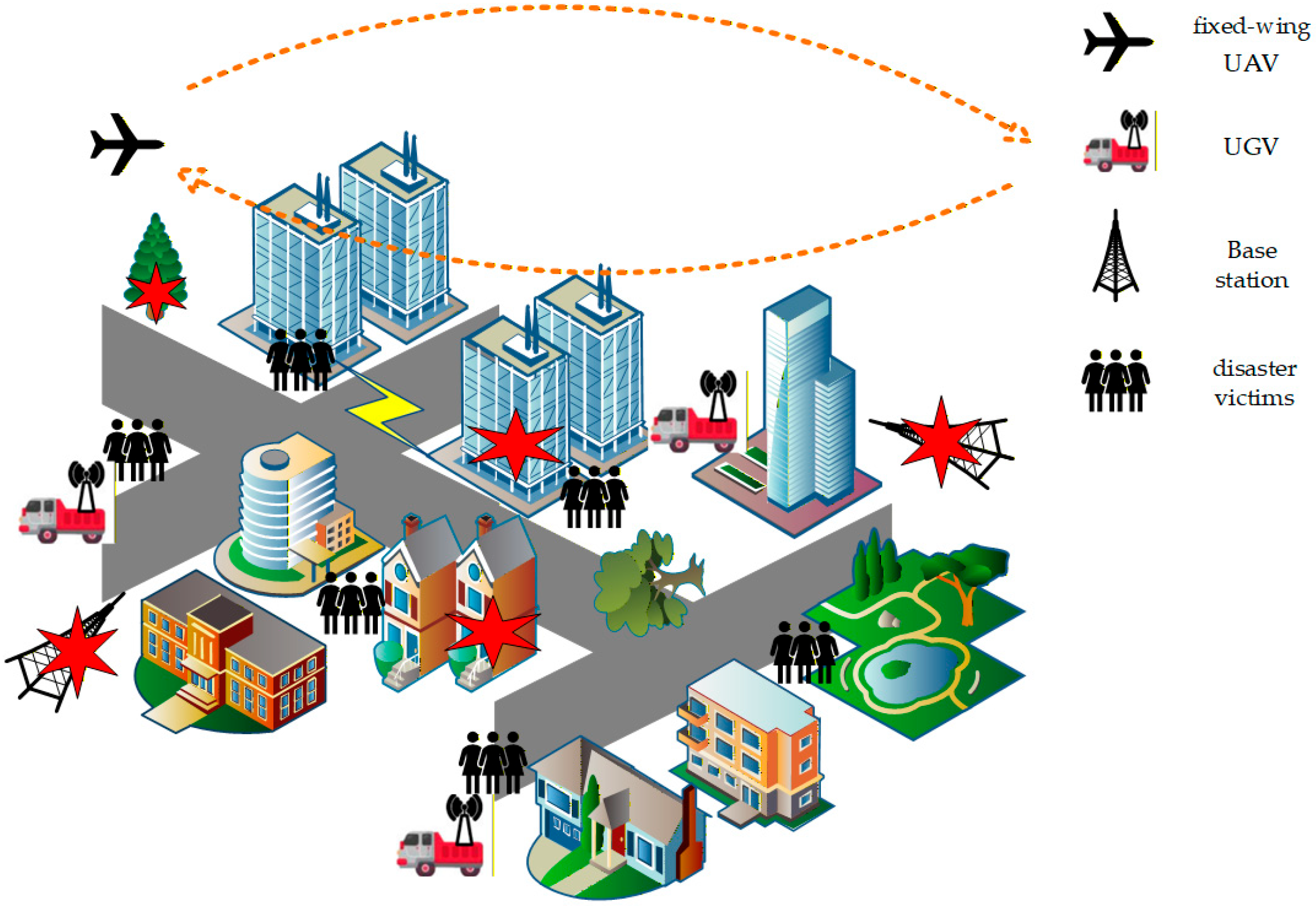
This paper proposes a collaborative emergency communication system integrating the extended endurance of fixed-wing UAV with the continuous coverage capability of vehicle-mounted base stations to enhance overall emergency response capacity. However, following urban disasters, ground roads are often disrupted by collapses or damage, preventing vehicle-mounted base stations from following planned routes or even reaching target areas, thereby delaying communication restoration. To address these challenges, this paper investigates joint path planning strategies for air-ground coordinated deployment under conditions of uncertain road disruption probability. This approach aims to ensure rapid reconstruction and sustained coverage of communication networks in disaster-stricken areas. Considering directed graphs , the node set V comprises the base station c, several intersections, and all candidate points; the edge set E includes all navigable road segments. The system model is illustrated in Figure 1, featuring one fixed-wing UAV, multiple UGVs, and U disaster victims.
Figure 1.
System model.
2.1. Channel Model
In practical applications, frequent ascents or descents by UAVs result in significant energy consumption. To extend flight duration, it is assumed that the UAV will maintain a constant altitude h. This altitude h should be kept sufficiently low to avoid frequent changes in elevation and any obstacles, such as terrain or buildings.
In urban environments, transmission links between disaster victims and base stations composed of UAV and UGVs may be obstructed by buildings. This paper employs a line-of-sight probability model to characterize the channel, incorporating both LOS and NLOS components [23].
The distance between disaster victims and base stations can be mathematically expressed as:
Here, indicates the coordinates of fixed-wing UAV or UGVs. indicates the coordinates of the affected individuals.
The large-scale coefficient of the channel can be expressed mathematically as:
Here, indicates the path loss per unit distance in a line-of-sight environment. indicates the attenuation loss in a non-line-of-sight environment. indicates a parameter related to path loss.
The line-of-sight link between disaster victims and base stations can be mathematically expressed as:
Here, and indicate environmental parameters. indicates the elevation angle between disaster victims and fixed-wing UAV or UGVs.
The non-line-of-sight link between disaster victims and base stations can be mathematically expressed as:
The channel gain formula is as follows:
According to Shannon’s formula, the communication rate is expressed as follows:
Here, indicates the channel bandwidth between disaster victims and fixed-wing UAV or UGVs. indicates the maximum transmission power for disaster victims. indicates noise power.
When considering communication rate constraints, based on the properties of logarithmic functions, to simplify the constraints, we now consider signal-to-noise ratio (SNR) constraints. The minimum signal-to-noise ratio (SNR) is denoted as :
Here, indicates whether disaster victims are connected to fixed-wing UAV or UGVs.
2.2. Uncertain Set Construction
In practical scenarios, the probability distribution of road disruptions is unknown. To enhance system robustness, this paper constructs an uncertainty set based on historical data to represent the uncertainty of road disruptions. can be mathematically expressed as:
where, represents the probability of road damage within region . is the reference probability distribution constructed based on historical data. denotes the distance between the possible probability distribution and the reference probability distribution . is the associated tolerance value, representing the maximum permissible distance between and .
Divide the city map into regions. Let Z denote the total number of path segments traversable by UGVs within region a. Let denote the number of path segments actually damaged after monitoring. Let denote the probability of road damage at node within region a. This model can be mathematically expressed as:
Here, indicates whether the zth segment in region a is interrupted. indicates that the path is interrupted; otherwise, it is not interrupted.
Based on this, this paper introduces the following three probabilistic distance metrics to construct uncertainty sets [24,25].
- (1)
- L∞-Norm Probability Distance Metric Method
The uncertainty set constructed based on the L∞-norm probability distance metric has a confidence level denoted as . At this confidence level, the lower bound on the probability that the reference distribution falls within the given uncertainty set can be expressed as:
Here, denotes the probability of event occurring. Therefore, for an uncertainty set based on the L∞-norm probability distance metric, its tolerance value is defined as:
- (2)
- L1-Norm Probability Distance Metric Method
The uncertainty set based on the L1-norm probabilistic distance metric, with confidence level , can be mathematically expressed as:
Therefore, for an uncertainty set based on the L1-norm probabilistic distance metric, its tolerance value can be expressed as:
- (3)
- Fortet–Mourier (FM) Probability Distance Metric Method
This paper employs the FM metric within the ζ-structured probability measure for quantifying the distance between two distributions. The ζ-structured probability measure between any two probability distributions and can be defined by the formula:
where indicates the sample space. is a family of real-valued bounded measurable functions on . represents the distance between two random variables and , rather than the absolute value of the difference between and .
The uncertainty set based on the FM distance probabilistic distance metric, with its confidence level calculated as:
where indicates the convergence rate of the true distribution.
Thus, for the uncertainty set based on the FM distance probabilistic distance metric, its tolerance value can be calculated using Formula (21):
Here, is the dimension of , .
2.3. Problem Formulation
Based on the uncertainty set constructed above, this paper proposes a two-stage distributed robust optimization problem addressing the uncertainty in road disruption probability. In the first stage, the deployment points for UGVs and the cruise paths for fixed-wing UAV are pre-determined. In the second stage, when road disruption probabilities materialize, the deployment plan and paths are adjusted based on these probabilities to minimize the expected total cost under the most unfavorable probability distribution. Table 1 provides a detailed summary of the parameters involved in this model and the symbolic definitions of decision variables. Subsequent sections will not elaborate on each item individually.
Table 1.
Symbol definitions.
By optimizing the deployment and paths of fixed-wing UAV and UGVs, the model achieves comprehensive cost minimization under the worst-case probability distribution of road disruptions while satisfying multiple constraints. The comprehensive cost encompasses the fixed costs of fixed-wing UAV and UGVs, the path costs of fixed-wing UAV, and the path costs of multiple ground unmanned vehicles. This model can be expressed as follows:
Equation (24) indicates that the probability distribution Pi belongs to the uncertainty set Di. To ensure flight safety, Based on the road interruption probability defined by Equation (10), the following constraints determine the flight path of fixed-wing UAV and deployment decisions for UGVs, where the actual passability of road segments directly influences the route feasibility of UGVs. Constraint (25) mandates that the flight path of fixed-wing UAVs must strictly avoid all designated no-fly zones. To achieve point-based cruise coverage missions, constraints (26) and (27) jointly impose closed-loop requirements on the flight path, ensuring wide-area cruise coverage by fixed-wing UAVs. To avoid path redundancy and guarantee route efficiency, constraint (28) introduces a sub-loop elimination mechanism.
Regarding ground resource allocation, constraints (29)–(32) collectively manage the deployment of ground unmanned vehicles. Specifically, constraints (29) and (30) are allocation constraints, ensuring a one-to-one correspondence between unmanned vehicles and deployment points. Constraint (31) stipulates that all unmanned vehicles must depart from the base, while constraint (32) ensures they cease movement upon reaching designated deployment points, as these vehicles serve as base stations requiring stationary presence at demand locations.
Finally, constraints (33)–(37) aim to guarantee service quality. Constraint (33) ensures all disaster sites are covered by either UAV or UGVs. Considering physical limitations of the equipment, constraints (34) and (35) impose capacity limits on the number of affected individuals that a single UAV and a single UGV can respectively serve. To guarantee communication reliability, constraints (36) and (37) set signal-to-noise ratio thresholds, ensuring the connection quality between affected locations and fixed-wing UAVs or UGVs meets the minimum requirements for effective data transmission.
3. Method of Solution
3.1. Evaluation Indicators
To achieve the prioritized spatial deployment of emergency communication resources post-disaster, a quantifiable priority assessment of affected areas is required. Given that the core objective of post-disaster communication support is to “prioritize high-demand and high-urgency areas within feasible constraints,” this paper constructs an evaluation index system based on three dimensions: demand scale, disaster urgency, and spatial feasibility. This system further generates a comprehensive score for priority classification. For urban areas, Voronoi partitioning is employed to divide the region into a finite number of grid cells , where each cell possesses a geometric center and a coverage area .
(1) Population Density Indicator. Population density directly reflects the number of affected individuals within a grid and serves as a fundamental factor in determining emergency communication requirements. Let denote the number of affected individuals within grid g. This parameter is obtained through spatial statistics applied to the generated distribution of affected individuals. Since grid areas may vary slightly due to Voronoi boundary segmentation, population density is used instead of absolute numbers to ensure comparability. The population density of grid g is defined as:
where, indicates the number of disaster victims within the grid. represents the grid area.
To normalize the indicators to the range [0, 1], introduce maximum-minimum normalization:
The larger the normalized A value, the greater the number of affected individuals within that grid unit area, and the higher the priority for communication support.
(2) Disaster Intensity Index. The impact of seismic disasters is not uniformly distributed but typically propagates outward from the epicenter or secondary hazard sources. To simulate this characteristic, this paper constructs a disaster intensity field using a superposition of Gaussian kernel functions. Let there be key regions , each characterized by a center coordinate , weight , and standard deviation . The disaster intensity at any spatial point is defined as:
For grid , the disaster intensity across the entire grid can be represented by the intensity at its center :
The influence of each focal point on surrounding areas decreases exponentially with distance. The greater the weight and the smaller the standard deviation, the more concentrated the influence becomes. To eliminate dimensional effects, normalization is also performed:
The normalized A value indicates that the higher the value, the more severe the disaster situation facing the grid and the greater the demand for emergency communications.
(3) Accessibility Metrics. Due to secondary earthquake hazards (such as fires, chemical leaks, building collapses, etc.), certain airspaces may be designated as no-fly zones, rendering them inaccessible to UAV. The existence of no-fly zones reduces the likelihood of aerial platform coverage in corresponding areas, necessitating their inclusion in priority assessments. Define no-fly zone as a circular area on a plane:
where, denotes the center of the no-fly zone. denotes the radius of the no-fly zone.
For grid , its accessibility is defined as the proportion of area within the grid not covered by no-fly zones. Since the grid shape may be rectangular or irregular polygonal, direct analytical calculation is complex. Therefore, a Monte Carlo sampling method is used for approximation. By uniformly sampling S points within grid and counting the number of points falling within no-fly zones, the accessibility metric is:
When S is sufficiently large, it approaches the proportion of flyable area within the grid. Clearly, , where values closer to 1 indicate the grid is almost entirely unaffected by no-fly zones, allowing UAV to cover it freely; values closer to 0 indicate the grid is mostly or entirely occupied by no-fly zones, making aerial coverage difficult and necessitating reliance on ground vehicles for coverage.
(4) Comprehensive Priority Score. To further characterize spatial variations within each subregion, Voronoi subregions were locally discretized using grid cells as the basic evaluation units. Population density, disaster intensity, and accessibility were calculated for each grid cell based on the aforementioned indicators, yielding the comprehensive priority score :
where, , and represents the weighting coefficient, and satisfy the condition .
The overall score falls within the range [0, 1]. A higher value indicates a more urgent need for emergency communications in that grid, warranting priority consideration during deployment.
3.2. Algorithm Design
Within a two-stage robust optimization framework, decision problems can typically be formulated as seeking the optimal decision under the worst-case scenario within an uncertainty set. Consequently, such problems are often expressed as minimax optimization problems. Optimization algorithms such as C&CG, heuristics, and dual-based exact solutions can typically be employed to address this problem [25,26,27].
To solve this complex two-layer optimization problem, this paper adopts a column and constraint generation algorithm framework. The C&CG algorithm decomposes the original problem into a main problem and a subproblem, iteratively approximating the optimal solution. For fixed-wing UAV path planning, considering heading angle constraints, the Dubins path model is employed to generate smooth paths. A local optimization (LO) algorithm fine-tunes the heading angles at both ends of the path to obtain the shortest feasible route. Subsequently, a branch-and-bound (B&B) algorithm is applied to search for the optimal path within the angular space.
By discretizing the sample space, we obtain S distinct scenarios. The main problem addresses the decision-making for temporary base station siting and fixed-wing UAV path planning, while the subproblem derives the autonomous vehicle path under the worst-case scenario of road disruption probability distribution, given the aforementioned decisions. The main problem of C&CG is expressed as:
S.t. (25)–(28), (33)–(37)
By solving the main problem, the decision variables ,, and are obtained. The subproblem can be expressed as:
S.t.(24), (29)–(32)
In constructing uncertainty sets, this paper selects probabilistic distance metrics based on the L∞-norm, L1-norm, and FM distance. The L∞-norm focuses on the maximum divergence of cumulative distribution functions, while the L1-norm emphasizes the total sum of differences in probability density functions. When employing the FM distance for probabilistic distance metrics in uncertainty set construction, dualization is required. The subproblem using FM distance is expressed as:
Equation (51) represents the fundamental constraints of the probability distribution, where J denotes the number of candidate points, B denotes the dimension of the candidate points, denotes the value of the jth candidate point in the Hth component, and denotes the mean. After dualizing the above problem, it is expressed as:
Building upon this foundation, the C&CG framework is employed to iteratively optimize deployment schemes and robust paths for UGVs and fixed-wing UAV by alternately solving the main problem and subproblems, ultimately yielding a globally optimal solution. The overall algorithmic workflow is illustrated in Algorithm 1.
| Algorithm 1. The pseudocode for algorithm—DRDPRP |
| 1: Candidate site: Based on the comprehensive score, deployment candidate points m and n are obtained. 2: Initialization: Set the initial solution, upper and lower bounds (UB = +∞, LB = −∞), convergence threshold τ, and iteration count t = 0 |
| 3: Precomputing: Calculating Dubin’s path for fixed-wing UAV using branch-and-bound and local optimization techniques |
| 4: Solve the main problem to obtain the current optimal solutions , and the objective value, then update the lower bound LB |
| 5: Submit to solve the subproblem, obtaining the worst-case probability distribution and objective value, then update the upper bound UB |
| 6: If (UB − LB)/UB ≤ τ, then the algorithm converges; jump to step 8, else |
| 7: Return to step 4 and continue iteration, t = t + 1 |
| 8: Output: Optimal deployment plans , fixed-wing UAV path decision , and robust path planning results for UGVs |
To address the challenge of generating numerous dubins paths for fixed-wing UAV during patrol operations, a path preprocessing step is first implemented using a branch-and-bound approach integrated with local optimization techniques, as detailed in Algorithm 2.
| Algorithm 2. Branch-and-bound combined with local optimization |
| 1: Input: Fixed-wing UAV coordinates , tolerance tol, minimum turning radius r, maximum iteration count |
| 2: Initial Upper Bound (UB) Calculation: Perform coarse grid search (S × S) on the angular space [−π, π) × [−π, π), evaluate Dubin’s length at each point, and take the minimum value as the initial UB |
| 3: Perform local refinement on the coarse grid optimal solution using Nelder–Mead. If improvement occurs, update the UB |
| 4: Initialize the priority queue (min-heap): Insert the entire angular rectangle (−π, π) × (−π, π) as the root node into the heap, with the lower bound LB of this rectangle |
| 5: If the node’s LB ≥ UB − tol, proceed to step 11; otherwise, proceed to step 6 |
| 6: Take the midpoint of the subinterval and compute the Dubin’s length L_mid corresponding to this midpoint |
| 7: Perform a local search starting from the midpoint of the interval to obtain a better L_refine; use it to update L_mid. Obtain the angle and length, then update UB |
| 8: If L_mid < UB, then update UB and the corresponding optimal angle |
| 9: Apply binary search along the “longer dimension” of the current interval to generate two subintervals. Calculate the lower bound (LB) for each subinterval. If LB < UB − tol, add it to the heap |
| 10: If the current heap minimum LB ≥ UB − tol, proceed to step 11; otherwise, return to step 6 |
| 11: Output UB and optimal angle |
4. Simulation Experiment
4.1. Simulation Parameters
Simulation parameters are configured as follows: The urban layout is set to 10 × 10 km. One fixed-wing UAV is deployed to achieve fixed-point cruise communication coverage, while multiple ground unmanned vehicles equipped with base stations provide fixed-point communication coverage. Uncertainty set parameters are configured as follows: 200 path sampling points are collected per area, with the uncertainty set confidence level set to 0.9. The weighting coefficients for comprehensive evaluation priorities , , and are 0.5, 0.4, and 0.1, respectively. System parameter summaries are presented in Table 2. Parameters adopted in this study reference [28,29].
Table 2.
Simulation parameters.
4.2. Simulation Analysis
4.2.1. Analysis of Experimental Validity
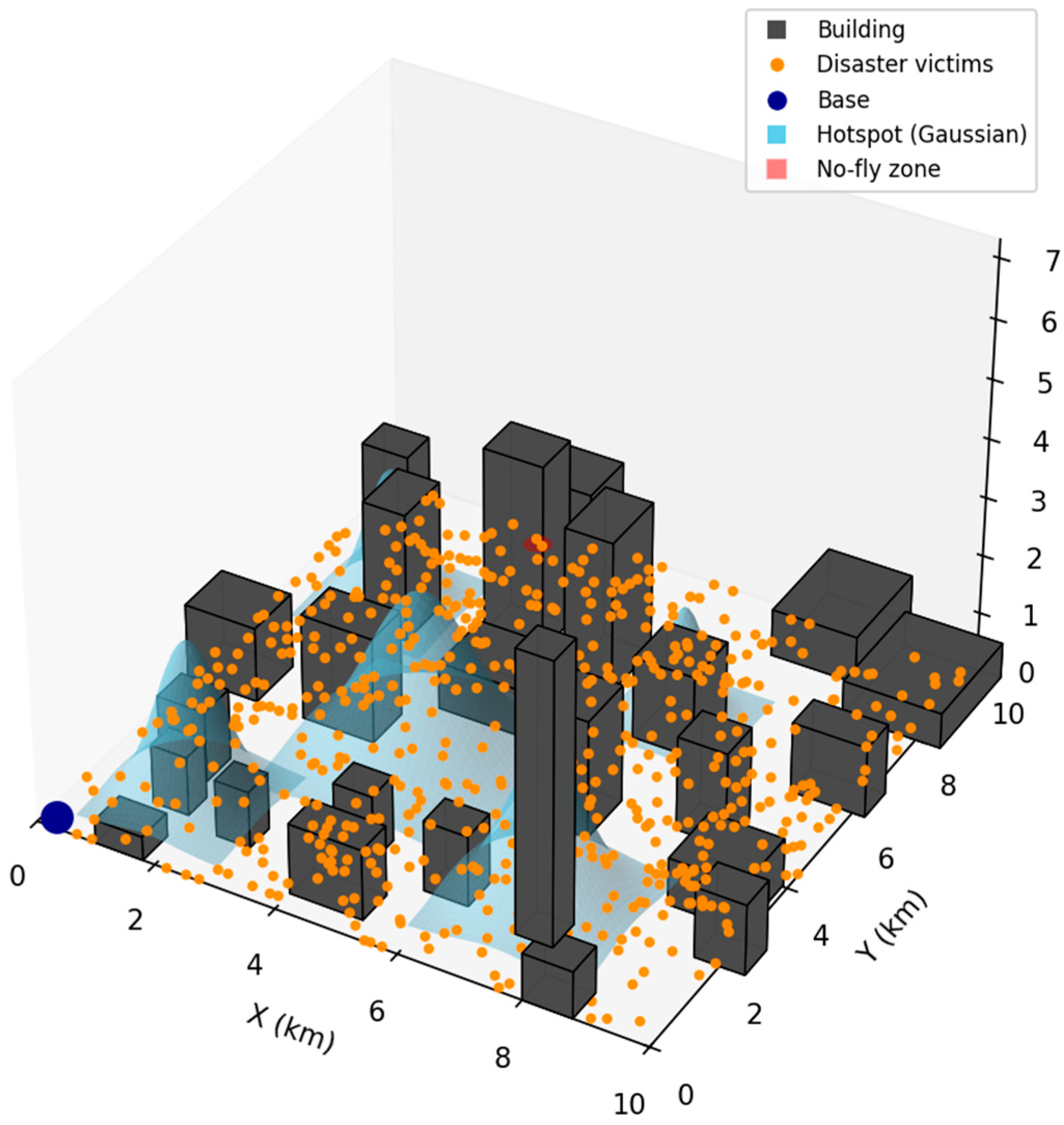
As shown in Figure 2, to simulate the distribution of communication demands in disaster-stricken areas, a compound Poisson process is employed to generate user locations. First, clustering zones are generated centered around 10 random points, with locally aggregated disaster victims generated according to a Poisson distribution of specified intensity. Subsequently, affected individuals were randomly generated at uniform density across the entire urban background area. After merging these two components, 600 affected individuals were randomly sampled to construct a demand scenario featuring both local clustering and global randomness. Concurrently, areas were comprehensively scored based on population density, disaster severity, and no-fly zones, resulting in six zones and the generation of 36 candidate deployment points.
Figure 2.
Urban layout under a compound Poisson distribution of disaster victims.
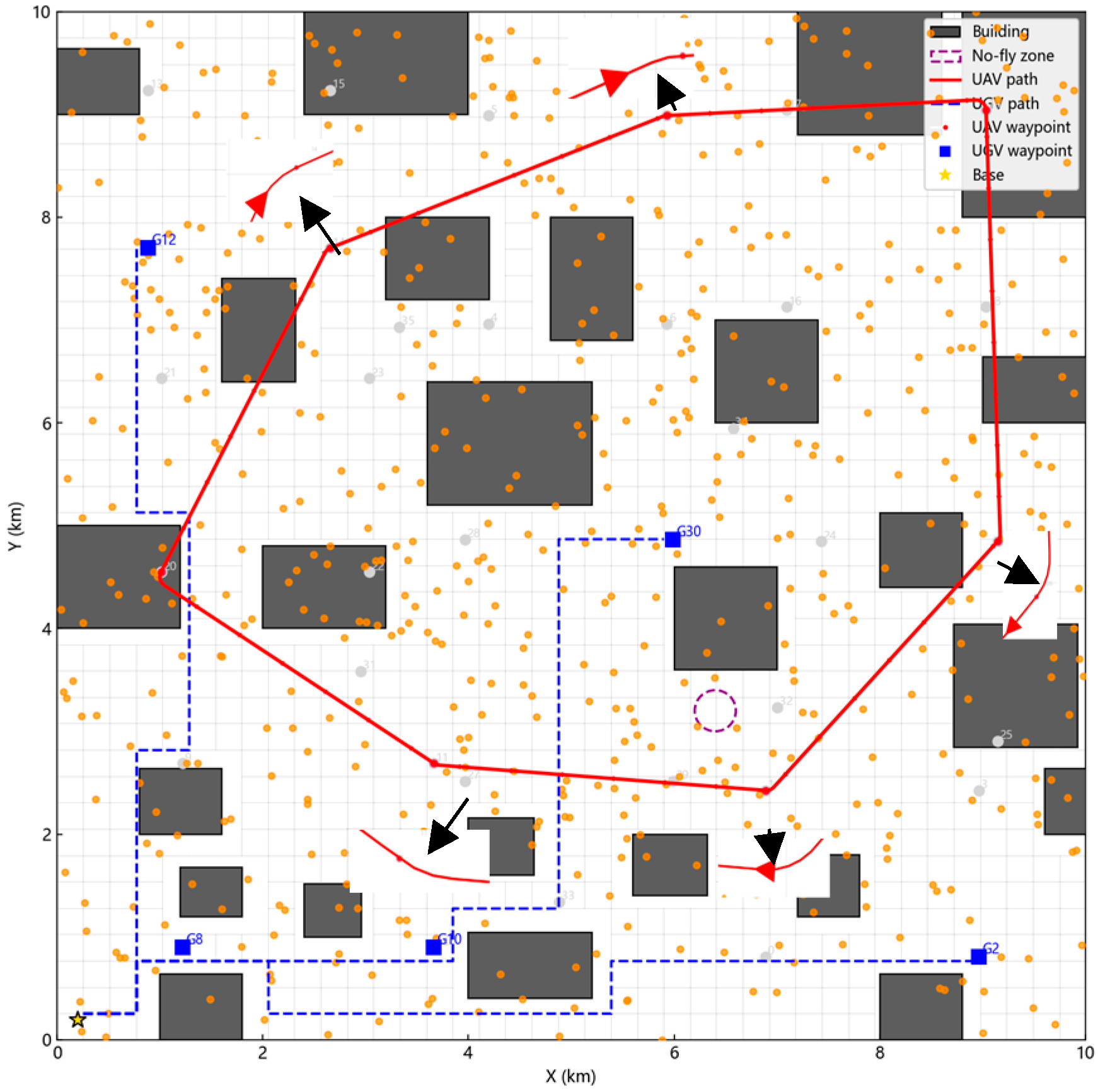
The results of fixed-wing UAV-UGV collaborative deployment and path planning under defined environmental conditions (known road disruptions) are shown in Figure 3. The fixed-wing UAV employs Dubin’s curve path planning, fully accounting for its minimum turning radius physical constraint. Subfigures illustrate the curved paths of the fixed-wing UAV at nodes. UGVs traverse the road network, forming air-ground collaborative coverage with the fixed-wing UAV. This result provides a critical baseline for subsequent robust optimization models incorporating uncertainty.
Figure 3.
Deployment and path in a defined environment.
Table 3 compares simulation results for collaborative mission planning between fixed-wing UAVs and ground unmanned vehicles under different methodologies. Stochastic Planning (SP) achieved the lowest objective value under idealized conditions where the probability distribution of road disruptions is known, thus serving as a reference benchmark for fully informed scenarios. However, this method relies on the premise of accurately known probability distributions—an assumption often untenable in real-world post-disaster contexts characterized by sudden, dynamic, and incomplete information regarding road disruptions. In contrast, the proposed distribution-robust optimization model, while yielding a slightly higher objective value than SP, captures the uncertainty in the interruption probability distribution. Consequently, the resulting planning scheme demonstrates greater robustness and applicability for real-world post-disaster emergency scenarios.
Table 3.
Mission planning scheme for fixed-wing UAV and UGVs collaboration.
Regarding the comparison with AVOA, Table 3 shows that its objective function value is significantly higher than that of the proposed method, with a coverage rate of only 96.50%. This indicates that under the multiple coupled constraints of this study, the AVOA algorithm failed to consistently find feasible solutions satisfying all requirements. This outcome suggests that generic heuristic methods may exhibit limitations in feasibility assurance when solving such complex collaborative planning problems. Consequently, the primary purpose of including AVOA for comparison is to establish it as a reference heuristic baseline to reveal the problem’s solution complexity, rather than to serve as direct evidence demonstrating the universal superiority of the proposed method over various heuristic algorithms.
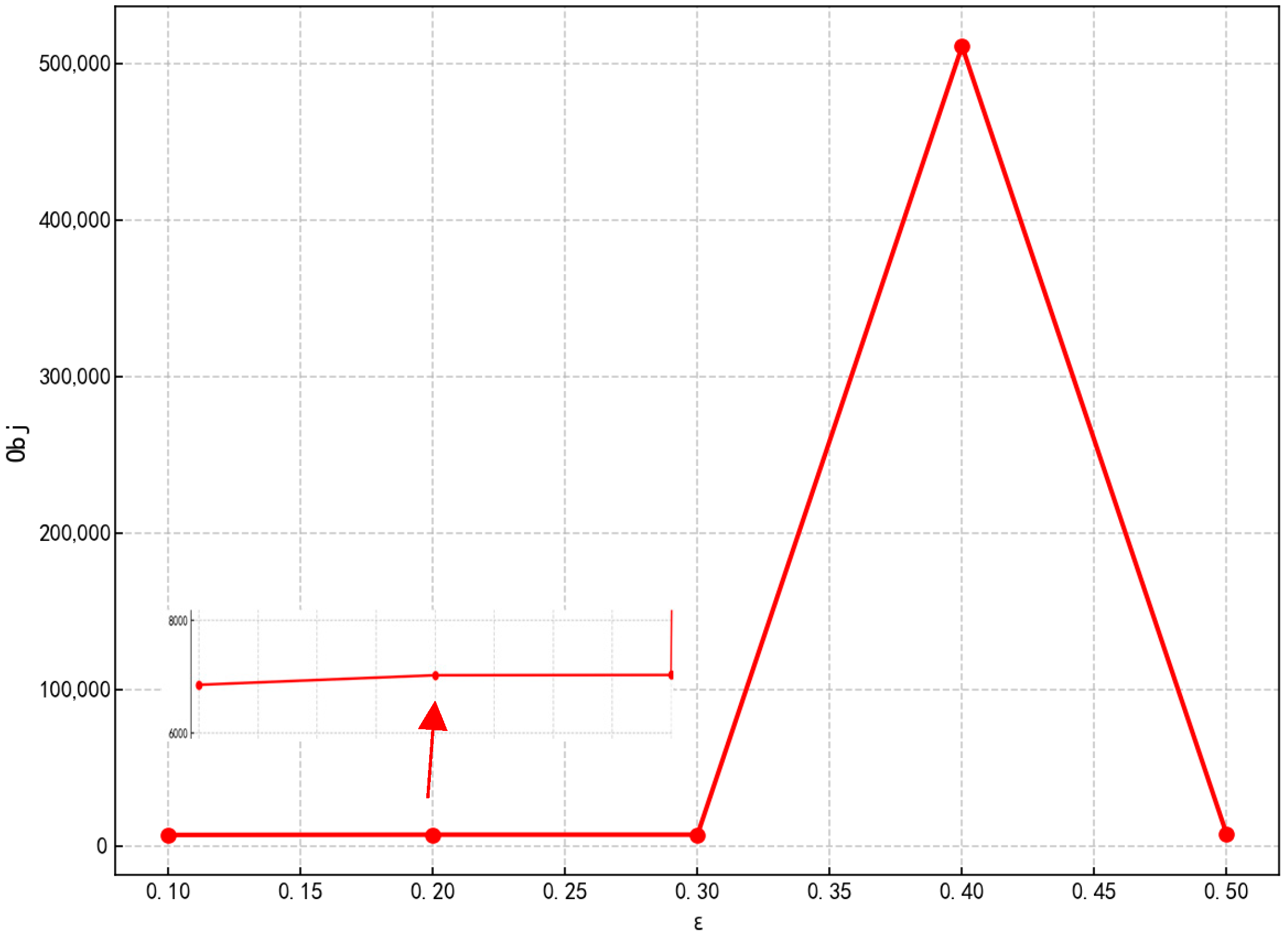
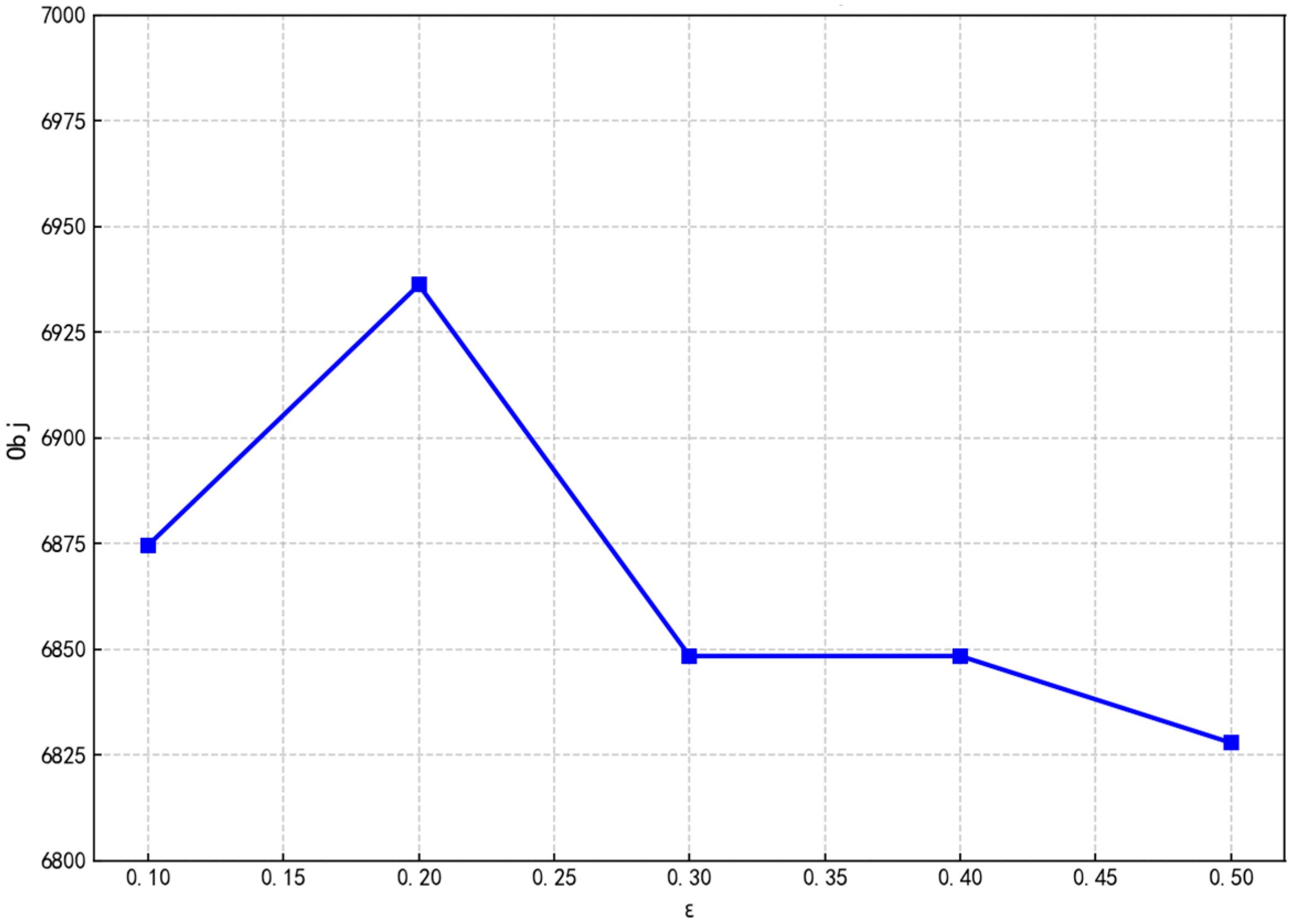
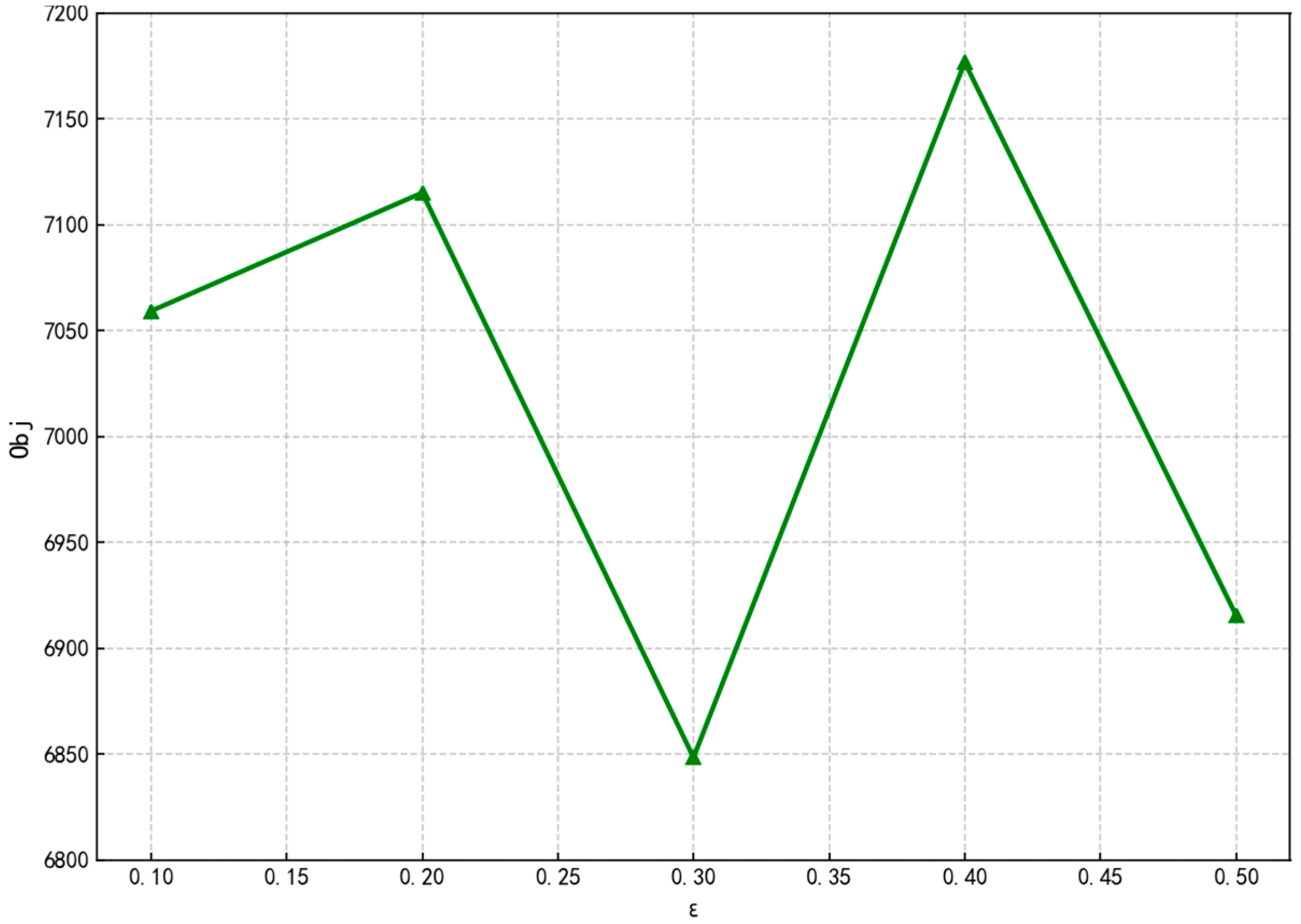
This paper compares the performance of three probabilistic distance metrics under different tolerance parameters. Experimental results show that all robust models accounting for uncertainty exhibit higher total costs than deterministic models, indicating that enhancing system robustness incurs a certain economic cost. Different probabilistic distance metrics significantly influence the deployment positions of fixed-wing UAV waypoints and UGVs, the optimal target values, and the number of C&CG iterations required for algorithm convergence. Among these, the uncertainty set constructed based on the L∞ norm exhibits a sudden surge in target value to 510,930.37 at a tolerance parameter of 0.4, significantly higher than other scenarios. This phenomenon is not attributable to computational error but rather stems from the L∞ distance’s heightened sensitivity to the most unfavorable probability deviation. Consequently, the model tends toward more conservative deployment and path decisions at this parameter level, substantially elevating the system’s total cost. When the tolerance parameter further increased to 0.5, the objective value did not continue to grow at the same rate, indicating that the model had adjusted its collaborative deployment and path schemes to avoid high-risk sections. Thus, this anomalously large value reflects the model’s heightened sensitivity to extreme risk perturbations under the L∞ distance metric and the resulting structural changes in decision-making. In contrast, target values based on the L1 norm and FM probabilistic distance models remained relatively stable, with the L1 norm achieving algorithmic convergence faster in most scenarios. This experiment demonstrates that increasing tolerance values prompts corresponding adjustments to deployment strategies, balancing robustness and target values. This provides rich and targeted strategic options for deploying fixed-wing UAV and unmanned vehicles under diverse practical requirements.
Visualize and compare the target values of three types of probabilistic distance metrics under different tolerance parameters, characterizing their trend characteristics and differences as tolerance varies. Figure 4 illustrates the variation of total system cost with tolerance value in the L∞-norm-based metric method. The cost curve exhibits significant fluctuations, particularly showing abrupt changes when the tolerance value ranges from 0.3 to 0.4. This indicates extreme sensitivity to path variations within the uncertainty set, reflecting a high cost for achieving robustness assurance.
Figure 4.
Relationship between tolerance value and Obj in L∞-norm metric methods.
The relationship between tolerance values and target values in the L1-norm-based metric is illustrated in Figure 5. Its cost curve exhibits significantly less fluctuation than the L∞-norm, demonstrating outstanding stability. This indicates that the metric imposes relatively lenient constraints on uncertainty, enabling it to maintain a certain level of robustness while preventing drastic cost variations due to minor tolerance adjustments.
Figure 5.
Relationship between tolerance value and Obj in L1-norm metric methods.
Figure 6 analyzes the model performance based on the FM probability distance metric. Its cost curve exhibits significant fluctuations at a tolerance value of 0.3, reflecting the impact of increased unavailable road segments at this threshold. However, as the tolerance value continues to increase, the cost actually decreases. This indicates that the system tends to select alternative paths with lower interruption probabilities, demonstrating the adaptive adjustment capability of the solution strategy under this metric.
Figure 6.
Relationship between tolerance value and Obj in FM distance metric method.
4.2.2. Analysis of the Applicability of the Experiment
We analyzed the impact of the number of UGVs on system deployment and total cost under resource constraints. As shown in Table 4, increasing the upper limit of UGVs from 5 to 10 significantly raises the total system cost. Concurrently, the proportion of UGVs in deployment schemes increases, while the number of fixed-wing UAV path nodes correspondingly decreases. When the vehicle count is capped at 8 or 10, not all UGVs are utilized. The table indicates that with an 8-vehicle limit, 7 UGVs are deployed each time; and at a limit of 10, the deployed UGVs numbered 10, 10, and 7. This demonstrates that the model in this paper selects the optimal deployment strategy for UGVs and fixed-wing UAV based on the overall system performance, rather than solely pursuing continuous communication coverage capability. This illustrates the trade-off between resource investment and system performance.
Table 4.
Impact of UGV quantity restrictions on experiments.
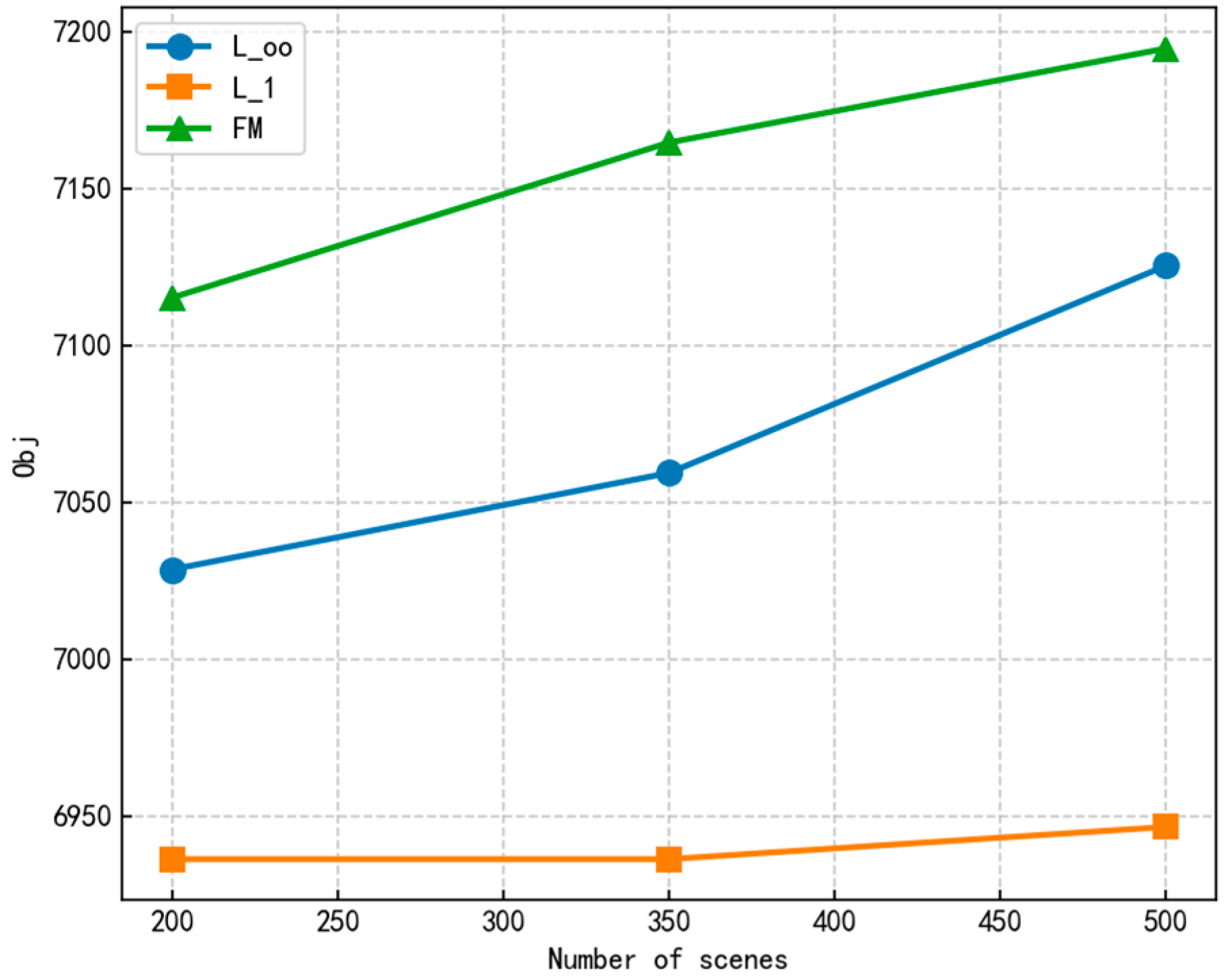
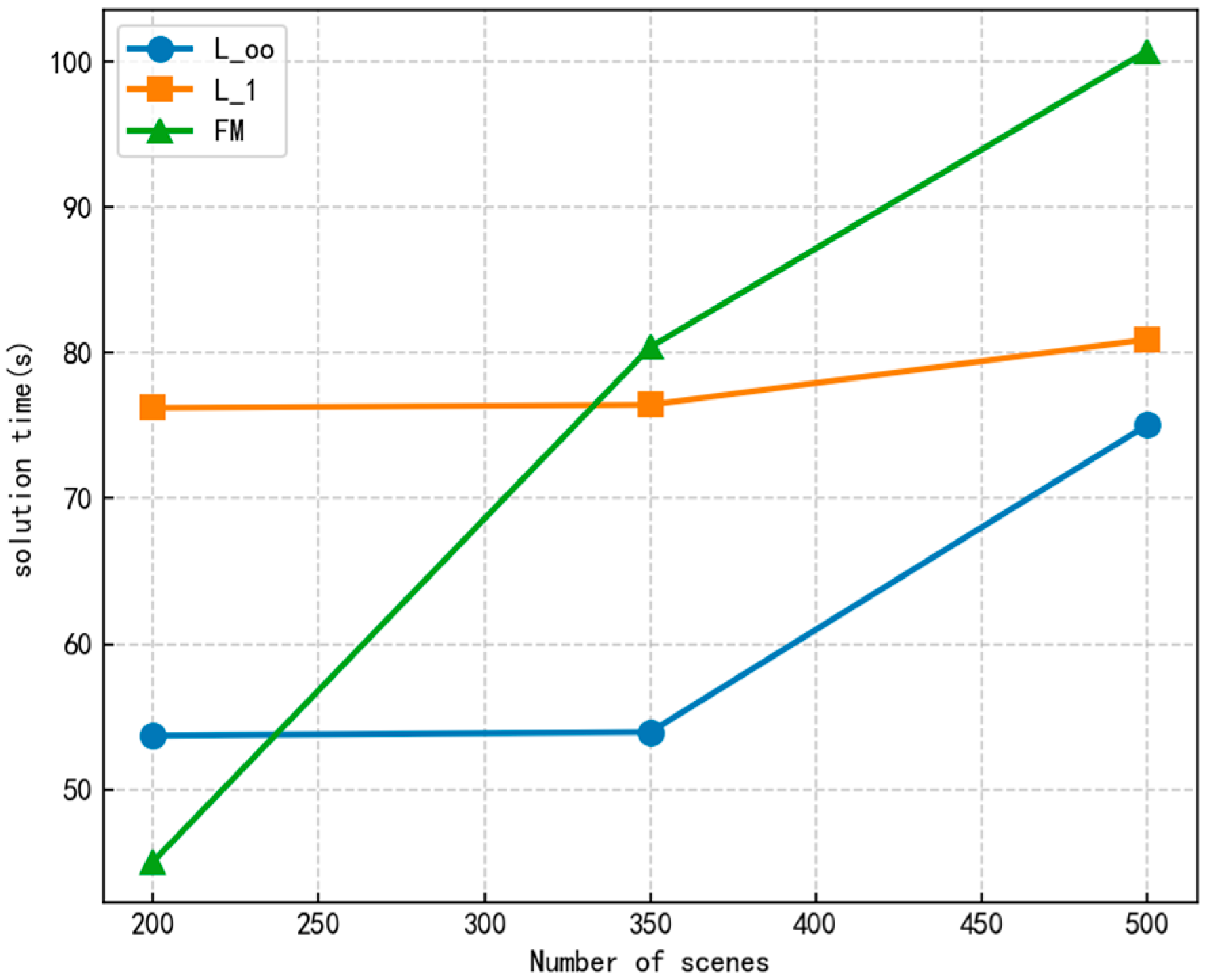
Analyzing the impact of the number of discrete scenarios on experimental results reveals that, as shown in Figure 7, the total system cost increases with the number of scenarios. This indicates that a higher number of discrete scenarios leads to increased time complexity. As depicted in Figure 8, the model’s computation time also steadily increases.
Figure 7.
Relationship between scene count and Obj.
Figure 8.
Relationship between scene count and solution time.
Table 5 validates the scalability of the algorithm from the perspective of the number of affected individuals. The total cost increases as the scale grows, consistent with expectations. The computation time increases gradually without exhibiting exponential growth. The number of C&CG iterations stabilizes between 1 and 3, demonstrating excellent convergence. This confirms that the DRDPRP model is applicable to disaster scenarios of varying complexity.
Table 5.
Impact of affected population size on the experiment.
5. Conclusions
To address the challenges posed by uncertain probabilities of ground road disruptions caused by urban earthquakes and limited static coverage range that hinder emergency communication restoration, this paper constructs the DRDPRP model. Aiming to minimize system costs under worst-case scenarios, it seeks to design a performance-guaranteed collaborative planning scheme for post-earthquake emergency communications. (1) Compared to a deterministic environment with known road disruptions, the proposed model increases average total cost by 9.86%. This incremental cost represents the necessary trade-off for enhancing system robustness against road disruption uncertainty. (2) Comparing three probabilistic distance metrics reveals: The L∞-norm exhibits sensitivity to extreme path variations, making it suitable for protecting critical facility failures. The L1-norm demonstrates stability under tolerance variations, ideal for global deviation control. while the FM distance reflects spatial coupling relationships and demonstrates adaptive adjustment capabilities when road disruption probabilities change. (3) The system’s total cost exhibits sublinear growth with increasing affected population scale, while the average solution time remains under 90 s without exponential growth, demonstrating the model’s applicability to medium-to-large-scale scenarios.
From an engineering application perspective, the method proposed in this paper provides a planning and decision-support tool for post-disaster emergency communications restoration. By integrating key data such as road disruption information and its probability estimates, communication coverage parameters, and operational constraints of unmanned platforms, the model generates air-ground coordinated communication restoration plans, offering quantitative references for emergency command departments to formulate restoration strategies. It should be noted that the results presented here are primarily validated through simulation scenarios, aiming to evaluate the decision-making effectiveness of the proposed method in complex, uncertain post-disaster environments. Actual deployment requires further implementation by integrating on-site information acquisition capabilities and equipment dispatch mechanisms. Future research may further explore dynamic disaster information updates and real-time decision-making mechanisms to enhance the model’s applicability in complex disaster scenarios.
Author Contributions
Conceptualization, W.W. and M.M.; methodology, W.W. and M.M.; software, W.W., M.M. and X.L.; validation, W.W.; formal analysis, W.W. and M.M.; writing—original draft, W.W. and M.M.; writing—review and editing, W.W. and M.M.; visualization, M.M.; validation, W.W. and X.L.; investigation, W.W. and X.L.; data curation, M.M. and X.L. All authors have read and agreed to the published version of the manuscript.
Funding
This research was supported by the National Natural Science Foundation of China (Grant No. 61802107), the China Higher Education Industry-Academia-Research Innovation Fund (Grant No. 2024ZY015), and the Hebei Provincial Higher Education Science and Technology Research Project (Grant No. ZD2020171).
Data Availability Statement
Data are contained within the article.
Conflicts of Interest
The authors declare no conflicts of interest.
Abbreviations
The following abbreviations are used in this manuscript:
| UAV | Unmanned Aerial Vehicle |
| UGV | Unmanned Ground Vehicle |
| LOS | Line of Sight |
| NLOS | Non-Line-of-Sight |
| C&CG | Column and Constraint Generation |
| SP | Stochastic Programming |
| AVOA | African Vulture Optimization Algorithm |
References
- Cao, Y. Urban flood disaster risk mitigation from the perspective of system resilience: A case study of the Zhengzhou “7·20” extreme rainfall disaster. J. Wuhan Inst. Eng. Vocat. Tech. Coll. 2024, 36, 63–68. (In Chinese) [Google Scholar]
- Shao, L.; Hu, G.; Tian, Y.P.; Kuang, J.Q. Seismic disaster risk assessment in Hunan Province. J. Disaster Sci. 2025, 40, 86–91. (In Chinese) [Google Scholar] [CrossRef]
- Li, L.; Zhu, L.; Huang, F.; Wang, D.; Li, X.; Wu, T.; He, Y. Post-disaster emergency communications enhanced by drones and non-orthogonal multiple access: Three-dimensional deployment optimization and spectrum allocation. Drones 2024, 8, 63. [Google Scholar] [CrossRef]
- Aggarwal, S.; Kumar, N.; Alhussein, M. Blockchain-envisioned UAV communication using 6G networks: Open issues, use cases, and future directions. IEEE Internet Things Mag. 2021, 4, 60–65. [Google Scholar] [CrossRef]
- Yu, J.Y.; Zhang, J.; Li, X.; Ding, X.; Xu, X.H.; Xie, W.L. Integrated air–ground communication networks as the foundation for the low-altitude economy. Inf. Commun. Technol. Policy 2024, 50, 11–17. Available online: http://ictp.caict.ac.cn/EN/lexeme/showArticleByLexeme.do?articleID=1316 (accessed on 15 February 2026). (In Chinese) [CrossRef]
- Wang, L.; Li, R.; Xu, L.; Zhu, W.; Zhang, Y.; Fei, A. Aerial-ground cooperative vehicular networks for emergency integrated localization and communication. IEEE Netw. 2023, 37, 323–330. [Google Scholar] [CrossRef]
- Ying, B.; Su, Z.; Xu, Q.; Ma, X. Game theoretical bandwidth allocation in UAV-UGV collaborative disaster relief networks. In Proceedings of the 2021 IEEE 23rd Int Conf on High Performance Computing & Communications; 7th Int Conf on Data Science & Systems; 19th Int Conf on Smart City; 7th Int Conf on Dependability in Sensor, Cloud & Big Data Systems & Application (HPCC/DSS/SmartCity/DependSys), Haikou, China, 20–22 December 2021; pp. 1498–1504. [Google Scholar] [CrossRef]
- Zhu, Y.; Wang, S. Cooperative aerial and ground vehicle trajectory planning for post-disaster communications: An attention-based learning approach. Veh. Commun. 2023, 42, 100631. [Google Scholar] [CrossRef]
- Ramasamy, S.; Reddinger, J.P.F.; Dotterweich, J.M.; Childers, M.A.; Bhounsule, P.A. Coordinated route planning of multiple fuel-constrained unmanned aerial systems with recharging on an unmanned ground vehicle for mission coverage. J. Intell. Robot. Syst. 2022, 106, 30. [Google Scholar] [CrossRef]
- Wu, S.; Xu, W.; Wang, F.; Li, G.; Pan, M. Distributed federated deep reinforcement learning based trajectory optimization for air-ground cooperative emergency networks. IEEE Trans. Veh. Technol. 2022, 71, 9107–9112. [Google Scholar] [CrossRef]
- Zuo, B.; Xu, Y.; Yang, D.; Xiao, L.; Zhang, T. Joint resource optimization and trajectory design for energy minimization in UAV-assisted mobile-edge computing systems. Comput. Commun. 2023, 203, 312–323. [Google Scholar] [CrossRef]
- Ji, J.; Zhu, K.; Yi, C.; Niyato, D. Energy consumption minimization in UAV-assisted mobile-edge computing systems: Joint resource allocation and trajectory design. IEEE Internet Things J. 2020, 8, 8570–8584. [Google Scholar] [CrossRef]
- Yan, Z.; Lu, Y.Y.; Ding, C.; He, D.Y.; Ouyang, B.; Yang, L.; Wang, Y.N. Power allocation and trajectory design for UAV relays in user mobile scenarios. J. Electron. Inf. Technol. 2024, 46, 1896–1907. (In Chinese) [Google Scholar] [CrossRef]
- Nguyen, V.L.; Nguyen, L.H.; Kuo, J.J.; Lin, P.C.; Hwang, R.H. Intelligent aerial relay deployment for enhancing connectivity in emergency communications. IEEE Trans. Veh. Technol. 2024, 73, 8782–8796. [Google Scholar] [CrossRef]
- Yin, M.; Lin, W.; Wu, S.; Gao, X.; Li, W.; Yu, P.; Feng, L. Heterogeneous Low Altitude Platforms Deployment Strategy for Emergency Network. In Proceedings of the 2023 IEEE International Symposium on Broadband Multimedia Systems and Broadcasting (BMSB), Beijing, China, 14–16 June 2023. [Google Scholar] [CrossRef]
- Xie, Z.; Liu, J.; Sheng, M.; Zhang, Y.; Quek, T.Q.; Li, J. Statistical A2G coverage characteristics in dynamic fixed-wing UAV networks. IEEE Wirel. Commun. Lett. 2023, 13, 771–775. [Google Scholar] [CrossRef]
- Ouyang, C.; Zhong, X.; Zhou, S.; Li, J. UAV trajectory planning for 5G network coverage. In Proceedings of the 2024 IEEE/CIC International Conference on Communications in China (ICCC), Hangzhou, China, 7–9 August 2024; pp. 1531–1536. [Google Scholar]
- Lin, N.; Liu, C.; Wu, T.; Hawbani, A.; Zhao, L.; Wan, S.; Guizani, M. Green Communications: RIS-assisted fixed-wing UAV coverage scheme based on deep reinforcement learning. IEEE Internet Things J. 2024, 12, 4115–4127. [Google Scholar] [CrossRef]
- Wilkinson, B.; Sims, J.; White, C.; Thomas, C.; Williams, T.; Teer, C.; Green, R.B. Cellular Network Deployment from Fixed Wing Uncrewed System for Network Denied Areas. In Proceedings of the SoutheastCon, Orlando, FL, USA, 1–16 April 2023; pp. 578–583. [Google Scholar]
- Zhang, D.; Zhang, Y.; Li, S.; Li, S.; Chen, W. Bi-objective robust optimisation on relief collaborative distribution considering secondary disasters. Int. J. Prod. Res. 2024, 62, 2435–2454. [Google Scholar] [CrossRef]
- Cao, J.R.; Wang, W.; Xu, N.; Su, W.T.; Xing, L.X.; Su, J.T. Robust energy efficiency optimization strategy for emergency communication based on fixed-wing UAV. J. Comput. Sci. Technol. 2024, 35, 37–57. [Google Scholar] [CrossRef]
- Faiz, T.I.; Vogiatzis, C.; Noor-E-Alam, M. Robust two echelon vehicle and drone routing for post disaster humanitarian operations. arXiv 2020, arXiv:2001.06456. [Google Scholar] [CrossRef]
- Hammouti, H.; Benjillali, M.; Shihada, B.; Alouini, M.S. Learn-as-you-fly: A distributed algorithm for joint 3d placement and user association in multi-UAVs networks. IEEE Trans. Wirel. Commun. 2019, 18, 5831–5844. [Google Scholar] [CrossRef]
- Li, L.; Shi, D.; Hou, R.; Chen, R.; Lin, B.; Pan, M. Energy-efficient proactive caching for adaptive video streaming via data-driven optimization. IEEE Internet Things J. 2020, 7, 5549–5561. [Google Scholar] [CrossRef]
- Jia, Z.; Jiang, G.; Cui, C.; Zhang, L.; Wu, Q. Distributionally robust task offloading for low-altitude intelligent networks. J. Electron. Inf. Technol. 2025, 47, 1–11. (In Chinese) [Google Scholar] [CrossRef]
- Sun, Y.; Zhang, K.; Gegenaoqi, G.; Wu, P.; Zhu, J. A two-stage distributed robust optimization method for coordinated computing–power–thermal management of edge data center clusters. Trans. China Electrotech. Soc. 2026, 1–24. (In Chinese) [Google Scholar] [CrossRef]
- Gu, J.; Liu, Y.; Zhang, Y.; Wang, Z.G.; Cao, B.S.; Cai, P.C.; Wang, S.Z. Two-stage Wasserstein distributionally robust optimization scheduling for multi-energy microgrids considering source–load uncertainty and gas hydrogen blending. Mod. Power 2026, 1–12. (In Chinese) [Google Scholar] [CrossRef]
- He, H.; Zhang, S.; Zeng, Y.; Zhang, R. Joint altitude and beamwidth optimization for UAV-enabled multiuser communications. IEEE Commun. Lett. 2017, 22, 344–347. [Google Scholar] [CrossRef]
- Ribeiro, P.; Coelho, A.; Campos, R. SUPPLY: Sustainable Multi-UAV Performance-Aware Placement Algorithm for Flying Networks. IEEE Access 2024, 12, 159445–159461. [Google Scholar] [CrossRef]
Disclaimer/Publisher’s Note: The statements, opinions and data contained in all publications are solely those of the individual author(s) and contributor(s) and not of MDPI and/or the editor(s). MDPI and/or the editor(s) disclaim responsibility for any injury to people or property resulting from any ideas, methods, instructions or products referred to in the content. |
© 2026 by the authors. Licensee MDPI, Basel, Switzerland. This article is an open access article distributed under the terms and conditions of the Creative Commons Attribution (CC BY) license.