


Abstract
Wireless sensor networks (WSNs) consist of distributed nodes to monitor various physical and environmental parameters. The sensor nodes (SNs) are usually resource constrained such as power source, communication, and computation capacity. In WSN, energy consumption varies depending on the distance between sender and receiver SNs. Communication among SNs having long distance requires significantly additional energy that negatively affects network longevity. To address these issues, WSNs are deployed using multi-hop routing. Using multi-hop routing solves various problems like reduced communication and communication cost but finding an optimal cluster head (CH) and route remain an issue. An optimal CH reduces energy consumption and maintains reliable data transmission throughout the network. To improve the performance of multi-hop routing in WSN, we propose a model that combines Multi-Objective Particle Swarm Optimization (MOPSO) and a Decision Tree for dynamic CH selection. The proposed model consists of two phases, namely, the offline phase and the online phase. In the offline phase, various network scenarios with node densities, initial energy levels, and BS positions are simulated, required features are collected, and MOPSO is applied to the collected features to generate a Pareto front of optimal CH nodes to optimize energy efficiency, coverage, and load balancing. Each node is labeled as selected CH or not by the MOPSO, and the labelled dataset is then used to train a Decision Tree classifier, which generates a lightweight and interpretable model for CH prediction. In the online phase, the trained model is used in the deployed network to quickly and adaptively select CHs using features of each node and classifying them as a CH or non-CH. The predicted nodes broadcast the information and manage the intra-cluster communication, data aggregation, and routing to the base station. CH selection is re-initiated based on residual energy drop below a threshold, load saturation, and coverage degradation. The simulation results demonstrate that the proposed model outperforms protocols such as LEACH, HEED, and standard PSO regarding energy efficiency and network lifetime, making it highly suitable for applications in green computing, environmental monitoring, precision agriculture, healthcare, and industrial IoT.
1. Introduction
Wireless Sensor Networks (WSNs) became the foundation of various modern technologies due to the advancement in microelectronics, with widespread applications in environmental, infrastructure monitoring, healthcare, smart cities, military operations, and industrial automation [1,2,3]. Recent technologies such as edge computing, IoT, sensor fusion, machine learning, blockchain technology, and sensor cloud architectures are being transformed and made more scalable with the help of WSN [4,5]. The WSNs consist of spatially distributed sensor nodes (SNs) that sense and transmit data to a central base station (BS) or sink node. The process of communicating data among SNs is called routing [6,7,8], where most of the energy is drained in communication. Energy utilization depends on the distance between the nodes; long-range communications require significantly more energy. SNs are mostly battery-powered, and recharging and replacing batteries is hard because of the area in which they are deployed. After reaching a power threshold, the SN stops participating in the network, causes coverage and connectivity issues, and thus reduces the reliability of the network. The primary objective is to maintain effective and consistent communication while minimizing energy consumption and extending the longevity of the network [9]. Many routing algorithms have been proposed to address the issues. Table 1 presents a summary of prevalent routing protocols, categorized by their operational procedures.
Routing protocols can be flat or hierarchical; in the former, the SN communicates directly with the BS and consumes more energy due to the longer communication distance, while in the latter, the SNs are grouped into clusters and a node is designated as cluster head (CH). The CHS are primarily responsible for communication with the BS, which becomes the most effective strategy to improve the lifetime, efficiency, and scalability of the network [10]. The member nodes within a cluster share the sensed data with the CH. Typically, CHs not only collect and transfer data, but also aggregate them to reduce communication overhead and minimize energy consumption [11]. Figure 1 represents the hierarchical structure of a WSN. Hierarchical protocols such as LEACH and HEED are popular for their simplicity; however, the approach of LEACH for CH selection often results in an uneven energy distribution due to suboptimal CH placement, limiting its applicability in dynamic network scenarios [12], while HEED uses a more efficient approach that considers both residual energy and the proximity of the SN to the CHs to calculate the communication cost [13].
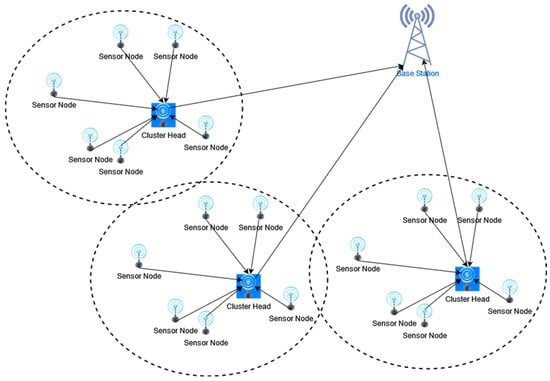
Figure 1.
Heirarchical WSN with SN, CH, and BS. (Arrows are demonstrating the communication among SN to CH and from CH to Base Station.).
Conventional CH selection algorithms are simple; however, they require less computation and suffer from handling the dynamic nature of the network [12]. Some recent solutions use optimization and machine learning (ML) techniques to improve the CH selection procedure. Metaheuristic methods have shown considerable promise in addressing the multi-objective challenge of CH selection. Algorithms such as Multi-Objective Particle Swarm Optimization (MOPSO) and the Genetic Algorithm (GA) have been used to address multiple objectives [14]. In particular, MOPSO addresses various conflicting factors such as energy consumption, network coverage, and load distribution among nodes by generating a diverse set of Pareto-optimal solutions [15] but relying solely on MOPSO creates challenges in rapidly changing network conditions and in addressing real-world networks, such as when managing heterogeneous member nodes.

Table 1.
Common categories of routing protocols [16,17].
Table 1.
Common categories of routing protocols [16,17].
| Factors | Routing Protocol | Description |
|---|---|---|
| Based on the Objective | Data Centric Routing | A communication paradigm where data is disseminated and retrieved based on content rather than the traditional source-to-destination addressing used in conventional networks. Examples include COUGAR, SPIN, DCS, Trickle, and SPRITE. |
| Event-Driven Routing | A routing paradigm where data packets are transmitted in response to specific events or changes in the environment being monitored by the sensors. Examples include ACQUIRE, Rumor routing, and A-MAC. | |
| Location-Based Routing | These protocols depend on the knowledge of the physical positions of SNs to improve routing efficiency, reduce energy consumption, and enhance data accuracy. It can be further divided into the following classes: Proximity-based (GPSR, CCR), Anchor-based (DV-Hop, APIT), Grid-based (GLS, GCR). | |
| Based on the network structure | Flat routing | A type of routing protocol where all SNs in the network are considered equal or flat in terms of hierarchy. In other words, there are no distinct roles or levels of hierarchy among nodes, and every SN is responsible for routing and forwarding data packets independently. Examples include SEP and DREAM. |
| Hierarchical routing | Organizes the SNs into a hierarchical structure with multiple levels or tiers of nodes, each serving a specific role in the network. Examples are LEACH, PEGASIS, and HEED. | |
| Mesh routing | A multi-hop network where SNs can communicate with each other through multiple intermediate nodes, forming a mesh-like structure. Protocols like RPL, HSR, MR-LQSR, DSR, and EMRP use mesh routing. | |
| Based on the routing approach | Proactive (Table-drive) | These protocols preserve up-to-date routing data at all times, continuously updating routing tables. Examples include OSPF, DSDV, OLSR, and TBRPF. |
| Reactive (on-demand) | Establish routes between nodes only when there is a genuine requirement to transmit data, reducing the overhead associated with maintaining routing tables. Examples include AODV, TORA, and DYMO. | |
| Hybrid | Hybrid protocols aim to provide a balance between maintaining routing information continuously and establishing routes only when needed. Examples include ZRP, EEARP, H-ARQ, and MMSPEED. | |
| Based on energy efficiency | Energy-aware routing | The objective of these protocols is to minimize the power requirement to prolong the network’s overall lifetime. Examples include HEED, T-MAC, and LEACH. |
| Energy-balanced routing | Designed to allocate the energy consumption among SNs more evenly, thereby prolonging the network’s overall lifetime. Examples include EEARP, ABR, and SEP. | |
| Based on security | Secure routing | These protocols include mechanisms to defend the system from attacks and confirm secure data transmission. Examples include SEER, SRP, CICADA, and TAS. |
| Trust-based routing | Nodes make routing decisions based on the trust level assigned to neighboring nodes. Examples include TAS, REPT, SBTR, CBTR. |
Various ML-based techniques have been used to select optimal CH from Pareto-optimal solutions generated by the MOPSO, as machine learning models can learn from previous optimizations. This reduces computational overhead and speeds up the decision-making procedure. ML algorithms can also adopt dynamic changes and anticipate them accordingly. A trained ML model assists in classifying and predicting optimal CH with minimal energy consumption and reduces the need for repetitive resource-intensive computation. SN deployment often requires a simple and explainable model for real-time decision-making. Integrating the decision tree model with MOPSO provides clear and easily interpretable decision rules to understand the CH selection process. Decision tree models also offer other benefits such as low computational complexity, fast decision making for real-time applications, and the ability to handle mixed and noisy data [18,19,20]. However, other algorithms, such as neural networks and support vector machines, operate as black-box models, making it difficult to understand the reason behind CH selection. The proposed two-phase model based on MOPSO-DT addresses the challenges of CH selection in conventional algorithms by considering various conflicting objectives to enhance the longevity of the network and reduce the energy consumption. The proposed algorithm was compared with the LEACH, HEED, and PSO algorithms for the selection of CH on various parameters, and the result shows that the proposed algorithm considerably improves network longevity and reduces energy consumption.
The organization of the paper is as follows. Section 2 performs a background study and reviews existing work on CH selection algorithms, considering metaheuristic optimization techniques and machine learning approaches for CH selection in WSNs, identifying their strengths, limitations, and research gaps. Section 3 defines the proposed methodology that covers the system model, mathematical formulation of the multi-objective function using MOPSO, integration of DT, algorithm workflow, and experimental setup. The evaluation covers in detail the simulation environment, performance metrics, and comparative analysis with LEACH, HEED, and PSO. In Section 4, Results and Discussion are presented, whereas Section 5, Conclusion and Future Directions, summarizes the contributions and key findings, emphasizing the algorithm’s importance in improving WSN performance, and suggests some future research directions, including real-world implementation and further exploration of advanced machine learning techniques.
2. Background Study and Literature Survey
Typical WSNs consist of a large number of spatially distributed SNs in the area of interest to monitor various surrounding conditions, such as pressure, temperature, motion, and humidity etc. SNs are resource-constrained devices that have a limited energy source, often in the form of a battery, limited memory, computational power constraints, and communication capacity. After successful deployment, the SN initiates a beacon process to form network topologies; however, the topology may change at any time due to environmental conditions, physical damage, tampering, or depletion of energy in a particular SN below a threshold value. Clustering is an energy-efficient approach to organizing SN into a cluster led by a node called CH. Clustering basically improves the energy efficiency of the network by reducing the long-distance transmission to the BS by each node, thus reducing redundancy and improving data accuracy by aggregation and load balancing within the cluster.
Among various cluster-based routing protocols, LEACH and HEED gained attention because of their ability to reduce communication overhead and balance energy consumption. The LEACH protocol uses a probabilistic method based on a threshold function for CH selection. This process reduces the overall energy consumption of the network by nominating the CH between member nodes over time, still suffers from uneven energy consumption due to the random selection procedure, and is not suitable for heterogeneous networks [21]. However, the HEED protocol uses a combination of residual energy and communication cost as a key factor in the selection of CH [22]. In comparison to LEACH, the HEED performs a uniform distribution in CH selection and improves load balancing across the network. Although the HEED performs multiple iterations, it increases the complexity compared to LEACH and introduces additional overhead under dynamic network conditions. Another protocol called TEEN was designed for time-critical applications but is not effective for non-time-bound communications [23]. These limitations underscore the need for energy-efficient adaptive CH selection strategies. Table 2 summarizes the important parameters considered for optimal CH selection in the literature.
Table 2.
Common parameters used for CH selection [24,25,26].
Earlier algorithms for CH selection were mainly focused on addressing one objective, but with the use of metaheuristic algorithms, multiple objectives can be addressed at a time to select the optimal CH. Various algorithms, such as Genetic Algorithm (GA), Particle Swarm Optimization (PSO), and Artificial Bee Colony (ABC), were used to select optimized CH. Saadallah et al., in their work, use the GA based approach along with the LEACH protocol, which demonstrates significant improvement in network longevity compared to the traditional LEACH protocol [27]. A Hybrid Genetic Algorithm (HGA) addresses the Minimum Dominating Set (MDS) problem in heterogeneous networks by optimizing the number of CHs while ensuring connectivity [28]. Lakshmaiah et al. in their work [29] utilized the Fish Swarm algorithm having parameters such as residual energy and proximity to the base station for CH selection. Habelalmateen et al. in their work [30] proposed the Wild Horse Optimization (WHO) algorithm for heterogeneous WSNs having single or multiple sinks. The work achieved notable results in network longevity and energy consumption by optimizing parameters such as distance to sink and residual energy. Subramanian et al. in their work [31] uses the Transient Search Optimization (TSO) algorithm to optimize the overall performance of the network by decreasing delay and reduced traffic flow among SNs. The work leads to notable advancements in network longevity compared to various algorithms. Kanase et al. in their research [32] proposed a modified HEED algorithm by incorporating deep learning and mathematical modeling to handle the non-uniform distribution of SNs for selection of optimal CH. Jalili et al. in their work [33] proposed a method for effective CH selection based on residual energy and applied neural networks to handle the dynamic nature of the network. This enhances the overall performance of the network.
The PSO utilize the social behavior of particle swarms to find the optimal CH based on parameters such as throughput and energy efficiency. Multi-Objective Particle Swarm Optimization (MOPSO) is a multi-objective variant of the PSO algorithm. The MOPSO optimizes conflicting objectives to improve the overall performance of the network and outperform traditional algorithms in critical metrics such as First Node Dies (FND) and Last Node Dies (LND). The MOPSO based CH selection enhance network reliability and longevity along with reduced communication overhead, and improved overall network performance. The MOPSO significantly reduce the number of CHs going below the threshold of energy by selecting according to their residual energy and predicted future energy consumption, as demonstrated in [34]. Sekaran et al. in [35] proposed an algorithm that uses Gray Wolf Optimizer (GWO) for CH selection. The proposed method outperforms in terms of power consumption, network longevity, and data packet reception, demonstrating successful execution across various test cases with varying numbers of SNs and CHs.
Zhang and Zhu [36] proposed the TDLMOPSO algorithm to address multi-objective optimization problems. In temporal-difference learning, the particles are intelligent enough to choose various actions to maximize the rewards, which are based on personal archive and Pareto dominance. In the algorithm, particles are treated as agents using a Markov decision. The algorithm faces limitations when applied to optimization problems with constraints. Kathiroli and Selvadurai [37] proposed a hybrid Sparrow Search (SS) Algorithm with a differential evolution algorithm to address the CH selection issue. Their approach enhances energy consumption and throughput compared to additional algorithms.
Integration of ML models with MOPSO allows for more accurate predictions of node energy levels, leading to better CH selection and a prolonged network lifetime. Despite its advantages, MOPSO requires the fine-tuning of parameters and is computationally expensive for large-scale WSNs. For selecting the best suitable solution from the various Pareto-optimal solutions generated by MOPSO, an ML model can reduce the number of iterations. The DT-based approach provides an interpretable and computationally efficient method for CH selection depending on parameters such as residual energy, node density, and communication distance. Once trained, the model can efficiently select CH from Pareto-optimal solutions generated by MOPSO and reduces computational iterations. However, ML-based models also present challenges such as including high computational complexity, data dependency, and potential over/under-fitting. The effectiveness of ML-based models depends on the training data. Further, deep learning-based models require significant processing power, making them unsuitable for resource-constrained WSNs. Although DT-based methods offer efficiency and transparency, they may not fully address multi-objective trade-offs, whereas techniques like SVMs and Neural Networks (NNs) provide better adaptability, but at the cost of increased training complexity. Balancing these factors is crucial to optimizing CH selection while ensuring practical implementation in real-world WSN deployments.
Kadhim et al. [38] uses a DT-based CH selection scheme aimed at reducing the intra-cluster communication distances while effectively managing the overall energy consumption in the network. Rao et al. [39] utilized PSO-based model for CH selection with efficient power, exceeding the prevailing algorithms in relation to the total power required, the life of the network, and the quantity of data packets received. The algorithm enables cluster construction, wherein CMs join a CH based on a weight matrix, enhancing energy efficiency. Kumar and Mahapatra [40] proposed a power-efficient CH selection technique using a hybrid optimization approach in WSN, demonstrating its superiority over conventional algorithms in terms of live node analysis. Singh, Doja, and Alam [41] introduced FBECS, which exhibits better stability periods, longer time with better load balancing, and enhanced communication with BS compared to its counterparts, such as BCSA and LEACH. Pal, Singh, and Yadav [42] presented an algorithm that introduces a genetic-based approach to CH selection in central clustering algorithms, optimizing the number of CHs for every round and extending the life of the network compared to traditional clustering algorithms. Sharma, Vashisht, and Singh [43] introduced the M-IWOCA algorithm, which considerably minimizes the number of non-functional SNs per iteration and reduces power utilization. It extends the duration of the network by 45% compared to ABC and by 18% to QABC. Shows superior performance compared to HEED, LEACH, QABC, EIWO, and ABC.
Methods in the literature often fail to effectively combine optimization strategies with intelligent decision-making capacity. This gap causes suboptimal performance of WSNs in dynamic and heterogeneous network conditions. Various methods focused on specific objectives, such as energy efficiency, while neglecting other objectives, such as network coverage and load balancing. To address these limitations, in this paper we propose a two-phased MOPSO-DT-based CH selection model. The model not only optimizes multiple objectives but also adapts to dynamic network conditions. The proposed model aims to bridge these gaps by integrating MOPSO-DT and address the challenges of power requirements, network coverage, and load balancing simultaneously. Through extensive evaluations, it has been observed that the proposed model not only improves WSN performance but also extends network longevity. This research contributes to the advancement of CH selection strategies, providing valuable insights for the design and optimization of WSNs in various applications.
3. Proposed Methodology and Experimental Setup
The proposed hybrid model selects the optimal CH in hierarchical WSNs to ensure efficient energy utilization, area coverage, and load balancing. The model operates in two phases, the offline phase and the online phase. In hierarchical WSNs the BS is usually fixed and is responsible for collecting data from the CHs. The routing protocols mainly operate in two modes: the setup stage and the steady-state stage [21]. In the initial phase, the cluster is formed, SNs discover their neighbors, routing paths are determined, and an aggregation mechanism is applied to data to minimize redundant transmissions and optimize resource use. In the later phase, periodic data transmission occurs, and adaptive techniques are used to ensure minimal energy consumption. If an SN reaches its energy threshold and stops participating in communication, alternative routes are dynamically selected. The assumptions are provided.
- SNs are stationary and organized in a hierarchical approach.
- Every cluster has its local CH, which can manage its assigned CM nodes.
- SNs periodically sense and transmit data to CH for aggregation and use single-hop communication for data transmission within the cluster.
- Data aggregation ensures that no redundant data can be transmitted.
- CH forwards aggregated data to BS directly or through multi-hop for efficient energy consumption.
- Each SN has limited initial energy (E0) and adheres to a standard energy model.
- The energy consumption model is the first-order radio energy model given in Equation (5).
Setup stage: The setup stage is concerned with the deployment, the initialization of the cluster, the selection of CH, and the aggregation of data is performed to reduce redundant data. The energy model considered in this paper calculates the energy consumption for the transmission of the data using the number of bits transmitted and the distance between the sender and the receiver, considering factors such as dissipation of the electric circuit and the energy required for the amplifier. Equation (1) summarize two sections: , representing energy consumption based on data size, and , responsible for energy consumption associated with path loss. Here, ε characterizes the path loss coefficient, and represents the path loss, with n denoting the path loss exponent with distance d. The path loss exponent value was considered to be two for free-space communication and four for multi-path environments.
In hierarchical WSNs establishment of a local CH with in each cluster is required to ensure efficient data processing, data fusion, aggregation and reducing communication distance. This approach reduces energy consumption by reducing data transmissions to the local CH. However, the local CH depletes energy faster than non-CH nodes due to additional processing. This requires the rotation of CH roles among nodes to maintain the overall energy of the network. The CH election is determined by a threshold calculated through Equation (2):
where for any n that belongs to G, the value is 1; otherwise, it is 0. G denotes set of SNs that have lost the opportunity to become a CH in preceding 1/p iterations, p is the chosen percentage of CHs, and r denotes the present iteration. The current CH uses this information to create a channel allocation scheme using the TDMA method, assigning separate time slots to each member (CM) of the cluster. The residual energy of a SN is calculated by Equation (3) and denotes how much energy is left relative to maximum energy capacity and denoted as Er, at time t after engaging in various communication activities.
where Emax represents the initial energy of the node, and denotes the present energy. This normalization results in a relation that ranges from 0 to 1 and facilitates the comparison of the energy status of different SNs, irrespective of their initial energy. This ratio plays an important parameter in monitoring and managing the energy consumption and help in the assessment of the network’s longevity and reliability.
Steady stage: The steady-state stage is concerned with maintaining efficient communication and changes in the network to ensure reliable delivery of data to the BS. The distance between the BS to CH is determined by Equation (4):
here, distbs is the distance from SN to BS, and distfar represents the length between the outermost SN to BS. Power requirement at every SN is influenced by the data packet size and the length from the sender, as indicated by Equation (1). The overall energy requirement during the transmission of datum from a SN to a distant receiver at length d is calculated by Equation (5).
where EDelec is the power required per bit during transceiver circuit execution, εfs and εmp are amplification coefficients of communication amplifier in an open space and multipath modal correspondingly. The threshold of communication distance (d0) is determined by Equation (6):
the energy consumed for receiving 1-bit of data at a SN () is calculated using Equation (7):
for N SNs, divided into C clusters and having K CHs, the power requirement of every CH is calculated by Equation (8):
Here EDA is the power required in aggregation, dtoBS is the average length from BS to CH node Equation (5). The power consumed by SN for transmission of the package to CH is calculated by Equation (9):
where is the length from the CM to respective CH. The over-all power dissipated by a cluster is given by Equation (10):
the over-all power consumed for transmission of frame is . The optimum quantity of CHs () can be calculated by differentiating by K as per Equation (11).
The objective of CH selection is to prolong the operational life of the network while maintaining reliable data delivery. For a SN i, the CH selection process is framed as a multi-objective optimization problem represented in Equation (12).
- Energy Efficiency : The function f1 represents the overall energy consumption of the network such as sensing, processing, transmission, and reception. The energy is normalized between 0 and 1. Values closer to 0 indicate lower energy consumption and values close to 1 represent high energy consumption. Each wi is a weight that reflects the relative importance of the corresponding operation in Equation (13).
- Network Coverage : Network coverage ensure that CHs are evenly distributed among the SNs to reduce the communication distance between CM. Also uses a redundancy function to reduce overlap using coordinates and sensing radius. The v1 + v2 + v3 + v4 = 1 in Equation (14) represents that the coverage is one of four coverage-related components such as coverage ratio, boundary coverage, overlap penalty, and distance-based dispersion.
- Load Balancing : Load balancing is the ability to evenly distribute the workload evenly among CHs to avoid the energy depletion of a particular CH. Further, load balancing ensures equal cluster size and minimizes repeated CH selection to prevent quick energy drain. Thus, avoiding coverage or connectivity holes. In Equation (15) ui represents objectives of load balancing such as cluster size, Ch energy consumption, and selection frequency.
These objectives are conflicting because optimizing one objective may negatively impact others, making it a suitable problem for multi-objective optimization techniques. To address this multi-objective problem, MOPSO is employed to generate an optimal set of CH candidates by considering residual energy, node centrality, distance to cluster centroid, node density, and cluster size. In this paper, MOPSO is used because it uses fewer parameters to tune, making it computationally simpler, easier to implement, and adaptable to dynamic conditions, thus making it suitable for WSN. MOPSO builds on particles following the best personal and global, leading to faster convergence. The DT model is then trained on these solutions to efficiently classify the most suitable CHs in real time while reducing computational overhead.
MOSPO and DT for CH-Selection
The MOPSO generates a set of Pareto-optimal solutions using the parameters chosen for optimization. For energy efficiency, residual energy, energy consumption rate, average energy of neighbors, and total energy of cluster are taken; for coverage optimization, node density, number of neighbors, sensing radius, and node coordinates are considered; and for load balancing, cluster size, historical CH role frequency, and hop count to CH/BS are considered. Node density and neighbor node count can be estimated via periodic beaconing and local topology discovery protocols inherent in many WSN standards, where nodes exchange short-range control packets within their communication or sensing radius to maintain neighborhood information. Average neighbor node energy can be communicated during these beacon exchanges as part of routine status updates or can be estimated based on historical energy consumption models shared among neighbors depending on the protocol design. Many contemporary WSN protocols incorporate neighbor management for routing and clustering purposes, making these features generally available without significant additional overhead. Our model assumes that such features can be gathered with lightweight local communication without excessive energy consumption, consistent with energy-efficient clustering protocols. The schema of the dataset is given in Table 3. The values of the features are collected from every node in the offline phase, and MOPSO is applied to the dataset to label the Is_CH feature.
Table 3.
Features, data types, and their objectives.
The optimization objectives are mathematically expressed by Equations (13)–(15). The multi objective function to be optimized is represented by Equation (16) and achieved by the following steps:
The values of the weight coefficient are determined using iterative tunning and satisfy w1+w2+w3 = 1. The values are set as w1 = 0.4, w2 = 0.3, w3 = 0.3 to reflect the criticality of energy efficiency while ensuring coverage and load balancing.
- A population of particles (SNs) is initialized with random positions and velocities. Each particle in MOPSO represents a potential CH and is encoded as a vector of SN indices selected as CH given in Equation (17):
- CHi represents the index of a selected CH. The velocity of each particle is initialized within a predefined range to control the rate of movement in the search space. A swarm of S particles is generated, and the positions and velocities are iteratively updated based on their own best-known position (pbest) and the best-known global position (gbest).
- Each particle is evaluated according to the defined objectives: energy consumption, coverage, and load balancing. A dominance-based ranking mechanism is used to compare solutions. The multi objective fitness vector where f1, f2, and f3 are energy efficiency, coverage, and load balancing objectives, respectively. The proposed CH is supposed to maximize f1 and f2 and minimize f3.
- Non-dominated solutions are evaluated by MOPSO to build a Pareto front of the best-quality selection of CH. The global best (gbest) particle is chosen from the Pareto front using a crowding-distance-based selection strategy. These are the best CHs found for all the particles and iterations.
- From the Pareto front nodes selected as CH are marked Is_CH = 1; otherwise, Is_CH = 0. This approach convert the outcome as learning data. The DT is trained using the data and predict CH in online phase.
Particles representing CH selections evolve iteratively, generating Pareto-optimal solutions. The final optimal CH were selected using a DT model, trained on MOPSO generated solutions, to further reduce computational complexity while ensuring real time adaptation to network dynamics. Phase-1 of the proposed hybrid model is given in Algorithm 1.
Min-Max scaling is applied on the dataset to ensure consistency using . Redundant and highly correlated features were removed to ensure model efficiency called feature correlation. The CH formed a smaller subset of the SN, and Synthetic Minority Over Sampling Techniques (SMOTE) was applied to balance the dataset. The DT model was trained using input features to determine the classification of nodes as CH or non-CH. The dataset was separated into training subset (80%) and testing subset (20%). Pre-pruning is used to avoid over-fitting and standard metrices such as accuracy, precision, recall, and F1 score were used for the evaluation of the model.
Integration of DT ensured interpretability and computational efficiency. Figure 2 summaries the flow of the proposed model. An algorithm named Next CH Selection is given in Algorithm 2 and implements phase-2 of the proposed model.
| Algorithm 1 Phase-1 Dataset creation and use of MOPSO. |
1. Network Initialization
5. Convergence Check
|
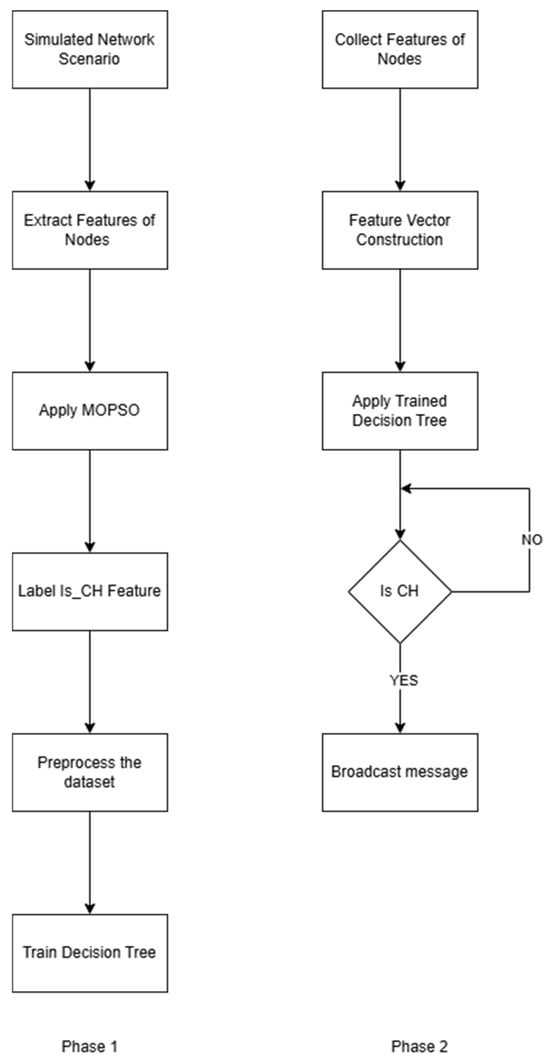
Figure 2.
Control Flow in proposed hybrid MOPSO-DT model. (The arrows represent change of state in the pipeline.).
The proposed model was implemented using the Python programming language using the Jupyter Notebook. Various Python libraries such as NumPy, Pandas, Matplotlib, SimPy, and SciPy were enabled for efficient implementation of the model and data visualization. Table 4 provide network configuration used to ensure realistic results. To demonstrate the effectiveness of the proposed model, we compared it with the LEACH, HEED, and PSO based algorithms.
Table 4.
Parameters and their respective values used in network configuration.
The interpretability offered by DT is necessary for understanding and trusting the model’s performance. The feature interpretability, identifies residual energy as the most critical feature, contributing approximately 87% to the classification decisions, followed by node density and neighbor energy.
| Algorithm 2 Next CH Selection Using MOPSO-DT Based Model |
| Require: Dataset (DMOPSO) generated by phase-1 Ensure: Optimal CH selection 1: Begin 2: while CHi ≤ N do ▷ i is non-negative and less than N 3: Phase 1: Multi-Objective Optimization Using MOPSO 4: Initialize network parameters and deploy N SNs. 5: Represent particles, set fitness functions, and initialize positions. 6: for each particle do 7: Evaluate performance; store non-dominated solutions. 8: Update velocity and position using MOPSO equations. 9: end for 10: if termination condition met then 11: Pre-process the dataset 12: Classify Is CH feature as CH/non-CH 13: Proceed to DT training. 14: else 15: Continue optimization. 16: end if 17: Phase 2: DT-Based CH Selection 18: Classify nodes as CH/non-CH, select optimal CHs, and implement rotation. 19: Broadcast CH status; member nodes transmit data to CHs, then to BS. 20: end while 21: End |
The proposed hybrid MOPSO-DT based approach improves network longevity, load balancing, and reduces energy consumption compared to LEACH, HEED, and PSO. The proposed model improves energy efficiency. However, the time required in computation is slightly higher in comparison to LEACH because of the optimization process. The algorithm scales effectively to larger network sizes up to 500 nodes. Adaptability to heterogeneous WSNs with varying energy levels were tested. The proposed model was tested on various parameters, such as network lifetime (FND, HND, and LND), energy consumption, average throughput, and packet delivery ratio.
4. Result and Discussion
The proposed hybrid model combines MOPSO optimization capabilities with DT classification efficiency, leading to a more robust and adaptive CH selection algorithm. The proposed model is compared with the LEACH, HEED, and PSO-based protocols. The PSO algorithm employed for comparison is the standard single-objective PSO variant focused primarily on optimizing energy efficiency during cluster head selection. This choice was made to benchmark the proposed multi-objective MOPSO-DT hybrid model against a commonly used baseline PSO that optimizes a single criterion, allowing us to demonstrate the benefits of considering multiple objectives simultaneously. Comparisons are made on various metrics such as network lifetime, energy consumption, packet delivery ratio, coverage, and CH load distribution.
To compare the performance of the proposed model, we have used key matrices first node death (FND), half node death (HND), and last node death (LND) to evaluate the network lifetime and energy efficiency. FND indicates how early SNs lost their energy and become unavailable to the network. The early unavailability causes coverage and connectivity issues. HND explain distribution of energy and load balancing whereas LND is used for overall network longevity. To determine the reliability of the evaluated results, a statistical analysis was performed. Each experiment was repeated 30 times under identical simulation conditions, and the mean values with standard deviations were recorded for FND, HND, LND, and PDR metrics. A one-way ANOVA test with a significance level of 0.05 demonstrated that the performance gains observed in the proposed MOPSO-DT model over LEACH, HEED, and PSO were statistically significant (p < 0.01). The low standard deviations in energy consumption and throughput across trials confirmed the model’s stability in dynamic conditions.
The proposed model shows a substantial improvement in lifetime and energy efficiency. In Figure 3, FND occurred after 200 rounds in the proposed model while in LEACH, HEED and PSO FND at 120, 140, and 160 rounds, respectively, and LND is after 470, 295, 355, and 405, respectively. For HND the proposed model shows significant improvement compared to other protocols. Based on the comparison performed it is clear that the proposed model consumes less energy and extends the network lifetime. Next, we evaluated the proposed model to ensure reliability and efficiency of the network using packet delivery ratio (PDR). High PDR value indicates how well the network ensures data integrity, low packet loss, and routing efficiency. The successfully delivered packets are calculated as the ratio of successfully received packets at the destination to the total number of packets sent by the source. Figure 4 shows that the proposed model achieved the highest PDR which is due to the optimal placement of the CH and the hop count. The high PDR indicates that the network is reliable and consistent.
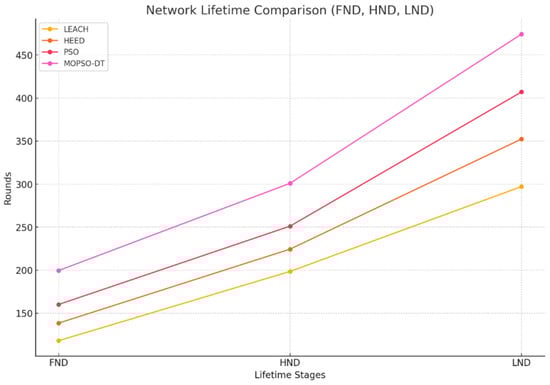
Figure 3.
Network Lifetime comparison of LEACH, HEED, PSO and MOPSO-DT using FND, HND and LND parameters.
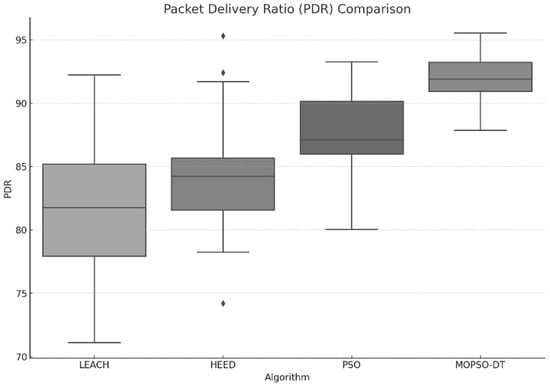
Figure 4.
Packet delivery ratio of LEACH, HEED, PSO, and MOPSO-DTs. (The diamond symbol represents the outliers.).
Furthermore, we evaluated the proposed model to test the network capacity and efficiency by performing throughput comparison. Throughput ensures that network delivers more data per unit time, better congestion, and bandwidth. Figure 5 shows that the proposed model has minimum retransmissions due to the highest throughput of 70 data packets per round, while LEACH, HEAD, and PSO has 50, 55, and 60, respectively. From the previous results it is clear that the proposed model not only performs fast delivery but also significantly reduces the packet loss. Figure 6 shows the energy consumption among the proposed and existing protocols and it is clear that the proposed model has a minimum median of 3.7 units compared to 4.3, 4.6, and 5.1 of PSO, HEED, and LEACH respectively. The narrow median suggests efficient energy use which means the CH selected by the DT model has reduced long range communication and balanced the load across the WSN. Although the hybrid MOPSO-DT model exhibited promising results, some limitations were identified.
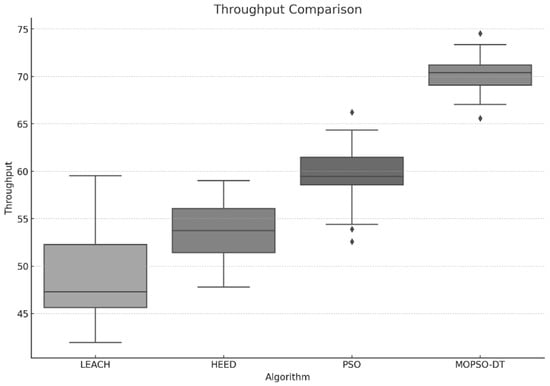
Figure 5.
Comparison of throughput comparison of LEACH, HEED, PSO, and MOPSO-DT. (The diamond symbol represents the outliers.).
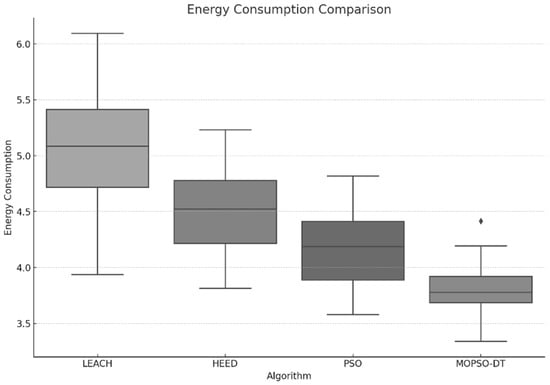
Figure 6.
Comparison of energy consumpsion of LEACH, HEED, PSO, and MOPSO-DT. (The diamond symbol represents the outliers.).
The computational complexity and runtime of MOPSO-DT were also examined. Time complexity of the model consists of two phases. The offline MOPSO optimization has a complexity of approximately O (S × I × N × F), where S is swarm size, I is iterations, N is the number of nodes, and F is the number of features. The decision tree training complexity is about O (MlogM), where M is the number of training samples. During the online phase, DT inference operates in O (logM) time, enabling fast and efficient cluster head selection for real-time WSN operations. For, a 500-node simulation in Figure 7, the average runtime per round was 1.38 s, compared to 0.85 s for PSO, 0.66 s for HEED, and 0.42 s for LEACH. Though marginally higher, this overhead is justified by prolonged network lifetime and energy balance. The DT significantly reduces long-term computing costs by replacing repetitive optimization with lightweight inference, achieving a 63% reduction in repeated computation compared to pure MOPSO search.
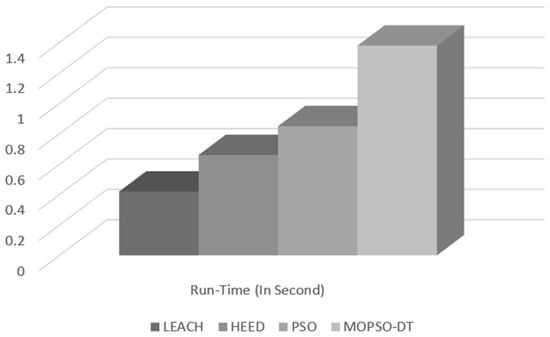
Figure 7.
Runtime comparison of proposed MOPSO-DT with LEACH, HEED, and PSO.
To further evaluate the robustness of the proposed MOPSO-DT model, we analyzed its performance under heterogeneous node energy conditions, reflecting practical deployment scenarios. While our prior results focused primarily on homogeneous networks, it is critical to understand how variations in initial energy among sensor nodes affect network lifetime, energy efficiency, and CH distribution. Figure 8 demonstrates that the proposed MOPSO-DT model maintains robust performance under both homogeneous and heterogeneous node energy distributions. The network lifetime indicators, including FND and LND, show only slight reductions in the heterogeneous scenario, indicating effective adaptation to varied initial energy levels. Energy consumption distribution reveals a marginal increase in variability under heterogeneity but remains comparable to the homogeneous case, suggesting balanced energy usage across nodes. Additionally, the CH selection frequency adjusts dynamically in the heterogeneous network, promoting fair load distribution and preventing premature depletion of weaker nodes. These findings collectively validate the model’s capability to sustain efficient and balanced operation in realistic WSN deployments with energy heterogeneity.
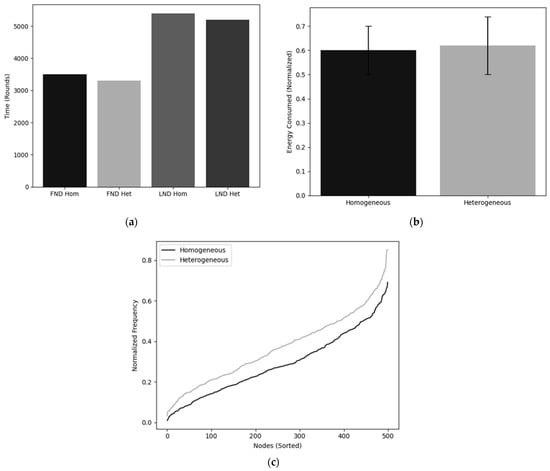
Figure 8.
Performance evaluation of proposed algorithm on homogeneous and hetrogeneous SNs (a) Network Lifetime comparison on FND, LND parameters, (b) Energy utilization, and (c) CH Selection and frequency based on nodes comparison.
In Table 5, the proposed model’s performance is evaluated on networks having 200, 500, 1000, and 1500 nodes, respectively. The MOPSO-DT model continued with more than 92% packet delivery ratio and ensure a minimum of 78% network coverage. This validates the model’s robustness. Furthermore, the energy consumption is also enhanced by 7.3.
Table 5.
Scalability analysis.
The proposed hybrid MOPSO-DT model significantly enhances CH selection by optimizing energy consumption, enhancing network longevity, and maintaining load balancing. One important limitation of the model lies in the generalization ability of the DT classifier for previously unseen network conditions, such as sudden topology changes, node failures, high mobility, or erratic energy depletion patterns. Since the classifier is trained offline on data generated by MOPSO across diverse but finite scenarios, its accuracy may degrade when confronted with network states outside the training distribution. Additionally, the static nature of offline training limits responsiveness to dynamic environmental changes, despite periodic re-selection strategies. The use of a DT, while interpretable and efficient, may also limit modeling of complex temporal dependencies that could be better captured by more advanced or adaptive models. Future work will focus on addressing the challenges of scalability, generalization, and higher processing time to further optimize computational efficiency for large-scale networks.
5. Conclusions and Future Directions
The proposed hybrid MOPSO-DT-based CH selection model improves energy efficiency, prolongs the network life, and the reliability of the network. The main contribution is the hybrid approach of MOPSO optimization and DT classification. The use of MOPSO for generating the dataset ensures that multiple objectives can be handled at a time and the DT predicts CH selection using extracted features. Use of DT reduces generalization, computational overhead, energy consumption, and enhances network longevity compared to LEACH, HEED and PSO based algorithms. The model also improved performance in terms of PDR, energy consumption, and computational overhead in WSNs.
The proposed method reduces overall energy consumption by offline MOPSO optimization and uses lightweight DT in SNs to enhance the energy utilization in the network. The proposed method can be applied in a number of real-world applications such as smart agriculture, environmental monitoring, and smart cities. In smart agriculture the node with high energy will be prioritized for CH role in non-uniform area. Whereas balanced clustering will maintain coverage and connectivity in detection of various environmental parameters such as wildfire. In smart cities it supports scalable node setup for infrastructure monitoring.
Despite of the advantages, the proposed model suffers from various shortcoming. One of them is the time required for optimization in large-scale and mission-critical applications. This can be reduced by incorporating CNN, RNN, or Transformer-based algorithms. They may perform better by selecting more accurate and adaptive CH. In addition, the model requires resilience for various security concerns such as sybil attacks, and node tampering in hostile environments. The optimization parameters for CH selection can be enhanced by incorporating advanced feature selection methods such as SHAP, LIME, or PFI to identify the most influential parameters in real-world deployment. The lightweight deep learning architectures can capture spatial and temporal patterns in sensor data that facilitate transfer learning and end-to-end adaptation in time-evolving WSN environments where traditional models struggle. This approach enhances generalization and robustness in real-world mission critical network conditions. Detailed analysis of trade-offs among latency, and energy efficiency will guide optimization of the model for real-time and resource-constrained WSN applications. These improvements will improve the proposed model and balance interpretability, computational efficiency, and adaptability to meet the requirements of next-generation WSN and IoT systems.
Author Contributions
Conceptualization, R.M. and S.K.J.; methodology, R.M.; software, R.M.; validation, S.K.J., S.P. and R.S.R.; formal analysis, S.K.J.; investigation, S.P.; resources, R.M.; data curation, R.S.R.; writing—original draft preparation, S.P.; writing—review and editing, R.S.R.; visualization, R.M.; supervision, S.K.J.; project administration, R.S.R. All authors have read and agreed to the published version of the manuscript.
Funding
This research received no external funding.
Data Availability Statement
Dataset is available at https://github.com/Rahulmishrajk/Data (accessed on 1 December 2025).
Conflicts of Interest
The authors declare no conflicts of interest.
Abbreviations
The following abbreviations are used in this manuscript:
| WSNs | Wireless Sensor Networks |
| SNs | Sensor Nodes |
| BS | Base Station |
| CH | Cluster Head |
| LEACH | Low Energy Adaptive Clustering Hierarchy |
| HEED | Hybrid Energy Efficient Distributed |
| MOPSO | Multi-Objective Particle Swarm Optimization |
| DT | Decision Tree |
| ML | Machine Learning |
| PSO | Particle Swarm Optimization |
References
- Yadav, G.; Srivastava, G.; Shrivastava, A.; Monika; Sharma, S. WSN, IOT & RFID Integrated Solutions for Smart Cities & Industries: Introduction, Applications, Framework and Challenges. In Proceedings of the 2024 2nd International Conference on Disruptive Technologies (ICDT), Greater Noida, India, 15–16 March 2024; pp. 1128–1135. [Google Scholar]
- Iskandarani, M.Z. Effect of Intelligent Reflecting Surface on WSN Communication with Access Points Configuration. IEEE Access 2025, 13, 13380–13394. [Google Scholar] [CrossRef]
- Sinha, P.; Sahu, D.; Prakash, S.; Rathore, R.S.; Dixit, P.; Pandey, V.K.; Hunko, I. An efficient data driven framework for intrusion detection in wireless sensor networks using deep learning. Sci. Rep. 2025, 15, 34046. [Google Scholar] [CrossRef] [PubMed]
- Wang, T.; Liang, Y.; Shen, X.; Zheng, X.; Mahmood, A.; Sheng, Q.Z. Edge computing and sensor-cloud: Overview, solutions, and directions. ACM Comput. Surv. 2023, 55, 1–37. [Google Scholar] [CrossRef]
- Mohanty, A.; Mohapatra, A.G.; Mohanty, S.K.; Mohanty, A.; Yang, T.; Rathore, R.S.; Wang, L. Sensor Fusion Techniques for Comprehensive Environmental Monitoring in Smart Cities. In Proceedings of the 2025 3rd International Conference on Data Science and Information System (ICDSIS), Hassan, India, 16–17 May 2025. [Google Scholar]
- Alsuwat, H.; Alsuwat, E. Energy-aware and efficient cluster head selection and routing in wireless sensor networks using improved artificial bee colony algorithm. Peer-to-Peer Netw. Appl. 2025, 18, 65. [Google Scholar] [CrossRef]
- Shanker, M.; Saraswathi, D.; Deepalakshmi, R.; Jemila, S.J.; Sathishkumar, A. Optimizing energy-efficient routing in wireless sensor networks via genetic algorithm for enhanced performance. In Proceedings of the 2024 International Conference on Cybernation and Computation (CYBERCOM), Dehradun, India, 15–16 November 2024; IEEE: New York, NY, USA, 2024; pp. 626–631. [Google Scholar]
- Guha, D.; Mukherjee, I.; Ghoshrave, E.; Chilluri, V.S.; Rathore, R.S.; Wu, H.; Chu, X. Deployment of Bio-Inspired Intelligent Model for Self-organizing Smart Sensory Systems. In Innovative Computing and Communications; Hassanien, A.E., Anand, S., Jaiswal, A., Kumar, P., Eds.; Lecture Notes in Networks and Systems; Springer: Singapore, 2025; Volume 1432. [Google Scholar]
- Priyadarshi, R. Energy-efficient routing in wireless sensor networks: A metaheuristic and artificial intelligence-based approach: A comprehensive review. Arch. Comput. Methods Eng. 2024, 31, 2109–2137. [Google Scholar] [CrossRef]
- Ramya, R.; Brindha, T. A comprehensive review on optimal cluster head selection in wsn-iot. Adv. Eng. Softw. 2022, 171, 103170. [Google Scholar] [CrossRef]
- Sindhuja, M.; Vidhya, S.; Jayasri, B.; Shajin, F.H. Multi-objective cluster head using self-attention based progressive generative adversarial network for secured data aggregation. Ad Hoc Netw. 2023, 140, 103037. [Google Scholar] [CrossRef]
- Harun, H.B.; Islam, M.S.; Hanif, M. Genetic algorithm for efficient cluster head selection in leach protocol of wireless sensor network. In Proceedings of the 2022 International Conference on Advancement in Electrical and Electronic Engineering (ICAEEE), Gazipur, Bangladesh, 24–26 February 2022; IEEE: New York, NY, USA, 2022; pp. 1–6. [Google Scholar]
- Mostarda, L.; Navarra, A.; De Leone, R. Optimal vs rotation heuristics in the role of cluster-head for routing in IoT constrained devices. Internet Things 2023, 22, 100757. [Google Scholar] [CrossRef]
- Zakariyya, A.; Olanrewaju, O.M. Optimal selection of the cluster head in wireless sensor networks by combining particle swarm optimization and efficient genetic algorithm. Int. J. Softw. Eng. Comput. Syst. 2023, 9, 129–139. [Google Scholar] [CrossRef]
- Zheng, A.; Zhang, Z.; Liu, W.; Liu, J.; Xiao, Y.; Li, C. Dual cluster head optimization of wireless sensor networks based on multi-objective particle swarm optimization. Sensors 2022, 23, 231. [Google Scholar] [CrossRef]
- Maqbool, B.B.; Peer, M. Classification of current routing protocols for ad hoc networks—A review. Int. J. Comput. Appl. 2010, 7, 26–32. [Google Scholar] [CrossRef]
- Behera, T.; Samal, U.; Mohapatra, S. Routing protocols. In Computational Intelligence in Sensor Networks; Springer: Berlin/Heidelberg, Germany, 2019; pp. 79–99. [Google Scholar]
- Douiba, M.; Benkirane, S.; Guezzaz, A.; Azrour, M. An improved anomaly detection model for IoT security using decision tree and gradient boosting. J. Supercomput. 2023, 79, 3392–3411. [Google Scholar] [CrossRef]
- Gupta, S.K.; Sinha, P.; Yadav, S.K.; Sahu, P.K.; Yang, T.; Prakash, S.; Rathore, R.S. An Efficient Model for WSN Emerging Applications Using Machine Learning. In Proceedings of the 2024 OITS International Conference on Information Technology (OCIT), Vijayawada, India, 12–14 December 2024. [Google Scholar]
- Costa, V.G.; Pedreira, C.E. Recent advances in decision trees: An updated survey. Artif. Intell. Rev. 2023, 56, 4765–4800. [Google Scholar] [CrossRef]
- Heinzelman, W.R.; Chandrakasan, A.; Balakrishnan, H. Energy-efficient communication protocol for wireless microsensor networks. In Proceedings of the 33rd Annual Hawaii International Conference on System Sciences, Maui, HI, USA, 7 January 2020; IEEE: New York, NY, USA, 2000; p. 10. [Google Scholar]
- Ullah, Z. A survey on hybrid, energy efficient and distributed (HEED) based energy efficient clustering protocols for wireless sensor networks. Wirel. Pers. Commun. 2020, 112, 2685–2713. [Google Scholar] [CrossRef]
- Jalal, R.D.; Aliesawi, S.A. Enhancing TEEN protocol using the particle swarm optimization and bat algorithms in underwater wireless sensor network. In Proceedings of the 2023 15th International Conference on Developments in eSystems Engineering (DeSE), Baghdad, Iraq, 9–12 January 2023; pp. 504–510. [Google Scholar] [CrossRef]
- John, J.; Rodrigues, P. A survey of energy-aware cluster head selection techniques in wireless sensor network. Evol. Intell. 2022, 15, 1109–1121. [Google Scholar] [CrossRef]
- Raj, B.; Ahmedy, I.; Idris, M.Y.I.; Md. Noor, R. A survey on cluster head selection and cluster formation methods in wireless sensor networks. Wirel. Commun. Mob. Comput. 2022, 2022, 5322649. [Google Scholar] [CrossRef]
- Deosarkar, B.P.; Yadav, N.S.; Yadav, R. Clusterhead selection in clustering algorithms for wireless sensor networks: A survey. In Proceedings of the 2008 International Conference on Computing, Communication and Networking, Karur, India, 18–20 December 2008; IEEE: New York, NY, USA, 2008; pp. 1–8. [Google Scholar]
- Saadallah, N.; Alabady, S.; Al-Turjman, F. Energy-efficient cluster head selection via genetic algorithm. Al-Rafidain Eng. J. 2024, 29, 12–25. [Google Scholar] [CrossRef]
- Uslu, E.E.; Dagdeviren, Z.A.; Dagdeviren, O. Design and implementation of a hybrid genetic algorithm for cluster head selection in heterogeneous wireless sensor networks. In Proceedings of the 2024 8th International Artificial Intelligence and Data Processing Symposium (IDAP), Malatya, Turkiye, 21–22 September 2024. [Google Scholar]
- Lakshmaiah, L.; Raja, K.; Reddy, B.R.S. Energy efficient cluster head selection using fish swarm optimization algorithm (EECHS-FSOA) in wireless sensor network (WSN). In Proceedings of the 2024 3rd International Conference on Artificial Intelligence For Internet of Things (AIIoT), Vellore, India, 3–4 May 2024; IEEE: New York, NY, USA, 2024; pp. 1–6. [Google Scholar]
- Habelalmateen, M.I.; Kumar, G.R.; Nayana, B.; Venkatramulu, S.; Saranya, N.N. Cluster head selection for single and multiple data sinks in heterogeneous WSN using wild horse optimization. In Proceedings of the 2024 International Conference on Integrated Circuits and Communication Systems (ICICACS), Raichur, India, 23–24 February 2024; IEEE: New York, NY, USA, 2024; pp. 1–5. [Google Scholar]
- Subramanian, S.; Muthusamy, D.; Kulandaivelu, G.; Subramanian, K.S. An efficient cluster head selection in WSNs using transient search optimization (TSO) algorithm. Int. J. Commun. Syst. 2025, 38, e5970. [Google Scholar] [CrossRef]
- Kanase, S. Optimizing cluster head selection in wireless sensor networks using mathematical modeling and statistical analysis of the hybrid energy-efficient distributed (HEED) algorithm. Commun. Appl. Nonlinear Anal. 2024, 31, 602–617. [Google Scholar] [CrossRef]
- Jalili, A.; Gheisari, M.; Alzubi, J.A.; Fernández-Campusano, C.; Kamalov, F.; Moussa, S. A novel model for efficient cluster head selection in mobile WSNs using residual energy and neural networks. Meas. Sens. 2024, 33, 101144. [Google Scholar] [CrossRef]
- Al Mohammad, B. Machine learning approach for cluster head selection in internet of things-based wireless sensor network. In Proceedings of the 2024 22nd International Conference on Research and Education in Mechatronics (REM), Amman, Jordan, 24–26 September 2024; IEEE: New York, NY, USA, 2024; pp. 369–374. [Google Scholar]
- Sekaran, K.; Rajakumar, R.; Dinesh, K.; Rajkumar, Y.; Latchoumi, T.; Kadry, S.; Lim, S. An energy-efficient cluster head selection in wireless sensor network using grey wolf optimization algorithm. Telkomnika 2020, 18, 2822–2833. [Google Scholar] [CrossRef]
- Zhang, D.; Zhu, G. Particle swarm optimization based on temporal-difference learning for solving multi-objective optimization problems. Computing 2023, 105, 1795–1820. [Google Scholar] [CrossRef]
- Kathiroli, P.; Selvadurai, K. Energy efficient cluster head selection using improved sparrow search algorithm in wireless sensor networks. J. King Saud Univ. Comput. Inf. Sci. 2022, 34, 8564–8575. [Google Scholar] [CrossRef]
- Kadhim, A. Intra-clustering communication enhancement in WSN by using skilful methodologies. J. Phys. Conf. Ser. 2020, 1530, 012005. [Google Scholar] [CrossRef]
- Rao, P.S.; Jana, P.K.; Banka, H. A particle swarm optimization based energy efficient cluster head selection algorithm for wireless sensor networks. Wirel. Netw. 2017, 23, 2005–2020. [Google Scholar] [CrossRef]
- Yadav, R.K.; Mahapatra, R.P. Energy aware optimal cluster head selection using hybrid algorithm for clustering routing in wireless sensor networks. Int. J. Intell. Eng. Syst. 2020, 13, 222–231. [Google Scholar] [CrossRef]
- Mehra, P.S.; Doja, M.N.; Alam, B. Fuzzy based enhanced cluster head selection (FBECS) for WSN. J. King Saud Univ. Sci. 2020, 32, 390–401. [Google Scholar] [CrossRef]
- Pal, V.; Singh, G.; Yadav, R.P. Cluster head selection optimization based on genetic algorithm to prolong lifetime of wireless sensor networks. Procedia Comput. Sci. 2015, 57, 1417–1423. [Google Scholar] [CrossRef]
- Sharma, R.; Vashisht, V.; Singh, U. Fuzzy modelling based energy aware clustering in wireless sensor networks using modified invasive weed optimization. J. King Saud Univ. Comput. Inf. Sci. 2022, 34, 1884–1894. [Google Scholar] [CrossRef]
Disclaimer/Publisher’s Note: The statements, opinions and data contained in all publications are solely those of the individual author(s) and contributor(s) and not of MDPI and/or the editor(s). MDPI and/or the editor(s) disclaim responsibility for any injury to people or property resulting from any ideas, methods, instructions or products referred to in the content. |
© 2025 by the authors. Licensee MDPI, Basel, Switzerland. This article is an open access article distributed under the terms and conditions of the Creative Commons Attribution (CC BY) license (https://creativecommons.org/licenses/by/4.0/).