

Selection of Optimal Cluster Head Using MOPSO and Decision Tree for Cluster-Oriented Wireless Sensor Networks



Abstract
1. Introduction

| Factors | Routing Protocol | Description |
|---|---|---|
| Based on the Objective | Data Centric Routing | A communication paradigm where data is disseminated and retrieved based on content rather than the traditional source-to-destination addressing used in conventional networks. Examples include COUGAR, SPIN, DCS, Trickle, and SPRITE. |
| Event-Driven Routing | A routing paradigm where data packets are transmitted in response to specific events or changes in the environment being monitored by the sensors. Examples include ACQUIRE, Rumor routing, and A-MAC. | |
| Location-Based Routing | These protocols depend on the knowledge of the physical positions of SNs to improve routing efficiency, reduce energy consumption, and enhance data accuracy. It can be further divided into the following classes: Proximity-based (GPSR, CCR), Anchor-based (DV-Hop, APIT), Grid-based (GLS, GCR). | |
| Based on the network structure | Flat routing | A type of routing protocol where all SNs in the network are considered equal or flat in terms of hierarchy. In other words, there are no distinct roles or levels of hierarchy among nodes, and every SN is responsible for routing and forwarding data packets independently. Examples include SEP and DREAM. |
| Hierarchical routing | Organizes the SNs into a hierarchical structure with multiple levels or tiers of nodes, each serving a specific role in the network. Examples are LEACH, PEGASIS, and HEED. | |
| Mesh routing | A multi-hop network where SNs can communicate with each other through multiple intermediate nodes, forming a mesh-like structure. Protocols like RPL, HSR, MR-LQSR, DSR, and EMRP use mesh routing. | |
| Based on the routing approach | Proactive (Table-drive) | These protocols preserve up-to-date routing data at all times, continuously updating routing tables. Examples include OSPF, DSDV, OLSR, and TBRPF. |
| Reactive (on-demand) | Establish routes between nodes only when there is a genuine requirement to transmit data, reducing the overhead associated with maintaining routing tables. Examples include AODV, TORA, and DYMO. | |
| Hybrid | Hybrid protocols aim to provide a balance between maintaining routing information continuously and establishing routes only when needed. Examples include ZRP, EEARP, H-ARQ, and MMSPEED. | |
| Based on energy efficiency | Energy-aware routing | The objective of these protocols is to minimize the power requirement to prolong the network’s overall lifetime. Examples include HEED, T-MAC, and LEACH. |
| Energy-balanced routing | Designed to allocate the energy consumption among SNs more evenly, thereby prolonging the network’s overall lifetime. Examples include EEARP, ABR, and SEP. | |
| Based on security | Secure routing | These protocols include mechanisms to defend the system from attacks and confirm secure data transmission. Examples include SEER, SRP, CICADA, and TAS. |
| Trust-based routing | Nodes make routing decisions based on the trust level assigned to neighboring nodes. Examples include TAS, REPT, SBTR, CBTR. |
2. Background Study and Literature Survey
3. Proposed Methodology and Experimental Setup
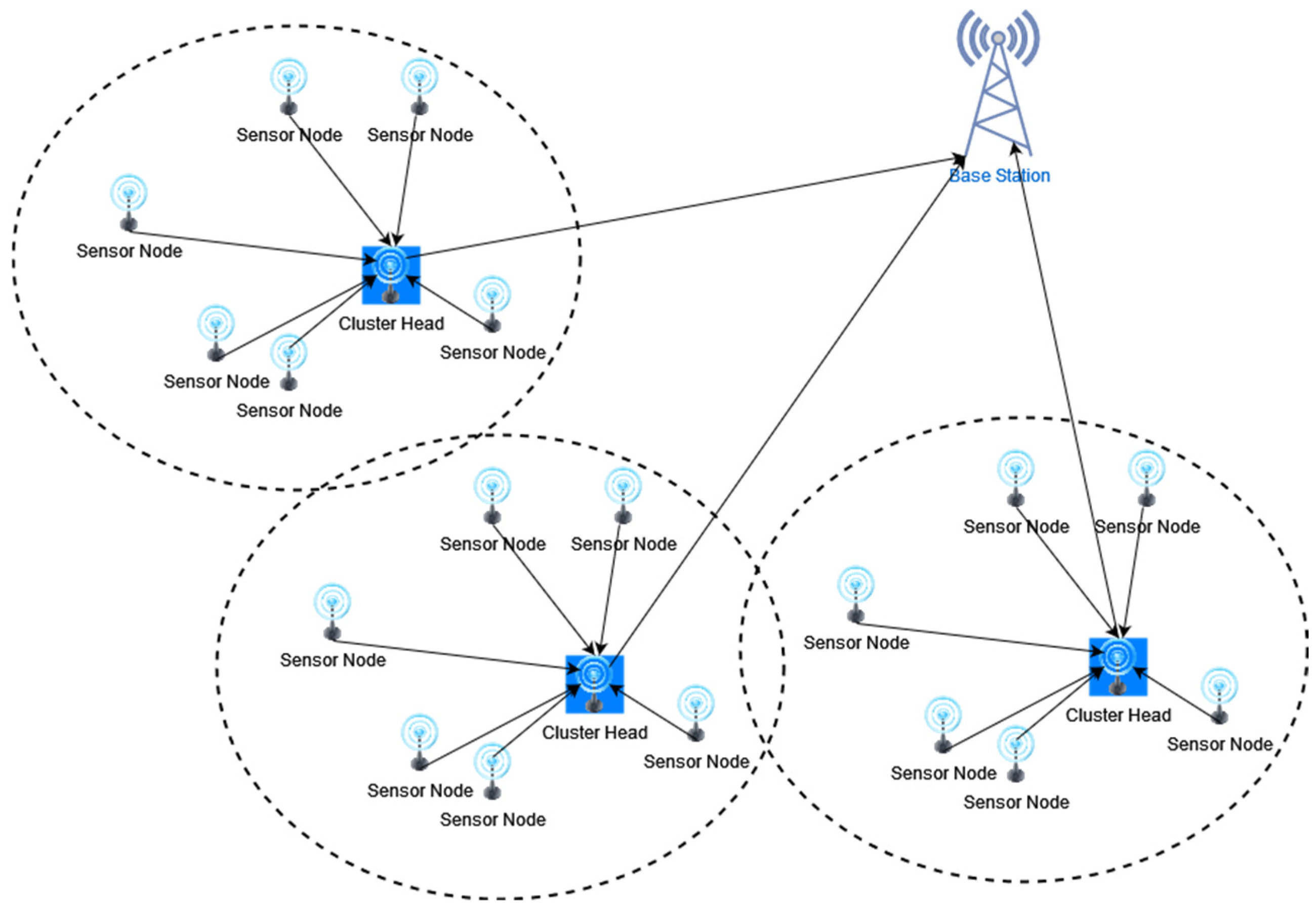
- SNs are stationary and organized in a hierarchical approach.
- Every cluster has its local CH, which can manage its assigned CM nodes.
- SNs periodically sense and transmit data to CH for aggregation and use single-hop communication for data transmission within the cluster.
- Data aggregation ensures that no redundant data can be transmitted.
- CH forwards aggregated data to BS directly or through multi-hop for efficient energy consumption.
- Each SN has limited initial energy (E0) and adheres to a standard energy model.
- The energy consumption model is the first-order radio energy model given in Equation (5).
- Energy Efficiency : The function f1 represents the overall energy consumption of the network such as sensing, processing, transmission, and reception. The energy is normalized between 0 and 1. Values closer to 0 indicate lower energy consumption and values close to 1 represent high energy consumption. Each wi is a weight that reflects the relative importance of the corresponding operation in Equation (13).
- Network Coverage : Network coverage ensure that CHs are evenly distributed among the SNs to reduce the communication distance between CM. Also uses a redundancy function to reduce overlap using coordinates and sensing radius. The v1 + v2 + v3 + v4 = 1 in Equation (14) represents that the coverage is one of four coverage-related components such as coverage ratio, boundary coverage, overlap penalty, and distance-based dispersion.
- Load Balancing : Load balancing is the ability to evenly distribute the workload evenly among CHs to avoid the energy depletion of a particular CH. Further, load balancing ensures equal cluster size and minimizes repeated CH selection to prevent quick energy drain. Thus, avoiding coverage or connectivity holes. In Equation (15) ui represents objectives of load balancing such as cluster size, Ch energy consumption, and selection frequency.
MOSPO and DT for CH-Selection
- A population of particles (SNs) is initialized with random positions and velocities. Each particle in MOPSO represents a potential CH and is encoded as a vector of SN indices selected as CH given in Equation (17):
- CHi represents the index of a selected CH. The velocity of each particle is initialized within a predefined range to control the rate of movement in the search space. A swarm of S particles is generated, and the positions and velocities are iteratively updated based on their own best-known position (pbest) and the best-known global position (gbest).
- Each particle is evaluated according to the defined objectives: energy consumption, coverage, and load balancing. A dominance-based ranking mechanism is used to compare solutions. The multi objective fitness vector where f1, f2, and f3 are energy efficiency, coverage, and load balancing objectives, respectively. The proposed CH is supposed to maximize f1 and f2 and minimize f3.
- Non-dominated solutions are evaluated by MOPSO to build a Pareto front of the best-quality selection of CH. The global best (gbest) particle is chosen from the Pareto front using a crowding-distance-based selection strategy. These are the best CHs found for all the particles and iterations.
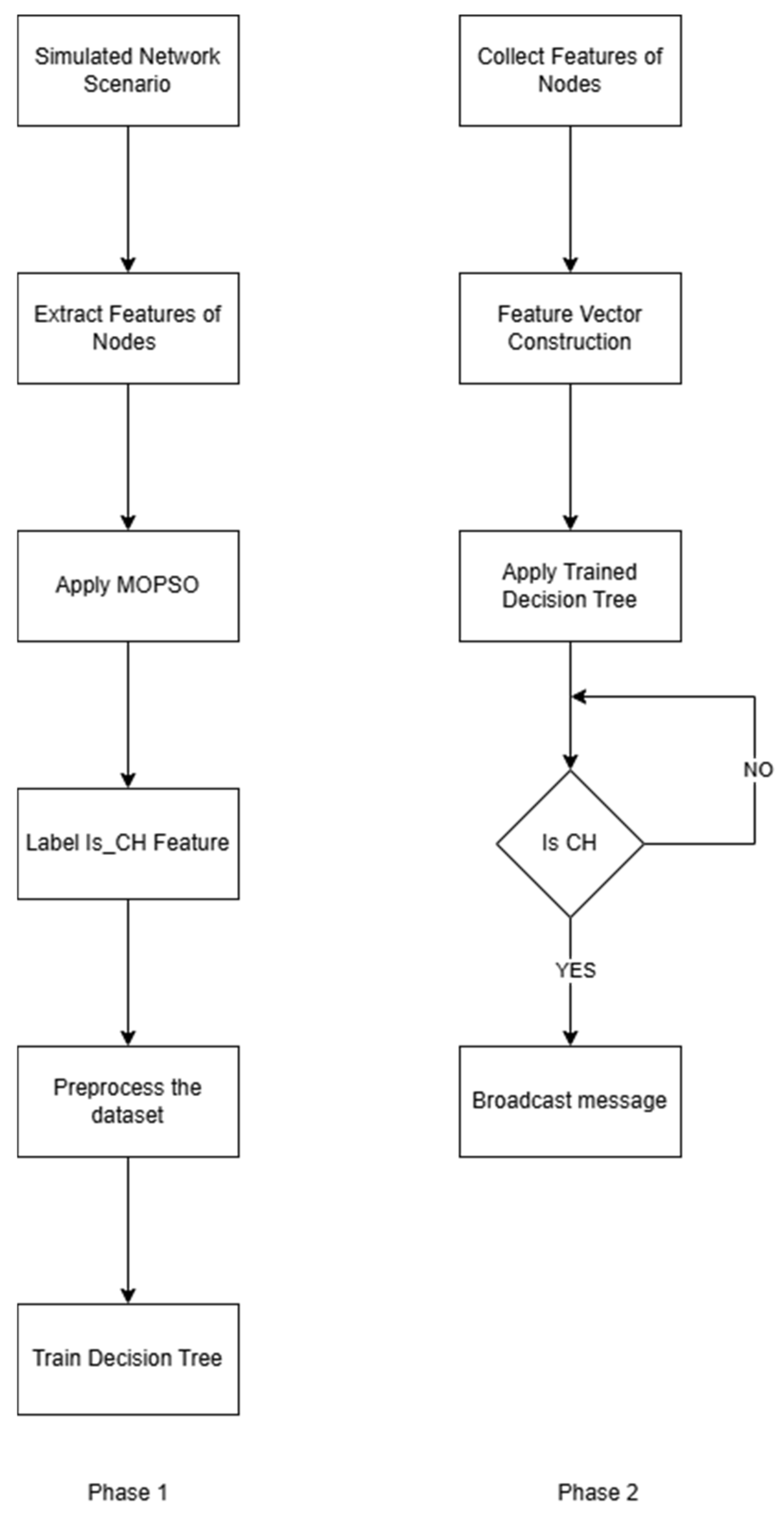
- From the Pareto front nodes selected as CH are marked Is_CH = 1; otherwise, Is_CH = 0. This approach convert the outcome as learning data. The DT is trained using the data and predict CH in online phase.
| Algorithm 1 Phase-1 Dataset creation and use of MOPSO. |
1. Network Initialization
5. Convergence Check
|
| Algorithm 2 Next CH Selection Using MOPSO-DT Based Model |
| Require: Dataset (DMOPSO) generated by phase-1 Ensure: Optimal CH selection 1: Begin 2: while CHi ≤ N do ▷ i is non-negative and less than N 3: Phase 1: Multi-Objective Optimization Using MOPSO 4: Initialize network parameters and deploy N SNs. 5: Represent particles, set fitness functions, and initialize positions. 6: for each particle do 7: Evaluate performance; store non-dominated solutions. 8: Update velocity and position using MOPSO equations. 9: end for 10: if termination condition met then 11: Pre-process the dataset 12: Classify Is CH feature as CH/non-CH 13: Proceed to DT training. 14: else 15: Continue optimization. 16: end if 17: Phase 2: DT-Based CH Selection 18: Classify nodes as CH/non-CH, select optimal CHs, and implement rotation. 19: Broadcast CH status; member nodes transmit data to CHs, then to BS. 20: end while 21: End |
4. Result and Discussion
5. Conclusions and Future Directions
Author Contributions
Funding
Data Availability Statement
Conflicts of Interest
Abbreviations
| WSNs | Wireless Sensor Networks |
| SNs | Sensor Nodes |
| BS | Base Station |
| CH | Cluster Head |
| LEACH | Low Energy Adaptive Clustering Hierarchy |
| HEED | Hybrid Energy Efficient Distributed |
| MOPSO | Multi-Objective Particle Swarm Optimization |
| DT | Decision Tree |
| ML | Machine Learning |
| PSO | Particle Swarm Optimization |
References
- Yadav, G.; Srivastava, G.; Shrivastava, A.; Monika; Sharma, S. WSN, IOT & RFID Integrated Solutions for Smart Cities & Industries: Introduction, Applications, Framework and Challenges. In Proceedings of the 2024 2nd International Conference on Disruptive Technologies (ICDT), Greater Noida, India, 15–16 March 2024; pp. 1128–1135. [Google Scholar]
- Iskandarani, M.Z. Effect of Intelligent Reflecting Surface on WSN Communication with Access Points Configuration. IEEE Access 2025, 13, 13380–13394. [Google Scholar] [CrossRef] [Scilit]
- Sinha, P.; Sahu, D.; Prakash, S.; Rathore, R.S.; Dixit, P.; Pandey, V.K.; Hunko, I. An efficient data driven framework for intrusion detection in wireless sensor networks using deep learning. Sci. Rep. 2025, 15, 34046. [Google Scholar] [CrossRef] [Scilit] [PubMed]
- Wang, T.; Liang, Y.; Shen, X.; Zheng, X.; Mahmood, A.; Sheng, Q.Z. Edge computing and sensor-cloud: Overview, solutions, and directions. ACM Comput. Surv. 2023, 55, 1–37. [Google Scholar] [CrossRef] [Scilit]
- Mohanty, A.; Mohapatra, A.G.; Mohanty, S.K.; Mohanty, A.; Yang, T.; Rathore, R.S.; Wang, L. Sensor Fusion Techniques for Comprehensive Environmental Monitoring in Smart Cities. In Proceedings of the 2025 3rd International Conference on Data Science and Information System (ICDSIS), Hassan, India, 16–17 May 2025. [Google Scholar]
- Alsuwat, H.; Alsuwat, E. Energy-aware and efficient cluster head selection and routing in wireless sensor networks using improved artificial bee colony algorithm. Peer-to-Peer Netw. Appl. 2025, 18, 65. [Google Scholar] [CrossRef] [Scilit]
- Shanker, M.; Saraswathi, D.; Deepalakshmi, R.; Jemila, S.J.; Sathishkumar, A. Optimizing energy-efficient routing in wireless sensor networks via genetic algorithm for enhanced performance. In Proceedings of the 2024 International Conference on Cybernation and Computation (CYBERCOM), Dehradun, India, 15–16 November 2024; IEEE: New York, NY, USA, 2024; pp. 626–631. [Google Scholar]
- Guha, D.; Mukherjee, I.; Ghoshrave, E.; Chilluri, V.S.; Rathore, R.S.; Wu, H.; Chu, X. Deployment of Bio-Inspired Intelligent Model for Self-organizing Smart Sensory Systems. In Innovative Computing and Communications; Hassanien, A.E., Anand, S., Jaiswal, A., Kumar, P., Eds.; Lecture Notes in Networks and Systems; Springer: Singapore, 2025; Volume 1432. [Google Scholar]
- Priyadarshi, R. Energy-efficient routing in wireless sensor networks: A metaheuristic and artificial intelligence-based approach: A comprehensive review. Arch. Comput. Methods Eng. 2024, 31, 2109–2137. [Google Scholar] [CrossRef] [Scilit]
- Ramya, R.; Brindha, T. A comprehensive review on optimal cluster head selection in wsn-iot. Adv. Eng. Softw. 2022, 171, 103170. [Google Scholar] [CrossRef] [Scilit]
- Sindhuja, M.; Vidhya, S.; Jayasri, B.; Shajin, F.H. Multi-objective cluster head using self-attention based progressive generative adversarial network for secured data aggregation. Ad Hoc Netw. 2023, 140, 103037. [Google Scholar] [CrossRef] [Scilit]
- Harun, H.B.; Islam, M.S.; Hanif, M. Genetic algorithm for efficient cluster head selection in leach protocol of wireless sensor network. In Proceedings of the 2022 International Conference on Advancement in Electrical and Electronic Engineering (ICAEEE), Gazipur, Bangladesh, 24–26 February 2022; IEEE: New York, NY, USA, 2022; pp. 1–6. [Google Scholar]
- Mostarda, L.; Navarra, A.; De Leone, R. Optimal vs rotation heuristics in the role of cluster-head for routing in IoT constrained devices. Internet Things 2023, 22, 100757. [Google Scholar] [CrossRef] [Scilit]
- Zakariyya, A.; Olanrewaju, O.M. Optimal selection of the cluster head in wireless sensor networks by combining particle swarm optimization and efficient genetic algorithm. Int. J. Softw. Eng. Comput. Syst. 2023, 9, 129–139. [Google Scholar] [CrossRef] [Scilit]
- Zheng, A.; Zhang, Z.; Liu, W.; Liu, J.; Xiao, Y.; Li, C. Dual cluster head optimization of wireless sensor networks based on multi-objective particle swarm optimization. Sensors 2022, 23, 231. [Google Scholar] [CrossRef] [Scilit]
- Maqbool, B.B.; Peer, M. Classification of current routing protocols for ad hoc networks—A review. Int. J. Comput. Appl. 2010, 7, 26–32. [Google Scholar] [CrossRef] [Scilit]
- Behera, T.; Samal, U.; Mohapatra, S. Routing protocols. In Computational Intelligence in Sensor Networks; Springer: Berlin/Heidelberg, Germany, 2019; pp. 79–99. [Google Scholar]
- Douiba, M.; Benkirane, S.; Guezzaz, A.; Azrour, M. An improved anomaly detection model for IoT security using decision tree and gradient boosting. J. Supercomput. 2023, 79, 3392–3411. [Google Scholar] [CrossRef] [Scilit]
- Gupta, S.K.; Sinha, P.; Yadav, S.K.; Sahu, P.K.; Yang, T.; Prakash, S.; Rathore, R.S. An Efficient Model for WSN Emerging Applications Using Machine Learning. In Proceedings of the 2024 OITS International Conference on Information Technology (OCIT), Vijayawada, India, 12–14 December 2024. [Google Scholar]
- Costa, V.G.; Pedreira, C.E. Recent advances in decision trees: An updated survey. Artif. Intell. Rev. 2023, 56, 4765–4800. [Google Scholar] [CrossRef] [Scilit]
- Heinzelman, W.R.; Chandrakasan, A.; Balakrishnan, H. Energy-efficient communication protocol for wireless microsensor networks. In Proceedings of the 33rd Annual Hawaii International Conference on System Sciences, Maui, HI, USA, 7 January 2020; IEEE: New York, NY, USA, 2000; p. 10. [Google Scholar]
- Ullah, Z. A survey on hybrid, energy efficient and distributed (HEED) based energy efficient clustering protocols for wireless sensor networks. Wirel. Pers. Commun. 2020, 112, 2685–2713. [Google Scholar] [CrossRef] [Scilit]
- Jalal, R.D.; Aliesawi, S.A. Enhancing TEEN protocol using the particle swarm optimization and bat algorithms in underwater wireless sensor network. In Proceedings of the 2023 15th International Conference on Developments in eSystems Engineering (DeSE), Baghdad, Iraq, 9–12 January 2023; pp. 504–510. [Google Scholar] [CrossRef] [Scilit]
- John, J.; Rodrigues, P. A survey of energy-aware cluster head selection techniques in wireless sensor network. Evol. Intell. 2022, 15, 1109–1121. [Google Scholar] [CrossRef] [Scilit]
- Raj, B.; Ahmedy, I.; Idris, M.Y.I.; Md. Noor, R. A survey on cluster head selection and cluster formation methods in wireless sensor networks. Wirel. Commun. Mob. Comput. 2022, 2022, 5322649. [Google Scholar] [CrossRef] [Scilit]
- Deosarkar, B.P.; Yadav, N.S.; Yadav, R. Clusterhead selection in clustering algorithms for wireless sensor networks: A survey. In Proceedings of the 2008 International Conference on Computing, Communication and Networking, Karur, India, 18–20 December 2008; IEEE: New York, NY, USA, 2008; pp. 1–8. [Google Scholar]
- Saadallah, N.; Alabady, S.; Al-Turjman, F. Energy-efficient cluster head selection via genetic algorithm. Al-Rafidain Eng. J. 2024, 29, 12–25. [Google Scholar] [CrossRef] [Scilit]
- Uslu, E.E.; Dagdeviren, Z.A.; Dagdeviren, O. Design and implementation of a hybrid genetic algorithm for cluster head selection in heterogeneous wireless sensor networks. In Proceedings of the 2024 8th International Artificial Intelligence and Data Processing Symposium (IDAP), Malatya, Turkiye, 21–22 September 2024. [Google Scholar]
- Lakshmaiah, L.; Raja, K.; Reddy, B.R.S. Energy efficient cluster head selection using fish swarm optimization algorithm (EECHS-FSOA) in wireless sensor network (WSN). In Proceedings of the 2024 3rd International Conference on Artificial Intelligence For Internet of Things (AIIoT), Vellore, India, 3–4 May 2024; IEEE: New York, NY, USA, 2024; pp. 1–6. [Google Scholar]
- Habelalmateen, M.I.; Kumar, G.R.; Nayana, B.; Venkatramulu, S.; Saranya, N.N. Cluster head selection for single and multiple data sinks in heterogeneous WSN using wild horse optimization. In Proceedings of the 2024 International Conference on Integrated Circuits and Communication Systems (ICICACS), Raichur, India, 23–24 February 2024; IEEE: New York, NY, USA, 2024; pp. 1–5. [Google Scholar]
- Subramanian, S.; Muthusamy, D.; Kulandaivelu, G.; Subramanian, K.S. An efficient cluster head selection in WSNs using transient search optimization (TSO) algorithm. Int. J. Commun. Syst. 2025, 38, e5970. [Google Scholar] [CrossRef] [Scilit]
- Kanase, S. Optimizing cluster head selection in wireless sensor networks using mathematical modeling and statistical analysis of the hybrid energy-efficient distributed (HEED) algorithm. Commun. Appl. Nonlinear Anal. 2024, 31, 602–617. [Google Scholar] [CrossRef] [Scilit]
- Jalili, A.; Gheisari, M.; Alzubi, J.A.; Fernández-Campusano, C.; Kamalov, F.; Moussa, S. A novel model for efficient cluster head selection in mobile WSNs using residual energy and neural networks. Meas. Sens. 2024, 33, 101144. [Google Scholar] [CrossRef] [Scilit]
- Al Mohammad, B. Machine learning approach for cluster head selection in internet of things-based wireless sensor network. In Proceedings of the 2024 22nd International Conference on Research and Education in Mechatronics (REM), Amman, Jordan, 24–26 September 2024; IEEE: New York, NY, USA, 2024; pp. 369–374. [Google Scholar]
- Sekaran, K.; Rajakumar, R.; Dinesh, K.; Rajkumar, Y.; Latchoumi, T.; Kadry, S.; Lim, S. An energy-efficient cluster head selection in wireless sensor network using grey wolf optimization algorithm. Telkomnika 2020, 18, 2822–2833. [Google Scholar] [CrossRef] [Scilit]
- Zhang, D.; Zhu, G. Particle swarm optimization based on temporal-difference learning for solving multi-objective optimization problems. Computing 2023, 105, 1795–1820. [Google Scholar] [CrossRef] [Scilit]
- Kathiroli, P.; Selvadurai, K. Energy efficient cluster head selection using improved sparrow search algorithm in wireless sensor networks. J. King Saud Univ. Comput. Inf. Sci. 2022, 34, 8564–8575. [Google Scholar] [CrossRef] [Scilit]
- Kadhim, A. Intra-clustering communication enhancement in WSN by using skilful methodologies. J. Phys. Conf. Ser. 2020, 1530, 012005. [Google Scholar] [CrossRef] [Scilit]
- Rao, P.S.; Jana, P.K.; Banka, H. A particle swarm optimization based energy efficient cluster head selection algorithm for wireless sensor networks. Wirel. Netw. 2017, 23, 2005–2020. [Google Scholar] [CrossRef] [Scilit]
- Yadav, R.K.; Mahapatra, R.P. Energy aware optimal cluster head selection using hybrid algorithm for clustering routing in wireless sensor networks. Int. J. Intell. Eng. Syst. 2020, 13, 222–231. [Google Scholar] [CrossRef] [Scilit]
- Mehra, P.S.; Doja, M.N.; Alam, B. Fuzzy based enhanced cluster head selection (FBECS) for WSN. J. King Saud Univ. Sci. 2020, 32, 390–401. [Google Scholar] [CrossRef] [Scilit]
- Pal, V.; Singh, G.; Yadav, R.P. Cluster head selection optimization based on genetic algorithm to prolong lifetime of wireless sensor networks. Procedia Comput. Sci. 2015, 57, 1417–1423. [Google Scholar] [CrossRef] [Scilit]
- Sharma, R.; Vashisht, V.; Singh, U. Fuzzy modelling based energy aware clustering in wireless sensor networks using modified invasive weed optimization. J. King Saud Univ. Comput. Inf. Sci. 2022, 34, 1884–1894. [Google Scholar] [CrossRef] [Scilit]





| Parameter | Description |
|---|---|
| Energy Level | SNs with maximum power reserves are often preferred as CHs. This choice helps ensure that CHs have sufficient energy reserves to handle the additional responsibilities associated with their role. |
| Distance to BS | Distance among the SN and the BS is a crucial parameter because less distance requires low energy in communication. |
| Communication Reliability | SNs have a lower packet loss ratio and therefore are favorable nodes for being next to CH to ensure reliability. |
| Sensor Node Mobility | SNs having less or predictable mobility is preferred to be selected as next CH to enhance the stability. |
| Node Density | CHs may be chosen from denser regions of the network to distribute the workload more evenly across the network, thus optimizing energy consumption. |
| Residual Resources | SNs having extra resources such as memory and processing capacity are preferred when selecting CHs to ensure additional processing required. |
| Load Balancing | Equitably distributing the role of CH among SNs is essential to prevent premature energy depletion in certain nodes, thus extending the network’s overall lifetime. |
| Security Considerations | SNs having safeguards such as authentication and trustworthiness may influence CH selection to safeguard the network against potential attacks and unauthorized access. |
| Latency and Delay Constraints | SNs that fulfill the criteria of applications having strict latency or delay constraints are prioritize to ensure faster data forwarding as CHs. |
| Communication Cost | SNs having fewer intermediate nodes to the BS are selected as CH to reduce intermediate communication cost. |
| Features | Data Type | Objective |
|---|---|---|
| Node ID | Integer | Unique identifier for each SN |
| Residual Energy | Float | Remaining energy of the node |
| Energy Consumption Rate | Float | Energy consumed per round |
| Average Neighbor Energy | Float | Average residual energy of neighboring nodes |
| Cluster Total Energy | Float | Sum of residual energy in the node’s current cluster |
| Node Density | Float | Number of nodes per unit area around the node |
| Num Neighbors | Integer | Number of directly reachable neighboring nodes |
| Sensing Radius | Float | Sensing range of the node (meter) |
| Coord X | Float | X-coordinate of the node’s position |
| Coord Y | Float | Y-coordinate of the node’s position |
| Cluster Size | Integer | Number of nodes currently in the cluster |
| CH History Count | Integer | Number of times the node has been selected as CH in past |
| Hop Count To BS | Integer | Number of hops from node to the BS |
| Is_CH | Integer (0/1) | Target label: 1 if node is a CH, 0 otherwise |
| Parameter | Value |
|---|---|
| Number of nodes | 100, 200, 500 |
| Deployment Area | 100 M × 100 M, 200 M × 200 M |
| Deployment Type | Random |
| Base Station | Fixed |
| Initial Energy per node | 1.0 J |
| Node Sensing Range | 10 M, 20 M |
| Node Communication Range | 20 M, 40 M |
| Simulation Rounds | LND (1000+) |
| Packet Size | 4000 bit (Data), 200 bit (Control) |
| Energy Model | First-order radio model |
| Number of Nodes | Packet Delivery Ratio (%) | Network Coverage (%) | Energy Consumption Increase (%) |
|---|---|---|---|
| 200 | 96 | 85 | 0.0 |
| 500 | 94 | 82 | 3.2 |
| 1000 | 93 | 80 | 5.5 |
| 1500 | 92 | 78 | 7.3 |
Disclaimer/Publisher’s Note: The statements, opinions and data contained in all publications are solely those of the individual author(s) and contributor(s) and not of MDPI and/or the editor(s). MDPI and/or the editor(s) disclaim responsibility for any injury to people or property resulting from any ideas, methods, instructions or products referred to in the content. |
© 2025 by the authors. Licensee MDPI, Basel, Switzerland. This article is an open access article distributed under the terms and conditions of the Creative Commons Attribution (CC BY) license (https://creativecommons.org/licenses/by/4.0/).
Share and Cite
Mishra, R.; Jha, S.K.; Prakash, S.; Rathore, R.S. Selection of Optimal Cluster Head Using MOPSO and Decision Tree for Cluster-Oriented Wireless Sensor Networks. Future Internet 2025, 17, 577. https://doi.org/10.3390/fi17120577
Mishra R, Jha SK, Prakash S, Rathore RS. Selection of Optimal Cluster Head Using MOPSO and Decision Tree for Cluster-Oriented Wireless Sensor Networks. Future Internet. 2025; 17(12):577. https://doi.org/10.3390/fi17120577
Chicago/Turabian StyleMishra, Rahul, Sudhanshu Kumar Jha, Shiv Prakash, and Rajkumar Singh Rathore. 2025. "Selection of Optimal Cluster Head Using MOPSO and Decision Tree for Cluster-Oriented Wireless Sensor Networks" Future Internet 17, no. 12: 577. https://doi.org/10.3390/fi17120577
APA StyleMishra, R., Jha, S. K., Prakash, S., & Rathore, R. S. (2025). Selection of Optimal Cluster Head Using MOPSO and Decision Tree for Cluster-Oriented Wireless Sensor Networks. Future Internet, 17(12), 577. https://doi.org/10.3390/fi17120577