Abstract
Background: The binding of glycosaminoglycans (GAG) to Wnt signaling components plays a key regulatory role in bone formation and regeneration. We previously reported de novo designed chemically modified hyaluronan derivatives, named REGAG (Rationally Engineered GAG), which demonstrated bone-regenerative properties in a mouse calvaria defect model. To gain initial insights into the pharmacological profile of two REGAG currently under preclinical investigation in mice, we performed a comprehensive in silico investigation of their binding to human and murine serum albumin (HSA and MSA), as it might influence their ADME properties. Furthermore, we evaluated whether REGAG binding might impact the recognition of well-characterized HSA-binding drugs. Methods: State-of-the-art in silico ADMET tools, docking and molecular dynamics simulations were used to predict and characterize the interaction of REGAG with HSA and MSA, and to investigate the molecular mechanisms involved at the atomic level. Results: The investigated REGAG molecules show a consistent binding preference for the FA1 site in both proteins, and an additional preference for the FA7 site in HSA. Their recognition might induce protein conformational changes and alter the functional state. Furthermore, REGAG’s conformational adaptability is predicted to influence their binding to the FA5/6 and FA8/9 sites of HSA, and to the FA3/4 and FA7 sites of MSA. Conclusions: Our investigations predict the binding of two hyaluronan derivatives to HSA and MSA. The mechanistic insights gained into the molecular recognition of these two REGAG molecules offer valuable information for their potential clinical application and serve as a rational basis for future molecular design aimed at improving pharmacokinetic properties.
1. Introduction
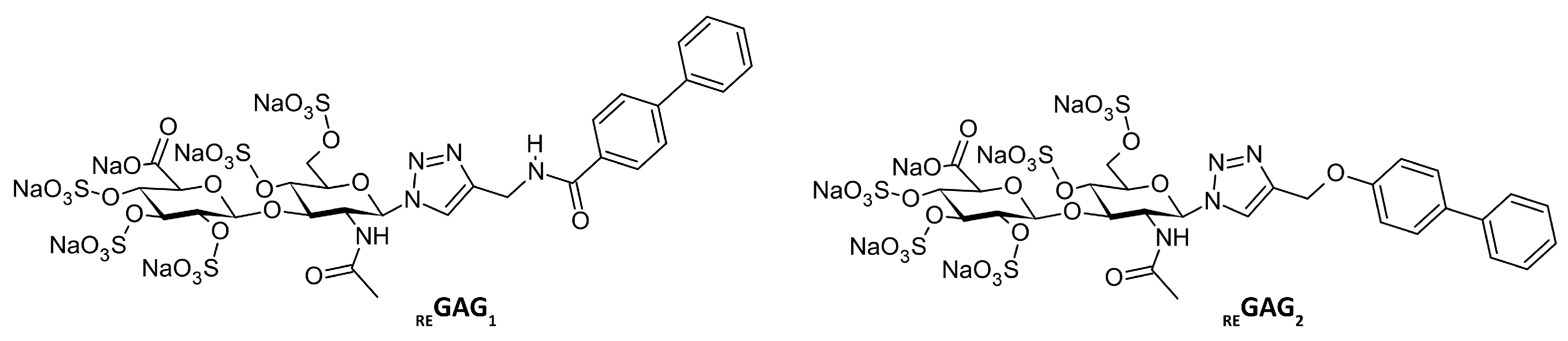
Rationally engineered glycosaminoglycan derivatives (REGAG) have been recently reported as promising molecules for bone regeneration by targeting key inhibitors of the Wnt/β catenin signaling pathway. In vitro and in vivo studies showed that two of these REGAG variants, named REGAG1 and REGAG2 (Figure 1), outperform synthetic polymeric highly sulfated hyaluronan by achieving up to 50% bone regeneration in a mouse calvaria defect model [1]. These REGAG molecules can restore Wnt signaling by interacting with and inhibiting the Wnt negative regulators Dickkopf-1 (DKK-1) and sclerostin [1], which function cooperatively and compete with activating Wnt ligands for binding sites on the receptors low-density lipoprotein receptor related protein 5 and 6 (LRP5/6) [2,3,4,5]. Of note, a dual inhibition of both Wnt negative regulators is crucial to enhance Wnt signaling and promote synergistic bone formation, compared to monotherapies targeting either DKK-1 or sclerostin separately [6,7]. REGAG mimic the LRP5/6 receptor region recognized by DKK-1 C-term and several Wnt activating ligands. Because of several recognition resemblances to LRP5/6 regions used by DKK-1 and sclerostin, REGAG are able to scavenge both endogenous inhibitors of the Wnt/β catenin signaling pathway, thereby preventing its inhibition and promoting osteogenesis [1].
Figure 1.
Chemical structure of the bone-regenerative REGAG variants REGAG1 and REGAG2.
The chemical structure of REGAG1 and REGAG2 consists of a sugar-based moiety, a pentasulfated hyaluronan disaccharide functionalized at the anomeric center, with either 1,2,3-triazol-amide or ether linkers connecting it to a hydrophobic aromatic moiety (Figure 1).
Given the therapeutic potential of REGAG1 and REGAG2 in bone-related diseases such as osteoporosis [8], further investigation into their pharmacological properties is warranted. A key step in early drug development involves determining ADMET (absorption, distribution, metabolism, excretion, and toxicity) properties to evaluate the safety and efficacy of novel drug candidates. In this regard, computational methods can be used to predict several ADMET properties and thus reduce experimental work costs [9]. A key parameter in computational ADMET profiling is the determination of plasma protein binding. In this context, human serum albumin (HSA) constitutes a key target as it plays a central role in drug transport, distribution, and clearance. Furthermore, HSA is the most abundant plasma protein (500–700 µM), capable of binding a wide range of endogenous and exogenous ligands, including fatty acids and drugs [10,11,12]. Therefore, the in silico investigation of the interaction of REGAG1 and REGAG2 (Figure 1) with HSA represents an important step toward advancing understanding of their pharmacological profiles. Furthermore, because ligand-binding characteristics can differ between human and mouse serum albumins, the successful translation of preclinical findings from mouse models to human applications requires a rigorous comparison of ligand recognition in both species. State-of-the-art computational strategies provide an efficient and cost-effective first step for examining ligand recognition by both the human and mouse serum albumin proteins and identifying potential species-specific interactions. Such insights are valuable for prioritizing candidates, guiding experimental validation, as well as supporting future optimization through the lead-to-drug development process.
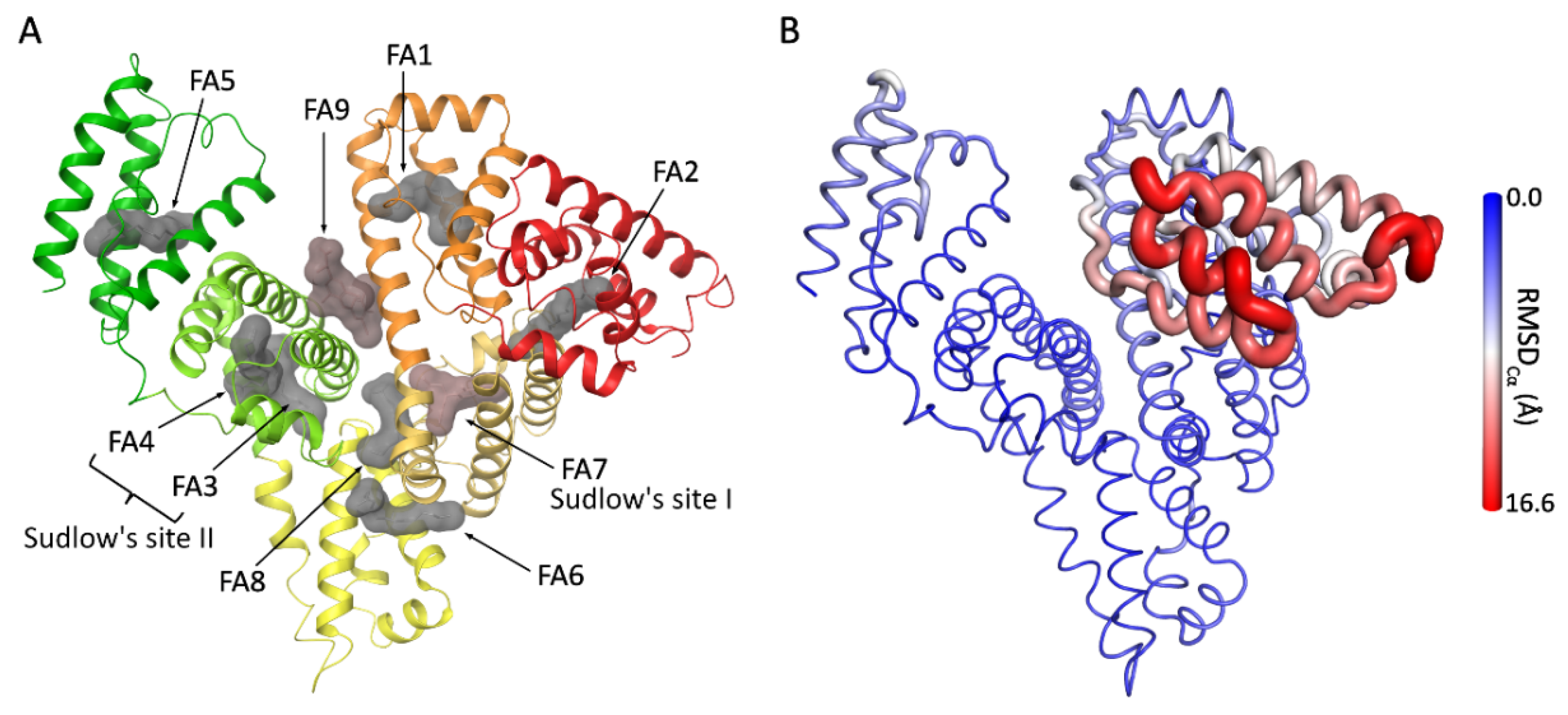
The 3D structure of murine serum albumin (MSA) has not been yet experimentally solved. However, there are several high-resolution crystallographic structures of its human homologue, HSA, available in the Protein Databank. HSA consists of six different subdomains (IA (residues 5–107), IB (residues 108–197), IIA (residues 198–296), IIB (residues 297–382), IIIA (residues 383–494), and IIIB (residues 495–569) [13]), which are connected by flexible loops (Figure 2). HSA’s well-characterized structure features three main drug-binding sites (Sudlow sites I and II in subdomains IIA and IIIA, respectively, as well as drug site III in subdomain IB) and nine fatty acid (FA) binding pockets (FA1–FA9), some of which are located at the subdomain interfaces (Figure 2A) [14,15,16,17]. Notably, HSA is an allosterically regulated protein (i.e., ligand binding at one site can alter the binding properties at others). For example, binding of ferric heme at FA1 significantly reduces drug affinity at Sudlow’s site I and, conversely, drugs binding at Sudlow’s site I can hinder ferric heme association [10]. Fatty acids also modulate ligand binding, as Sudlow site I ligands preferentially bind the FA-free state, while FA1 ligands show enhanced binding in the FA-bound conformation [10,18].
Figure 2.
HSA structural features. (A) Crystallographic structure of HSA in complex with both endogenous and exogenous ligands at the fatty acids binding sites (PDB ID 1H9Z, 2.5 Å). HSA is shown in cartoon (subdomain IA in red, IB in orange, IIA in faded orange, IIB in yellow, IIIA in green-yellow, and IIIB in green). Ligands at the different binding sites (indicated by arrows and labeled) are shown as molecular surfaces (in gray: myristic acid at FA1- FA6 and Decanoic acid at FA8 (taken from PDB ID 1E7E, 2.5 Å); in red-brown: warfarin at FA7 and thyroxine at FA9 (taken from PDB ID 1HK4, 2.4 Å)). Figure generated with Maestro v14.3. (B) Cartoon putty representation of HSA colored and rendered according to RMSDCα values (indicated by the gradient side bar) relative to the comparison between its complex with propofol at subdomain IIIA (PDB ID 1E7A, 2.2 Å) and with heme-Fe(III) at subdomain IB (PDB ID 1N5U, 1.9 Å). Figure generated with PyMOL v2.3.
Due to its allosteric nature, HSA can undergo conformational changes in response to variations in pH and ligand binding (Figure 2B) [19]. Indeed, two well-defined conformational states have been characterized. The “neutral” (N) form occurs at pH 7 in the FA-free state, and the “basic” (B) form appears at pH higher than 8 in the FA-free state or at neutral pH in the FA-bound state [20]. In addition, occupation of key HSA binding sites can significantly alter binding behavior, thereby affecting the distribution of other ligands and modulating HSA capacity to transport metabolites and drugs [15,21,22,23]. HSA’s conformational diversity is extensively represented in the structures available at the Protein Data Bank (PDB), revealing major structural rearrangements within subdomains I and III [15,16,24,25,26,27,28], particularly in their orientation with respect to subdomain II, which acts as a structural pivot during conformational transitions [20,29]. Fatty acid binding to the FA2 site between the interface of subdomains IA and IIA has been considered one of the major forces of this conformational change [27].
Here, we investigate the pharmacological properties of REGAG1 and REGAG2 in silico by characterizing their ability to interact with HSA in different conformational states and assessing their potential to alter the binding of clinically relevant reference drugs. Furthermore, we analyze the interactions of these REGAG molecules with murine serum albumin (MSA), a critical aspect for ongoing preclinical studies and for supporting potential future translation to human applications.
2. Materials and Methods
2.1. In Silico Prediction of REGAG Binding to Plasma Proteins
The web-based platforms ADMET-AI [30], ADMETlab [31], Deep-PK [32], and admetSAR [33] were employed to predict plasma protein binding for the two investigated REGAG molecules. These tools make use of classical computational approaches as well as machine learning and deep learning algorithms, as implemented in ADMET-AI and Deep-PK.
2.2. Molecular Modeling of Murine Serum Albumin (MSA)
The three-dimensional (3D) structure of MSA was built by comparative modeling using as template the crystallographic structure of HSA in complex with aristolochic acid (PDB ID 8RCO, 1.9 Å) [25] (72% sequence identity and 89% similarity). The program MODELLER as implemented in BIOVIA [34] was used for the modeling. The obtained MSA model was compared to the MSA structure predicted by AlphaFold (AF-P02768-F1-v4) [35,36].
2.3. Molecular Docking
Given that HSA is allosterically regulated and undergoes ligand-induced conformational changes [18], the ligand-bound structures available at high resolution in the PDB offer a variety of conformational variations in the respective subdomains. Therefore, we selected three representative crystallographic structures of HSA that capture distinct initial conformational states relevant to particular ligand-binding subdomains and reflect conformational variability between domains I and III. The warfarin- and myristic acid-bound HSA structure (PDB ID 1H9Z, 2.5 Å) [27] was chosen because it reflects the ligand-bound conformational state across FA1-FA7. A second structure comprising heme-Fe(III) bound in FA1 and myristic acid occupying FA2-FA6 (PDB ID 1N5U, 1.9 Å) [28] was also included because it represents a ligand-free conformation of drug binding site I (FA7) within subdomain IIA, while maintaining ligand-bound conformations in adjacent subdomains. Finaly, the propofol-bound structure (PDB ID 1E7A, 2.2 Å) [24] was selected because it represents the conformational state with ligands exclusively occupying the FA3/4 (drug-binding site II) and FA5 sites. Furthermore, these crystal structures have been employed in previous molecular docking and dynamics studies of HSA–ligand complex [37,38,39], thereby supporting their suitability for comparative docking in the present work. In the selected structures, the co-crystallized ligands were removed prior to protein preparation. Additionally, the fatty acid- and heme-Fe(III)–containing HSA structure (PDB 1H9Z) was selected for molecular docking to investigate the molecular recognition of the REGAG molecules in a ligand-bound conformational state. All structures were prepared in BIOVIA [34] and refined in QuickPrep from MOE [40] using the Amber14 forcefield [41], the Generalized Born implicit solvation model [42] and additional default parameters.
Given the hybrid structure of the REGAG1 and REGAG2 molecules, which include both a GAG and a non-GAG moiety, three different but complementary docking approaches were employed: Glycotorch Vina [43], a specialized tool for investigating GAG–protein interactions, and Autodock 3 [44] and Glide [45,46], which are optimized for small-molecule docking. The combined use of these three methods ensured a more complete and reliable representation of the binding properties of the investigated REGAG molecules. The structures of REGAG1 and REGAG2 were prepared for Glycotorch using AutoDock Tools [47]. In Glide, their 3D structures were prepared in LigPrep from the Maestro suite (v14.3.129, Release 2025-1) [48] using the OPLS4 force field [49] and Epik [50] to generate ionization states at pH 7.4 ± 2.0. For comparison and validation purposes, heme-Fe(III), cantharidin, warfarin, propofol and flurbiprofen were also prepared in LigPrep.
The ligands were treated flexibly. In Glycotorch and Autodock 3, the proteins were treated rigidly, while in Glide flexible rotation of hydroxyl and thiol groups of Ser, Thr, Tyr and Cys was allowed. In GlycoTorch, the size box dimensions for the ligand-free HSA structures PDB IDs 1H9Z, 1N5U, and 1E7A were set up to 50.0 Å × 50.0 Å × 50.0 Å, 48.6 Å × 48.6 Å × 48.6 Å, and 49.4 Å × 49.4 Å × 49.4 Å, respectively. For warfarin- and myristic acid-bound HSA (PDB ID 1H9Z), the size box dimension was set up to 84.3 Å × 84.3 Å × 84.3 Å. For MSA, a size box dimension of 63.4 Å × 63.4 Å × 63.4 Å was used. The exhaustiveness of the search algorithm and number of decoys were set up to 100. For Autodock 3 calculations, autogrid3 was used to compute the atomic potential of HSA PDB ID 1H9Z with a spacing grid and grid box of 0.397 Å and 126 Å × 126 Å × 126 Å, respectively. Glide docking calculations were carried out in standard precision. The grid boxes were centered (x: 28.578, y: 12.695, z: 7.549 for PDB ID 1H9Z; x: 26.783, y: 3.931, z: 20.932 for PDB ID 1N5U; x: 1.166 y: 11.600, z: −12.133 for PDB ID 1E7A; x: 28.782, y: 2.499, z: 7.995 for the MSA model centering FA1; x: 13.008, y: 4.881, z: 10.543 for the MSA model centering FA7, and x: 41.519, y: −0.940, z: 25.809 for the MSA model centering subdomain IIIA) with inner and outer boxes of dimensions 25.0 Å × 25.0 Å × 25.0 Å and 53.0 Å × 53.0 Å × 53.0 Å, respectively, for PDB ID 1H9Z, 29.0 Å × 29.0 Å × 29.0 Å and 65.0 Å × 65.0 Å × 65.0 Å, respectively, for PDB ID 1E7A, and 40.0 Å × 40.0 Å × 40.0 Å and 76.0 Å × 76.0 Å × 76.0 Å, respectively, for PDB ID 1N5U and the MSA model. In Glycotorch and Autodock 3, the top 50 docking solutions were clustered with DBSCAN as previously described [51]. In Glide, the top 20 best docking solutions were kept and analyzed. Three binding poses from each cluster were selected as representative REGAG/protein complex structures for further MD refinement. Docking results figures were created with Maestro v14 [48].
2.4. Molecular Dynamics (MD) Simulations
The selected representative REGAG/HSA and REGAG/MSA complex structures were energetically refined by MD simulations in AMBER19 [52]. Charges were taken from the GLYCAM 06-j force field [53], and from the literature for sulfate groups [54]. Parameters for the GAG moiety were taken from the GLYCAM-06j force field [53], and protein parameters from the ff14SB force field [41]. Parameters for the GAG-anomeric functionalities were taken from previous work [1]. Each REGAG/protein complex was solvated in a truncated octahedral box of TIP3P water molecules and neutralized with Na+ counterions. MD simulations were preceded by two energy-minimization steps: (i) only the solvent and ions were relaxed with position restraints for the solute (500 kcal/mol·Å2) using 1000 steps of steepest descent minimization followed by 500 steps of conjugate gradient minimization; (ii) the entire system was minimized without restraints applying 3000 cycles of steepest descent and 3000 of conjugate gradient equilibration. Then, the system was heated up from 200 K to 300 K in 20 ps with weak position restraints (10 kcal/mol·Å2). Langevin temperature coupling with a collision frequency γ = 1 ps−1 was used at this step. The system was equilibrated under constant pressure of 1 atm using periodic boundary conditions (NPT conditions) at 300 K for 500 ps. A total of 100 ns MD simulation was carried out at 300 K with NPT conditions for each complex. The SHAKE algorithm was used to constrain all bonds involving hydrogen atoms with a time step of 2 fs. A cutoff of 8 Å was applied to treat the non-bonded interactions, and the Particle Mesh Ewald (PME) method was used to treat long-range electrostatic interactions. MD trajectories were recorded every 10 ps. The pyranose rings in the REGAG molecules were harmonically restrained. Trajectories were visualized with VMD [55] and evaluated in terms of RMSD and principal component analysis using the CPPTRAJ module implemented in AMBER19 [52]. Pairwise energy decomposition and binding free energy post-processing analysis of 200 frames distributed along the MD production runs were performed in implicit solvent using MM-GBSA [56,57] as implemented in AMBER19. The Pandas, NumPy, and Matplotlib packages were utilized as tools for data manipulation, analysis, and visualization. Figures were created with PyMOL v2.3 [58].
3. Results
3.1. In Silico Predictions of REGAG Binding to Plasma Proteins
REGAG1 and REGAG2 plasma protein binding was investigated using several web-based ADMET platforms (see Methods Section 2.1, Table 1). Since these molecules are de novo designed, it should be noticed that the predictions made rely entirely on the models and training sets used by the respective tools and may be biased depending on the chemical features represented in those datasets.
Table 1.
Predicted plasma protein binding (given in %) for REGAG1 and REGAG2.
The probability of REGAG1 and REGAG2 binding to plasma proteins was predicted medium to high. The obtained results indicated greater variability for REGAG1 in comparison to REGAG2, suggesting moderate and good predictive reliability for REGAG1 and REGAG2, respectively [59].
3.2. Molecular Recognition of REGAG by HSA
Docking calculations were carried out to investigate in detail the molecular recognition of REGAG1 and REGAG2 by HSA. For this purpose, considering that the REGAG molecules contain GAG and non-GAG moieties, we used different docking programs that have been designed for predicting binding of GAGs (i.e., GlycoTorch) [43] and/or small molecules (i.e., Glide, Autodock 3) [44,45,60]. Moreover, the predictive capacity of Glide was further assessed by blind docking calculations with five known HSA-binding ligands (see Methods Section 2.3, Figure S1), confirming its robustness in identifying previously reported HSA recognition sites. The representative REGAG/HSA complexes obtained were further optimized by MD simulations (see Methods Section 2.4) to evaluate their stability and characterize the strength of the interactions between the REGAG molecules and HSA at the predicted recognition sites. In particular, we investigated the interactions of REGAG1 and REGAG2 with HSA at the following binding sites: drug site I (FA7), FA6 and FA8 in subdomain II (using the HSA structure from PDB ID 1H9Z and 1N5U, which differ in their co-crystallized ligands and occupied FA sites, see Methods Section 2.3), drug site II (FA3/4) and FA5 binding site in subdomain III, as well as FA9 between subdomains I and III (using PDB ID 1E7A), and the drug site III (heme site/FA1) in subdomain I (using PDB ID 1N5U and 1H9Z) and FA2 site between subdomains I and IIA (using PDB ID 1N5U). Structural superimposition and comparative analysis of the selected HSA crystallographic structures revealed that the largest conformational changes occur in subdomain I, which exhibited the highest RMSDCα values (Table S1 and Figure 2B).
Docking results suggested that REGAG1 and REGAG2 would not compete with ligands that recognize subdomain IA, the FA2 site and drug-binding site II (Figure 2A), as no binding poses were observed in those regions. The obtained docking poses for the REGAG molecules clustered at drug-binding site III (heme site), drug-binding site I (Sudlow’s site I), and fatty acid binding sites FA5, FA6, FA8, and FA9 in different extents. Detailed results are provided in the following subsections:
3.2.1. Subdomain IB (Drug Site III/Heme/FA1 Site)
In the absence of the native heme ligand at HSA subdomain IB (PDB ID 1N5U), docking of REGAG1 and REGAG2 with GlycoTorch suggested that the biphenyl groups of the REGAG molecules could act as anchoring moieties through π–π interactions with residues Tyr138 and Tyr161 of HSA, which are known to be key for heme recognition [28] (Figure S2). Interestingly, docking calculations with Glide only predicted binding poses at that site for REGAG2. Furthermore, the Glide docking score obtained for the interaction of heme with HSA (−12.2 ± 1.8 kcal/mol) was more favorable than for REGAG2 (−5.5 ± 3.4 kcal/mol) and the reported monoterpene cantharidin competitive ligand [61] (−5.3 ± 0.3 kcal/mol). These results suggest that, in ligand-free HSA, the REGAG molecules might compete for the heme site but are unlikely to displace the bound heme-Fe(III).
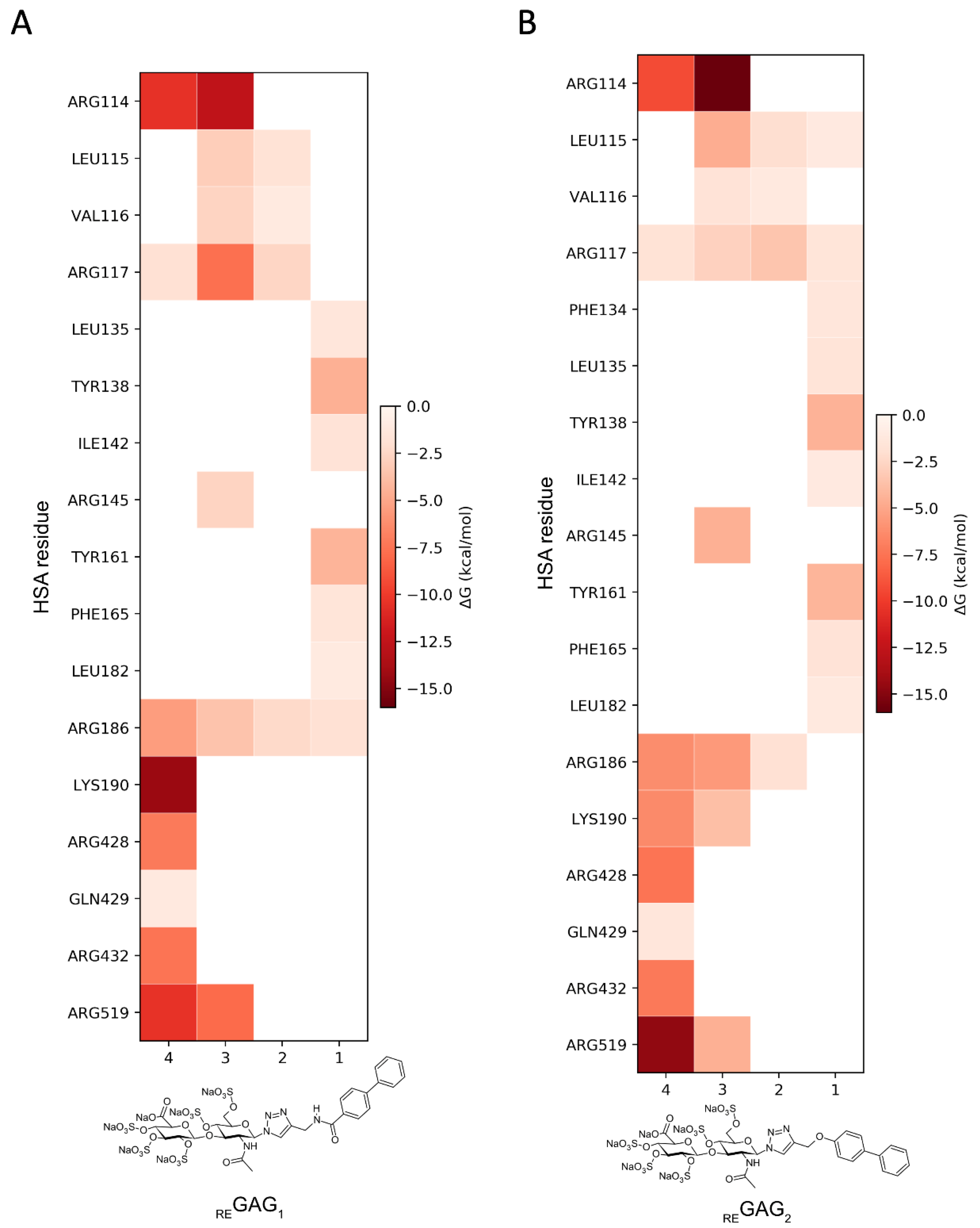
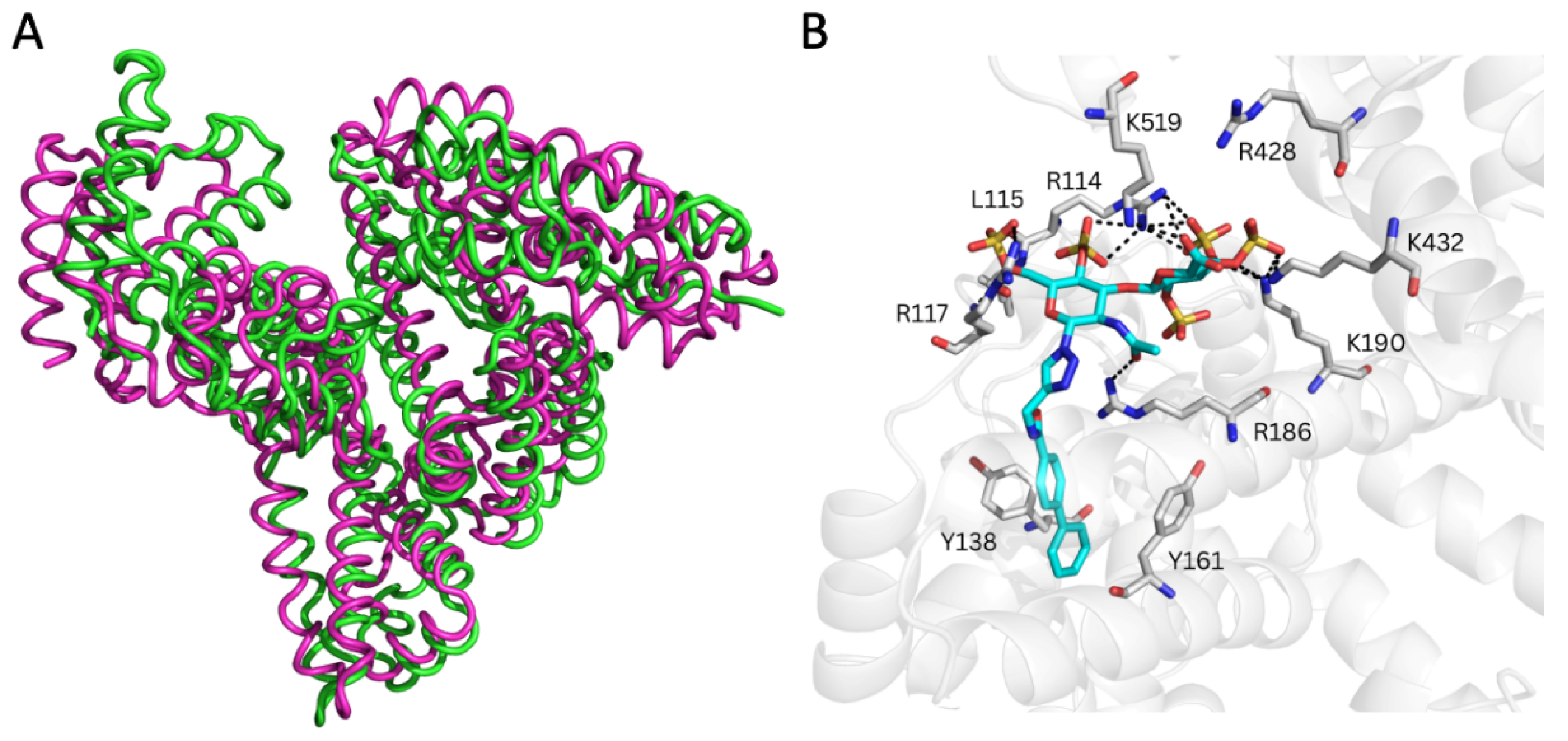
Moreover, the analysis of the representative REGAG/HSA complexes predicted by GlycoTorch and refined by MD revealed large structural fluctuations after approximately 50 ns of simulation, especially in subdomain IIIB as clearly inferred from the principal component analysis (Figure 3, Figures S3 and S4). This indicates that this region contributes most strongly to the dominant collective motions captured in the simulation and, therefore, it reflects possible rearrangements of the protein–ligand complexes over time. The free energies of binding along the MD trajectories computed with MM-GBSA [56,57] for the REGAG molecules (see Methods Section 2.4) indicated comparable binding (i.e., ΔGREGAG1 = −52.8 ± 1.6 kcal/mol; ΔGREGAG2 = −56.6 ± 4.6 kcal/mol; Table 2). The binding of each REGAG molecule to the heme site involved HSA residues across subdomains I and III, reflecting a cooperative interdomain interaction network. In particular, the disaccharide moiety of both REGAG molecules interacted with HSA residues Arg114, Leu115, Arg117, Arg145, Arg186, Lys190, Arg428, Lys432, and Lys519, while the biphenyl groups formed a stable sandwich between Tyr138 and Tyr161 (Figure 3B and Figure 4).
Figure 3.
Molecular recognition of REGAG1 by HSA (PDB ID 1N5U) at the heme (FA1) site. (A) Superimposition of two MD-refined HSA structures (green and pink ribbons) highlighting conformational displacements relating to the first five principal components obtained from principal component analysis over 100 ns MD simulations of REGAG1 in complex with HSA. (B) Representative MD-refined structure of REGAG1 (in cyan sticks colored by atom type) in complex with HSA (transparent gray cartoon). Relevant interacting HSA residues are shown in gray sticks and colored by atom type. H-bonds are depicted with dashed black lines. Figure generated with PyMOL v2.3.
Table 2.
Free energies of binding of REGAG molecules to HSA. Energies were obtained with MM-GBSA from three independent 100 ns MD simulations.
Figure 4.
Pairwise binding free energy contributions calculated with MM-GBSA from three independent 100 ns MD simulations of HSA (PDB ID 1N5U) in complex with (A) REGAG1 and (B) REGAG2 bound to the heme site (FA1). Mean values are indicated by the gradient-colored side bar. The different fragments of each REGAG molecule are represented in the x axis by the numbers: (1) biphenyl group, (2) linker, (3) fully sulfated N-acetylglucosamine (GlcNAc), and (4) fully sulfated glucuronic acid (GlcA).
3.2.2. Subdomain IIA (Drug-Binding Site I/Warfarin/FA7 Site)
GlycoTorch predicted a main cluster for REGAG1 and REGAG2 binding at the drug-binding site I of HSA (PDB ID 1H9Z), whereas no binding poses were identified at the FA7 site when using Glide. This, instead, predicted binding poses surrounding the FA7 pocket (Figure S5). To gain further insights into these differing predictive results, we performed additional studies using Autodock 3 (Figure S6), whose results resembled those from Glide.
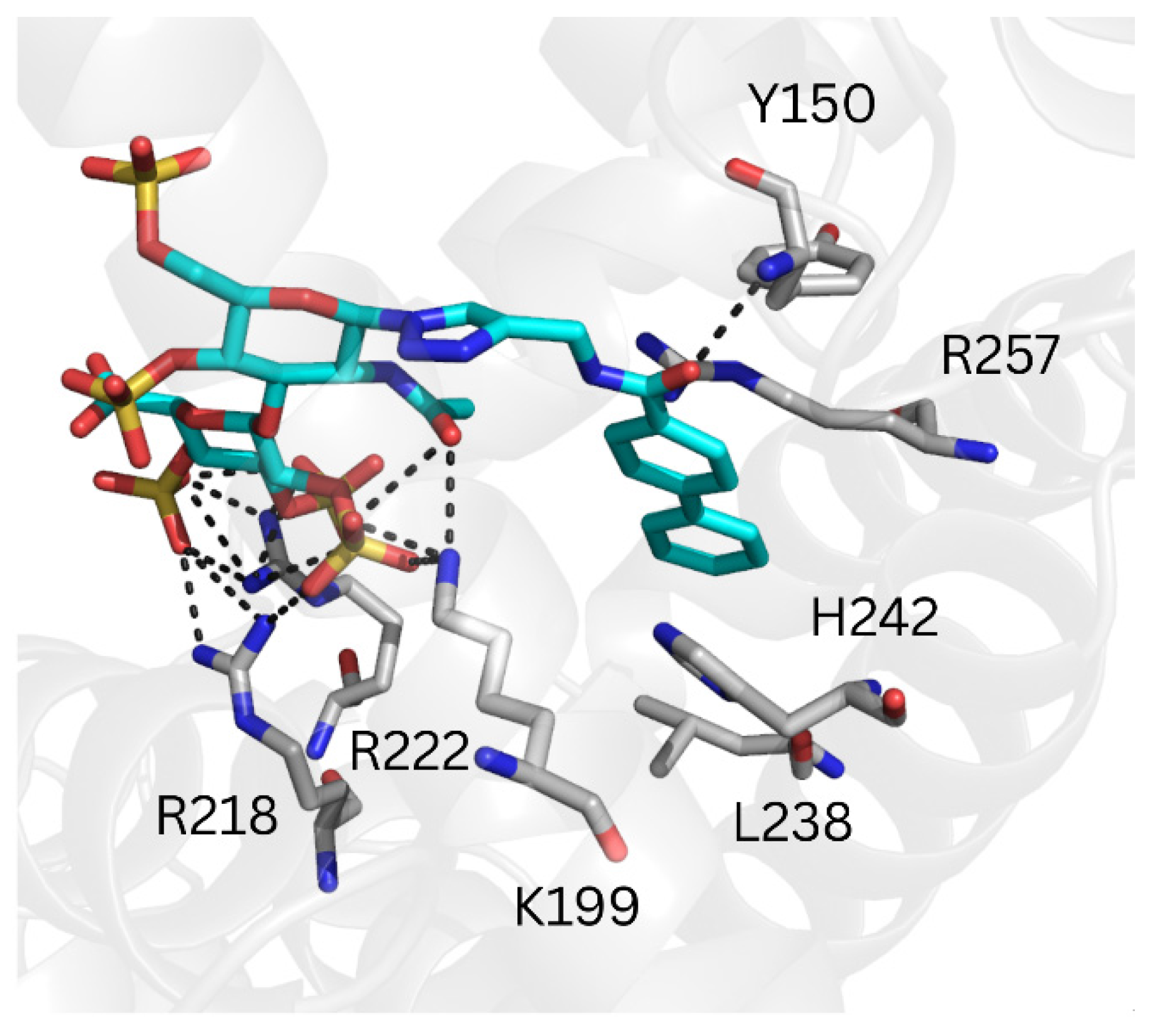
The binding poses predicted by GlycoTorch positioned the GAG moiety of the REGAG molecules at the same site, while their respective non-GAG moieties adopted different binding modes (Figure S5A). The computed free energies of binding suggested that REGAG1 binding to HSA drug-site I was slightly more favorable than REGAG2 (i.e., ΔGREGAG1 = −57.9 ± 10.2 kcal/mol for one recognition mode; ΔGREGAG1 = −39.3 ± 7.3 kcal/mol for another recognition mode; ΔGREGAG2 = −49.1 ± 9.8 kcal/mol; Table 2). Furthermore, the pairwise binding energy decomposition analysis obtained from the MD trajectories indicated that the GAG moiety of the REGAG molecules interacts strongly with the basic residues Lys195, Lys199, Arg218, Arg222 and Lys444 (Figure S7), underscoring its relevant role for REGAG recognition. Likewise, and considering the most favorable recognition mode of REGAG1, Leu219, Leu238, His242, Arg257, Leu260, Ile290 and Ala291, which forms the hydrophobic core within Sudlow’s site I (subdomain IIA), emerged as anchor points for the recognition of the biphenyl groups in both REGAG molecules (Figure 5, Figure S7A). In contrast, in the less favorable recognition mode of REGAG1, the biphenyl group was predicted to establish interactions with Tyr150, Gln196, Lys199, Arg218, Leu238, His242 and Arg257 (Figure S7B). Notably, given that the hydrophobic residues Leu219 and Leu238 act in concert with other key residues, such as Arg218, Arg222 and His242 for (R)-warfarin recognition [27], the competition of the REGAG molecules for the same site as warfarin might affect the therapeutic effect of both, REGAG and the anticoagulant when used simultaneously.
Figure 5.
Representative MD-refined structure of REGAG1 in complex with HSA (transparent gray cartoon) at the warfarin (FA7) site. Relevant interacting HSA residues are shown in gray sticks and colored by atom type. REGAG1 is shown in cyan sticks and colored by atom type. H-bonds are depicted with dashed black lines. Figure generated with PyMOL v2.3.
As an additional control, we investigated the interaction of REGAG1 and REGAG2 at drug-binding site I using the HSA structure PDB ID 1N5U, which has higher resolution than 1H9Z and may more accurately reflect local conformational changes induced by their distinct co-crystallized ligands. GlycoTorch predicted similar binding poses for both molecules (Figure S2). Once the complexes were MD-refined, in comparison to those obtained with HSA PDB ID 1H9Z, they exhibited a more closed conformation of HSA, particularly within subdomains IB and IIIB. In this case, both REGAG molecules showed similar binding strength to HSA (ΔGREGAG1 = −47.6 ± 1.2 kcal/mol; ΔGREGAG2 = −47.5 ± 14.2 kcal/mol; Table 2). Strong interactions between the HSA basic residues Lys199, Arg218, Arg222, and the GAG moieties were also predicted. On the other hand, the non-GAG moieties, especially the biphenyl groups, established interactions with Tyr148, Tyr150, Gln196, Lys199, His242, Cys245, Cys246 and Arg257 (Figure S8). These results further support that REGAG1 and REGAG2 may bind to the FA7 site and interfere with warfarin recognition by interacting with HSA key residues.
3.2.3. Subdomain II (FA6 and FA8 Sites)
Molecular docking to HSA PDB ID 1H9Z predicted the binding of REGAG1 and REGAG2 at the FA6 and FA8 sites.
At the FA6 site, GlycoTorch only predicted binding poses for REGAG2. However, Glide predicted similar binding poses for both REGAG molecules, although the cluster corresponding to REGAG1 was more populated than that of REGAG2 (Figure S5). Interestingly, Autodock 3 (Figure S6) suggested similar binding poses to those predicted by GlycoTorch (Figure S5A). The binding poses predicted by Glide (Figure S5B) were MD-refined and further analyzed to obtain additional insights into the potential recognition of both REGAG molecules at the FA6 site. The calculated free energy of binding for REGAG1 was particularly weaker than that of REGAG2 (ΔGREGAG1 = −23.2 ± 1.9 kcal/mol, ΔGREGAG2 = −38.4 ± 8.9 kcal/mol, Table 2) and also in comparison to the values obtained at the drug-binding site I, suggesting a clear lower preference of REGAG1 for the FA6 site. For both REGAG molecules, the GAG moiety established electrostatic interactions with the basic residues Arg209, Lys212, Lys233, Lys240 and Lys323. In addition, the GAG moiety of REGAG2 interacted with Lys351, Ser480 and Asn483 (Figure S9). These contacts were mostly transient but recurrent through the MD trajectories, highlighting the flexibility and accessibility of the FA6 site. With respect to the non-GAG moiety, the biphenyl groups of both REGAG molecules were positioned within the HSA hydrophobic core formed by the aliphatic parts of the side chains of Arg209, Lys212, Ala213, Asp324, Leu327, and Gly328, with additional contributions from Leu331, Ala350 and Lys351 in the case of REGAG1 (Figure S9).
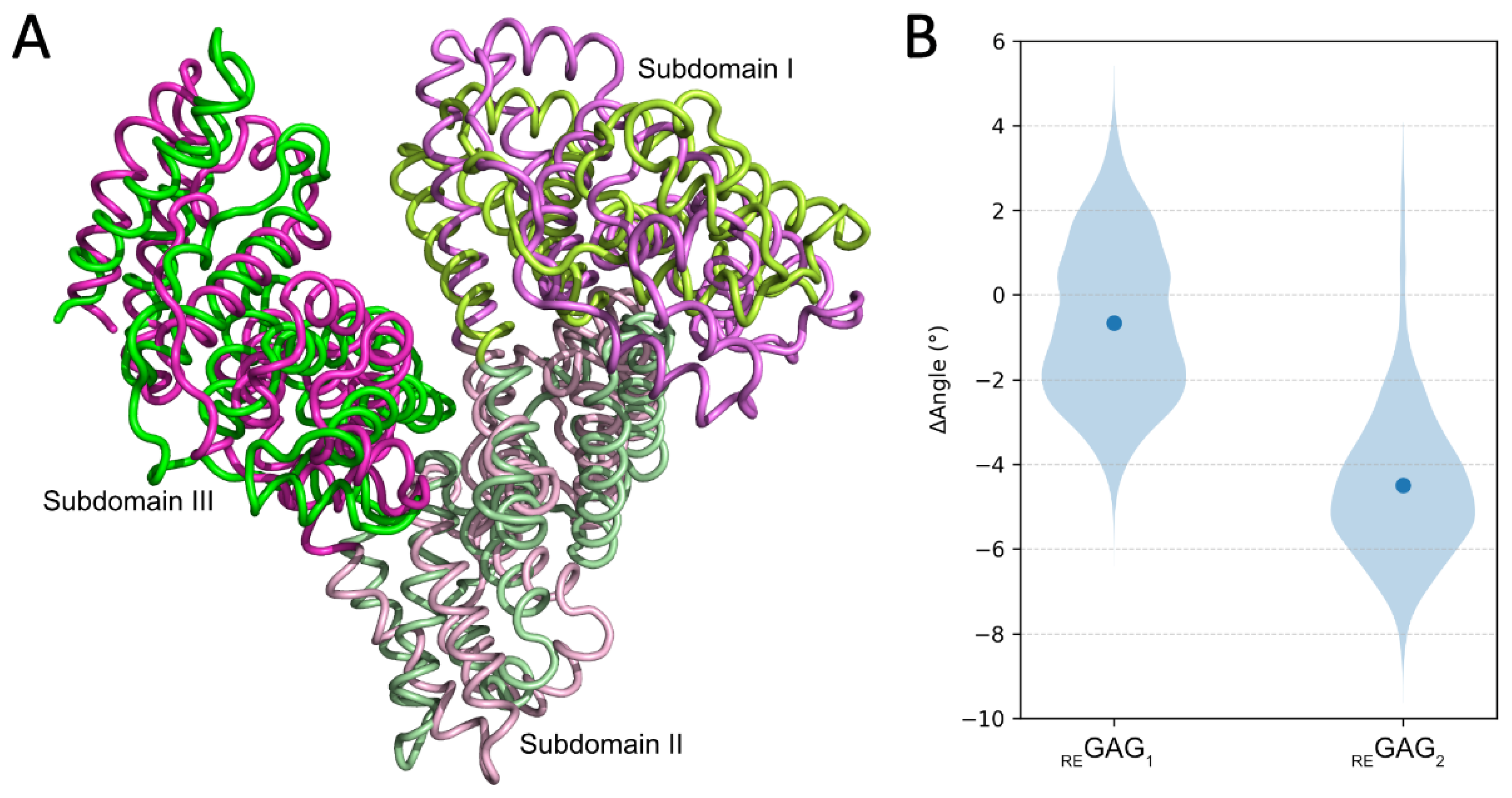
At the FA8 site, both GlycoTorch and Glide predicted similar binding poses for REGAG2, while REGAG1 was predicted to bind at the neighboring FA8 site (Figure S5). In REGAG2, the biphenyl group was predicted to interact with Trp214 via π–π stacking, whereas the GAG moiety adopted two distinct orientations, one at HSA’s surface, partially overlapping the FA6 site [17], and the other encompassing subdomains IB, II and III. The MD refinement of representative complexes suggested that REGAG2 binds more favorably to HSA in the second recognition mode (Table 2). Furthermore, MD-based analysis confirmed the stability of the binding mode already predicted by GlycoTorch and Glide in which the biphenyl group of REGAG2 interacts with Trp214. Additionally, interactions of the biphenyl group with residues Leu198, Lys199, Ser202 and Val344 at subdomain II, and Leu481 at subdomain IIIA (in the proximity of HSA’s C-term) were observed (Figure S10). In the binding mode with the GAG moiety at HSA’s surface, the biphenyl group also established van der Waals interactions with Lys195, Leu347 and Val482 (Figure S10B). In the binding mode with the GAG moiety located between subdomains IB, II and III, additional contacts with Phe206, Ala210 and Phe211 were predicted (Figure S10C). Of note, Phe211 has been reported as a key residue for warfarin recognition at the FA7 site [27]. In addition, in the binding mode at HSA’s surface, the GAG moieties were observed to be interacting with Arg209, Ala210, Lys323, Arg348, Lys351 Ser480, Val482 and Asn483 (Figure S10B), whereas in the case of the binding mode between subdomains IB, II and III, the GAG part of the molecule established interactions with Lys195, Lys199, Trp214, Arg218, Arg222, Arg257, Asn295, Ly436, Lys444 and Asp451 (Figure S10C). Notably, the principal component analysis of the MD trajectories indicated a concerted movement involving subdomains I and III, with subdomain III undergoing a hinge-like displacement towards subdomain I. Subdomain II remained comparatively stable, acting as a pivot point (Figure 6A). In particular, the calculated angle involving the three subdomains was around −4° (Figure 6B). This closure and opening of the subdomains I and III around REGAG2 may imply a potential conformational selection mechanism, where REGAG2 binding might be inducing or stabilizing distinct HSA conformations. The calculated free energies of binding further supported this hypothesis, as binding with the GAG moiety positioned along subdomains IB, II and IIIA in the closed conformation was more favorable (Table 2). In the case of REGAG1, for the binding poses predicted by both GlycoTorch and Glide, the GAG moiety clustered at the same site, whereas the non-GAG moiety adopted distinct orientations, either at subdomain IIA at the FA7 site (predicted by GlycoTorch), or between subdomains IIA and IIIA (predicted by Glide) (Figure S5). The MD-refined structures showed interactions of the GAG moiety with residues Arg160, Lys181, Lys195, Lys432, Lys436, Lys439, His440, Lys444, and Tyr452, with the particularity that those predicted by Glide exhibited the biphenyl group as interacting preferentially with Lys195, Trp214, Arg218, Arg222, Val343, Val344, Pro447, Glu450, and Asp451 (Figure S10A). Furthermore, the calculated angles between HSA subdomains I, II and III throughout the MD trajectories in the presence of REGAG1 also suggested a compact conformational state (Figure 6B). Overall, the observed recognition modes suggest that REGAG2, in particular, may partially compete with warfarin at drug-binding site I, likely because of several residues shared between their interactions (i.e., Phe211, Trp214 and Arg218).
Figure 6.
Conformational analysis of HSA in complex with REGAG molecules at the FA8 site in the most favorable recognition mode. (A) Principal component analysis of REGAG2 in complex with HSA. Superimposition of two MD-refined HSA structures, one shown in green and the other in pink, highlighting conformational displacements within the three subdomains—colored using gradients of the corresponding base color—captured by the first five principal components over 100 ns MD simulations. Figure generated with PyMOL v2.3. (B) MD-analysis of angles involving subdomains IA, IIB and IIIA of HSA in the closed conformation when complexed with the REGAG molecules. Violin representation of calculated angles from 100 ns MD simulations defined by the Cα carbon of residues P110, A364 and S427 of HSA (PDB ID 1H9Z). ΔAngle values correspond to the difference between the calculated angles over the MD trajectories and the angle from the initial structure. The mean is highlighted by a blue dot.
3.2.4. Subdomain III (FA5 Site)
Docking with GlycoTorch on the HSA structure PDB ID 1E7A predicted contacts of the biphenyl group of the REGAG molecules with Phe502, Phe507, Leu532, His535 and Val576, while their respective GAG moieties were predicted to be solvent-exposed. In contrast, Glide did not predict any binding pose at the FA5 site (Figure S11). The obtained MD-based free energies of binding suggested particularly weak binding for REGAG1 (ΔGREGAG1 = −29.8 ± 8.4 kcal/mol; ΔGREGAG2 = −39.6 ± 7.5 kcal/mol), and only little contacts between the GAG moieties and HSA residues Lys536, Lys538, Lys541 and Gln580 were observed. The predicted contacts of the biphenyl groups of both REGAG molecules remained formed through the MD simulations (Figure S12).
3.2.5. Cleft Between Subdomains I and III (FA9 Site)
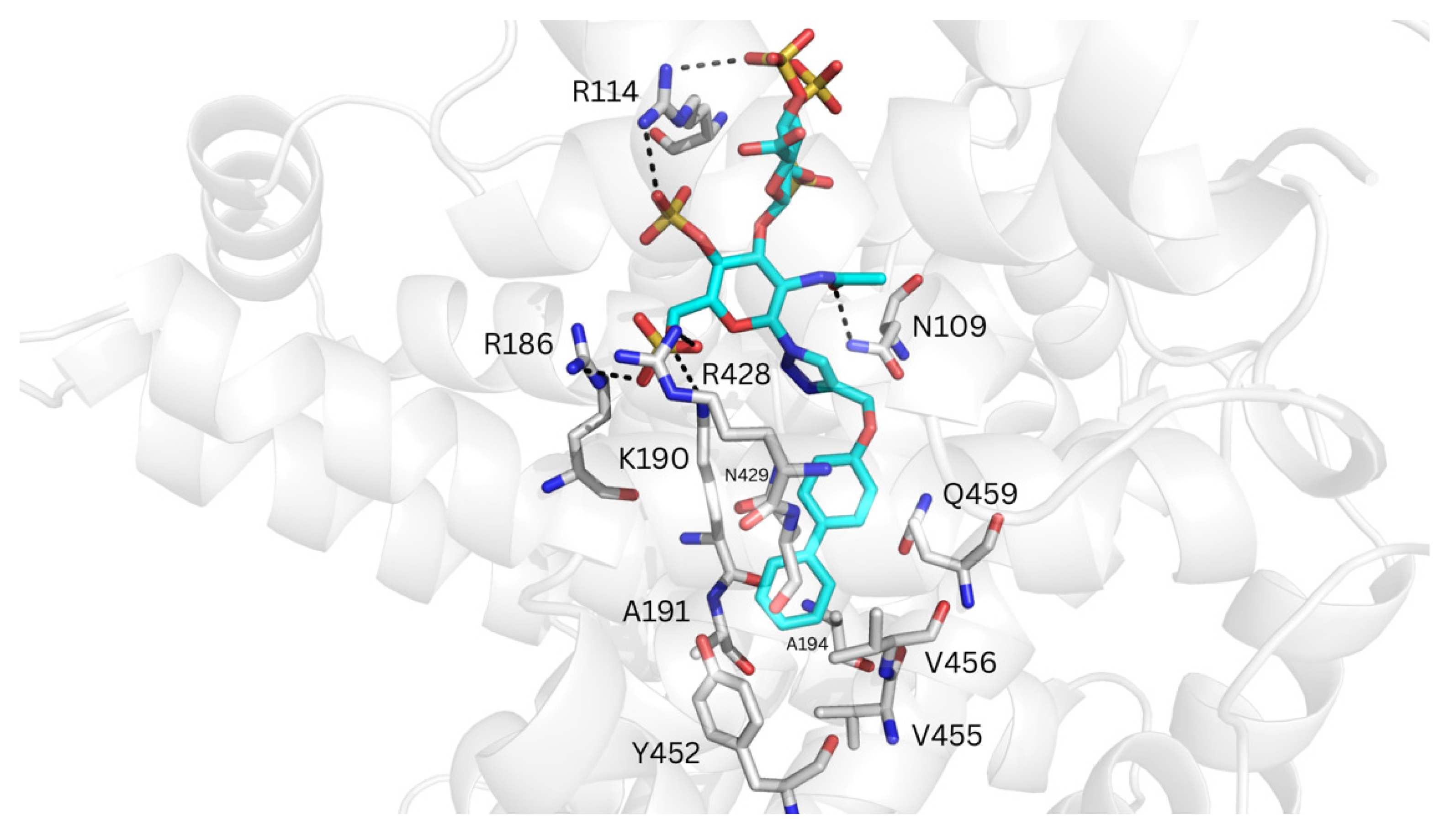
Molecular docking of REGAG1 and REGAG2 with GlycoTorch and Glide at the FA9 site, using the HSA structure PDB ID 1E7A suggested a shared recognition site for the GAG moiety, with Arg114 and Arg186 acting as common interacting residues. However, for the biphenyl groups, two main recognition sites involving either Val456 at subdomain IIIA or around Phe507 and Phe509 at subdomain IIIB were predicted (Figure S11). The free energies of binding calculated from the representative structures generated by GlycoTorch indicated that REGAG2 binds more favorably to the FA9 site of HSA than REGAG1, with the biphenyl group oriented towards subdomain IIIA being energetically preferred with respect to its orientation towards subdomain IIIB (i.e., ΔGREGAG1 = −34.8 ± 11.6 kcal/mol, ΔGREGAG2 = −44.1 ± 19.7 kcal/mol and ΔGREGAG1 = −32.4 ± 4.1 kcal/mol, ΔGREGAG2 = −40.1 ± 8.6 kcal/mol, respectively; Table 2). The GAG moiety in both REGAG molecules formed H-bonds with Arg114, Arg186 and Lys190 at subdomain IB, Arg428 and Lys466 at subdomain IIIA, and Lys519 at subdomain IIIB. In the binding mode with the biphenyl group oriented towards subdomain IIIA, the GAG moieties also interacted with Asn109 and Arg145, while Lys190, Ala191, Ala194, Asn429 and Gln459 acted as anchor residues for the biphenyl groups. In the case of REGAG2, the biphenyl group established additional van der Waals contacts with Val455 and Val456, as well as π-π interactions with Tyr452 (Figure 7, Figure S13). In the alternative recognition mode with the biphenyl groups oriented towards subdomain IIIB, the GAG moieties established additional electrostatic interactions with Arg117 and Lys524, whereas Phe509 served as the primary anchoring residue for the biphenyl groups. In REGAG1, the biphenyl group also interacted with Phe507, Ala528 and Phe551, while in REGAG2 it established additional van der Waals contacts with the side chain of Ile523 (Figure S14).
Figure 7.
Representative MD-refined structure of REGAG2 (in cyan sticks and colored by atom type) in complex with HSA (transparent gray cartoon) at the FA9 site. Relevant interacting HSA residues are shown in gray sticks and colored by atom type. H-bonds are depicted with dashed black lines. Figure generated with PyMOL v2.3.
Finally, in order to evaluate the preferential recognition of REGAG1 and REGAG2 by HSA when the FA1–6 sites are occupied by fatty acids and warfarin is bound to the FA7 site, we performed additional molecular docking calculations using GlycoTorch and the HSA structure PDB ID 1H9Z, which contains all these mentioned ligands. The two REGAG molecules were predicted to preferentially recognize the FA9 site. In addition, an alternative binding mode was predicted for both REGAG molecules in which the GAG moiety was found interacting with the FA9 site and the biphenyl group oriented in the proximity of the heme site. Additionally, binding poses were also identified for REGAG2 within the FA8 site (Figure S15). These findings are consistent with previous studies showing that drugs preferably recognize FA8 and FA9 sites when FA1-FA7 sites are occupied by long-chain fatty acids [61,62]. For instance, the monoterpene cantharidin was reported to bind to FA1 on ligand-free HSA, but to relocate to FA9 under FA-bound conditions [61].
3.3. Molecular Recognition of REGAG by MSA
To facilitate the translation of preclinical studies in mice to human applications, a comprehensive comparison of ligand recognition by the human and mouse serum albumin proteins is essential. Consequently, a 3D model of MSA was built based on its homology to HSA by comparative modeling (see Methods Section 2.2, Figure S16) and assessed differences with the available MSA structure predicted by AlphaFold (AF-P02768-F1-v4) [35,36]. The N-terminal segment spanning Met1 to Ala26, which is missing from any available crystal structure, which exhibited very low prediction confidence (pLDDT < 50) in the AlphaFold model. Upon superimposition of the two 3D models (RMSDCα(27–608) = 2.0 Å), it was observed that the structural divergence between them primarily stems from subdomain I (Figure S16C). This reflects on the conformational plasticity of this subdomain and its variability in the different HSA templates available for the modeling (Figure 2B).
The MSA 3D model obtained by comparative modeling (see Methods) was used to predict interactions with REGAG1 and REGAG2. Interestingly, in contrast to the results obtained with HSA, in which the FA8 and FA9 sites were predicted as potential interacting sites, the REGAG molecules were not predicted to bind at subdomain IA, the FA2, FA8 and the FA9 sites of MSA (Figure S17). The differences in shape and physicochemical properties between the FA8 and FA9 sites of MSA and HSA—particularly those involving residues Pro138, Leu214, Met222, Thr246, Leu464 and Arg456 in MSA (Arg114, Lys190, Leu198, Arg222, His440 and Gln459 in HSA)—may account for different ligand recognition profiles (Figure S18). In contrast to the results obtained for HSA, REGAG1 and REGAG2 might recognize drug-binding site II in MSA. These results are presented in detail in the following subsections:
3.3.1. Subdomain IB (Drug Site III/Heme/FA1 Site)
MSA subdomain IB differs from that of HSA in the entrance to its cavity, particularly due to residues Pro138 and Phe139 in MSA, which correspond to Arg114 and Leu115 in HSA (Figure S16B). Nevertheless, the predicted binding poses for REGAG1 and REGAG2 using Glide and Glycotorch (Figure S17) broadly resembled those obtained for HSA in subdomain IB (Figure S2). For both REGAG molecules, the GAG moiety formed H-bonds with Lys210 and Arg483. In addition, the biphenyl groups established π-π stacking interactions with Tyr162 and Tyr185. The calculated free energies of binding fell within a comparable range for both REGAG molecules (Table 3). The MD-based interaction analysis further indicated extensive electrostatic interactions between the GAG moiety and residues Arg169, Lys210, Arg221 and, within subdomain III, Arg452, Arg456, Arg483, Lys490, and Lys543. In both REGAG molecules, the biphenyl groups interacted with Tyr162 and Tyr185, and also established van der Waals contacts with the hydrophobic patch formed by Val166, Leu206 and Val209. In REGAG1, the biphenyl group additionally interacted with Phe139 and Arg141, whereas in REGAG2 π-π stacking interactions were observed with Tyr181 (Figure S19).
Table 3.
Free energies of binding of REGAG molecules to MSA. Energies were obtained with MM-GBSA from three independent 100 ns MD simulations.
3.3.2. Subdomain IIA (Drug-Binding Site I/Warfarin/FA7)
Subdomain IIA of MSA exhibits several physicochemical differences with respect to HSA. Notably, Arg222 and His242, which are key residues for warfarin binding in HSA, correspond to Thr246 and Asn266 in MSA. Similarly, Ile264 and Ala291, which were predicted to be crucial for REGAG2 recognition by HSA, correspond to Met288 and Ser315 in MSA. Furthermore, Glu188 and Lys195 residues, situated at the entrance of the FA7 pocket in HSA, correspond to Lys212 and Arg219 in MSA. These alterations in residue composition are anticipated to alter the binding profile at this pocket. In this context, for instance, warfarin has been previously reported to bind weakly to MSA [63], in contrast to its strong binding to HSA [14,63].
Glide and Glycotorch predicted a single cluster for REGAG1 within drug-binding site I (Figure S17). However, for REGAG2, only GlycoTorch identified binding poses in this region. For both REGAG, the GAG moieties were predicted to form H-bonds with Lys212, Arg219, Arg242, and Lys460, whereas the biphenyl groups were positioned within the hydrophobic region of the FA7 site. The analysis of the MD-refined structures indicated Lys460 as the strongest contributor to ligand binding (Figure S20). The biphenyl group of REGAG2 was deeply disposed at the hydrophobic patch of the FA7 site, making van der Waals contacts with Leu243, Leu262, Leu284, Met288, Leu314 and Ser315. In REGAG1, it was predicted to interact with Tyr174, Arg219, Gln220, Lys223, Cys269 and Arg281. Overall, the obtained results indicate that REGAG1 exhibits more favorable free energy of binding than REGAG2 at MSA drug-binding site I (Table 3).
3.3.3. Subdomain IIB (FA6 Site)
The FA6 site is highly conserved between HSA and MSA. Glide and GlycoTorch predicted well-defined single clusters for REGAG1 within this site, whereas only two disperse binding poses were observed for REGAG2 (Figure S17). The biphenyl moiety of REGAG1 was predicted to interact with Arg233. Furthermore, the sulfate groups of the GAG moiety were predicted by Glide to establish H-bonds with Lys236 and Lys257 (Figure S17B). Overall, the predicted binding poses closely resembled those obtained with Glide for HSA (Figure S5B). Thus, no further MD refinement was pursued.
3.3.4. Subdomain IIIA (Drug-Binding Site II)
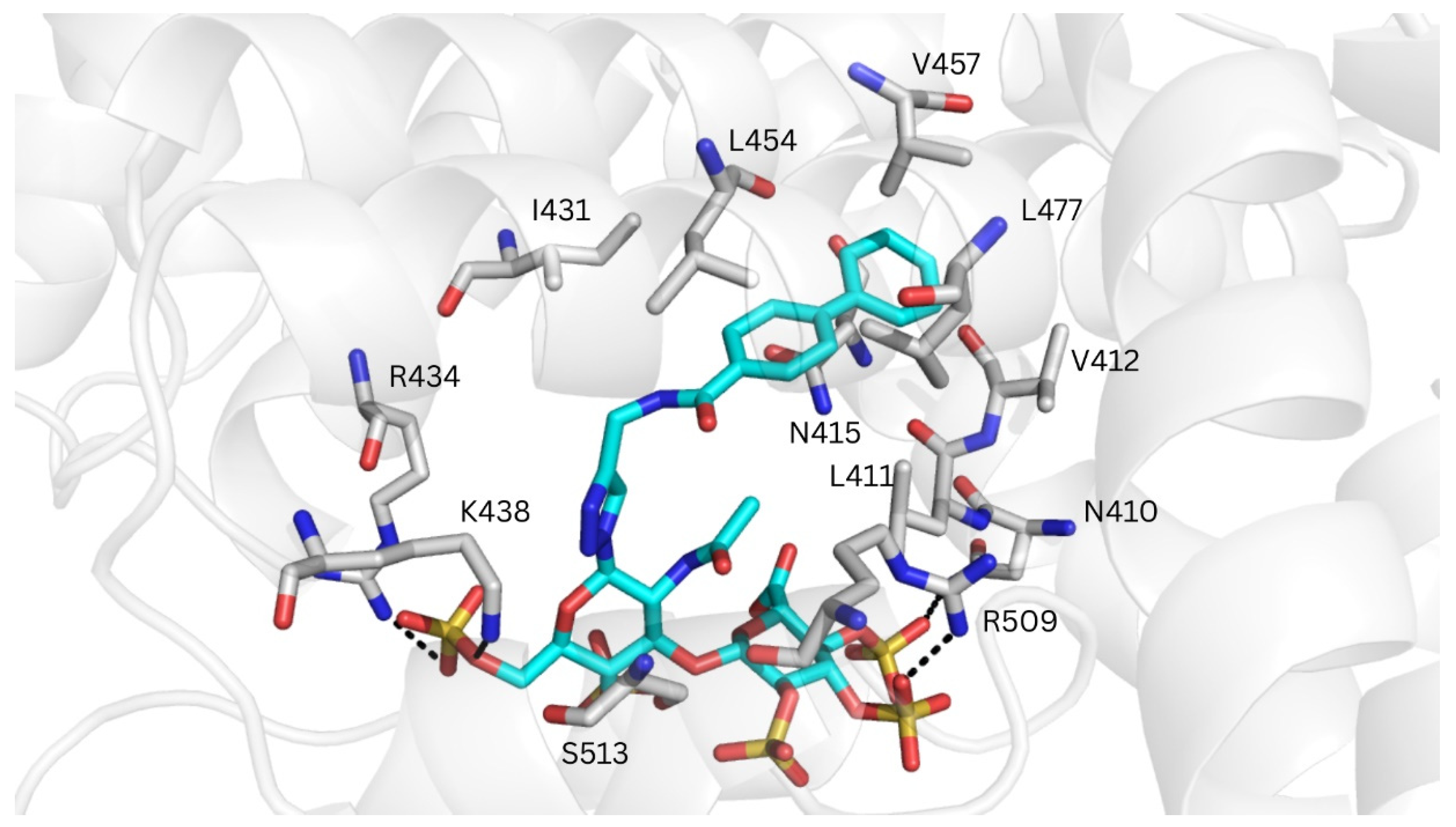
Only GlycoTorch predicted binding poses for REGAG1 at drug-binding site II, with the biphenyl group positioned within this region and the GAG moiety forming H-bonds with Lys438 (Figure S17A). This markedly differs from the results obtained for HSA, with no REGAG binding poses identified at this site. A plausible explanation for the distinct binding profiles observed in MSA may arise from differences at the entrance of the binding cavity, where the GAG moieties were located. In particular, Thr414 and Thr516 in MSA—corresponding to Gln390 and Glu492 in HSA—appear to make drug-binding site II more accessible. In addition, the size of the binding pocket in MSA seems wider than in HSA (Figure S18B), a feature that may be determinant for accommodating molecules of the size of the investigated REGAG molecules. The MD-refined structures showed extensive electrostatic interactions between the GAG moiety and Arg372, Lys375, Arg434, Lys438, and Arg509, and H-bonding with Asn410 and Ser513. In addition, the biphenyl groups made van der Waals contacts with Leu411, Val412, Asn415, Ile431, Leu454, Val457 and Leu477 (Figure 8). Interestingly, this recognition mode resembles those previously reported for commonly administered drugs that target site II of HSA. For instance, propofol is known to make hydrophobic interactions with Leu387, Ile388, Asn391, Leu407, and Val433, and a hydrogen bond with the main chain of Leu430 (corresponding to Leu411, Ile412, Asn415, Leu431, Val457, and Leu454 in MSA) [64]. In contrast, diazepam, diflunisal and ibuprofen exhibit a slightly different binding mode at drug-binding site II, primarily interacting with residues Leu387, Asn391, and Leu453 in HSA [13] (corresponding to Leu411, Asn415 and Leu477 in MSA).
Figure 8.
Representative MD-refined structure of REGAG1 (in cyan sticks and colored by atom type) in complex with MSA (transparent gray cartoon) at drug-binding site II. Relevant interacting MSA residues are shown in gray sticks and colored by atom type. H-bonds are depicted with dashed black lines. Figure generated with PyMOL v2.3.
3.3.5. Subdomain IIIB (FA5 Site)
The core residues at the binding pocket of subdomain IIIB are highly conserved between HSA and MSA. Interestingly, a single significant difference is Lys402 in HSA, which corresponds to Gly426 in MSA (Figure S16B). This residue variation might be relevant for differences in the recognition of the GAG moieties. Only GlycoTorch predicted one cluster for each REGAG1 molecule at the back side of subdomain IIIB in MSA (Figure S17), with their biphenyl group overlapping with the FA5 site. In particular, the biphenyl groups were predicted establishing π-π interactions with Phe575, and the GAG moieties forming H-bonds with Lys549 (Figure S17A).
The MD-refined structures indicated that Lys421 (subdomain IIIA), Lys545, Lys549 and Lys569 constitute the anchor recognition residues for the GAG moieties. Surrounding this positively charged patch, the biphenyl groups established van der Waals interactions with Phe531, Ala552, Leu553, Leu556, Met572 and Phe575, which form a deep hydrophobic cleft (Figure S21). In REGAG2, the biphenyl group showed additional interactions with Val571 and Leu599.
4. Discussion
The biological activity of a ligand depends not only on its interactions with its target molecule but also on its binding to plasma proteins. Investigating ligand binding to proteins such as human serum albumin provides valuable insights into their pharmacokinetics and potential pharmacological effects [21]. Furthermore, assessing ligand competition for drug binding sites or co-binding is essential for understanding possible interactions in vivo and their therapeutic effect [65,66,67,68].
HSA exhibits a large ligand-binding capacity. Among the nine binding sites for drugs and other ligands so-far described in HSA, FA1 (drug site III or heme-binding site), FA3-FA4 (drug site II) and FA7 (drug site I) are generally considered the most relevant for drug binding [11]. In this work, the two investigated REGAG molecules were predicted to preferentially recognize HSA drug-binding sites III and I, and, in the particular case of REGAG2, also sites FA8 and FA9. Notably, no interactions were observed for any of the REGAG molecules at drug-binding site II.
Drug-binding site III in HSA is characterized by a hydrophobic D-shaped cavity formed by residues Tyr138 and Tyr161, which serves as the recognition site for heme. For instance, the monoterpene cantharidin was reported to bind in this cavity on ligand-free HSA through hydrophobic interactions with the aromatic rings of Tyr138 and Tyr161, and it was suggested to inhibit competitively heme-Fe(III) association [61]. Our docking studies predicted comparable binding affinities for the REGAG molecules and cantharidin, suggesting that the REGAG molecules might compete with other drugs for this site under HSA ligand-free conditions. In addition, the free energies of binding obtained along the MD trajectories suggest strong binding of the REGAG molecules to the HSA heme site, especially when compared to the values reported for cantharidin at the FA1 site [61]. The REGAG molecules not only recognized the two key Tyr residues for heme binding, but also relevant basic residues disposed between subdomain IB and IIIA. Furthermore, we observed an opening movement between the helices containing Tyr138 and Tyr161 during REGAG recognition, a phenomenon previously associated with allosteric transitions in the B-to-N state switch of HSA [69]. It could be hypothesized that such conformational change corresponds to a general feature of HSA’s dynamic response, not limited to pH or fatty acid binding.
Interactive association of drugs binding to HSA typically occurs at drug-binding site I, which has a large hydrophobic cavity capable of accommodating multiple drugs simultaneously. At this site, HSA generally shows a preference for binding anionic over cationic drugs [70,71]. For instance, the anticoagulant warfarin, the antirheumatic drugs azapropazone and indomethacin, the antibiotic sulfisoxazole, the contrast agent iodipamide and the diuretic furosemide have been reported to bind drug-binding site I on HSA. Studies from Yang et al. [72] and Peng et al. [73] also reported strong binding of hydroxylated polybrominated diphenyl ethers (Ka values between 0.5–1.8 × 10⁷ M−1) and perfluorononanonic acid (Ka = 7.8 × 10⁶ M−1) to the subdomain IIA. Interestingly, their calculated free energies of binding were less favorable than those obtained for the REGAG molecules, which may suggest strong binding of REGAG to the FA7 site. Furthermore, co-binding of fatty acids and drugs has also been documented [13,67,74], although it has been reported that fatty acids weakly bind to subdomain IIA and can be replaced by drugs [75,76]. For instance, molecules like AZT (3′-Azido-3′-deoxythymidine) are known to coexist with fatty acids in the IIA subdomain. The presence of a fatty acid in the FA7 site can lead to AZT binding to a new subsite within this subdomain, where it forms a hydrogen bond with the fatty acid itself. This new subsite is besieged by hydrophilic and polar amino acids, including Glu153, Ser192, Lys195, and Gln196 from subdomain IB and Lys199, His242, Arg257, and Glu292 from site I [77]. Both investigated REGAG molecules were predicted to interact with several of those residues (i.e., Gln196, Lys199, His242 and Arg257). In general, displacement interactions become clinically relevant only for drugs that are highly bound to HSA (>90%, [78]), such as warfarin, phenytoin, or diazepam. In contrast, drugs with plasma protein binding of less than 85% do not raise concerns for adverse drug-drug interactions [79]. Although the predicted free energies of binding for the REGAG are not directly comparable to experimental binding affinities, they might be considered within the affinity range reported for typical therapeutic ligands of HSA [14,21,72,80,81]. Based on our observations, the possibility of REGAG1 and REGAG2 interacting with or displacing certain drugs in drug-binding site I should not be excluded. Therefore, the co-administration of REGAG1 and REGAG2 with other drugs should be further investigated experimentally in future studies and, if necessary, carefully considered to mitigate contraindications [65,66,67,68].
The FA8 site and, to a lesser extent, FA9 were also identified in our studies as potential binding sites, particularly for REGAG2. Interestingly, FA8 and FA9 have been reported as additional ligand binding pockets becoming accessible when long-chain fatty acids such as myristic acid occupy the FA1-FA7 sites [11,15,16]. For instance, earlier docking studies revealed ligand recognition at the FA8 and FA9 sites in the presence of endogenous molecules such as heme-Fe(III) and long-chain FA [61,62]. Furthermore, FA9 has been previously identified as the binding site for thyroxine, and has been referred to as thyroxine binding site Tr5 [15]. Both FA8 and FA9 sites are formed by fatty acid-induced conformational changes in the crevice between IA-IB-IIA subdomains on one side and IIB-IIIA-IIIB subdomains on the other side [16,74,82]. The docking results obtained with REGAG1 and REGAG2 on the structure of HSA with bound fatty acids and warfarin (PDB ID 1H9Z) suggested that the REGAG molecules might be preferentially associate to the FA8 and FA9 sites in the presence of such competing ligands. Given that HSA primarily acts as a carrier of fatty acids and heme in blood [11], the extent to which the investigated REGAG molecules can bind to FA1, FA5, FA6, or drug-binding site I may be competitively or allosterically influenced by these endogenous ligands. This could potentially lead to an increased unbound fraction of those ligands in plasma. This possibility underscores the importance of carefully revising the optimal dosing of REGAG1 and REGAG2. Likewise, physiological conditions affecting HSA plasma levels (e.g., analbuminemia, dehydration) may also impact the pharmacokinetics and pharmacodynamics of the investigated REGAG molecules [83].
Regarding the FA5/6 and FA8/9 sites, REGAG2 generally displayed more favorable binding free energies than REGAG1 when being docked to the ligand-free HSA. These results can be attributable to the different chemical composition of their respective linker group joining the non-GAG and GAG moieties, affecting the conformational adaptability of the molecule. In particular, the ether linker in REGAG2 is inherently more flexible than the rotationally restricted amide linker in REGAG1. Given that the FA6 and FA8/9 sites are more solvent-accessible than other fatty acid sites and involve several flexible loop regions, the conformational adaptability of REGAG2 might facilitate its ability to adopt conformations that fit more snugly into various albumin binding pockets.
With respect to the assessment of binding of REGAG1 and REGAG2 to murine serum albumin, our results suggested a similar recognition to the predicted for the human protein, particularly concerning the occupation of the most conserved sites among the homologs (i.e., FA1, FA6, and FA7). Nevertheless, subtle sequence differences between HSA and MSA resulted in different predicted accessibility to certain binding sites. For instance, REGAG1 was found to bind in drug-binding site II in MSA but not in HSA, which could be due to the fact that this site differs in the size of the entrance of the binding cavity in both proteins.
When comparing REGAG1 and REGAG2 binding to HSA and MSA, additional recognition differences were observed. In particular, binding of REGAG1 was predicted to be slightly more favorable to the FA7 site in HSA compared to REGAG2, whereas a greater preference for recognition of REGAG1 at this site was notable in MSA. These observations might be attributed to alterations in the shape of the binding pocket, arising from variations between the two proteins in the physicochemical properties of residues within the FA7 site and its entrance.
While the present work provides valuable insights based on in silico predictions, the results obtained should be interpreted with caution. Future experimental work will be essential to confirm our predictive models and to further substantiate the conclusions drawn from them.
5. Conclusions
Overall, this work represents a comprehensive study investigating, at the atomic level, the serum albumin binding properties of two novel bone-regenerative lead molecules currently undergoing preclinical testing. Our investigations delve into the dynamic mechanisms of molecular recognition suggesting that these molecules could strongly bind to serum albumin and induce conformational changes. Furthermore, they could potentially co-exist or even compete for known recognition sites of endogenous ligands or other drugs. Our mechanistic studies also include a comparative analysis between the serum albumin human and murine proteins, which is of particular relevance for translating the knowledge from preclinical studies in mice to future human applications. Therefore, the results obtained here provide valuable insights for advancing these novel REGAG molecules to the next stage of pharmacological profiling, which is essential for their potential clinical application and for establishing a rational basis for future molecular design aimed at improving pharmacokinetic properties.
Supplementary Materials
The following supporting information can be downloaded at: https://www.mdpi.com/article/10.3390/pharmaceutics17111445/s1, Table S1: Structural comparison of HSA crystallographic structures: RMSD analysis; Figure S1: Docking results obtained with Glide for HSA-binding ligands in comparison to experimentally determined HSA-ligand complex structures; Figure S2: Molecular recognition of REGAG molecules by HSA. Docking results of REGAG1 (cyan sticks) and REGAG2 (azure sticks) within two distinct binding sites on HSA (PDB ID 1N5U, grey cartoon) using (A) GlycoTorch and (B) Glide; Figure S3: RMSD for REGAG molecules interaction with HSA from PDB ID 1N5U at the FA1 site. Values are relative to the first frame of the MD simulation and without structural fitting; Figure S4: MD-analysis of angles involving subdomains IA, IIB and IIIA of HSA when complexed with REGAG molecules at the FA1 site. Violin representation of calculated angles from 100 ns MD simulations defined by the Cα carbon of residues P110, A364 and S427 of HSA from PDB ID 1N5U; Figure S5: Molecular recognition of REGAG molecules by HSA. Docking results of REGAG1 (cyan sticks) and REGAG2 (azure sticks) with HSA (PDB ID 1H9Z, grey cartoon) using (A) GlycoTorch and (B) Glide; Figure S6: Molecular recognition of REGAG molecules by HSA. Docking results of REGAG1 (cyan sticks) and REGAG2 (azure sticks) with HSA (PDB ID 1H9Z, grey cartoon) using AutoDock3; Figure S7: Pairwise binding free energy contributions calculated with MM-GBSA from three independent 100 ns MD simulations of HSA (from PDB ID 1H9Z) in complex with (A)-(B) REGAG1 and (C) REGAG2 bound to the warfarin (FA7) site; Figure S8: Pairwise binding free energy contributions calculated with MM-GBSA from three independent 100 ns MD simulations of HSA (from PDB ID 1N5U) in complex with (A) REGAG1 and (B) REGAG2 bound to the warfarin (FA7) site; Figure S9: Pairwise binding free energy contributions calculated with MM-GBSA from three independent 100 ns MD simulations of HSA (from PDB ID 1H9Z) in complex with (A) REGAG1 and (B) REGAG2 bound to the FA6 site; Figure S10: Pairwise binding free energy contributions calculated with MM-GBSA from three independent 100 ns MD simulations of HSA (from PDB ID 1H9Z) in complex with (A) REGAG1 and (B)-(C) REGAG2 bound to the FA8 site; Figure S11: Molecular recognition of REGAG molecules by HSA. Docking results of REGAG1 (cyan sticks) and REGAG2 (azure sticks) with HSA (PDB ID 1E7A, grey cartoon, back side view) using (A) GlycoTorch and (B) Glide; Figure S12: Pairwise binding free energy contributions calculated with MM-GBSA from three independent 100 ns MD simulations of HSA (from PDB ID 1E7A) in complex with (A) REGAG1 and (B) REGAG2 bound to the FA5 site; Figure S13: Pairwise binding free energy contributions calculated with MM-GBSA from three independent 100 ns MD simulations of HSA (from PDB ID 1E7A) in complex with (A) REGAG1 and (B) REGAG2 bound to the FA9 site. The results shown correspond to complexes in which the biphenyl groups of REGAG molecules are oriented towards the subdomain IIIA; Figure S14: Pairwise binding free energy contributions calculated with MM-GBSA from three independent 100 ns MD simulations of HSA (from PDB ID 1E7A) in complex with (A) REGAG1 and (B) REGAG2 bound to the FA9 site. The results shown correspond to complexes in which the biphenyl groups of REGAG molecules are oriented towards the subdomain IIIB; Figure S15: Molecular recognition of REGAG molecules by HSA. Docking results of REGAG1 (cyan sticks) and REGAG2 (azure sticks) in warfarin- (red-brown sticks and transparent surface) and FA-bound (purple sticks and transparent surface) HSA (PDB ID 1H9Z, grey cartoon) using GlycoTorch; Figure S16: Molecular modeling of MSA; Figure S17: Molecular recognition of REGAG molecules by MSA. Docking results of REGAG1 (cyan sticks) and REGAG2 (azure sticks) with the MSA model using (A) GlycoTorch and (B) Glide; Figure S18: Comparative of HSA (left, in grey) and MSA (right, in magenta) recognition sites (shown as molecular surfaces). Non-conserved residues between the human and murine proteins are labeled; Figure S19: Pairwise binding free energy contributions calculated with MM-GBSA from three independent 100 ns MD simulations of MSA in complex with (A) REGAG1 and (B) REGAG2 bound to the FA1 site; Figure S20: Pairwise binding free energy contributions calculated with MM-GBSA from three independent 100 ns MD simulations of MSA in complex with (A) REGAG1 and (B) REGAG2 bound to the FA7 site; Figure S21: Pairwise binding free energy contributions calculated with MM-GBSA from three independent 100 ns MD simulations of MSA in complex with (A) REGAG1 and (B) REGAG2 bound to the FA5 site.
Author Contributions
Conceptualization, P.K., A.Ö., G.R.-G. and M.T.P.; methodology, P.K. and A.Ö.; validation, P.K., A.Ö. and G.R.-G.; formal analysis, P.K., A.Ö., G.R.-G. and M.T.P.; investigation, P.K., A.Ö., G.R.-G. and M.T.P.; resources, M.T.P.; data curation, P.K., A.Ö., G.R.-G. and M.T.P.; writing—original draft preparation, P.K., A.Ö., G.R.-G. and M.T.P.; writing—review and editing, P.K., A.Ö., G.R.-G. and M.T.P.; visualization, P.K., A.Ö., G.R.-G. and M.T.P.; supervision, G.R.-G. and M.T.P.; project administration, M.T.P.; funding acquisition, M.T.P. All authors have read and agreed to the published version of the manuscript.
Funding
The project on which the reported work is based was funded by the Federal Ministry of Education and Research (Bundesministerium für Bildung und Forschung, BMBF) under reference 01KC2304A. The authors are responsible for the content of this publication.
Institutional Review Board Statement
Not applicable.
Informed Consent Statement
Not applicable.
Data Availability Statement
The original contributions presented in this study are included in the article/Supplementary Material. Further inquiries can be directed to the corresponding authors.
Acknowledgments
We thank Pedro M Guillem-Gloria for invaluable technical support.
Conflicts of Interest
The authors declare no conflicts of interest.
Abbreviations
| ADMET | Absorption, Distribution, Metabolism, Excretion, and Toxicity |
| FA | Fatty Acid |
| HSA | Human Serum Albumin |
| MD | Molecular Dynamics |
| MSA | Murine Serum Albumin |
References
- Ruiz-Gómez, G.; Salbach-Hirsch, J.; Dürig, J.-N.; Köhler, L.; Balamurugan, K.; Rother, S.; Heidig, S.-L.; Moeller, S.; Schnabelrauch, M.; Furesi, G.; et al. Rational engineering of glycosaminoglycan-based Dickkopf-1 scavengers to improve bone regeneration. Biomaterials 2023, 297, 122105. [Google Scholar] [CrossRef] [PubMed]
- Ahn, V.E.; Chu, M.L.-H.; Choi, H.-J.; Tran, D.; Abo, A.; Weis, W.I. Structural Basis of Wnt Signaling Inhibition by Dickkopf Binding to LRP5/6. Dev. Cell 2011, 21, 862–873. [Google Scholar] [CrossRef]
- Witcher, P.C.; Miner, S.E.; Horan, D.J.; Bullock, W.A.; Lim, K.E.; Kang, K.S.; Adaniya, A.L.; Ross, R.D.; Loots, G.G.; Robling, A.G. Sclerostin neutralization unleashes the osteoanabolic effects of Dkk1 inhibition. JCI Insight 2018, 3, e98673. [Google Scholar] [CrossRef]
- Kim, J.; Han, W.; Park, T.; Kim, E.J.; Bang, I.; Lee, H.S.; Jeong, Y.; Roh, K.; Kim, J.; Kim, J.-S.; et al. Sclerostin inhibits Wnt signaling through tandem interaction with two LRP6 ectodomains. Nat. Commun. 2020, 11, 5357. [Google Scholar] [CrossRef]
- Liu, J.; Xiao, Q.; Xiao, J.; Niu, C.; Li, Y.; Zhang, X.; Zhou, Z.; Shu, G.; Yin, G. Wnt/β-catenin signalling: Function, biological mechanisms, and therapeutic opportunities. Signal Transduct. Target. Ther. 2022, 7, 3. [Google Scholar] [CrossRef] [PubMed]
- Florio, M.; Gunasekaran, K.; Stolina, M.; Li, X.; Liu, L.; Tipton, B.; Salimi-Moosavi, H.; Asuncion, F.J.; Li, C.; Sun, B.; et al. A bispecific antibody targeting sclerostin and DKK-1 promotes bone mass accrual and fracture repair. Nat. Commun. 2016, 7, 11505. [Google Scholar] [CrossRef]
- Florio, M.; Kostenuik, P.J.; Stolina, M.; Asuncion, F.J.; Grisanti, M.; Ke, H.Z.; Ominsky, M.S. Dual Inhibition of the Wnt Inhibitors DKK1 and Sclerostin Promotes Fracture Healing and Increases the Density and Strength of Uninjured Bone: An Experimental Study in Nonhuman Primates. J. Bone Jt. Surg. Am. 2023, 105, 1145–1155. [Google Scholar] [CrossRef]
- Salbach-Hirsch, J.; Rauner, M.; Hofbauer, C.; Hofbauer, L.C. New insights into the role of glycosaminoglycans in the endosteal bone microenvironment. Biol. Chem. 2021, 402, 1415–1425. [Google Scholar] [CrossRef]
- Davis, A.M.; Riley, R.J. Predictive ADMET studies, the challenges and the opportunities. Curr. Opin. Chem. Biol. 2004, 8, 378–386. [Google Scholar] [CrossRef]
- Ascenzi, P.; Bocedi, A.; Notari, S.; Menegatti, E.; Fasano, M. Heme impairs allosterically drug binding to human serum albumin Sudlow’s site I. Biochem. Biophys. Res. Commun. 2005, 334, 481–486. [Google Scholar] [CrossRef] [PubMed]
- Fanali, G.; Di Masi, A.; Trezza, V.; Marino, M.; Fasano, M.; Ascenzi, P. Human serum albumin: From bench to bedside. Mol. Asp. Med. 2012, 33, 209–290. [Google Scholar] [CrossRef]
- Belinskaia, D.A.; Voronina, P.A.; Vovk, M.A.; Shmurak, V.I.; Batalova, A.A.; Jenkins, R.O.; Goncharov, N.V. Esterase Activity of Serum Albumin Studied by 1H NMR Spectroscopy and Molecular Modelling. Int. J. Mol. Sci. 2021, 22, 10593. [Google Scholar] [CrossRef]
- Ghuman, J.; Zunszain, P.A.; Petitpas, I.; Bhattacharya, A.A.; Otagiri, M.; Curry, S. Structural basis of the drug-binding specificity of human serum albumin. J. Mol. Biol. 2005, 353, 38–52. [Google Scholar] [CrossRef] [PubMed]
- Sudlow, G.; Birkett, D.J.; Wade, D.N. The characterization of two specific drug binding sites on human serum albumin. Mol. Pharmacol. 1975, 11, 824–832. [Google Scholar] [CrossRef] [PubMed]
- Petitpas, I.; Petersen, C.E.; Ha, C.-E.; Bhattacharya, A.A.; Zunszain, P.A.; Ghuman, J.; Bhagavan, N.V.; Curry, S. Structural basis of albumin-thyroxine interactions and familial dysalbuminemic hyperthyroxinemia. Proc. Natl. Acad. Sci. USA 2003, 100, 6440–6445. [Google Scholar] [CrossRef]
- Bhattacharya, A.A.; Grüne, T.; Curry, S. Crystallographic analysis reveals common modes of binding of medium and long-chain fatty acids to human serum albumin. J. Mol. Biol. 2000, 303, 721–732. [Google Scholar] [CrossRef]
- Ashraf, S.; Qaiser, H.; Tariq, S.; Khalid, A.; Makeen, H.A.; Alhazmi, H.A.; Ul-Haq, Z. Unraveling the versatility of human serum albumin—A comprehensive review of its biological significance and therapeutic potential. Curr. Res. Struct. Biol. 2023, 6, 100114. [Google Scholar] [CrossRef] [PubMed]
- Ascenzi, P.; Fasano, M. Serum heme-albumin: An allosteric protein. IUBMB Life 2009, 61, 1118–1122. [Google Scholar] [CrossRef]
- Kun, R.; Szekeres, M.; Dékány, I. Isothermal titration calorimetric studies of the pH induced conformational changes of bovine serum albumin. J. Therm. Anal. Calorim. 2009, 96, 1009–1017. [Google Scholar] [CrossRef]
- Mishra, V.; Heath, R.J. Structural and Biochemical Features of Human Serum Albumin Essential for Eukaryotic Cell Culture. Int. J. Mol. Sci. 2021, 22, 8411. [Google Scholar] [CrossRef]
- Fasano, M.; Curry, S.; Terreno, E.; Galliano, M.; Fanali, G.; Narciso, P.; Notari, S.; Ascenzi, P. The extraordinary ligand binding properties of human serum albumin. IUBMB Life 2005, 57, 787–796. [Google Scholar] [CrossRef] [PubMed]
- Fanali, G.; Fesce, R.; Agrati, C.; Ascenzi, P.; Fasano, M. Allosteric modulation of myristate and Mn(III)heme binding to human serum albumin. Optical and NMR spectroscopy characterization. FEBS J. 2005, 272, 4672–4683. [Google Scholar] [CrossRef]
- Bomba-Opon, D.; Wielgos, M.; Szymanska, M.; Bablok, L. Effects of free fatty acids on the course of gestational diabetes mellitus. Neuro Endocrinol. Lett. 2006, 27, 277–280. [Google Scholar]
- Bhattacharya, A.A.; Curry, S.; Franks, N.P. Binding of the general anesthetics propofol and halothane to human serum albumin. High resolution crystal structures. J. Biol. Chem. 2000, 275, 38731–38738. [Google Scholar] [CrossRef]
- Pomyalov, S.; Minetti, C.A.; Remeta, D.P.; Bonala, R.; Johnson, F.; Zaitseva, I.; Iden, C.; Golebiewska, U.; Breslauer, K.J.; Shoham, G.; et al. Structural and mechanistic insights into the transport of aristolochic acids and their active metabolites by human serum albumin. J. Biol. Chem. 2024, 300, 107358. [Google Scholar] [CrossRef] [PubMed]
- Sugio, S.; Kashima, A.; Mochizuki, S.; Noda, M.; Kobayashi, K. Crystal structure of human serum albumin at 2.5 Å resolution. Protein Eng. 1999, 12, 439–446. [Google Scholar] [CrossRef] [PubMed]
- Petitpas, I.; Bhattacharya, A.A.; Twine, S.; East, M.; Curry, S. Crystal structure analysis of warfarin binding to human serum albumin: Anatomy of drug site I. J. Biol. Chem. 2001, 276, 22804–22809. [Google Scholar] [CrossRef]
- Wardell, M.; Wang, Z.; Ho, J.X.; Robert, J.; Ruker, F.; Ruble, J.; Carter, D.C. The atomic structure of human methemalbumin at 1.9 Å. Biochem. Biophys. Res. Commun. 2002, 291, 813–819. [Google Scholar] [CrossRef] [PubMed]
- Adams, R.; Griffin, L.; Compson, J.E.; Jairaj, M.; Baker, T.; Ceska, T.; West, S.; Zaccheo, O.; Davé, E.; Lawson, A.D.; et al. Extending the half-life of a fab fragment through generation of a humanized anti-human serum albumin Fv domain: An investigation into the correlation between affinity and serum half-life. MAbs 2016, 8, 1336–1346. [Google Scholar] [CrossRef]
- Swanson, K.; Walther, P.; Leitz, J.; Mukherjee, S.; Wu, J.C.; Shivnaraine, R.V.; Zou, J. ADMET-AI: A machine learning ADMET platform for evaluation of large-scale chemical libraries. Bioinformatics 2024, 40, btae416. [Google Scholar] [CrossRef]
- Xiong, G.; Wu, Z.; Yi, J.; Fu, L.; Yang, Z.; Hsieh, C.; Yin, M.; Zeng, X.; Wu, C.; Lu, A.; et al. ADMETlab 2.0: An integrated online platform for accurate and comprehensive predictions of ADMET properties. Nucleic Acids Res 2021, 49, W5–W14. [Google Scholar] [CrossRef]
- Myung, Y.; de Sá, A.G.C.; Ascher, D.B. Deep-PK: Deep learning for small molecule pharmacokinetic and toxicity prediction. Nucleic Acids Res 2024, 52, W469–W475. [Google Scholar] [CrossRef] [PubMed]
- Yang, H.; Lou, C.; Sun, L.; Li, J.; Cai, Y.; Wang, Z.; Li, W.; Liu, G.; Tang, Y. admetSAR 2.0: Web-service for prediction and optimization of chemical ADMET properties. Bioinformatics 2018, 35, 1067–1069. [Google Scholar] [CrossRef] [PubMed]
- Dassault Systèmes. Discovery Studio; BIOVIA: San Diego, CA, USA, 2020. [Google Scholar]
- Jumper, J.; Evans, R.; Pritzel, A.; Green, T.; Figurnov, M.; Ronneberger, O.; Tunyasuvunakool, K.; Bates, R.; Žídek, A.; Potapenko, A.; et al. Highly accurate protein structure prediction with AlphaFold. Nature 2021, 596, 583–589. [Google Scholar] [CrossRef]
- Varadi, M.; Bertoni, D.; Magana, P.; Paramval, U.; Pidruchna, I.; Radhakrishnan, M.; Tsenkov, M.; Nair, S.; Mirdita, M.; Yeo, J.; et al. AlphaFold Protein Structure Database in 2024: Providing structure coverage for over 214 million protein sequences. Nucleic Acids Res. 2024, 52, D368–D375. [Google Scholar] [CrossRef]
- Deeb, O.; Rosales-Hernández, M.C.; Gómez-Castro, C.; Garduño-Juárez, R.; Correa-Basurto, J. Exploration of human serum albumin binding sites by docking and molecular dynamics flexible ligand–protein interactions. Biopolymers 2010, 93, 161–170. [Google Scholar] [CrossRef]
- Lexa, K.W.; Dolghih, E.; Jacobson, M.P. A Structure-Based Model for Predicting Serum Albumin Binding. PLoS ONE 2014, 9, e93323. [Google Scholar] [CrossRef]
- Alshaikh, N.E.; Zaki, M.; Sharfalddin, A.A.; Al-Radadi, N.S.; Hussien, M.A.; Hassan, W.M. Synthesis, structural characterization, DNA/HSA binding, molecular docking and anticancer studies of some D-Luciferin complexes. Arab. J. Chem. 2023, 16, 104845. [Google Scholar] [CrossRef]
- Chemical Computing Group ULC. Molecular Operating Environment (MOE); CCG: Montreal, QC, Canada, 2025. [Google Scholar]
- Maier, J.A.; Martinez, C.; Kasavajhala, K.; Wickstrom, L.; Hauser, K.E.; Simmerling, C. ff14SB: Improving the Accuracy of Protein Side Chain and Backbone Parameters from ff99SB. J. Chem. Theory Comput. 2015, 11, 3696–3713. [Google Scholar] [CrossRef] [PubMed]
- Marenich, A.V.; Cramer, C.J.; Truhlar, D.G. Generalized Born Solvation Model SM12. J. Chem. Theory Comput. 2013, 9, 609–620. [Google Scholar] [CrossRef]
- Boittier, E.D.; Burns, J.M.; Gandhi, N.S.; Ferro, V. GlycoTorch Vina: Docking Designed and Tested for Glycosaminoglycans. J. Chem. Inf. Model. 2020, 60, 6328–6343. [Google Scholar] [CrossRef]
- Morris, G.M.; Goodsell, D.S.; Halliday, R.S.; Huey, R.; Hart, W.E.; Belew, R.K.; Olson, A.J. Automated docking using a Lamarckian genetic algorithm and an empirical binding free energy function. J. Comput. Chem. 1998, 19, 1639–1662. [Google Scholar] [CrossRef]
- Friesner, R.A.; Banks, J.L.; Murphy, R.B.; Halgren, T.A.; Klicic, J.J.; Mainz, D.T.; Repasky, M.P.; Knoll, E.H.; Shelley, M.; Perry, J.K.; et al. Glide: A new approach for rapid, accurate docking and scoring. 1. Method and assessment of docking accuracy. J. Med. Chem. 2004, 47, 1739–1749. [Google Scholar] [CrossRef] [PubMed]
- Halgren, T.A.; Murphy, R.B.; Friesner, R.A.; Beard, H.S.; Frye, L.L.; Pollard, W.T.; Banks, J.L. Glide: A New Approach for Rapid, Accurate Docking and Scoring. 2. Enrichment Factors in Database Screening. J. Med. Chem. 2004, 47, 1750–1759. [Google Scholar] [CrossRef] [PubMed]
- Morris, G.M.; Huey, R.; Lindstrom, W.; Sanner, M.F.; Belew, R.K.; Goodsell, D.S.; Olson, A.J. AutoDock4 and AutoDockTools4: Automated docking with selective receptor flexibility. J. Comput. Chem. 2009, 30, 2785–2791. [Google Scholar] [CrossRef]
- Schrödinger Release 2025-1: LigPrep and Maestro; Schrödinger, LLC: New York, NY, USA, 2025.
- Lu, C.; Wu, C.; Ghoreishi, D.; Chen, W.; Wang, L.; Damm, W.; Ross, G.A.; Dahlgren, M.K.; Russell, E.; Bargen, C.D. von.; et al. OPLS4: Improving Force Field Accuracy on Challenging Regimes of Chemical Space. J. Chem. Theory Comput. 2021, 17, 4291–4300. [Google Scholar] [CrossRef]
- Johnston, R.C.; Yao, K.; Kaplan, Z.; Chelliah, M.; Leswing, K.; Seekins, S.; Watts, S.; Calkins, D.; Chief Elk, J.; Jerome, S.V.; et al. Epik: pKa and protonation state prediction through machine learning. J. Chem. Theory Comput. 2023, 19, 2380–2388. [Google Scholar] [CrossRef]
- Gehrcke, J.-P.; Pisabarro, M.T. Identification and characterization of a glycosaminoglycan binding site on interleukin-10 via molecular simulation methods. J. Mol. Graph. Model. 2015, 62, 97–104. [Google Scholar] [CrossRef]
- Case, D.A.; Ben-Shalom, I.Y.; Brozell, S.R.; Cerutti, D.S.; Cheatham, T.E., III; Cruzeiro, V.W.D.; Darden, T.A.; Duke, R.E.; Ghoreishi, D.; Giambasu, G.; et al. AMBER19; University of California: San Francisco, CA, USA, 2019. [Google Scholar]
- Kirschner, K.N.; Yongye, A.B.; Tschampel, S.M.; González-Outeiriño, J.; Daniels, C.R.; Foley, B.L.; Woods, R.J. GLYCAM06: A generalizable biomolecular force field. Carbohydrates 2008, 29, 622–655. [Google Scholar]
- Huige, C.J.M.; Altona, C. Force field parameters for sulfates and sulfamates based on ab initio calculations: Extensions of AMBER and CHARMm fields. J. Comput. Chem. 1995, 16, 56–79. [Google Scholar] [CrossRef]
- Humphrey, W.; Dalke, A.; Schulten, K. VMD: Visual molecular dynamics. J. Mol. Graph. 1996, 14, 33–38. [Google Scholar] [CrossRef]
- Wang, J.; Morin, P.; Wang, W.; Kollman, P.A. Use of MM-PBSA in Reproducing the Binding Free Energies to HIV-1 RT of TIBO Derivatives and Predicting the Binding Mode to HIV-1 RT of Efavirenz by Docking and MM-PBSA. J. Am. Chem. Soc. 2001, 123, 5221–5230. [Google Scholar] [CrossRef]
- Miller, B.R., III. McGee, T.D.; Swails, J.R.; Homeyer, J.M.; Gohlke, N.; H.; Roitberg, A.E. MMPBSA.py: An Efficient Program for End-State Free Energy Calculations. J. Chem. Theory Comput. 2012, 8, 3314–3321. [Google Scholar] [CrossRef] [PubMed]
- The PyMOL Molecular Graphics System; Schrödinger, LLC: New York, NY, USA, 2020.
- Vickers, A.J.; Elkin, E.B. Decision curve analysis: A novel method for evaluating prediction models. Med. Decis. Making 2006, 26, 565–574. [Google Scholar] [CrossRef] [PubMed]
- Samsonov, S.A.; Pisabarro, M.T. Computational analysis of interactions in structurally available protein-glycosaminoglycan complexes. Glycobiology 2016, 26, 850–861. [Google Scholar] [CrossRef] [PubMed]
- Polticelli, F.; Leboffe, L.; Tortosa, V.; Trezza, V.; Fanali, G.; Fasano, M.; Ascenzi, P. Cantharidin inhibits competitively heme- F e(III) binding to the FA 1 site of human serum albumin. J. Mol. Recognit. 2017, 30, e2641. [Google Scholar] [CrossRef]
- de Simone, G.; Pasquadibisceglie, A.; Di Masi, A.; Buzzelli, V.; Trezza, V.; Macari, G.; Polticelli, F.; Ascenzi, P. Binding of direct oral anticoagulants to the FA1 site of human serum albumin. J. Mol. Recognit. 2021, 34, e2877. [Google Scholar] [CrossRef]
- von Oettingen, U.; Niedner, R.; Meyer, F. Rodenticidal action of warfarin/4th communication: Binding to serum albumin of mice and rats (author’s transl). Arzneimittelforschung 1975, 25, 1705–1706. [Google Scholar]
- Shityakov, S.; Roewer, N.; Förster, C.; Broscheit, J.-A. In silico investigation of propofol binding sites in human serum albumin using explicit and implicit solvation models. Comput. Biol. Chem. 2017, 70, 191–197. [Google Scholar] [CrossRef]
- Tesseromatis, C.; Alevizou, A. The role of the protein-binding on the mode of drug action as well the interactions with other drugs. Eur. J. Drug Metab. Pharmacokinet. 2008, 33, 225–230. [Google Scholar] [CrossRef]
- Otagiri, M. A molecular functional study on the interactions of drugs with plasma proteins. Drug Metab. Pharmacokinet. 2005, 20, 309–323. [Google Scholar] [CrossRef] [PubMed]
- Yang, F.; Zhang, Y.; Liang, H. Interactive association of drugs binding to human serum albumin. Int. J. Mol. Sci. 2014, 15, 3580–3595. [Google Scholar] [CrossRef] [PubMed]
- Meijer, D.K.; van der Sluijs, P. The influence of binding to albumin and alpha 1-acid glycoprotein on the clearance of drugs by the liver. Pharm. Weekbl. Sci. 1987, 9, 65–74. [Google Scholar] [PubMed]
- Paris, G.; Ramseyer, C.; Enescu, M. A principal component analysis of the dynamics of subdomains and binding sites in human serum albumin. Biopolymers 2014, 101, 561–572. [Google Scholar] [CrossRef]
- Kragh-Hansen, U. Molecular aspects of ligand binding to serum albumin. Pharmacol. Rev. 1981, 33, 17–53. [Google Scholar] [CrossRef]
- Schönfeld, D.L.; Ravelli, R.B.G.; Mueller, U.; Skerra, A. The 1.8-Å crystal structure of alpha1-acid glycoprotein (Orosomucoid) solved by UV RIP reveals the broad drug-binding activity of this human plasma lipocalin. J. Mol. Biol. 2008, 384, 393–405. [Google Scholar] [CrossRef]
- Yang, L.; Yang, W.; Wu, Z.; Yi, Z. Binding of hydroxylated polybrominated diphenyl ethers with human serum albumin: Spectroscopic characterization and molecular modeling. Luminescence 2017, 32, 978–987. [Google Scholar] [CrossRef]
- Peng, M.; Xu, Y.; Wu, Y.; Cai, X.; Zhang, W.; Zheng, L.; Du, E.; Fu, J. Binding Affinity and Mechanism of Six PFAS with Human Serum Albumin: Insights from Multi-Spectroscopy, DFT and Molecular Dynamics Approaches. Toxics 2024, 12, 43. [Google Scholar] [CrossRef]
- Curry, S.; Mandelkow, H.; Brick, P.; Franks, N. Crystal structure of human serum albumin complexed with fatty acid reveals an asymmetric distribution of binding sites. Nat. Struct. Biol. 1998, 5, 827–835. [Google Scholar] [CrossRef]
- Simard, J.R.; Zunszain, P.A.; Ha, C.-E.; Yang, J.S.; Bhagavan, N.V.; Petitpas, I.; Curry, S.; Hamilton, J.A. Locating high-affinity fatty acid-binding sites on albumin by x-ray crystallography and NMR spectroscopy. Proc. Natl. Acad. Sci. USA 2005, 102, 17958–17963. [Google Scholar] [CrossRef]
- Simard, J.R.; Zunszain, P.A.; Hamilton, J.A.; Curry, S. Location of high and low affinity fatty acid binding sites on human serum albumin revealed by NMR drug-competition analysis. J. Mol. Biol. 2006, 361, 336–351. [Google Scholar] [CrossRef]
- Zhu, L.; Yang, F.; Chen, L.; Meehan, E.J.; Huang, M. A new drug binding subsite on human serum albumin and drug-drug interaction studied by X-ray crystallography. J. Struct. Biol. 2008, 162, 40–49. [Google Scholar] [CrossRef] [PubMed]
- Bertucci, C.; Domenici, E. Reversible and covalent binding of drugs to human serum albumin: Methodological approaches and physiological relevance. Curr. Med. Chem. 2002, 9, 1463–1481. [Google Scholar] [CrossRef]
- Bohnert, T.; Gan, L.-S. Plasma protein binding: From discovery to development. J. Pharm. Sci. 2013, 102, 2953–2994. [Google Scholar] [CrossRef]
- Ploch-Jankowska, A.; Pentak, D. A Comprehensive Spectroscopic Analysis of the Ibuprofen Binding with Human Serum Albumin, Part, I. Pharmaceuticals 2020, 13, 205. [Google Scholar] [CrossRef]
- Fan, J.; Gilmartin, K.; Octaviano, S.; Villar, F.; Remache, B.; Regan, J. Using Human Serum Albumin Binding Affinities as a Proactive Strategy to Affect the Pharmacodynamics and Pharmacokinetics of Preclinical Drug Candidates. ACS Pharmacol. Transl. Sci. 2022, 5, 803–810. [Google Scholar] [CrossRef] [PubMed]
- Curry, S.; Brick, P.; Franks, N.P. Fatty acid binding to human serum albumin: New insights from crystallographic studies. Biochim. Biophys. Acta Mol. Cell Biol. Lipids 1999, 1441, 131–140. [Google Scholar] [CrossRef]
- Zhivkova, Z.D. Studies on drug-human serum albumin binding: The current state of the matter. Curr. Pharm. Des. 2015, 21, 1817–1830. [Google Scholar] [CrossRef] [PubMed]
Disclaimer/Publisher’s Note: The statements, opinions and data contained in all publications are solely those of the individual author(s) and contributor(s) and not of MDPI and/or the editor(s). MDPI and/or the editor(s) disclaim responsibility for any injury to people or property resulting from any ideas, methods, instructions or products referred to in the content. |
© 2025 by the authors. Licensee MDPI, Basel, Switzerland. This article is an open access article distributed under the terms and conditions of the Creative Commons Attribution (CC BY) license (https://creativecommons.org/licenses/by/4.0/).