Seroprevalence and Epidemiological Characteristics of Severe Fever with Thrombocytopenia Syndrome in Patients with Chronic Diseases in Korea
 , ,
, ,  , ,
, ,
Abstract
1. Introduction
2. Materials and Methods
2.1. Study Population and Sample Collection
2.2. Serological Testing
2.3. Data Collection and Classification
2.4. Statistical Analysis
3. Results
3.1. Demographic Characteristics and Seroprevalence
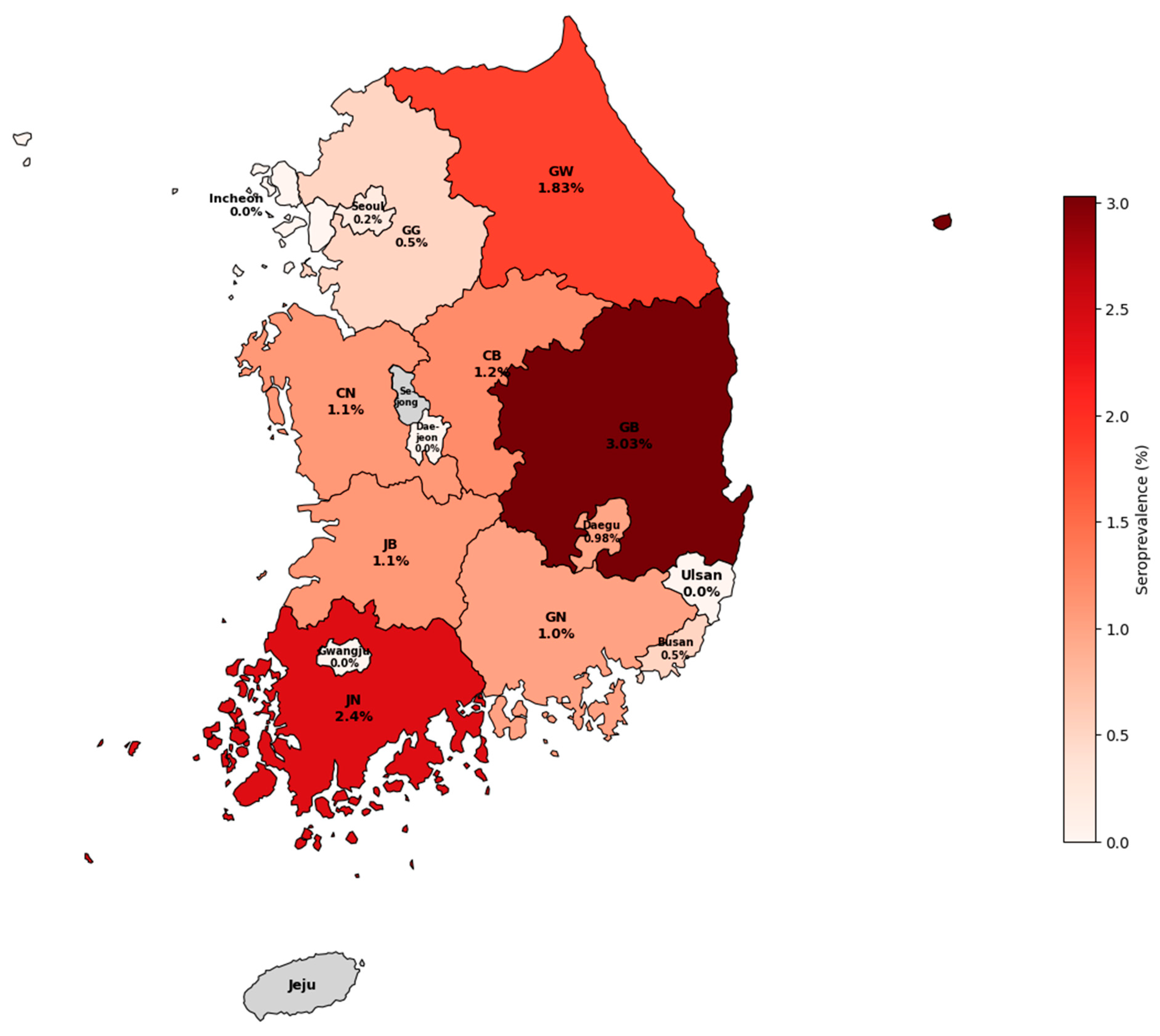
3.2. Regional Seroprevalence
3.3. Seroprevalence by Underlying Disease (ICD Code)
3.4. Seasonal Distribution of Seropositive Samples
3.5. Multivariable Analysis of Factors Associated with Seropositivity
4. Discussion
5. Conclusions
Supplementary Materials
Author Contributions
Funding
Institutional Review Board Statement
Informed Consent Statement
Data Availability Statement
Acknowledgments
Conflicts of Interest
Abbreviations
| ELISA | Enzyme-linked immunosorbent assay |
| ICD | International Classification of Diseases |
| Ig | Immunoglobulin |
| KBN | Korea Biobank Network |
| PP | Percentage of the positive control |
| rNP | Recombinant nucleocapsid protein |
| SFTS | Severe fever with thrombocytopenia syndrome |
| SFTSV | Severe fever with thrombocytopenia syndrome virus |
References
- International Committee on Taxonomy of Viruses (ICTV). Taxonomy Browser: Bandavirus dabieense. Available online: https://ictv.global/taxonomy/taxondetails?taxnode_id=202400166&taxon_name=Bandavirus%20dabieense (accessed on 15 January 2026).
- Yu, X.J.; Liang, M.F.; Zhang, S.Y.; Liu, Y.; Li, J.D.; Sun, Y.L.; Zhang, L.; Zhang, Q.F.; Popov, V.L.; Li, C.; et al. Fever with thrombocytopenia associated with a novel bunyavirus in China. N. Engl. J. Med. 2011, 364, 1523–1532. [Google Scholar] [CrossRef] [Scilit] [PubMed]
- Kim, K.H.; Yi, J.; Kim, G.; Choi, S.J.; Jun, K.I.; Kim, N.H.; Choe, P.G.; Kim, N.J.; Lee, J.K.; Oh, M.D. Severe fever with thrombocytopenia syndrome, South Korea, 2012. Emerg. Infect. Dis. 2013, 19, 1892–1894. [Google Scholar] [CrossRef] [Scilit] [PubMed]
- Kim, J.; Hong, H.J.; Hwang, J.H.; Shin, N.R.; Hwang, K. Risk factors associated with death due to severe fever with thrombocytopenia syndrome in hospitalized Korean patients (2018–2022). Osong Public Health Res. Perspect. 2023, 14, 151–163. [Google Scholar] [CrossRef] [Scilit] [PubMed]
- Choi, S.J.; Park, S.W.; Bae, I.G.; Kim, S.H.; Ryu, S.Y.; Kim, H.A.; Jang, H.C.; Hur, J.; Jun, J.B.; Jung, Y.; et al. Severe fever with thrombocytopenia syndrome in South Korea, 2013–2015. PLoS Neglected Trop. Dis. 2016, 10, e0005264. [Google Scholar] [CrossRef] [Scilit] [PubMed]
- Korea Disease Control and Prevention Agency. Surveillance Statistics of Infectious Diseases, National Notifiable Infectious Diseases. Available online: https://dportal.kdca.go.kr/pot/is/summaryEDW.do (accessed on 28 January 2025).
- Takahashi, T.; Maeda, K.; Suzuki, T.; Ishido, A.; Shigeoka, T.; Tominaga, T.; Kamei, T.; Honda, M.; Ninomiya, D.; Sakai, T.; et al. The first identification and retrospective study of Severe Fever with thrombocytopenia Syndrome in Japan. J. Infect. Dis. 2014, 209, 816–827. [Google Scholar] [CrossRef] [Scilit] [PubMed]
- Fukushima, S.; Akazawa, H.; Koyama, T.; Hagiya, H. Trends in the incidence of severe fever with thrombocytopenia syndrome in Japan: An observational study from 2013 to 2022. Sci. Rep. 2025, 15, 20715. [Google Scholar] [CrossRef] [Scilit] [PubMed]
- Cui, H.; Shen, S.; Chen, L.; Fan, Z.; Wen, Q.; Xing, Y.; Wang, Z.; Zhang, J.; Chen, J.; La, B.; et al. Global epidemiology of severe fever with thrombocytopenia syndrome virus in human and animals: A systematic review and meta-analysis. Lancet Reg. Health–West. Pac. 2024, 48, 101133. [Google Scholar] [CrossRef] [Scilit] [PubMed]
- Han, M.A.; Kim, C.M.; Kim, D.M.; Yun, N.R.; Park, S.W.; Han, M.G.; Lee, W.J. Seroprevalence of severe fever with thrombocytopenia syndrome virus antibodies in rural areas, South Korea. Emerg. Infect. Dis. 2018, 24, 872–874. [Google Scholar] [CrossRef] [Scilit] [PubMed]
- Yoo, J.R.; Heo, S.T.; Kim, M.; Song, S.W.; Boo, J.W.; Lee, K.H. Seroprevalence of severe fever with thrombocytopenia syndrome in the agricultural population of Jeju island, Korea, 2015–2017. Infect. Chemother. 2019, 51, 337–344. [Google Scholar] [CrossRef] [Scilit] [PubMed]
- Kim, K.-H.; Kim, A.; Noh, M.; Kim, C.; Son, H.; Ko, M.K.; Yi, J. Seroprevalence and epidemiological insights into severe fever with thrombocytopenia syndrome on Jeju island, Republic of Korea. Viruses 2025, 17, 466. [Google Scholar] [CrossRef] [Scilit] [PubMed]
- Heo, N.; Heo, S.J.; Park, Y.S.; Yi, S.; Lee, H.; Lee, H.J.; Kim, Y.C. One-year mortality and morbidities of severe fever with thrombocytopenia syndrome compared with other diseases: A nationwide cohort study in South Korea. PLoS Neglected Trop. Dis. 2024, 18, e0012253. [Google Scholar] [CrossRef] [Scilit]
- Jiao, Y.; Zeng, X.; Guo, X.; Qi, X.; Zhang, X.; Shi, Z.; Zhou, M.; Bao, C.; Zhang, W.; Xu, Y.; et al. Preparation and evaluation of recombinant severe fever with thrombocytopenia syndrome virus nucleocapsid protein for detection of total antibodies in human and animal sera by double-antigen sandwich enzyme-linked immunosorbent assay. J. Clin. Microbiol. 2012, 50, 372–377. [Google Scholar] [CrossRef] [Scilit] [PubMed]
- CLSI. User Verification of Precision and Estimation of Bias, Approved Guideline, 3rd ed.; CLSI Document EP15-A3; Clinical and Laboratory Standards Institute: Wayne, PA, USA, 2014. [Google Scholar]
- Kim, K.H.; Ko, M.K.; Kim, N.; Kim, H.H.; Yi, J. Seroprevalence of severe fever with thrombocytopenia syndrome in Southeastern Korea, 2015. J. Korean Med. Sci. 2017, 32, 29–32. [Google Scholar] [CrossRef] [Scilit] [PubMed]
- Kim, C.-M.; Han, M.A.; Yun, N.R.; Bang, M.-S.; Lee, Y.M.; Lee, B.; Kim, D.-M. Seroprevalence of severe fever with thrombocytopenia syndrome using specimens from the Korea National Health & Nutrition Examination Survey. PLoS Neglected Trop. Dis. 2023, 17, e0011097. [Google Scholar] [CrossRef] [Scilit]
- Li, P.; Tong, Z.-D.; Li, K.-F.; Tang, A.; Dai, Y.-X.; Yan, J.-B. Seroprevalence of severe fever with thrombocytopenia syndrome virus in China: A systematic review and meta-analysis. PLoS ONE 2017, 12, e0175592. [Google Scholar] [CrossRef] [Scilit] [PubMed]
- Lu, Q.B.; Cui, N.; Hu, J.G.; Chen, W.W.; Xu, W.; Li, H.; Zhang, X.A.; Ly, H.; Liu, W.; Cao, W.C. Characterization of immunological responses in patients with severe fever with thrombocytopenia syndrome: A cohort study in China. Vaccine 2015, 33, 1250–1255. [Google Scholar] [CrossRef] [Scilit] [PubMed]
- Wen, Y.; Song, D.; Li, A.; Sun, L.; Ma, S.; Liu, T.; Huang, X.; Huang, T.; Li, B.; Wang, M.; et al. Longitudinal Analysis of Antibody Dynamics in Severe Fever with Thrombocytopenia Syndrome Patients—High-Incidence Regions of China, 2010–2023. China CDC Wkly. 2024, 6, 1211–1217. [Google Scholar] [CrossRef] [Scilit] [PubMed]


| Characteristic | Total (n) | Positive (n) | Seropositivity, % (95% CI) | p-Value |
|---|---|---|---|---|
| Sex | 0.013 a | |||
| Male | 1441 | 25 | 1.73 (1.13–2.55) | |
| Female | 1507 | 11 | 0.73 (0.36–1.30) | |
| Age Group (years) | 0.001 b | |||
| <30 | 73 | 1 | 1.37 (0.03–7.40) | |
| 30–39 | 194 | 1 | 0.52 (0.01–2.84) | |
| 40–49 | 408 | 1 | 0.25 (0.01–1.36) | |
| 50–59 | 673 | 5 | 0.74 (0.24–1.73) | |
| 60–69 | 707 | 6 | 0.85 (0.31–1.84) | |
| 70–79 | 697 | 19 | 2.73 (1.65–4.22) | |
| ≥80 | 196 | 3 | 1.53 (0.32–4.41) | |
| Total | 2948 | 36 | 1.22 (0.86–1.69) |
| Disease Category | Total (n) | Male/Female (Ratio) | Mean Age ± SD | Positive (n) | Seropositivity, % (95% CI) |
|---|---|---|---|---|---|
| Hepatobiliary/Pancreatic Cancer | 95 | 2.96 | 65.4 ± 11.8 | 3 | 3.16 (0.66–8.95) |
| Prostate Cancer | 80 | - | 70.6 ± 5.3 | 2 | 2.50 (0.30–8.74) |
| Lung Cancer | 373 | 2.89 | 68.5 ± 9.1 | 6 | 1.61 (0.59–3.47) |
| Gastric Cancer | 512 | 2.05 | 64.5 ± 11.7 | 8 | 1.56 (0.68–3.06) |
| Breast Cancer | 216 | - | 54.7 ± 12.1 | 3 | 1.39 (0.29–4.01) |
| Colorectal Cancer | 376 | 1.47 | 66.8 ± 11.6 | 5 | 1.33 (0.43–3.08) |
| Diabetes | 300 | 1.05 | 60.4 ± 12.3 | 4 | 1.33 (0.36–3.38) |
| Thyroid Cancer | 565 | 0.14 | 47.2 ± 11.7 | 4 | 0.71 (0.19–1.80) |
| Cardiovascular Diseases | 311 | 1.21 | 64.3 ± 11.7 | 1 | 0.32 (0.01–1.78) |
| Others (Benign/Screening) | 120 | 0.69 | 43.1 ± 15.4 | 0 | 0.00 (0.00–3.03) |
| Month | Total (n) | Positive (n) | Seropositivity, % (95% CI) |
|---|---|---|---|
| January | 325 | 0 | 0.00 (0.00–1.13) |
| February | 244 | 1 | 0.41 (0.01–2.26) |
| March | 209 | 0 | 0.00 (0.00–1.75) |
| April | 196 | 4 | 2.04 (0.56–5.14) |
| May | 187 | 0 | 0.00 (0.00–1.95) |
| June | 242 | 2 | 0.83 (0.10–2.95) |
| July | 273 | 6 | 2.20 (0.81–4.72) |
| August | 330 | 3 | 0.91 (0.19–2.63) |
| September | 232 | 7 | 3.02 (1.22–6.12) |
| October | 217 | 7 | 3.23 (1.31–6.53) |
| November | 251 | 5 | 1.99 (0.65–4.59) |
| December | 242 | 1 | 0.41 (0.01–2.28) |
| Total | 2948 | 36 | 1.22 (0.86–1.69) |
| Characteristic | Adjusted OR, 95% CI | p-Value |
|---|---|---|
| Sex | ||
| Male | (Ref.) | |
| Female | 0.52 (0.25–1.05) | 0.068 |
| Age Group (per 10-year increase) | 1.47 (1.12–1.97) | 0.005 |
| Season | ||
| Spring | 0.25 (0.08–0.65) | 0.003 |
| Summer | 0.50 (0.23–1.03) | 0.062 |
| Autumn | (Ref.) | |
| Winter | 0.10 (0.02–0.33) | <0.001 |
| Urban/Rural | ||
| Urban | (Ref.) | |
| Rural | 0.77 (0.33–2.16) | 0.600 |
Disclaimer/Publisher’s Note: The statements, opinions and data contained in all publications are solely those of the individual author(s) and contributor(s) and not of MDPI and/or the editor(s). MDPI and/or the editor(s) disclaim responsibility for any injury to people or property resulting from any ideas, methods, instructions or products referred to in the content. |
© 2026 by the authors. Licensee MDPI, Basel, Switzerland. This article is an open access article distributed under the terms and conditions of the Creative Commons Attribution (CC BY) license.
Share and Cite
Yi, J.; Kim, A.; Noh, M.S.; Kim, C.; Son, H.J.; Ko, M.K.; Kim, K.-H. Seroprevalence and Epidemiological Characteristics of Severe Fever with Thrombocytopenia Syndrome in Patients with Chronic Diseases in Korea. Viruses 2026, 18, 217. https://doi.org/10.3390/v18020217
Yi J, Kim A, Noh MS, Kim C, Son HJ, Ko MK, Kim K-H. Seroprevalence and Epidemiological Characteristics of Severe Fever with Thrombocytopenia Syndrome in Patients with Chronic Diseases in Korea. Viruses. 2026; 18(2):217. https://doi.org/10.3390/v18020217
Chicago/Turabian StyleYi, Jongyoun, Ahreum Kim, Maeng Seok Noh, Changhoon Kim, Hyun Jin Son, Mee Kyung Ko, and Kye-Hyung Kim. 2026. "Seroprevalence and Epidemiological Characteristics of Severe Fever with Thrombocytopenia Syndrome in Patients with Chronic Diseases in Korea" Viruses 18, no. 2: 217. https://doi.org/10.3390/v18020217
APA StyleYi, J., Kim, A., Noh, M. S., Kim, C., Son, H. J., Ko, M. K., & Kim, K.-H. (2026). Seroprevalence and Epidemiological Characteristics of Severe Fever with Thrombocytopenia Syndrome in Patients with Chronic Diseases in Korea. Viruses, 18(2), 217. https://doi.org/10.3390/v18020217