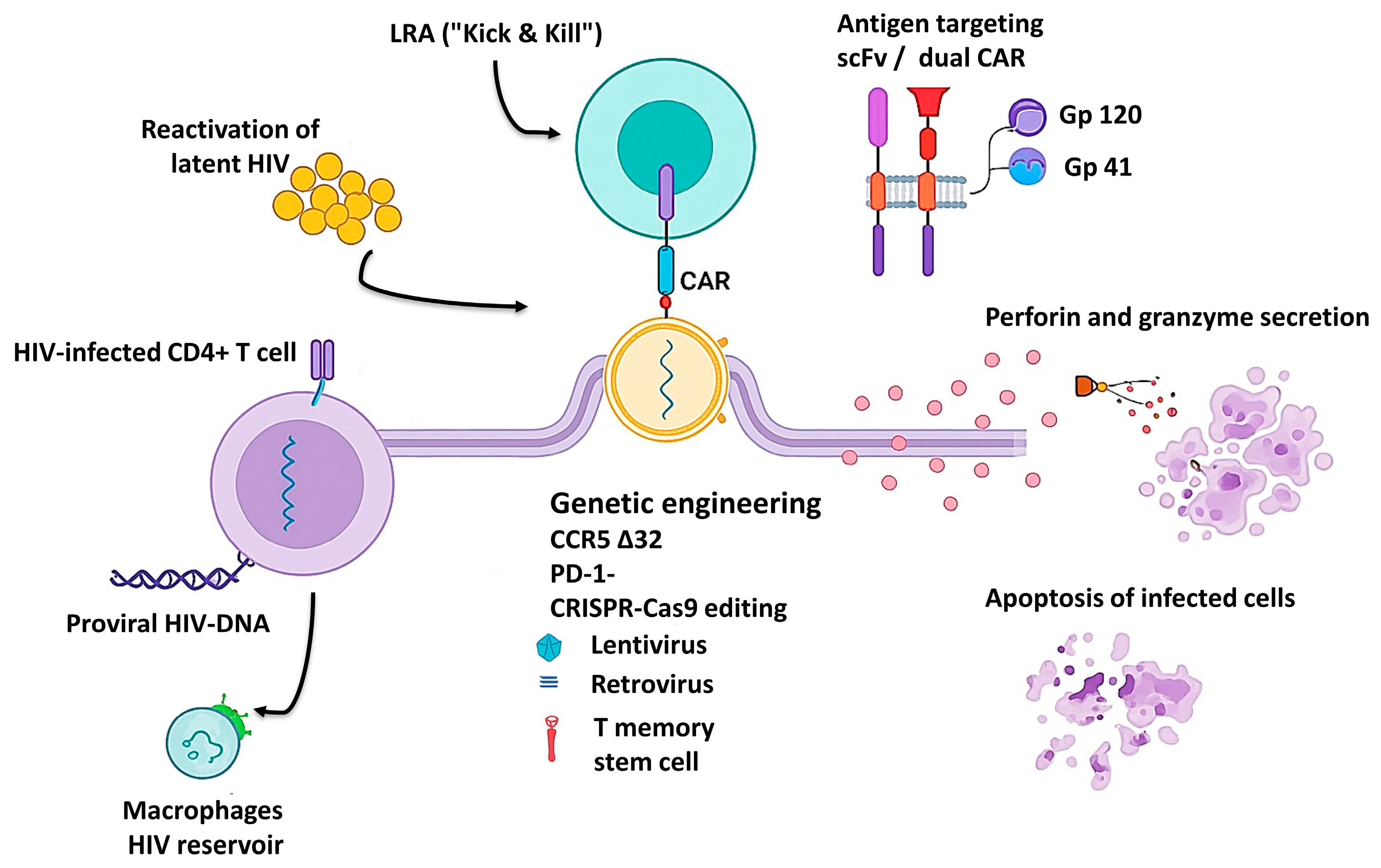

CAR-T Cell Therapy for HIV Cure: Current Challenges, Advances and Future Directions

 ,
, 
 , and
, and
Abstract
1. Introduction
2. Materials and Methods
2.1. Search Strategy
2.2. Eligibility Criteria and Data Extraction
2.2.1. Inclusion Criteria
2.2.2. Exclusion Criteria
2.3. Quality Assessment
3. Results
4. Discussion
4.1. The Need for a Curative Approach to HIV and the Therapeutic Potential of CAR-T Cells
4.2. Insights from Recent Literature on CAR-T Therapy in HIV Infection
4.2.1. Mechanistic Advances
4.2.2. Clinical and Translational Applications
4.2.3. Challenges and Future Perspectives
4.3. Promising Preclinical Findings: Antiviral Efficacy and Reservoir Reduction
4.3.1. Experimental Evidence of CAR-T Antiviral Activity
4.3.2. Validation in Complex Animal Models
4.3.3. Therapeutic Synergies: CAR-T and Immune Checkpoint Blockade
4.3.4. Optimization of Vectors and Genetic Engineering
4.3.5. Limitations, Causal Inference and Future Research
4.4. Clinical Perspectives on CAR-T Therapy in HIV
4.4.1. Feasibility and Safety in People Living with HIV
4.4.2. Early Efficacy Signals in HIV-Focused Studies
4.4.3. Clinical and Operational Considerations in PLWH
4.4.4. Virological Monitoring: The Pitfall of Post–CAR-T False Positives
4.4.5. Gaps, Limitations, and Research Priorities
4.5. Technological Challenges: Persistence, Viral Evasion, and Safety
4.5.1. Persistence and Expansion of CAR-T Cells
4.5.2. Viral Evasion and HIV Adaptability
4.5.3. Safety and Immunogenicity
4.6. Ethical Considerations in CAR-T Therapy
5. Conclusions
Author Contributions
Funding
Institutional Review Board Statement
Informed Consent Statement
Data Availability Statement
Acknowledgments
Conflicts of Interest
Abbreviations
| ACT | Antiretroviral combination therapy |
| allo-HSCT | Allogeneic hematopoietic stem cell transplantation |
| ATI | Analytical treatment interruption |
| bNAbs | Broadly neutralizing antibodies |
| BCMA | B-cell maturation antigen |
| BLT mice | Humanized bone marrow–liver–thymus mice |
| CAR | Chimeric antigen receptor |
| CAR-T | Chimeric antigen receptor T cells |
| CAR-NK | Chimeric antigen receptor natural killer cells |
| CCR5 | C-C chemokine receptor type 5 |
| CNS | Central nervous system |
| CRISPR/Cas9 | Clustered regularly interspaced short palindromic repeats/Cas9 gene-editing system |
| CRS | Cytokine release syndrome |
| CTL | Cytotoxic T lymphocytes |
| CTLA-4 | Cytotoxic T-lymphocyte antigen-4 |
| CXCR4 | C-X-C chemokine receptor type 4 |
| DARPin | Designed ankyrin repeat proteins |
| duoCAR | Dual or bispecific chimeric antigen receptor |
| Env | HIV envelope glycoprotein |
| GALT | Gut-associated lymphoid tissue |
| GC | Germinal centers |
| GvHD | Graft-versus-host disease |
| HIV | Human immunodeficiency virus |
| HSPC | Hematopoietic stem/progenitor cells |
| HSCT | Hematopoietic stem cell transplantation |
| ICANS | Immune effector cell-associated neurotoxicity syndrome |
| ICOS | Inducible T-cell co-stimulator |
| IL-2/IL-7/IL-15 | Interleukin-2/-7/-15 |
| LRA | Latency-reversing agent |
| LV | Lentiviral vector |
| MHC | Major histocompatibility complex |
| MLV | Murine leukemia virus |
| NAAT | Nucleic acid amplification test |
| NHP | Non-human primates |
| NK | Natural killer cells |
| PD-1 | Programmed cell death protein 1 |
| PD-L1 | Programmed death-ligand 1 |
| PRISMA | Preferred Reporting Items for Systematic Reviews and Meta-Analyses |
| PROSPERO | International Prospective Register of Systematic Reviews |
| qPCR | Quantitative polymerase chain reaction |
| scFv | Single-chain variable fragment |
| SHIV | Simian–human immunodeficiency virus |
| SIV | Simian immunodeficiency virus |
| synNotch | Synthetic Notch receptor |
| TCM | Central memory T cells |
| TCR | T-cell receptor |
| TLR7 | Toll-like receptor 7 |
| 4-1BB (CD137) | Costimulatory signaling domain 4-1BB |
References
- UNAIDS. Global HIV & AIDS Statistics—Fact Sheet 2025. Available online: https://www.unaids.org/en/resources/fact-sheet (accessed on 7 October 2025).
- Petronić, T.; Alfilali, M.; Ašić, A. The CCR5Δ32 allele as an HIV infection resistance marker: Possible evolutionary theories of origin. Gene Rep. 2024, 34, 101856. [Google Scholar] [CrossRef] [Scilit]
- Marsden, M.D.; Zack, J.A. HIV/AIDS eradication. Bioorganic Med. Chem. Lett. 2013, 23, 4003–4010. [Google Scholar] [CrossRef] [Scilit]
- Anderko, R.R.; Mailliard, R.B. Mapping the interplay between NK cells and HIV: Therapeutic implications. J. Leukoc. Biol. 2023, 113, 109–138. [Google Scholar] [CrossRef] [Scilit] [PubMed]
- Abrams, D.; Lévy, Y.; Losso, M.H.; Babiker, A.; Collins, G.; Cooper, D.A.; Darbyshire, J.; Emery, S.; Fox, L.; Gordin, F.; et al. Interleukin-2 therapy in patients with HIV infection. N. Engl. J. Med. 2009, 361, 1548–1559. [Google Scholar] [CrossRef] [Scilit] [PubMed]
- Kovacs, J.A.; Vogel, S.; Albert, J.M.; Falloon, J.; Davey, R.T., Jr.; Walker, R.E.; Polis, M.A.; Spooner, K.; Metcalf, J.A.; Baseler, M.; et al. Controlled trial of interleukin-2 infusions in patients infected with the human immunodeficiency virus. N. Engl. J. Med. 1996, 335, 1350–1356. [Google Scholar] [CrossRef] [Scilit] [PubMed]
- Chun, T.W.; Stuyver, L.; Mizell, S.B.; Ehler, L.A.; Mican, J.A.; Baseler, M.; Lloyd, A.L.; Nowak, M.A.; Fauci, A.S. Presence of an inducible HIV-1 latent reservoir during highly active antiretroviral therapy. Proc. Natl. Acad. Sci. USA 1997, 94, 13193–13197. [Google Scholar] [CrossRef] [Scilit]
- Borducchi, E.N.; Cabral, C.; Stephenson, K.E.; Liu, J.; Abbink, P.; Ng’ang’a, D.; Nkolola, J.P.; Brinkman, A.L.; Peter, L.; Lee, B.C.; et al. Ad26/MVA therapeutic vaccination with TLR7 stimulation in SIV-infected rhesus monkeys. Nature 2016, 540, 284–289. [Google Scholar] [CrossRef] [Scilit]
- Caskey, M.; Klein, F.; Lorenzi, J.C.C.; Seaman, M.S.; West, A.P., Jr.; Buckley, N.; Kremer, G.; Nogueira, L.; Braunschweig, M.; Scheid, J.F.; et al. 3BNC117, a Broadly Neutralizing Antibody, Suppresses Viremia in HIV-1-Infected Humans. Nature 2015, 522, 487–491. [Google Scholar] [CrossRef] [Scilit]
- Elsheikh, M.M.; Tang, Y.; Li, D.; Jiang, G. Deep latency: A new insight into a functional HIV cure. eBioMedicine 2019, 45, 624–629. [Google Scholar] [CrossRef] [Scilit]
- Deeks, S.G.; Archin, N.; Cannon, P.; Collins, S.; Jones, R.B.; de Jong, M.A.W.P.; Lambotte, O.; Lamplough, R.; Ndung’u, T.; Sugarman, J.; et al. Research priorities for an HIV cure: International AIDS Society Global Scientific Strategy 2021. Nat. Med. 2021, 27, 2085–2098. [Google Scholar] [CrossRef] [Scilit]
- Marín-Sánchez, N.; Paredes, R.; Borgognone, A. Exploring potential associations between the human microbiota and reservoir of latent HIV. Retrovirology 2024, 21, 21. [Google Scholar] [CrossRef] [Scilit] [PubMed]
- Anthony-Gonda, K.; Ray, A.; Su, H.; Wang, Y.; Xiong, Y.; Lee, D.; Block, A.; Chilunda, V.; Weiselberg, J.; Zemelko, L.; et al. In vivo killing of primary HIV-infected cells by peripheral-injected early memory–enriched anti-HIV duoCAR T cells. JCI Insight 2022, 7, e161698. [Google Scholar] [CrossRef] [Scilit] [PubMed]
- Campos-Gonzalez, G.; Martinez-Picado, J.; Velasco-Hernandez, T.; Salgado, M. Opportunities for CAR-T cell immunotherapy in HIV cure. Viruses 2023, 15, 789. [Google Scholar] [CrossRef] [Scilit] [PubMed]
- Mao, Y.; Liao, Q.; Zhu, Y.; Bi, M.; Zou, J.; Zheng, N.; Zhu, L.; Zhao, C.; Liu, Q.; Liu, L.; et al. Efficacy and safety of novel multifunctional M10 CAR-T cells in HIV-1-infected patients: A phase I, multicenter, single-arm, open-label study. Cell Discov. 2024, 10, 49. [Google Scholar] [CrossRef] [Scilit]
- Cappell, K.M.; Kochenderfer, J.N. Long-term outcomes following CAR T cell therapy: What we know so far. Nat. Rev. Clin. Oncol. 2023, 20, 359–371. [Google Scholar] [CrossRef] [Scilit]
- Tristán-Manzano, M.; Maldonado-Pérez, N.; Justicia-Lirio, P.; Cortijo-Gutiérrez, M.; Tristán-Ramos, P.; Blanco-Benítez, C.; Pavlovic, K.; Aguilar-González, A.; Muñoz, P.; Molina-Estevez, F.J.; et al. Lentiviral vectors for inducible, transactivator-free advanced therapy medicinal products: Application to CAR-T cells. Mol. Ther. Nucleic Acids 2023, 32, 322–339. [Google Scholar] [CrossRef] [Scilit]
- Loos, P.; Short, L.; Savage, G.; Evgin, L. Expansion and retroviral transduction of primary murine T cells for CAR T-cell therapy. In Cancer Immunotherapy: Methods and Protocols; Springer: New York, NY, USA, 2023; pp. 41–53. [Google Scholar]
- Rossi, M.; Breman, E. Engineering strategies to safely drive CAR T-cells into the future. Front. Immunol. 2024, 15, 1411393. [Google Scholar] [CrossRef] [Scilit]
- Xiao, Q.; He, S.; Wang, C.; Zhou, Y.; Zeng, C.; Liu, J.; Liu, T.; Li, T.; Quan, X.; Wang, L.; et al. Deep Thought on the HIV Cured Cases: Where Have We Been and What Lies Ahead? Biomolecules 2025, 15, 378. [Google Scholar] [CrossRef] [Scilit]
- Hütter, G.; Nowak, D.; Mossner, M.; Ganepola, S.; Müßig, A.; Allers, K.; Schneider, T.; Hofmann, J.; Kücherer, C.; Blau, O.; et al. Long-term control of HIV by CCR5Δ32/Δ32 stem-cell transplantation. N. Engl. J. Med. 2009, 360, 692–698. [Google Scholar] [CrossRef] [Scilit]
- Hütter, G. More on shift of HIV tropism in stem-cell transplantation with CCR5Δ32/Δ32 mutation. N. Engl. J. Med. 2014, 371, 2437–2438. [Google Scholar] [CrossRef] [Scilit]
- Allers, K.; Hütter, G.; Hofmann, J.; Loddenkemper, C.; Rieger, K.; Thiel, E.; Schneider, T. Evidence for the cure of HIV infection by CCR5Δ32/Δ32 stem cell transplantation. Blood 2011, 117, 2791–2799. [Google Scholar] [CrossRef] [Scilit] [PubMed]
- Gupta, R.K.; Gregson, J.; Parkin, N.; Haile-Selassie, H.; Tanuri, A.; Andrade, F.L.; Hamers, R.L.; Wallis, C.L.; Schuurman, R.; Siwale, M.; et al. HIV-1 drug resistance before initiation or re-initiation of first-line antiretroviral therapy in low-income and middle-income countries: A systematic review and meta-regression analysis. Lancet Infect. Dis. 2018, 18, 346–355. [Google Scholar] [CrossRef] [Scilit] [PubMed]
- Jensen, B.O.; Knops, E.; Cords, L.; Lübke, N.; Salgado, M.; Busman-Sahay, K.; Estes, J.D.; Huyveneers, L.E.P.; Perdomo-Celis, F.; Wittner, M.; et al. In-depth virological and immunological characterization of HIV-1 cure after CCR5Δ32/Δ32 allogeneic hematopoietic stem cell transplantation. Nat. Med. 2023, 29, 583–587. [Google Scholar] [CrossRef] [Scilit] [PubMed]
- Dickter, J.K.; Aribi, A.; Cardoso, A.A.; Gianella, S.; Gendzekhadze, K.; Li, S.; Feng, Y.; Chaillon, A.; Laird, G.M.; Browning, D.L.; et al. HIV-1 remission after allogeneic hematopoietic-cell transplantation. N. Engl. J. Med. 2024, 390, 669. [Google Scholar] [CrossRef] [Scilit]
- Hsu, J.; Van Besien, K.; Glesby, M.J.; Pahwa, S.; Coletti, A.; Warshaw, M.G.; Petz, L.; Moore, T.B.; Chen, Y.H.; Pallikkuth, S.; et al. HIV-1 remission and possible cure in a woman after haplo-cord blood transplant. Cell 2023, 186, 1115–1126. [Google Scholar] [CrossRef] [Scilit]
- Sáez-Cirión, A.; Mamez, A.-C.; Avettand-Fenoel, V.; Nabergoj, M.; Passaes, C.; Thoueille, P.; Decosterd, L.; Hentzien, M.; Perdomo-Celis, F.; Salgado, M.; et al. Sustained HIV remission after allogeneic hematopoietic stem cell transplantation with wild-type CCR5 donor cells. Nat. Med. 2024, 30, 3544–3554. [Google Scholar] [CrossRef] [Scilit]
- Mallapaty, S. Seventh patient ‘cured’ of HIV: Why scientists are excited. Nature 2024, 632, 235–236. [Google Scholar] [CrossRef] [Scilit]
- Zaegel-Faucher, O.; Boschi, C.; Benkouiten, S.; Laroche, H.; Dos Santos, M.C.; Motte, A.; Izadifar-Legrand, F.; Olive, D.; Colson, P.; Bregigeon-Ronot, S. Absence of Viral Rebound without Antiretrovirals after CCR5Δ32/Δ32 Allogeneic Hematopoietic Stem Cell Transplantation: A New Case of a Potential Cure of HIV? In Proceedings of the HIV Drug Therapy Conference, Barcelona, Spain, 10–13 November 2024. [Google Scholar]
- Essat, A.; Chapel, A.; Amokrane, K.; Monceaux, V.; Didier, C.; Melard, A.; Gardiennet, E.; Avettand-Fenoel, V.; Orr, S.; Boufassa, F.; et al. A genetic fingerprint associated with durable HIV remission after interruption of antiretroviral treatment: ANRS VISCONTI/PRIMO. Med 2025, 6, 100670. [Google Scholar] [CrossRef] [Scilit]
- Li, J.Z.; Etemad, B.; Ahmed, H.; Aga, E.; Bosch, R.J.; Mellors, J.W.; Kuritzkes, D.R.; Henrich, T.J.; Gulick, R.M.; Volberding, P.; et al. The Control of HIV After Antiretroviral Medication Pause (CHAMP) Study: Posttreatment controllers identified from 14 clinical studies. J. Infect. Dis. 2019, 219, 1941–1951. [Google Scholar] [CrossRef] [Scilit]
- Shacklett, B.L.; Buggert, M.; Dias, J. Editorial: CD8+ T-cells in HIV/SIV infection, prophylaxis, and therapy. Front. Immunol. 2023, 14, 1159452. [Google Scholar] [CrossRef] [Scilit]
- Wang, X.; Liu, J.; Hao, F.; Ajavavarakula, T.; Shi, X. CAR-T Therapy in HIV: Pioneering Advances and Navigating Challenges. J. Infect. Dis. Immun. 2024, 4, 194–205. [Google Scholar] [CrossRef] [Scilit]
- Bjorgen, J.C.; Dick, J.K.; Cromarty, R.; Hart, G.T.; Rhein, J. NK cell subsets and dysfunction during viral infection: A new avenue for therapeutics? Front. Immunol. 2023, 14, 1267774. [Google Scholar] [CrossRef] [Scilit] [PubMed]
- Kheiri, R.; Zhou, H.; Liu, T.; Elhassanny, A.; Chen, J. Addressing graft-versus-host disease in allogeneic cell-based immunotherapy. Exp. Hematol. Oncol. 2025, 14, 54. [Google Scholar] [CrossRef] [Scilit]
- Perera Molligoda, A.S. NK cell-based therapies for HIV infection: Investigating current advances and future possibilities. J. Leukoc. Biol. 2022, 111, 921–931. [Google Scholar] [CrossRef] [Scilit]
- PROSPERO International Prospective Register of Systematic Reviews. Available online: https://www.crd.york.ac.uk/PROSPERO/view/CRD42041178068 (accessed on 7 October 2025).
- Sterne, J.A.C.; Hernán, M.A.; Reeves, B.C.; Savović, J.; Berkman, N.D.; Viswanathan, M.; Henry, D.; Altman, D.G.; Ansari, M.T.; Boutron, I.; et al. ROBINS-I: A Tool for Assessing Risk of Bias in Non-Randomised Studies of Interventions. BMJ 2016, 355, i4919. [Google Scholar] [CrossRef] [Scilit]
- Sterne, J.A.C.; Savović, J.; Page, M.J.; Elbers, R.G.; Blencowe, N.S.; Boutron, I.; Cates, C.J.; Cheng, H.-Y.; Corbett, M.S.; Eldridge, S.M.; et al. RoB 2: A Revised Tool for Assessing Risk of Bias in Randomised Trials. BMJ 2019, 366, l4898. [Google Scholar] [CrossRef] [Scilit]
- Page, M.J.; McKenzie, J.E.; Bossuyt, P.M.; Boutron, I.; Hoffmann, T.C.; Mulrow, C.D.; Shamseer, L.; Tetzlaff, J.M.; Akl, E.A.; Brennan, S.E.; et al. The PRISMA 2020 Statement: An Updated Guideline for Reporting Systematic Reviews. BMJ 2021, 372, n71. [Google Scholar] [CrossRef] [Scilit]
- Mu, W.; Carrillo, M.A.; Kitchen, S.G. Engineering CAR T Cells to Target the HIV Reservoir. Front. Cell. Infect. Microbiol. 2020, 10, 410. [Google Scholar] [CrossRef] [Scilit]
- Matsui, Y.; Miura, Y. Advancements in cell-based therapies for HIV cure. Cells 2024, 13, 64. [Google Scholar] [CrossRef] [Scilit]
- Su, H.; Mueller, A.; Goldstein, H. Recent advances on anti-HIV CAR-T cell treatment to provide sustained HIV remission. Curr. Opin. HIV AIDS 2024, 19, 169–178. [Google Scholar] [CrossRef] [Scilit]
- Buck, A.M.; Deveau, T.-M.; Henrich, T.J.; Deitchman, A.N. Challenges in HIV-1 Latent Reservoir and Target Cell Quantification in CAR-T Cell and Other Lentiviral Gene Modifying HIV Cure Strategies. Viruses 2023, 15, 1126. [Google Scholar] [CrossRef] [Scilit] [PubMed]
- Borrajo, A. Breaking Barriers to an HIV-1 Cure: Innovations in Gene Editing, Immune Modulation, and Reservoir Eradication. Life 2025, 15, 276. [Google Scholar] [CrossRef] [Scilit] [PubMed]
- Kruglova, N.; Shepelev, M. Increasing Gene Editing Efficiency via CRISPR/Cas9- or Cas12a-Mediated Knock-In in Primary Human T Cells. Biomedicines 2024, 12, 119. [Google Scholar] [CrossRef] [Scilit] [PubMed]
- Rothemejer, F.H.; Lauritsen, N.P.; Juhl, A.K.; Schleimann, M.H.; König, S.; Søgaard, O.S.; Bak, R.O.; Tolstrup, M. Development of HIV-Resistant CAR T Cells by CRISPR/Cas-Mediated CAR Integration into the CCR5 Locus. Viruses 2023, 15, 202. [Google Scholar] [CrossRef] [Scilit]
- Li, S.; Wang, H.; Guo, N.; Su, B.; Lambotte, O.; Zhang, T. Targeting the HIV reservoir: Chimeric antigen receptor therapy for HIV cure. Chin. Med. J. 2023, 136, 2747–2755. [Google Scholar] [CrossRef] [Scilit]
- Li, W.; Liang, L.; Liao, Q.; Li, Y.; Zhou, Y. CD38: An important regulator of T cell function. Biomed. Pharmacother. 2022, 153, 113395. [Google Scholar] [CrossRef] [Scilit]
- York, J.; Gowrishankar, K.; Micklethwaite, K.; Palmer, S.; Cunningham, A.L.; Nasr, N. Evolving strategies to eliminate the CD4 T cells HIV viral reservoir via CAR T cell immunotherapy. Front. Immunol. 2022, 13, 873701. [Google Scholar] [CrossRef] [Scilit]
- Chen, X.; Jia, L.; Zhang, X.; Zhang, T.; Zhang, Y. One arrow for two targets: Potential co-treatment regimens for lymphoma and HIV. Blood Rev. 2022, 55, 100965. [Google Scholar] [CrossRef] [Scilit]
- Hattenhauer, T.; Mispelbaum, R.; Hentrich, M.; Boesecke, C.; Monin, M.B. Enabling CAR T-cell therapies for HIV-positive lymphoma patients—A call for action. HIV Med. 2023, 24, 957–964. [Google Scholar] [CrossRef] [Scilit]
- Reddy, S.R.; Llukmani, A.; Hashim, A.; Haddad, D.R.; Patel, D.S.; Ahmad, F.; Abu Sneineh, M.; Gordon, D.K. The role of chimeric antigen receptor-T cell therapy in the treatment of hematological malignancies: Advantages, trials, and tribulations, and the road ahead. Cureus 2021, 13, e13552. [Google Scholar] [CrossRef] [Scilit]
- Kapoor, A.; Tan, C.S. Immunotherapeutics to treat HIV in the central nervous system. Curr. HIV/AIDS Rep. 2020, 17, 499–506. [Google Scholar] [CrossRef] [Scilit] [PubMed]
- Alnefaie, A.; Albogami, S.; Asiri, Y.; Ahmad, T.; Alotaibi, S.S.; Al-Sanea, M.M.; Althobaiti, H. Chimeric Antigen Receptor T-Cells: An Overview of Concepts, Applications, Limitations, and Proposed Solutions. Front. Bioeng. Biotechnol. 2022, 10, 797440. [Google Scholar] [CrossRef] [Scilit] [PubMed]
- Kalinichenko, S.V.; Ramadan, L.; Kruglova, N.A.; Lukashina, M.I.; Mazurov, D.V.; Shepelev, M.V. A New Chimeric Antibody against the HIV-1 Fusion Inhibitory Peptide MT-C34 with a High Affinity and Fc-Mediated Cellular Cytotoxicity. Biology 2024, 13, 675. [Google Scholar] [CrossRef] [Scilit] [PubMed]
- Nardo, D.; Maddox, E.G.; Riley, J.L. Cell therapies for viral diseases: A new frontier. Semin. Immunopathol. 2025, 47, 5. [Google Scholar] [CrossRef] [Scilit]
- Rust, B.J.; Kiem, H.P.; Uldrick, T.S. CAR T-cell therapy for cancer and HIV through novel approaches to HIV-associated haematological malignancies. Lancet Haematol. 2020, 7, e690–e696. [Google Scholar] [CrossRef] [Scilit]
- Dubé, K.; Kanazawa, J.; Patel, H.; Louella, M.; Sylla, L.; Sheehy, J.; Dee, L.; Taylor, J.; Adair, J.; Anthony-Gonda, K.; et al. Ethical and practical considerations for cell and gene therapy toward an HIV cure: Findings from a qualitative in-depth interview study in the United States. BMC Med. Ethics 2022, 23, 67. [Google Scholar] [CrossRef] [Scilit]
- Bui, J.K.; Starke, C.E.; Poole, N.H.; Rust, B.J.; Jerome, K.R.; Kiem, H.P.; Peterson, C.W. CD20 CAR T cells safely and reversibly ablate B cell follicles in a non-human primate model of HIV persistence. Mol. Ther. 2024, 32, 1031–1046. [Google Scholar] [CrossRef] [Scilit]
- Clark, I.C.; Mudvari, P.; Thaploo, S.; Smith, S.; Abu-Laban, M.; Hamouda, M.; Theberge, M.; Shah, S.; Ko, S.H.; Pérez, L.; et al. HIV silencing and cell survival signatures in infected T cell reservoirs. Nature 2023, 614, 318–324. [Google Scholar] [CrossRef] [Scilit]
- Davey, B.C.; Pampusch, M.S.; Cartwright, E.K.; Abdelaal, H.M.; Rakasz, E.G.; Rendahl, A.; Berger, E.A.; Skinner, P.J. Development of an anti-CAR antibody response in SIV-infected rhesus macaques treated with CD4-MBL CAR/CXCR5 T cells. Front. Immunol. 2022, 13, 1032537. [Google Scholar] [CrossRef] [Scilit]
- Eichholz, K.; Fukazawa, Y.; Peterson, C.W.; Haeseleer, F.; Medina, M.; Hoffmeister, S.; Duell, D.M.; Varco-Merth, B.D.; Dross, S.; Park, H.; et al. Anti–PD-1 chimeric antigen receptor T cells efficiently target SIV-infected CD4+ T cells in germinal centers. J. Clin. Investig. 2024, 134, e169309. [Google Scholar] [CrossRef] [Scilit]
- Gao, Y.; Fang, X.; Zhang, L.; Yin, X. STAR Protocols. STAR Protoc. 2024, 5, 103350. [Google Scholar] [CrossRef] [Scilit] [PubMed]
- Jiang, Z.; Liang, H.; Pan, H.; Liang, Y.; Wang, H.; Yang, X.; Lu, P.; Zhang, X.; Yang, J.; Zhang, D.; et al. HIV-1-Specific CAR-T Cells With Cell-Intrinsic PD-1 Checkpoint Blockade Enhance Anti-HIV Efficacy in vivo. Front. Microbiol. 2021, 12, 684016. [Google Scholar] [CrossRef] [Scilit] [PubMed]
- Pan, H.; Yang, X.; Wang, J.; Liang, H.; Jiang, Z.; Zhao, L.; Wang, Y.; Liang, Z.; Shen, X.; Lin, Q.; et al. Allogeneic gene-edited HIV-specific CAR-T cells secreting PD-1 blocking scFv enhance specific cytotoxic activity against HIV Env+ cells in vivo. Virol. Sin. 2023, 38, 285–295. [Google Scholar] [CrossRef] [Scilit] [PubMed]
- Peterson, C.W. HIV-specific CAR T cells return to the clinic. J. Clin. Investig. 2025, 135, e150211. [Google Scholar] [CrossRef] [Scilit]
- Barber-Axthelm, I.M.; Barber-Axthelm, V.; Sze, K.Y.; Zhen, A.; Suryawanshi, G.W.; Chen, I.S.Y.; Zack, J.A.; Kitchen, S.G.; Kiem, H.P.; Peterson, C.W. Stem cell–derived CAR T cells traffic to HIV reservoirs in macaques. JCI Insight 2021, 6, e141502. [Google Scholar] [CrossRef] [Scilit]
- Carrillo, M.A.; Zhen, A.; Mu, W.; Rezek, V.; Martin, H.; Peterson, C.W.; Kiem, H.P.; Kitchen, S.G. Stem cell-derived CAR T cells show greater persistence, trafficking, and viral control compared to ex vivo transduced CAR T cells. Mol. Ther. 2024, 32, 1000–1013. [Google Scholar] [CrossRef] [Scilit]
- Mu, W.; Tomer, S.; Harding, J.; Kedia, N.; Rezek, V.; Cook, E.; Patankar, V.; Carrillo, M.A.; Martin, H.; Ng, H.; et al. Rapamycin enhances CAR-T control of HIV replication and reservoir elimination in vivo. J. Clin. Investig. 2025, 135, e185489. [Google Scholar] [CrossRef] [Scilit]
- Zhen, A.; Carrillo, M.A.; Mu, W.; Rezek, V.; Martin, H.; Hamid, P.; Chen, I.S.Y.; Yang, O.O.; Zack, J.A.; Kitchen, S.G. Robust CAR-T memory formation and function via hematopoietic stem cell delivery. PLoS Pathog. 2021, 17, e1009404. [Google Scholar] [CrossRef] [Scilit]
- Maldini, C.R.; Claiborne, D.T.; Okawa, K.; Chen, T.; Dopkin, D.L.; Shan, X.; Power, K.A.; Trifonova, R.T.; Krupp, K.; Phelps, M.; et al. Dual CD4-based CAR T cells with distinct costimulatory domains mitigate HIV pathogenesis in vivo. Nat. Med. 2020, 26, 1776–1787. [Google Scholar] [CrossRef] [Scilit]
- Lim, R.M.; Rong, L.; Zhen, A.; Xie, J. A universal CAR-NK cell targeting various epitopes of HIV-1 gp160. ACS Chem. Biol. 2020, 15, 2299–2310. [Google Scholar] [CrossRef] [Scilit]
- Patasic, L.; Seifried, J.; Bezler, V.; Kaljanac, M.; Schneider, I.H.; Schmitz, H.; Tondera, C.; Hartmann, J.; Hombach, A.; Buchholz, C.J.; et al. Designed Ankyrin Repeat Protein (DARPin) to target chimeric antigen receptor (CAR)-redirected T cells towards CD4+ T cells to reduce the latent HIV+ cell reservoir. Med. Microbiol. Immunol. 2020, 209, 681–691. [Google Scholar] [CrossRef] [Scilit] [PubMed]
- Urak, R.; Pahlavanneshan, S.; Gittins, B.; Nakamura, R.; Zaia, J.A.; Baird, J.H.; Clark, M.C.; Forman, S.J.; Wang, X. Simultaneous targeting of B-cell malignancies and human immunodeficiency virus with bispecific chimeric antigen receptor T cells. Haematologica 2024, 109, 3053–3058. [Google Scholar] [CrossRef] [Scilit] [PubMed]
- Guo, Q.; Zhen, A.; Parikh, K.; Zhang, J.; An, D.S. Anti-HIV-1 HSPC-based gene therapy with safety kill switch to defend against and attack HIV-1 infection. Mol. Ther. Methods Clin. Dev. 2025, 33, 101486. [Google Scholar] [CrossRef] [Scilit] [PubMed]
- Meng, L.; Zhao, H.; Chang, S.; Li, W.; Tian, Y.; Wang, R.; Wang, L.; Gu, T.; Wu, J.; Yu, B.; et al. Engineering of CD8+ T cells with an HIV-specific synthetic notch receptor to secrete broadly therapeutic antibodies for combining antiviral humoral and cellular immune responses. mBio 2025, 16, e03839-24. [Google Scholar] [CrossRef] [Scilit]
- Moore-Kelly, C.; Clarkson, N.G.; Reddem, R.; Farley, D.C.; Alberts, B.M.; Wright, J.; Mitrophanous, K.A.; Evans, T.; Kulkarni, A.; Raposo, R.A.S. Enhancing titers of therapeutic lentiviral vectors using PKC agonists. Mol. Ther. Methods Clin. Dev. 2025, 33, 101484. [Google Scholar] [CrossRef] [Scilit]
- Rothemejer, F.H.; Lauritsen, N.P.; Søgaard, O.S.; Tolstrup, M. Strategies for enhancing CAR T cell expansion and persistence in HIV infection. Front. Immunol. 2023, 14, 1253395. [Google Scholar] [CrossRef] [Scilit]
- Urak, R.Z.; Soemardy, C.; Ray, R.; Li, S.; Shevchenko, G.; Scott, T.; Lim, L.; Wang, X.; Morris, K.V. Conditionally replicating vectors mobilize chimeric antigen receptors against HIV. Mol. Ther. Methods Clin. Dev. 2020, 19, 554–565. [Google Scholar] [CrossRef] [Scilit]
- Urak, R.; Gittins, B.; Soemardy, C.; Grepo, N.; Goldberg, L.; Maker, M.; Shevchenko, G.; Davis, A.; Li, S.; Scott, T.; et al. Evaluation of the elements of short hairpin RNAs in developing shRNA-containing CAR T cells. Cancers 2023, 15, 2848. [Google Scholar] [CrossRef] [Scilit]
- Clayton, K.L.; Mylvaganam, G.; Villasmil-Ocando, A.; Stuart, H.; Maus, M.V.; Rashidian, M.; Ploegh, H.L.; Walker, B.D. HIV-infected macrophages resist efficient NK cell-mediated killing while preserving inflammatory cytokine responses. Cell Host Microbe 2021, 29, 435–447.e9. [Google Scholar] [CrossRef] [Scilit]
- Haeseleer, F.; Eichholz, K.; Tareen, S.U.; Iwamoto, N.; Roederer, M.; Kirchhoff, F.; Park, H.; Okoye, A.A.; Corey, L. Real-time killing assays to assess the potency of a new anti-simian immunodeficiency virus chimeric antigen receptor T cell. AIDS Res. Hum. Retroviruses 2020, 36, 1047–1056. [Google Scholar] [CrossRef] [Scilit]
- Jeremiah, N.; Ferran, H.; Antoniadou, K.; De Azevedo, K.; Nikolic, J.; Maurin, M.; Benaroch, P.; Manel, N. RELA tunes innate-like interferon I/III responses in human T cells. J. Exp. Med. 2023, 220, e20220666. [Google Scholar] [CrossRef] [Scilit] [PubMed]
- Mi, Z.; Zhao, J.; Chen, J.; Huang, J.; Huan, C.; Wang, H.; Zheng, B.; Du, N.; Yang, W.; Zhang, W.; et al. A novel FITC-chimeric antigen receptor-T cell targeting HIV-1-infected cells with FITC-conjugated antibodies for enhanced cytotoxicity. Int. J. Biol. Macromol. 2025, 319, 145715. [Google Scholar] [CrossRef] [Scilit] [PubMed]
- Tao, L.; Farooq, M.A.; Gao, Y.; Zhang, L.; Niu, C.; Ajmal, I.; Zhou, Y.; He, C.; Zhao, G.; Yao, J.; et al. CD19-CAR-T cells bearing a KIR/PD-1-based inhibitory CAR eradicate CD19⁺HLA-C1 malignant B cells while sparing CD19⁺HLA-C1⁺ healthy B cells. Cancers 2020, 12, 2612. [Google Scholar] [CrossRef] [Scilit] [PubMed]
- Zenere, G.; Wu, C.; Midkiff, C.C.; Johnson, N.M.; Grice, C.P.; Wimley, W.C.; Kaur, A.; E Braun, S. Extracellular domain, hinge, and transmembrane determinants affecting surface CD4 expression of a novel anti-HIV chimeric antigen receptor (CAR) construct. PLoS ONE 2024, 19, e0293990. [Google Scholar] [CrossRef] [Scilit]
- Haeseleer, F.; Fukazawa, Y.; Park, H.; Varco-Merth, B.; Rust, B.J.; Smedley, J.V.; Eichholz, K.; Peterson, C.W.; Mason, R.; Kiem, H.-P.; et al. Immune inactivation of anti-simian immunodeficiency virus chimeric antigen receptor T cells in rhesus macaques. Mol. Ther. Methods Clin. Dev. 2021, 22, 824–835. [Google Scholar] [CrossRef] [Scilit]
- Iwamoto, N.; Wagers, I.D.; Patel, B.; Song, K.; Mason, R.; Bolivar, S.; Bergamaschi, C.; Roederer, M.; Pavlakis, G.N.; Berger, E. Evaluation of chimeric antigen receptor T cell therapy in non-human primates infected with SHIV or SIV. PLoS ONE 2021, 16, e0248973. [Google Scholar] [CrossRef] [Scilit]
- Kranz, E.; Kuhlmann, C.J.; Chan, J.; Kim, P.Y.; Chen, I.S.Y.; Kamata, M. Efficient derivation of chimeric antigen receptor-modified TSCM cells. Front. Immunol. 2022, 13, 877682. [Google Scholar] [CrossRef] [Scilit]
- Pampusch, M.S.; Sevcik, E.N.; Quinn, Z.E.; Davey, B.C.; Berg, J.M.; Gorrell-Brown, I.; Abdelaal, H.M.; Rakasz, E.G.; Rendahl, A.; Skinner, P.J. Assessment of anti-CD20 antibody pre-treatment for augmentation of CAR-T cell therapy in SIV-infected rhesus macaques. Front. Immunol. 2023, 14, 1101446. [Google Scholar] [CrossRef] [Scilit]
- Choudhary, M.C.; Cyktor, J.C.; Riddler, S.A. Advances in HIV-1-specific chimeric antigen receptor cells to target the HIV-1 reservoir. J. Virus Erad. 2022, 8, 100073. [Google Scholar] [CrossRef] [Scilit]
- Hamilton, J.R.; Tsuchida, C.A.; Nguyen, D.N.; Shy, B.R.; McGarrigle, E.R.; Sandoval Espinoza, C.R.; Carr, D.; Blaeschke, F.; Marson, A.; Doudna, J.A. Targeted delivery of CRISPR-Cas9 and transgenes enables complex immune cell engineering. Cell Rep. 2021, 35, 109207. [Google Scholar] [CrossRef] [Scilit]
- Zhou, Y.; Jadlowsky, J.; Baiduc, C.; Klattenhoff, A.W.; Chen, Z.; Bennett, A.D.; Pumphrey, N.J.; Jakobsen, B.K.; Riley, J.L. Chimeric antigen receptors enable superior control of HIV replication by rapidly killing infected cells. PLoS Pathog. 2023, 19, e1011853. [Google Scholar] [CrossRef] [Scilit] [PubMed]
- Gao, Y.; Ju, Y.; Ren, X.; Zhang, L.; Yin, X. Enhanced infection efficiency and cytotoxicity mediated by vpx-containing lentivirus in chimeric antigen receptor macrophage (CAR-M). Heliyon 2023, 9, e21886. [Google Scholar] [CrossRef] [Scilit] [PubMed]
- Padurariu-Covit, M.-D.; Chiscop, I.; Gutu, C.; Arbune, A.-A.; Niculet, E.; Arbune, M. Retrospective analysis of HIV-associated lymphomas: Insights from a single Romanian center over 15 years. Front. Oncol. 2025, 15, 1569433. [Google Scholar] [CrossRef] [Scilit] [PubMed]
- Huang, C.; Wu, L.; Liu, R.; Li, W.; Li, Z.; Li, J.; Liu, L.; Shan, B. Efficacy and safety of CD19 chimeric antigen receptor T cells in the treatment of 11 patients with relapsed/refractory B-cell lymphoma: A single-center study. Ann. Transl. Med. 2020, 8, 1048. [Google Scholar] [CrossRef] [Scilit]
- Wang, B.Y.; Zhao, W.H.; Chen, Y.X.; Cao, X.M.; Yang, Y.; Zhang, Y.L.; Wang, F.X.; Zhang, P.Y.; Lei, B.; Gu, L.F.; et al. Five-year remission without disease progression in a patient with relapsed/refractory multiple myeloma with extramedullary disease treated with LCAR-B38M chimeric antigen receptor T cells in the LEGEND-2 study: A case report. J. Med. Case Rep. 2022, 16, 459. [Google Scholar] [CrossRef] [Scilit]
- Zhong, G.; Zhang, X.; Guo, Z.; Gao, Y.; Zhao, B.; Liu, X.; Chen, L.; Qiao, J.; Yu, C.; Wang, L.; et al. Complete remission of advanced pancreatic cancer induced by claudin18.2-targeted CAR-T cell therapy: A case report. Front. Immunol. 2024, 15, 1325860. [Google Scholar] [CrossRef] [Scilit]
- Yang, L.; Wu, M.; Yang, H.; Sun, X.; Xing, L.; Liu, D.; Xing, L.; Yu, J. Case report: Bridging radiation therapy before chimeric antigen receptor T-cell therapy induces sustained remission in patients with relapsed/refractory double-expressor diffuse large B-cell lymphoma with localized compressive symptoms. Front. Immunol. 2024, 15, 1441404. [Google Scholar] [CrossRef] [Scilit]
- Kutsch, N.; Gödel, P.; Voltin, C.-A.; Kobe, C.; Hallek, M.; Scheid, C.; Borchmann, P.; Holtick, U. Sustained remission of relapsed diffuse large B-cell lymphoma after safe administration of CD19-directed CAR T-cells in a patient with chronic intestinal and pulmonal GvHD. HemaSphere 2022, 6, e735. [Google Scholar] [CrossRef] [Scilit]
- Trottier, C.A.; Yen, C.F.; Malvar, G.; Arnason, J.; Avigan, D.E.; Alonso, C.D. Case Report: Refractory Cryptosporidiosis after CAR T-Cell Therapy for Lymphoma. Am. J. Trop. Med. Hyg. 2021, 105, 651–653. [Google Scholar] [CrossRef] [Scilit]
- Valdivieso-Shephard, J.L.; Matas-Pérez, E.; García-Bujalance, S.; Mirones-Aguilar, I.; González-Martínez, B.; Pérez-Martínez, A.; Lopez-Granados, E.; Martínez-Feito, A.; Sánchez-Zapardiel, E. The challenge of standardizing CAR-T cell monitoring: A comparison of two flow-cytometry methods and correlation with qPCR technique. Cytom. A 2024, 105, 368–375. [Google Scholar] [CrossRef] [Scilit]
- Alali, A.; Ferreira, C.B.; Folorunso, O.S.; Alquethamy, S.F.; Al-Yahya, S.; Alanazi, M.; Alamer, O.M.; Al-Harbi, H.M.; Mahfouz, M. Genetic engineering strategies for HIV cure: Advances in CAR-T cell therapy. Int. J. Mol. Sci. 2022, 23, 11882. [Google Scholar] [CrossRef] [Scilit]
- Keri, V.C.; Topulli, M.V.; Deol, A.; Uberti, J.; Salimnia, H.; Chandrasekar, P.H. False-Positive Human Immunodeficiency Virus Nucleic Acid Amplification Test After Chimeric Antigen Receptor T-Cell Therapy With Ciltacabtagene Autoleucel. Open Forum Infect. Dis. 2023, 11, ofad633. [Google Scholar] [CrossRef] [Scilit] [PubMed]
- Villalba, J.A.; Maus, M.V.; Frigault, M.J.; Zaffini, R.; Gandhi, R.T.; Rosenberg, E.S.; Siedner, M.J. False-positive human immunodeficiency virus test results in patients receiving lentivirus-based chimeric antigen receptor T-cell therapy: Case report, review of the literature, and proposed recommendations. J. Infect. Dis. 2022, 225, 1933–1936. [Google Scholar] [CrossRef] [Scilit] [PubMed]
- Yoon, S.E.; Huh, K.; Kim, T.Y.; Huh, H.J.; Kim, S.J.; Kim, W.S. Detection of HIV RNA after CAR-T Cell Therapy in a Relapsed/Refractory Diffuse Large B-Cell Lymphoma Patient: Possibility of False Positivity and Clinical Implications. Case Rep. Cancer Res. Treat. 2025; ahead of print. [CrossRef] [Scilit]
- Li, K.; Zhang, C.; Deng, J.; Zeng, H.; Zhang, Y.; Lai, G.; Zhong, X.; Xie, B. Causal Effects of Gut Microbiome on HIV Infection: A Two-Sample Mendelian Randomization Analysis. BMC Infect. Dis. 2024, 24, 280. [Google Scholar] [CrossRef] [Scilit]
- Chou, T.C.; Maggirwar, N.S.; Marsden, M.D. HIV Persistence, Latency, and Cure Approaches: Where Are We Now? Viruses 2024, 16, 1163. [Google Scholar] [CrossRef] [Scilit]
- Conway, J.M.; Perelson, A.S.; Li, J.Z. Predictions of Time to HIV Viral Rebound Following ART Suspension That Incorporate Personal Biomarkers. PLoS Comput. Biol. 2019, 15, e1007229. [Google Scholar] [CrossRef] [Scilit]
- European Centre for Disease Prevention and Control. Stigma: Survey of People Living with HIV. Monitoring Implementation of the Dublin Declaration on Partnership to Fight HIV/AIDS in Europe and Central Asia: 2022 Progress Report; ECDC: Stockholm, Sweden, 2023.
- Corrigan, K.L.; Knettel, B.A.; Suneja, G. Inclusive Cancer Care: Rethinking Patients Living with HIV and Cancer. Oncologist 2020, 25, 361–363. [Google Scholar] [CrossRef] [Scilit]
- Bell, J.A.H.; Jeffries, G.A.; Chen, C.I. Mitigating inequity: Ethically prioritizing patients for CAR T-cell therapy. Blood 2023, 142, 1263–1270. [Google Scholar] [CrossRef] [Scilit]



| Category | Specific Category | No. of Articles | Type of Review | Main Focus/Observations |
|---|---|---|---|---|
| General CAR-T and HIV reviews | Overview | 6 [4,14,20,42,43,44] | Narrative reviews | Broad perspectives on CAR-T applicability in HIV; discuss therapeutic challenges, feasibility, and future directions. |
| Mechanistic/Genetic engineering reviews | Mechanisms | 8 [24,45,46,47,48,49,50,51] | Mechanistic/molecular reviews | Focus on CAR design, vector optimization, CRISPR-based editing, resistance mechanisms, and long-term persistence. |
| Clinical and translational reviews | Clinical | 10 [33,37,52,53,54,55,56,57,58,59] | Clinical/translational narrative reviews | Discuss clinical application, safety, management of HIV + lymphomas, translational implications, and early clinical trials. |
| Ethical and social reviews | Ethical | 1 [60] | Qualitative/ethical review | Examines patient perception, ethical implications, and social perspectives regarding cellular therapies in HIV. |
| Category | Mechanism | No of Articles | Country | Study Type | Key Findings/Observations |
|---|---|---|---|---|---|
| Immunomodulation | Cytokine support (IL-15/IL-7) | 1 [61] | USA | In vivo—macaques | IL-15 preconditioning enhanced CAR-T expansion and persistence. |
| PD-1/checkpoint blockade | 1 [62] | USA | In vivo—macaques | Revealed PD-1–associated immune exhaustion and latency maintenance in ART-treated macaques, supporting PD-1 blockade | |
| Immunogenicity/anti-CAR responses | 1 [63] | USA | In vivo—macaques | Limited in vivo efficacy due to rapid CAR-T clearance. | |
| PD-1/checkpoint blockade | 1 [64] | Multi-country | In vivo—macaques | Checkpoint blockade improved persistence and reduced T-cell exhaustion. | |
| 3 [65,66,67] | China | In vitro/preclinical | Reducing PD-1 expression or blocking the PD-1 pathway significantly enhances CAR-T cell function against HIV by improving their expansion, strengthening antiviral activity, and increasing cytotoxicity and cytokine production. | ||
| Immunogenicity/anti-CAR responses | 1 [68] | USA | In vivo—macaques | Documented anti-CAR immune responses limiting persistence. | |
| Stemness and persistence | HSPC-derived/long-lived CAR-T | 2 [69,70] | USA | In vivo—macaques | Stem-cell–derived CAR-T maintained long-term persistence and tissue homing. |
| 2 [71,72] | USA [71], China [72] | In vivo—humanized mice (BLT) | Demonstrated that HSPC-derived CAR-T cells persist long-term, enhance viral control, and reduce the HIV reservoir; rapamycin improved CAR-T expansion and antiviral efficacy. | ||
| Targeting diversity | Bispecific/dual CAR constructs + Novel epitope targeting | 5 [13,73,74,75,76] | USA | In vivo—humanized mice (BLT) [13,73] | Dual-target CAR-T recognized multiple HIV epitopes and limited viral escape. |
| In vitro/preclinical [74,75,76] | New scFv binding domains improved antigen binding and signaling. Dual CARs targeting gp120/gp41 broadened antigen recognition. | ||||
| Genetic protection | CCR5 editing/entry resistance | 1 [77] | USA | In vivo—macaques | HSPC gene therapy with CCR5 editing conferred HIV entry resistance and included a safety kill switch for controlled elimination of transduced cells. |
| Antiviral payloads | 1 [78] | China | In vivo—humanized mice | Synthetic Notch–CAR-T cells secreted bNAbs upon HIV recognition, achieving durable viral control without ART. | |
| Vector safety/off-target | 1 [79] | Canada | Mixed (in vitro + in vivo) | Assessed vector safety and off-target editing in preclinical assays. | |
| CCR5 editing/entry resistance | 3 [80,81,82] | Netherlands [80]; USA [81,82] | In vitro/preclinical | CCR5 editing and vector engineering improved safety and resistance. | |
| Reservoir targeting | Latency reversal + CAR-T (shock & kill) | 1 [83] | USA | In vitro/preclinical | CAR-T efficiently targeted reactivated HIV-infected cells in latency models. |
| Latency/reservoir interaction | 1 [84] | Belgium | In vitro/preclinical | Validated CAR-T cytotoxicity after LRA-induced proviral reactivation. | |
| Latency reversal + CAR-T (shock & kill) | 1 [85] | UK | In vitro/preclinical | Cleared reactivated reservoirs in primary CD4+ T-cell assays. | |
| Novel reservoir targeting | 1 [86] | China | In vivo—humanized mice (BLT) | Combined novel targeting with latency modulation in BLT mice. | |
| Latency reversal + CAR-T (shock & kill) | 1 [87] | China | Mixed (in vitro + in vivo) | LRAs combined with CAR-T enabled clearance of reactivated cells. | |
| Reservoir biology/latency | 1 [88] | Italy | In vitro/preclinical | Explored CAR-T interactions with HIV latency dynamics. | |
| Trafficking & homing | Tissue infiltration/lymphoid homing | 2 [89,90] | Belgium [89]; Japan [90] | In vivo—macaque | Early viral control associated with improved CAR-T trafficking. |
| 1 [91] | USA | In vivo—humanized mice (BLT) | Evaluated cytotoxicity and persistence with tissue distribution metrics. | ||
| 1 [92] | USA | In vivo—macaque | Observed CAR-T infiltration in gut-associated lymphoid tissue (GALT). | ||
| Methods & manufacturing | Safety/cytokine profile | 1 [93] | USA | In vitro/preclinical | Characterized cytokine release and safety parameters. |
| Signaling strength/monitoring | 1 [94] | USA | In vitro/preclinical | Refined monitoring and control of CAR signaling strength. | |
| Imaging/tracking methods | 1 [95] | China | In vitro/preclinical | Developed imaging to monitor CAR-T distribution and dynamics. | |
| Uncategorized | 1 [96] | China | In vitro/preclinical | PD-1 knockdown improved CAR-T function against HIV targets. |
| Characteristics | No of Articles | Country | Study Type | Number of Patients | HIV Relevance | Key Findings/Observations |
|---|---|---|---|---|---|---|
| CAR T in HIV patients | 1 [15] | China | Phase I, multicenter, single-arm trial | 18 HIV-positive | Direct (anti-HIV M10 CAR-T) | First clinical trial of CAR-T in PLWH; demonstrated safety and viral suppression. |
| Non-HIV clinical studies | 1 [97] | Romania | Retrospective, single-center | 47 HIV-positive | Indirect (HIV-associated lymphomas, no CAR-T) | Contextual epidemiology of HIV-associated lymphomas; highlights need for innovative therapies. |
| 1 [98] | China | Clinical study, single center | 11 | Indirect (HIV-negative) | Evaluated efficacy and safety of CD19 CAR-T in relapsed/refractory B-cell lymphoma. | |
| 1 [99] | China | Case report | 1 | Indirect (HIV-negative) | Long-term remission (5 years) after BCMA CAR-T therapy for multiple myeloma. | |
| 1 [100] | China | Case report | 1 | Indirect (HIV-negative) | Reported complete remission of pancreatic cancer following CLDN18.2 CAR-T therapy. | |
| 1 [101] | China | Case report | 1 | Indirect (HIV-negative) | Achieved sustained remission in DLBCL after CAR-T combined with bridging radiotherapy. | |
| 1 [102] | Germany | Case report | 1 | Indirect (HIV-negative) | CAR-T feasible and effective in patient with GvHD post allogeneic SCT. | |
| 1 [103] | USA | Case report | 1 | Indirect (HIV-negative) | Reported opportunistic cryptosporidiosis after CAR-T; highlights infection risks. | |
| 1 [104] | Spain | Clinical methodological study | 5 (B-ALL patients + 1 donor) | Indirect (HIV-negative) | Compared two flow-cytometry protocols for CAR-T cell monitoring; ligand-based assay showed higher sensitivity and good correlation with qPCR; useful for standardizing CAR-T follow-up. | |
| Special aspects | 4 [105,106,107,108] | USA | Case report | 6 | False-positive HIV tests after CAR-T therapy | Reports cases of false-positive HIV detection by PCR following CAR-T cell therapy, with important implications for clinical monitoring. |
Disclaimer/Publisher’s Note: The statements, opinions and data contained in all publications are solely those of the individual author(s) and contributor(s) and not of MDPI and/or the editor(s). MDPI and/or the editor(s) disclaim responsibility for any injury to people or property resulting from any ideas, methods, instructions or products referred to in the content. |
© 2025 by the authors. Licensee MDPI, Basel, Switzerland. This article is an open access article distributed under the terms and conditions of the Creative Commons Attribution (CC BY) license (https://creativecommons.org/licenses/by/4.0/).
Share and Cite
Padurariu-Covit, M.-D.; Georgescu, C.; Andreescu, M.; Chiscop, I.; Plesea-Condratovici, C.; Arbune, M. CAR-T Cell Therapy for HIV Cure: Current Challenges, Advances and Future Directions. Viruses 2025, 17, 1615. https://doi.org/10.3390/v17121615
Padurariu-Covit M-D, Georgescu C, Andreescu M, Chiscop I, Plesea-Condratovici C, Arbune M. CAR-T Cell Therapy for HIV Cure: Current Challenges, Advances and Future Directions. Viruses. 2025; 17(12):1615. https://doi.org/10.3390/v17121615
Chicago/Turabian StylePadurariu-Covit, Monica-Daniela, Costinela Georgescu, Mihaela Andreescu, Iulia Chiscop, Catalin Plesea-Condratovici, and Manuela Arbune. 2025. "CAR-T Cell Therapy for HIV Cure: Current Challenges, Advances and Future Directions" Viruses 17, no. 12: 1615. https://doi.org/10.3390/v17121615
APA StylePadurariu-Covit, M.-D., Georgescu, C., Andreescu, M., Chiscop, I., Plesea-Condratovici, C., & Arbune, M. (2025). CAR-T Cell Therapy for HIV Cure: Current Challenges, Advances and Future Directions. Viruses, 17(12), 1615. https://doi.org/10.3390/v17121615