The Complexity of Bovine Leukemia Virus Oncogenesis
 , , , and
Abstract
1. The Spectrum of BLV-Infected Hosts Includes Different Bovid Species
2. BLV Infects, Persists and Transforms B-Lymphocytes
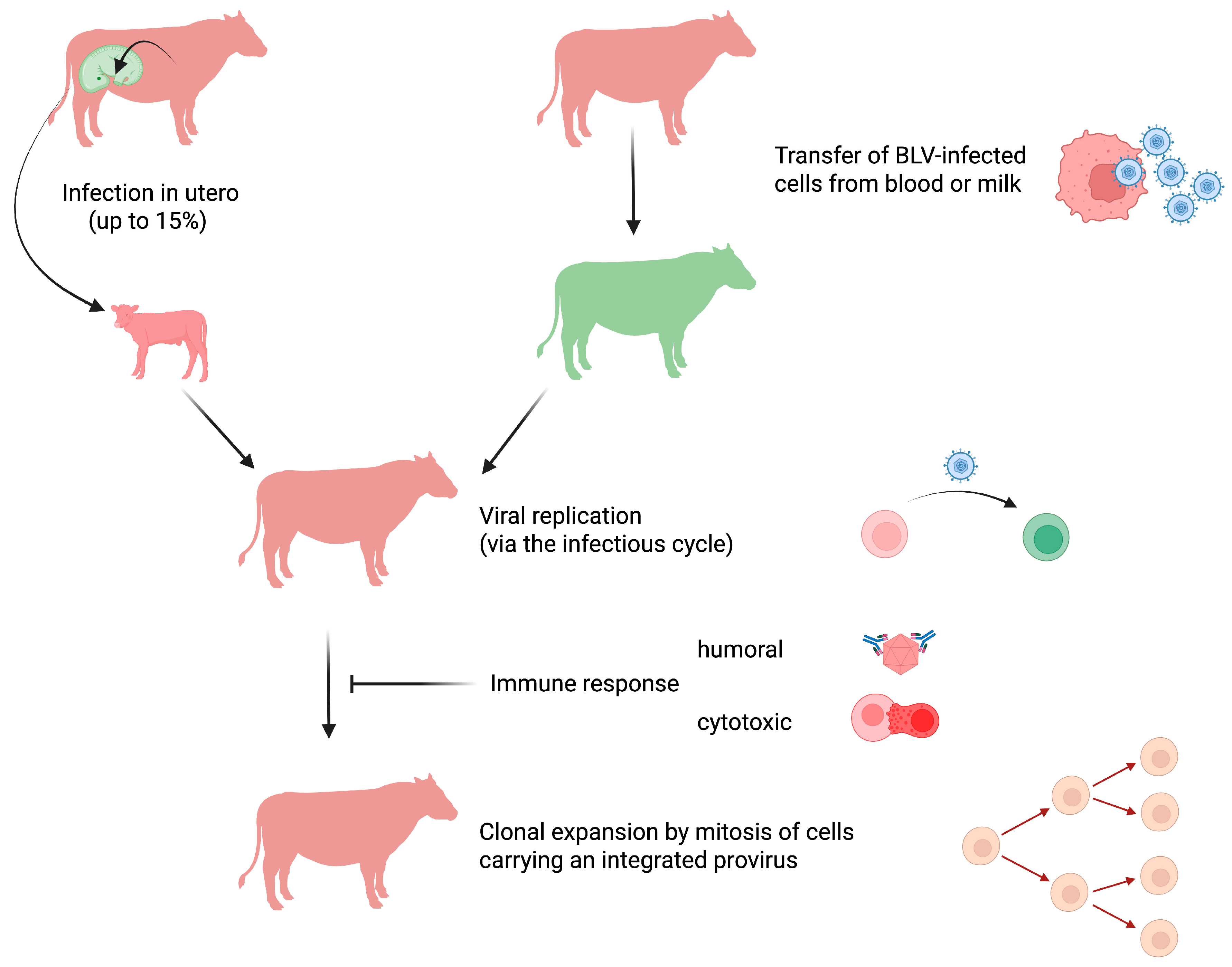
3. Viral Transmission Requires the Transfer of a Live Cell
4. BLV Undergoes Two Distinct Modes of Viral Replication
5. The Host’s Immune Response Controls Viral Replication
- -
- -
- Lymphoid organs such as the spleen regulate the onset of leukemia [66]. Splenectomized sheep develop disease faster.
- -
- Cells expressing the virus have a shorter lifespan [67]. Transient stimulation of viral expression ex vivo reduces persistence of infected cells after reinfusion in vivo.
- -
- Improving promoter strength of the LTR paradoxically reduces BLV replication [68].
- -
- -
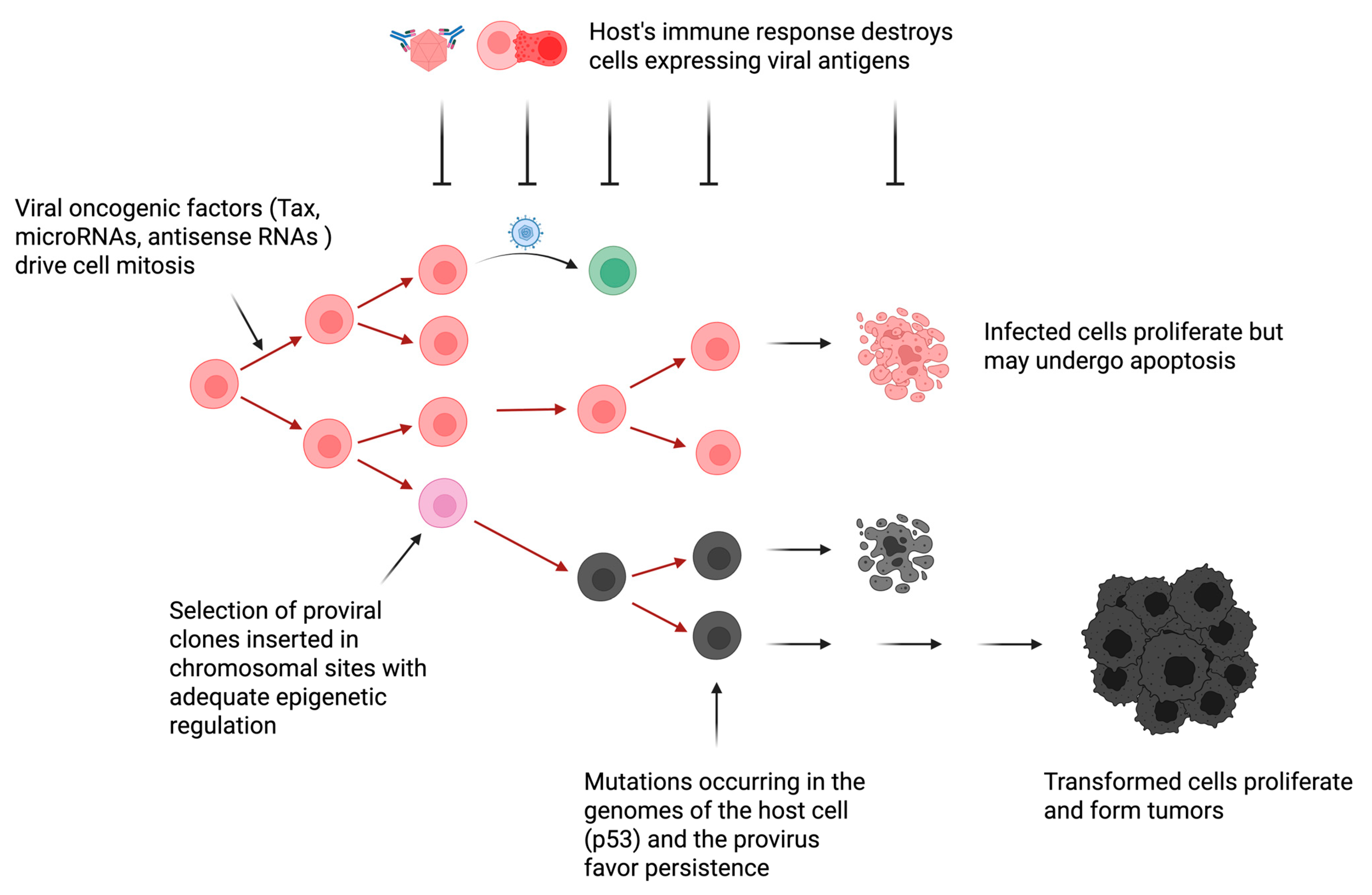
6. Despite Host’s Immunity, BLV Persists Lifelong Leading to Leukemogenesis
- -
- (i) Genetic mutations inside the integrated provirus. Base substitutions and duplications appear in the provirus during leukemogenesis [100,101]. Limited genetic variability is concentrated in envelope and LTR promoter regions (10% at the nucleotide level). Large deletions may occur, generating noninfectious proviruses. The process of homologous recombination generates type 1 deletion mutants lacking the 5′ region of the viral genome. Although this process is frequent at late stages of the pathogenesis, a complete and infectious proviral copy remains intact in the infected animal [102].
- -
- (ii) Epigenetic modifications. Histone deacetylation of LTR chromatin locks down viral transcription [95]. Cytosine methylation of the LTR promoter reduces and shuts off viral gene expression. These mechanisms allow the virus to remain silent and undetectable by the host immunity.
- -
- -
- (iv) Mutations of the host cell genome. Uncontrolled expansion of infected cells leads to mutations in the cellular genome, which may contribute to leukemogenesis [104,105,106]. Enforced clonal expansion of infected cells is associated with the onset of mutations, such as those affecting p53, promoting tumor development.
7. Conclusions
Author Contributions
Funding
Institutional Review Board Statement
Informed Consent Statement
Data Availability Statement
Acknowledgments
Conflicts of Interest
Correction Statement
References
- Burny, A.; Bruck, C.; Cleuter, Y.; Couez, D.; Deschamps, J.; Gregoire, D.; Ghysdael, J.; Kettmann, R.; Mammerickx, M.; Marbaix, G. Bovine leukemia virus and enzootic bovine leukosis. Cancer Res. 1985, 45, 4578s–4582s. [Google Scholar]
- Gillet, N.; Florins, A.; Boxus, M.; Burteau, C.; Nigro, A.; Vandermeers, F.; Balon, H.; Bouzar, A.-B.; Defoiche, J.; Burny, A.; et al. Mechanisms of leukemogenesis induced by bovine leukemia virus. Retrovirology 2007, 4, 18. [Google Scholar] [CrossRef]
- Bartlett, P.C.; Norby, B.; Byrem, T.M.; Parmelee, A.; Ledergerber, J.T.; Erskine, R.J. Current Developments in the Epidemiology and Control of Enzootic Bovine Leukosis as Caused by Bovine Leukemia Virus. Pathogens 2020, 9, 1058. [Google Scholar] [CrossRef]
- Marawan, M.A.; Alouffi, A.; El Tokhy, S.; Badawy, S.; Shirani, I.; Dawood, A.; Guo, A.; Almutairi, M.M.; Alshammari, F.A.; Selim, A. Bovine Leukaemia Virus: Current Epidemiological Circumstance and Future Prospective. Viruses 2021, 13, 2167. [Google Scholar] [CrossRef] [PubMed]
- EFSA Panel on Animal Health and Welfare (AHAW). Enzootic bovine leukosis. EFSA J. 2015, 13, 4188. [Google Scholar] [CrossRef]
- Dagnaw, M.; Alemu Yilhal, G.; Admassu, B.; Demessie, Y. Global distribution and host range of enzootic bovine leukosis in ruminants: A systematic review and meta-analysis. Vet. Anim. Sci. 2025, 30, 100499. [Google Scholar] [CrossRef] [PubMed]
- Zhao, Y.; Wang, J.; Chen, J.; Chen, Y.; Hu, C.; Chen, X.; Guo, A. Bovine Leukemia Virus: Origin, Prevalence, Phylogenetic Diversity, Risk Factors, and Strategies for Control. Animals 2025, 15, 1344. [Google Scholar] [CrossRef]
- Florins, A.; Gillet, N.; Asquith, B.; Boxus, M.; Burteau, C.; Twizere, J.-C.; Urbain, P.; Vandermeers, F.; Debacq, C.; Sanchez-Alcaraz, M.T.; et al. Cell dynamics and immune response to BLV infection: A unifying model. Vet. Immunol. Immunopathol. 2008, 125, 1–7. [Google Scholar] [CrossRef]
- Olaya-Galán, N.N.; Corredor-Figueroa, A.P.; Velandia-Álvarez, S.; Vargas-Bermudez, D.S.; Fonseca-Ahumada, N.; Nuñez, K.; Jaime, J.; Gutiérrez, M.F. Evidence of bovine leukemia virus circulating in sheep and buffaloes in Colombia: Insights into multispecies infection. Arch. Virol. 2022, 167, 807–818. [Google Scholar] [CrossRef]
- Nekoei, S.; Taktaz Hafshejani, T.; Khamesipour, F. Molecular detection of bovine leukemia virus in peripheral blood of Iranian cattle, camel and sheep. Pol. J. Vet. Sci. 2015, 18, 703–707. [Google Scholar] [CrossRef]
- Yektaseresht, A.; Ghane, M.; Kargar, R.; Mohammad-Sadegh, G. Serological and Molecular Evidence of Bovine Leukemia Virus in Sheep Populations in the South of Iran. Vet. Med. Sci. 2025, 11, e70303. [Google Scholar] [CrossRef]
- Sinha, G. Bovine leukemia virus possibly linked to breast cancer. J. Natl. Cancer Inst. 2016, 108, djw010. [Google Scholar] [CrossRef] [PubMed]
- Raouf, M.; Kamai, S.; Elsayed, R.; Zaki, I.; Kholeif, D. Detection of bovine leukemia virus, Epstein-Barr virus and human papillomavirus in breast cancer tissues of Egyptian patients. Infect. Agents Cancer 2025, 20, 43. [Google Scholar] [CrossRef] [PubMed]
- Buehring, G.C.; Shen, H.M.; Jensen, H.M.; Jin, D.L.; Hudes, M.; Block, G. Exposure to bovine leukemia virus is associated with breast cancer: A case–control study. PLoS ONE 2015, 10, e0134304. [Google Scholar] [CrossRef]
- Olaya-Galán, N.N.; Salas-Cárdenas, S.P.; Rodriguez-Sarmiento, J.L.; Ibáñez-Pinilla, M.; Monroy, R.; Corredor-Figueroa, A.P.; Rubiano, W.; de la Peña, J.; Shen, H.; Buehring, G.C.; et al. Risk factor for breast cancer development under exposure to bovine leukemia virus in Colombian women: A case-control study. PLoS ONE 2021, 16, e0257492. [Google Scholar] [CrossRef] [PubMed]
- Gillet, N.; Willems, L.; Gillet, N.; Willems, L. Whole genome sequencing of 51 breast cancers reveals that tumors are devoid of bovine leukemia virus DNA. Retrovirology 2016, 13, 75. [Google Scholar] [CrossRef]
- Khatami, A.; Pormohammad, A.; Farzi, R.; Saadat, H.; Mehrabi, M.; Kiani, S.J.; Ghorbani, S. Bovine Leukemia virus (BLV) and risk of breast cancer: A systematic review and meta-analysis of case-control studies. Infect. Agents Cancer 2020, 15, 48. [Google Scholar] [CrossRef]
- Saeedi-Moghaddam, F.; Mohammaditabar, M.; Mozhgani, S.H. Bovine leukemia virus (BLV) and risk of breast cancer; a systematic review and meta-analysis. Retrovirology 2024, 21, 20. [Google Scholar] [CrossRef]
- Blanco, C.; Quezada-Romegialli, C.; Muñoz, J.P. Bovine Leukemia Virus and Human Breast Cancer: A Review of Clinical and Molecular Evidence. Viruses 2025, 17, 324. [Google Scholar] [CrossRef]
- Bai, L.; Sato, H.; Kubo, Y.; Wada, S.; Aida, Y. CAT1/SLC7A1 acts as a cellular receptor for bovine leukemia virus infection. FASEB J. 2019, 33, 14516–14524. [Google Scholar] [CrossRef]
- Sato, H.; Bai, L.; Borjigin, L.; Aida, Y. Overexpression of bovine leukemia virus receptor SLC7A1/CAT1 enhances cellular susceptibility to BLV infection on luminescence syncytium induction assay (LuSIA). Virology J. 2020, 17, 57. [Google Scholar] [CrossRef]
- Schwartz, I.; Bensaid, A.; Polack, B.; Berthelemy, M.; Levy, D. In vivo leukocyte tropism of bovine leukemia virus in sheep and cattle. J. Virol. 1994, 68, 4589–4595. [Google Scholar] [CrossRef]
- Debacq, C.; Asquith, B.; Reichert, M.; Burny, A.; Kettmann, R.; Willems, L. Reduced cell turnover in bovine leukemia virus-infected, persistently lymphocytotic cattle. J. Virol. 2003, 77, 13073–13083. [Google Scholar] [CrossRef] [PubMed]
- Lima, E.d.S.; Blagitz, M.G.; Batista, C.F.; Alves, A.J.; Fernandes, A.C.d.C.; Sanchez, E.M.R.; Torres, H.F.; Diniz, S.A.; Silva, M.X.; Della Libera, A.M.M.P.; et al. Milk macrophage function in bovine leukemia virus-infected dairy cows. Front. Vet. Sci. 2021, 8, 650021. [Google Scholar] [CrossRef]
- Cantor, G.H.; Pritchard, S.M.; Dequiedt, F.; Willems, L.; Kettmann, R.; Davis, W.C. CD5 is dissociated from the B-cell receptor in B cells from bovine leukemia virus-infected, persistently lymphocytotic cattle: Consequences to B-cell receptor-mediated apoptosis. J. Virol. 2001, 75, 1689–1696. [Google Scholar] [CrossRef]
- Levkut, M.; Ponti, W.; Soligo, D.; Quirici, N.; Rocchi, M.; Lambertenghi Deliliers, G. Expression and quantification of IgG and IgM molecules on the surface of lymphocytes of cattle infected with bovine leukaemia virus. Res. Vet. Sci. 1995, 59, 45–49. [Google Scholar] [CrossRef]
- Roos, E.O.; Bonnet-Di Placido, M.; Mwangi, W.N.; Moffat, K.; Fry, L.M.; Waters, R.; Hammond, J.A. OMIP-085: Cattle B-cell phenotyping by an 8-color panel. Cytometry 2023, 103, 12–15. [Google Scholar] [CrossRef]
- Mendes, R.E.; Perosa, F.F.; Ilha, M.R.S.; Boldori, É.; Tonin, R.V.A.; Graham, E.A.; Piva, M.M.; Gris, A.H.; Rissi, D.R. A divergent anatomic distribution of bovine lymphoma: Time for an update. J. Vet. Diagn. Investig. 2025, in press. [Google Scholar] [CrossRef] [PubMed]
- Horn, V.W.; Perosa, F.F.; Gris, A.H.; Piva, M.M.; Stilz, C.R.; Boldori, É.; Gabriel, M.E.; Pelisser, G.; Pavarini, S.P.; Gomes, T.M.A.; et al. Splenic rupture in dairy cattle: Report of 24 cases. Vet. Pathol. 2025, 62, 74–85. [Google Scholar] [CrossRef] [PubMed]
- Kuczewski, A.; Orsel, K.; Barkema, H.W.; Mason, S.; Erskine, R.; van der Meer, F. Invited review: Bovine leukemia virus—Transmission, control, and eradication. J. Dairy Sci. 2021, 104, 6358–6375. [Google Scholar] [CrossRef]
- Sajiki, Y.; Konnai, S.; Nishimori, A.; Okagawa, T.; Maekawa, N.; Goto, S.; Nagano, M.; Kohara, J.; Kitano, N.; Takahashi, T.; et al. Intrauterine infection with bovine leukemia virus in pregnant dam with high viral load. J. Vet. Med. Sci. 2017, 79, 2036–2040. [Google Scholar] [CrossRef] [PubMed]
- Mekata, H.; Kusuda, E.; Mori, C. Avoidance of Natural Suckling from Dams with Bovine Leukemia Virus Is a Low Priority Countermeasure against Postnatal Transmission. Vet. Sci. 2021, 8, 255. [Google Scholar] [CrossRef]
- Quadros, D.L.; Puhl, K.; Ribeiro, V.A.; Frandoloso, R.; Kreutz, L.C. The transmission of bovine leukemia virus to calves occurs mostly through colostrum and milk. Vet. World 2024, 17, 2918–2924. [Google Scholar] [CrossRef] [PubMed]
- Ferrer, J.F.; Piper, C.E. Role of colostral and milk in in natural resistance to bovine leukemia virus infection. Cancer Res. 1981, 41, 4906–4912. [Google Scholar] [PubMed]
- Hopkins, S.G.; DiGiacomo, R.F. Natural transmission of bovine leukemia virus in dairy and beef cattle. Vet. Clin. North. Am. Food Anim. Pract. 1997, 13, 107–128. [Google Scholar] [CrossRef]
- Kobayashi, S.; Tsutsui, T.; Yamamoto, T.; Hayama, Y.; Kameyama, K.-I.; Konishi, M.; Murakami, K. Risk factors associated with within-herd transmission of bovine leukemia virus on dairy farms in Japan. BMC Vet. Res. 2010, 6, 1. [Google Scholar] [CrossRef]
- Shimizu, K.; Mori, C.; Okada, A.; Inoshima, Y. Use of blood meals from stable flies to evaluate the bovine leukemia virus infection status in cattle herds: A pilot study. J. Vet. Diagn. Investig. 2025, 37, 148–154. [Google Scholar] [CrossRef]
- Kohara, J.; Takeuchi, M.; Hirano, Y.; Sakurai, Y.; Takahashi, T. Vector control efficacy of fly nets on preventing bovine leukemia virus transmission. J. Vet. Med. Sci. 2018, 80, 1524–1527. [Google Scholar] [CrossRef]
- Komatsu, N.; Iwanaga, M.; Hasegawa, Y.; Miura, S.; Fuchi, N.; Moriuchi, H.; Yanagihara, K.; Miura, K. Frequency of HTLV-1 seroconversion between pregnancies in Nagasaki, Japan, 2011–2018. Front Microbiol. 2022, 13, 1036955. [Google Scholar] [CrossRef] [PubMed]
- Benavides, B.; Monti, G. Bovine leukemia virus transmission rates in persistent lymphocytotic infected dairy cows. Front. Vet. Sci. 2024, 11, 1367810. [Google Scholar] [CrossRef] [PubMed]
- Shrestha, S.; Orsel, K.; Droscha, C.; Mijar, S.; van der Meer, F. Removing bovine leukemia virus-infected animals with high proviral load leads to lower within-herd prevalence and new case reduction. J. Dairy Sci. 2024, 107, 6015–6024. [Google Scholar] [CrossRef] [PubMed]
- Borjigin, L.; Watanuki, S.; Hamada, R.; Bai, L.; Hirose, T.; Sato, H.; Yoneyama, S.; Yasui, A.; Yasuda, S.; Yamanaka, R.; et al. Effectiveness of integrated bovine leukemia virus eradication strategies utilizing cattle carrying resistant and susceptible major histocompatibility complex class II DRB3 alleles. J. Dairy Sci. 2023, 106, 9393–9409. [Google Scholar] [CrossRef] [PubMed]
- Ruggiero, V.; Norby, B.; Benitez, O.; Hutchinson, H.; Sporer, K.; Droscha, C.; Swenson, C.; Bartlett, P. Controlling bovine leukemia virus in dairy herds by identifying and removing cows with the highest proviral load and lymphocyte counts. J. Dairy Sci. 2019, 102, 9165–9174. [Google Scholar] [CrossRef] [PubMed]
- Julianera, M.A.; Barrios, C.N.; Ceriani, M.C.; Esteban, E.N. Hot topic: Bovine leukemia virus (BLV)-infected cows with low proviral load are not a source of infection for BLV-free cattle. J. Dairy Sci. 2016, 99, 4586–4589. [Google Scholar]
- Bendixen, H.J. Enzootic bovine leukosis. Adv. Vet. Sci. 1965, 10, 129–204. [Google Scholar]
- Miller, J.M.; Miller, L.D.; Olson, C.; Gillette, K.G. Virus-like particles in phytohemagglutinin-stimulated lymphocyte cultures with reference to bovine lymphosarcoma. J. Natl. Cancer Inst. 1969, 43, 1297–1305. [Google Scholar]
- Willems, L.; Portetelle, D.; Kerkhofs, P.; Chen, G.; Burny, A.; Mammerickx, M.; Kettmann, R. In vivo transfection of bovine leukemia provirus into sheep. Virology 1992, 189, 775–783. [Google Scholar] [CrossRef]
- Pomier, C.; Alcaraz, M.T.S.; Debacq, C.; Lançon, A.; Kerkhofs, P.; Willems, L.; Wattel, E.; Mortreux, F. Early and transient reverse transcription during primary deltaretroviral infection of sheep. Retrovirology 2008, 5, 16. [Google Scholar] [CrossRef]
- A Gillet, N.; Gutiérrez, G.; Rodriguez, S.M.; De Brogniez, A.; Renotte, N.; Alvarez, I.; Trono, K.; Willems, L. Massive depletion of bovine leukemia virus proviral clones located in genomic transcriptionally active sites during primary infection. PLoS Pathog. 2013, 9, e1003687. [Google Scholar] [CrossRef]
- Debacq, C.; Asquith, B.; Kerkhofs, P.; Portetelle, D.; Burny, A.; Kettmann, R.; Willems, L. Increased cell proliferation—But not reduced cell death—Induces lymphocytosis in Bovine Leukemia Virus-infected sheep. Proc. Natl. Acad. Sci. USA 2002, 99, 10048–10053. [Google Scholar] [CrossRef]
- Okagawa, T.; Nojiri, N.; Yoshida-Furihata, H.; Nao, N.; Tominaga, M.; Kohara, J.; Gondaira, S.; Higuchi, H.; Takeda, Y.; Ogawa, H.; et al. Performance evaluation of an improved RAISING method for clonality analysis of bovine leukemia virus-infected cells: A collaborative study in Japan. J. Vet. Med. Sci. 2025, 87, 551–558. [Google Scholar] [CrossRef]
- Moulés, V.; Pomier, C.; Sibon, D.; Gabet, A.-S.; Reichert, M.; Kerkhofs, P.; Willems, L.; Mortreux, F.; Wattel, E. Fate of premalignant clones during the asymptomatic phase preceding lymphoid malignancy. Cancer Res. 2005, 65, 1234–1243. [Google Scholar] [CrossRef]
- Willems, L.; Heremans, H.; Chen, G.; Portetelle, D.; Billiau, A.; Burny, A.; Kettmann, R. Cooperation between bovine leukaemia virus transactivator protein and Ha-ras oncogene product in cellular transformation. EMBO J. 1990, 9, 1577–1581. [Google Scholar] [CrossRef]
- Kincaid, R.P.; Burke, J.M.; Sullivan, C.S. RNA virus microRNA that mimics a B-cell oncomiR. Proc. Natl. Acad. Sci. USA 2012, 109, 3077–3082. [Google Scholar] [CrossRef] [PubMed]
- Rosewick, N.; Momont, M.; Durkin, K.; Takeda, H.; Caiment, F.; Cleuter, Y.; Vernin, C.; Mortreux, F.; Wattel, E.; Burny, A.; et al. Deep sequencing reveals abundant noncanonical retroviral microRNAs in B-cell leukemia/lymphoma. Proc. Natl. Acad. Sci. USA 2013, 110, 2306–2311. [Google Scholar] [CrossRef] [PubMed]
- Lagarias, D.M.; Radke, K. Transcriptional activation of bovine leukemia virus in blood cells from experimentally infected, asymptomatic sheep with latent infections. J. Virol. 1989, 63, 2099–2107. [Google Scholar] [CrossRef] [PubMed]
- Ramanayake, S.; Moulding, D.A.; Tanaka, Y.; Singh, A.; Bangham, C.R.M. Dynamics and consequences of the HTLV-1 proviral plus-strand burst. PLoS Pathog. 2022, 18, e1010774. [Google Scholar] [CrossRef]
- Kerkhofs, P.; Adam, E.; Droogmans, L.; Portetelle, D.; Mammerickx, M.; Burny, A.; Kettmann, R.; Willems, L. Cellular pathways involved in the ex vivo expression of bovine leukemia virus. J. Virol. 1996, 70, 2170–2177. [Google Scholar] [CrossRef]
- Gupta, P.; Ferrer, J.F. Expression of bovine leukemia virus genome is blocked by a nonimmunoglobulin protein in plasma from infected cattle. Science 1982, 215, 405–407. [Google Scholar] [CrossRef]
- Tajima, S.; Aida, Y. Induction of expression of bovine leukemia virus (BLV) in blood taken from BLV-infected cows without removal of plasma. Microbes Infect. 2005, 7, 1211–1216. [Google Scholar] [CrossRef]
- Elemans, M.; Florins, A.; Willems, L.; Asquith, B. Rates of CTL killing in Persistent viral infection in vivo. PLoS Comput. Biol. 2014, 10, e1003534. [Google Scholar] [CrossRef]
- Forletti, A.; Juliarena, M.A.; Ceriani, C.; Amadio, A.F.; Esteban, E.; Gutiérrez, S.E. Identification of cattle carrying alleles associated with resistance and susceptibility to the Bovine Leukemia Virus progression by real-time PCR. Res. Vet. Sci. 2013, 95, 991–995. [Google Scholar] [CrossRef]
- Lo, C.-W.; Borjigin, L.; Saito, S.; Fukunaga, K.; Saitou, E.; Okazaki, K.; Mizutani, T.; Wada, S.; Takeshima, S.-N.; Aida, Y. BoLA-DRB3 Polymorphism is Associated with Differential Susceptibility to Bovine Leukemia Virus-Induced Lymphoma and Proviral Load. Viruses 2020, 12, 352. [Google Scholar] [CrossRef]
- Nakatsuchi, A.; Watanuki, S.; Borjigin, L.; Sato, H.; Bai, L.; Matsuura, R.; Kuroda, M.; Murakami, H.; Sato, R.; Asaji, S.; et al. BoLA-DRB3 Polymorphism Controls Proviral Load and Infectivity of Bovine Leukemia Virus (BLV) in Milk. Pathogens 2022, 11, 210. [Google Scholar] [CrossRef]
- Lohr, C.E.; Sporer, K.R.B.; Brigham, K.A.; Pavliscak, L.A.; Mason, M.M.; Borgman, A.; Ruggiero, V.J.; Taxis, T.M.; Bartlett, P.C.; Droscha, C.J. Phenotypic Selection of Dairy Cattle Infected with Bovine Leukemia Virus Demonstrates Immunogenetic Resilience through NGS-Based Genotyping of BoLA MHC Class II Genes. Pathogens 2022, 11, 104. [Google Scholar] [CrossRef]
- Florins, A.; Reichert, M.; Asquith, B.; Bouzar, A.-B.; Jean, G.; François, C.; Jasik, A.; Burny, A.; Kettmann, R.; Willems, L. Earlier Onset of δ-retrovirus-induced leukemia after splenectomy. PLoS ONE 2009, 4, e6943. [Google Scholar] [CrossRef]
- Florins, A.; Bouzar, A.-B.; Debrogniez, A.; François, C.; Reichert, M.; Willems, L. Viral expression directs the fate of B cells in BLV-infected sheep. J. Virol. 2012, 86, 621–627. [Google Scholar] [CrossRef] [PubMed]
- Merezak, C.; Pierreux, C.; Adam, E.; Lemaigre, F.; Rousseau, G.G.; Calomme, C.; Van Lint, C.; Christophe, D.; Kerkhofs, P.; Burny, A.; et al. Suboptimal enhancer sequences are required for efficient bovine leukemia virus propagation in vivo: Implications for viral latency. J. Virol. 2001, 75, 6977–6988. [Google Scholar] [CrossRef] [PubMed]
- Merezak, C.; Reichert, M.; Van Lint, C.; Kerkhofs, P.; Portetelle, D.; Willems, L.; Kettmann, R. Inhibition of histone deacetylases induces bovine leukemia virus expression in vitro and in vivo. J. Virol. 2002, 76, 5034–5042. [Google Scholar] [CrossRef]
- Achachi, A.; Florins, A.; Gillet, N.; Debacq, C.; Urbain, P.; Foutsop, G.M.; Vandermeers, F.; Jasik, A.; Reichert, M.; Kerkhofs, P.; et al. Valproate activates bovine leukemia virus gene expression, triggers apoptosis and induces leukemia/lymphoma regression in vivo. Proc. Natl. Acad. Sci. USA 2005, 102, 10309–10314. [Google Scholar] [CrossRef] [PubMed]
- Abdala, A.; Alvarez, I.; Brossel, H.; Calvinho, L.; Carignano, H.; Franco, L.; Gazon, H.; Gillissen, C.; Hamaidia, M.; Hoyos, C.; et al. BLV: Lessons on vaccine development. Retrovirology 2019, 16, 26. [Google Scholar] [CrossRef] [PubMed]
- Archilla, G.S.; Gutiérrez, G.; Camussone, C.; Calvinho, L.; Abdala, A.; Alvarez, I.; Petersen, M.; Franco, L.; Destefano, G.; Monti, G.; et al. A safe and effective vaccine against bovine leukemia virus. Front. Immunol. 2022, 13, 980514. [Google Scholar] [CrossRef] [PubMed]
- Nakamura, H.; Konnai, S.; Okagawa, T.; Maekawa, N.; Tiyamanee, W.; Ikehata, M.; Matsubara, K.; Watari, K.; Kamitani, K.; Saito, M.; et al. Comprehensive analysis of immune checkpoint molecules profiles phenotype and function of exhausted T cells in enzootic bovine leukosis. J. Immunol. 2025, in press. [Google Scholar] [CrossRef] [PubMed]
- Werling, D.; Howard, C.J.; Niederer, E.; Straub, O.C.; Saalmüller, A.; Langhans, W. Analysis of the phenotype and phagocytic activity of monocytes/macrophages from cattle infected with the bovine leukaemia virus. Vet. Immunol. Immunopathol. 1998, 62, 185–195. [Google Scholar] [CrossRef]
- Frie, M.C.; Coussens, P.M. Bovine leukemia virus: A major silent threat to proper immune responses in cattle. Vet. Immunol. Immunopathol. 2015, 163, 103–114. [Google Scholar] [CrossRef]
- Konnai, S.; Murata, S.; Ohashi, K. Immune exhaustion during chronic infections in cattle. J. Vet. Med. Sci. 2017, 79, 1–5. [Google Scholar] [CrossRef]
- Nakamura, H.; Konnai, S.; Okagawa, T.; Maekawa, N.; Sajiki, Y.; Watari, K.; Kamitani, K.; Saito, M.; Kato, Y.; Suzuki, Y.; et al. Combined Immune Checkpoint Blockade Enhances Antiviral Immunity against Bovine Leukemia Virus. J. Virol. 2023, 97, e0143022. [Google Scholar] [CrossRef]
- Menin, Á.; Bueno, N.M.M.; Hindlmayer, M.E.; Reck, C.; Nogueira, L.d.L.; Pinto, A.R.; Báfica, A. BLV coinfection impairs immunity and diagnostics in bovine tuberculosis. Sci. Rep. 2025, 15, 30286. [Google Scholar] [CrossRef]
- Ohira, K.; Nakahara, A.; Konnai, S.; Okagawa, T.; Nishimori, A.; Maekawa, N.; Ikebuchi, R.; Kohara, J.; Murata, S.; Ohashi, K. Bovine leukemia virus reduces anti-viral cytokine activities and NK cytotoxicity by inducing TGF-β secretion from regulatory T cells. Immun. Inflamm. Dis. 2016, 4, 52–63. [Google Scholar] [CrossRef]
- Watanabe, A.; Murakami, H.; Kakinuma, S.; Murao, K.; Oomae, K.; Akamatsu, H.; Seto, T.; Shinozuka, Y.; Kawai, K. Predicting an increased risk of severe clinical mastitis and economic loss using a threshold value of bovine leukemia virus proviral load. Am. J. Vet. Res. 2023, 27, 1–9. [Google Scholar] [CrossRef]
- Nascimento, A.M.M.D.; de Souza, C.M.S.; Oliveira, A.C.D.; Blagitz, M.G.; Sanchez, E.M.R.; Della Libera, A.M.M.P.; Leite, R.d.M.H.; Fernandes, A.C.d.C.; Souza, F.N. The bovine leukemia virus infection prolongs immunosuppression in dairy cows during the periparturient period by sustaining higher expression of immunological checkpoints in T cells. Vet. Immunol. Immunopathol. 2023, 263, 110636. [Google Scholar] [CrossRef]
- Nakada, S.; Fujimoto, Y.; Kohara, J.; Makita, K. Economic losses associated with mastitis due to bovine leukemia virus infection. J. Dairy Sci. 2023, 106, 576–584. [Google Scholar] [CrossRef]
- Watanabe, A.; Maeda, Y.; Murakami, H.; Miyoshi, S.; Miura, M.; Murao, K.; Shinozuka, Y.; Kurumisawa, T.; Kawai, K. Evaluation of the Therapeutic Effect of Levamisole on Subclinical Mastitis in Bovine Leukemia Virus-Infected Cows Classified by Proviral Load. Animals 2025, 15, 2145. [Google Scholar] [CrossRef] [PubMed]
- Archambault, D.; Morin, G.; Elazhary, M.A. Possible impairment of rotavirus immune response in cattle infected with BLV. Vet. Rec. 1989, 124, 570. [Google Scholar] [CrossRef] [PubMed]
- Orlik, O.; Splitter, G.A. Progression to persistent lymphocytosis and tumor development in bovine leukemia virus (BLV)-infected cattle correlates with impaired proliferation of CD4+ T cells in response to gag- and env-encoded BLV proteins. J. Virol. 1996, 70, 7584–7593. [Google Scholar] [CrossRef]
- Frie, M.C.; Sporer, K.R.; Wallace, J.C.; Maes, R.K.; Sordillo, L.M.; Bartlett, P.C.; Coussens, P.M. Reduced humoral immunity and atypical cell-mediated immunity in response to vaccination in cows naturally infected with bovine leukemia virus. Vet. Immunol. Immunopathol. 2016, 182, 125–135. [Google Scholar] [CrossRef]
- Rosen, C.; Sodroski, J.; Willems, L.; Kettmann, R.; Campbell, K.; Zaya, R.; Burny, A.; Haseltine, W. The 3′ region of bovine leukemia virus genome encodes a trans-activator protein. EMBO J. 1986, 5, 2585–2589. [Google Scholar] [CrossRef] [PubMed]
- Derse, D. Bovine leukemia virus transcription is controlled by a virus-encoded trans-acting factor and by cis-acting response elements. J. Virol. 1987, 61, 2462–2471. [Google Scholar] [CrossRef]
- Willems, L.; Gegonne, A.; Chen, G.; Burny, A.; Kettmann, R.; Ghysdael, J. The bovine leukemia virus p34 is a transactivator protein. EMBO J. 1987, 6, 3385–3389. [Google Scholar] [CrossRef]
- Derse, D. Trans-acting regulation of bovine leukemia virus mRNA processing. J. Virol. 1988, 62, 1115–1119. [Google Scholar] [CrossRef]
- Alexandersen, S.; Carpenter, S.; Christensen, J.; Storgaard, T.; Viuff, B.; Wannemuehler, Y.; Belousov, J.; A Roth, J. Identification of alternatively spliced mRNAs encoding potential new regulatory proteins in cattle infected with bovine leukemia virus. J. Virol. 1993, 67, 39–52. [Google Scholar] [CrossRef]
- A Gillet, N.; Hamaidia, M.; De Brogniez, A.; Gutiérrez, G.; Renotte, N.; Reichert, M.; Trono, K.; Willems, L. Bovine leukemia virus small noncoding RNAs are functional elements that regulate replication and contribute to oncogenesis in vivo. PLoS Pathog. 2016, 12, e1005588. [Google Scholar] [CrossRef]
- Safari, R.; Jacques, J.R.; Brostaux, Y.; Willems, L. Ablation of non-coding RNAs affects bovine leukemia virus B lymphocyte proliferation and abrogates oncogenesis. PLoS Pathog. 2020, 16, e1008502. [Google Scholar] [CrossRef]
- Durkin, K.; Rosewick, N.; Artesi, M.; Hahaut, V.; Griebel, P.; Arsic, N.; Burny, A.; Georges, M.; Van den Broeke, A. Characterization of novel Bovine Leukemia Virus (BLV) antisense transcripts by deep sequencing reveals constitutive expression in tumors and transcriptional interaction with viral microRNAs. Retrovirology 2016, 13, 33. [Google Scholar] [CrossRef]
- Plant, E.; Bellefroid, M.; Van Lint, C. A complex network of transcription factors and epigenetic regulators involved in bovine leukemia virus transcriptional regulation. Retrovirology 2023, 20, 11. [Google Scholar] [CrossRef] [PubMed]
- Matsuoka, M.; Mesnard, J.M. HTLV-1 bZIP factor: The key viral gene for pathogenesis. Retrovirology 2020, 17, 2. [Google Scholar] [CrossRef] [PubMed]
- Andoh, K.; Nishimori, A.; Matsuura, Y. The bovine leukemia virus-derived long non-coding RNA AS1-S binds to bovine hnRNPM and alters the interaction between hnRNPM and host mRNAs. Microbiol. Spectr. 2023, 11, e0085523. [Google Scholar] [CrossRef]
- Joris, T.; Jouant, T.; Jacques, J.-R.; Gouverneur, L.; Saintmard, X.; Mañá, L.V.; Jamakhani, M.; Reichert, M.; Willems, L. Reduction of antisense transcription affects bovine leukemia virus replication and oncogenesis. PLoS Pathog. 2024, 20, e1012659. [Google Scholar] [CrossRef] [PubMed]
- Rosewick, N.; Durkin, K.; Artesi, M.; Marçais, A.; Hahaut, V.; Griebel, P.; Arsic, N.; Avettand-Fenoel, V.; Burny, A.; Charlier, C.; et al. Cis-perturbation of cancer drivers by the HTLV-1/BLV proviruses is an early determinant of leukemogenesis. Nat. Commun. 2017, 8, 15264. [Google Scholar] [CrossRef]
- Pavliscak, L.A.; Nirmala, J.; Singh, V.K.; Sporer, K.R.B.; Taxis, T.M.; Kumar, P.; Goyal, S.M.; Mor, S.K.; Schroeder, D.C.; Wells, S.J.; et al. Tracing Viral Transmission and Evolution of Bovine Leukemia Virus through Long Read Oxford Nanopore Sequencing of the Proviral Genome. Pathogens 2021, 10, 1191. [Google Scholar] [CrossRef]
- Artesi, M.; Hahaut, V.; Cole, B.; Lambrechts, L.; Ashrafi, F.; Marçais, A.; Hermine, O.; Griebel, P.; Arsic, N.; van der Meer, F.; et al. PCIP-seq: Simultaneous sequencing of integrated viral genomes and their insertion sites with long reads. Genome Biol. 2021, 22, 97. [Google Scholar] [CrossRef] [PubMed]
- Tajima, S.; Ikawa, Y.; Aida, Y. Complete bovine leukemia virus (BLV) provirus is conserved in BLV-infected cattle throughout the course of B-cell lymphosarcoma development. J. Virol. 1998, 72, 7569–7576. [Google Scholar] [CrossRef]
- Bellefroid, M.; Rodari, A.; Galais, M.; Krijger, P.H.L.; Tjalsma, S.J.D.; Nestola, L.; Plant, E.; Vos, E.S.M.; Cristinelli, S.; Van Driessche, B.; et al. Role of the cellular factor CTCF in the regulation of bovine leukemia virus latency and three-dimensional chromatin organization. Nucleic Acids Res. 2022, 50, 3190–3207. [Google Scholar] [CrossRef] [PubMed]
- Dequiedt, F.; Kettmann, R.; Burny, A.; Willems, L. Mutations of the p53 tumor-suppressor gene are frequently involved during bovine leukemia virus (BLV)-induced leukemogenesis in cattle but not in sheep. Virology 1995, 209, 676–683. [Google Scholar] [CrossRef] [PubMed]
- Konishi, M.; Kameyama, K.; Yamamoto, T. Mutations in the tumor suppressor gene p53 in cattle are associated with enzootic bovine leukosis. Vet. Microbiol. 2021, 263, 109269. [Google Scholar] [CrossRef]
- Nishimori, A.; Andoh, K.; Matsuura, Y.; Okagawa, T.; Konnai, S. Effect of C-to-T transition at CpG sites on tumor suppressor genes in tumor development in cattle evaluated by somatic mutation analysis in enzootic bovine leukosis. mSphere 2024, 9, e0021624. [Google Scholar] [CrossRef]


Disclaimer/Publisher’s Note: The statements, opinions and data contained in all publications are solely those of the individual author(s) and contributor(s) and not of MDPI and/or the editor(s). MDPI and/or the editor(s) disclaim responsibility for any injury to people or property resulting from any ideas, methods, instructions or products referred to in the content. |
© 2025 by the authors. Licensee MDPI, Basel, Switzerland. This article is an open access article distributed under the terms and conditions of the Creative Commons Attribution (CC BY) license (https://creativecommons.org/licenses/by/4.0/).
Share and Cite
Doucet, F.; Fontaine, A.; Hamaidia, M.; Jacques, J.-R.; Jouant, T.; Mhaidly, N.; Qin, S.; Terres, R.; Saintmard, X.; Willems, L.; et al. The Complexity of Bovine Leukemia Virus Oncogenesis. Viruses 2025, 17, 1609. https://doi.org/10.3390/v17121609
Doucet F, Fontaine A, Hamaidia M, Jacques J-R, Jouant T, Mhaidly N, Qin S, Terres R, Saintmard X, Willems L, et al. The Complexity of Bovine Leukemia Virus Oncogenesis. Viruses. 2025; 17(12):1609. https://doi.org/10.3390/v17121609
Chicago/Turabian StyleDoucet, Florine, Alexis Fontaine, Malik Hamaidia, Jean-Rock Jacques, Thomas Jouant, Nour Mhaidly, Songkang Qin, Roxane Terres, Xavier Saintmard, Luc Willems, and et al. 2025. "The Complexity of Bovine Leukemia Virus Oncogenesis" Viruses 17, no. 12: 1609. https://doi.org/10.3390/v17121609
APA StyleDoucet, F., Fontaine, A., Hamaidia, M., Jacques, J.-R., Jouant, T., Mhaidly, N., Qin, S., Terres, R., Saintmard, X., Willems, L., & Zwaenepoel, M. (2025). The Complexity of Bovine Leukemia Virus Oncogenesis. Viruses, 17(12), 1609. https://doi.org/10.3390/v17121609