You are currently on the new version of our website. Access the old version .
ForestsForests
  • Review
  • Open Access

8 January 2026

Air Pollution as a Driver of Forest Dynamics: Patterns, Mechanisms, and Knowledge Gaps

,
,
,
,
,
and
1
Natural Sciences Museum Complex “Răsvan Angheluţă” Galați, No. 11 Street Regimentul 11, 800340 Galaţi, Romania
2
National Institute for Research and Development in Forestry “Marin Drăcea”, 128 Eroilor Boulevard, 077190 Voluntari, Romania
3
Department of Chemistry, Physics and Environment, Faculty of Sciences and Environmental, Dunărea de Jos University Galați, 47 Domnească Street, 800008 Galati, Romania
4
Rexdan Research Infrastructure, “Dunarea de Jos” University of Galati, 800008 Galati, Romania
This article belongs to the Section Forest Meteorology and Climate Change

Abstract

Air pollution is a major but often under-integrated driver of forest dynamics at the global scale. This review combines a bibliometric analysis of 258 peer-reviewed studies with a synthesis of ecological, physiological, and biogeochemical evidence to clarify how multiple air pollutants influence forest structure, function, and regeneration. Research output is dominated by Europe, East Asia, and North America, with ozone, nitrogen deposition, particulate matter, and acidic precipitation receiving the greatest attention. Across forest biomes, air pollution affects growth, wood anatomy, nutrient cycling, photosynthesis, species composition, litter decomposition, and soil chemistry through interacting pathways. Regional patterns reveal strong context dependency, with heightened sensitivity in mountain and boreal forests, pronounced ozone exposure in Mediterranean and peri-urban systems, episodic oxidative stress in tropical forests, and long-term heavy-metal accumulation in industrial regions. Beyond being impacted, forests actively modify atmospheric chemistry through pollutant filtration, aerosol interactions, and deposition processes. The novelty of this review lies in explicitly framing air pollution as a dynamic driver of forest change, with direct implications for afforestation and restoration on degraded lands. Key knowledge gaps remain regarding combined pollution–climate effects, understudied forest biomes, and the scaling of physiological responses to ecosystem and regional levels, which must be addressed to support effective forest management under global change.

1. Introduction

Forests are among the most important terrestrial ecosystems, providing essential ecosystem services such as carbon sequestration, climate regulation, biodiversity conservation, soil protection, water regulation, and socio-economic benefits. However, forest ecosystems worldwide are increasingly threatened by multiple anthropogenic stressors, among which atmospheric air pollution plays a critical role. Over the last two decades, forest research has evolved from documenting visible forest decline caused by air pollution toward a broader and more integrative understanding of forest health, encompassing productivity, resilience, and the capacity of forests to sustain ecosystem services under multiple environmental pressures [1].
This shift in perspective has highlighted the need to consider forests as complex systems influenced by interacting drivers rather than isolated stress factors. In particular, the combined effects of air pollution and climate change—including elevated ozone concentrations, altered nitrogen deposition, and changes in carbon and water availability—have emerged as critical research themes. Current evidence suggests that air pollution may pose increasing risks to forests under changing climatic conditions, especially when interacting with abiotic and biotic stressors such as drought, competition, pests, and fire. These interactions generate antagonistic and synergistic responses that affect ecosystem services related to productivity, biodiversity, soil protection, water balance, and socio-economic value, underscoring the need for integrated research, monitoring, and modeling approaches [1].
European forests are expected to undergo substantial transformations driven by climate change, which, when coupled with changes in air quality, may significantly influence forest productivity, species composition, and carbon storage in vegetation and soils. Despite extensive research efforts, key knowledge gaps remain. These include: (i) understanding how changes in air quality (e.g., trace gas concentrations) interact with climate and site-specific factors to shape ecosystem responses, (ii) clarifying the role of biotic processes in ecosystem functioning, (iii) developing tools that enable mechanistic understanding and scaling from local observations to regional and continental patterns, and (iv) integrating empirical data with modeling frameworks to achieve a unified and predictive understanding of forest dynamics [2].
In parallel, recent studies have emphasized the reciprocal relationship between forests and air pollution, highlighting the capacity of forest ecosystems to mitigate air pollution and its associated health impacts. Using satellite imagery, individual-level mortality records, and air quality data across China, Liu et al. [3] demonstrated that increased forest greenness improves air quality and reduces mortality. A 10-percentage-point increase in seasonal average normalized difference vegetation index (NDVI) was associated with a 2.6-point improvement in the air quality index (AQI), corresponding to reductions of 1.09% in cardiorespiratory deaths and 0.87% in non-cardiorespiratory deaths. Moreover, forest greenness was shown to mitigate pollution-related mortality risks, with particularly strong benefits observed among elderly males. These findings suggest that the health benefits derived from increased forest cover can substantially outweigh the costs of forest conservation [3].
Despite these benefits, forest ecosystems are projected to face increasing exposure to harmful air pollutants at the global scale. By 2100, approximately 49% of forests worldwide (around 17 million km2) are expected to be exposed to damaging levels of tropospheric ozone. Although sulfur dioxide (SO2) emissions have declined by 48% in North America and 25% in Europe, sulfur deposition is still projected to threaten up to 5.9 million km2 of forest area by 2050. Meanwhile, nitrogen oxide emissions have remained stable or slightly increased, leading to significant changes in the SO42−/NO3 ratio in precipitation over the past two decades, alongside shifts in temperature and precipitation regimes. Although long-term monitoring programs have generated extensive datasets, these data often lack the conceptual and statistical rigor required to detect subtle trends in forest health or to establish causal relationships, highlighting the need for improved and restructured monitoring strategies [4].
The effects of air pollution on forest ecosystems can be broadly categorized into three exposure classes. At low exposure levels (Class I), forests function primarily as sinks for atmospheric pollutants, often with negligible or even positive effects on ecosystem functioning. At intermediate exposure levels (Class II), air pollution may subtly impair physiological processes at the species level, affecting nutrient balance, photosynthesis, reproduction, and resistance to pests and diseases. These changes can lead to reduced productivity, biomass loss, or gradual shifts in species composition. At high exposure levels (Class III), acute damage may result in tree morbidity or mortality, triggering pronounced alterations in ecosystem structure, hydrology, nutrient cycling, erosion processes, microclimate, and overall ecosystem stability [5].
The synergistic interactions between air pollution and climate change—particularly elevated ozone concentrations and altered nitrogen, carbon, and water availability—represent a critical frontier for forest research. Climate-induced changes in water dynamics have been widely documented [6,7,8], and forests play a central role in regulating the hydrological cycle through evapotranspiration, infiltration, and runoff. However, climate change can disrupt these processes, intensifying soil erosion and surface runoff [9,10,11], increasing forest vulnerability, mortality rates, and shifts in species composition, while reducing the capacity of forests to deliver key ecosystem services [12,13,14,15].
Although numerous reviews have addressed air pollution impacts [16,17,18,19] and broader forest ecosystem responses [20,21,22,23], a notable gap remains in the literature regarding the role of air pollution in the afforestation of degraded lands. This gap is particularly critical given the increasing reliance on afforestation as a strategy for ecosystem restoration, climate mitigation, and land degradation reversal. Accordingly, this review is guided by three main objectives: (1) to identify the dominant pollutants and spatial patterns shaping forest dynamics across biomes; (2) to synthesize the physiological, ecological, and biogeochemical mechanisms through which air pollution influences forest structure, function, and regeneration; and (3) to assess how these processes affect afforestation outcomes on degraded lands under interacting pressures from climate change and land use. By addressing these questions, the review aims to highlight critical knowledge gaps that currently constrain restoration planning and sustainable forest management.

2. Materials and Methods

The methodological workflow consisted of two complementary components. The first involved a bibliometric assessment designed to identify global research patterns concerning the influence of air pollution on forest dynamics. The second component comprised a traditional literature review aimed at synthesizing thematic insights from the selected body of work. While bibliometric analyses provide a structured, quantitative overview of publication trends and intellectual linkages, they are inherently constrained by database coverage, keyword selection, and document indexing practices. These limitations were explicitly considered when interpreting the results and integrating them into the qualitative synthesis.

2.1. Bibliometric Analysis

2.1.1. Data Sources and Search Strategy

The bibliometric phase drew upon two major international bibliographic databases: Scopus and the Science Citation Index Expanded (SCI-Expanded) within the Web of Science (WoS) platform. Searches were conducted using the core phrase “influence of air pollution on forest dynamics” together with an extended list of subject-specific terms. Additional keywords (e.g., forest health, atmospheric pollution, forest decline, ecosystem responses, environmental stress) were combined through Boolean operators AND and OR to construct a comprehensive search strategy capturing broad and specific aspects of air pollution impacts on forest ecosystems.
Although the phrase “forest dynamics” was used as a central conceptual anchor, we acknowledge that relevant studies may employ alternative terminology (e.g., tree growth, stand development, ecosystem change) without explicitly using this term. To mitigate this potential bias, the search strategy incorporated multiple related expressions describing forest condition, productivity, decline, and ecosystem responses. Nevertheless, some relevant studies may remain outside the retrieved dataset due to differences in terminology or indexing practices.
All retrieved records were screened and refined according to the PRISMA (Preferred Reporting Items for Systematic Reviews and Meta-Analyses) framework to ensure transparency and reproducibility [24].

2.1.2. Search Strings

To facilitate methodological reproducibility, the exact search strings used in each database are presented below. Standard operators, quotation marks, and field tags were adapted as required by individual database rules. To retrieve the most relevant literature, we adapted the search strings to the specific syntax and Boolean logic used by each database. Scopus and Web of Science (WoS) apply Boolean operators with different precedence rules and allow different forms of truncation and field-specific search structures. Therefore, the keywords were aligned conceptually but adjusted technically for each platform. In Scopus, the search was conducted in the TITLE-ABS-KEY field, which requires explicit grouping of synonyms, whereas in WoS the Topic (TS) field automatically searches title, abstract, keywords, and Keywords Plus. Consequently, minor variations in structure and term grouping were necessary to ensure that both databases captured the same thematic scope—air pollution effects on forest dynamics, decline, health, productivity, and associated ecosystem responses—while remaining fully compliant with each platform’s search rules.
Scopus (advanced search; field: TITLE-ABS-KEY): TITLE-ABS-KEY(“air pollution” AND “forest dynamics” OR “forest decline” OR “forest health” OR “atmospheric pollutants” OR “ecosystem response*”)
Web of Science—SCI-Expanded (topic search; TS): TS = (“air pollution” AND “forest dynamics” OR “forest decline” OR “forest productivity” OR “tree growth” OR “atmospheric deposition”)
Wildcard characters (*) were included where appropriate to expand the search to plural forms and morphological variations. Slight adjustments were applied between databases to maintain logical consistency while accommodating platform-specific syntax.

2.1.3. Search Parameters

Time range: no temporal restrictions; all years available in Scopus and WoS at the time of data extraction were considered.
Document types: peer-reviewed research articles and review papers were included as the core literature. Conference papers and book chapters were also retained where they provided substantive empirical results or methodological innovations relevant to air pollution–forest interactions. We recognize that the inclusion of non-journal literature introduces a degree of heterogeneity; however, these sources were retained to capture emerging research topics and region-specific evidence that may not yet be fully represented in journal publications.
Excluded records: editorial materials, letters, notes, and theses were removed during the screening process.

2.1.4. De-Duplication and Data Validation

Duplicate entries were eliminated using a two-level procedure:
1. Automated removal through DOI and title matching in Microsoft Excel.
2. Manual verification of residual cases by comparing titles, authors, publication years, and journal names to resolve incomplete metadata or inconsistent DOI information.
This procedure resulted in the removal of 87 duplicate records. Additional quality control steps included verification of bibliographic metadata, correction of typographical or OCR-related errors, and harmonization of author and institutional names. All modifications were logged in an internal audit file.

2.1.5. Eligibility Criteria

A two-stage screening approach was employed:
-Title and abstract screening, undertaken independently by two reviewers.
-Full-text evaluation, applied to all potentially relevant papers.
Inclusion criteria required that articles:
-were peer-reviewed;
-directly addressed air pollution impacts on forest ecosystems, forest dynamics, or tree physiological responses;
-provided adequate methodological and descriptive information;
-contained complete bibliographic metadata.
Exclusion criteria applied to:
-documents lacking peer review (e.g., editorials, correspondence, theses);
-studies not focused on forest ecosystems or lacking relevant pollutant/forest interaction data;
-papers in which air pollution was only tangentially mentioned;
-records without accessible full texts or missing abstracts.
Full-text exclusions were categorized using the following codes:
(A) outside the thematic scope, (B) non-peer-reviewed, (C) insufficient pollution-forest data, (D) inaccessible full text, (E) inadequate methodological description.

2.1.6. Screening Process

The screening procedure was performed independently by two reviewers (A and B). Any publication considered relevant by at least one reviewer during the first stage progressed to full-text review. Conflicts or discrepancies in the second stage were resolved through consultation with a senior reviewer (C).
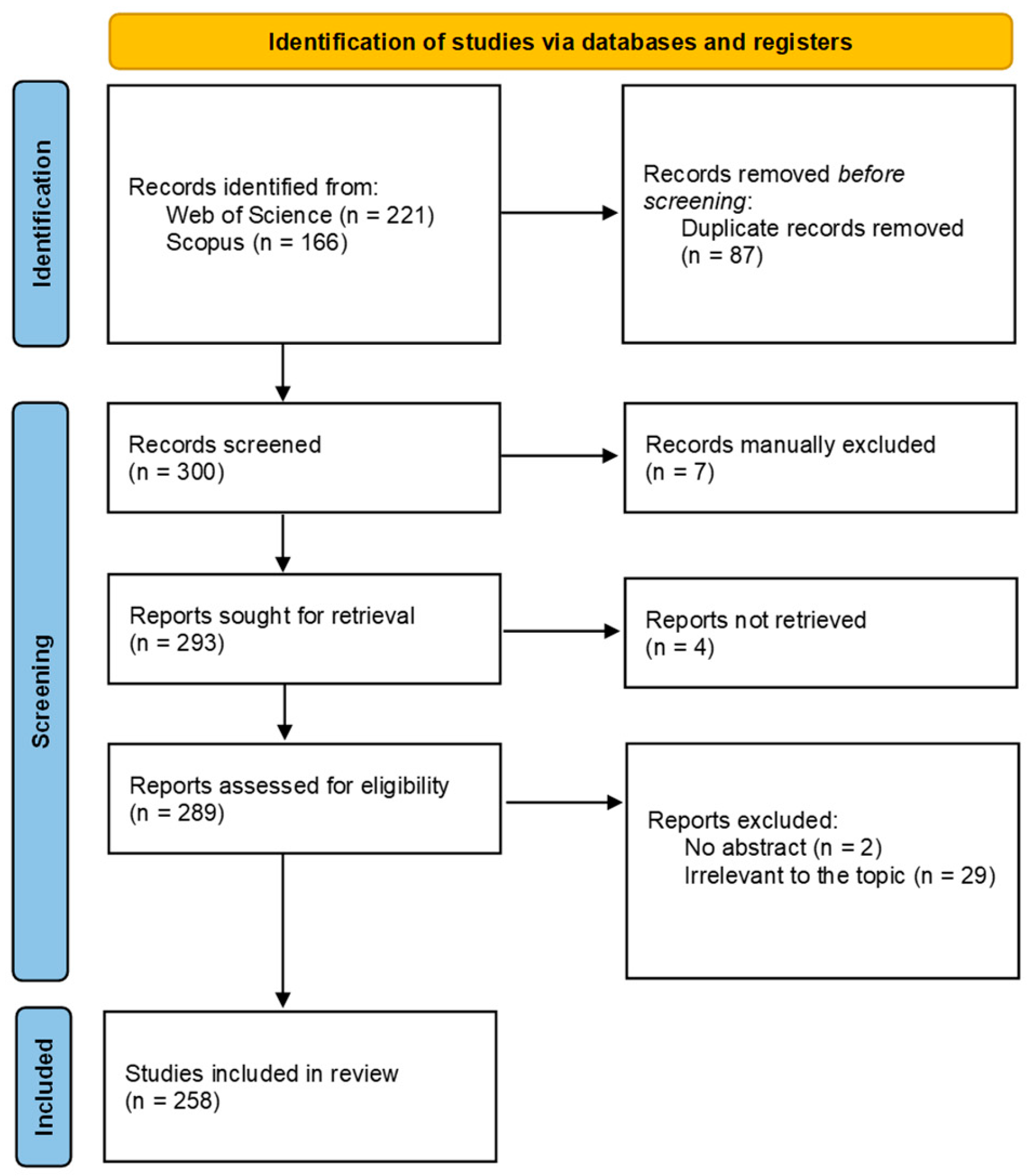
The search initially identified 387 publications (166 in Scopus; 221 in WoS). After duplicate removal, 300 unique records remained. Application of inclusion/exclusion criteria resulted in the removal of 8 items due to manual filtering, 5 inaccessible papers, 5 records without abstracts, and 86 irrelevant publications. Ultimately, 258 articles were retained for bibliometric mapping and qualitative interpretation (Figure 1).
Figure 1. Selection process of the eligible reports based on the PRISMA 2020 flow diagram.
Bibliometric analyses were performed using Web of Science Core Collection (v.5.35) [25], Scopus [26], Microsoft Excel 2024 [27], and Geochart [28]. In addition, VOSviewer (v.1.6.20) [29] was used to construct visual networks for co-authorship, co-citation, and keyword co-occurrence analyses. These analyses were not intended to be purely descriptive; rather, they were used to identify dominant research clusters, influential publications, and underrepresented themes that subsequently guided the structure and emphasis of the narrative synthesis.

2.2. Traditional Literature Review

The second phase consisted of a narrative synthesis based on the refined dataset. A subset of 258 publications underwent detailed qualitative assessment to identify dominant research themes and conceptual linkages. A total of 258 publications met our inclusion criteria and were fully analyzed. Of these, 150 were selected for citation in the manuscript because they provided the most directly relevant insights, empirical evidence, or conceptual contributions to our synthesis.
Importantly, the outcomes of the bibliometric analysis informed the narrative review by highlighting major thematic clusters, frequently co-occurring keywords, and gaps in geographic or topical coverage. These quantitative signals were used to prioritize themes, balance regional representation, and explicitly address underexplored research questions within the narrative discussion.
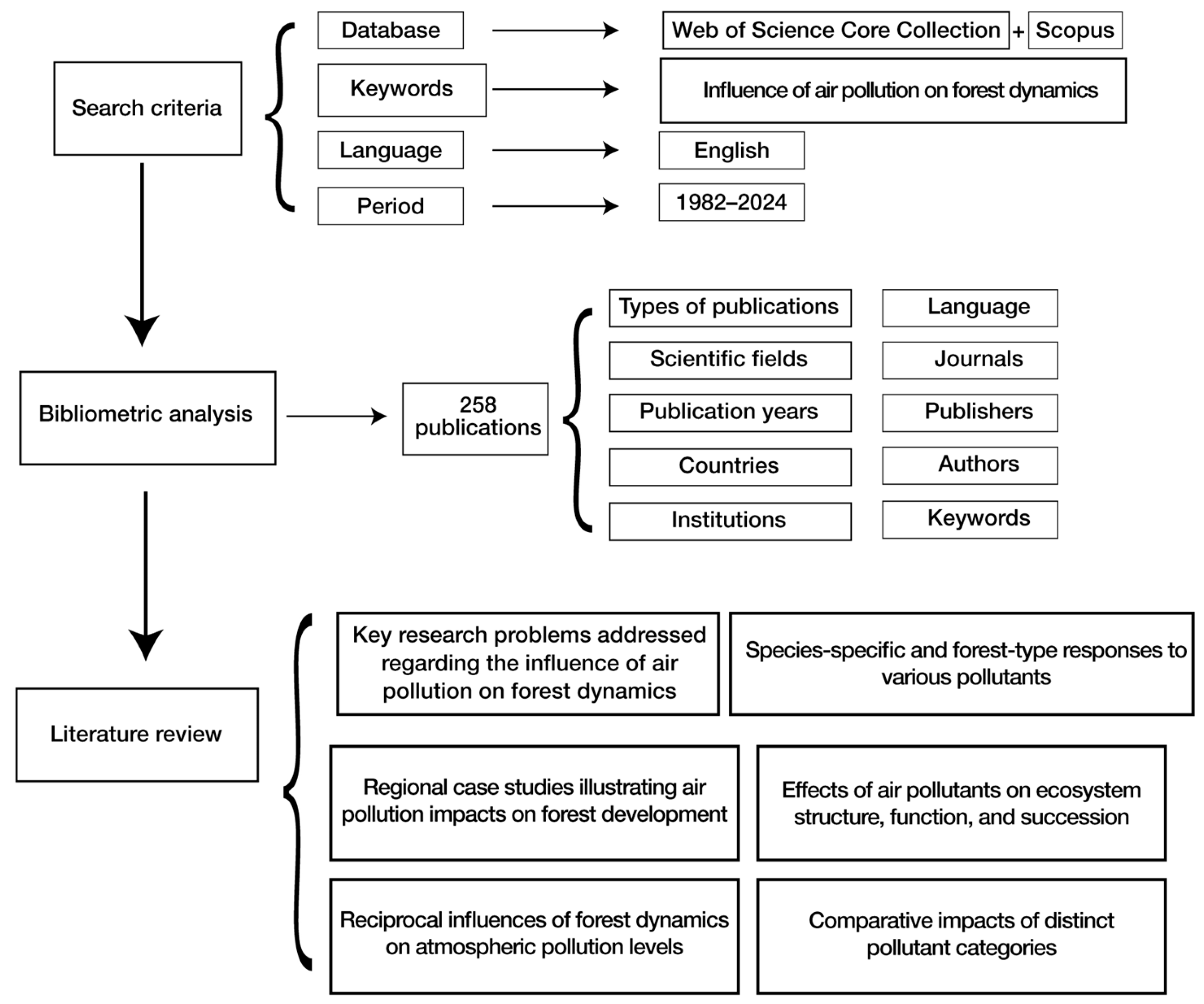
The selected literature was organized into six overarching thematic domains: (1) Key research problems addressed regarding the influence of air pollution on forest dynamics; (2) Species-specific and forest-type responses to various pollutants; (3) Regional case studies illustrating air pollution impacts on forest development; (4) Effects of air pollutants on ecosystem structure, function, and succession; (5) Reciprocal influences of forest dynamics on atmospheric pollution levels; (6) Comparative impacts of distinct pollutant categories (e.g., ozone, nitrogen compounds, particulate matter).
To address potential thematic overlap among the six research domains, each publication was evaluated for its primary and, where applicable, secondary thematic alignment. Publications that legitimately spanned more than one domain were coded accordingly to ensure an accurate representation of cross-cutting research areas. Based on this coding process, we generated a statistical table summarizing the number of studies associated with each thematic domain, including cases of multiple classification. This table (Table 1) provides a transparent overview of literature distribution across domains and highlights areas of research convergence and divergence within the dataset. The classification results support the narrative synthesis by clarifying the relative weight of each thematic cluster in the selected body of evidence.
Table 1. Distribution of the 258 reviewed publications across the six thematic research domains. (Values represent the number of studies assigned to each thematic domain; studies could be coded into more than one domain where appropriate).
A schematic overview of the complete methodological framework is provided in Figure 2, which summarizes the workflow from initial data acquisition through quantitative bibliometric assessment and final qualitative synthesis.
Figure 2. Schematic presentation of the workflow used in this research.

3. Results and Discussion

3.1. A Bibliometric Review

A total of 258 publications related to influence of air pollution on forest dynamics were compiled. The dataset was predominantly composed of research articles (217 articles, representing 84% from the total publications), followed by conference proceedings (28; 11%), review papers (11; 4%), book chapters (2; 1%).
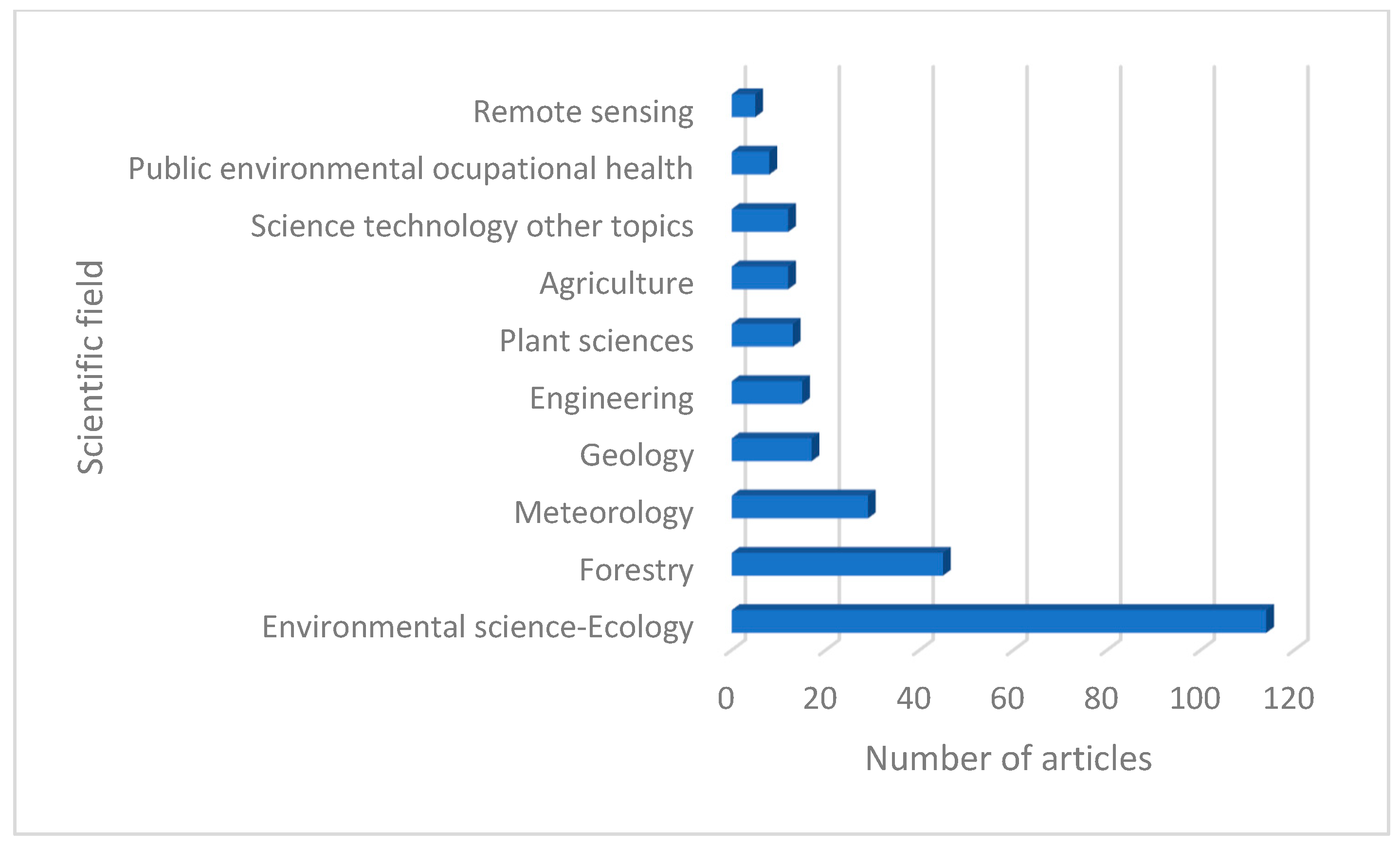
According to the Web of Science classification, the published articles are assigned to various research areas. Among these, Environmental Sciences & Ecology stands out (with 114 articles), followed by Forestry (with 45 articles) and Meteorology (with 29 articles) (Figure 3).
Figure 3. The main 10 scientific areas with publication related to influence of air pollution on forest dynamics.
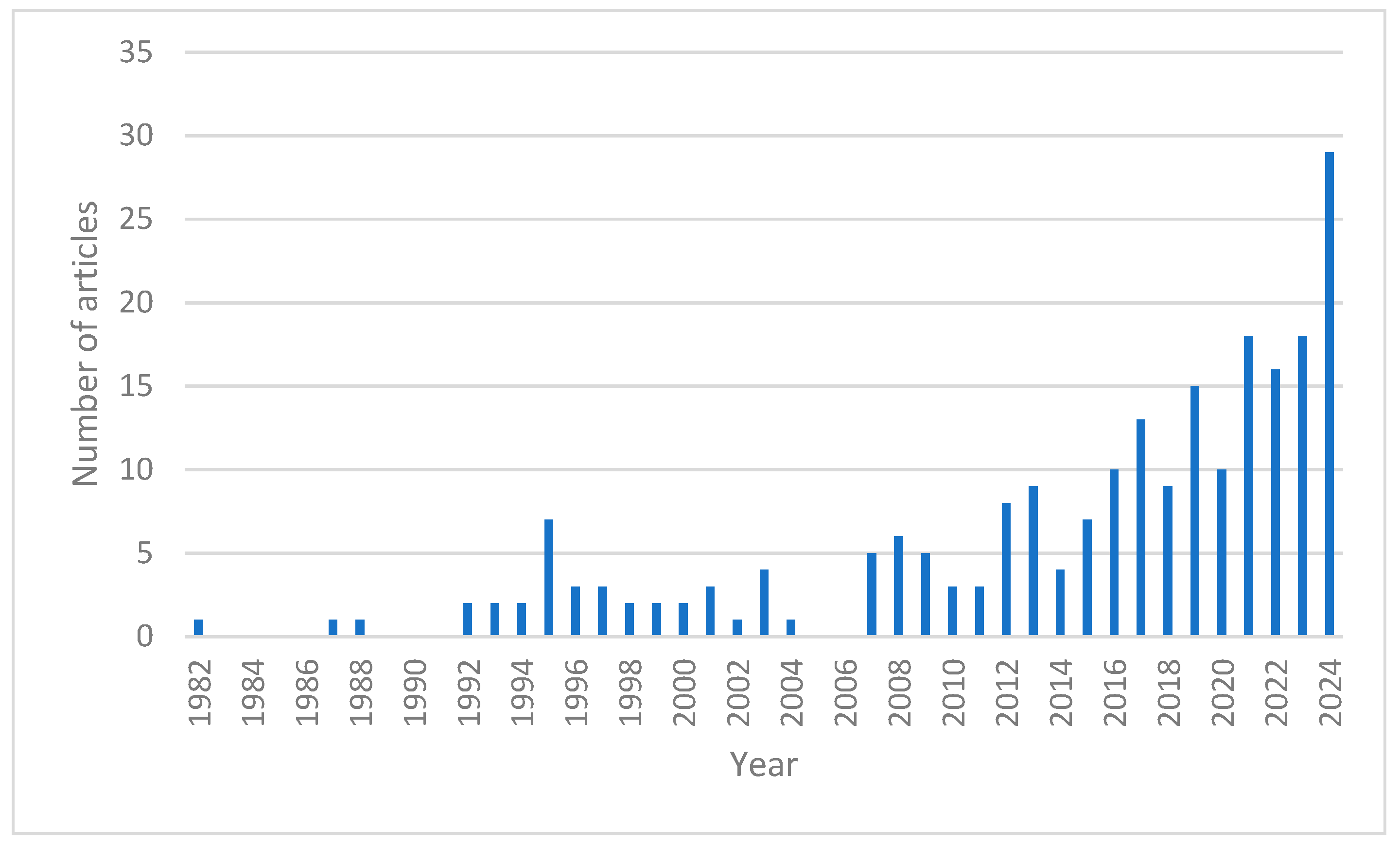
Published articles were rare during the early period (1982–1992), but their number increased steadily after 2012 (Figure 4).
Figure 4. Annual distribution of articles on influence of air pollution on forest dynamics.
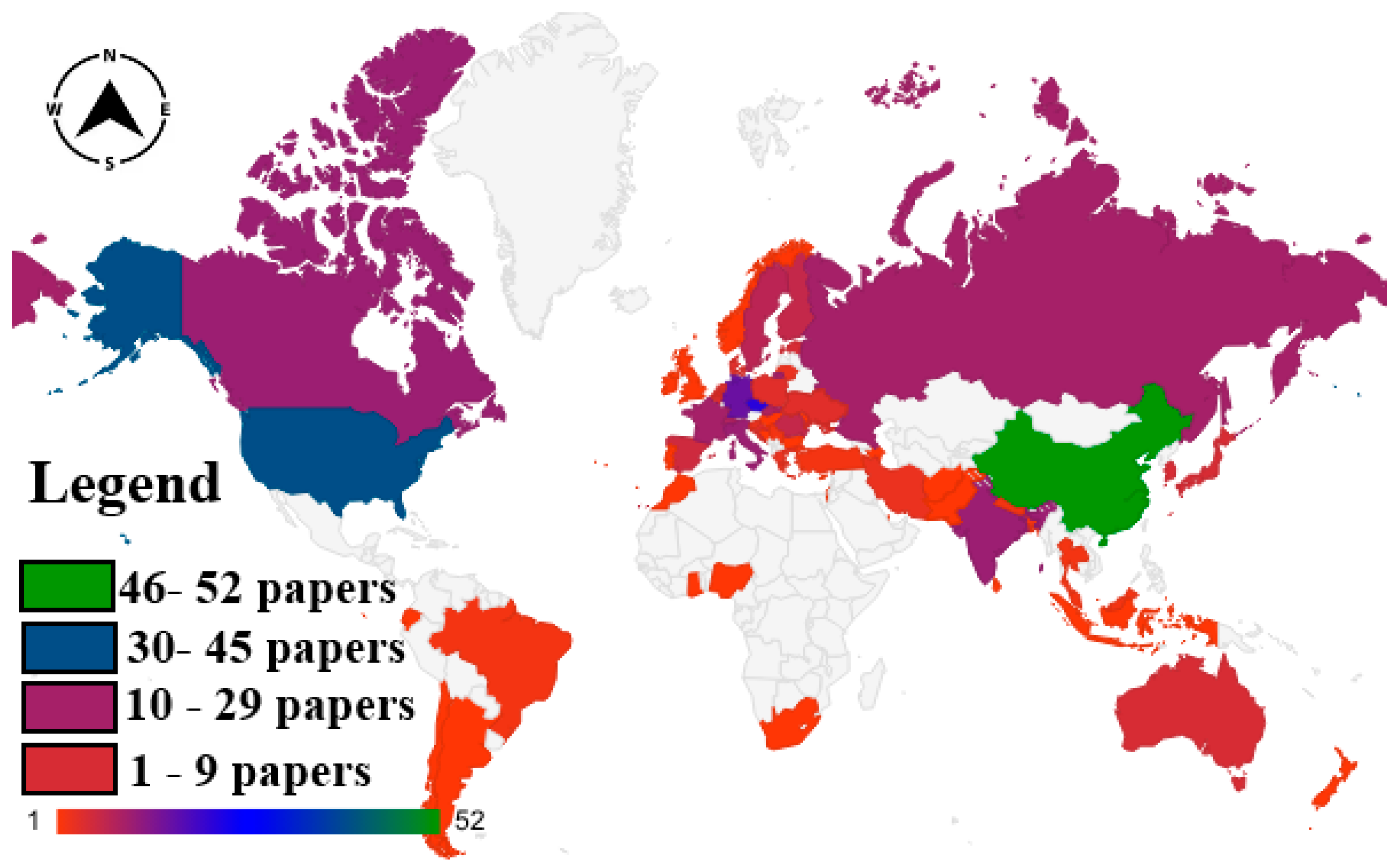
Our inventory identified a total of 63 countries to which the authors who have published indexed articles on this topic so far belong (Figure 5). The most prominently represented countries in terms of publication output were China (52 articles), the United States of America (40 articles), Czech Republic (22 articles), and Germany (16 articles).
Figure 5. Countries with contributing authors of articles on influence of air pollution on forest dynamics.
The countries where the authors of these articles come from can be grouped into several clusters; of these, three are more representative (each containing at least six countries). Cluster 1 includes only European countries: Croatia, Czech Republic, Denmark, England, Estonia, Finland, Italy, Lithuania, Slovenia, and Sweden. Cluster 2 includes countries from Asia, America, and Australia: Australia, Canada, India, Japan, China, Singapore, South Korea, and the USA. Cluster 3 again includes European countries: Germany, Greece, the Netherlands, Spain, Switzerland, and Ukraine. These clusters highlight how research activity is structured geographically and may reflect regional scientific collaborations, funding priorities, and shared environmental concerns. In Cluster 1, the grouping of Northern and Central European countries likely arises from long-standing research networks focused on transboundary air pollution and forest health monitoring programs, such as ICP Forests. The studies from these countries often share methodological approaches, including long-term forest inventory data and standardized monitoring protocols. In Cluster 2, which spans Asia, North America, and Australia, the studies tend to focus on rapidly changing emission patterns, urbanization pressures, and large-scale atmospheric transport. The presence of major emitter countries (e.g., China, India, USA) alongside nations with advanced monitoring technologies (e.g., Japan, South Korea, Australia) suggests a network driven more by global research themes than by regional proximity. Cluster 3 consists predominantly of Western and Southern European countries characterized by mixed Mediterranean and temperate forest systems. Here, studies frequently address ozone impacts, drought-pollution interactions, and region-specific forest responses. This cluster likely reflects thematic similarity in ecological challenges rather than geographic closeness alone. Overall, the clustering indicates that research on air pollution and forest dynamics forms distinct regional and thematic communities. These groupings highlight shared scientific interests, common environmental pressures, and collaborative networks among the contributing countries.
The articles were published across 133 different journals. The most prominently represented journals were Science of the Total Environment, Forest Ecology and Management, Environmental Pollution and Forests (Table 2).
Table 2. Leading journals publishing articles on influence of air pollution on forest dynamics.
The leading institutions affiliated with the authors of these articles, ranked by publication volume, include the Chinese Academy of Sciences (16 articles), Czech University of Life Sciences Prague (14 articles) and Swiss Federal Institutes of Technology Domain (8 articles) and the major publishers: Elsevier (60 articles), Springer Nature (29 articles), MDPI (18 articles), and Wiley (11 articles).
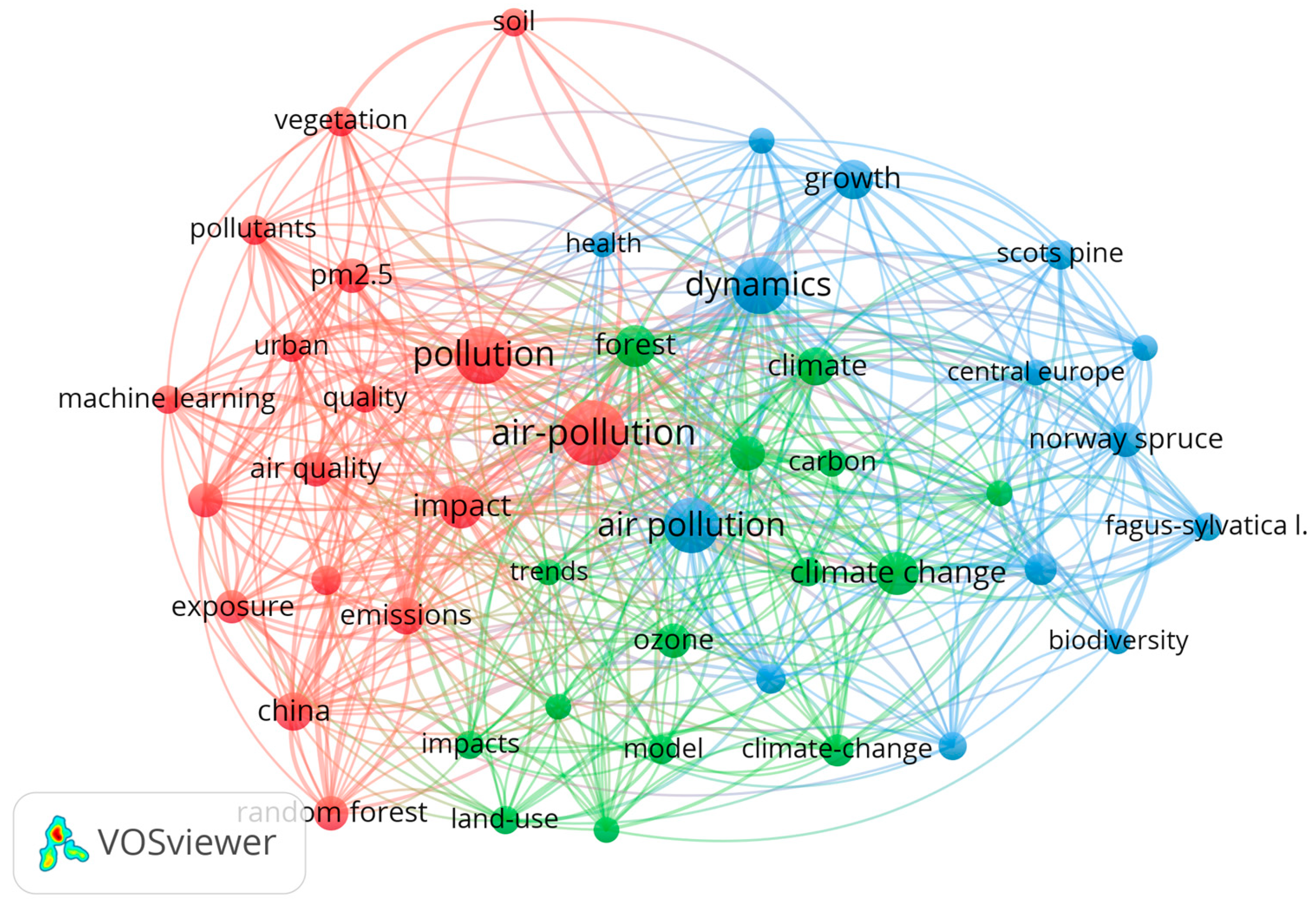
Among the keywords analyzed in these articles, the most frequently occurring were air pollution, pollution, dynamics, impact and climate change.
Based on their interconnections, the keywords can be grouped into several thematic clusters that reflect the major research themes in the field. Three clusters are particularly representative (each containing more than 10 keywords). The first cluster includes terms primarily associated with air pollution and its quantitative assessment (e.g., pollution, air pollution, particulate matter, PM2.5, pollutants). This cluster also contains several analytical and modeling approaches frequently used to evaluate pollution effects—such as random forest, modeling, machine learning. Their presence indicates that methodological tools are closely linked to pollution-focused studies. The second cluster comprises keywords related to climate and atmospheric chemistry (e.g., climate, climate change, nitrogen, carbon, tropospheric ozone, ozone), highlighting the tight connection between pollution and broader environmental change. The third cluster includes terms associated with forest ecosystems and pollution-sensitive species (e.g., Fagus sylvatica, Norway spruce, Scots pine, forests, growth, radial growth), emphasizing the biological and ecological impacts of pollution on forest dynamics (Figure 6).
Figure 6. Authors’ keywords related to influence of air pollution on forest dynamics.
As in the case of other review-type articles [30,31,32], journal articles account for the largest share of the publications. In this case, however, the notably high proportion (11%) of proceedings papers stands out, reflecting the large number of symposia dedicated to this topic (both pollution and forest dynamics are, individually, subjects that are extensively debated within the scientific community).
The exponential increase in the number of published articles—particularly over the past decade—is a trend observed in other cases as well [33,34,35], and can be attributed to the growing number of authors and scientific journals recorded during this period, as well as to the increasing importance of the topic under investigation.
It is already well established that China and the USA are the countries with the highest numbers of authors studying various scientific aspects [36,37,38], but in this case, the presence of the Czech Republic is a pleasant surprise.
The keywords used are, naturally, primarily those related to the search conducted, but as in other situations [39,40,41], the presence of keywords reflecting the latest trends in international research is noteworthy.
Taken together, the bibliometric results identify clear geographic concentrations, dominant pollutant categories, and recurrent research themes, while also revealing gaps in biome coverage and thematic integration. These quantitative patterns provide the structural backbone for the following synthesis, which moves beyond publication trends to examine how the identified pollutants operate through ecological and physiological mechanisms and how these mechanisms scale to forest dynamics.

3.2. Literature Review

3.2.1. Main Problems Addressed in Studies on Influence of Air Pollution on Forest Dynamics

Building on the bibliometric patterns identified above, the literature review synthesizes how air pollution influences forest dynamics through recurring ecological, physiological, and biogeochemical processes. Rather than isolated case studies, the reviewed evidence reveals consistent patterns that link observed publication trends to underlying mechanisms operating across spatial and temporal scales (Table 3).
Table 3. Some of the analyzed issues in articles about influence of air pollution on forest dynamics (extract from the literature).
At the broadest level, many studies adopt global or regional perspectives to evaluate long-term pollution pressures on forest ecosystems. Broad-scale assessments [42,45,58] consistently identify air pollution as a persistent and global determinant of forest health, productivity, and demographic trajectories. In this regard, the identification and deployment of resilient species and provenances developed through genetic improvement programs has been proposed as a feasible strategy for forest restoration under polluted environments [59,60,61,62,63].
A second dominant research theme concerns atmospheric chemistry and deposition processes. Numerous studies demonstrate that pollutants such as acidic compounds, nitrogen, and ozone are transferred from the atmosphere to forest ecosystems through wet and dry deposition, with profound ecological consequences. Research on acid deposition [46] and long-term ozone or nitrogen monitoring [53,55,56] shows that these inputs modify soil chemistry, disrupt nutrient availability, and alter physiological processes such as foliar nutrient retranslocation. These chemical changes propagate through the system, influencing microbial activity, root functioning, and plant metabolism, and ultimately reshaping forest structure and functioning.
Closely linked to deposition processes are vegetation-level and physiological responses to pollution stress. Empirical evidence from European and Asian forests indicates that polluted environments are associated with changes in species composition, growth rates, and wood anatomy [47,49,52]. These responses reflect both acute stress interactions, such as pollution combined with frost events, and chronic shifts in atmospheric chemistry. The convergence of findings across different forest types and climatic regions underscores the widespread sensitivity of temperate forests to pollutant exposure and suggests that pollution acts as a selective force influencing forest assemblages over time.
Another recurring pattern involves the role of industrial, urban, and combustion-related pollution sources. Studies conducted near industrial facilities reveal that heavy metal contamination leads to soil degradation and reductions in plant diversity [40]. Similarly, investigations of forest fires and peat-forest burning [48,54] show that episodic but intense pollution pulses can cause substantial short- to medium-term ecological impacts. These sources often interact with climatic variability and land-use change, amplifying their effects and complicating attribution to single stressors.
Several contributions emphasize that forest responses to air pollution cannot be fully understood without considering broader socio-ecological contexts. Modeling and observational studies linking pollution with land-use change, urbanization, and climate variability [46,51] demonstrate that forest exposure and vulnerability are shaped by human activities and regional climate trends.
Mechanistic insights into forest–atmosphere interactions are provided by studies focusing on pollutant exchange processes at the canopy–atmosphere interface. Investigations of gas-phase exchanges of semivolatile compounds [43] and geographically explicit analyses of vegetation responses [57] illustrate that forests are not only passive recipients of pollution but also active components of atmospheric chemistry. Understanding these bidirectional fluxes is essential for improving predictive models of forest dynamics under changing air quality conditions.
Taken together, the reviewed literature reveals that air pollution influences forest dynamics through intertwined chemical, physiological, ecological, and socio-environmental mechanisms. While geographic coverage spans multiple continents, research efforts remain unevenly distributed, with a strong concentration in Europe, East Asia, and North America. This imbalance points to a significant knowledge gap in other forest biomes and highlights the need for expanded monitoring, experimental, and modeling studies to achieve a more comprehensive global understanding of pollution-driven forest change.
While these studies define the principal research questions and conceptual frameworks in the field, their implications become clearer when examined through the responses of specific forest types and tree species. The following section therefore shifts from thematic problems to organism- and stand-level responses, highlighting how pollution effects are expressed across functional forest types.

3.2.2. Forest Types and Species Responses to Air Pollution

A wide diversity of forest types and tree species has been investigated in relation to air-pollution impacts across different regions. Table 4 provides a synthesis of representative studies documenting how individual species, mixed stands, and entire forest ecosystems respond to various pollutants.
Table 4. Some tree species and forest types cited in articles concerning the influence of air pollution on forest dynamics (extract from the literature).
Rather than reiterating individual study outcomes, the following synthesis groups forest responses by functional type and dominant pollutant pathways. Across taxa and regions, species-specific responses converge into a limited number of recurring patterns related to atmospheric deposition, ozone exposure, and industrial emissions. This approach highlights shared mechanisms and ecosystem-level implications while avoiding repetition of study-by-study descriptions.
This section synthesizes observed response patterns across coniferous, broadleaf, and mixed forests, emphasizing shared sensitivities and contrasting adaptive strategies under different pollution regimes.
Coniferous Forests: Sensitivity to Deposition and Industrial Emissions
Studies of coniferous forests consistently indicate high sensitivity to chronic sulfur and nitrogen deposition and to industrial point-source emissions, particularly in montane and managed systems. Abies alba has been examined from a general perspective [64] as well as in mixed stands with Picea abies [84], while Picea abies itself has been frequently assessed under acidic deposition pressures in the Czech Republic [73]. These studies consistently indicate that long-term sulfur and nitrogen deposition can alter growth patterns, nutrient balance, and stand productivity, particularly in montane and managed forest systems.
Additional conifer-focused studies include Picea sitchensis exposed to elevated N and S deposition in Germany [74] and Picea rubens in the USA, where forest condition changes linked to acidic deposition were evaluated [75].
Research on Larix species encompasses effects of predicted nitrogen deposition in Japan [55] and, in combination with Pinus species, assessments of water-use efficiency dynamics in China [77]. Mediterranean and eastern European research further includes work on Pinus halepensis and P. nigra under atmospheric deposition in Croatia [76], and studies of pulp-and-paper emissions affecting Pinus sylvestris in Poland and Russia [78,79]. Collectively, these studies show that conifers respond not only to acidic inputs but also to industrial point sources, with physiological adjustments (e.g., water-use efficiency) often preceding visible decline.
Broadleaf Forests: Ozone, Nutrient Imbalance, and Physiological Responses
Broadleaf forests show pronounced sensitivity to ozone exposure and nutrient imbalance, with physiological and litter-mediated responses often preceding visible structural change. Responses of birch (Betula spp.) and poplar (Populus spp.) to air pollutants were reviewed for Central Europe [66], while nutrient status in Fagus sylvatica forests was evaluated in southern Europe [67].
Investigations in East Asia include Ginkgo biloba leaf-litter responses to elevated O3 in China [68] and Quercus variabilis in studies addressing vegetation productivity and its influence on negative air ions [72]. Additional research has addressed Quercus ilex in peri-urban Spanish forests [70] and aerosol fluxes in Quercus–Carpinus forests in Italy [69]. These studies highlight how broadleaf species often serve as sensitive indicators of ozone stress, altered litter decomposition dynamics, and canopy-level pollutant processing.
North American studies contribute further insights, with Quercus macrocarpa and Populus tremuloides used to assess the effects of emissions from a coal-fired power station in Canada [71], and combined CO2 and O3 impacts on Populus tremuloides and Betula papyrifera tested in the USA [80]. Experimental approaches in these systems emphasize interactive pollution effects, showing that ozone responses may be modified by rising CO2 concentrations.
Mixed Forests and Multispecies Comparisons as Indicators of Ecosystem-Level Effects
Mixed-species forests provide integrative insight into ecosystem-level pollution effects by revealing contrasting species sensitivities under identical exposure conditions. Investigations include Fagus sylvatica–Abies alba–Picea abies mixtures [68] and mixed-species comparisons of Abies alba versus Picea abies [84]. These studies demonstrate that interspecific differences in growth and basal-area increment can clarify pollution signals that may be obscured in single-species analyses.
Additional studies have examined deciduous–conifer mixtures exposed to roadside dust in the Czech Republic [83] and the accumulation of mercury in foliage of Populus alba, Tilia cordata and Prunus avium in Romania [82].
Regional Patterns and Dominant Pollution Drivers
Regional patterns in forest responses largely reflect dominant emission sources and regulatory histories rather than fundamentally different ecological mechanisms. Central and Eastern Europe show a strong emphasis on acidic, nitrogen, and sulfur deposition as well as industrial emissions, particularly in the Czech Republic, Poland, and Germany [73,74,78,83]. Mediterranean studies predominantly address atmospheric deposition and peri-urban pollution pressures [66,70], while East Asia—especially China—focuses on ozone pollution, nitrogen interactions, and physiological or litter-based responses [68,72,77,81]. North American research often centers on industrial point sources and controlled CO2–O3 experiments [71,80]. These patterns underline how local emission profiles shape both research priorities and observed forest responses.
Integrated Physiological and Ecosystem Responses
Across forest types, air pollution induces a spectrum of physiological and biogeochemical responses that frequently occur without immediate visible damage [67,68,69,74,75,77,82].
Synthesis and Implications
Taken together, the integrated evidence shows that air pollution exerts measurable and multifaceted influences across global forest types. Both coniferous and broadleaf forests are vulnerable to a spectrum of pollutants, and mixed stands provide particularly valuable insights into ecosystem-level effects. Despite differences in regional focus and methodology, a consistent pattern emerges: air pollution acts as a pervasive driver of physiological stress, nutrient imbalance, and altered ecosystem processes, reinforcing its role as a key factor shaping contemporary forest dynamics.

3.2.3. Regional Examples of Air Pollution Impact on Forest Dynamics

Regional case studies provide an essential bridge between species-level mechanisms and large-scale forest dynamics, illustrating how similar physiological processes lead to divergent outcomes depending on climate, emission sources, and landscape context.
Arctic, Subarctic, and Northern Boreal Regions
Air pollution affects even remote Arctic and subarctic forests, where ecosystem sensitivity amplifies pollutant impacts. Evidence from the Kola and Taimyr Peninsulas demonstrates that sulfate and trace metal deposition alters vegetation composition, productivity, regeneration, soil chemistry, and biological activity [86]. Across these regions, morphological and physiological injury symptoms resemble those observed in temperate forests, indicating shared stress pathways. However, northern ecosystems exhibit distinctive damage patterns driven by open canopies, thin photosynthetic layers, and prolonged snow cover, resulting in differential injury above and below the snowline, simultaneous stand-level damage, and enhanced krummholz formation.
Pollution effects are strongly modulated by background stress. Species already constrained by cold, nutrient limitation, or shallow soils display lower tolerance thresholds, and the loss of pollution-sensitive taxa such as lichens can trigger rapid ecosystem degradation. At the same time, not all industrial pollution results in detectable growth suppression. Near the Arkhangelsk pulp and paper mill, dendrochronological analyses showed no significant relationship between pine radial growth and emissions from 2001–2018; growth trends followed expected age-related patterns with no synchronous or lagged pollution signal [79].
Mountain Forests of Central Europe
Mountain forests experience compounded stress from climate constraints and pollutant exposure. In the Orlické hory Mountains, forest structure and dynamics varied systematically with elevation and hilltop exposure [87,88]. Tree spatial patterns shifted from random at lower elevations to aggregated under strong hilltop effects, with regeneration showing similar clustering. These structural changes reflect the combined influence of wind exposure, temperature limitation, and pollutant loading.
Species-specific growth responses further illustrate pollution–climate interactions. Spruce exhibited long-term growth suppression after 1978, followed by recovery after 1998, while beech maintained stable growth over the twentieth century. Spruce radial growth was negatively correlated with SO2 and NOx concentrations, particularly during spring, and pollution effects intensified at summit locations. Temperature exerted a stronger influence than precipitation, indicating that pollution sensitivity is amplified under climatic limitation.
Tropical Forests: Amazon and Subtropical Asia
In tropical systems, air pollution effects are closely coupled with atmospheric dynamics. In the central Amazon, baseline ozone concentrations are low, but episodic peaks exceeding 75 ppbv occur due to biomass burning and long-range transport [89]. Convective storms play a critical role by transporting ozone-rich mid-tropospheric air to the forest canopy, producing short-term increases of up to 25 ppbv and sustaining elevated levels for several hours. These events intensify oxidation of biogenic volatile organic compounds, increase hydroxyl radical concentrations, and alter forest–atmosphere chemical exchange. The results challenge the perception of tropical forests as largely insulated from pollution and highlight the importance of extreme meteorological processes in shaping exposure.
In subtropical Asia, long-term observations from the Yunzhong Mountain forest reveal how air quality interacts with microclimate to influence negative air ions (NAIs), a component linked to ecosystem services and human well-being [90]. NAIs showed strong seasonal and diurnal patterns, peaking in summer and early morning. Concentrations were negatively associated with NO2 and particulate matter, while humidity exerted a positive influence. Structural equation modelling demonstrated that air pollutants have strong direct negative effects on NAIs, whereas meteorological variables act as positive drivers, with radiation influencing NAIs indirectly. These findings illustrate how pollution effects in subtropical forests often manifest through indirect atmospheric and physiological pathways rather than overt vegetation damage.
Urban and Peri-Urban Forests
Urban and peri-urban forests exemplify the dual role of forests as both pollution sinks and pollution-stressed ecosystems. In an oak–hornbeam forest of the Po Plain, aerosol flux measurements showed pronounced seasonal and size-dependent variability [69]. Leaf presence enhanced deposition of accumulation-mode particles but increased emissions of ultrafine and coarse particles, while leafless periods were characterized by net submicron emissions. Deposition velocities tracked leaf area index and stomatal conductance, emphasizing the importance of canopy phenology and physiological activity. Turbulence enhanced aerosol exchange, whereas near-condensing conditions reduced fluxes.
Across Mediterranean Quercus ilex forests in Spain, ozone emerged as the only pollutant consistently reaching phytotoxic levels [70]. Nitrogen compounds remained below direct toxicity thresholds but likely contributed to eutrophication through deposition. Peri-urban stands reduced below-canopy concentrations of gaseous pollutants, particularly NH3, demonstrating a clear air purification function alongside chronic exposure to urban emissions. Similarly, studies in urban green spaces of Xianyang revealed strong species-specific differences in particulate matter deposition [32,80]. Broadleaf communities showed high per-area deposition, while certain conifers accumulated large particle loads per leaf area. Community composition outweighed structural attributes in determining particulate dynamics, reinforcing the importance of species selection for urban forest management.
Central, Southern, and Western Europe
Long-term monitoring across Central Europe has largely refuted the concept of widespread pollution-driven forest dieback encapsulated in the term Waldsterben [91]. While localized foliar injuries associated with SO2, frost, or biotic agents occur, regional trends show stable or increasing tree growth, with climate exerting a stronger influence than air pollution. These findings emphasize the risk of overgeneralization and the need for site-specific assessments.
In southern Europe, evidence for large-scale pollution-induced decline is similarly limited [92]. Documented impacts include deterioration of coastal forests due to polluted sea spray, failures of poorly matched reforestation efforts, and oak declines linked to climatic stress and biotic interactions. Ozone causes visible foliar injury in several native species, but many effects remain non-visible and are often missed by broad surveys, indicating a need for more spatially explicit and sensitive monitoring approaches.
North America: United States and Canada
In North America, ozone and nitrogen deposition exert broad ecological effects, while sulfur pollution remains important at local scales [93]. Modelling studies from regions such as the San Bernardino Mountains and Hubbard Brook demonstrate that future forest function depends on interactions among climate change, pollutant deposition, and additional stressors such as drought and pests. These interactions influence hydrology, nutrient cycling, and productivity, with implications for carbon sequestration and water regulation.
In eastern Canada, tolerant hardwood forests on shallow, poorly buffered soils show decline symptoms linked to soil acidification [94]. Decreases in soil pH and base saturation, coupled with increased exchangeable aluminum, are associated with reduced forest health. Acid fog contributes to foliar injury and soil degradation in coastal areas, and chronic ozone exposure may further disrupt nutrient cycling. Without continued pollution reduction and adaptive management, long-term productivity in sensitive regions may be at risk.
Asia: Integrated Pressures of Pollution and Climate Change
Across Asia, forests are increasingly exposed to combined pressures from greenhouse gases, ozone, trace pollutants, and rapid climate change [95]. While individual stressors have been studied, their synergistic effects on forest dynamics remain poorly understood. Given the pace and scale of environmental change, this represents a critical research gap. Integrated monitoring, modelling, and experimental approaches are required to disentangle multiple stressors and to inform effective forest management and policy.
Regional Synthesis
Despite strong geographical contrasts in pollution sources and forest types, regional differences primarily reflect variations in exposure intensity and climatic modulation rather than distinct underlying mechanisms. Pollution effects are consistently amplified under climatic stress—particularly drought, cold limitation, or high radiation—indicating that air pollution most often acts as a stress multiplier rather than an isolated driver of forest change.

3.2.4. Effects of Air Pollution on Forest Dynamics

The mechanistic and regional patterns described above converge at the level of forest dynamics, where air pollution influences growth, structure, and long-term stability. This section integrates evidence across organizational levels, from physiological responses to stand-scale and ecosystem-scale change.
Growth Reduction, Stand Degradation, and Spatial Pollution Gradients
Across industrial and high-deposition regions, long-term exposure to air pollutants consistently reduced radial growth and forest vitality, with spatial patterns reflecting prevailing wind directions and proximity to emission sources [96,97]. Although emission reductions initiated partial recovery, growth trajectories rarely returned to reference levels, and affected stands frequently exhibited increased sensitivity to drought and climatic extremes, indicating persistent physiological legacy effects.
Together, these studies indicate that pollution does not act in isolation but interacts strongly with climatic extremes and biotic agents, accelerating stand-level decline and reducing long-term resilience.
Pollutant Effects on Wood Anatomy and Structural Traits
Air pollution also generated measurable shifts in wood anatomical characteristics. In the Ore Mountains, extreme winter pollution (1995/96) caused substantial reductions in lumen width, tracheid number, and cell wall thickness in Picea abies from heavily damaged stands [40]. Differences between earlywood and latewood responses indicated distinct reaction dynamics, and stand recovery required approximately three years depending on the anatomical parameter considered.
Physiological and Biochemical Responses of Needles
Studies in industrial regions demonstrated species-specific alterations in needle pigment composition. In the Ufa industrial center, pollution altered the chlorophyll and carotenoid profiles of Pinus, Picea, and Larix species, with no uniform adaptive trend among taxa [98]. Although chlorophylls a and b remained relatively stable structurally, their relative proportion increased under pollution, accompanied by a decline in carotenoids. Larix, despite its high photosynthetic potential, showed the greatest pigmental sensitivity to technogenic load.
Interactions Between Ozone Exposure and Litter Decomposition
Elevated ozone concentrations in urban forests influenced litter chemistry and decomposition processes. In open-top chamber experiments with Ginkgo biloba, exposure to 120 ppb O3 significantly increased leaf K content while reducing phenols and soluble sugars, without altering C, N, P, lignin, or tannins [51]. Although overall mass loss during the 150-day decomposition period did not differ significantly between ambient and elevated ozone, early-stage decomposition slowed under high O3 while later stages were slightly accelerated. Nutrient release patterns were strongly influenced by seasonal conditions regardless of treatment.
These findings suggest that ozone can subtly modify litter quality and decomposition timing rather than total decomposition rates. Such shifts may alter short-term nutrient availability and microbial activity, linking atmospheric pollution to ecosystem-level nutrient cycling processes.
Crown Condition, Soil Chemistry, and Ozone-Related Symptoms
Assessments of Fagus sylvatica at long-term monitoring sites indicated interactions among foliar nutrition, soil acidity, and atmospheric pollution [99,100]. Defoliation peaked in 1996 following drought, and biotic stressors (notably Rhynchaenus fagi) further contributed to canopy decline. Visible ozone injury on Fagus and Vaccinium myrtillus suggested contributions from O3 and anthropogenic hydrocarbons, supported by measured high ozone concentrations. Soils were nutrient-poor and desaturated in base cations, with frequent acidic precipitation episodes, particularly in winter.
This combination of foliar injury, soil degradation, and biotic stress underscores the cumulative nature of pollution impacts. Canopy decline cannot be attributed to a single driver but instead emerges from interacting chemical, climatic, and biological pressures.
Global Patterns of Atmospheric Deposition and Ozone Exposure
Globally, forest canopies enhance pollutant deposition due to their rough surface structure and aerodynamic properties [101]. In both Scottish and German sites, forests received substantially higher S and N deposition than adjacent moorlands. Model simulations showed increasing global exposure to phytotoxic ozone levels (>60 ppb): from 0% of forest area in 1860, to 6% in 1950, 24% in 1990, and potentially nearly 50% by 2100. Acid deposition is projected to expand particularly in tropical and subtropical regions, with 17% of global forests expected to receive >1 kg H+ ha−1 yr−1 as sulfur by 2050.
These trends indicate that pollution pressures historically concentrated in temperate industrial regions are becoming globally pervasive. As a result, stress responses documented in European forests may increasingly characterize tropical and subtropical systems, where background resilience and soil buffering capacity may differ substantially.
Modeling the Combined Influence of Pollution and Population Pressure
Mathematical modeling further highlighted the interacting effects of atmospheric pollution and human land-use pressure on forest dynamics [102]. Pollutants reduced intrinsic forest growth rates, while population-driven land use decreased carrying capacity [103]. The model exhibited parameter-dependent bifurcations and, counterintuitively, demonstrated stabilizing effects when incorporating time-delayed pollutant impacts.
These modeling results reinforce the view that pollution impacts are systemic and temporally complex. Delayed responses imply that present-day forest conditions may reflect past pollution regimes, complicating attribution and management decisions.
Integrated Synthesis
Collectively, these studies show that air pollution affects forest ecosystems through multiple, interacting pathways—reducing tree growth, altering wood structure and physiology, modifying nutrient cycling, and amplifying climatic and biotic stressors. While emission reductions often lead to partial recovery, many impacts persist for decades, indicating long-lasting legacy effects. The combined empirical and modeling evidence suggests that air pollution can fundamentally alter forest functioning and resilience, emphasizing the need for integrative, long-term approaches when assessing forest responses to anthropogenic stress.

3.2.5. Impacts of Forest Dynamics on Air Pollution

Urban Forests, Air Pollutant Removal, and Green Infrastructure Performance
Urban forests play a central role in regulating airborne particulate matter, yet their efficiency is strongly shaped by ongoing urbanization, vegetation structure, and landscape configuration. In Changchun City, long-term simulations revealed that despite an increase in overall forest cover from 18.09% (2000) to 24.59% (2020), rapid urbanization led to greater forest fragmentation and simplified patch geometry. Although 12% of forested areas were converted to impervious surfaces, gains from the conversion of cropland and wetland to forest maintained a net increase. These landscape changes substantially weakened PM2.5 removal capacity: total removal declined from 793 t yr−1 to 528 t yr−1, affecting nearly half of the urban area. Urban forest landscape patterns explained 72% of PM2.5 removal effectiveness, but the increasing dominance of impervious surfaces gradually surpassed this regulatory effect, ultimately reducing removal efficiency [104].
This result highlights a critical pattern emerging across urban systems: forest spatial configuration can be as important as total forest area in determining air-pollution mitigation capacity. Fragmentation reduces edge efficiency, alters airflow pathways, and limits cumulative deposition potential, suggesting that urban greening strategies focused solely on increasing canopy cover may fail to deliver expected air-quality benefits if spatial integrity is not preserved.
At the microscale, vegetation influences pollutant concentrations through both deposition and modification of airflow. Coupled PALM–VIDA simulations showed that vegetation substantially reduces PM concentrations within street canyons, while reductions in NO2 are more modest and depend heavily on vegetation structure and ventilation dynamics. Sparse canopies or species with open crowns improved airflow and were often more effective at lowering NO2 than denser vegetation, which can trap pollutants despite higher deposition rates. These findings underscore that both deposition and aerodynamic effects must be considered when designing vegetation for air-quality improvement, as unsuitable species placement may increase local pollutant levels [105].
Together with the Changchun results, these simulations demonstrate a scale-dependent trade-off: dense vegetation maximizes surface area for particle deposition, while open canopies enhance ventilation and gas-phase pollutant dispersion. This reinforces the need for context-specific vegetation design, particularly in narrow street canyons where aerodynamic effects may dominate over deposition.
Machine-learning approaches provide additional tools for evaluating vegetation-based mitigation of traffic-related air pollution (TRAP). Using CFD-generated datasets, RF, NN, and XGBoost models achieved high predictive accuracy (NRMSE 6–7%; R2 > 0.91) for downwind particle concentrations across a wide range of vegetation barrier configurations. Vegetation width, height, leaf area index, leaf area density, wind speed, and particle size emerged as the dominant predictors. These models offer a rapid and practical method for optimizing roadside vegetation design [106].
The use of machine learning addresses a key limitation identified in earlier studies: the difficulty of generalizing results across diverse urban forms and meteorological conditions. By integrating structural and atmospheric variables, these approaches facilitate adaptive, evidence-based planning, bridging the gap between site-specific CFD studies and large-scale urban policy.
Urban canopy characteristics also influence PM2.5 dynamics across functional zones. In a subtropical city, PM2.5 concentrations were highest in park zones, intermediate in traffic zones, and lowest in residential areas. Seasonal patterns showed winter peaks (84.00 ± 45.97 μg m−3) and summer minima (36.85 ± 17.63 μg m−3). Canopy metrics such as diameter, area, and volume correlated positively with PM2.5, but their influence remained minor compared with meteorological factors. Notably, a 1 m2 increase in canopy area increased PM2.5 by 0.864 μg m−3, whereas a 1 mm increase in rainfall raised PM2.5 by 13.665 μg m−3, indicating the dominant role of climate variability over canopy structure [107].
Canopy structure alone cannot compensate for unfavorable atmospheric conditions, underscoring the importance of integrating climate variability into assessments of green infrastructure performance.
Negative air ions (NAIs), often associated with air-quality benefits, also varied across green-infrastructure types. Suburban forests exhibited the highest NAI levels, while roadside greenery displayed the lowest. Relative humidity and temperature increased NAIs, while air pressure and PM10 concentrations reduced them. These patterns highlight vegetation type and microclimatic factors as key regulators of NAI generation [108], further supporting the conclusion that biophysical context, rather than canopy size alone, governs air-quality-related ecosystem services.
Vegetation as Pollutant Sinks, Bioindicators, and Hyperaccumulators
Analytical foliar diagnoses provide information on the nutritional state of trees (macro- and microelements), synergism, antagonism, and accumulation of essential nutrients and pollutants (from air, soil, and water). This method has been used in forest health monitoring, studies of complex forest decline, and assessments of urban (polluted) areas [109,110,111]. Accumulation of air pollutants in tree leaves represents a direct pathway of air decontamination, with species-specific capacities. Populus × canadensis proved most efficient in chlorine sequestration (31,320 ppm), Betula pendula and P. × canadensis in sulfur (8230–8724 ppm), and Acer pseudoplatanus in fluorine (770–1530 ppm) [112].
At the same time, plants function as effective bioindicators of air pollution, with species-specific sensitivities: Hypericum perforatum for fluorine, Urtica urens for ozone, Medicago sativa for carbon dioxide, Gmelina arborea for Air Pollution Tolerance Index (APTI) assessments, and Evernia prunastri for nitrogen oxides [109,113]. These biological indicators complement instrumental monitoring, particularly in regions lacking dense air-quality networks.
Forest mushrooms (e.g., Leccinum, Boletus) can accumulate radionuclides (U, Cs, Th, Pb, Po, Sr, Cd), serving as bioindicators of environmental contamination [114]. However, they are not considered hyperaccumulators compared with species such as Boehmeria nivea (uranium), Acer rubrum, Liquidambar styraciflua, and Liriodendron tulipifera (Cs-137, Sr-90, Pu-238), or Pteris vittata (arsenic) [115,116,117].
Some tree species and their symbiotic mushrooms are listed among hyperaccumulators of heavy metals: Pycnandra acuminata for nickel; Salix spp. for Ag, Cr, Hg, Se, Cd, Pb, U, and Zn; Pinus spp. for selenium and zinc; Chengiopanax sciadophylloides for manganese; Amanita strobiliformis for silver; and Amanita muscaria for selenium. Due to their exceptional uptake capacity, hyperaccumulators—particularly Salix spp.—are widely applied in phytoremediation and phytomining [118,119,120,121,122,123,124,125].
Collectively, these studies reveal that forests act not only as passive sinks for airborne pollutants but also as active biological filters and diagnostic tools, linking air pollution, ecosystem health, and remediation potential.
Forest Canopy Effects on Atmospheric Deposition
In Mediterranean pine ecosystems, substantial differences in ion deposition were observed between bulk open precipitation and throughfall. Throughfall consistently exhibited higher ion concentrations, with the strongest enrichment for K+. Total inorganic nitrogen deposition in Aleppo pine forests exceeded the critical load for Mediterranean pine systems, suggesting risks of eutrophication and soil acidification. Seasonal precipitation patterns and prolonged dry periods enhanced ion leaching from canopies, reinforcing the need for long-term monitoring under changing environmental conditions [76,114].
Forests also influence the atmospheric cycling of persistent organic pollutants. On the Tibetan Plateau, passive air sampling along Sygera Mountain showed significantly higher DDT concentrations during monsoon seasons (20.5–57.4 pg m−3) than in non-monsoon periods (9.2–27.4 pg m−3), confirming monsoon-driven long-range transport from South Asia. Comparisons between forested and open sites indicated that forest canopies reduced airborne DDTs by a factor of two, demonstrating strong interception and absorption capacities [125].
These findings highlight forests as biogeochemical reactors, amplifying atmospheric deposition while simultaneously protecting downwind environments by intercepting long-range transported pollutants.
Forest Fires and Pollutant Emission Dynamics
Forest fires represent major episodic sources of air pollutants across diverse regions. In Fujian Province (2000–2010), fire frequency initially increased and later declined, with total combusted biomass reaching 6.57 Mt. Emissions included 1.64 Mt CO2, 98.19 kt CO, 1.43 kt NOx, 9.43 kt CH4, 10.12 kt PM2.5, and other pollutants. Spatial patterns showed the highest emissions in southwestern Nanping, northwestern Sanming, and transitional areas between Nanping, Sanming, Ningde, and Fuzhou. Increasing ratios of PM2.5 from forest fires relative to industrial dust highlighted a growing influence of fires on regional air quality [126].
High-resolution modeling of the 2021 Manavgat fires in Turkey revealed strong meteorological control on plume behavior. WRF-Chem simulations, validated by ground-level and satellite observations, accurately predicted AOD (r = 0.93), aerosol index (r = 0.81), and PM10 (r = 0.82). A low-pressure system promoted plume lofting to 6 km above sea level, enabling regional smoke transport across Antalya. Persistent aerosol layers after fire suppression were linked to both local and remotely transported fire emissions [127].
In the Kathmandu Valley (2021), PM2.5 concentrations rose dramatically during two fire episodes, peaking at 371 μg m−3 and 280 μg m−3 compared with 199 μg m−3 during the pre-fire period. Despite more fire counts in the second episode, lower PM2.5 concentrations suggested a strong role of fire proximity and atmospheric dispersion. A two-day lag between ignition and PM2.5 increase was observed, with pollutant-specific responses: HCHO reacted rapidly, while AOD and CO exhibited delayed increases. Low wind speed, temperature, and humidity exacerbated pollution accumulation [128].
Similarly, in Kalimantan (2015), extensive peat-forest fires during El Niño conditions generated severe PM10 pollution. HYSPLIT trajectory modeling showed that dispersion patterns were governed by wind fields and topography, producing large spatial contrasts between Banjarbaru and Palangka Raya [129].
These studies collectively demonstrate that fire impacts on air quality are controlled as much by atmospheric dynamics as by fire intensity, and that climate-driven increases in fire frequency may increasingly offset the air-quality benefits provided by forests during non-disturbance periods.
Finally, CFD simulations in Portugal demonstrated that urban trees modify pollutant dispersion by altering wind flow. In Lisbon, vegetation increased domain-average CO concentrations by 12% under non-aligned wind conditions, whereas in Aveiro, aligned winds and canopy structures enhanced ventilation and reduced concentrations by 16%. Inclusion of vegetation improved model performance and compliance with EU air-quality modeling standards [113].
Integrated Synthesis
Across scales and disturbance regimes, forests influence air pollution through four primary pathways:
(1) Direct pollutant removal via deposition and bioaccumulation [87,88,95];
(2) Enhancement of chemical transformation and atmospheric deposition [59,108];
(3) Modification of airflow and pollutant dispersion [88,130];
(4) Pollutant generation during forest and peat fires [126,127,128,129].
These pathways operate simultaneously but with strong context dependence, shaped by vegetation structure, spatial configuration, meteorology, and disturbance regimes. Consequently, forest dynamics can either mitigate or exacerbate air pollution. Effective air-quality management therefore requires integrated strategies that combine vegetation planning, landscape design, fire-risk reduction, and atmospheric modeling to fully harness the regulatory potential of forests while minimizing unintended impacts.

3.2.6. Influence of Different Types of Air Pollution on Forest Dynamics

Particulate Matter and Aerosols
Airborne particulate pollution, including coarse and fine particles, strongly modulates forest microclimates, vegetation functioning, and carbon balance. Numerical simulations have demonstrated that vegetation structure plays a central role in modifying dust dispersion from transportation corridors. Using a Reynolds-averaged Navier–Stokes (RANS) modelling framework with PM10 and PM75 as passive scalars, Benes [83] quantified the performance of 49 coniferous and deciduous forest configurations. Differences in forest type, density, height, and width influenced turbulence, deposition efficiency, and pollutant retention. Coniferous and deciduous stands exhibited contrasting capacities for pollutant interception, emphasizing the importance of forest design for pollution mitigation.
Structural traits—such as canopy density and leaf morphology—emerge as critical determinants of mitigation efficiency, suggesting that targeted forest design along transport corridors can substantially enhance air-quality benefits. This highlights a key pattern across studies: forest structure mediates pollutant exposure as strongly as pollutant load itself.
Atmospheric aerosols also exert substantial radiative forcing effects on forest carbon exchange. In semideciduous tropical forests of Mato Grosso, reduced incoming solar irradiance (relative irradiance: f = 1.10–0.67) was associated with decreased net ecosystem exchange (NEE), whereas higher aerosol optical depth (AOD > 1.25, f < 0.5) increased NEE by 25–110% due to enhancement of diffuse photosynthetically active radiation. Aerosols originating mainly from biomass burning also cooled canopy temperatures by 3–4 °C and reduced vapor pressure deficit by 2–3 hPa, ultimately altering CO2 flux behaviour [131].
This apparent contradiction underscores the nonlinear and context-dependent nature of aerosol impacts. Moderate aerosol loading constrains photosynthesis via light limitation, while heavy aerosol loads can enhance diffuse radiation and partially offset thermal and vapor-pressure stress. Together, these results indicate that aerosols can either suppress or stimulate forest carbon uptake depending on background climate, aerosol composition, and canopy structure.
Acidic Deposition and Sulfur/Nitrogen Pollution
Moderate sulfate and reactive nitrogen deposition significantly affected physiological processes in Norway spruce forests of the Bohemian Forest despite a lack of visible growth decline. A multi-decadal dendrochronological analysis revealed a 1.88‰ decrease in carbon isotope discrimination (Δ13C), driven primarily by changes in stomatal conductance rather than photosynthetic capacity. Concurrent increases in intrinsic water-use efficiency (iWUE) occurred without corresponding increases in biomass increment. The decoupling between Δ13C and growth during pollution peaks suggests stomatal-mediated physiological stress as the dominant mechanism [73].
Trees appear to maintain structural growth while operating under constrained gas exchange, masking pollution impacts when assessments rely solely on growth metrics. Isotopic indicators thus provide critical insights into sub-lethal stress mechanisms induced by chronic deposition.
Carbon Dioxide (CO2) and Carbon Cycling
Rising atmospheric CO2 concentrations exert complex, site-dependent influences on tree growth and water-use efficiency. In the Miyun Reservoir Basin near Beijing, tree-ring analyses indicated that CO2 was the primary driver of basal area increment (BAI), accounting for up to 92% of variation in Pinus tabuliformis and 74% in Larix gmelinii at remote sites. However, this influence was lower near urban centers, where nitrogen deposition increasingly limited growth. iWUE rose steadily across sites and species, though quadratic relationships revealed diminishing carbon sequestration benefits once water stress intensified and stomatal conductance decreased [77].
These findings emphasize that CO2 fertilization effects are strongly constrained by co-occurring stressors, particularly water limitation and nutrient imbalance. Increased iWUE does not necessarily translate into proportional biomass gains, reinforcing the idea that physiological efficiency gains may coincide with ecological limitations.
At broader scales, CO2 emissions in China were found to be asymmetrically influenced by cereal crop production, energy use, forestry production, and economic growth. Positive shocks to crop production increased emissions in the long term, whereas forestry production had no significant influence. These findings underscore the importance of renewable energy transition for achieving carbon neutrality [132].
Together, these site-level and national-scale results indicate that while forests respond to rising CO2, their capacity to offset emissions is embedded within broader socioeconomic systems, limiting the effectiveness of forest-based mitigation alone.
Carbon Monoxide (CO)
CO pollution patterns strongly align with urbanization and seasonal dynamics. In the Abuja Municipal Area Council (Nigeria), satellite-derived CO concentrations peaked during dry seasons and in densely populated districts. Vegetation indices revealed significant stress in urban vegetation, though the observed positive correlation between CO and the Enhanced Vegetation Index (EVI) (r = 0.695) was attributed to seasonal vegetation cycles rather than CO-related benefits. Machine learning approaches, including Random Forest modelling, improved prediction accuracy and highlighted nonlinear CO–vegetation relationships [133].
This case illustrates the risk of misinterpreting remote-sensing correlations in urban environments. Vegetation indices may reflect phenology rather than pollutant responses, underscoring the need for integrative modelling approaches to disentangle pollution effects from seasonal dynamics.
Negative Air Ions (NAIs)
Forest ecosystems act as natural sources of negative air ions, which mitigate air pollution and provide health benefits. Long-term monitoring shows strong seasonal and diurnal patterns in NAI production. In subtropical broad-leaved forests, NAI concentrations reached WHO-defined clean-air thresholds, peaking in summer and during midday hours. Air temperature and PM2.5 were identified as key environmental regulators, and a predictive model incorporating temperature, humidity, wind speed, and particulate matter explained NAI variability [134].
Extending these insights, machine-learning analysis of long-term forest observations demonstrated that vegetation photosynthetic capacity—quantified using solar-induced chlorophyll fluorescence (SIF)—significantly explains spatiotemporal NAI patterns. Vegetation exerted greater influence in spring and summer, while environmental drivers dominated in autumn and winter. Temperature and radiation were the most influential variables depending on season [135].
Further, net ecosystem productivity (NEP) was shown to be a robust indicator of NAI variation in Quercus variabilis forests. Under high PAR conditions, NEP tracked NAI dynamics more closely than PAR itself (R2 = 0.458 vs. 0.367), supporting NEP as a reliable proxy for NAI production at the ecosystem scale [72].
Collectively, these studies reveal a consistent pattern: NAI dynamics are tightly coupled to ecosystem metabolism, linking atmospheric chemistry directly to forest carbon fluxes. This positions NAIs as an integrative indicator of forest functional state rather than a purely atmospheric phenomenon.
Tropospheric Ozone (O3)
Tropospheric ozone continues to rise globally, posing major stress to forest vegetation. Continuous field measurements in subtropical evergreen forests demonstrated that canopy solar-induced fluorescence (SIF) decreases sharply when O3 exceeds 60 ppb, with differing seasonal thresholds (dry season: 75 ppb; wet season: 45 ppb). High ozone levels disrupted the typical linear SIF–GPP relationship, with physiological processes being more vulnerable than radiative or structural components. These findings highlight SIF as an effective indicator of O3 stress [136].
Long-standing methodological challenges remain in extrapolating seedling-based ozone experiments to mature trees. Larger trees typically exhibit lower stomatal conductance—and thus lower ozone uptake—than seedlings, although exceptions occur (e.g., Quercus rubra). Differences in avoidance, compensation, defense, and repair capacities complicate scaling ozone sensitivity across life stages. Consistent methodologies and long-term datasets are needed to improve predictions of forest-level impacts [137].
A broader review emphasizes that risk assessment frameworks still rely heavily on the AOT40 exposure concept rather than flux-based metrics that account for actual physiological uptake. The complexity of ozone behaviour, its interaction with climate and biotic stressors, and limited species-specific flux models hinder the development of robust risk indices [138].
Organ-Specific Responses and Nitrogen Interactions
Experimental exposure of poplar species to elevated ozone revealed substantial reductions in fine-root biomass, surpassing losses in leaf biomass. Leaf litter chemistry shifted toward more recalcitrant components (increased lignin, tannins, and C:N ratios), suggesting delayed decomposition and altered nutrient cycling. Fine-root chemistry was comparatively stable under ozone stress. Nitrogen additions did not meaningfully mitigate ozone effects on either organ, indicating limited potential of N fertilization to counteract O3-induced functional changes [81].
These results highlight a recurring theme: belowground processes may be more sensitive to pollution than aboveground indicators, with cascading effects on nutrient cycling and soil carbon dynamics.
Combined O3 and CO2 Effects
Atmospheric enrichment of both CO2 and O3 produces complex interactions in forest chemistry. At the Aspen FACE facility, elevated CO2 increased condensed tannins and fibre in aspen leaves, whereas O3 reduced nitrogen content and increased structural carbon compounds. In co-occurring treatments, CO2 mitigated many O3-induced chemical changes. Birch exhibited weaker responses to both gases compared to aspen. These shifts in foliar traits have potential consequences for herbivory, nutrient cycling, and successional trajectories [80].
A study in California (USA) using i-Tree Eco model to analyze the air quality benefits of different tree species found that the Turkey oak (Quercus laevis) was the most effective for improving overall air quality, particularly in removing ozone (O3). The effects of existing public trees were found to be comparatively minor when compared to the potential of targeted new plantings. This highlights the importance of species selection in urban forest management for improved environmental and public health outcomes [139].
Together, these studies indicate that species-specific traits strongly mediate both pollutant damage and mitigation capacity, reinforcing the need for functional trait–based forest management.
Biogenic Volatile Organic Compounds (BVOCs) and Secondary Organic Aerosols (SOAs)
Urban forests act as both sources and sinks of atmospheric pollutants, with BVOCs and SOAs playing a critical role in shaping air quality. High-frequency monitoring in Shanghai revealed complex diurnal interactions between BVOCs, SOAs, and O3, with daytime BVOC oxidation enhancing SOA formation and nighttime dynamics controlled by meteorology [140].
Seasonal and spatial contrasts in Thailand further demonstrated that biogenic emissions dominate forest VOC profiles, while anthropogenic hydrocarbons prevail in urban areas [141]. Long-term modelling confirmed that BVOC emissions respond nonlinearly to vegetation succession and climate variability, complicating future projections [142].
These findings collectively emphasize that forests can both improve and complicate urban air chemistry, depending on species composition, phenology, and meteorological context.
Nitrogen (N) and Sulfur (S) Deposition
Excessive anthropogenic nitrogen deposition is a pressing concern in urban-adjacent forests. In the forests surrounding the Tokyo metropolitan area, bulk precipitation and throughfall analyses revealed that nitrogen and sulfur influxes from throughfall exceeded open-field precipitation, sometimes surpassing urban deposition levels. Forest canopy structure enhanced dry deposition capture, accelerating N influx, which led to high nitrate leaching in bordering streams [143].
This evidence highlights the amplifying role of forest canopies in pollutant capture, particularly in peri-urban settings. Rather than acting solely as buffers, forests can intensify nitrogen loading through enhanced dry deposition, with downstream consequences for aquatic ecosystems. The results emphasize that canopy-mediated deposition is a critical, and often underappreciated, pathway linking air pollution to watershed biogeochemistry.
Long-term evaluations in Sweden indicated that while soil acidification occurred over decades, forests were generally not saturated with nitrogen. Only a few high-deposition coastal stands exhibited leaching losses comparable to deposition rates. In most areas, nitrogen remained a limiting nutrient, and fertilization experiments demonstrated that additional N typically increased growth, whereas non-N nutrient additions showed minimal effect. Liming sometimes reduced growth by 5–10% over decades. Overall, no evidence suggested that N deposition had impaired forest health or productivity in Sweden [144].
These contrasting outcomes underscore a central pattern in deposition studies: the ecological consequences of nitrogen inputs depend strongly on background nutrient status and soil buffering capacity. In nitrogen-limited systems, moderate deposition may enhance productivity, whereas in already enriched or poorly buffered systems it can drive leaching and acidification.
Similarly, projections in Austrian forests using the VSD+ soil model coupled with the PROPS plant response model indicated that future climate change will primarily drive shifts in habitat suitability, often offsetting N eutrophication effects. Thermophilic species are expected to increase, while cold-tolerant species may decline, showing that climate change interacts with N deposition in complex ways [145].
This modelling work reinforces the conclusion that climate change is increasingly the dominant driver of future forest composition, modulating or even overriding deposition effects. Nitrogen deposition thus operates within a broader matrix of interacting global change factors, complicating attribution of long-term ecological trajectories.
Acid Rain and Long-Term Deposition Effects
Long-term monitoring of bulk precipitation and throughfall (1986–2012) demonstrated decreasing trends in H+, SO42−, Cl, and Ca2+ fluxes, reflecting reduced industrial emissions. Tree species influenced deposition patterns: spruce canopies intensified acidification and nutrient leaching due to their needle structure and persistence, whereas beech leaves buffered acidity. These dynamics affect soil nutrient availability and forest growth over decades. Throughfall contributes significantly to the biological cycling of elements like K and N [146].
These findings highlight the species-specific modulation of deposition impacts, where canopy architecture determines not only pollutant interception but also chemical transformation before pollutants reach the soil. Even under declining emission regimes, legacy effects persist through canopy–soil interactions, influencing nutrient cycling and recovery trajectories.
Radial growth chronologies of red spruce in northern Maine highlighted the challenge of linking air pollution directly to growth changes. Growth reductions were often preceded by disturbance-driven growth releases, emphasizing the need to account for natural stand dynamics when interpreting pollutant effects. Acidic deposition could not be excluded as a potential factor but must be contextualized with stand history [75].
This case exemplifies a broader methodological issue: pollution signals are often confounded by disturbance and successional processes. Without accounting for stand dynamics, pollution impacts may be underestimated, overestimated, or misattributed, reinforcing the need for integrated dendroecological and historical analyses.
Mercury (Hg) and Heavy Metals
Mercury accumulation in urban forests poses significant ecological and health risks. In Turda, Romania, Hg concentrations in leaves of white poplar, linden, and cherry plum ranged from 2.4 to 7.3 mg kg−1 dw, exceeding soil intervention thresholds. Leaf Hg content increased with age and species-specific uptake, suggesting differential mitigation potential across tree species [82].
These results demonstrate that tree species differ markedly in their capacity to intercept and accumulate heavy metals, offering both risks and opportunities. While certain species may function as effective biofilters, accumulation in foliage also raises concerns regarding litter contamination and trophic transfer.
In boreal coniferous forests of Russia’s Murmansk region, atmospheric emissions from the Severonickel Cu–Ni smelter caused soil and precipitation metal concentrations tens to hundreds of times above background. While distant transport reduced concentrations, local sparse forests showed declining deposition trends for larger particles, reflecting complex interactions between emission reductions and local microclimate [147].
Long-term monitoring around the Middle Ural Copper Smelter and Monchegorsk smelter showed that even after drastic emission reductions, vegetation in high-impact zones remained severely suppressed, with low species diversity and persistent tree mortality. Field experiments indicated that heavy metal and acid rain treatments mainly affected species arrivals rather than extinctions, and interactions with fungi influenced community responses [148,149].
These studies collectively reveal the long legacy of metal pollution, where ecosystem recovery lags far behind emission reductions. Altered soil chemistry, impaired regeneration, and disrupted biotic interactions constrain resilience, demonstrating that heavy metals represent one of the most persistent air-pollution stressors in forest ecosystems.
In Lithuania, Scots pine growth near the Achema fertilizer plant exhibited an initial stimulation under elevated nitrogen, followed by depression under chronic pollution. Recovery occurred as emissions decreased, highlighting the importance of reduced sulfur and nitrogen deposition for forest restoration. Individual tree factors, such as pre-stress growth rate and crown defoliation, influenced recovery potential, while stand density and competition modulated growth responses [150].
Industrial and urban pollution has also played a significant role in shaping forest dynamics across Russia, particularly within boreal and subarctic ecosystems. Long-term exposure to emissions from smelters, power plants, and large industrial centers has resulted in measurable declines in forest health, including altered stand structure, reduced productivity, and changes in soil and root systems. Studies from Eastern Siberia and the Ural region document elevated concentrations of heavy metals and sulfur compounds in forest soils and vegetation near industrial centers, with clear gradients of ecological degradation extending from pollution sources [151,152]. Similar patterns have been reported in the Russian Subarctic, where industrial pollution has affected forest composition, vitality, and nutrient cycling over decadal timescales [153]. Beyond direct industrial emissions, Russian forests are increasingly influenced by regional and global atmospheric stressors. Pollution-induced changes in atmospheric deposition, including nitrogen compounds and ozone precursors, have been observed even at the northern tree line, leading to shifts in soil water chemistry and nutrient availability in coniferous forests. In addition, interactions between aerosol pollution, land-cover change, and land-use dynamics across Northern Eurasia have altered surface–atmosphere feedbacks, with implications for forest stress, disturbance regimes, and broader climate–ecosystem interactions [154]. Together, these studies demonstrate that forests in Russia experience many of the same pollution-related pressures documented elsewhere, underscoring their importance in global syntheses of air pollution impacts on forest dynamics.
This recovery trajectory illustrates that forest resilience depends on both external mitigation (emission reduction) and intrinsic biological traits. Trees with higher pre-stress vigor recover more rapidly, suggesting that management strategies enhancing structural diversity and reducing competition may improve post-pollution recovery.
Synthesis
Collectively, the evidence indicates that air pollution influences forest dynamics through a hierarchical cascade from physiological disruption (e.g., altered photosynthesis, nutrient imbalance, oxidative stress) to changes in growth, species interactions, and long-term stand structure. While growth reduction under acidic and nitrogen deposition and foliar injury under ozone exposure are well established, emerging evidence highlights subtler but persistent effects on water-use efficiency, litter decomposition timing, and canopy–atmosphere exchange.
Having established species- and forest-type response patterns, the review now examines how these responses manifest at regional scales under contrasting climatic and pollution contexts.

3.2.7. Conceptual Integration and Remaining Knowledge Gaps

Taken together, the reviewed studies support two overarching conceptual frameworks: (1) air pollution drives forest dynamics through cascading effects from physiological processes to ecosystem structure and function, and (2) pollution impacts are strongly contingent on interactions with climate, site conditions, and forest structure. While key mechanisms such as growth suppression, nutrient imbalance, and ozone-induced injury are well documented, substantial uncertainties remain regarding combined pollution–climate effects, responses of tropical and afforestation systems, and the scaling of physiological responses to landscape and regional levels. Addressing these gaps will require integrative monitoring, mechanistic experiments, and modeling approaches explicitly designed to capture multi-stressor interactions.

3.3. Implications for Forest Management, Restoration, and Afforestation Under Air Pollution

The reviewed evidence clearly indicates that air pollution is not only a driver of forest decline but also a critical factor shaping the success or failure of forest management, restoration, and afforestation efforts. Translating pollution–forest interactions into management-relevant insights is essential, particularly as afforestation and reforestation are increasingly promoted as solutions for climate mitigation, land degradation, and biodiversity loss.

3.3.1. Pollution Sensitivity as a Criterion for Species Selection

Air pollution acts as a selective pressure influencing species performance, competitive dynamics, and long-term stand stability. Numerous studies reviewed here demonstrate strong interspecific differences in sensitivity to ozone, nitrogen deposition, acidic inputs, particulate matter, and heavy metals (e.g., [49,52,66,73,84,85]). These differences have direct implications for species selection in afforestation and restoration projects.
In polluted environments, particularly near urban, industrial, or traffic-related emission sources, species and provenances with demonstrated tolerance to ozone and nitrogen enrichment (e.g., certain broadleaved species such as Quercus spp. and Populus spp.) may outperform pollution-sensitive conifers such as Picea abies under comparable conditions [49,73,85]. Conversely, in regions dominated by particulate matter and dust deposition, species with rough leaf surfaces, high leaf area index, and strong particulate interception capacity may provide both higher survival and greater air-quality co-benefits [69,83,104].
For afforestation of degraded lands, particularly those affected by industrial legacy pollution or long-range deposition, pollution tolerance should therefore be treated as a primary selection criterion alongside climate suitability, soil conditions, and water availability. Mixed-species stands, repeatedly shown to buffer pollution stress and reduce synchronized decline [84,85], represent a robust design strategy under uncertain pollution and climate trajectories.

3.3.2. Implications for Restoration Strategies and Stand Design

The literature indicates that afforestation under polluted conditions may require different design principles than restoration in relatively pristine environments. Chronic air pollution can weaken physiological resilience, increase drought sensitivity, and generate long-lasting legacy effects even after emission reductions [96,97]. Consequently, restoration strategies should prioritize structural and functional diversity to enhance system-level resilience.
Stand designs that incorporate species with complementary physiological traits—such as contrasting nutrient acquisition strategies, rooting depths, and pollution uptake capacities—can reduce vulnerability to single stressors and stabilize ecosystem functioning [84,85]. In peri-urban and urban settings, canopy structure becomes particularly important: dense canopies maximize particulate deposition, whereas more open canopies may improve ventilation and reduce gaseous pollutant accumulation [69,105]. These trade-offs highlight the need for site-specific design rather than uniform afforestation templates.
In degraded lands with acidic or metal-contaminated soils, species with phytoremediation potential or high pollutant accumulation capacity (e.g., Salix spp., Populus spp.) may accelerate soil recovery while simultaneously reducing airborne pollutant loads [109,112,118]. However, such strategies should be accompanied by long-term monitoring to avoid unintended accumulation of pollutants within food webs or harvested biomass.

3.3.3. Monitoring Indicators for Pollution-Informed Forest Management

A key finding of this review is that air pollution often induces subtle physiological and biochemical changes long before visible damage or mortality occurs [52,98,100]. This has important implications for forest monitoring and adaptive management. Traditional indicators such as defoliation or mortality rates may fail to detect early-stage pollution stress.
Management-oriented monitoring should therefore integrate indicators sensitive to air pollution, including foliar nutrient ratios, pigment composition, wood anatomical traits, and ozone injury symptoms [52,98,100]. Dendrochronological analyses, when combined with pollution and climate records, provide valuable tools for identifying delayed and cumulative pollution effects [79,96]. In urban and peri-urban forests, particulate deposition rates and canopy-level flux measurements can inform both ecosystem health assessments and air-quality mitigation performance [69,104].
Such indicators are particularly relevant for afforestation projects on degraded lands, where early detection of pollution stress can guide corrective interventions (e.g., species replacement, soil amendments, or changes in stand density) before large-scale failure occurs.

3.3.4. Afforestation as Both a Mitigation and Exposure Pathway

Finally, the review highlights an important duality: forests mitigate air pollution by filtering pollutants and modifying atmospheric processes, yet afforestation itself can increase pollutant deposition within forest ecosystems [76,101]. This paradox is especially relevant in polluted regions, where newly established forests may receive higher pollutant loads than surrounding open lands.
Afforestation under polluted conditions should therefore be framed as a trade-off between ecosystem restoration benefits and increased exposure risks. Integrating pollution projections, emission scenarios, and climate trends into afforestation planning is essential to ensure long-term sustainability. In this context, afforestation should not be treated as a universal remedy but as a targeted intervention requiring pollution-aware design, species choice, and monitoring.
Overall, incorporating air pollution explicitly into forest management and restoration planning enhances the likelihood that afforestation efforts will deliver durable ecosystem services under accelerating global change.

3.4. Research Gaps and Future Directions

Despite substantial progress in documenting the effects of air pollution on forest dynamics across biomes and scales, critical knowledge gaps remain that limit predictive understanding and management relevance. Research to date is geographically biased toward Europe, North America, and East Asia, while tropical, subtropical, African, and South American dry forests—often characterized by nutrient-poor soils, strong seasonality, and high exposure to biomass-burning aerosols—remain underrepresented. This imbalance constrains global synthesis and model transferability. Moreover, most studies examine individual pollutants in isolation, despite forests being exposed to complex mixtures of ozone, nitrogen deposition, particulate matter, and VOCs that interact with climatic extremes such as drought and heatwaves. The mechanisms underlying synergistic or antagonistic effects among these stressors, and their consequences for long-term stand dynamics, are still poorly resolved.
Another major limitation is the reliance on seedlings, saplings, or chamber-based experiments, which may not adequately capture responses of mature trees and structurally complex canopies, where hydraulic constraints, phenology, and canopy architecture modify pollutant uptake and sensitivity. In parallel, belowground processes remain insufficiently integrated, even though soil acidification, nitrogen saturation, heavy metal accumulation, and microbial dynamics strongly mediate vegetation responses and recovery trajectories. Forests also actively influence air quality through biogenic volatile organic compound emissions that contribute to ozone and secondary organic aerosol formation, yet the balance between pollutant removal and pollutant generation remains uncertain, particularly under warming climates and changing species composition.
Progress is further hampered by inconsistent metrics and monitoring approaches, including continued reliance on exposure-based indices rather than flux-based risk assessments that better reflect biological uptake. Finally, socio-ecological dimensions—such as land-use change, forest management, urbanization, and policy interventions—are rarely incorporated, despite their central role in shaping pollution exposure and forest vulnerability. Addressing these gaps will require coordinated, interdisciplinary efforts that expand long-term monitoring in underrepresented regions, adopt harmonized and flux-based metrics, integrate canopy- and soil-level processes, leverage emerging remote-sensing technologies, and explicitly link ecological understanding with socioeconomic scenarios and policy-relevant frameworks.

4. Conclusions

Air pollution remains one of the most pervasive and influential drivers of forest dynamics worldwide, acting through a complex interplay of chemical, physiological, and ecological mechanisms. The present review—supported by a comprehensive bibliometric analysis and an extensive synthesis of global case studies—demonstrates that forests respond to air pollution in diverse and context-dependent ways. Pollutants such as tropospheric ozone, nitrogen and sulfur compounds, particulate matter, heavy metals, and combustion-derived aerosols alter tree physiology, modify growth patterns, disrupt nutrient cycling, accelerate soil acidification, and affect long-term forest stability. These impacts manifest across multiple spatial and temporal scales, from leaf-level biochemical changes to landscape-level alterations in productivity, species composition, and ecosystem services.
The global literature shows clear regional patterns: industrial and urban pollution dominate concerns in Europe, including Russia and North America; ozone, nitrogen deposition, and rapid land-use change shape forest stress in East Asia, while biomass burning and atmospheric transport processes exert a strong influence in tropical regions. Certain forest types—montane spruce stands, peri-urban oak forests, pollution-exposed boreal conifers, and sensitive tropical ecosystems—emerge as critical indicators of atmospheric stress. Despite these differences, a unifying trend is evident: interactions between air pollution and climate change amplify forest vulnerability, especially under conditions of drought, heat, frost, and biotic disturbance.
Forests also play a dual role in atmospheric processes. While canopies efficiently intercept pollutants such as particulate matter, nitrogen compounds, and persistent organic pollutants, they simultaneously emit biogenic volatile organic compounds that can contribute to secondary aerosol formation. This bidirectional relationship underscores the importance of viewing forests not only as passive recipients of pollution but also as active participants in atmospheric chemistry.
The evidence compiled in this review highlights that the effects of air pollution on forest ecosystems are neither uniform nor static; they depend on pollutant type, forest composition, climatic gradients, and historical exposure. Moreover, the persistence of legacy effects—even after emissions decline—demonstrates the long-term imprint of pollution on forest structure and function.
In conclusion, air pollution continues to reshape forest dynamics across the globe. Although significant progress has been made in understanding these effects, challenges remain in predicting future trajectories under rapidly changing environmental conditions. Integrating long-term monitoring, mechanistic experimentation, advanced modeling, and socio-ecological perspectives will be essential for improving forest management, guiding policy, and safeguarding the ecosystem services that forests provide. A deeper and more holistic understanding of forest–atmosphere interactions is crucial to ensure forest resilience in the face of ongoing and emerging air-quality pressures.

Author Contributions

Conceptualization, L.D. and G.M.; methodology, L.D.; software, G.M. and D.M.; validation, R.D. and I.S.; formal analysis, D.M. and I.S.; investigation, R.D. and G.D.M.; resources, E.T. and I.S.; data curation, G.M. and D.M.; writing—original draft preparation, E.T., L.D. and G.M.; writing—review and editing, E.T., L.D. and G.M.; visualization, G.M.; supervision, G.D.M. and L.D.; project administration, E.T. All authors have read and agreed to the published version of the manuscript.

Funding

The work of Gabriel Murariu was supported by “Grant intern de cercetare in domeniul Ingineriei Mediului privind studierea distribuției factorilor poluanți in zona de Sud Est a Europei”—Contract de finanțare nr. 14886/11.05.2022 Universitatea Dunărea de Jos din Galati—“Internal research grant in the field of Environmental Engineering regarding the study of the distribution of polluting factors in the South-Eastern area of Europe”—Financing contract no. 14886/11.05.2022 Dunărea de Jos University of Galati. Also, this research work was carried out with the support of the Romanian Ministry of Education and Research, within the FORCLIMSOC Nucleu Programme (Contract no. 12N/2023)/Project PN23090301. This work was supported by financing contract 7950/31.03.2025 “Digitalization of administrative processes—solutions for making local public administration more efficient and transparent”, from Dunărea de Jos University of Galati.

Data Availability Statement

No new data were created or analyzed in this study. Data sharing is not applicable to this article.

Conflicts of Interest

The authors declare no conflicts of interest. All authors have read and agreed to the published version of the manuscript.

References

  1. Paoletti, E.; Schaub, M.; Matyssek, R.; Wieser, G.; Augustaitis, A.; Bastrup-Birk, A.M.; Bytnerowicz, A.; Günthardt-Goerg, M.; Müller-Starck, G.; Serengil, Y. Advances of Air Pollution Science: From Forest Decline to Multiple-Stress Effects on Forest Ecosystem Services. Environ. Pollut. 2010, 158, 1986–1989. [Google Scholar] [CrossRef] [PubMed]
  2. Matyssek, R.; Wieser, G.; Calfapietra, C.; De Vries, W.; Dizengremel, P.; Ernst, D.; Jolivet, Y.; Mikkelsen, T.; Mohren, G.; Le Thiec, D.; et al. Forests under Climate Change and Air Pollution: Gaps in Understanding and Future Directions for Research. Environ. Pollut. 2012, 160, 57–65. [Google Scholar] [CrossRef] [PubMed]
  3. Liu, S.; Qi, J.; Xu, J.; Yi, Y.; Yin, P.; Zhou, M. Forest Mitigates Short-Term Health Risk of Air Pollution: Evidence from China. Environ. Resour. Econ. 2024, 87, 2163–2204. [Google Scholar] [CrossRef]
  4. Percy, K.E.; Ferretti, M. Air Pollution and Forest Health: Toward New Monitoring Concepts. Environ. Pollut. 2004, 130, 113–126. [Google Scholar] [CrossRef]
  5. Smith, W.H. Air Pollution—Effects on the Structure and Function of the Temperate Forest Ecosystem. Environ. Pollut. (1970) 1974, 6, 111–129. [Google Scholar] [CrossRef]
  6. Marin, M.; Clinciu, I.; Tudose, N.C.; Ungurean, C.; Mihalache, A.L.; Mărțoiu, N.E.; Tudose, O.N. Assessment of Seasonal Surface Runoff under Climate and Land Use Change Scenarios for a Small Forested Watershed: Upper Tarlung Watershed (Romania). Water 2022, 14, 2860. [Google Scholar] [CrossRef]
  7. Marin, M.; Tudose, N.C.; Ungurean, C.; Mihalache, A.L. Application of Life Cycle Assessment for Torrent Control Structures: A Review. Land 2024, 13, 1956. [Google Scholar] [CrossRef]
  8. Murariu, G.; Hahuie, V.; Murariu, A.; Georgescu, L.; Iticescu, C.; Calin, M.; Preda, C.; Buruiana, D.L.; Carp, G.B. Forest Monitoring Method Using Combinations of Satellite and UAV Aerial Images: Case Study—Bălăbăneşti Forest. Int. J. Conserv. Sci. 2017, 8, 703–714. [Google Scholar]
  9. Davidescu, S.O.; Clinciu, I.; Tudose, N.C.; Ungurean, C. An Evaluating Methodology for Hydrotechnical Torrent-Control Structures Condition. Ann. For. Res. 2012, 55, 125–143. [Google Scholar] [CrossRef]
  10. Mihalache, A.L.; Marin, M.; Davidescu, Ș.O.; Ungurean, C.; Adorjani, A.; Tudose, N.C.; Davidescu, A.A.; Clinciu, I. Physical Status of Torrent Control Structures in Romania. Environ. Eng. Manag. J. 2020, 19, 861–872. [Google Scholar] [CrossRef]
  11. Tudose, N.C.; Petritan, I.C.; Toiu, F.L.; Petritan, A.-M.; Marin, M. Relation between Topography and Gap Characteristics in a Mixed Sessile Oak–Beech Old-Growth Forest. Forests 2023, 14, 188. [Google Scholar] [CrossRef]
  12. Oprică, R.; Tudose, N.C.; Davidescu, S.O.; Zup, M.; Marin, M.; Comanici, A.N.; Crit, M.N.; Pitar, D. Gender Inequalities in Transylvania’s Largest Peri-Urban Forest Usage. Ann. For. Res. 2022, 65, 57–69. [Google Scholar] [CrossRef]
  13. Mustățea, M.; Clius, M.; Tudose, N.C.; Cheval, S. An Enhanced Machado Index of Naturalness. Catena 2022, 212, 106091. [Google Scholar] [CrossRef]
  14. Vasile, D.; Petritan, A.-M.; Tudose, N.C.; Toiu, F.L.; Scarlatescu, V.; Petritan, I.C. Structure and Spatial Distribution of Dead Wood in Two Temperate Old-Growth Mixed European Beech Forests. Not. Bot. Horti Agrobot. Cluj-Napoca 2017, 45, 639–645. [Google Scholar] [CrossRef]
  15. Achim, F.; Dincă, L.; Chira, D.; Răducu, R.; Chirca, A.; Murariu, G. Sustainable Management of Willow Forest Landscapes: A Review of Ecosystem Functions and Conservation Strategies. Land 2025, 14, 1593. [Google Scholar] [CrossRef]
  16. Manisalidis, I.; Stavropoulou, E.; Stavropoulos, A.; Bezirtzoglou, E. Environmental and Health Impacts of Air Pollution: A Review. Front. Public Health 2020, 8, 14. [Google Scholar] [CrossRef]
  17. Jerrett, M.; Arain, A.; Kanaroglou, P.; Beckerman, B.; Potoglou, D.; Sahsuvaroglu, T.; Morrison, J.; Giovis, C. A Review and Evaluation of Intraurban Air Pollution Exposure Models. J. Expo. Sci. Environ. Epidemiol. 2005, 15, 185–204. [Google Scholar] [CrossRef]
  18. González-Martín, J.; Kraakman, N.J.R.; Pérez, C.; Lebrero, R.; Muñoz, R. A State-of-the-Art Review on Indoor Air Pollution and Strategies for Indoor Air Pollution Control. Chemosphere 2021, 262, 128376. [Google Scholar] [CrossRef]
  19. He, K.; Huo, H.; Zhang, Q. Urban Air Pollution in China: Current Status, Characteristics, and Progress. Annu. Rev. Energy Environ. 2002, 27, 397–431. [Google Scholar] [CrossRef]
  20. Slepetiene, A.; Belova, O.; Fastovetska, K.; Dinca, L.; Murariu, G. Managing Boreal Birch Forests for Climate Change Mitigation. Land 2025, 14, 1909. [Google Scholar] [CrossRef]
  21. Dinca, L.; Lupoae, M.; Murariu, G.; Tupu, E.; Munteanu, D. Conservation Biodiversity in Silver Fir (Abies alba Mill.) Forests: A Bibliometric Review. Int. J. Conserv. Sci. 2025, 16, 1529–1544. [Google Scholar] [CrossRef]
  22. Bratu, I.; Dinca, L.; Constandache, C.; Murariu, G. Resilience and Decline: The Impact of Climatic Variability on Temperate Oak Forests. Climate 2025, 13, 119. [Google Scholar] [CrossRef]
  23. Dincă, L.; Constandache, C.; Postolache, R.; Murariu, G.; Tupu, E. Timber Harvesting in Mountainous Regions: A Comprehensive Review. Forests 2025, 16, 495. [Google Scholar] [CrossRef]
  24. Page, M.J.; McKenzie, J.E.; Bossuyt, P.M.; Boutron, I.; Hoffmann, T.C.; Mulrow, C.D.; Shamseer, L.; Tetzlaff, J.M.; Akl, E.A.; Brennan, S.E.; et al. The PRISMA 2020 Statement: An Updated Guideline for Reporting Systematic Reviews. BMJ 2021, 71, 372. [Google Scholar] [CrossRef]
  25. Clarivate.com. Web of Science Core Collection. Available online: https://clarivate.com/products/scientific-and-academic-research/research-discovery-and-workflow-solutions/webofscience-platform/web-of-science-core-collection/ (accessed on 20 May 2025).
  26. Elsevier. Scopus. Available online: https://www.elsevier.com/products/scopus (accessed on 20 May 2025).
  27. Microsoft Corporation. Microsoft Excel. Available online: https://www.microsoft.com/en-us/microsoft-365/excel (accessed on 26 May 2025).
  28. Geochart. Available online: https://developers.google.com/chart/interactive/docs/gallery/geochart (accessed on 23 May 2025).
  29. VOSviewer. Available online: https://www.vosviewer.com/ (accessed on 22 May 2025).
  30. Bratu, I.; Dincă, L.; Schiteanu, I.; Mocanu, G.; Murariu, G.; Stanciu, M.; Zhiyanski, M. Sports in Natural Forests: A Systematic Review of Environmental Impact and Compatibility for Readability. Sports 2025, 13, 250. [Google Scholar] [CrossRef]
  31. Dincă, L.; Coca, A.; Tudose, N.C.; Marin, M.; Murariu, G.; Munteanu, D. The Role of Trees in Sand Dune Rehabilitation: Insights from Global Experiences. Appl. Sci. 2025, 15, 7358. [Google Scholar] [CrossRef]
  32. Murariu, G.; Dincă, L.; Munteanu, D. Trends and Applications of Principal Component Analysis in Forestry Research: A Literature and Bibliometric Review. Forests 2025, 16, 1155. [Google Scholar] [CrossRef]
  33. Budău, R.; Timofte, C.S.C.; Mirisan, L.V.; Bei, M.; Dincă, L.; Murariu, G.; Racz, K.A. Living Landmarks: A Review of Monumental Trees and Their Role in Ecosystems. Plants 2025, 14, 2075. [Google Scholar] [CrossRef]
  34. Dincă, L.; Murariu, G.; Lupoae, M. Understanding the ecosystem services of riparian forests: Patterns, gaps, and global trends. Forests 2025, 16, 947. [Google Scholar] [CrossRef]
  35. Murariu, G.; Stanciu, S.; Dincă, L.; Munteanu, D. GIS Applications in Monitoring and Managing Heavy Metal Contamination of Water Resources. Appl. Sci. 2025, 15, 10332. [Google Scholar] [CrossRef]
  36. Enescu, C.M.; Mihalache, M.; Ilie, L.; Dincă, L.; Constandache, C.; Murariu, G. Agricultural benefits of shelterbelts and windbreaks: A bibliometric analysis. Agriculture 2025, 15, 1204. [Google Scholar] [CrossRef]
  37. Timis-Gansac, V.; Dincă, L.; Constandache, C.; Murariu, G.; Cheregi, G.; Timofte, C.S.C. Conservation Biodiversity in Arid Areas: A Review. Sustainability 2025, 17, 2422. [Google Scholar] [CrossRef]
  38. Buciumeanu, E.C.; Guță, I.C.; Vizitiu, D.E.; Dincă, L.; Murariu, G. From Vines to Ecosystems: Understanding the Ecological Effects of Grapevine Leafroll Disease. Appl. Sci. 2025, 15, 11920. [Google Scholar] [CrossRef]
  39. Tudor, C.; Constandache, C.; Dincă, L.; Murariu, G.; Badea, N.O.; Tudose, N.C.; Marin, M. Pine Afforestation on Degraded Lands: A Global Review of Carbon Sequestration Potential. Front. For. Glob. Change 2025, 8, 1648094. [Google Scholar] [CrossRef]
  40. Dincă, L.; Constandache, C.; Murariu, G.; Antofie, M.M.; Draghici, T.; Bratu, I. Environmental Archaeology Through Tree Rings: Dendrochronology as a Tool for Reconstructing Ancient Human–Environment Interactions. Heritage 2025, 8, 482. [Google Scholar] [CrossRef]
  41. Enescu, C.M.; Mihalache, M.; Ilie, L.; Dincă, L.; Timofte, A.I.; Murariu, G. Afforestation of Degraded Lands: A Global Review of Practices, Species, and Ecological Outcomes. Forests 2025, 16, 1743. [Google Scholar] [CrossRef]
  42. Taylor, G.E.; Johnson, D.W.; Andersen, C.P. Air Pollution and Forest Ecosystems: A Regional to Global Perspective. Ecol. Appl. 1994, 4, 662–689. [Google Scholar] [CrossRef]
  43. Nizzetto, L.; Perlinger, J.A. Climatic, Biological, and Land Cover Controls on the Exchange of Gas-Phase Semivolatile Chemical Pollutants Between Forest Canopies and the Atmosphere. Environ. Sci. Technol. 2012, 46, 2699–2707. [Google Scholar] [CrossRef]
  44. Zhang, Y.; Li, J.; Tan, J.; Li, W.; Singh, B.P.; Yang, X.; Bolan, N.; Chen, X.; Xu, S.; Bao, Y.; et al. An Overview of the Direct and Indirect Effects of Acid Rain on Plants: Relationships Among Acid Rain, Soil, Microorganisms, and Plants. Sci. Total Environ. 2023, 873, 162388. [Google Scholar] [CrossRef]
  45. Metzler, W. Dynamical Systems Modelling and Simulation of Air Polluted Forest Ecosystems. Math. Model. 1987, 8, 786–791. [Google Scholar] [CrossRef]
  46. McDonnell, T.C.; Reinds, G.J.; Sullivan, T.J.; Clark, C.M.; Bonten, L.T.C.; Mol-Dijkstra, J.P.; Wamelink, G.W.W.; Dovciak, M. Feasibility of Coupled Empirical and Dynamic Modeling to Assess Climate Change and Air Pollution Impacts on Temperate Forest Vegetation of the Eastern United States. Environ. Pollut. 2018, 234, 902–914. [Google Scholar] [CrossRef]
  47. Thimonier, A.; Dupouey, J.L.; Timbal, J. Floristic Changes in the Herb-Layer Vegetation of a Deciduous Forest in the Lorraine Plain Under the Influence of Atmospheric Deposition. For. Ecol. Manag. 1992, 55, 149–167. [Google Scholar] [CrossRef]
  48. Sofiev, M.; Siljamo, P.; Karppinen, A.; Kukkonen, J. Air Quality Forecasting During Summer 2006: Forest Fires as One of Major Pollution Sources in Europe. In Air Pollution Modeling and Its Application XIX; Springer: Dordrecht, The Netherlands, 2008; pp. 305–312. [Google Scholar]
  49. Oulehle, F.; Šamonil, P.; Urban, O.; Čáslavský, J.; Ač, A.; Vašíčková, I.; Kašpar, J.; Hubený, P.; Brázdil, R.; Trnka, M. Growth and Assemblage Dynamics of Temperate Forest Tree Species Match Physiological Resilience to Changes in Atmospheric Chemistry. Glob. Change Biol. 2025, 31, e70147. [Google Scholar] [CrossRef] [PubMed]
  50. Koptsik, S.; Koptsik, G.; Livantsova, S.; Eruslankina, L.; Zhmelkova, T.; Vologdina, Z. Heavy Metals in Soils Near the Nickel Smelter: Chemistry, Spatial Variation, and Impacts on Plant Diversity. J. Environ. Monit. 2003, 5, 441–450. [Google Scholar] [CrossRef] [PubMed]
  51. Aghazadeh, F.; Samadi, M.; Cheval, S.; Moshiri, S. Impacts of Land Use, Vegetation, and Air Pollution on Surface Urban Heat Island Spatiotemporal Dynamics: Tehran as a Case Study. Int. J. Environ. Sci. Technol. 2025, 22, 14607–14633. [Google Scholar] [CrossRef]
  52. Samusevich, A.; Zeidler, A.; Vejpustková, M. Influence of Air Pollution and Extreme Frost on Wood Cell Parameters at Mountain Spruce Stands (Picea abies (L.) Karst.) in the Ore Mountains. Wood Res. 2017, 62, 79–90. [Google Scholar]
  53. Silaghi, D.; Badea, O. Monitoring of ozone in selected forest ecosystems in Southern Carpathian and Romanian Intensive Monitoring Network (level II). J. Environ. Monit. 2012, 14, 1710–1717. [Google Scholar] [CrossRef]
  54. Lan, Y.; Tham, J.; Jia, S.; Sarkar, S.; Fan, W.H.; Reid, J.S.; Ong, C.N.; Yu, L.E. Peat-forest burning smoke in Maritime Continent: Impacts on receptor PM2.5 and implications at emission sources. Environ. Pollut. 2021, 275, 116626. [Google Scholar] [CrossRef]
  55. Kim, Y.S.; Imori, M.; Watanabe, M.; Hatano, R.; Yi, M.J.; Koike, T. Simulated nitrogen inputs influence methane and nitrous oxide fluxes from a young larch plantation in northern Japan. Atmos. Environ. 2012, 46, 36–44. [Google Scholar] [CrossRef]
  56. Shi, C.; Eguchi, N.; Meng, F.; Watanabe, T.; Satoh, F.; Koike, T. Retranslocation of foliar nutrients of deciduous tree seedlings in different soil condition under free-air O3 enrichment. iForest-Biogeosci. For. 2016, 9, 835. [Google Scholar]
  57. Chang, E.; Terwilliger, V.J. The effects of air pollution on vegetation from a geographic perspective. Prog. Phys. Geogr. 2000, 24, 53–74. [Google Scholar] [CrossRef]
  58. Shriner, D.S.; Karnosky, D.F. What is the role of demographic factors in air pollution and forests? Dev. Environ. Sci. 2003, 3, 43–55. [Google Scholar]
  59. Apostol, E.N.; Stuparu, E.; Scarlatescu, V.; Budeanu, M. Testing Hungarian oak (Quercus frainetto Ten.) provenances in Romania. iForest 2020, 13, 9–15. [Google Scholar] [CrossRef]
  60. Besliu, E.; Curtu, A.L.; Apostol, E.N.; Budeanu, M. Using adapted and productive European beech (Fagus sylvatica L.) provenances as future solutions for sustainable forest management in Romania. Land 2024, 13, 183. [Google Scholar] [CrossRef]
  61. Budeanu, M.; Şofletea, N.; Petriţan, I.C. Among-population variation in quality traits in two Romanian provenance trials with Picea abies L. Balt. For. 2014, 20, 37–47. [Google Scholar]
  62. Budeanu, M.; Besliu, E.; Pepelea, D. Testing the radial increment and climate–growth relationship between Swiss stone pine European provenances in the Romanian Carpathians. Forests 2025, 16, 391. [Google Scholar] [CrossRef]
  63. Şofletea, N.; Curtu, A.L.; Daia, M.L.; Budeanu, M. The dynamics and variability of radial growth in provenance trials of Norway spruce (Picea abies (L.) Karst.) within and beyond the hot margins of its natural range. Not. Bot. Horti Agrobot. Cluj-Napoca 2015, 43, 265–271. [Google Scholar] [CrossRef]
  64. Bledý, M.; Vacek, S.; Brabec, P.; Vacek, Z.; Cukor, J.; Černý, J.; Ševčík, R.; Brynychová, K. Silver fir (Abies alba Mill.): Review of ecological insights, Forest Management Strategies, and Climate Change’s impact on European forests. Forests 2024, 15, 998. [Google Scholar] [CrossRef]
  65. Heliotis, F.D.; Karandinos, M.G.; Whiton, J.C. Air pollution and the decline of the fir forest in Parnis National Park, near Athens, Greece. Environ. Pollut. 1988, 54, 29–40. [Google Scholar] [CrossRef]
  66. Matyssek, R.; Giinthardt-Goerg, M.S.; Schmutz, P.; Saurer, M.; Landolt, W.; Bücher, J.B. Response mechanisms of birch and poplar to air pollutants. J. Sustain. For. 1997, 6, 3–22. [Google Scholar] [CrossRef]
  67. Merino, A.; Real, C.; Rodríguez-Guitián, M.A. Nutrient status of managed and natural forest fragments of Fagus sylvatica in southern Europe. For. Ecol. Manag. 2008, 255, 3691–3699. [Google Scholar] [CrossRef]
  68. Fu, W.; He, X.; Xu, S.; Chen, W.; Li, Y.; Li, B.; Su, L.; Ping, Q. Changes in nutrients and decay rate of Ginkgo biloba leaf litter exposed to elevated O3 concentration in urban area. PeerJ 2018, 6, e4453. [Google Scholar] [CrossRef] [PubMed]
  69. Bignotti, L.; Finco, A.; Marzuoli, R.; Urgnani, R.; Riccio, A.; Chianese, E.; Muys, B.; Gerosa, G.A. Seasonal variation of size-resolved aerosol fluxes in a peri-urban deciduous broadleaved forest. Agric. For. Meteorol. 2022, 327, 109206. [Google Scholar] [CrossRef]
  70. García-Gómez, H.; Aguillaume, L.; Izquieta-Rojano, S.; Valiño, F.; Àvila, A.; Elustondo, D.; Santamaría, J.M.; Alastuey, A.; Calvete-Sogo, H.; Alonso, R.; et al. Atmospheric pollutants in peri-urban forests of Quercus ilex: Evidence of pollution abatement and threats for vegetation. Environ. Sci. Pollut. Res. 2016, 23, 6400–6413. [Google Scholar] [CrossRef]
  71. Boone, R.; Tardif, J.; Westwood, R. Radial growth of oak and aspen near a coal-fired station, Manitoba, Canada. Tree-Ring Res. 2004, 60, 45–58. [Google Scholar] [CrossRef]
  72. Shi, G.; Zhang, J.; Sang, Y.; Du, L.; Ni, X.; Hu, Y. Empirical analysis of the influence of vegetation photosynthetic productivity on negative air ions in forest ecosystems driven by solar radiation. Ecol. Indic. 2024, 166, 112377. [Google Scholar] [CrossRef]
  73. Čada, V.; Šantrůčková, H.; Šantrůček, J.; Kubištová, L.; Seedre, M.; Svoboda, M. Complex physiological response of Norway spruce to atmospheric pollution–decreased carbon isotope discrimination and unchanged tree biomass increment. Front. Plant Sci. 2016, 7, 805. [Google Scholar] [CrossRef]
  74. Stadler, B.; Müller, T.; Sheppard, L.; Crossley, A. Effects of Elatobium abietinum on nutrient fluxes in Sitka spruce canopies receiving elevated nitrogen and sulphur deposition. Agric. For. Entomol. 2001, 3, 253–261. [Google Scholar] [CrossRef]
  75. Reams, G.A.; Peterson, C.E., Jr. Evaluating changes in forest condition potentially related to acidic deposition: An example using red spruce. For. Ecol. Manag. 1992, 51, 5–16. [Google Scholar] [CrossRef]
  76. Limić, I.; Butorac, L.; Jakovljević, T.; Lovreškov, L.; Bratinčević, M.V.; Bakšić, D.; Jelić, G. Atmospheric deposition patterns in bulk open field precipitation and throughfall in Aleppo pine forest and black pine forest on the eastern Adriatic coast. Environ. Res. 2024, 262, 119723. [Google Scholar] [CrossRef]
  77. Fu, L.I.; Xu, Y.; Xu, Z.; Wu, B.; Zhao, D. Tree water-use efficiency and growth dynamics in response to climatic and environmental changes in a temperate forest in Beijing, China. Environ. Int. 2020, 134, 105209. [Google Scholar] [CrossRef] [PubMed]
  78. Cedro, A.; Cedro, B. Influence of Climatic Conditions and Air Pollution on Radial Growth of Scots Pine (Pinus sylvestris L.) in Szczecin’s City Forests. For. Res. Pap. 2018, 79, 105–112. [Google Scholar] [CrossRef]
  79. Barzut, O.S.; Surso, M.V.; Porshneva, U.V. The Influence of Atmospheric Emissions from the Pulp and Paper Industry on the Radial Growth of the Scots Pine in Arctic Zone. IOP Conf. Ser. Earth Environ. Sci. 2019, 302, 012015. [Google Scholar] [CrossRef]
  80. Couture, J.J.; Meehan, T.D.; Rubert-Nason, K.F.; Lindroth, R.L. Effects of Elevated Atmospheric Carbon Dioxide and Tropospheric Ozone on Phytochemical Composition of Trembling Aspen (Populus tremuloides) and Paper Birch (Betula papyrifera). J. Chem. Ecol. 2017, 43, 26–38. [Google Scholar] [CrossRef]
  81. Li, P.; Yin, R.; Zhou, H.; Xu, S.; Feng, Z. Functional Traits of Poplar Leaves and Fine Roots Responses to Ozone Pollution under Soil Nitrogen Addition. J. Environ. Sci. 2022, 113, 118–131. [Google Scholar] [CrossRef]
  82. Senila, M.; Varaticeanu, C.; Costiug, S.; Todor-Boer, O. An Evaluation of Mercury Accumulation Dynamics in Tree Leaves Growing in a Contaminated Area as Part of the Ecosystem Services: A Case Study of Turda, Romania. Land 2025, 14, 1529. [Google Scholar] [CrossRef]
  83. Beneš, L. Comparison of the Influence of Coniferous and Deciduous Trees on Dust Concentration Emitted from Low-Lying Highway by CFD. In Numerical Mathematics and Advanced Applications ENUMATH 2019; Springer: Cham, Switzerland, 2020; pp. 135–143. [Google Scholar]
  84. Mikulenka, P.; Prokůpková, A.; Vacek, Z.; Vacek, S.; Bulušek, D.; Simon, J.; Šimůnek, V.; Hájek, V. Effect of Climate and Air Pollution on Radial Growth of Mixed Forests: Abies alba Mill. vs. Picea abies (L.) Karst. Cent. Eur. For. J. 2020, 66, 23–36. [Google Scholar] [CrossRef]
  85. Oulehle, F.; Kolář, T.; Rybníček, M.; Hruška, J.; Büntgen, U.; Trnka, M. Complex Imprint of Air Pollution in the Basal Area Increments of Three European Tree Species. Sci. Total Environ. 2024, 951, 175858. [Google Scholar] [CrossRef]
  86. Alexeyev, V.A. Impacts of Air Pollution on Far North Forest Vegetation. Sci. Total Environ. 1995, 160, 605–617. [Google Scholar] [CrossRef]
  87. Králíček, I.; Vacek, Z.; Vacek, S.; Remeš, J.; Bulušek, D.; Král, J.; Štefančík, I.; Putalová, T. Dynamics and Structure of Mountain Autochthonous Spruce-Beech Forests: Impact of Hilltop Phenomenon, Air Pollutants and Climate. Dendrobiology 2017, 77, 119–137. [Google Scholar] [CrossRef]
  88. Dincă, L.; Crisan, V.; Ienaşoiu, G.; Murariu, G.; Drăşovean, R. Environmental Indicator Plants in Mountain Forests: A Review. Plants 2024, 13, 3358. [Google Scholar] [CrossRef] [PubMed]
  89. Gerken, T.; Wei, D.; Chase, R.J.; Fuentes, J.D.; Schumacher, C.; Machado, L.A.; Andreoli, R.V.; Chamecki, M.; de Souza, R.A.F.; Freire, L.S.; et al. Downward Transport of Ozone-Rich Air and Implications for Atmospheric Chemistry in the Amazon Rainforest. Atmos. Environ. 2016, 124, 64–76. [Google Scholar] [CrossRef]
  90. Li, A.; Zhao, Z.; Yang, Y.; Sun, K.; Chen, J.; Zhou, B. Air Temperature and Particulate Matter 2.5 Are Key Environmental Drivers of Negative Air Ion Dynamics: Results from Long-Term Monitoring in Subtropical Evergreen Broad-Leaved Forest. Trees For. People 2025, 21, 100944. [Google Scholar] [CrossRef]
  91. Kandler, O.; Innes, J.L. Air Pollution and Forest Decline in Central Europe. Environ. Pollut. 1995, 90, 171–180. [Google Scholar] [CrossRef]
  92. Bussotti, F.; Ferretti, M. Air Pollution, Forest Condition and Forest Decline in Southern Europe: An Overview. Environ. Pollut. 1998, 101, 49–65. [Google Scholar] [CrossRef]
  93. Bytnerowicz, A.; Fenn, M.; McNulty, S.; Yuan, F.; Pourmokhtarian, A.; Driscoll, C.; Meixner, T. Interactive Effects of Air Pollution and Climate Change on Forest Ecosystems in the United States: Current Understanding and Future Scenarios. Dev. Environ. Sci. 2013, 13, 333–369. [Google Scholar]
  94. McLaughlin, D. A Decade of Forest Tree Monitoring in Canada: Evidence of Air Pollution Effects. Environ. Rev. 1998, 6, 151–171. [Google Scholar] [CrossRef]
  95. Sonwani, S.; Hussain, S.; Saxena, P. Air Pollution and Climate Change Impact on Forest Ecosystems in Asian Region—A Review. Ecosyst. Health Sustain. 2022, 8, 2090448. [Google Scholar] [CrossRef]
  96. Chojnacka-Ożga, L.; Ożga, W. The Impact of Air Pollution on the Growth of Scots Pine Stands in Poland on the Basis of Dendrochronological Analyses. Forests 2021, 12, 1421. [Google Scholar] [CrossRef]
  97. Vacek, S.; Hůnová, I.; Vacek, Z.; Hejcmanová, P.; Podrázský, V.; Král, J.; Putalová, T.; Moser, W.K. Effects of Air Pollution and Climatic Factors on Norway Spruce Forests in the Orlické hory Mts. (Czech Republic), 1979–2014. Eur. J. For. Res. 2015, 134, 1127–1142. [Google Scholar] [CrossRef]
  98. Urazgil’din, R.V.; Amineva, K.Z.; Zaitsev, G.A.; Kulagin, A.Y. Comparative characteristics of pine, spruce and larch pigmental complex seasonal variability in industrial pollution conditions. KnE Life Sci. 2018, 4, 232–242. [Google Scholar]
  99. Santamaría, J.M.; Amores, G.; Garrigó, J.; Gimeno, B.S.; Luchetta, L.; Madotz, N.; Cavero, R.; Ederra, A. An Intensive Monitoring Study of Air Pollution Stress in a Beech Forest in Spain. Dev. Environ. Sci. 2003, 3, 359–374. [Google Scholar]
  100. Chețan, F.; Moraru, P.I.; Rusu, T.; Șimon, A.; Dincă, L.; Murariu, G. From Contamination to Mitigation: Addressing Cadmium Pollution in Agricultural Soils. Agriculture 2025, 15, 2179. [Google Scholar] [CrossRef]
  101. Fowler, D.; Cape, J.N.; Coyle, M.; Flechard, C.; Kuylenstierna, J.; Hicks, K.; Derwent, D.; Johnson, C.; Stevenson, D. The Global Exposure of Forests to Air Pollutants. Water Air Soil Pollut. 1999, 116, 5–32. [Google Scholar] [CrossRef]
  102. Jha, A.; Misra, A.K. Analyzing the Synergistic Effects of Population and Pollution on Forest Resources: A Mathematical Model. Int. J. Bifurc. Chaos 2025, 35, 2550057. [Google Scholar] [CrossRef]
  103. Timis-Gansac, V.; Dincă, L.; Tudose, N.C.; Constandache, C.; Murariu, G.; Cheregi, G.; Moțiu, P.T.; Derecichei, L.M. Community-Based Conservation in Mountain Forests: Patterns, Challenges, and Policy Implications. Trees For. People 2025, 22, 101041. [Google Scholar] [CrossRef]
  104. Guo, Y.; Wang, C.; Hong, S.; Hong, W.; Geng, R.; Ren, Z.; He, X. Dynamic Evolution of PM2.5 Removal by Urban Forests During Rapid Urbanization: From Forest Landscape Pattern Dominance to Impervious Surfaces. J. Clean. Prod. 2025, 493, 144930. [Google Scholar] [CrossRef]
  105. Gustafsson, M.S.; Lindén, J.; Johansson, E.M.; Watne, Å.K.; Uddling, J.; Sjölie, D.; Pleijel, H. Well-Planned Greenery Improves Urban Air Quality—Modelling the Effect of Altered Airflow and Pollutant Deposition. Atmos. Environ. 2024, 338, 120829. [Google Scholar] [CrossRef]
  106. Hashad, K.; Gu, J.; Yang, B.; Rong, M.; Chen, E.; Ma, X.; Zhang, K.M. Designing Roadside Green Infrastructure to Mitigate Traffic-Related Air Pollution Using Machine Learning. Sci. Total Environ. 2021, 773, 144760. [Google Scholar] [CrossRef]
  107. Huang, Y.; Cai, Y.; Jiao, J.; Pan, C.; Wang, G.; Li, C.; Jia, Z.; Chen, Z.; Zhou, Y.; Zhou, G. The Impact of Meteorological Factors and Canopy Structure on PM2.5 Dynamics under Different Urban Functional Zones in a Subtropical City. Forests 2025, 16, 479. [Google Scholar] [CrossRef]
  108. Xu, Y.; Jiao, J. Vegetation Type Modulates Negative Air Ion Generation in Urban Green Spaces: The Critical Role of Suburban Forests in Air Quality Enhancement. Front. Public Health 2025, 13, 1597966. [Google Scholar] [CrossRef]
  109. Bolea, V.; Chira, D.; Popa, M.; Mantale, C.; Pepelea, D.; Gancz, V.; Surdu, A.; Iacoban, C. Trees—Synthetic Bioindicators and Bioaccumulators in Forest Ecosystems. Analele ICAS 2006, 49, 67–77. [Google Scholar]
  110. Badea, O.; Bytnerowicz, A.; Silaghi, D.; Neagu, S.; Barbu, I.; Iacoban, C.; Guiman, G.; Preda, E.; Seceleanu, I.; Oneata, M.; et al. Status of the Southern Carpathian Forests in the Long-Term Ecological Research Network. Environ. Monit. Assess. 2012, 184, 7491–7515. [Google Scholar] [CrossRef] [PubMed]
  111. Șimonca, V.; Oroian, I.; Chira, D.; Tăut, I. Methods for Quantification of the Decline Phenomenon and Determination of the Vulnerability Degree for the Oak Stands in Northwestern Transylvania, Romania. Not. Bot. Horti Agrobot. Cluj-Napoca 2017, 45, 623–631. [Google Scholar] [CrossRef]
  112. Bolea, V.; Chira, D. Biomonitoring of Air Quality in Forest Ecosystems. Rev. Silvic. Cinegetică 2004, 19–20, 35–40. [Google Scholar]
  113. Narayanti, P.S.; Astija, A.; Kundera, I.N. Plant Bioindicators in Assessing Air Quality: A Short Review. Int. J. Environ. Pollut. Res. 2024, 12, 1–11. [Google Scholar] [CrossRef]
  114. Munteanu, D.; Murariu, G.; Lupoae, M.; Dincă, L.; Chira, D.; Popa, A.S. Global Perspectives on the Medicinal Potential of Pines (Pinus spp.). Forests 2025, 16, 1772. [Google Scholar] [CrossRef]
  115. Sullivan, J.H.; Gitz, D.C.; Peek, M.S.; McElrone, A.J. Response of Three Eastern Tree Species to Supplemental UV-B Radiation: Leaf Chemistry and Gas Exchange. Agric. For. Meteorol. 2003, 120, 219–228. [Google Scholar] [CrossRef]
  116. Kitajima, N.; Kashiwabara, T.; Fukuda, N.; Endo, S.; Hokura, A.; Terada, Y.; Nakai, I. Observation of Arsenic Transfer in Leaf Tissue of Hyperaccumulator Fern by Utilizing Synchrotron Radiation Micro-XRF Imaging. Chem. Lett. 2008, 37, 32–33. [Google Scholar] [CrossRef]
  117. Wang, W.H.; Luo, X.G.; Liu, L.; Zhang, Y.; Zhao, H.Z. Ramie (Boehmeria nivea)’s Uranium Bioconcentration and Tolerance Attributes. J. Environ. Radioact. 2018, 184, 152–157. [Google Scholar] [CrossRef]
  118. Mizuno, T.; Hirano, K.; Hosono, A.; Kato, S.; Obata, H. Continual pH Lowering and Manganese Dioxide Solubilization in the Rhizosphere of the Mn-Hyperaccumulator Plant Chengiopanax sciadophylloides. Soil Sci. Plant Nutr. 2006, 52, 726–733. [Google Scholar] [CrossRef]
  119. Osobová, M.; Urban, V.; Jedelský, P.L.; Borovička, J.; Gryndler, M.; Ruml, T.; Kotrba, P. Three Metallothionein Isoforms and Sequestration of Intracellular Silver in the Hyperaccumulator Amanita strobiliformis. New Phytol. 2011, 190, 916–926. [Google Scholar] [CrossRef] [PubMed]
  120. Lipka, K.; Falandysz, J. Accumulation of Metallic Elements by Amanita muscaria from Rural Lowland and Industrial Upland Regions. J. Environ. Sci. Health Part B 2017, 52, 184–190. [Google Scholar] [CrossRef] [PubMed]
  121. Juranović Cindrić, I.; Zeiner, M.; Starčević, A.; Stingeder, G. Metals in Pine Needles: Characterisation of Bio-Indicators Depending on Species. Int. J. Environ. Sci. Technol. 2019, 16, 4339–4346. [Google Scholar] [CrossRef]
  122. Isnard, S.; L’huillier, L.; Paul, A.L.; Munzinger, J.; Fogliani, B.; Echevarria, G.; Erskine, P.D.; Gei, V.; Jaffré, T.; van der Ent, A. Novel Insights into the Hyperaccumulation Syndrome in Pycnandra (Sapotaceae). Front. Plant Sci. 2020, 11, 559059. [Google Scholar] [CrossRef]
  123. Çomaklı, E.; Bingöl, M.S. Heavy Metal Accumulation of Urban Scots Pine (Pinus sylvestris L.) Plantation. Environ. Monit. Assess. 2021, 193, 192. [Google Scholar] [CrossRef]
  124. Yang, W.; Liu, D.; Wang, Y.; Hussain, B.; Zhao, F.; Ding, Z.; Yang, X.; Zhu, Z.; Dawood, M. Variations in Phytoremediation Potential and Phytoavailability of Heavy Metals in Different Salix Genotypes Subjected to Seasonal Flooding. J. Environ. Manag. 2021, 299, 113632. [Google Scholar] [CrossRef]
  125. Ren, J.; Wang, X.; Xue, Y.; Gong, P.; Joswiak, D.R.; Xu, B.; Yao, T. Persistent Organic Pollutants in Mountain Air of the Southeastern Tibetan Plateau: Seasonal Variations and Implications for Regional Cycling. Environ. Pollut. 2014, 194, 210–216. [Google Scholar] [CrossRef]
  126. Jin, Q.F.; Wang, W.H.; Ma, X.Q.; Yang, S.Y.; Guo, F.T. Temporal and Spatial Dynamics of Pollutants Emission from Forest Fires in Fujian During 2000–2010. Zhongguo Huanjing Kexue/China Environ. Sci. 2017, 37, 476–485. [Google Scholar]
  127. Kara, Y.; Yavuz, V.; Toros, H. Understanding Air Pollution Dynamics of Antalya Manavgat Forest Fires: A WRF-Chem Analysis. Environ. Monit. Assess. 2025, 197, 1–29. [Google Scholar] [CrossRef]
  128. Khadgi, J.; Kafle, K.; Thapa, G.; Khaitu, S.; Sarangi, C.; Cohen, D.; Kafle, H. Concentration of particulate matter and atmospheric pollutants in the residential area of Kathmandu Valley: A case study of March–April 2021 forest fire events. Environ. Pollut. 2024, 363, 125280. [Google Scholar] [CrossRef] [PubMed]
  129. Effendy, S.; Makmur, E.E.S. Trajectory and concentration PM10 on forest and vegetation peat-fire HYSPLIT model outputs and observations (Period: September–October 2015). IOP Conf. Ser. Earth Environ. Sci. 2017, 58, 012038. [Google Scholar]
  130. Amorim, J.H.; Rodrigues, V.; Tavares, R.; Valente, J.; Borrego, C. CFD modelling of the aerodynamic effect of trees on urban air pollution dispersion. Sci. Total Environ. 2013, 461, 541–551. [Google Scholar] [CrossRef] [PubMed]
  131. Rodrigues, S.; Cirino, G.; Moreira, D.; Pozzer, A.; Palácios, R.; Lee, S.C.; Imbiriba, B.; Nogueira, J.; Vitorino, M.I.; Vourlitis, G. Enhanced net CO2 exchange of a semideciduous forest in the southern Amazon due to diffuse radiation from biomass burning. Biogeosciences 2024, 21, 843–868. [Google Scholar] [CrossRef]
  132. Rehman, A.; Ulucak, R.; Murshed, M.; Ma, H.; Işık, C. Carbonization and atmospheric pollution in China: The asymmetric impacts of forests, livestock production, and economic progress on CO2 emissions. J. Environ. Manag. 2021, 294, 113059. [Google Scholar] [CrossRef]
  133. Salawu, J.O.; Okhimamhe, A.A.; Muhammed, M. Spatiotemporal insights on carbon monoxide pollution and vegetation health dynamics in Abuja Municipal Area Council, Nigeria. Environ. Earth Sci. 2025, 84, 593. [Google Scholar] [CrossRef]
  134. Li, C.; Zong, C.; Chen, B.; Yang, X.; Huang, M.; Hong, Y.; Kuang, K.; Ali, H.; Zhang, G. Temporal dynamics and relationship between negative air ions and environmental factors in subtropical forests, China. Sci. Rep. 2025, 15, 12228. [Google Scholar] [CrossRef]
  135. Cai, L.; Shi, G.; Zhang, J.; Du, L.; Ni, X.; Hu, Y.; Pang, D.; Meng, J. Empirical analysis of the influence mechanism of vegetation and environment on negative air ion in warm temperate forest ecosystems. Environ. Pollut. 2024, 363, 125273. [Google Scholar] [CrossRef]
  136. Chen, J.; Wang, S.; Zhu, K.; Chen, B.; Wang, Q.; Zhang, L.; Li, Y.; Zheng, C. Tropospheric ozone alters solar-induced chlorophyll fluorescence and its relationship with gross primary production in a subtropical evergreen forest. Agric. For. Meteorol. 2025, 372, 110695. [Google Scholar] [CrossRef]
  137. Kolb, T.E.; Fredericksen, T.S.; Steiner, K.C.; Skelly, J.M. Issues in scaling tree size and age responses to ozone: A review. Environ. Pollut. 1997, 98, 195–208. [Google Scholar] [CrossRef]
  138. Lorenzini, G.; Pellegrini, E.; Nali, C. A new Mission: Impossible: A mechanistic understanding of ozone impact and risk assessment on forest ecosystems? Agrochimica 2018, 62, 273–300. [Google Scholar] [CrossRef]
  139. Ayturan, Z.C.; Kongoli, C.; Kunt, F. Investigation of the effects of tree species on air quality using i-Tree software: A case study in California. Ann. For. Res. 2024, 67, 201–213. [Google Scholar] [CrossRef]
  140. Long, Y.; Zhang, W.; Sun, N.; Zhu, P.; Yan, J.; Yin, S. Sequential interaction of biogenic volatile organic compounds and SOAs in urban forests revealed using Toeplitz inverse covariance-based clustering and causal inference. Forests 2023, 14, 1617. [Google Scholar] [CrossRef]
  141. Pripdeevech, P.; Janta, R.; Sripahco, T.; Meesang, W.; Aiyathiti, C.; Prabamroong, T.; Mahatheeranont, S.; Poshyachinda, S.; Pongpiachan, S.; Khruengsai, S. Seasonal volatile organic compound dynamics in urban and forest environments in Thailand: Implications for air quality and secondary pollutants. Environ. Pollut. 2025, 367, 125565. [Google Scholar] [CrossRef] [PubMed]
  142. Martin, P.H.; Guenther, A.B. Insights into the dynamics of forest succession and non-methane hydrocarbon trace gas emissions. J. Biogeogr. 1995, 22, 493–499. [Google Scholar] [CrossRef]
  143. Itoh, Y.; Kobayashi, M.; Okamoto, T.; Imaya, A.; Sakai, Y.; Yoshinaga, S. Influence of chronic and excessive nitrogen influx on forest ecosystems connected to the Tokyo metropolitan area. Ecol. Indic. 2021, 127, 107771. [Google Scholar] [CrossRef]
  144. Binkley, D.; Högberg, P. Does atmospheric deposition of nitrogen threaten Swedish forests? For. Ecol. Manag. 1997, 92, 119–152. [Google Scholar] [CrossRef]
  145. Dirnböck, T.; Djukic, I.; Kitzler, B.; Kobler, J.; Mol-Dijkstra, J.P.; Posch, M.; Reinds, G.J.; Schlutow, A.; Starlinger, F.; Wamelink, W.G.W. Climate and air pollution impacts on habitat suitability of Austrian forest ecosystems. PLoS ONE 2017, 12, e0184194. [Google Scholar] [CrossRef]
  146. Pierret, M.C.; Viville, D.; Dambrine, E.; Cotel, S.; Probst, A. Twenty-five year record of chemicals in open field precipitation and throughfall from a medium-altitude forest catchment (Strengbach–NE France): An obvious response to atmospheric pollution trends. Atmos. Environ. 2019, 202, 296–314. [Google Scholar] [CrossRef]
  147. Ershov, V.; Sukhareva, T.; Isaeva, L.; Ivanova, E.; Urbanavichus, G. Pollution-induced changes in the composition of atmospheric deposition and soil waters in coniferous forests at the northern tree line. Sustainability 2022, 14, 15580. [Google Scholar] [CrossRef]
  148. Vorobeichik, E.L.; Trubina, M.R.; Khantemirova, E.V.; Bergman, I.E. Long-term dynamic of forest vegetation after reduction of copper smelter emissions. Russ. J. Ecol. 2014, 45, 498–507. [Google Scholar] [CrossRef]
  149. Zobel, M.; Pilt, I.; Moora, M.; Pärtel, M.; Liira, J. Small-scale dynamics of plant communities in an experimentally polluted and fungicide-treated subarctic birch–pine forest. Acta Oecologica 1999, 20, 29–37. [Google Scholar] [CrossRef]
  150. Juknys, R.; Augustaitis, A.; Venclovienė, J.; Kliučius, A.; Vitas, A.; Bartkevičius, E.; Jurkonis, N. Dynamic response of tree growth to changing environmental pollution. Eur. J. For. Res. 2014, 133, 713–724. [Google Scholar] [CrossRef]
  151. Kalugina, O.V.; Shergina, O.V.; Mikhailova, T.A. Ecological condition of natural forests located within the territory of a large industrial center, Eastern Siberia, Russia. Environ. Sci. Pollut. Res. 2020, 27, 22400–22413. [Google Scholar] [CrossRef]
  152. Smorkalov, I.A.; Vorobeichik, E.L. Does long-term industrial pollution affect the fine and coarse root mass in forests? Preliminary investigation of two copper smelter contaminated areas. Water Air Soil Pollution 2022, 233, 55. [Google Scholar] [CrossRef]
  153. Gytarsky, M.L.; Karaban, R.T.; Nazarov, I.M.; Sysygina, T.I.; Chemeris, M.V. Monitoring of forest ecosystems in the Russian Subarctic: Effects of industrial pollution. Sci. Total Environ. 1995, 164, 57–68. [Google Scholar] [CrossRef]
  154. Sokolik, I.N.; Curry, J.; Radionov, V. Interactions of Arctic aerosols with land-cover and land-use changes in Northern Eurasia and their role in the Arctic climate system. In Eurasian Arctic Land Cover and Land Use in a Changing Climate; Springer: Dordrecht, The Netherlands, 2010; pp. 237–268. [Google Scholar]
Disclaimer/Publisher’s Note: The statements, opinions and data contained in all publications are solely those of the individual author(s) and contributor(s) and not of MDPI and/or the editor(s). MDPI and/or the editor(s) disclaim responsibility for any injury to people or property resulting from any ideas, methods, instructions or products referred to in the content.

Article Metrics

Citations

Article Access Statistics

Multiple requests from the same IP address are counted as one view.