Influence of Urban-Road Green Space Plant Configurations on NO2 Concentrations in Nanjing City during Winter

Abstract
:1. Introduction
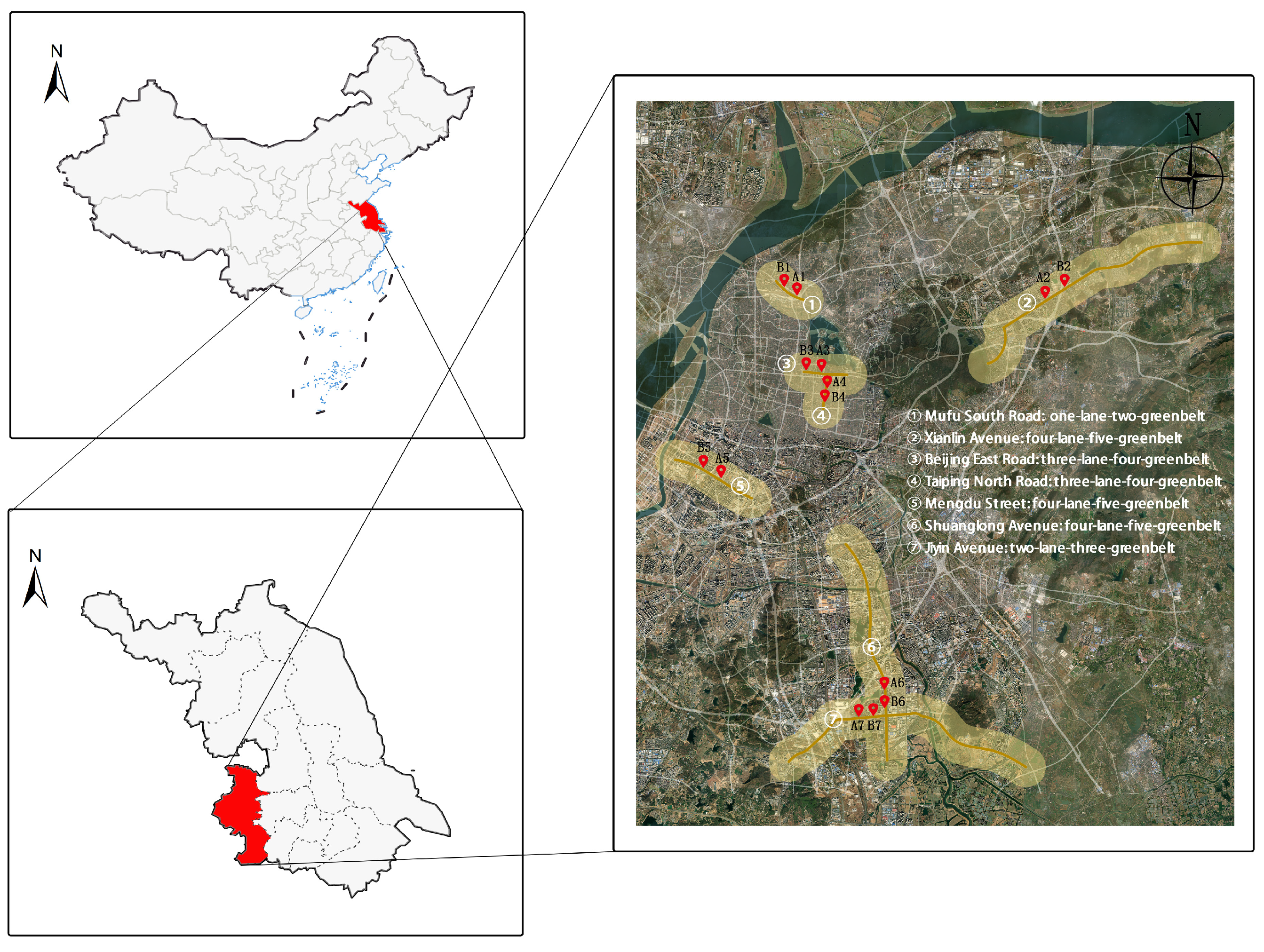
2. Study Area
3. Methods
3.1. Field Testing
3.2. Monitoring Methods
3.3. Data Processing and Analysis
4. Results
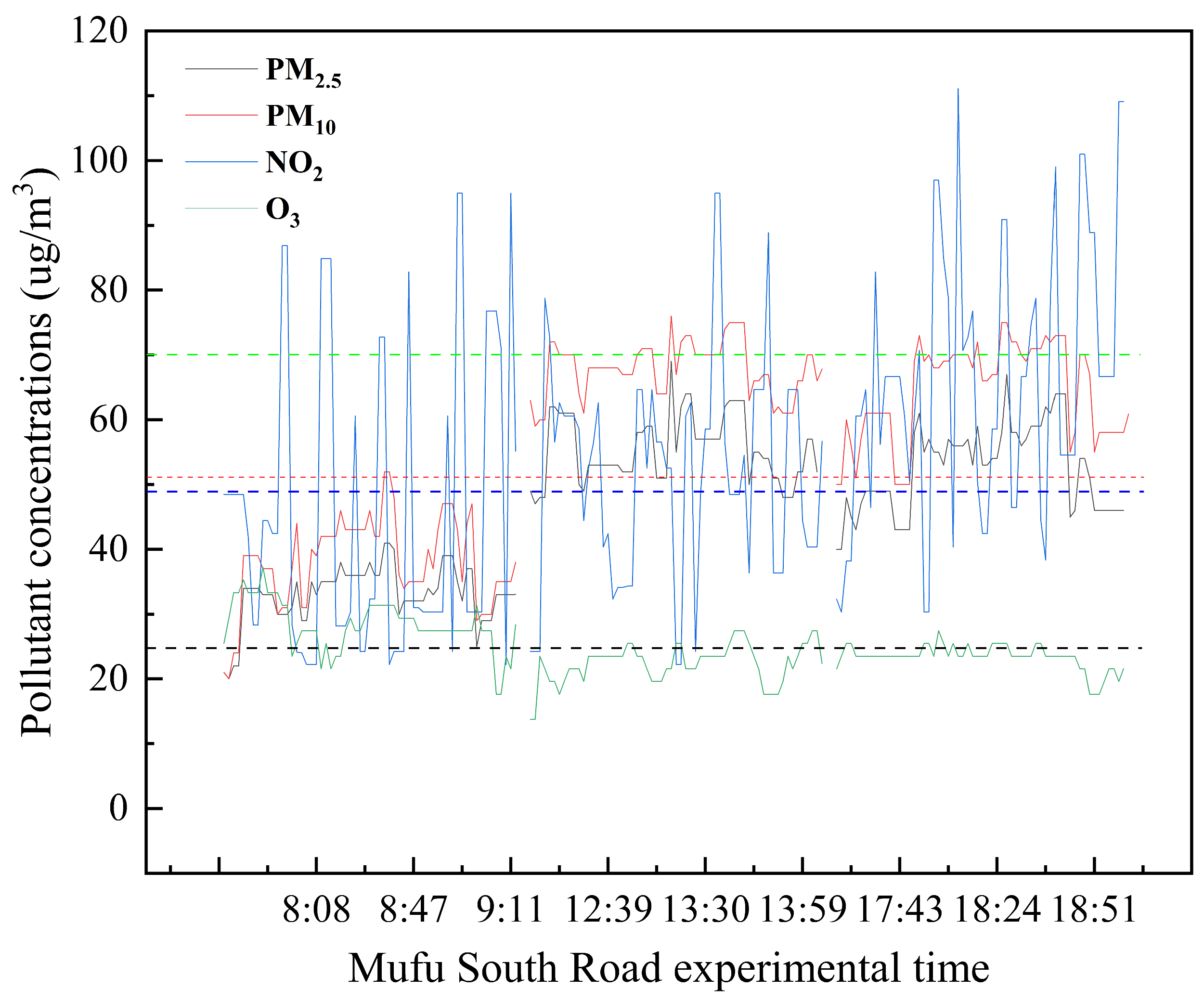
4.1. Experimental Analysis of Pollutant Concentrations on Roads in Nanjing City
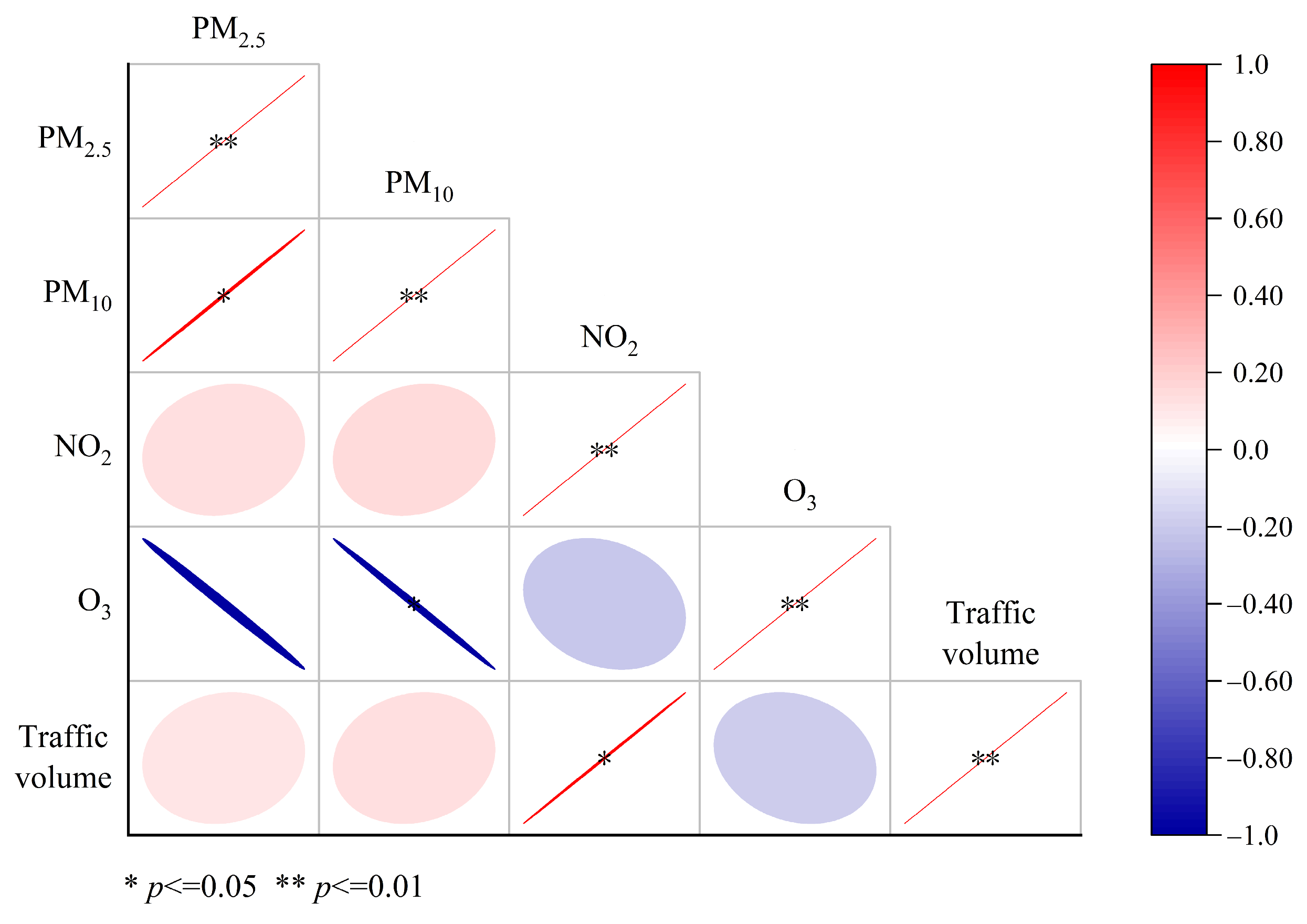
4.2. Correlation Analysis between Meteorological Factors and Air Pollutant Concentrations on Different Roads
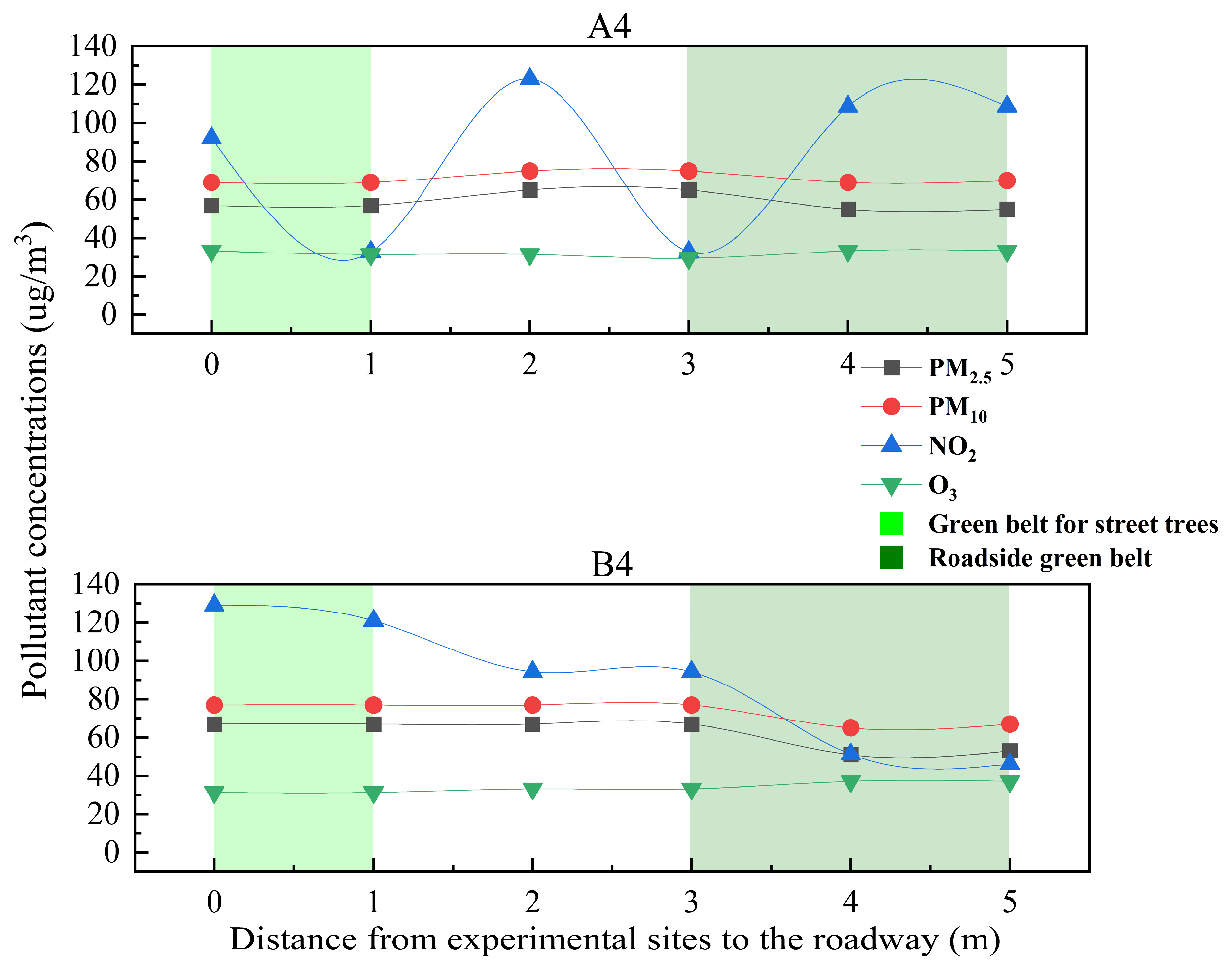
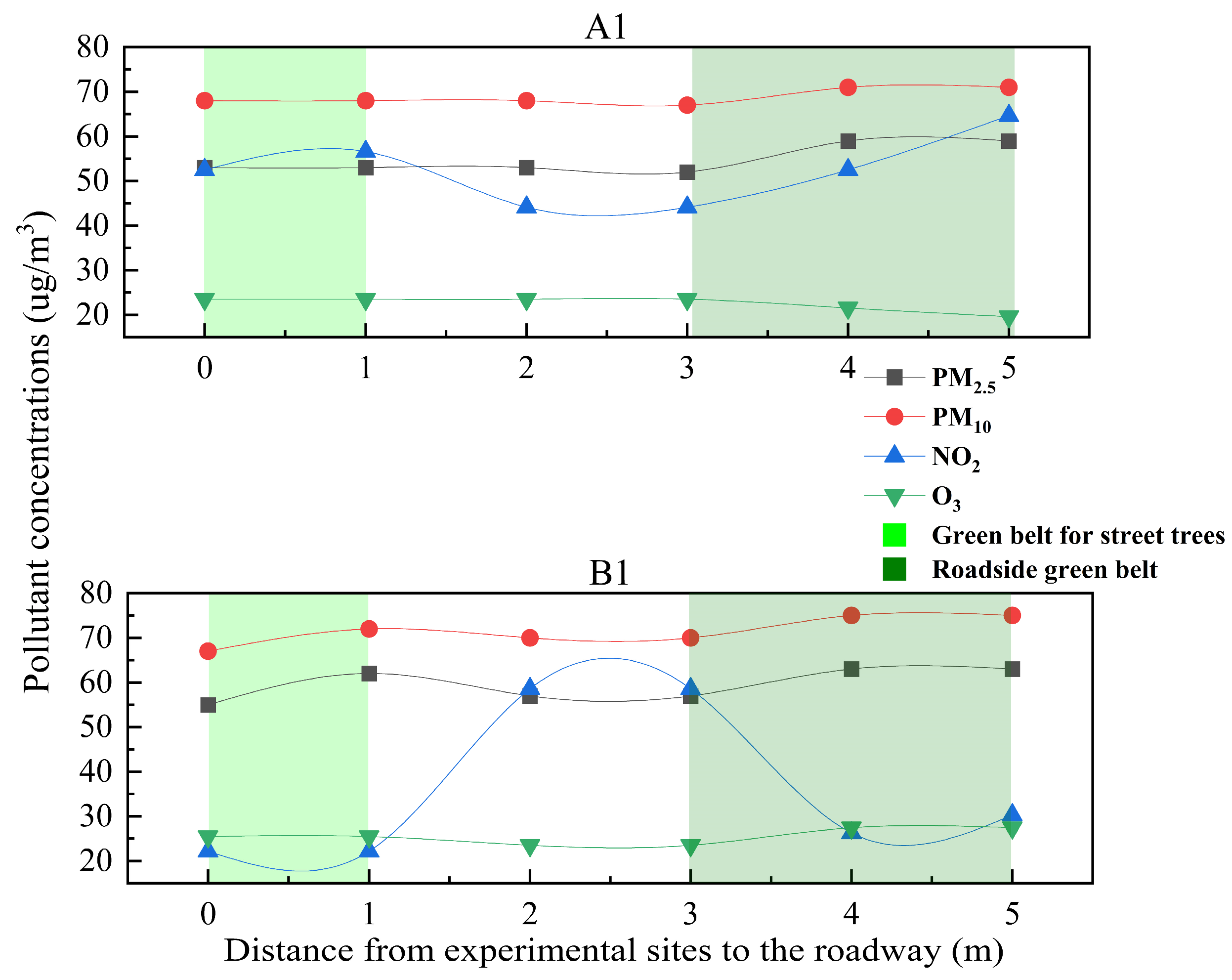
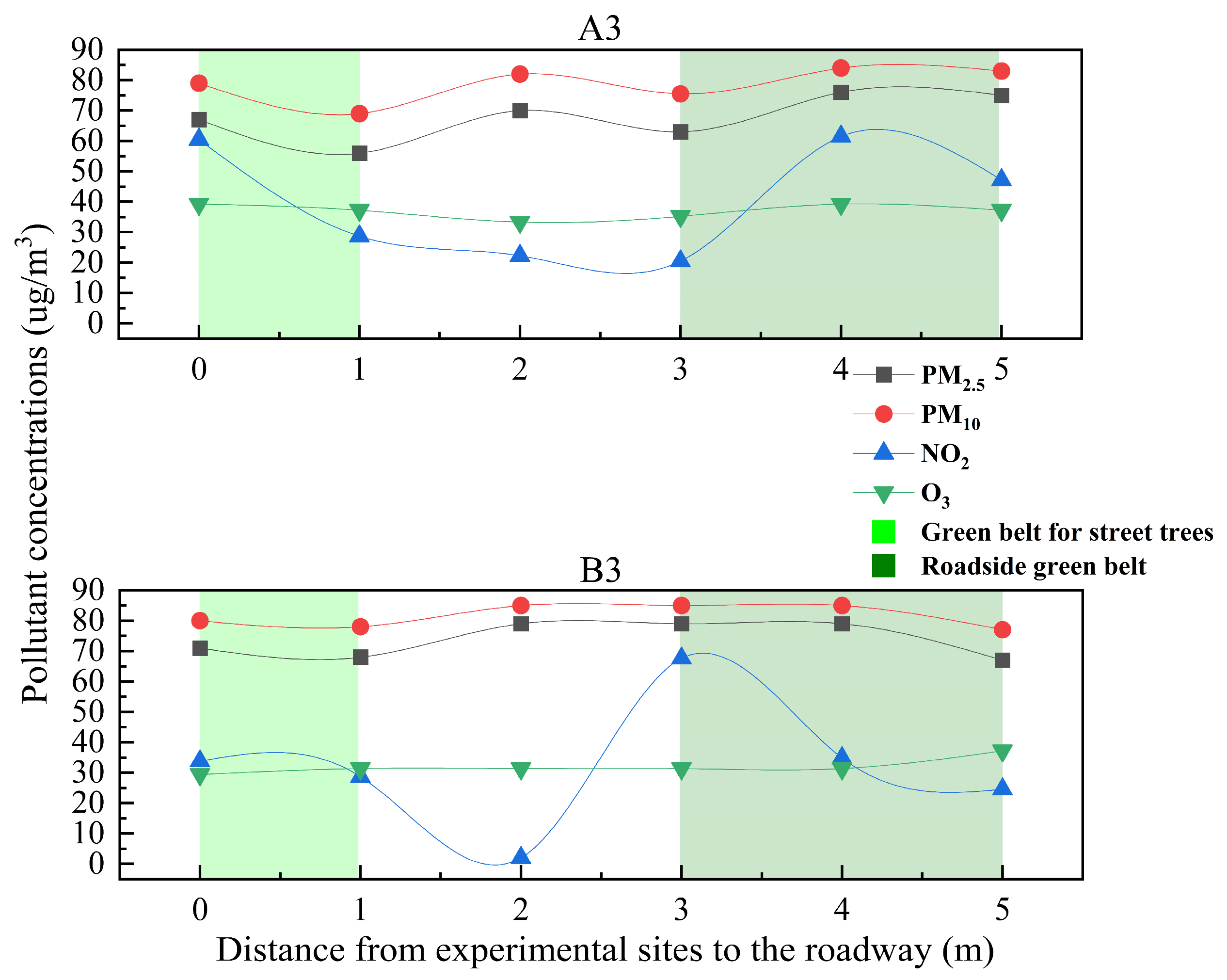
4.3. Influence of Different Green Space Plant Configurations on Air Pollutants
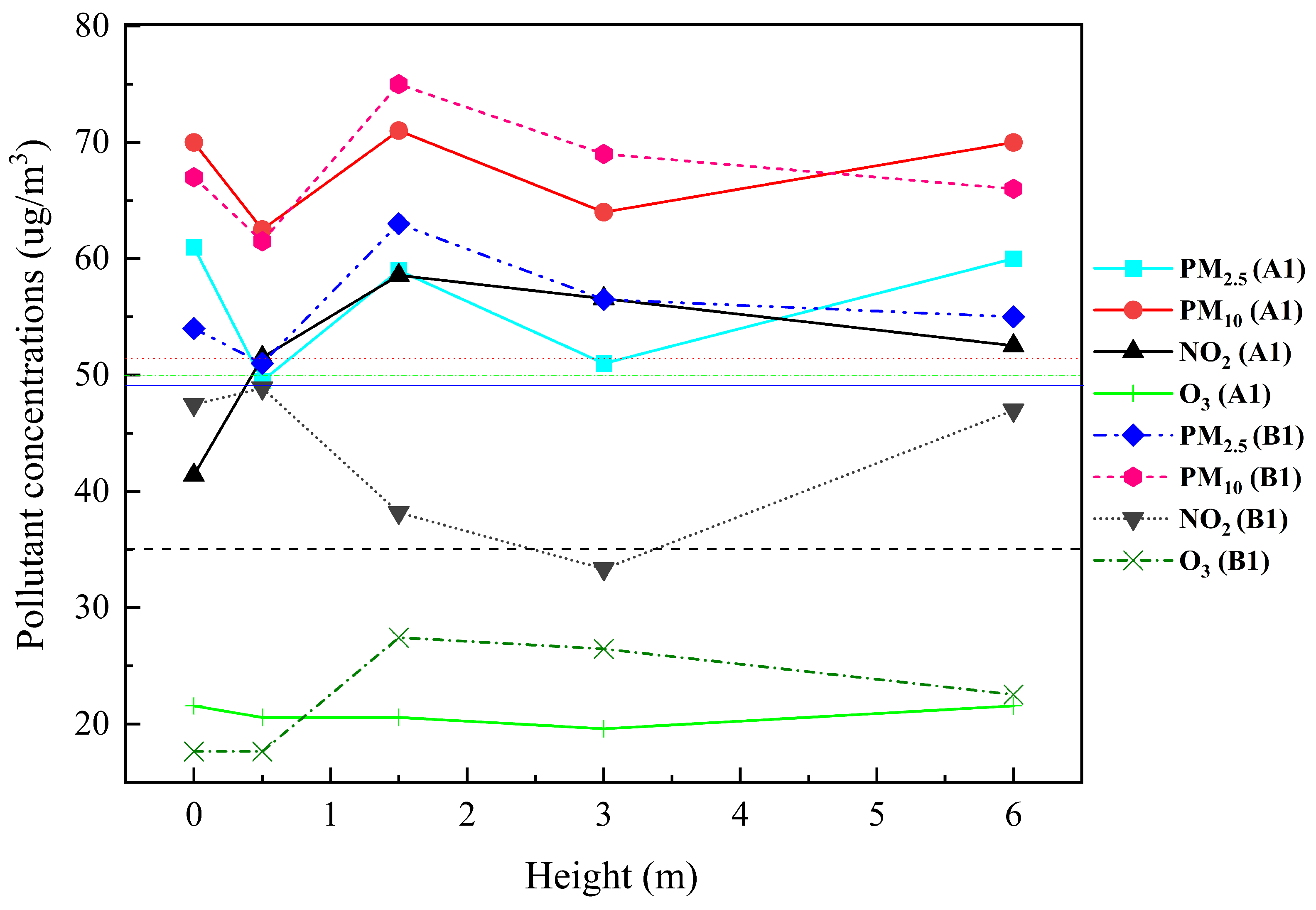
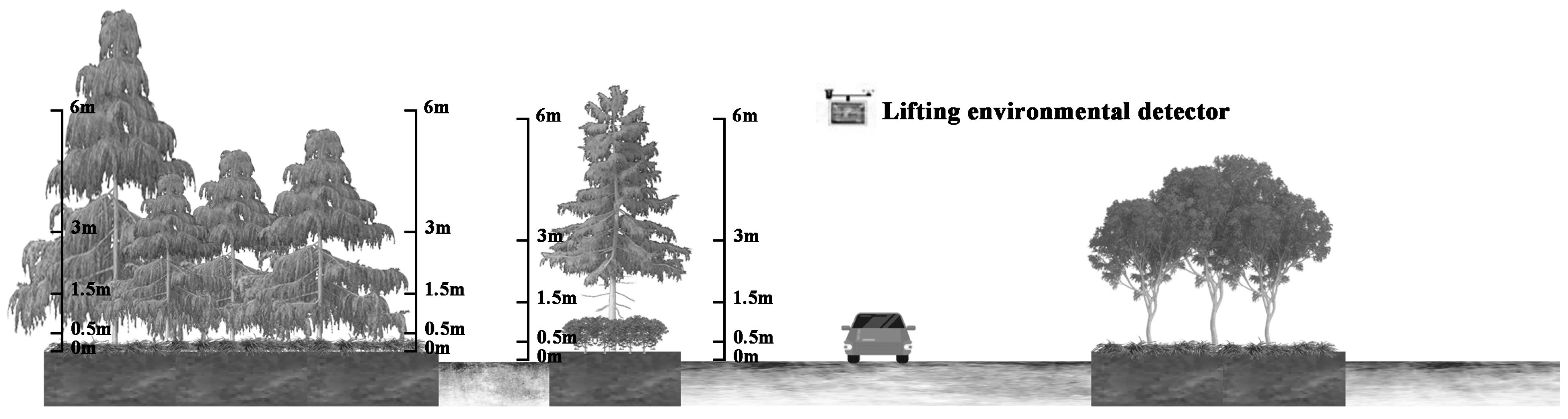
4.4. Influence of Plant Configuration at Different Heights on Pollutants
5. Discussion and Conclusions
5.1. Discussion
5.1.1. Influence of Traffic Volume on Air Pollutant Concentration
5.1.2. Influence of Meteorological Factors on Air Pollutant Concentration
5.1.3. Influence of Plant Configuration on Air Pollutant Concentration
5.2. Conclusions
Author Contributions
Funding
Data Availability Statement
Conflicts of Interest
References
- Wei, Y.X.; Zhang, X.Y.; Zhang, H. Spatial and temporal distribution of sulfur dioxide and main emission sources in China. China Environ. Sci. 2023, 1–9. Available online: https://link.cnki.net/urlid/11.2201.X.20230804.1609.004 (accessed on 16 August 2023).
- Shi, T.H.; Ming, T.Z.; Wu, Y.J.; Peng, C.; Fang, Y.P.; de Richter, R. The effect of exhaust emissions from a group of moving vehicles on pollutant dispersion in the street canyons. Build. Environ. 2020, 181, 107120. [Google Scholar] [CrossRef]
- Guilbert, A.; De Cremer, K.; Heene, B.; Demoury, C.; Aerts, R.; Declerck, P.; Brasseur, O.; Van Nieuwenhuyse, A. Personal exposure to traffic-related air pollutants and relationships with respiratory symptoms and oxidative stress: A pilot cross-sectional study among urban green space workers. Sci. Total Environ. 2019, 649, 620–628. [Google Scholar] [CrossRef] [PubMed]
- Lelieveld, J.; Evans, J.S.; Fnais, M.; Giannadaki, D.; Pozzer, A. The contribution of outdoor air pollution sources to premature mortality on a global scale. Nature 2015, 525, 367–371. [Google Scholar] [CrossRef]
- Sini, J.F.; Anquetin, S.; Mestayer, P.G. Pollutant dispersion and thermal effects in urban street canyons. Atmos. Environ. 1996, 30, 2659–2677. [Google Scholar] [CrossRef]
- Helmreich, B.; Hilliges, R.; Schriewer, A.; Horn, H. Runoff pollutants of a highly trafficked urban road–Correlation analysis and seasonal influences. Chemosphere 2010, 80, 991–997. [Google Scholar] [CrossRef]
- Dai, A.Q.; Liu, C.Z.; Sheng, Q.Q.; Zhu, Z.L. Coupling relationship between three-dimensional green quantity and the concentration of air pollutants in the green space of urban roads. J. Cent. South Univ. For. Technol. 2022, 42, 173–181. [Google Scholar]
- Ghobadi, P.; Nasrollahi, N. Assessment of pollutant dispersion in deep street canyons under different source positions: Numerical simulation. Urban Clim. 2021, 40, 101027. [Google Scholar] [CrossRef]
- Zhou, Y. Analysis of the Possible Effects of PM2.5 Air Pollution on Respiratory Diseases in Nanjing. Ph.D. Thesis, Nanjing University of Information Science and Technology, Nanjing, China, 2021. [Google Scholar]
- Miao, Q.Q.; Jiang, N.; Zhang, R.Q.; Zhao, X.N.; Qi, J.W. Characteristics and sources of PM2.5 pollution in typical cities of the central Plains urban agglomeration in autumn and winter. Environ. Sci. 2021, 42, 19–29. [Google Scholar]
- Fu, B.F.; Wu, H.T.; Zhao, L.H. Effect of urban road green belts on PM2.5 reduction based on ENVI-met. Acta Ecol. Sin. 2023, 43, 6293–6306. [Google Scholar]
- Huang, Y.D.; Li, M.Z.; Ren, S.Q.; Wang, M.J.; Cui, P.Y. Impacts of tree-planting pattern and trunk height on the airflow and pollutant dispersion inside a street canyon. Build. Environ. 2019, 165, 106385. [Google Scholar] [CrossRef]
- Al-Dabbous, A.N.; Kumar, P. The influence of roadside vegetation barriers on airborne nanoparticles and pedestrians exposure under varying wind conditions. Atmos. Environ. 2014, 90, 113–124. [Google Scholar] [CrossRef]
- Hu, M.; Yin, S.; Tang, X.M. Study on purification effect of plant communities on gaseous pollutants in traffic. Hunan Agric. Sci. 2020, 6, 82–85. [Google Scholar]
- Sheng, Q.Q.; Zhang, Y.L.; Zhu, Z.L.; Li, W.Z.; Xu, J.Y.; Tan, R. An experimental study to quantify road greenbelts and their association with PM2.5 concentration along city main roads in Nanjing, China. Sci. Total Environ. 2019, 667, 710–717. [Google Scholar] [CrossRef] [PubMed]
- Sheng, Q.Q.; Dai, A.Q.; Zhang, H.H.; Xu, J.Y.; Zhu, Z.L. Effects of common garden plants on tolerance, absorption and recovery abilities to NO2 stress. J. Nanjing For. Univ. (Nat. Sci. Ed.) 2022, 46, 127–134. [Google Scholar]
- Wu, X.G.; Lin, Y.D. Impact of plant configuration mode of greening segregating belt on air quality of adjacent sidewalk in urban street. Acta Sci. Circumstantiae 2015, 35, 984–990. [Google Scholar]
- Gu, K.K.; Qian, Z.; Fang, Y.H.; Sun, Z.; Wen, H. Influence of vegetation arrangement on PM2.5 in urban roadside based on ENVI-met. Acta Ecol. Sin. 2020, 40, 4340–4350. [Google Scholar]
- Zhao, Q.Y.; Liu, J.; Yu, K.Y.; Ai, J.W.; Shangguan, S.Y.; Xiang, J.; Lin, Y.B. Park plant configuration based on SBE method and quantitative analysis of color combination. J. Northwest For. Univ. 2018, 33, 245–251. [Google Scholar]
- Huang, Y.L.; Fu, W.C.; Chen, J.R.; Dong, J.W.; Wang, M.H. Study on the influence of plant community characteristics on the summer microclimate of the tree-shaded space in parks. Chin. Landsc. Archit. 2022, 38, 118–123. [Google Scholar]
- Gao, S.H.; Tao, S.C.; Xiong, X.Z.; Huang, S.Q.; Li, N. Characteristics of air pollution in a typical expressway near road areas in northern China. Ecol. Environ. Sci. 2019, 28, 1168–1174. [Google Scholar]
- Yin, S.; Cai, J.P.; Chen, L.P.; Shen, Z.M.; Zou, X.D.; Wang, W.H. Effects of vegetation status in urban green spaces on particles removal in a canyon street atmosphere. Acta Ecol. Sin. 2007, 11, 4590–4595. [Google Scholar]
- Li, X.Z.; Jiang, C.J. Plant community structure for street planting in Nanning. J. Zhejiang A F Univ. 2011, 28, 761–766. [Google Scholar]
- Wang, S.H.; Zhu, X.Y.; Tian, R.N.; Wen, S.S. Comprehensive analysis of dust retention efficiency of six common garden plants in Nanjing. Chin. Landsc. Archit. 2021, 37, 111–116. [Google Scholar]
- Yang, Y.B.; Zhao, D.S.; Cheng, Z.T. Study of landscape plant structure of streets in Changchun. J. Chang. Univ. 2007, 2, 87–89. [Google Scholar]
- Xu, W.W.; Xu, X.J.; Yin, C.Q. Study on non-road mobile source emission inventory for Jiangsu province. Energy Environ. Prot. 2019, 33, 59–64. [Google Scholar]
- Li, Q.C.; Li, J.; Zheng, Z.F.; Wang, Y.T.; Yu, M. Influence of mountain valley breeze and sea land breeze in winter on distribution of air pollutants in Beijing-Tianjin-Hebei region. Environ. Sci. 2019, 40, 513–524. [Google Scholar]
- Zhang, S.P.; Liu, C.Q. A brief discussion on the trends of modern garden plant configuration in China. J. Jiangxi Agric. Univ. 2004, 4, 131–133. [Google Scholar]
- Ji, Y.U.; Sheng, Q.Q.; Zhu, Z.L. Assessment of ecological benefits of urban green spaces in Nanjing city, China, Based on the entropy method and the coupling harmonious degree model. Sustainability 2023, 15, 10516. [Google Scholar] [CrossRef]
- Sun, S.; Li, L.J.; Zhao, W.J.; Qi, M.X.; Tian, X.; Li, S.S. Variation in pollutant concentrations and correlation analysis with the vegetation index in Beijing-Tianjin-Hebei. Environ. Sci. 2019, 40, 1585–1593. [Google Scholar]
- Li, J.X.; He, J.; Sun, Y.M.; Zhao, A.; Tian, Q. Physiological and ecological responses of ten garden plant functional traits to air pollution. Ecol. Environ. Sci. 2020, 29, 1205–1214. [Google Scholar]
- Tao, X.Q.; Lu, G.N.; Zhou, K.Q.; Liu, H.; Dang, Z. Phytodecontamination of atmosphere chemical pollution: A review. Ecol. Environ. 2007, 5, 1546–1550. [Google Scholar]
- Xiong, X.Z.; Tao, S.C.; Gao, S.H.; Yao, J.L.; Kong, Y.P. Characteristics of air pollution in a typical main urban area of Beijing in winter. Ecol. Environ. Sci. 2017, 26, 1167–1173. [Google Scholar]
- Liu, C.Z.; Dai, A.Q.; Ji, Y.U.; Sheng, Q.Q.; Zhu, Z.L. Effect of different plant communities on fine particle removal in an urban road greenbelt and its key factors in Nanjing, China. Sustainability 2023, 15, 156. [Google Scholar] [CrossRef]
- Carslaw, D.C.; Ropkins, K.; Bell, M.C. Change-point detection of gaseous and particulate traffic-related pollutants at a roadside location. Environ. Sci. Technol. 2006, 40, 6912–6918. [Google Scholar] [CrossRef]
- Claesen, J.L.A.; Wheeler, A.J.; Klabbers, G.; Gonzalez, D.D.; Molina, M.A.; Tham, R.; Nieuwenhuijsen, M.; Carver, A. Associations of traffic-related air pollution and greenery with academic outcomes among primary schoolchildren. Environ. Res. 2021, 199, 111325. [Google Scholar] [CrossRef]
- Buccolieri, R.; Jeanjean, A.P.R.; Gatto, E.; Leigh, R.J. The impact of trees on street ventilation, NOx and PM2.5 concentrations across heights in Marylebone Rd street canyon, central London. Sustain. Cities Soc. 2018, 41, 227–241. [Google Scholar] [CrossRef]
- GB 3095—2012; Ministry of Ecology and Environment of the People’s Republic of China. Ambient Air Quality Standards. China Environmental Science Press: Beijing, China, 2016. Available online: https://www.mee.gov.cn/ywgz/fgbz/bz/bzwb/dqhjbh/dqhjzlbz/201203/t20120302_224165.shtml (accessed on 16 May 2023).
- World Health Organization. WHO Global Air Quality Guidelines: Particulate Matter (PM2.5 and PM10), Ozone, Nitrogen Dioxide, Sulfur Dioxide and Carbon Monoxide; World Health Organization: Geneva, Switzerland, 2021; Available online: https://apps.who.int/iris/handle/10665/345329 (accessed on 28 May 2023).
- Marcial-Pablo, M.D.; Ontiveros-Capurata, R.E.; Jimenez-Jimenez, S.I.; Ojeda-Bustamante, W. Maize crop coefficient estimation based on spectral vegetation indices and vegetation cover fraction derived from UAV-Based multispectral images. Agronomy 2021, 11, 668. [Google Scholar] [CrossRef]
- Bao, H.G.; Wang, C.; Qie, G.F.; Du, W.G.; Sun, L. Distribution characteristics of PM2.5 concentration in Haidian Park in summer. Chin. J. Environ. Eng. 2017, 11, 3678–3684. [Google Scholar]
- Zhang, X.Y.; Xu, X.D.; Ding, Y.H.; Liu, Y.J.; Zhang, H.D.; Wang, Y.Q.; Zhong, J.T. The impact of meteorological changes from 2013 to 2017 on PM2.5 mass reduction in key regions in China. Sci. China-Earth Sci. 2019, 62, 1885–1902. [Google Scholar] [CrossRef]
- Xu, Z.P.; Chen, S.X.; Wu, X.Q. Meteorological change and impacts on air pollution: Results from north China. J. Geophys. Res.-Atmos. 2020, 125, e2020JD032423. [Google Scholar] [CrossRef]
- Kim, E.; Hopke, P.K. Characterization of fine particle sources in the Great Smoky Mountains area. Sci. Total Environ. 2006, 368, 781–794. [Google Scholar] [CrossRef] [PubMed]
- Rogge, W.F.; Mazurek, M.A.; Hildemann, L.M.; Cass, G.R.; Simoneit, B.R.T. Quantification of urban organic aerosols at a molecular level: Identification, abundance and seasonal variation. Atmos. Environ. 1993, 27, 1309–1330. [Google Scholar] [CrossRef]
- Safarzadeh-Amiri, A.; Bolton, J.R.; Cater, S.R. Ferrioxalate-mediated photodegradation of organic pollutants in contaminated water. Water Res. 1997, 31, 787–798. [Google Scholar] [CrossRef]
- Shen, J.F.; Su, K.J.; Feng, J.J. Study on anti-pollution patterns of road green. Urban Environ. Urban Ecol. 2001, 14, 52–53. [Google Scholar]




| Road Name | Experimental Sites | Roadside Green Belt |
|---|---|---|
| Mufu South Road | A1 | Cynodon dactylon (L.) Persoon. |
| B1 | Malus halliana Koehne + Camphora officinarum Nees ex Wall. + Osmanthus fragrans (Thunb.) Lour. + Acer palmatum Thunb. in Murray—Photinia serratifolia (Desf.) Kalkman + Euonymus japonicus ‘Aurea-marginatus’ + Loropetalum chinense var. rubrum + Ligustrum lucidum Ait. f. lucidum—Ophiopogon bodinieri H. Lév. | |
| Elevation |  Elevation of experimental sites A1 and B1 on Mufu South Road | |
| Xianlin Avenue | A2 | Cedrus deodara (Roxb.) G. Don—Pennisetum alopecuroides (L.) Spreng. |
| B2 | Cedrus deodara (Roxb.) G. Don + Camphora officinarum Nees ex Wall.— Ophiopogon bodinieri H. Lév. | |
| Elevation | 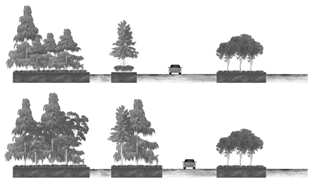 Elevation of experimental sites A2 and B2 on Xianlin Avenue | |
| Beijing East Road | A3 | Square. |
| B3 | Sophora japonica + Prunus subg. Cerasus sp.—Zoysia japonica Steud. | |
| Elevation |  Elevation of experimental sites A3 and B3 on East Beijing Road | |
| Taiping North Road | A4 | Metasequoia glyptostroboides Hu & W. C. Cheng + Carya illinoinensis (Wangenh.) K. Koch + Prunus subg. Cerasus sp.—Photinia serratifolia (Desf.) Kalkman + Nandina domestica Thunb. + Mahonia bealei (Fortune) Carr. |
| B4 | Osmanthus fragrans (Thunb.) Lour. + Phyllostachys edulis (Carrière) J. Houz. + Magnolia grandiflora L. + Zelkova serrata (Thunb.) Makino + Carya illinoinensis (Wangenh.) K. Koch + Prunus subg. Cerasus sp.—Euonymus japonicus ‘Aurea-marginatus’ + Photinia × fraseri + Loropetalum chinense var. rubrum—Zoysia japonica Steud. | |
| Elevation | 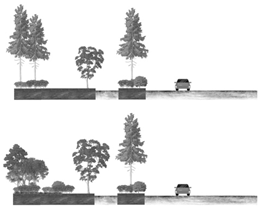 Elevation of experimental sites A4 and B4 on Taiping North Road | |
| Mengdu Street | A5 | Camphora officinarum Nees ex Wall. + Ginkgo biloba L. |
| B5 | Camphora officinarum Nees ex Wall. + Ginkgo biloba L. + Acer palmatum Thunb. in Murray—Rhododendron simsii Planch. + Pittosporum tobira (Thunb.) W. T. Aiton + Loropetalum chinense var. rubrum—Ophiopogon japonicus (L. f.) Ker Gawl. + Ophiopogon bodinieri H. Lév. | |
| Elevation |  Elevation of experimental sites A5 and B5 on Mengdu Street | |
| Shuanglong Avenue | A6 | Sapindus saponaria L. + Prunus cerasifera ‘Atropurpurea’ + Camphora officinarum Nees ex Wall. + Ginkgo biloba L.—Zoysia japonica Steud. |
| B6 | Prunus cerasifera ‘Atropurpurea’ + Ginkgo biloba L. + Cornus wilsoniana Wangerin + Albizia julibrissin Durazz. + Camphora officinarum Nees ex Wall.—Photinia serratifolia (Desf.) Kalkman—Zoysia japonica Steud. | |
| Elevation |  Elevation of experimental sites A6 and B6 on Shuanglong Avenue | |
| Jiyin Avenue | A7 | Koelreuteria paniculata Laxm. + Photinia serratifolia (Desf.) Kalkman + Camphora officinarum Nees ex Wall. + Platanaceae T. Lestib. |
| B7 | Koelreuteria paniculata Laxm. + Osmanthus fragrans (Thunb.) Lour. + Lagerstroemia indica L. + Prunus subg. Cerasus sp. + Nerium oleander L. + Prunus persica (L.) Batsch—Euonymus japonicus ‘Aurea-marginatus’ + Ligustrum × vicaryi Rehder—Ophiopogon japonicus (L. f.) Ker Gawl. | |
| Elevation | 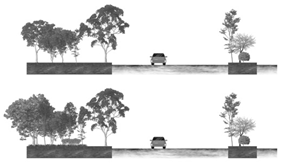 Elevation of experimental sites A7 and B7 on Jiyin Avenue |
| Road Name | Road Style | Experimental Site | Planting Density | Roadside Green Belt | Green Belt for Street Trees | Green Belt for Lane Separator |
|---|---|---|---|---|---|---|
| Mufu South Road | one-lane, two-greenbelt | A1 | sparse structure | grass | arbor: Camphora officinarum Nees ex Wall. | None |
| B1 | ventilated structure | arbor–shrub–grass | ||||
| Xianlin Avenue | four-lane, five-greenbelt | A2 | compact structure | arbor–grass | arbor–shrub: Cedrus deodara (Roxb.) G. Don—Euonymus japonicus ‘Aurea-marginatus’ | arbor–grass: Camphora officinarum Nees ex Wall.—Zoysia japonica Steud. |
| B2 | ventilated structure | arbor–grass | arbor–grass: Cedrus deodara (Roxb.) G. Don—Coreopsis basalis (A. Dietr.) S. F. Blake | |||
| Beijing East Road | three-lane, four-greenbelt | A3 | sparse structure | square | arbor–shrub: Metasequoia glyptostroboides Hu & W. C. Cheng + Cedrus deodara (Roxb.) G. Don—Pittosporum tobira (Thunb.) W. T. Aiton + Euonymus japonicus ‘Aurea-marginatus’+ Loropetalum chinense var. rubrum | None |
| B3 | ventilated structure | arbor–grass | ||||
| Taiping North Road | three-lane, four-greenbelt | A4 | compact structure | arbor–shrub | arbor–shrub: Metasequoia glyptostroboides Hu & W. C. Cheng—Pittosporum tobira (Thunb.) W. T. Aiton | None |
| B4 | ventilated structure | arbor–shrub–grass | ||||
| Mengdu Street | four-lane, five-greenbelt | A5 | ventilated structure | arbor | arbor–shrub: Platanaceae T. Lestib.—Pittosporum tobira (Thunb.) W. T. Aiton + Loropetalum chinense var. rubrum | shrub: Pittosporum tobira (Thunb.) W. T. Aiton + Photinia serratifolia (Desf.) Kalkman |
| B5 | ventilated structure | arbor–shrub–grass | arbor–shrub: Osmanthus fragrans (Thunb.) Lour.—Loropetalum chinense var. rubrum | |||
| Shuanglong Avenue | four-lane, five-greenbelt | A6 | ventilated structure | arbor–grass | arbor–grass: Platanaceae T. Lestib.—Zoysia japonica Steud. | arbor–grass: Camphora officinarum Nees ex Wall.—Cynodon dactylon (L.) Persoon |
| B6 | compact structure | arbor–shrub–grass | grass: Ophiopogon bodinieri H. Lév. | |||
| Jiyin Avenue | two-lane, three-greenbelt | A7 | compact structure | arbor | None | arbor–shrub: Prunus subg. Cerasus sp.+ Populus L.—Pittosporum tobira (Thunb.) W. T. Aiton |
| B7 | compact structure | arbor–shrub |
| Testing Content | Measuring Range | Resolution Ratio | Precision |
|---|---|---|---|
| PM2.5 | 0–1000 μg/m3 | 1 μg/m3 | ±10 μg/m3 |
| PM10 | 0–1000 μg/m3 | 1 μg/m3 | ±10 μg/m3 |
| NO2 | 0–100 ppm | 0.01 ppm | ≤Reading ± 3% |
| O3 | 0–100 ppm | 0.01 ppm | ≤Reading ± 3% |
| Temperature | −40–80 °C | 0.1 °C | ±2 °C |
| Humidity | 0–100%RH | 0.1%RH | ±2%RH |
| Wind speed | 0–60 m/s | 0.1 m/s | ±0.5 m/s |
| Atmospheric pressure | 300–1200 hpa | 1 pa | ±1.5 hpa |
| Atmospheric radiation | 0–2000 μw/cm2 | 1 | ±1 μw/cm2 |
| Illumination | 0–300 KLux | 0.1 KLux | ±0.1 KLux |
| Noise | 30–120 dB | 0.1 dB | <2% |
| Road Name | Pollutants | Temperature/°C | Humidity/% | Wind Speed/m/s | Atmospheric Pressure/pa | Atmospheric Radiation/μw/cm2 | Light/Lux | Noise/DB |
|---|---|---|---|---|---|---|---|---|
| Beijing East Road (winter) | PM2.5 | 0.365 * | 0.300 | 0.214 | −0.106 | 0.028 | −0.027 | 0.034 |
| PM10 | −0.405 * | −0.319 * | −0.145 | 0.203 | −0.083 | 0.095 | −0.044 | |
| NO2 | 0.347 * | 0.049 | 0.131 | −0.289 | −0.151 | 0.124 | −0.147 | |
| O3 | −0.194 | −0.353 * | −0.080 | −0.334 * | −0.194 | 0.188 | −0.217 | |
| Mufu South Road (winter) | PM2.5 | 0.316 * | −0.012 | 0.011 | 0.365 ** | −0.261 | 0.355 * | −0.130 |
| PM10 | −0.432 ** | 0.001 | 0.147 | −0.322 | 0.253 | −0.312 * | 0.173 | |
| NO2 | 0.143 | 0.140 | −0.084 | −0.305 * | 0.146 | −0.212 | −0.273 | |
| O3 | −0.407 ** | −0.309 * | 0.203 | −0.490 ** | 0.064 | −0.198 | 0.252 | |
| Taiping North Road (winter) | PM2.5 | 0.031 | 0.479 ** | 0.357 * | −0.424 ** | 0.146 | −0.173 | 0.072 |
| PM10 | −0.172 | −0.603 ** | −0.238 | 0.256 | −0.162 | 0.187 | −0.024 | |
| NO2 | 0.331 * | 0.191 | −0.142 | 0.204 | −0.256 | 0.286 * | −0.095 | |
| O3 | −0.120 | 0.271 | 0.420 ** | −0.632 ** | −0.085 | 0.041 | 0.232 | |
| Jiyin Avenue (winter) | PM2.5 | 0.348 ** | 0.437 ** | 0.156 | 0.220 | 0.311 * | −0.310 * | 0.412 ** |
| PM10 | −0.255 * | −0.422 ** | −0.053 | −0.111 | −0.347 ** | 0.339 ** | −0.413 ** | |
| NO2 | 0.170 | 0.053 | 0.153 | 0.246 | −0.056 | 0.043 | 0.241 | |
| O3 | −0.497 ** | −0.080 | −0.245 | −0.519 ** | −0.025 | 0.017 | −0.040 | |
| Shuanglong Avenue (winter) | PM2.5 | −0.043 | 0.004 | −0.161 | −0.185 | 0.118 | −0.141 | 0.004 |
| PM10 | 0.013 | −0.036 | 0.228 | 0.253 * | −0.114 | 0.128 | −0.006 | |
| NO2 | −0.081 | −0.286 * | 0.024 | 0.049 | −0.168 | 0.121 | 0.187 | |
| O3 | −0.476 ** | −0.626 ** | −0.058 | −0.559 ** | 0.288 * | −0.380 ** | 0.173 | |
| Mengdu Street (winter) | PM2.5 | −0.334 ** | −0.128 | 0.127 | 0.017 | 0.246 | −0.257 * | 0.297 * |
| PM10 | 0.268 * | 0.244 | 0.023 | −0.219 | −0.341 ** | 0.357 ** | −0.129 | |
| NO2 | 0.074 | −0.232 | 0.111 | −0.088 | −0.012 | 0.015 | 0.064 | |
| O3 | −0.531 ** | 0.044 | −0.096 | −0.149 | 0.270 * | −0.292 * | 0.101 | |
| Xianlin Street (winter) | PM2.5 | 0.108 | 0.082 | −0.004 | −0.217 | 0.122 | −0.177 | −0.135 |
| PM10 | −0.145 | −0.092 | 0.115 | 0.204 | −0.063 | 0.132 | 0.124 | |
| NO2 | 0.214 | 0.092 | 0.006 | −0.232 | 0.017 | 0.014 | 0.215 | |
| O3 | 0.121 | −0.039 | 0.501 ** | −0.536 ** | −0.082 | −0.010 | −0.186 |
| Road Experiment Site | Plant Configurations and Species |
|---|---|
| Mufu South Road experimental site A1 (grass) | Roadside green belt: grass (Cynodon dactylon); green belt for street trees: arbor (Camphora officinarum) |
| Mufu South Road experimental site B1 (arbor–shrub–grass) | Roadside green belt: arbor–shrub–grass (Malus halliana + Camphora officinarum + Osmanthus fragrans + Acer palmatum—Photinia serratifolia + Euonymus japonicus + Loropetalum chinense var. rubrum + Ligustrum lucidum—Ophiopogon bodinieri); green belt for street trees: arbor (Camphora officinarum) |
| Beijing East Road experimental site A3 (square) | Roadside green belt: square; green belt for street trees: arbor–shrub (Metasequoia glyptostroboides + Cedrus deodara—Pittosporum tobira + Euonymus japonicus + Loropetalum chinense var. rubrum) |
| Beijing East Road experimental site B3 (arbor–grass) | Roadside green belt: arbor–grass (Sophora japonica + Prunus subg. Cerasus sp.—Zoysia japonica); green belt for street trees: arbor–shrub (Metasequoia glyptostroboides + Cedrus deodara—Pittosporum tobira + Euonymus japonicus + Loropetalum chinense var. rubrum) |
| Beijing East Road experimental site A4 (arbor–shrub) | Roadside green belt: arbor–shrub (Metasequoia glyptostroboides + Carya illinoinensis + Prunus subg. Cerasus sp.—Photinia serratifolia + Nandina domestica + Mahonia bealei; green belt for street trees: arbor–shrub (Metasequoia glyptostroboides—Pittosporum tobira) |
| Beijing East Road experimental site B4 (arbor–shrub–grass) | Roadside green belt: arbor–shrub–grass (Osmanthus fragrans + Phyllostachys edulis + Magnolia grandiflora + Zelkova serrata + Metasequoia glyptostroboides + Carya illinoinensis + Prunus subg. Cerasus sp.—Euonymus japonicus + Photinia × fraseri + Pittosporum tobira + Loropetalum chinense var. rubrum—Zoysia japonica); green belt for street trees: arbor–shrub (Metasequoia glyptostroboides—Pittosporum tobira) |
| Experimental Site | PM2.5 (μg/m3) | PM10 (μg/m3) | NO2 (ppm) | O3 (ppm) |
|---|---|---|---|---|
| Mufu South Road experimental site A1 (grass) | −11.32% | −4.41% | −18.52% | 16.67% |
| Mufu South Road experimental site B1 (arbor–shrub–grass) | −7.69% | −7.91% | 27.27% | 7.69% |
| Beijing East Road experimental site A3 (square) | 15.19% | 9.41% | 29.41% | −18.75% |
| Beijing East Road experimental site B3 (arbor–grass) | −19.05% | −9.93% | 30.00% | 5.56% |
| Beijing East Road experimental site A4 (arbor–shrub) | 15.38% | 7.33% | −39.47% | −9.68% |
| Beijing East Road experimental site B4 (arbor–shrub–grass) | 22.39% | 14.29% | 69.57% | −11.76% |
Disclaimer/Publisher’s Note: The statements, opinions and data contained in all publications are solely those of the individual author(s) and contributor(s) and not of MDPI and/or the editor(s). MDPI and/or the editor(s) disclaim responsibility for any injury to people or property resulting from any ideas, methods, instructions or products referred to in the content. |
© 2023 by the authors. Licensee MDPI, Basel, Switzerland. This article is an open access article distributed under the terms and conditions of the Creative Commons Attribution (CC BY) license (https://creativecommons.org/licenses/by/4.0/).
Share and Cite
Sheng, Q.; Ji, Y.; Huang, Z.; Liu, C.; Dai, A.; Zhu, Z. Influence of Urban-Road Green Space Plant Configurations on NO2 Concentrations in Nanjing City during Winter. Forests 2023, 14, 1892. https://doi.org/10.3390/f14091892
Sheng Q, Ji Y, Huang Z, Liu C, Dai A, Zhu Z. Influence of Urban-Road Green Space Plant Configurations on NO2 Concentrations in Nanjing City during Winter. Forests. 2023; 14(9):1892. https://doi.org/10.3390/f14091892
Chicago/Turabian StyleSheng, Qianqian, Yaou Ji, Zhengwei Huang, Congzhe Liu, Anqi Dai, and Zunling Zhu. 2023. "Influence of Urban-Road Green Space Plant Configurations on NO2 Concentrations in Nanjing City during Winter" Forests 14, no. 9: 1892. https://doi.org/10.3390/f14091892
APA StyleSheng, Q., Ji, Y., Huang, Z., Liu, C., Dai, A., & Zhu, Z. (2023). Influence of Urban-Road Green Space Plant Configurations on NO2 Concentrations in Nanjing City during Winter. Forests, 14(9), 1892. https://doi.org/10.3390/f14091892