Abstract
The macroelement (nitrogen, phosphorus, potassium, sulfur, calcium, and magnesium) contents in individual parts of 1-year-old seedlings (leaves, shoots, root system) of the common beech (Fagus sylvatica L.) were investigated. The seedlings were grown in nine different densities of peat substrate (0.196–0.317 g cm−3) in 265 cm3 containers. It was found that substrate compaction influenced macroelement content in the seedlings. With an increase in substrate compaction, there was a decrease in macroelement content in the leaves (except for N). The macroelement contents derived from this study were compared to the optimal contents indicated in the literature. Studies have shown that the availability of Mg is of great importance for the growth of beech seedlings. The least-compacted substrate allowed for the best root growth in the seedlings, which translated into a higher Mg uptake, resulting in a better dry-mass shoot to root ratio. Our findings confirmed that the lowest compaction of a peat substrate (0.196 g cm−3 actual density) containing dolomite is the best for cultivating common beech under foliar fertilization in 265 cm3 containers.
1. Introduction
The common beech (Fagus sylvatica L.) is a valuable deciduous species that grows across Europe. Its natural range extends from southern Scandinavia to Sicily, and from Spain in the west to northwestern Turkey in the east [1]. It is the most common species of deciduous tree, with its share in European forests being 11.9% [2]. Currently, in Poland, the reconstruction of coniferous monocultures is underway, adjusting the species composition of forest stands to the conditions of the habitat. This is one of the methods being employed to maintain forest stability and increase their biological resistance to increasingly adverse environmental influences [3]. This reconstruction envisages an increase in the share of deciduous species, especially beech, with the change in species composition being a response to the dieback of spruce forests in the Carpathians with the progression of climate change. As a result of the decay of spruce stands, unstable spruce monocultures [4] are being converted into mixed stands. This is consistent with studies that have shown higher yields from mixed stands compared to monocultures [5,6]. Spruce in stands mixed with beech results in significant incremental benefits [7].
Due to the increasing share of beech in this artificial forest regeneration and the increase in container production in Poland, it is important to conduct detailed research on the quality of beech seedlings and the macroelement contents in their individual parts (roots, shoots, and leaves).
One of the key factors influencing plant growth is the availability of nutrients. European beech has average requirements in terms of soil fertility and moisture [8,9]. The common beech stores and mobilizes nitrogen (N), sulfur (S), and phosphorus (P) in the bark of its branches and stems [10]. The type of fertilization used during the production of seedlings in container nurseries is of key importance for their growth and nutritional level [11,12]. In order to determine the fertilization needs of the common beech, and to investigate the condition of the seedlings, a chemical analysis of the elemental concentrations is usually carried out during plant growth, with the content of elements in the assimilation apparatus being examined most often. For 1-year-old beech seedlings, the optimal macroelement contents in dried leaf matter should be in the following ranges: N 2.20%–2.50%; P 0.20%–0.35%; potassium (K) 0.80%–1.80%; and magnesium (Mg) 0.17%–0.30% [13]. Due to the lack of optimal values for calcium (Ca) and S in beech seedlings, the contents of these elements in the leaves of healthy, well-growing trees are used for comparative purposes. At the end of summer, these values were found to amount to 0.29%–1.83% for Ca and 0.056% for S [8]. When interpreting the chemical analysis of leaves in the context of determining the nutritional status, it is not only the content of the individual elements that is important, but also the proportions between them. In order to ensure a proper supply of nutrients, each element must be present in a proportion appropriate to the concentration of the other nutrients. Only these conditions ensure optimal plant growth [14]. According to Wesoły and Hauke [15], the proportions of the elements included in fertilizers necessary for beech should correspond to 100:32:70:11:10:9 for N, P, K, Ca, Mg, and S, respectively.
The availability of nutrients depends, among other things, on the compaction of the substrate, which is one of the key factors that influence plant growth. Negative effects (observed in biometric features) are associated with both too-low and especially too-high density, as confirmed by field and pot experiments [16,17,18,19,20,21,22,23,24,25,26]. Unfortunately, container nurseries do not use tools to measure the compaction, but it is organoleptically checked and the assessment of compactness depends on the experience of the nursery worker. The compaction of the ground affects air–water relationships, and thus the availability of water and minerals. Excessive compaction of the substrate may limit the growth of fine roots, which are responsible for the uptake of elements [27]. Pająk et al. [26] determined that the compaction of peat substrates influences certain biometric parameters in beech grown in containers. It was shown that the best parameters: S/R (shoot-to-root ratio) and SQ (sturdiness quotient) were reached by the seedlings growing in a density of 0.196 g·cm−3. The present work adds to the knowledge base concerning the influence of differences in the bulk density of peat substrates on the macronutrient content (N, P, K, Ca, Mg, S) of Fagus sylvatica beech seedlings under foliar fertilization in container cultures.
The hypothesis that a difference in substrate density influences the content of macroelements in beech seedlings was tested in this study. In addition, the density of peat substrate supplying the optimal nutrition (in terms of the macroelement content in the assimilation apparatus) to beech seedlings was examined, based on the concentrations needed as supplied by Fober [8] and Szołtyk and Hilszczańska [13].
2. Materials and Methods
A substrate produced at Nędza Farm in Nędza in the Rudy Raciborskie Forest District of Poland was used in the experiment (GPS 50.167964′ N, 18.3138334.17′ E). This substrate had a composition of 93% peat and 7% perlite, with dolomite added at 3 kg m−3 of substrate in order to obtain a pH of 5.5. The peat was characterized by a maximum degree of decomposition of 15%, an organic-matter content of >85%, a grain-size composition of 2.5% 10.1–20 mm, 12.5% 4.1–10 mm, 12.5% 2.1–4.0 mm, and 72.5% < 2.0 mm, an air capacity of 15%–25% by volume and a water capacity of 70%–80% by volume at 10 cm H2O, a general porosity of 85%–95% by volume, a humidity of ~65%, a pH in H2O of 3.0–4.5, and a salinity of up to 0.12 mS cm−1.
Polyethylene containers (HIKO V265) with dimensions of 352 × 216 × 150 mm (length × width × height) and containing 28 cells, each with a volume of 265 cm3, were used in the study. The cells tapered downward and were equipped with vertical guides for the root systems. Nine variants of compacted peat–perlite substrate were prepared. The minimum bulk density (Variant V1) was obtained by pouring uncompacted substrate, with a moisture level of 60%, into one of the cells up to the brim and then pouring this out and weighing it. The procedure was repeated three times, and the masses were averaged. The substrate mass obtained for Variant V1 was 52.0 ± 0.2 g. The maximum density was obtained by pouring substrate into the cell and then compacting it using a wooden punch, adding more and compacting it again until the compacted substrate reached the brim. The substrate was then poured out and weighed, the procedure was repeated three times and the values were averaged. The mass for this variant (V9) was 84.0 ± 0.3 g. The difference in weight for the variants in between the least and most compacted was then calculated as 4 g (Table 1). Bulk density used in practice in container nurseries corresponds to a value between variants V4 and V5. For each of these variants, three containers were filled with the substrate (replicates), each cell filled with the calculated mass of the substrate, weighed on an analytical balance to an accuracy of ±0.1 g.
Table 1.
Mass of the substrate, with a humidity of 60%, used to fill the cells of the various variants, and the corresponding actual and dry bulk densities.
After filling the containers with the various densities of substrate, beech seeds were sown in these by hand. All the seeds used in this experiment had the same provenance (certificate of origin MR/30629/11/PL). A total of 756 seeds were sown, 84 seeds in each variant (28 cells per container × three replicates). After sowing, the containers were placed in a vegetation hall for 4 weeks and then transported to an external production field. The containers (27 in all), marked with the variant and the repetition number, were placed randomly on the rack (pallet), which was placed among other seedlings of this species in the central part of the production field. During the growth of the seedlings, plant protection products and manual weeding were employed. The seedlings were grown for 5 months in accordance with the procedure used in the container nursery [28]. During the period of seedling growth, the total rainfall was only 78 mm, and so to replenish the water deficit, irrigation was applied using an automatic HAB-T1 BCC sprinkler ramp. In total, during the production season, irrigation was carried out on 103 days, providing 904 mm of water. Floralesad foliar fertilizer was applied (five times in the tent and 11 times in the production field) at a total dose of 0.270 dm3 m−2, and to accelerate the lignification of the seedlings at the end of the growing season, Florasin K 500 was used once. The composition of the Floralesad (in g dm−3) was 103.1 N, 0.0214 N as N dioxide (N-NO2), 16.369 as nitrate (N-NO3−), 2.602 as ammonium (N-NH4), 84.107 as amine (N-NH2), 17.231 P, 47.423 K, 3.567 Mg, 0.737 Ca, 0.28 sodium (Na), 1.24 S, 1.107 boron (B), 0.123 copper (Cu), 1.04 iron (Fe), 0.281 manganese (Mn), 0.048 molybdenum (Mo), and 0.231 zinc (Zn) and the fertilizer Florasin K 500: K 420.75, Na 2.2 1 and Ca 0.003. Throughout the vegetation cycle, the conductivity of the aqueous fertilizer solution was maintained at a level of ~600 µS cm−1.
2.1. Biometric Analysis
At the end of the production cycle, the number of grown seedlings was determined, afterwards the root collar diameter (RCD) and seedling height (SH) were measured. The strength factor (SQ) was calculated as the proportion of SH to RCD [29,30] and the dry-mass shoot:root (S:R) ratio [31]. Leaves from each seedling were scanned and their surface determined using WinFolia software (Regent Instruments Inc., Québec City, QC, Canada). For each replication of each variant, three cuttings that were closest to the average were selected, and their root systems were subjected to detailed analysis. The selected seedlings were taken out of the cells and the root ball was divided (cut) into three equal parts—upper (a) 0–5-cm cell depth, middle (b) 5–10 cm, and lower (c) 10–15 cm. The roots obtained from each part were scanned. Root length was determined using WinRhizo software (Regent Instruments Inc., Québec City, QC, Canada) [32,33]. All parts of the seedlings (assimilation apparatus, shoots, roots) were dried at 105 °C for 48 h and then weighed to an accuracy of ±0.1 mg. For each variant, the share of seedlings meeting both quality indices (SQ ≤ 6.5 and S\R ≤ 2:1), meeting only one, and not meeting any was calculated. The results of the biometric analyses are presented in detail in Pająk et al. [26].
2.2. Elemental Analysis
Substrate samples (previously dried at 105 °C for 48 h) and plant material from each compaction variant were analyzed for their N and S contents using a LECO CNS TruMac analyzer and their P, K, Ca, and Mg contents using a Thermo iCAP 6500DUO inductively coupled plasma–optical emission spectroscope following mineralization in nitric and hydrochloric acids at a ratio of 7:3. The concentrations of the elements (expressed in percentages, grams element per 100 g dry sample) were obtained. The analyses were performed at the Laboratory of Forest Environment Geochemistry and Land Intended for Reclamation in the Department of Ecology and Silviculture, Faculty of Forestry, University of Agriculture in Krakow, Poland.
2.3. Statistical Analysis
The data were statistically analyzed by one-way analysis of variance and Tukey’s post-hoc multiple comparison test performed using Statistica 13.3 software [34], with a significance of p = 0.01. The aim was to test, for the individual parts of the seedlings, which substrate variant differed statistically significantly from the others based on selected biometric features and elemental content. By means of non-linear regression, the elemental contents of the individual parts of the seedlings were visualized based on the density of the substrate.
3. Results
Of the 756 beech seeds sown, 404 grew into seedlings, giving a success rate of 53%. A total of 22% of the seeds failed to germinate and 25% of the seedlings died during growth. The differences in the success rate of emergence between the variants were not statistically significant.
The concentration of elements in the starting substrate (used to fill the cassettes before seeding) was compared with the substrate after cultivation (the substrate variants being analyzed separately). The highest elemental concentration before and after growing the seedlings in the substrate was determined for Ca (1.1% before and after cultivation) and the lowest for P (0.01% before cultivation and, on average, 0.05% after cultivation) (Table 2). The content of Mg in the starting substrate was higher than the content of Mg after cultivation in each of the variants. The N, P, and K contents in the substrate after cultivation differed statistically significantly between the variants (Table 2).
Table 2.
Percentage of macroelements in the substrate before sowing and after growing (V1–V9) the seedlings for each density variant (±SD). The letters a, b and c indicate significant differences between the means.
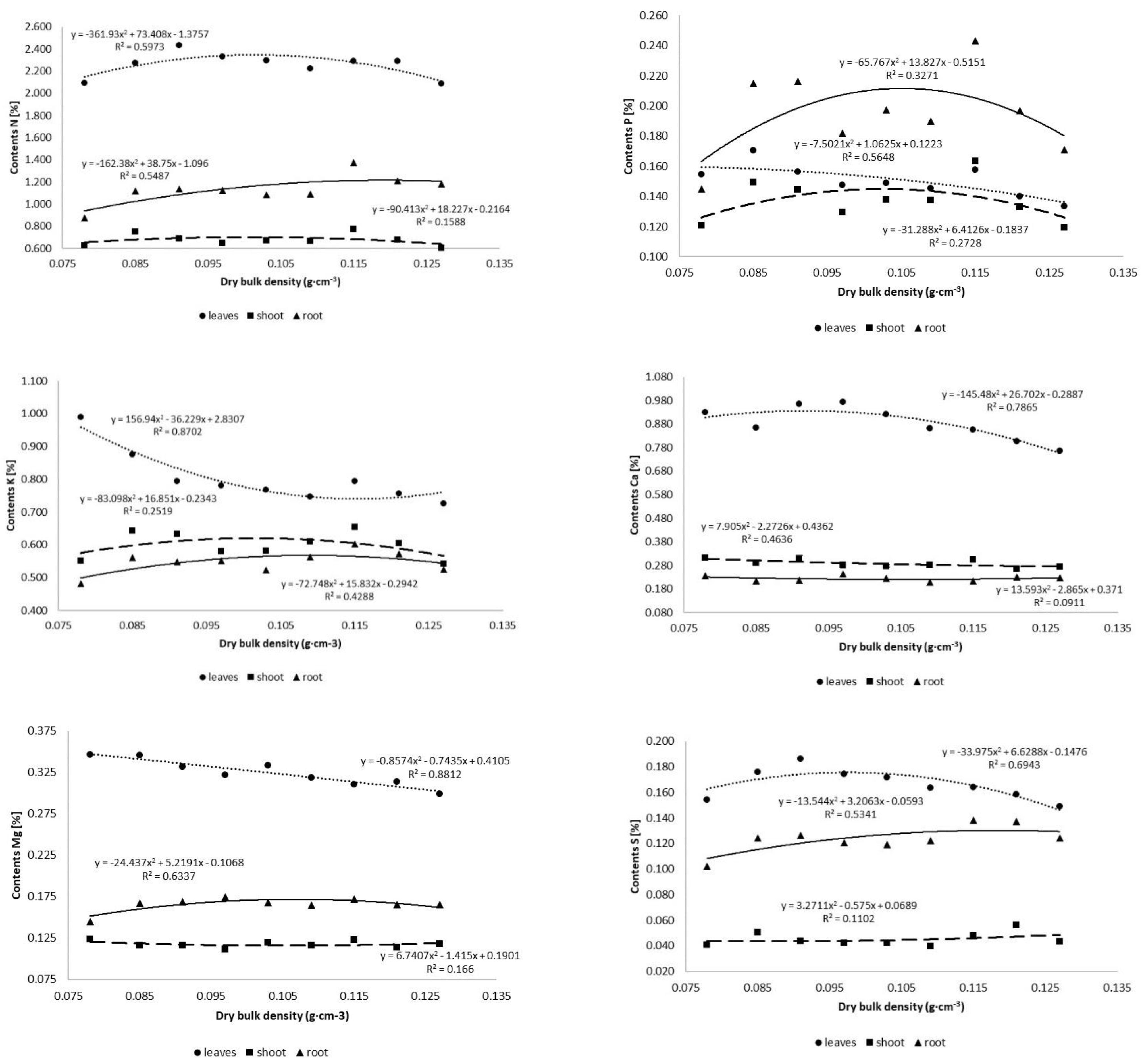
Apart from N, the contents of all elements in the leaves showed a downward trend with an increase in the density of the substrate in which the seedlings grew (Table 3). This dependence was especially visible in the cases of Mg and P, where the coefficients of determination (R2) were 0.88 and 0.87, respectively (Figure 1). The N content in the leaves was highest in the V3 variant, which differed significantly from the extreme density variants, V1 and V9, in which it was the lowest (Table 3).
Table 3.
Percentages of macroelements in the leaves for each substrate density variant (±SD). The letters a, b, c and d indicate significant differences between the means.
Figure 1.
Average elemental contents in individual parts of the seedlings in relation to compaction of the substrate after growing the seedlings.
The ratios of the individual macronutrients to N in the V2–V9 variants were similar (Table 4). In the least-compacted variant (V1), the K, Ca, and Mg contents in relation to N, constituting 100%, was higher than in the other variants.
Table 4.
Percentage of macroelements in relation to N in the leaves from each substrate density variant after growing the seedlings.
The macronutrient contents in the stems showed no strong decreasing or increasing tendencies with an increase in substrate compaction (Figure 1). Only for Ca was there a slight decreasing trend observed with an increase in substrate compaction (R2 = 0.4). The P, K, and Ca contents in the stems differed statistically significantly between the substrate variants (Table 5).
Table 5.
Percentage of macroelements in the stems from each substrate density variant after growing the seedlings (±SD). The letters a, b and c indicate significant differences between the means.
The N and Mg contents in the roots increased with an increase in substrate density (Figure 1). The N, P, K, and Mg contents in the roots were statistically significant between the variants. However, in the case of Mg, the statistical difference occurred only in Variant V1 in relation to the other variants, in which the amount of Mg was higher than in V1. The Ca content in the roots remained at a similar level in all variants and was not dependent on density, similarly to the case of S (Table 6).
Table 6.
Percentage of macroelements in the roots for each substrate density variant after growing the seedlings (±SD). The letters a, b and c indicate significant differences between the means.
4. Discussion
A comparison of the macroelemental contents in the examined leaves with the optimal values given in Fober [8] and Szołtyk and Hilszczańska [13] showed that, in most cases, the elements were in the optimal range, except for N in V1 and V9 and P in V8 and V9, which fell below the lower threshold. Phosphorus and K remained at the lower limit of the optimum, Mg at the upper limit. Dzwonko [35] found that, during the growing season, the concentrations of N, P, K, and Mg in beech leaves decreased (withdrawal to wood), whereas the Ca content increased, especially at the end of the growing season. Baule and Fricker [36] described the demand for Ca as high and for K as very high. According to Dzwonko [35], beech seedlings develop better in a substrate rich in Ca, Mg, and K. The use of dolomite (containing Ca and Mg) to fertilize beech trees in plantations has a positive effect on the survival and growth of the trees [37]. Apart from N, P is an important nutrient for the growth of beech. Its content in leaves depends on the season and the amount of N in the substrate. A large amount of N in the substrate may have a limiting effect on the uptake of P by beech [10]. In the tested substrates, especially when comparing the content of Mg before and after the cultivation period, a decrease in P was noted. The only element occurring in a smaller amount in the substrate after the cultivation period than in the starting substrate was Mg, which proves the high demand for this element by the beech seedlings. Magnesium deficiency is a common factor in limiting plant production. Certain soil conditions, such as the concentration of exchangeable Mg and soil pH, have a direct impact on the availability of Mg to crops. It is easily leached in acidic soils, and competition with excess cations makes it less available to plant roots. The use of Mg has improved yields by 8.5% in various field conditions around the world, irrespective of crop type, soil condition, and other factors. Using Mg fertilizers has proven to be more efficient at improving yields than using N, P, and K [38].
A biometric study carried out on the same seedlings used in this study by Pająk et al. [26] showed that the best parameters, including the dry-weight ratio of the above- to belowground parts and the SH:RCD ratio, were achieved by the seedlings grown in the lowest-density substrate (i.e., 0.196 g cm−3). The distribution of dry matter among plant organs is one of the key variables in influencing the survival, competitive ability, and productivity of individual plants. It is influenced by several variables, including the availability of minerals in the rhizosphere and the flow of nutrients to the roots [39]. Magnesium had a clear effect on the dry-weight S:R ratio, which is associated with a massive accumulation of carbohydrates, especially sucrose and starch, in the leaves. Higher concentrations of carbohydrates in Mg-deficient leaves, with an accompanying increase in the dry-weight S:R ratio, indicate an impairment in the export of assimilates from the leaves. Studies on common beans (Phaseolus vulgaris L.) and sugar beet (Beta vulgaris L. subsp. vulgaris) have demonstrated that Mg plays an essential role in the phloem transport of sucrose. In the very early stage of Mg deficiency, the export of sucrose from the phloem is severely disturbed (occurring before noticeable changes, such as shoot growth, chlorophyll concentration, or photosynthetic activity). These findings suggest that the accumulation of carbohydrates in Mg-deficient leaves is directly caused by stress related to Mg deficiency [40].
Pająk et al. [26] also showed that, in the lowest-density substrate (V1), the number of roots was the highest among all the variants (V2–V9). Banach et al. [41] conducted an experiment on European beech (Fagus sylvatica) and silver fir (Abies alba Mill.) seedlings in a sawdust–peat substrate, finding that substrate structure is essential for good growth in beech seedlings, which need a well-aerated substrate. In the presented study, the Mg content in the leaves decreased with increasing compaction of the substrate. In addition, in the V1 substrate, the ratio of K, Ca, and Mg to N in the leaves was higher than with the other variants. The substrate used for growing the seedlings was enriched in Mg (and also Ca) before cultivation due to the dolomite additive (used in order to increase the pH of the substrate), and Mg was also provided in the form of a foliar fertilizer during cultivation. The elemental contents obtained from the seedlings in this study, together with the biometric results of Pająk et al. [26], suggest that an enhanced root system led to increased Mg uptake by the seedlings from lower substrate densities, resulting in a better proportion of dry-weight above- to belowground parts. Potassium also plays an important role in loading the phloem and transporting carbohydrates in plants. Its deficiency may also result in an increase in the dry-weight S:R ratio, as indicated by studies conducted on common bean (Phaseolus vulgaris) and warty birch (Betula pendula Roth) cuttings [42]. In addition to reducing soil acidification and increasing the Mg content in the plant, fertilization with dolomite also improves enzymatic activity in the soil, as evidenced by studies conducted on a forest nursery cultivating common beech (Fagus sylvatica) and English oak (Quercus robur L.) [43].
One of the best indicators for assessing soil biological activity is its enzymatic activity. Soil enzymes actively participates in metabolizing and catalyzing processes related to the processing of matter and energy that take place in the substrate [44]. Enzymatic activity in soil plays an important role in catalyzing the reactions necessary in the life processes of soil microorganisms, the decomposition of matter, the circulation of nutrients, the uptake of elements by the plant, and the formation of organic matter and soil structure [45,46]. Magnesium fertilization stimulates the reproduction of soil microorganisms in the shoot-elongation phase [47]. The short-term application of Mg fertilizers affects the microbial biomass in the soil, and the activity and composition of the microorganisms [48]. Strong soil compaction makes root growth impossible, limiting access to water and nutrients, and reducing the amount of oxygen in soil solutions, which results in the reduced activity of aerobic microorganisms and increased denitrification [49,50]. Both too-high and too-low compaction of the peat substrate may affect the growth of the root system in beech (Fagus sylvatica) seedlings [26] and the growth of the root system and uptake of elements in Scots pine (Pinus sylvestris L.) grown in containers [51]. Pająk et al. [51] revealed a limiting effect of high substrate bulk density on the uptake of most macroelements by Scots pine (Pinus sylvestris) cuttings and on certain biometric features. Compaction of a substrate affects its physical parameters, such as the availability of water and air, as well as its water permeability. The availability of oxygen and water depends on a plant’s metabolism, which affects the transport of elements. During cultivation, the dry weight of the substrate decreases as the density increases. Water permeability of substrate affects the ability to retain water charged with elements from fertilizer, rain, or the substrate itself. Similarly, the water capacity allows water to be retained for long periods [52]. Substrate compaction causes a reduction in space and in the continuity of space for the growth of roots responsible for the uptake of water and minerals, which leads to growth inhibition and even plant dieback [53,54]. Compacted substrates are poorly aerated, which reduces the mineralization of organic matter, which may reduce the availability of N and other nutrients. A decrease in the uptake of K and P, as a result of reduced oxygen (O2) levels in soil cavities in compacted substrates, has been noted in Pinus elliottii Engelm. and Prunus spp. [16]. Apple trees (Malus × domestica Borkh.) grown in containers with an increased clay–loam soil bulk density above 1.5 g·cm−3 had lower concentrations of N, Ca, Mg, Na and higher of P, K, in leaves [21]. In the greenhouse study, strong densification of loamy-skeletal, mixed, mesic Typic Paleudults (Ultisol) to 1.8 g·cm−3 reduced N uptake by red oak (Quercus rubra L.) and scarlet (Quercus coccinea Muencch) seedlings growing in PVC pots for six months [18].
5. Conclusions
The compaction of peat substrates in cells with a volume of 265 cm3 affects the elemental contents in 1-year-old beech seedlings treated with the same dose of fertilizer. This effect was especially visible in differences in macroelement concentrations in the leaves. Apart from N, the contents of all elements in the leaves of the seedlings decreased with an increase in substrate compaction. In terms of the optimal content of macroelements in leaves, as determined by Fober [8] and Szołtyk and Hilszczańska [13], the best densities were in the range 0.211–0.287 g·cm−3 (the V2–V7 variants). Studies have shown that the availability of Mg is of great importance in the growth of beech seedlings. The least-compacted substrate allowed for the best seedling root growth, which translated into higher Mg uptake, resulting in a better dry-weight S:R ratio. This study confirms that the least-compacted peat substrate (0.196 g·cm−3), with the addition of dolomite, is the best for growing common beech under foliar fertilization in 265 cm3 containers.
Author Contributions
Conceptualization, K.P., S.M. and M.K.; data curation, S.M. and M.K.; formal analysis, K.P. and M.J.; funding acquisition, S.M.; investigation, K.P., S.M. and M.K.; methodology, K.P., S.M. and M.K.; project administration, S.M. and M.K.; resources, S.M. and M.K.; software, K.P. and J.B.; supervision, S.M. and M.K.; validation, S.M. and M.K.; visualization, K.P. and J.B.; writing—original draft, K.P.; writing—review & editing, K.P., S.M., M.K. and M.J. All authors have read and agreed to the published version of the manuscript.
Funding
The research was Funded by the STATE FORESTS NATIONAL FOREST HOLDING. Grant number ER-2717-4/14.
Institutional Review Board Statement
Not applicable.
Informed Consent Statement
Not applicable.
Data Availability Statement
https://repo.ur.krakow.pl/search.seam?ps=20&t=simple&showRel=false&lang=pl&cid=271487 (accessed on 2 October 2022).
Acknowledgments
We would like to thank the staff of the Rudy Raciborskie Forest District and the management and employees of the Nędza Nursery Farm for allowing and assisting us in the performance of this research work, as well as Rafał Czuchta, for providing help in conducting experiments.
Conflicts of Interest
The authors declare no conflict of interest.
References
- Durrant, T.; de Rigo, D.; Caudullo, G. Fagus sylvatica in Europe: Distribution, Habitat, Usage and Threats. In European Atlas of Forest Tree Species; San-Miguel-Ayanz, J., de Rigo, D., Caudullo, G., Durrant, T., Mauri, A., Eds.; Publication Office of the European Union: Luxembourg, 2016; pp. 94–95. ISBN 978-92-79-36740-3. [Google Scholar]
- FOREST EUROPE. State of Europe’s Forests 2020; Liaison Unit Bratislava: Zvolen, Slovakia, 2020. [Google Scholar]
- Available online: https://isap.sejm.gov.pl/isap.nsf/download.xsp/WDU19911010444/U/D19910444Lj.pdf (accessed on 2 October 2022).
- Ekologiczne i Hodowlane Uwarunkowania Przebudowy Drzewostanów Świerkowych w Beskidzie Śląskim i Beskidzie Żywieckim; Małek, S., Ed.; Wydawnictwo Uniwersytetu Rolniczego: Kraków, Poland, 2015; ISBN 978-83-64758-15-7. [Google Scholar]
- Griess, V.C.; Knoke, T. Growth Performance, Windthrow, and Insects: Meta-Analyses of Parameters Influencing Performance of Mixed-Species Stands in Boreal and Northern Temperate Biomes. Can. J. For. Res. 2011, 41, 1141–1159. [Google Scholar] [CrossRef]
- Pretzsch, H.; Rötzer, T. Indicating Forest Ecosystem and Stand Productivity: From Deductive to Inductive Concepts. In Ecological Forest Management Handbook; Larocque, G.R., Ed.; CRC Press: Boca Raton, FL, USA, 2016; pp. 426–455. ISBN 978-0-429-18878-7. [Google Scholar]
- Ding, H.; Pretzsch, H.; Schütze, G.; Rötzer, T. Size-Dependence of Tree Growth Response to Drought for Norway Spruce and European Beech Individuals in Monospecific and Mixed-Species Stands. Plant Biol. J. 2017, 19, 709–719. [Google Scholar] [CrossRef] [PubMed]
- Fober, H. Mineralne Żywienie. In Buk Zwyczajny Fagus sylvatica L.; Białobok, S., Ed.; Państwowe Wydawnictwo Naukowe: Warszawa, Poland; Poznań, Poland, 1990; Volume 10, pp. 143–157. ISBN 978-83-01-07700-6. [Google Scholar]
- Jaworski, A. Hodowla Lasu. T. 3. Charakterystyka Hodowlana Drzew i Krzewów Leśnych; Powszechne Wydawnictwo Rolnicze i Leśne: Warszawa, Poland, 2019; ISBN 978-83-09-01117-0. [Google Scholar]
- Yang, F.; Magh, R.-K.; Ivanković, M.; Lanšćak, M.; Haberstroh, S.; Du, B.; Dannenmann, M.; Rennenberg, H.; Herschbach, C. Foliar P Nutrition of European Beech (Fagus sylvatica L.) Depends on the Season but Remains Unaffected by Co-Cultivation with Silver Fir (Abies alba Mill.). Eur. J. For. Res. 2020, 139, 853–868. [Google Scholar] [CrossRef]
- Salifu, K.F.; Timmer, V.R. Optimizing Nitrogen Loading of Picea Mariana Seedlings during Nursery Culture. Can. J. For. Res. 2003, 33, 1287–1294. [Google Scholar] [CrossRef]
- Oliet, J.A.; Planelles, R.; Artero, F.; Valverde, R.; Jacobs, D.F.; Segura, M.L. Field Performance of Pinus Halepensis Planted in Mediterranean Arid Conditions: Relative Influence of Seedling Morphology and Mineral Nutrition. New For. 2009, 37, 313–331. [Google Scholar] [CrossRef]
- Szołtyk, G.; Hilszczańska, D. Rewitalizacja Gleb w Szkółkach Leśnych; Centrum Informacyjne Lasów Państwowych: Warszawa, Poland, 2003; ISBN 978-83-88478-61-1. [Google Scholar]
- Fober, H. Odżywianie mineralne. In Dęby. Quercus robur L. Quercus petraea (Matt.) Liebl.; Nasze Drzewa Leśne; Bogucki Wydawnictwo Naukowe: Poznań, Poland; Polska Akademia Nauk. Instytut Dendrologii: Kórnik, Poland, 2006; pp. 232–264. ISBN 978-83-60247-22-8. [Google Scholar]
- Wesoły, W.; Hauke, M. Szkółkarstwo Leśne od A do Z: Praca Zbiorowa; Centrum Informacyjne Lasów Państwowych: Warszawa, Poland, 2009; ISBN 978-83-89744-81-4. [Google Scholar]
- Kozlowski, T.T. Soil Compaction and Growth of Woody Plants. Scand. J. For. Res. 1999, 14, 596–619. [Google Scholar] [CrossRef]
- Passioura, J.B. Soil Conditions and Plant Growth’: Soil Conditions and Plant Growth. Plant Cell Environ. 2002, 25, 311–318. [Google Scholar] [CrossRef]
- Jordan, D.; Ponder, F.; Hubbard, V.C. Effects of Soil Compaction, Forest Leaf Litter and Nitrogen Fertilizer on Two Oak Species and Microbial Activity. Appl. Soil Ecol. 2003, 23, 33–41. [Google Scholar] [CrossRef]
- Lipiec, J.; Medvedev, V.V.; Birkas, M.; Dumitru, E.; Lyndina, T.E.; Rousseva, S.; Fulajtár, E. Effect of Soil Compaction on Root Growth and Crop Yield in Central and Eastern Europe. Int. Agrophys. 2003, 17, 61–69. [Google Scholar]
- Lipiec, J.; Horn, R.; Pietrusiewicz, J.; Siczek, A. Effects of Soil Compaction on Root Elongation and Anatomy of Different Cereal Plant Species. Soil Tillage Res. 2012, 121, 74–81. [Google Scholar] [CrossRef]
- Ferree, D.C.; Streeter, J.G.; Yuncong, Y. Response of Container-Grown Apple Trees to Soil Compaction. HortScience 2004, 39, 40–48. [Google Scholar] [CrossRef]
- Hamza, M.A.; Anderson, W.K. Soil Compaction in Cropping Systems. Soil Tillage Res. 2005, 82, 121–145. [Google Scholar] [CrossRef]
- Kormanek, M.; Banach, J.; Ryba, M. Influence of Substrate Compaction in Nursery Containers on the Growth of Scots Pine (Pinus sylvestris L.) Seedlings. For. Res. Pap. 2013, 74, 307–314. [Google Scholar] [CrossRef]
- Kormanek, M.; Banach, J.; Leńczuk, D. Determination of the Impact of Soil Compaction on Growth Performance and Quality of Seedlings of European Beech Fagus sylvatica L. Grown in the Laboratory Conditions; Technická Univerzita Zvolen: Zvolen, Slovakia, 2013; pp. 67–78. [Google Scholar]
- Kormanek, M.; Głąb, T.; Banach, J.; Szewczyk, G. Effects of Soil Bulk Density on Sessile Oak Quercus petraea Liebl. Seedlings. Eur. J. For. Res. 2015, 134, 969–979. [Google Scholar] [CrossRef]
- Pająk, K.; Kormanek, M.; Małek, S.; Banach, J. Effect of Peat-Perlite Substrate Compaction in Hiko V265 Trays on the Growth of Fagus sylvatica L. Seedlings. Sustainability 2022, 14, 4585. [Google Scholar] [CrossRef]
- Onweremadu, E.U.; Eshett, E.T.; Ofoh, M.C.; Nwufo, M.I.; Obiefuna, J.C. Seedling Performance as Affected by Bulk Density and Soil Moisture on a Typic Tropaquept. J. Plant Sci. 2007, 3, 43–51. [Google Scholar] [CrossRef]
- Szabla, K.; Pabian, R. Szkółkarstwo Kontenerowe: Nowe Technologie i Techniki w Szkółkarstwie Leśnym; Centrum Informacji Lasów Państwowych: Warszawa, Poland, 2009; ISBN 978-83-89744-80-7. [Google Scholar]
- Skrzyszewska, K.; Banach, J.; Bownik, G. Wpływ sposobu przedsiewnego przygotowania żołędzi i terminu siewu na kiełkowanie nasion i wzrost sadzonek dębu szypułkowego. Sylwan 2019, 163, 716–725. [Google Scholar] [CrossRef]
- Banach, J.; Kormanek, M.; Jaźwiński, J. Quality of Scots Pine, European Beech and Pedunculate Oak Grown from Sowing on Soil with Different Compaction Levels. Leśne Prace Badawcze 2020, 81, 167–174. [Google Scholar] [CrossRef]
- Haase, D.L. Morphological and Physiological Evaluations of Seedling Quality. In Proceedings of the National Proceedings: Forest and Conservation Nursery Associations—2006. Proceedings RMRS-P-50; Riley, L.E., Dumroese, R.K., Landis, T.D., Eds.; Department of Agriculture, Forest Service, Rocky Mountain Research Station: Fort Collins, CO, USA, 2007; Volume 50, pp. 3–8. [Google Scholar]
- Makita, N.; Hirano, Y.; Mizoguchi, T.; Kominami, Y.; Dannoura, M.; Ishii, H.; Finér, L.; Kanazawa, Y. Very Fine Roots Respond to Soil Depth: Biomass Allocation, Morphology, and Physiology in a Broad-Leaved Temperate Forest. Ecol. Res. 2011, 26, 95–104. [Google Scholar] [CrossRef]
- Farahnak, M.; Mitsuyasu, K.; Hishi, T.; Katayama, A.; Chiwa, M.; Jeong, S.; Otsuki, K.; Sadeghi, S.M.M.; Kume, A. Relationship between Very Fine Root Distribution and Soil Water Content in Pre- and Post-Harvest Areas of Two Coniferous Tree Species. Forests 2020, 11, 1227. [Google Scholar] [CrossRef]
- TIBCO Software Inc. Statistica (Data Analysis Software System); TIBCO Software Inc.: Palo Alto, CA, USA, 2017. [Google Scholar]
- Dzwonko, Z. Ekologia. In Buk Zwyczajny: Fagus sylvatica L.; Białobok, S., Ed.; Nasze Drzewa Leśne; Państwowe Wydawnictwo Naukowe: Poznań, Poland, 1990; pp. 237–328. ISBN 978-83-01-07700-6. [Google Scholar]
- Baule, H.; Fricker, C. Nawożenie Drzew Leśnych; II; Państwowe Wydaw. Rolnicze i Leśne: Warszawa, Poland, 1973. [Google Scholar]
- Balcar, V.; Kacálek, D.; Kuneš, I.; Dušek, D. Effect of Soil Liming on European Beech (Fagus sylvatica L.) and Sycamore Maple (Acer pseudoplatanus L.) Plantations. Folia For. Pol. Ser. A 2011, 53, 85–92. [Google Scholar] [CrossRef]
- Wang, Z.; Hassan, M.U.; Nadeem, F.; Wu, L.; Zhang, F.; Li, X. Magnesium Fertilization Improves Crop Yield in Most Production Systems: A Meta-Analysis. Front. Plant Sci. 2020, 10, 1727. [Google Scholar] [CrossRef] [PubMed]
- McDonald, A.J.S.; Ericsson, T.; Larsson, C.-M. Plant Nutrition, Dry Matter Gain and Partitioning at the Whole-Plant Level. J. Exp. Bot. 1996, 47, 1245–1253. [Google Scholar] [CrossRef] [PubMed]
- Cakmak, I.; Kirkby, E.A. Role of Magnesium in Carbon Partitioning and Alleviating Photooxidative Damage. Physiol. Plant. 2008, 133, 692–704. [Google Scholar] [CrossRef]
- Banach, J.; Skrzyszewska, K.; Świeboda, Ł. Substrate Influences the Height of One- and Two-Year-Old Seedlings of Silver Fir and European Beech Growing in Polystyrene Containers. For. Res. Pap. 2013, 74, 117–125. [Google Scholar] [CrossRef]
- Cakmak, I. Magnesium in Crop Production, Food Quality and Human Health. Plant Soil 2013, 368, 1–4. [Google Scholar] [CrossRef]
- Lasota, J.; Kempf, M.; Kempf, P.; Błońska, E. Effect of Dolomite Fertilization on Nutritional Status of Seedlings and Soil Properties in Forest Nursery. Soil Sci. Ann. 2021, 72, 132236. [Google Scholar] [CrossRef]
- Onyszko, M.; Wrońska, I.; Cybulska, K.; Dobrowolska, A.; Telesiński, A. Porównanie Aktywności Enzymatycznej Wybranych Torfowych Podłoży Ogrodniczych. Woda-Sr. Obsz. Wiej. 2015, 15, 69–77. [Google Scholar]
- Błońska, E. Enzyme Activity In Forest Peat Soils. Folia For. Pol. Ser. A 2010, 52, 52–55. [Google Scholar] [CrossRef]
- Salyers, A.A.; Whitt, D.D. Mikrobiologia: Różnorodność, Chorobotwórczość i Środowisko; Wyd. 1, 5 dodr; Wydawnictwo Naukowe PWN: Warszawa, Poland, 2012; ISBN 978-83-01-14057-1. [Google Scholar]
- Wyszkowska, J.; Wyszkowski, M. Effect of Cadmium and Magnesium on Microbiological Activity in Soil. Pol. J. Environ. Stud. 2002, 11, 585–591. [Google Scholar]
- Yang, W.; Zhang, X.; Wu, L.; Rensing, C.; Xing, S. Short-Term Application of Magnesium Fertilizer Affected Soil Microbial Biomass, Activity, and Community Structure. J. Soil Sci. Plant Nutr. 2021, 21, 675–689. [Google Scholar] [CrossRef]
- Clark, L.J.; Whalley, W.R.; Barraclough, P.B. How Do Roots Penetrate Strong Soil? Plant Soil 2003, 255, 93–104. [Google Scholar] [CrossRef]
- Brzezińska, M. Wykorzystanie Ekofizjologicznych Wskaźników Mikrobiologicznych Do Oceny Jakości Gleby. Postępy Nauk. Rol. 2009, 61, 39–51. [Google Scholar]
- Pająk, K.; Małek, S.; Kormanek, M.; Jasik, M. The Effect of Peat Substrate Compaction on the Macronutrient Content of Scots Pine Pinus Sylvestris L. Container Seedlings. Sylwan 2022, 166, 211–223. [Google Scholar] [CrossRef]
- Kormanek, M.; Małek, S.; Banach, J.; Durło, G.; Jagiełło-Leńczuk, K.; Dudek, K. Seasonal Changes of Perlite–Peat Substrate Properties in Seedlings Grown in Different Sized Container Trays. New For. 2021, 52, 271–283. [Google Scholar] [CrossRef]
- Sinnett, D.; Poole, J.; Hutchings, T.R. A Comparison of Cultivation Techniques for Successful Tree Establishment on Compacted Soil. Forestry 2008, 81, 663–679. [Google Scholar] [CrossRef]
- Shrestha, R.K.; Lal, R. Changes in Physical and Chemical Properties of Soil after Surface Mining and Reclamation. Geoderma 2011, 161, 168–176. [Google Scholar] [CrossRef]
Publisher’s Note: MDPI stays neutral with regard to jurisdictional claims in published maps and institutional affiliations. |
© 2022 by the authors. Licensee MDPI, Basel, Switzerland. This article is an open access article distributed under the terms and conditions of the Creative Commons Attribution (CC BY) license (https://creativecommons.org/licenses/by/4.0/).