Simplification of Low-Cycle Creep–Fatigue Load Spectrum of Combustion Chamber and Life Assessment for Feature Simulation Specimens



Highlights
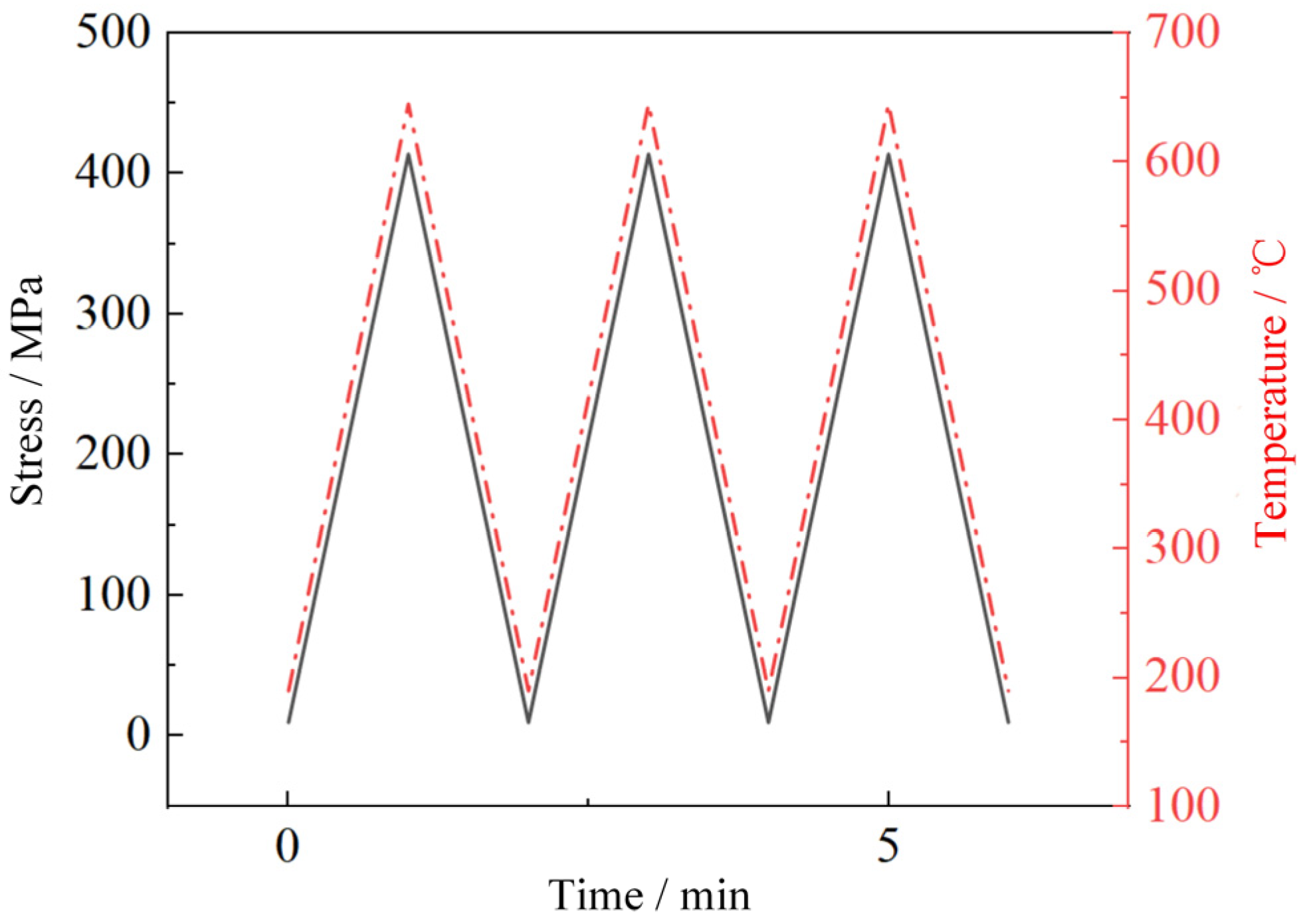
- A simplified load spectrum for low-cycle creep–fatigue of combustion chambers was developed with experimental validation.
- Different combustion chamber feature simulation specimens were tested under original and simplified load spectrums.
- The low-cycle creep–fatigue life of the combustion chamber feature simulation specimens was predicted.
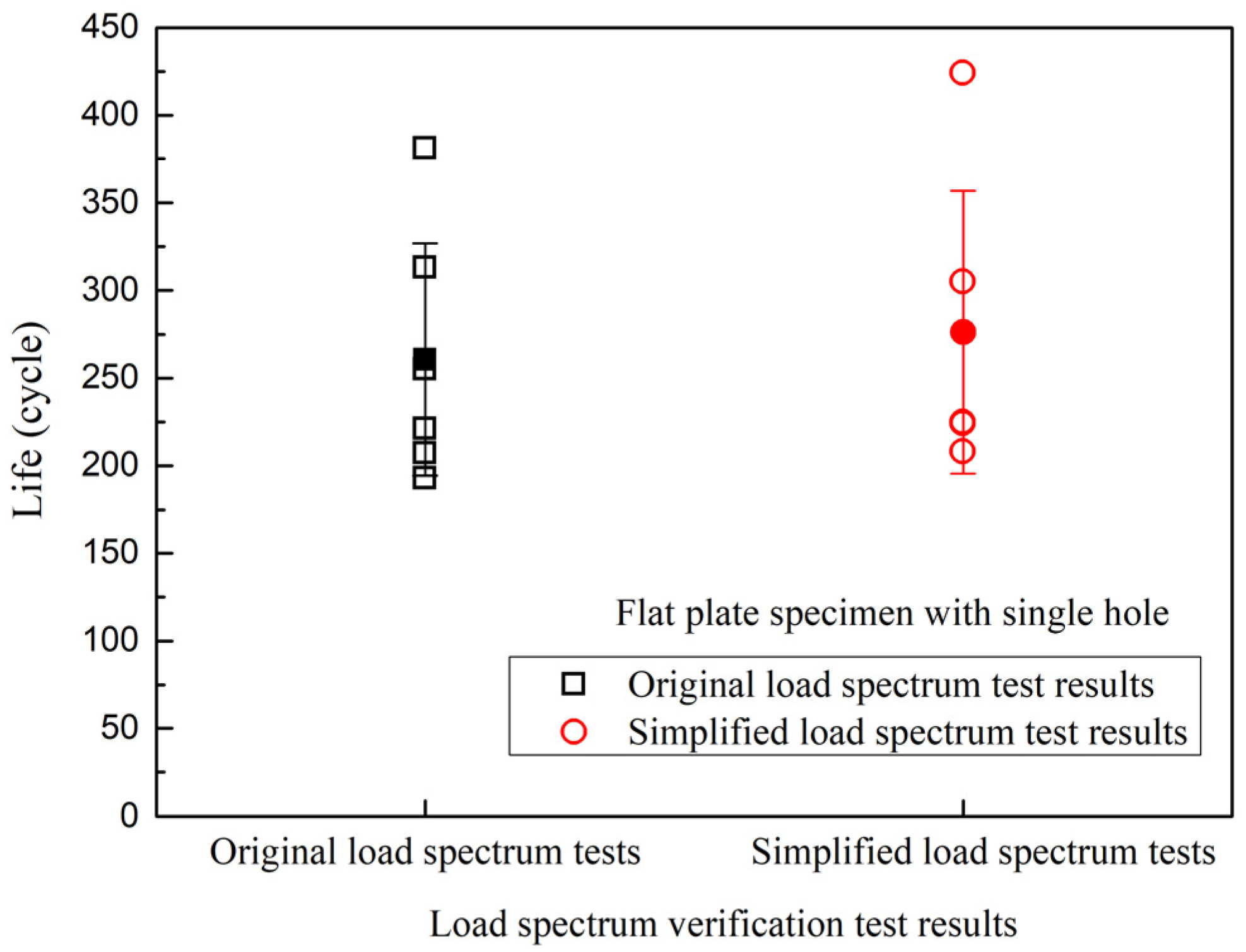
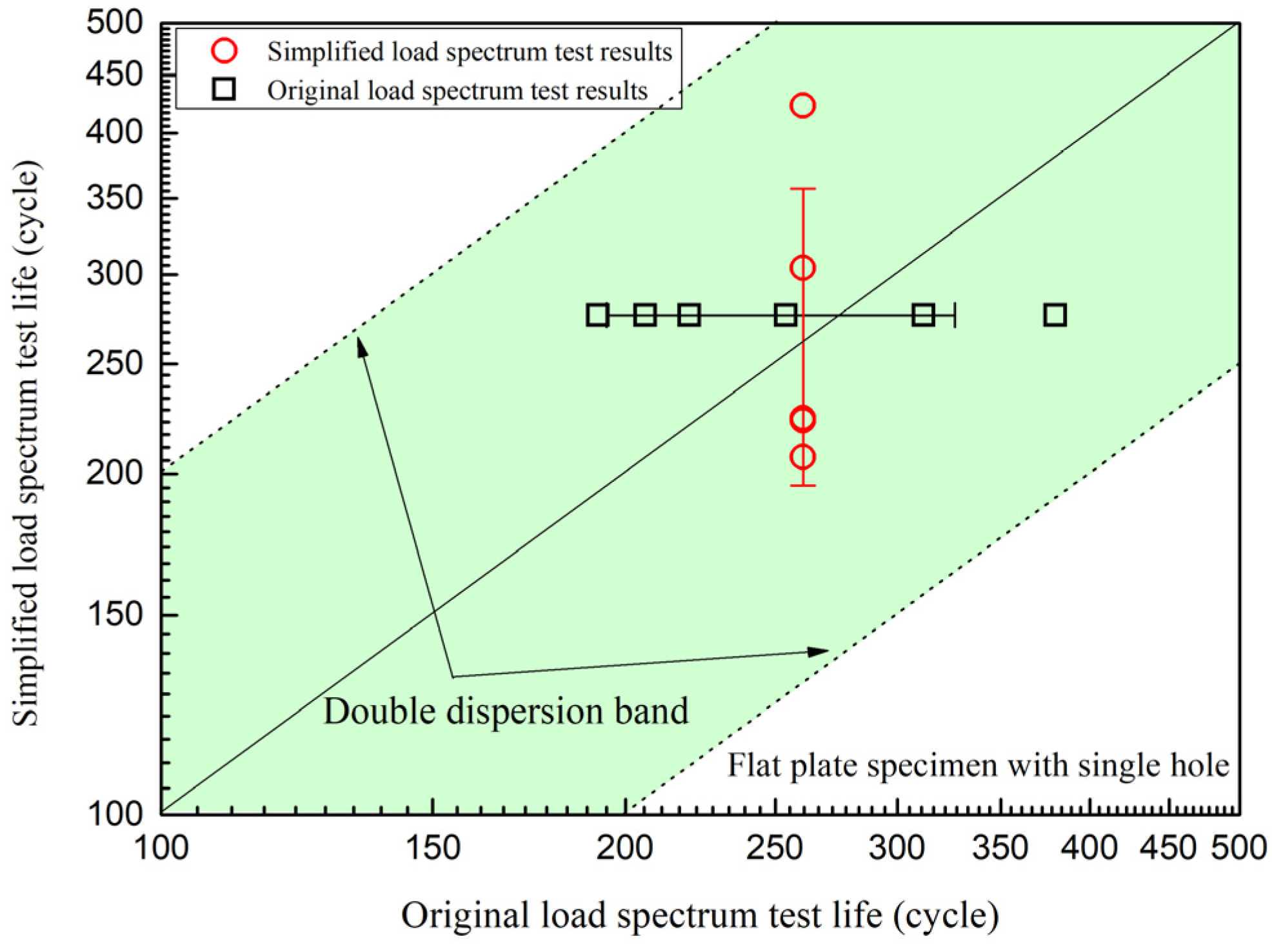
- The simplified load spectrum yielded a 6.13% average life error compared to the original spectrum, with both results lying within the double dispersion band.
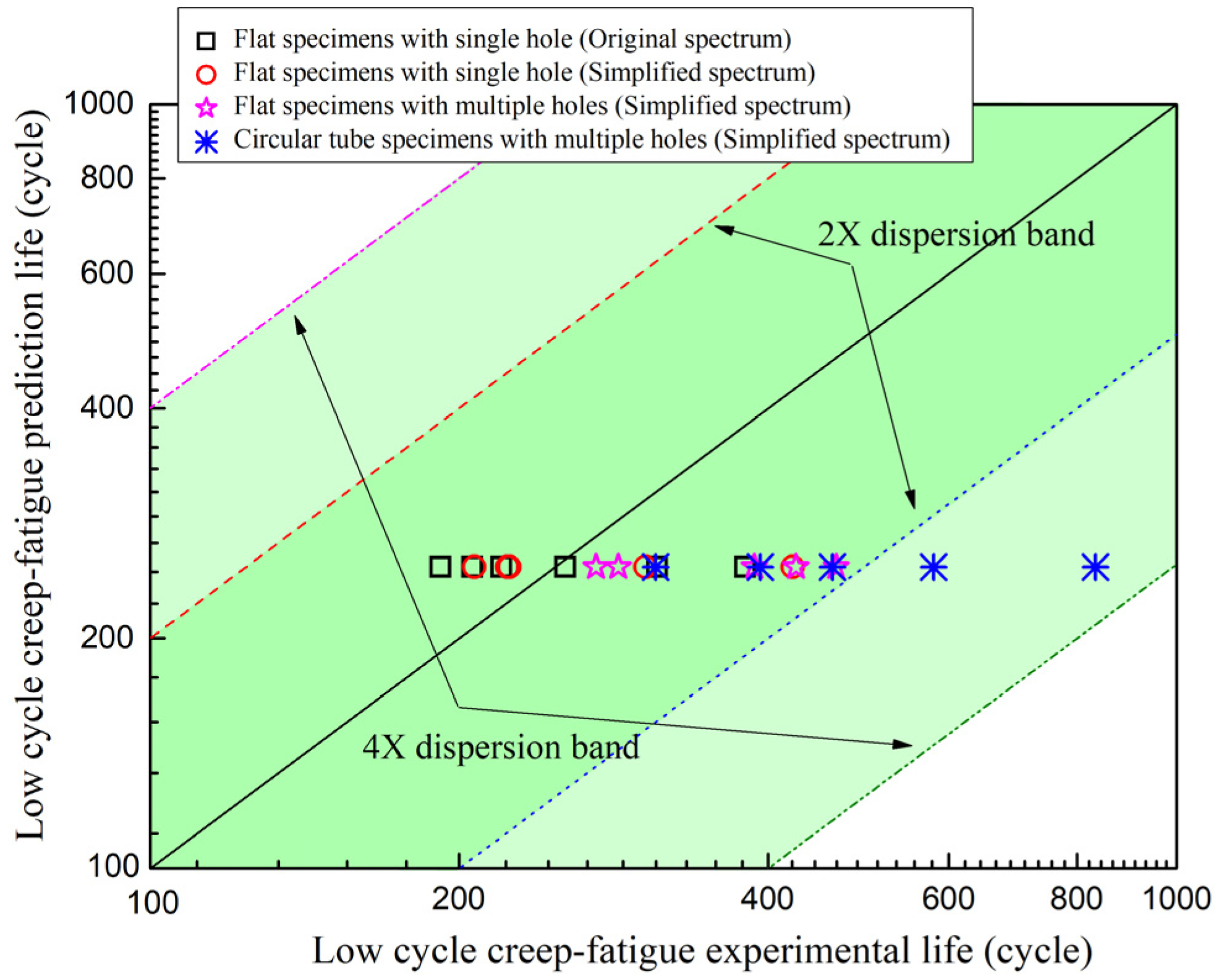
- The experimental results of the flat specimens with single or multiple holes were both within the double dispersion band of the predicted results.
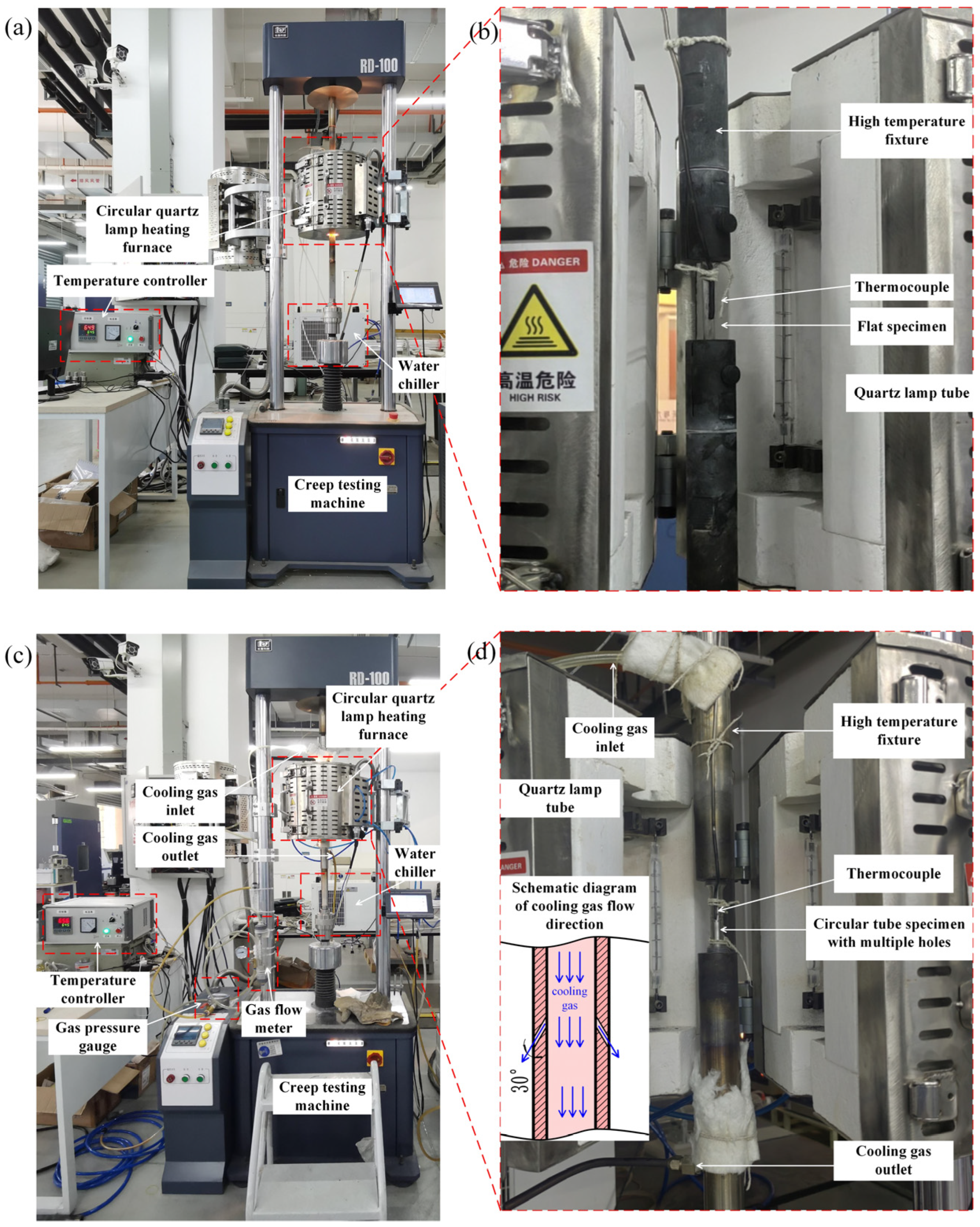
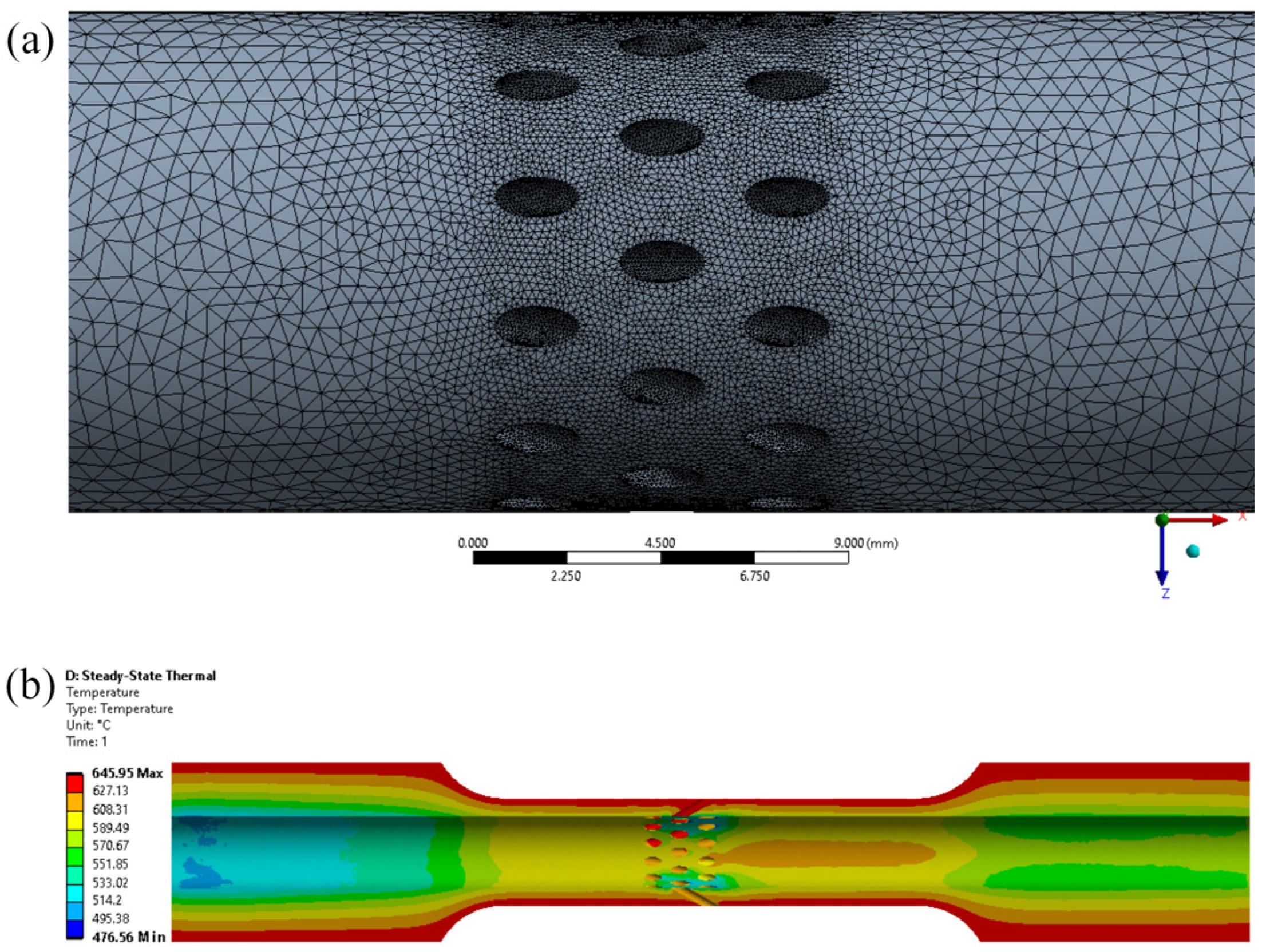
- Internal cooling gas flow reduced temperatures near film-cooling holes in tubular specimens, enhancing their low-cycle creep–fatigue life.
Abstract
1. Introduction
2. Materials and Methods
2.1. GH3230 Superalloy
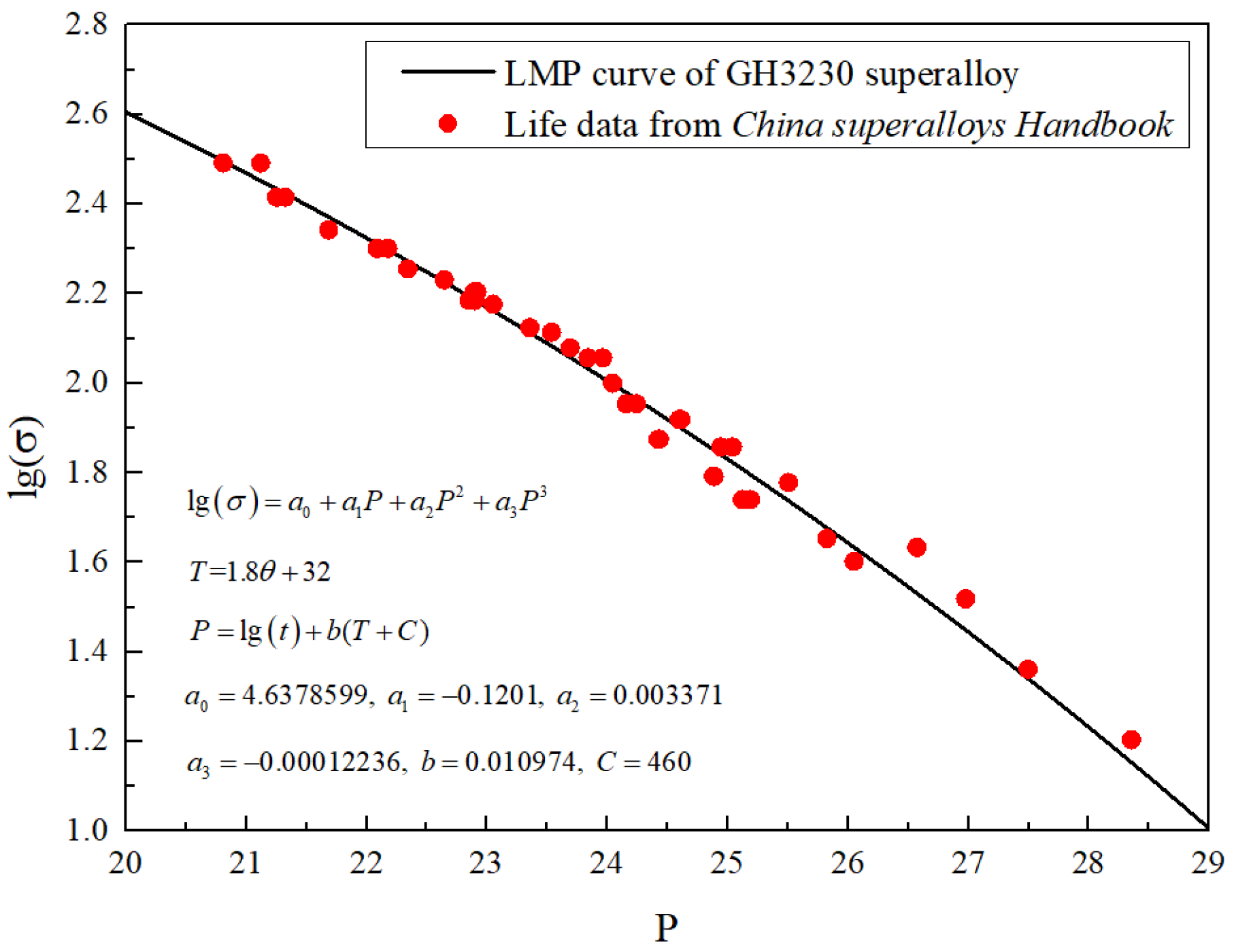
2.2. Larson–Miller Parameter (LMP) Method
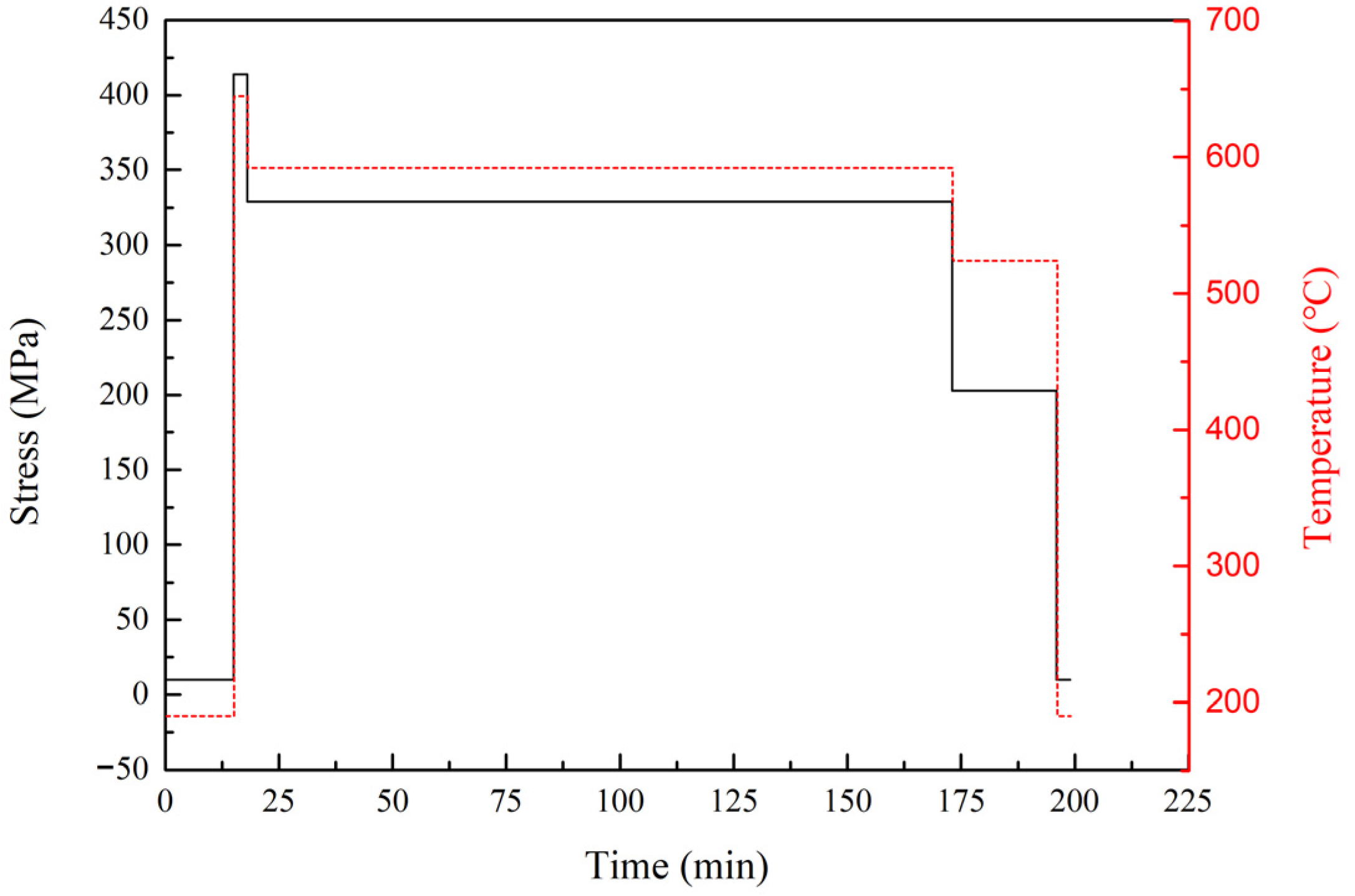
2.3. Creep–Fatigue Damage Assessment of GH3230 Superalloy Under Multi-Stage Flight Conditions
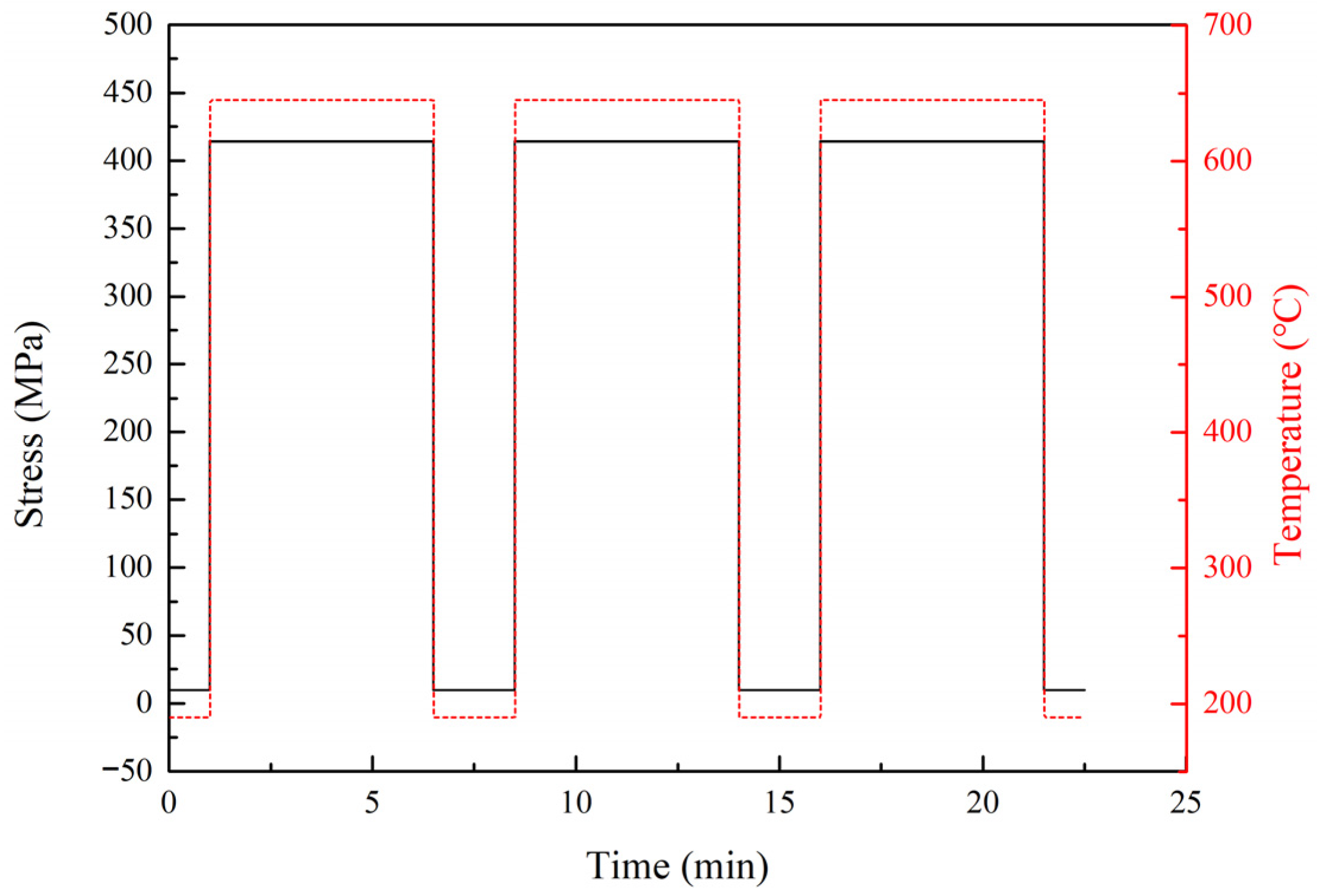
2.4. Simplified Load Spectrum Compilation Based on the Damage Equivalence Principle
3. Experiments
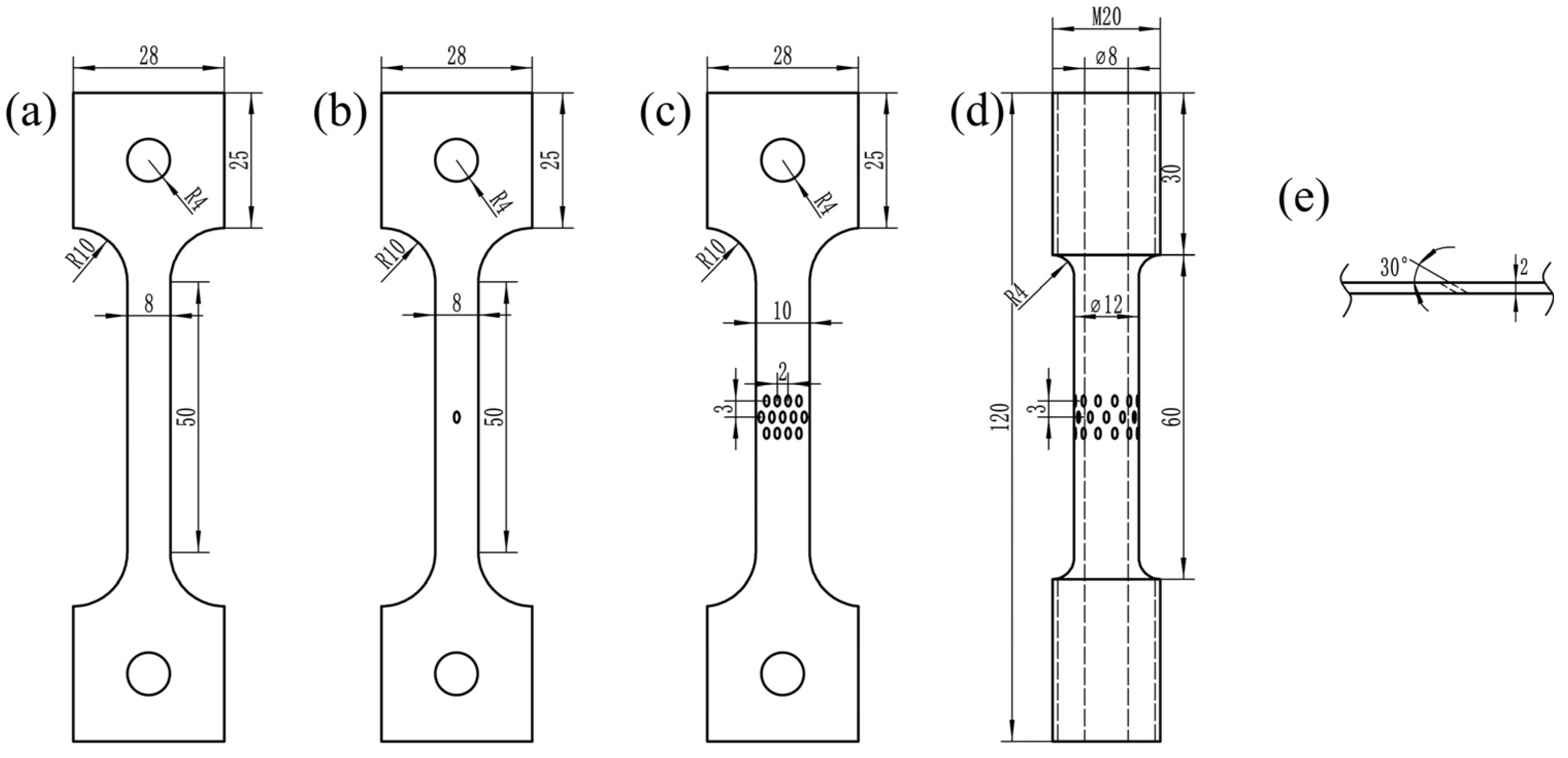
3.1. Design of Feature Simulation Specimens
3.2. Low-Cycle Creep–Fatigue Tests
4. Results and Discussion
4.1. Analysis of Load Spectrum Verification Test Results
4.2. Prediction of Low-Cycle Creep–Fatigue Test Life
4.3. Temperature Simulation Analysis of Circular Tube Specimens with Multiple Holes
4.4. Uncertainty Analysis of Circular Tube Specimens with Multiple Holes
4.5. Fracture Analysis
5. Conclusions
- (1)
- Compared with the original load spectrum, the simplified load spectrum showed an average life error of 6.13% in the low-cycle creep–fatigue tests of flat-plate specimens with single holes.
- (2)
- The simplified load spectrum test results and the original load spectrum test results were both within the double dispersion band of their average values.
- (3)
- The low-cycle creep–fatigue test results of the flat specimens with single or multiple holes were both within the double dispersion band of the predicted results, while the test results of the circular tube specimens with multiple holes were basically within the fourfold dispersion band of the predicted results.
- (4)
- The introduction of internal cooling gas flow reduced the temperature near the gas film holes of the circular tube specimens with multiple holes, thereby improving their low-cycle creep–fatigue test life.
Author Contributions
Funding
Institutional Review Board Statement
Informed Consent Statement
Data Availability Statement
Conflicts of Interest
References
- Zheng, Q.A.; Cai, C.P.; Zhang, H.W.; Zhang, H.B. Prediction of engine combustion chamber outlet temperature field based on deep learning: Application in aero-engine life extension control. Appl. Therm. Eng. 2024, 254, 123911. [Google Scholar] [CrossRef]
- Wang, Z.; Wang, Z.P.; Ding, K.Y.; Dai, H.W. Failure analysis and reliability assessment of a type of aero-engine combustion chamber thermal barrier coatings. Case Stud. Therm. Eng. 2024, 53, 103886. [Google Scholar] [CrossRef]
- Wang, C.J.; Qiao, Z.Y.; Tao, H.Y.; Xu, P.Y.; Liu, H.B.; Li, X.T. The scale-adaptive simulation of reverse coupling of aero-engine high pressure high-pressure turbine to combustion chamber flow. Appl. Therm. Eng. 2025, 280, 128275. [Google Scholar] [CrossRef]
- Hu, L.; Wang, W.T.; Wang, X.; Yang, J.G.; Yu, Y.H.; Mei, C.Y. Reliability evaluation and multi-objective optimization of combustion chamber’s key components of marine engine. Case Stud. Therm. Eng. 2025, 73, 106497. [Google Scholar] [CrossRef]
- Zhang, Y.J.; Hou, C.; Jin, X.C.; Li, D.; Zhao, L.; Yang, L.; Fan, X. Thermal fatigue crack initiation and propagation behaviors of GH3230 nickel-based superalloy. Fatigue Fract. Eng. Mater. Struct. 2024, 47, 6–19. [Google Scholar] [CrossRef]
- Xu, Q.P.; Hou, C.; Ren, X.D.; Yang, J.; Jin, X.; Yang, Q.; Fan, X. Study on creep behaviors of GH3230 superalloy with side notches or a center inclined hole at 900 °C and 1000 °C. Fatigue Fract. Eng. Mater. Struct. 2025, 48, 14498. [Google Scholar] [CrossRef]
- Zhao, H.; Cheng, D.; Chen, M.; Xiao, W.; Hou, C. Research on Creep Behaviors of GH3230 Superalloy Sheets with Side Notches. Materials 2025, 18, 5509. [Google Scholar] [CrossRef]
- Zhao, L.; Wang, X.; Xu, L.Y.; Han, Y.D.; Jing, H.Y. Fatigue performance of Hastelloy X at elevated temperature via small punch fatigue test. Theor. Appl. Fract. Mech. 2021, 116, 103118. [Google Scholar] [CrossRef]
- Esmaeilzadeh, M.; Qods, F.; Arabi, H.; Sadeghi, B.M. Evolution of the texture and microstructure in a nickel based superalloy during thermo-mechanical fatigue (TMF), using a modified integrated model and experimental results. Int. J. Fatigue 2017, 105, 191–207. [Google Scholar] [CrossRef]
- Healey, R.; Wang, J.; Wallbrink, C.; Chiu, W.K.; Xu, Z. The application of cycle merging and an extension of a fatigue spectrum simplification methodology from unidirectional to woven composite materials. Compos. Part C Open Access 2022, 8, 100283. [Google Scholar] [CrossRef]
- Healey, R.; Wang, J.; Chiu, W.K.; Chowdhury, N.M.; Baker, A.; Wallbrink, C. A Review on Aircraft Spectra Simplification Techniques for Composite Structures. Compos. Part C Open Access 2021, 5, 100131. [Google Scholar] [CrossRef]
- Moucun, Y.; Hong, N. Analysis approach to durability based on material initial fatigue quality and S-N curve. Chin. J. Aeronaut. 2007, 20, 518–523. [Google Scholar] [CrossRef]
- Vueti, N.; Jovii, G.; Krsti, B.; Ivkovi, M.; Milovanovi, V.; Kamarik, J.; Antunovi, R. Research of an aircraft engine cylinder assembly integrity assessment—Thermomechanical FEM analysis. Eng. Fail. Anal. 2020, 111, 104453. [Google Scholar]
- Molent, L.; Singh, R. Using the lead crack framework to reduce durability test duration. Aeronaut. J. 2019, 124, 814–820. [Google Scholar] [CrossRef]
- Liu, X.N.; Tan, J.H.; Long, S.B. Multi-axis fatigue load spectrum editing for automotive components using generalized S-transform. Int. J. Fatigue 2024, 188, 108503. [Google Scholar] [CrossRef]
- Fang, J.; Li, K.Y.; Liu, C.X.; Zou, S.; Sun, B. A novel two-scale nonlinear damage accumulation model for vibration fatigue life prediction. Int. J. Non-Linear Mech. 2024, 166, 104769. [Google Scholar] [CrossRef]
- Zheng, G.F.; Duan, Y.L.; Su, H.; Liu, X.L.; Xu, X.Y.; Hao, H. Novel method for accelerated multi-axial load spectrum editing with phase preservation based on the fusion of damage and energy domain features. Eng. Fract. Mech. 2025, 316, 110880. [Google Scholar] [CrossRef]
- Chen, L.; Ding, K.Q. Research on multiaxial fatigue life prediction of lifting equipment based on symbol corrected equivalent stress spectrum. J. Phys. Conf. Ser. 2024, 2808, 012026. [Google Scholar] [CrossRef]
- Jiang, R.J.; Yang, X.G.; Cheng, M.W.; Huang, J.; Shi, D.Q. Experimental investigation and life prediction for the load spectrum with flight mission characteristics on a p/m superalloy. Chin. J. Aeronaut. 2025, 38, 103313. [Google Scholar] [CrossRef]
- He, X.F.; Dong, Y.M.; Zhai, B.; Liu, W.T. The fleet life reliability analysis under the 90% severe load spectrum. Eng. Fail. Anal. 2011, 18, 394–402. [Google Scholar] [CrossRef]
- He, X.F.; Sui, F.C.; Dong, Y.M.; Liu, W.T. Relative severity investigation in a severe load spectrum. Eng. Fail. Anal. 2010, 17, 1509–1516. [Google Scholar] [CrossRef]
- Li, X.; Sun, Q. Simplification approaches for multi-level load spectra by using equivalent damage rule. Chin. J. Aeronaut. 2021, 34, 119–130. [Google Scholar] [CrossRef]
- Zhang, J.; Sun, X.F.; Li, J.R.; Dong, J.X. China Superalloys Handbook; Standards Press of China: Beijing, China, 2012. [Google Scholar]
- Wen, Z.X.; Zhang, D.X.; Zhang, Z.J.; Zhang, W.; Li, L.; Wang, X.M.; Yue, Z.F. Structural Strength of Film Cooling Holes in Nickel-Based Single-Crystal Turbine Blades; Science Press: Beijing, China, 2017; ISBN 9787030521118. [Google Scholar]
- Du, C.Y.; Cui, H.T.; Zhang, H.J. Thermal fatigue behaviors of thin-walled structures with holes: Experiments and phase field fracture modeling. Int. J. Fatigue 2024, 185, 108338. [Google Scholar] [CrossRef]
- Liang, J.S.; Qiao, H.C.; Zhao, J.B.; Cao, Z.H.; Zhang, Y.T.; Zhang, Q. Simulation and experimental study on double staggered-axis air-assisted water jet-guided laser film cooling hole machining. Opt. Laser Technol. 2025, 181, 112057. [Google Scholar] [CrossRef]



| Elements | C | Cr | Ni | Co | W | Mo | Al | Ti |
| Mass fraction/% | 0.05–0.15 | 20.00–24.00 | balance | ≤5.00 | 13.00–15.00 | 1.00–3.00 | 0.20–0.50 | ≤0.10 |
| Elements | Fe | La | B | Si | Mn | S | P | Co |
| Mass fraction/% | ≤3.00 | 0.005–0.05 | ≤0.015 | 0.25–0.75 | 0.30–1.00 | ≤0.015 | ≤0.05 | ≤0.50 |
| Temperature/°C | Elasticity Modulus E/GPa | Poisson Ratio v | Yield Strength/MPa | Tensile Strength/MPa | Thermal Expansion Coefficient α/10−6 °C−1 | Thermal Conductivity λ/W/(m·K) | Specific Heat Capacity c/J/(kg·K) | Thermal Diffusivity Q/10−6 m2/s |
|---|---|---|---|---|---|---|---|---|
| 25 | 215 | 0.31 | 389.5 | 905–910 | / | 12.3 | / | / |
| 200 | 204 | 0.31 | / | / | 13.5 | 14.2 | 469 | 2.95 |
| 400 | 194 | 0.32 | / | / | 14.4 | 16.7 | 503 | 3.57 |
| 600 | 182 | 0.32 | 316.6 | 735–740 | 14.7 | 20.1 | 530 | 4.06 |
| 700 | 176 | 0.33 | 289.9 | 620–635 | 15.3 | 22.4 | / | / |
| 800 | 168 | 0.33 | 234.2 | 405–410 | 15.7 | 25.04 | 550 | 4.71 |
| 900 | 160 | 0.34 | 142.7 | 250–285 | 16.0 | 27.2 | / | / |
| 1000 | 150 | 0.35 | 71.5 | 151–157 | 16.3 | 29.3 | 534 | 4.67 |
| Temperature/°C | Stress/MPa | Life/h | Temperature/°C | Stress/MPa | Life/h |
|---|---|---|---|---|---|
| 1000 | 42 | 26.2 | 800 | 160 | 49.2, 52 |
| 33 | 66.6 | 153 | 44.5, 49.5 | ||
| 23 | 220.4 | 133 | 142.6 | ||
| 16 | 1583.9 | 120 | 309 | ||
| 900 | 75 | 17.6, 18 | 100 | 693 | |
| 62 | 50.6, 51.3 | 750 | 200 | 74.8, 91.8 | |
| 55 | 88, 102.8 | 170 | 270 | ||
| 45 | 443.9 | 150 | 689 | ||
| 40 | 747.6 | 130 | 2104.8 | ||
| 870 | 114 | 18, 23.8 | 700 | 310 | 38.2, 78.5 |
| 90 | 37.5, 45.3 | 260 | 106.3, 125.2 | ||
| 83 | 103, 106.5 | 220 | 288.3 | ||
| 72 | 228.2, 285.3 | 180 | 1304.2 | ||
| 60 | 832.5 | ||||
| Service Time /min | Service Condition | Dangerous Position Stress/MPa | Dangerous Position Temperature/°C |
|---|---|---|---|
| 0–15 | Low speed | 10 | 190 |
| 15–18 | Takeoff | 414 | 645 |
| 18–173 | Climb | 329 | 592 |
| 173–196 | Cruise | 203 | 524 |
| 196–199 | Low speed | 10 | 190 |
| Flight Conditions | Service Life/h | Damage | Total Damage Dtotel During a Single Flight Mission Cycle | Converted Takeoff Condition Time/min |
|---|---|---|---|---|
| Low speed | >107 | 0 | 1.555 × 10⁻³ | 5.5 |
| Take off | 59.125 | 8.46 × 10⁻⁴ | ||
| Climb | 3642.2 | 7.09 × 10⁻⁴ | ||
| Cruise | 2,303,525.4 | 1.66 × 10⁻⁷ |
| Specimens | Original Spectrum Tests | Simplified Spectrum Tests | Thermomechanical Fatigue Tests |
|---|---|---|---|
| Smooth flat specimen | / | / | 5 |
| Flat specimen with single hole | 6 | 5 | / |
| Flat specimen with multiple holes | / | 5 | / |
| Circular tube specimen with multiple holes | / | 5 | / |
Disclaimer/Publisher’s Note: The statements, opinions and data contained in all publications are solely those of the individual author(s) and contributor(s) and not of MDPI and/or the editor(s). MDPI and/or the editor(s) disclaim responsibility for any injury to people or property resulting from any ideas, methods, instructions or products referred to in the content. |
© 2026 by the authors. Licensee MDPI, Basel, Switzerland. This article is an open access article distributed under the terms and conditions of the Creative Commons Attribution (CC BY) license.
Share and Cite
Cheng, D.; Zhao, H.; Zhang, Q.; Chen, M.; Zhao, H.; Hou, C. Simplification of Low-Cycle Creep–Fatigue Load Spectrum of Combustion Chamber and Life Assessment for Feature Simulation Specimens. Materials 2026, 19, 620. https://doi.org/10.3390/ma19030620
Cheng D, Zhao H, Zhang Q, Chen M, Zhao H, Hou C. Simplification of Low-Cycle Creep–Fatigue Load Spectrum of Combustion Chamber and Life Assessment for Feature Simulation Specimens. Materials. 2026; 19(3):620. https://doi.org/10.3390/ma19030620
Chicago/Turabian StyleCheng, Dingnan, Honghua Zhao, Qiang Zhang, Minmin Chen, Hao Zhao, and Cheng Hou. 2026. "Simplification of Low-Cycle Creep–Fatigue Load Spectrum of Combustion Chamber and Life Assessment for Feature Simulation Specimens" Materials 19, no. 3: 620. https://doi.org/10.3390/ma19030620
APA StyleCheng, D., Zhao, H., Zhang, Q., Chen, M., Zhao, H., & Hou, C. (2026). Simplification of Low-Cycle Creep–Fatigue Load Spectrum of Combustion Chamber and Life Assessment for Feature Simulation Specimens. Materials, 19(3), 620. https://doi.org/10.3390/ma19030620