Effect of Strain Rate on the Formability Prediction of Cold-Rolled DX56D+Z100-M-C-O Steel Sheets
 , , ,
, , ,  and
and 
Abstract
1. Introduction
2. Material and Methods
2.1. Material
2.2. Tensile Test
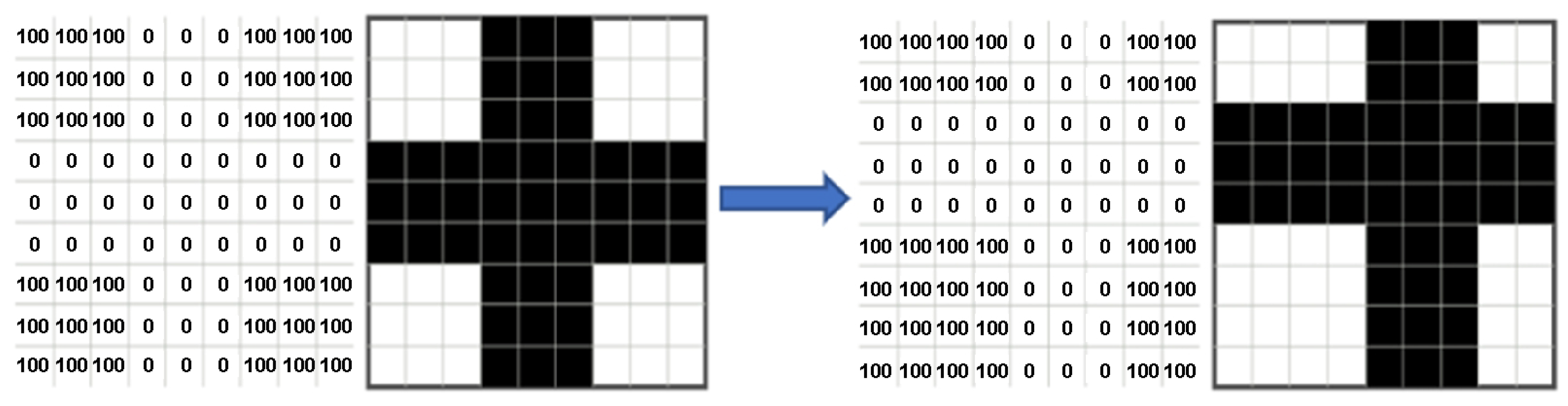
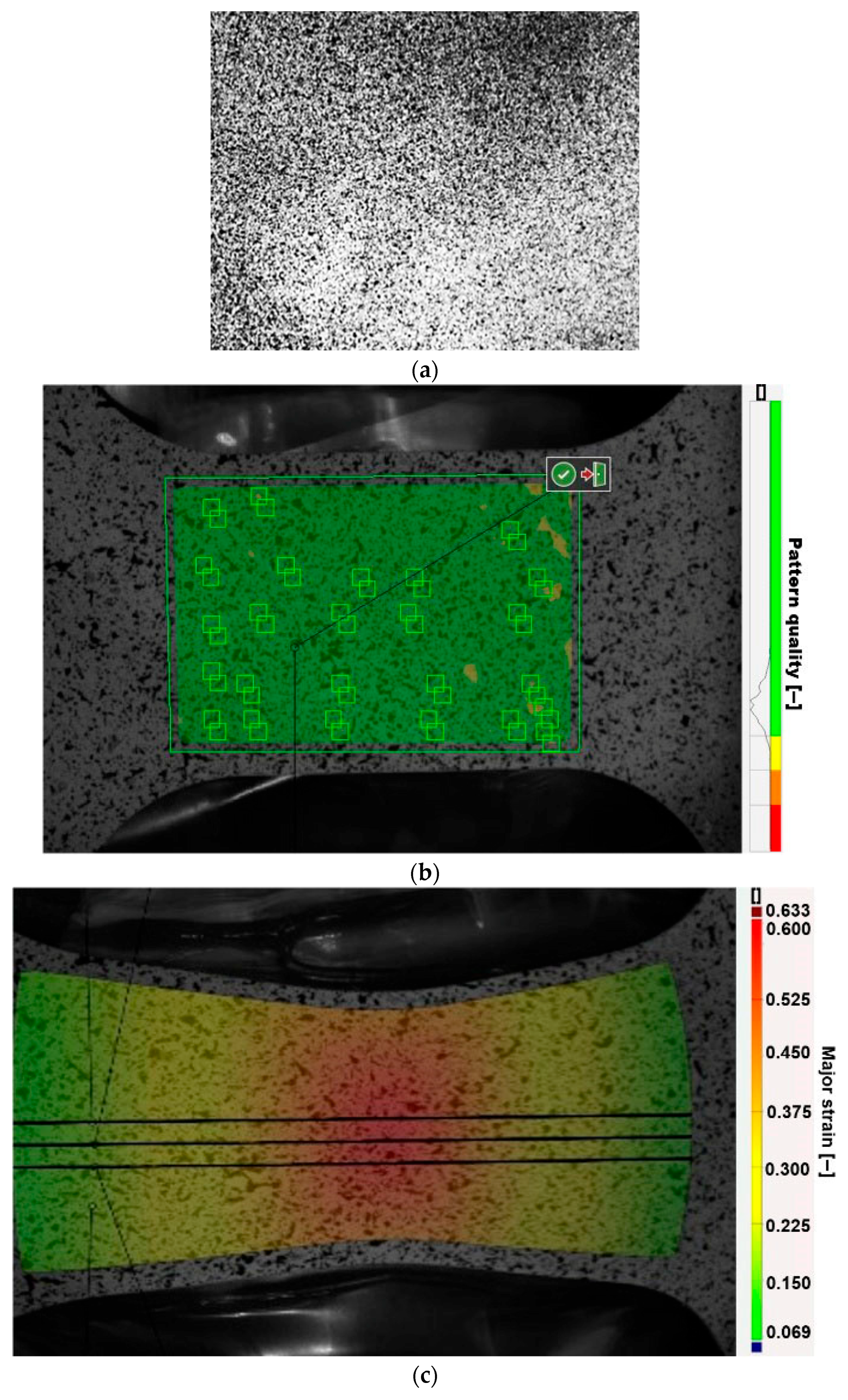
2.3. Digital Image Correlation
2.4. Analysis of Chemical Composition
3. Results and Discussion
3.1. Tensile Tests
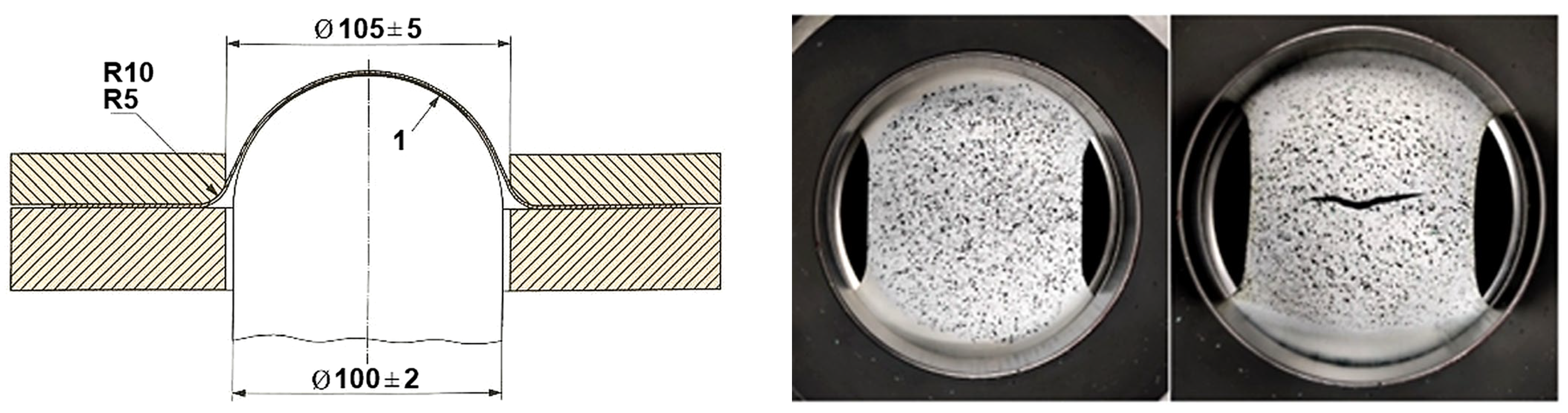
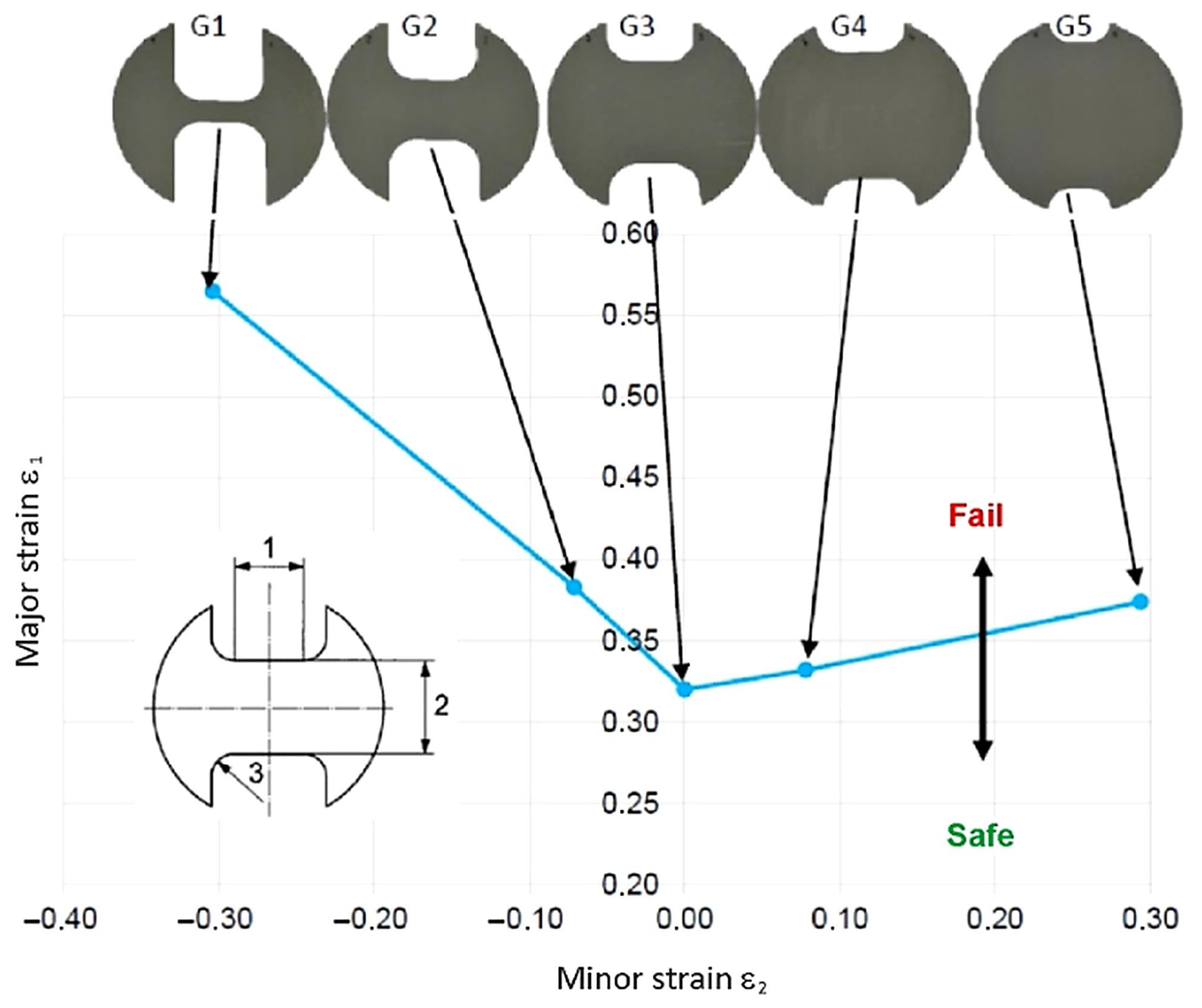
3.2. Formability Tests
3.3. Metallographic Analysis
4. Conclusions
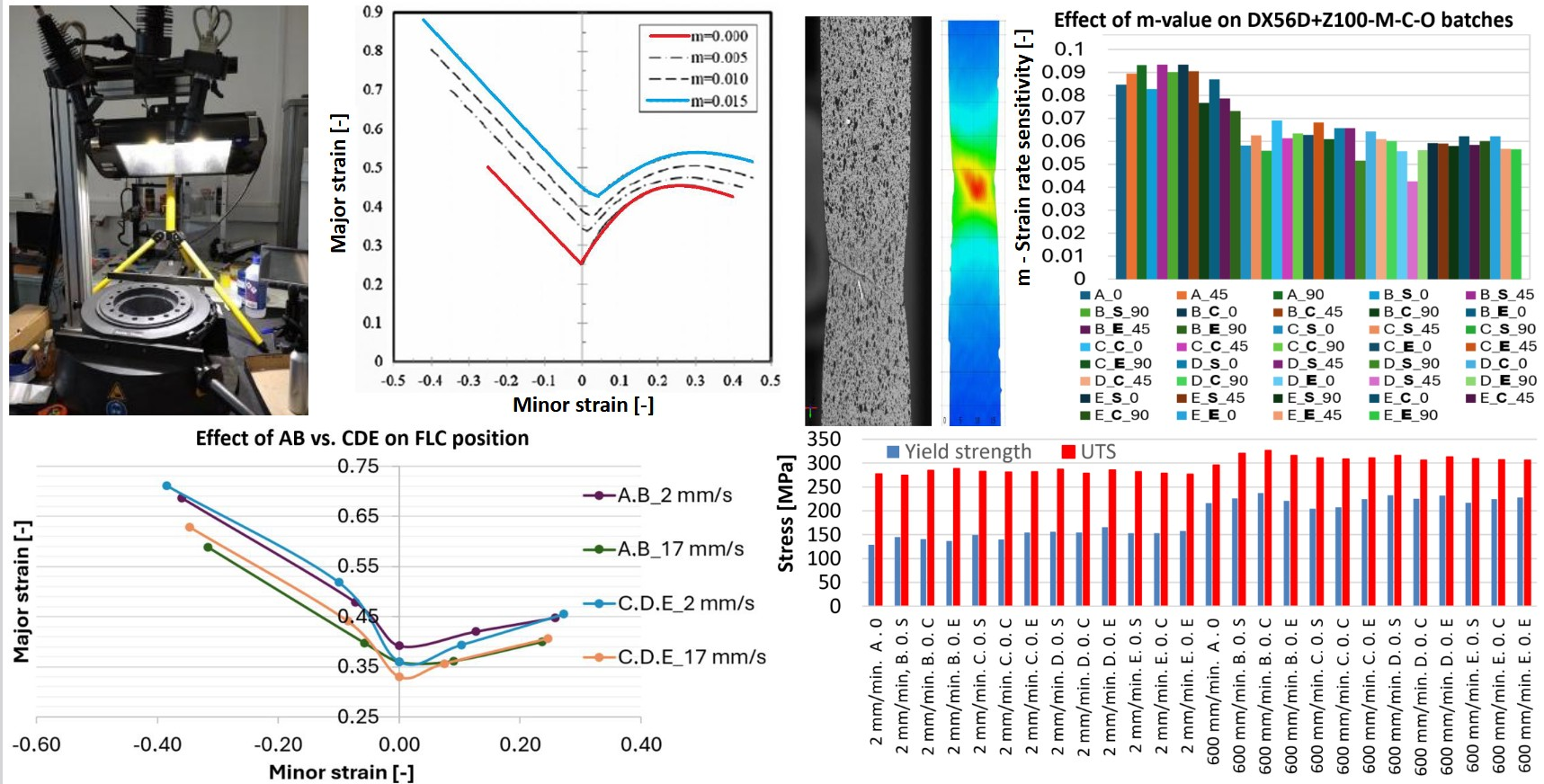
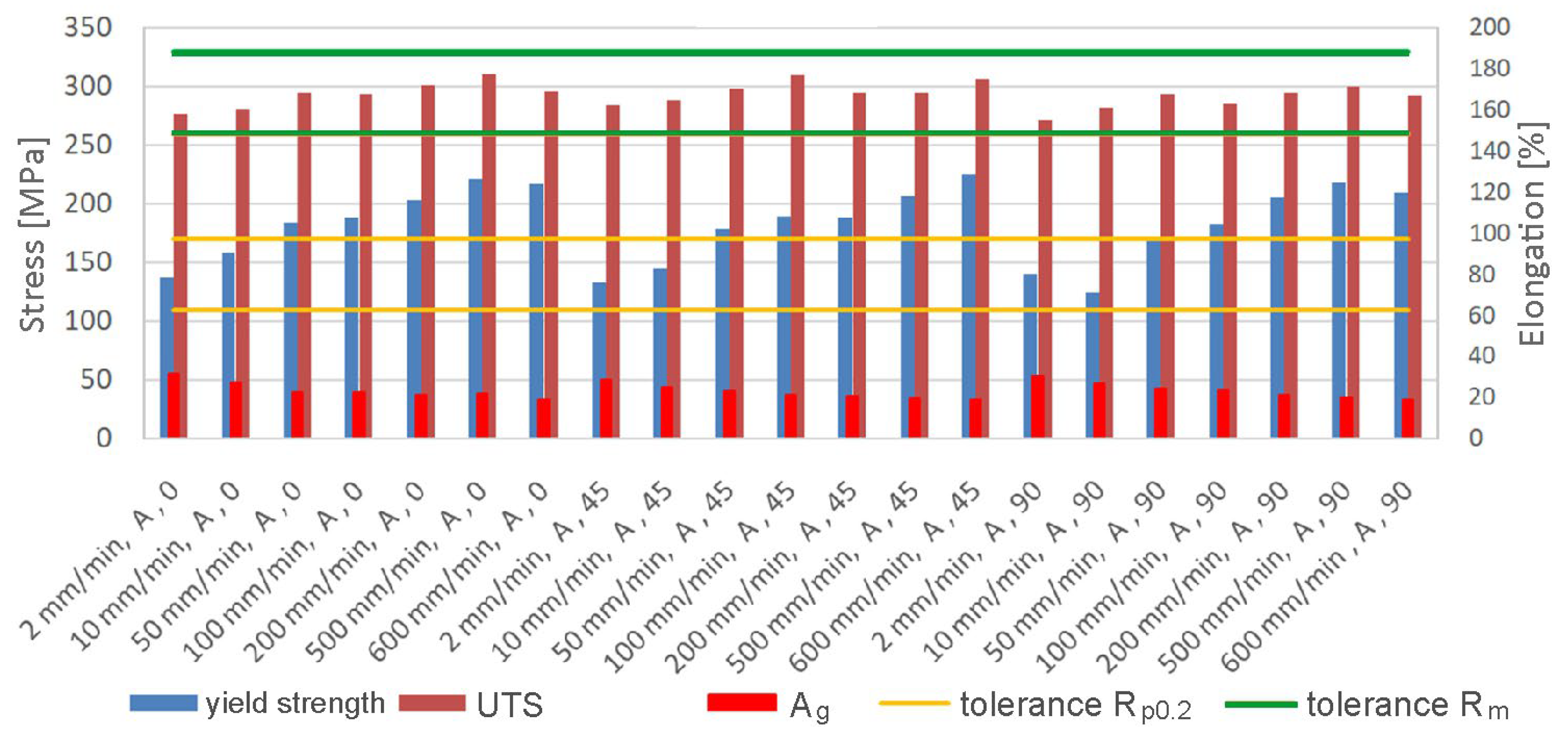
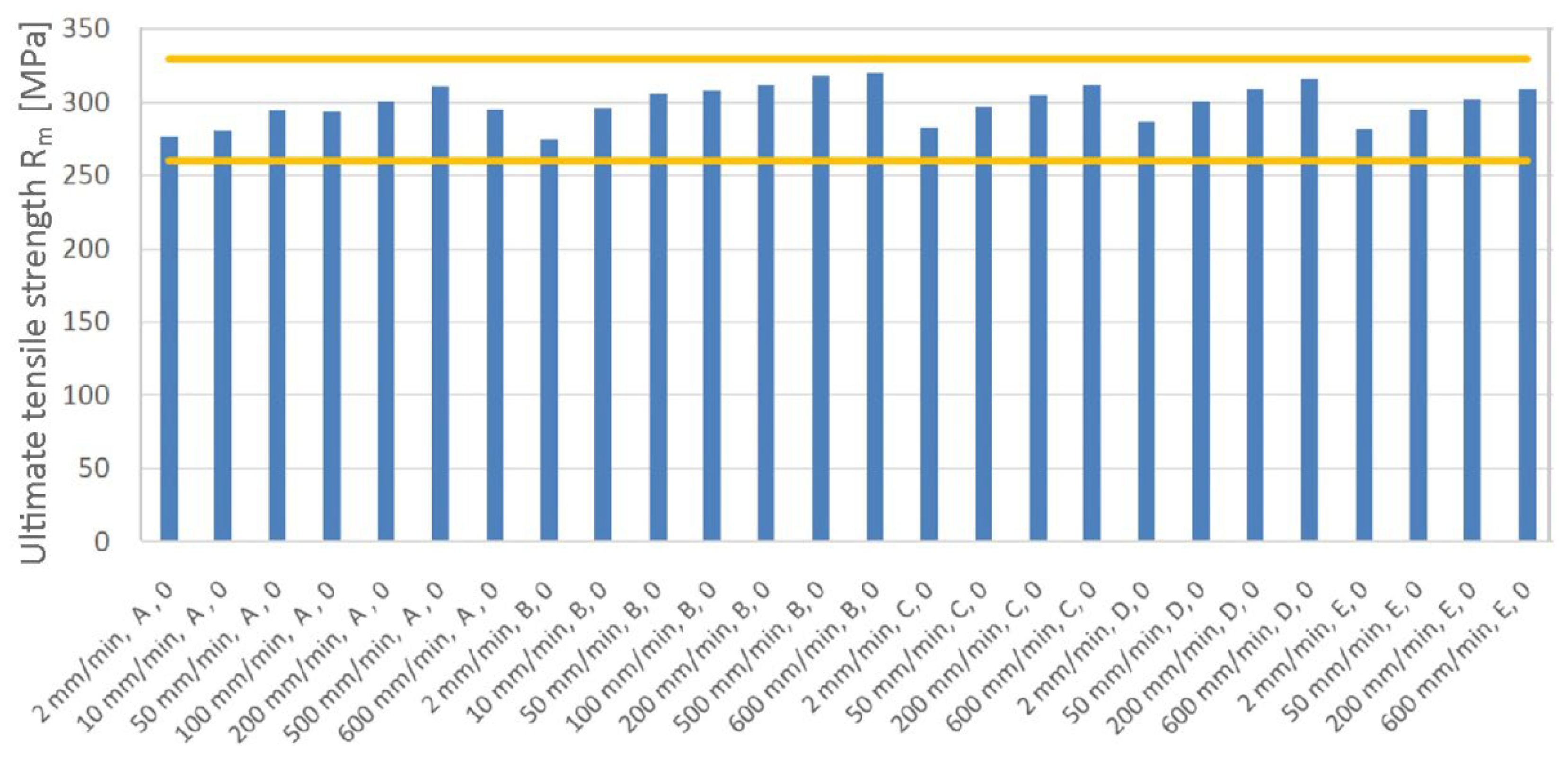
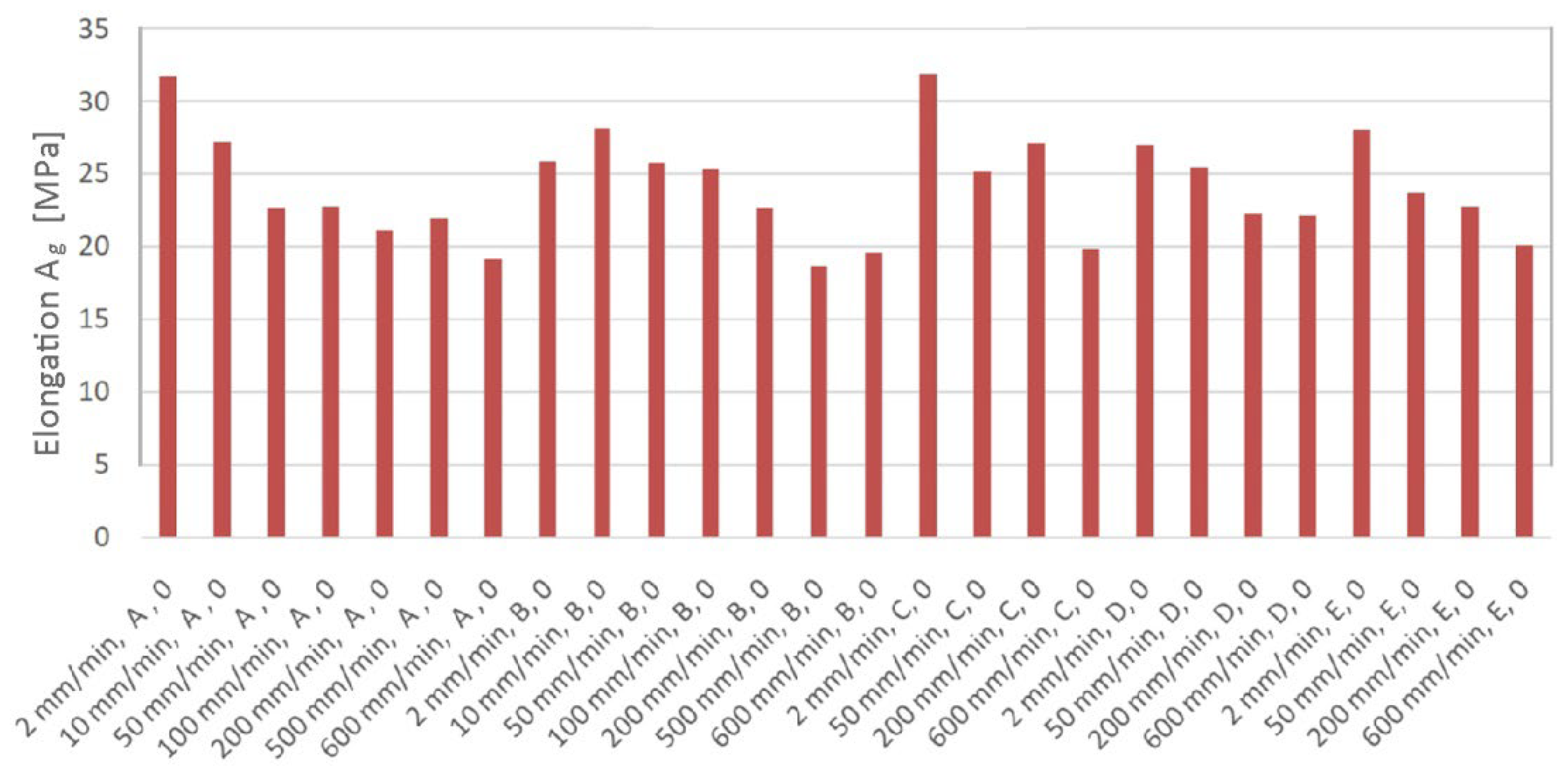
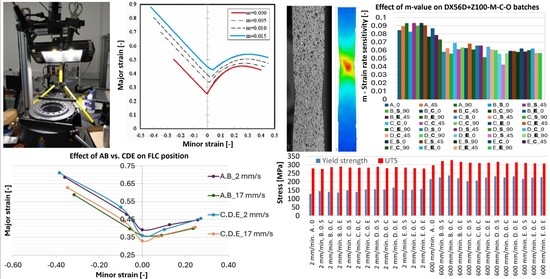
- The yield strength and UTS of the test material increase with an increase in the strain rate. The increase is more pronounced in the yield strength than in the UTS. The ductility of the material determined by the elongation reduces with the increasing strain rate. However, this reduction causes a degradation of the so-called ‘plasticity reserve’ as the ratio between yield strength and UTS, affecting formability evaluation.
- During the experimentation, it was found that there was an average yield strength increase of 74 MPa as a result of strain rate, along with an average ultimate tensile strength increase of 30 MPa. Elongation decrease is greater than 10% in certain cases within the scope of deformation rates evaluated.
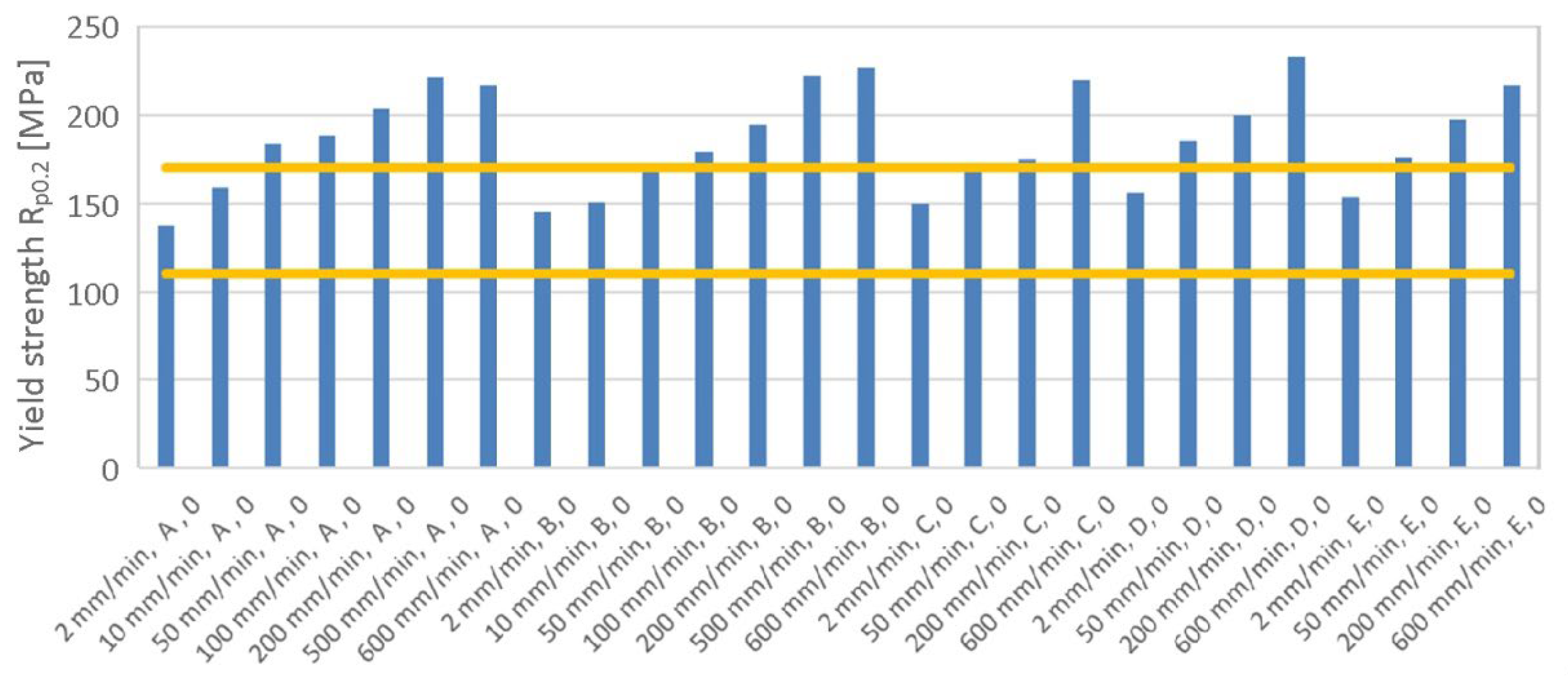
- When considering the position of the sample in the coil, it was found that batch C is the most sensitive to changes in yield strength values when samples are oriented at the sheet-rolling direction. The scatter of elongation values, however, was consistent across all batches.
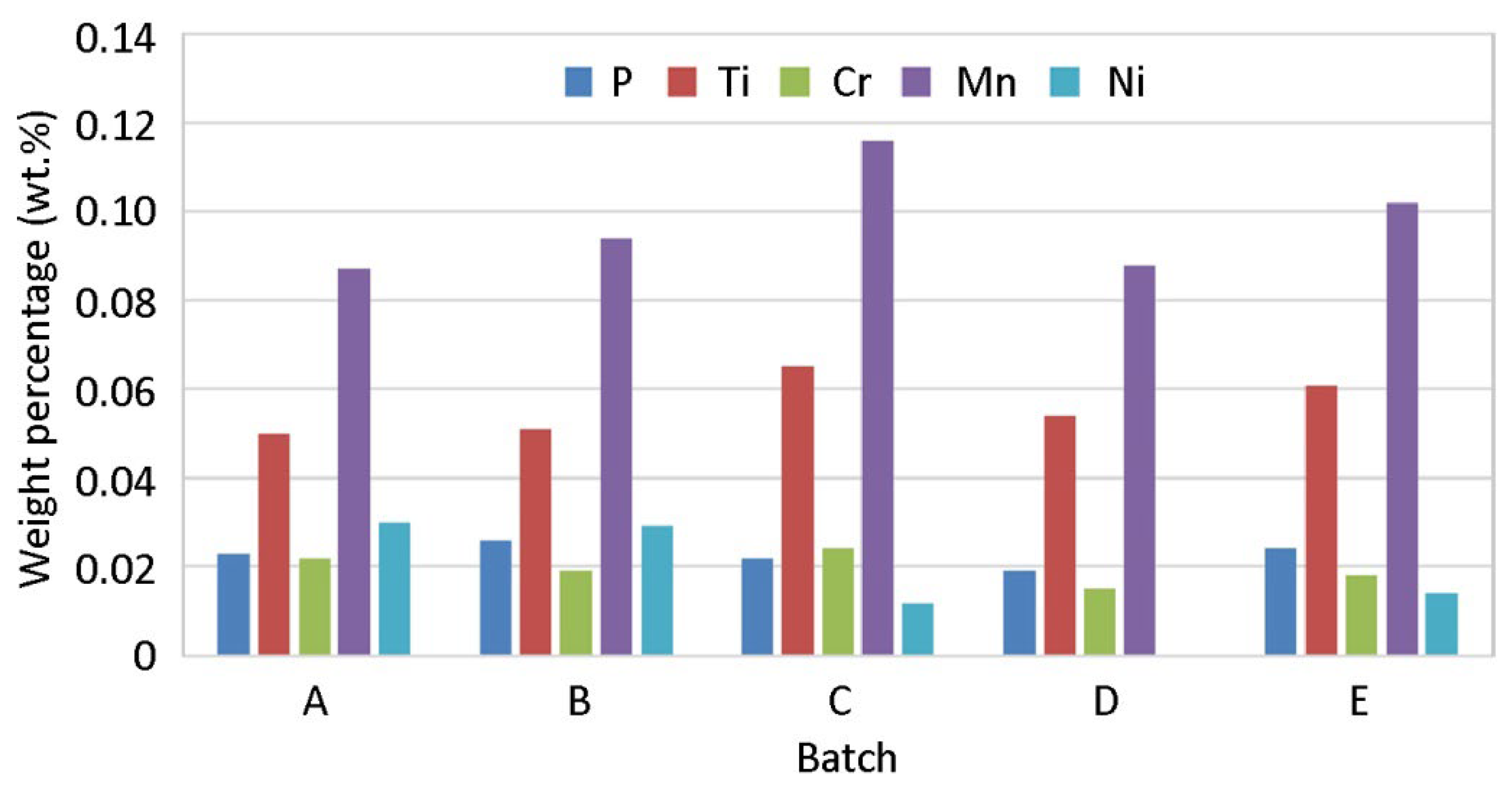
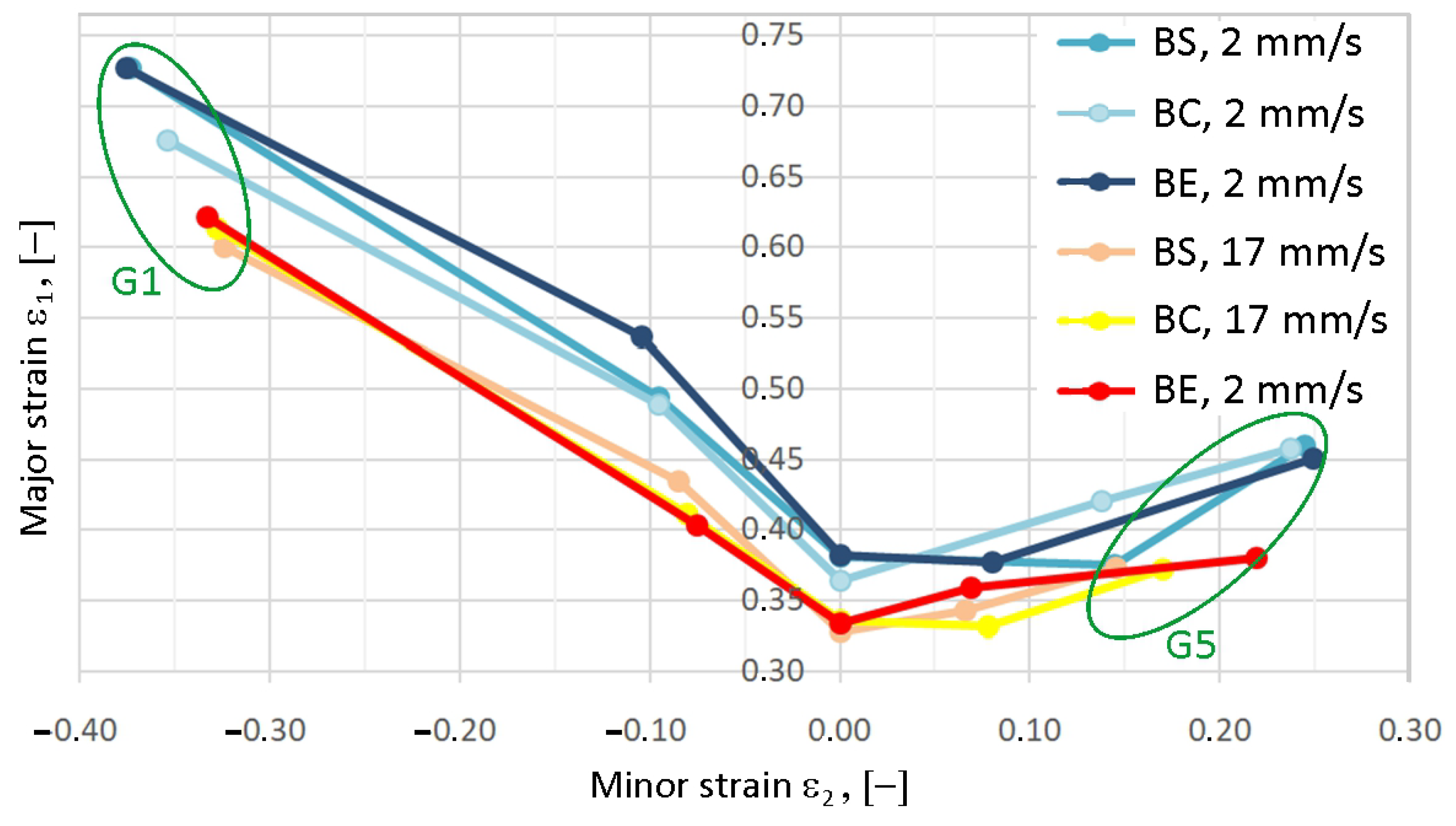
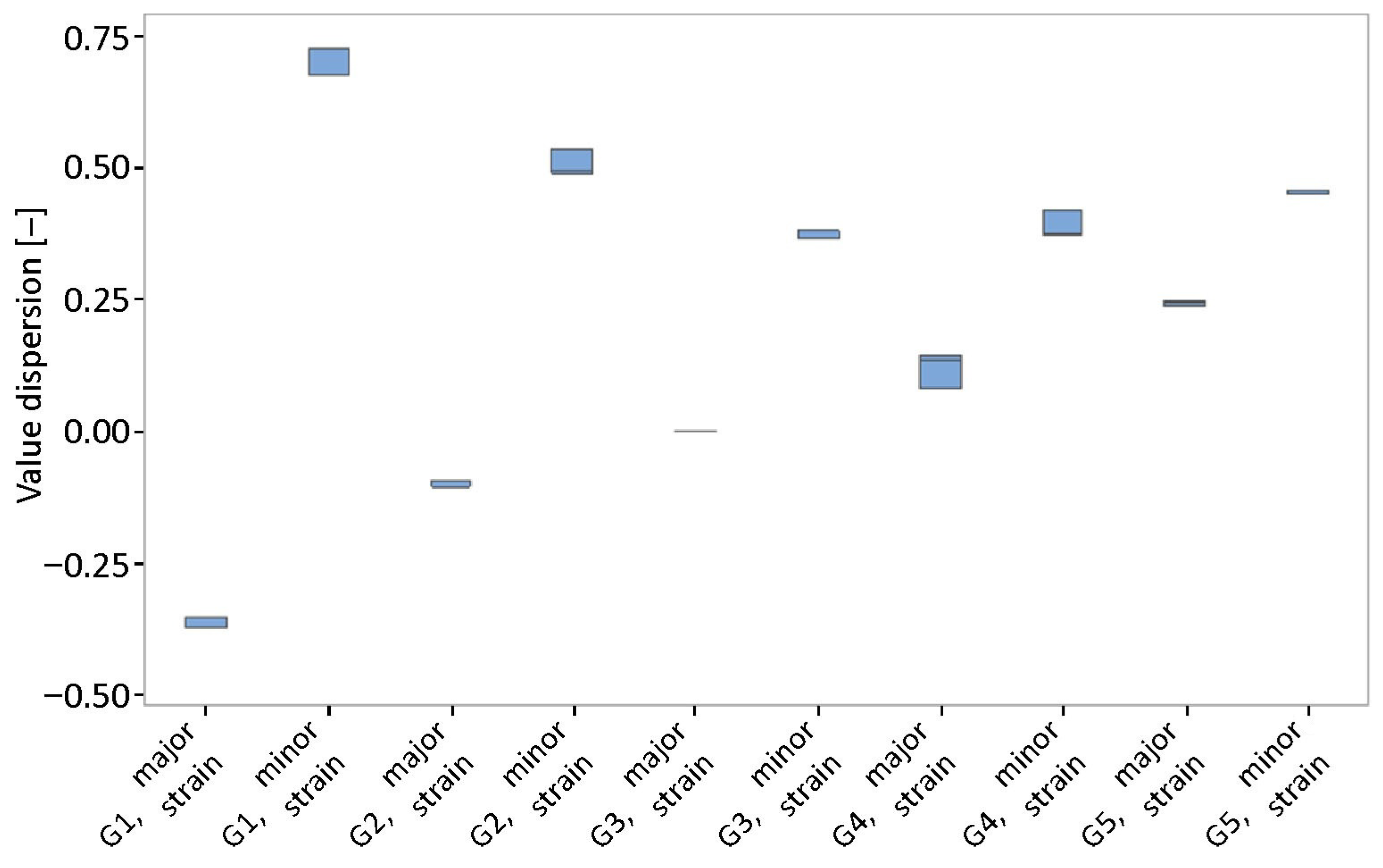
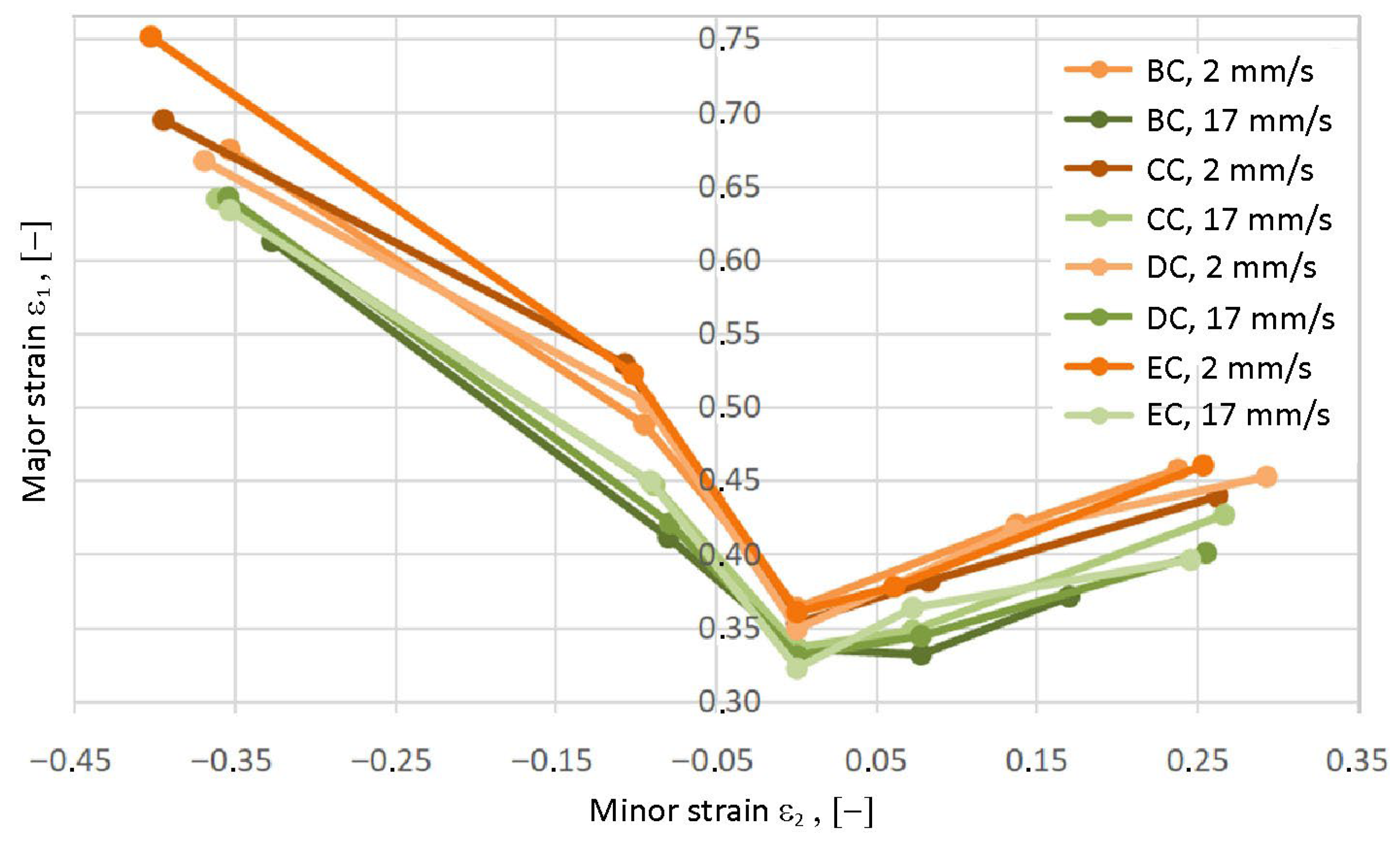
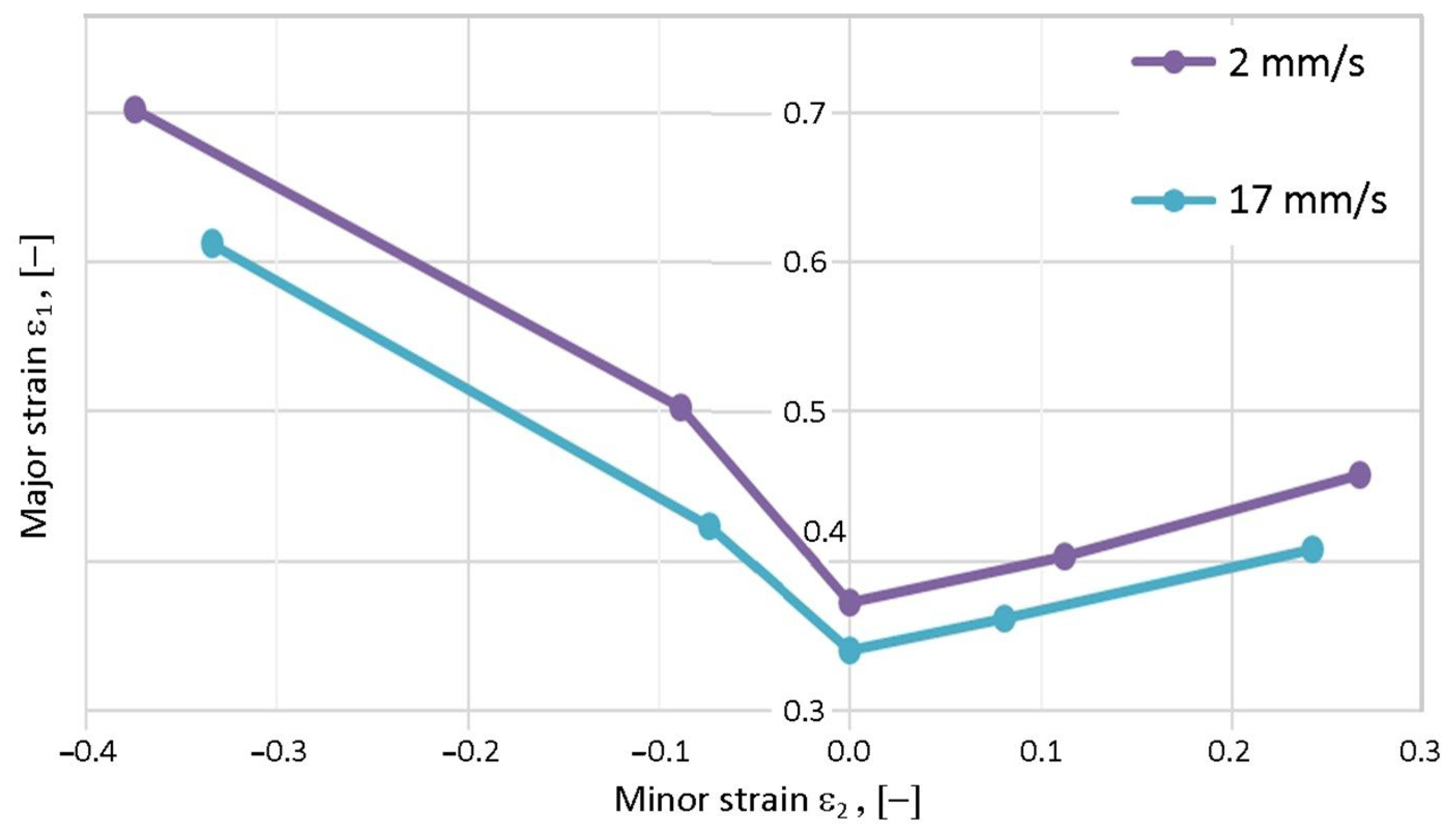
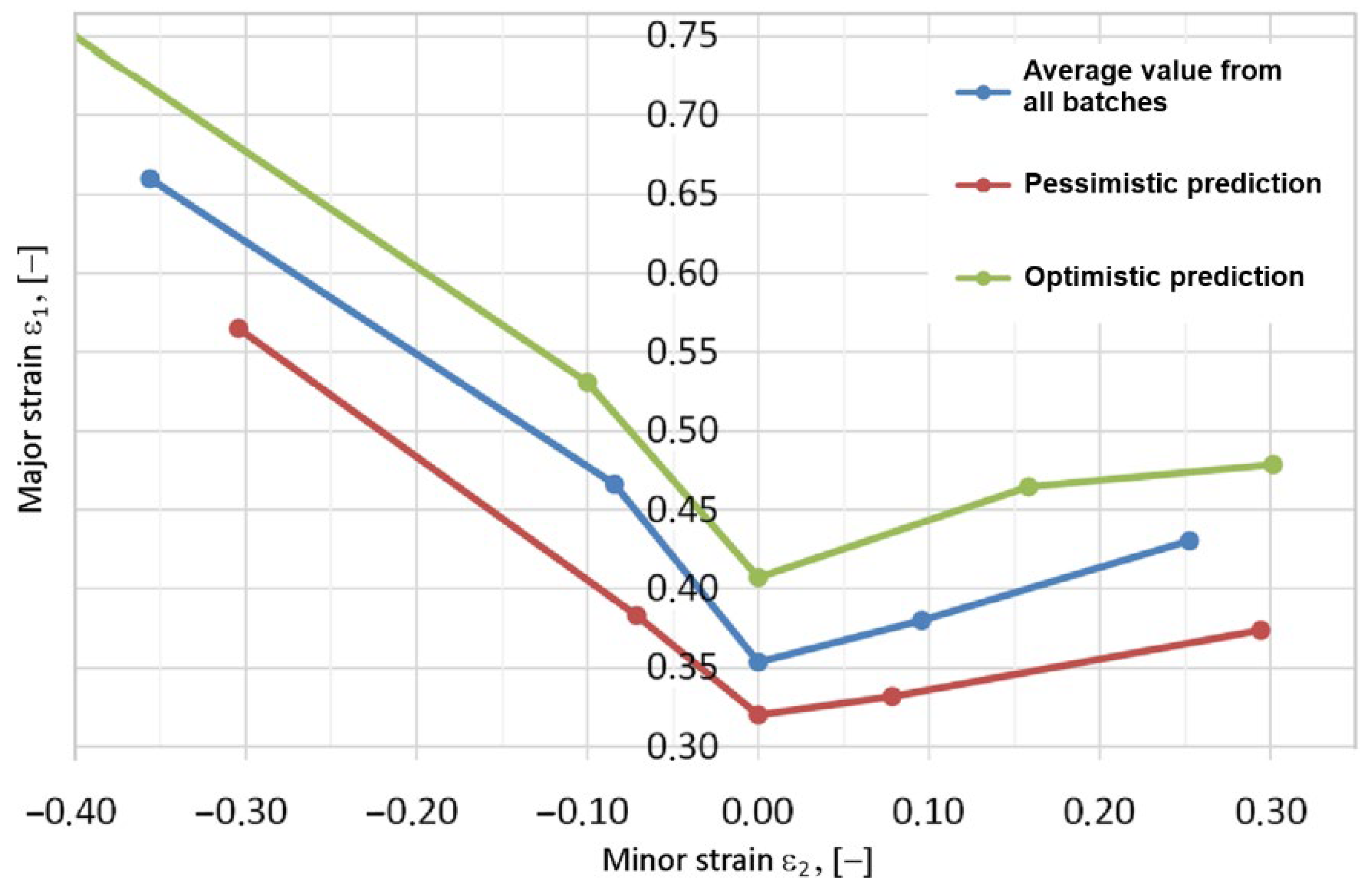
- The results presented in this article indicate that the chemical composition of individual batches of the same material can significantly affect sheet deformability by altering its mechanical properties. Depending on the sample type, the difference in major strains between optimistic and pessimistic variants can range from 20.9% to 28.32%. Simultaneously, the difference between the minor strain points for pessimistic and optimistic variants can be as much as 26.2%.
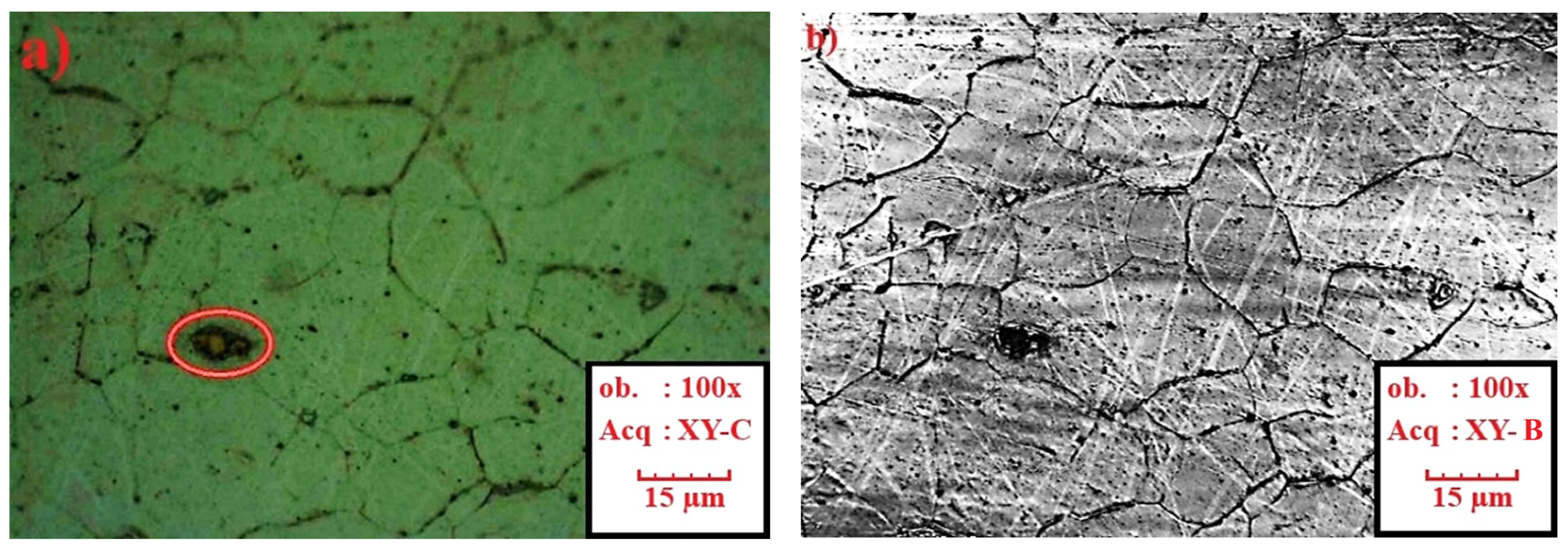
- Analysis of the microstructure observed on the metallographic cut etched with NITAL 2% etchant revealed regular ferritic grains with an average grain size of 20 μm. They correspond to the expected size. For automotive sheets, it is stated that there should be 50–100 grains in the thickness of the material. Yellow, sharp-edged formations in the structure consisting of Al, Ti, C, and N were observed. From the metallographic analyses performed, it follows that with the increasing rate of deformation, the size of the deformation is localized to a smaller distance from the crack. Furthermore, deformation occurs mainly in the grains at a small depth below the surface. With increasing depth or distance from the crack, the amount of grain deformation decreases. The same observation applies to all analyzed stress states.
- The measured data can be used to refine material cards for numerical simulations and to achieve a more robust forming process. In numerical simulations, attention will be given not only to the initial conditions but also to the position of the material within the coil, the specific heat, and the supplier.
Author Contributions
Funding
Institutional Review Board Statement
Informed Consent Statement
Data Availability Statement
Conflicts of Interest
References
- Wankede, P.; Suresh, K. A review on the evaluation of formability in sheet metal forming. Adv. Mater. Process. Technol. 2020, 6, 458–485. [Google Scholar] [CrossRef]
- Čada, R.; Tiller, P.; Hikade, A. Blank Material Influence on Stamping Springback. MM Sci. J. 2024, 17, 7185–7195. [Google Scholar] [CrossRef]
- Čada, R.; Pektor, T. Development of a Low-Cost Drawing Tool for a Press Brake. In Proceedings of the 30th Anniversary International Conference on Metallurgy and Materials METAL 2021, Brno, Czech Republic, 26–28 May 2021; pp. 241–246. [Google Scholar]
- Żaba, K.; Nowosielski, M.; Puchlerska, S.; Kwiatkowski, M.; Kita, P.; Głodzik, M. Investigation of the mechanical properties and microstructure of nickel superalloys processed in shear forming. Arch. Metall. Mater. 2015, 60, 2637–2644. [Google Scholar] [CrossRef]
- Evin, E.; Tomáš, M. Influence of Friction on the Formability of Fe-Zn-Coated IF Steels for Car Body Parts. Lubricants 2022, 10, 297. [Google Scholar] [CrossRef]
- Tomáš, M.; Németh, S.; Evin, E.; Hollý, F.; Kundracik, V.; Kulya, J.M.; Buber, M. Comparison of Friction Properties of GI Steel Plates with Various Surface Treatments. Lubricants 2024, 12, 198. [Google Scholar] [CrossRef]
- Hojny, M.; Woźniak, D.; Głowacki, M.; Żaba, K.; Nowosielski, M.; Kwiatkowski, M. Analysis of die design for the stamping of a bathtub. Arch. Metall. Mater. 2015, 60, 661–666. [Google Scholar] [CrossRef]
- Woźniak, D.; Głowacki, M.; Żaba, K.; Jędrzejczyk, D.; Nowosielski, M. Application of numerical and photogrammetric systems to verification of tools designated for deep drawing process. In Proceedings of the 23rd International Conference on Metallurgy and Materials, Brno, Czech Republic, 21–23 May 2014; pp. 1534–1539. [Google Scholar]
- Madej, L.; Wang, J.; Perzynski, K.; Hodgson, P.D. Numerical modeling of dual phase microstructure behavior under deformation conditions on the basis of digital material representation. Comput. Mater. Sci. 2014, 95, 651–662. [Google Scholar] [CrossRef]
- Madej, L.; Sieradzki, L.; Sitko, M.; Perzynski, K.; Radwanski, K.; Kuziak, R. Multi scale cellular automata and finite element based model for cold deformation and annealing of a ferritic–pearlitic microstructure. Comput. Mater. Sci. 2013, 77, 172–181. [Google Scholar] [CrossRef]
- Yanagimoto, J.; Banabic, D.; Banu, M.; Madej, L. Simulation of metal forming—Visualization of invisible phenomena in the digital era. CIRP Ann. 2022, 71, 599–622. [Google Scholar] [CrossRef]
- Čada, R.; Pektor, T. Design of the Production Technology of a Bent Component. Appl. Sci. 2023, 13, 13033. [Google Scholar] [CrossRef]
- Evin, E.; Tomáš, M.; Németh, S. Numerical and Experimental Analysis of Stress–Strain Characteristics in DP 600 and TRIP 400/700 Steel Sheets. Materials 2024, 17, 210. [Google Scholar] [CrossRef]
- Boljanovic, V. Sheet Metal Forming Processes and Die Design; Industrial Press Inc.: South Norwalk, CT, USA, 2004. [Google Scholar]
- Żaba, K.; Muzykiewicz, W.; Nowak, S. Analysis of the perforation process of steel strips used in automotive industry. Arch. Civ. Mech. Eng. 2008, 8, 145–154. [Google Scholar] [CrossRef]
- Petruželka, J.; Sonnek, P. Tvářitelnost Kovových Materiálů; VŠB—Technická univerzita Ostrava: Österlava, Czech Republic, 2006. [Google Scholar]
- Banabic, D. Plastic behaviour of sheet metal. In Sheet Metal Forming Processes; Banabic, D., Ed.; Springer: Berlin/Heidelberg, Germany, 2010; pp. 27–140. [Google Scholar]
- Reddy, A.C.S.; Rajesham, S.; Reddy, P.R.; Umamaheswar, A.C. Formability: A review on different sheet metal tests for formability. AIP Conf. Proc. 2020, 2269, 30026. [Google Scholar] [CrossRef]
- Pereira, R.; Peixinho, N.; Costa, S.L. A Review of Sheet Metal Forming Evaluation of Advanced High-Strength Steels (AHSS). Metals 2024, 14, 394. [Google Scholar] [CrossRef]
- Żaba, K.; Kuczek, Ł.; Balcerzak, M. The Effect of Varnishing and Soaking on Formability of the AW-5052-H28 Aluminium Alloy Sheets in Erichsen Cupping Test. Adv. Mech. Mater. Eng. 2024, 41, 137–144. [Google Scholar] [CrossRef]
- Sorce, F.S.; Ngo, S.; Lowe, C.; Taylor, A.C. Quantification of coating surface strains in Erichsen cupping tests. J. Mater. Sci. 2019, 54, 7997–8009. [Google Scholar] [CrossRef]
- Rossi, M.; Lattanzi, A.; Amodion, D. Enhancing the hydraulic bulge-test using full-field DIC data. J. Phys. Conf. Ser. 2018, 1063, 12042. [Google Scholar] [CrossRef]
- Agha, A.; Abu-Farha, F. On the Measurement of Nakazima Testing Based Out-of-Plane Forming Limit Curves using 2D Digital Image Correlation. Int. J. Pioneer. Technol. Eng. 2023, 2, 120–127. [Google Scholar] [CrossRef]
- Elsayed, A.; Gonzalez, D.; Yakushina, E. Development of the Forming Limit Diagram for AA6016-T4 at Room Temperature Using Uniaxial Tension of Notched Samples and a Biaxial Test. Crystals 2023, 13, 1134. [Google Scholar] [CrossRef]
- Keeler, S.P. Circular Grid System—A Valuable Aid for Evaluating Sheet Metal Formability. SAE Tech. Pap. 1968, 77, 371–379. [Google Scholar]
- Goodwin, G.M. Application of Strain Analysis to Sheet Metal Forming Problems in the Press Shop. SAE Tech. Pap. 1968, 77, 380–387. [Google Scholar]
- Marciniak, Z.; Kuczyński, K. Limit strains in the processes of stretch-forming sheet metal. Int. J. Mech. Sci. 1967, 9, 609–620. [Google Scholar] [CrossRef]
- EN ISO 12004-2:2021; Metallic Materials—Sheet and Strip—Determination of Forming-Limit Curves—Part 2: Determination of Forming-Limit Curves in the Laboratory. International Organization for Standardization: Geneva, Switzerland, 2021.
- Gronostajski, Z.; Matuszak, A.; Niechajowicz, A.; Zimniak, Z. The system for sheet metal forming design of complex parts. J. Mater. Process. Technol. 2004, 157–158, 502–507. [Google Scholar] [CrossRef]
- Nasir, M.W.; Chalal, H.; Abed-Meraim, F. Formability prediction using bifurcation criteria and GTN damage model. Int. J. Mech. Sci. 2021, 191, 106083. [Google Scholar] [CrossRef]
- Wójcik, M.; Skrzat, A.; Stachowicz, F.; Spišák, E. Crystal Plasticity Elastic-Plastic Rate-Independent Numerical Analyses of Pollycrystalline Materials. Adv. Mech. Mater. Eng. 2023, 40, 63–78. [Google Scholar] [CrossRef]
- Zhang, R.; Shao, Z.; Lin, J. A review on modelling techniques for formability prediction of sheet metal forming. Int. J. Lightweight Mater. Manuf. 2018, 1, 115–125. [Google Scholar] [CrossRef]
- Lin, J.; Mohamed, M.; Balint, D.; Dean, T.A. The development of continuum damage mechanics-based theories for predicting forming limit diagrams for hot stamping applications. Int. J. Damage Mech. 2013, 23, 684–701. [Google Scholar] [CrossRef]
- DiCecco, S.; Cheong, K.; Khameneh, F.; Deng, Z.; Worswick, M.; Butcher, C. Formability Characterization Using Curvature and Strain-Rate-Based Limit Strain Detection Methods Applied to Marciniak, Nakazima, and Stretch-Bend Tests. Metals 2024, 14, 1164. [Google Scholar] [CrossRef]
- Aljuaid, A.A.; Masood, S.A.; Tipu, J.A. Integrating Industry 4.0 for Sustainable Localized Manufacturing to Support Saudi Vision 2030: An Assessment of the Saudi Arabian Automotive Industry Model. Sustainability 2024, 16, 5096. [Google Scholar] [CrossRef]
- Wellbrock, W.; Ludin, D.; Röhrle, L.; Gerstlberger, W. Sustainability in the automotive industry, importance of and impact on automobile interior—Insights from an empirical survey. Int. J. Corp. Soc. Responsib. 2020, 5, 10. [Google Scholar] [CrossRef]
- Trzepieciński, T.; Najm, S.M. Current Trends in Metallic Materials for Body Panels and Structural Members Used in the Automotive Industry. Materials 2024, 17, 590. [Google Scholar] [CrossRef]
- Wang, H.; Niu, Q.; Yan, Y. Study of Anisotropic Behavior in Sheet Metal Forming. Materials 2024, 17, 2031. [Google Scholar] [CrossRef]
- Rabahallah, M.; Balan, T.; Barlat, F. Application of strain rate potentials with multiple linear transformations to the description of polycrystal plasticity. Int. J. Solids Struct. 2009, 46, 1966–1974. [Google Scholar] [CrossRef]
- Dariani, B.M.; Liaghat, G.H.; Gerdooei, M. Experimental investigation of sheet metal formability under various strain rates. Proc. Inst. Mech. Eng. Part B J. Eng. Manuf. 2009, 223, 703–712. [Google Scholar] [CrossRef]
- Vegter, H.; Carel, T.H.; Michael, A. The corus-vegter lite material model: Simplifying advanced material modelling. Int. J. Mater. Form. 2009, 2, 511–514. [Google Scholar] [CrossRef]
- Vegter, H.; Van Den Boogaard, A.H. A plane stress yield function for anisotropic sheet material by interpolation of biaxial stress states. Int. J. Plast. 2006, 22, 557–580. [Google Scholar] [CrossRef]
- EN 10346:2015; Continuously Hot-Dip Coated Steel Flat Products for Cold Forming—Technical Delivery Conditions. European Committee for Standardization: Brussels, Belgium, 2015.
- VDA 239-100:2024; Sheet Steel for Cold Forming. Available online: https://webshop.vda.de/VDA/en/vda-239-100-052024 (accessed on 12 August 2025).
- EN ISO 6892-1:2020; Metallic Materials—Tensile Testing—Part 1: Method of Test at Room Temperature. International Organization for Standardization: Geneva, Switzerland, 2020.
- Digital Image Correlation: Motion and Deformation Analysis. Available online: https://www.gom.com/en/topics/digital-image-correlation (accessed on 12 August 2025).
- Górszczyk, J.; Malicki, K.; Zych, T. Application of Digital Image Correlation (DIC) Method for Road Material Testing. Materials 2019, 12, 2349. [Google Scholar] [CrossRef]
- Novák, V.; Valeš, M.; Tatíček, F.; Šanovec, J.; Chrášťanský, L. The effect of strain rate on position of forming limit curve. In Proceedings of the 28th International Conference on Metallurgy and Materials, Brno, Czech Republic, 22–24 May 2019; pp. 450–454. [Google Scholar]
- Ma, J.; Tang, X.; Hou, Y.; Li, H.; Lin, J.; Fu, M.W. sheet forming process, limiting the production of drawpieces with the desired dimensions or shapes. Int. J. Mach. Tool. Manuf. 2025, 207, 104268. [Google Scholar] [CrossRef]
- Oliveira, M.C.; Fernandes, J.V. Modelling and Simulation of Sheet Metal Forming Processes. Metals 2019, 9, 1356. [Google Scholar] [CrossRef]
- Hou, Y.; Myung, D.; Park, J.K.; Min, J.; Lee, H.-R.; El-Aty, A.A.; Lee, M.-G. A Review of Characterization and Modelling Approaches for Sheet Metal Forming of Lightweight Metallic Materials. Materials 2023, 16, 836. [Google Scholar] [CrossRef]



| Yield Strength Rp0.2, MPa | Tensile Strength Rm, MPa | Elongation | Anisotropy | Strain-Hardening Exponent n10–20/Ag | ||
|---|---|---|---|---|---|---|
| A50, % | A80, % | r90/20 | rm/20 | |||
| 140–180 | 270–330 | ≥40 | ≥39 | ≥1.9 | ≥1.6 | ≥0.20 |
| C | Si | Mn | P | S | Al | Ti | Fe |
|---|---|---|---|---|---|---|---|
| ≤0.06 | ≤0.50 | ≤0.40 | ≤0.025 | ≤0.025 | ≥0.010 | ≤0.30 | balance |
| BS | BC | BE | B Average | ||||||||
|---|---|---|---|---|---|---|---|---|---|---|---|
| Sample | ε2 (Minor) | ε1 (Major) | Sample | ε2 (Minor) | ε1 (Major) | Sample | ε2 (Minor) | ε1 (Major) | Sample | ε2 (Minor) | ε1 (Major) |
| G1 | −0.373 | 0.727 | G1 | −0.354 | 0.675 | G1 | −0.375 | 0.727 | G1 | −0.368 | 0.710 |
| G2 | −0.096 | 0.494 | G2 | −0.095 | 0.488 | G2 | −0.104 | 0.537 | G2 | −0.098 | 0.506 |
| G3 | 0.000 | 0.381 | G3 | 0.000 | 0.364 | G3 | 0.000 | 0.382 | G3 | 0.000 | 0.376 |
| G4 | 0.145 | 0.375 | G4 | 0.137 | 0.421 | G4 | 0.081 | 0.377 | G4 | 0.121 | 0.391 |
| G5 | 0.245 | 0.459 | G5 | 0.237 | 0.457 | G5 | 0.249 | 0.451 | G5 | 0.244 | 0.456 |
| BS | BC | BE | B average | ||||||||
|---|---|---|---|---|---|---|---|---|---|---|---|
| Batch B | ε2 (Minor) | ε1 (Major) | Batch B | ε2 (Minor) | ε1 (Major) | Batch B | ε2 (Minor) | ε1 (Major) | Batch B | ε2 (Minor) | ε1 (Major) |
| G1 | −0.324 | 0.600 | G1 | −0.327 | 0.613 | G1 | −0.333 | 0.621 | G1 | −0.328 | 0.612 |
| G2 | −0.085 | 0.435 | G2 | −0.080 | 0.412 | G2 | −0.075 | 0.403 | G2 | −0.080 | 0.417 |
| G3 | 0.000 | 0.328 | G3 | 0.000 | 0.336 | G3 | 0.000 | 0.334 | G3 | 0.000 | 0.333 |
| G4 | 0.066 | 0.343 | G4 | 0.078 | 0.332 | G4 | 0.069 | 0.359 | G4 | 0.071 | 0.345 |
| G5 | 0.146 | 0.373 | G5 | 0.170 | 0.372 | G5 | 0.219 | 0.380 | G5 | 0.178 | 0.375 |
| Test Speed | Crack Region Under 200× Magnification [50 µm] | ||
|---|---|---|---|
| Uniaxial Stress State | Plane Stress State | Biaxial Stress State | |
| 2 mm/s |  |  |  |
| 17 mm/s |  |  |  |
Disclaimer/Publisher’s Note: The statements, opinions and data contained in all publications are solely those of the individual author(s) and contributor(s) and not of MDPI and/or the editor(s). MDPI and/or the editor(s) disclaim responsibility for any injury to people or property resulting from any ideas, methods, instructions or products referred to in the content. |
© 2025 by the authors. Licensee MDPI, Basel, Switzerland. This article is an open access article distributed under the terms and conditions of the Creative Commons Attribution (CC BY) license.
Share and Cite
Novák, V.; Tatíček, F.; Stejskal, O.; Trzepieciński, T.; Żaba, K. Effect of Strain Rate on the Formability Prediction of Cold-Rolled DX56D+Z100-M-C-O Steel Sheets. Materials 2026, 19, 99. https://doi.org/10.3390/ma19010099
Novák V, Tatíček F, Stejskal O, Trzepieciński T, Żaba K. Effect of Strain Rate on the Formability Prediction of Cold-Rolled DX56D+Z100-M-C-O Steel Sheets. Materials. 2026; 19(1):99. https://doi.org/10.3390/ma19010099
Chicago/Turabian StyleNovák, Vít, František Tatíček, Ondřej Stejskal, Tomasz Trzepieciński, and Krzysztof Żaba. 2026. "Effect of Strain Rate on the Formability Prediction of Cold-Rolled DX56D+Z100-M-C-O Steel Sheets" Materials 19, no. 1: 99. https://doi.org/10.3390/ma19010099
APA StyleNovák, V., Tatíček, F., Stejskal, O., Trzepieciński, T., & Żaba, K. (2026). Effect of Strain Rate on the Formability Prediction of Cold-Rolled DX56D+Z100-M-C-O Steel Sheets. Materials, 19(1), 99. https://doi.org/10.3390/ma19010099