Analysis of Energy Consumption in the Cutting Zone During Turning Bearing Steel 16MnCr5


Abstract
1. Introduction
2. Materials and Methods
3. Results and Their Discussion
3.1. Cutting Force Components
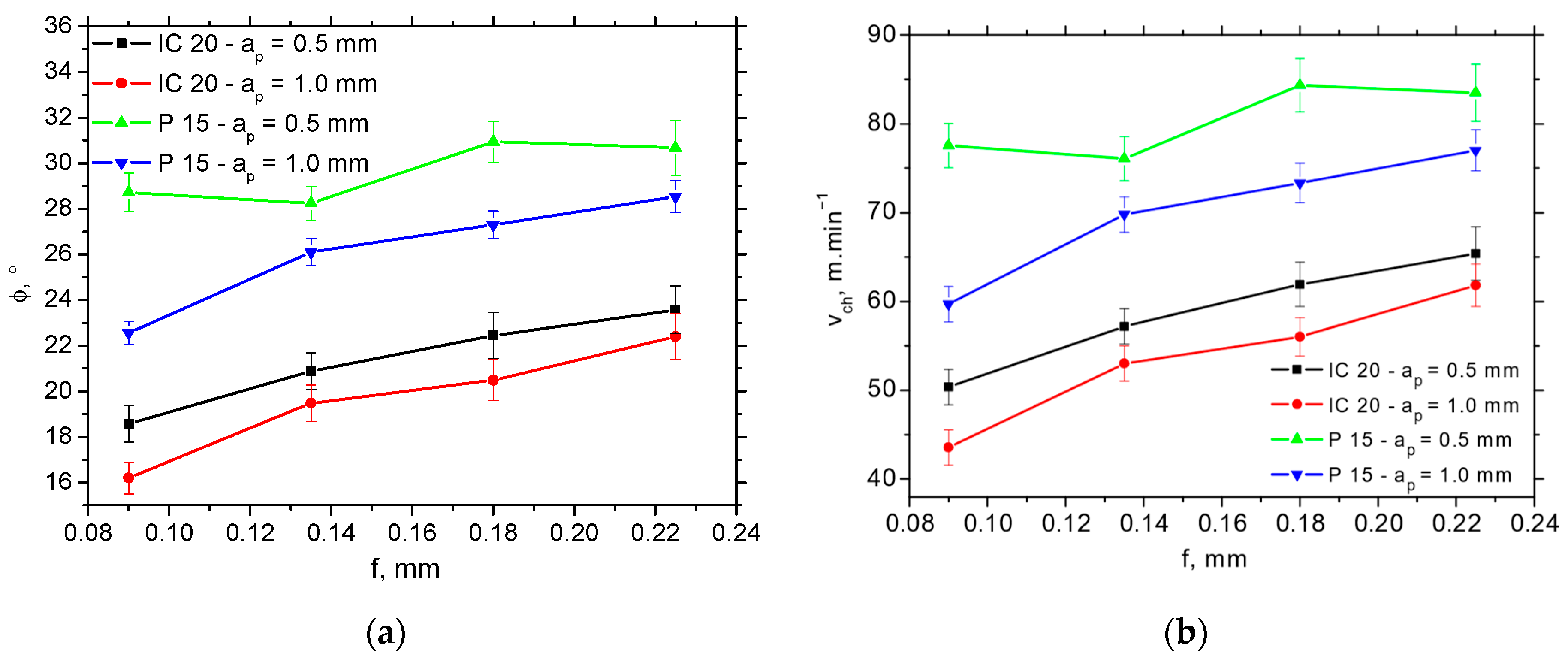
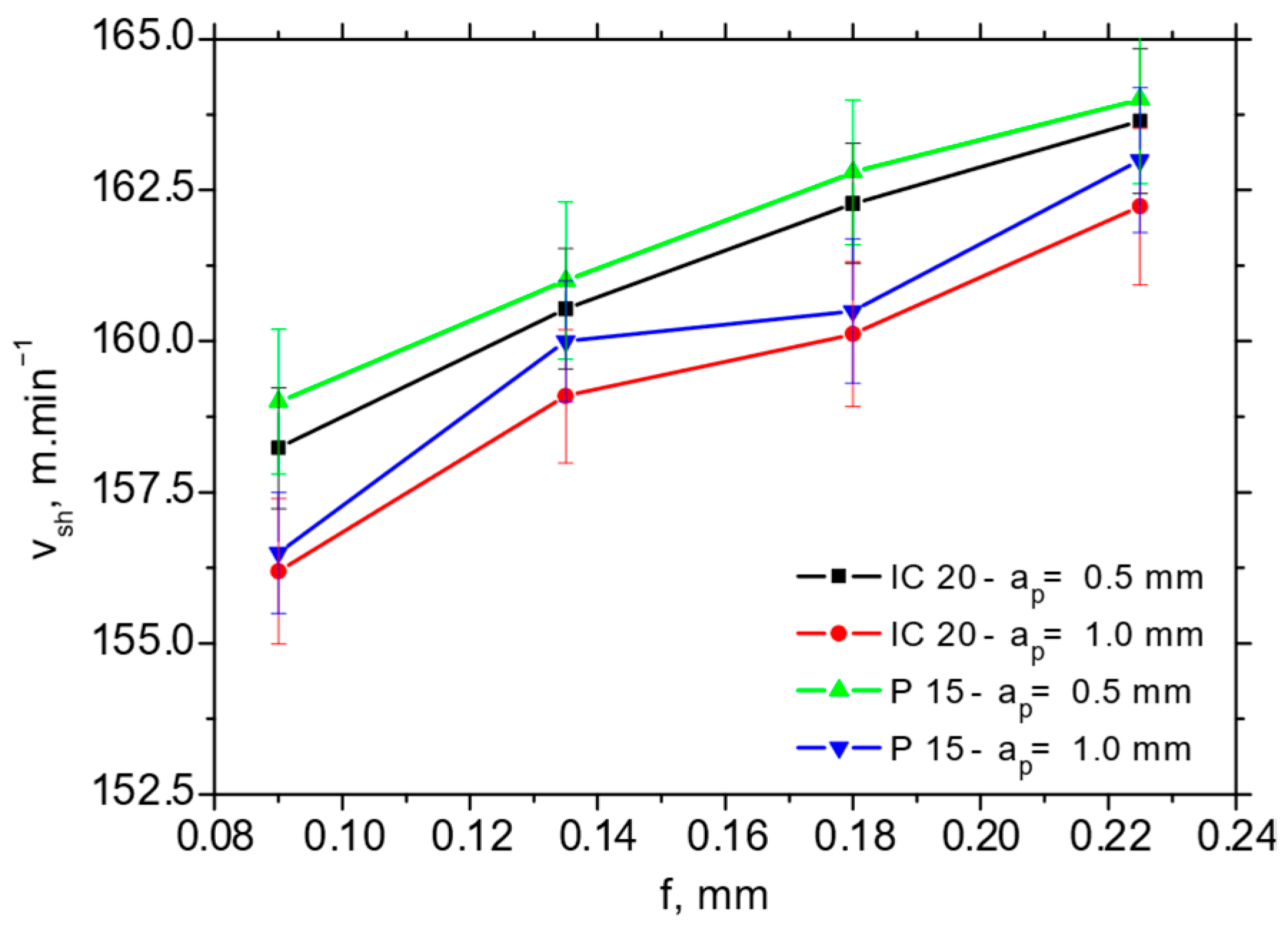
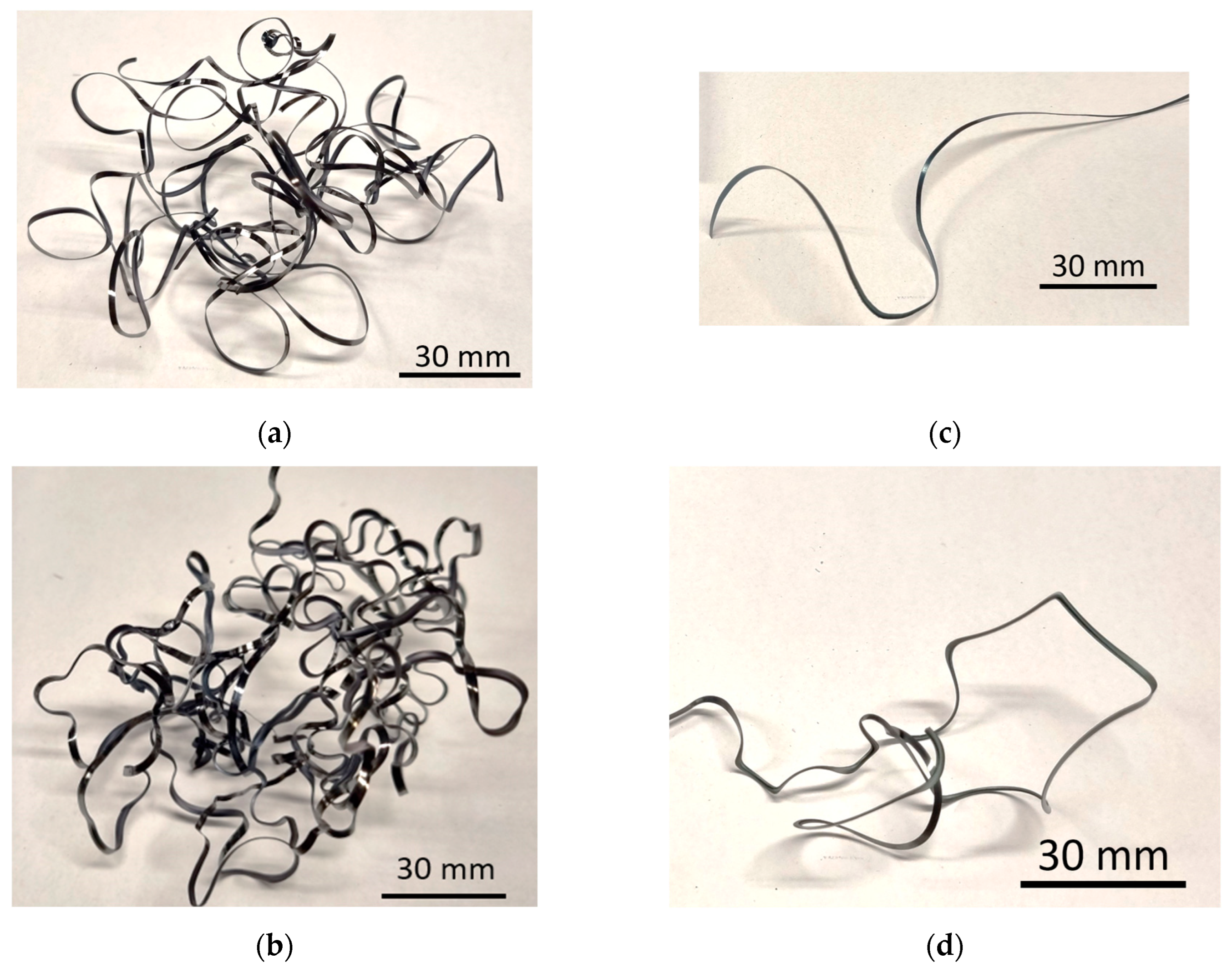
3.2. Chips Thickness and Shape
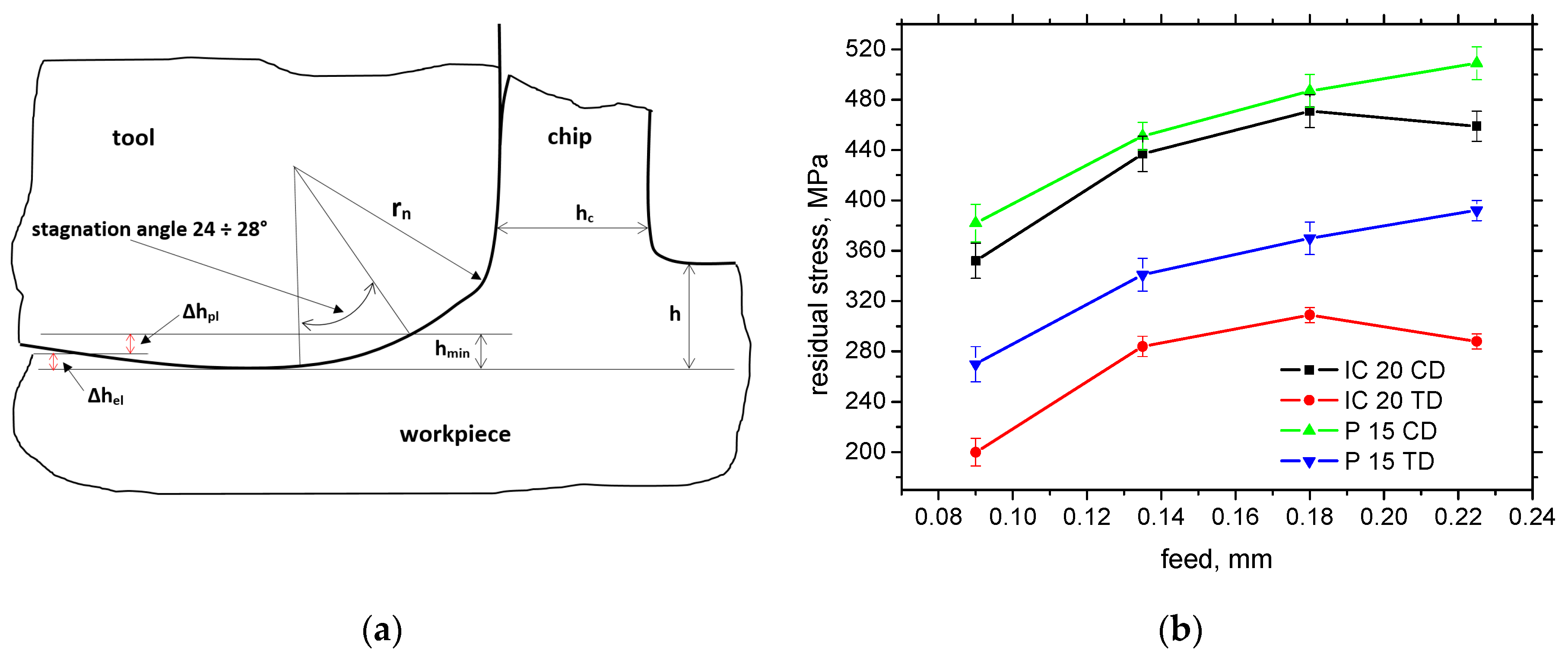
3.3. Surface State
4. Conclusions
Author Contributions
Funding
Data Availability Statement
Conflicts of Interest
References
- Neslušan, M.; Uríček, J.; Mičietová, A.; Minárik, P.; Píška, M.; Čilliková, M. Decomposition of cutting forces with respect to chip segmentation and white layer thickness when hard turning 100Cr6. J. Manuf. Process. 2020, 50, 475–484. [Google Scholar] [CrossRef]
- Beňo, J. Theory of Metal Cutting, 1st ed.; Vienala Košica: Košice, Slovakia, 1999. [Google Scholar]
- Lee, E.H.; Shaeffler, B.W. The theory of plasticity applied to a problem of machining. J. Appl. Mech. 1951, 18, 405–413. [Google Scholar] [CrossRef]
- De Chiffre, L.; Wanheim, T. What can be do about chip formation mechanics? CIRP Ann. 1985, 34, 129–132. [Google Scholar] [CrossRef]
- Denkena, B.; Krödel, A.; Heckemeyer, A. Numerical and experimental analysis of thermal and mechanical tool load when turning AISI 52100 with ground cutting edge microgeometries. CIRP J. Manuf. Sci. Technol. 2021, 35, 494–501. [Google Scholar] [CrossRef]
- Tu, L.; An, Q.; Zhang, J.; Chen, M.; Yu, D. Understanding tool cutting-edge microstructure and deformation mechanism induced by adhesive wear in the turning of nickel-based superalloys. Wear 2024, 556–557, 205519. [Google Scholar] [CrossRef]
- Čilliková, M.; Mičietová, A.; Čep, R.; Jacková, M.; Minárik, P.; Neslušan, M.; Kouřil, K. Analysis of Surface State after Turning of High Tempered Bearing Steel. Materials 2022, 15, 1718. [Google Scholar] [CrossRef]
- Zou, Z.; He, L.; Zhou, T.; Wang, M.; Tian, P.; Zhou, X. Research on microhardness prediction of 304 stainless steel turning based on dislocation density. J. Manuf. Process. 2022, 83, 522–535. [Google Scholar] [CrossRef]
- Neslušan, M.; Trojan, K.; Haušild, P.; Minárik, P.; Mičietová, A.; Čapek, J. Monitoring of components made of duplex steel after turning as a function of flank wear by the use of Barkhausen noise emission. Mater. Charact. 2020, 169, 110587. [Google Scholar] [CrossRef]
- Jiang, H.; Wang, C.; Ren, Z.; He, L. Comparative Analysis of Residual Stress and Dislocation Density of Machined Surface during Turning of High Strength Steel. Procedia CIRP 2021, 101, 38–41. [Google Scholar] [CrossRef]
- Rech, J.; Han, S.; Cavard, A.; Raffestin, M.; Valiorgue, F. Prediction of residual stresses induced in turning—Influence of cutting tool geometry. Manuf. Lett. 2025, 44, 643–650. [Google Scholar] [CrossRef]
- Qi, S.; Yan, S.; Xu, J.; Sun, Y. Predictive modeling of deformation induced by residual stress for thin-walled parts in double-sided alternating precision turning. J. Manuf. Process. 2025, 146, 19–29. [Google Scholar] [CrossRef]
- Denkena, B.; Breidenstein, B.; Dittrich, M.A.; Wichmann, M.; Nguyen, H.N.; Fricke, L.V.; Zaremba, D.; Barton, S. Setting of deformation-induced martensite content in cryogenic external longitudinal turning. Procedia CIRP 2022, 108, 170–175. [Google Scholar] [CrossRef]
- Fricke, L.V.; Basten, S.; Nguyen, H.N.; Breidenstein, B.; Kirsch, B.; Aurich, J.C.; Zaremba, D.; Maier, H.J.; Barton, S. Combined influence of cooling strategies and depth of cut on the deformation-induced martensitic transformation turning AISI 304. J. Mater. Process. Technol. 2023, 312, 117861. [Google Scholar] [CrossRef]
- Kulkarni, A.; Ambhore, N.; Deshpande, A.; Anerao, P.; Chinchanikar, S. Analysis of cutting temperature during turning of SS 304 using uncoated and PVD coated carbide inserts. Mater. Today 2022, 68, 2569–2573. [Google Scholar] [CrossRef]
- Zhang, C.; Zhou, Y.; Ma, W.; Lu, Y.; Ma, L.; Li, M.; Gong, Y. Study on the chip formation mechanism and micro characteristics of adiabatic shear band in nickel-based single crystal superalloy. J. Alloys Compd. 2025, 1038, 182846. [Google Scholar] [CrossRef]
- Lin, J.; Yu, B.; Gu, Y.; Gao, T.; Zhang, X.; Jia, R.; Zhao, J.; Luan, Y.; Liu, H. Effect of pulsed laser on chips formation and surface morphology of SiCp/Al during turning. Appl. Surf. Sci. 2025, 696, 162982. [Google Scholar] [CrossRef]
- Bergmann, B.; Denkena, B.; Grove, T.; Picker, T. Chip Formation of Rounded Cutting Edges. Int. J. Precis. Eng. Manuf. 2019, 20, 37–44. [Google Scholar] [CrossRef]
- Mikołajczyk, T.; Latos, H.; Pimenov, D.Y.; Paczkowski, T.; Gupta, M.K.; Krolczyk, G. Influence of the main cutting edge angle value on minimum uncut chip thickness during turning of C45 steel. J. Manuf. Process. 2020, 57, 354–362. [Google Scholar] [CrossRef]
- Liang, X.; Liu, Z.; Chen, L.; Hao, G.; Wang, B.; Cai, Y.; Song, Q. Tool wear induced modifications of plastic flow and deformed material depth in new generated surfaces during turning Ti-6Al-4V. J. Mater. Res. Technol. 2020, 9, 10782–10795. [Google Scholar] [CrossRef]
- Talib, R.J.; Zaharah, A.M.; Selamat, M.A.; Mahaidin, A.A.; Fazira, M.F. Friction and Wear characteristics of WC and TiCN-coated Insert in Turning Carbon Steel Workpiece. Proc. Eng. 2013, 68, 716–722. [Google Scholar] [CrossRef]
- Li, S.; Kim, D.K.; Benson, S. The influence of residual stress on the ultimate strength of longitudinally compressed stiffened panels. Ocean Eng. 2021, 231, 108839. [Google Scholar] [CrossRef]
- Yan, H.; Zhu, P.; Chen, Z.; Zhang, H.; Zhang, Y.; Zhang, Y. Effect of shot peening on the surface properties and wear behavior of heavy-duty-axle gear steels. J. Mater. Res. Technol. 2022, 17, 22–32. [Google Scholar] [CrossRef]



| Fe | C | Mn | Cr | S | P | Si | Cu |
| bal. | 0.18 | 1.25 | 1 | 0.035 | 0.025 | 0.2 | 0.4 |
| IC 20 | P 15 | |
|---|---|---|
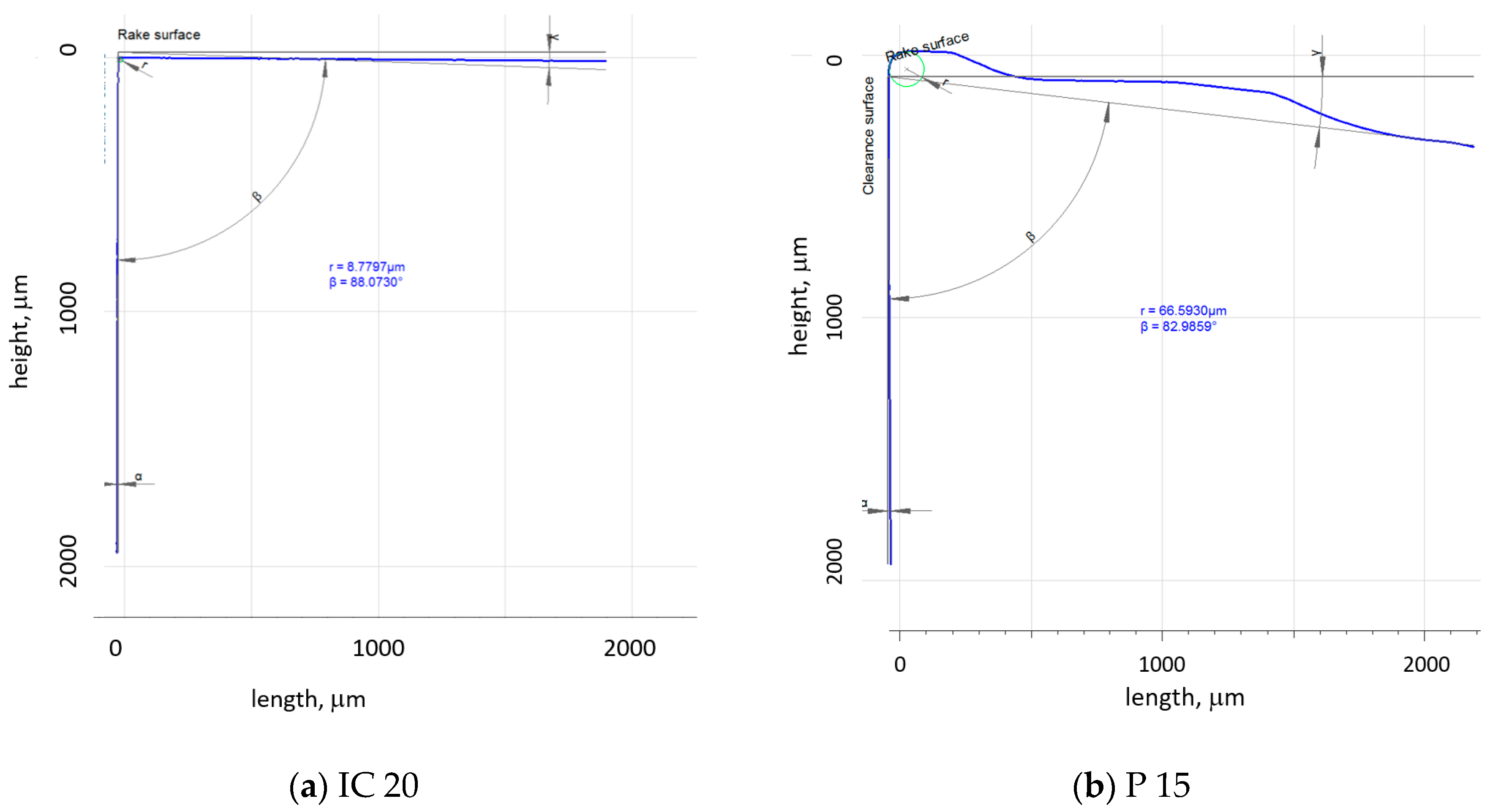
| Mean radius of mean edge rn, mm | 8.8 | 66.6 |
| Clearance angle α, ° | 0 (eff. 4) | 0.33 (eff. 4.33) |
| Wedge angle β, ° | 88.0 | 82.9 |
| Rake angle γ, ° | 2.05 (eff. −1,95) | 6.69 (eff. 2.69) |
| IC 20 | P 15 | |||||
|---|---|---|---|---|---|---|
| vc | 50 m.min−1 | 100 m.min−1 | 150 m.min−1 | 50 m.min−1 | 100 m.min−1 | 150 m.min−1 |
| Fαt | 39 N | 39 N | 38 N | 16 N | 15 N | 13 N |
| Fαtn | 121 N | 86 N | 76 N | 65 N | 50 N | 47 N |
| f = 0.09 mm | f = 0.135 mm | f = 0.180 mm | f = 0.225 mm | |
|---|---|---|---|---|
| vc = 50 m.min−1 | 0.29 ± 0.009 mm | 0.38 ± 0.011 mm | 0.46 ± 0.016 mm | 0.54 ± 0.023 mm |
| vc = 100 m.min−1 | 0.27 ± 0.010 mm | 0.35 ± 0.010 mm | 0.43 ± 0.015 mm | 0.51 ± 0.022 mm |
| vc = 150 m.min−1 | 0.26 ± 0.008 mm | 0.33 ± 0.007 mm | 0.41 ± 0.012 mm | 0.49 ± 0.018 mm |
Disclaimer/Publisher’s Note: The statements, opinions and data contained in all publications are solely those of the individual author(s) and contributor(s) and not of MDPI and/or the editor(s). MDPI and/or the editor(s) disclaim responsibility for any injury to people or property resulting from any ideas, methods, instructions or products referred to in the content. |
© 2025 by the authors. Licensee MDPI, Basel, Switzerland. This article is an open access article distributed under the terms and conditions of the Creative Commons Attribution (CC BY) license (https://creativecommons.org/licenses/by/4.0/).
Share and Cite
Mičietová, A.; Drbúl, M.; Čilliková, M.; Neslušan, M. Analysis of Energy Consumption in the Cutting Zone During Turning Bearing Steel 16MnCr5. Materials 2025, 18, 5059. https://doi.org/10.3390/ma18215059
Mičietová A, Drbúl M, Čilliková M, Neslušan M. Analysis of Energy Consumption in the Cutting Zone During Turning Bearing Steel 16MnCr5. Materials. 2025; 18(21):5059. https://doi.org/10.3390/ma18215059
Chicago/Turabian StyleMičietová, Anna, Mário Drbúl, Mária Čilliková, and Miroslav Neslušan. 2025. "Analysis of Energy Consumption in the Cutting Zone During Turning Bearing Steel 16MnCr5" Materials 18, no. 21: 5059. https://doi.org/10.3390/ma18215059
APA StyleMičietová, A., Drbúl, M., Čilliková, M., & Neslušan, M. (2025). Analysis of Energy Consumption in the Cutting Zone During Turning Bearing Steel 16MnCr5. Materials, 18(21), 5059. https://doi.org/10.3390/ma18215059