Author Contributions
Conceptualization, A.R., S.C., A.A., R.B.; methodology, A.R., S.C., A.A., R.B., E.B.; writing—original draft preparation, E.B.; writing—review and editing, R.B.; supervision, A.R., A.A., R.B.; formal analysis, A.R., S.C., A.A., R.B., E.B.; investigation, R.B., E.B. All authors have read and agreed to the published version of the manuscript.
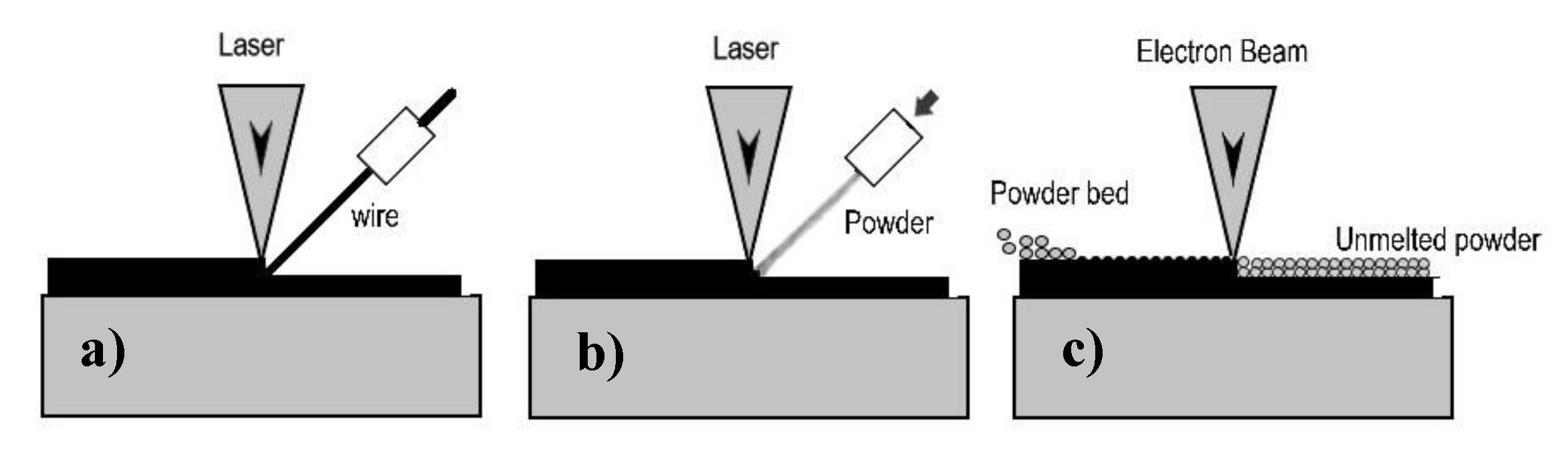
Figure 1.
Schematic representation of metal additive manufacturing (AM) processes used: (a) laser wire melting with wire feeding system; (b) laser metal deposition system; (c) powder bed fusion with electron beam melting.
Figure 1.
Schematic representation of metal additive manufacturing (AM) processes used: (a) laser wire melting with wire feeding system; (b) laser metal deposition system; (c) powder bed fusion with electron beam melting.
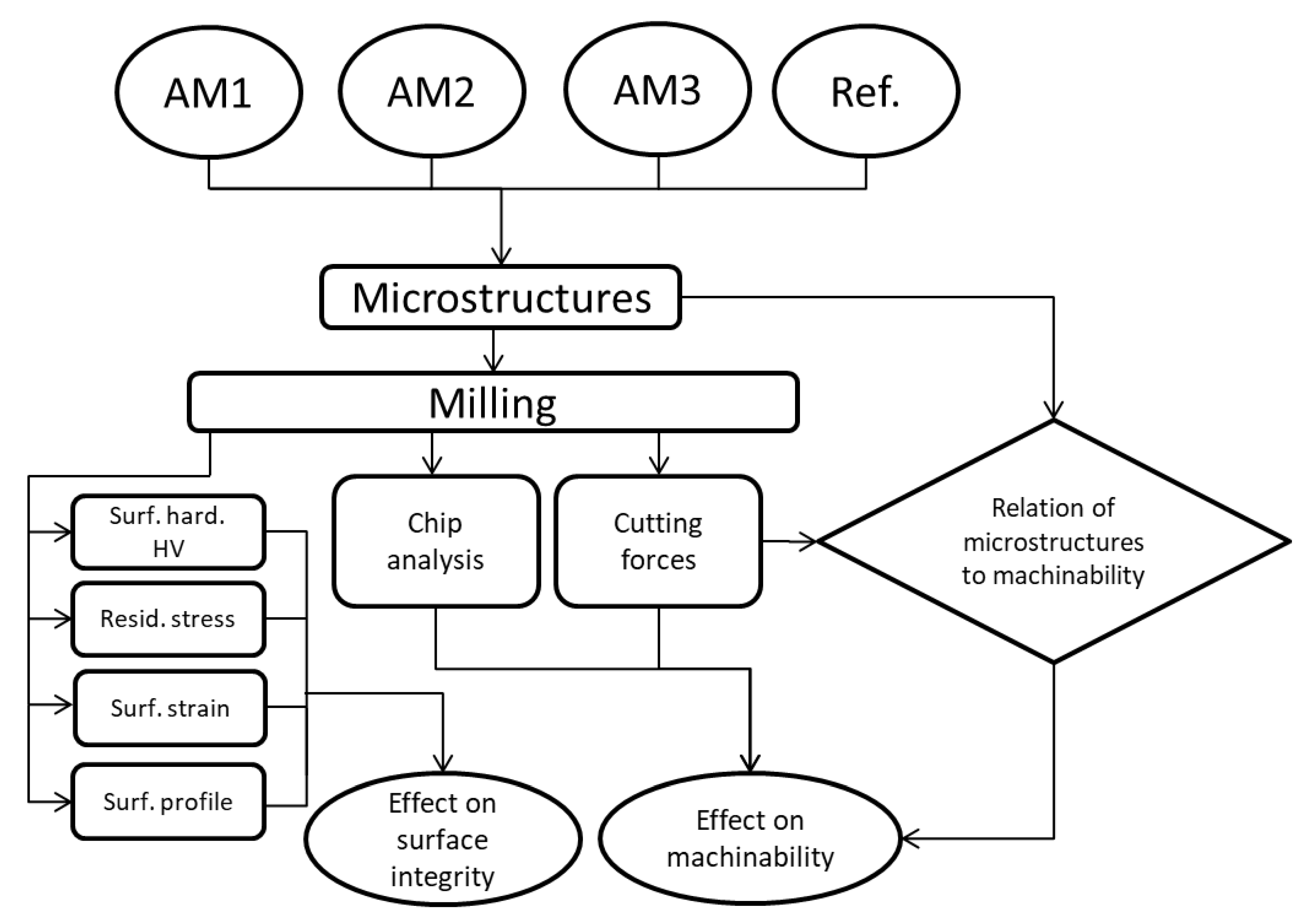
Figure 2.
Flowchart showing the experimentation process. (AM, Additive Manufacturing; Ref., Reference; Surf., Surface; hard., hardness; Resid., Residual).
Figure 2.
Flowchart showing the experimentation process. (AM, Additive Manufacturing; Ref., Reference; Surf., Surface; hard., hardness; Resid., Residual).
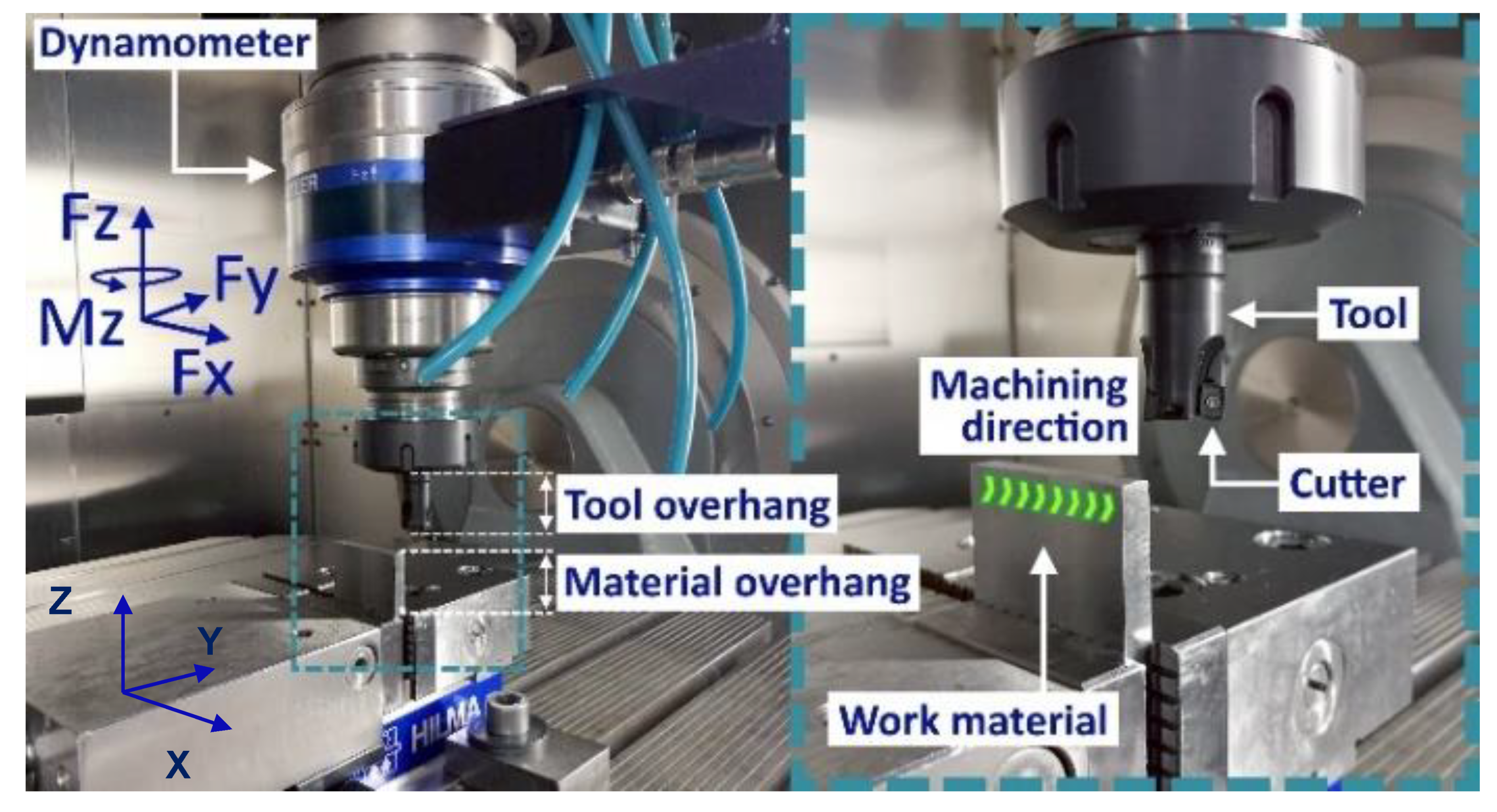
Figure 3.
Machining setup and force directions.
Figure 3.
Machining setup and force directions.
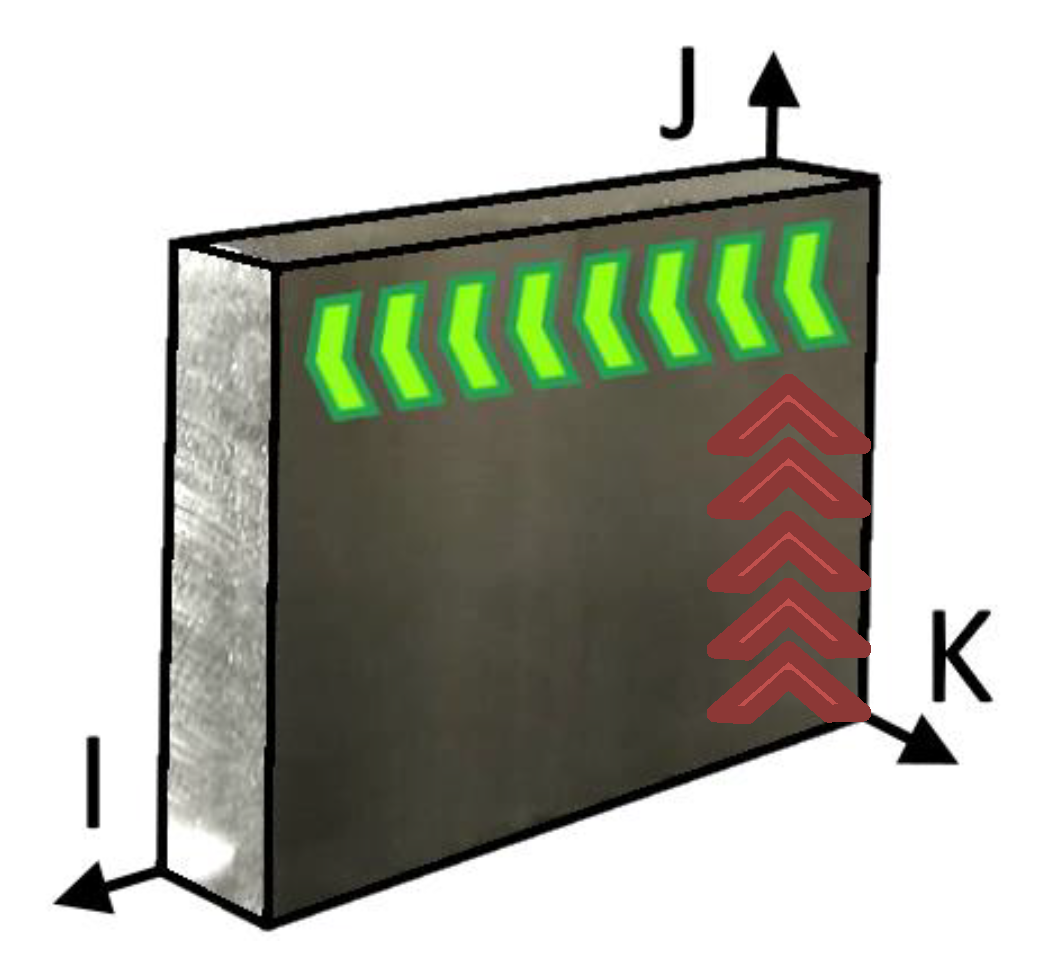
Figure 4.
Schematic overview of the two machining directions in the IJ-plane of the workpiece. The green arrows show the machining parallel to the I-direction, and the red arrows show the machining parallel to the J-direction.
Figure 4.
Schematic overview of the two machining directions in the IJ-plane of the workpiece. The green arrows show the machining parallel to the I-direction, and the red arrows show the machining parallel to the J-direction.
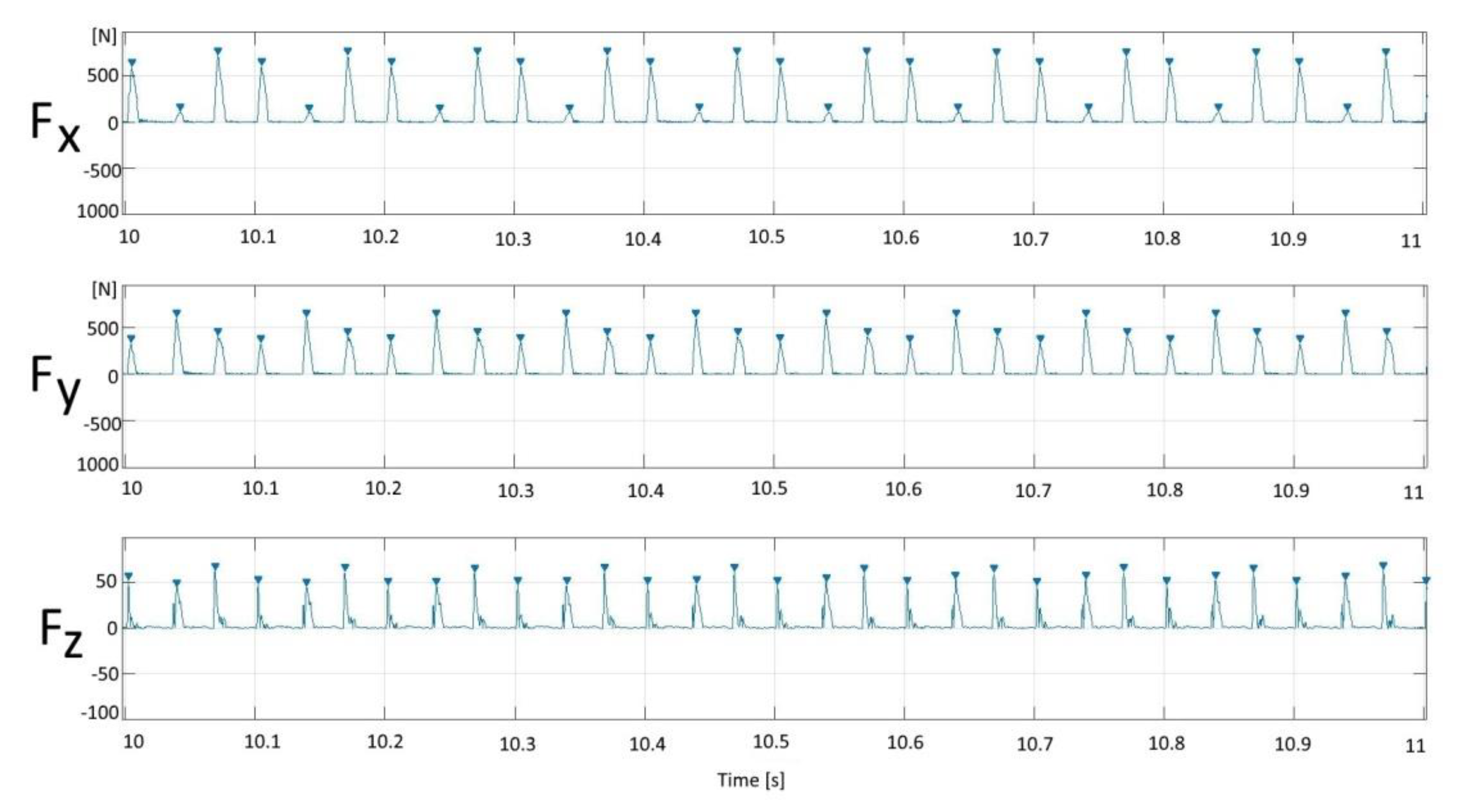
Figure 5.
Typical dynamometer force readings.
Figure 5.
Typical dynamometer force readings.
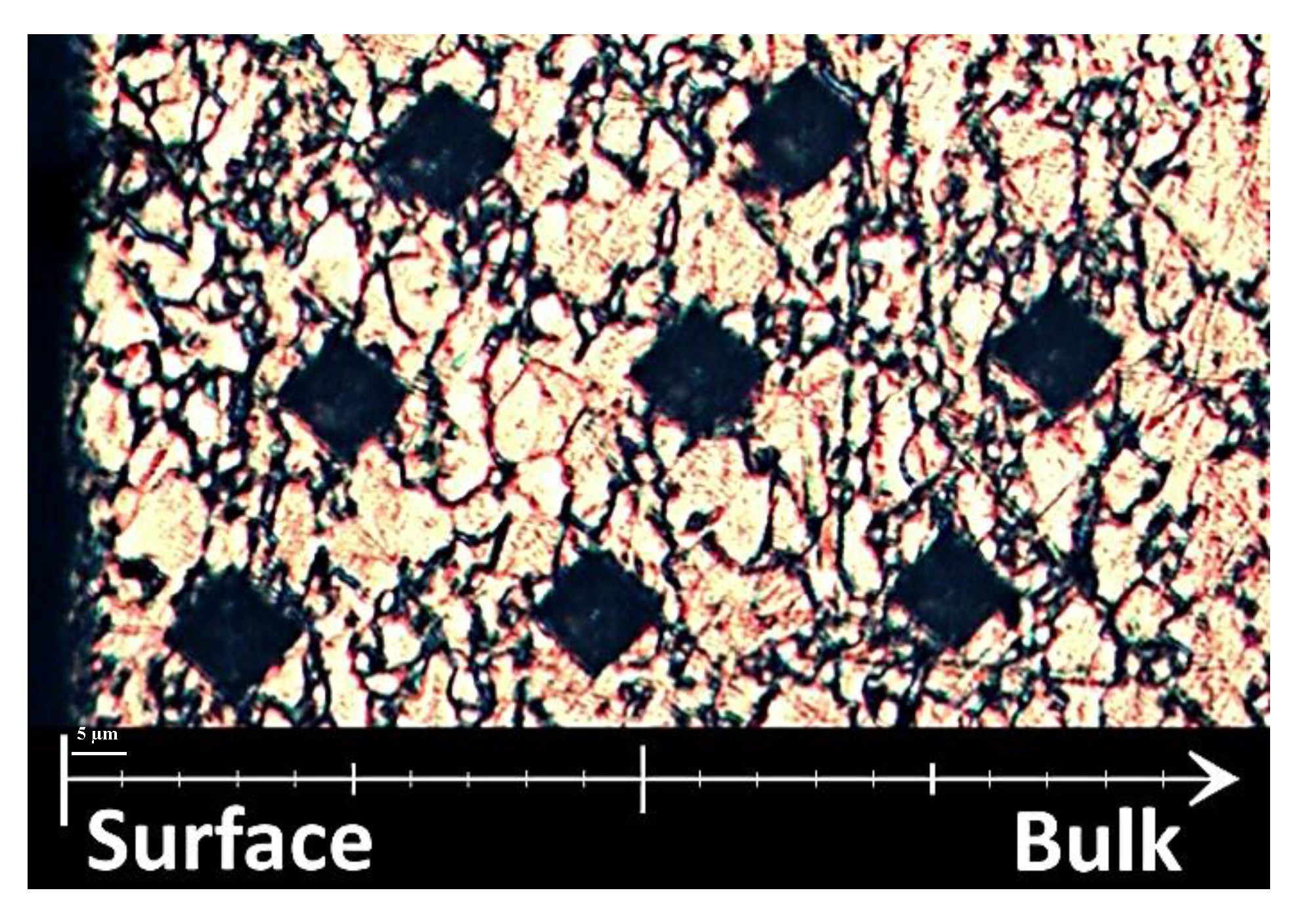
Figure 6.
Example of microhardness indentations. The machined surface is on the left side and the indentations are perpendicular to this surface.
Figure 6.
Example of microhardness indentations. The machined surface is on the left side and the indentations are perpendicular to this surface.
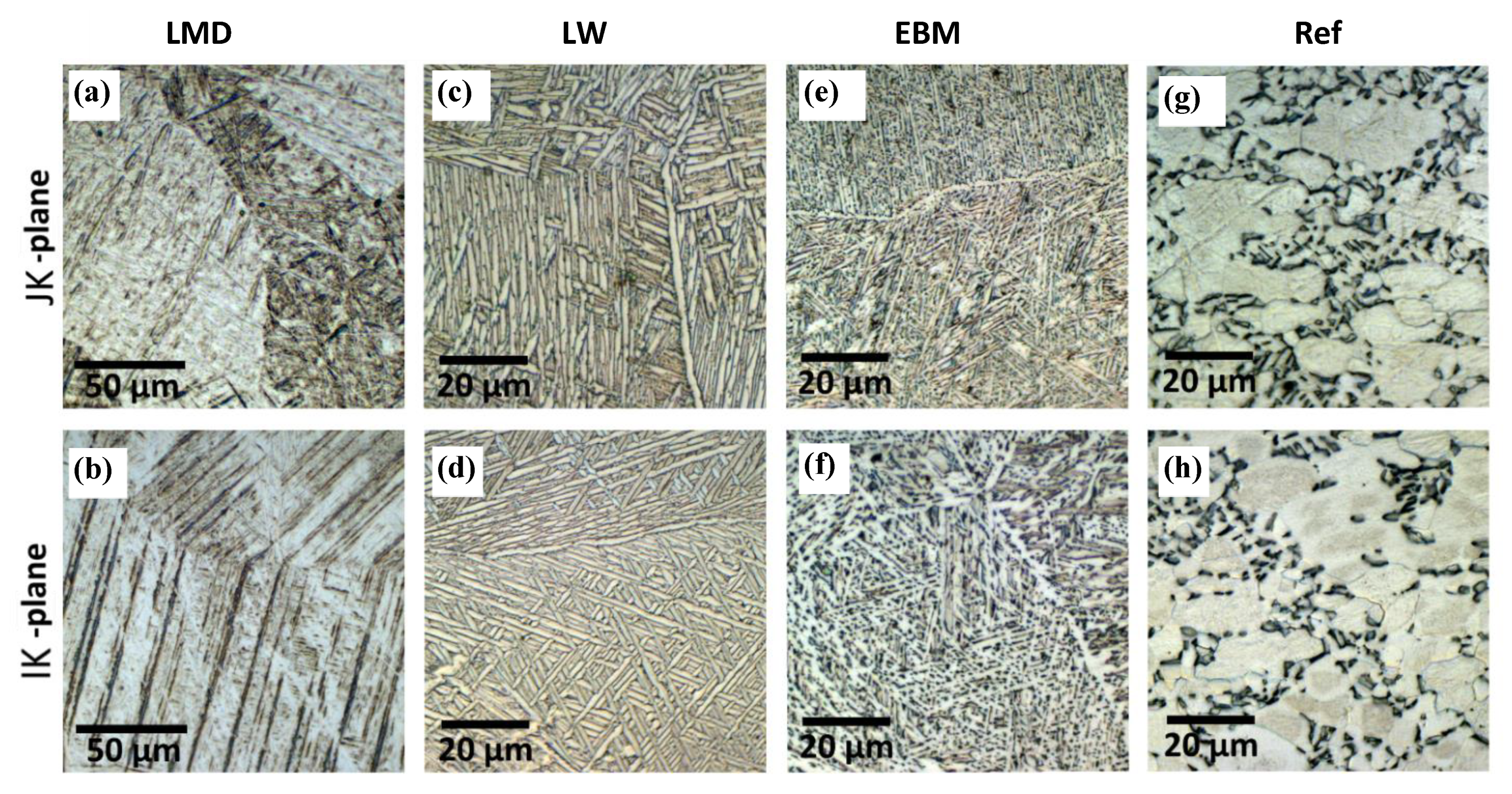
Figure 7.
Microstructures of the three AM Ti-6Al-4V alloys and the forged reference. Images of LMD, LW, EBM, and reference materials were taken in the JK- (a,c,e,g) and IK-planes (b,d,f,h). Note that (a,c) are perpendicular to the build direction, and (b,d,e,f) are within the built plane.
Figure 7.
Microstructures of the three AM Ti-6Al-4V alloys and the forged reference. Images of LMD, LW, EBM, and reference materials were taken in the JK- (a,c,e,g) and IK-planes (b,d,f,h). Note that (a,c) are perpendicular to the build direction, and (b,d,e,f) are within the built plane.
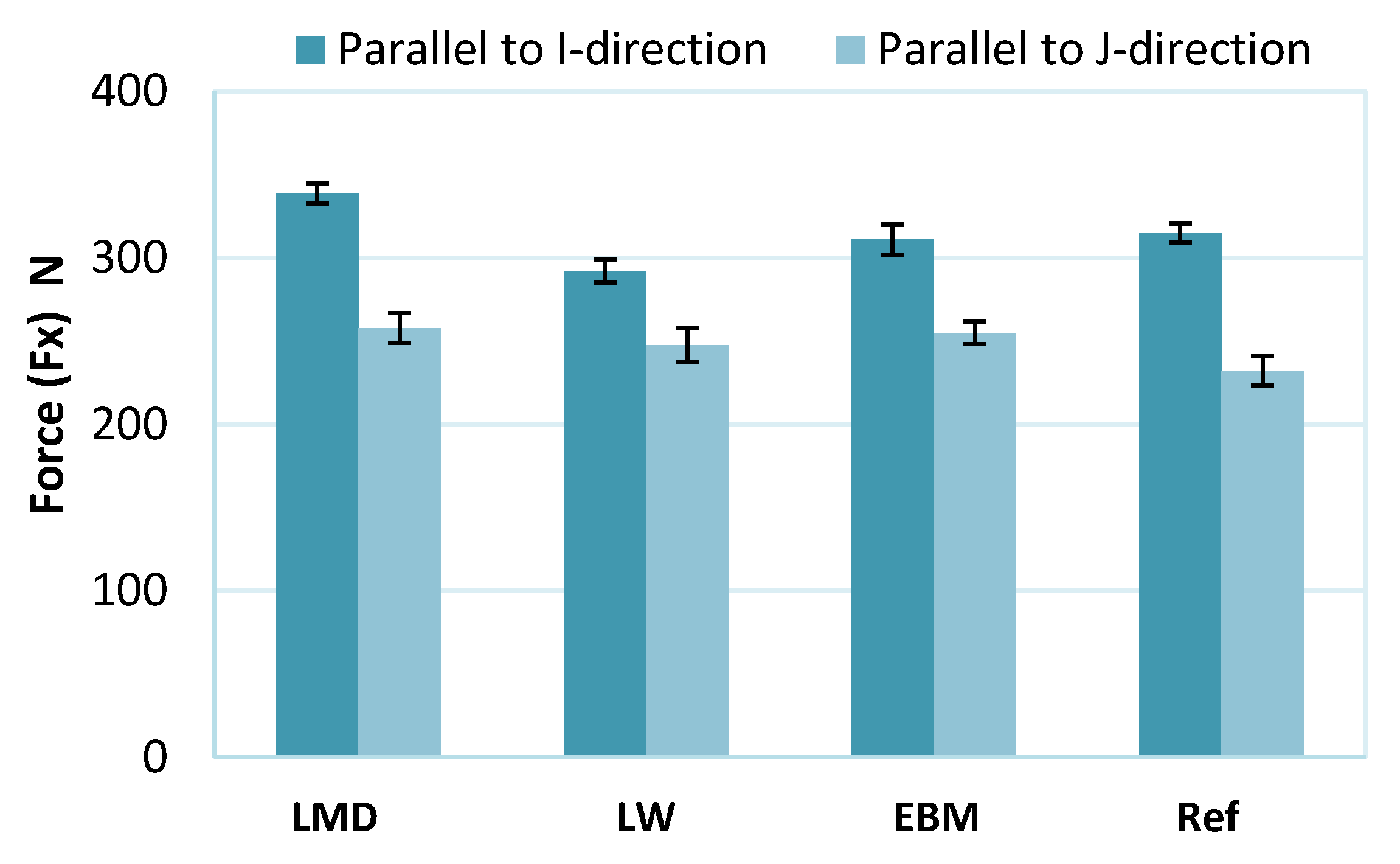
Figure 8.
Forces along X-direction (feed) for the LMD, LW, EBM, and reference (Ref) materials.
Figure 8.
Forces along X-direction (feed) for the LMD, LW, EBM, and reference (Ref) materials.
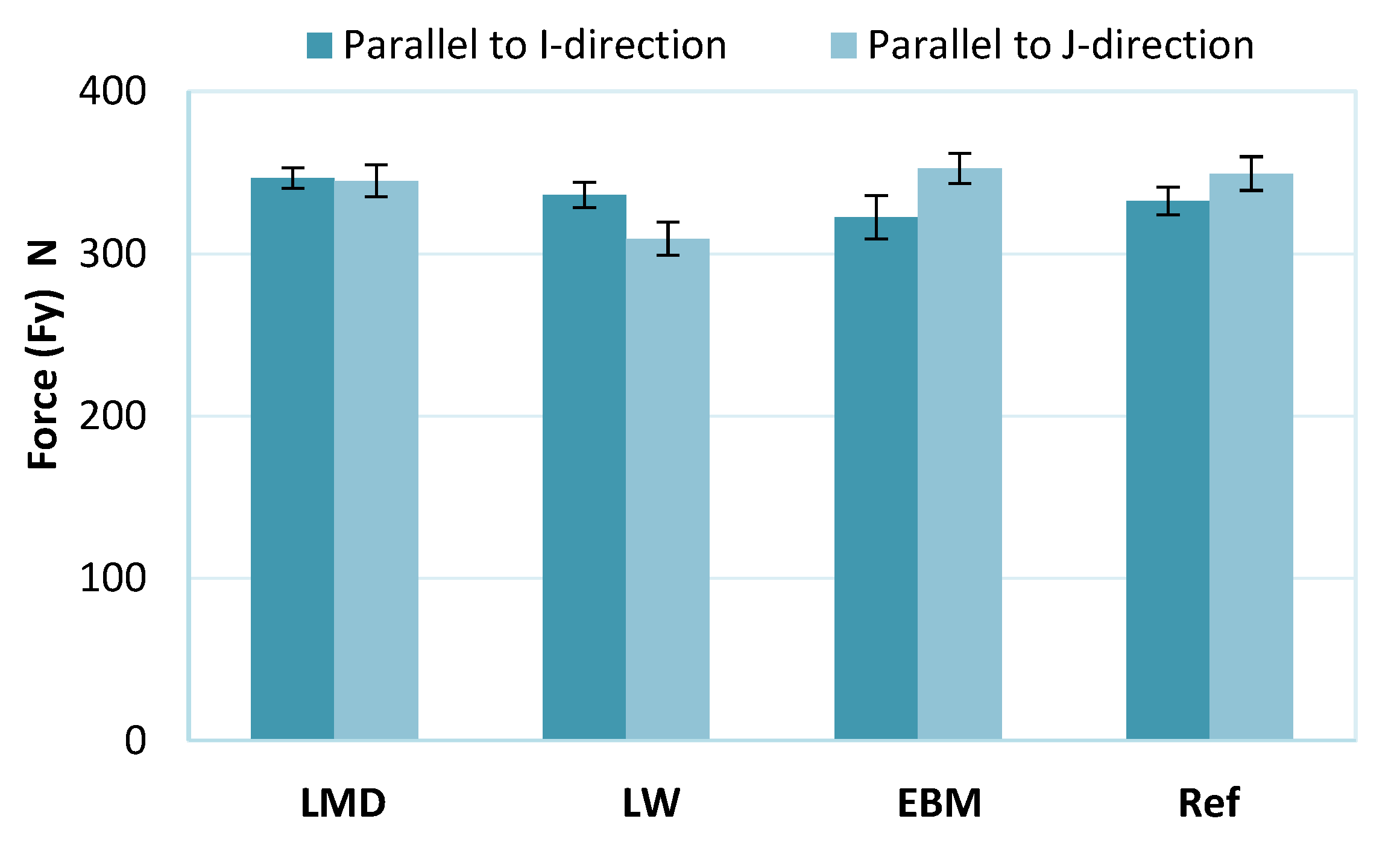
Figure 9.
Forces perpendicular to the feed in the Y-direction for the LMD, LW, EBM, and reference (Ref) materials.
Figure 9.
Forces perpendicular to the feed in the Y-direction for the LMD, LW, EBM, and reference (Ref) materials.
Figure 10.
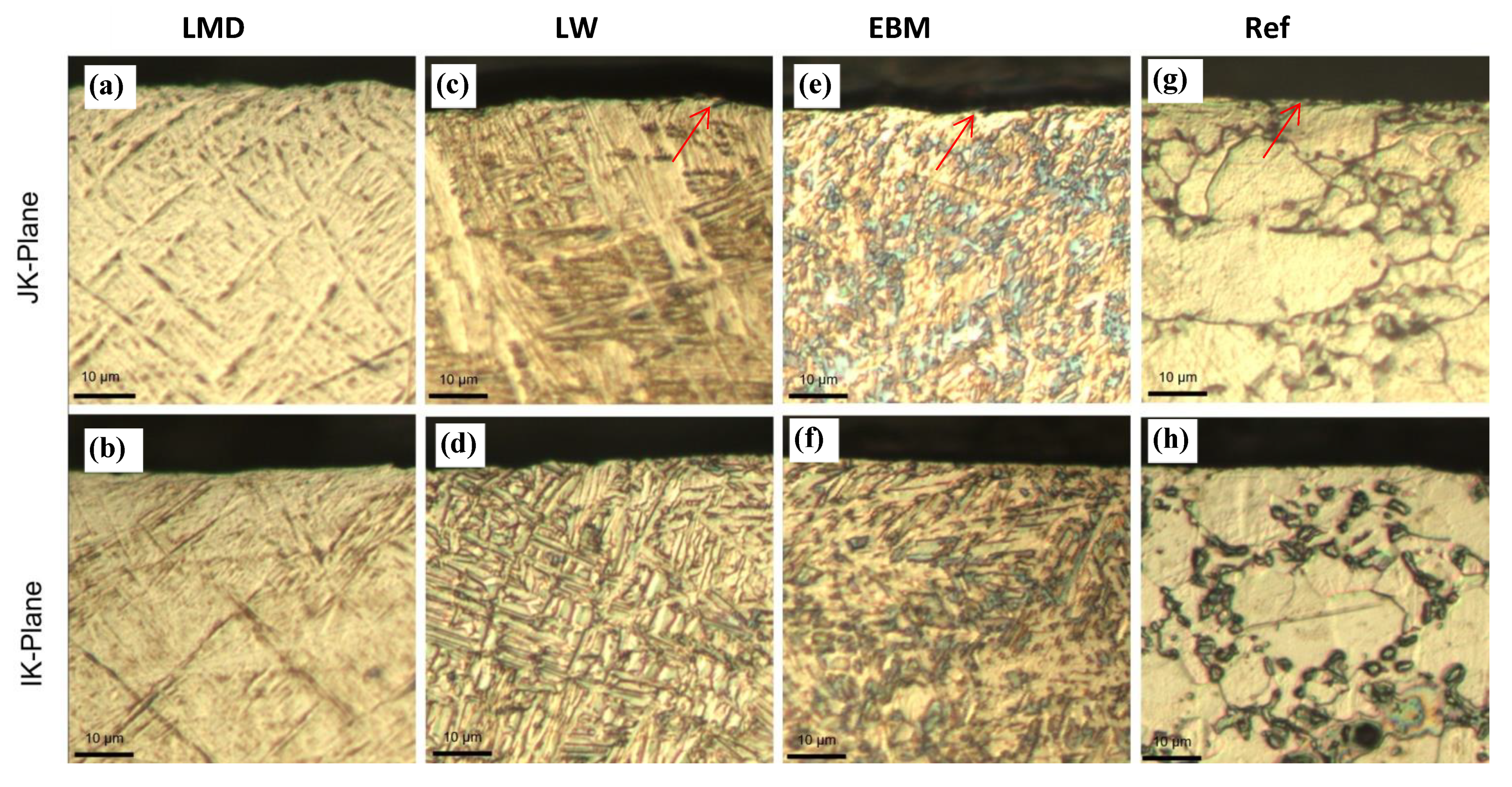
Machined layer and subsurface deformation of the three AM Ti-6Al-4V alloys and the forged reference. Images of LMD, LW, EBM, and reference materials were taken in the JK- (a,c,e,g) and IK-planes (b,d,f,h). Arrows indicate deformed grains. Note that (a,c) are perpendicular to the build direction and (b,d,e,f) are within the built plane.
Figure 10.
Machined layer and subsurface deformation of the three AM Ti-6Al-4V alloys and the forged reference. Images of LMD, LW, EBM, and reference materials were taken in the JK- (a,c,e,g) and IK-planes (b,d,f,h). Arrows indicate deformed grains. Note that (a,c) are perpendicular to the build direction and (b,d,e,f) are within the built plane.
Figure 11.
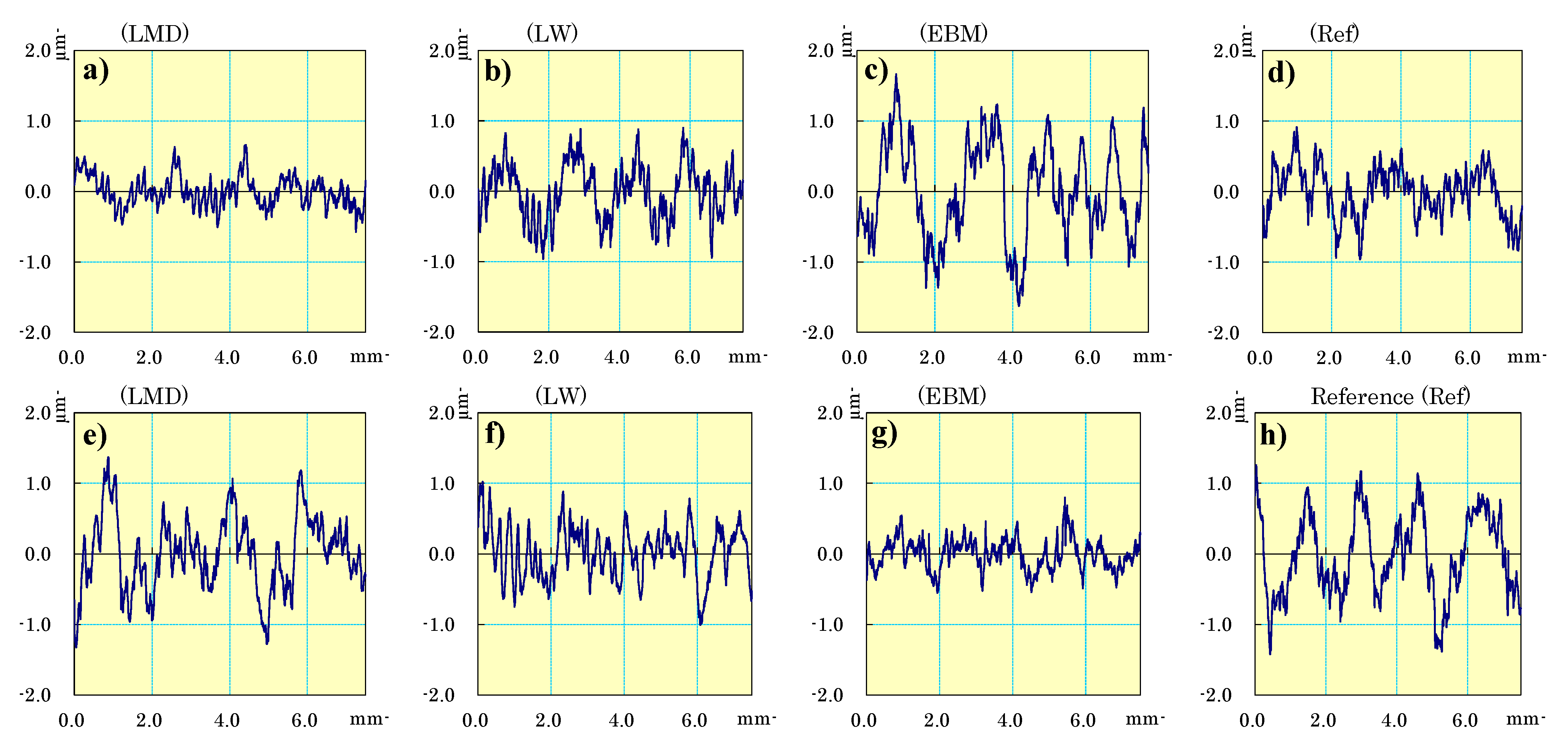
(a–d) Profilometry measurements conducted in the machining direction in the IJ-plane. The samples were machined in the I-direction. (e–h) Profilometry measurements conducted in the machining direction in the IJ-plane. The samples were machined in the J-direction.
Figure 11.
(a–d) Profilometry measurements conducted in the machining direction in the IJ-plane. The samples were machined in the I-direction. (e–h) Profilometry measurements conducted in the machining direction in the IJ-plane. The samples were machined in the J-direction.
Figure 12.
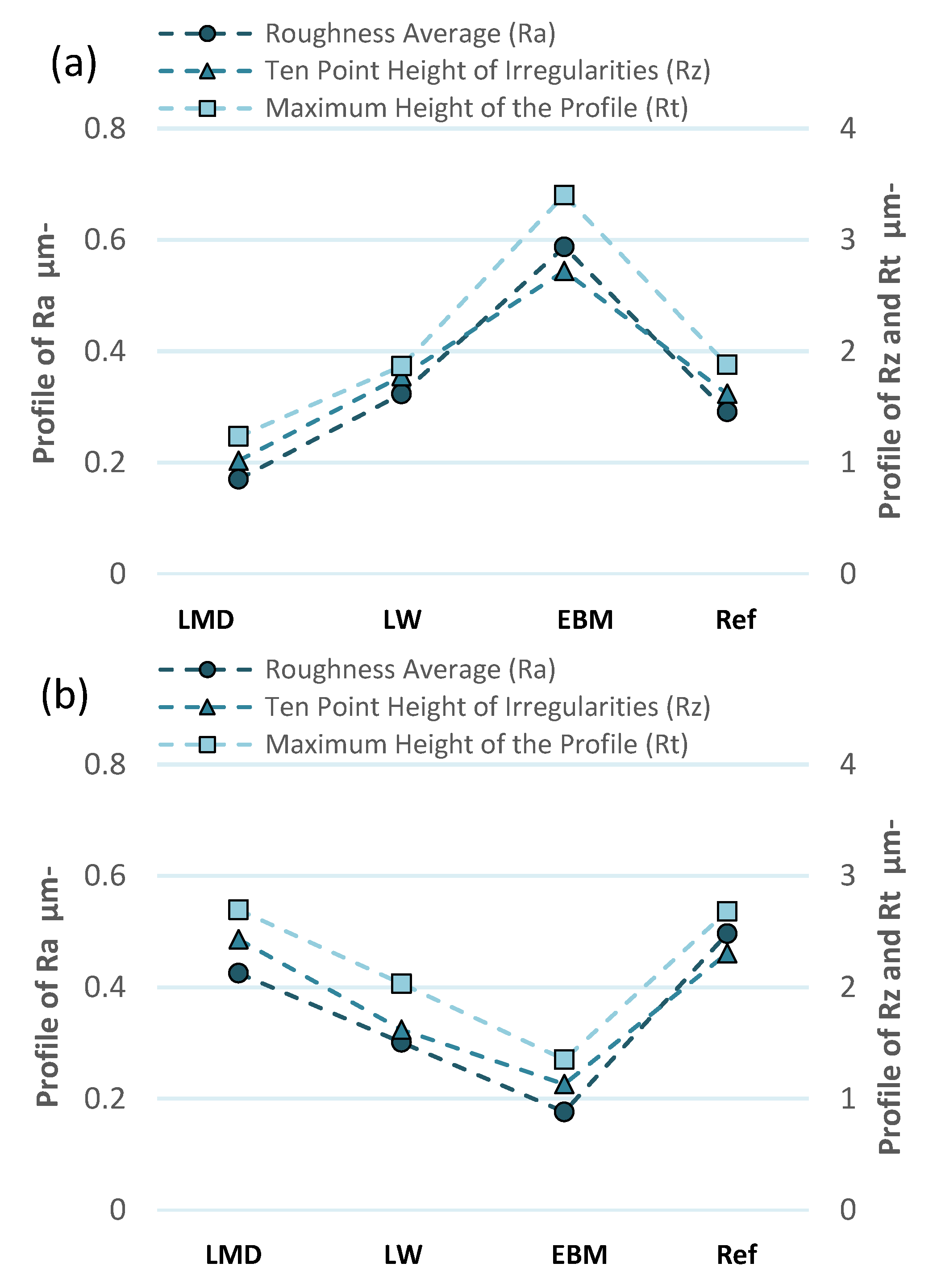
Summary of the profilometry measurements based on roughness average (Ra), ten-point height of irregularities (Rz) and maximum height of the profile (Rt). (a) Measurements conducted parallel to the machining direction in the IJ-plane. The samples were machined in the I-direction. (b) Measurements conducted parallel to the machining direction in the IJ-plane. The samples were machined in the J-direction.
Figure 12.
Summary of the profilometry measurements based on roughness average (Ra), ten-point height of irregularities (Rz) and maximum height of the profile (Rt). (a) Measurements conducted parallel to the machining direction in the IJ-plane. The samples were machined in the I-direction. (b) Measurements conducted parallel to the machining direction in the IJ-plane. The samples were machined in the J-direction.
Figure 13.
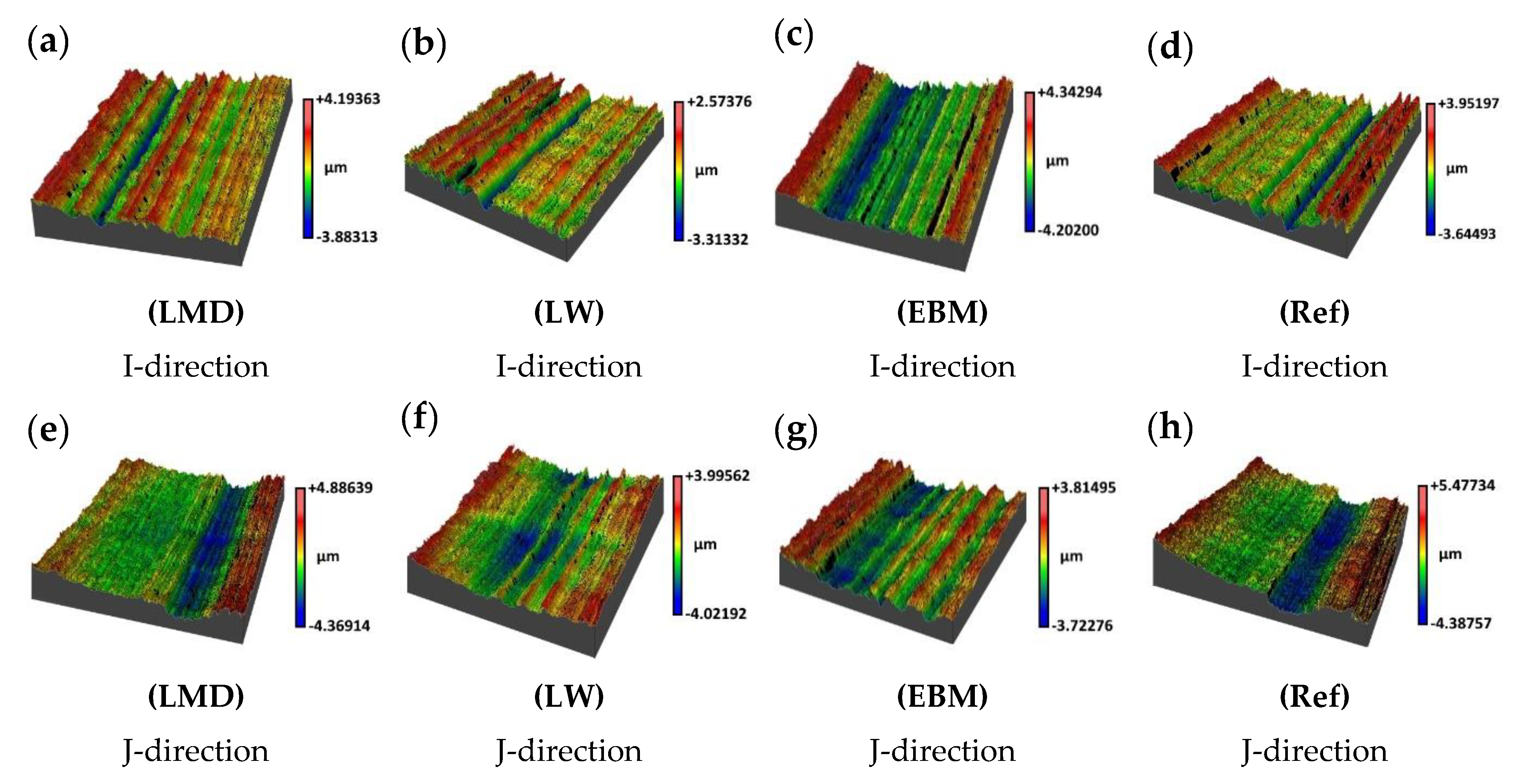
White light interferometry profile projections of analyzed 1 × 1 mm squares. One projection of each sample was selected amongst three measured and are referred to as (a–h). The feed direction is along the grooves, so from the bottom to the top of paper.
Figure 13.
White light interferometry profile projections of analyzed 1 × 1 mm squares. One projection of each sample was selected amongst three measured and are referred to as (a–h). The feed direction is along the grooves, so from the bottom to the top of paper.
Figure 14.
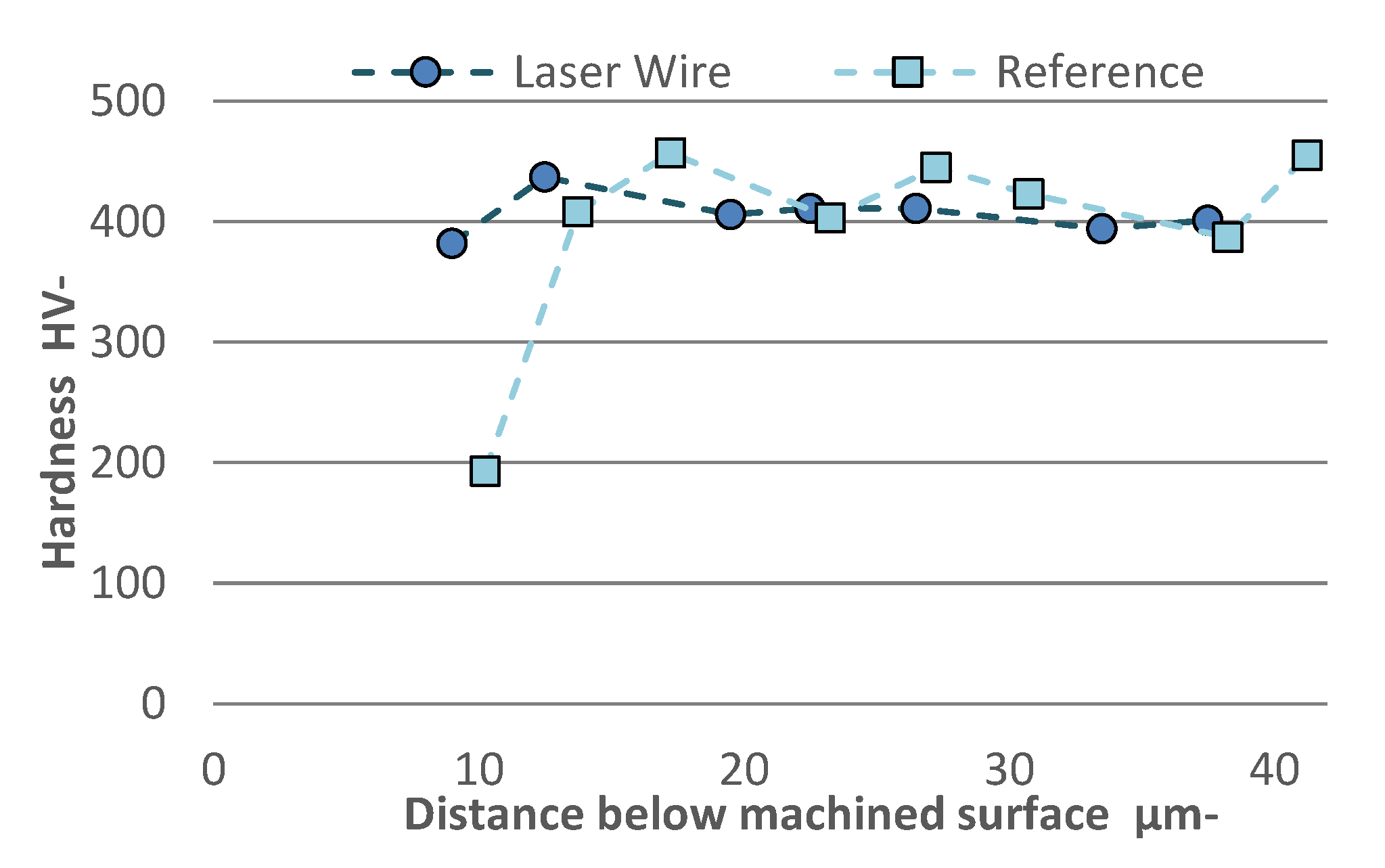
Microhardness profile of LW and reference materials. Measurements taken from the surface level into the bulk.
Figure 14.
Microhardness profile of LW and reference materials. Measurements taken from the surface level into the bulk.
Figure 15.
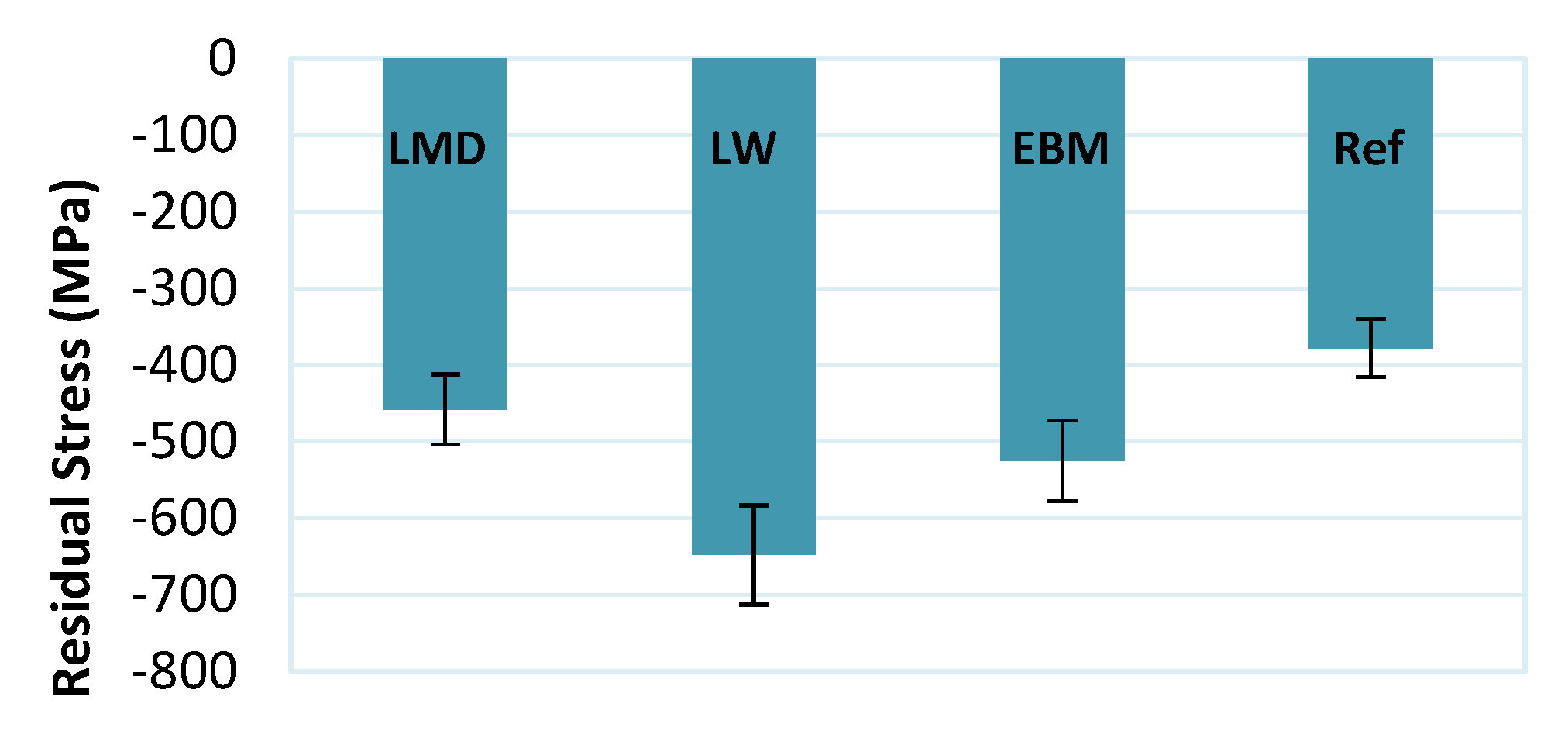
Residual stress measurements after machining.
Figure 15.
Residual stress measurements after machining.
Figure 16.
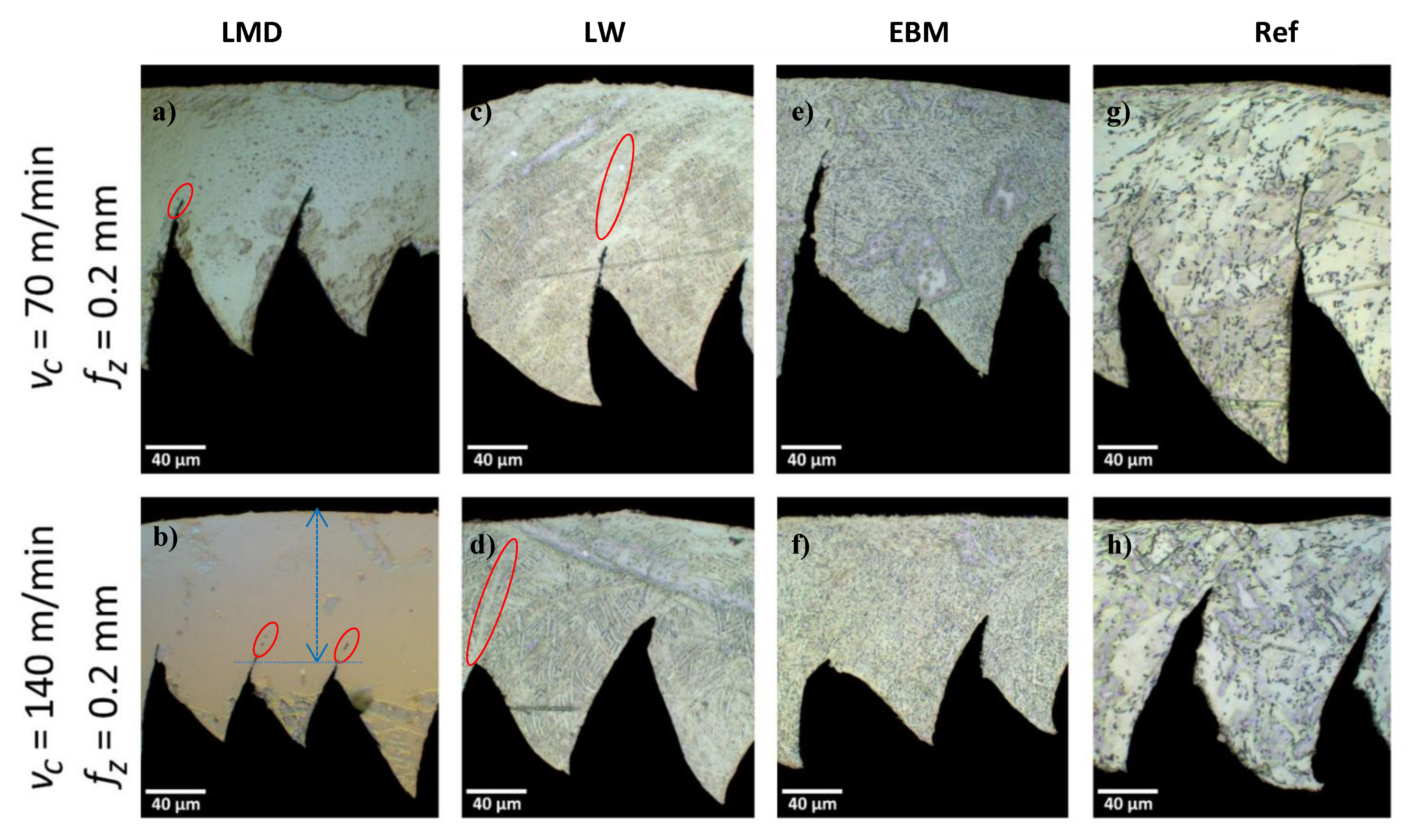
Chip geometry for LMD, LW, EBM, and Ref for two cutting speeds (vc) of 70 m/min (a,c,e,g) and 140 m/min (b,d,f,h). The feed rate (fz) was constant at 0.2 mm.
Figure 16.
Chip geometry for LMD, LW, EBM, and Ref for two cutting speeds (vc) of 70 m/min (a,c,e,g) and 140 m/min (b,d,f,h). The feed rate (fz) was constant at 0.2 mm.
Figure 17.
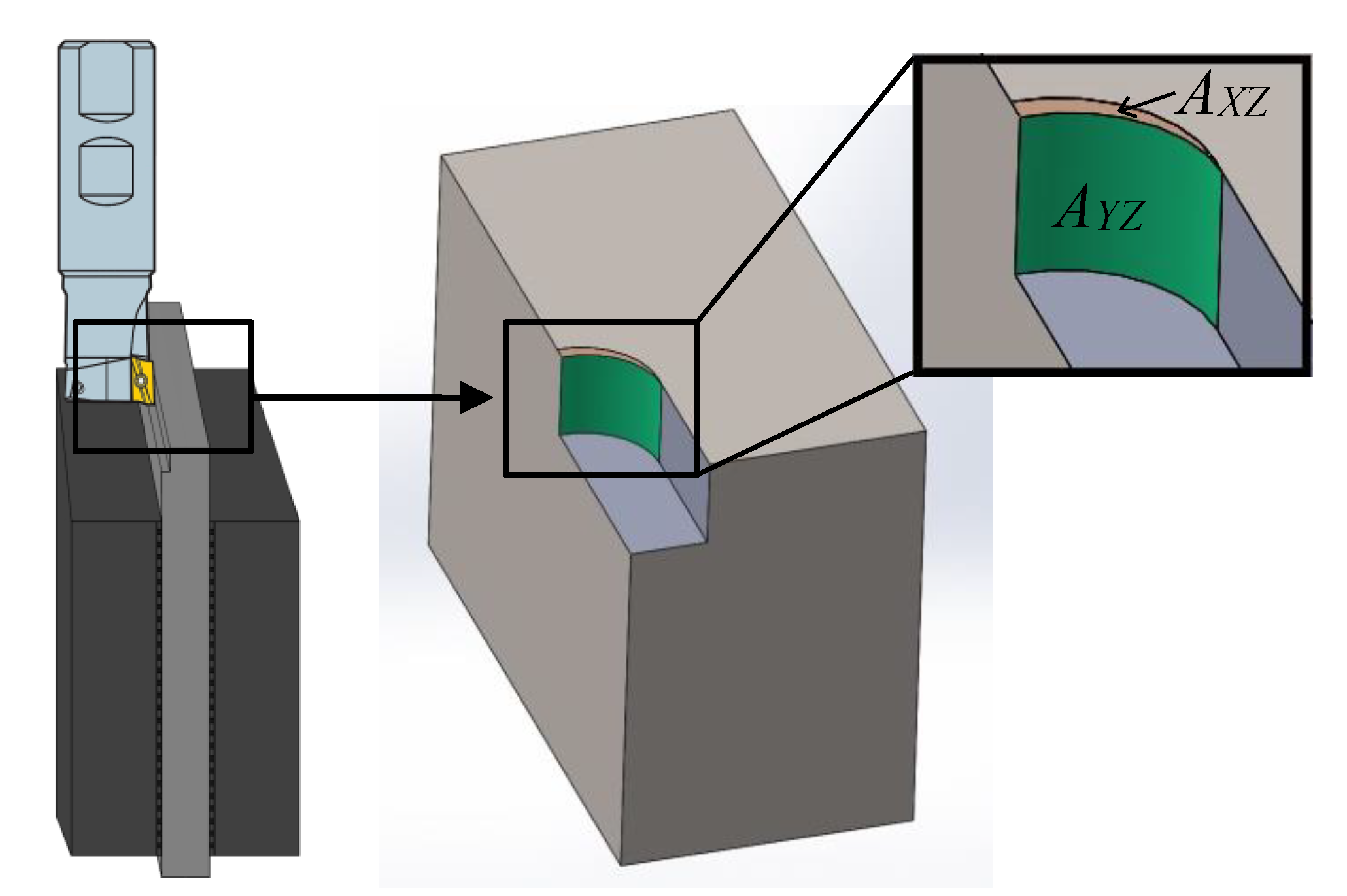
Machined volume showing the AYZ (green) and AXZ (yellow) areas.
Figure 17.
Machined volume showing the AYZ (green) and AXZ (yellow) areas.
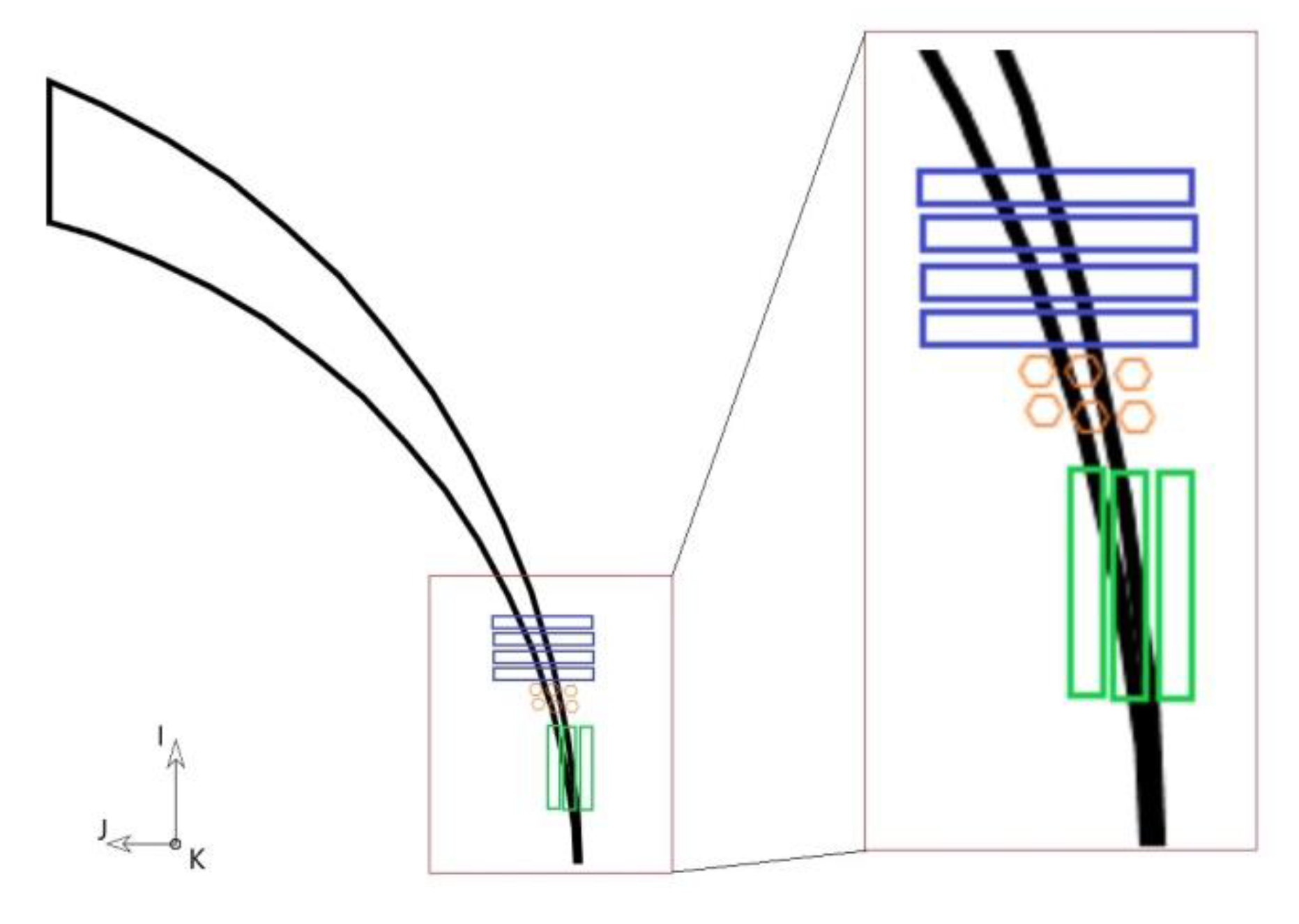
Figure 18.
Areas cut in each cycle with green grains along the cut (I-direction), blue grains perpendicular to the cut (J-direction), and orange grains perpendicular to the figure plane (K-direction). This figure represents the top side of the workpiece shown in
Figure 17.
Figure 18.
Areas cut in each cycle with green grains along the cut (I-direction), blue grains perpendicular to the cut (J-direction), and orange grains perpendicular to the figure plane (K-direction). This figure represents the top side of the workpiece shown in
Figure 17.
Table 1.
Tool specifications.
Table 1.
Tool specifications.
| Tool | R390-016A16-07M |
|---|
| Cutting diameter mm | 16 |
| Tool overhang length mm | 32 |
| Number of teeth | 3 |
| Inserts | 390R-070208M-MM S30T |
| Coating | PVD (Ti, Al) N |
Table 2.
Milling operation parameters.
Table 2.
Milling operation parameters.
| Cutting Speed, vc | 70 m/min |
| Feed Rate, fz | 0.05 mm/tooth |
| Axial Depth of Cut, ap | 5 mm |
| Radial Depth of Cut, ae | 0.5 mm |
Table 3.
Build direction.
Table 3.
Build direction.
| Sample | Build Plane Deposition
Parallel to * |
|---|
| Laser metal deposition (LMD) | I-direction |
| Laser wire (LW) | I-direction |
| Electron beam melting (EBM) | K-direction |
Table 4.
Chemical specifications of the workpiece materials. Data are in weight %.
Table 4.
Chemical specifications of the workpiece materials. Data are in weight %.
| | LMD | LW | EBM | Reference Material |
|---|
| Aluminum | 6.23 | 6.04 | 6 | 6.47 |
| Vanadium | 4.21 | 3.95 | 4 | 4.07 |
| Carbon | 0.01 | 0.02 | 0.03 | 0.14 |
| Iron | 0.18 | 0.13 | 0.1 | 0.15 |
| Oxygen | 0.11 | 0.15 | 0.15 | 0.17 |
| Nitrogen | 0.007 | 0.01 | 0.01 | 0.003 |
| Hydrogen | 0.002 | 0.002 | 0.003 | 0.001 |
| Titanium | Balance | Balance | Balance | Balance |
Table 5.
Mechanical properties of the reference (Ref) Ti-6Al-4V.
Table 5.
Mechanical properties of the reference (Ref) Ti-6Al-4V.
| Mechanical Properties | Longitudinal | Transverse |
|---|
| Proof stress, Rp0.2 MPa | 921 | 928 |
| Tensile strength, MPa | 975 | 987 |
| Elongation 50 mm, % | 16.5 | 16.5 |
| Hardness, HV | 350 | - |
Table 6.
Powder particle size and wire diameter of the AM raw materials.
Table 6.
Powder particle size and wire diameter of the AM raw materials.
| | Particle Size | Wire Diameter |
|---|
| LMD | 45–75 µm | - |
| LW | - | 1.143 mm |
| EBM | 45–100 µm | - |
Table 7.
Average hardness of AM and reference materials based on three measurements.
Table 7.
Average hardness of AM and reference materials based on three measurements.
| | Hardness (HRC) |
|---|
| LMD | 41 |
| LW | 38 |
| EBM | 38 |
| Reference | 36 |
Table 8.
Data of 3D surface roughness parameters: arithmetical mean height (Sa), root mean square height (Sq), and peak-to-valley (PV). These data are shown parallel to the I-direction and parallel to the J-direction for all samples.
Table 8.
Data of 3D surface roughness parameters: arithmetical mean height (Sa), root mean square height (Sq), and peak-to-valley (PV). These data are shown parallel to the I-direction and parallel to the J-direction for all samples.
| Sample | Sa µm | Sq µm | PV µm |
|---|
| LMD parallel to I | 0.87 ± 0.09 | 1.07 ± 0.09 | 7.81 ± 0.19 |
| LMD parallel to J | 0.94 ± 0.05 | 1.20 ± 0.04 | 8.74 ± 0.37 |
| LW parallel to I | 0.69 ± 0.15 | 0.85 ± 0.15 | 7.96 ± 2.14 |
| LW parallel to J | 0.95 ± 0.03 | 1.15 ± 0.02 | 7.36 ± 0.80 |
| EBM parallel to I | 0.93 ± 0.15 | 1.12 ±0.15 | 7.80 ± 0.55 |
| EBM parallel to J | 1.33 ± 0.05 | 1.58 ± 0.05 | 8.59 ± 0.68 |
| Ref parallel to I | 0.93 ± 0.04 | 1.15 ± 0.05 | 7.62 ± 0.09 |
| Ref parallel to J | 1.04 ± 0.25 | 1.27 ± 0.28 | 8.21 ± 1.35 |