


Abstract
This article provides a comprehensive review of theory and research on the individual-level predictors of household energy usage. Drawing on literature from across the social sciences, we examine two broad categories of variables that have been identified as potentially important for explaining variability in energy consumption and conservation: socio-demographic factors (e.g., income, employment status, dwelling type/size, home ownership, household size, stage of family life cycle) and psychological factors (e.g., beliefs and attitudes, motives and intentions, perceived behavioral control, cost-benefit appraisals, personal and social norms). Despite an expanding literature, we find that empirical evidence of the impact of these variables has been far from consistent and conclusive to date. Such inconsistency poses challenges for drawing generalizable conclusions, and underscores the complexity of consumer behavior in this domain. In this article, we propose that a multitude of factors—whether directly, indirectly, or in interaction—influence how householders consume and conserve energy. Theory, research and practice can be greatly advanced by understanding what these factors are, and how, when, where, why and for whom they operate. We conclude by outlining some important practical implications for policymakers and directions for future research.
1. Introduction
In recent years, a growing body of research has sought to identify the key factors underlying patterns of residential energy consumption and conservation. In particular, many studies have been conducted to investigate different types of energy consumer “profiles” in an effort to pinpoint precisely what factors are associated with energy-saving and energy-wasting behavior (e.g., [1,2,3,4,5]). A number of important determinants have been identified, ranging from situational factors in the external environment (e.g., contextual, structural and institutional factors) through to more person-specific attributes of consumers themselves (e.g., socio-demographic, psychological and motivational factors) [6,7,8,9,10,11,12]. Yet efforts to summarize, integrate and synthesize the key findings across studies have failed to keep pace. The current paper addresses this gap by conducting a comprehensive review of published research on the socio-demographic and psychological determinants of household energy consumption and conservation. In the literature, behaviors related to energy conservation are sometimes categorized into “curtailment” behaviors (i.e., ongoing day-to-day actions to reduce consumption, such as setting thermostats, switching off lights, limiting use of heating/cooling and ventilation systems, etc.) and “efficiency” behaviors (i.e., once-off actions to save energy, such as investing in home improvements like insulation, solar panels, energy-efficient appliances, new technology, etc.) [13,14]. In this article, we focus on both categories of energy usage behavior. By doing so, we aim to provide researchers, practitioners and policymakers with a deeper understanding of what person-specific factors might explain different patterns of household energy usage, and thereby provide valuable insights on when, where, how, why and for whom energy-efficient interventions might serve to promote and sustain new energy-conserving practices.
Advancing our understanding of the key factors shaping consumers’ energy-related behavior is important for many reasons. Against a backdrop of global concerns over climate change and rising greenhouse gas emissions, renewable and sustainable energy use has become a key challenge and opportunity for improving the overall social-ecological resilience of communities worldwide. Globally, researchers and policymakers are investing significant resources in designing cost-effective solutions and new technology to increase household energy efficiency and conservation. Yet there is vast scope for improvement, as reflected by recent calls for greater integration of social and behavioral sciences in energy research [15]. Solving many of the world’s energy-related problems requires not only technological advances, but also changes in human behavior—and successfully shifting the behavior of consumers in the desired direction (i.e., toward more efficient and sustainable practices) is facilitated by first identifying potential causal and explanatory variables (predictors and “mediators”) and various contingencies (interactions or “moderators”) that might impact the nature, intensity, frequency and duration of behavior across time and contexts.
So why is it important to identify the correlates of energy consumption and conservation? The answer is simple: to know how to intervene, and with whom, where and when. It is necessary to understand what drives household energy consumption and conservation in order to determine how these behaviors can usefully be altered by consumer-focused interventions, technological solutions, public policy initiatives and other such strategies.
In an effort to integrate key insights from the literature, our paper begins by providing a theoretical overview of residential energy usage, with a focus on describing how the processes and predictors of energy consumption and conservation have been conceptualized to date. Drawing heavily on published work from the social and behavioral sciences, we then review research and empirical evidence on the individual-level predictors of household energy use in an effort to identify the key characteristics and variables that explain consumers’ energy-related behavior. This includes a review of the major socio-demographic factors that have been touted as explaining individual differences in household energy consumption and conservation, as well as the psychological and motivational attributes of consumers that have also been hypothesized to play a role. We review publications that present both primary and secondary research, and studies that employ a range of designs and methodologies. In outlining our key findings and conclusions, we provide a brief summary of research in the body of the article itself, with a more detailed review of empirical evidence and citations appearing in the accompanying table. Finally, we draw out the implications of our key findings for theory, research and practice, with a focus on identifying some cost-effective behavioral solutions to influence household energy consumption and conservation.
2. Theoretical Background: Conceptualizing Energy Consumption and Conservation
Over the past few decades, the factors underpinning individual differences in pro-environmental attitudes and behavior have been examined from a range of different theoretical perspectives (for reviews, see [16,17,18,19,20]). Due to the complex and dynamic nature of behavior in this domain, a wide variety of conceptual models have been hypothesized and countless studies have been conducted to investigate the variables influencing environmentally significant decision-making and action. Some of the most influential and commonly cited perspectives, theories and models of pro-environmental behavior include: Hines et al.’s [21] model of responsible environmental behavior; Ajzen’s theory of planned behavior [22,23]; Guagnano et al.’s [24] attitude-behavior-external conditions (ABC) model; Stern et al.’s [25] value-belief-norm (VBN) theory; Blake’s [26] conceptualization of the barriers between environmental concern and action; Stern’s [19] framework of environmentally significant behaviors and causal variables; and Kollmuss and Agyeman’s [20] model of pro-environmental behavior.
This theoretical research from the broad domain of pro-environmental behavior has extended to the more specific area of residential energy conservation, with recent years witnessing an increased focus on identifying the specific factors that influence household energy usage (e.g., consumption) and changes in energy use over time (e.g., curtailment and efficiency behaviors) [6,13,14,27]. An exhaustive summary of all relevant theories, frameworks and conceptual models of household energy use is beyond the scope of this paper. However, some of the most influential and commonly cited approaches include: Van Raaij and Verhallen’s [8] behavioral model of residential energy use; Costanzo et al.’s [10] socio-psychological model of energy conservation behavior; and Stern and Oskamp’s [28] causal model of resource use. Some researchers have also applied Hägerstrand’s [29,30] time-geographic approach to study household energy-related activities [31,32]; and Schatzki’s [33] practice theory to study the unconscious habits and technological structures that influence residential energy consumption [34,35]. Rogers’ [36,37] diffusion of innovations theory has also been used to explain consumers’ decision-making and behavior in the context of residential energy consumption, specifically in terms of the adoption of energy-saving practices and products [38,39,40,41,42].
While various theoretical perspectives have emerged in the literature, there is no single conceptual framework or model that is universally accepted by scholars as providing an all-inclusive explanation of energy consumption and conservation, nor any single approach that precisely predicts individual differences in such behavior. Rather, the extant literature seems to indicate that the issue of what distinguishes above- and below-average energy users—or “energy-wasting” and “energy-saving” consumers—is so complex that it is difficult to capture in a single framework [20,21]. Further, while empirical evidence indicates that some variables may be better predictors of energy consumption than others, the findings have still been far from consistent across time, contexts, samples of participants, and studies. This inconsistency may be partly an artifact: due to energy-related “behavior” being conceptually and operationally defined in different ways—for example, it can be measured in terms of overall household energy consumption (e.g., kilowatts per hour usage), changes in specific everyday practices (e.g., curtailment actions), or adoption of certain energy-efficient technology (e.g., efficiency actions), among many others. And the role of different explanatory variables can appear to vary depending on exactly how a “behavior” is defined and measured, and the relationships specified (or “allowed”) in the model. The inconsistency may also be due to the fact that very few studies have rigorously tested causal relationships using the appropriate scientific methodology (i.e., randomized controlled trials), with many relying on non-experimental designs that can only explore correlations between variables. In the absence of well-designed, consistently specified, and rigorously conducted empirical research, it is impossible to draw firm conclusions regarding the precise causal impact of certain factors on energy consumption and conservation.
Nevertheless, several researchers have made progress with integrating different perspectives in a bid to advance the literature and resolve inconsistent findings [14,43,44,45]. This effort has yielded some clarity and there is now general agreement that several broad yet interrelated categories of variables may explain individual differences in household energy use. These explanatory variables include a range of socio-demographic factors (e.g., income, education, household size, dwelling type, stage of family life cycle), psychological factors (e.g., knowledge, values, attitudes, motivations, intentions, social norms) and external contextual and situational factors (e.g., socio-cultural, economic, political, legal, institutional forces), among others.
The literature now features models that better articulate the multiplicity of forces underpinning energy consumption and conservation. In early research, Costanzo et al. [10] proposed a social-psychological model of energy conservation consisting of two interacting sets of factors: psychological (i.e., factors shaping consumers’ information-processing and decision-making, such as perception, evaluation, understanding and memory) and positional/situational (i.e., factors that facilitate or constrain consumers’ actions, such as disposable income, home ownership, home repair skills, and own-home technology). More recently, Abrahamse et al. [14] proposed that both micro-level factors (e.g., preferences, attitudes, values, abilities, opportunities) and macro-level factors (e.g., availability of new technology, economic and population growth, government regulations and policies, socio-cultural change) can influence household energy consumption. Kollmuss and Agyeman [20] have also distinguished multiple influences of pro-environmental behavior, such as demographic factors (e.g., gender, years of education), external factors (e.g., social, cultural, economic, institutional), and internal factors (e.g., motivation, environmental knowledge, awareness, values, attitudes, emotion, locus of control, responsibilities, priorities). Similarly, Stern [19] has proposed that environmental behavior is shaped by a range of attitudinal variables (e.g., general environmentalist predisposition, behavior-specific norms and beliefs, perceived costs/benefits, non-environmental attitudes), personal capabilities (e.g., literacy, social status, financial resources, behavior-specific knowledge and skills), contextual factors (e.g., social norms and expectations, material costs/rewards, available technology, advertising, and laws, policies and regulations), and habits and routines.
Over the years, researchers have increasingly favored these integrative approaches, which view energy consumption and conservation as arising from an ongoing interaction of multiple factors (e.g., [10,14,19,20]). We follow this approach by conceptualizing household energy usage as a complex process with a range of predictors—including both individual and situational factors, and their interaction—that jointly influence the energy-related practices and behavior of households (Figure 1).
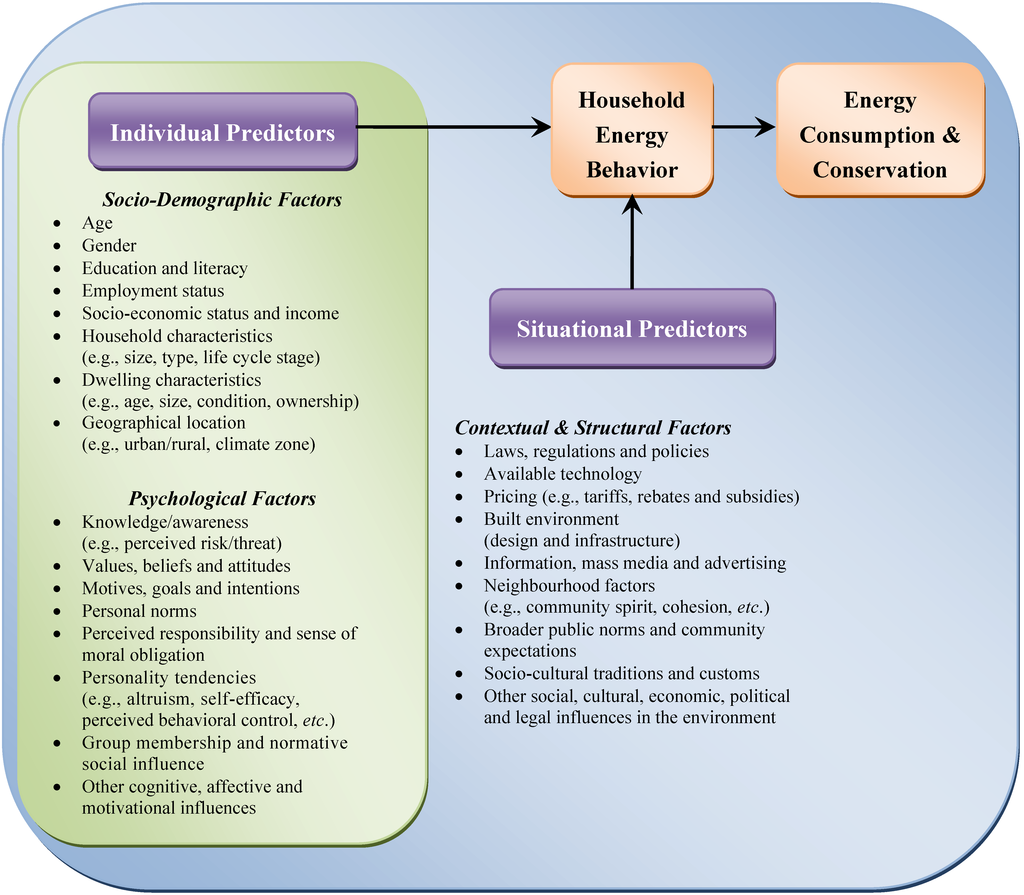
Figure 1.
Integrative conceptualization of the various individual (socio-demographic and psychological) and situational (contextual and structural) factors that may influence household energy consumption and conservation.
Figure 1.
Integrative conceptualization of the various individual (socio-demographic and psychological) and situational (contextual and structural) factors that may influence household energy consumption and conservation.
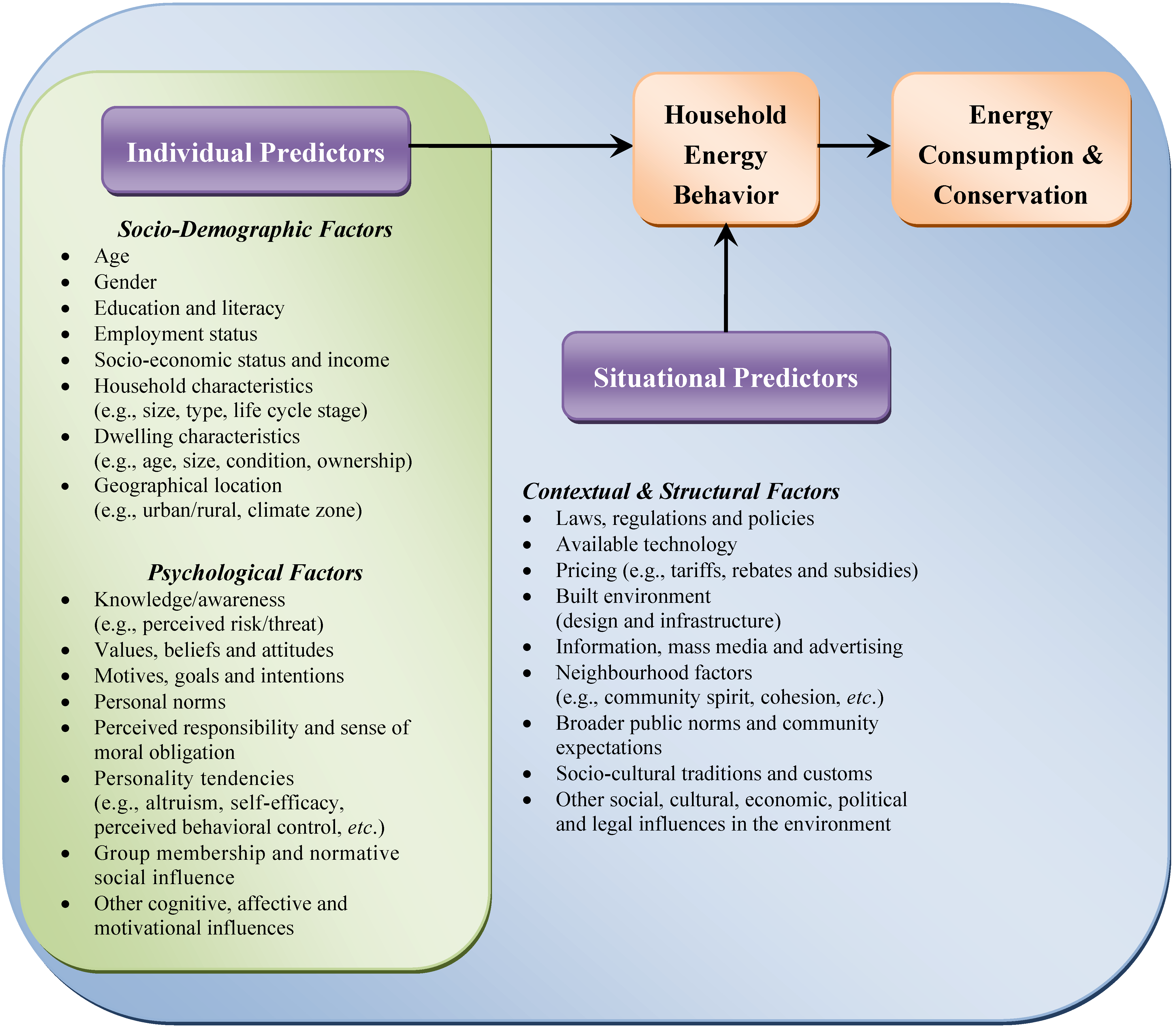
While we use this integrative conceptualization as our overarching framework for understanding energy consumption and conservation, our review only centers on a subset of factors from the framework: the individual-level predictors of household energy use. This is in keeping with traditional psychological perspectives of pro-environmental behavior, which focus primarily on person-specific factors.
3. The Current Review
3.1. Focus and Scope of the Review
While not discounting the important role of contextual and situational factors, this paper will focus squarely on reviewing the most commonly-examined individual factors correlated with household energy consumption and conservation. Comparatively less emphasis will be placed on macro-level predictors in the broader environment, which are often social, technological and institutional constraints that prevent householders from acting (or enable householders to act) in a certain way regardless of their particular socio-demographic features, psychological attributes and other person-specific characteristics. For example, contextual forces such as government regulations, public policies and other aspects of the broader social, cultural, economic, and political environment (e.g., public infrastructure, electricity prices, government sensitivity to public and interest group pressures, mass media, advertising campaigns, financial markets) can influence patterns of household energy usage, often independent of any individual-level influences. These macro-level factors may also place constraints on policymakers, who are faced with making public policy decisions about the energy industry and consumers within relatively fixed societal and institutional boundaries. While it is important to recognize the potential impact of these contextual factors, they fall outside the scope of this review, whose focus is on first elucidating the individual (i.e., human behavior) part of the equation. Nonetheless, many of the individual variables discussed herein inherently reflect the interface between people and their environment, to the extent that such factors are inextricably linked with one another (as in the case of normative social influence, for example).
3.2. Procedure for the Review
A rigorous process was followed to identify relevant literature for this review. First, a systematic search of the academic literature was undertaken using a number of bibliographic databases in the social, behavioral and environmental sciences (e.g., PsychINFO, ScienceDirect, SpingerLink, Wiley Online Library), as well as other internet search engines and online resources. Subject headings and keywords used in the search process included: residential energy consumption, residential energy conservation, household energy consumption, household energy conservation, and household energy use. Publications from the domains of energy, industry and the built environment were also examined. As part of this literature search process, the reference lists, bibliographies and citations of retrieved literature were also scanned for additional sources. We confined our search to studies conducted in Western countries, written in English, and published since the late 1970s. Evidence from non-western contexts was excluded due to potentially significant and consequential differences in the socio-demographic and psychological determinants of residential energy usage in less developed countries. Studies conducted before the 1970s were also excluded due to concerns about their applicability and generalizability to contemporary contexts (many patterns and predictors of household energy use may have changed over the past 40 years). Our overriding objective was to draw valid conclusions for current contexts and consumers; up-to-date knowledge and insights are essential for devising cost-effective and readily scalable solutions to contemporary energy-related challenges.
In conducting our review, we examined both primary and secondary evidence, and included studies with a wide range of research designs and methodologies. To make our review as comprehensive as possible, we considered not just studies where socio-demographic and psychological factors were the focal variables of interest, but also those that shed light on such factors incidentally, as a by-product of the primary analyses, as well as publications that usefully synthesized earlier findings. While our primary objective was to review published research in the specific domain of household energy usage, we also considered key insights from the broader domains of pro-environmental behavior (e.g., conservation activities) and resource usage (e.g., consumption), as well as empirical findings regarding the psychology of human behavior more generally. Our systematic review of the literature ultimately identified a large number of journal articles, books and book chapters, working papers, conference proceedings and reports—which in totality formed the basis for the key findings and conclusions presented herein.
3.3. Structure of the Review
In the sections that follow, we summarize the key findings from our comprehensive review of the literature, first for socio-demographic predictors and then for psychological factors. While a range of variables have been hypothesized to explain variation in household energy consumption and conservation, we focus only on the individual-level factors most often touted as distinguishing “energy-wasting” from “energy-saving” consumers. Prior research suggests that residential energy use is more strongly related to socio-demographic variables, whereas changes in residential energy use over time are more dependent on psychological and motivational variables [27]. We summarize here the broad findings that have emerged to date for both categories of predictors. To maintain focus and clarity, the main body of this article presents only a concise summary of general findings, with the accompanying table furnishing a more comprehensive review of prior research—including sources of supporting evidence and full citations.
4. Overview of Key Findings
4.1. Socio-Demographic Predictors
As evident in the top portion of Table 1, household energy consumption and conservation are associated with a wide range of socio-demographic variables. The relatively unchanging opportunities and constraints that people confront when seeking to engage in certain activities may significantly influence how much energy a particular consumer or household can use at any moment in time. Socio-demographic factors such as household income, dwelling type and size, home ownership, family size and composition, and life cycle stage are just some of the many factors that may influence these opportunities and constraints, and thereby indelibly shape the amount, frequency and duration of a household’s energy use. Our review of the literature reveals a good number of sources examining the effects of standard socio-demographic factors like age, gender, income, home ownership and household size, but comparatively little assessment of variables such as householders’ technical expertise and ownership of home technology. Despite considerable uncertainty introduced by the complex interactions that can occur between multiple factors over time (see the diversity of results evident in Table 1), some general findings to emerge regarding the socio-demographic predictors of energy usage include the following:
- There is inconsistent empirical support for age and gender differences in energy consumption, with any effects tending to be rather small and/or statistically insignificant.
- Education tends to be associated with increased knowledge, awareness and concern regarding environmental issues (such as energy efficiency), however, higher levels of education generally do not lead certainly and directly to pro-environmental behavior (e.g., saving energy).
- Employment status of household occupants (e.g., full-time, part-time, retired or unemployed) may indirectly impact energy consumption, by influencing household income and socio-economic status, which in turn can constrain the household’s financial capacity to invest in efficiency measures. Links between occupational status and acceptance of energy-saving strategies have also been examined, but there is limited and inconsistent evidence that this strongly influences energy consumption.
- Household income tends to be positively related to residential energy consumption, but may also enhance household capacity to invest in products and improvements that increase energy efficiency (e.g., to purchase new appliances and more energy-efficient technology).
- Household size (number of people per residence) tends to be positively associated with energy consumption, such that larger families generally consume more energy overall. However, energy usage per capita tends to be lower in larger households, presumably due to the sharing of energy services among multiple residents.
- Dwelling size (floor space, number of rooms/floors, etc.) appears to be positively related to household energy consumption, with larger dwellings typically using more energy. Additionally, people residing in detached dwellings (free-standing homes and townhouses) tend to consume more energy than those in multi-unit dwellings (apartments and units).
- Homeowners tend to make larger capital investments in energy conservation measures (e.g., household improvements to increase energy efficiency, purchase of new technology and energy-saving devices) than those living in rental housing.
- Stage of family life cycle appears to be an important predictor of household energy use, with energy consumption typically peaking during the child-rearing years, presumably due to associated changes in household work (e.g., cleaning, cooking, laundry), childcare, and family activities (e.g., in-home entertainment, recreation). The presence or absence of family members—including changes in family composition over time (e.g., the birth of a baby, an older child leaving home)—may also influence levels and patterns of household energy consumption.

Table 1.
Socio-demographic and psychological factors associated with household energy consumption and conservation.
| Category | Predictor | Impact on household energy consumption and conservation behavior |
|---|---|---|
| Socio-demographic factors | Age |
|
| Gender |
| |
| Education |
| |
| Employment status |
| |
| Socio-demographic factors | Employment status |
|
| Income |
| |
| Socio-demographic factors | Household size |
|
| Dwelling type and size |
| |
| Socio-demographic factors | Dwelling type and size |
|
| Dwelling age |
| |
| Home ownership |
| |
| Socio-demographic factors | Home ownership |
|
| Stage of family life cycle |
| |
| Geographical location |
| |
| Socio-demographic factors | Ownership of home technology & technical expertise |
|
| Psychological factors | Knowledge & problem awareness |
|
| Psychological factors | Values, attitudes & beliefs |
|
| Psychological factors | Motives, intentions & goals |
|
| Psychological factors | Motives, intentions & goals |
|
| Personal norms |
| |
| Psychological factors | Perceived responsibility |
|
| Locus of control, self-efficacy, and perceived behavioral control |
| |
| Psychological factors | Locus of control, self-efficacy, and perceived behavioral control |
|
| Perceived cost: benefit ratio |
| |
| Psychological factors | Perceived cost: benefit ratio |
|
| Need for personal comfort |
| |
| Psychological factors | Need for personal comfort |
|
| Normative social influence |
| |
| Psychological factors | Normative social influence |
|
- Ownership of non-energy technology (e.g., “high-tech” products like computers and gadgets) is often related to greater use of energy-saving devices and systems (e.g., energy efficient appliances). The presence of “handy” household members with technical knowledge and skills in home repairs (e.g., home appliance and automotive repairs) has also been linked with energy conservation. However, very detailed technical knowledge does not consistently promote pro-environmental behavior.
- Regional differences in climate, temperature and geography are closely related to energy use, with households located in colder zones typically consuming more energy than households in warmer zones. Households in rural regions also tend to have higher levels of energy use than those in urban areas, other things being equal.
4.2. Psychological Factors Related to Household Energy Consumption
While socio-demographic factors clearly play an important, albeit complex role in household energy consumption and conservation, a range of person-specific psychological factors may also have powerful effects (e.g., [8,9,11,27,104]). As shown in the bottom portion of Table 1, some of the psychological factors most commonly associated with household energy usage include: knowledge and problem awareness (both of environmental and energy issues); beliefs, values and attitudes; motives, intentions and goals; subjective appraisals and perceptions (e.g., cost-benefit trade-offs; perceived behavioral control); personality tendencies (e.g., self-efficacy, locus of control); and personal and social norms. Our review of the literature shows considerable attention being paid to the influence of values, attitudes and beliefs, as well as motivational constructs such as goals and intentions, but relative less emphasis on investigating variables such as locus of control and self-efficacy. This variation in the attention paid to different psychological constructs is reflected in Table 1, and adds another dimension to our understanding of the extant literature and what we can rightly make of the evidence currently available.
Before reviewing the key findings regarding these psychological factors, we point out that over the years there has been some variation and even marked shifts in the definition of some of these constructs, particularly beliefs, values, attitudes and motives (for more detailed reviews, see [89,90,91,117,147,148,149,150,151]). There is considerable overlap among the latter factors, in particular, and ongoing debate over their precise definitions and degree of relatedness. Some scholars use the terms somewhat interchangeably while others argue that they represent conceptually and operationally distinct constructs. For example, some researchers have examined the value basis of environmental beliefs and behavior by distinguishing between egoistic, altruistic and biospheric values, value orientations and/or attitudes (e.g., [97,112,114,152]), whereas others have explored these same categories—egoistic, altruistic and biospheric—as applied to motives (e.g., [96,114,153,154]). We will avoid unnecessarily complicating the current review by simply adopting the most common conceptualizations and usages of each construct.
As shown in Table 1, some of the general findings to emerge from research exploring the specific psychological and motivational variables that influence patterns of household energy consumption and conservation include the following:
- Knowledge, awareness and understanding of environmental issues (e.g., energy-related problems) does not always lead directly and consistently to pro-environmental behavior such as energy conservation. Rather, there may often be a “knowledge-action gap” [65], such that increasing knowledge and awareness does not routinely translate into congruent behavioral change, perhaps due to the influence of various moderating factors that may constrain or facilitate energy-related behavior.
- Likewise, pro-environmental values, beliefs and attitudes do not reliably translate to congruent changes in energy consumption or conservation, with the relationship between values and behavior ultimately contingent upon various moderating factors, such as knowledge, problem awareness, household technology, socio-demographic constraints, and the like. In the end, there may often be a marked “value-action gap” and/or “attitude-action gap” [26,102,103].
- Likewise, we might reasonably expect that people who are driven by certain goals (e.g., self-transcendence versus self-enhancing goals; hedonic versus gain frames) and motives (e.g., pro-social, altruistic) will be inclined toward energy-saving behavior. But again, the relationship between “good intentions” and actual behavior depends ultimately on moderating factors. Again, we are often left with a marked “intention-action gap” [123,124], with possession of environmentally friendly goals and motives failing to translate—reliably and consistently—into environmentally friendly behavior, such as energy conservation.
- Personal norms (e.g., feeling a strong moral obligation to act in a pro-social, altruistic manner) tend to encourage pro-environmental behavior such as energy conservation. But this relationship may be contingent on awareness of the consequences of one’s behavior and ascription of felt responsibility for these behavioral consequences.
- Perceived responsibility for environmental issues and problems tends to be positively associated with pro-environmental behavior and sustainable consumption, presumably because people who feel personally responsible for a particular problem also tend to feel a stronger obligation to help minimize and mitigate it, thereby activating personal norms (e.g., moral obligation to act). However, the precise strength of these associations depends on a range of other mediating and moderating factors.
- Perceived behavioral control (and the associated construct of self-efficacy) tends to be positively associated with pro-environmental behavior such as energy conservation, such that individuals with an internal locus of control are more likely to engage in pro-environmental behavior than those with a more external locus of control. Similar to personal norms and perceived responsibility, however, the strength of this association depends on a range of other mediators and moderators.
- Both economic and behavioral cost-benefit tradeoffs may influence energy consumption and conservation, with people tending (other things being equal) to select courses of action that yield the highest benefit for the lowest cost (in terms of time, effort, money, status/prestige, social approval, comfort, convenience, etc.). However, research in behavioral economics shows that people are also frequently prone to a range of cognitive biases, heuristics and other anomalies in their decision-making and behavioral choices—including around environmental protection, renewable and sustainable technologies, and energy consumption—which cause them to act in seemingly “irrational” ways that diverge markedly from traditional economic models of behavior [104,155,156,157,158].
- Personal comfort, particularly the perceived loss of comfort that energy-saving measures may entail, can have a powerful influence on household energy usage. Any decrease in personal comfort, or reduction in lifestyle quality, may reduce the likelihood of householders engaging in energy conservation behavior.
- Group membership and normative social influence (e.g., the perceived energy-related practices of one’s peers or neighbors, and social pressure from family/friends to save energy) can significantly influence household energy use. Much research indicates that people tend to behave in ways similar to those around them (i.e., people desire normalcy and often exhibit conformity). This is largely due to the effects of social norms—those explicit and implicit “rules” or expectations that guide what is deemed normal, common and/or desirable behavior in society. In terms of pro-environmental actions, injunctive norms (i.e., perceptions of what attitudes and behavior are approved/desired by a social group with whom one associates or identifies) and descriptive norms (i.e., perceptions of what attitudes and behavior are normal/common among this social group) can both exercise great influence over behavior.
4.3. Summary of Key Findings and Conclusions
Our comprehensive literature review has revealed that household energy consumption and conservation are associated with a number of socio-demographic and psychological variables, but that these associations are not always substantial, straightforward or consistent, making it difficult (and certainly more difficult than is typically assumed) to draw definitive conclusions across studies. Indeed, it is clear that most of the factors we have reviewed actually interact with other variables, often in rather complex ways, and that their impact is heavily contingent upon those “moderating” factors. It is not simply a matter of household energy use being shaped—in a direct and linear fashion—by just a few principal individual-level factors. Rather, there are a multitude of variables (predictors, mediators and moderators) that together influence the nature, intensity and duration of behavior around energy consumption and conservation [10,14,19,20]. This complexity and inconsistency pose some challenges for drawing firm conclusions about specific effects (e.g., the size and direction of a particular variable’s impact on household energy use), and especially for generalizing findings more broadly. Accordingly, we strongly recommend that researchers and practitioners exercise due caution when drawing inferences regarding the effects of individual variables as reported herein, without taking careful account of the complex interplay among the various factors.
In terms of socio-demographic predictors, our review suggests that several factors (e.g., household income, dwelling type/size, home ownership, family size/composition) are strongly associated with household energy usage, but in some cases the effects are mixed. For example, while a few studies suggest curvilinear effects on energy consumption for certain socio-demographic factors (e.g., age, income, stage of family life cycle), this non-linear pattern does not always hold up in other studies. To illustrate, some research has suggested that middle-income households are actually most likely to save energy, with low-income households (already, by necessity, consuming little energy) simply unable, and high-income households unwilling, to reduce usage [52,73]. However, most research has observed a simple linear association [6,7,27,53,54,69,70,71,72]. Moreover, the relationship (whether curvilinear or otherwise) between income and energy use is expected also to be influenced by the greater capacity of higher income householders to invest in energy efficiency technologies and measures. If we take proper account of these nuances, it would be misleading simply to claim that higher income leads to greater household energy consumption. This pattern of results for income is just one example of the many complexities we identified in the literature. It is clear that the extent to which socio-demographic variables influence household energy usage depends on complex and dynamic interactions among different factors, sometimes simultaneous, and other times unfolding over time.
In terms of psychological predictors of energy usage, our review identified several factors that seem to play an important role, with normative social influence being especially powerful. But the results for many of the other psychological factors we reviewed were again far from consistent and conclusive across studies. For example, we identified a wealth of research investigating the impact on household energy usage of variables such as knowledge and awareness; beliefs, values and attitudes; goals, motives and intentions; and personal and social norms. Yet the available evidence indicates that environmentally friendly knowledge and values do not reliably predict environmentally friendly actions—there is often a sizable discrepancy between “good intentions” and actual behavior. Furthermore, the empirical evidence on balance suggests that the effects of many psychological factors (like values, attitudes and beliefs) on subsequent energy behavior tend to be small and/or weak [6,27,53,54,70,99]—often failing to attain statistical significance—especially compared to the effects of socio-demographic factors [7]. For instance, Poortinga et al. [7] found that while attitudinal variables explained a mere 2% of variation in home energy use, the variance explained increased to 15% after taking into account several socio-demographic variables. The relatively poor correspondence between psychological factors and actual energy use suggests that future energy-saving initiatives must direct considerable additional efforts toward helping people act in accordance with their underlying values, beliefs and attitudes, and ultimately, to translate their good intentions into tangible changes in energy consumption and conservation.
In summary then, while some general trends have emerged from the literature, it is clear that predicting and explaining household energy consumption and conservation is considerably more complex than often assumed. This complexity has previously been remarked not only for the specific domain of energy usage, but also for the broader domain of pro-environmental behavior (see Hines et al.’s [21] early meta-analysis). Similar to many other forms of environmentally significant behavior, household energy usage is a complex phenomenon, which is worked upon—directly and indirectly—by a great variety of factors. In the end, a multiplicity of forces interact to influence the nature, intensity and duration of household energy conservation [10,14,19,20]. If the researcher or practitioner seeks specific guidance—lessons applicable to a particular type of householder, context, or point in time—then we must caution them always to take care to undertake their own focused study, one that can reveal the complex interplay of forces bearing upon their specific problem and population of interest.
Nevertheless, the general trends and broad conclusions we have managed to draw out remain illuminating to the extent that they highlight how different types of consumers can have markedly different socio-demographic, psychological and behavioral profiles. When designing and implementing energy-saving interventions, it would be useful for policymakers to identify what unique household profiles exist in their target population. Different types of consumers and households are bound to have vastly different characteristics, needs, and living arrangements. The environments in which people live, and their ability and willingness to control energy use by taking certain actions, will vary widely. To take a simple example, it is likely that conventional energy-saving tips aimed at homeowners living in free-standing dwellings are far less applicable and persuasive for those living in master-metered apartments or subsidized accommodation [159]. It is also likely that strategies promoting financial investment in one-off efficiency measures (e.g., home improvements, such as installing energy-saving retrofits or purchasing new energy efficient technology) are better targeted at high-income households that can afford to outlay money for such measures. Low-income households may benefit more from inexpensive behavioral strategies that help them to recognize and modify certain key energy-wasting practices [51]. By understanding the unique profiles of customers, policymakers will be better placed to identify and target opportunities for effective behavior change, along with the messages and motivational strategies most likely to sustain that change in the specific population of interest.
5. Practical Implications and Directions for Future Research
The key findings and conclusions presented in this paper have important implications for future research and practice. Greater knowledge and understanding of precisely what drives energy consumption and conservation in households, alongside when, where, how, why and for whom this occurs, can make a valuable contribution toward the cost-effective design and delivery of consumer-focused behavioral interventions to promote energy efficiency. Developing innovative, evidence-based solutions to reduce energy consumption—particularly solutions that are cost-effective, mass-scalable and generalizable to broad sections of the community—is currently a major priority at local, national and international levels. Any viable long-term solution to curtailing rising residential energy usage relies on addressing the major determinants of consumer behavior. This naturally includes consideration of the various socio-demographic and psychological characteristics of individuals themselves, alongside immediate contextual factors (which are still bound to an individual’s psychology via the automatic perception of, or deliberate appraisal of, their environment) that influence behavior. While promoting societal acceptance and uptake of new energy efficient technology and low-emission “green” energy sources can go some way toward solving the world’s energy-related problems, longer-term behavior change in the day-to-day usage of such technology and the enactment of other everyday energy-consuming practices is also at the crux of achieving significant reductions in residential energy usage.
To date, a range of strategies have been developed to encourage pro-environmental behavior among consumers, including behavior change interventions to reduce residential energy consumption and/or improve efficiency [44,160,161,162,163,164]. Such interventions have typically targeted many of the individual-level factors (or the individual’s immediate environment) reviewed in this paper. Interventions have ranged from so-called “antecedent strategies” aimed at changing the factors that precede consumer behavior—such as basic information provision and education; goal-setting and commitment strategies; and the use of social/group norms, peer influence and social modeling—through to more “consequence” strategies aimed at changing the outcomes of such behavior—such as self-monitoring; delivering feedback (on one’s behavior or performance); and the use of rewards (intrinsic and extrinsic) and other incentives [14,165]. While the literature suggests that all of these strategies have the potential to motivate pro-environmental behavior, the effects have been far from robust and consistent across studies—certain strategies have been found to be effective in some contexts, for some people, and for some types of behavior, but not others (for an overview, see [166]).
Interestingly, the efficacy of different behavioral interventions appears to be highly domain-specific—that is, contingent on the specific type of pro-environmental behavior in question. In an extensive meta-analysis, Osbaldiston and Schott [161] found statistically significant variation in the effect sizes of treatments for different types of pro-environmental behavior (e.g., public recycling, public energy conservation, water conservation, gasoline conservation, curbside recycling, central location recycling, home energy conservation, home energy adoption, and other behaviors), such that no single treatment or intervention was highly effective across all of the behaviors. Rather, there was considerable variability across the different types of behavior in the extent to which certain interventions were (in)effective relative to others. In terms of home energy conservation, treatments that included social modeling, commitment and rewards were found to be most effective, with goal-setting, cognitive dissonance and feedback showing modest effects. In contrast, treatments involving instructions, justifications and prompts to save energy had comparatively weaker, if any, effects. While more empirical research is clearly needed, these results suggest that there may be value in examining the underlying socio-demographic and psychological correlates of specific energy-related practices when designing interventions, rather than simply focusing on the more general domains of consumption and conservation. It may well be that specific energy-related practices (i.e., showering, laundering, space heating/cooling) have different underlying predictors, such that marked variation exists in the responsiveness of these specific practices to different treatments. In addition, practitioners and policymakers are strongly advised to undertake a comprehensive analysis of their specific target population of interest before designing and implementing their own interventions in the field. In particular, it is important to take into account the socio-demographic and psychological profiles of the target population, as well as the relevant contextual factors and experiences (social, cultural economic, political, environmental) that may influence this population.
In parallel, the overall success of any tailored intervention to motivate and sustain positive change in consumer behavior can be enhanced by gaining greater knowledge of the specific antecedents (i.e., predictors) of such behavior, as well as by better understanding the underlying explanatory variables (i.e., mediators) and factors that may influence the nature, intensity, frequency and duration of that behavior (i.e., moderators). This review has highlighted that there are various socio-demographic and psychological factors that may predict (albeit to differing degrees) energy consumption and conservation. In terms of changing behavior, therefore, practitioners and policymakers would be well-placed to focus greatest attention toward those predictors that are most strongly and consistently related to energy usage, and most malleable and responsive to external influences. For example, compared to traditional information-intensive interventions such as educational campaigns that aim to increase knowledge and modify deep-seated beliefs and values, lower-cost strategies that capitalize on behavioral economics principles (e.g., message framing, choice architecture and incentives) to target psychological factors such as cost-benefit appraisals and social norms may prove more impactful [104]. At the same time, it is also imperative to consider the socio-demographic and psychological profiles of individual consumers and households, to ensure behavioral strategies are appropriately tailored and customized to the target population of interest. Finally, both before and after implementing any behavior change intervention, it is critically important for policymakers to consider cost-effectiveness and return-on-investment—not only compared to business-as-usual (i.e., compared to not implementing the intervention at all), but equally importantly, compared to other strategies that may achieve similar results but in a far more/less expensive and mass-scalable manner.
Moving forward, there is still vast scope to extend our understanding of unique customer and household profiles by drawing on the key findings from our review. In particular, the literature could be advanced by developing and testing an evidence-based framework for consumer segmentation that incorporates many of the socio-demographic and psychological factors variables discussed in this paper, and that successfully and usefully distinguishes consumers with different energy-consuming patterns of use. A systematic and consistent framework—validated by empirical evidence—would enable researchers, policymakers and industry experts to better predict how different types of energy consumers are likely to behave in different contexts and at different points in time. Such insight would also enable the design and delivery of tailored intervention efforts that might ultimately be more cost-effective than alternative mass-market solutions.
6. Conclusions
In conclusion, this article has demonstrated that there are a number of individual-level predictors of household energy consumption and conservation. Based on a review of theory and evidence from the social and behavioral sciences, we have identified two broad categories of variables that are commonly proposed as explaining variability in energy usage: socio-demographic and psychological factors. While the influence of specific predictors within each of these categories has not always been consistent or conclusive across studies, we have sought to bring some clarity to the literature by summarizing some of the more robust, generalizable findings that have emerged to date. In doing so, we have highlighted the importance of taking multiple factors into account when aiming to design and deliver strategies that reduce consumption and increase conservation. By shedding more light on precisely what drives consumer behavior, this paper provides practitioners and policymakers with useful insights for developing cost-effective solutions that target and exploit these individual-level predictors of household energy consumption and conservation. We hope that the key findings from our review help to advance the design and delivery of behavior change interventions that will ultimately assist individual consumers, households and entire communities achieve greater sustainability in the use of energy, both now and in the future.
Author Contributions
All three authors were involved in conceiving the aims, objectives, scope and structure of the review. Elisha Frederiks was responsible for conducting the literature review and writing the manuscript. Karen Stenner and Elizabeth Hobman both reviewed and edited the manuscript drafts. All authors have therefore been involved in the preparation and have approved the submitted manuscript.
Conflicts of Interest
The authors declare no conflict of interest.
References
- Painter, J.; Semenik, R.; Belk, R. Is there a generalized energy conservation ethic? A comparison of the determinants of gasoline and home heating energy conservation. J. Econ. Psychol. 1983, 3, 317–331. [Google Scholar] [CrossRef]
- Rosson, P.J.; Sweitzer, R.W. Home heating oil consumption: Profiling ‘efficient’ and ‘inefficient’ households. Energy Policy 1981, 9, 216–225. [Google Scholar] [CrossRef]
- Guerra Santin, O. Behavioural patterns and user profiles related to energy consumption for heating. Energy Build. 2011, 43, 2662–2672. [Google Scholar] [CrossRef]
- Gaspar, R.; Antunes, D. Energy efficiency and appliance purchases in europe: Consumer profiles and choice determinants. Energy Policy 2011, 39, 7335–7346. [Google Scholar] [CrossRef]
- Pedersen, M. Segmenting residential customers: energy and conservation behaviours. In Proceedings of the 2008 ACEEE Summer Study on Energy Efficiency in Buildings, Pacific Grove, CA, USA, 17–22 August 2008; Volume 7, pp. 229–241.
- Abrahamse, W.; Steg, L. Factors related to household energy use and intention to reduce it: The role of psychological and socio-demographic variables. Hum. Ecol. Rev. 2011, 18, 30–40. [Google Scholar]
- Poortinga, W.; Steg, L.; Vlek, C. Values, environmental concern and environmental behavior: A study into household energy use. Environ. Behav. 2004, 36, 70–93. [Google Scholar] [CrossRef]
- Van Raaij, W.F.; Verhallen, T.M.M. A behavioral model of residential energy usage. J. Econ. Psychol. 1983, 3, 39–63. [Google Scholar] [CrossRef]
- Wilson, C.; Dowlatabadi, H. Models of decision making and residential energy use. Annu. Rev. Environ. Resour. 2007, 32, 169–203. [Google Scholar] [CrossRef]
- Costanzo, M.; Archer, D.; Aronson, E.; Pettigrew, T. Energy conservation behavior: The difficult path from information to action. Am. Psychol. 1986, 41, 521–528. [Google Scholar] [CrossRef]
- Stern, P. What psychology knows about energy conservation. Am. Psychol. 1992, 47, 1224–1232. [Google Scholar] [CrossRef]
- Stern, P. Psychological dimensions of global environmental change. Annu. Rev. Psychol. 1992, 43, 269–302. [Google Scholar] [CrossRef]
- Gardner, G.; Stern, P. Environmental Problems and Human Behavior; Pearson: Boston, MA, USA, 2002. [Google Scholar]
- Abrahamse, W.; Steg, L.; Vlek, C.; Rothengatter, T. A review of intervention studies aimed at household energy conservation. J. Environ. Psychol. 2005, 25, 273–291. [Google Scholar] [CrossRef]
- Sovacool, B.K. Diversity: Energy studies need social science. Nature 2014, 511, 529–530. [Google Scholar] [CrossRef] [PubMed]
- Bamberg, S.; Möser, G. Twenty years after hines, hungerford, and tomera: A new meta-analysis of psycho-social determinants of pro-environmental behaviour. J. Environ. Psychol. 2007, 27, 14–25. [Google Scholar] [CrossRef]
- Vining, J.; Ebreo, A. Emerging theoretical and methodological perspectives on conservation behavior. In Handbook of Environmental Psychology; Bechtel, R.B., Churchman, A., Eds.; Wiley: New York, NY, USA, 2002; pp. 541–558. [Google Scholar]
- Wapner, S.; Demick, J.; Yamamoto, T.; Minami, H. Theoretical Perspectives in Environment-Behavior Research: Underlying Assumptions, Research Problems, and Methodologies; Kluwer Academic/Plenum Publishers: New York, NY, USA, 2000. [Google Scholar]
- Stern, P. Toward a coherent theory of environmentally significant behavior. J. Soc. Issues 2000, 56, 407–424. [Google Scholar] [CrossRef]
- Kollmuss, A.; Agyeman, J. Mind the gap: Why do people act environmentally and what are the barriers to pro-environmental behavior? Environ. Educ. Res. 2002, 8, 239–260. [Google Scholar] [CrossRef]
- Hines, J.M.; Hungerford, H.R.; Tomera, A.N. Analysis and synthesis of research on responsible environmental behavior: A meta-analysis. J. Environ. Educ. 1987, 18, 1–8. [Google Scholar] [CrossRef]
- Ajzen, I. From intentions to actions: A theory of planned behavior. In Action-Control: From Cognition to Behavior; Kuhl, J., Beckmann, J., Eds.; Springer: Heidelberg, Germany, 1985; pp. 11–39. [Google Scholar]
- Ajzen, I. The theory of planned behavior. Organ. Behav. Hum. Decis. Process. 1991, 50, 179–211. [Google Scholar] [CrossRef]
- Guagnano, G.A.; Stern, P.C.; Dietz, T. Influences on attitude-behavior relationships: A natural experiment with curbside recycling. Environ. Behav. 1995, 27, 699–718. [Google Scholar] [CrossRef]
- Stern, P.; Dietz, T.; Abel, T.; Guagnano, G.; Kalof, L. A value-belief-norm theory of support for social movements: The case of environmentalism. Hum. Ecol. Rev. 1999, 6, 81–97. [Google Scholar]
- Blake, J. Overcoming the ‘value-action gap’ in environmental policy: Tensions between national policy and local experience. Int. J. Justice Sustain. 1999, 4, 257–278. [Google Scholar]
- Abrahamse, W.; Steg, L. How do socio-demographic and psychological factors relate to households’ direct and indirect energy use and savings? J. Econ. Psychol. 2009, 30, 711–720. [Google Scholar] [CrossRef]
- Stern, P.C.; Oskamp, S. Managing Scarce Environmental Resources. In Handbook of Environmental Psychology; Stokols, D., Altman, I., Eds.; John Wiley & Sons, Inc.: New York, NY, USA, 1987; pp. 1043–1088. [Google Scholar]
- Hägerstrand, T. What about people in regional science? Pap. Reg. Sci. Assoc. 1970, 24, 6–21. [Google Scholar] [CrossRef]
- Hägerstrand, T. Geography and the study of interaction between nature and society. Geoforum 1976, 7, 329–334. [Google Scholar] [CrossRef]
- Palm, J.; Ellegård, K. Visualizing energy consumption activities as a tool for developing effective policy. Int. J. Consum. Stud. 2011, 35, 171–179. [Google Scholar] [CrossRef]
- Ellegård, K.; Palm, J. Visualizing energy consumption activities as a tool for making everyday life more sustainable. Appl. Energy 2011, 88, 1920–1926. [Google Scholar] [CrossRef]
- Schatzki, T.R. Social Practices: A Wittgensteinian Approach to Human Activity and the Social; Cambridge University Press: Cambridge, UK, 1996. [Google Scholar]
- Gram-Hanssen, K. Residential heat comfort practices: Understanding users. Buildi. Res. Inf. 2010, 38, 175–186. [Google Scholar] [CrossRef]
- Gram-Hanssen, K. New needs for better understanding of household’s energy consumption—behaviour, lifestyle or practices? Archit. Eng. Des. Manag. 2014, 10, 91–107. [Google Scholar]
- Rogers, E.M. Diffusion of Innovations, 1st ed.; Free Press: New York, NY, USA, 1962. [Google Scholar]
- Rogers, E.M. Diffusion of Innovations, 5th ed.; Free Press: New York, NY, USA, 2003. [Google Scholar]
- Darley, J.M.; Beniger, J.R. Diffusion of energy-conserving innovations. J. Soc. Issues 1981, 37, 150–171. [Google Scholar] [CrossRef]
- Faiers, A.; Cook, M.; Neame, C. Towards a contemporary approach for understanding consumer behaviour in the context of domestic energy use. Energy Policy 2007, 35, 4381–4390. [Google Scholar] [CrossRef]
- Darley, J.M. Energy conservation techniques as innovations, and their diffusion. Energy Build. 1978, 1, 339–343. [Google Scholar] [CrossRef]
- Mahapatra, K.; Gustavsson, L. An adopter-centric approach to analyze the diffusion patterns of innovative residential heating systems in sweden. Energy Policy 2008, 36, 577–590. [Google Scholar] [CrossRef]
- Dieperink, C.; Brand, I.; Vermeulen, W. Diffusion of energy-saving innovations in industry and the built environment: Dutch studies as inputs for a more integrated analytical framework. Energy Policy 2004, 32, 773–784. [Google Scholar] [CrossRef]
- Barr, S.; Gilg, A.W.; Ford, N. The household energy gap: Examining the divide between habitual- and purchase-related conservation behaviours. Energy Policy 2005, 33, 1425–1444. [Google Scholar] [CrossRef]
- Steg, L.; Vlek, C. Encouraging pro-environmental behaviour: An integrative review and research agenda. J. Environ. Psychol. 2009, 29, 309–317. [Google Scholar] [CrossRef]
- Van den Bergh, J.C.J.M. Environmental regulation of households: An empirical review of economic and psychological factors. Ecol. Econ. 2008, 66, 559–574. [Google Scholar]
- Nair, G.; Gustavsson, L.; Mahapatra, K. Factors influencing energy efficiency investments in existing swedish residential buildings. Energy Policy 2010, 38, 2956–2963. [Google Scholar] [CrossRef]
- Powers, T.L.; Swan, J.E.; Lee, S.-D. Identifying and understanding the energy conservation consumer: A macromarketing systems approach. J. Macromarket. 1992, 12, 5–15. [Google Scholar] [CrossRef]
- Hartman, R.S.; Doane, M.J. The estimation of the effects of utility-sponsored conservation programmes. Appl. Econ. 1986, 18, 1–25. [Google Scholar] [CrossRef]
- Curtin, R.T. Consumer adaptation to energy shortages. J. Energy Dev. 1976, 2, 38–59. [Google Scholar]
- Frey, C.J.; LaBay, D.G. A comparative study of energy consumption and conservation across family life cycle. Adv. Consum. Res. 1983, 10, 641–646. [Google Scholar]
- Poortinga, W.; Steg, L.; Vlek, C.; Wiersma, G. Household preferences for energy-saving measures: A conjoint analysis. J. Econ. Psychol. 2003, 24, 49–64. [Google Scholar] [CrossRef]
- Verhage, B.J. Stimulating energy conservation: Applying the business heritage of marketing. Eur. J. Market. 1980, 14, 167–179. [Google Scholar] [CrossRef]
- Gatersleben, B.; Steg, L.; Vlek, C. Measurement and determinants of environmentally significant consumer behavior. Environ. Behavi. 2002, 34, 335–362. [Google Scholar] [CrossRef]
- Ritchie, B.; McDougall, G.; Claxton, J. Complexities of household energy consumption and conservation. J. Consum. Res. 1981, 8, 233–242. [Google Scholar] [CrossRef]
- Fritzsche, D.J. An analysis of energy consumption patterns by stage of family life cycle. J. Market. Res. 1981, 18, 227–232. [Google Scholar] [CrossRef]
- Tonn, B.; Berry, L. Determinants of participation in home energy audit/loan programs: Discrete choice model results. Energy 1986, 11, 785–795. [Google Scholar] [CrossRef]
- Zelezny, L.C.; Chua, P.-P.; Aldrich, C. Elaborating on gender differences in environmentalism. J. Soc. Issues 2000, 56, 443–457. [Google Scholar] [CrossRef]
- Clark, C.F.; Kotchen, M.J.; Moore, M.R. Internal and external influences on pro-environmental behavior: Participation in a green electricity program. J. Environ. Psychol. 2003, 23, 237–246. [Google Scholar] [CrossRef]
- Sardianou, E. Estimating energy conservation patterns of greek households. Energy Policy 2007, 35, 3778–3791. [Google Scholar] [CrossRef]
- Olsen, M.E. Public acceptance of consumer energy conservation strategies. J. Econ.Psychol. 1983, 4, 183–196. [Google Scholar] [CrossRef]
- Clancy, J.; Roehr, U. Gender and energy: Is there a northern perspective? Energy Sustain. Dev. 2003, 7, 44–49. [Google Scholar] [CrossRef]
- Oparaocha, S.; Dutta, S. Gender and energy for sustainable development. Curr. Opin. Environ. Sustain. 2011, 3, 265–271. [Google Scholar] [CrossRef]
- Semenza, J.C.; Hall, D.E.; Wilson, D.J.; Bontempo, B.D.; Sailor, D.J.; George, L.A. Public perception of climate change: Voluntary mitigation and barriers to behavior change. Am. J. Prev. Med. 2008, 35, 479–487. [Google Scholar] [CrossRef] [PubMed]
- Kennedy, T.; Regehr, G.; Rosenfield, J.; Roberts, S.W.; Lingard, L. Exploring the gap between knowledge and behavior: A qualitative study of clinician action following an educational intervention. Acad. Med. 2004, 79, 386–393. [Google Scholar] [CrossRef] [PubMed]
- Courtenay-Hall, P.; Rogers, L. Gaps in mind: Problems in environmental knowledge-behaviour modelling research. Environ. Educ. Res. 2002, 8, 283–297. [Google Scholar] [CrossRef]
- Katzev, R.D.; Johnson, T.R. Promoting Energy Conservation: An Analysis of Behavioral Research; Westview Press: Boulder, CO, USA, 1987. [Google Scholar]
- Curtis, F.A.; Simpson-Housley, P.; Drever, S. Communications on energy: Household energy conservation. Energy Policy 1984, 12, 452–456. [Google Scholar] [CrossRef]
- Van Raaij, W.F.; Verhallen, T.M.M. Patterns of residential energy behavior. J. Econ. Psychol. 1983, 4, 85–106. [Google Scholar]
- Biesiot, W.; Noorman, K.J. Energy requirements of household consumption: A case study of The Netherlands. Ecol. Econ. 1999, 28, 367–383. [Google Scholar] [CrossRef]
- Brandon, G.; Lewis, A. Reducing household energy consumption: A qualitative and quantitative field study. J. Environ. Psychol. 1999, 19, 75–85. [Google Scholar] [CrossRef]
- Holloway, D.; Bunker, R. Planning, housing and energy use: A review, urban policy and research. Urban Policy Res. 2006, 24, 115–126. [Google Scholar] [CrossRef]
- O’Neill, B.C.; Chen, B.S. Demographic determinants of household energy use in the United States. Popul. Dev. Rev. 2002, 28, 53–88. [Google Scholar]
- Cunningham, W.H.; Joseph, B. Energy conservation, price increases and payback periods. In Advances in Consumer Research; Hunt, H.K., Ed.; Association for Consumer Research: Ann Abor, MI, USA, 1978; Volume 5, pp. 201–205. [Google Scholar]
- Benders, R.M.J.; Kok, R.; Moll, H.C.; Wiersma, G.; Noorman, K.J. New approaches for household energy conservation-in search of personal household energy budgets and energy reduction options. Energy Policy 2006, 34, 3612–3622. [Google Scholar] [CrossRef]
- Schipper, L.; Bartlett, S.; Hawk, D.; Vine, E. Linking life-styles and energy use: A matter of time? Annu. Rev. Energy 1989, 14, 273–320. [Google Scholar] [CrossRef]
- Verhallen, M.M.; van Raaij, W.F. Household behavior and the use of natural gas for home heating. J. Consum. Res. 1981, 8, 253–257. [Google Scholar] [CrossRef]
- Black, J.S.; Stern, P.C.; Elworth, J.T. Personal and contextual influences on household energy adaptations. J. Appl. Psychol. 1985, 70, 3–21. [Google Scholar] [CrossRef]
- Rehdanz, K. Determinants of residential space heating expenditures in Germany. Energy Econ. 2007, 29, 167–182. [Google Scholar] [CrossRef]
- Stern, P.; Gardner, G. Psychological research and energy policy. Am. Psychol. 1981, 36, 329–342. [Google Scholar] [CrossRef]
- Walsh, M. Energy tax credits and housing improvement. Energy Econ. 1989, 11, 275–284. [Google Scholar] [CrossRef]
- Murphy, P.E.; Staples, W.A. A modernized family life cycle. J. Consum. Res. 1979, 6, 12–22. [Google Scholar] [CrossRef]
- Wells, W.; Gubar, G. Life cycle concept in marketing research. J. Market. Res. 1966, 3, 355–363. [Google Scholar] [CrossRef]
- Lutzenhiser, L. Social and behavioral aspects of energy use. Annu. Rev. Energy Environ. 1993, 18, 247–289. [Google Scholar] [CrossRef]
- Mayer, P.C. Do-it-yourself and energy conservation. Contemp. Econ. Policy 1996, 14, 116–118. [Google Scholar] [CrossRef]
- Herberlein, T.A.; Warriner, G.K. The influence of price and attitude on shifting residential electricity consumption from on- to off-peak periods. J. Econ. Psychol. 1983, 4, 107–130. [Google Scholar] [CrossRef]
- Sligo, F.X.; Jameson, A.M. The knowledge-behavior gap in use of health information. J. Am. Soc. Inf. Sci. 2000, 51, 858–869. [Google Scholar] [CrossRef]
- Staats, H.J.; Wit, A.P.; Midden, C.Y.H. Communicating the greenhouse effect to the public: Evaluation of a mass media campaign from a social dilemma perspective. J. Environ. Manag. 1996, 46, 189–203. [Google Scholar] [CrossRef]
- Geller, E.S. Evaluating energy conservation programs: Is verbal report enough? J. Consum. Res. 1981, 8, 331–335. [Google Scholar] [CrossRef]
- Schwartz, S.H. Universals in the Content and Structure of Values: Theoretical Advances and Empirical Tests in 20 Countries; Academic Press: Orlando, FL, USA, 1992; Volume 25. [Google Scholar]
- Schwartz, S.H. Are there universal aspects in the structure and contents of human values? J. Soc. Issues 1994, 50, 19–45. [Google Scholar] [CrossRef]
- Schwartz, S.H.; Bilsky, W. Toward a universal psychological structure of human values. J. Personal. Soc. Psychol. 1987, 53, 550–562. [Google Scholar] [CrossRef]
- Eagly, A.H.; Chaiken, S. Attitude structure and function. In Handbook of Social Psychology; Gilbert, D.T., Fiske, S.T., Lindzey, G., Eds.; McGraw-Hill: New York, NY, USA, 1998; pp. 269–322. [Google Scholar]
- Becker, L.J.; Seligman, C.; Fazio, R.H.; Darley, J.M. Relating attitudes to residential energy use. Environ. Behav. 1981, 13, 590–609. [Google Scholar] [CrossRef]
- Samuelson, C.D.; Biek, M. Attitudes toward energy conservation: A confirmatory factor analysis. J. Appl. Soc. Psychol. 1991, 21, 549–568. [Google Scholar] [CrossRef]
- Seligman, C.; Kriss, M.; Darley, J.M.; Fazio, R.H.; Becker, L.J.; Pryor, J.B. Predicting summer energy consumption from homeowners’ attitudes. J. Appl. Soc. Psychol. 1979, 9, 70–90. [Google Scholar] [CrossRef]
- Schultz, P.W. New environmental theories: Empathizing with nature: The effects of perspective taking on concern for environmental issues. J. Soc. Issues 2000, 56, 391–406. [Google Scholar] [CrossRef]
- Schultz, P.W.; Zelezny, L.C. Reframing environmental messages to be congruent with American values. Hum. Ecol. Rev. 2003, 10, 126–136. [Google Scholar]
- Seligman, C.; Darley, J.M.; Becker, L.J. Behavioral approaches to residential energy conservation. Energy Build. 1978, 1, 325–337. [Google Scholar] [CrossRef]
- Cook, S.W.; Berrenberg, J.L. Approaches to encouraging conservation behavior: A review and conceptual framework. J. Soc. Issues 1981, 37, 73–107. [Google Scholar] [CrossRef]
- Anker-Nilssen, P. Household energy use and the environment—A conflicting issue. Appl. Energy 2003, 76, 189–196. [Google Scholar] [CrossRef]
- Boulstridge, E.; Carrigan, M. Do consumers really care about corporate responsibility? Highlighting the attitude-behaviour gap. J. Commun. Manag. 2000, 4, 355–368. [Google Scholar] [CrossRef]
- Flynn, R.; Bellaby, P.; Ricci, M. The ‘value-action gap’ in public attitudes towards sustainable energy: The case of hydrogen energy. Sociol. Rev. 2010, 57, 159–180. [Google Scholar] [CrossRef]
- Huddart-Kennedy, E.; Beckley, T.M.; McFarlane, B.L.; Nadeau, S. Why we don’t “walk the talk”: Understanding the environmental values/behaviour gap in Canada. Hum. Ecology Rev. 2009, 16, 151–160. [Google Scholar]
- Frederiks, E.R.; Stenner, K.; Hobman, E.V. Household energy use: Applying behavioural economics to understand consumer decision-making and behaviour. Renew. Sustain. Energy Rev. 2015, 41, 1385–1394. [Google Scholar] [CrossRef]
- Baumeister, R.F.; Vohs, K.D. Handbook of Self-Regulation: Research, Theory, and Applications; Guilford Press: New York, NY, USA, 2004. [Google Scholar]
- Carver, C.S.; Scheier, M.F. On the Self-Regulation of Behavior; Cambridge University Press: New York, NY, USA, 2001. [Google Scholar]
- Latham, G.P.; Pinder, C.C. Work motivation theory and research at the dawn of the twenty-first century. Annu. Rev. Psychol. 2005, 56, 485–516. [Google Scholar] [CrossRef] [PubMed]
- Locke, E.A.; Latham, G.P. New directions in goal-setting theory. Curr. Dir. Psychol. Sci. 2006, 15, 265–268. [Google Scholar] [CrossRef]
- Locke, E.A.; Latham, G.P. Building a practically useful theory of goal setting and task motivation: A 35-year odyssey. Am. Psychol. 2002, 57, 705–717. [Google Scholar] [CrossRef] [PubMed]
- Locke, E.A.; Latham, G.P. What should we do about motivation theory? Six recommendations for the twenty first century. Acad. Manag. Rev. 2004, 29, 388–403. [Google Scholar]
- Steel, P.; König, C. Integrating theories of motivation. Acad. Manag. Rev. 2006, 31, 889–913. [Google Scholar] [CrossRef]
- Stern, P.; Dietz, T. The value basis of environmental concern. J. Soc. Issues 1994, 50, 65–84. [Google Scholar] [CrossRef]
- Stern, P.; Dietz, T.; Kalof, L. Value orientations, gender, and environmental concern. Environ. Behav. 1993, 25, 322–348. [Google Scholar] [CrossRef]
- Schultz, P.W. The structure of environmental concern: Concern for self, other people, and the biosphere. J. Environ. Psychol. 2001, 21, 327–339. [Google Scholar] [CrossRef]
- Deci, E.L.; Ryan, R.M. Intrinsic Motivation and Self-Determination in Human Behavior; Plenum Press: New York, NY, USA, 1985. [Google Scholar]
- De Young, R. Expanding and evaluating motives for envrionmentally responsible behavior. J. Soc. Issues 2000, 56, 509–526. [Google Scholar] [CrossRef]
- Pelletier, L.G. A Motivational analysis of self-determination for pro-environmental behaviors. In Handbook of Self-Determination Research; Deci, E.L., Ryan, R.M., Eds.; University of Rochester Press: Rochester, NY, USA, 2002; pp. 205–232. [Google Scholar]
- Pelletier, L.G.; Sharp, E. Persuasive communication and proenvironmental behaviours: How message tailoring and message framing can improve the integration of behaviours through self-determined motivation. Can. Psychol. 2008, 49, 210–217. [Google Scholar] [CrossRef]
- Lindenberg, S. Intrinsic motivation in a new light. Kyklos 2001, 54, 317–342. [Google Scholar] [CrossRef]
- Lindenberg, S. Social rationality versus rational egoism. In Handbook of Sociological Theory; Turner, J.H., Ed.; Kluwer Academic/Plenum Publishers: New York, NY, USA, 2001; pp. 635–668. [Google Scholar]
- Lindenberg, S. Prosocial Behavior, Solidarity and Goal-Framing Processes. In Solidarity and Prosocial Behavior; Fetchenhauer, D., Flache, A., Buunk, B., Lindenber, S., Eds.; Kluwer: Amsterdam, The Netherlands, 2006; pp. 23–44. [Google Scholar]
- Lindenberg, S.; Steg, L. Normative, gain and hedonic goal frames guiding environmental behavior. J. Soc. Issues 2007, 63, 117–137. [Google Scholar] [CrossRef]
- Sheeran, P.; Abraham, C. Mediator of moderators: Temporal stability of intention and the intention-behavior relation. Pers. Soc. Psychol. Bull. 2003, 29, 205–215. [Google Scholar] [CrossRef] [PubMed]
- Sheeran, P. Intention-behavior relations: A conceptual and empirical review. Eur. Rev. Soc. Psychol. 2002, 12, 1–36. [Google Scholar] [CrossRef]
- Webb, T.L.; Sheeran, P. Does changing behavioral intentions engender behavior change? A meta-analysis of the experimental evidence. Psychol. Bull. 2006, 132, 249–268. [Google Scholar] [CrossRef] [PubMed]
- Schwartz, S.H. Normative influences on altruism. In Advances in Experimental Social Psychology; Berkowitz, L., Ed.; Academic Press: New York, NY, USA, 1977; Volume 10, pp. 221–279. [Google Scholar]
- Wiidegren, O. The new environmental paradigm and personal norms. Environ. Behav. 1998, 30, 75–100. [Google Scholar] [CrossRef]
- Harland, P.; Staats, H.; Wilke, H.A.M. Explaining proenvironmental intention and behavior by personal norms and the theory of planned behavior. J. Appl. Soc. Psychol. 1999, 29, 2505–2528. [Google Scholar] [CrossRef]
- Kallgren, C.A.; Reno, R.R.; Cialdini, R.B. Focus theory of normative conduct: When norms do and do not affect behavior. Pers. Soc. Psychol. Bull. 2000, 26, 1002–1012. [Google Scholar] [CrossRef]
- Midden, C.J.H.; Ritsema, B.S.M. The meaning of normative processes for energy conservation. J. Econ. Psychol. 1983, 4, 37–55. [Google Scholar] [CrossRef]
- Hummel, C.F.; Levitt, L.; Loomis, R.J. Perceptions of the energy crisis who is blamed and how do citizens react to environment-lifestyle trade-offs? Environ. Behav. 1978, 10, 37–88. [Google Scholar] [CrossRef]
- Loewenstein, G.; Thaler, R.H. Anomalies: Intertemporal choice. J. Econ. Perspect. 1989, 3, 181–193. [Google Scholar] [CrossRef]
- Thaler, R.H. Some empirical evidence on dynamic inconsistency. Econ. Lett. 1981, 8, 201–207. [Google Scholar] [CrossRef]
- Thaler, R.H. Toward a positive theory of consumer choice. J. Econ. Behav. Organ. 1980, 1, 39–60. [Google Scholar] [CrossRef]
- Cialdini, R.B.; Trost, M.R. Social influence: Social norms, conformity and compliance. In The Handbook of Social Psychology, 4th ed.; Gilbert, D.T., Fiske, S.T., Lindzey, G., Eds.; McGraw-Hill: New York, NY, USA, 1998; Volumes 1 and 2, pp. 151–192. [Google Scholar]
- Feldman, D.C. The development and enforcement of group norms. Acad. Manag. Rev. 1984, 9, 47–55. [Google Scholar]
- Cialdini, R.B. Influence: Science and Practice, 5th ed.; Pearson Educational Incorporated: Upper Saddke River, NJ, USA, 2003. [Google Scholar]
- Cialdini, R.B.; Kallgren, C.A.; Reno, R.R. A focus theory of normative conduct: A theoretical refinement and reevaluation of the role of norms in human behavior. Adv. Exp. Soc. Psychol. 1991, 24, 201–234. [Google Scholar]
- Turner, J.C. Social Influence; Brooks/Cole: Pacific Grove, CA, USA, 1991. [Google Scholar]
- Cialdini, R.B. Crafting normative messages to protect the environment. Curr. Dir. Psychol. Sci. 2003, 12, 105–109. [Google Scholar] [CrossRef]
- Allcott, H. Social norms and energy conservation. J. Public Econ. 2011, 95, 1082–1095. [Google Scholar] [CrossRef]
- Allcott, H.; Mullainathan, S. Behavioral Science and Energy Policy; Ideas42: Cambridge, MA, USA, 2010. [Google Scholar]
- Allcott, H.; Mullainathan, S. External Validity and Partner Selection Bias; NBER Working Paper No. 18373; National Bureau of Economic Research (NBER): Cambridge, MA, USA, 2012. [Google Scholar]
- Ayres, I.; Raseman, S.; Shih, A. Evidence from Two Large Field Experiments that Peer Comparison Feedback Can Reduce Residential Energy Usage; NBER Working Paper No. 15386; National Bureau of Economic Research (NBER): Cambridge, MA, USA, 2009. [Google Scholar]
- Costa, D.L.; Kahn, M.E. Energy Conservation “Nudges” and Environmentalist Ideology: Evidence from a Randomized Residential Electricity Field Experiment; NBER Working Paper No. 15939; National Bureau of Economic Research (NBER): Cambridge, MA, USA, 2010. [Google Scholar]
- Nolan, J.M.; Schultz, P.W.; Cialdini, R.B.; Goldstein, N.J.; Griskevicius, V. Normative social influence is underdetected. Pers. Soc. Psychol. Bull. 2008, 34, 913–923. [Google Scholar] [CrossRef] [PubMed]
- Kahneman, D.; Tversky, A. Choices, values and frames. Am. Psychol. 1984, 39, 341–350. [Google Scholar] [CrossRef]
- Eccles, J.S.; Wigfield, A. Motivational beliefs, values, and goals. Annu. Rev. Psychol. 2002, 53, 109–132. [Google Scholar] [CrossRef] [PubMed]
- Latham, G.P. Work Motivation: History, Theory, Research, and Practice; Sage Publications, Inc.: Thousand Oaks, CA, USA, 2007. [Google Scholar]
- Weiner, B. Human Motivation: Metaphors, Theories, and Research; Sage: Newbury Park, CA, USA, 1992. [Google Scholar]
- Fishbein, M.; Ajzen, I. Belief, Attitude, Intention, and Behavior: An Introduction to Theory and Research; Addison-Wesley: Reading, MA, USA, 1975. [Google Scholar]
- De Groot, J.I.M. Value orientations to explain beliefs related to environmental significant behavior: How to measure egoistic, altruistic, and biospheric value orientations. Environ. Behav. 2007, 40, 330–354. [Google Scholar] [CrossRef]
- Bruni, C.M.; Schultz, P.W. Implicit beliefs about self and nature: Evidence from an IAT game. J. Environ. Psychol. 2010, 30, 95–102. [Google Scholar] [CrossRef]
- Splash, C. Non-economic motivation for contingent values: Rights and attitudinal beliefs in the willingness to pay for environmental improvements. Land Econ. 2006, 82, 602–622. [Google Scholar]
- Camerer, C.F.; Loewenstein, G.; Rabin, M. Advances in Behavioral Economics; Princeton University Press: Princeton, NJ, USA, 2004. [Google Scholar]
- Kahneman, D. Maps of bounded rationality: Psychology for behavioral economics. Am. Econ. Rev. 2003, 93, 1449–1475. [Google Scholar] [CrossRef]
- Pesendorfer, W. Behavioral economics comes of age: A review essay on advances in behavioral economics. J. Econ. Lit. 2006, 44, 712–721. [Google Scholar] [CrossRef]
- Pollitt, M.G.; Shaorshadze, I. The role of behavioural economics in energy and climate policy. In Handbook on Energy and Climate Change; Fouquet, R., Ed.; Edward Elgar: Cheltenham, UK, 2013; pp. 523–546. [Google Scholar]
- McMakin, A.H.; Malone, E.L.; Lundgren, R.E. Motivating residents to conserve energy without financial incentives. Environ. Behav. 2002, 34, 848–863. [Google Scholar] [CrossRef]
- Geller, E.S. The challenge of increasing proenvironmental behavior. In Handbook of Environmental Psychology; Bechtel, R.B., Churchman, A., Eds.; Wiley: New York, NY, USA, 2002; pp. 525–540. [Google Scholar]
- Osbaldiston, R.; Schott, J.P. Environmental sustainability and behavioral science: A meta-analysis of proenvironmental behavior experiments. Environ. Behav. 2012, 44, 257–299. [Google Scholar] [CrossRef]
- Stern, P. Information, incentives, and proenvironmental consumer behavior. J. Consum. Policy 1999, 22, 461–478. [Google Scholar] [CrossRef]
- Winkler, R.C.; Winett, R.A. Behavioral interventions in resource conservation: A systems approach based on behavioral economics. Am. Psychol. 1982, 37, 421–435. [Google Scholar] [CrossRef]
- Yates, S.; Aronson, E. A social psychological perspective on energy conservation in residential buildings. Am. Psychol. 1983, 38, 435–444. [Google Scholar] [CrossRef]
- Geller, E.S.; Berry, T.D.; Ludwig, T.D.; Evans, R.E.; Gilmore, M.R.; Clarke, S.W. A conceptual framework for developing and evaluating behavior change interventions for injury control. Health Educ. Res. Theory Pract. 1990, 5, 125–137. [Google Scholar] [CrossRef]
- Schultz, P.W. Strategies for promoting proenvironmental behavior: Lots of tools but few instructions. Eur. Psychol. 2014, 19, 107–117. [Google Scholar] [CrossRef]
© 2015 by the authors; licensee MDPI, Basel, Switzerland. This article is an open access article distributed under the terms and conditions of the Creative Commons Attribution license (http://creativecommons.org/licenses/by/4.0/).