1. Introduction
The global energy landscape is undergoing a profound transformation, driven by the urgent imperatives of climate change, energy security, and technological advancement [
1]. This shift is characterized by a decisive move away from centralized, fossil-fuel-based power generation towards a decentralized, digitalized, and decarbonized paradigm heavily reliant on distributed energy resources (DERs), which are primarily renewable sources like solar photovoltaics and wind turbines [
2]. While this transition is crucial for a sustainable future, the inherent intermittency and stochastic nature of these resources pose significant challenges to the stability, reliability, and power quality of the traditional electrical grid. The microgrid concept has emerged as a foundational solution to this challenge, representing a localized cluster of DERs, energy storage systems, and controllable loads that can operate both interconnected with the main grid and autonomously as an island. This dual operational capability is paramount, as it ensures continuous power supply to critical loads during main grid outages, enhances resilience against extreme weather events, and allows for optimal utilization of local renewable generation [
3]. Consequently, the development of sophisticated control strategies that can seamlessly manage this complex hybrid system across its two distinct operational modes is not merely an academic exercise but a critical enabler for the future resilient and efficient smart grid [
4].
A microgrid’s architecture fundamentally defines its capabilities and operational philosophy, with its configuration being primarily distinguished by its physical network type and its operational mode [
5]. In terms of connectivity, a microgrid operates in either grid-connected or islanded mode. In the former, it synchronizes with the main utility grid, importing or exporting power to enhance stability, reduce energy costs, and provide ancillary services, while in the latter, it autonomously disconnects and self-governs during faults or planned isolation, maintaining its own voltage and frequency stability through local generation and storage to ensure uninterrupted power to critical loads [
6]. Physically, the architecture can be designed as an AC, DC, or hybrid AC/DC microgrid: a traditional AC microgrid interfaces seamlessly with the existing AC utility infrastructure and most commercial loads, but requires inverters for DC sources like solar PV, introducing efficiency losses; a DC microgrid, more suited for data centers or electric vehicle charging stations, offers higher efficiency for integrating native DC sources and storage without conversion losses, yet necessitates inverters for AC loads; and a hybrid AC/DC microgrid elegantly bridges this divide, employing interconnected AC and DC sub grids linked through a bidirectional power converter, which allows for the flexible and efficient integration of diverse AC and DC sources and loads, optimizing overall system performance, reducing conversion stages, and enhancing reliability by providing multiple paths for power flow [
7,
8]. This architectural versatility enables the microgrid to function as a resilient, self-healing entity within the broader smart grid ecosystem.
The maximum power point tracking (MPPT) technique is essential for enabling photovoltaic (PV) and wind generation systems to operate at their highest efficiency under variable environmental conditions. In PV systems, MPPT algorithms dynamically adjust the operating voltage and current to maximize power extraction corresponding to changes in irradiance and temperature. Common PV MPPT techniques include perturb and observe [
9], incremental conductance [
10], fractional open-circuit voltage [
11], and advanced approaches, such as fuzzy logic, neural networks, and hybrid approaches [
12,
13,
14]. Similarly, wind generation systems rely on MPPT strategies that regulate the turbine’s tip–speed ratio or generator torque to optimize aerodynamic energy capture. Popular methods include tip–speed ratio control [
15], power signal feedback [
16], and optimal torque control [
17], along with intelligent methods, such as adaptive fuzzy controllers and machine learning-based approaches [
18]. Without effective MPPT, a considerable portion of renewable energy remains untapped, leading to reduced energy yield and inefficiencies. In hybrid AC/DC microgrids, accurate and fast MPPT not only increases renewable penetration but also enhances power balance, reduces the dependency on storage and grid support, and ensures stable and cost-effective operation under dynamic operating conditions [
19].
PID controllers are widely used in microgrid power electronics, but their reliance on parameter tuning, nested feedback loops, and PWM modulation makes the design complex and prone to latency, resulting in slow dynamic response. Their fixed gains and linear nature limit adaptability to renewable energy fluctuations, causing oscillations and degraded power quality [
20,
21,
22]. To improve load sharing among distributed generation units (DGs), hierarchical control combining droop methods with inner current and outer voltage loops is commonly adopted, though still dependent on PID control and its associated complexity [
23]. Enhancements, such as derivative-integral droop control [
24] and adaptive virtual impedance strategies [
25], have shown better transient and reactive power sharing. However, these methods increase control complexity and often depend on communication networks, which compromise reliability during failures [
26]. The Lyapunov-based controller offers significant advantages for microgrid operation, providing a mathematically rigorous framework for ensuring large signal stability and robust performance under large disturbances. However, its practical implementation is often hindered by computational complexity and the challenge of accurately formulating the Lyapunov function for highly nonlinear and uncertain system dynamics [
27]. The sliding mode control (SMC) overcomes these shortcomings by enforcing a sliding manifold that renders the system invariant to matched uncertainties and disturbances, ensuring robust stability without relying on precise system parameters. This approach eliminates the need for complex gain scheduling and provides consistently fast transient response, even under significant nonlinearities and varying operating conditions [
28]. SMC faces chattering issues, which are mitigated in improved SMC techniques through methods, such as higher-order sliding modes, boundary layer saturation, or intelligent adaptive gains [
29]. Despite their advancements, improved SMC techniques often still struggle with inherent chattering, complex gain tuning for time-varying systems, and limited ability to explicitly handle system constraints and multi-objective optimization [
30,
31]. A hybrid AC/DC microgrid topology that uses a three-port converter to realize significant benefits, such as the single power conversion process between subgrids that has less losses and higher efficiency, fewer semiconductors (12 IGBTs versus 18), a smooth transition between grid-connected and islanded-operating modes without controller reconfiguration, plug and play interface to distributed energy resources, and predictive online high-speed MPPT algorithm of solar energy (takes only low-level computing). Nevertheless, the suggested system has significant drawbacks: its offline MPPT is based on a fixed-temperature assumption, which restricts its flexibility to thermal changes in reality; the topology does not include fault-tolerant behavior and comprehensive protection mechanisms with respect to semiconductor failures; and the control strategy implies depending on pre-computed curves, which can be detrimental when the grid is affected by uncharacterized dynamic disturbances [
32]. The unified control architecture offers the following benefits: smooth, communication-free operation with proportional power sharing; intrinsic fault tolerance against source failures and line faults without reconfiguring controllers; plug-and-play scaling to keep RESs at their peak power points; and experimental operation across a wide range of operating conditions. Nevertheless, it too has some drawbacks, including the complexity of control through the need to inject small AC values in DC connections, possible accuracy losses when communications fail or gross imbalances, sensitivity to parameter settings and changes in system topology in virtual impedance design, and the lack of validation of large-scale real-world deployments, which leaves the problem of practical implementation unresolved [
33]. Distributed robust sliding mode control has key strengths: effective power sharing and balance control between parallel interlinking converters; robust disturbance rejection by an active built-in observer, which reduces chattering; robustness when trying to operate under a communication failure; plug-and-play events; and more advantages over traditional approaches when attempting to operate in the presence of an unknown disturbance. Conversely, its weaknesses include increased implementation complexity from combined observer and sliding mode designs, reliance on communication to coordinate and thus reduced autonomy in the face of disturbances in a network, sensitivity of parameter tuning to disturbance-estimation errors, and high computational cost from high-frequency control updates [
34].
To overcome these limitations, the Model Predictive Control (MPC) scheme is adopted in the literature, where the optimal switching state of the power converter is determined in real time according to a specified cost function, enabling precise constraint handling, superior dynamic performance, and direct minimization of operational objectives. Despite its advantages, MPC is seldom reported in the coordinated control of multiple converters within microgrids, as existing research has primarily focused on system-level algorithms for objectives [
35,
36]. However, these system-level approaches often neglect the structural intricacies of microgrids and the critical device-level control of power converters, creating a significant gap between high-level optimization and practical, reliable implementation. Furthermore, previous studies have predominantly focused on either AC or DC microgrids, while hybrid AC/DC architectures that combine the benefits of both remain underexplored. The lack of unified control strategies capable of coordinating PV, wind, ESS, and grid interfaces under both islanded and grid-connected modes represents a critical limitation in the current literature.
Unlike traditional linear and nonlinear controllers, Finite Control Set–Model Predictive Control (FCS-MPC) directly predicts converter behavior using a discrete model and applies the input that minimizes a predefined cost function [
37]. The proposed FCS-MPC has a finite set of control points, making it computationally feasible via iteration-based optimization, and it provides a fixed, predictable computational load per sampling period of 25 µs. In larger microgrids with several distributed generators, one can consider a decentralized or distributed MPC architecture, in which each local controller controls a set of converters, and some global coordination is provided through communication with neighbors. Moreover, event-based systems can reduce communication and computational loads by updating control actions on demand, thereby preserving performance and improving scalability.
There is still a severe divide between theory and practice. Current MPC work in microgrids focuses mainly on system-level power management that defines power set points but ignores the dynamic, switching-level behavior of power converters. These methods are based on ideal converter responses and do not address problems, such as switching losses, harmonic distortion, or short-term stability during mode switching. On the other hand, converter-level MPC studies typically consider individual converters without synchronizing multiple sources in a hybrid infrastructure. This is shown in this work, which suggests a single FCS-MPC model that considers discrete time models of all the essential converters, including PV boost, wind rectifier boost, bidirectional ESS converter, and connecting VSI, into one predictive control loop. This guarantees the simultaneous enforcement of high-level goals, such as power balance and MPPT, and low-level constraints, such as voltage/current limits and switching frequency.
Typically, based on the Euclidean distance between reference and actual signals, this approach offers robustness, fast transient response, and flexibility in handling nonlinearities, constraints, and multiple objectives. Owing to these advantages, FCS-MPC has gained prominence in power electronics applications such as grid-connected converters, active filters, and electrical drive control [
38]. Nevertheless, the excellent performance of MPC depends on the availability of precise and timely future state information. Practical microgrids are criticized for this assumption because of the susceptibility of sensor networks and communication links. As critically noted in the literature on resilient load frequency control (LFC), Phasor Measurement Unit (PMU) faults and communication intermittency are common attacks that may result in data loss. Unless the control design explicitly accounts for these realistic imperfections, the stability and power quality of this system may be seriously impaired during such events, and the reliability of advanced control is compromised. Another similar issue crucial to the implementation of practical MPC is that its computational cost is inherently high and increases with system complexity, making it challenging to avoid communication networks for time-sensitive data exchange. This has been countered through the development of event-triggered control (ETC) schemes. Memory-based event-triggering with maximum time interval allowed conditions can achieve advanced ETC, resulting in a significant reduction in computation and communication burden by updating the control action only when needed, without compromising closed-loop performance. However, this is promising, and incorporating mechanisms of communication responsiveness into FCS-MPC models of microgrids is a delicate field that permits further analysis. In addition to single-point failures, the control structure should generally be resilient to system-wide uncertainty and coordinate among complex systems. This requires leaving behind the design of centralization or local designs. Studies of robust distributed control focus on such strategies in which the networked system has two or more controllers. Still, these controllers collaborate to maintain system stability and performance in the face of uncertainty in renewable generation, load changes, and the PMU failures described above. To ensure the stable operation of modern hybrid microgrids, it is necessary to design an MPC strategy that reflects this architectural resilience: the coordination of different sources, such as PV, wind, and storage, across AC and DC lines [
39,
40,
41].
This work presents a unified application of FCS-MPC for hybrid AC/DC microgrids that ensures reliable and efficient operation under islanded and grid-connected modes. Unlike prior studies that focus either on converter-level dynamics or high-level optimization, the proposed approach bridges this gap by incorporating detailed converter modeling into the predictive control framework. Furthermore, the work demonstrates enhanced operational flexibility, reduced voltage deviations, and robust transient performance compared to conventional control methods. By explicitly handling system constraints and nonlinearities, FCS-MPC regulates the DC bus voltage, achieves accurate MPPT, and coordinates ESS charging and discharging for power balance.
In addition, the proposed framework enables seamless grid synchronization and manages bidirectional power flow in grid-connected mode, thereby enhancing dynamic stability, renewable utilization, and overall microgrid reliability. The key contribution of the article is given as follows:
- 1.
Unlike conventional cascade linear control, the proposed Finite Control Set–Model Predictive Control (FCS-MPC) approach eliminates the need for PID tuning, PWM modulation, and complex coordinate transformations.
- 2.
Switching level simulations are carried out using wind, PV, and battery modules to emulate realistic AC/DC microgrid operation. This ensures effective integration and control under dynamic, real-time conditions rather than relying on fixed reference profiles.
- 3.
The proposed FCS-MPC strategy enhances DC bus voltage regulation by minimizing overshoot and oscillations under varying load and generation conditions, while also improving AC bus voltage quality with reduced harmonic distortion.
2. Architecture of Microgrid
The AC/DC microgrid architectures are categorized in the literature as AC-coupled, DC-coupled, and AC/DC-coupled microgrids, depending on the technique of how sources, loads, and buses are interconnected. It assesses power management techniques for both grid-connected and islanded operational modes, with control goals focused on voltage control, power balancing, and smooth mode changes. The study also discusses practical applications, communication systems, and how interlinking converters can be used to coordinate power flow between the AC and DC subsystems. Therefore, it presents future trends and research gaps, where AC/DC-coupled microgrids are becoming increasingly significant due to their ability to integrate renewable energy and DC loads efficiently [
42]. This research is based on a hybrid AC/DC microgrid structure, an advanced topology designed to overcome the weaknesses of homogeneous AC or DC systems by combining the benefits of both. The main design idea, as explained in
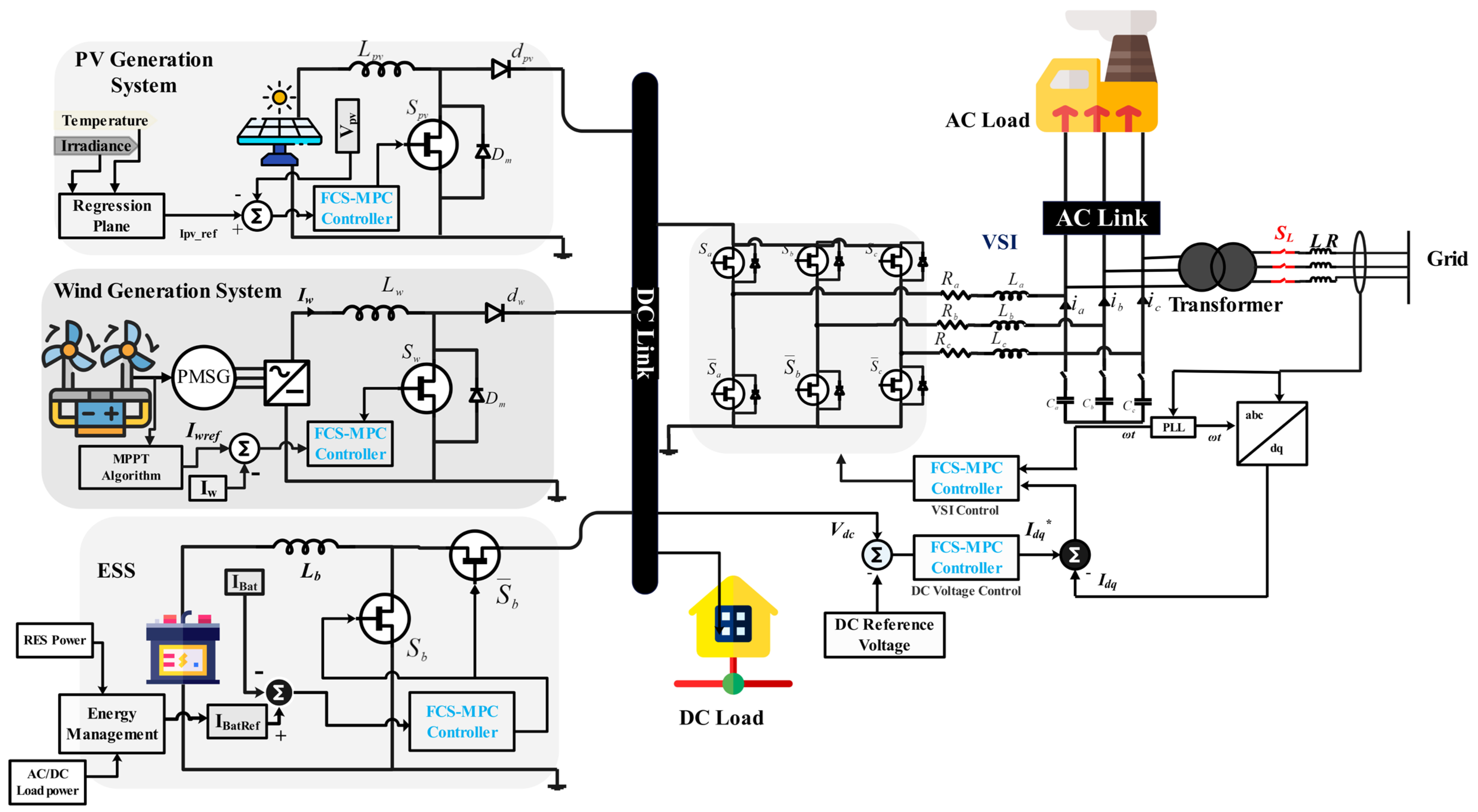
Figure 1, is to design a partitioned and fully integrated energy system whereby the sources of generation, storage, and loads are positioned on an AC or DC electrical bus depending on the characteristics of its origin to reduce the number of redundant power conversion steps and the corresponding power conversion losses. It is a divided architecture consisting of two coupled sub-grids. The sub-grid is built around a shared DC link and is characterized by a voltage
. This bus is the natural junction point between DC sources: the photovoltaic (PV) array, driven with a unidirectional DC-DC boost converter that has embedded maximum power point tracking (MPPT); and the battery energy storage system (BESS), which is linked via a bidirectional buck–boost converter to allow controlled charging and discharging. This DC bus is served by a wind generation system (WGS), which includes an AC generator, a front-end AC-DC rectifier, and a DC-DC boost converter to convert its variable AC output into a controlled DC input. This DC bus focus maximizes such primary resources and storage resources. In parallel with this, the AC sub-grid has standard distribution voltage and frequency (230 V/50 Hz) in
Table 1. It feeds conventional AC loads and provides an interface to the primary utility grid at the point of common coupling (PCC). The nexus between these two separate electrical spheres is a two-way voltage-sourced interlinking converter (ILC), a flexible power-electronic interface. The ILC is not in a fixed operational mode; it is dynamically reconfigured by the central controller based on the system’s global state, enabling the architecture’s defining dual-mode functionality. The microgrid is synchronized with the primary grid in grid-connected mode. In this case, the ILC operates in grid-following mode. It controls the transfer of power
and
between the DC and the AC sub-grids as set by an energy management system, effectively enabling the DC-side resources to either export excess energy or import during a power shortage. The primary grid provides a strict voltage and frequency reference
and
to ensure overall stability. The BESS in this state operates strategically in response to economic dispatch signals or in response to high-frequency ancillary services, such as ramp-rate control, and the PV and WGS in this state run at their peak available power.
Islanded mode is a test of the system’s resilience and is activated when a grid fault is detected or a planned disconnection is initiated at the PCC. This shift alters the control goals which is shown in
Table 2. The entire grid reference is lost, and the BESS converter now maintains the DC-link voltage
at a constant value to provide a stable, stiff DC bus for the entire microgrid. At the same time, the ILC is reformed into a grid unit. It stops the existing control and starts producing a high-quality, stable sinusoidal voltage waveform
and
on the AC bus, acting as a virtual synchronous generator to provide voltage and frequency references for all islanded AC loads. The renewable generators remain in MPPT mode, and the BESS actively corrects the real-time imbalance in power demand
through its dispatch, maintaining uninterrupted power balance and frequency stability of the isolated system.
2.1. Modeling of PV Generation System
An exact and computationally economical way to calculate the five major electrical parameters of a photovoltaic model or module with just one diode model. The authors use a genetic algorithm in combination with particle swarm optimization to optimize the model parameters, balancing speed and precision by maximizing the number of measurement points required to plot an I–V curve, typically 20–30 points per plot. Their method reduces computational cost by more than 60 percent, and fitting errors are very low across monocrystalline, polycrystalline, and amorphous PV technologies. This concentrates the approach highly applicable to integrating it into the PV system modeling and monitoring architecture, where accuracy and real-time performance are crucial [
43]. The PV generation system is one of the core renewable energy sources in the microgrid that converts sunlight into electrical energy through PV panels. The PV generation system consists of a PV panel, a non-inverting buck–boost converter, and an MPPT controller [
44]. The boost converter is connected to the output of PV panels and operates in continuous conduction mode to track the MPPT.
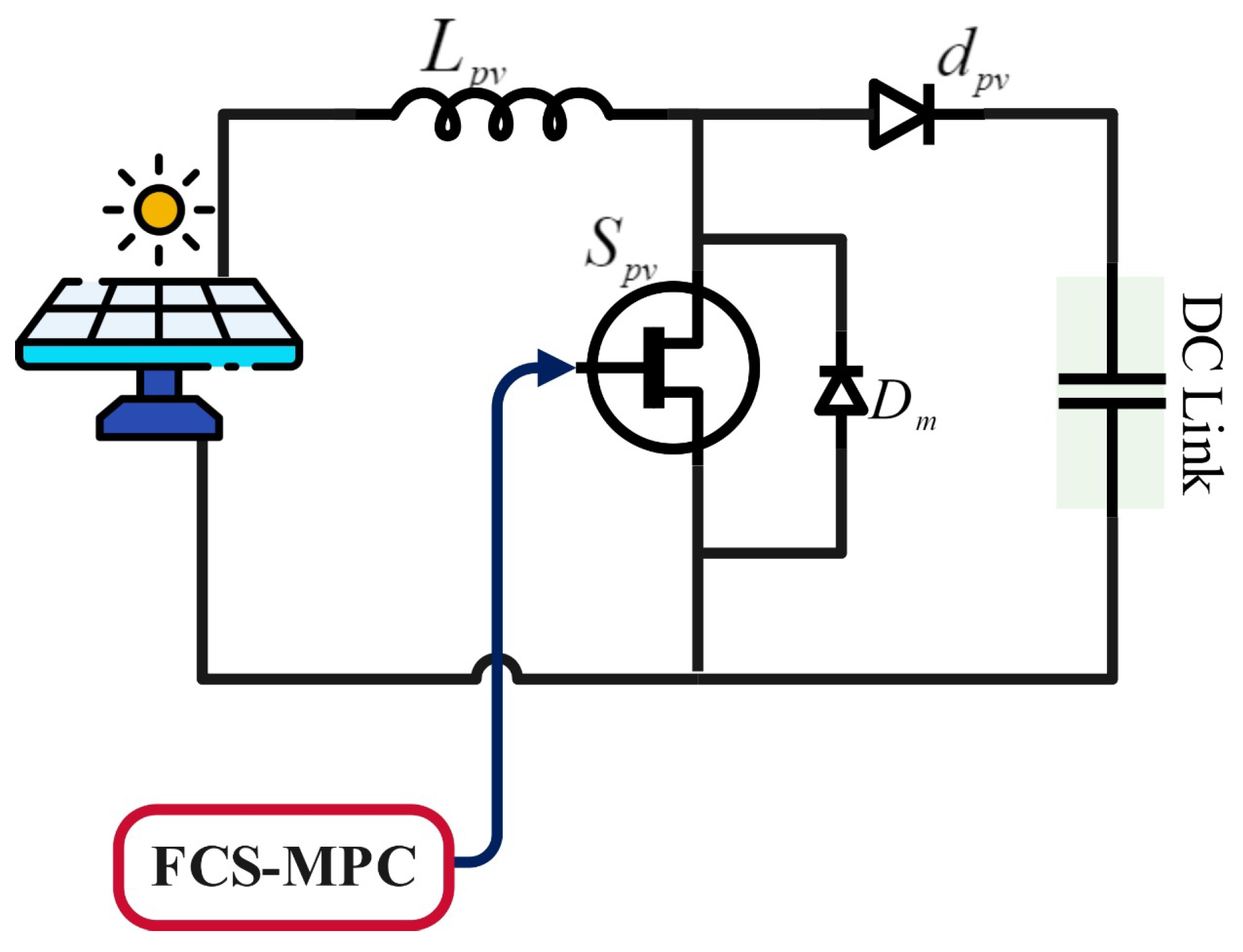
Figure 2 illustrates the internal circuit diagram of PVGS. The single diode equation of the PV module can be presented as
The boost converter is integrated with PV panels to step up the DC voltage, as shown in
Figure 2. The configuration consists of one switch (
), one diode (
), an inductor (
), and an input capacitor (
). The converter operates in two modes. In Mode I (switch ON), the diode
is reverse-biased, and the input PV voltage (
) is applied across the inductor
, causing it to store energy. In Mode II (switch OFF), the diode
becomes forward-biased, allowing the inductor to release its stored energy to the output and the load. This process results in an output voltage higher than the input voltage. The output voltage can be regulated by adjusting the duty cycle.
(
) of the switching signal, thereby controlling the voltage gain of the converter. The mathematical model for the non-inverting buck–boost converter is expressed as follows:
2.2. Modeling of Wind Generation System
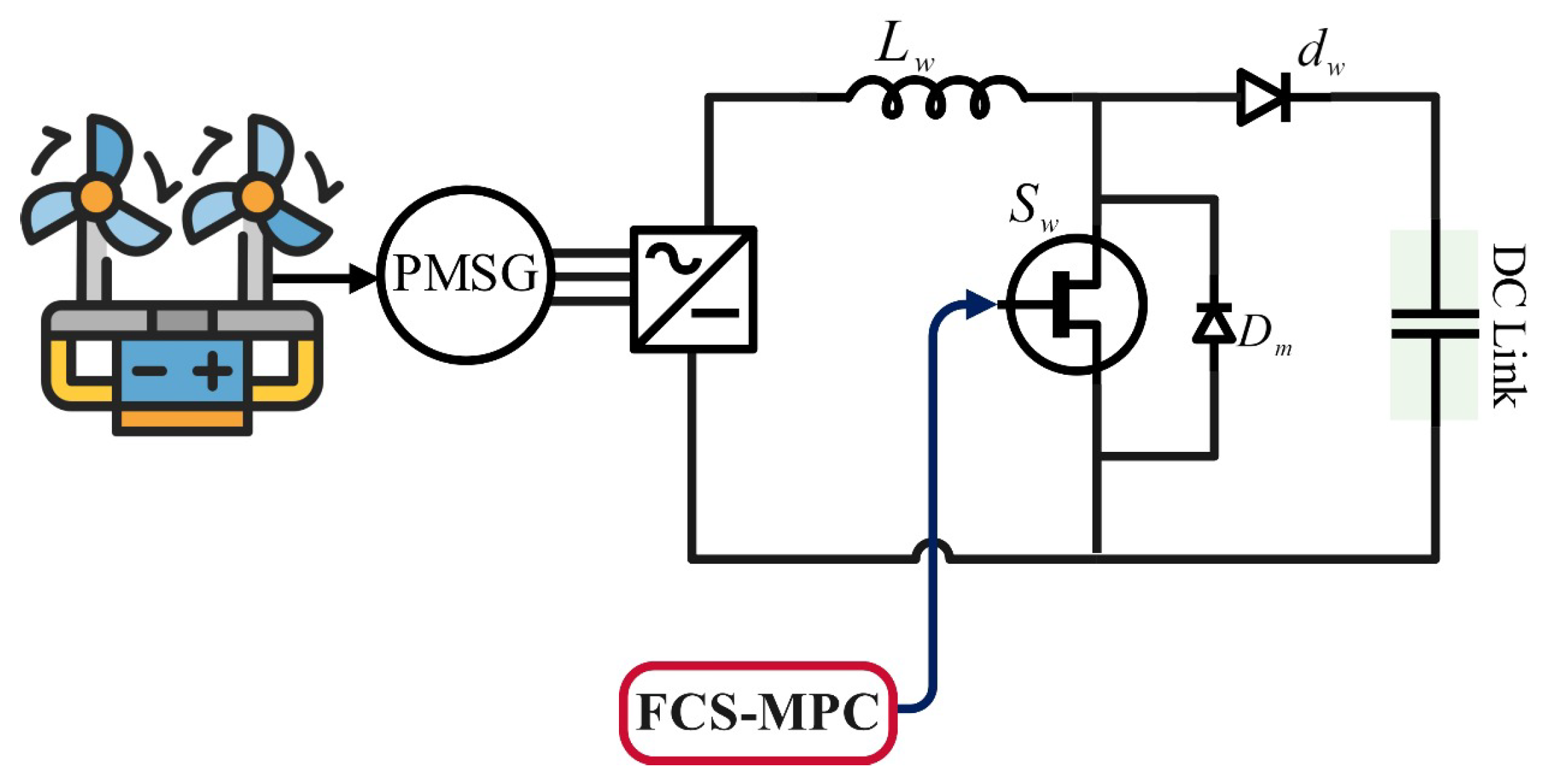
A wind generation system (WGS) converts kinetic energy from wind into electrical energy through the use of wind turbines. These turbines incorporate permanent magnet synchronous generators, which efficiently convert the rotational energy from the turbine blades into electricity and allow efficient energy generation from different combinations of wind conditions. Furthermore, power generated from WGS is injected into a three-phase rectifier, which converts the AC power into DC. The output from this rectifier is then connected to a DC boost converter, which steps up the voltage to achieve the desired level. The unidirectional boost converter operates in continuous conduction mode to ensure power conversion and delivery. MPPT is essential for WGS to optimize the energy harvested from wind turbines. Two primary methods for implementing MPPT are the direct and indirect approaches. The indirect method is preferred for WGS due to the non-minimal phase characteristics of boost converters. This approach uses wind current as a reference instead of voltage for more efficient and stable power extraction [
45]. The internal circuitry of WGS and its integration with the grid are shown in
Figure 3.
The extracted power from the wind turbine can be expressed as [
46]
By substituting the value of
from
into Equation (4), we get
Equation (5) highlights the dependence of extracted power on the tip–speed ratio, wind speed, turbine radius, and the power coefficient, as well as the rotational speed, with the blade pitch angle influencing the overall system performance. A boost converter is connected with a wind turbine generator that consists of a switch (
), and a diode (
). This converter has two modes: Mode I, which is when the
is ON and it allows current (
) to flow through the inductor (
). During this mode, the inductor stores energy. Mode II, which is when
is OFF, the stored energy in the inductor is released. The inductor generates a voltage that adds to the input voltage (
), resulting in a higher output voltage. The mathematical expression can be expressed as
2.3. Modeling of Energy Storage System
ESS is an important aspect of RES-based microgrids. It serves to balance supply and demand, store excess energy generated by RESs, and provide backup during outages or peak demand periods. This backup system enhances the reliability, stability, and efficiency of microgrid operations. The key components of ESS include a battery bank, a bidirectional buck–boost converter, and SOC monitoring. A battery bank stores excess energy during periods of surplus generation and supplies power during deficits. A bidirectional buck–boost converter controls the charging and discharging operations by flowing power in both directions. The SOC monitoring system tracks the battery’s energy level relative to its total capacity, ensuring optimized operation and longevity.
Figure 4 depicts the internal circuitry of ESS that highlights the equivalent circuitry model of ESS and its integration with a bidirectional buck–boost converter.
The battery model includes the following:
SOC Limits: Operation is constrained between and to prevent over-discharge and overcharge, extending battery life.
Efficiency Losses: Charging and discharging efficiencies are incorporated into the power balance equations.
Aging Effects: While detailed aging dynamics (cycle life and temperature effects) are not simulated in this study to focus on the primary control validation, the impact of efficiency and SOC limits is considered. Future work will integrate a comprehensive aging model.
A bidirectional buck–boost converter is connected with ESS to transfer energy in both directions. During the charging phase, the converter operates in buck mode, effectively reducing the input voltage to a level suitable for charging the battery. Conversely, during the discharging phase, the converter operates in boost mode to increase the battery voltage and fulfill the associated load requirements. The circuitry of the buck–boost converter consists of two IGBT switches
and
, high-frequency inductor
and filter capacitor
. It is essential that both switches of the bidirectional buck–boost converter are not ON simultaneously to prevent short circuits and ensure proper operation by allowing only one path for current flow at any given time. The operation of the bidirectional buck–boost converter can be expressed as
In Equation (8),
represents the mode of operation of the converter, while
denotes the reference current of the battery. This reference current is determined according to SOC and load demand through the energy management system. When
, the battery operates in discharging mode. In this mode, switch
is turned ON for a time
, where
represents the duty cycle for discharging and
is the switching period. During this time, the converter boosts the battery voltage to meet the load requirements. Conversely, switch
is turned ON for a time
and
is off. The mathematical expression of this boost mode can be expressed as
In the above equations,
and
represent the battery current and voltage, respectively. Additionally,
and
denote the resistance and inductance associated with the converter circuitry. Furthermore,
is the internal current of the battery. When the
, the converter operates in buck mode to charge the battery. In this mode, the switch
is OFF for time
and switch
is ON for time
. The mathematical expression of this mode can be expressed as
A centralized control duty cycle can be generated through virtual control, which simplifies the overall control system, as indicated by the equation below:
This approach allows for the organized management of various system parameters, enhancing the efficiency and responsiveness of the control mechanism. By employing virtual control (
), the complexity associated with individual control actions is reduced, facilitating a more streamlined response to changes in system conditions. This unified control signal ultimately contributes to improved performance and stability of the system. The above equations can be simplified through virtual control as
2.4. Modeling of Voltage Source Inverter
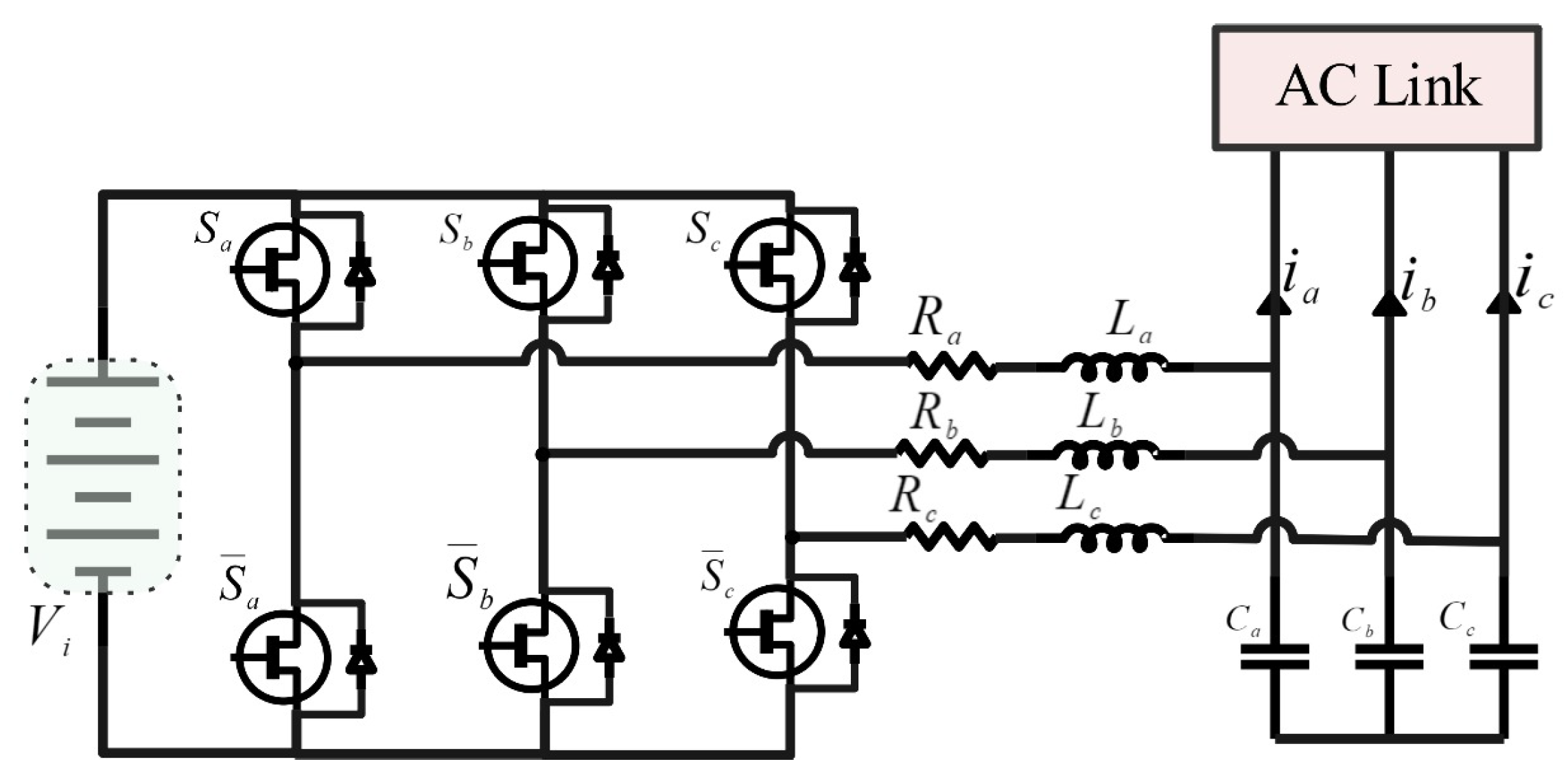
The operation of VSI is to convert the DC into AC and allow it to inject or absorb power with the main grid as needed. The circuitry of VSI is shown in
Figure 4. To a better decoupled control of
grid-tied Voltage Source Inverters (VSIs). The HSRC provides an effective solution to the current harmonics introduced by nonlinear loads by integrating a Second-Order Generalized Integrator (SOGI) as a notch filter into the cascaded PI controllers in the synchronous rotating reference frame, which also independently follow active and reactive power references. The method is much more effective at enhancing the quality of power, as simulations show output current THD reduces to 2.21–16.53% with this method, and it provides an inexpensive, stable, and predictable alternative to complicated multi-controller or active filter designs [
47]. The AC loads are modeled as balanced three-phase with a nominal power of 5 kW. DC loads are represented as constant power loads connected to the 400 V DC bus. Harmonic distortion is limited by the FCS-MPC cost function, ensuring THD < 3% under linear and nonlinear loading conditions. Unbalanced operation is reserved for future study. The LCL filter parameters are developed with a switching frequency
= 20 kHz, a suitable current ripple < 10%, and a resonant frequency range of 500 Hz to 10 kHz. A damping resistor
is added to reduce resonance. The design has been optimized to achieve THD less than 3% under nonlinear loads. The mathematical modeling of the VSI by utilizing Park’s and Clarke’s
transformations can be represented by the following set of equations:
In the above equations,
represents the resistance,
denotes inductor,
indicates a capacitor, and
represents the angular frequency.
and
are the voltage components in the
axes, while
and
represent the current components in the same axes. Additionally,
and
signify the grid output currents in
axes, respectively. If
and
denote the resistance and inductance of the grid, the rate of change in the direct axis grid currents can be expressed as
3. Proposed Methodology
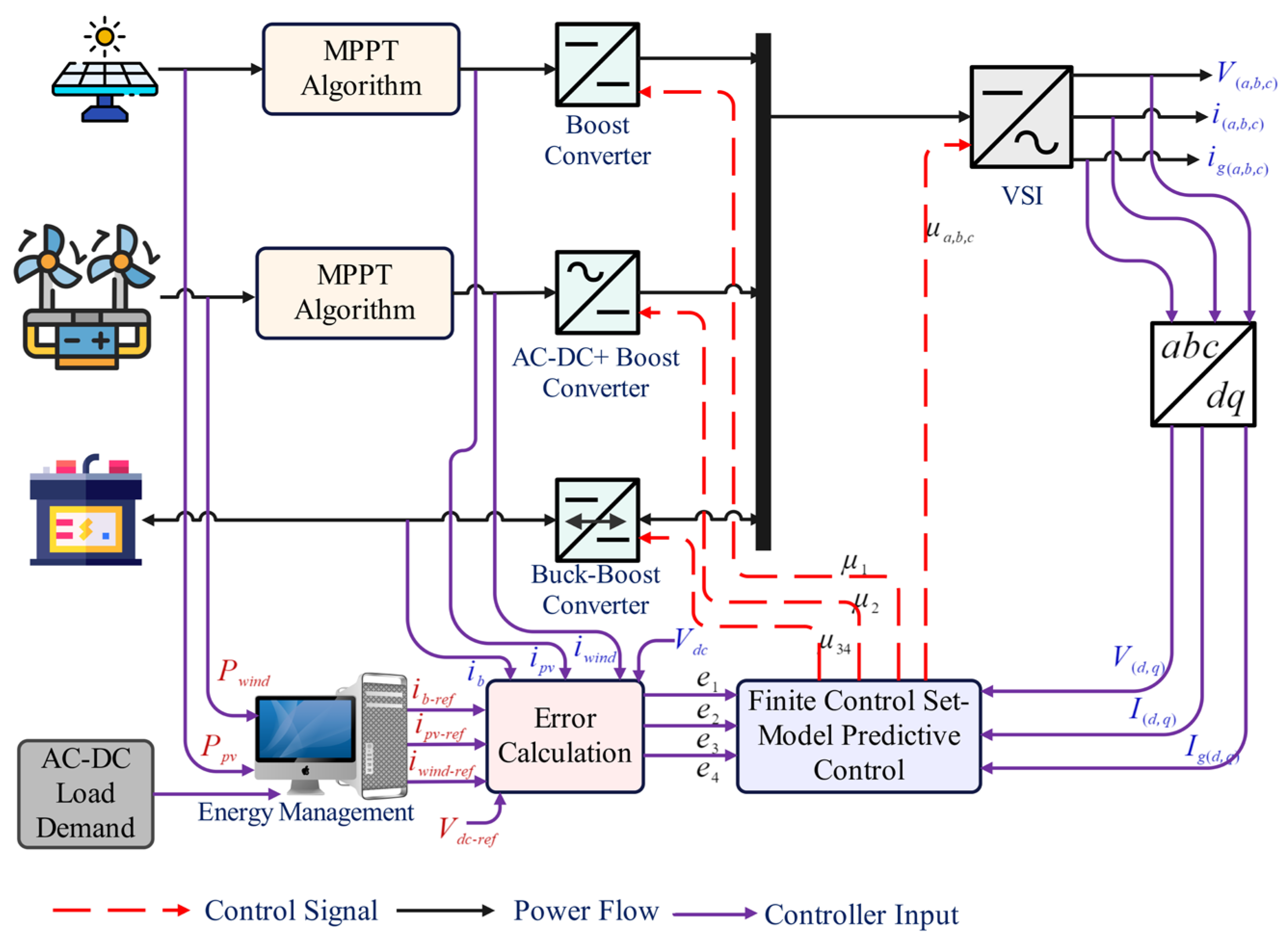
A Finite Control Set–Model Predicative Control methodology is used in this work to control the operation of the proposed hybrid AC/DC microgrid. The controller diagram is shown in
Figure 5. The process begins with mode selection, where the microgrid operates in either grid-connected or islanded mode. A reference generator produces set points for controlling, depending on system requirements. The predictive capability of the proposed controller is enhanced by external inputs such as temperature, irradiance, wind speed, and turbine operational data, which help anticipate variations in renewable generation. The controller solves a cost function and optimization problem to minimize operational costs, tracking errors, and other performance metrics while adhering to system constraints. The solution yields an optimal control action, which adjusts set points like PV reference current or wind reference current to MPPT operations of the RESs.
PV MPPT: The regression plane method is used to generate the reference voltage
ref as a function of irradiance
and temperature
:
where coefficients
are determined from the PV module’s characteristic curves.
Wind MPPT: The optimum torque control (OTC) method. The reference torque,
, is determined based on the optimal power–speed curve:
where
and
represents the generator speed. The corresponding reference current,
, is subsequently determined using the generator’s torque constant.
The FCS-MPC strategy is applied and tested in MATLAB/Simulink (2024b) using a fixed-step discrete solver with
= 25
, corresponding to a switching frequency of
= 20 kHz, DC bus voltage
= 400, AC grid voltage of 230 V/50 Hz, LCL filter values
= 3 mH,
= 10
, and PV/wind/ESS models as in
Section 2. Power electronic switches are idealized as antiparallel diodes of ideal IGBTs; sensor measurements are suitable, with no communication delays except noted. All simulations are performed in 10 s to capture dynamic transitions between islanded and grid-connected modes.
Converter Losses: Conduction losses in switches and diodes are modeled using equivalent series resistances (ESR) for inductors and capacitors, and diode forward voltage drops.
Switching Losses: While the simulations use ideal IGBTs for clarity, a switching loss factor is included in the efficiency calculations for each converter (boost, buck-boost, and VSI). The overall efficiency of the power stage is estimated at 96–98%, consistent with commercial components.
The primary focus of this paper is on the control strategy’s dynamic performance and stability. Including detailed loss models does not alter the fundamental conclusions regarding FCS-MPC’s superiority in voltage regulation, MPPT, and mode transition. However, error-sensitive optimization is noted as a valuable extension for future work.
The operation of the PV generation system, wind generation system, and ESS is controlled by providing the control signals generated. For the PV system, based on the PV module specification, we use the regression plane method to generate the MPPT references as given in [
13]. For WGS, we generate the current reference through the optimum torque control method as given in [
29]. FCS-MPC ensures that these RESs operate at their MPPT to maximize energy capture. The controller provides precise control signals to the power converters to maintain the optimal voltage and current levels required for MPPT.
This allows for efficient tracking of the reference values. The MPC controller manages the charging and discharging of the ESS in case of islanded mode to balance the power supply and demand. If renewable generation is less than the load, the controller commands the ESS to discharge. If there is a surplus of renewable power, it commands the ESS to charge, storing the excess energy for later use.
In the case of grid-connected mode, the MPC transfers the power to the main grid and ensures grid synchronization. VSI operation of the microgrid is controlled by using two complementary switches of each leg, whose states are digitally represented by the Boolean values 1 (ON) or 0 (OFF). These switches serve as the primary decision variables that actions are directly determine the inverter’s output voltage, yielding eight distinct switching states that correspond to six active and two null voltage vectors.
This paper will fill this gap by proposing a single Finite Control Set–Model Predictive Control (FCS-MPC) framework to coordinate multiple power converters (PV, wind, ESS, and interlinking converter) in a hybrid AC/DC microgrid. This framework is compatible with islanded and grid-connected operation without requiring reconfiguration or controller-mode-specific operation, and hence enabling robust transitions and steady operation. The suggested methodology integrates high-reliability, discrete-time models of each power electronic converter (PV boost converter, wind rectifier-boost system, bidirectional buck-boost ESS converter, and voltage source inverter) into the predictive control loop. This enables the controller to predict the system’s behavior in dynamic situations and to tightly control the cost function (voltage/current limits and switching frequency) rather than requiring cascaded PID loops and external limiters. A new multi-objective idea is developed to maximize:
DC bus voltage regulation;
PV and wind power, and maximum power point tracking;
Charging/discharging of the power balance ESS;
Grid synchronization, power quality (harmonic reduction and unity power factor);
Minimization of switching frequency.
This combined strategy enables the controller to address the system’s limitations directly and achieve optimal performance between inconsistent goals without hierarchical or decoupled control structures. The proposed FCS-MPC is switching-level-based, and a finite set of possible inverter vectors is selected directly, without PWM modulation or duty-cycle computation. It eliminates delays caused by modulators, enhances dynamic response, and simplifies the control architecture by removing the need for coordinate transformations ( decoupling networks) and PI tuning. A predictive voltage control scheme with a phase-locked loop (PLL) is developed to provide a smooth, continuous transition between islanded and grid-connected modes. When the interlinking converter operates in islanded mode, it acts as a voltage source to stabilize the AC voltage. As a grid-following source that uses active/reactive power control, it operates in grid-connected mode. A smooth transition is achieved by setting the frequency reference slightly above the grid frequency until phase matching is achieved, then reconnecting. The approach is confirmed by component-level simulations in MATLAB/Simulink using detailed models of PV modules (single-diode equation), wind turbines (aerodynamic power model), Li-ion batteries (SOC-based dynamics), and switching converters. This is to ensure the controller is used in real-time operation, dynamic conditions, rather than idealized, steady-state conditions, so that it can be applied in practice and tested for robustness.
The proposed FCS-MPC employs a centralized control architecture that utilizes measurements from the following sources:
DC-bus voltage and currents associated with photovoltaic (PV) systems, wind turbines, and battery energy storage systems (BESS);
AC-bus voltages and currents at the point of common coupling (PCC);
Grid voltage and frequency measured using a phase-locked loop (PLL).
Inter-converter communication is not required for basic operation. For mode transitions and power sharing, a low-bandwidth communication link is assumed between the central controller, the grid relay for islanding detection, and the BESS controller. Sampling is performed synchronously with a period of .
The sampling time is also a design parameter that is vital in ensuring that the control performance and the hardware implementation meet the following requirements:
Nyquist Criterion and Control Bandwidth: The sampling frequency is required to be many times greater than the target control bandwidth, in this case, 1 kHz, which is sufficient to capture microgrid dynamics. satisfies this.
Relationship to Switching Frequency: In FCS-MPC, the maximum switch period possible is determined by the sampling period. With a switching frequency of 20 kHz , a sampling time of 25 , and not less than one sampling interval per switch transition, the maximum switching frequency of 20 kHz is achievable. This is in line with productive IGBT capabilities and restricts switching losses.
Computational Feasibility: 25 gives enough time over a modern digital signal processor (DSP) to identify the optimizing voltages (9 vectors) by means of the computation.
The computational cost of the suggested controller is predictable and constant. During each sampling period, the cost function for the seven acceptable voltage vectors of a two-level VSI must be evaluated. The worst-case performance time has been profiled to about 10 on a Random Instruments TMS320F28379D DSP (200 MHz), which is 40% of the 25 sampling interval. This provides sufficient time to acquire sensor data, communicate, and perform other wasteful activities, and it has been proven that real-time implementation can be achieved on the industry-standard platform.
These possible voltage vectors are mathematically defined as
The operational framework of the microgrid encompasses islanded and grid-connected modes, each of which is detailed in the subsequent section.
3.1. Islanded Mode
The block diagram of the proposed control strategy for the AC/DC converter in islanded operation is illustrated in
Figure 6. In this mode, the bypass switch is ON while the circuit breaker is OFF, decoupling the microgrid from the main grid. The dynamics of the LC filter capacitor are governed by
In above Equation (24),
denotes the capacitor voltage vector,
is the filter capacitance, and
is the filter capacitance. The mathematical model of the AC/DC interlinking converter is expressed as
In the above equation,
represents the converter output voltage vector,
and
are the filter resistance and inductance, respectively, and
is the filter current vector. Building upon this operational framework, during islanded mode, the ESS regulates the DC bus voltage to ensure continuous power availability. The AC/DC interlinking converter subsequently operates in a manner analogous to an uninterruptible power supply (UPS), employing a Model Predictive Voltage Control (MPVC) strategy to provide a stable and high-quality AC voltage for critical loads. Consequently, the capacitor voltage of the LC filter is designated as the primary control objective for the predictive controller, ensuring precise regulation and robust performance in the absence of grid support. The state space representation for the islanded operational mode is derived by integrating Equations (25) and (26), yielding the following continuous-time linear system:
In the above equation
, input vector
, and system matrices are defined as [
34]
By solving the linear state-space differential Equation (27), the discrete-time predictive model is obtained through exact discretization [
28]:
This model enables the prediction of the capacitor voltage vector at the
sampling instant. To ensure precise voltage regulation, the cost function is formulated to minimize the tracking error in the stationary
reference frame:
The voltage vector that minimizes is selected and applied during the next sampling period. This approach ensures tight decoupled control of the components, forcing the capacitor voltage to accurately track its sinusoidal reference, thereby establishing a stable and high-quality output voltage. Building upon the established predictive voltage control framework, grid synchronization is facilitated using a phase-locked loop (PLL) to accurately detect the grid voltage amplitude and frequency. A reference voltage for the cost function in Equation (30) is then generated with the same amplitude as the grid but at a marginally higher frequency, while preserving the phase angle previously maintained during islanded operation. This deliberate frequency offset causes the microgrid voltage phasor to rotate at a slightly different angular velocity than the grid phasor, despite their identical amplitudes. Once the phase angles of both voltages align, a condition detected by the PLL, the circuit breaker can be closed, enabling a smooth and transient-minimized transition to grid-connected operation. Grid synchronization is performed using a SOGI-PLL with a 50 Hz bandwidth and a damping ratio of 0.707. Its dynamic response is quick and precise, with phase-sensitive disturbance detection, as confirmed during mode transitions. The transformations and reference generation of both grid-following and grid-forming modes are determined by the PLL angle .
Mode transition logic is a PLL phase alignment mode transition logic, but it is designed to be resistant to grid disturbances. The SOGI-PLL has harmonic rejection functions and ensures correct synchronization under grid voltage THD of 5%. Moreover, the circuit breaker closure is only activated when phase coordination is maintained, along with voltage and frequency variations within safe limits over a specified duration of 5 cycles. The multi-condition check avoids undesirable transitions during distorted or transient grid conditions, as confirmed in simulation under harmonic, unbalanced, and sag conditions.
3.2. Grid-Connected Mode
When the microgrid is synchronized and tied to the utility, the interlinking converter operates as a grid-following power conditioner: it regulates the DC-bus energy by commanding active power exchange with the grid while maintaining a near unity power factor at the point of common coupling (PCC). The plant dynamics seen from the converter output (grid side of the filter) are well described by the lumped
model:
where
is the inverter voltage vector selected from the finite set of two-level space vectors,
is the grid voltage at the PCC, and
is the filter inductor current. Using the power invariant
frame, instantaneous three-phase active and reactive powers are
with
the complex conjugate. Discretizing (34) with sampling time
(forward Euler), the one-step prediction of
under a candidate voltage vector
is
Substituting (34) into (32) gives for each admissible vector without any continuous optimization.
Cost and selection (power domain form): With active/reactive references
, the enumerative FCS–MPC selects
and applies the minimizing vector
during the next sample. The last term penalizes unnecessary commutations using the Hamming distance of the switch state
; we also employ a small keep state hysteresis
to curb chatter.
Alternative current domain cost (
form): Using the PLL angle
to form the
frame (with a built-in angle auto-alignment described below), the same predictor (34) is rotated to obtain
, and we minimize as follows:
The tuning of the weighting factors in the cost functions (35) and (36) is through a systematic process. The initial values are set by physical scaling of individual terms, such as which is relative to the nominal power, to correct the switching effort. The reduction in the Integral of Time-weighted Absolute Error (ITAE) of DC voltage and AC power tracking over a variety of operating conditions is achieved through final tuning via simulation iteration. Sensitivity analysis, testing all weights with a 50% change, ensured that the leading performance indicators (DC voltage overshoot < 2%, THD < 3%) did not change significantly.
The transition is managed as follows:
Section 2.4 of the
modeling presents a continuous-time dynamic model for controller design and stability analysis. In the case of FCS-MPC implementation, the system is discretized, and the prediction is made in the stationary
frame to eliminate the need for coordinate transformations in the online optimization loop. The
reference
produced by the high-level power commands is converted to
reference with the inverse Park transformation, depending on the angle of the PLL. The cost functional Equation (36) is computed in the αβ frame, and the optimum voltage state is chosen directly in the finite space of the inverter switching states. This method does not require PWM modulators, making the predictive control loop much simpler than
based reference generation.
where the damping term (second term) reduces the current ripple. We map power references to current references using the instantaneous PCC magnitude
:
Reference generation from DC side power balance: To regulate the dc bus without relying on a slow integral loop, we use a physics-based power command. Let
be the capacitor energy. The net power into
neglecting small losses, balancing the DC link yields the feed-forward command:
which we found gives faster and better damped
regulation than a pure PI outer loop. (If desired, the closed-form mapping that includes
losses can be used: solve
).
Specifically, the instantaneous PCC angle computed from the power invariant Clarke variables is used to correct the PLL angle prior to the Park transformation, which enforces at the PCC and improves tracking and power factor regulation even in the presence of sensor placement differences or transformer vector group shifts. Current references are synthesized from the instantaneous PCC magnitude according to (37), avoiding RMS/peak conversion artifacts, e.g., and maintaining consistency during voltage sags or harmonic distortion. To limit unnecessary commutations and the associated EMI, the selection cost includes a switching effort term , together with a small keep-state hysteresis band, this combination reduces chattering without resorting to mixed integer or variable-horizon optimization. Finally, because the inverter input belongs to a finite set of eight two-level space vectors, the controller operates by enumeration; the cost in (36) (power domain) or (37) (current domain) is evaluated for all admissible candidates each sampling period, and the minimizer is applied. No duty-cycle synthesis, PWM stage, or QP/MIQP solver is required, yielding a fixed and predictable computational load per sample.
The equation of power balance between ESS and the grid as the secondary source is as follows:
The BESS in the islanded mode sustains the DC-link voltage by
where
is controlled by FCS-MPC in the compensation of
.
In grid-connected mode, the grid compensates for any power mismatch.
The cost function of the FCS-MPC combines this approach by deriving the reference for the interlinking converter from the power balance error.
The uncertainty of the grid impedance is recognized as a practical challenge. The predictive model uses the grid voltage measured at the PCC, which is inherently affected by grid impedance. The controller’s tolerance to incompatibilities in the model is tested through simulations in which and vary by ±20 percent. Enhanced robustness across a broad range of impedances may be incorporated into future research by including a disturbance observer or an adaptive prediction model.