


Abstract
Thermodynamic entropy generation quantifies irreversibility in energy conversion processes, providing rigorous thermodynamic foundations for optimizing efficiency and sustainability in thermal and energy systems. This critical review synthesizes advances in computational entropy modeling across numerical methods, optimization strategies, and sustainable energy applications. Computational fluid dynamics, finite element methods, and lattice Boltzmann methods enable spatially resolved entropy analysis in convective, conjugate, and microscale systems, but exhibit varying maturity levels and accuracy–cost trade-offs. The minimization of entropy generation and the integration of artificial intelligence demonstrate quantifiable performance improvements in heat exchangers, renewable energy systems, and smart grids, with reported efficiency gains of 15 to 39% in specific applications under controlled conditions. While overall performance depends critically on system scale, operating regime, and baseline configuration, persistent limitations still constrain practical deployment. Systematic conflation between thermodynamic entropy (quantifying physical irreversibility) and information entropy (measuring statistical uncertainty) leads to inappropriate method selection; validation challenges arise from entropy’s status as a non-directly-measurable state function; high-order maximum entropy models achieve superior uncertainty quantification but require prohibitive computational resources; and standardized benchmarking protocols remain absent. Research fragmentation across thermodynamics, information theory, and machine learning communities limits integrated frameworks capable of addressing multi-scale, transient, multiphysics systems. This review provides structured, cross-method, application-aware synthesis identifying where computational entropy modeling achieves industrial readiness versus research-stage development, offering forward-looking insights on physics-informed machine learning, unified theoretical frameworks, and real-time entropy-aware control as critical directions for advancing sustainable energy system design.
1. Introduction
Entropy generation and exergy analysis have emerged as indispensable frameworks for quantifying irreversibility and thermodynamic losses in thermal and energy systems, addressing fundamental limitations inherent in first-law energy analysis. Entropy generation minimization (EGM) provides rigorous thermodynamic foundations for optimizing renewable energy systems across biomass, wind, solar photovoltaic, and geothermal technologies, demonstrating quantifiable efficiency improvements through systematic irreversibility reduction [1]. Although energy conservation satisfies the mass and energy balances, it does not capture degradation in energy quality during conversion or identify locations and magnitudes of inefficiency [2]. Exergy analysis extends second-law principles by quantifying the maximum useful work obtainable from systems. This reveals that energy transformations inevitably generate entropy through heat transfer across finite temperature differences, viscous dissipation, and chemical reactions [3,4]. This distinction is critical for sustainable energy systems, where optimizing performance requires minimizing irreversibility to maximize useful work extraction from finite resources. Throughout this review, the term ‘entropy’ refers exclusively to thermodynamic entropy as defined by the second law of thermodynamics, which quantifies irreversibility and energy quality degradation in physical processes. This must be distinguished from information entropy (Shannon entropy measuring statistical uncertainty in data) and configurational entropy (statistical disorder in molecular arrangements). These three concepts, while mathematically related through logarithmic formulations, represent fundamentally different physical phenomena requiring distinct computational approaches. Unless explicitly stated otherwise, all entropy discussions herein address thermodynamic entropy generation in energy systems.
Computational methods have fundamentally transformed entropy modeling capabilities, enabling spatially, resolved transient analysis of complex energy systems previously inaccessible through analytical approaches. Classical thermodynamic modeling has been progressively integrated with advanced computational techniques, bridging theoretical foundations with data-driven applications [5]. Machine learning applications in sustainable energy systems have expanded entropy modeling through improved predictive accuracy, uncertainty quantification, and optimization under variable conditions [6]. Artificial intelligence integration in energy conversion demonstrates enhanced process optimization, with hybrid models combining entropy concepts with deep learning or Bayesian inference achieving superior performance in handling complex, nonlinear, uncertain energy data [7]. Physics-informed frameworks increasingly embed thermodynamic constraints, with entropy-driven deep reinforcement learning achieving substantial HVAC energy savings and maximum entropy principles providing robust uncertainty quantification in stochastic renewable systems [8,9]. Graph-based modeling for transient exergy analysis enables the quantification of dynamic entropy in integrated systems, while entropy-based stochastic optimization incorporates higher-order sensitivities to address modeling uncertainties [10,11].
Despite these advances, persistent conceptual gaps and methodological fragmentation motivate a comprehensive synthesis. Theoretical ambiguities regarding entropy definitions and appropriate application contexts persist, with systematic conflation between thermodynamic entropy (quantifying energy dispersal) and information entropy (measuring statistical uncertainty) leading to inappropriate computational method selection [2]. Research approaches remain fragmented across disciplinary boundaries: thermodynamic EGM studies often proceed independently from information-theoretic entropy applications in economic dispatch, while AI-enhanced entropy modeling develops with limited integration of established thermodynamic principles [12,13]. Validation challenges constrain practical deployment, as computational models often lack extensive experimental or real-world validation, reducing confidence in predictive accuracy and practical applicability [5]. Scalability limitations persist, as high-order maximum entropy predictive models incorporating fourth-order sensitivities achieve superior uncertainty quantification but require computational resources prohibitive for real-time optimization of large-scale networks [14]. The rapid proliferation of entropy-based optimization methods occurs without standardized benchmarking protocols, preventing systematic performance comparison and method selection guidance [10].
The growing need for cross-disciplinary and methodologically integrated reviews arises from converging factors. Urban energy systems face increasing complexity in demand aggregation and renewable dispatch, which requires entropy-based methods to quantify information loss and optimize spatial scales [15]. Renewable integration introduces stochastic generation that demands robust uncertainty quantification frameworks, with entropy providing effective variability metrics [16]. Multi-energy systems that link electrical, thermal and chemical networks exhibit complex interactions that require integrated entropy–exergy analysis to identify optimization opportunities [4]. Emerging applications span electric vehicle charging reliability, blockchain-based renewable trading, and the sustainability of urban green systems, demonstrating the expanding role of entropy beyond traditional thermodynamic domains [17,18,19]. The interdisciplinary nature of computational sustainability, which encompasses thermodynamics, information theory, artificial intelligence, and socio-technical perspectives, requires comprehensive frameworks that synthesize various methodologies [20].
This review addresses these gaps through the comprehensive synthesis of advances in computational entropy modeling in theoretical foundations, numerical methods, optimization strategies, and emerging sustainable energy applications. The review systematically evaluates how entropy generation analysis reveals fundamental performance limits, how computational methods enable rigorous quantification of entropy with varying accuracy–cost trade-offs, how entropy-based optimization frameworks balance competing irreversibilities, and how these approaches translate to practical efficiency improvements in heat exchangers, renewable energy systems, smart grids, and urban infrastructure. By integrating thermodynamic rigor with computational innovation and identifying critical limitations alongside demonstrated successes, this review provides foundations for advancing entropy modeling as a cornerstone methodology for sustainable energy system design and operation.
Figure 1 presents a conceptual overview of the structure of the review, synthesizing the key layers of computational entropy modeling in sustainable energy systems. It illustrates how core entropy frameworks—thermodynamic, information-theoretic, and maximum entropy principles—anchor a range of computational methods that vary in maturity and application readiness. These methods are mapped to the main application areas, highlighting how theoretical developments translate into practical tools. The framework also visualizes cross-cutting challenges, such as scalability and validation, alongside emerging directions, including real-time control and standardized benchmarking.
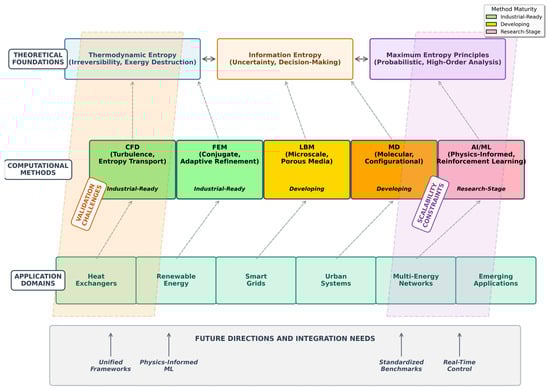
Figure 1.
Conceptual overview of computational entropy modeling in theory, methods, and applications.
2. Fundamentals of Entropy in Applied Thermodynamics
This section investigates the theoretical foundations and practical implications of entropy in thermal systems. It addresses entropy generation in closed and open systems, the role of the second law and exergy analysis, and the methodological distinction between configurational and generated entropy. Emphasis is placed on the mechanisms of entropy production in heat transfer, thermal–frictional trade-offs, and entropy behavior in power generation and energy storage systems under variable operating conditions.
2.1. Theoretical Framework of Entropy
2.1.1. Entropy Generation in Closed and Open Systems
The theoretical framework of entropy generation distinguishes between closed and open thermodynamic systems. In closed systems, entropy generation quantifies irreversibility through the difference between phenomenological entropy (evaluated over irreversible paths) and reversible entropy (calculated along ideal reversible paths) [21]. However, practical application faces significant challenges. The selection of appropriate thermodynamic potentials remains non-trivial and system-dependent [21]. However, most computational implementations adopt standardized functions without justification. More fundamentally, the status of entropy as a mathematical state function versus a measurable physical property creates a validation paradox [22,23]. If entropy lacks direct physical measurability, computational predictions cannot be definitively validated. Most validation efforts rely on indirect inference from temperature and pressure measurements, introducing compounding uncertainties rarely quantified in the literature.
Open systems introduce additional complexity through mass and energy exchange. In open quantum systems, entropy generation is related to the separation of internal energy changes into heat and work contributions [24]. The dynamics of the entropy production rate depend critically on the initial states, environmental conditions, and interaction parameters [25]. Recent molecular dynamics frameworks have incorporated non-equilibrium thermodynamics, where time scaling factors measure entropy production rates dynamically rather than as post-processing [26]. Additionally, explicit configurational entropy calculations from instantaneous particle coordinates now enable real-time mixing dynamics analysis [27]. These advances bridge atomistic simulations with continuum entropy analysis, enabling identification of irreversibility sources during transient phenomena.
A critical methodological concern emerges from systematic conflation between entropy generation (irreversibility in non-equilibrium processes, measured in [J/(K·s))] and configurational entropy (statistical disorder in equilibrium states, measured in [J/K]). Three different concepts of entropy appear in the broader literature, but must not be conflated [28,29,30]:
- Thermodynamic entropy generation (): irreversibility in non-equilibrium processes ([W/K] or [J/(K·s)]), arising from heat transfer, viscous dissipation, and mass diffusion. Quantified via entropy transport equations.
- Configurational entropy S(config) ([J/K]): statistical disorder in equilibrium molecular arrangements [J/K], calculated from partition functions or molecular dynamics ensemble averaging. Relevant for battery materials and mixing phenomena.
- Information entropy H ([bits] or [nats]): uncertainty measure in probability distributions [bits or nats], defined by Shannon formula , where —the probability of the i-th event, for units in bits, or for units in nats.
The selection of computational methods critically depends on the entropy type: CFD with entropy transport equations for thermodynamic entropy generation; molecular dynamics for configurational entropy; statistical algorithms for information entropy. Confusing these concepts leads to order-of-magnitude errors in computational cost and physically inconsistent results.
The rigorous theoretical foundation for entropy generation stems from the local entropy balance derived from the second law of thermodynamics [31,32]. For a control volume Ω with boundary ∂Ω, the entropy balance states [31,33]:
where the left side represents entropy accumulation [W/K], the first right-hand term is convective entropy flux [W/K], the second is conductive entropy flux (reversible) [W/K], and the third is entropy production (irreversible) [W/K]. The variables are: ρ—density [kg/m3], s—specific entropy [J/(kg·K)], u—velocity vector [m/s], n—outward unit normal [–], q—heat flux vector [W/m2], T—absolute temperature [K], and —volumetric entropy generation rate [W/(m3·K)] [31,33].
Applying the divergence theorem and taking the local limit yields the differential form is [31,33]:
The second law requires ≥ 0 at every point and instant, with equality holding only for reversible processes [31,32]. Substituting Fourier’s law q = −k∇T and expanding the divergence [33,34]:
This formulation separates reversible entropy transport (first two terms on left, first term on right) from irreversible entropy production (last term) [31,33]. The entropy generation rate emerges from the Clausius–Duhem inequality, which ensures thermodynamic consistency [35,36]:
where e is the specific internal energy [J/kg] and τ is the stress tensor [Pa]. This inequality requires that internal dissipation always increases entropy [35,36]. Combined with constitutive relations (Fourier’s law for heat conduction, Newton’s law for viscous stress, Fick’s law for mass diffusion), the Clausius–Duhem inequality yields explicit expressions for thermal, viscous, and diffusive entropy generation [32,34,36].
The Gouy–Stodola theorem connects entropy generation to exergy destruction [1,18]:
where is exergy destruction rate [W], T0 is reference (dead state) temperature [K], and is total entropy generation rate [W/K]. This theorem establishes that minimizing entropy generation is equivalent to minimizing exergy destruction, providing the thermodynamic foundation for entropy generation minimization (EGM) as an optimization strategy [37,38].
2.1.2. The Second Law and Exergy Analysis
The second law of thermodynamics governs the directionality of energy transformations. Exergy analysis extends this principle by quantifying the maximum useful work available from systems, integrating first- and second law considerations [39]. Unlike energy-based analyses satisfying conservation principles, exergy analysis identifies quality degradation in energy conversion processes. Modern computational frameworks suggest the second law emerges from computational irreducibility, where process complexity and observer limitations contribute to apparent entropy increase [40]—a philosophically provocative stance lacking widespread acceptance.
Although exergy analysis theoretically provides superior system evaluation, practical implementation confronts significant challenges that are rarely acknowledged. Exergy calculations require the specification of reference dead states (ambient temperature T0 and pressure P0), yet this dependency receives inconsistent treatment. Different research groups employ varying reference conditions without acknowledging comparability limitations. For systems at elevated temperatures, variations in the T0 specification substantially alter the calculated exergy destruction. Furthermore, real environments fluctuate seasonally and diurnally, yet analyses assume fixed reference conditions. Time-varying reference states would provide more realistic assessments, but are computationally prohibitive. Since exergy combines energy (measurable) with entropy (not directly measurable), experimental validation typically achieves substantially higher uncertainty than energy balance validation. This uncertainty often exceeds the claimed optimization improvements, rendering validation inconclusive. Despite this limitation, most computational exergy studies present results without uncertainty quantification or sensitivity analysis with respect to reference state selection.
Recent applications demonstrate utility despite limitations. Solar-assisted distillation systems benefit from exergy-based efficiency evaluations that identify irreversibility sources [41]. Gas turbine analyses quantify irreversible losses through exergy destruction mapping [42]. However, these studies present results without addressing fundamental validation challenges. Theoretical foundations span classical thermodynamics, quantum mechanics, statistical mechanics, and information theory—creating conceptual fragmentation. For computational practitioners, this diversity presents both opportunities (cross-validation across methods) and challenges (ambiguity in method selection). The fundamental tension between entropy as a mathematical state function versus measurable physical property remains unresolved, leaving entropy-based optimization with inherent validation limitations that energy-based optimization does not face.
2.2. Entropy and Irreversibility in Heat Transfer
2.2.1. General Mathematical Framework for Entropy Generation
The local volumetric entropy generation rate for multi-physics systems follows from the Gouy–Stodola theorem and irreversible thermodynamic principles [32,38]. The total entropy generation rate decomposes into contributions from distinct physical mechanisms:
From Fourier’s law and temperature gradients, thermal entropy generation arises from heat conduction across finite temperature differences [34,38]:
where k is thermal conductivity [W/(m·K)], T is absolute temperature [K], and ∇T is the temperature gradient [K/m].
For anisotropic media with conductivity tensor k, the expression generalizes to the following:
This formulation ensures positive entropy production for all non-zero temperature gradients, consistent with the second law of thermodynamics [32,34].
From the Newtonian stress tensor τ and velocity gradients, viscous entropy generation quantifies irreversibility due to fluid friction [38,43]:
where μ is dynamic viscosity [Pa·s], u is the velocity vector [m/s], and is the viscous dissipation function [s−2]. The viscous dissipation function depends on the coordinate system [43,44].
Cartesian coordinates (x, y, z):
Cylindrical coordinates (r, θ, z):
For non-Newtonian fluids following the power-law model , where K is consistency index [Pa·sn] and n is flow behavior index [-].
The generation of viscous entropy becomes [45,46]:
where is the magnitude of the rate-of-deformation tensor [s−1].
For multi-component systems with species diffusion, mass transport irreversibility arises from concentration gradients [47,48]:
where R is the universal gas constant [J/(mol·K)], Ji—molar diffusion flux of the species i [mol/(m2·s)], and μi—chemical potential of the species i [J/mol]. For ideal gas mixtures, μi = μi0 + RT ln(xi), where xi—mole fraction [–] [48].
Using Fick’s law Ji = −Di∇Ci, where Di is the diffusion coefficient [m2/s] and Ci is the molar concentration [mol/m3], the simplified form becomes:
From the reaction affinity and the reaction rate rj, the irreversibility of the chemical reaction follows [47,49]:
For a single irreversible reaction with affinity = −ΔG(rxn), where ΔG(rxn)—Gibbs free energy change [J/mol]:
where ΔH(rxn)—enthalpy change [J/mol], ΔS(rxn)—entropy change [J/(mol·K)], and r—reaction rate [mol/(m3·s)] [49].
For conducting media with current density J [A/m2] and electric field E [V/m], electromagnetic irreversibility arises from Joule heating [50,51]:
where σ is electrical conductivity [S/m].
For magnetohydrodynamic (MHD) flows with magnetic field B [T] and velocity u [m/s], the induced electric field contributes to additional entropy generation [51]:
In coupled transport phenomena, cross-effects between heat, mass, and momentum transfer contribute to the generation of entropy [48,52]. The Soret effect (thermal diffusion) and Dufour effect (diffusion thermo) introduce coupling terms:
where Jq is the total heat flux [W/m2], including both Fourier and Dufour terms, and Ji is the mass diffusion flux, including the Soret contribution [48,52].
This general framework is reduced to simplified forms under specific assumptions: single-phase, single-component, negligible electromagnetic effects, and local thermodynamic equilibrium [34,38].
2.2.2. Thermal–Viscous Entropy Trade-Offs
Before examining specific entropy production mechanisms (Section 2.2.3), it is essential to understand the fundamental trade-off governing heat transfer optimization: interventions that reduce thermal irreversibility typically increase viscous dissipation, and vice versa.
A fundamental challenge in heat transfer optimization emerges from opposing trends in thermal and viscous entropy generation. The total entropy generation rate decomposes:
where denotes the entropy generated by heat conduction across temperature gradients, and represents entropy produced by viscous dissipation (fluid friction).
Every intervention that improves heat transfer simultaneously increases friction. Experimental investigations of entropy generation in pipe heat exchangers with turbulence generators have provided rare experimental validation [53]. Turbulators increased total entropy depending on the configuration, with heat transfer irreversibility dominating. Optimal turbulator pitch exists in specific pitch-to-diameter ratios, minimizing total entropy. External turbulators generated less entropy than internal designs for equivalent enhancement. Experimental validation showed that computational predictions agreed with measurements within reasonable tolerances for total entropy, providing confidence in numerical approaches.
Numerical investigations of entropy generation for refrigerant flow boiling in corrugated U-bend tubes demonstrated that the effects of surface corrugation depend on the flow regime [54]. In boiling nucleates at low vapor quality, the benefits of corrugation outweigh the penalties. In convective boiling with high vapor quality, the reverse occurs as vapor-phase viscous dissipation dominates. This flow-regime-dependent behavior complicates optimization, requiring spatially varying enhancement for systems operating across multiple regimes.
Several approaches address thermal–frictional trade-offs. The minimization of classical entropy generation seeks operating conditions that minimize total entropy [55]. However, recent theoretical work demonstrated that maximizing productive entropy (heat transfer alone) while minimizing viscous entropy generation can optimize performance more effectively [55]. The key insight: thermal entropy generation is productive (accompanies desired heat transfer), while viscous entropy generation is parasitic. Treating thermal and viscous entropy generation as separate objectives generates Pareto fronts revealing trade-off relationships. Comparative studies found that entropy-based objective functions outperformed volume-based approaches [56].
The Bejan number () [-] indicates relative importance of thermal versus frictional irreversibility. Systems with Be >> 0.5 improved heat transfer enhancement despite pressure penalties; systems with Be << 0.5 a reduction in friction. This dimensionless parameter provides decision framework for optimization strategy selection, yet remains underutilized.
2.2.3. Entropy Production Mechanisms
Heat conduction generates an entropy proportional to the magnitude of the temperature gradient and inversely to the absolute temperature, as quantified by Equation (7) [57,58]. Since entropy generation scales with 1/T2, lower temperatures amplify conduction irreversibility for identical gradients, although cryogenic systems require detailed property modeling due to strong temperature-dependent conductivity [55]. Minimizing temperature gradients reduces conduction entropy, but often requires increased heat transfer area or enhanced convection, introducing trade-offs with other entropy sources.
Convective heat transfer generates entropy through thermal and viscous mechanisms [59,60]:
where μ is dynamic viscosity [Pa·s] and Φ is the viscous dissipation function [s−2].
This expression is valid for incompressible Newtonian fluids under the assumptions of steady-state flow and negligible body forces. The first term represents thermal irreversibility, while the second one accounts for viscous (mechanical) dissipation due to velocity gradients. This dual-source nature creates fundamental optimization challenges. Enhancing convection through higher Reynolds numbers (Re) improves heat transfer and reduces thermal entropy generation but substantially increases viscous dissipation, increasing viscous entropy. Turbulence improves mixing and typically reduces the thickness of the thermal boundary layer, decreasing the generation of thermal entropy. However, it also introduces steep velocity gradients, especially near walls, which significantly increase viscous entropy. The net effect depends on the flow regime, Re, and the properties of the fluid. The Prandtl number (Pr), which relates momentum diffusivity to thermal diffusivity, influences the relative thickness of the velocity and thermal boundary layers. Its role in the balance of the entropy generation is indirect but important when designing systems where viscous and thermal effects compete.
A dimensionless entropy generation number (Ns) can be defined to evaluate irreversibility [57,60]:
where [W/K] is the total entropy generated within the system, [K] is the reference temperature, and [W] is the total heat transfer rate. This formulation facilitates optimization by providing a nondimensional measure of irreversibility; however, its exact definition may vary across studies depending on the chosen scaling parameters (e.g., heat capacity rates or inlet temperatures).
Studies on natural convection demonstrate that optimizing geometry and configuration can substantially minimize this parameter [61]. However, optimizations are highly geometry-specific. Recent computational studies analyzed entropy generation in heat exchangers with perforated conical ring turbulators, revealing that turbulator geometry significantly affects thermal–viscous entropy balance, with optimal designs achieving substantial reduction compared to smooth tubes [62]. Strategic flow disruption can reduce net entropy despite increased viscous dissipation—challenging conventional wisdom. Perforated designs allow some flow through holes, maintaining bulk momentum while creating localized mixing.
Radiative heat transfer generates entropy through the propagation of electromagnetic wave [63]. The volumetric entropy generation rate due to radiation is as follows:
where σ is the Stefan–Boltzmann constant (σ = 5.67 × 10⁻⁸ W/(m2·K4)) and ε is the emissivity [-].
In high-temperature environments, radiative entropy can dominate total irreversibility. Most CFD studies neglect radiative contributions, assuming conduction–convection dominance. This assumption holds for low-temperature systems or low-emissivity surfaces but fails otherwise. Recent studies employing the Lattice Boltzmann method (LBM) have investigated entropy generation in natural convection under systematically varied surface emissivity and Rayleigh number (Ra) conditions [64]. The results indicate that at low emissivity (ε < 0.3), radiation contributes minimally, validating neglect in entropy analyses. At high emissivity (ε > 0.7), radiation contributes substantially, becoming co-dominant with conduction. Neglecting radiation introduces substantial prediction errors. This work establishes quantitative criteria for when radiation must be included.
Comparative entropy analysis on plate, shell-and-tube and double-pipe heat exchangers using nanofluids with varying volume fractions has provided quantitative guidance [65]. As shown in Table 1, plate heat exchangers exhibited the lowest entropy generation at optimal nanoparticle concentration, attributed to the high surface area density and thin flow channels. A volumetric concentration of approximately 4% represented an optimal threshold; higher concentrations increased viscous entropy faster than thermal entropy generation decreased. This threshold appears robust across nanoparticle types and base fluids, suggesting a fundamental physical limit related to particle–particle interactions. CFD analysis of evacuated tube solar collectors using TiO2 and SiO2 water-based nanofluids demonstrates substantial entropy generation reductions: heat transfer entropy decreases by 77.5% (TiO2) and 79% (SiO2) compared to pure water at 735 W/m2 solar radiation [66]. Thermal entropy generation dominates by approximately three orders of magnitude over viscous entropy (0.014 W/K vs. 5 × 10⁻⁶ W/K for TiO2), with heat loss accounting for 95% of total entropy generation, confirming that optimization efforts in solar thermal systems must prioritize thermal irreversibility reduction [66].

Table 1.
Heat Transfer Entropy Generation Mechanisms and Optimization.
2.3. Entropy in Power Generation and Energy Storage
2.3.1. Entropy Production in Power Systems
Entropy generation in power generation systems correlates directly with efficiency losses. Combustion irreversibility arises from viscous dissipation, heat conduction, mass diffusion, and chemical reactions [67]. In premixed flames, the chemical reaction dominates exergy loss. In diffusion flames, heat conduction becomes more significant because of steep temperature gradients. The uncertainty in combustion entropy quantification remains poorly characterized, with studies reporting substantial variations under nominally identical conditions. Sources include chemical kinetics (detailed mechanisms predict substantially different entropy than single-step mechanisms), turbulence–chemistry interaction, and boundary conditions.
An inverse relationship has been demonstrated between thermal efficiency and specific entropy generation in combustion systems [68]. However, this relationship breaks down under very lean conditions, where the combustion instability introduces additional irreversibility not captured by steady-state entropy analysis. This limitation—that steady-state analysis fails for unsteady combustion—receives insufficient attention. Gas turbines experience entropy generation through aerodynamic losses, heat transfer irreversibility, and mixing losses [42]. However, an off-design operation dramatically alters the entropy distribution—a critical consideration rarely addressed.
Recent analysis of entropy production in radial inflow turbines with variable input guide vanes under off-design conditions revealed the inadequacy of design-point optimization [69]. Local entropy generation increases substantially at part load, with the greatest increases in the tip and hub regions. High entropy generation regions shift spatially from rotor mid-span at design conditions to tip/hub at off-design. Variable guide vanes substantially reduce the generation of entropy across the operating range. Entropy-based optimization at the design point does not guarantee off-design performance.
2.3.2. Entropy in Energy Storage
Energy storage systems exhibit unique entropy characteristics related to charge/discharge cycles and phase transitions. The battery literature uses “entropy” in three distinct senses: (1) thermodynamic entropy generation—irreversibility during charge/discharge from ohmic losses and concentration gradients; (2) configurational entropy—equilibrium statistical mechanics of mixing in multi-component electrodes; and (3) entropy coefficient (∂V/∂T)—reversible thermodynamic property characterizing voltage–temperature dependence. These are physically distinct phenomena that require different modeling approaches. Configurational entropy can improve performance by stabilizing crystal structures, entropy generation always degrades performance, and the entropy coefficient determines thermal management requirements. Configurational entropy can improve performance by stabilizing crystal structures; entropy generation always degrades performance; and the entropy coefficient determines thermal management requirements.
High-entropy materials improve electrochemical performance by improving improved ion/electron transport and structural stability [70]. Entropy-regulated electrolytes in zinc batteries improve ion transport and cycling life substantially [71]. The entropy coefficients in silicon-carbon anodes affect the heat requirements for heat generation and battery management [72]. Silicon anodes exhibit strongly state-of-charge-dependent entropy coefficients with sign changes. An extended analysis of the state-of-charge and aging conditions revealed critical practical implications [72]. The entropy coefficient varies nonlinearly with the state-of-charge, exhibiting sign changes corresponding to phase transitions. Aging reduces the magnitude of the entropy coefficient, altering thermal behavior. Accurate thermal modeling requires state-of-charge- and age-dependent entropy coefficients. Models using constant coefficients predict temperature within acceptable tolerances for fresh cells but show substantial errors for aged cells. This work challenges common battery thermal modeling practices that treat entropy coefficients as constants.
Entropy generation in latent thermal energy storage systems indicates irreversibility during melting/solidification [73]. Recent work proposed using the entropy generation rate as an indicator of charge completion, offering practical advantages over traditional methods that require distributed sensing [73]. The entropy generation rate can be inferred from inlet/outlet temperature and flow rate measurements alone. The entropy generation rate peaks during active melting and then decays exponentially as melting completes. Analysis of entropy generation in variable-wavy-walled triplex tube latent heat storage revealed geometry optimization opportunities [74]. The wavy wall geometry substantially reduced entropy generation compared to straight tubes. Optimal wave amplitude exists; excessive amplitude increases viscous entropy more than thermal benefit. As summarized in Table 2, the entropy characteristics in the power generation and energy storage systems vary substantially depending on operating conditions, aging state, and system configuration.
Table 2.
Entropy in Power Generation and Energy Storage Systems.
3. Computational Methods for Entropy Analysis
This section presents recent advances in numerical methods for the analysis of entropy generation across thermal and fluid systems. Specifically, it focuses on computational fluid dynamics (CFD), finite element methods (FEM), and LBM, describing the governing equations, turbulence modeling, and entropy transport formulations. Special attention is given to adaptive meshing, entropy-stable solvers, and multi-physics coupling strategies. The comparative evaluation of accuracy, scalability, and suitability guides the selection of the method for diverse applications, including heat exchangers, porous media, and microscale systems.
3.1. Overview of Discretization Approaches
CFD provides the overarching framework for numerically solving entropy transport and generation in thermal–fluid systems. Within this framework, the governing partial differential equations are discretized into algebraic systems, and the selected discretization method determines accuracy, computational cost, and suitability for different classes of entropy analysis.
The finite volume method (FVM), widely used in commercial solvers such as ANSYS Fluent, OpenFOAM, and STAR-CCM+, discretizes conservation laws in integral form over control volumes, ensuring inherent conservation and robustness for fluid-based entropy generation studies. FEM, based on weak formulations with domain-specific basis functions, is particularly effective for conjugate heat transfer and solid-state entropy generation, widely implemented in multiphysics tools such as COMSOL and ANSYS Mechanical. The finite difference method (FDM) approximates differential operators through Taylor series expansions on structured grids. Although efficient for canonical geometries, its limited geometric flexibility restricts its industrial use. The LBM instead operates at the mesoscopic scale, discretizing the Boltzmann transport equation on Cartesian lattices. This kinetic-based formulation excels in microscale, porous, and transient entropy applications. At the molecular level, molecular dynamics (MD) simulations capture configurational entropy directly from statistical mechanics, bridging quantum and continuum scales. MD is indispensable for nanoscale systems where continuum assumptions fail.
Smoothed Particle Hydrodynamics (SPH) provides a Lagrangian meshless approach discretizing fluid motion through moving particles, providing a conservative entropy formulation for compressible flows with discontinuities and complex free surfaces. Direct Simulation Monte Carlo (DSMC) operates at the kinetic level, solving the Boltzmann equation through probabilistic particle collisions, providing a statistical mechanics basis for entropy analysis in rarefied gas flows where continuum assumptions break down.
Each method balances fidelity and computational efficiency differently: FVM offers robustness, FEM geometric flexibility, FDM simplicity, LBM kinetic resolution, MD atomistic detail, SPH meshless adaptability for free surfaces, and DSMC statistical mechanics foundation for rarefied flows.
3.2. Computational Fluid Dynamics
3.2.1. Governing Equations and Entropy Transport
CFD enables spatially resolved analysis of thermodynamic entropy generation by solving the conservation laws of mass, momentum, and energy, in conjunction with thermodynamic entropy balances. Under the assumptions of a Newtonian incompressible single-phase fluid in local thermodynamic equilibrium, the differential form of the entropy transport equation is [75,76]:
where is the fluid density [kg/m3], is specific entropy [J/(kg·K)], and is the volumetric entropy generation rate [W/(m3·K)].
The local entropy generation comprises thermal and viscous contributions [77,78]:
This formulation enables the identification of irreversibility hotspots in complex geometries. However, practical implementation faces significant challenges. Accurate entropy calculation requires high-quality velocity and temperature gradient fields, which require fine mesh resolution in boundary layers and shear regions [78]. Numerical diffusion in convective terms can artificially suppress entropy generation peaks, particularly in high-Re flows where gradients are steep. Most commercial CFD codes compute the entropy as a post-processing value rather than directly solving transport equations, introducing additional approximations [75].
Turbulence modeling significantly affects predicted entropy generation. Reynolds-averaged Navier–Stokes approaches with two-equation turbulence models provide time-averaged entropy fields, but cannot capture instantaneous fluctuations contributing to irreversibility [77,78]. The turbulent entropy generation must be modeled separately, typically through a turbulent dissipation rate. Large-eddy simulation offers improved accuracy by resolving large-scale turbulent structures, but the computational cost increases substantially. Direct numerical simulation provides exact entropy fields but remains prohibitively expensive for engineering applications at practical Reynolds numbers. The choice of turbulence modeling approach introduces uncertainties in the predicted entropy generation that can exceed differences between design alternatives, but sensitivity analysis regarding turbulence model selection remains rare in the literature [77].
3.2.2. Turbulence Modeling and Numerical Accuracy
CFD methods for entropy generation analysis in turbulent thermal flows rely on solving the Navier–Stokes equations coupled with energy and species transport equations. The governing equations include continuity, momentum, and energy conservation, supplemented by turbulence closure models that account for unresolved scales. In the context of entropy generation, the local entropy production rate is computed from velocity and temperature gradients, requiring accurate resolution of these fields under turbulent, non-isothermal, and compressible conditions [79,80]. Advanced turbulence models—Reynolds-Averaged Navier–Stokes (RANS), Large Eddy Simulation (LES), hybrid RANS-LES, and Direct Numerical Simulation (DNS)—differ fundamentally in their treatment of turbulent scales and thus influence the fidelity of entropy prediction.
The key dimensionless parameters governing the production of entropy include the Re, the Pr, the Mach number (Ma), and the turbulent Schmidt and Pr numbers, which characterize the relative importance of the effects of inertial, viscous, thermal and compressibility [81,82]. At high Re typical of heat exchangers and combustion systems, turbulence intensifies, leading to steep gradients in velocity and temperature fields that dominate entropy generation. Accurate prediction of these gradients is critically dependent on the ability of the turbulence model to correctly resolve or parameterize subgrid-scale (SGS) dissipation and heat transfer [83,84].
The choice of turbulence modeling approach significantly affects the accuracy of entropy generation prediction. RANS models provide time-averaged solutions at low computational cost, but often fail to capture unsteady turbulent structures and localized entropy production in separated or swirling flows [85,86]. LES resolves large-scale turbulent motions while modeling smaller scales via SGS closures, offering improved accuracy for complex flows but demanding fine meshes near walls and in high-gradient regions [80,82]. Hybrid RANS-LES methods, such as Detached Eddy Simulation (DES) and Self-Adaptive Turbulence Eddy Simulation (SATES), combine the efficiency of RANS in boundary layers with the resolution of LES in separated regions, balancing cost and accuracy [87,88]. DNS, which resolves all turbulent scales without modeling, provides benchmark-quality entropy data but remains computationally prohibitive for high Re industrial flows [89,90]. Studies show that LES and hybrid methods substantially improve entropy generation predictions compared to RANS, particularly in capturing unsteady thermal and velocity fluctuations [79,91].
Mesh density and quality are critical determinants of the reliability of CFD entropy prediction. Insufficient grid resolution in boundary layers, shear layers, and reacting zones leads to under-resolved gradients, causing significant errors in the generation of computed entropy [80,90]. Adaptive mesh refinement (AMR) and grid-adaptive simulation (GAS) techniques dynamically adjust mesh resolution based on local flow features or error indicators, effectively resolving steep entropy gradients and reducing computational cost [92,93]. Entropy-based error indicators and combined entropy-output adaptive approaches guide mesh refinement to entropy-sensitive regions, enhancing solution precision [94,95]. Grid independence studies confirm that high-order numerical schemes and self-adaptive turbulence models reduce the sensitivity to mesh resolution, enabling accurate predictions on coarser grids [84,96]. However, mesh sensitivity remains a persistent challenge, especially near walls and in compressible or reacting flows, where numerical errors can be comparable to modeling errors and may partially cancel, complicating closure model development [90].
The main methodological limitations constrain the robustness and applicability of CFD-based entropy generation modeling. Numerical dissipation introduced by discretization schemes can artificially dampen turbulent fluctuations and alter entropy production, particularly on coarse meshes or with low-order methods [82,90]. Hybrid RANS-LES methods frequently encounter the “gray area” problem, where inconsistent energy transfer between modeled and resolved scales leads to underprediction of turbulence and entropy generation [97,98]. Near-wall turbulence modeling remains challenging, as wall-resolved LES demands prohibitively fine meshes at high Re, while wall-modeled LES introduces empirical uncertainties [99,100]. In reacting flows, turbulence–chemistry interaction and steep temperature gradients further complicate entropy prediction, requiring coupled adaptive combustion–turbulence models that remain computationally expensive and under-validated [83,101]. The lack of comprehensive validation against high-fidelity experimental or DNS data in complex geometries limits confidence in entropy generation predictions for industrial applications [86]. Additionally, uncertainty quantification and error estimation for entropy calculations are not yet standard practice, restricting the reliability of CFD results for design optimization [102,103]. These limitations underscore the need for integrated approaches that combine advanced turbulence models, adaptive meshing, high-order discretization, and entropy-stable solvers to achieve robust and accurate predictions of entropy generation in demanding turbulent thermal flows.
3.3. Finite Element Method
FEM provides an alternative numerical framework for entropy analysis, particularly suitable for conjugate heat transfer problems involving solid–fluid coupling and complex geometries [104,105]. FEM employs the same fundamental assumptions as CFD (Section 3.2) but discretizes entropy transport via weak formulations rather than control volumes. The weak formulation of entropy transport enables flexible discretization of irregular domains and straightforward implementation of boundary conditions. Similarly to CFD practice (Section 3.2), the generation of entropy is typically reconstructed from post-processed temperature and velocity fields rather than solving entropy transport equations directly. For steady-state problems, the FEM discretization of entropy generation follows from energy equation solutions. Accurate evaluation of entropy generation requires fine spatial resolution, particularly in thermal and velocity boundary layers, to correctly resolve the squared gradient terms in the following integral expressions:
where is the computational domain.
In conjugate heat transfer problems, may include both solid and fluid subdomains. In solid regions, only thermal entropy generation () is present, while in fluid domains, viscous dissipation also contributes via the term . The temperature field T and velocity field u are obtained from coupled thermal and momentum equations, then post-processed to extract entropy generation. This post-processing approach avoids the need to solve a separate entropy transport PDE, while still enabling accurate spatial and integral assessments of irreversibility in engineered systems. FEM offers advantages in handling material discontinuities, anisotropic properties, and moving boundaries compared to finite-volume CFD [104,105]. However, entropy calculation accuracy depends critically on element quality and refinement in high-gradient regions. Distorted elements near complex boundaries can introduce significant errors in gradient calculations, directly affecting entropy predictions [106].
FEM for entropy generation analysis in conduction-dominant and thermomechanical systems discretizes the governing partial differential equations into weak or variational forms. Entropy source terms, arising from thermal gradients and irreversible processes, are integrated into the energy equation and evaluated at quadrature points within each element. Standard Galerkin formulations employ polynomial basis functions to approximate temperature and heat flux fields, while mixed and multi-field FEM formulations treat temperature, heat flux, and stress as independent variables, improving convergence and physical fidelity in nonlinear scenarios [107,108]. High-order hp-finite element methods enable p-refinement alongside h-refinement, achieving fast convergence and oscillation-free solutions in complex heat conduction problems [107,108].
Handling entropy source terms requires robust numerical stabilization to address steep gradients and nonlinearities. Continuous interior penalty (CIP) and ghost penalty stabilization ensure numerical stability and accurate flux approximations at phase change interfaces in unfitted mesh approaches such as CutFEM [109]. Entropy viscosity methods add artificial diffusion proportional to local entropy residuals, ensuring entropy consistency and optimal convergence [110]. Discontinuous Galerkin formulations with entropy-based stabilization preserve stability and positivity of entropy, effectively capturing discontinuities in compressible systems [111]. These strategies mitigate oscillations but introduce computational overhead and require parameter tuning [110].
The mesh design critically influences the accuracy of entropy prediction. Adaptive mesh refinement (AMR) using hierarchical B-splines and multilevel schemes dynamically adjusts resolution based on error indicators, resolving steep entropy gradients while reducing computational cost by 78–99% in phase-field fracture simulations [112,113]. Anisotropic mesh adaptation guided by level-set interface capture improves interface representation in conjugate heat transfer problems [114]. Polygonal finite elements demonstrate superconvergence and mesh flexibility without explicit refinement [115,116]. However, mesh sensitivity persists in transient and nonlinear problems, where grid quality impacts entropy localization and stability [112,113].
Complex boundary conditions, including phase change and moving boundaries, are addressed through implicit interface tracking via level-set methods combined with ghost penalty stabilization, achieving optimal convergence without conforming meshes [109]. Phase-field approaches coupled with Allen–Cahn formulations model convective phase change with moving interfaces, preserving the maximum bound principles [117]. Immersed boundary and isogeometric methods with Nitsche’s weak enforcement facilitate multi-material coupling, reducing meshing complexity [118,119]. Capturing sharp interface dynamics without numerical diffusion requires fine discretization, increasing computational demands [109,120].
The main limitations constrain the applicability of FEM. High-order and mixed formulations increase degrees of freedom and complexity, requiring sophisticated solvers [107,108]. Stabilization techniques introduce parameters and overhead, with effectiveness demonstrated on limited benchmarks [110]. Adaptive refinement relies on problem-specific error estimators that may not be generalized [112,113]. Phase change models struggle with sharp interface capture and lack experimental validation [109,120]. Nonlinear temperature-dependent properties cause convergence difficulties with few standardized benchmarks [121,122].
3.4. Lattice Boltzmann Method
The LBM has emerged as a competitive alternative to conventional CFD for entropy analysis, particularly for complex geometries and multiphysics coupling [123,124,125]. The LBM solves the discrete Boltzmann equation on a cartesian lattice:
where is the particle distribution function in the discrete velocity direction at position and time ; is the discrete lattice velocity vector in direction ; is the time step; is the relaxation time controlling viscous effects; and is the local equilibrium distribution function toward which relaxes.
Macroscopic properties (density, velocity, temperature) are computed from distribution function moments. The entropy generation is then calculated from the reconstructed velocity and temperature gradients using standard formulations [124,125]. The LBM offers several advantages for entropy analysis: straightforward implementation of complex boundary conditions, natural parallelization in modern computing architectures, and inherent coupling of thermal and flow physics [123]. However, compressibility effects are limited to low Ma, and turbulence modeling remains less mature than conventional CFD.
Recent algorithmic developments in LBM formulations for entropy generation modeling have focused on enhancing numerical stability through advanced collision operators. Multiple-relaxation-time (MRT) schemes demonstrate superior stability over single-relaxation-time (SRT) BGK models, particularly for non-Newtonian fluids and complex flow regimes [126,127,128]. Entropic LBM models enforce entropy constraints in the collision step, guaranteeing unconditional stability by satisfying the H-theorem and eliminating spurious oscillations [129]. The term ‘entropic’ in entropic lattice Boltzmann methods refers to a kinetic H-function (analogous to Boltzmann’s H-theorem from statistical mechanics) used for numerical stability. While mathematically related through statistical mechanics foundations, the entropic LBM collision operator ensures non-negative entropy production at the kinetic scale, which indirectly guarantees thermodynamic consistency in macroscopic entropy generation calculations [129].
Thermal coupling approaches have advanced significantly for non-isothermal and conjugate heat transfer scenarios. Multi-distribution function approaches enable an accurate representation of temperature-dependent properties and Pr variations critical for entropy quantification [130]. Thermal LBM schemes that incorporate temperature-dependent viscosity and conductivity capture nonlinear effects in flows of nanofluid and porous media [131,132]. Conjugate heat transfer modeling in partitioned media employs coupled LBM formulations for fluid and solid domains, enabling detailed entropy mapping at interfaces [133,134]. The effects of thermal radiation are integrated using finite difference coupling, with emissivity that strongly affects the components of entropy [64]. Two-phase LBM models for nanofluids under magnetic fields capture nonequilibrium effects, improving entropy predictions [135].
Boundary condition treatment advances include refined slip flow modeling and wall injection techniques. Slip boundary conditions incorporating Knudsen number (Kn) effects capture rarefaction and velocity slip impacts on entropy generation in microchannels [134,136,137]. Curved boundary treatments using immersed boundary methods (IBM) facilitate entropy analysis in complex geometries without conforming meshes [138,139].
Entropic collision operators ensure non-negative entropy production at each lattice node, enhancing convergence in high Ra and Hartmann number (Ha) flows [129]. The MRT-LBM schemes decouple relaxation times for different hydrodynamic modes, improving stability in shear-dominated and magnetohydrodynamic flows [126,127]. Microstructure-sensitive models incorporating the Darcy expanded Brinkman–Forchheimer relations capture flow resistance in porous media, with the generation of entropies dependent on porosity and Darcy number (Da) [131,140].
The LBM effectively captures slip flow regimes and wall injection effects in microchannels, with Knudsen and Re numbers that critically influence the generation of entropy [134,141]. In porous media, Da, porosity, and nanoparticle volume fraction strongly modulate entropy generation [131,132]. Rarefied gas flows in microcavities exhibit slip-dominated entropy generation, accurately modeled with Knudsen-dependent boundary conditions [142].
3.5. Comparative Analysis and Method Selection
Table 3 summarizes the technical capabilities and ranges of validated parameters for each discretization method based on verified literature data, providing a foundation for understanding method strengths and limitations before application-specific selection.
Table 3.
Technical Capabilities and Validated Ranges of Discretization Methods for Entropy Analysis.
The selection of numerical methods for the modeling of entropy generation requires a systematic evaluation of the accuracy, computational cost, scalability, and suitability of the entropy mechanism. Finite volume methods (FVM) dominate industrial CFD applications through conservation properties and geometric flexibility, accurately predicting thermal and viscous entropy in complex geometries, though accuracy depends critically on turbulence model selection [156,157]. FEM provides competitive accuracy with superior capability for irregular domains and multiphysics coupling, demonstrated by fractional-order FEM capturing thermo-magnetic entropy in porous enclosures [158]. High-order finite difference schemes achieve superior spatial accuracy for three-dimensional convection entropy analysis while maintaining computational efficiency [159]. Entropy-stable schemes—discontinuous Galerkin (DG) with Direct Enforcement of Entropy Balance (DEEB) and nonlinearly stable flux reconstruction (NSFR)—guarantee discrete adherence to the second law, providing provable nonlinear stability in compressible flows through entropy variables and entropy-conserving fluxes [160,161,162]. The LBM offers advantages for microscale entropy modeling where kinetic-scale physics and complex boundary conditions significantly affect entropy generation [135,163].
Table 4 summarizes comparative performance metrics. High-order entropy-stable schemes incur increased complexity, but enable larger stable time steps [162]. FVM and FEM exhibit moderate computational demands suitable for engineering workflows; the LBM demonstrates favorable parallel scalability for microscale problems [164]. The Response Surface Methodology (RSM) dramatically reduces computational expense, achieving design space exploration with 10–20 simulations [165,166]. Physics-informed neural networks (PINNs) and artificial neural networks (ANNs) enable rapid prediction of entropy, reducing grid requirements by 50% while maintaining 5% accuracy [167,168,169].
Table 4.
Comparative Performance of Numerical Methods for Entropy Generation Modeling.
Based on technical capabilities (Table 3) and performance metrics (Table 4), Table 5 provides application-specific method selection guidelines. These recommendations are based on systematic evaluation across five criteria derived from a comparative literature analysis: (1) computational cost assessed through relative CPU time for representative benchmarks [156,157,161,162]; (2) accuracy evaluated via entropy generation prediction error against validated experimental and DNS data [135,156,157,158,159,160,161,162,163]; (3) physics capability considering alignment with dominant entropy mechanisms—FVM/FEM for thermal–viscous processes, LBM for rarefaction effects in microscale systems [135,163], and entropy-stable schemes for thermodynamic consistency in compressible flows [161,162]; (4) scalability examining parallel efficiency and mesh size limitations across different computational architectures [164]; and (5) implementation maturity reflecting commercial software availability, validation database extent, and community support [156,157]. Each application class represents optimal trade-offs: turbulent heat exchangers benefit from mature FVM turbulence models [156,157], microscale systems leverage the LBM’s kinetic physics advantages [163], and compressible flows require entropy-stable schemes for guaranteed consistency [161,162].
Table 5.
Method Selection Guidelines for Representative Entropy Analysis Applications.
Computational resources fundamentally constrain selection. High-performance computing enables high-order entropy-stable schemes that provide maximum fidelity at significant expense [162]. Resource-limited scenarios require efficient formulations—compact schemes, algebraic fluxes, or machine learning surrogates [159,160]. Adaptive mesh refinement guided by entropy-based error indicators concentrates computational effort in high-entropy-generation regions [94].
4. Computational Approaches to Entropy-Based System Optimization
This section reviews computational strategies for minimizing entropy generation to enhance thermal system efficiency. It covers foundational methods like EGM, constructal theory, and multi-objective optimization, emphasizing thermodynamic trade-offs and practical constraints. Advanced approaches integrate artificial intelligence and machine learning to accelerate optimization and improve predictive accuracy, while case studies demonstrate entropy-based performance gains in heat exchangers, thermal management, and renewable energy systems.
4.1. Entropy Generation Minimization Methods
EGM provides a thermodynamic framework for reducing irreversibilities in thermal and energy systems by quantifying and minimizing entropy production arising from heat transfer, fluid friction, and other dissipative processes. The mathematical foundation is based on the Gouy–Stodola theorem, which relates entropy generation to exergy destruction, establishing that minimizing total entropy generation maximizes system efficiency and available work [176,177]. EGM formulations integrate local entropy generation rates with global optimization constraints, balancing thermal performance objectives against irreversibility penalties through multi-objective frameworks [178,179]. Constructional theory extends EGM by optimizing geometric configurations to minimize entropy production in heat and mass transfer systems, demonstrated through optimal spacing and shape designs in heat-generating disks and flow architectures [180]. Alternative thermodynamic formulations, including generalized entransy dissipation, offer competing optimization criteria that coincide with EGM under specific boundary conditions but diverge in systems with non-uniform temperature distributions [181].
Key assumptions underlying EGM include steady-state operation, local thermodynamic equilibrium, and idealized boundary conditions, which may not hold in transient or highly non-equilibrium systems [176]. Case studies reveal that EGM effectively predicts optimal operating conditions in heat exchangers, solar thermal systems, and thermoelectric generators when thermal and viscous irreversibilities dominate, with entropy-minimized designs achieving 15–30% efficiency improvements over baseline configurations [177,178,182]. However, EGM can misalign with actual system efficiency in scenarios involving significant transient effects, complex multiphysics coupling (e.g., electromagnetic losses in superconducting cables), or when pumping power penalties outweigh heat transfer gains, particularly in nanofluid applications [183,184]. Table 6 summarizes EGM methodologies, their assumptions, and alignment with system performance across representative applications.
Table 6.
EGM Methodologies, Assumptions, and Performance Alignment.
Computational and multi-objective trade-offs in EGM applications involve balancing heat transfer enhancement with pressure drop penalties, material costs, and manufacturing constraints [182]. Multi-objective genetic algorithms identify Pareto-optimal designs simultaneously minimizing entropy generation and maximizing heat transfer effectiveness, revealing that optimal configurations often differ from single-objective optima [178,179]. Computational expense scales with problem dimensionality and fidelity; surrogate modeling and response surface methods reduce evaluation costs but introduce approximation errors [178]. EGM applied to supercritical CO2-cooled microchannels demonstrates that entropy-minimized geometries achieve 20% reduction in total irreversibility while maintaining thermal performance, though fabrication tolerances constrain practical implementation [185]. Phase change material thermal storage systems optimized via EGM exhibit configuration-dependent entropy generation, with triplex tube designs reducing irreversibility by 25% compared to conventional geometries [186]. Solar air heaters with conic-curve profile ribs optimized through EGM achieve 18% efficiency improvement, though entropy minimization does not universally correlate with maximum thermal efficiency due to competing viscous and thermal irreversibilities [187]. CFD-based entropy generation analysis of Linear Fresnel Reflector systems reveals that conduction dominates total irreversibility (97.4%), with viscous dissipation and radiation contributing the remainder [188].
Port-Hamiltonian formulations provide alternative frameworks for EGM by embedding entropy production into energy-conserving structures, allowing systematic controller design for thermal systems [189]. Low-dissipation heat engines exhibit energetic self-optimization induced by stability constraints, suggesting that EGM naturally emerges from dynamic stability requirements rather than explicit optimization [189]. EGM applied to concentrated solar power (CSP) technologies using molten salt heat transfer fluids (NaCl/KCl/MgCl2) identifies optimal flow rates and heat exchanger configurations that reduce irreversibility by 30%, though material compatibility and high-temperature stability remain practical constraints [190]. These findings underscore that while EGM provides robust theoretical guidance for thermal system optimization, practical implementation requires careful consideration of assumptions, validation against experimental data, and integration of multi-objective constraints reflecting real-world operational and economic considerations.
4.2. Artificial Intelligence and Machine Learning in Entropy Optimization
This section examines the use of artificial intelligence and machine learning to minimize the generation of thermodynamic entropy in energy systems. AI and ML accelerate thermodynamic optimization by replacing computationally intensive CFD analyses with surrogate models such as physics-informed or artificial neural networks that predict . Throughout this section, “entropy” in optimization contexts refers to thermodynamic entropy generation, while “entropy” in algorithmic contexts denotes information entropy within ML methods.
The AI and machine learning methods applied to EGM leverage physics-informed architectures, reinforcement learning, and Bayesian frameworks to enhance thermodynamic consistency and predictive accuracy. Physics-informed neural networks (PINNs) embed thermodynamic partial differential equations and variational principles directly into loss functions. This enables entropy minimization in channel flows with reduced grid resolution requirements and computational cost compared to classical CFD solvers [169]. Port-metriplectic neural networks and GENERIC formalism-based latent space models enforce energy conservation and non-negative entropy production by construction, guaranteeing adherence to the second law while learning system dynamics from data [191,192]. Variational Onsager Neural Networks (VONNs) employ thermodynamics-based variational learning strategies for non-equilibrium PDEs, ensuring robust entropy production predictions across phase transformations and viscoelastic systems [193]. Deep reinforcement learning identifies optimal thermodynamic paths minimizing entropy production in quantum and classical systems through policy optimization under thermodynamic constraints, demonstrating superior efficiency compared to traditional trajectory optimization methods [194].
Performance comparisons reveal that thermodynamically informed models outperform purely data-driven approaches in predictive accuracy and generalization. Hybrid deep neural network-Bayesian frameworks achieve superior accuracy and interpretability in energy dissipation modeling across quantum, fluid dynamics, and climate systems compared to standalone neural networks, although at moderate computational cost [195]. Graph neural networks informed locally by thermodynamics demonstrate high accuracy and strong generalization across solid and fluid mechanics while maintaining computational efficiency through preservation of local structure [196]. However, assembling global Poisson and dissipation matrices in metriplectic formulations disrupts local network structures, limiting scalability to large systems [196]. Entropy-driven deep reinforcement learning for HVAC optimization achieves up to 39% energy savings with improved algorithmic efficiency compared to conventional control strategies, though training remains computationally intensive [8]. Table 7 compares AI/ML approaches for entropy optimization, highlighting key features, performance characteristics, and limitations.
Table 7.
Comparison of AI/ML Approaches for Entropy Optimization.
The distinction between data-driven and physics-informed neural networks is critical in entropy modeling. Figure 2 contrasts these two paradigms through a schematic comparison. Black-box machine learning (left panel) requires extensive training datasets (103–106 samples) covering wide parameter spaces. These data-driven neural networks perform pure pattern recognition without physics constraints, achieving accurate entropy predictions only within the training domain but exhibiting limited extrapolation capability beyond training ranges. They may violate thermodynamic laws and lack interpretability. Physics-informed machine learning (right panel) operates with sparse data (102–103 samples, representing 10–100× reduction) by embedding thermodynamic constraints directly into the neural network architecture. Specifically, entropy transport equations, energy conservation, and the second law inequality (Ṡ(gen) ≥ 0) are guaranteed by construction. This approach achieves thermodynamically consistent entropy generation predictions with robust extrapolation capability, maintaining accuracy both within and beyond training domains. The trade-off involves increased implementation complexity, though substantial data reduction and guaranteed physical consistency make physics-informed approaches particularly suitable for entropy optimization applications.
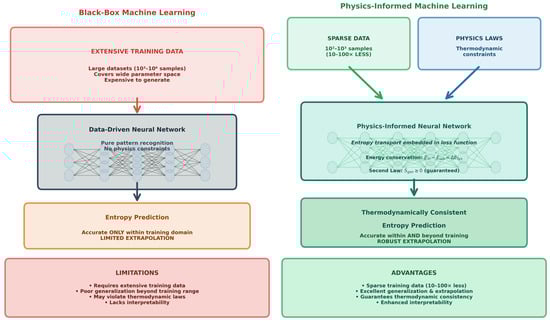
Figure 2.
Schematic comparison between black-box ML versus physics-informed ML for entropy prediction.
The interpretability of the model and the data requirements represents critical challenges. Physics-informed models improve interpretability by embedding known thermodynamic laws, but their complexity increases the implementation difficulty and computational overhead [202]. Purely data-driven models without physics constraints risk overfitting and generating physically inconsistent predictions, particularly when extrapolating beyond training data [201]. Inductive biases based on thermodynamics reduce data requirements by incorporating structural knowledge; single-generator versus double-generator formulations show improved accuracy with fewer training samples when physical principles are embedded [202]. Bayesian physics-informed neural networks provide uncertainty quantification for phonon transport problems, enabling robust reconstruction with sparse and noisy data compared to deterministic PINNs [198]. However, Bayesian methods incur higher training complexity and computational expense, limiting scalability to high-dimensional multi-physics problems [198].
The generalization capability varies significantly between methods. Thermodynamics-informed latent space dynamics identification (tLaSDI) demonstrates robust extrapolation across thermodynamic regimes by embedding first and second laws via the GENERIC formalism, outperforming purely data-driven latent models [191]. Graph neural networks with local metriplectic biases generalize effectively across solid and fluid mechanics applications without retraining [196]. Conversely, surrogate neural networks for multi-generation system optimization achieve high predictive accuracy (R2 > 0.98) within training domains but exhibit degraded performance when applied to systems with significantly different configurations or operating conditions [203]. Adaptive sampling strategies guided by energy dissipation rates improve PINN accuracy six times over traditional methods in Allen–Cahn phase field models, demonstrating that physics-informed sampling enhances generalization [204].
Hybrid physics-informed models balance flexibility and thermodynamic fidelity. Neural ODEs with irreversible port-Hamiltonian system frameworks provide physically consistent predictions for the building of thermodynamics and gas-piston systems while maintaining modular flexibility [205]. Variational Neural Networks for Observable Thermodynamics (V-NOTS) guarantee non-decreasing entropy evolution with low parameter counts, achieving data-efficient phase space predictions in dissipative dynamical systems [206]. Multi-branch PINN deep operator networks combine physics-informed constraints with operator learning, allowing rapid thermal simulations orders of magnitude faster than numerical solvers without retraining for variable parameters [207].
AI/ML methods clearly improve optimization results when thermodynamic constraints dominate and the training data are representative. Entropy-driven DRL for HVAC achieves substantial energy savings by learning control policies that balance thermal comfort and entropy generation [8]. PINNs accelerate the inverse design of heat exchangers by parameterizing the geometry and operating inputs, enabling Pareto-optimal design search in real-time compared to iterative CFD-based optimization [208]. However, AI/ML approaches may fail or overfit when: (1) training data are insufficient or non-representative, leading to poor generalization [204]; (2) physics constraints are inadequately enforced, resulting in thermodynamically inconsistent predictions [201]; (3) systems exhibit highly nonlinear or chaotic dynamics beyond model capacity; (4) computational resources limit hyperparameter tuning or ensemble training [203]. Reinforcement learning methods struggle with interpretability and stability in stochastic environments, potentially converging to suboptimal policies despite high training costs [194]. These limitations underscore the necessity of integrating domain knowledge, validating across diverse operating conditions, and employing uncertainty quantification to ensure reliable entropy optimization in practical thermal and energy systems.
4.3. Case Studies in Entropy-Based Optimization
Entropy-based optimization techniques have been systematically applied in heat exchangers, thermal management systems, and renewable energy technologies, demonstrating quantifiable improvements in thermodynamic performance. In heat exchangers, multi-objective optimization frameworks integrating EGM with thermal–hydraulic metrics achieve substantial performance gains. Topology optimization of discontinuous fin-based microchannel heat exchangers using multi-objective CFD with penalization factors yields 30–35% reductions in both entropy generation and pressure drop while maintaining thermal gain [209]. Genetic programming applied to refrigerant heat exchanger circuitry minimizes entropy generation while maximizing coefficient of performance (COP), confirming that reduced friction and heat transfer irreversibility correlate with improved COP [199]. NSGA-II optimization of rectangular microchannel heat sinks achieves up to 19% entropy reduction and 90% improvement in figure of merit through simultaneous thermal and hydraulic optimization [210]. Figure 3 presents quantitative performance improvements from this methodology. The optimization approach couples the Response Surface Methodology (RSM) with the NSGA-II multi-objective genetic algorithm, targeting simultaneous minimization of entropy generation, pressure drop, and thermal resistance [210]. Performance improvements include 19% entropy reduction, 90% figure of merit enhancement (FOM defined as (Rth·ΔP)−1), and 91% computational cost savings via RSM surrogate modeling compared to full factorial design of experiments [165,210]. Entropy generation analysis reveals thermal entropy dominance (70–75% of total), justifying prioritization of heat transfer enhancement strategies (e.g., increased channel depth, optimized fin geometry) over friction reduction in microchannel design optimization [210]. RSM-coupled NSGA-II enables rapid design space exploration with 15–25 CFD evaluations versus 200+ for full factorial approaches, while maintaining typical validation errors of 3–12% for thermal resistance and pressure drop predictions [165,211].
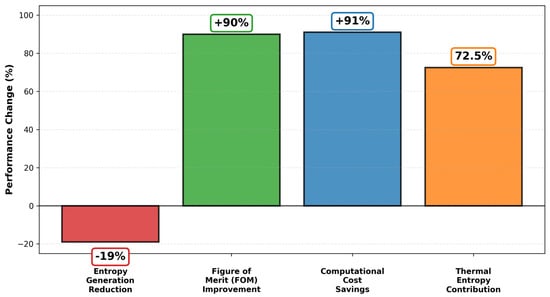
Figure 3.
Verified performance improvements from microchannel heat sink optimization using the RSM-coupled NSGA-II methodology (Figure prepared using data and information reported in the cited publications [165,210]).
Multi-objective genetic algorithms applied to serrated plate-fin heat exchangers demonstrate 31% entropy reduction with improved heat transfer factors, revealing high sensitivity of entropy generation to structural parameters [212].
Thermal management systems benefit from entropy-based optimization through structural and architectural improvements. Supercritical CO2-cooled microchannel heat sinks optimized by numerical simulation and structural optimization reduce entropy generation while enhancing temperature uniformity [185]. Graph-based modeling with dynamic optimization of aircraft thermal management architectures minimizes total entropy generation and bleed air flow, revealing architecture-level trade-offs between entropy and mass flow rate across mission profiles [213]. Double-layer liquid-cooled plates optimized via genetic algorithms reduce pump power by up to 70%, though entropy reduction is less pronounced, highlighting method-dependent fitness function selection [214].
Renewable energy systems demonstrate significant entropy-based optimization potential. Exergo-economic and thermo-mechanical optimization of segmented thermoelectric generators to concentrate solar power maximizes power and exergy efficiency while minimizing entropy, and balancing thermal, economic, and environmental objectives [182]. Multi-objective optimization using Rao algorithms with multi-attribute decision-making (MADM) for Stirling solar dish heat engines minimizes entropy generation while maximizing power and efficiency, providing competitive design flexibility [215]. Helical fins for concentrated solar receivers optimized by surrogate modeling and CFD achieve quantified separation of thermal and viscous entropy contributions, with the operational Re critically affecting the balance of entropy [216]. Ocean thermal energy conversion (OTEC) condensers optimized using multi-objective genetic algorithms achieve 9.9% composite function reduction, with Pareto sets aiding performance selection balancing entropy generation and pumping power [217]. Table 8 synthesizes key case studies, highlighting system types, optimization methods, quantitative results, and computational characteristics.
Table 8.
Summary of Key Entropy-Based Optimization Case Studies.
Comparative synthesis reveals that multi-objective genetic algorithms (NSGA-II, MOGA) and metaheuristics (Harris Hawks, Grasshopper) consistently deliver robust entropy reductions across diverse systems, with computational costs ranging from moderate to high depending on CFD integration. Methods work well when: (1) design spaces are well-defined with measurable trade-offs between entropy, thermal performance, and pressure drop; (2) sufficient computational resources enable high-fidelity simulations; (3) experimental validation or surrogate modeling constrains solution spaces. Limitations emerge when: (1) idealized boundary conditions do not capture real-world transient or multiphysics interactions [218]; (2) computational expense restricts parameter exploration in high-dimensional spaces [216]; (3) economic and manufacturability constraints are inadequately integrated, reducing practical applicability [219]; (4) experimental validation is sparse, limiting confidence in predicted performance gains [214,220].
The trade-offs between the reduction in entropy and the computational cost across various optimization methods are visualized in Figure 4. The scatter plot maps seven case studies from Table 8, with the x-axis representing the percentage of entropy reduction (5–40%) and the y-axis indicating computational cost categories (Low to High). Marker size represents additional performance gains (e.g., COP improvement, pressure drop reduction). The figure reveals distinct patterns: the highest entropy reductions (30–35%) correspond to computationally intensive multi-objective CFD methods applied to microchannel systems [209,212], where baseline configurations are far from optimal. Lower reductions (9.9–15%) in more mature systems (OTEC condensers [217], solar Stirling engines [215]) reflect incremental improvements over already-optimized baselines. The green-shaded “Sweet Spot Zone” (17–33% reduction at moderate cost) identifies methods achieving substantial entropy reduction without prohibitive computational expense, including genetic algorithms [199,210] and multi-objective approaches [212,215]. This visualization guides method selection: preliminary design favors computationally efficient surrogate models, while detailed optimization justifies high-fidelity CFD despite increased cost.
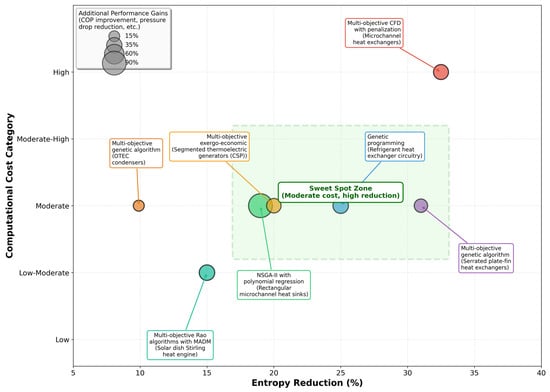
Figure 4.
Reduction in entropy in relation to the computational cost for selected optimization methods.
Constructal theory-based approaches demonstrate efficiency in achieving substantial entropy and temperature reductions with lower computational cost compared to exhaustive CFD-based topology optimization, though applicability is constrained to systems amenable to flow architecture simplifications [221]. Hybrid machine learning and multi-objective frameworks in photovoltaic-thermal systems with phase change materials reveal trade-offs between electrical power output and entropy generation, with multi-criteria decision-making enhancing design flexibility [222]. Harris Hawks optimization applied to microchannel heat sinks outperforms traditional metaheuristics in computational efficiency and entropy minimization quality, suggesting that algorithmic selection significantly impacts optimization results [174]. The response surface methodology coupled with NSGA-II for twisted elliptical tubes identifies Pareto-optimal designs that minimize entropy while balancing the Nusselt number and friction factor, demonstrating synergistic effects of design variables [165]. These findings collectively underscore that the effectiveness of entropy-based optimization depends critically on problem formulation, algorithm selection, computational resource allocation, and integration of practical constraints, with successful implementations requiring careful balance between thermodynamic rigor and engineering feasibility.
5. Advances in Computational Entropy Analysis for Emerging Technologies
This section explores recent advances in computational entropy and exergy analysis applied to emerging technologies in green buildings, smart grids, and waste heat recovery. The emphasis is on the use of CFD, FEM and AI-driven methods to quantify irreversibility, optimize thermal performance, and guide sustainable system design. Key developments include HVAC control informed by entropy, entropy–exergy trade-offs in renewable energy systems, and advanced exergy partitioning for component-level optimization in integrated energy infrastructures.
5.1. Green Buildings and Thermal Management
Computational thermodynamic entropy analysis in green buildings and thermal management systems quantifies thermodynamic irreversibility and evaluates energy efficiency through entropy generation, exergy destruction, and second-law efficiency metrics. HVAC system applications demonstrate the utility of entropy in identifying operational inefficiencies and optimizing control strategies. Deep reinforcement learning enhanced with entropy screening for HVAC control achieves up to 38.95% energy savings under high-temperature conditions, with entropy-based information filtering improving algorithmic efficiency [8]. Local entropy generation modeling in dew-point evaporative coolers identifies optimal operating conditions minimizing entropy production, validated through thermodynamic analysis without AI or CFD coupling [223]. Improved entropy value methods for refrigeration and air conditioning energy efficiency evaluation achieve accuracy exceeding 95% by combining entropy metrics with refrigeration energy efficiency transport functions [224]. CFD simulation of entropy generation in plus-shaped HVAC cavities quantifies significant heat transfer enhancement alongside entropy generation, providing correlations for natural convection optimization [225].
Building envelope applications employ entropy and exergy analysis to assess thermal performance and sustainability. Exergy and entropy performance analysis in integrated buildings reports fuel-based exergy efficiency of 55.02% with 20.31% improvement potential, identifying entropy destruction in heating systems through comparative parametric studies [226]. Phase change material (PCM) integration in building envelopes optimized via deep reinforcement learning and Bayesian optimization on large thermal datasets achieves up to 45% heating and cooling load energy savings with reduced temperature fluctuation, validated on extensive simulated building thermal profiles [227]. CFD modeling combined with energetic, environmental, and economic (3E) assessment for PCM-enhanced envelopes reduces annual energy consumption by 20% and improves thermal comfort by 14%, validated experimentally and economically [228]. FEM simulations using COMSOL Multiphysics for dual cavity systems quantify trade-offs between heat transfer improvement and entropy increase through parametric entropy analysis [229].
Indoor thermal comfort models integrate entropy metrics with computational approaches to optimize environmental conditions. Multi-objective optimization using EnergyPlus simulation with NSGA-II and Shannon information entropy weighting achieves energy savings of up to 82.66% while improving thermal comfort across climates through thermostat and insulation optimization, validated statistically [230]. Parametric optimization of summer thermal comfort using DesignBuilder simulations optimizing windows, shading, and HVAC reduces cooling energy by 62% and improves thermal comfort by 54% in university office spaces [231]. Table 9 summarizes selected studies demonstrating entropy applications across HVAC, building envelopes, and thermal comfort domains.
Table 9.
Selected Studies on Computational Entropy in the Thermal Management of Green Buildings.
CFD-based entropy analysis provides spatial resolution for thermal and airflow optimization. Numerical optimization of baffled channel thermohydraulics using the response surface methodology reduces entropy generation while improving performance in air channels with baffle design, validated through multi-objective optimization [232]. CFD simulations combined with machine learning for urban heat mitigation quantify the effectiveness of urban and building-scale cooling strategies, validated with real weather and urban data [233]. Thermodynamic entropy footprint modeling on an urban scale coupled with high-resolution climate and spatial modeling reduces the flux of entropy and the cooling load in urban greenery scenarios, validated with climate datasets [17]. The evaluation of the ecological network (ENA) based on dynamic exergy flows reduces the heating and cooling energy by 84% and source energy by 15% in building and community energy systems, validated through Modelica-based simulation [234].
AI-based techniques improve predictive capabilities for entropy analysis. Hybrid prediction that combines wavelet decomposition and entropy-based model selection improves prediction speed and accuracy for building energy consumption, validated experimentally on multiple real datasets [235]. Information entropy (Shannon entropy, distinct from thermodynamic entropy) applied as an uncertainty metric in clustering algorithms effectively detects abnormal modes of energy consumption of HVAC in central air-conditioning systems, validated with data monitored over two years [236]. Entropy-based data reduction integrated with machine learning guides feature extraction and selection, enhancing prediction accuracy and computational efficiency in multidisciplinary engineering systems [237]. Dynamic exergy analysis based on energy network theory identifies exergy loss and storage in integrated energy systems with electrical and thermal flows, validated through a case study with theoretical and numerical methods [238]. These applications collectively demonstrate that computational entropy analysis provides rigorous thermodynamic foundations to evaluate and improve energy efficiency, thermal comfort, and sustainability in green building systems, with quantitative performance improvements ranging from 14% to 84% across diverse applications and scales.
5.2. Smart Grids and Waste Heat Recovery
Computational entropy and exergy analyses in smart grids and waste heat recovery (WHR) systems quantify thermodynamic irreversibility and guide performance optimization through AI-based models, in addition to CFD and FEM approaches. AI-based modeling techniques demonstrate high predictive accuracy for entropy generation and exergy destruction in WHR components. ANN surrogate models predict the performance of the ejector with exergy destruction quantified at 19.39 kW, enabling the optimization of multi-objective particle swarms (MOPSO) to effectively reduce total exergy destruction [239]. XGBoost-Random Forest hybrid models outperform other AI approaches in thermo-economic prediction for ORC systems, integrating entropy/exergy metrics to identify parameters minimizing exergy loss and achieving first/second law efficiencies suitable for design optimization [240]. ANN combined with genetic algorithms models direct internal reforming solid oxide fuel cells (DIR-SOFC) with 57.6% exergy efficiency, using multi-objective optimization with TOPSIS to reduce exergy destruction while balancing power, exergy, and environmental impact [241]. Machine learning models predict supercritical CO2-ORC cycle performance precisely, minimizing exergy loss via bottoming cycle integration and genetic algorithm optimization of cycle parameters to achieve maximum thermal and exergetic efficiencies [242].
Advanced exergy analyses partition entropy generation into avoidable/unavoidable and endogenous/exogenous components, revealing irreversible sources for targeted improvements. Conventional and advanced exergy analyses applied to hybrid geothermal–solar ORC quantify avoidable and endogenous exergy destruction per component, demonstrating that integration of the hybrid system reduces exergy destruction through solar augmentation [243]. Advanced exergy analysis identifies exergy destruction in LNG cold energy systems, with heat exchangers and condensers dominating entropy generation; quantified avoidable exergy destruction for turbines and heat exchangers yields an exergy efficiency of 21.40%, prioritizing component improvements [244]. Comparative advanced exergy analysis across three ORC types quantifies avoidable and endogenous exergy destruction, showing regenerative ORCs significantly reduce exergy destruction and guide component prioritization [245]. Table 10 summarizes selected studies demonstrating AI-based modeling, advanced exergy analysis, and multi-objective optimization applications.
Table 10.
Selected Studies on Computational Entropy/Exergy Analysis in Smart Grids and WHR Systems.
Smart grid applications integrate entropy/exergy metrics for energy conversion, transmission, and storage optimization. Exergy analysis model with cutting plane method applied to 97-node integrated energy systems accurately quantifies exergy destruction, enabling sequential optimization to reduce total destroyed exergy by 23% while establishing exergy-based pricing for economic evaluation [246]. Exergy-based planning framework for industrial waste heat recovery reduces exergy loss by 27.3% and decreases operating costs by 20.6% through integrated planning, demonstrating exergy theory’s utility in guiding integrated energy system design [247]. Exergo-economic modeling with the response surface methodology optimizes wind power hybrid storage systems, increasing exergy efficiency by 10% and reducing unit exergy cost by 0.03 yuan/KJ, improving power quality and efficiency [248]. Multi-objective coordinated operation for multi-energy hubs using bargaining game approach models and minimizes thermal exergy loss, achieving 2.6% reduction in exergy loss and operation cost through coordination [249].
The applications of WHR components demonstrate evaluation and optimization based on entropy. Performance modeling with advanced exergy analysis for data center fuel cell and absorption systems quantifies exergy destruction, showing that waste heat recovery increases exergy efficiency by 9.78% to total exergy efficiency of 60.55%, guiding system improvement strategies [250]. Matlab simulation with advanced exergy and exergo-economic analysis quantifies component-level exergy destruction, partitioning losses to improve exergetic efficiency from 27.1% to 27.7% through graphical optimization enhancing thermodynamic and economic performance in ORC systems [251]. Comparative analysis of ORC and absorption-ORC (AORC) systems reveals AORC reduces entropy generation via large temperature gradients, achieving electrical exergy efficiency of 55.45% with lower exergy loss, identifying optimal waste heat recovery design [252]. Hybrid supercritical CO2 and ORC integration with machine learning optimization minimizes exergy losses via cascade heat utilization, achieving cycle efficiency of 60% and demonstrating improved waste heat recovery through hybrid system design [253].
Entropy flow analysis applied to integrated energy systems captures dynamic thermal transmission irreversibility. The entropy flow analysis for thermal transmission quantifies entropy generation at nodes and branches, linking irreversible entropy generation to power loss, and improving the accuracy of the thermal system through modeling based on entropy [254]. The carbon emission–exergy flow model for integrated energy systems tracks carbon emission sources using entropy and exergy metrics, linking exergy destruction to renewable energy variability and informing low-carbon operation benchmarking [4]. Multi-objective optimization frameworks balance thermodynamic, economic, and environmental objectives. Pattern recognition and sensitivity analysis applied to cogeneration systems use entropy-related metrics to identify key parameters, with multi-objective optimization reducing exergy destruction and emissions while benchmarking cogeneration performance through exergy and economic indicators [255]. These applications collectively demonstrate that computational entropy and exergy analyses provide rigorous frameworks for quantifying irreversibility, benchmarking system performance, and guiding design improvements in smart grids and WHR systems, with reported exergy efficiency improvements ranging from 9.78% to 27.3% and exergy destruction reductions up to 23% across diverse applications.
6. Challenges and Future Directions
Computational entropy modeling for sustainable energy systems faces fundamental challenges spanning theoretical foundations, computational implementation, and empirical validation. This section synthesizes critical limitations identified in the literature and proposes future research directions through structured analytical frameworks.
6.1. Overview of Critical Challenges
The literature reveals four principal categories of challenges that collectively constrain the advancement and deployment of computational entropy modeling: theoretical limitations arising from definitional ambiguities and unresolved source modeling, computational constraints related to scalability and numerical stability, validation barriers due to experimental benchmark scarcity and system-level verification gaps, and methodological gaps in comparative frameworks and multi-scale integration. Table 11 provides a comprehensive taxonomy of these challenges with specific manifestations and representative studies.
Table 11.
Critical Challenges in Computational Entropy Modeling.
Figure 5 illustrates the complex interdependencies among challenge categories, revealing that progress in one domain often depends on advances in others. Theoretical ambiguities in entropy definitions directly impact computational method development, as algorithms must accommodate multiple formulations or assume specific definitions that may not generalize. Validation barriers compound theoretical uncertainties, since the scarcity of experimental data prevents empirical resolution of competing theoretical frameworks. Computational scalability constraints limit the complexity of models that can be validated, creating a bottleneck where only simplified cases receive experimental corroboration. Methodological gaps in comparative frameworks perpetuate fragmentation, as researchers cannot systematically identify which computational approaches best address specific theoretical or validation challenges. Figure 5 visualizes this hierarchical structure. Theoretical limitations (top) cascade through three mid-level challenge categories—computational constraints, validation barriers, and methodological gaps—which collectively limit practical deployment (bottom box). Arrows indicate specific dependency mechanisms: theoretical ambiguities constrain algorithm design, prevent empirical resolution, and perpetuate fragmentation.
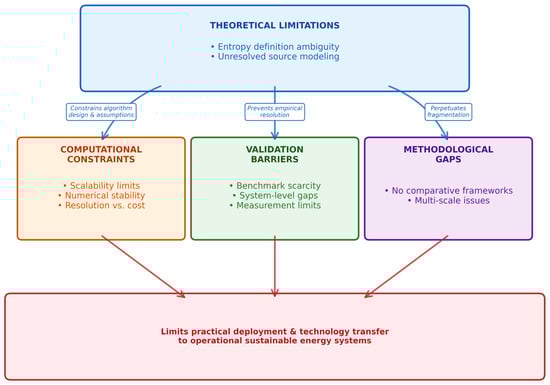
Figure 5.
Interdependency Network of Computational Entropy Modeling Challenges.
6.2. Future Research Directions
Table 12 synthesizes future research directions organized by priority level (high, medium) based on the potential impact on advancing the field, the feasibility within the 5-year horizon and the number of challenges addressed categories. High-priority directions simultaneously address multiple challenge categories and offer paths to near-term practical impact.
Table 12.
Future Research Directions with Implementation Pathways.
Figure 6 presents a 5-year implementation roadmap organizing research directions into three parallel tracks (Theoretical Foundations, Computational Methods, Validation and Deployment) with explicit dependencies and milestones. Near-term efforts (Years 1–2) focus on establishing foundational capabilities: unified entropy frameworks, benchmark dataset development, and physics-informed ML prototypes. Mid-term activities (Years 2–4) emphasize integration and validation: multi-physics coupling, experimental corroboration, and testbed deployment. Long-term objectives (Years 4–5) target operational implementation: real-time control strategies, validated digital twins, and technology transfer to industry. Figure 6 organizes activities into three horizontal tracks (blue: Theoretical, orange: Computational, green: Validation) across three temporal phases. Horizontal arrows indicate time progression within tracks, while vertical bidirectional dashed arrows represent cross-track dependencies that require coordination. The bottom purple bar emphasizes continuous interdisciplinary coordination that spans all phases.
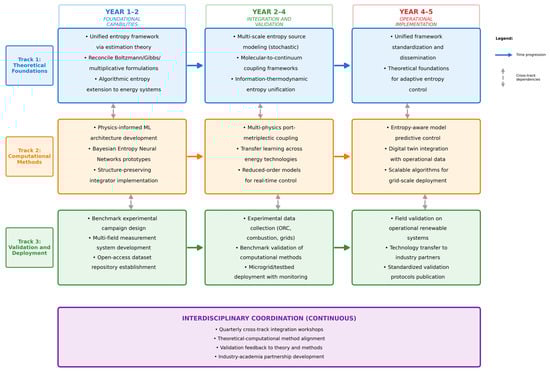
Figure 6.
Implementation Roadmap to Advance Computational Entropy Modeling.
7. Conclusions
This review synthesizes advances in computational entropy modeling advances across theoretical foundations, numerical methods, optimization strategies, and emerging energy applications, revealing entropy’s dual role as both analytical challenge and system design tool.
Theoretical assessments establish persistent challenges beyond computational precision. Competing entropy formulations—Boltzmann, Gibbs, multiplicative, algorithmic—create conceptual fragmentation that hinders standardization. Critically, entropy’s status as a mathematical state function rather than directly measurable property introduces validation paradoxes absent in energy-based analyses. Systematic conflation between entropy generation (irreversibility) and configurational entropy (statistical disorder) leads to inappropriate method selection with order-of-magnitude computational cost differences.
Numerical modeling evaluations reveal maturity stratification. CFD achieves industrial readiness for steady-state, single-phase thermal systems but struggles with transient multiphase phenomena and entropy transport stability. FEM demonstrates superior capability for conjugate heat transfer, yet it faces entropy source term stabilization challenges. The LBM shows promise for microscale applications, though turbulence modeling remains immature. Critically, comparative benchmarking between methods in standardized cases remains absent, preventing systematic selection guidance.
Optimization analysis demonstrates that EGM provides rigorous design guidance when thermal and viscous irreversibilities dominate. Multi-objective genetic algorithms deliver 15–35% entropy reductions across heat exchangers and thermal management systems. However, thermal–-frictional trade-offs create Pareto frontiers where entropy-minimized designs may not maximize performance; off-design operation invalidates design-point optimization; and transient effects violate steady-state assumptions. AI integration through physics-informed neural networks enhances efficiency 10–100× while maintaining thermodynamic consistency, yet faces data requirements and generalization challenges.
Applications reveal selective maturity. Green building HVAC achieves operational deployment with 20–83% validated energy savings. Smart grid and waste heat recovery demonstrate exergy destruction quantification enabling 9.78–27.3% efficiency improvements. However, successes concentrate in steady-state systems with well-characterized boundaries. Transient renewable integration, stochastic disturbances, and strongly coupled multi-energy systems remain inadequately addressed.
The critical unresolved limitations span all domains. Theoretically, entropy source modeling in non-equilibrium multiphase systems lacks predictive accuracy. Computationally, high-order sensitivity analyses remain prohibitively expensive for real-time optimization. Validation faces experimental benchmark scarcity: simultaneous high-resolution multi-field measurements enabling component-level verification are unavailable, forcing reliance on indirect integrated quantities obscuring local errors. Methodologically, molecular-to-system entropy accounting remains incomplete with ad hoc scale-bridging.
The field exhibits greatest maturity in steady-state, single-phase thermal systems with dominant conductive–convective entropy generation, where commercial CFD coupled with response surface methodology enables practical optimization. Significant gaps persist in transient multiphysics systems, microscale entropy transport, turbulent combustion prediction, and real-time entropy-aware control. Future progress requires coordinated advances: unified theoretical frameworks reconciling competing definitions; physics-informed machine learning enabling scalable predictions; and standardized experimental benchmarks facilitating validation. The roadmap prioritizes foundational capabilities (Years 1–2), integration and validation (Years 2–4), and operational implementation (Years 4–5), with interdisciplinary coordination being essential to translate advances into validated tools supporting sustainable energy system design.
Funding
This work was supported by the Ministry of Science and Higher Education, Poland, Grant AGH University of Krakow no. 16.16.110.663.
Data Availability Statement
The original contributions presented in this study are included in the article material. Further inquiries can be directed to the corresponding author.
Conflicts of Interest
The author declares no conflicts of interest.
References
- Nabwey, H.A.; Ashraf, M.; Nadeem, H.; Rashad, A.M.; Chamkha, A.J. Optimizing renewable energy systems: A comprehensive review of entropy generation minimization. AIP Adv. 2024, 14, 120702. [Google Scholar] [CrossRef]
- Haseli, Y. Interpretation of Entropy Calculations in Energy Conversion Systems. Energies 2021, 14, 7022. [Google Scholar] [CrossRef]
- Hao, J.; Ju, C.; Ma, T.; Wang, X.; Liang, L.; Hong, F.; Du, X. Integrated modeling and exergy evaluation of an advanced solar-driven supercritical carbon dioxide-heat pump cogeneration system by standard thermal resistance. Energy Convers. Manag. 2024, 307, 118357. [Google Scholar] [CrossRef]
- Yang, W.; Huang, Y.; Zhang, T.; Zhao, D. Mechanism and analytical methods for carbon emission-exergy flow distribution in heat-electricity integrated energy system. Appl. Energy 2023, 352, 121980. [Google Scholar] [CrossRef]
- Tolasa, D.G. Advancements in Thermodynamic Modeling: Bridging Classical Theory and Computational Techniques. Eur. J. Biophys. 2025, 13, 1–9. [Google Scholar] [CrossRef]
- Donti, P.L.; Kolter, J.Z. Machine Learning for Sustainable Energy Systems. Annu. Rev. Environ. Resour. 2021, 46, 719–747. [Google Scholar] [CrossRef]
- Mira, K.; Bugiotti, F.; Morosuk, T. Artificial Intelligence and Machine Learning in Energy Conversion and Management. Energies 2023, 16, 7773. [Google Scholar] [CrossRef]
- Zhang, C.; Tan, Z. Entropy-driven deep reinforcement learning for HVAC system optimization. J. Renew. Sustain. Energy 2025, 17, 015101. [Google Scholar] [CrossRef]
- Cacuci, D.G.; Cacuci, D.G. Second-Order MaxEnt Predictive Modelling Methodology. I: Deterministically Incorporated Computational Model (2nd-BERRU-PMD). Am. J. Comput. Math. 2023, 13, 236–266. [Google Scholar] [CrossRef]
- Wang, X.; Wang, J.; Wei, M.; Yue, Y. Entropy-Based Stochastic Optimization of Multi-Energy Systems in Gas-to-Methanol Processes Subject to Modeling Uncertainties. Entropy 2025, 27, 52. [Google Scholar] [CrossRef]
- Manion, A.R.; Malatesta, W.A.; Jain, N. Development of a Graph-based Modeling Framework for Transient Exergy Analysis. In Proceedings of the 2022 21st IEEE Intersociety Conference on Thermal and Thermomechanical Phenomena in Electronic Systems (iTherm), San Diego, CA, USA, 31 May–3 June 2022. [Google Scholar] [CrossRef]
- Liu, Z.; Huang, B.; Du, P.; Sun, Q.; Maharjan, S.; Gao, D.W.; Li, Y. An Information Theory-Based Locational Marginal Pricing Solution for Low-Carbon Power Systems. IEEE Trans. Ind. Inform. 2024, 20, 13559–13570. [Google Scholar] [CrossRef]
- Zhao, Z.; Yang, D.; Yu, W.; Zhao, N.; Zhang, P.; Deng, L. Economic Dispatch of Urban Renewable Energy Based on Information Entropy. In Proceedings of the 2024 Second International Conference on Cyber-Energy Systems and Intelligent Energy (ICCSIE), Shenyang, China, 17–19 May 2024. [Google Scholar] [CrossRef]
- Cacuci, D.G.; Fang, R. Review of Fourth-Order Maximum Entropy Based Predictive Modeling and Illustrative Application to a Nuclear Reactor Benchmark: II. Best-Estimate Predicted Values and Uncertainties for Model Responses and Parameters. Energies 2024, 17, 3875. [Google Scholar] [CrossRef]
- Wang, R.; Liu, X.; Zhao, X.; Cheng, X.; Qiu, H. A novel entropy-based method for quantifying urban energy demand aggregation: Implications for urban planning and policy. Sustain. Cities Soc. 2024, 103, 105284. [Google Scholar] [CrossRef]
- Klen, K.; Navrotskyi, V.; Zhuikov, V. Simulation modeling of a power supply system taking into account the stochastic nature of energy generation and consumption processes. Comput. Probl. Electr. Eng. 2023, 13, 15–22. [Google Scholar] [CrossRef]
- Balocco, C.; Pierucci, G.; Baia, M.; Borghi, C.; Francini, S.; Chirici, G.; Mancuso, S. Energy Sustainability of Urban Areas by Green Systems: Applied Thermodynamic Entropy and Strategic Modeling Means. Atmosphere 2025, 16, 975. [Google Scholar] [CrossRef]
- Tripathi, H.; Neupane, S.; Rahimi, S.; Golilarz, N.A.; Mittal, S.; Sepehrifar, M. Estimating Reliability of Electric Vehicle Charging Ecosystem Using the Principle of Maximum Entropy. arXiv 2025, arXiv:2508.00916. [Google Scholar]
- Liu, Z.; Huang, B.; Hu, X.; Du, P.; Sun, Q. Blockchain-Based Renewable Energy Trading Using Information Entropy Theory. IEEE Trans. Netw. Sci. Eng. 2024, 11, 5564–5575. [Google Scholar] [CrossRef]
- Chatterjee, D.; Rao, S. Computational Sustainability: A Socio-technical Perspective. ACM Comput. Surv. 2021, 53, 101. [Google Scholar] [CrossRef]
- Osara, J.A.; Bryant, M.D. Methods to Calculate Entropy Generation. Entropy 2024, 26, 237. [Google Scholar] [CrossRef]
- Xu, S.Z.; Zhao, T.; Chen, Q.; Liang, X.G.; Guo, Z.Y. State functions/quantities in thermodynamics and heat transfer. Fundam. Res. 2022, 2, 101–107. [Google Scholar] [CrossRef]
- Tiezzi, E. Is entropy far from equilibrium a state function? Int. J. Ecodynamics 2006, 1, 44–54. [Google Scholar] [CrossRef]
- Alipour, S.; Rezakhani, A.T.; Chenu, A.; del Campo, A.; Ala-Nissila, T. Entropy-Based Formulation of Thermodynamics in Arbitrary Quantum Evolution. Phys. Rev. A 2019, 105, L040201. [Google Scholar] [CrossRef]
- Mihaescu, T.; Isar, A. Dynamics of Entropy Production Rate in Two Coupled Bosonic Modes Interacting with a Thermal Reservoir. Entropy 2022, 24, 696. [Google Scholar] [CrossRef] [PubMed]
- Aoki, K.M.; Ohnishi, S.; Sogo, K. Molecular Dynamics in the Light of Non-equilibrium Thermodynamics. Mol. Dyn. Light Non-Equilib. Thermodyn. 2022, 91, 074010. [Google Scholar] [CrossRef]
- Hanke, T.; Upterworth, A.L.; Sebastiani, D. Explicit Configurational Entropy of Mixing in Molecular Dynamics Simulations. J. Phys. Chem. Lett. 2024, 15, 11320–11327. [Google Scholar] [CrossRef] [PubMed]
- Ben-Naim, A. Entropy and the Second Law: Interpretation and Misss-Interpretations; World Scientific Publishing Co.: Singapore, 2012. [Google Scholar]
- Gao, J.; Liu, F.; Zhang, J.; Hu, J.; Cao, Y. Information Entropy As a Basic Building Block of Complexity Theory. Entropy 2013, 15, 3396–3418. [Google Scholar] [CrossRef]
- Kish, L.B.; Ferry, D.K. Information entropy and thermal entropy: Apples and oranges. J. Comput. Electron. 2018, 17, 43–50. [Google Scholar] [CrossRef]
- Naterer, G.F.; Camberos, J.A. Entropy-Based Design and Analysis of Fluids Engineering Systems; CRC Press: Boca Raton, FL, USA, 2008. [Google Scholar]
- Dewar, R.C.; Lineweaver, C.H.; Niven, R.K.; Regenauer-Lieb, K. (Eds.) Beyond the Second Law: Entropy Production and Non-Equilibrium Systems; Springer: Berlin/Heidelberg, Germany, 2014. [Google Scholar]
- Kondepudi, D.; Prigogine, I. Modern Thermodynamics: From Heat Engines to Dissipative Structures; Wiley Blackwell: Hoboken, NJ, USA, 2014. [Google Scholar] [CrossRef]
- Bejan, A. Entropy Generation Through Heat and Fluid Flow. J. Appl. Mech. 1983, 50, 475. [Google Scholar] [CrossRef]
- Annamalai, K.; Puri, I.K.; Jog, M.A. Advanced Thermodynamics Engineering; CRC Press: Boca Raton, FL, USA, 2011. [Google Scholar]
- Flügge, S. (Ed.) Principles of Classical Mechanics and Field Theory/Prinzipien der Klassischen Mechanik und Feldtheorie; Springer: Berlin/Heidelberg, Germany, 1960. [Google Scholar] [CrossRef]
- Bejan, A.; Jones, J.A. Advanced Engineering Thermodynamics; Wiley: Hoboken, NJ, USA, 2016. [Google Scholar] [CrossRef]
- Bejan, A. Entropy Generation Minimization: The Method of Thermodynamic Optimization of Finite-Size Systems and Finite-Time Processes; CRC Press: Boca Raton, FL, USA, 1996. [Google Scholar]
- Bejan, A. Fundamentals of exergy analysis, entropy generation minimization, and the generation of flow architecture. Int. J. Energy Res. 2002, 26, 545–565. [Google Scholar] [CrossRef]
- Wolfram, S. Computational Foundations for the Second Law of Thermodynamics. Complex Syst. 2024, 33, 133–252. [Google Scholar] [CrossRef]
- Gakkhar, N.; Soni, M.S.; Jakhar, S. Second law thermodynamic study of solar assisted distillation system: A review. Renew. Sustain. Energy Rev. 2016, 56, 519–535. [Google Scholar] [CrossRef]
- Jin, Y.; Du, J.; Li, Z.; Zhang, H. Second-Law Analysis of Irreversible Losses in Gas Turbines. Entropy 2017, 19, 470. [Google Scholar] [CrossRef]
- Bird, R.B.; Stewart, W.E.; Lightfoot, E.N. Transport Phenomena; Wiley: Hoboken, NJ, USA, 2003. [Google Scholar]
- White, F. Viscous Fluid Flow; McGraw-Hill Science/Engineering/Math: Columbus, OH, USA, 2005. [Google Scholar]
- Khan, M.I.; Alzahrani, F.; Hobiny, A.; Ali, Z. Estimation of entropy generation in Carreau-Yasuda fluid flow using chemical reaction with activation energy. J. Mater. Res. Technol. 2020, 9, 9951–9964. [Google Scholar] [CrossRef]
- Shehzad, S.A.; Madhu, M.; Shashikumar, N.S.; Gireesha, B.J.; Mahanthesh, B. Thermal and entropy generation of non-Newtonian magneto-Carreau fluid flow in microchannel. J. Therm. Anal. Calorim. 2021, 143, 2717–2727. [Google Scholar] [CrossRef]
- Yoshida, N. New formulation of local-equilibrium thermodynamics. AIP Adv. 2019, 9, 75117. [Google Scholar] [CrossRef]
- Demirel, Y. Nonequilibrium Thermodynamics: Transport and Rate Processes in Physical, Chemical and Biological Systems; Elsevier: Amsterdam, The Netherlands, 2007. [Google Scholar] [CrossRef]
- Mohammadi, I.; Ajam, H. A theoretical study of entropy generation of the combustion phenomenon in the porous medium burner. Energy 2019, 188, 116004. [Google Scholar] [CrossRef]
- Wakif, A.; Qasim, M.; Afridi, M.I.; Saleem, S.; Al-Qarni, M.M. Numerical Examination of the Entropic Energy Harvesting in a Magnetohydrodynamic Dissipative Flow of Stokes’ Second Problem: Utilization of the Gear-Generalized Differential Quadrature Method. J. Non-Equilib. Thermodyn. 2019, 44, 385–403. [Google Scholar] [CrossRef]
- Aslam, F.; Noreen, S.; Afridi, M.I.; Qasim, M. Analysis of Homogeneous/Heterogeneous Reactions in an Electrohydrodynamic Environment Utilizing the Second Law. Micromachines 2023, 14, 821. [Google Scholar] [CrossRef]
- Freidoonimehr, N.; Rashidi, M.M.; Abelman, S.; Lorenzini, G. Analytical Modeling of MHD Flow over a Permeable Rotating Disk in the Presence of Soret and Dufour Effects: Entropy Analysis. Entropy 2016, 18, 131. [Google Scholar] [CrossRef]
- Dhumal, G.S.; Havaldar, S.N. Experimental investigation of entropy generation in a pipe heat exchanger with turbulence generator inside and on the outside. Case Stud. Therm. Eng. 2023, 51, 103464. [Google Scholar] [CrossRef]
- Jatau, T.; Bello-Ochende, T.; De Paepe, M.; Demeester, T. Numerical investigation of entropy generation for flow boiling of R600A in the corrugated U-bend tube heat exchangers. Int. Commun. Heat Mass Transf. 2024, 155, 107510. [Google Scholar] [CrossRef]
- Fakheri, A. Maximization of the Heat Transfer Irreversibility. ASME J. Heat Mass Transf. 2024, 146, 021001. [Google Scholar] [CrossRef]
- Lee, K.; Kim, M.; Ha, M.Y.; Min, J.K. Investigation of heat-exchanger-sizing methods using genetic, pattern search, and simulated annealing algorithms and the effect of entropy generation. J. Mech. Sci. Technol. 2018, 32, 915–928. [Google Scholar] [CrossRef]
- Bejan, A. Second-Law Analysis in Heat Transfer and Thermal Design. Adv. Heat Transf. 1982, 15, 1–58. [Google Scholar] [CrossRef]
- Liu, I.S. On Fourier’s law of heat conduction. Contin. Mech. Thermodyn. 1990, 2, 301–305. [Google Scholar] [CrossRef]
- Varuvel, E.G.; Sonthalia, A.; Aloui, F.; Saravanan, C.G. Basics of heat transfer: Convection. In Handbook of Thermal Management Systems; Elsevier: Amsterdam, The Netherlands, 2023; pp. 35–77. [Google Scholar] [CrossRef]
- Su, L.; Yang, Y. Convective Heat Transfer and Entropy Generation Analysis in Elliptic Microchannels. ASME J. Heat Mass Transf. 2024, 146, 021004. [Google Scholar] [CrossRef]
- Biswal, P.; Basak, T. Entropy generation vs energy efficiency for natural convection based energy flow in enclosures and various applications: A review. Renew. Sustain. Energy Rev. 2017, 80, 1412–1457. [Google Scholar] [CrossRef]
- Anitha, S. CFD approach to analyze entropy generation, heat transfer of perforated conical ring turbulators embedded in heat exchanger with biological ternary hybrid nanofluid. Numer. Heat Transf. Part B Fundam. 2024, 87, 2341438. [Google Scholar] [CrossRef]
- Modest, M.F. Radiative Heat Transfer, 3rd ed.; Elsevier: Amsterdam, The Netherlands, 2013. [Google Scholar] [CrossRef]
- Abbasi, A.; Safavinejad, A.; Lakhi, M. Numerical study of surface radiation-natural convection entropy generation in a 2D cavity using the LBM. Int. Commun. Heat Mass Transf. 2023, 149, 107141. [Google Scholar] [CrossRef]
- Gelis, K.; Ozbek, K.; Huwaish, M. Entropy generation minimization for different types of heat exchangers using nanofluids. Energy Sources Part A Recover. Util. Environ. Eff. 2024, 46, 1403–1418. [Google Scholar] [CrossRef]
- López-Núñez, O.A.; Lara, F.; González-Angeles, A.; Cardenas-Robles, A.; Ramírez-Minguela, J.J.; Alfaro-Ayala, J.A. Assessment of thermohydraulic performance and entropy generation in an evacuated tube solar collector employing pure water and nanofluids as working fluids. Heliyon 2024, 10, e29309. [Google Scholar] [CrossRef]
- Nishida, K.; Takagi, T.; Kinoshita, S. Analysis of entropy generation and exergy loss during combustion. Proc. Combust. Inst. 2002, 29, 869–874. [Google Scholar] [CrossRef]
- Haseli, Y.; Hornbostel, K. Demonstration of an Inverse Relationship between Thermal Efficiency and Specific Entropy Generation for Combustion Power Systems. J. Energy Resour. Technol. Trans. ASME 2018, 141, 014501. [Google Scholar] [CrossRef]
- Wang, Z.; Xie, B.; Xia, X.; Luo, L.; Yang, H.; Li, X. Entropy production analysis of a radial inflow turbine with variable inlet guide vane for ORC application. Energy 2023, 265, 126313. [Google Scholar] [CrossRef]
- Hu, X.; Li, H.; Wang, Z.; Liu, M.; Lu, Y.; Zhang, Y.; Li, J.; Ding, K.; Liu, H.; Ma, Z.; et al. High Entropy Helps Na4Fe3(PO4)2P2O7 Improve Its Sodium Storage Performance. Adv. Funct. Mater. 2025, 35, 2412730. [Google Scholar] [CrossRef]
- Hong, J.; Qiu, M.; Liang, Y.; Liu, Y.; Chen, J.; Sun, P.; Mai, W. Entropy-regulated electrolytes for improving Zn2+ dynamics and Zn anodes reversibility. Appl. Phys. Lett. 2024, 124, 263902. [Google Scholar] [CrossRef]
- Böhm, K.; Zintel, S.; Ganninger, P.; Jäger, J.; Markus, T.; Henriques, D. Exploring the Impact of State of Charge and Aging on the Entropy Coefficient of Silicon–Carbon Anodes. Energies 2024, 17, 5790. [Google Scholar] [CrossRef]
- Huo, Y.; Shen, S.; Zhou, H.; Wang, S.; Rao, Z. Using entropy generation as evaluating indicator of charging completion in a latent thermal energy storage system. Int. Commun. Heat Mass Transf. 2023, 146, 106858. [Google Scholar] [CrossRef]
- Shahsavar, A.; Shaham, A.; Yıldız, Ç.; Arıcı, M. Entropy generation characteristics of phase change material in a variable wavy walled triplex tube latent heat storage unit for battery thermal management system. J. Energy Storage 2022, 51, 104374. [Google Scholar] [CrossRef]
- Sciacovelli, A.; Verda, V.; Sciubba, E. Entropy generation analysis as a design tool—A review. Renew. Sustain. Energy Rev. 2015, 43, 1167–1181. [Google Scholar] [CrossRef]
- Mahian, O.; Kianifar, A.; Kleinstreuer, C.; Al-Nimr, M.A.; Pop, I.; Sahin, A.Z.; Wongwises, S. A review of entropy generation in nanofluid flow. Int. J. Heat Mass Transf. 2013, 65, 514–532. [Google Scholar] [CrossRef]
- Herwig, H.; Kock, F. Direct and indirect methods of calculating entropy generation rates in turbulent convective heat transfer problems. Heat Mass Transf. Stoffuebertragung 2007, 43, 207–215. [Google Scholar] [CrossRef]
- Kock, F.; Herwig, H. Local entropy production in turbulent shear flows: A high-Reynolds number model with wall functions. Int. J. Heat Mass Transf. 2004, 47, 2205–2215. [Google Scholar] [CrossRef]
- Wang, R.; Du, Q.; Xie, Y.; Xie, L.; Lu, L. Large-eddy simulation of non-isothermal flow and heat transfer in an enclosed rotor-stator cavity. Phys. Fluids 2023, 35, 114112. [Google Scholar] [CrossRef]
- Du, Q.; Xie, Y.; Wang, Z.; Jiang, X.; Xie, L. An entropy viscosity method for large eddy simulation of turbulent thermal flow in a rotor-stator cavity. Phys. Fluids 2023, 35, 035126. [Google Scholar] [CrossRef]
- Wang, R.; Gao, F.; Chew, J.W.; Marxen, O.; Sun, Z. Advanced Modelling of Flow and Heat Transfer in Rotating Disc Cavities Using Open-Source CFD. In Proceedings of the ASME Turbo Expo 2023: Turbomachinery Technical Conference & Exposition, Boston, MA, USA, 26–30 June 2023; Volume 7. [Google Scholar] [CrossRef]
- Qiao, Z.; Chen, Y.; Wan, K.; Lv, Y. On the robustness and accuracy of large-eddy simulation in predicting complex internal flow of a gas-turbine combustor. Phys. Fluids 2023, 35, 085120. [Google Scholar] [CrossRef]
- Xia, Z.; Zhang, H.; Han, X.; Ren, Z. Self-adaptive turbulence eddy simulation of a premixed jet combustor. Phys. Fluids 2023, 35, 085137. [Google Scholar] [CrossRef]
- Wu, W.; Min, Y.; Han, X.; Ma, Y.; Yan, Z.; Deng, X. Self-Adaptive Turbulence Eddy Simulation with a high-order finite differencing method for high Reynolds number complex flows. Aerosp. Sci. Technol. 2023, 141, 108562. [Google Scholar] [CrossRef]
- Hu, K.S.; Shih, T.I.P. Large-Eddy vs. Reynolds-Averaged Navier–Stokes Simulations of Flow and Heat Transfer in a U-Duct with Unsteady Flow Separation. Energies 2024, 17, 2414. [Google Scholar] [CrossRef]
- Zope, A.; Schemmel, A.; Wang, X.; Bhushan, S.; Singh, P.; Luke, E. Assessment of Predictive Capability of Hybrid RANS/LES Turbulence Models for Thermofluid Applications. In Proceedings of the Fluids Engineering Division Summer Meeting FEDSM, Virtual, 10–12 August 2021; Volume 1. [Google Scholar] [CrossRef]
- Chen, T.; Wang, B.; Xia, Z.; Han, X. Validation of Self-Adaptive Turbulence Eddy Simulation for Double and Triple Swirling Turbulent Flows. Energies 2025, 18, 4249. [Google Scholar] [CrossRef]
- Liu, H.; Yin, Z.; Liu, H. Adaptive detached eddy simulation of turbulent combustion with the subgrid dissipation concept. Phys. Fluids 2024, 36, 055154. [Google Scholar] [CrossRef]
- Park, S. Direct numerical simulation for backward-facing step flow with turbulence anisotropy analysis in a fully staggered curvilinear grid. Phys. Fluids 2024, 36, 095107. [Google Scholar] [CrossRef]
- Bae, H.J.; Lozano-Duran, A. Numerical and modeling error assessment of large-eddy simulation using direct-numerical-simulation-aided large-eddy simulation. arXiv 2022, arXiv:2208.02354. [Google Scholar]
- Lee, C.S.; Shih, T.I.P.; Bryden, K.M.; Dalton, R.P.; Dennis, R.A. Strongly Heated Turbulent Flow in a Channel with Pin Fins. Energies 2023, 16, 1215. [Google Scholar] [CrossRef]
- Wang, G.; Liu, Y. A grid-adaptive simulation model for turbulent flow predictions. Phys. Fluids 2022, 34, 075125. [Google Scholar] [CrossRef]
- Stiehl, B.; Genova, T.; Newmyer, M.; Fortin, M.; Tonarely, M.; Rezzag, T.; Ahmed, K.A. Exploration of Large Eddy Simulation with Adaptive Mesh Refinement for a High-Pressure Staged Combustion System. In Proceedings of the AIAA SciTech Forum and Exposition, San Diego, CA, USA, 3–7 January 2022. [Google Scholar] [CrossRef]
- Doetsch, K.T.; Fidkowski, K.J. A Combined Entropy and Output-based Adaptive Approach Using a Stabilized Continuous Finite Element Formulation. In Proceedings of the AIAA SciTech Forum and Exposition, San Diego, CA, USA, 3–7 January 2022. [Google Scholar] [CrossRef]
- Jiang, Y.; Nadarajah, S. Numerical Dissipation Based Error Estimators and Grid Adaptation for Large Eddy Simulation. arXiv 2020, arXiv:2011.03468. [Google Scholar] [CrossRef]
- Wu, W.; Yan, Z.; Min, Y.; Han, X.; Ma, Y.; Zhao, Z. High-order discretization–based self-adaptive turbulence eddy simulation for supersonic base flow with PHengLEI software. Eng. Comput. 2024, 41, 819–841. [Google Scholar] [CrossRef]
- Pederson, C.C.; Oliver, T.; Moser, R.D. An Active Model Split for Hybrid RANS/LES of Compressible Flows. In Proceedings of the AIAA SciTech Forum and Exposition, San Diego, CA, USA, 3–7 January 2022. [Google Scholar] [CrossRef]
- Mehta, M.; Manceau, R.; Duffal, V.; de Laage de Meux, B. An active hybrid Reynolds-averaged Navier-Stokes/large eddy simulation approach for gray area mitigation. Phys. Fluids 2023, 35, 125116. [Google Scholar] [CrossRef]
- Jaiswal, A.K.; Dewan, A.; Bhattacharya, A. Development of an Interpolated RANS-LES solver for wall-bounded turbulent fluid flows. Comput. Fluids 2023, 267, 106086. [Google Scholar] [CrossRef]
- Duan, Z.; Wang, Z.J. Calibrating sub-grid scale models for high-order wall-modeled large eddy simulation. Adv. Aerodyn. 2024, 6, 5. [Google Scholar] [CrossRef]
- Chen, Y.; Yang, T.; Zhou, H.; Mo, Y.; Chen, F.; Ren, Z. Coupled zone-adaptive turbulence and combustion modeling of turbulent swirling premixed flames. Phys. Fluids 2024, 36, 125181. [Google Scholar] [CrossRef]
- Heinz, S. Physically Consistent Resolving Simulations of Turbulent Flows. Entropy 2024, 26, 1044. [Google Scholar] [CrossRef]
- Fagbade, A.; Heinz, S. Continuous Eddy Simulation vs. Resolution-Imposing Simulation Methods for Turbulent Flows. Fluids 2024, 9, 22. [Google Scholar] [CrossRef]
- Zienkiewicz, O.C.; Taylor, R.L.; Nithiarasu, P. The Finite Element Method for Fluid Dynamics, 7th ed.; Elsevier: Amsterdam, The Netherlands, 2013. [Google Scholar] [CrossRef]
- Reddy, J.N.; Gartling, D.K. The Finite Element Method in Heat Transfer and Fluid Dynamics; CRC Press: Boca Raton, FL, USA, 2010. [Google Scholar] [CrossRef]
- Bathe, K.-J. Finite Element Procedures; Prentice Hall: Englewood Cliffs, NJ, USA, 2006. [Google Scholar]
- Tóth, B.; Molnár, Z.; Kovács, R. Two-field mixed hp-finite elements for time-dependent problems in the refined theories of thermodynamics. Contin. Mech. Thermodyn. 2024, 36, 825–838. [Google Scholar] [CrossRef]
- Tóth, B. Three-field mixed hp-finite element method for the solution of the Guyer–Krumhansl heat conduction model. Int. J. Heat Mass Transf. 2023, 217, 124663. [Google Scholar] [CrossRef]
- Tchinda Ngueyong, I.; Urquiza, J.M.; Martin, D. A CutFEM method for phase change problems with natural convection. Comput. Methods Appl. Mech. Eng. 2024, 420, 116713. [Google Scholar] [CrossRef]
- Kuzmin, D.; Quezada de Luna, M. Entropy conservation property and entropy stabilization of high-order continuous Galerkin approximations to scalar conservation laws. Comput. Fluids 2020, 213, 104742. [Google Scholar] [CrossRef]
- Kuzmin, D. Entropy stabilization and property-preserving limiters for P1discontinuous Galerkin discretizations of scalar hyperbolic problems. J. Numer. Math. 2021, 29, 307–322. [Google Scholar] [CrossRef]
- Bijaya, A.; Gupta, A.; Krishnan, U.M.; Chowdhury, R. A Multilevel Adaptive Mesh Scheme for Efficient Simulation of Thermomechanical Phase-Field Fracture. J. Eng. Mech. 2024, 150, 04024029. [Google Scholar] [CrossRef]
- Carraturo, M.; Torre, M.; Giannelli, C.; Reali, A. An isogeometric approach to coupled thermomechanics in 3D via hierarchical adaptivity. Comput. Math. Appl. 2024, 162, 133–144. [Google Scholar] [CrossRef]
- Meliga, P.; Abdel Nour, W.; Laboureur, D.; Serret, D.; Hachem, E. Multi-Objective Topology Optimization of Conjugate Heat Transfer Using Level Sets and Anisotropic Mesh Adaptation. Fluids 2024, 9, 105. [Google Scholar] [CrossRef]
- Yang, Y.; Yan, M.; Zhang, Z.; Hao, D.; Chen, X.; Chen, W. Steady-state and transient thermal stress analysis using a polygonal finite element method. Finite Elem. Anal. Des. 2025, 251, 104413. [Google Scholar] [CrossRef]
- Wu, C.T.; Wu, S.W.; Niu, R.P.; Jiang, C.; Liu, G.R. The polygonal finite element method for solving heat conduction problems. Eng. Anal. Bound Elem. 2023, 155, 935–947. [Google Scholar] [CrossRef]
- Yao, H. A phase field method for convective phase change problem preserving maximum bound principle. Appl. Numer. Math. 2024, 204, 232–248. [Google Scholar] [CrossRef]
- Fromm, J.E.; Wunsch, N.; Maute, K.; Evans, J.A.; Chen, J.S. Interpolation-based immersogeometric analysis methods for multi-material and multi-physics problems. Comput. Mech. 2025, 75, 301–325. [Google Scholar] [CrossRef]
- Noël, L.; Schmidt, M.; Doble, K.; Evans, J.A.; Maute, K. XIGA: An eXtended IsoGeometric analysis approach for multi-material problems. Comput. Mech. 2022, 70, 1281–1308. [Google Scholar] [CrossRef]
- Kaaks, B.J.; Rohde, M.; Kloosterman, J.L.; Lathouwers, D. An energy-conservative DG-FEM approach for solid–liquid phase change. Numer. Heat Transf. Part B Fundam. 2023, 84, 487–513. [Google Scholar] [CrossRef]
- Dehghan, M.; Moosaie, A.; Zamani, M.; Dehghan, M.; Moosaie, A.; Nejad, M.Z. A mixed pseudo-spectral FFT-FE method for asymmetric nonlinear heat transfer of a functionally graded hollow cylinder. Sci. Iran 2024, 31, 1906–1915. [Google Scholar] [CrossRef]
- Cobo, J.M.P.; Guerrero, R.P.; García, M.E.P.; Sevilla, R.G. Finite Element Formulation of Nonlinear Thermal Conductivity Problems with Applications to Nuclear Fusion. In Current Research in Thermal Conductivity; IntechOpen: London, UK, 2025. [Google Scholar] [CrossRef]
- Krüger, T.; Kusumaatmaja, H.; Kuzmin, A.; Shardt, O.; Silva, G.; Viggen, E.M. The Lattice Boltzmann Method; Springer: Cham, Switzerland, 2017. [Google Scholar] [CrossRef]
- Guo, Z.; Shu, C. Lattice Boltzmann Method and Its Applications in Engineering; World Scientific: Singapore, 2013; p. 3. [Google Scholar] [CrossRef]
- Chen, S.; Doolen, G.D. Lattice boltzmann method for fluid flows. Annu. Rev. Fluid Mech. 1998, 30, 329–364. [Google Scholar] [CrossRef]
- Rahman, A.; Nag, P.; Molla, M.M.; Hassan, S. Magnetic field effects on natural convection and entropy generation of non-Newtonian fluids using multiple-relaxation-time lattice Boltzmann method. Int. J. Mod. Phys. C 2021, 32, 2150015. [Google Scholar] [CrossRef]
- Islam, M.; Hasan, M.F.; Bhowmick, S.; Kamrujjaman, M.; Molla, M.M. GPU-optimized LBM-MRT simulation of free convection and entropy generation of non-Newtonian power-law nanofluids in a porous enclosure at REV scale. Int. J. Ambient Energy 2023, 44, 995–1016. [Google Scholar] [CrossRef]
- Akter, U.H.; Hasan, M.F.; Molla, M.M. A parallel computational study of power-law non-Newtonian nanofluid in a C-shaped enclosure by multiple-relaxation-time lattice Boltzmann simulation. Int. J. Model Simul. 2024, 1–30. [Google Scholar] [CrossRef]
- Atif, M.; Kolluru, P.K.; Ansumali, S. Essentially entropic lattice Boltzmann model: Theory and simulations. Phys. Rev. E 2022, 106, 055307. [Google Scholar] [CrossRef]
- Ben Ltaifa, K.; D’orazio, A.; Naji, H.; Hammouda, S.; Mabrouk, R.; Dhahri, H. Simulating Nanofluid Forced Convection Flow by Thermal Lattice Boltzmann Approach. J. Thermophys. Heat Transf. 2022, 37, 64–78. [Google Scholar] [CrossRef]
- Cham, B.M.; ul Islam, S.; ul Islam, Z. Numerical study on natural convection in a saturated non Darcian porous medium under radiation and entropy generation effects. Appl. Therm. Eng. 2024, 250, 123491. [Google Scholar] [CrossRef]
- Hammouda, S.; Naji, H.; Dhahri, H. Thermal lattice Boltzmann approach-based numerical study of nanofluid magnetohydrodynamic forced convection in a back-facing stepped porous channel. Numer. Heat Transf. Part A Appl. 2025, 86, 7255–7286. [Google Scholar] [CrossRef]
- Ferhi, M.; Djebali, R. Appraising conjugate heat transfer, heatlines visualization and entropy generation of Ag-MgO/H2O hybrid nanofluid in a partitioned medium. Int. J. Numer. Methods Heat Fluid Flow 2020, 30, 4529–4562. [Google Scholar] [CrossRef]
- Ferhi, M.; Abidi, S.; Djebali, R.; Mebarek-Oudina, F. Assessment of micro-scale heat exchangers efficiency using lattice Boltzmann method and design of experiments. Energy Built. Environ. 2024, 5, 840–852. [Google Scholar] [CrossRef]
- Ren, J.; Jin, Z.; Huang, X.; Belošević, S.; Milićević, A.; Tomanović, I.; Deng, L.; Che, D. A lattice Boltzmann method for two-phase nanofluid under variable non-uniform magnetic fields. J. Appl. Phys. 2022, 132, 174703. [Google Scholar] [CrossRef]
- Ferhi, M.; Djebali, R. Optimized model for heat transfer and entropy generation in micro-heat exchanger induced by walls injection using design of experiments. Rom. J. Phys. 2024, 69, 608. [Google Scholar] [CrossRef]
- Djebali, R.; Ferhi, M. DOE of heat transfer and entropy generation in channel microheat exchanger driven by a coflow. In Proceedings of the 13th International Renewable Energy Congress (IREC 2022), Hammamet, Tunisia, 13–15 December 2022. [Google Scholar] [CrossRef]
- Malekshah, E.H.; Aybar, H.; Ben Hamida, M.B.; Homod, R.Z. Parametric study on a convective flow in a thermal storage using IBM/thermal lattice Boltzmann flux solver. Eng. Anal. Bound Elem. 2023, 148, 62–72. [Google Scholar] [CrossRef]
- Hasani Malekshah, E.; Kolsi, L. Local/volumetric entropy production analysis of natural convective flow using lattice Boltzmann method for heat exchanger application. Int. J. Numer. Methods Heat Fluid Flow 2024, 34, 520–538. [Google Scholar] [CrossRef]
- Kashyap, D.; Dass, A.K. Analysis of Heat Transfer and Entropy Generation During Natural Convection in a Cu–Water Nanofluid-Filled Porous Cavity for Different Thermal Boundary Conditions; Springer: Singapore, 2020; pp. 649–661. [Google Scholar] [CrossRef]
- Fattahi, A. LBM simulation of thermo-hydrodynamic and irreversibility characteristics of a nanofluid in microchannel heat sink under affecting a magnetic field. Energy Sources Part A Recover. Util. Environ. Eff. 2025, 47, 1800868. [Google Scholar] [CrossRef]
- Ferhi, M.; Djebali, R.; Abboudi, S.; Al-Kouz, W. Magnetohydrodynamic (MHD) Convective Nanofluid Flow, Heat Transfer and Irreversibility Analysis in a Horizontal Micro Tall Cavity with Heat Sources in the Slip Regime. J. Nanofluids 2022, 11, 510–527. [Google Scholar] [CrossRef]
- Benhamou, J.; Lahmer, E.B.; Admi, Y.; Jami, M.; Mezrhab, A. Three-dimensional numerical simulation of free convection and entropy generation in a cubic cavity containing a heat source. Heat Transf. 2023, 52, 5108–5135. [Google Scholar] [CrossRef]
- Hatami, M.; Elelamy, A.F.; Jing, D. Mass transfer modeling in nanofluids: Numerical approaches and challenges. In Nanofluids Mass Transfer; Elsevier: Amsterdam, The Netherlands, 2022; pp. 273–296. [Google Scholar] [CrossRef]
- Al-Waaly, A.A.Y.; Tumpa, S.A.; Nag, P.; Paul, A.R.; Saha, G.; Saha, S.C. Entropy generation associated with natural convection within a triangular porous cavity containing equidistant cold domains. Front. Energy Res. 2024, 12, 1422256. [Google Scholar] [CrossRef]
- Chamkha, A.; Ismael, M.; Kasaeipoor, A.; Armaghani, T. Entropy Generation and Natural Convection of CuO-Water Nanofluid in C-Shaped Cavity under Magnetic Field. Entropy 2016, 18, 50. [Google Scholar] [CrossRef]
- Ogban, P.U.; Naterer, G.F. Control volume finite element method for entropy generation minimization in mixed convection of nanofluids. Numer. Heat Transf. Part B Fundam. 2019, 75, 363–382. [Google Scholar] [CrossRef]
- Basha, H.T.; Kim, H.; Jang, B. Buoyancy-driven heat transfer and entropy analysis of a hydromagnetic GO-Fe3O4/H2O hybrid nanofluid in an energy storage enclosure partially filled with non-Darcy porous medium under an oblique magnetic field. Int. J. Numer. Methods Heat Fluid Flow 2025, 35, 491–523. [Google Scholar] [CrossRef]
- Kumar, S.; Rathish Kumar, B.V.; Krishna Murthy, S.; Parmar, D. Numerical simulation of entropy generation in thermo-magnetic convection in an inverted T-shaped porous enclosure under thermal radiation. Int. J. Numer. Methods Heat Fluid Flow 2024, 34, 901–947. [Google Scholar] [CrossRef]
- Kavya, D.; Das, D.; Basak, T. Analysis of thermal management on processing of fluids within rhombic cavities: Heatlines vs. entropy generation. J. Taiwan Inst. Chem. Eng. 2016, 68, 301–322. [Google Scholar] [CrossRef]
- Qi, C.; Li, C.; Li, K.; Han, D. Natural convection of nanofluids in solar energy collectors based on a two-phase lattice Boltzmann model. J. Therm. Anal. Calorim. 2022, 147, 2417–2438. [Google Scholar] [CrossRef]
- Hong, Q.-J.; Liu, Z.-K. A generalized approach for rapid entropy calculation of liquids and solids. Phys. Rev. Res. 2024, 7, L012030. [Google Scholar] [CrossRef]
- Talaat, K.; Cowen, B.; Anderoglu, O. Method of information entropy for convergence assessment of molecular dynamics simulations. J. Appl. Phys. 2020, 128, 135102. [Google Scholar] [CrossRef]
- Pavelka, M.; Klika, V.; Kincl, O. Approaches to conservative Smoothed Particle Hydrodynamics with entropy. Adv. Struct. Mater. 2024, 238, 697–742. [Google Scholar] [CrossRef]
- Garcia, A.L. DSMC: A Statistical Mechanics Perspective. arXiv 2025, arXiv:2501.07785. [Google Scholar] [CrossRef]
- Yang, X.; Yang, L. Numerical Study of Entropy Generation in Fully Developed Turbulent Circular Tube Flow Using an Elliptic Blending Turbulence Model. Entropy 2022, 24, 295. [Google Scholar] [CrossRef]
- Samantaray, S.S.; Misra, A.; Shaw, S.; Nayak, M.K.; Nazari, S.; Boukhris, I.; Chamkha, A.J. Recent advances on entropy analysis of composite nanofluids—A critical review. Results Eng. 2024, 22, 101980. [Google Scholar] [CrossRef]
- Parmar, D.; Krishna Murthy, S.; Rathish Kumar, B.V.; Kumar, S. Entropy generation for thermo-magnetic fractional order convective flow in complex porous enclosures: A numerical study. Int. J. Numer. Methods Heat Fluid Flow 2024, 34, 1087–1116. [Google Scholar] [CrossRef]
- Punia, A.; Ray, R.K. New Higher-Order Super-Compact Finite Difference Scheme to Study Three-Dimensional Natural Convection and Entropy Generation in Non-Newtonian Fluids. Phys. Fluids 2024, 37, 013324. [Google Scholar] [CrossRef]
- De Michele, C.; Coppola, G. Asymptotically entropy-conservative and kinetic-energy preserving numerical fluxes for compressible Euler equations. J. Comput. Phys. 2023, 492, 112439. [Google Scholar] [CrossRef]
- Alberti, L.; Carnevali, E.; Colombo, A.; Crivellini, A. An entropy conserving/stable discontinuous Galerkin solver in entropy variables based on the direct enforcement of entropy balance. J. Comput. Phys. 2024, 508, 113007. [Google Scholar] [CrossRef]
- Cicchino, A.; Nadarajah, S. Discretely nonlinearly stable weight-adjusted flux reconstruction high-order method for compressible flows on curvilinear grids. J. Comput. Phys. 2025, 521, 113532. [Google Scholar] [CrossRef]
- Ferhi, M.; Khilifi, D.; Djebali, R. Heat Transfer and Irreversibility Response Due to Natural Convection in a Micro Partially Porous Cavity: Micro-Electronic Cooling Application. In Proceedings of the 14th International Renewable Energy Congress (IREC 2023), Sousse, Tunisia, 16–18 December 2023. [Google Scholar] [CrossRef]
- Ferhi, M.; Khilifi, D.; Djebali, R. Micro Scale Modeling of Heat Transfer and Entropy Generation in a Partially Porous Channel Using Lattice Boltzmann Method and Design of Experiments. In Proceedings of the 14th International Renewable Energy Congress (IREC 2023), Sousse, Tunisia, 16–18 December 2023. [Google Scholar] [CrossRef]
- Li, X.; Feng, J.; Tan, Y.; Wang, Z.; Tian, G.; Wang, L. Examination of convective heat transfer and entropy generation performance in twisted elliptical tubes using response surface method. Appl. Therm. Eng. 2024, 248, 123164. [Google Scholar] [CrossRef]
- Ferhi, M.; Mliki, B.; Miri, R.; Djebali, R. Optimization of co-flow micro-heat-exchanger performance using Response Surface Methodology: Energy transfer rate and thermodynamic irreversibility. FME Trans. 2025, 53, 409–425. [Google Scholar] [CrossRef]
- He, Y.; Geng, Y.; Guo, S.; Ma, R.; Li, Z. A machine learning approach and numerical investigation for intelligent forecasting of entropy generation rate inside a turbulator-inserted solar collector tube. Eng. Anal. Bound Elem. 2024, 158, 375–384. [Google Scholar] [CrossRef]
- Ahmed, S.E.; Raizha, Z.A.S.; Morsy, Z.; Alsubaie, F.; Alshehry, N. Entropy Generation Modeling in Dynamic Local Thermal Non-Equilibrium Systems Using Neural Networks. Processes 2025, 13, 319. [Google Scholar] [CrossRef]
- Jiang, H.; Yu, J.; Lan, S.; Chen, F. Entropy production minimization in channel flows using computational fluid dynamics and physics-informed neural networks. Phys. Fluids 2024, 36, 103605. [Google Scholar] [CrossRef]
- Al-Daamee, F.Q.; Hamza, N.H.; Khoshvaght-Aliabadi, M. On the corrugation effect on thermo-fluids characteristics and entropy generation in channels equipped with wavy and straight sections. J. Eng. Res. 2025, 13, 1785–1797. [Google Scholar] [CrossRef]
- Jasiński, P.B.; Górecki, G.; Cebulski, Z. Evaluation of the Efficiency of Heat Exchanger Channels with Different Flow Turbulence Methods Using the Entropy Generation Minimization Criterion. Energies 2024, 18, 132. [Google Scholar] [CrossRef]
- Kumar Das, A.; Hiremath, S.S. Experimental and numerical analysis of thermohydraulic performance and entropy-generation in a rectangular microchannel for laminar and single-phase flow: Parametric study and multi-objective optimization. Therm. Sci. Eng. Prog. 2022, 33, 101375. [Google Scholar] [CrossRef]
- Fukushima, G.; Kitamura, K. Peculiarity of moving weak shock computations: Entropy generation analysis of numerically expressed shock waves. Phys. Fluids 2025, 37, 086151. [Google Scholar] [CrossRef]
- Abbasi, A.; Firouzi, B.; Sendur, P. On the application of Harris hawks optimization (HHO) algorithm to the design of microchannel heat sinks. Eng. Comput. 2021, 37, 1409–1428. [Google Scholar] [CrossRef]
- Kumar, S.; Murthy, S.V.S.S.N.V.G.K.; Kumar, B.V.R.; Parmar, D. Thermo-magnetic radiative flow in porous enclosure with deep-learning parameter estimation. Int. J. Mech. Sci. 2024, 276, 109366. [Google Scholar] [CrossRef]
- Tsirlin, A.M.; Karpesh, S.V.; Balunov, A.I.; Starodumov, I.O. Optimal heat transfer systems design: Models and approaches. Math. Methods Appl. Sci. 2022, 45, 8151–8169. [Google Scholar] [CrossRef]
- Rashidi, S.; Yang, L.; Khoosh-Ahang, A.; Jing, D.; Mahian, O. Entropy generation analysis of different solar thermal systems. Environ. Sci. Pollut. Res. 2020, 27, 20699–20724. [Google Scholar] [CrossRef]
- Ponnusamy, S.; Kalaiarasu, B.; Gangadharan, S.S.K.; P, K. Exergetic characterization of flat plate solar collector using genetic algorithm. In Proceedings of the Institution of Mechanical Engineers, Part E: Journal of Process Mechanical Engineering; SAGE Publications Ltd.: Thousand Oaks, CA, USA, 2024. [Google Scholar] [CrossRef]
- Yadegari, M. An optimal design for S-shaped air intake diffusers using simultaneous entropy generation analysis and multi-objective genetic algorithm. Eur. Phys. J. Plus 2021, 136, 1019. [Google Scholar] [CrossRef]
- Feng, H.; You, J.; Chen, L.; Ge, Y.; Xia, S. Constructal design of a non-uniform heat generating disc based on entropy generation minimization. Eur. Phys. J. Plus 2020, 135, 257. [Google Scholar] [CrossRef]
- Su, C.J.; Zhao, T.; Guo, Z.Y. Generalized entransy dissipation and its application in heat conduction optimizations with arbitrary boundary conditions. Int. J. Heat Mass Transf. 2023, 216, 124534. [Google Scholar] [CrossRef]
- Alghamdi, H.; Maduabuchi, C.; Okoli, K.; Albaker, A.; Alatawi, I.; Alghassab, M.; Albalawi, H.; Alkhedher, M. Beyond traditional boundaries: Exergo-economic and thermo-mechanical optimization of segmented thermoelectric generators with varied cross-sections. J. Power Sources 2023, 581, 233500. [Google Scholar] [CrossRef]
- Ovando-Chacon, G.E.; Ovando-Chacon, S.L.; Rodriguez-Leon, A.; Diaz-Gonzalez, M.; Hernandez-Zarate, J.A.; Servin-Martinez, A. Numerical Study of Nanofluid Irreversibilities in a Heat Exchanger Used with an Aqueous Medium. Entropy 2020, 22, 86. [Google Scholar] [CrossRef] [PubMed]
- Gadekula, R.K.; Dondapati, R.S. Investigation on the thermohydraulic performance of high temperature superconducting (HTS) cables with heat loads using Entropy Generation Minimization (EGM) approach. Phys. C Supercond. Appl. 2020, 572, 1353634. [Google Scholar] [CrossRef]
- Huang, H.; Zhai, Y.; Li, Z.; Wang, H. Thermo-hydraulic characteristics and structural optimization of supercritical CO2-cooled microchannel heat sink. Int. Commun. Heat Mass Transf. 2024, 154, 107438. [Google Scholar] [CrossRef]
- Srivastava, U.; Sahoo, R.R. Energy and exergy investigation of a eutectic phase change material for a triplex tube thermal energy storage with various configurations. Mater. Today Commun. 2024, 38, 108398. [Google Scholar] [CrossRef]
- Phu, N.M.; Van Hap, N. Performance Evaluation of a Solar Air Heater Roughened with Conic-Curve Profile Ribs Based on Efficiencies and Entropy Generation. Arab. J. Sci. Eng. 2020, 45, 9023–9035. [Google Scholar] [CrossRef]
- López-Núñez, O.A.; Alfaro-Ayala, J.A.; Jaramillo, O.A.; Ramírez-Minguela, J.J.; Castro, J.C.; Damian-Ascencio, C.E.; Cano-Andrade, S. A numerical analysis of the energy and entropy generation rate in a Linear Fresnel Reflector using computational fluid dynamics. Renew. Energy 2020, 146, 1083–1100. [Google Scholar] [CrossRef]
- Gonzalez-Ayala, J.; Guo, J.; Medina, A.; Roco, J.M.M.; Calvo Hernández, A. Energetic Self-Optimization Induced by Stability in Low-Dissipation Heat Engines. Phys. Rev. Lett. 2020, 124, 050603. [Google Scholar] [CrossRef] [PubMed]
- Haddad, F.; Li, P. Entropy Generation Minimization to Optimize Heat Transfer in CSP Technologies Using Molten Salt System NaCl/KCl/MgCl2 as Heat Transfer Fluids. In Proceedings of the ASME 2022 International Mechanical Engineering Congress & Exposition (IMECE 2022), Columbus, OH, USA, 30 October–3 November 2022; Volume 11. [Google Scholar] [CrossRef]
- Park, J.S.R.; Cheung, S.W.; Choi, Y.; Shin, Y. tLaSDI: Thermodynamics-informed latent space dynamics identification. Comput. Methods Appl. Mech. Eng. 2024, 429, 117144. [Google Scholar] [CrossRef]
- Hernández, Q.; Badías, A.; Chinesta, F.; Cueto, E. Port-metriplectic neural networks: Thermodynamics-informed machine learning of complex physical systems. Comput. Mech. 2023, 72, 553–561. [Google Scholar] [CrossRef]
- Huang, S.; He, Z.; Chem, B.; Reina, C. Variational Onsager Neural Networks (VONNs): A thermodynamics-based variational learning strategy for non-equilibrium PDEs. J. Mech. Phys. Solids 2021, 163, 104856. [Google Scholar] [CrossRef]
- Xu, R. Reinforcement learning approach to shortcuts between thermodynamic states with minimum entropy production. Phys. Rev. E 2022, 105, 054123. [Google Scholar] [CrossRef] [PubMed]
- Deepthi, T.; Rajyalakshmi, P.; Srujana, V.; Chukka, A. Deep Neural Networks and Bayesian Approaches for Energy Dissipation Modeling in Non-Linear System. Glob. J. Eng. Innov. Interdiscip. Res. 2025, 5, 88. [Google Scholar] [CrossRef]
- Tierz, A.; Alfaro, I.; González, D.; Chinesta, F.; Cueto, E. Graph neural networks informed locally by thermodynamics. Eng. Appl. Artif. Intell. 2024, 144, 110108. [Google Scholar] [CrossRef]
- Ghaderi, E.; Bijarchi, M.; Hannani, S.K.; Nouri-Borujerdi, A. Evaluating Joule heating influence on heat transfer and entropy generation in MHD channel flow: A parametric study and ill-posed problem solution using PINNs. arXiv 2024, arXiv:2406.15810. [Google Scholar] [CrossRef]
- Li, R.; Zhou, J.; Wang, J.X.; Luo, T. Physics-Informed Bayesian Neural Networks for Solving Phonon Boltzmann Transport Equation in Forward and Inverse Problems With Sparse and Noisy Data. ASME J. Heat Mass Transf. 2025, 147, 032501. [Google Scholar] [CrossRef]
- Giannetti, N.; Milazzo, A.; Garcia, J.C.; Kim, C.H.; Sei, Y.; Enoki, K.; Saito, K. Thermodynamic optimization of heat exchanger circuitry via genetic programming. Appl. Therm. Eng. 2024, 252, 123623. [Google Scholar] [CrossRef]
- Turja, A.I.; Hasan, M.M.; Ehsan, M.M.; Khan, Y. Multi-objective performance optimization & thermodynamic analysis of solar powered supercritical CO2 power cycles using machine learning methods & genetic algorithm. Energy AI 2024, 15, 100327. [Google Scholar] [CrossRef]
- Kim, D.K.; Bae, Y.; Lee, S.; Jeong, H. Learning Entropy Production via Neural Networks. Phys. Rev. Lett. 2020, 125, 140604. [Google Scholar] [CrossRef]
- Urdeitx, P.; Alfaro, I.; González, D.; Chinesta, F.; Cueto, E. A comparison of single and double generator formalisms for thermodynamics-informed neural networks. Comput. Mech. 2025, 75, 1769–1785. [Google Scholar] [CrossRef]
- Ghafariasl, P.; Mahmoudan, A.; Mohammadi, M.; Nazarparvar, A.; Hoseinzadeh, S.; Fathali, M.; Chang, S.; Zeinalnezhad, M.; Garcia, D.A. Neural network-based surrogate modeling and optimization of a multigeneration system. Appl. Energy 2024, 364, 123130. [Google Scholar] [CrossRef]
- Li, C.; Yu, W.; Wang, Q. Energy Dissipation Rate Guided Adaptive Sampling for Physics-Informed Neural Networks: Resolving Surface-Bulk Dynamics in Allen-Cahn Systems. arXiv 2025, arXiv:2507.09757. [Google Scholar]
- Zakwan, M.; Di Natale, L.; Svetozarevic, B.; Heer, P.; Jones, C.N.; Trecate, G.F. Physically Consistent Neural ODEs for Learning Multi-Physics Systems. IFAC-PapersOnLine 2023, 56, 5855–5860. [Google Scholar] [CrossRef]
- Eldred, C.; Gay-Balmaz, F.; Putkaradze, V. Variational Neural Networks for Observable Thermodynamics (V-NOTS). arXiv 2025, arXiv:2509.09899. [Google Scholar] [CrossRef]
- Lu, Z.; Zhou, Y.; Zhang, Y.; Hu, X.; Zhao, Q.; Hu, X. A fast general thermal simulation model based on Multi-Branch Physics-Informed deep operator neural network. Phys. Fluids 2024, 36, 037142. [Google Scholar] [CrossRef]
- He, C.; Chen, Y. Reverse Design of Heat Exchange Systems Using Physics-Informed Machine Learning. In Applied AI Techniques in the Process Industry: From Molecular Design to Process Design and Optimization; John Wiley & Sons, Ltd.: Hoboken, NJ, USA, 2025; pp. 173–210. [Google Scholar] [CrossRef]
- Vishwakarma, S.K.; Kumar, P.; Dutta, P.; Somanath, N.; Gopi, P.C. Topology Optimization of Discontinuous Fin-Based Microchannel Heat Exchangers. J. Turbomach. 2026, 148, 041009. [Google Scholar] [CrossRef]
- Rabiee, A.; Ahmadian-Elmi, M.; Hajmohammadi, M.R.; Mohammadifar, M. Multi-objective optimization of rectangular microchannel heat sink based on entropy generation and hydro-thermal performance using NSGA-II algorithm. Int. Commun. Heat Mass Transf. 2023, 149, 107140. [Google Scholar] [CrossRef]
- Kaood, A.; Aboulmagd, A.; ElDegwy, A. Entropy generation analysis of turbulent flow in conical tubes with dimples: A numerical study. J. Therm. Anal. Calorim. 2023, 148, 5667–5685. [Google Scholar] [CrossRef]
- Guan, Y.; Wang, L.; Cui, H. Optimization Analysis of Thermodynamic Characteristics of Serrated Plate-Fin Heat Exchanger. Sensors 2023, 23, 4158. [Google Scholar] [CrossRef] [PubMed]
- Bolander, A.; Bird, T.J.; Manion, R.; Glebocki, M.; McCarthy, K.; Jain, N. A Second Law Approach to Dynamic Optimization of Enumerated Aircraft Thermal Management System Architectures. IEEE Trans. Transp. Electrif. 2025, 11, 12657–12666. [Google Scholar] [CrossRef]
- Liu, G.K.; Wang, J.; Chen, Y.Q.; Shi, S.Y. Energy efficiency improvement and entropy generation minimization through structural optimization of a double-layer liquid-cooled plate with circular arc-shaped flow channels. J. Enhanc. Heat Transf. 2024, 31, 67–91. [Google Scholar] [CrossRef]
- Rao, R.V.; Ranade, S.S. Multi-Objective Design Optimization of Solar Dish Stirling Heat Engine. In Advanced Engineering Optimization Through Intelligent Techniques: Select Proceedings of AEOTIT 2022; Springer: Singapore, 2023; pp. 701–712. [Google Scholar] [CrossRef]
- Pidaparthi, B.; Missoum, S.; Xu, B.; Li, P. Helical Fins for Concentrated Solar Receivers: Design Optimization and Entropy Analysis. J. Energy Resour. Technol. 2023, 145, 121706. [Google Scholar] [CrossRef]
- Wu, Z.; Feng, H.; Chen, L.; Ge, Y. Performance Optimization of a Condenser in Ocean Thermal Energy Conversion (OTEC) System Based on Constructal Theory and a Multi-Objective Genetic Algorithm. Entropy 2020, 22, 641. [Google Scholar] [CrossRef] [PubMed]
- Pourghasemi, M.; Fathi, N.; Anderson, K.R. Thermal-Fluid Analysis and Optimization of Micro-Scale Heat Sinks With Slip Boundary Condition Using Entropy Generation Minimization Method. In Proceedings of the ASME 2020 Fluids Engineering Division Summer Meeting (FEDSM2020), Virtual, 13–15 July 2020; Volume 1. [Google Scholar] [CrossRef]
- Maurya, A.K.; Agrawal, A.; Singh, R.; Khan, O.A.; Agrawal, B.N. Optimisation of E-Shell Heat Exchanger Using Multi-objective Evolutionary Algorithm NSGA-II. In Lecture Notes in Mechanical Engineering; Springer: Singapore, 2022; pp. 375–386. [Google Scholar] [CrossRef]
- Haddad, F.; Pidaparthi, B.; Afrin, N.N.; Missoum, S.; Li, J.; Xu, B.; Li, P. Flow and Heat Transfer Experimental Study for 3D-Printed Solar Receiving Tubes With Helical Fins at Internal Surface. J. Sol. Energy Eng. Trans. ASME 2025, 147, 011004. [Google Scholar] [CrossRef]
- Wang, R.; Xie, Z.; Lu, Z.; You, J.; Ge, Y. Second law constructal designs of hybrid single-finned and stagger-finned microchannel heat sinks. J. Enhanc. Heat Transf. 2022, 29, 115–142. [Google Scholar] [CrossRef]
- Li, Y.; Basem, A.; Alizadeh, A.; Singh, P.K.; Dixit, S.; Abdulaali, H.K.; Ali, R.; Cajla, P.; Rajab, H.; Ghachem, K. Synergizing neural networks with multi-objective thermal exchange optimization and PROMETHEE decision-making to improve PCM-based photovoltaic thermal systems. Case Stud. Therm. Eng. 2025, 68, 105851. [Google Scholar] [CrossRef]
- Yang, C.; Chen, H.; Miyazaki, T.; Kim, Y.D.; Khargotra, R.; Thu, K. Local Entropy Generation Analysis of the Counter-Flow Dew-Point Evaporative Coolers. J. Eng. Sustain. Build. Cities 2024, 5, 021004. [Google Scholar] [CrossRef]
- Wang, M. Energy efficiency evaluation method of refrigeration and air conditioning in intelligent buildings based on improved entropy value method. Int. J. Glob. Energy Issues 2023, 45, 42. [Google Scholar] [CrossRef]
- Al-Badri, A.R.; Al-Waaly, A.A.Y.; Saha, G.; Saha, T.; Saha, S.C. Improving Thermal Performance in Building Heating, Ventilation, and Air Conditioning Systems: A Study of Natural Convection and Entropy in Plus-Shaped Cavity. Heat Transf. 2025, 54, 2235–2250. [Google Scholar] [CrossRef]
- Ziya Sogut, M. Assessment of environmental sustainability with entropy-based indicators for integrated buildings. Int. J. Glob. Warm 2023, 29, 89–107. [Google Scholar] [CrossRef]
- Kumar Patro, S.; Shelke, S.; Maitre, N.; Samptaro Salunkhe, S. Optimizing the thermal performance of phase change materials in building applications using deep reinforcement learning and Bayesian optimization. Therm. Sci. Eng. Prog. 2024, 55, 102867. [Google Scholar] [CrossRef]
- Hadded, M.H.; Dardouri, S.; Yüksel, A.; Sghaier, J.; Arıcı, M. Enhancing Energy Efficiency and Thermal Comfort Through Integration of PCMs in Passive Design: An Energetic, Environmental, and Economic (3E) Analysis. Buildings 2025, 15, 3319. [Google Scholar] [CrossRef]
- Al-Waaly, A.A.Y.; Paul, A.R.; Saha, G.; Saha, S.C. Exploring Heat Transfer and Entropy Generation in a Dual Cavity System. Heat Transf. 2025, 54, 2279–2292. [Google Scholar] [CrossRef]
- He, P.; Ali, A.B.M.; Hussein, Z.A.; Singh, N.S.S.; Bains, P.S.; Saydaxmetova, S.; Baghoolizadeh, M.; Salahshour, S.; Alizadeh, A. Optimizing the thermostat setting points of residential and insulated buildings in the direction of economic efficiency and thermal comfort through advanced multi-purpose techniques. Energy Build. 2025, 332, 115428. [Google Scholar] [CrossRef]
- Özer Yaman, G. Enhancing summer thermal comfort and energy performance in university office spaces using DesignBuilder’s parametric optimization: The role of window openings, solar shading, and HVAC systems. Int. J. Energy Stud. 2025, 10, 461–510. [Google Scholar] [CrossRef]
- Luan, N.T.; Phu, N.M. Thermohydraulic Performance and Entropy Generation of Baffled Channel: Numerical Analysis and Optimization. J. Thermophys. Heat Transf. 2021, 36, 303–313. [Google Scholar] [CrossRef]
- Hashemi, F.; Mills, G.; Van Tran, Q.; Najafian, P. Data-Driven Urban Heat Mitigation: Integrating CFD and Machine Learning for Adaptive Cooling Strategies. In Proceedings of the ICUC12, Copernicus Meetings, Rotterdam, The Netherlands, 7–11 July 2025. [Google Scholar] [CrossRef]
- Hinkelman, K.; Anbarasu, S.; Zuo, W. Exergy-based ecological network analysis for building and community energy systems. Energy Build. 2024, 303, 113807. [Google Scholar] [CrossRef]
- Kong, C.; Jin, Y.; Li, G. Innovative hybrid prediction method integrating wavelet threshold decomposition and entropy-based model selection strategy for building energy consumption prediction. Energy Build. 2024, 311, 114169. [Google Scholar] [CrossRef]
- Zhou, X.; Zi, X.; Liang, L.; Yan, J.; Pan, D. Abnormal energy consumption mode detection of office building air conditioning system based on information entropy. Energy Proc. 2019, 2, 0049. [Google Scholar] [CrossRef]
- Hwang, S.; Lee, E.-H.; Choi, S.-K. Integrating Entropy-based Data Reduction and Machine Learning in Multidisciplinary Engineering Systems for Enhanced Response Prediction. Int. J. Precis. Eng. Manuf. Technol. 2024, 2, 79–92. [Google Scholar] [CrossRef]
- Chen, S.; Chen, H.; Chen, J.; Liu, X.; Chen, J.; Wang, Y. Dynamic Analysis and Simulation of Exergy Based on the Energy Network Theory. In Proceedings of the 2020 10th International Conference on Power Energy Systems ICPES 2020, Chengdu, China, 25–27 December 2020; pp. 505–511. [Google Scholar] [CrossRef]
- Megdouli, K.; Tashtoush, B.; Cinnella, P. Application of machine learning to enhance the performance of a two-stage, two-temperature ejector cycle driven by the waste heat of exhaust gas. Energy Convers. Manag. 2024, 302, 118091. [Google Scholar] [CrossRef]
- Tao, H.; Alawi, O.A.; Kamar, H.M.; Nafea, A.A.; AL-Ani, M.M.; Abba, S.I.; Salami, B.A.; Oudah, A.Y.; Mohammed, M.K.A. Development of integrative data intelligence models for thermo-economic performances prediction of hybrid organic rankine plants. Energy 2024, 292, 130503. [Google Scholar] [CrossRef]
- Aybek, U.; Namli, L.; Ozbey, M.; Dogan, B. Artificial neural network assisted multi-objective optimization of a methane-fed DIR-SOFC system with waste heat recovery. Therm. Sci. 2023, 27, 3413–3422. [Google Scholar] [CrossRef]
- Turja, A.I.; Sadat, K.N.; Hasan, M.M.; Khan, Y.; Ehsan, M.M. Waste Heat Recuperation in Advanced Supercritical CO2 Power Cycles with Organic Rankine Cycle Integration & Optimization Using Machine Learning Methods. Int. J. Thermofluids 2024, 22, 100612. [Google Scholar] [CrossRef]
- Alibaba, M.; Pourdarbani, R.; Manesh, M.H.K.; Herrera-Miranda, I.; Gallardo-Bernal, I.; Hernández-Hernández, J.L. Conventional and Advanced Exergy-Based Analysis of Hybrid Geothermal–Solar Power Plant Based on ORC Cycle. Appl. Sci. 2020, 10, 5206. [Google Scholar] [CrossRef]
- Wan, T.; Bai, B.; Zhou, W. Exergy destruction analysis of a power generation system utilizing the cold energy of LNG. Heliyon 2023, 9, e19393. [Google Scholar] [CrossRef]
- Dibazar, S.Y.; Salehi, G.; Davarpanah, A. Comparison of Exergy and Advanced Exergy Analysis in Three Different Organic Rankine Cycles. Processes 2020, 8, 586. [Google Scholar] [CrossRef]
- Chen, J.; Chen, H.; Liang, Z.; Tan, B.; Yin, X.; Zhao, Z. A joint solution framework for the optimal operation and evaluation of integrated energy systems based on exergy. Energy Convers. Manag. 2024, 301, 118071. [Google Scholar] [CrossRef]
- Ding, C.; Zhang, X.; Liang, G.; Feng, J. Optimizing Exergy Efficiency in Integrated Energy System: A Planning Study Based on Industrial Waste Heat Recovery. IEEE Access 2024, 12, 148074–148089. [Google Scholar] [CrossRef]
- Wen, C.; Lyu, Y.; Du, Q.; Zhang, B.; Lian, X.; Wang, Q.; Hao, H. Exergoeconomic analysis and optimization of wind power hybrid energy storage system. Sci. Rep. 2024, 14, 12501. [Google Scholar] [CrossRef] [PubMed]
- He, S.; Liu, N.; Li, R. Multiobjective Coordinated Operation for Multienergy Hubs: A Bargaining Game Approach. IEEE Trans. Ind. Appl. 2022, 58, 7892–7906. [Google Scholar] [CrossRef]
- Liu, W.; Jin, B.; Wang, D.; Yu, Z. Performance modeling and advanced exergy analysis for low-energy consumption data center with waste heat recovery, flexible cooling and hydrogen energy. Energy Convers. Manag. 2023, 297, 117756. [Google Scholar] [CrossRef]
- Fergani, Z.; Morosuk, T. Advanced Exergy-Based Analysis of an Organic Rankine Cycle (ORC) for Waste Heat Recovery. Entropy 2023, 25, 1475. [Google Scholar] [CrossRef] [PubMed]
- Li, L.; Qian, J.; Teng, S.; Zhang, Y.; Yin, J.; Zhou, Q. Comparative analysis and optimization of waste-heat recovery systems with large-temperature-gradient heat transfer. Appl. Therm. Eng. 2023, 234, 121179. [Google Scholar] [CrossRef]
- Khan, B.; Stepanek, J.; Dostal, V. Hybrid sCO2 and ORC Integration for Enhanced Waste Heat Recovery and Power Generation Efficiency. In Proceedings of the Turbomachinery Technical Conference & Exposition, Memphis, TN, USA, 16–20 June 2025; Volume 9. [Google Scholar] [CrossRef]
- Chen, C.; Wang, J.; Zhao, H.; Yu, Z.; Han, J.; Chen, J.; Liu, C. Entropy Flow Analysis of Thermal Transmission Process in Integrated Energy System Part II: Comparative Case Study. Processes 2022, 10, 1719. [Google Scholar] [CrossRef]
- Zhang, D.; Zhang, H.; Luo, Y.; Zhao, S.; Miao, X. Exploring energetic, exergetic, economic and environmental (4E) performance of waste heat power generation in nuclear power plant systems: A perspective of pattern recognition. J. Clean Prod. 2023, 425, 138911. [Google Scholar] [CrossRef]
- Natal, J.; Ávila, I.; Tsukahara, V.B.; Pinheiro, M.; Maciel, C.D. Entropy: From Thermodynamics to Information Processing. Entropy 2021, 23, 1340. [Google Scholar] [CrossRef] [PubMed]
- Kai, Z.Z. Entropy Driven Causality: A Physical Simulation Model with Computable Entropy Coordinates under Time-Entropy Duality. Preprint 2025. [Google Scholar] [CrossRef]
- Zhang, S.; Fei, Z.; Wang, X. Optimal Estimation of Temperature. arXiv 2025, arXiv:2501.03927. [Google Scholar] [CrossRef]
- Ebtekar, A.; Hutter, M. Foundations of algorithmic thermodynamics. Phys. Rev. E 2023, 111, 014118. [Google Scholar] [CrossRef] [PubMed]
- Jaffe, K. Infodynamics, Information Entropy and the Second Law of Thermodynamics. Qeios 2024, 6, 1–10. [Google Scholar] [CrossRef]
- Casiulis, M.; Martiniani, S. When you can’t count, sample! Computable entropies beyond equilibrium from basin volumes. Pap. Phys. 2023, 15, 150001. [Google Scholar] [CrossRef]
- Sadiki, A.; Agrebi, S.; Ries, F. Entropy Generation Analysis in Turbulent Reacting Flows and Near Wall: A Review. Entropy 2022, 24, 1099. [Google Scholar] [CrossRef]
- Ding, Y. Precision Evaluation Criteria for Simulation Algorithms in Infinite Systems: A Network Model-Based Approach. AIP Adv. 2025, 15, 045116. [Google Scholar] [CrossRef]
- Muixí, A.; González, D.; Chinesta, F.; Cueto, E. Structure-preserving formulations for data-driven analysis of coupled multi-physics systems. Comput. Mech. 2024, 75, 357–368. [Google Scholar] [CrossRef]
- Xu, K.; Qi, Y.; Sun, C.; Ai, D.; Wang, J.; He, W.; Yang, F.; Ren, H. Exergy Flow as a Unifying Physical Quantity in Applying Dissipative Lagrangian Fluid Mechanics to Integrated Energy Systems. Entropy 2024, 26, 791. [Google Scholar] [CrossRef] [PubMed]
- Batadi, E.M.S.; Molina, M.G.; Martínez, M. Optimization of Calibration Settings for Passive Anti-Islanding Protections Using a Bayesian Entropy Methodology to Support the Sustainable Integration of Renewable Distributed Generation. Sustainability 2025, 17, 4859. [Google Scholar] [CrossRef]
- Shin, W.; Yang, Z.J. Computational Strategies for Entropy Modeling in Chemical Processes. Chem. Asian J. 2023, 18, e202300117. [Google Scholar] [CrossRef] [PubMed]
- Korovushkin, V.; Boichenko, S.; Artyukhov, A.; Ćwik, K.; Wróblewska, D.; Jankowski, G. Modern Optimization Technologies in Hybrid Renewable Energy Systems: A Systematic Review of Research Gaps and Prospects for Decisions. Energies 2025, 18, 4727. [Google Scholar] [CrossRef]
- Rathnakumar, R.; Huang, J.; Yan, H.; Liu, Y. Bayesian Entropy Neural Networks for Physics-Aware Prediction. arXiv 2024, arXiv:2407.01015. [Google Scholar] [CrossRef]
- Jiao, P.H.; Chen, J.J.; Cai, X.; Zhao, Y.L. Fuzzy semi-entropy based downside risk to low-carbon oriented multi-energy dispatch considering multiple dependent uncertainties. Energy 2024, 287, 129717. [Google Scholar] [CrossRef]
Disclaimer/Publisher’s Note: The statements, opinions and data contained in all publications are solely those of the individual author(s) and contributor(s) and not of MDPI and/or the editor(s). MDPI and/or the editor(s) disclaim responsibility for any injury to people or property resulting from any ideas, methods, instructions or products referred to in the content. |
© 2026 by the author. Licensee MDPI, Basel, Switzerland. This article is an open access article distributed under the terms and conditions of the Creative Commons Attribution (CC BY) license.