


Abstract
With global air traffic surpassing pre-pandemic levels, improving the fuel economy of aircraft engines has become increasingly urgent, especially for small turbofan engines that suffer from high specific fuel consumption (SFC) at high power settings. This study aims to address the trade-off between compressor pressure ratio (CPR) and turbine entering temperature (TET), which strongly influence both engine performance and fuel utilization. A hierarchical optimization framework based on Stackelberg game theory is developed, and an Adaptive Chaotic Particle Swarm Optimization (ACPSO) algorithm is employed to solve the game-theoretic model. Surrogate models using artificial neural networks are integrated to capture nonlinear relationships among design parameters and performance metrics. The results show that the proposed Stackelberg-ACPSO method outperforms conventional multi-objective particle swarm optimization (MOPSO) in balancing thrust, SFC, and thermal efficiency. Specifically, it achieves a 0.1609% reduction in SFC and a 0.0904% increase in thrust, while also providing a 0.56% decrease in SFC with a 0.51% improvement in thermal efficiency under trade-off conditions. In addition, ambient temperature is found to significantly affect the interactions between objectives, further validating the robustness of the approach. Overall, this work demonstrates the effectiveness of applying Stackelberg game theory to small turbofan engine optimization and offers valuable insights into the coupling of fuel economy and performance for future engine design.
1. Introduction
With global air traffic surpassing pre-pandemic levels, the issue of fuel economy in aircraft engines has become increasingly prominent. Since 2010, air travel has become more popular. By 2019, the number of passengers had reached a staggering 4.6 billion, and it is projected to double by 2037 [1]. Simultaneously, as aircraft performance continues to improve, fuel resource wastage caused by combustion has emerged as a significant concern [2]. To enhance fuel economy, innovative solutions have emerged across various fields—including aerodynamics, engine technology, new materials, and alternative fuels—in addition to directives from aviation regulatory bodies.
As gas turbine engines expand into broader applications, optimizing their combustion performance must balance fuel efficiency with operational requirements. Published research indicates that innovations such as high-efficiency components and improved combustion technologies can lead to substantial operational cost reductions through enhanced fuel economy [3], underscoring the critical value of related R&D investments.
Under this context, improving the fuel economy of turbofan engines has become a central objective in current research. The thermal efficiency of gas turbine engines primarily depends on the high-pressure compressor ratio and turbine inlet temperature. However, the main challenge for small turbofan engines lies in the fact that under high-temperature, high-power operation, the specific fuel consumption (SFC)—a key indicator of fuel efficiency—tends to increase significantly with rising engine thrust. This indicates a notable decline in fuel economy during high-power operation. Therefore, reducing SFC under such conditions has become a critical issue in enhancing fuel efficiency.
Research indicates that increasing the compressor pressure ratio (CPR) (e.g., raising it from a baseline value) reduces SFC, suggesting that appropriately elevating the pressure ratio can optimize fuel efficiency [4]. However, excessively high CPR may lead to a decline in static thrust. Thus, while CPR and SFC exhibit a negative correlation, excessive CPR must be avoided to prevent thrust loss. Conversely, turbine inlet temperature (TET) and SFC show a positive correlation—higher TET improves thrust at the cost of fuel efficiency. Therefore, the two parameters require co-optimization to balance performance.
Building on this, Najjar and Balawneh [5] employed the General Algebraic Modeling System (GAMS) to minimize specific fuel consumption (SFC) and maximize static thrust (ST) by optimizing the compressor pressure ratio (CPR) and turbine inlet temperature (TET), achieving a balance between engine performance and fuel efficiency. Their study found that a 10% reduction in TET led to a simultaneous decrease in both ST and SFC, whereas a 10% reduction in CPR resulted in higher SFC but lower ST.
In a separate study, Liu et al. [6] utilized an improved genetic algorithm to reduce the fuel energy consumption rate (FECR) from 344.79 kW to 306.97 kW (an 11% decrease). They investigated the impact on fuel economy in commercial aircraft by adjusting key control variables, including heat exchanger area, bleed air temperature ratio, and ram air flow rate.
Meanwhile, Aygun et al. [4] first analyzed the influence of key parameters—including turbine inlet temperature (TET) and compressor pressure ratio (CPR)—on specific fuel consumption (SFC). They further employed a multi-objective optimization algorithm with CPR and TET as variables to identify the optimal SFC, achieving significant improvements in fuel efficiency.
However, in traditional multi-objective optimization algorithms, it is generally assumed that all objective functions compete on an equal footing, with compromise solutions being sought along the Pareto frontier. Yet in practical engine optimization problems, hierarchical relationships or master-slave dependencies may exist between different objectives.
The Stackelberg game can naturally model such hierarchical relationships. Its advantage lies in the fact that when strong conflicts exist between objectives (such as thrust vs. specific fuel consumption/SFC), traditional multi-objective optimization may fail to effectively prioritize them, while game theory can explicitly define master-slave strategies to provide solutions that better align with actual engineering requirements.
Fuel economy is one of the primary considerations in aircraft engine design. Aygun et al. [4] proposed from a design parameter perspective that increasing the high-pressure compressor ratio (HPCR) of small engines within a certain range can significantly reduce specific fuel consumption (SFC). Therefore, the objective function SFC can serve as the “leader” objective in the multi-objective optimization problem for overall engine fuel economy, while the engine thrust acts as the “follower.”
The innovative application of integrating Stackelberg game theory with multi-objective optimization in the engine domain [7] lies in its pioneering introduction of leader-follower game mechanisms into engine multi-objective optimization. This approach hierarchically processes strongly conflicting objectives (e.g., SFC vs. thrust), breaking through the limitations of traditional equal-weight optimization methods.
In recent developments, component-level exergy analysis of turbofan engines has emerged as one of the research hotspots in civil aviation energy studies.
The earliest research combining gas turbines with exergy analysis methods dates back to 2001 [8]. Early exergy analysis studies primarily focused on the impact of environmental conditions on the overall performance of gas turbines. Balli O. [9] conducted an exergy analysis of the T-56 engine integrated with economic and environmental assessments, calculating operational costs and emphasizing the need to balance economic factors and engine efficiency during the design phase. Turan et al. [10] further argued that gas turbine evaluation and design should comprehensively consider exergy efficiency, fuel economy, and sustainability.
Oğur et al. [11] employed the concept of exergy to evaluate engine performance metrics—including exergy utilization rate, fuel economy, and environmental impact—across various flight phases such as takeoff, climb, and cruise.
Aygun et al. [12] conducted a thermodynamic analysis of a high-bypass-ratio turbofan (HBP-TF) engine using jet fuel, subsequently investigating how different design conditions affect its thermodynamic performance and fuel efficiency. V.C. Tai et al. [13] optimized the design process of a twin-spool turbofan engine for a specific operating condition using genetic algorithms based on energy analysis.
Research on the environmental impact of turbojet engines involves multiple objective functions, including fuel consumption and environmental impact factors. Aygun et al. [4] investigated the multi-objective optimization of small turbojet engines (STJEs), primarily focusing on their energy performance metrics such as specific fuel consumption (SFC), overall exergy utilization rate, and fuel economy. They employed multi-objective optimization algorithms to examine how different design parameter environments affect engine performance. Similarly, Balli and Caliskan [14] provided a comprehensive assessment of turbofan engine performance from aviation, thermodynamic, and environmental perspectives, highlighting the variation in exergy efficiency across flight phases and emphasizing the trade-offs between propulsion performance and emission impacts. In a related study, Balli et al. [15] focused specifically on the TF33 turbofan engine, evaluating its performance, environmental footprint, and sustainability using a combined exergy and life cycle assessment approach, and recommending modernization strategies to improve its overall efficiency and reduce emissions.
Patel et al. [16] adopted the Multi-Objective Heat Transfer Search (MOHTS) algorithm to optimize turbojet engines, aiming to achieve the lowest specific fuel consumption (SFC) and maximum specific thrust (ST).
For conventional multi-objective optimization methods, the core workflow typically consists of the following steps: First, non-dominated solutions must be identified within each generation of evolutionary individuals to construct a corresponding non-dominated set (i.e., Pareto-optimal set). Through iterative optimization, this Pareto-optimal set is progressively refined to approach the theoretically optimal solution set—the Pareto frontier. Commonly used algorithms in this field include classical methods such as Multi-Objective Particle Swarm Optimization (MOPSO) [17].
However, such optimization methods often incur substantial computational costs and prolonged iteration times [10], due to the need to evaluate massive candidate solutions and maintain complex population structures.
Game theory provides a theoretical framework for studying how multiple decision-makers formulate optimal strategies under conflicting interests, based on competitors’ actions and their own constraints. This theory can be applied to aero-engine performance optimization by establishing game-theoretic models to analyze interactive effects between parameters, thereby identifying globally optimal solutions for the system. In such models, the performance of any subsystem depends not only on its own strategy but also on strategies adopted by other participants, ultimately achieving an equilibrium solution that optimizes all objectives [18,19].
In the game-theoretic modeling of integrated energy systems, the Stackelberg game framework distinguishing between leader and follower roles has been widely adopted. This approach effectively transforms multi-objective optimization problems into a series of nested single-objective optimization subproblems.
Huang et al. [7] developed an innovative two-stage energy management framework for hybrid electro-thermal integrated energy systems (HE-IES), employing Stackelberg game-theoretic dynamic pricing and source-load coordination optimization to simultaneously enhance system energy efficiency and ensure economic operation.
Therefore, the Stackelberg game model has been widely applied in research areas such as distributed microgrid energy management [20], optimization of energy supply revenue for renewable energy producers [21], operational strategy optimization of integrated energy systems [22], and auxiliary decision-making [23,24]. These fields mostly involve the coupling of multiple systems, multi-energy dispatch, and conflicts among participants regarding performance, revenue, and efficiency.
Currently, component-level research on civil turbofan engines has reached a high level of maturity. Given the aforementioned characteristics of turbofan engine components and the overall engine system—along with the system’s strong nonlinearity—the application of game theory is particularly well-suited for solving such problems. However, there has been relatively little research applying game theory in this field.
This paper applies the Stackelberg game model to study the SFC of small turbofan engines, constructing a dynamic game framework with the SFC as the leader and the engine thrust as the follower.
As the leader, the SFC can influence combustion efficiency by adjusting the turbine inlet temperature (TET) and compressor pressure ratio (CPR) during the design phase, thereby affecting the intake pressure of engine thermal combustion.
Calculations and experiments reveal that the compressor pressure ratio can effectively reduce SFC, while SFC increases with higher turbine inlet temperature. On the other hand, the engine thrust, as the follower, is determined by parameters such as the compressor pressure ratio (CPR) and TET. Thrust increases with higher TET, but the compressor pressure ratio leads to a significant drop in thrust when it exceeds a certain threshold. The two must be co-optimized to balance SFC and thrust requirements through Stackelberg equilibrium, achieving a trade-off between fuel economy and thrust.
The solution set of the objective function is optimized by adjusting the high-pressure compressor pressure ratio (CPR) and identifying the optimal TET. This objective function must strike a balance between SFC and thrust requirements.
Explored multi-objective optimization based on engine design parameters, there remains a lack of in-depth investigations that integrate game theory and comprehensively consider turbofan engine design parameters for fuel efficiency optimization.
The core innovation of this study lies in its pioneering application of game theory and related algorithms to systematically analyze the fuel economy of selected turbofan engines—a methodological approach that distinctly differs from previous literature.
Although previous studies have investigated the thermodynamic performance and multi-objective optimization of small gas turbine engines, most of this work remains incomplete. The present paper focuses on filling the following gaps in the thermodynamic research on small turbofan engines.
- Most existing studies on small turbojet/turbofan engines mainly adopt traditional multi-objective optimization methods (such as MOPSO), generally treating the various objectives (thrust, SFC, thermal efficiency, etc.) as being “on an equal competitive footing,” and thus lack a systematic characterization of the leader–follower (hierarchical) relationship between fuel economy and thrust;
- At the same time, the influence of external operating conditions—such as ambient temperature—on the optimal solutions and the trade-off relationships among the objectives has also not been systematically quantified in existing studies;
Moreover, this study effectively bridges a critical research gap by elucidating the correlation mechanisms between engine combustion design variables and performance parameters as well as fuel economy. Specifically, the primary academic contributions of this research are reflected in the following aspects:
- Study the influence of compressor pressure ratio and turbine inlet temperature on the performance parameters of small turbojet engines, and further evaluate fuel economy using Specific Fuel Consumption (SFC);
- Apply the Stackelberg game model to analyze the impact of aero-engine parameters on fuel economy, seeking a balance between fuel efficiency and propulsion performance;
2. System Description
The turbofan engine, with its exceptional thrust-to-weight ratio and operational reliability, has become the mainstream solution for modern aviation propulsion systems, widely employed in military fighters, transport aircraft, and commercial airliners. The technological breakthroughs of this power system primarily lie in the improvement of thermodynamic cycle efficiency and the optimization of structural weight, while an in-depth exploration of its component-level working mechanisms is key to achieving advanced performance.
Typical turbofan engine adopts a modular architecture, with its core gas path primarily composed of the inlet duct, low-pressure (LP) and high-pressure (HP) compressors, combustion chamber, turbine, and variable-geometry exhaust nozzle.
The workflow follows the Brayton cycle: intake air is compressed stage by stage by the compressor to form high-pressure gas, which undergoes isobaric combustion with atomized fuel in the combustion chamber. The fan compresses the air and splits it into the bypass duct (cold flow) and the core duct (core flow). The latter is pressurized by the compressor and then undergoes isobaric combustion with atomized fuel in the combustion chamber. The high-temperature gas drives the turbine to sustain the operation of the compressor and fan, while the remaining energy combines with the bypass airflow and is accelerated through the nozzle to generate thrust. Its efficiency depends on the collaborative design of aerodynamics and structure, with particular emphasis on rotor dynamic stability and the optimization of cooling for high-temperature components.
This paper focuses on a small turbofan engine designed for light jet aircraft. Compared to other engines commonly used in similar aircraft categories, this engine demonstrates notable advantages in compactness and lightweight design.
Table 1 presents the design parameters of a small turbofan engine.
Table 1.
Several parameters including the limits of control variables for small turbofan engine.
As shown in Table 2, the calibrated Simcenter Amesim model reproduces the reference take-off performance of the turbofan engine with very high accuracy. The simulated take-off thrust and specific fuel consumption (SFC) are both 1.07 kN and 17.7 g∙kN−1∙s−1, respectively, yielding zero deviation from the reference values. The predicted mass flow rate is 8.30 kg∙s−1 compared to the reference 8.38 kg∙s−1, corresponding to a relative error of only 0.95%, while the turbine inlet temperature is 1221.04 K versus 1216 K, with a deviation of 0.41%. All key performance indicators thus exhibit discrepancies below 1%, indicating that the calibrated model provides a reliable numerical representation of the reference small turbofan engine and can serve as a sound basis for the subsequent optimization study.
Table 2.
The small turbofan engine specifications at 10,000 ft and Mach number 0.338.
3. Methods and Methodology
In this section, the performance indicators of the small turbofan engine under different operating conditions are calculated. The analytical method first derives the exhaust gas velocity of the engine and then uses it to determine the net thrust.
3.1. Objective Functions
This study defines four objective functions: net thrust, fuel flow rate, specific fuel consumption (SFC), and thermal efficiency.
3.1.1. Net Thrust
As previously mentioned, this study determines engine thrust based on exhaust velocity. Achieving higher or even maximum thrust while maintaining constant engine diameter constitutes one of the primary optimization objectives in the aviation field.
In the formula, represents the bypass ratio, and represent the core and bypass mass flow rates of the small turbofan engine, respectively; is the area of the engine nozzle exit. and are the nozzle exit and inlet pressures.
3.1.2. Specific Fuel Consumption
This metric (SFC) serves as a criterion for comparing the performance of multiple turbofan engines, and ideally, its value should be minimized as much as possible [24].
where and are the fuel mass flow rate (kg/s) and the net thrust, respectively.
3.1.3. Thermal Efficiency
The thermal efficiency of the engine is expressed by the following formula. Thermal efficiency reflects the capability to convert fuel energy into total kinetic energy under given air conditions, also referred to as internal efficiency.
is the freestream velocity; and are the outlet velocities of the bypass and core streams, respectively; and are the corresponding mass flow rates; LHV is the lower heating value of the fuel (kJ/kg); represents the effective thrust power, and the other quadratic terms represent the increase in airflow kinetic energy.
3.2. Multi-Objective Optimization Based on Stackelberg Game Theory
3.2.1. Stackelberg Game Formulation
The Stackelberg game model comprises three fundamental elements: players, strategies, and utility functions. It can be formally represented as:
In each game iteration, the order of strategy formulation varies among participants due to their asymmetric positions. When optimizing their objective functions, players must dynamically respond to other participants’ strategies. The combination of all players’ strategies constitutes the strategy set in the Stackelberg game, while the resulting value of each player’s objective function under current strategies is termed the utility function.
This study establishes the specific fuel consumption (SFC) as the leader and thrust as the follower, where the follower makes optimal responses based on the leader’s decisions. Innovatively applying the Stackelberg game model to investigate the environmental impact and resource consumption of aero-engine parameters, we construct a dynamic game framework with SFC as the leader and thrust as the follower.
Within this framework, SFC as the leader dominates the overall engine performance optimization by adjusting the compressor ratio (CPR). Meanwhile, thrust as the follower regulates the turbine inlet temperature (TET) according to the compressor ratio set by SFC, thereby achieving a balance between fuel consumption and thrust performance.
Since both SFC and thrust represent complex nonlinear objective functions that defy precise analytical formulation, intelligent algorithms must be employed for iterative equilibrium solutions.
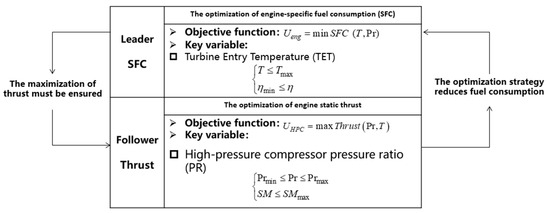
Based on the characteristics of the Stackelberg game model described previously, the SFC should be regarded as the leader, while the turbofan engine thrust serves as the follower. The game model can be formally expressed as follows:
During the engine design phase, the relationship between SFC and Thrust must be considered. Turbine Inlet Temperature (TET) refers to the total temperature (stagnation temperature) of the gas at the combustion chamber outlet and the inlet of the first-stage turbine guide vanes. It directly affects the engine’s thrust, efficiency, service life, and reliability, representing the highest temperature attained by the gas before entering the turbine. Therefore, TET is selected as the SFC’s decision variable.
In this Stackelberg game framework, the SFC (Specific Fuel Consumption), acting as the leader, must minimize itself to enhance the engine’s fuel economy.
Therefore, for the i-th game, it is the strategy:
M is the total number of possible strategies.
The set of available strategies for SFC is denoted as:
Therefore, the non-cooperative game of SFC can be expressed as:
where ΩSFCi represents the set of all strategies excluding the optimal strategy ΩSFCi.
The constraints for SFC include maintaining the compressor pressure ratio within specified limits while ensuring the surge margin does not exceed critical thresholds.
In these expressions, SM denotes the compressor surge margin, SMmax represents the maximum allowable surge margin, imposed by engine design and performance requirements to ensure both stability and efficiency.
From a design perspective, by setting the high-pressure compressor pressure ratio as an overall engine performance parameter, the objective of the aero-engine is to minimize fuel flow while maintaining specified thrust-to-weight ratio (TWR) and specific fuel consumption (SFC) requirements. The objective function can be expressed as follows:
The strategy of thrust in the i-th game iteration
N is the total number of available strategies.
The strategy set of thrust can be expressed as:
The constraints of thrust include the maximum turbine inlet temperature and a thermal efficiency that must exceed a certain value.
The interconnection between the SFC and Thrust game models is illustrated in the following Figure 1.
Figure 1.
A Stackelberg game model targeting the objective function.
3.2.2. ANN-Based Surrogate Model
Turbofan engines are high-order, nonlinear systems, making the direct application of the ACPSO algorithm for optimization computationally expensive and time-consuming. Instead, constructing a neural network surrogate model based on the Amesim simulation offers a more efficient solution [25]. While the Amesim model can generate extensive datasets for neural network training, developing a surrogate model that covers the entire operational envelope would require computing over 100,000 data points and performing intricate parameter tuning to meet accuracy standards [26]. This method is not ideal for Amesim and exceeds the scope of this study.
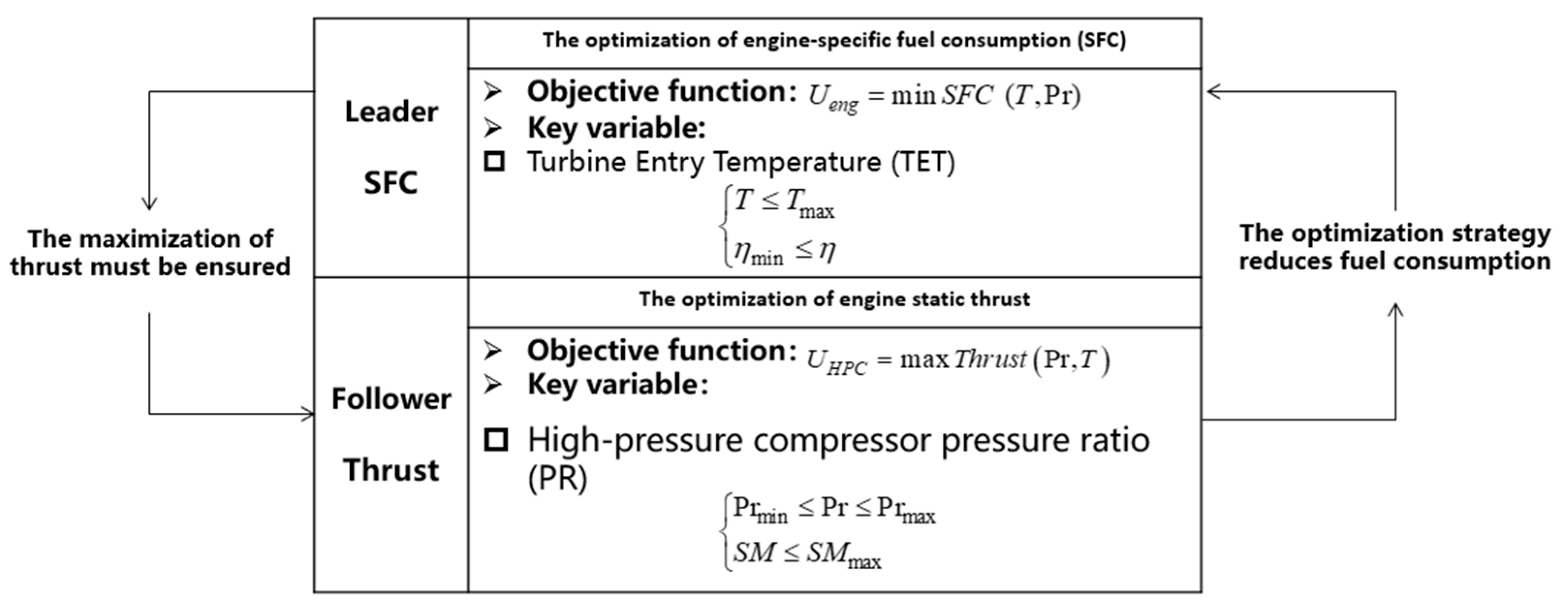
A more reasonable alternative is to establish a small turbofan-engine performance neural network surrogate model for each specific flight condition. Consequently, a feedforward multilayer neural network trained by the Levenberg–Marquardt backpropagation algorithm is incorporated into the small turbofan-engine performance surrogate model. The structure of the ANN surrogate model is illustrated in Figure 2.
Figure 2.
ANN-based turbine engine performance surrogate model.
The training process entails optimizing the network’s weights and biases to establish the mapping relationship between inputs and outputs, thereby minimizing the performance metric. This metric, denoted as V, can be formulated as shown in Equation (15).
The output equation of the neural network system can be expressed as the following formula, where a is the input vector.
In the equation, am, f, w, and am−1 represent the output of the neural network in matrix form, the activation function, the weight matrix, and the input vector, respectively.
The training process establishes a mapping relationship between inputs and outputs by optimizing the network’s weights and biases to minimize the performance index V. To further reduce ΔV(x), the Levenberg–Marquardt algorithm is employed to iteratively update the weights and biases, with the update expression given by.
V(x+Δx) is computed using the updated neural network parameters. If V(x+Δx)V(x+Δx) increases, the damping factor μ is scaled by β; otherwise, μ is divided by β. The algorithm converges when either VV or ∇V(x)∇V(x) reaches the predefined performance threshold or the minimum acceptable gradient magnitude.
To quantitatively evaluate the models predictive accuracy, the coefficient of determination R2 and mean squared error (MSE) are used to assess the goodness-of-fit between the predicted data and the reference data).
ŷ is the predicted data, y is the reference data, and ȳ is the mean of the reference data. The surrogate model established in the next section for calculating the engine performance—a neural network surrogate model—achieves R2 ≥ 0.999 and MSE ≤ 1 × 10⁻⁴. This indicates that the constructed neural network surrogate model can effectively capture the coupling between APTM and the engine, accurately reflecting the system performance.
3.2.3. Adaptive Chaotic PSO Algorithm
The backward induction method is commonly used to solve Stackelberg games. However, in cases where system models are implicit or interactions are too complex for analytical representation, iterative computational approaches are often necessary to determine equilibrium solutions. In this study, the Particle Swarm Optimization (PSO) algorithm is applied to optimize the objective function associated with the aircraft engine [27]. Nevertheless, the performance of PSO depends heavily on parameter tuning, including the inertia coefficient and learning factors. A major limitation of PSO is its tendency to converge prematurely to local optima, particularly in complex optimization problems characterized by high dimensionality, nonlinearity, or multi-modal search spaces [28]. To mitigate this issue, chaotic variables can be incorporated into the PSO framework, enhancing its ability to avoid local traps through adaptive self-learning coefficients [29].
Moreover, the distribution of initial solutions significantly impacts optimization accuracy and convergence speed—if the solution space is unevenly distributed, it may lead to the emergence of “super individuals,” causing a sharp decline in population diversity and prematurely trapping the algorithm in local optima. To address this issue, this paper introduces chaotic variables into the PSO algorithm, leveraging their self-learning characteristics to enhance global search capability and effectively avoid local optima traps [19].
The velocity update formula of the PSO algorithm:
where Vi = (Vi1 Vi2…Vin) is the velocity of the particle at the i-th generation. For the inertia coefficient (w), a larger value makes the particle swarm more inclined toward global exploration, while a smaller value favors local exploitation. Therefore, a nonlinear dynamic weight coefficient formula can be employed.
For the dynamic learning factor c1, which governs how particles learn from the individual best (pbest), a larger value biases the swarm toward local exploitation, while a smaller value promotes global exploration. Conversely, another dynamic learning factor c2, which drives particles to learn from the global best (gbest), exhibits the opposite effect.
By carefully designing these functions, the algorithm ensures that particles perform extensive global searches in the early evolutionary stages, then rapidly and precisely converge to the global optimum in later phases. The constructed functions are as follows:
For the initialization of the particle swarm, numerous chaotic system dynamic models are available for selection. In this study, the classic logistic model is adopted.
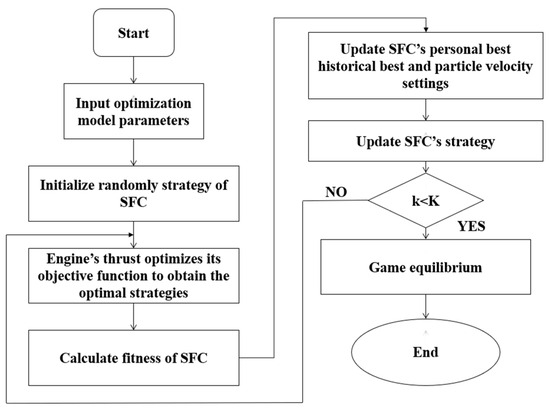
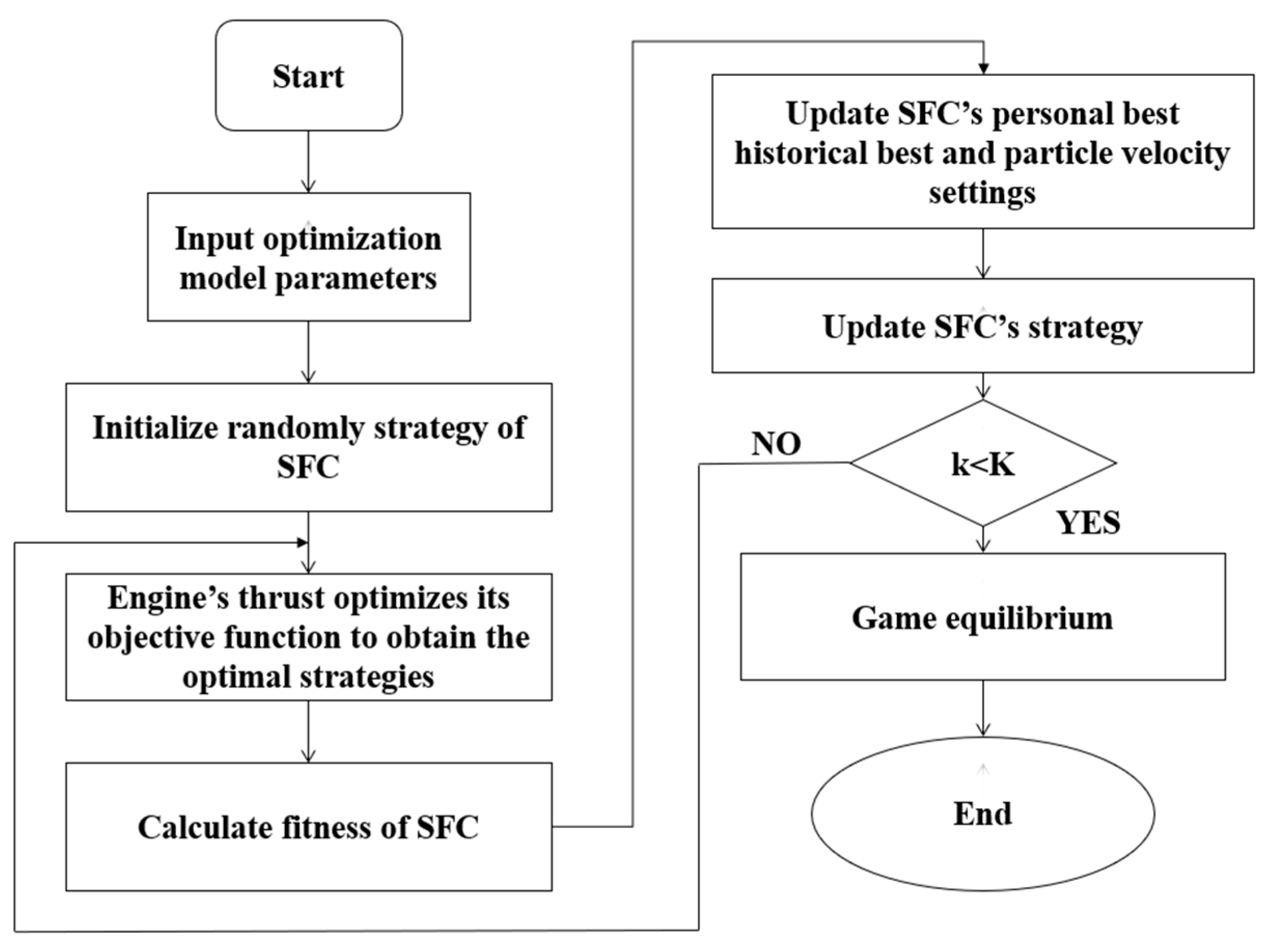
where μ is the control parameter, and Zt is a random number between 0 and 1. When μ = 4 and Zt ∉ {0, 0.25, 0.5, 0.75, 1}, the initialization achieves complete chaos [7]. The flowchart of the adaptive chaotic Particle Swarm Optimization (PSO) algorithm for solving the Stackelberg game mechanism is shown in the Figure 3 below.
Figure 3.
Flowchart of turbofan engine performance analysis.
3.3. Objective Functions
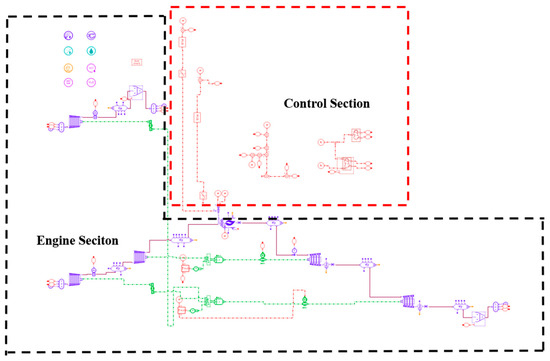
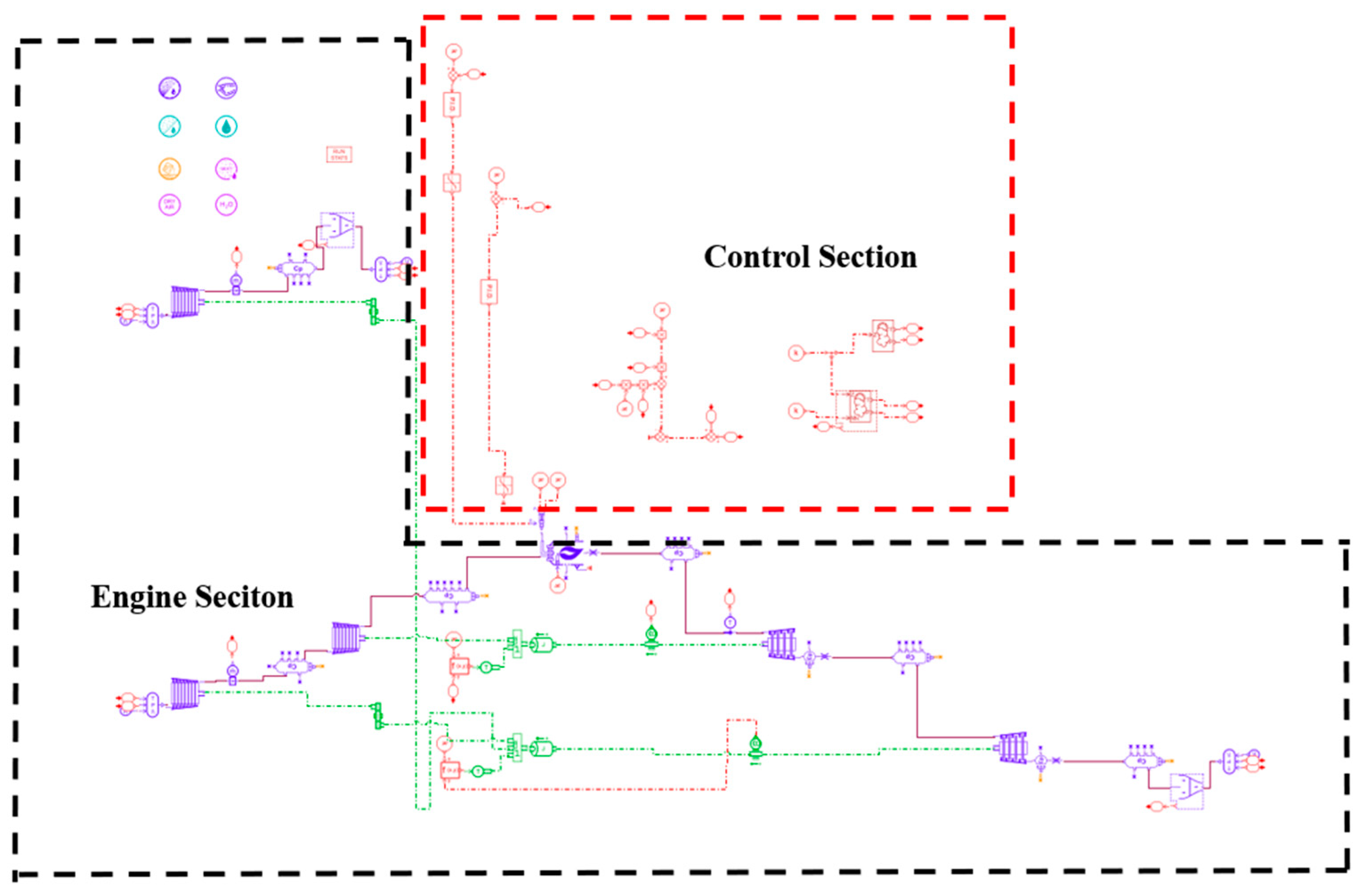
A simulation model of the certain type of turbofan engine was developed using Simcenter AMESim, version 2404 software, as shown in Figure 4. The model includes components such as the fan, high-pressure compressor (HPC), high-pressure turbine (HPT), low-pressure turbine (LPT), combustion chamber, and nozzle. Additionally, a PID control module was incorporated to regulate the turbine inlet temperature.
Figure 4.
Virtual simulation model of small turbofan engine.
4. Results and Discussion
This chapter can be divided into two main sections. Firstly, the performance analysis of a small turbofan engine is conducted based on three key control parameters: compressor pressure ratio (CPR), turbine entry temperature (TET), and ambient temperature (T0). Subsequently, two multi-objective optimization approaches—Stackelberg-ACPSO and MOPSO—are employed to present the optimal results of the engine performance parameters.
The optimization ranges for compressor pressure ratio (CPR) and turbine entry temperature (TET) are set at 4.5–5.3 and 1100–1300 K, respectively, while the ambient temperature (T0) is optimized within the range of 275–300 K.
4.1. Impact of Basic Design Parameters on Engine Performance
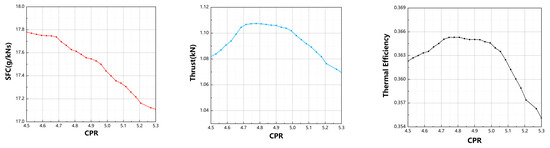
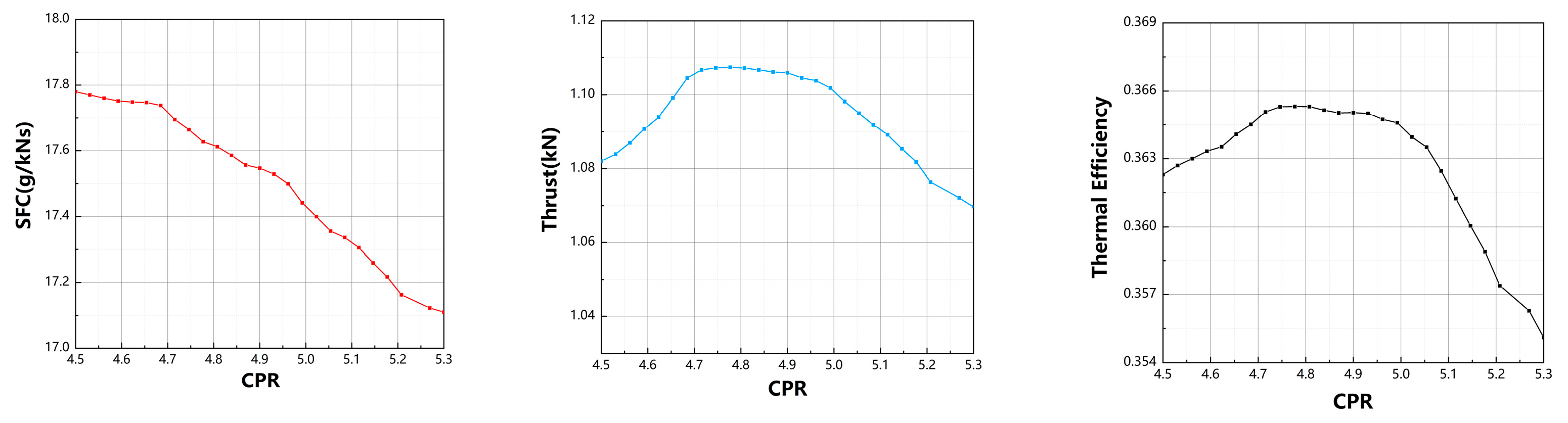
Figure 5 illustrates the variation trends of small turbofan engine performance parameters with respect to compressor pressure ratio. As shown in the figure, a nonlinear relationship exists between the compressor pressure ratio and various engine performance parameter.
Figure 5.
Variation in Performance Parameters with Compressor Pressure Ratio.
As the pressure ratio increases incrementally from the baseline condition, the specific fuel consumption (SFC) exhibits a characteristic nonlinear decreasing trend—declining from an initial value of 17.78 g/kNs to 17.09 g/kNs (a reduction of 3.88%). This observation corroborates the theoretical prediction from the Brayton cycle regarding the positive correlation between pressure ratio and thermodynamic efficiency.
However, it is noteworthy that the net thrust demonstrates non-monotonic behavior with increasing pressure ratio: reaching a peak value of 1.099 kN at PR = 4.72 (a 1.57% increase compared to the initial 1.082 kN), but exhibiting an anomalous decline to 1.065 kN at PR = 5.3.
Meanwhile, the thermal efficiency exhibits a significant increase from 0.3623 to 0.3653 (representing a relative gain of 0.83%), followed by a decline to 0.354 at CPR = 5.3. Computational results reveal the existence of a distinct multi-objective trade-off inflection point in the CPR range of 4–5. Although this region does not correspond to the global minimum SFC (achieved at PR = 5.3), it ensures the small turbofan engine maintains superior thrust performance. Consequently, the optimal pressure ratio selection must be determined based on specific aircraft mission requirements, with the final decision depending on which performance parameter (fuel economy or thrust output) is prioritized for the particular engine configuration.
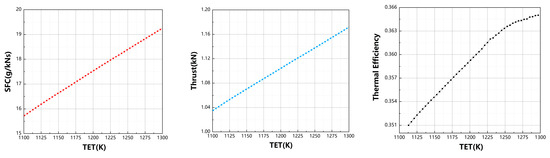
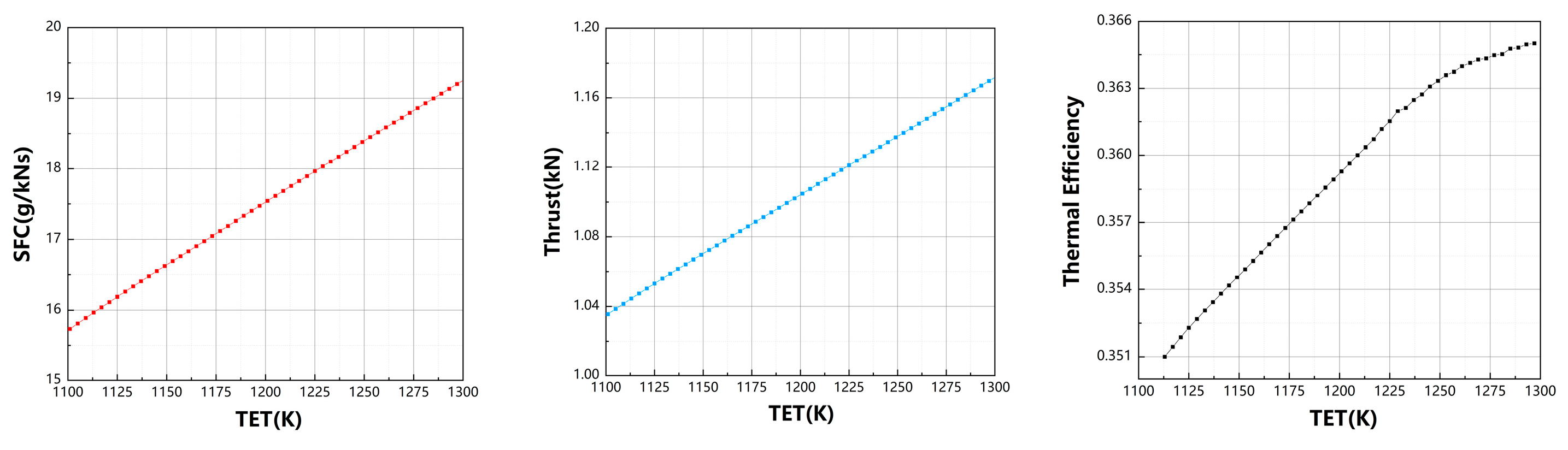
Figure 6 demonstrates the influence of turbine entry temperature (TET), a critical performance parameter for small turbofan engines, on multiple core performance indicators. The research results reveal a pronounced linear correlation between TET and engine performance parameters across the investigated temperature range (1100 K to 1300 K). Specifically, as TET increases from 1100 K to 1300 K, the specific fuel consumption (SFC) exhibits a significant rise from 15.63 g/kNs to 19.23 g/kNs, representing a 23% increase. Concurrently, the net thrust shows a 12.8% enhancement from 1.038 kN to 1.171 kN. These findings clearly demonstrate the coupled relationships among performance parameters in small turbofan engines, highlighting the importance of multi-objective optimization design.
Figure 6.
Variation in Performance Parameters with Turbine Inlet Temperature (TET).
Notably, the thermal efficiency displays a nonlinear increasing trend with elevated TET, improving from 0.351 to 0.364. These results carry substantial engineering significance: for military aero-engines prioritizing high thrust, increasing TET can effectively meet thrust demands despite the accompanying fuel consumption penalty; whereas for endurance-oriented aircraft engines, optimal TET operating points must be determined through optimization algorithms to achieve the best compromise between thrust performance and fuel economy. These findings provide a theoretical foundation for parameter optimization of small turbofan engines in different application scenarios.
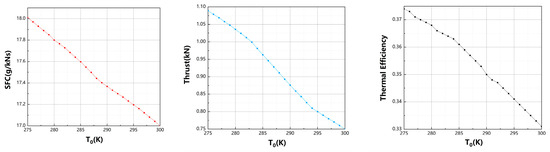
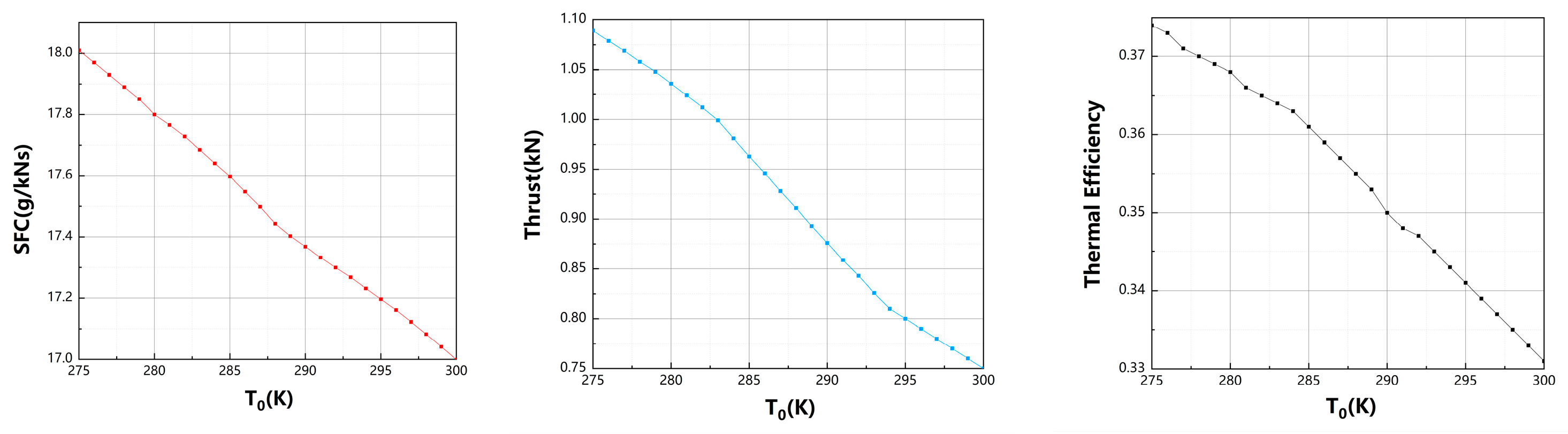
The data showed as Figure 7 analysis clearly demonstrates a systematic degradation in engine performance with increasing ambient temperature (T0): thrust output progressively decreases while specific fuel consumption (SFC) exhibits a continuous upward trend. This observed pattern indicates that elevated ambient temperatures lead to overall performance deterioration, manifested particularly through reduced thermal efficiency.
Figure 7.
Variation in Performance Parameters with Ambient Temperature (T0).
It is noteworthy that compared to other critical variables such as turbine entry temperature (TET) and compressor pressure ratio, ambient temperature T0 exerts a relatively modest influence on engine performance parameters. However, its underlying impact mechanisms remain non-negligible from an engineering perspective.
The experimental data reveal a clear performance degradation trend: when ambient temperature increases from the standard sea-level condition (275 K) to elevated temperature (300 K), the specific fuel consumption (SFC) decreases from 18.051 g/kNs to 16.998 g/kNs, while the maximum thrust output decreases significantly from 1.089 kN to 0.75 kN. Further analysis indicates that the thermal efficiency drops from 0.376 to 0.331, which can be attributed to altered combustor operating conditions caused by elevated intake temperatures. These experimental results provide critical reference data for performance prediction and operational adjustment of small turbofan engines under high-temperature conditions.
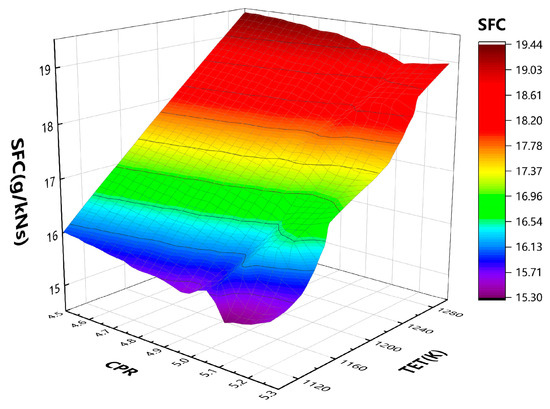
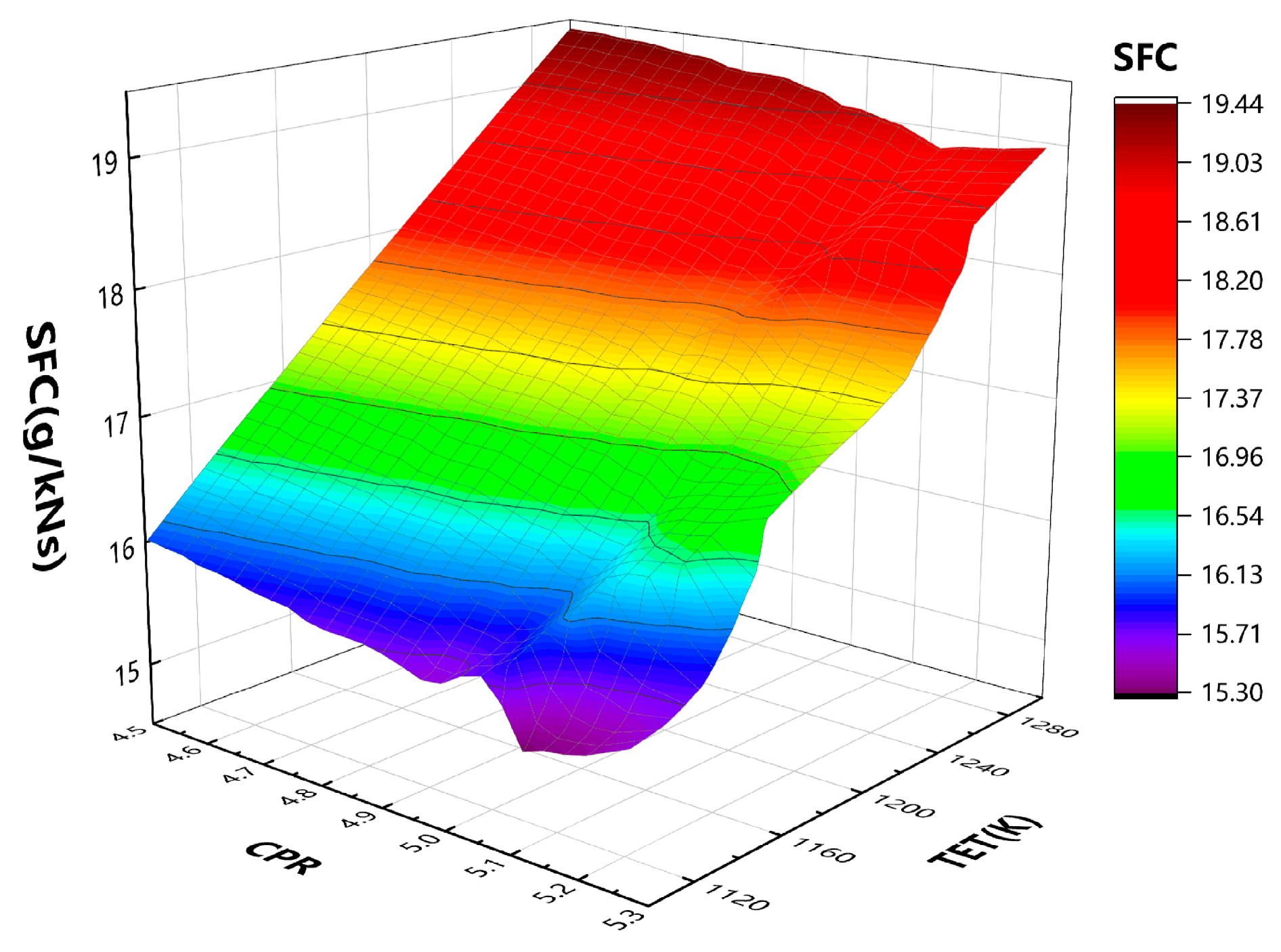
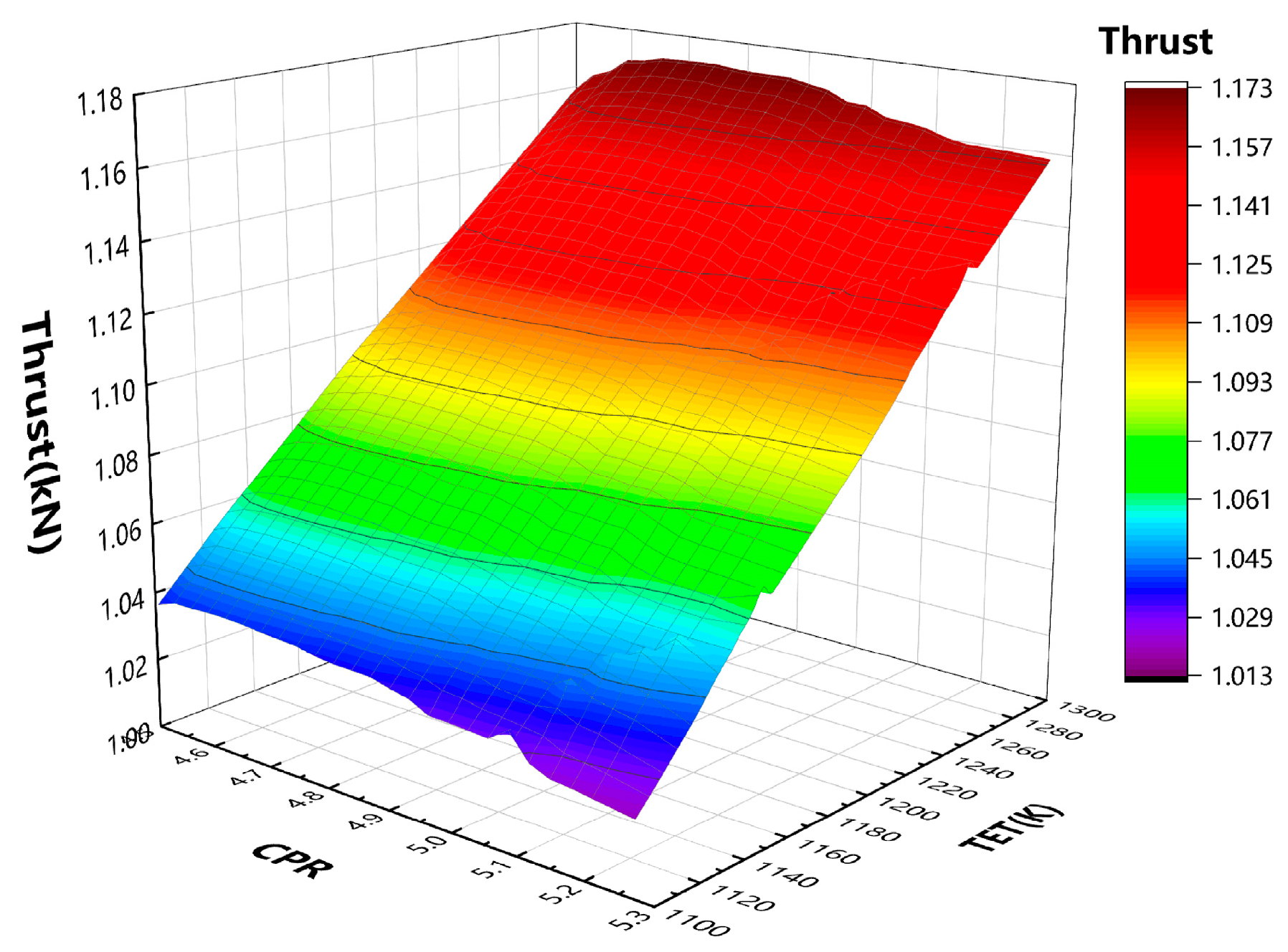
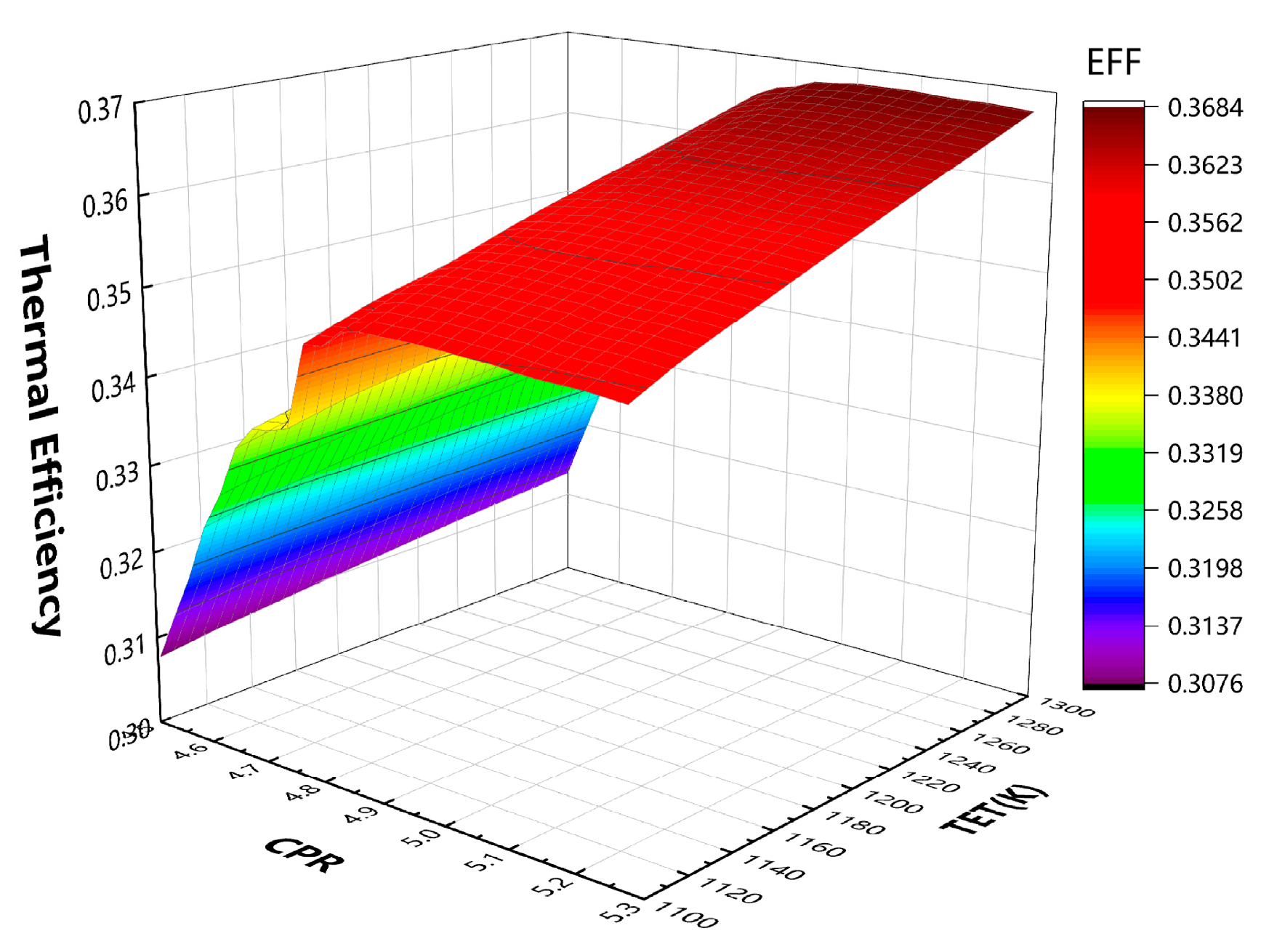
This study primarily investigates the combined effects of high-pressure compressor pressure ratio (CPR) and turbine inlet temperature (TET) on the performance parameters of small turbofan engines. Figure 8, Figure 9 and Figure 10 illustrates the paired relationships among several design variables, demonstrating the coupled influence of CPR and TET on specific fuel consumption (SFC), thrust, and overall efficiency.
Figure 8.
Variation in SFC with CPR and TET at T0 = 275.47 K.
Figure 9.
Variation in Thrust with CPR and TET at T0 = 275.47 K.
Figure 10.
Variation in Thermal Efficiency with CPR and TET at T0 = 275.47 K.
The research reveals that the minimum SFC occurs at specific operating points where neither CPR nor TET reaches its maximum or minimum value, highlighting the crucial role of optimization techniques in determining the optimal design variables for the studied engine configuration.
The data analysis demonstrates that the minimum specific fuel consumption (SFC = 15.578 g/kNs) is achieved at a turbine inlet temperature (TET) of 1105 K with a compressor pressure ratio (CPR) of 5.26, while the maximum SFC (19.423 g/kNs) occurs when TET reaches 1300 K at CPR = 4.50. Regarding thrust performance, the minimum thrust value (1.036 kN) appears under operating conditions of TET = 1101 K with CPR = 4.50, whereas the maximum thrust (1.172 kN) is obtained at TET = 1300 K with CPR = 5.3. The extreme values of overall efficiency are 0.3682% (corresponding to TET = 1300 K, CPR = 4.93) and 0.3076% (corresponding to TET = 1100 K, CPR = 4.50), respectively.
4.2. Results of the Surrogate Model Calculation
This study employs an artificial neural network (ANN)-based multi-objective optimization framework, which requires the construction of a high-precision parameter mapping database to obtain global optimal solutions. As shown in Table 3, the research first establishes a high-fidelity numerical model of a small turbofan engine using the AMEsim multi-physics simulation platform, systematically calculating engine performance parameters under various operating conditions. Subsequently, large-scale simulation results (sample size N > 104) are utilized to construct a surrogate model for multidimensional performance parameters.
Table 3.
Error and Accuracy in Neural Network Training.
Notably, this study designs a deep feedforward-structured ANN (detailed network architecture shown in Figure 3), developing four independent computational sub-networks specifically for key engine performance indicators: specific fuel consumption (SFC), static thrust, thermal efficiency, and fuel flow rate. Training results demonstrate that each objective function’s neural network model exhibits exceptional predictive performance: all networks achieve root mean square errors (RMSE) below 0.01% and coefficient of determination R2 ≥ 0.999. This outstanding fitting capability conclusively proves that the developed ANN surrogate model can accurately characterize the complex performance features of small turbofan engines under multi-physics coupling effects, particularly in capturing the nonlinear coupled relationships between design parameters and various target performance parameters. This establishes a reliable modeling foundation for subsequent multi-objective optimization design of the engine.
4.3. Multi-Objective Optimization Solving
This section presents multi-objective optimization results for small turbofan engine performance parameters using two distinct optimization approaches: the Stackelberg-ACPSO algorithm and the MOPSO (Multi-Objective Particle Swarm Optimization) method.
4.3.1. Stackelberg Game Theory
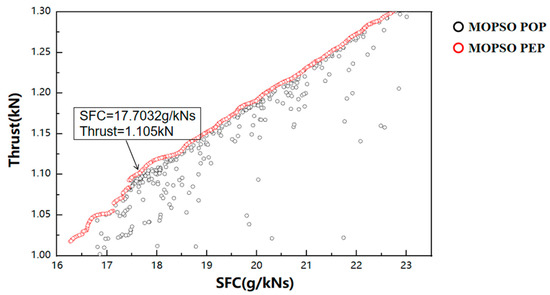
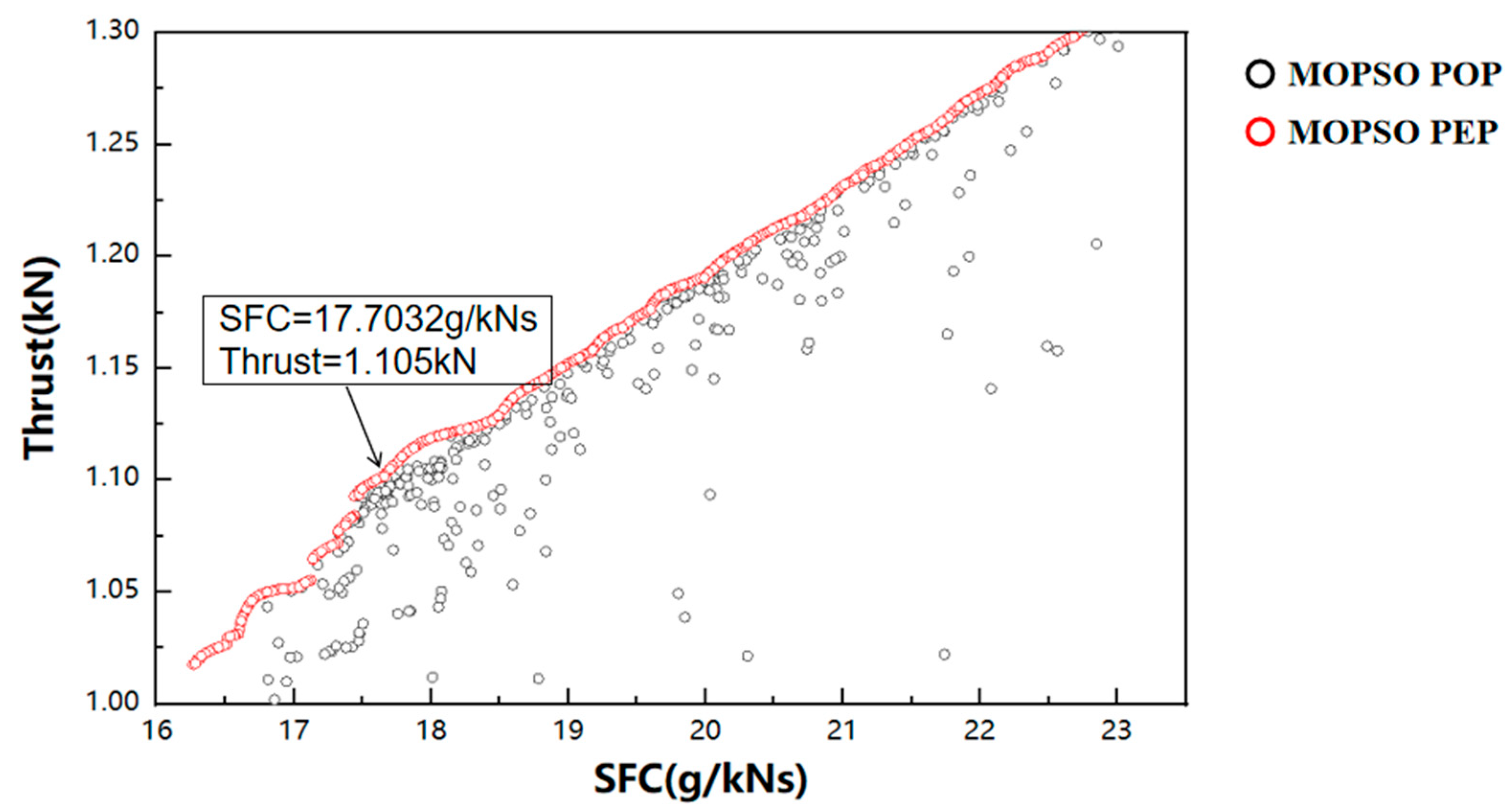
First, the optimal solution obtained through the MOPSO algorithm demonstrates convergence of all proposed optimization objectives after iterative computations (shown in Figure 11). In the performance trade-off between the two parameters of SFC and thrust, the aircraft engine’s specific fuel consumption decreased from 17.9125 g/kNs to 17.7032 g/kNs, while the static thrust declined from 1.109 kN to 1.105 kN. During the optimization process, the engine achieved a 1.12% improvement in fuel economy at the cost of a 0.27% reduction in static thrust.
Figure 11.
Thrust-SFC Optimal Solutions Obtained by MOPSO.
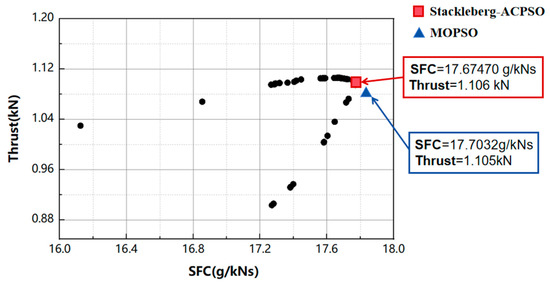
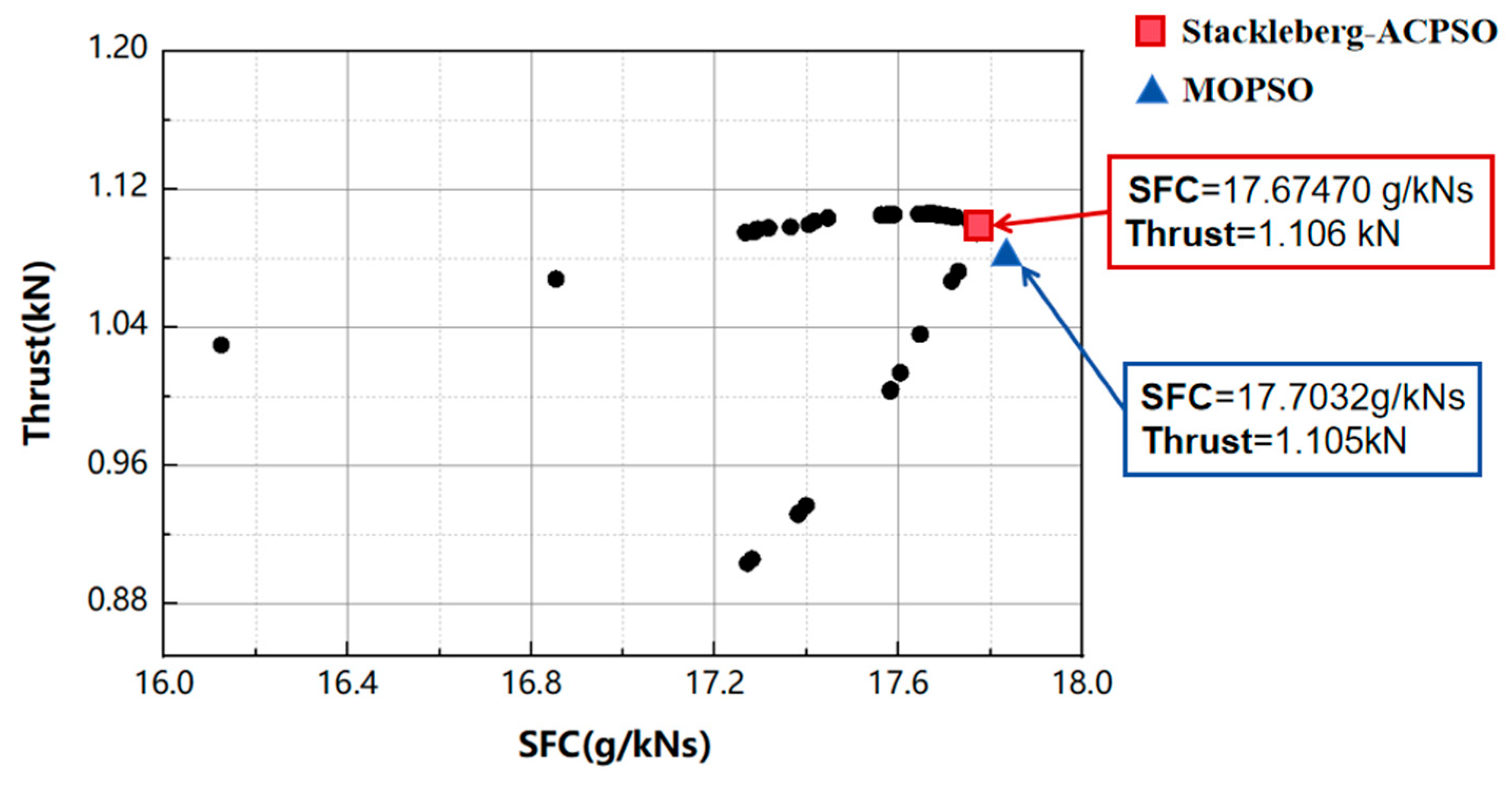
The results obtained using the Stackelberg-ACPSO algorithm demonstrate that (shown in Figure 12), after iterative computation, the performance trade-off between the two parameters of SFC and thrust yields a reduction in the aircraft engine’s specific fuel consumption from 17.9125 g/kNs to 17.6747 g/kNs, while the static thrust decreases from 1.109 kN to 1.106 kN. In this optimization process, a 0.26% reduction in thrust is exchanged for a 1.26% improvement in fuel economy.
Figure 12.
Thrust-SFC Optimal Solutions Obtained by Stackleberg-ACPSO.
In contrast to the Stackelberg game model, participants in MOPSO multi-objective optimization neither coordinate with each other nor adjust their strategies based on opponents’ decisions (shown in Table 4).
Table 4.
Comparison of Optimization Method Effectiveness.
This study presents a comparative analysis of optimal specific fuel consumption (SFC) and thrust solutions for specific flight mission profiles using the Stackelberg-ACPSO method, with results benchmarked against conventional multi-objective optimization algorithms. Computational results demonstrate that the proposed Stackelberg-ACPSO method achieves superior optimization outcomes, yielding a 0.1609% reduction in SFC and a 0.0904% improvement in thrust compared to traditional methods. These findings confirm that the Stackelberg-ACPSO method exhibits enhanced synergistic optimization capability when coordinating the thrust-fuel economy trade-off, thereby validating the effectiveness of hierarchical game-theoretic strategies in aircraft propulsion system optimization.
4.3.2. Optimal Thermal Efficiency-SFC Trade-Off Solutions
This study presents multi-objective optimization results for performance parameters of small turbofan engines using two distinct optimization methods: the Stackelberg-ACPSO algorithm and the MOPSO approach.
In the first case, the optimal solution obtained through the MOPSO algorithm demonstrates convergence of all proposed objectives after iterative computation.
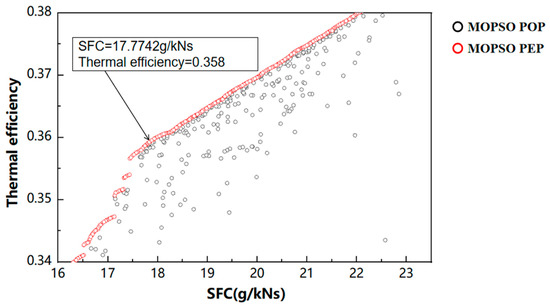
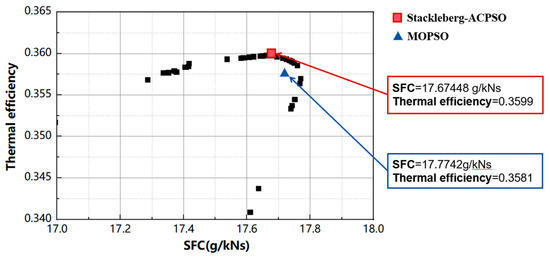
During the optimization process between specific fuel consumption (SFC) and thermal efficiency, the aircraft engine’s fuel consumption rate improved from 17.9623 g/kNs to 17.7742 g/kNs (shown in Figure 13), while thermal efficiency decreased from 0.3611 to 0.3581. This optimization process achieved a 1.05% enhancement in fuel economy at the cost of a 0.83% reduction in thermal efficiency. In contrast, results obtained using the Stackelberg-ACPSO algorithm show that after iterative optimization of the trade-off between SFC and thermal efficiency (shown in Figure 14), the engine’s fuel consumption rate decreased from 17.9623 g/kNs to 17.6744 g/kNs, with thermal efficiency declining from 0.3611 to 0.3599. This optimization strategy yielded a more favorable 1.60% improvement in fuel economy while only sacrificing 0.33% of thermal efficiency.
Figure 13.
Thermal efficiency-SFC Optimal Solutions Obtained by MOPSO.
Figure 14.
Thermal efficiency-SFC Optimal Solutions Obtained by Stackleberg-ACPSO.
Figure presents the iterative process results and optimal solutions, including performance metrics of aircraft engine fuel consumption and thermal efficiency. Distinct from the Stackelberg game model, participants in MOPSO multi-objective optimization operate without coordination and do not adjust their strategies based on opponents’ decisions (Table 5).
Table 5.
Comparison of Optimization Method Effectiveness.
This study presents a comparative analysis of the Stackelberg-ACPSO method for optimizing specific fuel consumption (SFC) and thermal efficiency solutions under designated flight mission profiles, with its performance benchmarked against conventional multi-objective optimization algorithms. Computational results demonstrate that the proposed Stackelberg-ACPSO method achieves superior optimization outcomes, yielding a 0.56% reduction in SFC accompanied by a 0.51% improvement in thermal efficiency compared to traditional approaches. These findings substantiate that the Stackelberg-ACPSO method exhibits enhanced synergistic optimization capabilities in balancing the thrust-fuel economy trade-off, thereby validating the effectiveness of hierarchical game-theoretic strategies for aircraft propulsion system optimization.
In addition to the numerical comparison, the observed differences can also be interpreted from the perspective of the optimization structure. In the Stackelberg optimization framework proposed in this paper, fuel consumption (SFC) is treated as the leader objective and thrust as the follower objective, which is consistent with the actual design priorities of small turbofan engines: fuel economy must be optimized first, and only then are thrust and operability constraints satisfied.
By solving the leader problem first, the search space is restricted to regions that are favorable for reducing SFC while still satisfying conservative limits on TET, CPR, and surge margin. On this basis, the follower-level thrust optimization can recover thrust levels comparable to those obtained by the MOPSO method that treats all objectives equally, but with overall lower SFC and more conservative operating points. In contrast, the MOPSO formulation treats SFC and thrust symmetrically, which is less desirable from an engineering standpoint.
4.3.3. Comparative Analysis of Solutions Under Variant Ambient Temperature Conditions
Since variations in ambient temperature also induce changes in the performance parameters of small turbofan engines, this section compares the optimization results of two methods—namely the Stackelberg-ACPSO algorithm and the MOPSO method—for the performance parameter optimization of small turbofan engines across the studied temperature range.
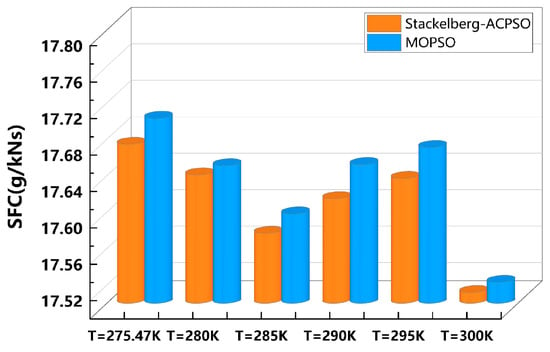
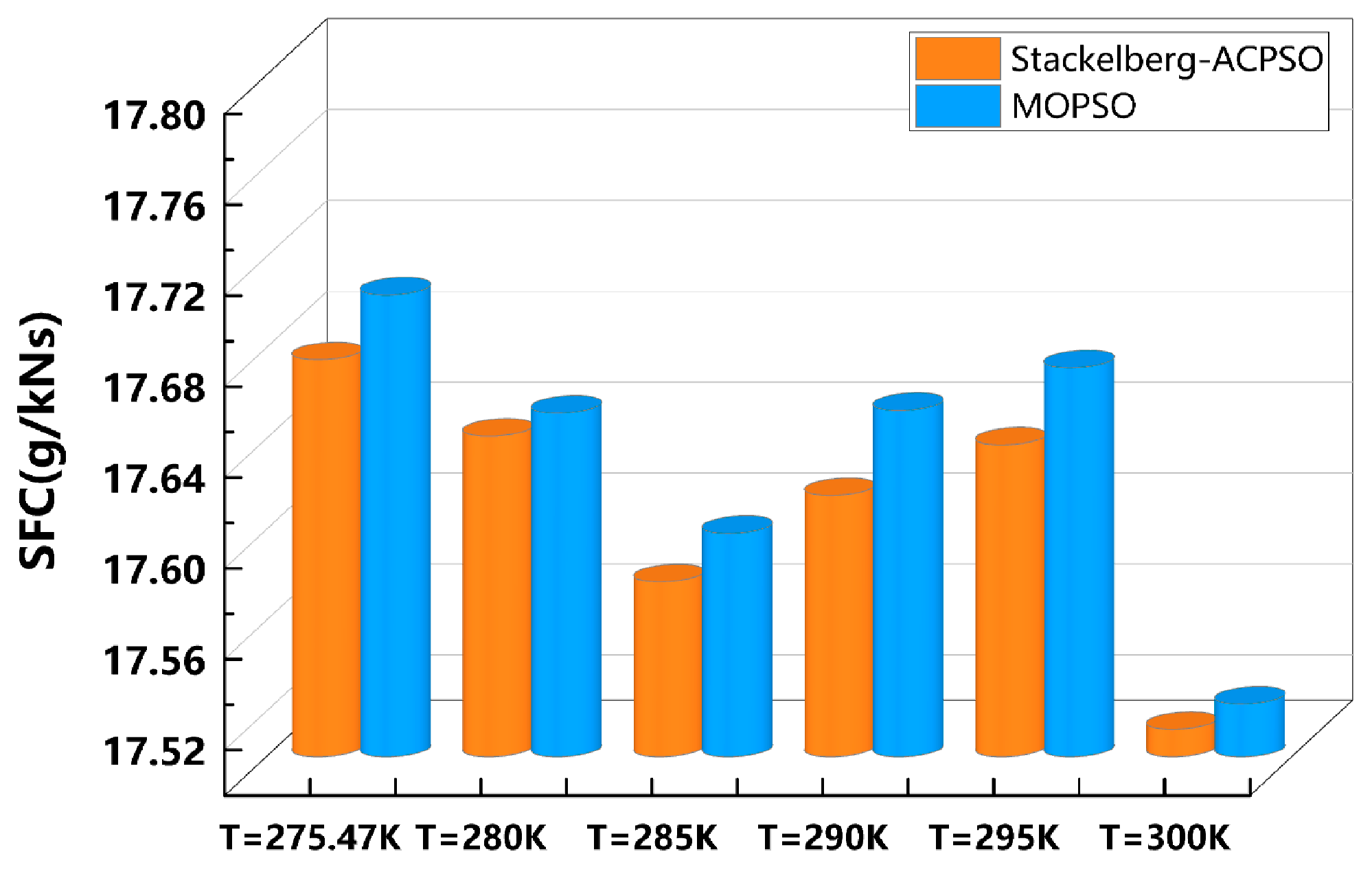
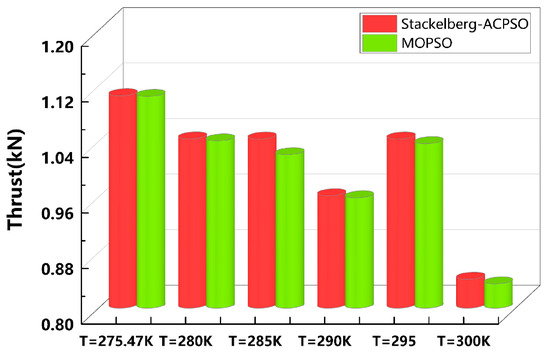
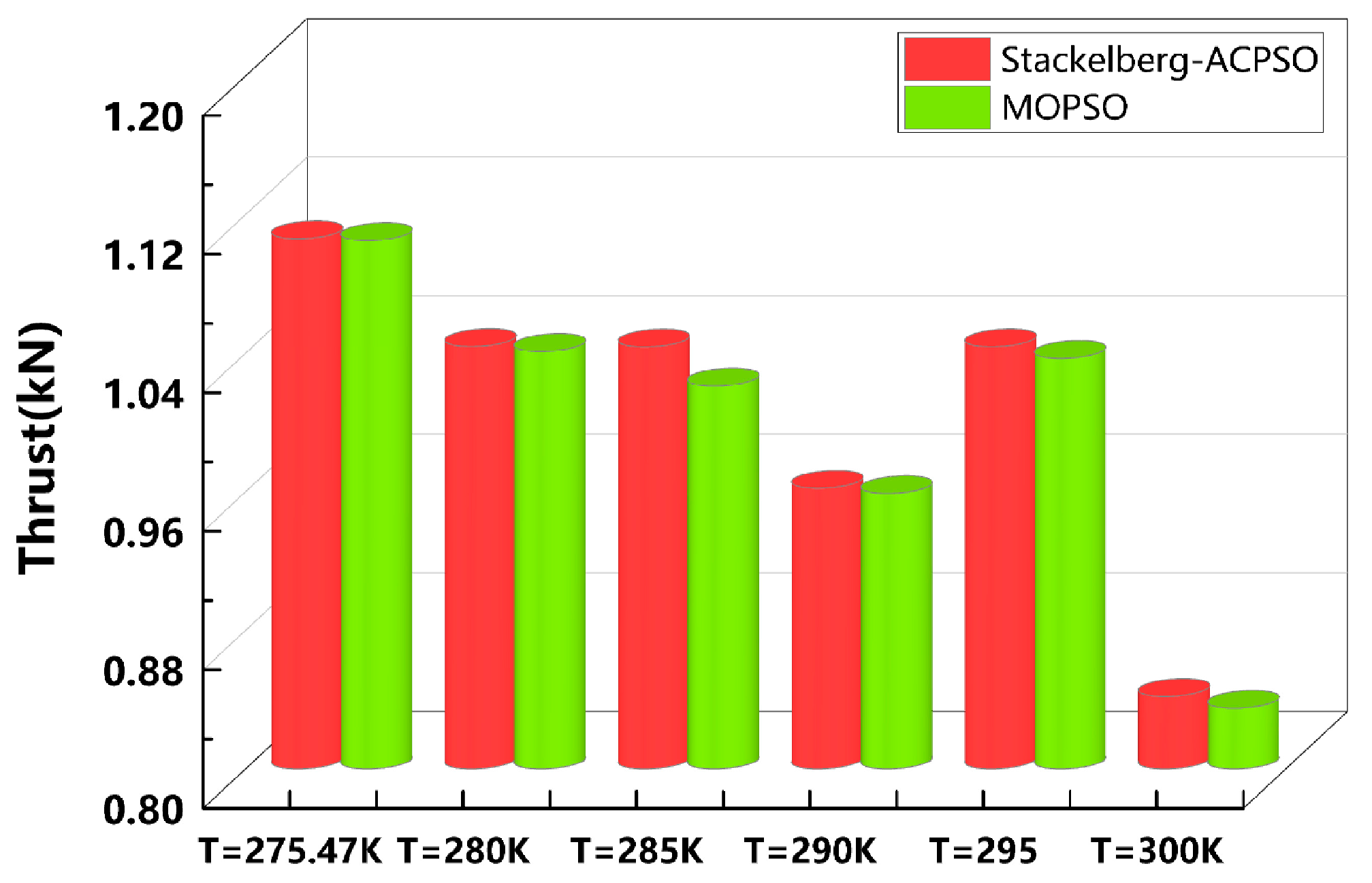
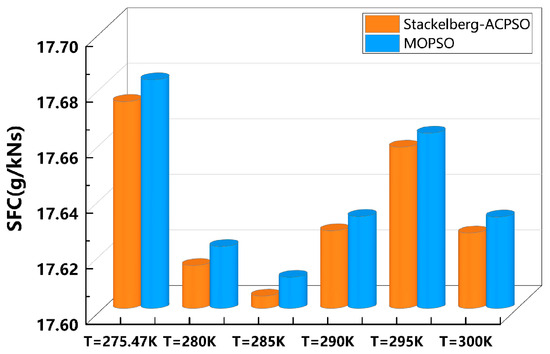
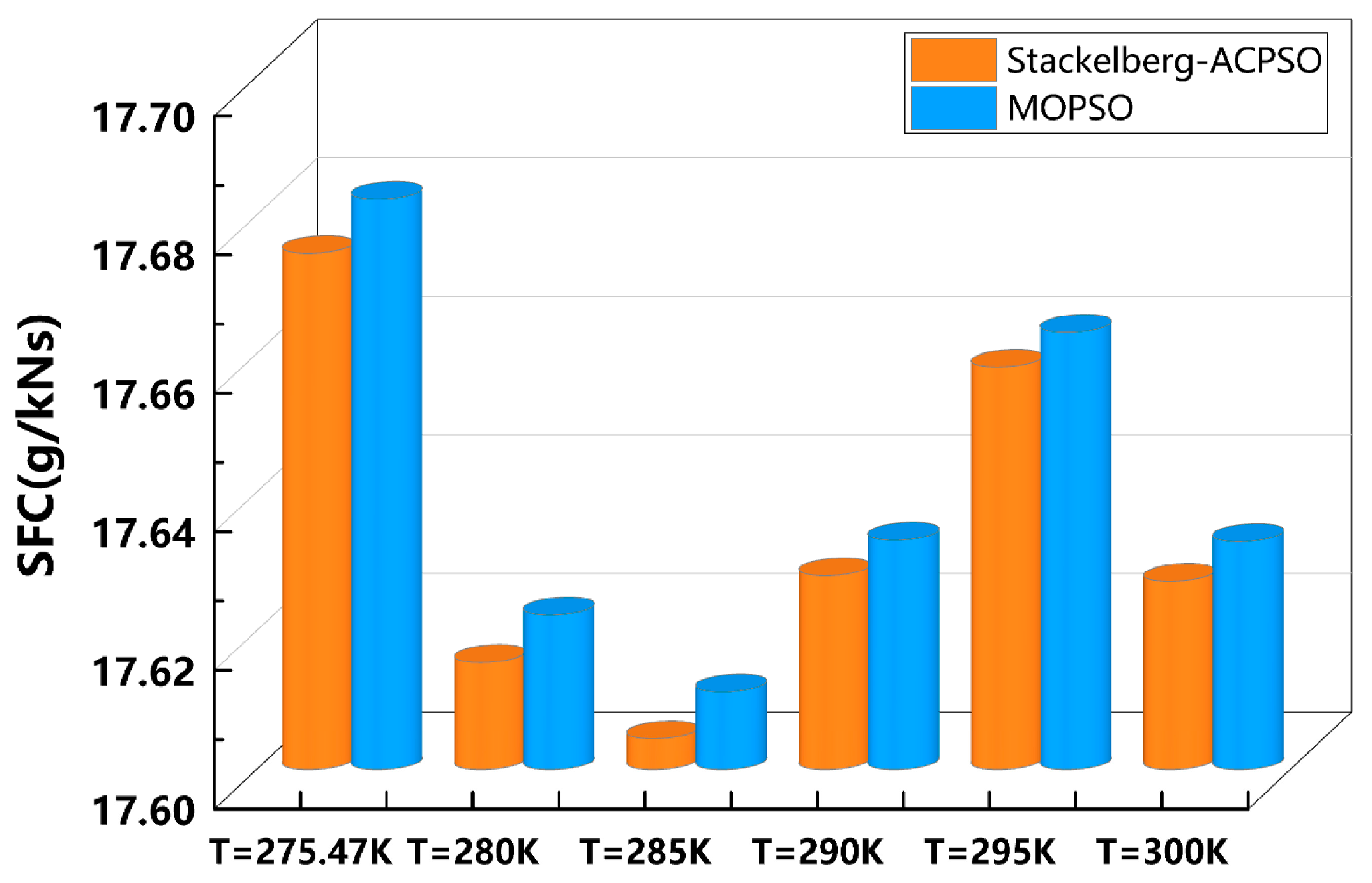
At 275.47 K, corresponding to standard flight mission conditions, the optimal solution of the Stackelberg-ACPSO algorithm yields a 0.161% improvement in SFC (Specific Fuel Consumption) over the MOPSO method (shown in Figure 15), while thrust performance is enhanced by 0.10% (shown in Figure 16).
Figure 15.
Comparative Analysis of SFC Optimal Solutions Across Flight Environmental Temperatures.
Figure 16.
Comparative Analysis of Thrust Optimal Solutions Across Flight Environmental Temperatures.
At 280 K, the Stackelberg-ACPSO algorithm demonstrates a 0.057% advantage in SFC and a 0.274% improvement in thrust compared to the MOPSO method.
At 295 K, the Stackelberg-ACPSO algorithm demonstrates a 0.121% advantage in SFC and a 0.231% improvement in thrust compared to the MOPSO method.
Under 290 K conditions, the Stackelberg-ACPSO algorithm achieves a 0.212% superiority in SFC and a 0.318% increase in thrust relative to the MOPSO method.
At 295 K, the Stackelberg-ACPSO algorithm demonstrates a 0.19% advantage in SFC and a 0.315% improvement in thrust compared to the MOPSO method.
At 300 K, the optimal solution obtained via the Stackelberg-ACPSO algorithm outperforms the MOPSO method by 0.064% in SFC and by 0.819% in thrust.
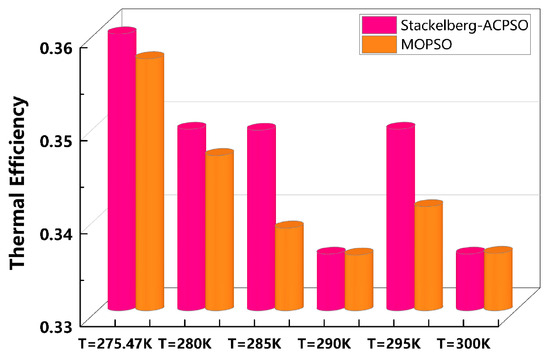
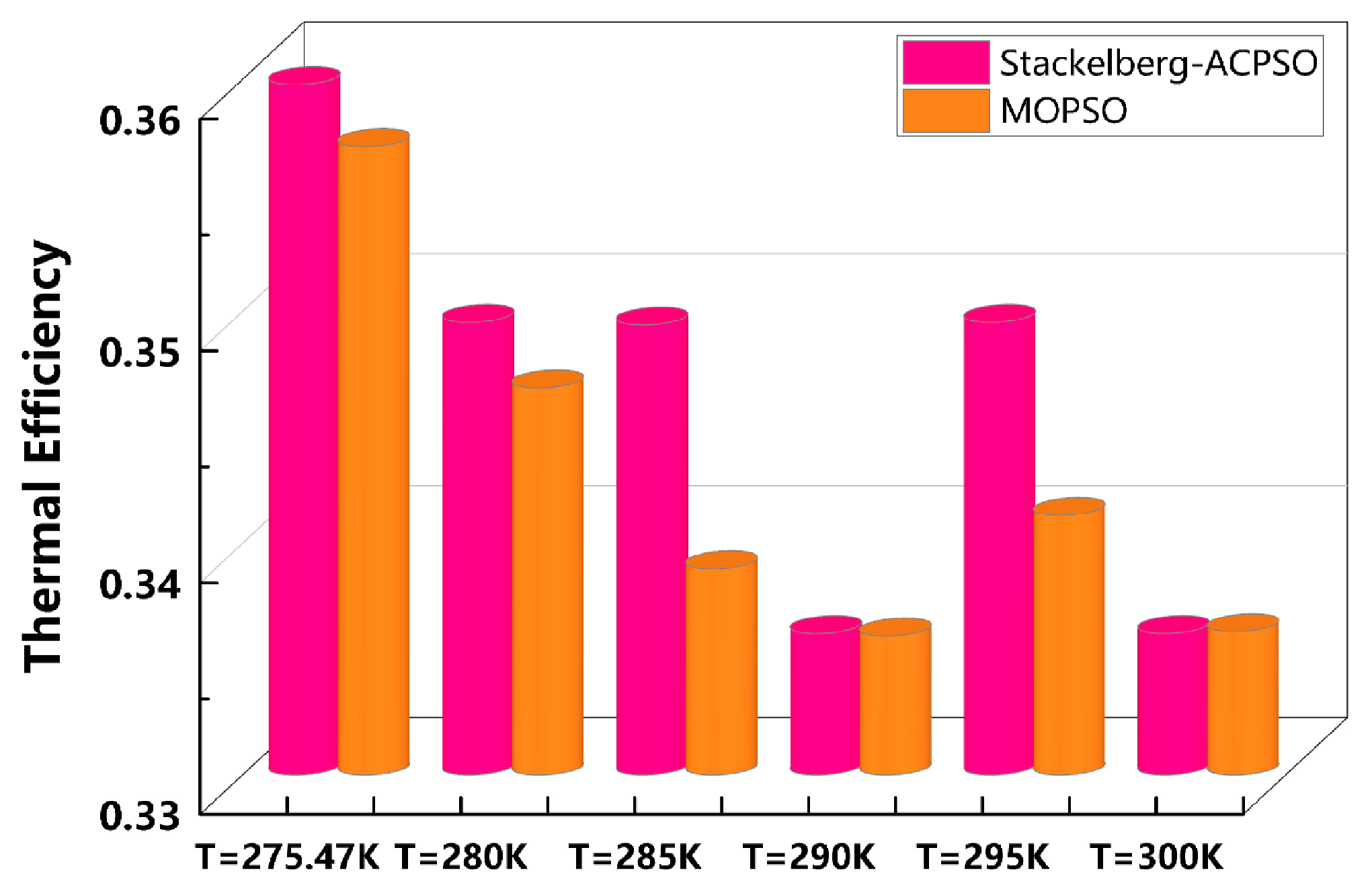
Regarding the trade-off between SFC (Specific Fuel Consumption) and EFF (Efficiency), variations in ambient temperature also lead to changes in the performance parameters of small turbofan engines. This section evaluates and compares the optimization results of two methods—the Stackelberg-ACPSO algorithm and the MOPSO method—for the performance parameter optimization of small turbofan engines across the studied temperature range (shown in Figure 17 and Figure 18).
Figure 17.
Comparative Analysis of SFC Optimal Solutions Across Flight Environmental Temperatures.
Figure 18.
Comparative Analysis of efficiency Optimal Solutions Across Flight Environmental Temperatures.
At 274.47 K, corresponding to standard flight mission conditions, the optimal solution obtained by the Stackelberg-ACPSO algorithm demonstrates a 0.044% improvement in SFC and a 0.45% enhancement in thrust compared to the MOPSO method.
At 280 K, the Stackelberg-ACPSO algorithm achieves a 0.039% advantage in SFC and a 0.73% increase in thrust over the MOPSO method.
At 285 K, the optimal solution derived from the Stackelberg-ACPSO algorithm outperforms the MOPSO method by 0.042% in SFC and by 0.31% in thrust.
Under 290 K conditions, the Stackelberg-ACPSO algorithm exhibits a 0.029% superiority in SFC and a 0.026% improvement in thrust relative to the MOPSO method.
At 295 K, the Stackelberg-ACPSO algorithm achieves a 0.031% advantage in SFC and a 0.023% increase in thrust over the MOPSO method.
At 300 K, the optimal solution derived from the Stackelberg-ACPSO algorithm outperforms the MOPSO method by 0.033% in SFC and by 0.023% in thrust.
5. Conclusions
This study conducts a systematic investigation of the performance trade-offs in a small turbofan engine and develops a Stackelberg game–based optimization framework to mitigate the conflicts among thrust, specific fuel consumption (SFC), and thermal efficiency.
This work first constructs an Amesim simulation model of a representative small turbofan engine, in which compressor pressure ratio (CPR), turbine inlet temperature (TET), and ambient temperature are selected as key design variables, and the performance trade-offs among them are analyzed on this basis. Subsequently, a neural-network surrogate model and an Adaptive Chaotic Particle Swarm Optimization (ACPSO) algorithm are introduced to solve the resulting bi-level Stackelberg game, enabling efficient multi-parameter analysis of engine performance.
- (1)
- Quantitative characterization of performance trade-offs.
The simulation results demonstrate a clear and quantifiable trade-off among SFC, thrust, and thermal efficiency. For example, under the design flight condition, when the ambient temperature increases from 275 K to 300 K, the maximum net thrust decreases from 1.106 kN to 0.841 kN (a reduction of approximately 24%), and the thermal efficiency drops from 0.359 to 0.336 (a reduction of about 6%), while the variation in SFC over the same range remains relatively modest. Similarly, within the admissible operating window of TET, increasing TET leads to an improvement in thermal efficiency (from 0.351 to 0.364) and an increase in thrust, but at the expense of higher SFC. These results quantitatively indicate that enhancing thrust or efficiency generally requires accepting a fuel-consumption penalty, and that there is no single operating condition that simultaneously optimizes all three objectives.
- (2)
- Stackelberg game–based optimization framework.
A Stackelberg game–based optimization model is established in which SFC is treated as the leader objective and thrust as the follower objective. This formulation reflects the practical design priority for small turbofan engines: fuel economy must be optimized first, and, on this basis, thrust and operability constraints (such as limits on TET, CPR, and surge margin) are then satisfied. The leader-level problem restricts the search space to regions that are favorable for reducing SFC while respecting conservative operating boundaries, and the follower-level problem subsequently determines thrust levels that meet mission requirements within this constrained domain.
- (3)
- Comparison with MOPSO and engineering implications.
Compared with the conventional Multi-Objective Particle Swarm Optimization (MOPSO) method, the proposed Stackelberg–ACPSO framework achieves a modest yet engineeringly meaningful improvement in fuel economy while maintaining a comparable thrust level. For example, under the representative operating condition considered, the Stackelberg–ACPSO solution reduces SFC from 17.7032 g·kN−1·s−1 (MOPSO) to 17.6747 g·kN−1·s−1 (a reduction of approximately 0.2%), with essentially unchanged thrust. In addition, the Stackelberg solutions tend to select more conservative operating points in terms of TET, CPR, and surge margin, whereas some MOPSO Pareto solutions lie closer to high-temperature regimes. Thus, the Stackelberg–ACPSO approach is not only competitive in numerical performance, but also better aligned with the practical requirements for safe and reliable aero-engine operation.
- (4)
- Design-parameter perspective
From a design-parameter perspective, the quantitative analysis in this study elucidates how variations in compressor pressure ratio (CPR) and turbine inlet temperature (TET) shape the performance of the small turbofan engine. Under the reference ambient condition, increasing the pressure ratio from the baseline reduces SFC from 17.78 to 17.09 g/kNs (a 3.88% decrease), while the net thrust attains a maximum of 1.099 kN at PR ≈ 4.72 and then gradually decreases at higher pressure ratios; correspondingly, the thermal efficiency first increases from 0.3623 to 0.3653 and subsequently drops to 0.354 at CPR = 5.3. As TET is raised from 1100 K to 1300 K, the thrust increases from 1.038 kN to 1.171 kN and the overall efficiency from 0.351 to 0.364, whereas SFC simultaneously deteriorates from 15.63 to 19.23 g/kNs. Consequently, the operating condition that ensures sufficient pressure while minimizing SFC does not occur at the extreme ends of the parameter space, but rather at an intermediate combination of CPR = 4.8 and TET = 1180 K. These findings quantitatively demonstrate the fundamental trade-off between fuel economy, thrust output, and thermal efficiency, which in turn motivates the Stackelberg game-based optimization framework proposed in this work.
- (5)
- Influence of ambient conditions.
The analysis conducted under different ambient temperatures indicates that the optimal strategy is sensitive to external environmental conditions. An increase in ambient temperature leads to a noticeable deterioration in both thrust and thermal efficiency. These findings underscore the importance of explicitly accounting for realistic atmospheric conditions when defining operating points and control strategies for small turbofan engines.
- (6)
- Limitations and future work.
This study is subject to several limitations. First, the neural-network surrogate model is trained on deterministic, high-fidelity simulation data generated by a calibrated Amesim model rather than on direct experimental engine measurements. Accordingly, the relatively high accuracy metrics reported for the neural network) primarily indicate its strong fitting capability with respect to the numerical model, and do not by themselves guarantee the same level of performance when predicting the behavior of real engine hardware, which is subject to measurement noise, unmodelled dynamics and manufacturing tolerances. Second, only a limited set of design variables (CPR, TET, and ambient temperature) and steady operating conditions are considered. In future work, the framework will be extended to incorporate additional design and control variables (such as variable nozzle area and component efficiencies) and to account for unsteady operating scenarios. Where feasible, experimental data will also be introduced to further validate and refine both the surrogate model and the Stackelberg-based optimization strategy.
Overall, the proposed Stackelberg–ACPSO framework provides a quantitative and physically interpretable approach to balancing fuel consumption, thrust, and thermal efficiency in small turbofan engines. The trade-offs and trends identified in this study may offer valuable engineering guidance for parameter selection and strategy design under varying operating and environmental conditions.
Author Contributions
Conceptualization, H.Z., Z.Z. and H.X.; Methodology, Z.Z.; Software, Z.Z. and R.L.; Validation, H.X.; Investigation, Z.Z.; Resource, H.X.; Data curation, H.X. and C.L.; Writing—review and editing, H.Z. and Z.Z.; Project administration, H.Z.; Funding acquisition, H.Z. All authors have read and agreed to the published version of the manuscript.
Funding
The present work was financially supported by the Fundamental Research Funds for the Central Universities (Grant No. 3122022098). This funding source provided essential resources and facilities that greatly facilitated the execution of this research.
Data Availability Statement
The original contributions presented in this study are included in the article. Further inquiries can be directed to the corresponding author.
Conflicts of Interest
The authors declare no conflicts of interest.
Abbreviations
The following abbreviations are used in this manuscript:
| SFC | Specific fuel consumption |
| TET | Turbine entering temperature |
| CPR | Compressor pressure ratio |
| ACPSO | Adaptive Chaotic Particle Swarm Optimization |
| MOPSO | Multi-objective Particle Swarm Optimization |
| R&D | Research and Development |
References
- Lee, D.S.; Fahey, D.W.; Skowron, A.; Allen, M.R.; Burkhardt, U.; Chen, Q.; Doherty, S.J.; Freeman, S.; Forster, P.M.; Fuglestvedt, J.; et al. The contribution of global aviation to anthropogenic climate forcing for 2000 to 2018. Atmos. Environ. 2021, 244, 117834. [Google Scholar] [CrossRef] [Scilit]
- Prussi, M.; Lee, U.; Wang, M.; Malina, R.; Valin, H.; Taheripour, F.; Velarde, C.; Staples, M.D.; Lonza, L.; Hileman, J.I. CORSIA: The first internationally adopted approach to calculate life-cycle GHG emissions for aviation fuels. Renew. Sustain. Energy Rev. 2021, 150, 111398. [Google Scholar] [CrossRef] [Scilit]
- Sogut, M.Z. New approach for assessment of environmental effects based on entropy optimization of jet engine. Energy 2021, 234, 121250. [Google Scholar] [CrossRef] [Scilit]
- Aygun, H.; Kirmizi, M.; Kilic, U.; Turan, O. Multi-objective optimization of a small turbofan engine energetic performance. Energy 2023, 271, 126983. [Google Scholar] [CrossRef] [Scilit]
- Najjar, Y.S.; Balawneh, I.A. Optimization of gas turbines for sustainable turbofan propulsion. Propuls. Power Res. 2015, 4, 114–121. [Google Scholar] [CrossRef] [Scilit]
- Liu, Q.; Zhuang, L.; Wen, J.; Dong, B.; Liu, Z. Thermodynamic optimization of aircraft environmental control system using modified genetic algorithm. Processes 2022, 10, 721. [Google Scholar] [CrossRef] [Scilit]
- Huang, Y.; Wang, Y.; Liu, N. A two-stage energy management for heat-electricity integrated energy system considering dynamic pricing of Stackelberg game and operation strategy optimization. Energy 2022, 244, 122576. [Google Scholar] [CrossRef] [Scilit]
- Şöhret, Y.; Ekici, S.; Altuntaş, Ö.; Hepbasli, A.; Karakoç, T.H. Exergy as a useful tool for the performance assessment of aircraft gas turbine engines: A key review. Prog. Aerosp. Sci. 2016, 83, 57–69. [Google Scholar] [CrossRef] [Scilit]
- Balli, O.; Hepbasli, A. Exergoeconomic, sustainability and environmental damage cost analyses of T56 turboprop engine. Energy 2014, 64, 582–600. [Google Scholar] [CrossRef] [Scilit]
- Turan, O. An exergy way to quantify sustainability metrics for a high bypass turbofan engine. Energy 2015, 86, 722–736. [Google Scholar] [CrossRef] [Scilit]
- Oğur, E.; Koç, A.; Köse, Ö.; Koç, Y.; Yağlı, H. Performance assessment of ammonia as a turbofan engine fuel during various altitude levels. Energy 2024, 308, 132714. [Google Scholar] [CrossRef] [Scilit]
- Aygun, H.; Sheikhi, M.R.; Caliskan, H. Thermodynamics, environmental and sustainability impacts of a turbofan engine under different design conditions considering variable needs in the aviation industry. Glob. Chall. 2024, 8, 2300205. [Google Scholar] [CrossRef] [Scilit]
- Tai, V.C.; See, P.C.; Mares, C. Optimisation of energy and exergy of turbofan engines using genetic algorithms. Int. J. Sustain. Aviat. 2014, 1, 25–42. [Google Scholar] [CrossRef] [Scilit]
- Balli, O.; Caliskan, H. Turbofan engine performances from aviation, thermodynamic and environmental perspectives. Energy 2021, 232, 121031. [Google Scholar] [CrossRef] [Scilit]
- Balli, O.; Ekici, S.; Karakoc, T.H. TF33 turbofan engine in every respect: Performance, environmental, and sustainability assessment. Environ. Prog. Sustain. Energy 2021, 40, e13578. [Google Scholar] [CrossRef] [Scilit]
- Patel, V.; Savsani, V.; Mudgal, A. Efficiency, thrust, and fuel consumption optimization of a subsonic/sonic turbojet engine. Energy 2018, 144, 992–1002. [Google Scholar] [CrossRef] [Scilit]
- Lee, D.S.; Sung, H.G. Performance design of a turbofan engine using multi-objective particle swarm optimization (MOPSO). Int. J. Aeronaut. Space Sci. 2022, 23, 533–545. [Google Scholar] [CrossRef] [Scilit]
- Zheng, F.; Chen, Y.; Zhang, J. A two-stage energy management for integrated thermal/energy optimization of aircraft airborne system based on Stackelberg game. Energy 2022, 269, 126506. [Google Scholar] [CrossRef] [Scilit]
- Chen, W.; Luo, W.; Liang, K.; Bai, C. Research on new energy investment strategy based on non-cooperative and cooperative bimatrix games. J. Syst. Sci. Math. Sci. 2024, 44, 3557–3572. (In Chinese) [Google Scholar] [CrossRef]
- Chen, Y.; Wang, X.; Qian, T.; Wu, X. Microgrid energy management based on generalized Stackelberg game. Electr. Power Autom. Equip. 2022, 42, 171–177. (In Chinese) [Google Scholar]
- Chen, L.; Fan, Y.; Li, G.; Li, F.; Zhao, D. Energy optimization management strategy for photovoltaic hydrogen production system based on Stackelberg game. Mod. Electr. Power 2024, 41, 507–516. [Google Scholar] [CrossRef]
- Lin, J.; Li, G. Power allocation scheme for wireless localization networks based on Stackelberg model. In Proceedings of the China Institute of Communications Satellite Communication Committee & Chinese Society of Astronautics Satellite Application Committee, Harbin, China, 23–25 May 2018; p. 8. [Google Scholar]
- Xu, H.; Chen, P.; Li, X.; Wang, P.; Ma, L. Electric vehicle charging management strategy based on Stackelberg game. Comput. Appl. Softw. 2024, 41, 382–388. [Google Scholar] [CrossRef]
- Zhang, X.; Wang, Y.; Zhang, H.; Zhao, J.; Jia, R. Research on high-speed automatic lane change decision-making and planning considering driving style. Automob. Technol. 2024, 1, 17–28. (In Chinese) [Google Scholar] [CrossRef]
- Quevedo-Reina, R.; Álamo, G.M.; Aznárez, J.J. ANN-based surrogate model for the structural evaluation of jacket support structures for offshore wind turbines. Ocean Eng. 2025, 317, 119984. [Google Scholar] [CrossRef] [Scilit]
- Candon, M.; Esposito, M.; Fayek, H.; Levinski, O.; Koschel, S.; Joseph, N.; Carrese, R.; Marzocca, P. Advanced multi-input system identification for next generation aircraft loads monitoring using linear regression, neural networks and deep learning. Mech. Syst. Signal Process. 2022, 171, 108809. [Google Scholar] [CrossRef] [Scilit]
- Cao, J.; Yang, D.; Dehghanian, P. Co-Optimization of Multiple Virtual Power Plants Considering Electricity-Heat-Carbon Trading: A Stackelberg Game Strategy. Int. J. Electr. Power Energy Syst. 2023, 153, 109294. [Google Scholar] [CrossRef] [Scilit]
- Raju, V.A.G.; Nayak, J.; Dash, P.B.; Mishra, M. Short-term solar irradiance forecasting model based on hyper-parameter tuned LSTM via chaotic particle swarm optimization algorithm. Case Stud. Therm. Eng. 2025, 69, 105999. [Google Scholar] [CrossRef] [Scilit]
- Zhang, G.; Zhang, J.; Guo, R.; Gao, Z.; Niu, Y. An adaptive chaotic particle swarm optimization-based scheduling strategy for combined cooling, heating and power system. Mod. Electr. Power 2020, 37, 551–558. (In Chinese) [Google Scholar] [CrossRef]

Disclaimer/Publisher’s Note: The statements, opinions and data contained in all publications are solely those of the individual author(s) and contributor(s) and not of MDPI and/or the editor(s). MDPI and/or the editor(s) disclaim responsibility for any injury to people or property resulting from any ideas, methods, instructions or products referred to in the content. |
© 2025 by the authors. Licensee MDPI, Basel, Switzerland. This article is an open access article distributed under the terms and conditions of the Creative Commons Attribution (CC BY) license.