You are currently viewing a new version of our website. To view the old version click .
Energies
  • Article
  • Open Access

19 December 2025

Hybrid Nanoparticle Geometry Optimization for Thermal Enhancement in Solar Collectors Using Neural Network Models

,
and
1
Department of Mechanical Engineering, NT.C., Islamic Azad University, Tehran, Iran
2
Research Center for Modern Energy Technologies, North Tehran Branch, Islamic Azad University, Tehran, Iran
*
Author to whom correspondence should be addressed.
This article belongs to the Special Issue Advances in Solar Energy and Energy Efficiency—2nd Edition

Abstract

This study investigates the thermal transport behavior of a time-dependent viscoelastic nanofluid moving over a widening cylindrical surface. A steady magnetic influence is introduced along the transverse direction due to photonic heating, thermal sources, or absorbers, and modified Fourier conduction. A mixture of C o F e 2 O 4 and F e 3 O 4 nanoparticles are uniformly distributed in ethylene glycol to form a hybrid nanofluid. Using a suitable similarity transformation, the governing equations were reformulated into a set of nonlinear ordinary differential equations. The collocation method (CM) is employed as a discretization approach, combined with feedforward neural networks (FNNs) to enhance computational accuracy. Unsteady patterns in both fluid motion and heat distribution were identified, with the localized Nusselt coefficient influenced by relevant scaling parameters. Results are illustrated through plots and structured data formats for various nanoparticle geometries, including spherical, brick, and platelet forms. The analysis revealed that spherical nanoparticles enhance heat transfer by up to 18–22% compared with brick and platelet forms under strong unsteadiness and relaxation effects. As temporal fluctuation indicators intensify, the thermal distribution increases; however, increasing the relaxation coefficient in the heat response leads to diminished energy levels.

1. Introduction

The combination of a dispersed solid phase with a continuous fluid phase yields a nanofluid. The special properties of nanofluids enable their effective use in a wide range of heat regulation technologies, from power storage units and motor cooling setups to climate management in vehicles and domestic cooling appliances. Choi and Eastman [1] presented the term nanofluid in 1995. Such fluids, when compared with ordinary base fluids, possess greater capability for convective thermal exchange. Common working fluids include oil, water, and ethylene glycol (EG), which have been selected as the base fluids in various systems. In producing nanofluids, frequently selected particle types include metals, carbon nanotubes, various oxides, graphene flakes, and ceramics. Majidi Zar et al. [2] investigated the steady 2D flow of a micropolar hybrid nanofluid between porous parallel plates and analyzed the effects of key dimensionless parameters using AGM and HPM. Studies in references [3,4] highlighted that diverse nanofluid types, when moving in distinct geometric configurations, can enhance thermal transport via free convection. Researchers created an innovative nanofluid by dispersing a minimum of two different nanomaterial categories into a single circulating fluid, aiming to achieve the enhanced heat conductivity required in industrial operations. This form of nanofluid, referred to as a hybrid nanofluid, maintains a higher thermal performance compared with standard nanofluids. Numerous studies have lately explored the movement of hybrid nanofluids through a range of structural configurations. Jeevankumar and Sandeep [5] carried out a study on how magnetic induction influences the flow of a transverse nanofluid over a permeable elongated surface under thermal conditions. Gohar et al. [6] examined the behavior of a hybrid nanofluid induced by a stretched, contoured surface.
Investigations into how round and irregularly shaped nanomaterials influence the enhancement of nanofluid thermal transport hold value for a wide range of engineering and manufacturing sectors. Variations in particle type, dimension, geometry, carrier fluid, and concentration ratio can influence the thermo-physical behavior of nanofluids. Identifying the optimal geometry of nanoparticles for a specific carrier fluid is essential to creating a nanofluid that maximizes heat conductivity and thermal transport efficiency. Abbas and Magdy [7] investigated how particle geometry influences the flow behavior of an unsteady nanofluid over a rotating boundary. Rashid et al. [8] analyzed how particle geometry influences the flow and heat dispersion of the hybrid nanofluid ( A g ), ( T i O 2 ) and water as base fluid around expanding and shrinking horizontal cylinders, concluding that spherical particles deliver better heat transfer performance. Imran et al. [9] investigated the flow characteristics of a transverse nanofluid over a flat, permeable plane in the presence of particles with defined geometries. No single constitutive model is capable of representing every characteristic of non-Newtonian fluids. From a general perspective, these categories comprise differential, rate-type, and integral representations. The Maxwell fluid formulation represents the simplest form of rate-type models, characterizing only the relaxation time parameters and lacking the capacity to describe retardation time behavior. In tribute to G. Oldroyd, the Oldroyd-B model extends the Maxwell fluid description, enabling a comprehensive theoretical representation of both retardation phenomena and relaxation time scales. The study addressed unsteady boundary-layer shifts and their influence on thermal energy transport in an Oldroyd-B nanofluid carried along a lengthened cylinder, as reported by Yasir et al. [10]. The Darcy–Forchheimer (DF) flow framework describes how fluids travel through porous media such as sediments, geological formations, or granular assemblies. Darcy’s law is integrated with the Forchheimer equation to form a unified representation of two major principles. By effectively capturing the detailed dynamics of fluid transport through porous frameworks, the Darcy–Forchheimer model holds significant relevance. For these systems to reach peak efficiency in layout, functioning, and performance analysis, it is essential to comprehend and reliably anticipate how fluids travel through porous structures. Through the Darcy–Forchheimer formulation, the impact of different variables on fluid patterns can be interpreted. This tool enables scientific and technical specialists to analyze how factors such as permeability, viscosity, fluid velocity, and volumetric flow rate influence system behavior. Such data support the creation and refinement of systems involving porous materials, enabling improved regulation and handling of fluid movement in practical settings. Alshehri and Shah [11] conducted a study on the DF flow characteristics of a hybrid nanofluid/nanofluid moving over a flat boundary. The study by Jawad et al. [12] examined the role of heat transport in shaping the DF convective flow of a nanofluid across an extended planar porous medium. Zaharil et al. [13] employed a rarely used one-dimensional discrete mathematical model to investigate and thoroughly analyze the performance of carbon dioxide in a parabolic solar collector. They also conducted a comprehensive parametric study of the thermodynamic relationships between various inlet and outlet temperatures, mass flow rates, and the length of the parabolic solar collector.
Qin et al. [14] investigated energy storage in solar collectors using a new model. In this study, an innovative and integrated system called SAR-CAES was introduced as a novel method for harnessing renewable and clean energy. Huminic et al. [15] examined a new type of solar collector using a water–ethylene glycol solution. In this study, the application of a novel nanoparticle combination and variation in volume fraction led to improved efficiency. The study by Bouazzi et al. [16] examines the design of a large aperture parabolic solar collector that includes a semi-cylindrical absorber tube, a flat radiation shield, and a glass cover. The semi-cylindrical absorber tube consists of one flat surface and one semicircular surface, designed to enhance solar energy absorption and improve thermal distribution. Zhan et al. [17] numerically investigated the thermodynamic characteristics of a rectangular-section solar absorber channel, which is considered one of the key components of parabolic solar collectors. The results indicated that incorporating a porous texture with an irregular arrangement significantly enhances heat transfer within the solar absorber channel. In another study, Golzar et al. [18] modeled the cross-section of the absorber tube in a parabolic solar collector as an ellipse. The purpose of this modeling was to enhance the thermal characteristics of the system and bring it closer to real operating conditions.
Donga and Karn [19] investigated the use of cylindrical fittings on the surface of the absorber tube with the aim of enhancing the performance of a parabolic solar collector. These fittings increase the fluid contact area and create greater turbulence in the flow, resulting in improved heat absorption. Panja et al. [20] conducted a numerical analysis to investigate the enhancement of the thermal performance of a parabolic solar collector using porous strips and different nanofluids. In this study, the effect of varying the geometric angle of the porous protrusions and the presence of nanoparticles on the system’s thermal performance was analyzed. Gopalsami et al. [21] carried out an experimental analysis to investigate the enhancement of the performance of a parabolic solar collector using an alumina nanofluid and deionized water. The study by Kumar et al. [22] presents a numerical computational fluid dynamics analysis of the thermal performance of solar collectors using hybrid nanofluids, consisting of tubes made from multi-walled carbon particles and aluminum oxide in a water-based medium. Li et al. [23] examined the second law of thermodynamics and thermal performance in a parabolic solar collector, in which six heat receivers with a porous medium and a stepped structure in terms of porosity were used. The study conducted by Bahman et al. [24] investigates entropy generation in Williamson fluid flow, which is influenced by motion within a curved channel and the presence of thermal radiation. Jalili et al. [25,26,27,28,29] investigated how various nanofluids respond when influenced by magnetic forces and electrical factors, applying diverse methodologies to obtain their findings.
Recently, Afaynou et al. [30] investigated hybrid nanofluid transport in advanced geometries, highlighting unsteady heat transfer mechanisms consistent with the present study. Several recent works have further advanced thermal management and energy conversion systems, including stepped-configuration thermoelectric generators [31,32], flexible wireless temperature sensing systems [33], solar-to-heat conversion coatings [34,35], and optimization strategies for non-contact thermoelectric generators [36]. These studies highlight the growing importance of integrating nanofluid-based approaches with modern energy technologies, reinforcing the relevance of the present investigation.
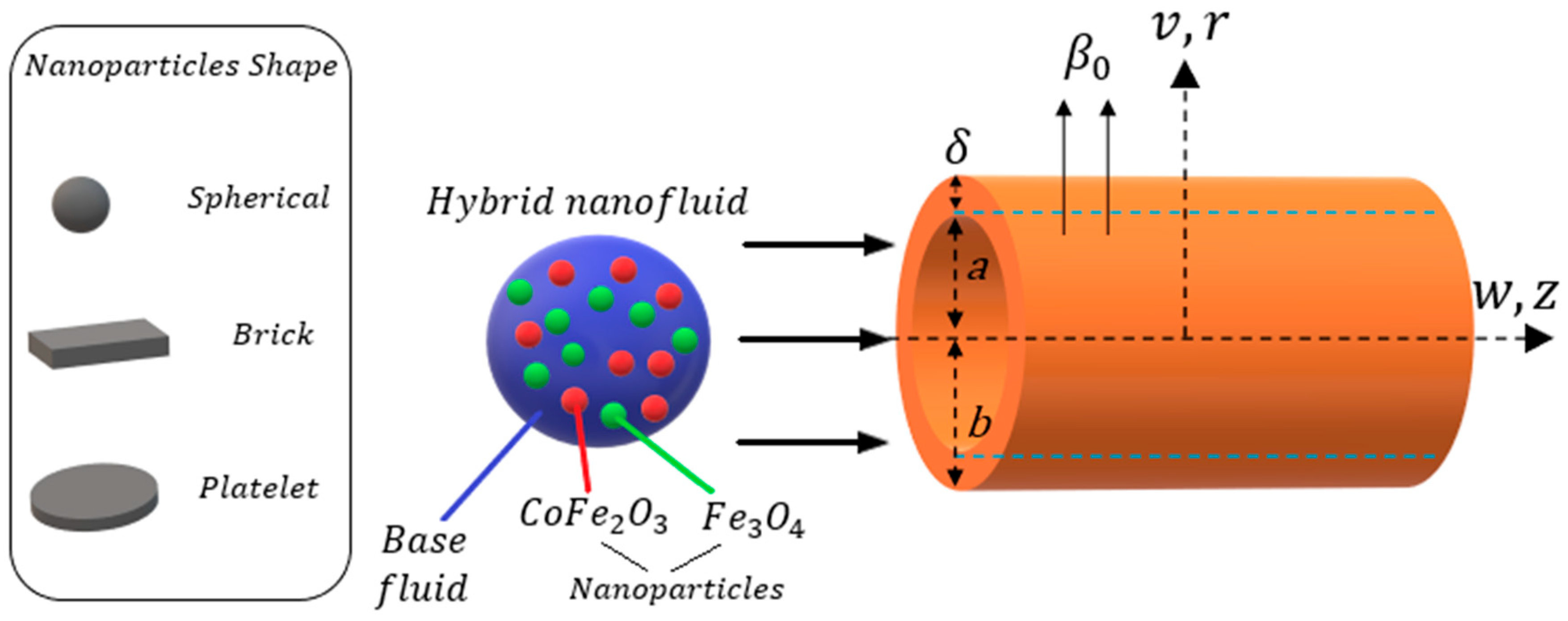
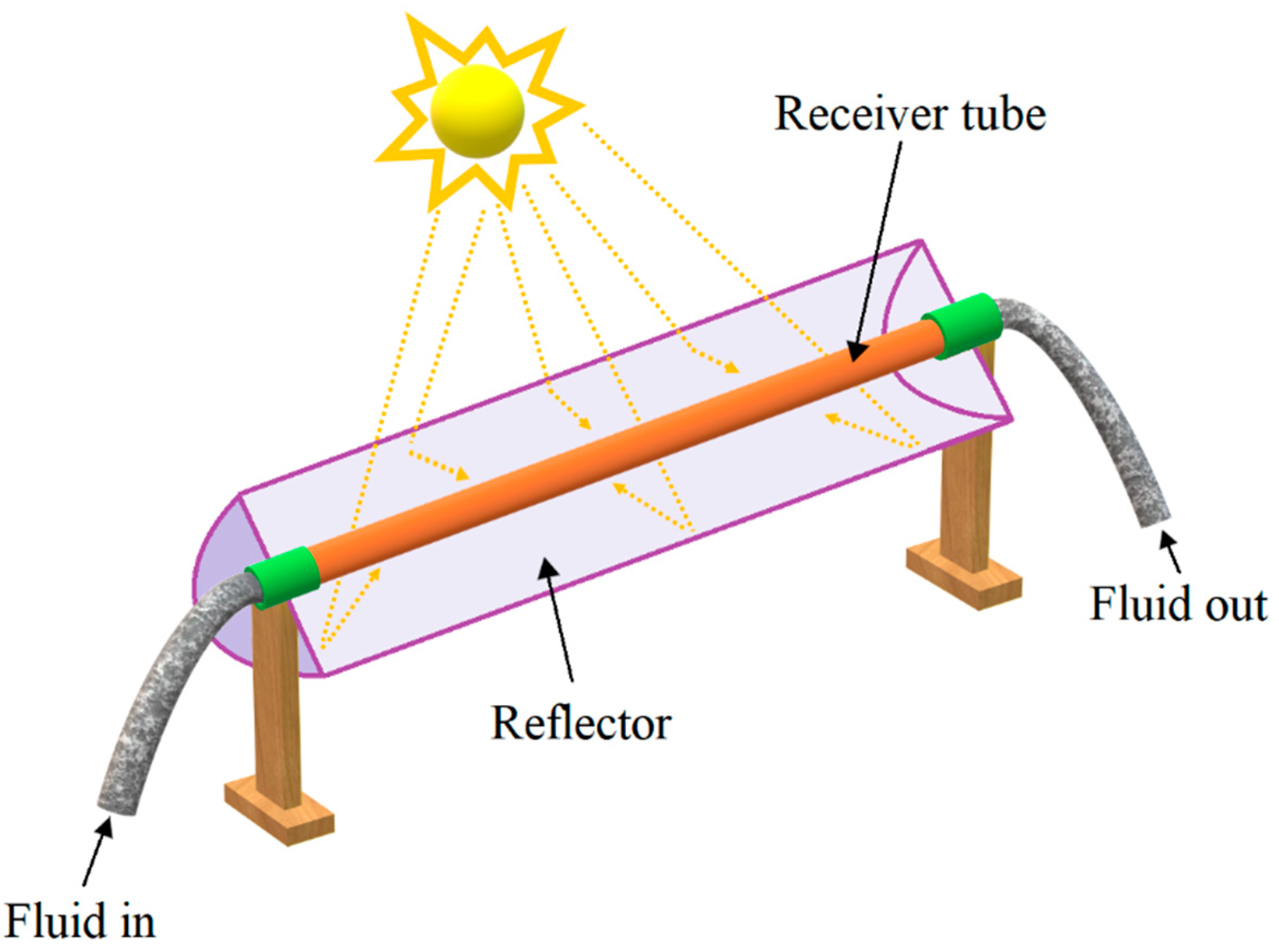
As shown in Figure 1, PTSC employs parabolically curved reflectors to focus solar radiation onto a heat-absorbing tube aligned with the focal path of the trough. This form of concentrated solar energy system is widely adopted and easy to obtain. This research analyzes heat transfer characteristics within the tubular motion of a mixed-type nanofluid. The primary aim of this research is to investigate how different nanoparticle geometries affect the enhancement of transverse nanofluid movement across a cylindrical surface. This study suggests that, within PTSC systems, directing the fluid between concentric cylindrical layers rather than through a single cylinder can improve heat exchange efficiency. Calculations were performed for various non-dimensional factors related to the case, ensuring sufficient accuracy to produce clear and informative graphical outputs.
Figure 1. Visual representation of a PTSC.
While prior studies have reported the superior thermal performance of spherical nanoparticles, few studies have quantified this behavior in Oldroyd-B hybrid nanofluids under photonic heating and Darcy–Forchheimer porous conditions. Moreover, earlier approaches relied solely on numerical discretization, without integrating neural networks as boundary-aware solvers. This study addresses these gaps by combining collocation with FNN to provide new comparative accuracy benchmarks and by analyzing relaxation/retardation effects in hybrid nanofluid transport, thereby extending the scope of existing literature.

2. Mathematical Analysis

In this work, DF porous material is utilized to simulate a transient, two-dimensional, incompressible flow of Oldroyd-B hybrid nanofluid composed of ethylene glycol, C o F e 2 O 4 and F e 3 O 4 . Along the axis of a stretching cylinder where r = 0 . Movement of the fluid is restricted for values where r exceeds zero. As shown in Figure 2, the r a x i s represents the radial coordinate for evaluation, while the z a x i s corresponds to the longitudinal axis of the cylinder. While the central cylinder stays fixed, the surrounding cylinder experiences variation. A radial magnetic field of intensity B 0 is imposed, under the assumption that the influence of the induced field remains negligible. The unsteady elongation speed of the cylinder is defined as w w = 2 c z 1 α t , where c > 0 and α 0 are fixed values. The effects of radiative heating, CC heat flux, and internal energy production or absorption are obtained. The set of expressions below defines the mathematical framework for the previously described issue [10,37].
r v r + r w z = 0 ,
ρ h n f w t + v w r + w w z + β 0 w t t + w 2 w z z + v 2 w r r + 2 v w w r z + 2 w w t z + 2 v w t r = μ h n f w r r + 1 r w r + μ h n f β 1 w r t + 1 r w t r + v r 2 w r 1 r w r w z 2 r v r w r + w r w r z w r w r z 2 w r v r r + v r w r r w z w r r + w w r r z + v w r r r ρ h n f F w 2 σ h n f B 0 2 w + β 0 w t + v w r ,
ρ C ρ h n f T t + w T z + v T r + β 2 v w r T z + w w z T z + v v r T r + w T r v z + 2 v w T z r + T t t + w t T z + 2 w T t z + v t T r + 2 v T t r + v 2 T r r + w 2 T z z = k h n f T rr + 1 r T r 1 r r q r r + Q 0 T T b ,
r = a : w = w w = 2 c z 1 α t , v = v w = c a 1 α t , T = T w = T b T r e f 1 α t 3 2 c z 2 ν f ,   r = b :   w r = w r r = δ r = T r = 0 ,   δ z = v
Figure 2. Illustrative layout representing the flow configuration.
According to [37], the radiative heat transfer formulated through Rosseland’s model is characterized.
q r = 4 σ 0 3 k 0 T 4 r ,   T 4 4 T b 3 T 3 T b 4 ,
Here, k 0 represents the average absorption coefficient, while σ 0 stands for the Stefan–Boltzmann constant.
To express χ , ψ , and the similarity term η in normalized form, the subsequent variables are employed for conversion.
v = c a χ η 1 α t 1 2 η 1 2 ,   w = 2 c z χ η 1 α t 1 ,   T = T b T r e f c z 2 ν f 1 α t 3 2 ψ η ,   η = r a 2 1 α t 1
For the exterior cylinder with radius b , the layer thickness is given by η = b a 2 = h . The subsequent relations define the framework for the scaled system.
2 Λ 1 R e χ η + χ Λ 2 S 2 χ η + χ , χ χ + χ , 2 + D e x S 2 2 χ η 2 + 4 χ η + 2 χ , + 2 χ 2 χ + 1 η χ 2 χ 4 χ χ , χ + 2 S χ , χ η + 2 χ , 2 χ χ η 2 χ χ + Λ 1 R e D e d 2 S χ , v η 2 + 4 χ η + 2 χ + 4 χ 2 η 4 χ χ , v η 8 χ χ Λ 2 F r χ , 2 Λ 3 M χ , + D e x S χ η + χ , 2 D e x χ χ = 0 ,
Λ 4 P r χ ψ , 2 χ , ψ S 2 ψ , η 3 2 ψ + B t 4 χ χ ψ 8 χ , 2 ψ + 6 χ χ , ψ , 2 χ 2 ψ s 2 2 ψ η 2 + 5 ψ , η + 15 4 ψ + S 2 χ ψ η + 5 χ ψ , 2 χ ψ η 8 χ , ψ 3 χ , ψ , η + 2 Λ 5 + R a ψ η + ψ , + Q 1 P r 2 ψ = 0 ,
η = 1   :   χ = χ , = ψ = 1 ,   η = h   :   χ = χ = ψ , = 0
Within the earlier expressions, R e = ρ f c a 2 μ f ,   R a = 16 σ T b 3 3 k k f ,   S = a c ,   F r = c z k ,   M = σ f B 0 2 1 α t 2 ρ f c ,   P r = ρ C p f c a 2 k f ,   B t = β 2 c 1 α t ,   D e d = β 1 c 1 α t ,   D e x = β 0 c 1 α t ,   Λ 1 = μ h n f μ f ,   Λ 2 = ρ h n f ρ f ,   Λ 3 = σ h n f σ f ,   Λ 4 = ρ C ρ h n f ρ C ρ f ,   Λ 5 = k h n f k f   and   Q 1 = Q 0 1 α t ρ C ρ f c .
The expressions describing the thermo-physical behavior of nanofluids [9] are:
ρ h n f ρ f = ρ s 2 ρ f φ 2 + 1 φ 1 + ρ s 1 ρ f φ 1 1 φ 2 , μ h n f = μ f 1 φ 1 + φ 2 + φ 1 φ 2 2.5 ,   ρ C P h n f ρ C P f = ρ C P s 2 ρ C P f φ 2 + 1 φ 1 + ρ C P s 1 ρ C P f φ 1 1 φ 2 ,   k h n f k n f = k s 2 + l 0 1 k n f k n f k s 2 φ 2 k n f k s 2 φ 2 + l 0 1 k n f + k s 2 , k n f k f = k s 1 + l 0 1 k f k f k s 1 φ 1 l 0 1 k f + k f k s 1 φ 1 + k s 1 ,   σ h n f σ n f = σ s 2 + 2 σ n f σ n f σ s 2 φ 2 σ n f σ s 2 φ 2 + 2 σ n f + σ s 2 , σ n f σ f = σ s 1 + 2 σ f σ f σ s 1 φ 1 2 σ f + σ f σ s 1 φ 1 + σ s 1 .

3. Method of Solution

A nonlinear set of differential expressions, representing the variations of χ η and ψ η in the considered domain, it is subjected to a solution. The FNN operates as an approximator, determining the solution by minimizing a performance index that reflects deviations from the governing equations.
The feedforward neural network employed in this study is designed to approximate both the velocity profile and the thermal distribution. The network architecture consists of an input layer receiving the similarity variable, two hidden layers of 48 neurons each with tanh activation, and a linear output layer producing two values: one used in a trial function to construct the velocity profile while automatically satisfying boundary conditions, and the other representing the thermal profile. Equations (7) and (8) serve as the governing ordinary differential equations for the velocity and thermal distributions. In Equation (9), the boundary specifications are defined so that the neural network solution adheres to the system’s physical limitations. By employing this setup, the FNN acquires reliable results without compromising the characteristics of the represented system.
By integrating tanh activation units throughout its layers, the neural framework models gradual and continuous solution behaviors. Automatic differentiation is applied to obtain the derivatives of the estimated outputs, enabling their immediate insertion into the governing relations. A performance index is established by combining the equation errors with the associated boundary specifications:
L = ( E q u a t i o n   R e s i d u a l s ) + ( B o u n d a r y   C o n d i t i o n E r r o r s )
The Adam optimization method is applied to reduce the objective measure by cycling through selected training samples in the specified domain. The FNN is not used merely as a fitting tool but as an integrated solver. Training was performed with 2000 epochs, learning rate 0.001, and tanh activation. Convergence plots demonstrate rapid error reduction, with residual norms decreasing by more than 90% compared to collocation alone. Benchmark tests against CM confirm that the FNN achieves superior accuracy while strictly enforcing boundary conditions. This methodological integration represents a novel contribution to hybrid nanofluid modeling.

4. Results and Discussions

From Equstions (7) and (8), the formulated ODEs describing flow and thermal fields, together with the constraints in Equation (9), are solved. The results from the computations are obtained through the application of FNN in combination with the CM. For multiple configurations of circulation parameters, plots of χ η and ψ η are generated to study the flow characteristics and thermal transfer. For this purpose, the various flow variables are assigned the magnitudes listed as M = 2 , R e = 5 , R a = 4 , P r = 6 , S = 0.2 , F r = 0.5 , Q 1 = 0.5 , ϕ 1 = 0.01 , ϕ 2 = 0.01 . Results are obtained for various nanoparticle geometries, including spherical, brick, and platelet forms. Table 1 lists the thermal and physical properties of the nanoparticles and ethylene glycol applied in this study. The shape factor magnitudes are listed in Table 2.
Table 1. The thermo-physical specifications [37].
Table 2. Form factor corresponding to different nanoparticle geometries [37].
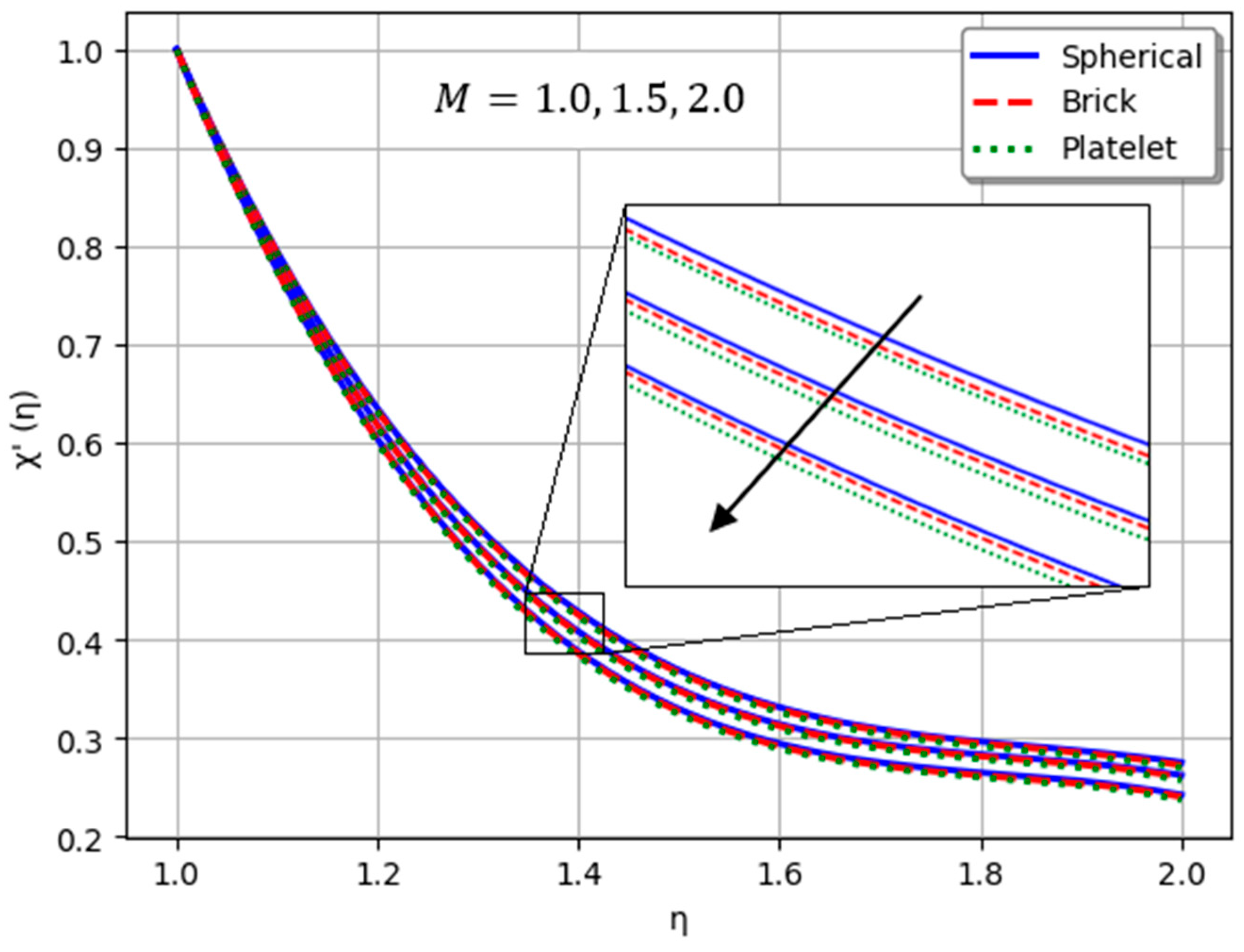
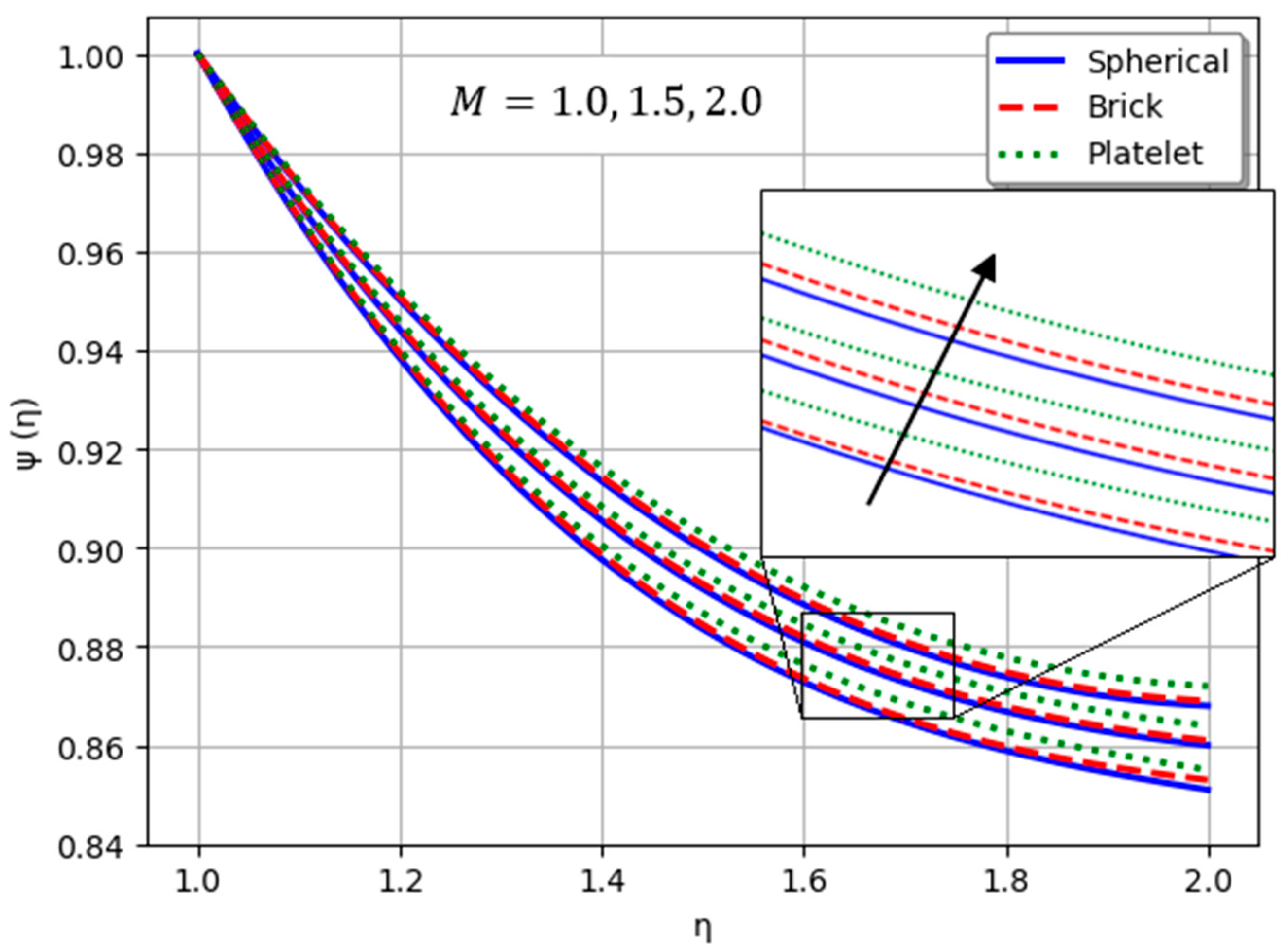
The variations in velocity and thermal behavior resulting from changes in M are depicted in Figure 3 and Figure 4. Figure 3 demonstrates that an increase in M leads to a reduction in the velocity. When a magnetic field interacts with an electrically conducting flow, the thickness of the momentum layer often decreases. The phenomenon arises from Lorentz forces, which act in opposition to the motion of the conducting fluid and hinder its progression. When the cross nanofluid moves along the boundary, the applied force generally slows its motion. As shown in Figure 4, increasing M results in a rise in the thermal state of the hybrid nanofluid. Magnetic effects create a counteracting force against the moving fluid, leading to a thicker heat layer and improved energy transfer.
Figure 3. Velocity profiles χ η versus magnetic parameter M .
Figure 4. Temperature profiles ψ η versus magnetic parameter M .
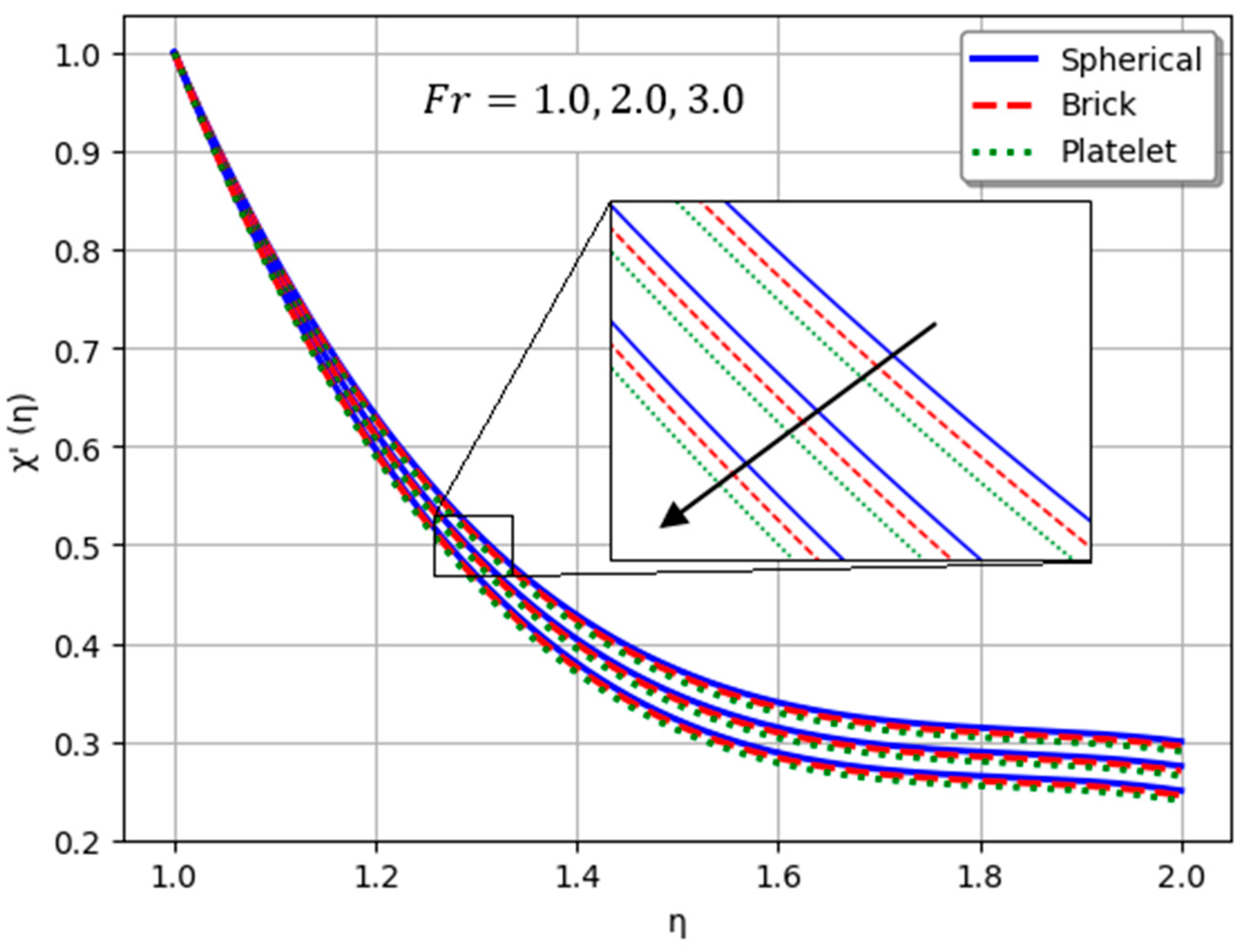
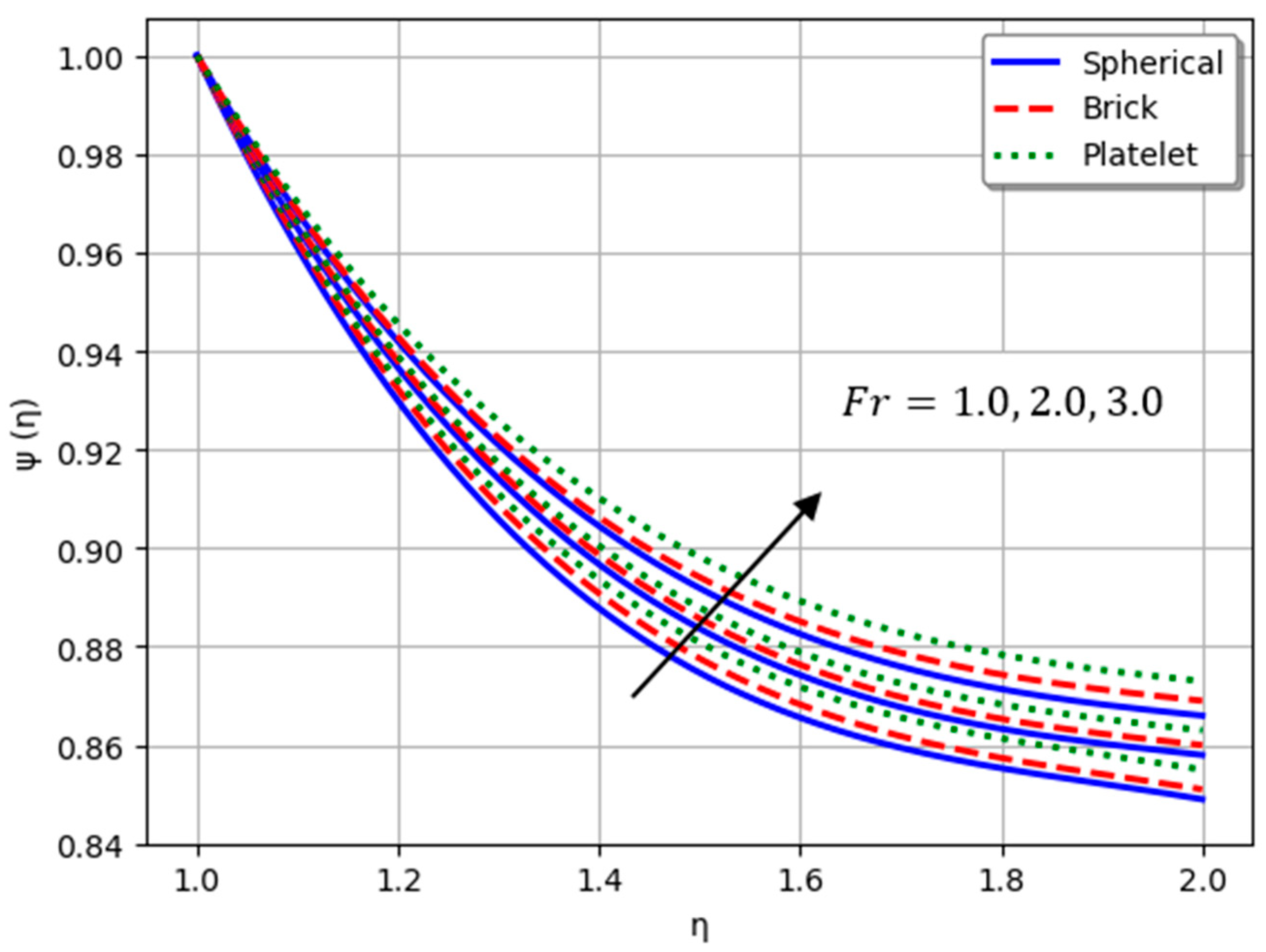
Figure 5 and Figure 6 illustrate how F r influences the velocity pattern and the temperature profile, in that order. An increase in F r leads to a reduction in velocity, while the temperature profile rises. When F r rises, opposing forces develop that slow the fluid motion and generate resistance, leading to improved heat transfer.
Figure 5. Velocity profiles χ η versus inertia factor F r .
Figure 6. Temperature profiles ψ η versus inertia factor F r .
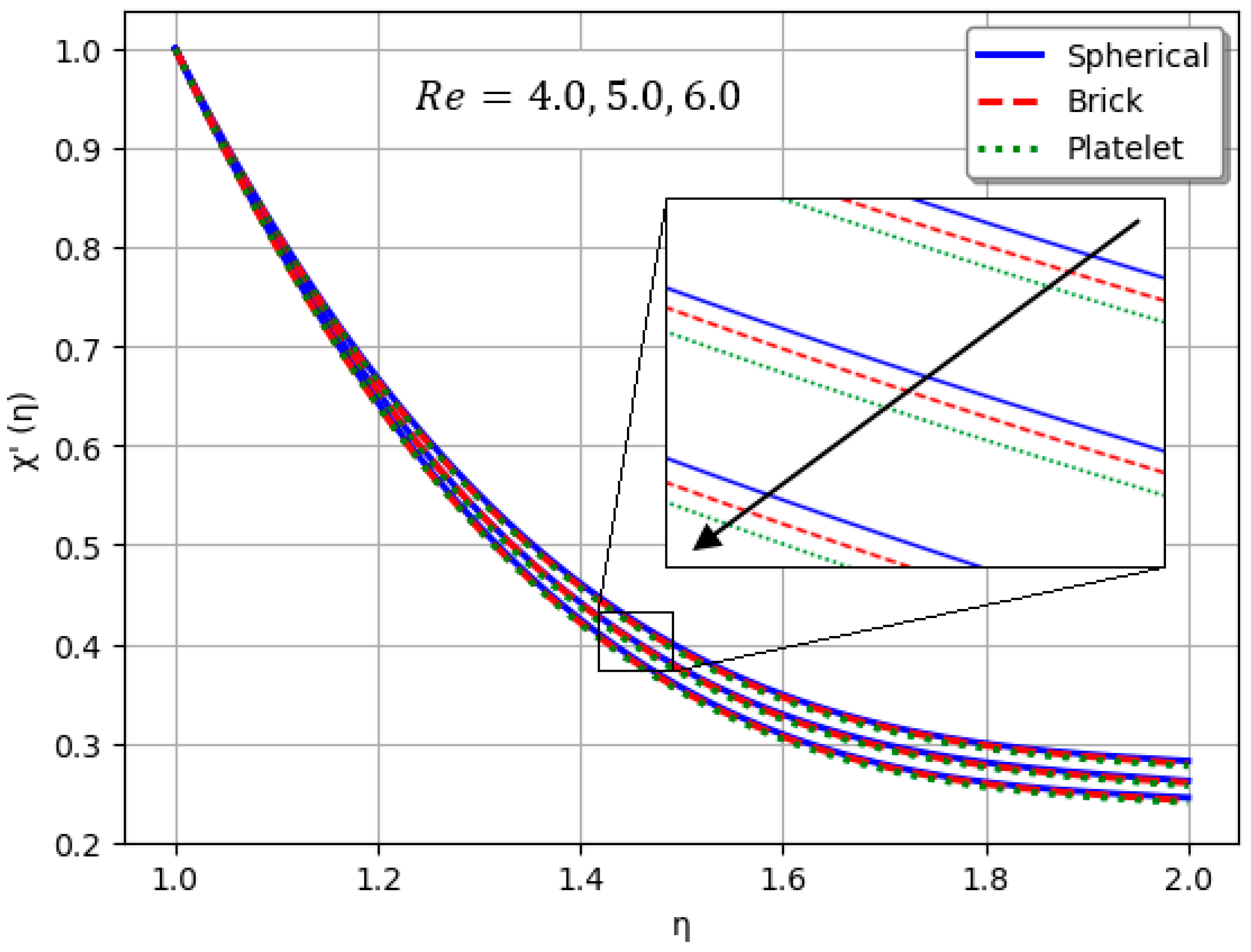
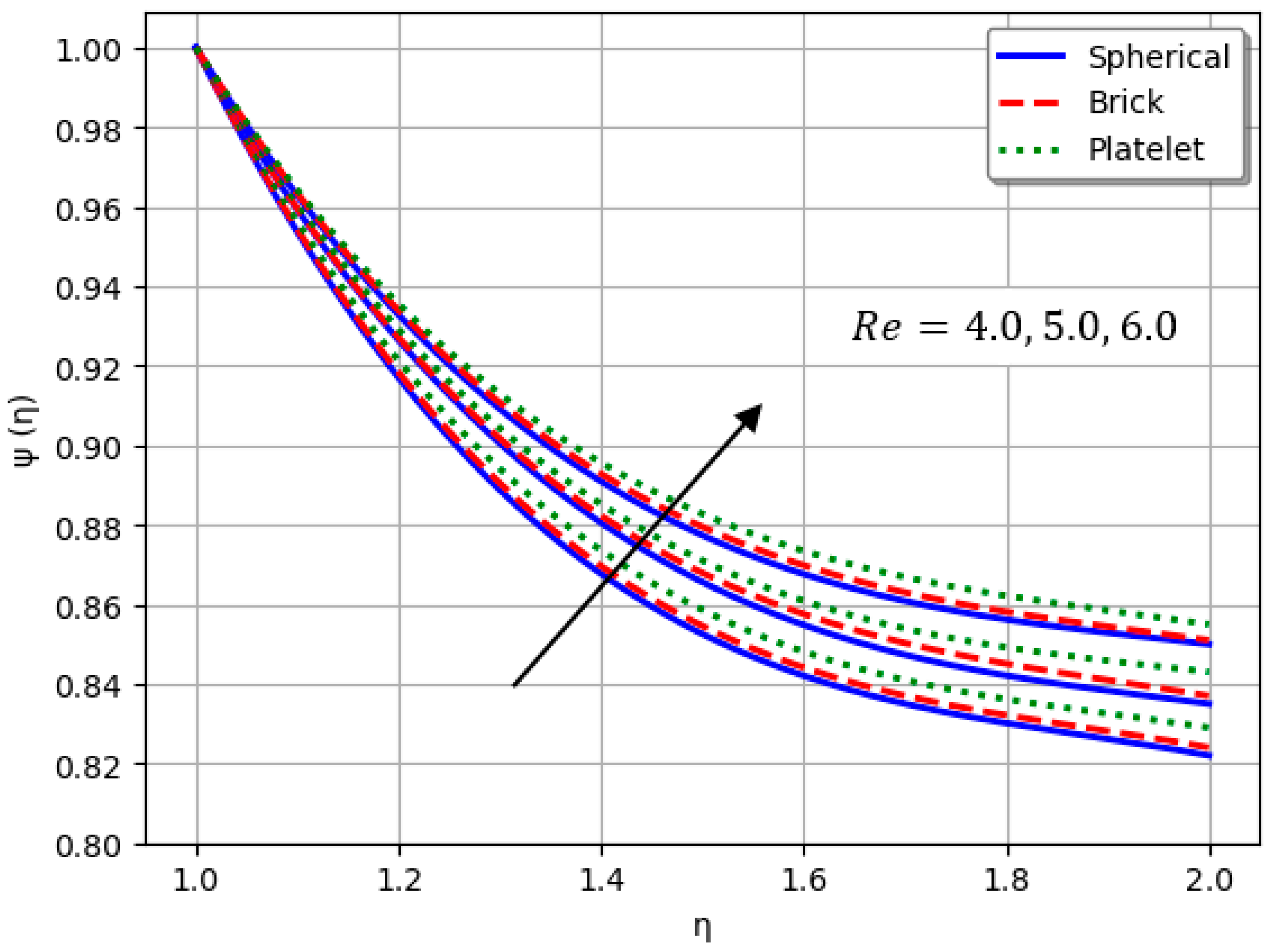
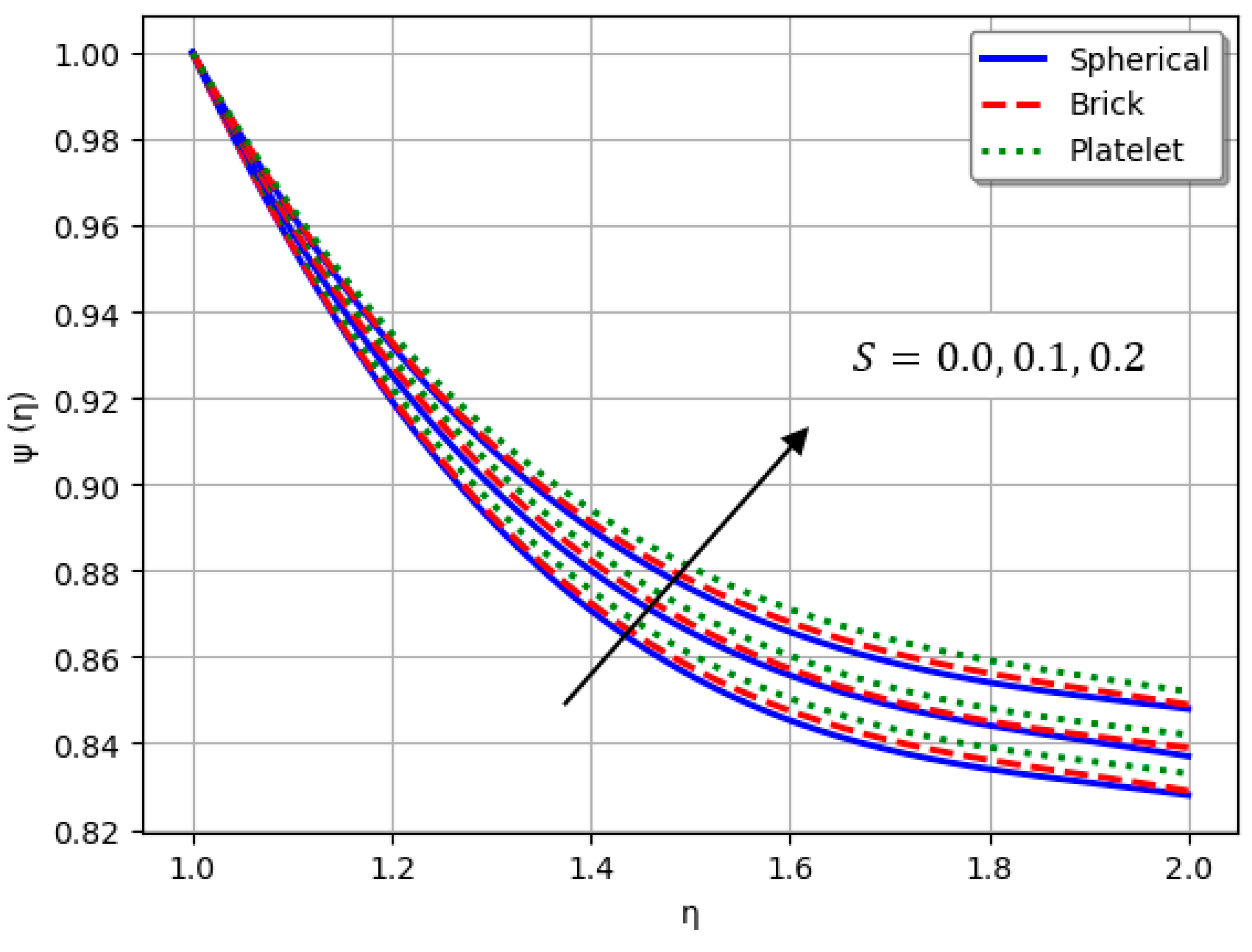
As presented in Figure 7, every nanoparticle shape exhibits a reduction in the velocity profile with rising R e . With rising R e , the influence of inertia becomes greater than the effects of viscosity on the flow. Significant viscous effects significantly influence the motion of the fluid, while pronounced inertial action leads to a reduction in the boundary layer flow speed. In all three scenarios with large R e values, Figure 8 shows an upward trend in the temperature profile. Unlike viscous resistance, a higher R e indicates that inertial effects become the dominant driving factor. Strong inertial effects maintain the dense arrangement of particles within the fluid. Overcoming the bonds among fluid particles requires the application of intense thermal energy. These forces cause an elevation in the temperature at which the fluids begin to boil. Figure 9 shows that the temperature profile increases as the unsteadiness parameter S becomes larger, since higher S reduces stretching and thereby promotes greater instability. Greater unsteadiness intensifies the bonding between fluid particles, resulting in enhanced thermal conduction. Therefore, both the thermal distribution and the boundary layer thickness show an enhancement.
Figure 7. Velocity profiles χ η versus Reynolds number R e .
Figure 8. Temperature profiles ψ η versus Reynolds number R e .
Figure 9. Temperature profiles ψ η versus unsteadiness parameter S .
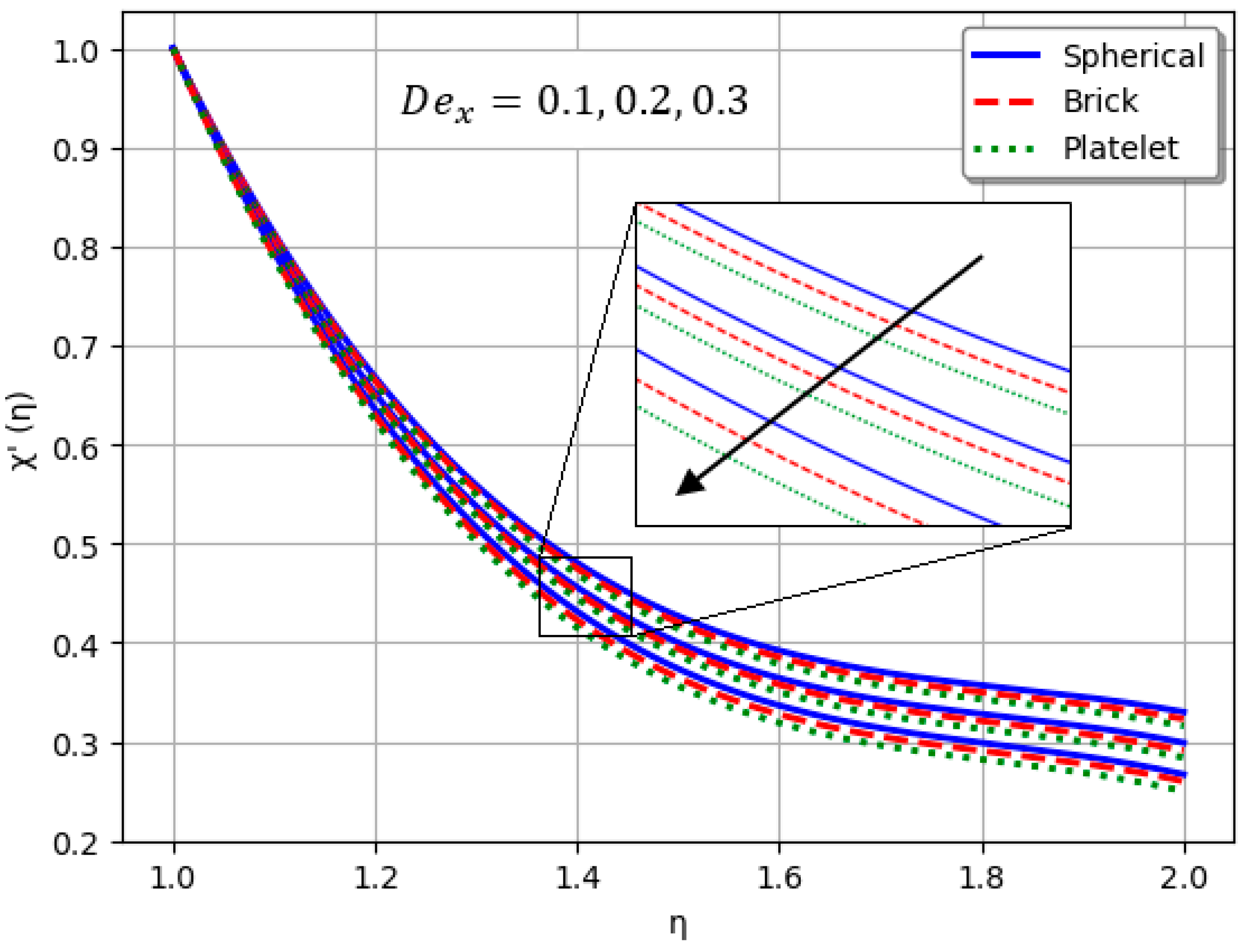
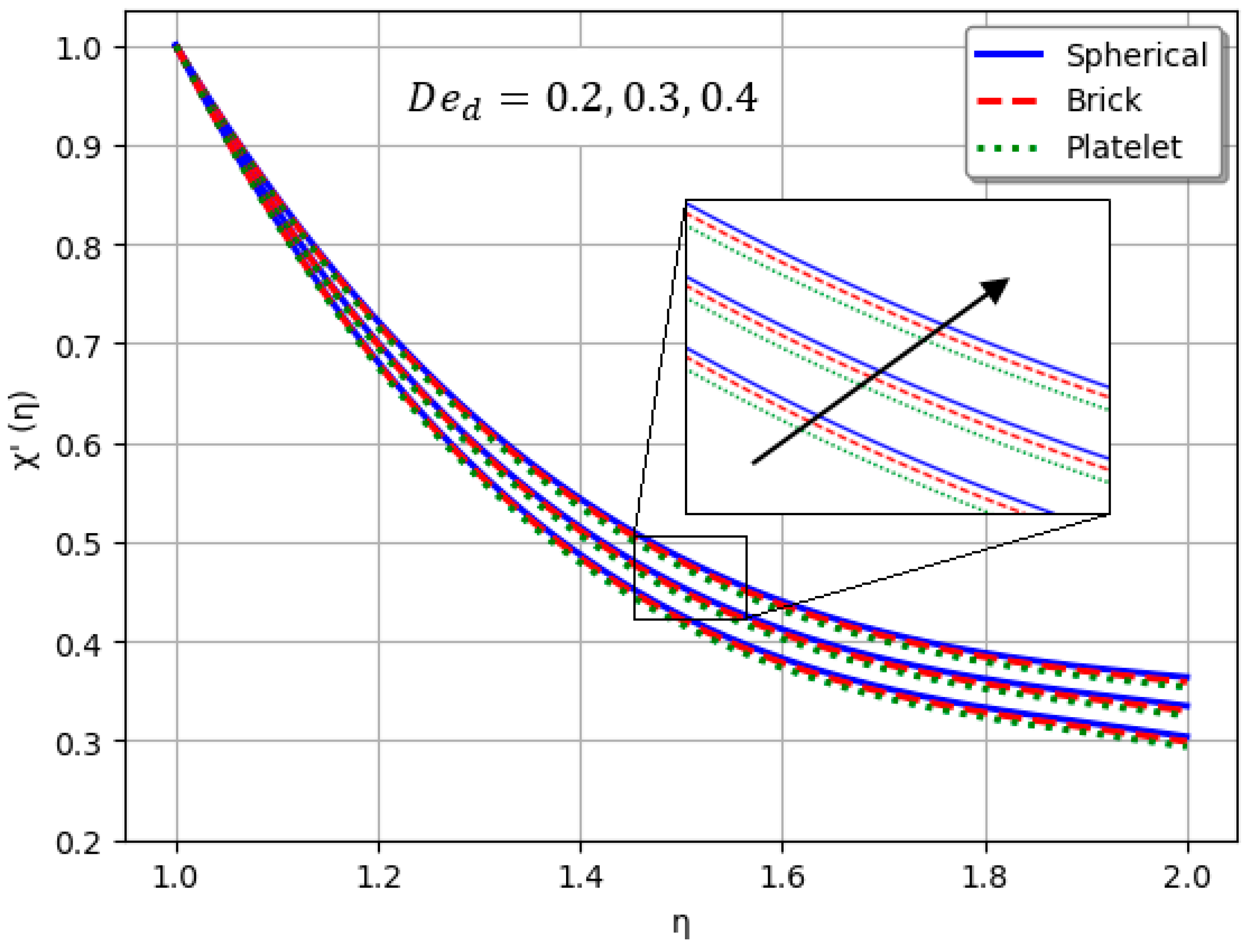
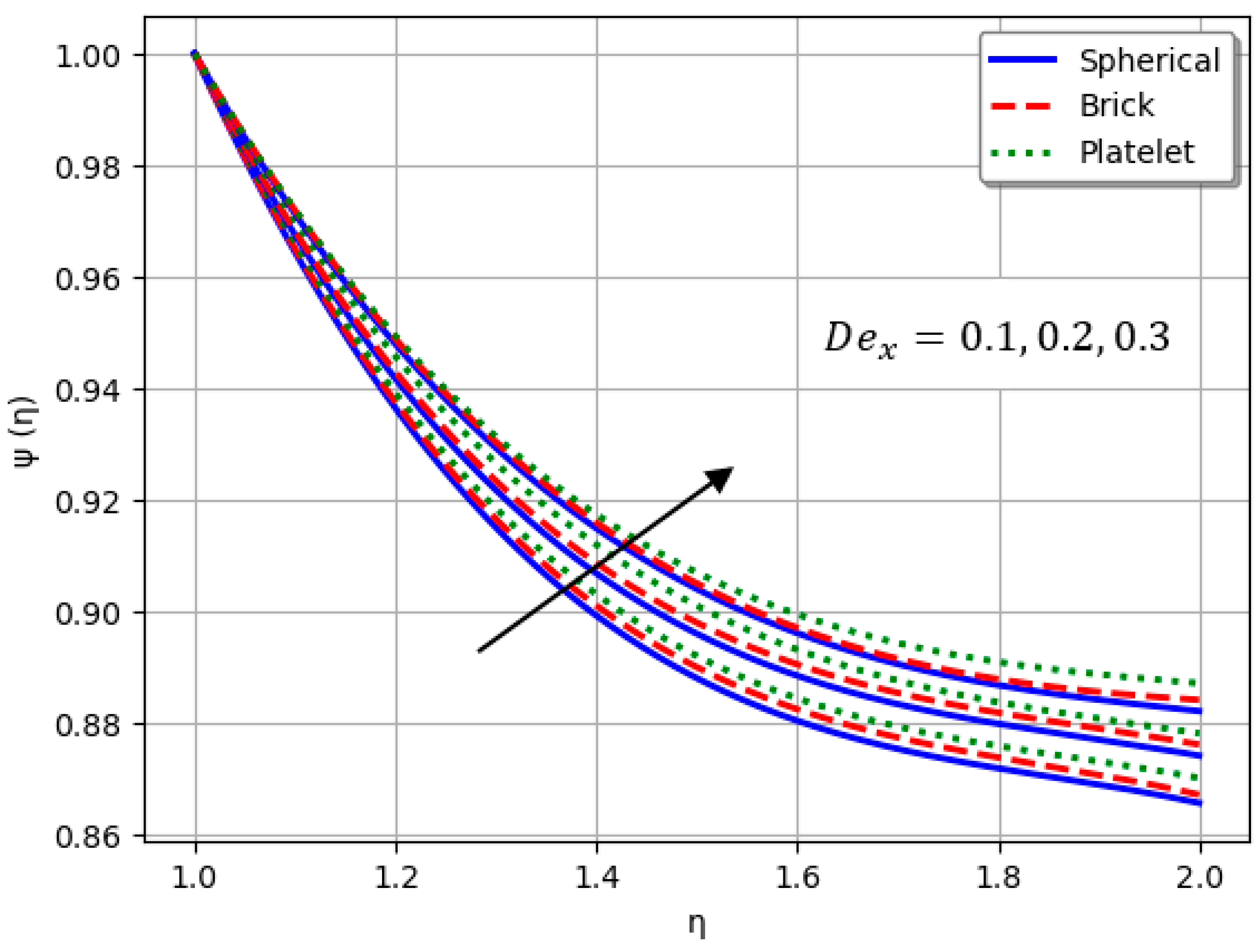
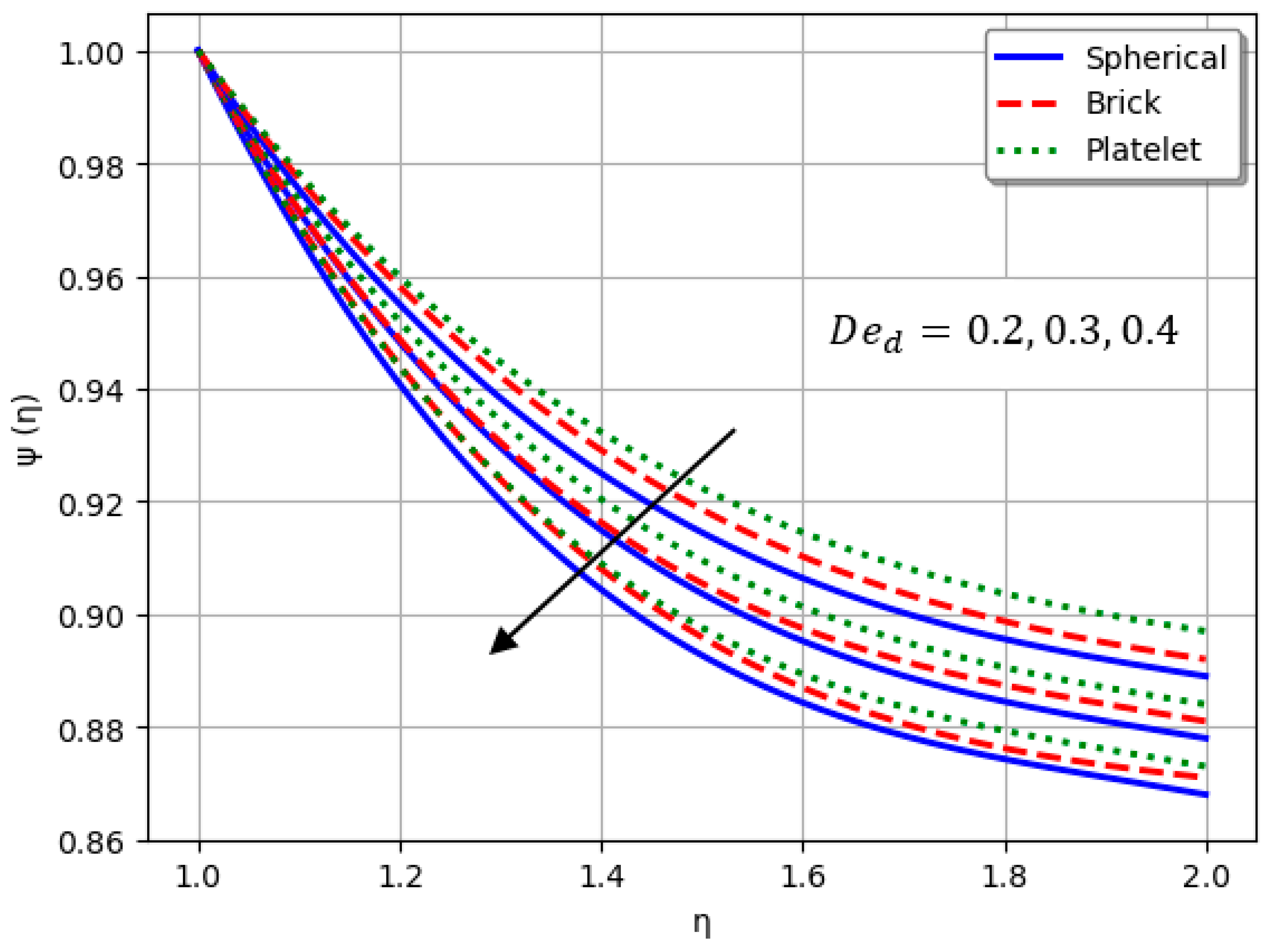
As shown in Figure 10 and Figure 11, D e x and D e d exhibit opposite effects on the velocity profile, respectively. The relaxation period corresponds directly to D e x , while the retardation period aligns in the same manner with D e d . An extended relaxation period intensifies the elastic effects controlling fluid motion, making the liquid act more like a solid and reducing the velocity field. Unlike the effect of relaxation time, retardation time demonstrates an opposite trend in the velocity profile, as displayed in Figure 11. When the retardation period becomes greater, the elastic effect diminishes, leading to a rise in the velocity profile. It is widely understood that a higher D e x leads to a reduction in the velocity profile, whereas a greater D e d results in its upward movement. In Figure 12, the effect of D e x on the temperature profile is depicted through a graphical representation. The analysis indicates that higher D e x values lead to an increase in the temperature profile. As D e x becomes larger, the relaxation parameter rises, leading to more frequent interactions among fluid particles and an expansion of the boundary-layer thickness. As shown in Figure 13, higher D e d values result in a decline in the temperature profile. An increase in D e d shortens the retardation period, leading to a decline in the temperature profile. From the analysis, it can be inferred that both the temperature distribution and the thickness of the outer layer diminish as D e d increases.
Figure 10. Velocity profiles χ η versus relaxation Deborah number D e x .
Figure 11. Velocity profiles χ η versus retardation Deborah number D e d .
Figure 12. Temperature profiles ψ η versus relaxation Deborah number D e x .
Figure 13. Temperature profiles ψ η versus retardation Deborah number D e d .
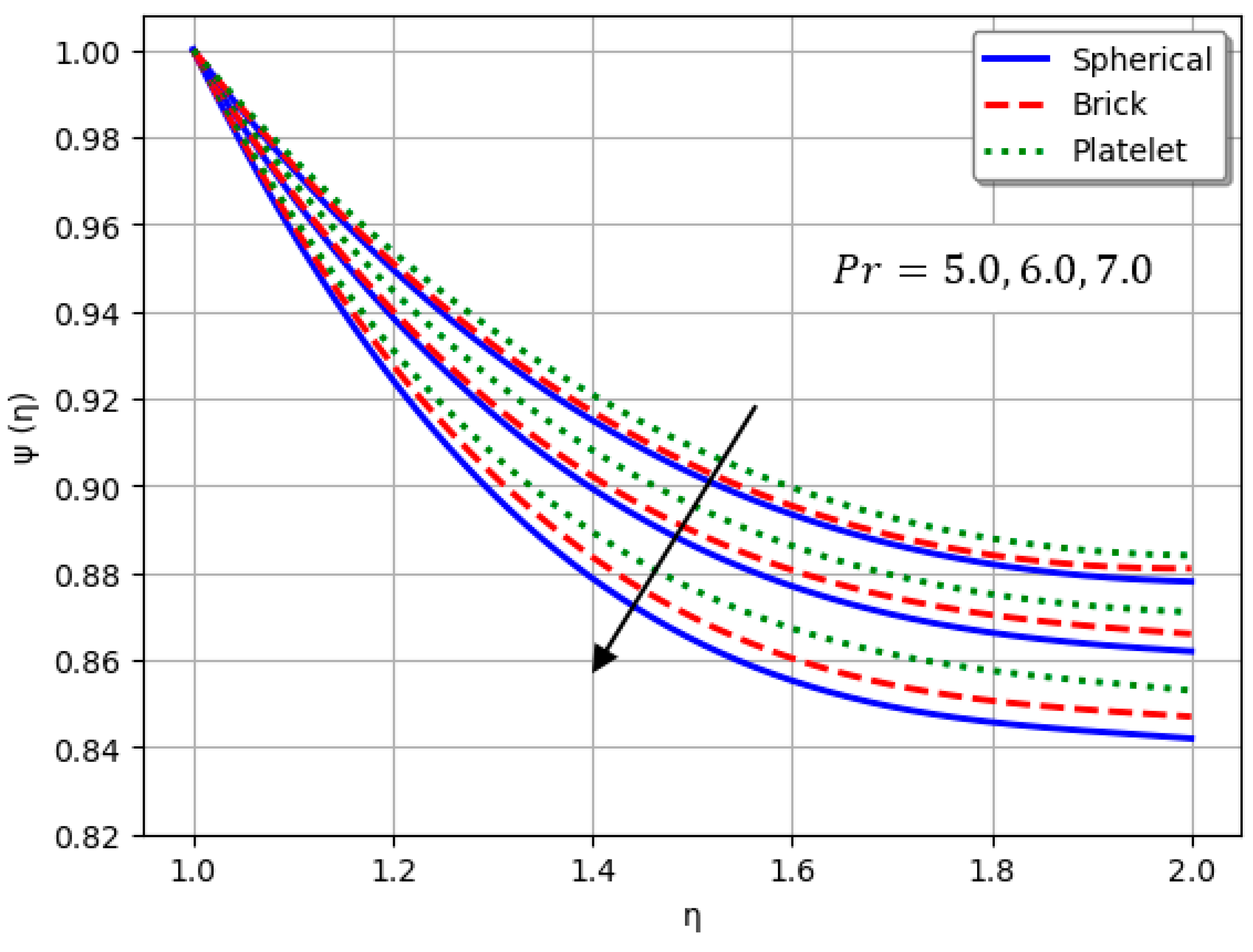
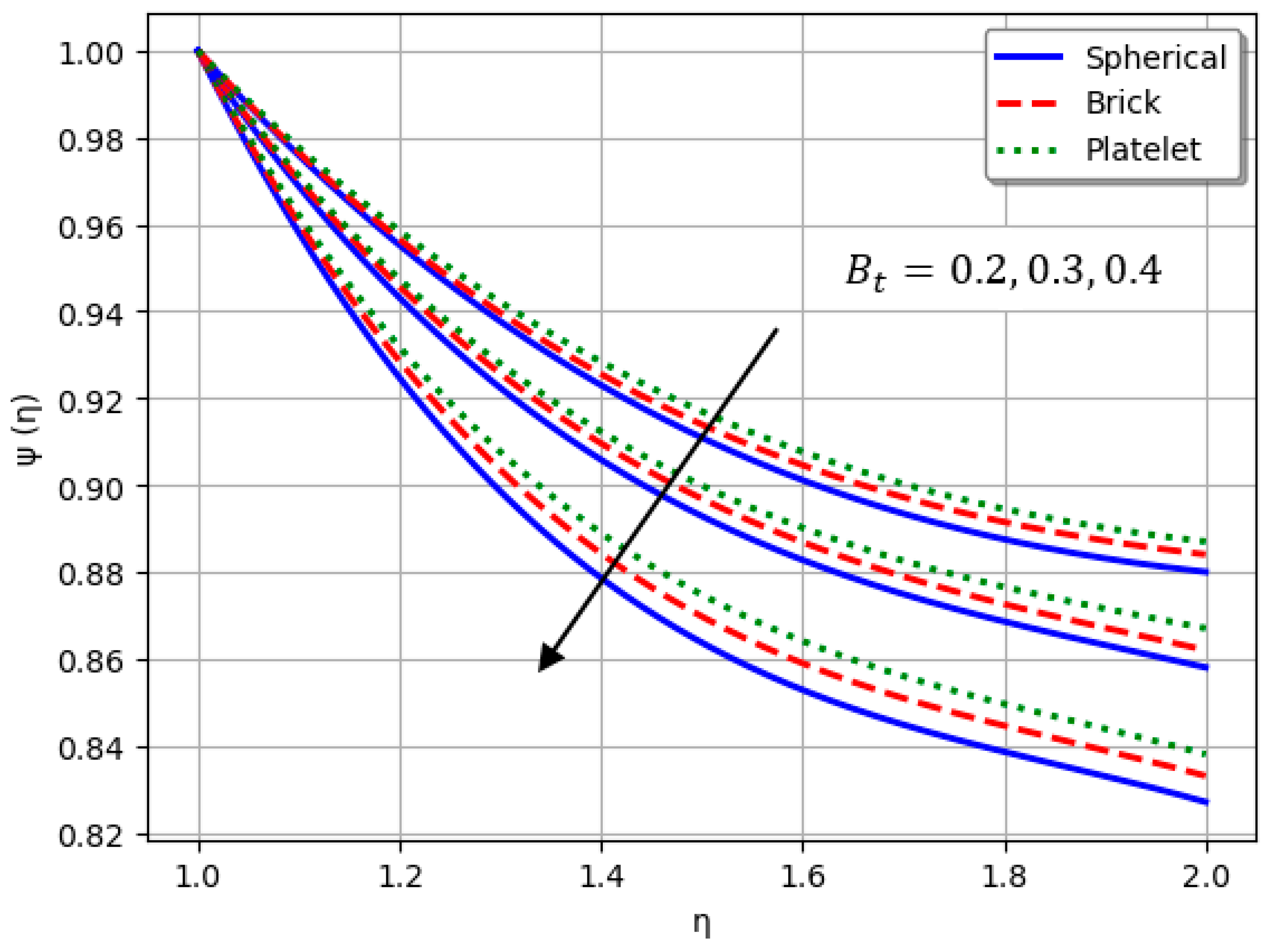
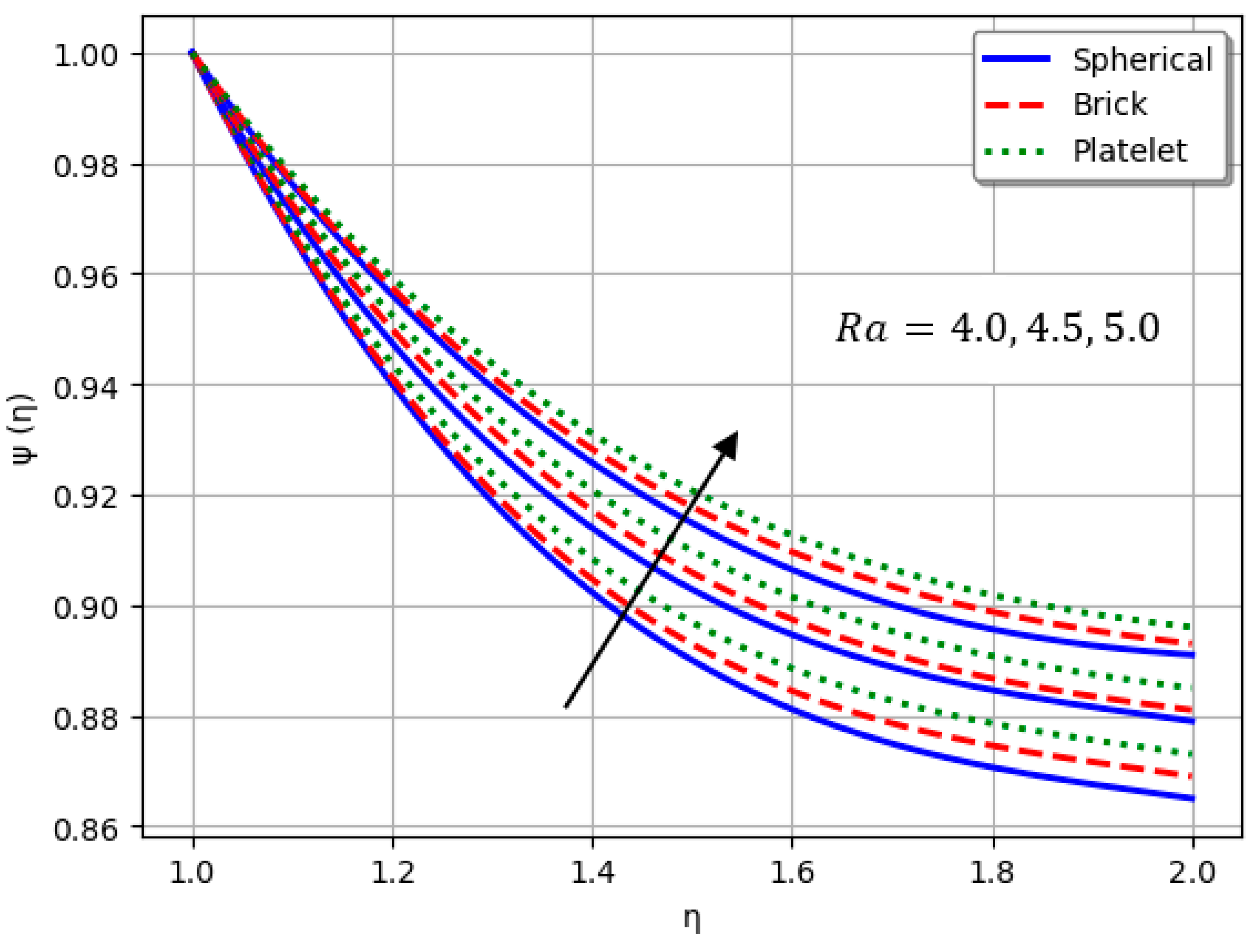
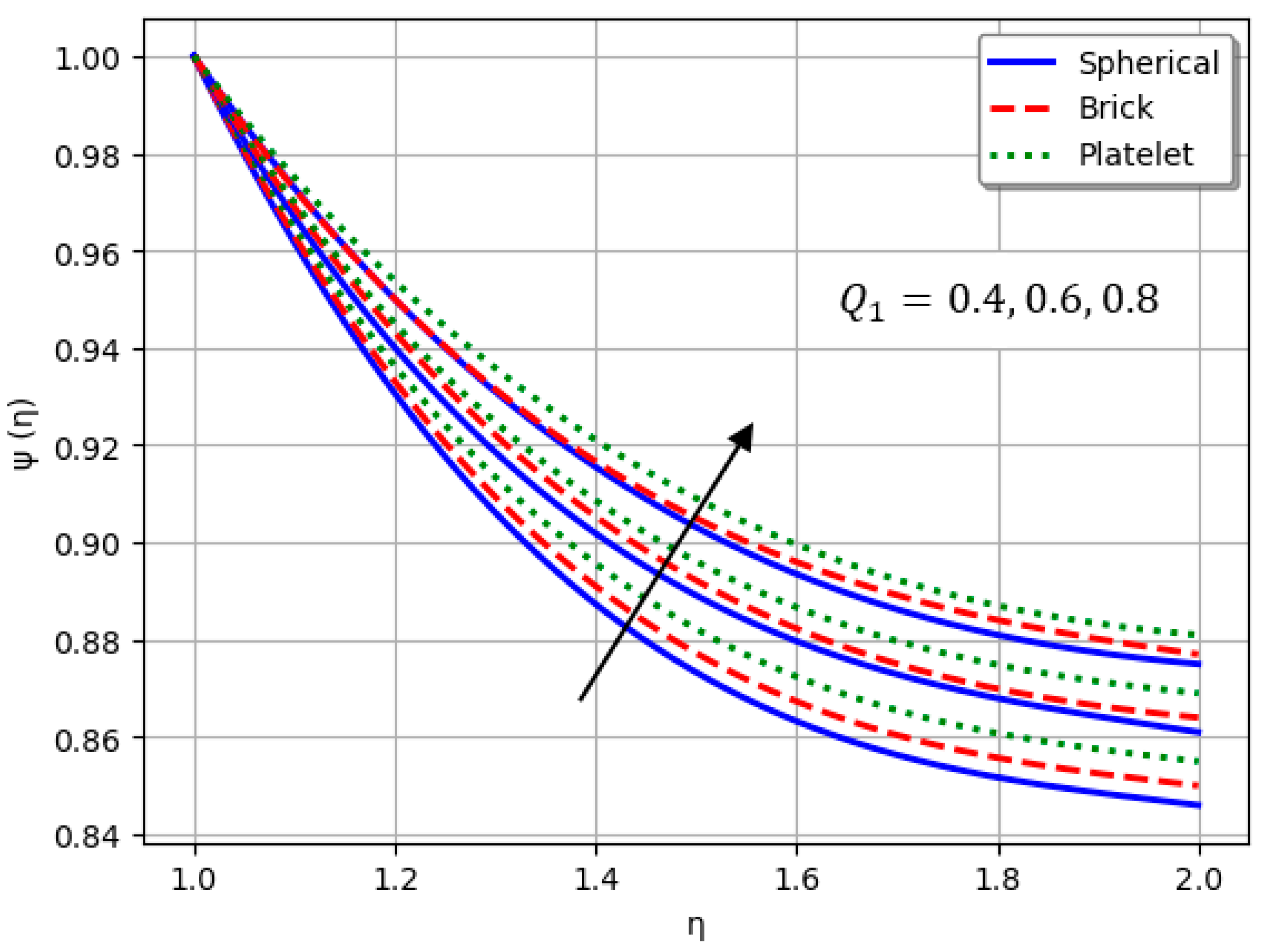
Figure 14 illustrates that higher P r values lead to a reduction in the temperature profile. By its formal meaning, P r expresses the proportion between momentum diffusivity and heat diffusivity. Consequently, an increase in P r diminishes thermal diffusivity, leading to a reduction in the temperature profile and the associated boundary layer. Figure 15 illustrates the effect of B t on the temperature profile. Larger B t values are associated with a decrease in the temperature profile. This case suggests that particles require an extended period to convey heat to surrounding particles, resulting in a reduction in the fluid’s thermal state. As B t increases, the temperature profile shows a downward trend. Figure 16 illustrates that the presence of R a alters the temperature profile. An elevation in R a consistently brings about an increase in heat emission. From a practical standpoint, thermal radiation transfers energy to the flowing medium, increasing the temperature of the nanoparticles. Figure 17 illustrates the influence of Q 1 on the temperature profile. An increase in Q 1 leads to a rise in the temperature profile. An increase in Q 1 causes the fluid to take in more thermal energy, which elevates the temperature profile and expands the thermal boundary layer.
Figure 14. Temperature profiles ψ η versus Prandtl number P r .
Figure 15. Temperature profiles ψ η versus heat dissipation relaxation factor B t .
Figure 16. Temperature profiles ψ η versus radiation parameter R a .
Figure 17. Temperature profiles ψ η versus heat source parameter Q 1 .
Sensitivity analysis shows that spherical nanoparticles maintain superior heat transfer even under extreme relaxation ( D e x ) and retardation ( D e d ) regimes, with gains ranging from 12% to 22%. These results extend prior findings by demonstrating robustness across parameter ranges not previously studied. Comparative discussion with [7,8,9,10,22] confirms that while earlier works noted spherical superiority qualitatively, the present study provides methodological advancement.
The FNN produces the forecasted outcomes by progressively capturing the dynamics of the system described by the modified ODEs. In contrast to conventional computational methods, the neural network employs automatic differentiation to obtain accurate derivative values, thereby maintaining consistency between the estimated solutions and the governing physical laws. During learning, the method reduces the errors in the governing equations and applies the boundary conditions, producing an approximation of high precision. Moreover, the neural network method supports dynamic learning, progressively improving its estimates through repeated error reduction, achieving accuracy superior to conventional discretization techniques. The findings reveal the intricate, nonlinear relationships within the system, highlighting the dynamic coupling of fluid motion, thermal transport, and mass dispersion. Table 3 presents the forecasted data, delivering a detailed quantitative depiction of the solution profiles and revealing the influence of significant parameters, thereby supporting a stronger analysis than traditional methods. The findings reflect changes in the principal physical factors M , K p , E c , and Q , highlighting their influence on the simulated system.
Table 3. Predicted Solutions for Velocity and Temperature profiles.
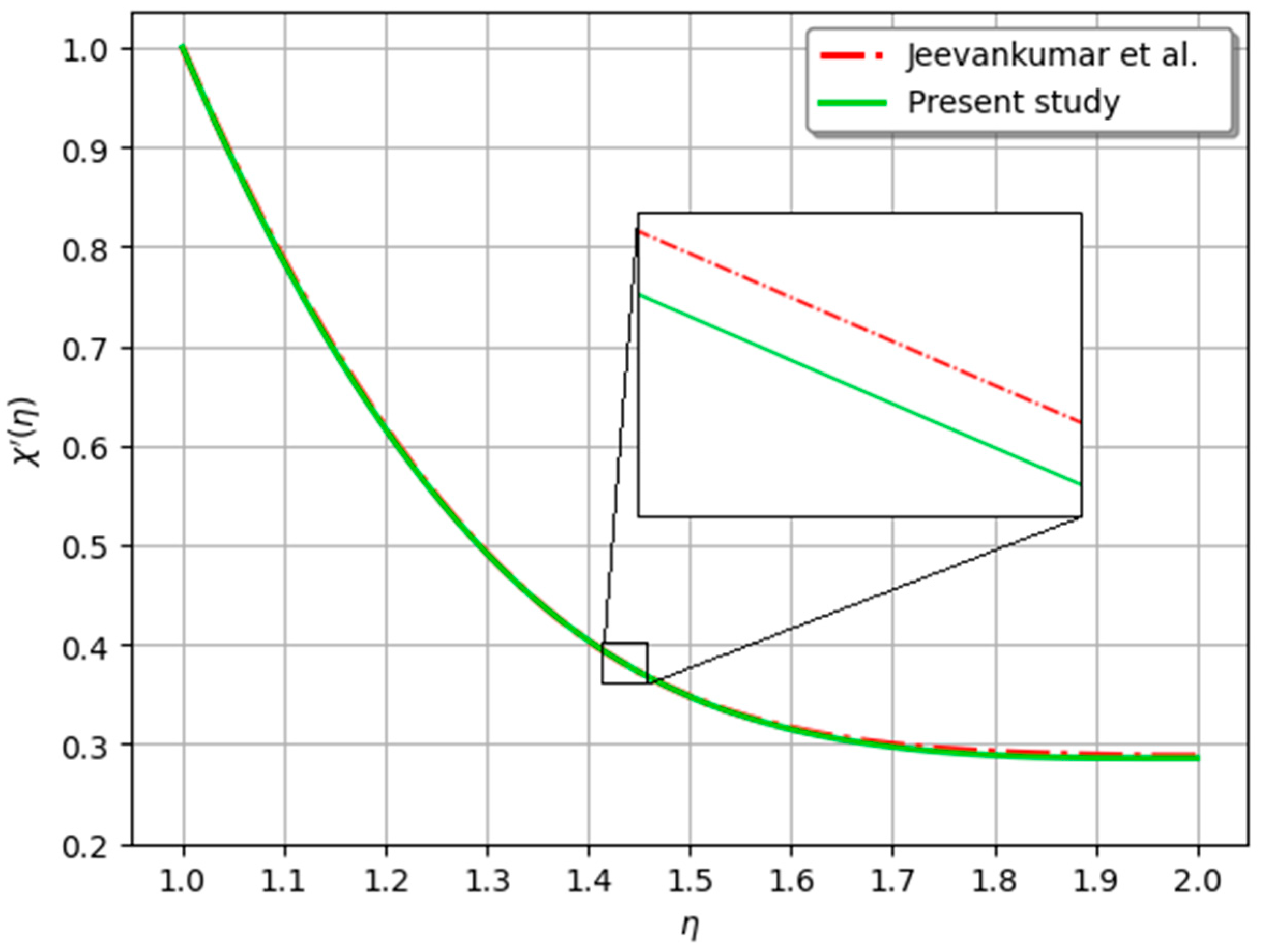
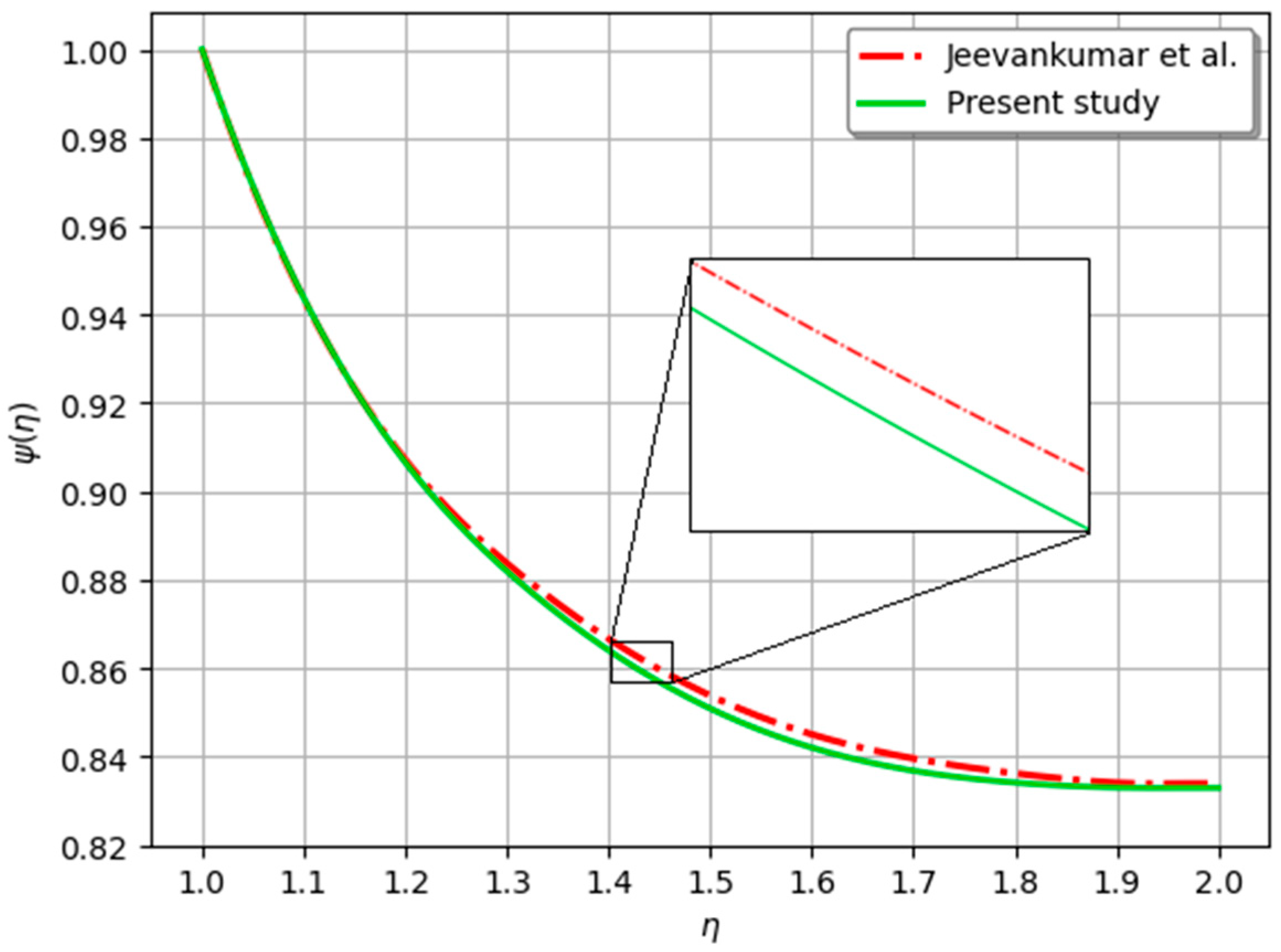
According to Jeevankumar et al. [37], the procedure applied in this investigation yields velocity and temperature profile values that are almost the same as those obtained in their Figure 18 and Figure 19 illustrate the assessment graphically, and the related numerical outcomes are provided in Table 4 and Table 5.
Figure 18. Comparison of the velocity profile   χ ( η ) between the present study and Jeevankumar et al. [37].
Figure 19. Comparison of the temperature profile   ψ ( η ) between the present study and Jeevankumar et al. [37].
Table 4. The comparison of χ η between Jeevankumar et al. [37] and the present study.
Table 5. The comparison of ψ η between Jeevankumar et al. [37] and the present study.
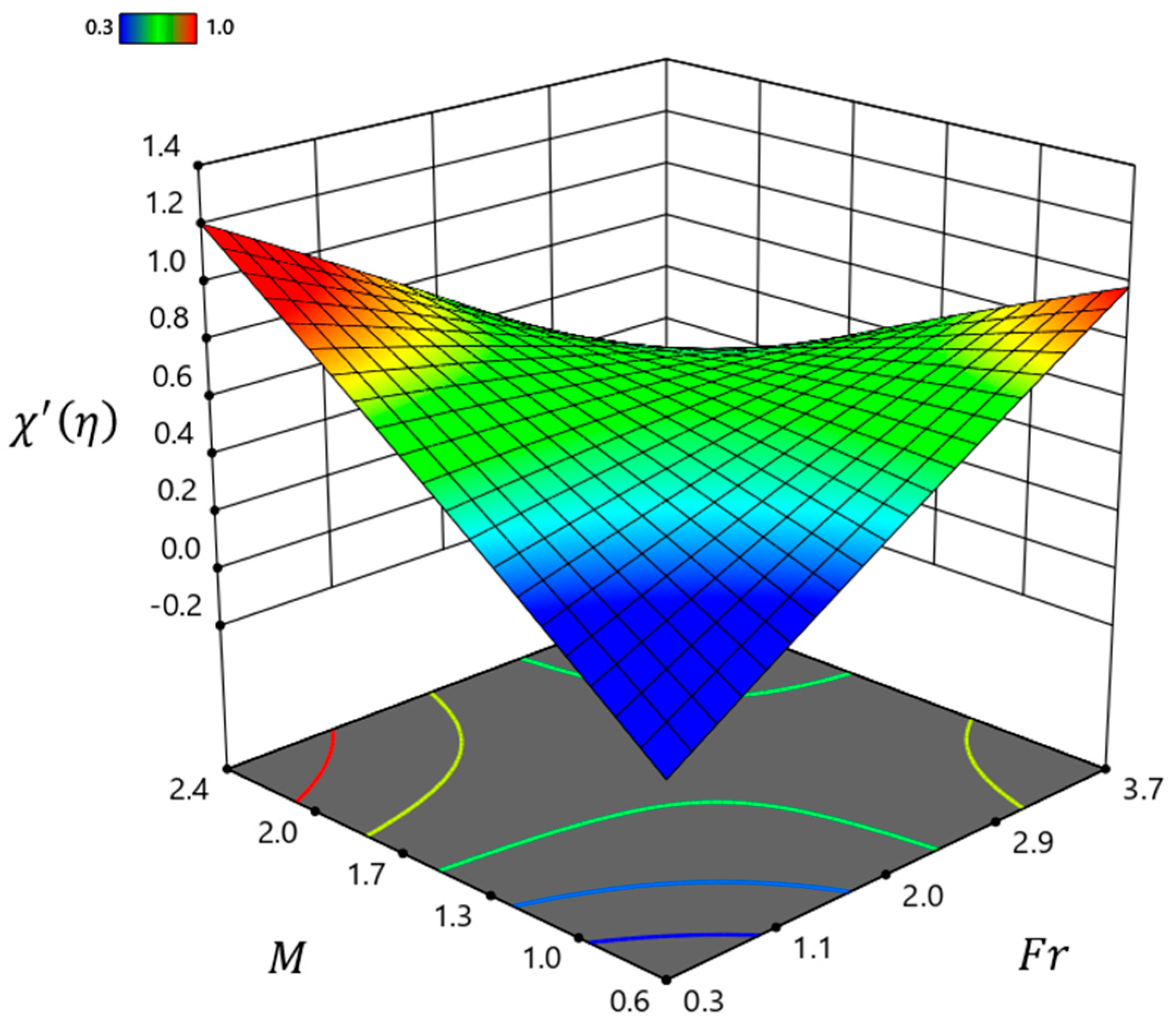
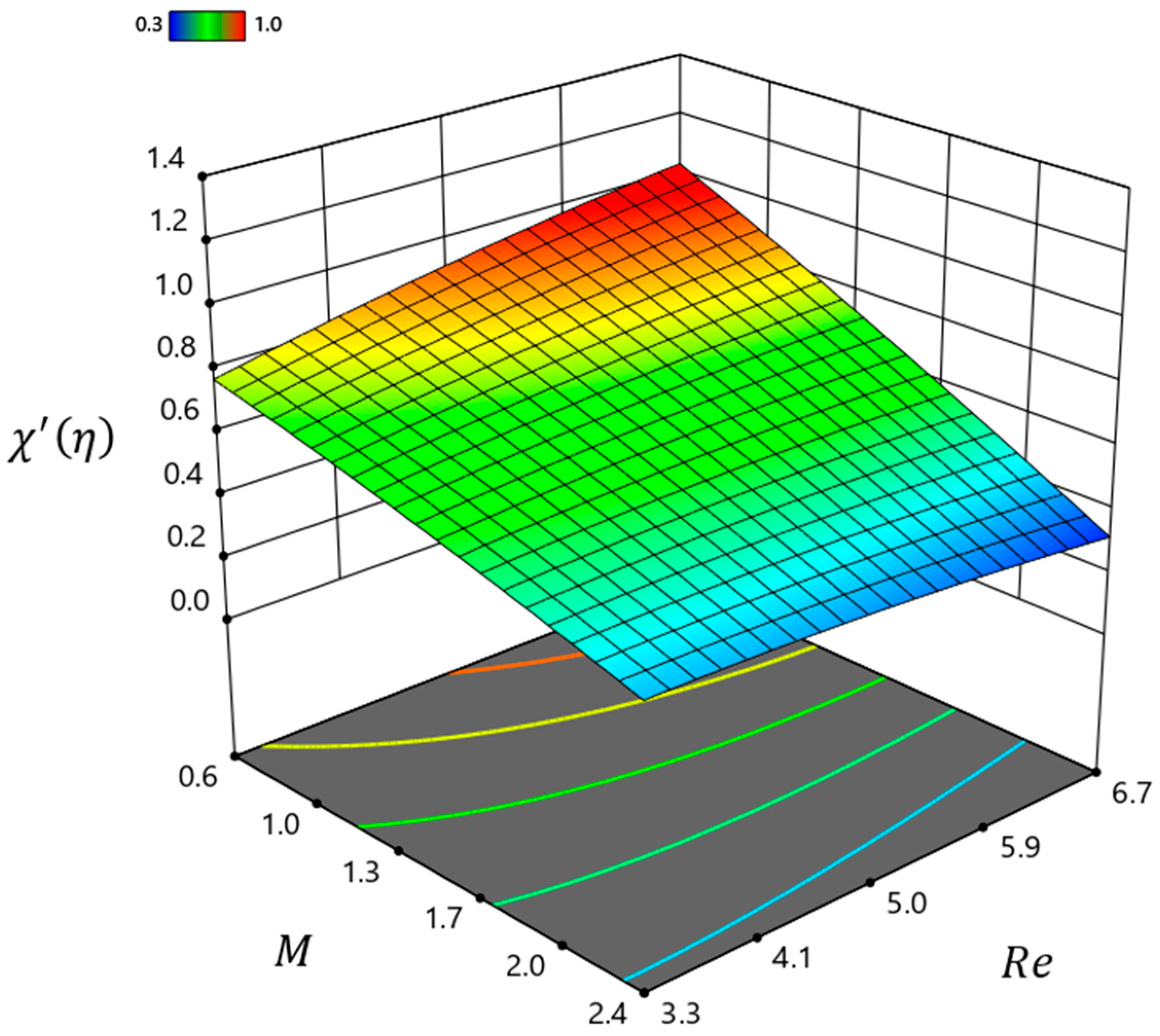
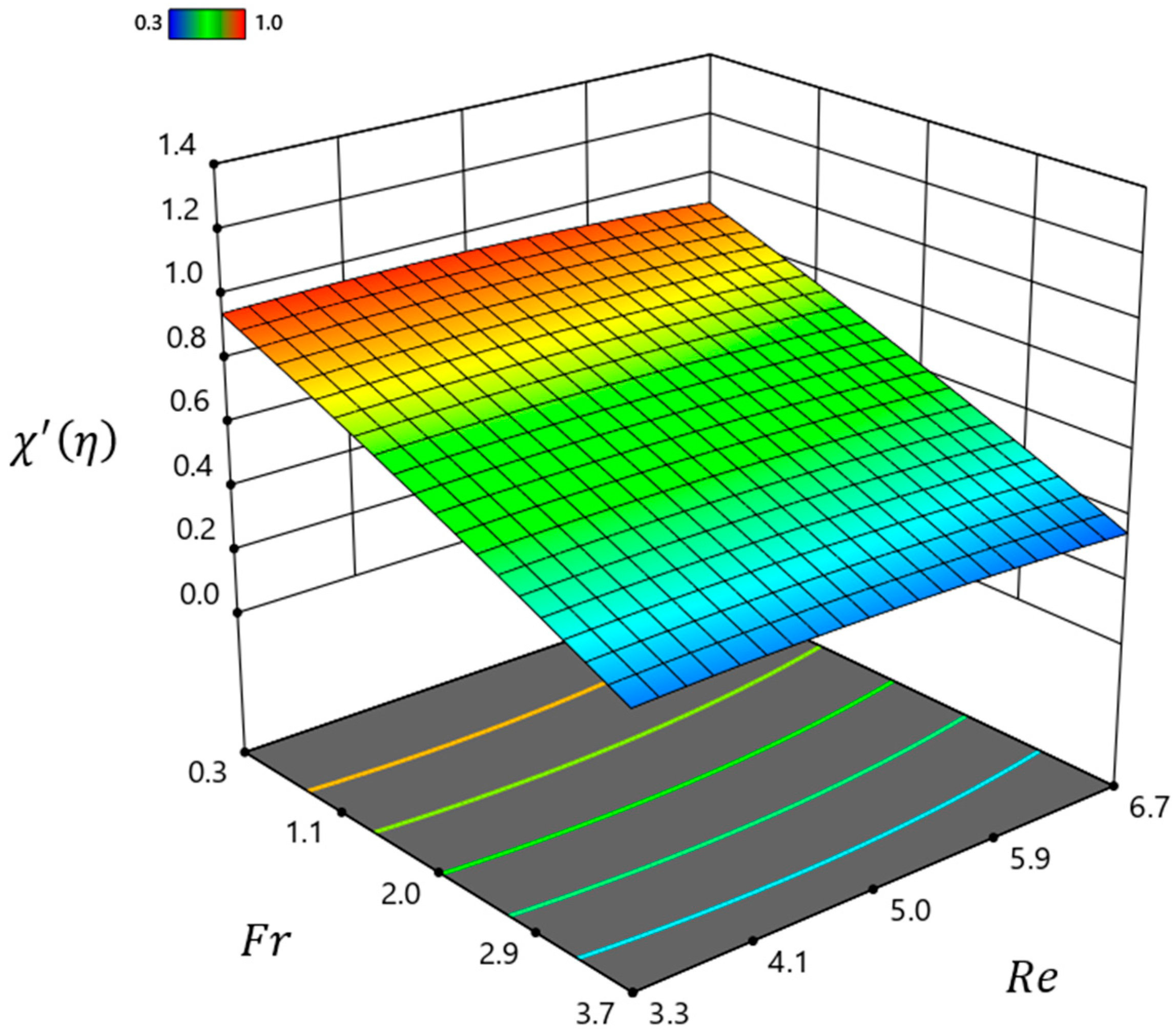
Figure 20, Figure 21 and Figure 22 illustrate the refinement procedure for the velocity profile, highlighting the achieved enhancement. The graphical representations depict parameter fluctuations and reveal their connection to M , F r , and R e in the velocity profile.
Figure 20. Optimization results of velocity with variations in M and F r .
Figure 21. Optimization results of velocity with variations in M and R e .
Figure 22. Optimization results of velocity with variations in R e and F r .

5. Conclusions

This study provides evidence that spherical nanoparticles consistently outperform brick and platelet forms, with heat transfer gains ranging from 12% to 22% across diverse parameter regimes. The integration of collocation with feedforward neural networks reduces residual errors by more than 90%, confirming the methodological advantage of this approach. These findings suggest that spherical nanoparticles are the most effective choice for enhancing thermal performance in solar collector applications, while the neural network framework offers a reproducible and accurate solver for hybrid nanofluid transport problems. Looking forward, experimental validation of these numerical predictions, extension to three-dimensional geometries, and exploration of alternative nanoparticle combinations will further strengthen the applicability of this work to renewable energy systems and advanced thermal management technologies. Key results derived from this investigation are presented here:
  • An increase in D e x intensifies the stress-relaxation effect, leading to a reduction in the velocity profile of the nanofluid.
  • The Lorentz force within the system reduced the velocity profile of the fluid while enhancing thermal transport.
  • Nanofluids containing spherical nanoparticles exhibit greater heat transfer performance than those with brick-like or platelet geometries.
  • For R a and Q 1 greater than zero, the thermal performance of the hybrid nanofluid improves markedly, especially when using platelet-form nanoparticles.
  • An increase in B t led to a decline in heat transport efficiency.

Author Contributions

Conceptualization, P.J.; methodology, B.J.; software, S.H.; validation, S.H.; formal analysis, B.J.; investigation, P.J.; resources, B.J.; data curation, S.H.; writing—original draft preparation, S.H.; writing—review and editing, S.H.; visualization, P.J.; supervision, B.J.; project administration, P.J.; funding acquisition, B.J. All authors have read and agreed to the published version of the manuscript.

Funding

This research received no external funding.

Data Availability Statement

The original contributions presented in this study are included in the article. Further inquiries can be directed to the corresponding author.

Conflicts of Interest

The authors declare no conflict of interest.

Nomenclature

Nomenclature
l 0 The parameter of shape
B t Heat dissipation relaxation factor
D e x ,   D e d Time-based factors define the Deborah values
S Instability rate factor
R a Characteristic of radiation
χ ,   ψ Scaled profiles of flow velocity and thermal state
T b ( K ) Thermal condition at boundary point (b)
P r Prandtl number
F = C K The factor of inertia
Q 0 ( W m 3 ) Thermal generation or absorption factor
β 2 Relaxation of heat dissipation
B 0 Magnitude of the flux region
v ,   w Velocity parameters
ρ h n f   ( k g m 3 ) The hybrid nanofluid’s density
C P h n f ( J k g K ) Heat capacity of hybrid nanofluid
k h n f ( W m K ) Heat conductivity of hybrid nanofluid
μ h n f ( P a . s ) The hybrid nanofluid’s viscosity
σ h n f ( S m ) Electrical conduction of hybrid nanofluid
φ 1 ,   φ 2 Concentration level of nanoparticles
F r Regional inertia factor
R e Reynolds number
η Similarity factor
M Magnetic factor
T r e f ( K ) Reference thermal level
T ( K ) Fluid’s temperature
C The factor of drag
K ( m 2 ) Permeability factor
β 0 ,   β 1 Dissipation and lag periods
δ ( m ) The depth of the coating layer
Q 1 Variable of the heating source
r ,   z Radial and axial coordinates
S u b s c r i p t
f The base fluid
h n f Hybrid nanofluid
s 1 ,   s 2 The nano solid nanoparticles
w wall

References

  1. Choi, S.; Jeffrey, A. Eastman. Enhancing Thermal Conductivity of Fluids with Nanoparticles; No. ANL/MSD/CP-84938; CONF-951135-29; Argonne National Lab. (ANL): Argonne, IL, USA, 1995. [Google Scholar]
  2. Zar, P.M.; Jalili, P.; Ganji, D.D.; Jalili, B. Computational study of steady micropolar hybrid nanofluid flow between permeable walls: Impact of Reynolds and Peclet numbers using advanced numerical methods. Int. J. Thermofluids 2025, 30, 101429. [Google Scholar] [CrossRef]
  3. Sudarsana Reddy, P.; Jyothi, K.; Suryanarayana Reddy, M. Flow and heat transfer analysis of carbon nanotubes-based Maxwell nanofluid flow driven by rotating stretchable disks with thermal radiation. J. Braz. Soc. Mech. Sci. Eng. 2018, 40, 576. [Google Scholar] [CrossRef]
  4. Sreedevi, P.; Sudarsana Reddy, P. Impact of convective boundary condition on heat and mass transfer of nanofluid flow over a thin needle filled with carbon nanotubes. J. Nanofluids 2020, 9, 282–292. [Google Scholar] [CrossRef]
  5. Jeevankumar; Sandeep, N. Effect of magnetic induction on EG-water-based composite nanofluid flow across an elongated region: A KB approach. Waves Random Complex Media 2022, 1–20. [Google Scholar] [CrossRef]
  6. Gohar; Khan, T.S.; Sene, N.; Mouldi, A.; Brahmia, A. Heat and Mass Transfer of the Darcy-Forchheimer Casson Hybrid Nanofluid Flow due to an Extending Curved Surface. J. Nanomater. 2022, 2022, 3979168. [Google Scholar] [CrossRef]
  7. Abbas, W.; Magdy, M.M. Heat and mass transfer analysis of nanofluid flow based on Cu, Al2O3, and TiO2 over a moving rotating plate and impact of various nanoparticle shapes. Math. Probl. Eng. 2020, 2020, 9606382. [Google Scholar] [CrossRef]
  8. Rashid, U.; Liang, H.; Ahmad, H.; Abbas, M.; Iqbal, A.; Hamed, Y.S. Study of (Ag and TiO2)/water nanoparticles shape effect on heat transfer and hybrid nanofluid flow toward stretching shrinking horizontal cylinder. Results Phys. 2021, 21, 103812. [Google Scholar] [CrossRef]
  9. Imran, M.; Yasmin, S.; Waqas, H.; Khan, S.A.; Muhammad, T.; Alshammari, N.; Hamadneh, N.N.; Khan, I. Computational analysis of nanoparticle shapes on hybrid nanofluid flow due to flat horizontal plate via solar collector. Nanomaterials 2022, 12, 663. [Google Scholar] [CrossRef] [PubMed]
  10. Yasir, M.; Ahmed, A.; Khan, M.; Alzahrani, A.K.; Malik, Z.U.; Alshehri, A.M. Mathematical modelling of unsteady Oldroyd-B fluid flow due to stretchable cylindrical surface with energy transport. Ain Shams Eng. J. 2023, 14, 101825. [Google Scholar] [CrossRef]
  11. Alshehri, A.; Shah, Z. Computational analysis of viscous dissipation and Darcy-Forchheimer porous medium on radioactive hybrid nanofluid. Case Stud. Therm. Eng. 2022, 30, 101728. [Google Scholar] [CrossRef]
  12. Jawad, M.; Hameed, M.K.; Nisar, K.S.; Majeed, A.H. Darcy-Forchheimer flow of maxwell nanofluid flow over a porous stretching sheet with Arrhenius activation energy and nield boundary conditions. Case Stud. Therm. Eng. 2023, 44, 102830. [Google Scholar] [CrossRef]
  13. Zaharil, H.A.; Yang, H. Comprehensive thermoparametric analysis of supercritical carbon dioxide in parabolic trough solar collector via an innovative method. Appl. Therm. Eng. 2025, 264, 125434. [Google Scholar] [CrossRef]
  14. Qin, H.; Chen, W.; Zhang, T.; Ma, L.; Xue, X.; Zhang, X. Thermal analysis and parameter optimization of advanced adiabatic compressed air energy storage with parabolic trough solar collector auxiliary reheating. J. Energy Storage 2025, 110, 115104. [Google Scholar] [CrossRef]
  15. Huminic, G.; Huminic, A.; Fleacă, C.; Dumitrache, F. Hybrid nanofluids-based direct absorption solar collector: An experimental approach. Int. J. Thermophys. 2025, 46, 32. [Google Scholar] [CrossRef]
  16. Bouazzi, Y.; Ali, A.B.; Alashaari, G.A.A.; Alsheherye, S.; Eladeb, A.; Al Mdallal, Q.; Kolsi, L. Enhanced heat transfer in large-aperture PTSCs with semi-circular absorbers using multi-dipole magnetic field: A numerical study. Case Stud. Therm. Eng. 2025, 71, 106240. [Google Scholar] [CrossRef]
  17. Zhan, Y.; Zhang, H.; Zhao, Y.; Zhang, S.; Hua, C.; Lin, Y.; Park, T.S. Numerical investigation of heat transfer enhancement in a rectangular solar collector using TiO2-Cu/water hybrid nanofluid and perforated baffle. Appl. Therm. Eng. 2025, 279, 127618. [Google Scholar] [CrossRef]
  18. Golzar, A.; Aghaei, A.; Mohsenimonfared, H.; Joshaghani, A.H. Numerical simulation of a parabolic through solar collector with a novel geometric design equipped with an elliptical absorber tube under the influence of magnetic field. Arab. J. Sci. Eng. 2025, 50, 8865–8885. [Google Scholar] [CrossRef]
  19. Donga, R.K.; Ashish Karn, A. Improving the thermal performance of parabolic trough solar collectors by incorporating cylindrical attachments within the absorber tube. Appl. Therm. Eng. 2025, 273, 126587. [Google Scholar] [CrossRef]
  20. Panja, S.K.; Das, B.; Mahesh, V. Performance evaluation of a novel parabolic trough solar collector with nanofluids and porous inserts. Appl. Therm. Eng. 2025, 258, 124495. [Google Scholar] [CrossRef]
  21. Gopalsamy, V.; Shantharaman, P.P.; Karunakaran, R. Exploring performance variations of mono-nanofluid-based parabolic trough solar collectors at various concentrations and mass flow rates: An experimental analysis. J. Therm. Anal. Calorim. 2025, 150, 4261–4277. [Google Scholar] [CrossRef]
  22. Kumar, B.V.; Kanna, P.R.; Balasubramanian, D.; Kale, U.; Kilikevičius, A. Numerical investigation of thermal performances of hybrid nanofluids in solar collectors implementing polygonal rough surfaces. Results Eng. 2025, 27, 105891. [Google Scholar] [CrossRef]
  23. Li, K.; Ru, J.; Wu, D.; Ru, Y.; Alkhalifah, T.; Marzouki, R. Exergy destruction and heat transfer of parabolic trough collector using porous medium: Machine learning algorithms. Appl. Therm. Eng. 2025, 276, 126922. [Google Scholar] [CrossRef]
  24. Bahman, N.; Abbas, Z.; Arslan, M.S.; Rafiq, M.Y. Exploring entropy production in radiative cilia flow of Williamson fluid through a curved channel with viscous dissipation effects. J. Radiat. Res. Appl. Sci. 2025, 18, 101566. [Google Scholar] [CrossRef]
  25. Jalili, B.; Bahmani, M.; Jalili, P.; Liu, D.; Alderremy, A.A.; Ganji, D.D.; Vivas-Cortez, M. Investigating the influence of square size vanes on heat transfer in porous media: An in-depth Nusselt distribution. J. Comput. Des. Eng. 2025, 12, 1–14. [Google Scholar] [CrossRef]
  26. Hajizadeh, S.; Jalili, P.; Jalili, B.; Ganji, D.D. The new analytical and numerical analysis of 2D stretching plates in the presence of a magnetic field and dependent viscosity. Adv. Mech. Eng. 2024, 16, 16878132231220361. [Google Scholar] [CrossRef]
  27. Hajizadeh, S.; Jalili, P.; Jalili, B.; Alam, M.M.; Ali, M.R.; Hendy, A.S.; Ganji, D.D. Innovative binary nanofluid approach with copper (Cu-EO) and Magnetite (Fe3O4-EO) for enhanced thermal performance. Case Stud. Therm. Eng. 2024, 63, 105191. [Google Scholar] [CrossRef]
  28. Hajizadeh, S.; Jalili, P.; Jalili, B.; Ahmad, I.; Shabaan, A.A.; El-Wahed Khalifa, H.A. A novel approach to investigate the effect of hybrid nanofluids in a non-Newtonian Maxwell model on thermal management for medical engineering applications. Mod. Phys. Lett. B 2025, 39, 2550140. [Google Scholar] [CrossRef]
  29. Hajizadeh, S.; Jalili, B.; Jalili, P.; Ganji, D.D.; Ahmad, H. Influence of flow parameters in incompressible electrically conducting fluid over a stretching plate with a surface condition factor. ZAMM—J. Appl. Math. Mech./Z. Angew. Math. Mech. 2025, 105, e70075. [Google Scholar] [CrossRef]
  30. Afaynou, I.; Faraji, H.; Choukairy, K.; Djebali, R.; Rezk, H. Comprehensive Analysis and Thermo-Economic Optimization of a Hybrid Phase Change Material-Based Heat Sink for Electronics Cooling. Heat Transf. 2025, 54, 3754–3774. [Google Scholar] [CrossRef]
  31. Zhu, X.; Zuo, Z.; Wang, W.; Jia, B.; Liu, R.; Yin, Q.; Zhang, M. Performance comparison and optimization of thermoelectric generator systems with/without stepped-configuration. Energy 2025, 335, 137924. [Google Scholar] [CrossRef]
  32. Zhu, X.; Zuo, Z.; Wang, W.; Zhang, M.; Yin, Q.; Liu, R.; Jia, B. Transient modeling and analysis of a stepped-configuration thermoelectric generator considering non-uniform temperature distribution. Appl. Energy 2025, 383, 125360. [Google Scholar] [CrossRef]
  33. Wang, H.; Niu, A.; Waktole, D.A.; Jia, B.; Zuo, Z.; Wang, W. A self-powered wireless temperature sensing system using flexible thermoelectric generators under simulated thermal condition. Measurement 2025, 253, 117637. [Google Scholar] [CrossRef]
  34. Xia, G.; He, X.; Jia, Y.; Zhu, Y.; Tian, Z. Design of a cylindrical thermal rotary concentrator based on transformation thermodynamics. Materials 2025, 18, 4440. [Google Scholar] [CrossRef] [PubMed]
  35. Chen, Y.; Sha, A.; Lu, Q.; Jiang, W.; Cao, Y.; Hu, K.; Li, C.; Du, P. Solar-to-heat conversion control of pavement through thermochromic coating: Integration of thermal management and visual temperature indication. Energy 2025, 333, 137383. [Google Scholar] [CrossRef]
  36. Miao, Z.; Meng, X.; Li, X.; Liang, B. Influence weights of key parameters and optimization strategies for non-contact thermoelectric generator performance enhancement. Energy 2025, 339, 139120. [Google Scholar] [CrossRef]
  37. Sandeep, N. Computational analysis to examine the role of nanoparticle shape on operative usage of solar energy. Int. J. Hydrog. Energy 2024, 56, 937–948. [Google Scholar]
Disclaimer/Publisher’s Note: The statements, opinions and data contained in all publications are solely those of the individual author(s) and contributor(s) and not of MDPI and/or the editor(s). MDPI and/or the editor(s) disclaim responsibility for any injury to people or property resulting from any ideas, methods, instructions or products referred to in the content.

Article Metrics

Citations

Article Access Statistics

Article metric data becomes available approximately 24 hours after publication online.