1. Introduction
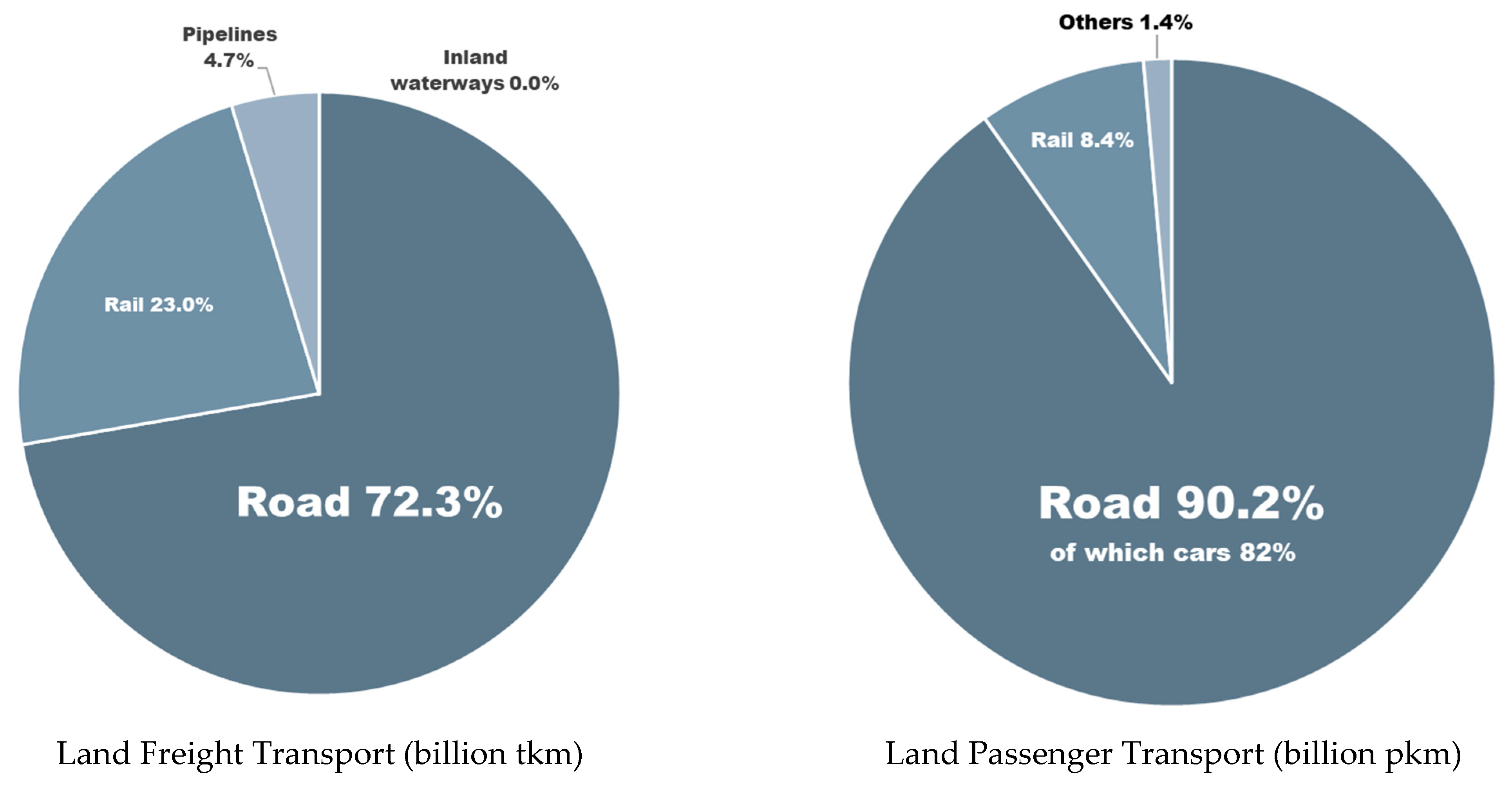
Road transport has dominated land freight transport in the European Union for decades. Despite numerous initiatives aimed at fostering modal shift and promoting the development of intermodal transport, the share of freight transported by road remains at a very high level. This is accompanied by substantial external costs that are not internalised in transport prices, including, among others, road accidents, congestion, air pollution, climate change, noise, land degradation, as well as the costs of crude oil extraction, refining and liquid fuel distribution. At the same time, the capital-intensive linear infrastructure of road transport, along with a large number of enterprises operating in the road freight transport market, constitutes a foundation for the functioning of the economies of many contemporary EU Member States [
1]. The road transport sector cannot be easily or quickly replaced by other transport modes, not only due to its significant dominance but also due to the advantages it offers. The sector is facing increasing pressure to reduce its environmental footprint and align with the European Union’s long-term climate and energy objectives. Numerous strategic analyses confirm that transforming heavy-duty road transport is one of the most demanding and critical components of the EU decarbonisation agenda [
2,
3].
Transport policy based on the concept of sustainable transport development seeks to reconcile the role of road transport within the national transport system with the need to reduce its negative impact on the environment, public health and the climate. The European Green Deal and the Fit for 55 package outline ambitious goals, including reducing greenhouse gas emissions by at least 55% by 2030 compared to 1990 levels, achieving climate neutrality by 2050, increasing the share of renewable energy in transport, developing alternative fuels infrastructure, accelerating the electrification of transport and reducing the emissions intensity of freight transport through improved energy efficiency and modal shift [
4,
5]. Achieving these objectives requires a transition towards cleaner vehicle technologies, supported by regulatory instruments, market incentives and coordinated infrastructure development [
6,
7].
In addition, international research confirms that the decarbonisation of heavy-duty transport requires coordinated actions combining vehicle electrification, infrastructure development and systemic policy adjustments. Sun et al. (2024) [
8] provide a comprehensive analysis of global pathways towards climate-neutral freight transport, demonstrating that large-scale deployment of zero-emission trucks must be accompanied by an equally ambitious expansion of charging and energy supply infrastructure. Their findings support the relevance of analysing the Polish TEN-T core network, as the challenges faced by Poland are consistent with broader international trends observed in road freight decarbonisation efforts [
8].
The acceleration of transport electrification is facilitated by the development of alternative fuels infrastructure, particularly high-power charging systems for electric heavy goods vehicles (e-HGVs). The Alternative Fuels Infrastructure Regulation (AFIR) imposes the implementation of charging and refuelling infrastructure the TEN-T network, which extends across the territory of Poland and includes the Baltic–Adriatic and North Sea–Baltic transport corridors [
9]. The evolution of the TEN-T corridors, including those crossing Poland, reflects the broader EU objective of creating an integrated, efficient and interoperable transport network that supports both economic performance and environmental goals [
10].
The transition pathways currently considered for heavy-duty transport include battery-electric trucks, hydrogen fuel-cell vehicles, electric road systems and advanced low-emission internal combustion technologies. Comparative strategic studies highlight that the feasibility and competitiveness of these technologies depend on infrastructural availability, energy system characteristics and the anticipated rate of technological progress [
3,
11]. Case studies from various regions of Europe and beyond further illustrate that electrification potential and infrastructure requirements vary depending on national conditions, but consistently point to the need for rapid and coordinated infrastructure development to enable long-haul decarbonisation [
12,
13]. In this context, Poland plays an important role in the European freight system. The development of charging infrastructure on Polish segments of the TEN-T corridors is therefore essential not only for national mobility but also for ensuring the continuity and sustainability of cross-border freight flows. Estimating future infrastructure needs requires integrating transport demand forecasts, assumptions regarding the electrification rate of heavy-duty vehicles and the technical parameters of charging systems [
10,
12].
Electrification of freight transport is expected to reduce external costs associated with emissions and air pollution. In this context, the aim of the article is to present a forecast of the demand for alternative fuels infrastructure along the TEN-T network in Poland, following the assumptions of sustainable transport development, with an emphasis on external transport costs and the electrification of road freight transport.
The remainder of the article is structured as follows. The second part provides an analysis of the body of knowledge on the environmental impact of transport, including the concept of sustainable transport development, with emphasis on external costs as well as key aspects of charging infrastructure development. The third part presents road transport in the context of external transport costs and the electrification of transport. The fourth part offers a forecast of infrastructure needs for alternative fuels along the A1 and A2 motorways, which form part of the linear infrastructure of the TEN-T network in Poland. A key element of the fourth part is the process of transport electrification in accordance with the AFIR, with a focus on the TEN-T corridors located in Poland.
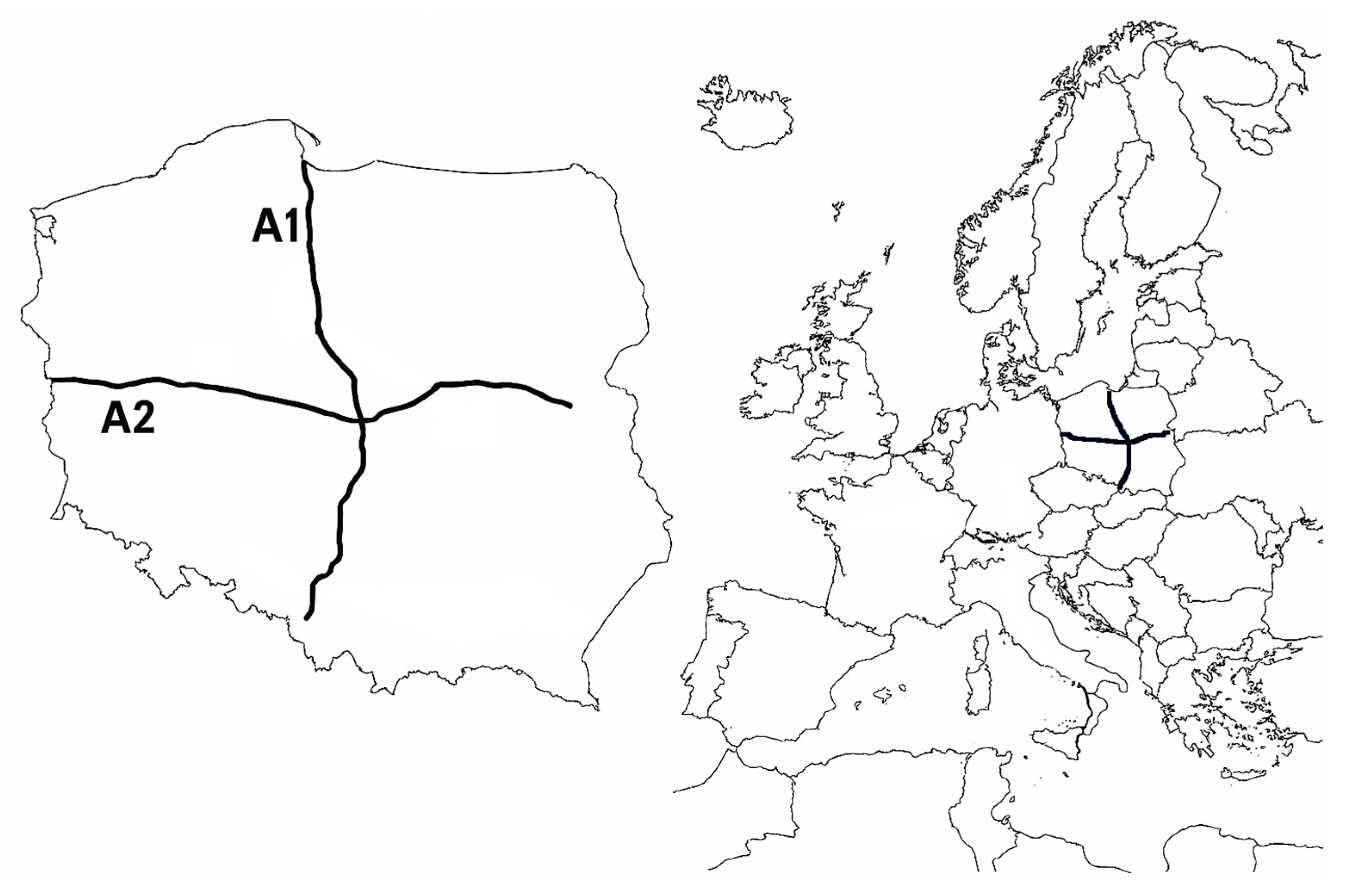
This paper focuses on the A1 and A2 motorways as a representative case study within the Polish section of the TEN-T core network. These two corridors constitute the fundamental longitudinal and latitudinal axes of the national transport system: the A1 runs vertically, dividing Poland into eastern and western halves while connecting Northern Europe (Sweden, Denmark) with Southern and Southeastern Europe (Czech Republic, Slovakia, Adriatic region), whereas the A2 crosses the country horizontally, linking Western Europe (Germany, Benelux) with Eastern Europe (Belarus, Baltic region). As such, both corridors carry exceptionally high volumes of heavy-duty road transport, including long-distance international freight flows that are structurally responsible for a disproportionate share of external costs—particularly greenhouse gas emissions, air pollution, noise, and congestion. By analysing the required charging infrastructure for battery-electric heavy-duty vehicles on these two critical axes, the study operationalises the broader sustainability framework: it quantifies how the fulfilment of AFIR obligations and the electrification of freight transport along strategic TEN-T corridors can meaningfully reduce externalities in one of the most carbon-intensive segments of the transport sector. Thus, the A1–A2 case study serves as a concrete and policy-relevant demonstration of how infrastructure planning can bridge the gap between EU-level decarbonisation targets and national-level implementation challenges.
3. Road Transport in the Context of External Transport Costs and Transport Electrification
3.1. Materials and Methods
The electrification of road transport infrastructure analysed in this article refers to infrastructure adapted to serve heavy-duty vehicles performing freight transport operations. The electrification process stems from the requirements set out in the AFIR and concerns the development of alternative fuels infrastructure. The infrastructure considered is intended to support electric heavy goods vehicles (e-HGVs) along the TEN-T network. In accordance with AFIR, charging points for e-HGVs are to be established to meet the demand generated by heavy-duty vehicle traffic operating on the TEN-T network. These activities are consistent with the concept of sustainable transport development, which includes, among other goals, reducing the share of conventional road transport in the European transport structure. Within the range of initiatives undertaken in this area, transport electrification constitutes a key element of actions aimed at reducing the environmental impact of road transport [
77].
The objectives of the research process relate to presenting essential aspects of sustainable transport development, including the identification of external transport costs, the process of electrifying road transport infrastructure, and forecasting the demand for alternative fuels infrastructure along the TEN-T network located in Poland. The research method applied in the article is a case study analysis of external transport costs and a forecast of infrastructure needs for alternative fuels along the A1 and A2 motorways, which form part of the TEN-T network in Poland. The implementation of the empirical research was divided into three stages:
Stage 1—defining the concept of sustainable transport development;
Stage 2—identifying external costs of road transport;
Stage 3—forecasting the demand for alternative fuels infrastructure along the road network, with a case study based on the A1 and A2 motorways, which form elements of the TEN-T network in Poland.
The methodological approach used in this study departs from existing European analyses of e-HGV charging infrastructure in several important ways. First, while most EU-level studies—such as those prepared by the ICCT or Transport & Environment—model long-distance freight flows at the continental scale and estimate infrastructure demand on aggregated European corridors, the present research applies a bottom-up corridor-specific methodology tailored to the Polish section of the TEN-T network. This includes integrating national traffic intensity datasets (GDDKiA Traffic Census and TransStat API), distinguishing corridor-level heavy-duty vehicle flows from national averages and calculating charging demand at the level of individual motorway segments. Second, unlike European studies that typically assume a standardised distribution of charging hubs, this analysis incorporates Poland-specific constraints such as the highly uneven distribution of motorway service areas (MOPs), the spatial structure of logistics nodes, and the strategic intersection of the A1 and A2 corridors near Stryków, one of the country’s largest and fastest-growing logistics clusters. Third, the study provides multiple electrification scenarios (5–100%), which goes beyond the single or limited-scenario modelling commonly found in European research. In these ways, the findings complement existing European literature by demonstrating how EU-level regulatory requirements (AFIR) translate into real-world infrastructural needs within the spatial, infrastructural and economic conditions of a specific Member State.
In order to ensure transparency and reproducibility of the analysis, the core assumptions applied in the modelling framework require explicit justification. First, the energy-consumption parameter for electric heavy-duty vehicles (e-HGVs) was set within the range reported by recent European field trials and simulation studies, which typically indicate values between 1.1 and 1.5 kWh/km for long-haul operations. This range reflects tested vehicle architectures, realistic payloads, and motorway speed conditions, and is consistent with large-scale assessments conducted by the European Automobile Manufacturers’ Association (ACEA) and the Joint Research Centre (JRC). The central value used in the model (e ≈ 1.3 kWh/km) therefore represents a widely accepted benchmark for long-distance battery-electric trucking.
Second, the assumed charging window duration is grounded in behavioural and regulatory patterns governing HGV operations. Drivers’ resting time regulations under Regulation (EC) No 561/2006 generate temporal clustering of demand, leading to identifiable peak charging periods. Empirical observations from existing pilot charging sites, as well as modelling studies of long-haul logistics scheduling, indicate that only a limited share of the 24 h cycle is practically available for high-power charging. Consequently, the adopted window reflects an operationally realistic timeframe that captures the constraints associated with mandatory rest breaks, fleet dispatching cycles, and uneven temporal distribution of freight movements. By presenting multiple window lengths, the model also accounts for uncertainty in user behaviour and technological development, enabling scenario-based interpretation of the results.
3.2. External Transport Cost Identification
Total external transport costs are highly dependent on the transport mode; however, within road transport itself, there is significant variation among different vehicle categories. These differences arise from both the nature of vehicle use and technical parameters such as vehicle mass, type of propulsion, load capacity, number of passengers, and typical operating conditions (urban areas, motorways, rural roads). Consequently, unit external costs expressed in euros per vehicle-kilometre (EUR/vkm), passenger-kilometre (EUR/pkm) or tonne-kilometre (EUR/tkm) vary substantially depending on the vehicle type and the transport function it performs.
As shown in
Table 3, the structure of external costs within road transport in the European Union, showing the extent to which individual vehicle types contribute to the total environmental and social burdens generated by this mode. The data come from the Handbook on the External Costs of Transport. Version 2019—1.1, prepared for the European Commission (DG MOVE) by the CE Delft, Ricardo and TRT consortium, which provides a comprehensive valuation of external transport costs based on 2016 prices [
78].
The largest share of external road transport costs is attributable to passenger cars, which account for approximately two-thirds of the total (66.1%). This stems primarily from their widespread use in passenger mobility, especially in urban agglomerations and suburban areas, where high traffic intensity generates considerable congestion, air pollution and accident costs. Despite technological progress and increasingly stringent emission standards, the overall social costs associated with the use of passenger cars remain very high, as the growth in individual mobility offsets the environmental efficiency gains.
The second-largest contributor is heavy goods vehicles (HGVs), responsible for around 13% of total external road transport costs in the European Union. Although this share is much lower than that of passenger cars, it is highly significant from the perspective of marginal cost structures, as each additional kilometre travelled by a heavy-duty vehicle generates relatively higher social and environmental costs compared to other road vehicle categories. The main sources of these costs include greenhouse gas and pollutant emissions, noise, infrastructure wear and tear, and road accidents. This segment is currently at the centre of EU transport and climate policy.
Other vehicle categories (light commercial vehicles (LCVs), buses and coaches, and motorcycles) play a smaller yet non-negligible role in the structure of external costs. Light commercial vehicles (approx. 9%) are gaining importance due to the development of urban logistics and e-commerce, while buses (approx. 5%) play an important role in public transport, where external costs per passenger are significantly lower than in individual motorised transport (
Table 3) [
79].
The conclusions drawn from this analysis clearly indicate that, despite the dominance of passenger transport in the total external costs, it is road freight transport, as the second largest contributor to external costs, that should constitute the primary focus of further analysis in the context of the implementation of the AFIR and the pursuit of the objectives set out in the European Green Deal and the Fit for 55 package.
Considering the adopted research scope, the following part of the discussion focuses on road freight transport in Poland, as it represents a key component of the national transport system and simultaneously one of the main sources of external costs.
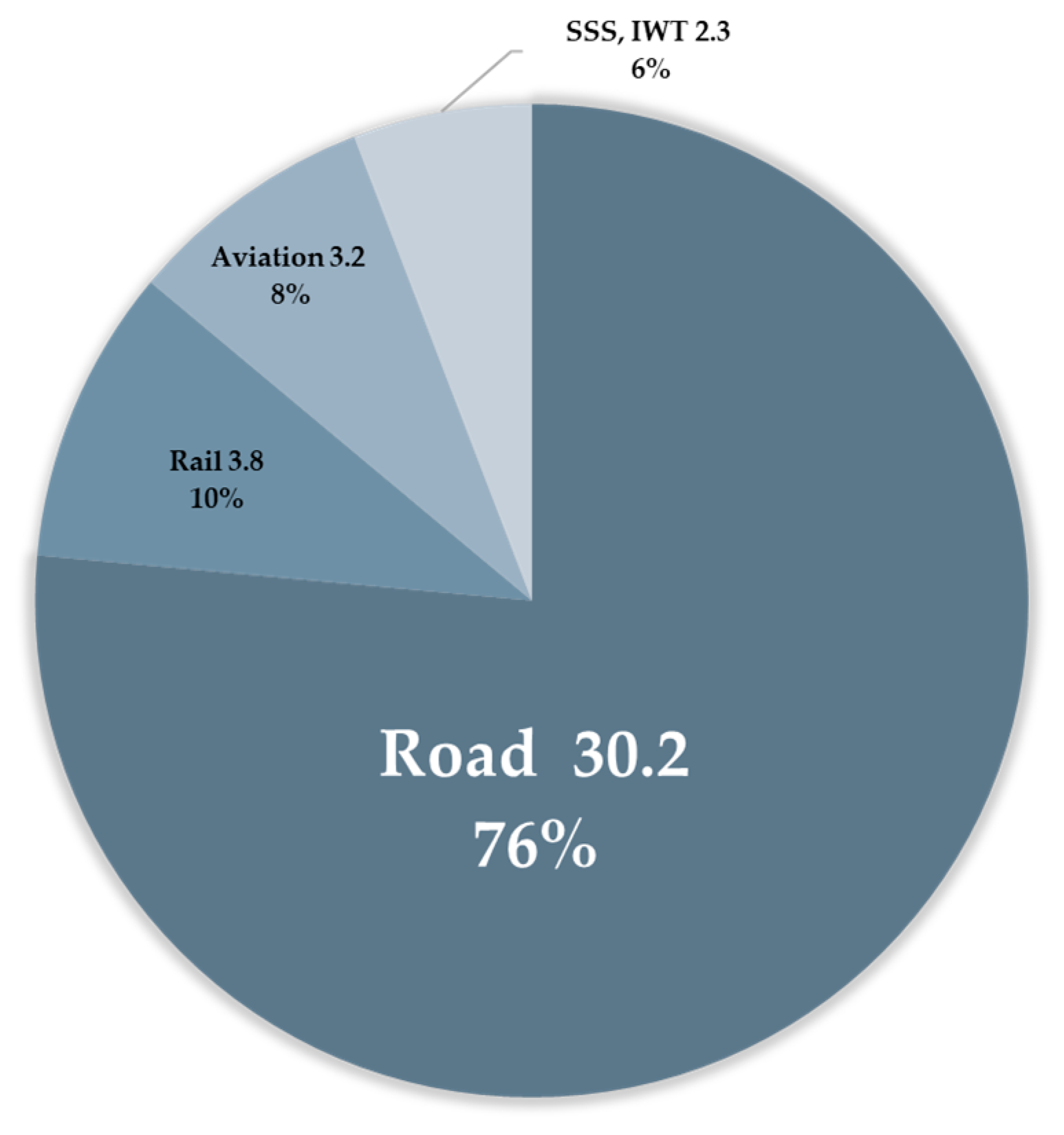
When compared with the average results for the European Union, the structure of external costs of road transport in Poland shows both certain similarities and notable quantitative differences resulting from the specific characteristics of the national transport system. In most EU Member States, road transport accounts for between 70% and 80% of all external costs of the transport sector, and this share is particularly high in countries where road transport dominates the modal structure. Poland is no exception (according to data from the Handbook on the External Costs of Transport, DG MOVE, CE Delft, 2019), the total external costs of road transport in Poland exceed EUR 30 billion annually, representing more than three quarters of all external costs in the national transport system (
Figure 2) [
80].
The data presented in
Figure 2 indicate that road transport clearly dominates the structure of external transport costs in Poland, confirming the high dependence of the national economy on road freight and passenger transport, as well as its significant impact on the environment, public health and road safety. The largest share of external road transport costs is attributable to air pollution emissions, road accidents and congestion—three factors directly linked to high traffic intensity and the low degree of internalisation of environmental costs in transport service prices. A relatively smaller, though still significant, share is generated by noise, environmental degradation and energy production (the so-called well-to-tank phase), which collectively portray road transport as the principal source of negative externalities in Poland.
As mentioned earlier, comparative studies of external transport costs by transport mode are relatively scarce. The most comprehensive study for Poland refers to 2016; therefore, it is essential to apply an inflation adjustment factor to update the values in order to ensure comparability. According to data published by the Ministry of Finance, the price increase coefficient for Poland for the period 2016–2024 amounts to K = 1.51 (
Table 4).
In the next stage of the analysis, unit external costs of road freight transport in Poland are presented. These costs make it possible to assess the level of environmental and social burdens per unit of transport performance. The data provide an extension of the earlier estimates of total external costs and allow for a more precise comparison of the efficiency of different types of road transport vehicles. They include both heavy goods vehicles, which form the basis of medium- and long-distance freight transport, and light commercial vehicles, which play a key role in urban logistics and the so-called last mile. The inflation-adjusted unit external costs, expressed in euro cents per tonne-kilometre, are presented in
Table 5.
The structure of external cost sources in Poland is similar to that of the European Union as a whole, yet differs in their relative significance. In Western European countries, greenhouse gas emissions and congestion account for the largest share, whereas in Poland a considerable proportion of costs is generated by air pollution and road accidents. This is a consequence of an ageing vehicle fleet, the high share of international transit traffic, and lower infrastructure safety standards. As a result, despite improvements in transport efficiency, road transport in Poland continues to be the largest source of negative externalities in the economy, and its share in environmental and social costs exceeds that of the industrial or energy sectors.
This comparison indicates that Poland is at a stage where the further development of road transport requires systemic support for technological and infrastructural transformation. In the context of achieving the objectives of the European Green Deal, the Fit for 55 package, and the implementation of the Alternative Fuels Infrastructure Regulation (AFIR), this implies the need to accelerate emission reduction in the heavy-duty vehicle segment, expand charging infrastructure, and gradually internalise external costs within fiscal and pricing policies for road transport.
At the same time, it should be emphasised that while the objectives of AFIR have significant potential to reduce external costs related to air pollution, greenhouse gas emissions and, to some extent, noise, they do not cover all cost categories. Transport electrification does not directly affect congestion levels or the number of road accidents, which also constitute a substantial share of external costs in Poland.
In the next step of the analysis, only external costs related to road freight transport are considered, divided into two main vehicle segments: light commercial vehicles (LCVs) and heavy goods vehicles (HGVs). This approach allows for a precise assessment of the cost structure generated by both categories, which perform different functions within the logistics system—LCVs in distribution and urban transport, and HGVs in long-distance and international freight transport. The application of the inflation adjustment factor (K = 1.51), reflecting cumulative inflation in Poland, enabled the recalculation of values to 2024 price levels, thus enhancing the current analytical relevance of the data. The results are presented in
Table 6, including both total values (in billion EUR) and the breakdown of external cost categories.
As shown in
Table 6, the inflation-adjusted external costs related to air pollution, noise, climate change, and the production and distribution of fuels amount to approximately EUR 11.061 billion annually, which highlights the substantial environmental and social burden generated by road freight transport in Poland.
3.3. Electrification of Road Transport
The electrification of the heavy-duty vehicle fleet offers the prospect of at least a partial reduction in external costs associated with the combustion of fossil fuels. The potential for electrifying road freight transport is based on several competing and substitutable energy supply technologies. The most important include hydrogen fuel cells, battery-electric systems, inductive charging while driving, and direct power supply from overhead electric traction. The latter two solutions are still at an experimental stage, as their large-scale deployment remains difficult to predict due to high infrastructure costs and the absence of technological standardisation. In contrast, hydrogen fuel cells and battery-electric propulsion are relatively well-developed technologies already used in practice, for example, in urban bus transport.
Despite their advantages, hydrogen fuel cells face significant limitations from a decarbonisation perspective. The key challenge concerns the origin of hydrogen. At present, the majority is produced from fossil fuels (so-called grey hydrogen), which limits potential environmental benefits. The production of so-called green hydrogen, generated through electrolysis using renewable energy, is currently characterised by low energy efficiency and a negative energy balance per unit of energy delivered to the vehicle.
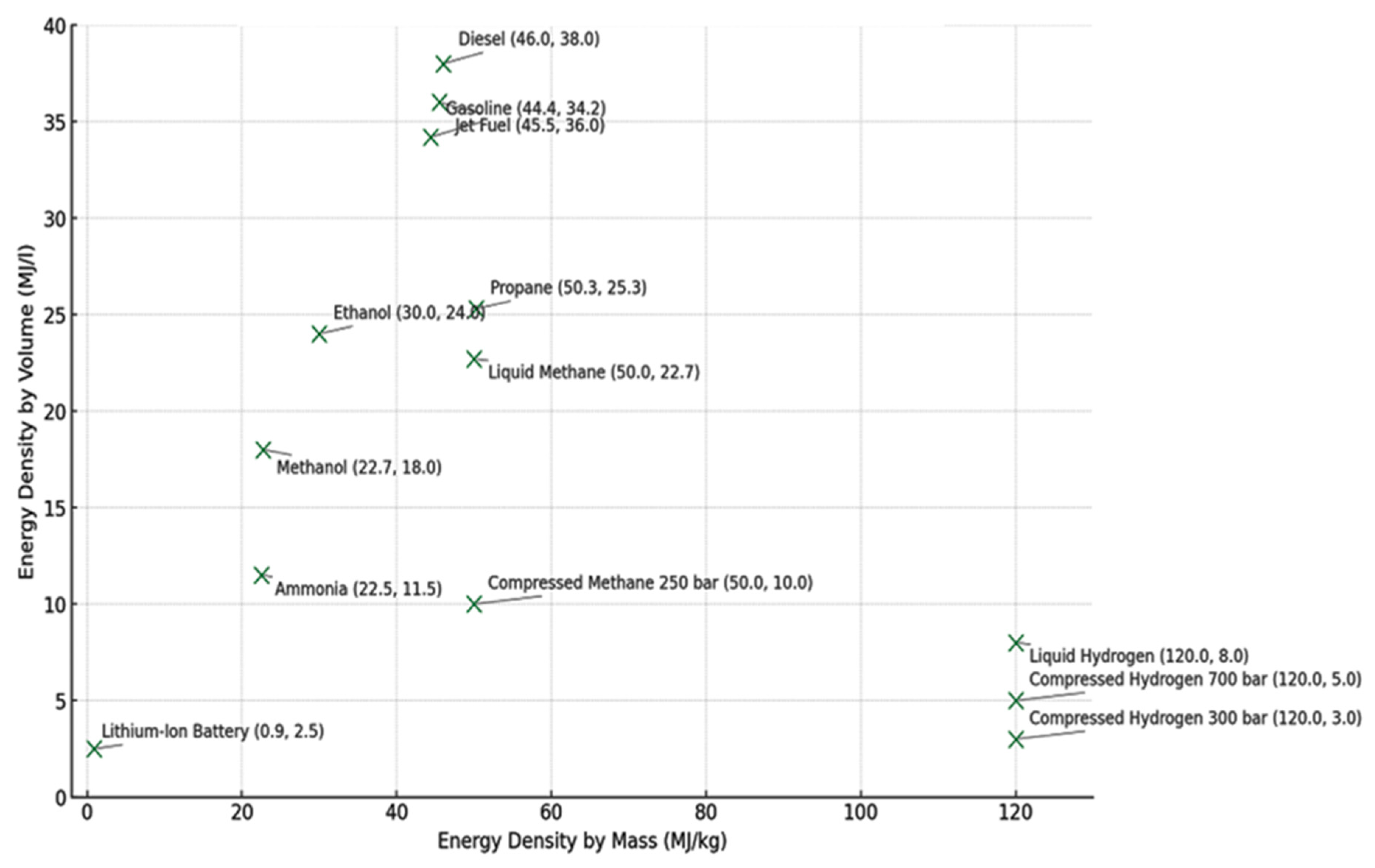
One of the main barriers to the development of zero-emission propulsion technologies in transport is the energy density of alternative energy carriers compared to conventional fuels. Petroleum-based fuels such as diesel remain the standard in road freight transport due to their high gravimetric and volumetric energy density, which is critical given the high energy demand of this transport segment.
Liquid hydrogen offers approximately three times higher energy density per unit of mass than diesel but requires around three times more volume. This creates substantial challenges in storage and integration of tanks into vehicle design. Other alternative fuels such as methanol, ethanol, ammonia or methane fall between hydrogen and fossil fuels, offering a compromise between gravimetric and volumetric energy density; however, they still require further development of storage technologies and refuelling infrastructure.
Lithium-ion batteries, however, reveal the greatest limitations. Despite the high efficiency of electric drive systems, they have the lowest energy density among all analysed energy carriers—approximately 0.9 MJ/kg and 2.5 MJ/L. This implies that to store an amount of energy equivalent to that of a conventional fuel tank in a heavy-duty vehicle or tractor unit, the mass and volume of the batteries would far exceed the limits allowed under road regulations (
Figure 3) [
81].
In heavy goods transport, characterised by high energy demand and long-distance journeys, the low energy density of batteries constitutes a major technological barrier affecting vehicle weight, operational range, and transport efficiency. In the longer term, it also determines the need for extensive charging infrastructure and is one of the key reasons behind the introduction of regulations such as the AFIR.
4. Forecast of Alternative Fuel Infrastructure Needs Along the Motorway Network—A Case Study of the A1 and A2 Motorways in Poland
The transformation of road freight transport towards zero-emission mobility cannot be limited solely to the replacement of the vehicle fleet with electric or hydrogen-powered trucks. A key prerequisite for the success of this transition is the provision of a sufficiently dense and high-capacity alternative fuels infrastructure (electric vehicle charging stations) capable of servicing heavy-duty vehicles with high electrical energy demand. While in the case of passenger cars the charging infrastructure is developing in a dispersed manner (in cities, on public parking lots, or private properties), freight transport requires the use of very high-power stations—up to 3.6 MW—located along major transport corridors, enabling energy replenishment during the mandatory, relatively short 45 min daily driver break. This challenge arises from the aforementioned very low energy density of batteries compared with diesel fuel, which means that vehicles must charge more frequently, and every break must enable the intake of a large amount of energy within a short time frame.
Planning charging infrastructure for heavy-duty vehicles must therefore be based on different assumptions than in the case of passenger cars. The key factor is not the number of registered vehicles, but the actual flow of vehicles within the road network, in particular the traffic volume of heavy goods vehicles (HGVs) over 3.5 tonnes gross vehicle weight on major transport routes. It is essential to account for the structure of traffic divided into domestic, international, and transit operations, as long-haul vehicles have different energy needs and stopping patterns compared to local or distribution vehicles. Additionally, infrastructure must be designed in compliance with EU regulations on driving time and driver rest periods (Regulation (EC) No 561/2006), which require a 45 min break after a maximum of 4.5 h of driving. This means that charging points should be located in places enabling simultaneous energy replenishment and the mandatory rest period, such as parking areas, motorway service areas (MSAs), or logistics terminals. These requirements are further reinforced by AFIR, which define the minimum density and connection power of charging infrastructure. Consequently, forecasting the needs for alternative fuel infrastructure along road corridors used by heavy-duty vehicles becomes an essential element of the analysis.
The forecast of the spatial distribution of alternative fuel infrastructure (electric vehicle charging stations) is carried out using the A1 and A2 motorways in Poland as a case study. The selection of the A1 and A2 motorways is justified by both functional and strategic considerations. These motorways are components of the core TEN-T network in Poland. The A1 motorway forms part of the Baltic–Adriatic corridor, linking the Tri-City area, Łódź, Upper Silesia and the Czech Republic. The A2 motorway is part of the North Sea–Baltic corridor, connecting the German border at Świecko with Warsaw and further with Belarus. These routes also carry the highest intensity of international heavy-duty vehicle traffic in Poland and are the main arteries servicing flows between seaports, distribution centres, intermodal terminals and major industrial agglomerations. A substantial share of freight flows between Germany, the Baltic States, the Czech Republic, Slovakia and within Poland itself is concentrated along these corridors. Therefore, the A1 and A2 motorways should be considered priority transport routes where the development of alternative fuel infrastructure should take place first, in line with AFIR requirements.
Given the above, the aim is not to provide a general assessment of the availability of public charging stations in Poland, but to attempt a quantitative determination of the minimum number of charging points for heavy-duty vehicles required to meet AFIR standards on selected sections of the TEN-T network. The analysis includes estimating the required number of charging bays and the necessary connection power along successive sections of the A1 and A2 motorways, under different scenarios of electric vehicle shares in traffic. The calculations take into account data on average daily traffic volumes of heavy-duty vehicles (ADT), corridor lengths, freight structure and the specificity of driver working patterns. As a result, it becomes possible to determine the scale of infrastructure investment required to carry out the energy transition in heavy road transport in a manner consistent with European regulations.
Government data indicate that by 2030, 166 charging locations for heavy-duty vehicles should be operational on the core TEN-T network, whereas currently only 29 are in operation, meaning that their number must be increased more than sixfold. At the same time, only a part of existing MSAs have access to sufficient grid connection capacity, and in many locations new stations will need to be built outside traditional motorway service areas (e.g., at logistics centres, transport operators’ parking areas). This situation is also confirmed by PSNM (New Mobility Association, Warsaw, Poland), which points out that despite formal infrastructure deployment plans, the real challenge lies in the availability of power in the electricity system and the technical feasibility of connecting stations with a capacity of 3.6 MW or more (
Table 7).
Accurate dimensioning of charging infrastructure along TEN-T corridors requires estimating the Average Daily Traffic (SDR) of heavy-duty vehicles. The General Traffic Count (GPR) 2020/21 [
82] provides reference data (national and regional reports), while the TranStat database [
83] offers more recent traffic profiles based on administrative records. The discrepancies between these two sources are methodological in nature: GPR is a periodic measurement averaged annually, whereas TranStat relies on registration data and is therefore more sensitive to daily and seasonal fluctuations. Consequently, averaged values were adopted for the calculations, with the caveat that project-level analyses should be based on segment-specific data for individual nodes in accordance with the formulae provided in [
82,
84].
where
—average daily heavy-duty vehicle traffic;
—average daily heavy-duty vehicle traffic estimated in the GPR;
—average daily heavy-duty vehicle traffic estimated in the TranStat.
The first step in estimating the demand for charging infrastructure along the A1 and A2 motorways is to determine the number of potential electric heavy goods vehicles (e-HGVs) expected to operate on these routes in 2030. Five model scenarios are applied, assuming the share of e-HGVs in the total HGV fleet at the levels of 5%, 25%, 50%, 75% and 100%. Since the AFIR does not impose a mandatory share of e-HGVs by 2030, these scenarios are theoretical in nature and consistent with methodologies used by the European Environment Agency (EEA), the International Council on Clean Transportation (ICCT), and DG MOVE (European Commission).
Before calculating the number of e-HGVs, it is necessary to determine the Average Daily Traffic (SDR) of heavy goods vehicles (HGVs) on the A1 and A2 motorways and subsequently multiply the SDR by the assumed share of e-HGVs in the fleet. For the A1 and A2 motorways, average traffic volumes of HGVs were determined based on two sources: the General Traffic Count 2021/2022 by GDDKiA and the TranStat API (automatic road traffic measurement system, 2023). Although SDR values derived from both sources are similar, local variations occur depending on specific road sections; therefore, an average of both datasets was adopted to improve the robustness of the estimates (
Table 8).
It is assumed that the share of electric heavy goods vehicles will increase in the coming years. Therefore, five scenarios were applied (5%, 25%, 50%, 75%, and 100%) to represent the level of electrification within the total number of heavy-duty vehicles operating on the analysed motorways. For each e-HGV share scenario, the number of electric heavy goods vehicles travelling daily on the A1 and A2 motorways was calculated using the following formula:
where
—average daily heavy-duty vehicle traffic adjusted by the fleet penetration rate;
—average daily heavy-duty vehicle traffic;
—penetration of the fleet by electric heavy goods vehicles (e-HGVs—0.05, 0.25, 0.50, 1).
In accordance with Equation (2), a summary was prepared showing the daily number of electric heavy goods vehicles travelling on the A1 and A2 motorways, taking into account scenarios of the share of battery-electric vehicles in the total number of heavy-duty vehicles operating on the analysed routes. It is assumed that this share will increase in the coming years (
Table 9).
The number of e-HGVs travelling along the A1 and A2 motorways is not equivalent to the number of vehicles that will use en route charging infrastructure. In practice, when planning charging infrastructure for heavy-duty transport, it is assumed that a portion of vehicles:
Charge at logistics depots or terminals (depot charging);
Operate on short or medium distances within regional distribution systems;
Have sufficient battery capacity to complete the journey without en route charging;
Use overnight charging, during rest periods or at cross-dock warehouses.
Studies by the National Renewable Energy Laboratory (NREL, U.S. Department of Energy, Office of Energy Efficiency & Renewable Energy, 2024) [
85] and Fraunhofer ISI (Germany, 2024) [
86] indicate that only 20–35% of e-HGVs require regular charging on long-distance routes, while the remaining vehicles rely on off-route charging solutions. For this reason, both in the literature and in TEN-T infrastructure planning, the en route charging coefficient
φ is commonly applied, defining the share of vehicles requiring charging during the journey. Methodologically, this value typically ranges from 0.15 to 0.35. In this study, following the recommendations of JRC, ICCT and the TENTec/AFIR methodology, a baseline value of
φ = 0.25 is adopted. This means that 25% of e-HGVs travelling on motorways will require en route charging, i.e.:
where
—number of e-HGVs requiring en route charging on the A1 and A2 motorways;
—number of e-HGVs running on the A1 and A2 motorways;
—en route charging coefficient.
The adjusted data for the daily number of e-HGVs on the A1 and A2 motorways, applying the en route charging coefficient
φ = 0.25, are presented in
Table 10.
After determining the number of e-HGVs requiring en route charging, the next step was to estimate the daily electricity demand generated by this group of vehicles on the analysed segments of the TEN-T core network in Poland (motorways A1 and A2). This step is crucial, as the number of vehicles alone does not reflect the required capacity of the charging infrastructure. Therefore, the values were converted into energy demand (kWh), and subsequently into power demand (kW/MW), which allows for determining the necessary number of high-power charging stations compliant with AFIR (≥350 kW for HDVs) [
87].
For the purpose of the calculations, parameters reflecting the average energy consumption of zero-emission 40-tonne heavy-duty vehicles (battery-electric articulated trucks) were adopted, based on recommendations by ICCT (2021), ACEA, and the European Alternative Fuels Observatory (EAFO, 2023). The methodological assumptions are presented in
Table 11.
The following formula was applied to calculate daily electricity demand (kWh/day):
where
—daily energy demand (kWh);
—average vehicle energy consumption (1.3 kWh/km);
—average daily driving distance per vehicle (400 km/day).
After performing the calculations, the results of the daily electricity consumption of heavy-duty electric vehicles requiring en route charging are presented in
Table 12.
Determining the daily energy demand for e-HGVs requiring en route charging does not in itself define the size of the necessary infrastructure. The dimensioning and technical parameters of charging stations are determined by the peak power that must be supplied within a specific charging time window. In the peak scenario, it is assumed that the entire
must be delivered within a relatively short period. According to the adopted operational assumption, this period is 1.5 h; therefore, the required charging power is calculated as:
This result should be interpreted as the upper bound of system load in a situation where charging sessions are concentrated within a short time window. Therefore, the daily energy demand (
) for the 5–100% scenarios was converted into peak power by dividing it by the charging time
. The resulting values, expressed in megawatts (MW), represent the minimum total power that charging stations along each motorway must provide to meet the demand under the assumed temporal conditions (
Table 13).
These values reflect a time-critical, extreme scenario. In practical implementation, instantaneous power demand can be reduced by extending the operational window through demand management, nighttime charging, or fleet-based charging profiles.
The peak power demand was subsequently converted into the number of high-power charging (HPC) points required. A nominal charging power of 350 kW per charging point was assumed, in line with AFIR requirements for heavy-duty vehicles. The number of charging points was calculated by dividing the peak power by 0.35 MW and then rounding the result up to the nearest whole number. This value should be interpreted as the minimum number of simultaneous charging points, rather than the number of charging stations (
Table 14).
On the core TEN-T network, by 2030 the AFIR requires the availability of charging infrastructure for e-HGVs at least every 60 km. In the first step, the minimum number of charging locations was calculated for each of the analysed motorways. For the A1 motorway, an approximate length of 565 km was adopted, and for the A2 motorway—approximately 480 km. The minimum network of locations therefore amounts to 10 points on A1 and 8 points on A2.
Table 15 presents the number of charging points assuming the construction of high-power charging stations every 60 km, in accordance with AFIR minimum requirements, for fleet electrification scenarios of 5–10%.
The largest heavy-duty vehicle charging stations currently under construction in Europe offer 22 charging bays, each with a capacity of 350 kW [
88]. This means that even with a 5% share of e-HGVs, the required number of charging locations exceeds the AFIR minimum (one station every 60 km).
To convert the total number of required charging bays into the number of charging stations, the demand for charging bays was divided by 22 and rounded up. This yields the minimum number of charging stations necessary to meet demand in each scenario for both motorways (
Table 16).
As demonstrated in
Table 16, at a 5% share of e-HGVs, a charging network spaced at 60 km intervals meets the minimum AFIR requirements. However, to accommodate actual charging demand, it would already be necessary to construct at least one additional charging station along the A1 motorway and three along the A2 motorway, assuming each location is equipped with 22 high-power charging points. In the 25–50% penetration scenarios, the scale of demand requires a significant increase in the number of charging locations beyond the AFIR minimum or, alternatively, the development of substantially larger charging hubs with more than 22 charging points, including the deployment of MCS ultra-fast chargers (750–1000 kW), replacing part of the 350 kW chargers [
89].
The calculations were based on a maximum-demand scenario, incorporating the following assumptions:
Total required charging time for the fleet is concentrated within a 1.5 h operational window per day;
Uniform charging power of 350 kW per charging point;
No use of 1 MW MCS chargers, which would increase station throughput;
22 charging points per station.
According to the Regulation of the European Parliament and of the Council, a heavy-duty vehicle driver may drive for a maximum of 9 h per day (extendable to 10 h twice a week), after which a minimum rest period of 11 h must be taken, which can be reduced to 9 h no more than three times per week. To better reflect real-world operational conditions, the calculation was therefore updated using an extended charging window of 12 h. All other parameters were kept unchanged due to current market conditions.
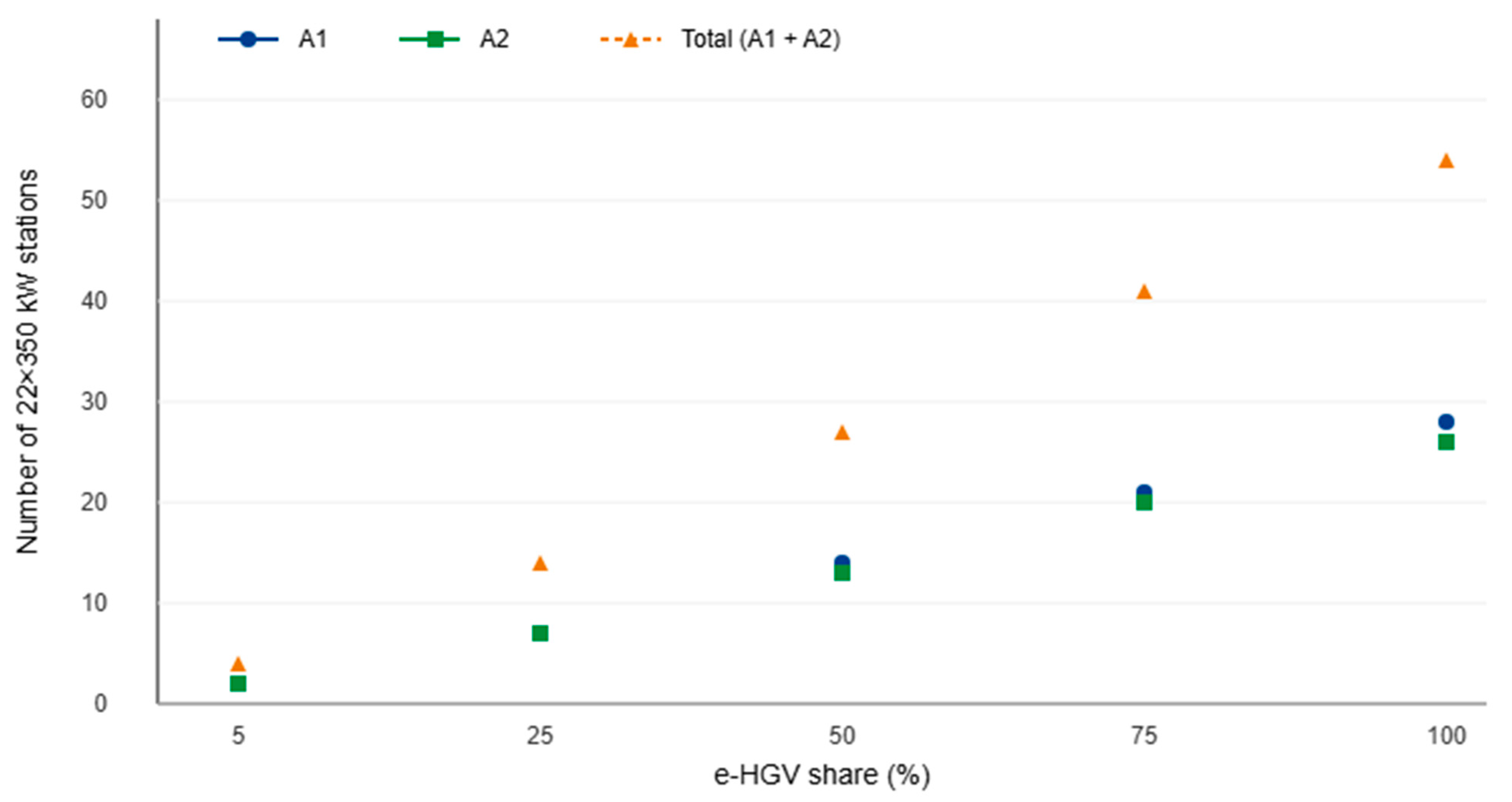
Based on these assumptions, the required number of charging stations along the A1 and A2 motorways was estimated (
Figure 4).
The results presented on
Figure 4 indicate that the number of required high-power charging stations for heavy-duty vehicles on the A1 and A2 motorways increases in line with the share of e-HGVs in traffic. Under a 12 h charging window—which should nonetheless be considered a highly demanding operational scenario—even at a 25% electrification level of the heavy-duty fleet, approximately 14 hub-type stations (each equipped with 22 charging points of 350 kW) would be needed along both corridors. Under full electrification, this number rises to more than 50 stations.
This demonstrates that shortening the available charging time from a full day to a 12 h window, as dictated by driver working time regulations, significantly increases the pressure on the number of infrastructure locations, not only on their connection capacity. In practice, this implies that with a high share of e-HGVs, expanding individual charging stations at existing motorway service areas (MOPs) will be insufficient; instead, a denser network of charging sites will be required, including those outside traditional service areas.
Although the 100% penetration scenario is a useful upper-bound modelling construct, its results imply very substantial infrastructure requirements that exceed current planning and implementation capacities. Such an extreme level of electrification would require a structural redesign of the TEN-T corridor infrastructure, including not only the expansion of charging hubs but also substantial reinforcement of medium- and high voltage grid connections, coordinated spatial planning for logistics facilities, and the development of large scale energy storage systems to stabilise peak demand. From a policy perspective, this scenario demonstrates that full electrification of heavy-duty transport cannot be achieved solely through AFIR-compliant corridor charging. Instead, it would require a complementary mix of depot-based charging, opportunity charging at logistics nodes, and a gradual restructuring of freight flows. These results also highlight that realistic medium-term strategies should prioritise partial electrification trajectories (e.g., 25–50%), where infrastructure requirements remain proportionate to feasible investment volumes and grid capacity expansion timelines.
In medium-range scenarios (around 50% e-HGV penetration), the deployment of approximately 25–30 stations along the two main TEN-T axes (A1–A2) appears to be the minimum necessary to maintain the continuity of heavy road transport operations without the risk of charging-induced congestion.
5. Discussion
The analysis confirms that road transport remains the primary source of external costs within Poland’s transport system, dominating both passenger and freight mobility. Despite advancements in vehicle efficiency and stricter emissions standards, its environmental and social impacts are disproportionately high compared to other transport modes. Road freight transport alone generates over EUR 17 billion in annual external costs, largely due to air pollution, noise, congestion, and accidents. These findings highlight the urgent need for structural changes in the sector, as further growth in road freight activity without effective mitigation would intensify these burdens. In this context, road transport electrification—supported by the Alternative Fuels Infrastructure Regulation (AFIR)—stands as a crucial instrument for reducing environmental impacts and advancing decarbonisation.
The forecast for the A1 and A2 motorways reveals that transitioning to zero-emission freight transport requires both fleet replacement and a large-scale expansion of charging infrastructure along the TEN-T corridors. Even a conservative scenario—with only a 5% share of electric heavy-duty vehicles—exceeds the minimum requirements set by the AFIR. Calculations shows that the A1 motorway will need at least 11 high-power charging stations, each with 22 bays of 350 kW, and the A2 will require a comparable number. As the share of electric trucks rises, infrastructure demands grow exponentially: nearly 30 stations for 50% electrification, and over 50 for full electrification. These results underscore the scale of the infrastructural challenge and the widening gap between current deployment levels and the expected demand over the next decade.
The study identifies a major constraint: the immense power demand from high-capacity truck charging. Modelling shows that the peak charging power required on key transport corridors will range from approximately 80 MW with 5% fleet electrification to over 1.6 GW with full electrification. This level of demand heavily burdens the national grid and surpasses the existing connection capacity of most motorway service areas. The current energy infrastructure is unprepared for the simultaneous operation of multiple megawatt-scale chargers, as a single truck charging hub can require tens of megawatts. This underscores a fundamental challenge—the electrification of road transport is inextricably linked to the parallel modernization and expansion of the electricity grid.
The analysis further reveals a strong spatial and temporal dimension to the charging challenge. Charging operations are concentrated within specific daily windows due to regulated driving times for heavy-duty vehicle drivers, which amplifies peak energy demand. Even when assuming an extended 12 h charging window, the number of required stations and chargers remains substantial. This implies that the future network must not only meet technical requirements, such as the AFIR-defined maximum distances between stations, but also accommodate the temporal clustering of demand caused by logistics schedules. Without adequate network planning and demand management, there is a risk that charging congestion could emerge as a new form of systemic inefficiency in road transport.
Decarbonising road freight transport in Poland is technically and infrastructurally feasible, yet hinges on unprecedented coordination between transport, energy, and industrial policy. Electrification offers significant potential to reduce greenhouse gas emissions, air pollution, and other external costs of fossil fuel combustion. However, the scale of required infrastructure investment—encompassing both the number of charging sites and the capacity of the power grid—poses a profound challenge. Consequently, achieving the objectives of the AFIR and the European Green Deal will depend not only on technological readiness but also on the successful integration of transport electrification into a broader, systemic framework for sustainable transport and energy development.
The electrification of heavy-duty road transport along the Polish TEN-T corridors entails profound implications for the national power system, which must be fully considered in future research. As shown by the infrastructure demand estimates developed in this study, the large-scale introduction of electric heavy-duty vehicles (e-HGVs) will generate substantial and geographically concentrated electricity loads, particularly at high-power charging hubs located along long-distance motorway corridors. A key challenge concerns the local grid’s ability to supply multi-megawatt charging clusters without destabilising regional power flows. This issue is especially relevant for the central Polish node around Stryków, where the A1 and A2 motorways intersect and where one of the country’s largest agglomerations of logistics warehouses and distribution centres is emerging (
Figure 5).
The co-location of intense freight activity, growing e-HGV flows, and high industrial electricity consumption suggests that this area will experience disproportionately high peak demand, requiring detailed assessment of grid hosting capacity, local transformer capabilities, and the need for distribution and transmission upgrades.
Future research should therefore prioritise the development of advanced simulation models capable of estimating spatiotemporal electricity demand from e-HGVs at individual TEN-T nodes. These models should incorporate dynamic traffic profiles, differentiated charging patterns (including en route and depot charging), seasonal variations and operational constraints stemming from drivers’ regulated rest times. Moreover, further studies should explore technically and economically optimal configurations of high-power charging hubs, examining different charging windows, power mixes (e.g., 350 kW + 1 MW chargers), redundancy levels and feasible grid connection architectures. Such analyses would support investment planning by indicating when connection to the transmission grid (110 kV or 220 kV) becomes necessary.
Another important direction for future work is the integration of long-haul charging demand with the rapidly expanding sector of urban and last-mile logistics. The overlap of these profiles could significantly reshape daily load curves, intensify peak demand and influence the location and sizing of charging hubs at the periphery of major metropolitan areas. Finally, research should also address the economic dimension of infrastructure deployment, including financing frameworks, regulatory incentives, tariff design and public–private partnership models. Comparative studies benchmarking Poland’s transition path against leading practices implemented in other EU and OECD countries would help identify efficient governance approaches and accelerate the implementation of AFIR-compliant infrastructure.





 ,
,