


Abstract
Frequent extreme-weather events pose severe challenges to the secure and economical operation of power systems with high renewable energy penetration. To strengthen grid resilience against such low-probability, high-impact events while maintaining good performance under normal conditions, this paper proposes an optimal energy storage allocation method for power systems with high-wind-power penetration. We first identify two representative extreme wind power events and develop a risk assessment model that jointly quantifies load-shedding volume and transmission-line security margins. On this basis, a multi-scenario joint siting-and-sizing optimization model is formulated over typical-day and extreme-day scenarios to minimize total system cost, including annualized investment cost, operating cost, and risk cost. To solve the model efficiently, a two-stage hierarchical solution strategy is designed: the first stage determines an investment upper bound from typical-day scenarios, and the second stage optimizes storage allocation under superimposed extreme-day scenarios within this bound, thereby balancing operating economy and extreme-weather resilience. Simulation results show that the proposed method reduces loss-of-load under extreme-weather scenarios by 32.46% while increasing storage investment cost by only 0.18%, significantly enhancing system resilience and transmission-line security margins at a moderate additional cost.
1. Introduction
With the ongoing global energy transition, the installed capacity of wind and solar power is rapidly increasing [1,2]. At the same time, climate change is leading to more frequent extreme-weather events, such as typhoons and heat waves, in many regions, posing serious threats to weather-sensitive renewable generation [3,4,5]. Among these high renewable systems, this paper focuses on wind-dominated grids where utility-scale projects are mainly wind farms connected at transmission buses, while solar photovoltaic (PV) resources in the same region are mostly deployed as small-scale or behind-the-meter installations. As a flexible and fast-responding resource, energy storage can mitigate the supply–demand imbalance caused by extreme weather and enhance the resilience of such systems [6,7]. Therefore, allocating storage capacity and power ratings in a way that explicitly accounts for extreme-weather impacts is essential for maintaining secure and economic operation of power systems with high renewable penetration.
To cope with renewable uncertainty, robust optimization (RO), distributionally robust optimization (DRO), and stochastic optimization (SO) have been widely used for energy storage allocation [8,9,10,11,12,13,14]. RO-based models ensure reliable operation under worst-case realizations but are often conservative; for example, [8] develops a two-stage robust model for a transmission system with wind and load uncertainty and optimizes against the worst wind scenario. DRO constructs an ambiguity set for the probability distribution of renewable energy and optimizes storage against the worst-case distribution within that set. Using the Wasserstein distance, [10] builds such an ambiguity set and addresses storage allocation with a two-step method, alleviating over-conservatism while maintaining economic efficiency, but without offering a direct and interpretable cost–risk trade-off. SO allocates resources under a prescribed probability distribution of renewable scenarios; for instance, [12] proposes a two-stage stochastic mixed-integer second-order cone model for flexible-resource allocation and improves cost effectiveness. In addition, because storage allocation in systems with high renewable penetration is typically a nonlinear optimization problem, multi-timescale allocation models have been proposed, such as [14], to enhance computational tractability. However, the models in [8,10,12,14] mainly optimize storage under normal operating conditions. They are not specifically designed for low-probability, high-impact extreme-weather events, and risk-quantified storage allocation tailored to such conditions remains limited.
Energy storage balances power and energy through charge–discharge control during extreme-weather conditions and has been widely studied for wind integration and resilience enhancement [15,16]. In distribution networks, storage is used in two-stage resilience models and coordinated with volt–var control and loss reduction to limit voltage violations, losses, and risk under extreme events [17,18]. For coupled transportation–power systems under hurricanes, rail-based mobile storage is proactively routed to enhance resilience through a two-stage robust optimization model [19]. At the dispatch level, storage is embedded in day-ahead unit-commitment models for typhoon response, fault prediction, and lightning-related risk warning [20,21,22]. In other complex operating environments, such as multi-energy ship microgrids and systems with high renewable penetration, storage is scheduled by risk-averse two-stage stochastic models or bilevel forecast-shaping frameworks to improve unit-commitment economics [23,24]. Nevertheless, these methods mainly target specific systems and short-term operation or dispatch and thus do not readily inform long-horizon storage siting and sizing in transmission grids with high-wind penetration under extreme-weather risks.
To address these issues, this paper first develops a risk assessment model for extreme-weather conditions by identifying two representative wind power output scenarios and assessing risk using both load-shedding volume and transmission-line security margins. Based on one year of historical wind power and load data, a set of typical-day and extreme-day scenarios is then constructed through clustering and extreme-weather event identification, and the corresponding scenario probabilities are used to represent source–load uncertainty. On this basis, an energy storage siting and sizing model with investment constraints is formulated for power systems with high renewable penetration and solved using a two-stage hierarchical strategy. Finally, numerical studies on the New England 10-generator, 39-bus system demonstrate improved economic performance, reduced load shedding, and increased network security margins.
This paper makes two main contributions. (1) Risk assessment under extreme-weather conditions. A risk assessment model is established for extreme-weather conditions by integrating load-shedding volume and transmission-line security margins. The model quantifies the operational risk of power systems with high renewable penetration under both sustained, prolonged low-output and abrupt ramp-down wind conditions and provides a quantitative basis for the siting and sizing of energy storage systems. (2) Two-stage storage allocation considering economy and resilience. An energy storage allocation optimization model is formulated that simultaneously accounts for system security constraints, annualized investment cost, typical-day operating economy, and extreme-day operating risk. To solve the model effectively, a two-stage optimization algorithm is proposed, which can effectively balance investment economy and power system resilience.
The rest of this paper is organized as follows. Section 2.1 presents the identification of extreme wind power output scenarios and the risk assessment model. Section 2.2 describes the generation of typical-day and extreme-day wind power output scenarios and the two-stage energy storage allocation optimization model. Simulation results are discussed in Section 3. Section 4 concludes the paper.
2. Materials and Methods
2.1. Risk Assessment Modeling of Power Systems Under Extreme Weather
An identification method for two types of extreme scenarios, including prolonged low output (PLO) scenarios and abrupt ramp-down output (ARO) scenarios, is proposed based on disaster characteristics and renewable energy output behavior. Subsequently, considering both load-loss risks and transmission network margin violations, a comprehensive risk assessment model for extreme weather is established, laying the foundation for energy storage allocation optimization.
2.1.1. Identification of Extreme Wind Power Output Scenarios
Extreme-weather events are meteorological hazards with high intensity, low frequency, and severe impacts, which include typhoons, heat waves, and heavy rainfall. Their increasing occurrence poses serious challenges to power systems with a high penetration of renewable energy. Wind generation is highly weather dependent, so its output is easily affected by extreme events and may exhibit large, long-lasting fluctuations or even interruptions, further aggravating supply–demand imbalance.
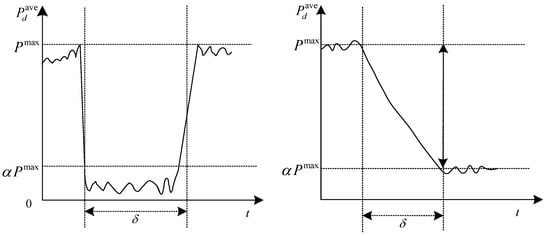
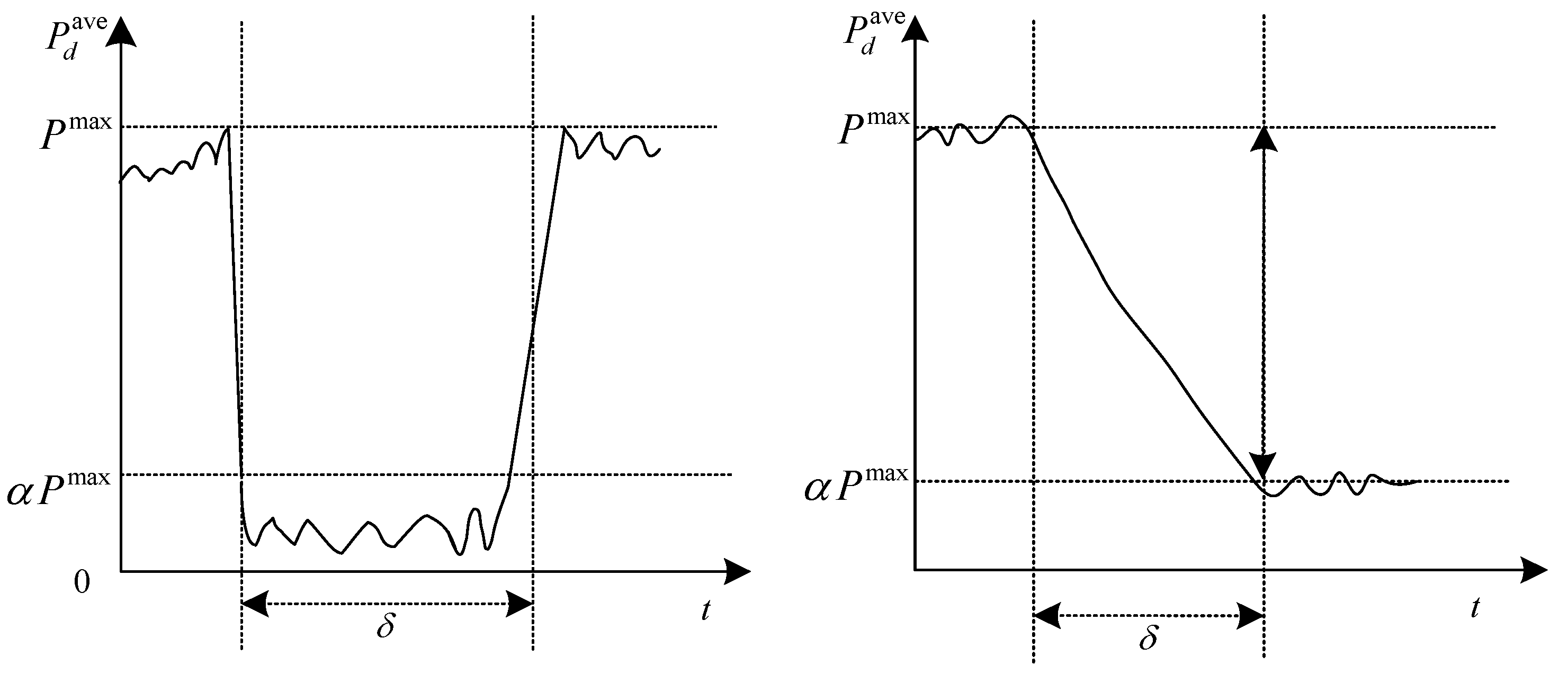
To comprehensively characterize the supply–demand imbalance risk under extreme weather, this paper considers two representative wind power output scenarios: PLO and ARO. The PLO scenario arises from conditions such as persistent low wind speeds or widespread haze, under which wind generation remains at a low fraction of rated capacity for an extended period. The ARO scenario is triggered by events like frontal passages, thunderstorms, or sandstorms that cause a sharp, steep drop in wind generation over a short interval.
The power curve fluctuations of these two extreme wind power output scenarios are illustrated in Figure 1. For the PLO scenario, we define a prolonged low output period as any interval during which the wind power output stays below αPmax (0 < α < 1). If this condition persists for more than δ hours, a PLO scenario is identified. We initially took α = 0.20 and δ = 10 h [25]. For the ARO scenario, we slid a time window of length δ and computed the drop from a local maximum to a subsequent minimum of wind power output within that window. If this drop exceeded α times the rated output, an ARO event was identified. We set α = 0.20 and δ = 20 min [26].
Figure 1.
Illustration of two extreme wind power output scenarios.
2.1.2. Risk Assessment
PLO and ARO may induce two types of risks to power systems. First, they may cause supply-demand imbalance during peak load periods, triggering large-scale load shedding. Second, substantial power fluctuations cause large-scale power flow transfers, resulting in heavily loaded or overloaded lines. To reflect these risks, a risk assessment index considering nodal load shedding and transmission-line security margin is proposed, shown as follows:
where denotes the amount of load shedding at bus n in scenario k at time t, is the unit cost of load shedding, Pmn,k,t is the active power flow on line mn in scenario k at time t, Pmn,max is the maximum allowable active power of line mn, and is the cost coefficient for the line security margin, chosen at a lower level than so that temporary operation with a reduced security margin is penalized, but less severely than actual load shedding.
To calculate the proposed index, some constraints need to be considered, including power balance constraints, thermal unit output constraints, energy storage operation constraints, nodal power balance constraints, wind farm curtailment constraints, nodal voltage magnitude constraints, network power flow constraints, and load shedding constraints.
(1) Thermal unit output constraints
Equation (2) represents the upper and lower output limits of thermal power units, where denotes the active power output of thermal unit g in scenario k at time t; and represent the upper and lower generation limits of thermal unit g, respectively; rg,down and rg,up indicate the upward and downward ramping rate limits of thermal unit g; and Δt is the time interval, set as 1 h in this paper.
(2) Energy storage operation constraints
Equation (3) specifies the operating constraints of the energy storage charging power and stored energy capacity, where , and denote the charging power, discharging power, and state of charge of the storage unit at bus n in scenario k at time t, respectively. and are the upper and lower bounds of the state of charge, and and are the charging and discharging efficiencies of the storage.
(3) Power balance constraint
Equation (4) represents the active power balance constraint at each bus. Equation (5) describes the reactive power balance constraint at each bus. Here, denotes the set of thermal power units located at bus n; is the active power output of the wind farm at bus n in scenario k at time t; represents the charging/discharging power of the energy storage system at bus n in scenario k at time t; and are the sets of branches originating from and terminating at bus n, respectively; Pmn,k,t is the active power flow on transmission-line mn in scenario k at time t; and is the set of all system buses; denotes the reactive power output of thermal power units in scenario k at time t; is the reactive power output of the wind farm at bus n in scenario k at time t; represents the reactive power flow on transmission corridor mn in scenario k at time t; and is the reactive power load at bus n in scenario k at time t.
(4) Wind power output constraint
where represents the wind power curtailment at bus n in scenario k at time t, denotes the maximum available wind power at bus n in scenario k at time t, and denotes the maximum wind power curtailment ratio at bus n.
(5) Voltage constraint
where Vn,k,t represents the voltage phase angle at bus n in scenario k at time t, and Vn,max and Vn,min denote the upper and lower limits of voltage magnitude at bus n, respectively.
(6) Network power flow constraint
where Pmn,k,t represents the active power flow on transmission line mn.
(7) Load shedding constraint
where represents the load shedding amount at bus n in scenario k at time t, and denotes the total load at bus n in scenario k at time t.
2.2. Energy Storage Allocation Optimization Considering Extreme-Weather Risks
Building on the above extreme-weather risk assessment, an optimal energy storage allocation approach is developed. First, a typical-day–extreme-day scenario generation technique based on historical wind power and load data is proposed, which constructs a multi-scenario set from one-year time-series samples and represents source–load uncertainty through scenario probabilities. On this basis, an energy storage allocation model is formulated as a mixed-integer nonlinear program that minimizes the total system cost while satisfying investment constraints, typical-day security constraints, and additional security constraints on extreme days. By employing the LPAC (Linear-Programming Approximation of AC) power flow approximation, the model is linearized into an MILP (Mixed-Integer Linear Program). A two-stage hierarchical solution strategy is then applied, in which investment bounds are determined from typical-day results and the energy storage allocation is further optimized under extreme-day scenarios.
2.2.1. Typical-Day and Extreme-Day Wind Power Output Scenario Generation
To capture the uncertainty of wind power and load in the allocation horizon while balancing computational efficiency and accuracy, this paper constructs typical-day and extreme-day scenarios for the energy storage allocation model based on historical data. First, k-means clustering is applied to the annual hourly wind power output samples to extract four representative daily curves corresponding to different seasons. Second, extreme-day scenarios are identified using the method described in Section 2.1 to characterize extreme-weather events. The specific approach is as follows:
(1) Typical-day scenario generation
The historical one-year wind power output samples are organized into a D × 24-dimensional feature matrix P ∈ RD×24, where D represents the number of sample days. The k-means algorithm is applied to cluster the feature matrix P, with its core objective being to minimize the sum of squared Euclidean distances between samples and their cluster centroids:
where Ck represents the k-th cluster, and μk denotes its centroid. The algorithm iteratively executes the “assignment-update” process until the cluster centroids stabilize. Typically, the number of clusters K is set between 4 and 8; this study selects K = 4. Each cluster centroid μk represents a typical-day scenario, with its weight defined as follows:
where γ represents the probability reserved for extreme-day scenarios.
(2) Extreme-day scenarios generation
Based on the extreme-day scenario identification method described in Section 2.1, PLO and ARO scenarios are selected from the historical one-year wind power output sample.
On the load side, the typical-day load scenarios are likewise constructed from the year-long hourly load data by applying the k-means clustering algorithm to obtain several representative daily load profiles, and the scenario weights are calculated from the occurrence frequency of each cluster. The extreme-day load scenarios are selected with reference to the meteorological causes of the corresponding extreme wind power events. PLO scenarios are mostly associated with hot summer conditions, and therefore, their load scenarios adopt typical summer load profiles. ARO scenarios are mainly intended to capture rapid variations in wind power, whose occurrence is less strongly tied to a specific season. To highlight the impact of fast renewable fluctuations themselves and avoid confounding effects from simultaneously stressing the demand side, the load curve used for the ARO scenario is chosen as a typical-day profile whose load level and shape are both at a medium level.
2.2.2. Energy Storage Allocation Optimization Model
Based on scenario generation and risk assessment, we construct a multi-scenario energy storage allocation optimization model that integrates investment and dispatch decisions. The objective combines three cost components, namely the annualized investment cost of energy storage, the operating cost under typical-day scenarios, and the risk cost under extreme-day scenarios. The constraint set consists of three parts—investment constraints, typical-day security constraints, and additional security constraints for extreme days.
(1) Objective function
Considering that energy storage allocation involves not only upfront capital investment but also significantly different operational benefits under typical-day and extreme-day scenarios, this paper comprehensively incorporates three cost factors in the objective function. First, the annualized investment cost of energy storage reflects the fixed expenses associated with capacity and power configuration. Second, under typical-day scenarios, the system primarily relies on conventional units for daily load regulation and energy balance, with operational costs constituting typical-day expenses. Finally, incorporating the extreme-day risk indicators from Section 2.2, the risk costs are included in the objective function. As specifically shown in Equation (15), the total system allocation cost is minimized through rational optimization of energy storage location, power, and capacity allocation.
In the equation, CInv represents the annualized investment cost of energy storage; CSB,Ope denotes the typical-day operational cost; and CCUT,Ope signifies the extreme-day risk cost. The weighting factors (1 − γ) and γ reflect the relative importance of typical-day operational costs and extreme-day risk costs in the optimization problem, respectively.
- (1)
- CInv Annualized investment cost
The annualized investment cost is constructed from the unit power and unit energy-capacity investment costs of the storage system, which are already converted to their annualized values.
In the equation, and represent the unit capacity annualized investment cost and unit power annualized investment cost of the energy storage, respectively, while and denote the total investment capacity and investment power of the energy storage.
- (2)
- CSB,Ope typical-day operational cost
The typical-day operational cost measures the operating expenses of the power system under normal weather and load conditions, including fuel consumption costs and startup/shutdown costs of thermal power units, as well as wind power curtailment costs.
In the equation, represents the probability of occurrence in the k-th typical-day scenario; denotes the unit operating cost of thermal unit g; indicates the unit startup cost of thermal unit g; // respectively represent the unit output and startup capacity of thermal unit g at time t in the k-th typical-day; is the cost per unit of wind power curtailment at bus n; and represents the wind power curtailment amount at bus n and time t in the k-th typical day.
- (3)
- CCUT,Ope Extreme-day risk cost
The construction principle of extreme-day risk costs has been presented in the previous section.
where represents the occurrence probability in the k-th extreme-day scenario, and denotes the extreme-weather risk indicator established in Section 2.2.
(2) Constraints
The allocation model developed in this paper incorporates three categories of constraints: investment constraints, typical-day constraints, and extreme-day constraints.
(1) Investment constraints
Equations (17) and (18) formulate the investment decision constraint of energy storage and the constraint on the number of installation buses. Specifically, xn is the investment decision variable indicating whether storage is installed at bus n (it takes the value 1 if storage is installed and 0 otherwise); ΓBES denotes the maximum allowable number of buses at which storage can be installed; and represent the maximum energy capacity and power capacity of the storage installed at bus n, respectively.
(2) Typical-day constraints
For typical days, wind power output must meet load demand to ensure safe and stable system operation. Therefore, this paper sets the load shedding volume to zero for typical-day scenarios. Other constraints include energy storage investment constraints, thermal unit operation constraints, energy storage operation constraints, power balance constraints, voltage constraints, and transmission-line power flow constraints, as detailed in Equations (2)–(9).
(3) Extreme-day constraints
Unlike traditional allocation models that only consider typical-day operational constraints, this paper incorporates extreme-day constraints as shown in Equations (2)–(10). By adding safety operation constraints under extreme-day scenarios, the model effectively controls power supply imbalance risks during extreme-weather events.
To solve the nonlinear energy storage allocation model, the formulation is linearized. Given the siting and sizing features, the LPAC method is adopted [27]. The method has two main features: a polyhedral relaxation of the cosine function via a set of supporting hyperplanes and a Taylor-expansion linearization of the residual nonlinear terms after relaxation. Assuming sin θ = θ, the power flow is processed as
where represents the approximate form of cos θmn; h is the number of tangent lines used to approximate the cosine function polyhedron; denotes the set power angle range (−, ); and d = /(h+1) is the interval between tangent points. indicates the bus voltage deviation value with = 0 for generator buses. After linear relaxation of power flow, the optimization model is given by Equation (27).
At this point, the nonlinear programming problem has been transformed into an MILP problem.
2.2.3. Two-Stage Energy Storage Allocation Optimization Two-Stage Energy Storage Allocation Optimization
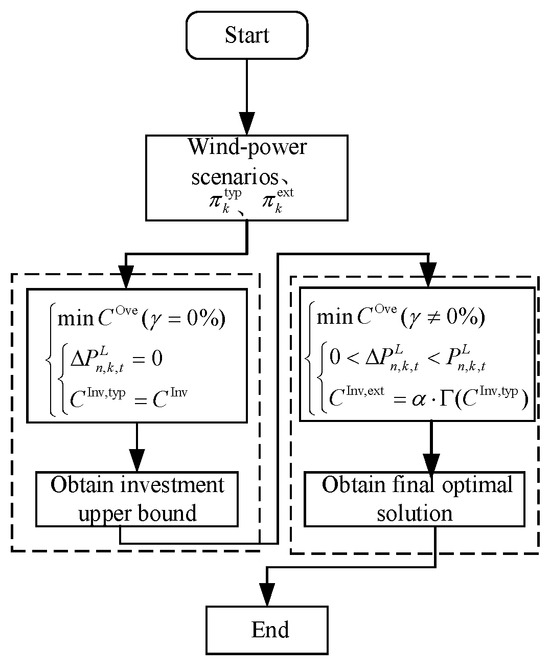
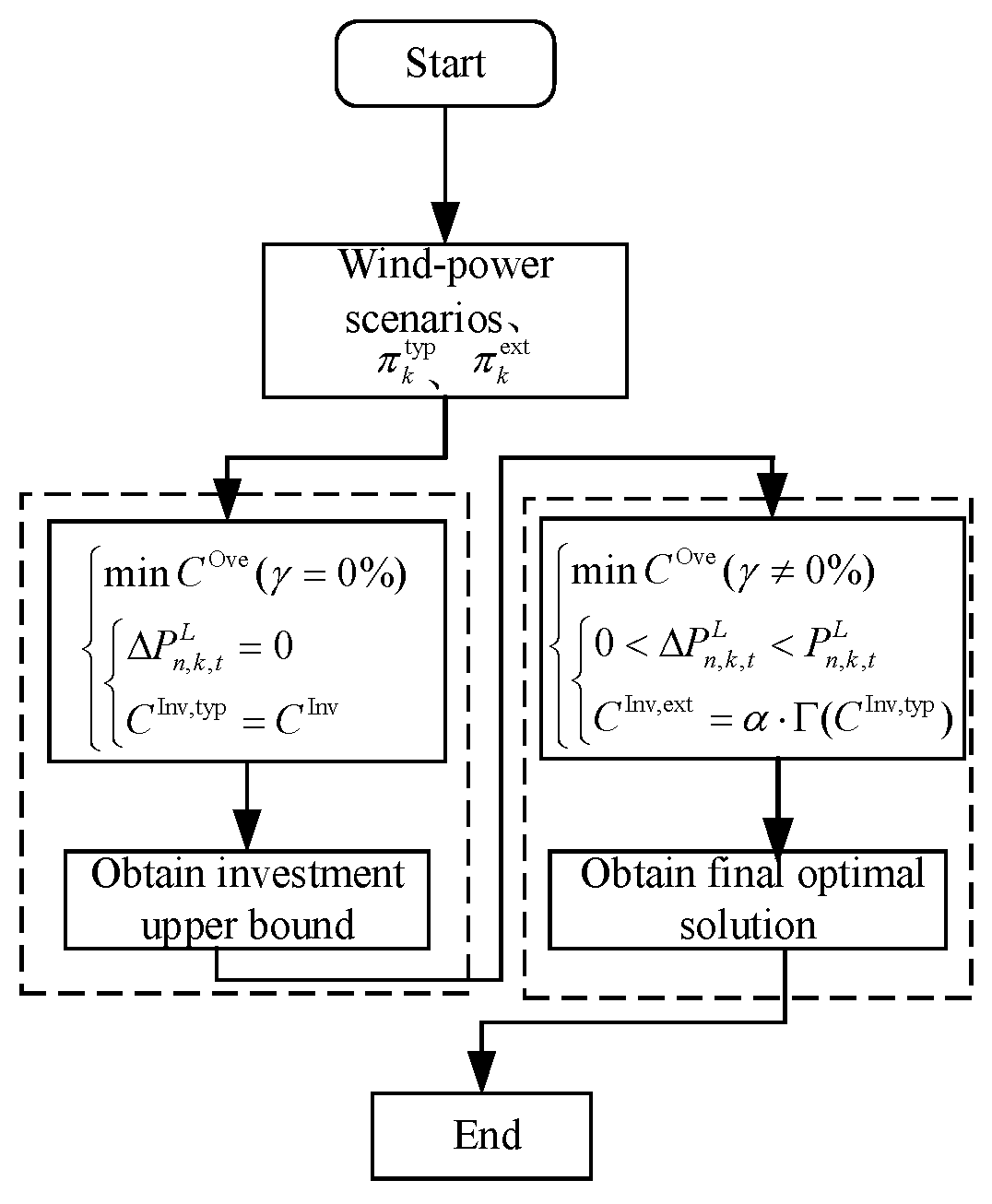
To balance operating economy on typical days and resilience under extreme conditions within limited computational resources, this paper divides the solution process into two stages (Figure 2). In the first stage, the typical-day model determines the investment bounds from the allocation results; in the second stage, the extreme-day model optimizes energy storage dispatch by superimposing extreme-day scenarios, significantly reducing the overall solution scale while avoiding solver convergence difficulties caused by multi-objective conflicts in the single-stage solution.
Figure 2.
Two-Stage Solution Strategy Flowchart.
Stage I: Typical-Day Allocation
This stage inputs only four typical-day scenarios and their weights , ignoring extreme-day probabilities ( = 0%). The load shedding is fixed at 0, enforcing a complete supply-demand balance under typical-day loads. The solution yields the energy storage energy capacity and power rating, as well as the first-stage investment CInv,typ.
Stage II: Extreme-Day Allocation
This stage incorporates both four typical-day scenarios and two extreme-day scenarios (with weights and ), and accounts for extreme-weather risks. Based on the investment CInv,typ obtained in Stage I, a tunable investment scaling factor α is introduced, and the total storage investment CInv,ext in Stage II is constrained by
where α is a tunable scaling factor for the extreme-day storage investment upper bound. By increasing α, additional capacity can be installed specifically for extreme days, whereas setting α = 1 keeps the budget at the typical-day level, thus enabling a controlled trade-off between enhanced extreme-day resilience and overall investment economy. Γ(·) denotes the rounding of the continuous budget αCInv,typ to discrete engineering modules of storage units. Under this constraint, energy storage siting and dispatch are re-optimized while permitting load shedding < . The objective function minimizes a weighted sum of operating cost, risk cost, and investment, subject to the scaled investment upper bound, aiming to reduce extreme-day risk as much as possible.
The simulation proceeds via stepwise optimization indexed by scenario and time step and ultimately produces, for each scenario and time, the following operational data: bus power balance, grid-connected and curtailed wind power, energy storage charge/discharge power, and state of charge.
3. Results
3.1. Case Configuration
3.1.1. System Architecture
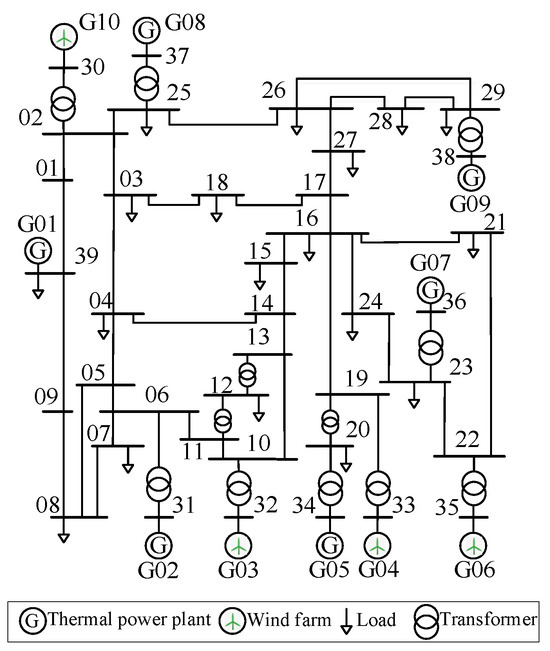
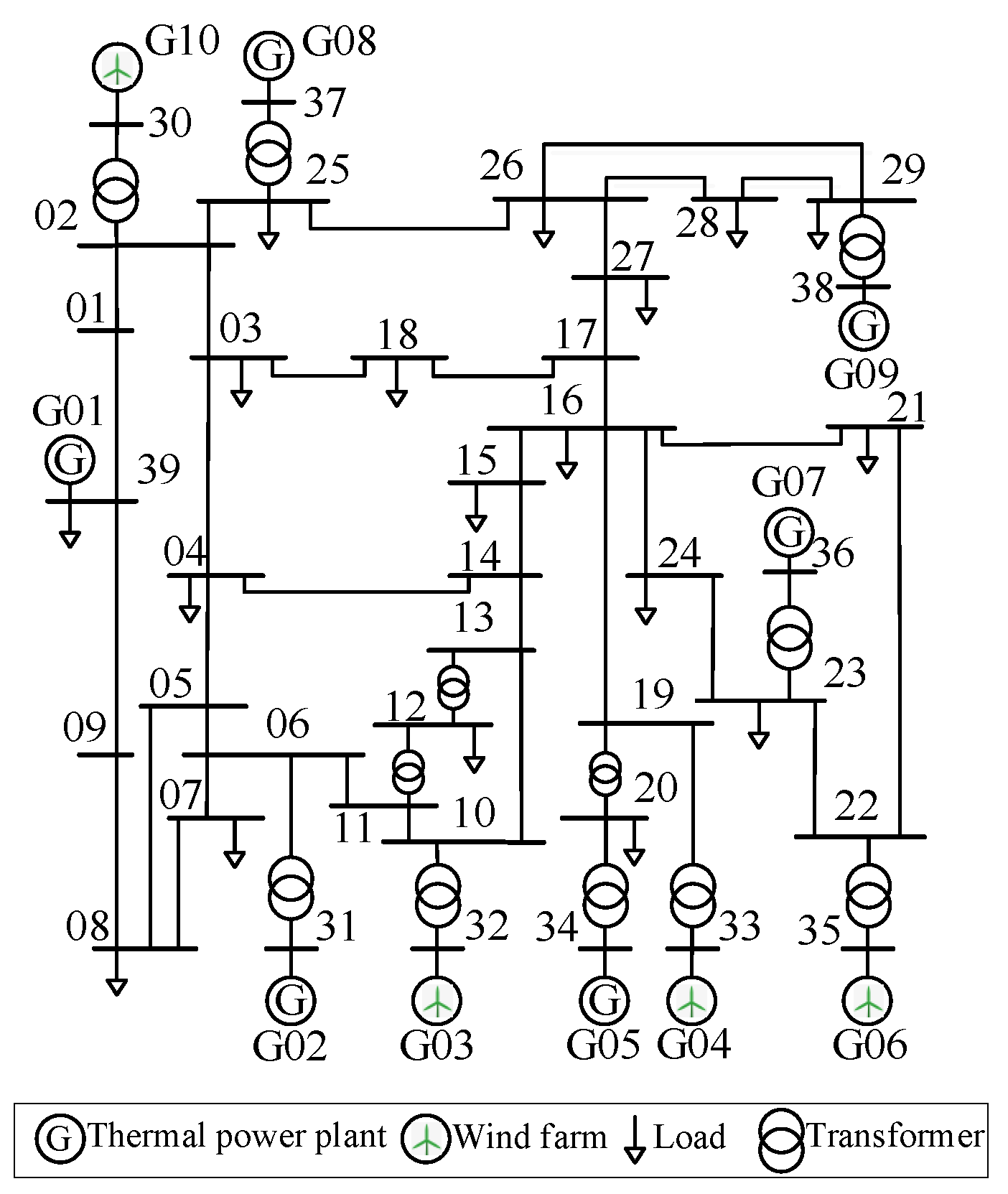
To match a study setting with large-scale renewable energy and energy storage, the case study builds on the New England 10-generator 39-bus system [28]. In the modified data set, wind power is represented as utility-scale plants located at generator buses and is modeled explicitly, whereas PV generation in the study area mainly appears as distributed resources and is therefore not modeled as separate generating units. Instead, its impact has already been aggregated into the net load profiles at each bus. The original network with 39 buses and 46 transmission lines is retained. The thermal units at buses 30, 32, 33, and 35 are replaced by wind farms with the same rated power, resulting in a total installed wind capacity of 3104 MW, which accounts for approximately 42% of the total generation capacity of the system (7367 MW). Each wind farm is assigned a reactive power capability of ±33% of its rated power to provide adequate reactive power support. The modified topology diagram is shown in Figure 3.
Figure 3.
The New England 10-generator 39-bus system topology diagram.
The case study is solved using the YALMIP toolbox with the Gurobi solver in the MATLAB2023b environment. In the two-stage allocation strategy, this paper sets the investment scaling factor to α = 1 and the probability weight of extreme-day scenarios to γ = 0.1.
3.1.2. Wind Power Output Scenarios
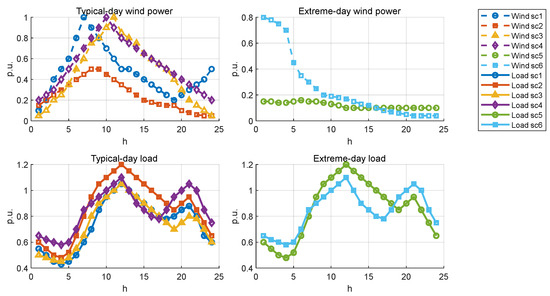
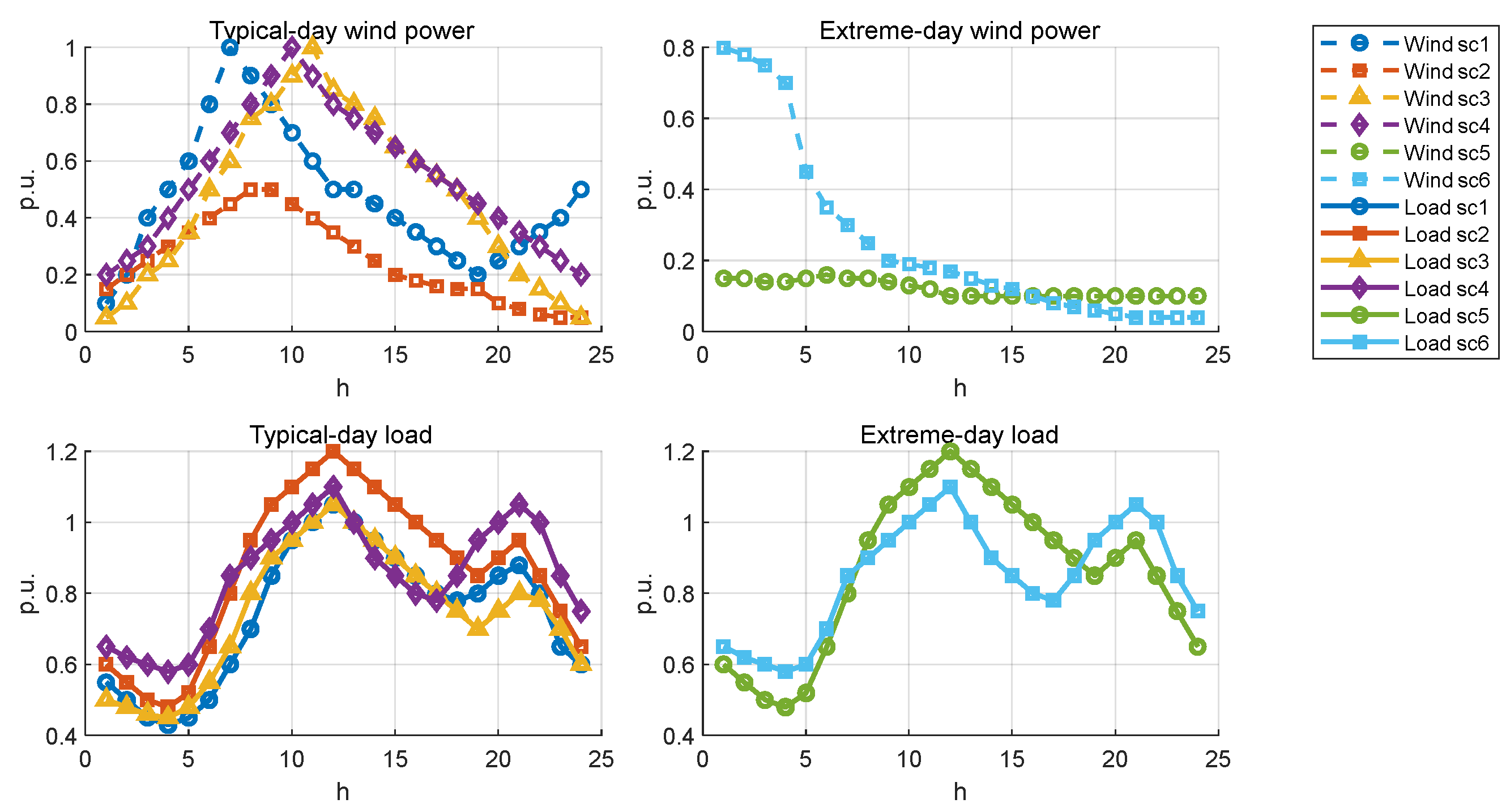
All wind power output scenarios use a 24 × 1 h daily time series (Figure 4). Typical-day scenarios are obtained by applying k-means clustering to historical one-year wind power output samples and extracting four representative days for spring, summer, autumn, and winter. Weights are computed with (14) from the occurrence frequency of each representative day in the samples, giving {0.34, 0.27, 0.22, 0.15}. Extreme-day scenarios are identified using the procedure in Figure 1. Rare PLO and ARO days in the samples are used to construct two extreme-day scenarios. Their weights are computed with (14), with a total probability of 1%, yielding {0.009, 0.001}. The typical-day and extreme-day weights sum to one. On the load side, the typical-day and extreme-day load profiles are generated using the scenario generation method described in Section 2.1, and the resulting trajectories are also shown in Figure 4.
Figure 4.
Typical-day and extreme-day wind power output scenarios.
3.1.3. Parameter Setting
This study compares energy storage siting with and without extreme-weather scenarios. Method 1 ignores extreme days and optimizes on typical days only, which account for 99% of the year. Method 2 includes extreme-day scenarios with a 1% share and applies the proposed two-stage allocation model to site and size energy storage. The bounds of each cost term in the objective and the key parameters are given in Table 1 [29].
Table 1.
Basic cost parameters for allocation.
3.2. Analysis of Energy Storage Allocation Results
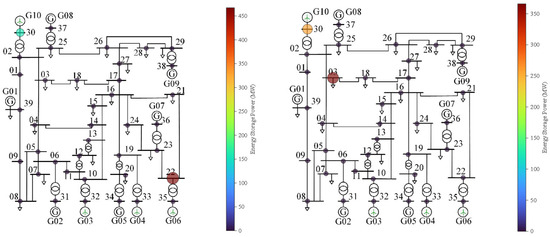
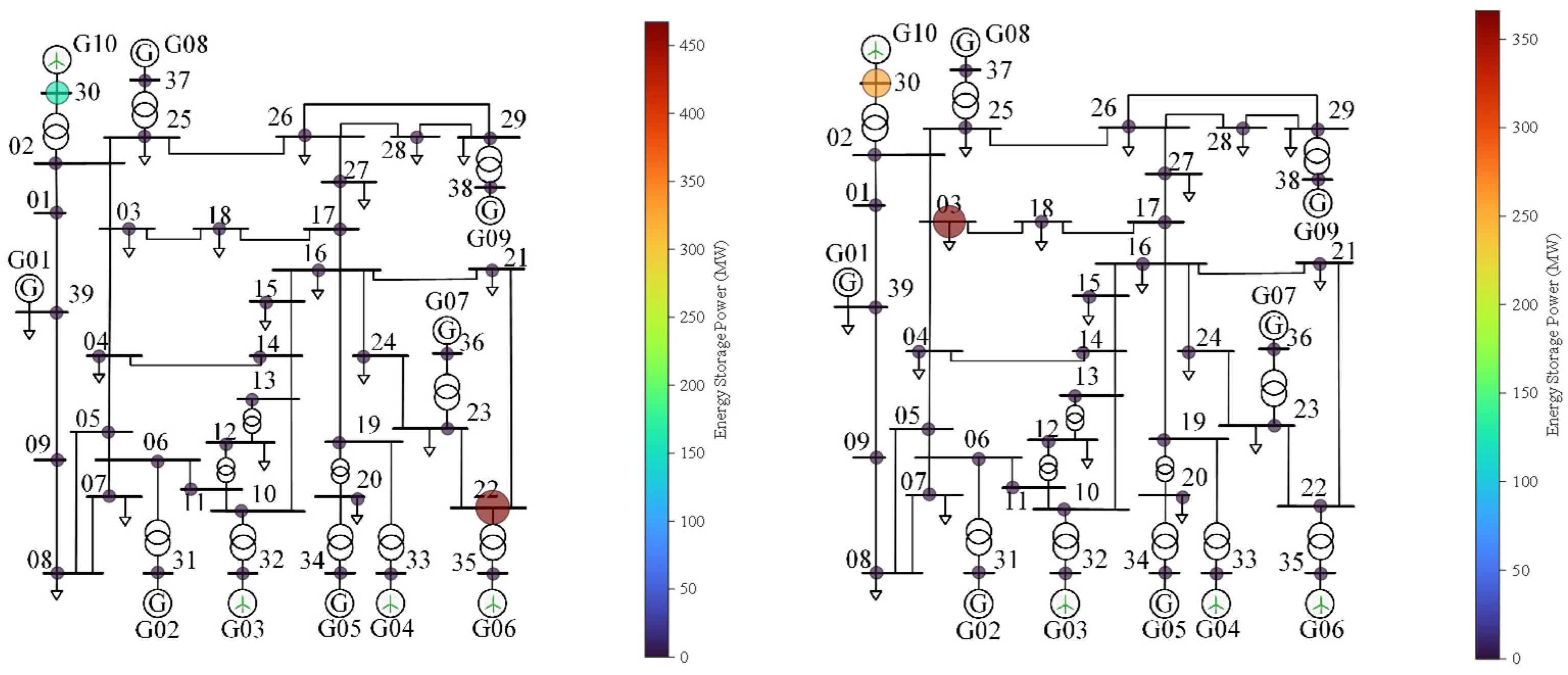
The energy storage allocation results under the two methods are presented in Figure 5, where the circle area denotes the energy storage capacity (MWh), and the color depth represents the energy storage power (MW). Table 2 further compares storage siting, power/capacity allocation, and extreme-day load shedding. Under Method 1, storage is mainly installed at buses 22 and 30, which can satisfy typical-day demand balancing but leads to about 1.84 × 10³ MWh of load shedding during extreme-day scenarios (34.5% of total demand).
Figure 5.
Energy storage siting bubble chart (size = capacity, color = power).
Table 2.
Energy storage allocation results under different methods.
With the proposed method, storage is reallocated to buses 3 and 30, giving a configuration that better supports critical load and transmission corridors under extreme conditions. For a comparable total storage capacity, the extreme-day load shedding is reduced to approximately 1.09 × 10² MWh, and the load-shedding ratio drops from 34.5% to 2.04%, indicating a marked improvement in system resilience against extreme-weather events.
3.3. Power System Operation Results Under Typical and Extreme Days
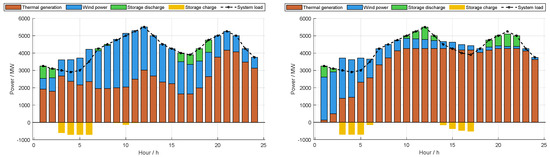
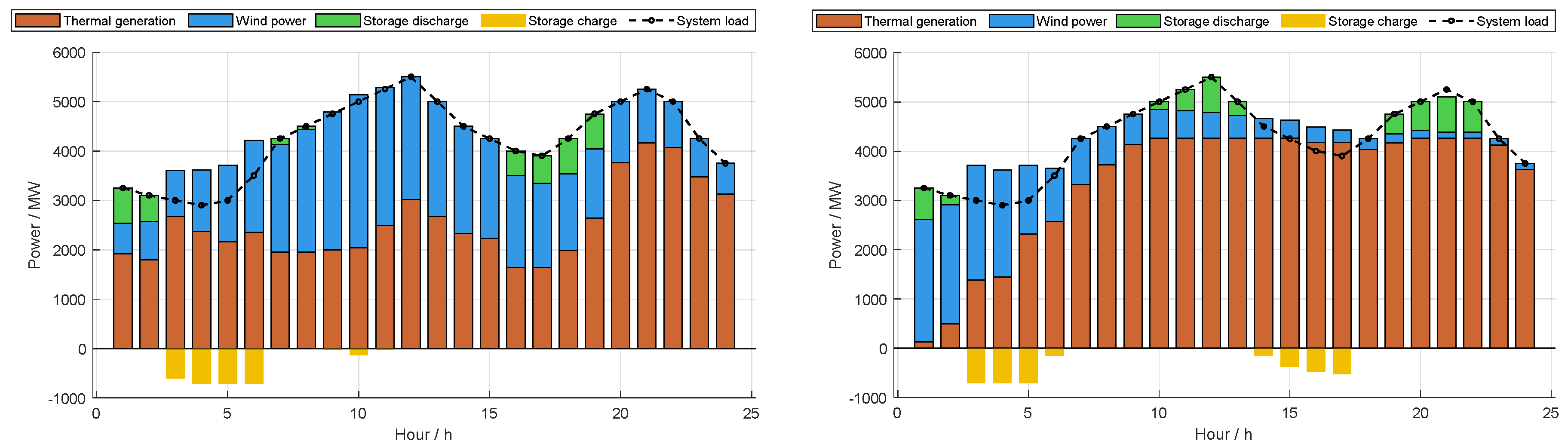
To demonstrate the operational benefits of the proposed allocation, we present a 24 h operating profile for typical-day 4 (Figure 6, left) and extreme-day 6 (Figure 6, right) under the optimized energy storage deployment. Taking the extreme day as an example, during 0—6 h, demand is low, and wind is plentiful. Energy storage absorbs the surplus wind, avoids night curtailment, and preserves energy for later peak shaving. In the morning peak (10—13 h), demand climbs while wind weakens, so energy storage switches to discharge. In the afternoon (14—17 h), the wind recovers and energy storage charges intermittently. In the evening peak (18—22 h), energy storage delivers more than 0.5 GW, filling the supply gap caused by the decline in wind power.
Figure 6.
24 h operating profiles for typical-day 4 and extreme-day 6.
Over the whole horizon, the energy storage net charge–discharge energy is strongly negatively correlated with wind and load fluctuations, demonstrating clear temporal complementarity. The demand trajectory closely follows the combined supply envelope of thermal units and wind, keeping the demand–supply mismatch within a very narrow band.
3.4. Economic Analysis
To assess economic performance, Table 3 compares the cost breakdown and total cost for the two allocation methods. Method 1 (typical-day only) yields the lowest expected total cost because extreme-day scenarios are almost ignored and the corresponding load-shedding cost is heavily discounted in the objective. With the proposed method, both operating cost and investment cost increase slightly, and the expected total cost rises from about 7.29 × 10⁶ CNY to about 7.59 × 10⁶ CNY. However, this modest additional expenditure buys a very large reduction in extreme-day loss of load (from 34.5% to 2.04% of total demand; see Table 2), indicating that the proposed allocation achieves a more favorable trade-off between investment and extreme-weather risk and notably enhances system resilience.
Table 3.
Cost breakdown and total cost for the two allocation methods.
3.5. Effectiveness for Operation Security Enhancement
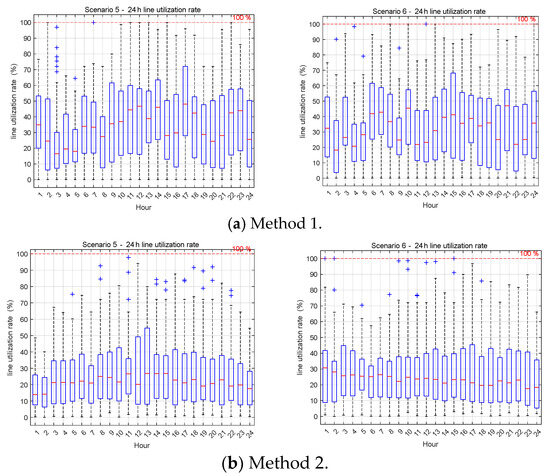
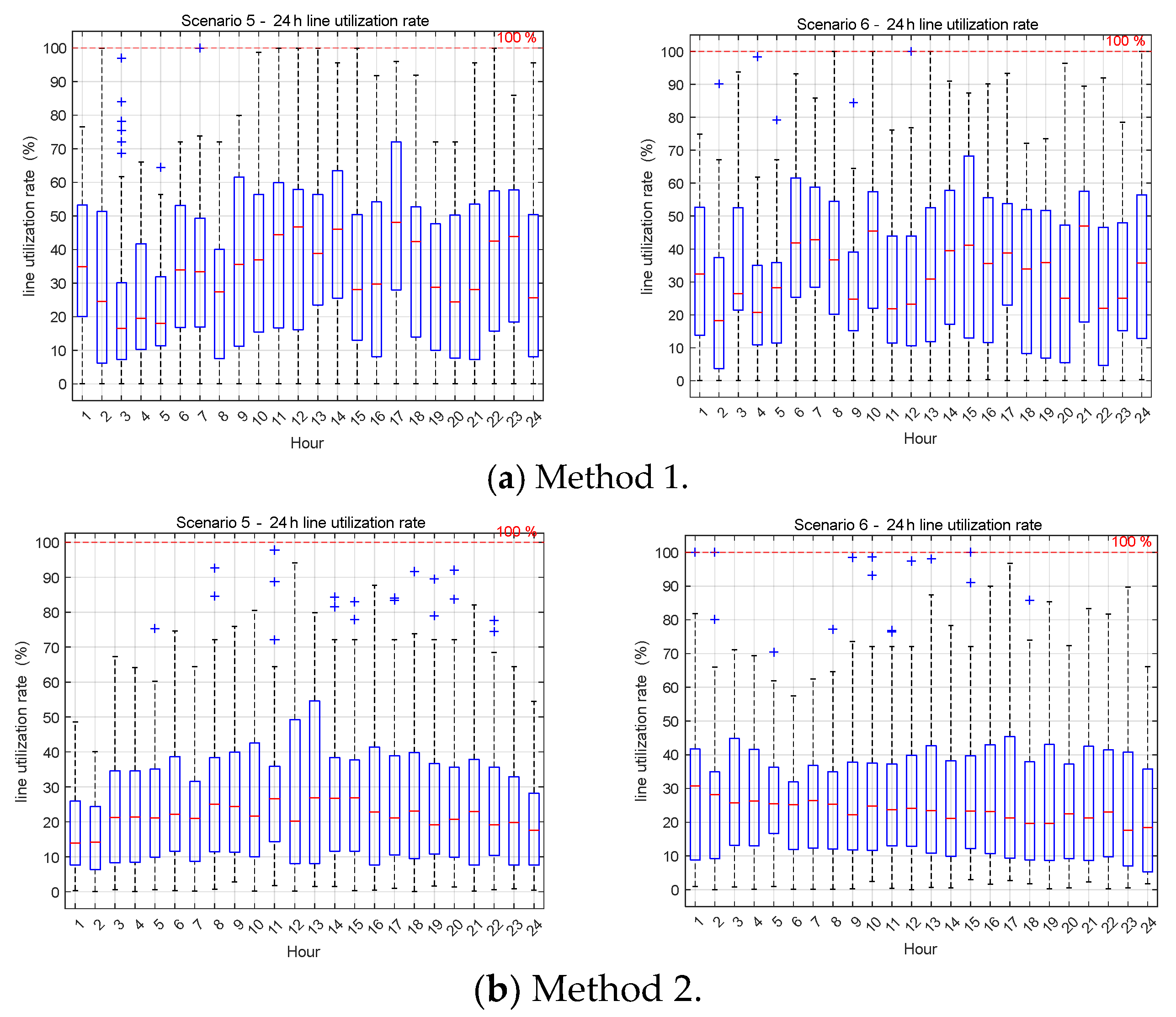
To further assess how energy storage improves transmission-line security margins, Figure 7 presents the hourly transmission-line loading for the extreme-day scenarios. Under Method 1, the boxplots for Scenario 5 and Scenario 6 show multiple hours in the high-load period with some lines loaded above 90% of their thermal limits, indicating substantial operational stress. Under Method 2, energy storage participation reshapes power flows and tightens the line-loading distributions; overload risk declines markedly, and system operation becomes more stable. Overall, explicitly incorporating extreme-day scenarios yields energy storage deployment that widens transmission-line security margins and strengthens system resilience.
Figure 7.
Statistical distribution of 24 h transmission-line loading under extreme scenarios.
3.6. Sensitivity with Respect to the Extreme-Day Probability Weight γ
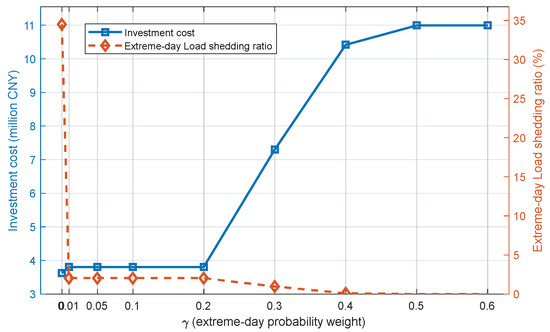
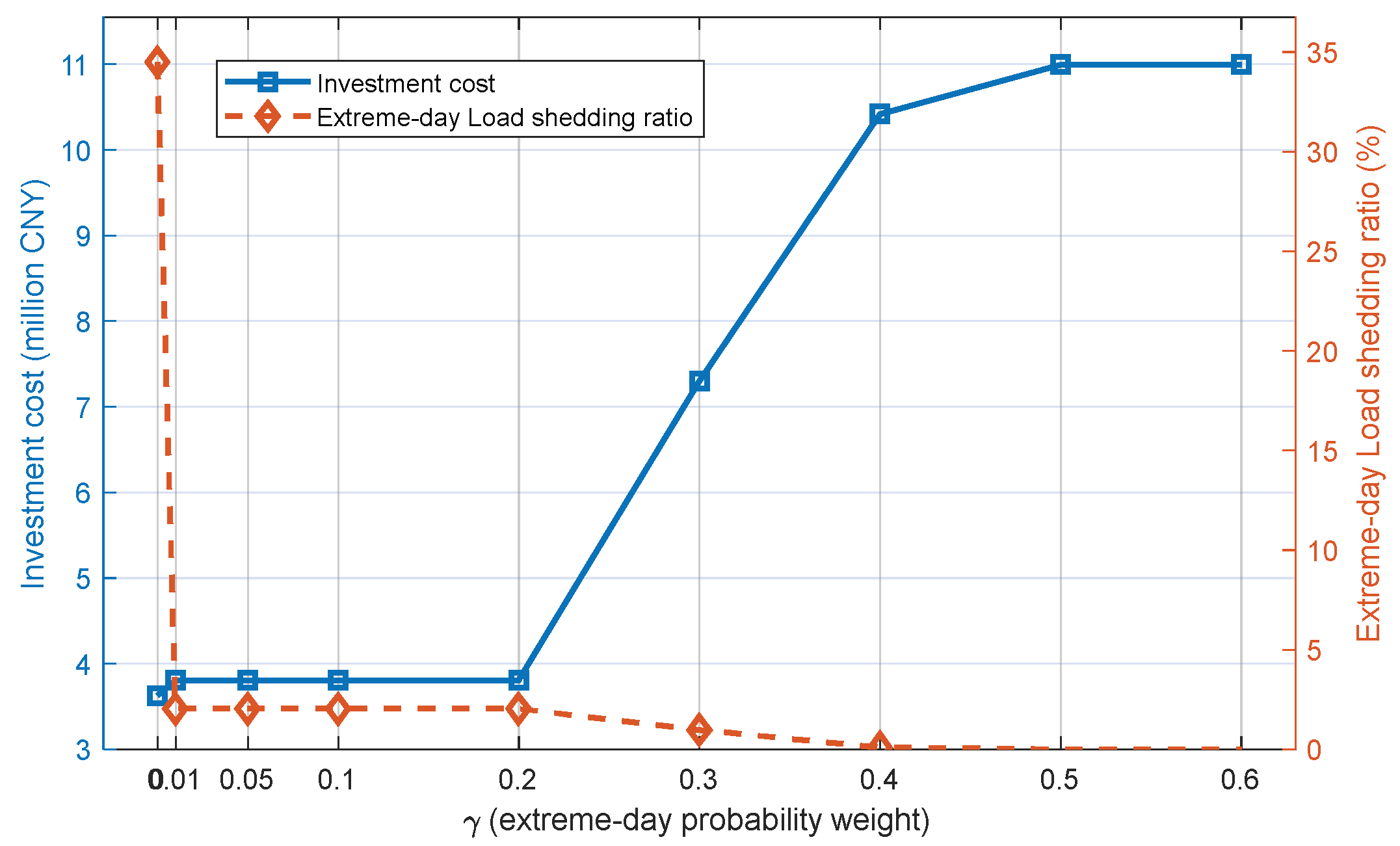
Figure 8 shows the sensitivity of storage investment cost and the extreme-day load-shedding ratio to the probability weight γ of extreme-day scenarios. When γ increases from 0 to small positive values, the investment cost rises only slightly, while the extreme-day load shedding ratio drops sharply from about one-third of the demand to only a few percent. This indicates that assigning a modest probability to extreme-day scenarios is already sufficient to trigger additional storage installation and to remove most of the extreme-day risk.
Figure 8.
Sensitivity of investment and extreme-day load shedding to γ.
As γ continues to increase, the marginal benefit of further investment quickly diminishes. For γ up to around 0.2, both the investment cost and the load-shedding ratio change only slightly. Once γ exceeds this range, the investment cost grows rapidly to several times its original level, whereas the remaining load shedding on extreme days is reduced only gradually and eventually approaches zero. These results suggest that, in practical allocation, γ should be chosen in a moderate range and combined with a reasonable investment upper bound, so that most of the extreme-day risk can be mitigated without incurring disproportionately high costs.
3.7. Comparison with Traditional RO
Table 4 compares the traditional RO with the proposed method. RO installs much larger storage and almost doubles the total cost simply to reduce extreme-day load shedding to zero. In contrast, the proposed scheme accepts a small and controllable amount of extreme-day shedding (about 2%), avoids over-investment driven by very rare events, and thus achieves a much more economical storage allocation under an acceptable reliability level.
Table 4.
Comparison between the proposed allocation method and RO.
4. Conclusions
This paper develops a two-stage optimization method for energy storage siting and sizing in power systems with high renewable energy, considering both typical-day and extreme-day scenarios. The method improves the economy and resilience of power systems with a controlled investment. The following conclusions are drawn from both theoretical analyses and numerical studies.
(1) The proposed risk assessment model can be used to establish an energy storage allocation optimization model, which can improve the system’s resilience against extreme weather. The expected load shedding amount under extreme weather is decreased from 34.5% to 2% with the proposed method.
(2) By considering the transmission-line security for energy storage allocation, the power system can be operated within a high security margin for both typical and extreme days, which provides robust support for large-scale renewable integration.
(3) By combining the two-stage optimization strategy with the γ-based weighting of extreme-day scenarios, the proposed method strengthens power system resilience under extreme events while requiring only a slight increase in storage investment compared with an allocation optimized only for typical days, thereby achieving a more favorable balance between investment cost and outage-risk cost.
Author Contributions
J.T. conceived the study, designed the methodology and optimization framework, led the writing of the original draft, and served as corresponding author. Z.Y. implemented the model (scenario generation, MILP/solver setup), conducted simulations, and contributed to result analysis. N.W. performed case studies and prepared figures and tables. Y.Z. developed a risk assessment model and assisted with visualization. R.S. conducted a literature review, supported model refinement, and assisted in technical editing of the manuscript. D.S. handled data and contributed to software and code validation. J.Z. provided engineering data and practical insights from the utility side, verified results against operational experience, and reviewed the manuscript critically for accuracy. All authors have read and agreed to the published version of the manuscript.
Funding
This study was supported by the Science and Technology Project of State Grid Shandong Electric Power Company, “Research on the Optimal Configuration of Grid-Forming Energy Storage in New Energy Station Cluster for Unconventional Security Risks” (Grant No. 520625240005).
Data Availability Statement
The data presented in this study are derived from the MATPOWER case39 (IEEE 39-bus test system). All additional parameters used in the simulations are provided in the article.
Conflicts of Interest
Author Jie Zhang was employed by the company State Grid Shandong Electric Power Company. Authors Yuyue Zhang, Nan Wang, Zhenhua Yuan and Donglei Sun were employed by the company Economic and Technology Research Institute, State Grid Shandong Electric Power Company. The remaining authors declare that the research was conducted in the absence of any commercial or financial relationships that could be construed as a potential conflict of interest.
References
- DeAngelo, J.; Azevedo, I.; Bistline, J.; Clarke, L.; Luderer, G.; Byers, E.; Davis, S.J. Energy systems in scenarios at net-zero CO2 emissions. Nat. Commun. 2021, 12, 6096. [Google Scholar] [CrossRef] [Scilit]
- Shu, Y.; Fan, J.; Li, Q.; Hu, H.; Li, L.; Wei, X. Interpretation of the IEC white paper “Zero-carbon power system with new energy as the main body”. Autom. Electr. Power Syst. 2024, 48, 1–10. (In Chinese) [Google Scholar]
- Pan, W.; Li, Y. Improving power grid resilience under extreme weather conditions with proper regulation and management of DERs—Experiences learned from the 2021 Texas power crisis. Front. Energy Res. 2022, 10, 919651. [Google Scholar] [CrossRef] [Scilit]
- Xu, L.; Feng, K.; Lin, N.; Perera, A.; Poor, H.V.; Xie, L.; Ji, C.; Sun, X.A.; Guo, Q.; O’mAlley, M. Resilience of renewable power systems under climate risks. Nat. Rev. Electr. Eng. 2024, 1, 53–66. [Google Scholar] [CrossRef] [Scilit]
- Ye, L.; Pei, M.; Yang, J.; Song, X.; Luo, Y.; Zhang, Z.; Yu, Y.; Tang, Y. Power and energy balance framework for renewable-dominated power systems under extreme weather. Autom. Electr. Power Syst. 2025, 49, 2–18. (In Chinese) [Google Scholar] [CrossRef]
- Sioshansi, R.; Denholm, P.; Arteaga, J.; Awara, S.; Bhattacharjee, S.; Botterud, A.; Cole, W.; Cortes, A.; De Queiroz, A.R.; DeCarolis, J.; et al. Energy-storage modeling: State-of-the-art and future research directions. IEEE Trans. Power Syst. 2022, 37, 860–875. [Google Scholar] [CrossRef] [Scilit]
- Tang, X.; Li, W.; Shen, X. Research progress and prospect of energy storage planning methods for the new-type power system. Autom. Electr. Power Syst. 2024, 48, 178–191. (In Chinese) [Google Scholar]
- Wang, S.; Geng, G.; Jiang, Q. Robust co-planning of energy storage and transmission line with mixed integer recourse. IEEE Trans. Power Syst. 2019, 34, 4728–4738. [Google Scholar] [CrossRef] [Scilit]
- Xie, L.; Huang, T.; Zheng, X.; Liu, Y.; Wang, M.; Vittal, V.; Kumar, P.; Shakkottai, S.; Cui, Y. Energy system digitization in the era of AI: A three-layered approach toward carbon neutrality. Patterns 2022, 3, 100640. [Google Scholar] [CrossRef] [Scilit]
- Maghami, A.; Ursavas, E.; Cherukuri, A. A two-step approach to Wasserstein distributionally robust chance- and security-constrained dispatch. IEEE Trans. Power Syst. 2024, 39, 1447–1459. [Google Scholar] [CrossRef] [Scilit]
- Li, J.; Xu, Z.; Liu, H.; Wang, C.; Wang, L.; Gu, C. A Wasserstein distributionally robust planning model for renewable sources and energy storage systems under multiple uncertainties. IEEE Trans. Sustain. Energy 2023, 14, 1346–1356. [Google Scholar] [CrossRef] [Scilit]
- Wang, J.; Zeng, P.; Yin, L.; Dong, Y.; Liu, X.; Yang, R. A two-stage distributed stochastic planning method for source-grid-load-storage flexibility resources considering flexible ramp capacity. Int. J. Electr. Power Energy Syst. 2024, 160, 110134. [Google Scholar] [CrossRef] [Scilit]
- Alobaidi, A.H.; Khodayar, M.; Vafamehr, A.; Gangammanavar, H.; Khodayar, M.E. Stochastic expansion planning of battery energy storage for the interconnected distribution and data networks. Int. J. Electr. Power Energy Syst. 2021, 133, 107231. [Google Scholar] [CrossRef] [Scilit]
- Zhang, N.; Jiang, H.; Du, E.; Zhuo, Z.; Wang, P.; Wang, Z.; Zhang, Y. An efficient power system planning model considering year-round hourly operation simulation. IEEE Trans. Power Syst. 2022, 37, 4925–4935. [Google Scholar] [CrossRef] [Scilit]
- Zhou, Y.; Li, X.; Han, H.; Wei, Z.; Zang, H.; Sun, G.; Chen, S. Resilience-oriented planning of integrated electricity and heat systems: A stochastic distributionally robust optimization approach. Appl. Energy 2024, 353, 122053. [Google Scholar] [CrossRef] [Scilit]
- Xue, Y.; Zhang, K.; Wang, Z.; Guo, G.; Liu, D.; Shi, R.; Huang, S. Planning of distributed energy storage with the coordination of transmission and distribution systems considering extreme weather. Front. Energy Res. 2024, 12, 1505582. [Google Scholar] [CrossRef] [Scilit]
- Ghasemi, M.; Kazemi, A.; Bompard, E.; Aminifar, F. A two-stage resilience improvement planning for power distribution systems against hurricanes. Int. J. Electr. Power Energy Syst. 2021, 132, 107214. [Google Scholar] [CrossRef] [Scilit]
- Xia, B.; Cao, K.; Xu, Z.; Liu, C.; Liu, Y. Coordinated optimization of voltage regulation and power loss reduction for distribution network with ultra-high penetration photovoltaics. J. Electr. Eng. 2024, 19, 108–119. (In Chinese) [Google Scholar]
- Yang, X.; Liu, X.; Li, Z.; Xiao, G.; Wang, P. Resilience-oriented proactive operation strategy of coupled transportation power systems under exogenous and endogenous uncertainties. Reliab. Eng. Syst. Saf. 2025, 262, 111161.22. [Google Scholar] [CrossRef] [Scilit]
- Papavasiliou, A.; Oren, S.S. Multiarea stochastic unit commitment for high wind penetration in a transmission constrained network. Oper. Res. 2013, 61, 578–592. [Google Scholar] [CrossRef] [Scilit]
- Zhao, T.; Zhang, H.; Liu, X.; Yao, S.; Wang, P. Resilient unit commitment for day-ahead market considering probabilistic impacts of hurricanes. IEEE Trans. Power Syst. 2020, 36, 1082–1094. [Google Scholar] [CrossRef] [Scilit]
- Wan, Z.; Fu, L.; Pu, Z.; Du, Z.; Chen, Z.; Zhu, Y.; Ma, X. Optimization of the lightning warning model for distribution network lines based on multiple meteorological factor thresholds. Front. Energy Res. 2023, 11, 1220867. [Google Scholar] [CrossRef] [Scilit]
- Fei, Z.; Zou, Y.; Hua, W.; Banda, O.V.; Guerrero, J.M.; Li, Z. Weather routing-based multi-energy ship microgrid operation under diverse uncertainties: A risk-averse stochastic approach. IEEE Trans. Smart Grid 2025, 16, 4648–4659. [Google Scholar] [CrossRef] [Scilit]
- Chen, X.; Liu, Y.; Wu, L. Towards improving unit commitment economics: An add-on tailor for renewable energy and reserve predictions. IEEE Trans. Sustain. Energy 2024, 15, 2547–2566. [Google Scholar] [CrossRef] [Scilit]
- Ohlendorf, N.; Schill, W.-P. Frequency and duration of low-wind-power events in Germany. Environ. Res. Lett. 2020, 15, 084045. [Google Scholar] [CrossRef] [Scilit]
- Wang, X. Forecasting of Ramp Events for Wind Power and Load. Ph.D. Thesis, Shandong University, Jinan, China, 2022. (In Chinese) [Google Scholar]
- Coffrin, C.; Van Hentenryck, P. A linear-programming approximation of AC power flows. Inf. J. Comput. 2014, 26, 718–734. [Google Scholar] [CrossRef] [Scilit]
- Wang, C.; Dong, P.; Ke, S.; Ma, M.; Liu, M. Two-stage siting and sizing stochastic planning of grid-side energy storage for large-scale offshore wind integration. High Volt. Eng. 2025, 51, 1696–1707. (In Chinese) [Google Scholar]
- Song, M.; Lin, G.; Gao, C.; Zhang, Z.; Chen, T. Generalized shared-storage optimal allocation method considering multiple uncertainties. Trans. China Electrotech. Soc. 2025, 40, 1521–1539. (In Chinese) [Google Scholar]

Disclaimer/Publisher’s Note: The statements, opinions and data contained in all publications are solely those of the individual author(s) and contributor(s) and not of MDPI and/or the editor(s). MDPI and/or the editor(s) disclaim responsibility for any injury to people or property resulting from any ideas, methods, instructions or products referred to in the content. |
© 2025 by the authors. Licensee MDPI, Basel, Switzerland. This article is an open access article distributed under the terms and conditions of the Creative Commons Attribution (CC BY) license.