Influence of Initial Bubble Mass on the Energy Storage Scale and the System Cycle Time in Compressed Air Energy Storage in Aquifers

Abstract
1. Introduction
2. Methodology
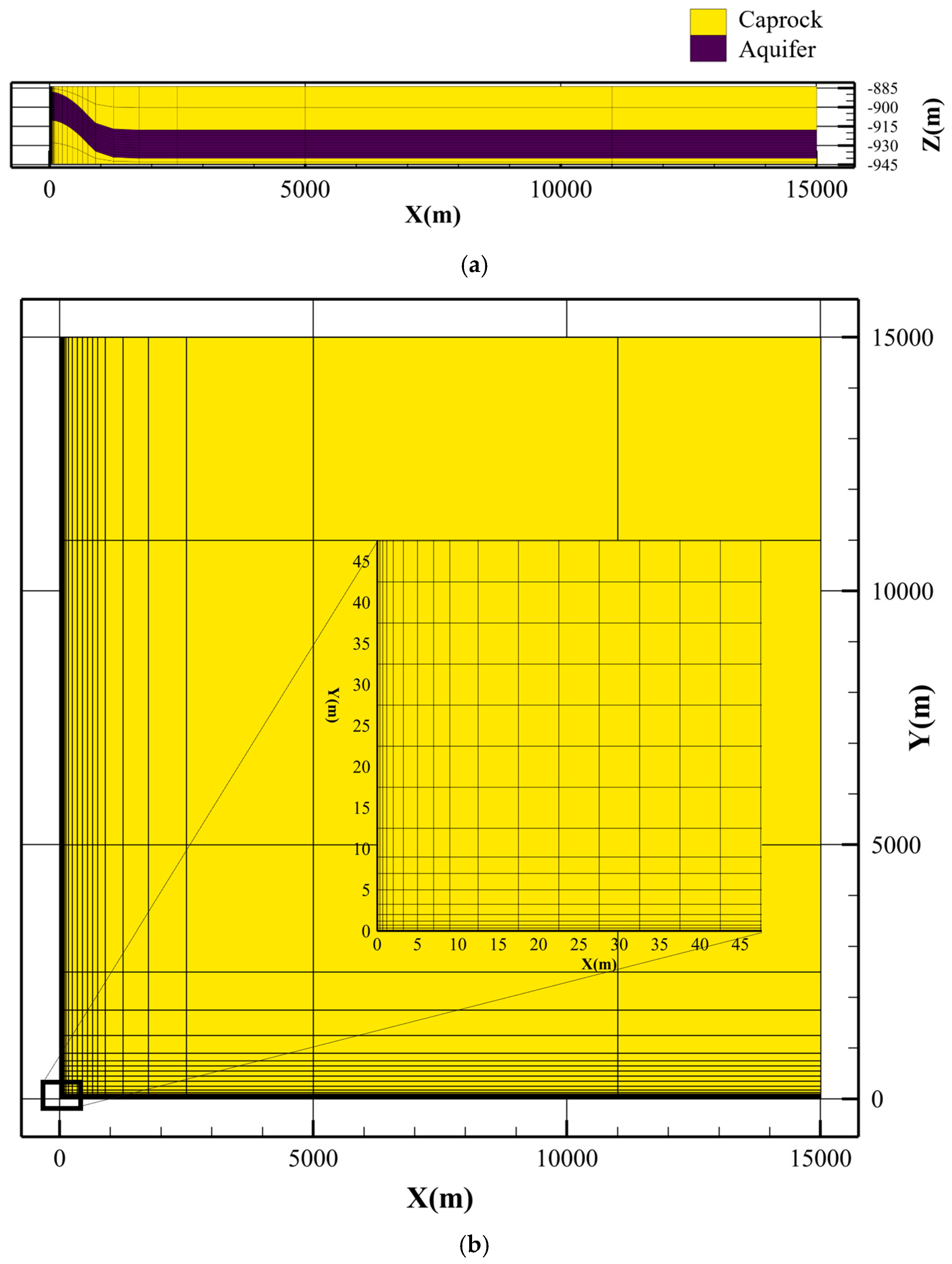
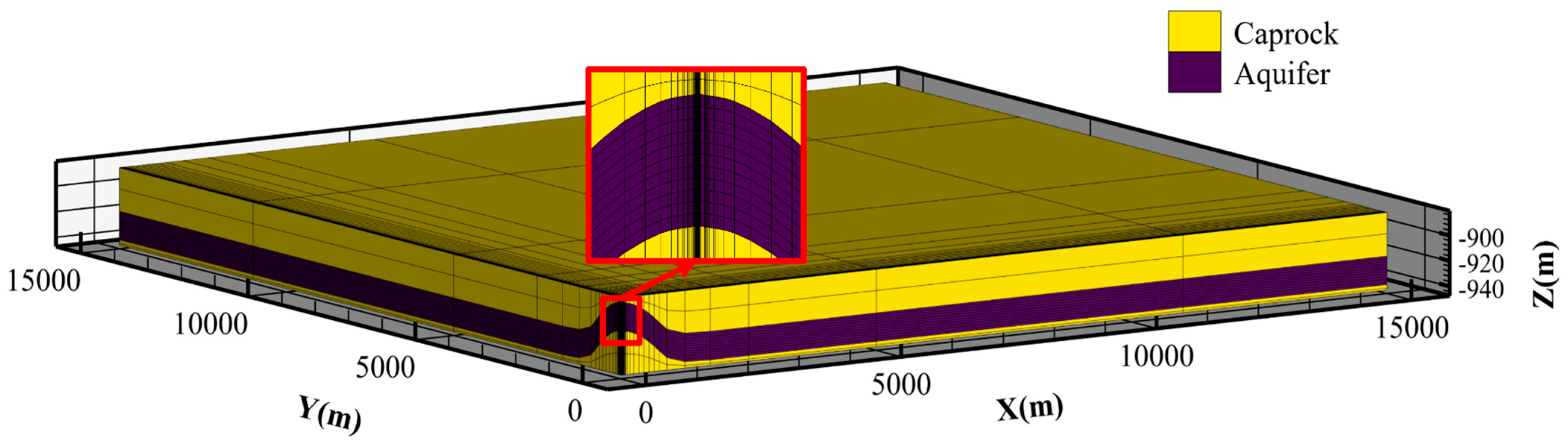
2.1. Model Setup
2.2. Numerical Modeling
2.3. Operation Scenarios
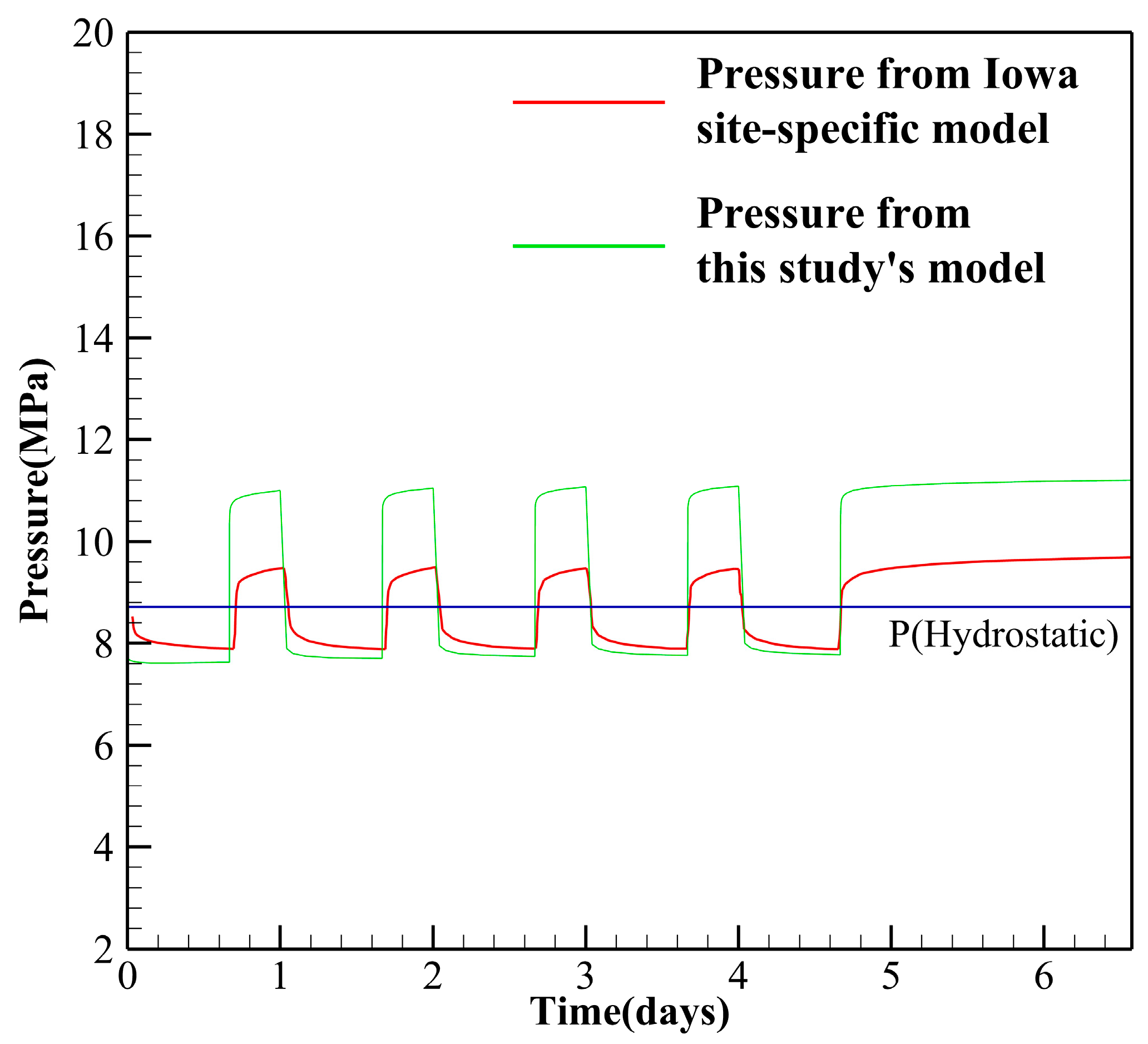
2.4. Feasibility Validation of Numerical Model
3. Results and Discussion
3.1. Basic Model Results
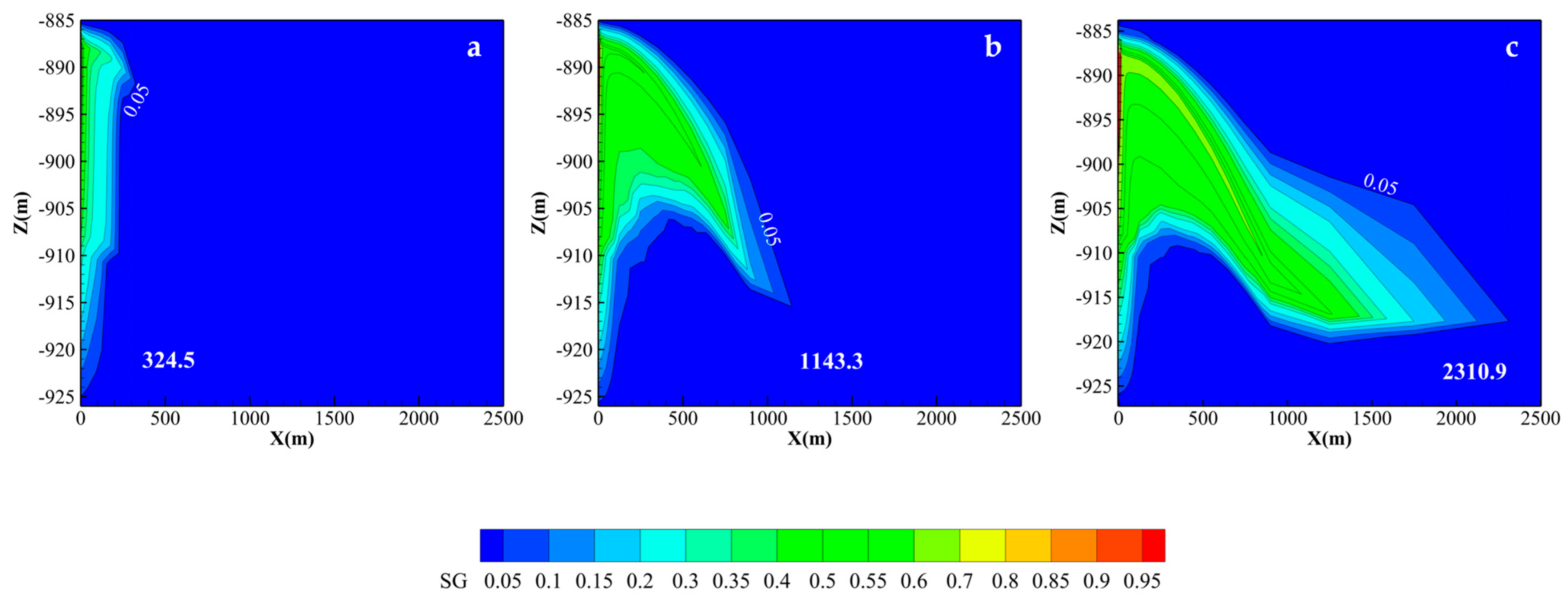
3.1.1. Gas Saturation and Pressure Variation
3.1.2. Influence of Well Penetration Length
3.2. Influence of Geological Conditions
4. Conclusions
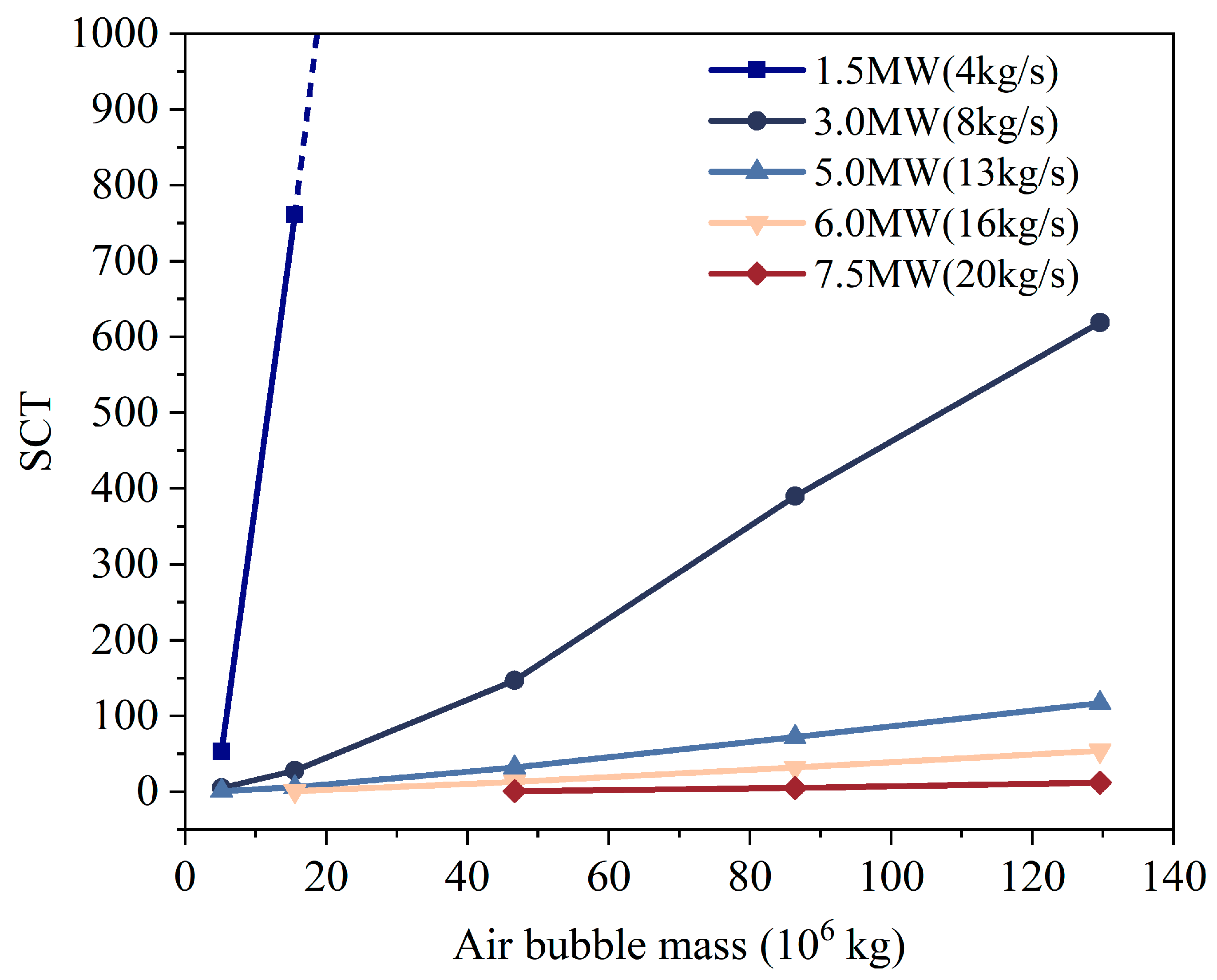
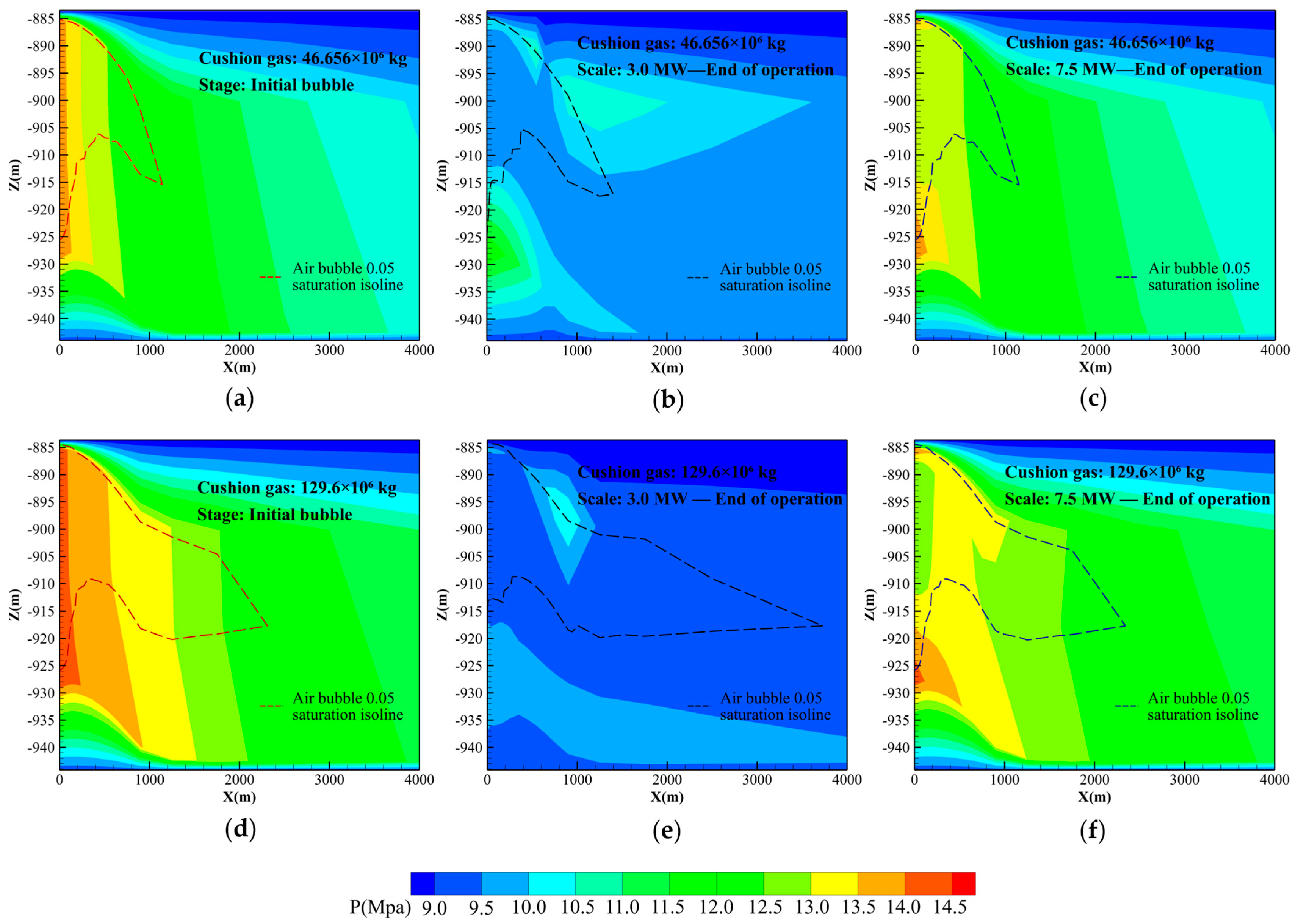
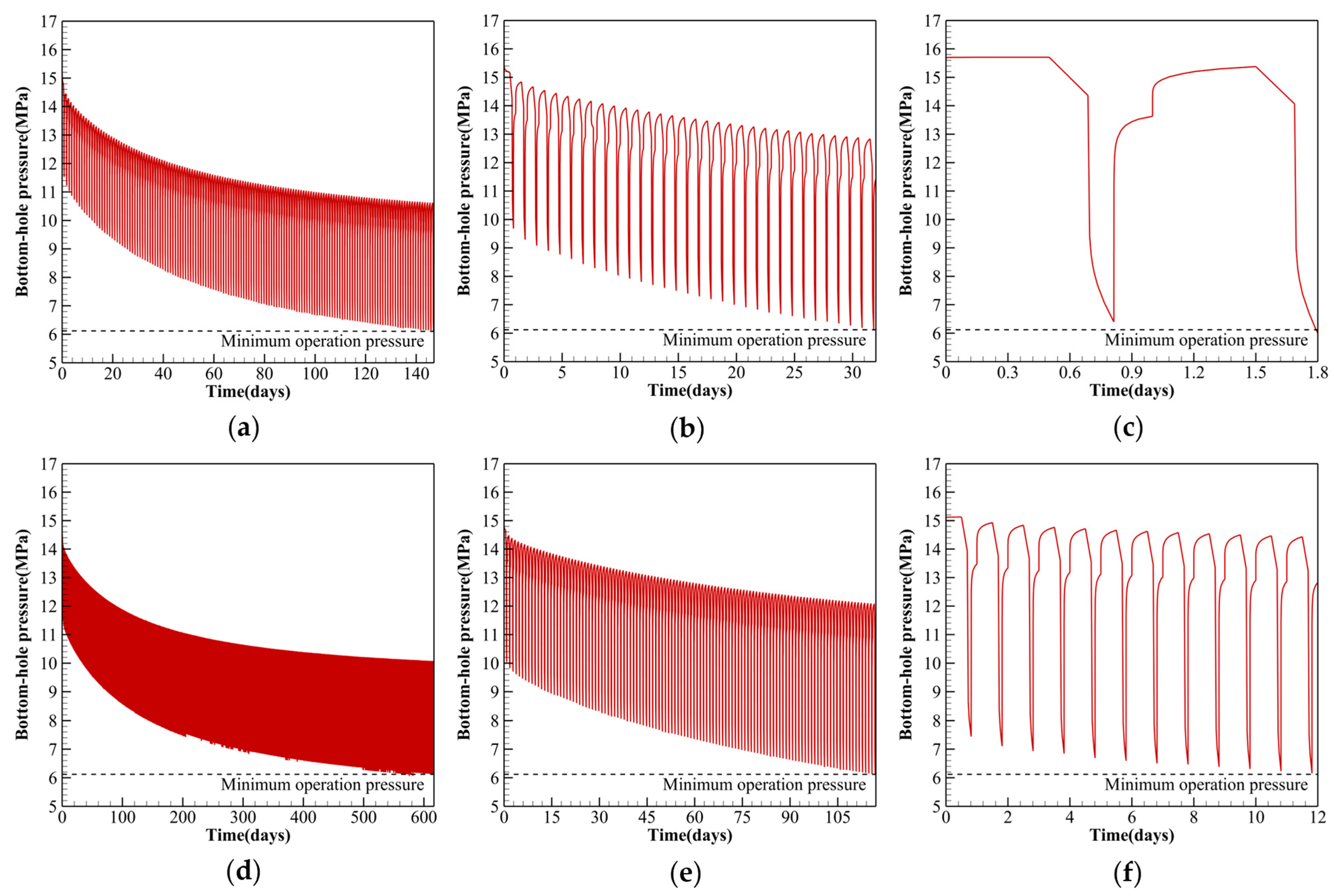
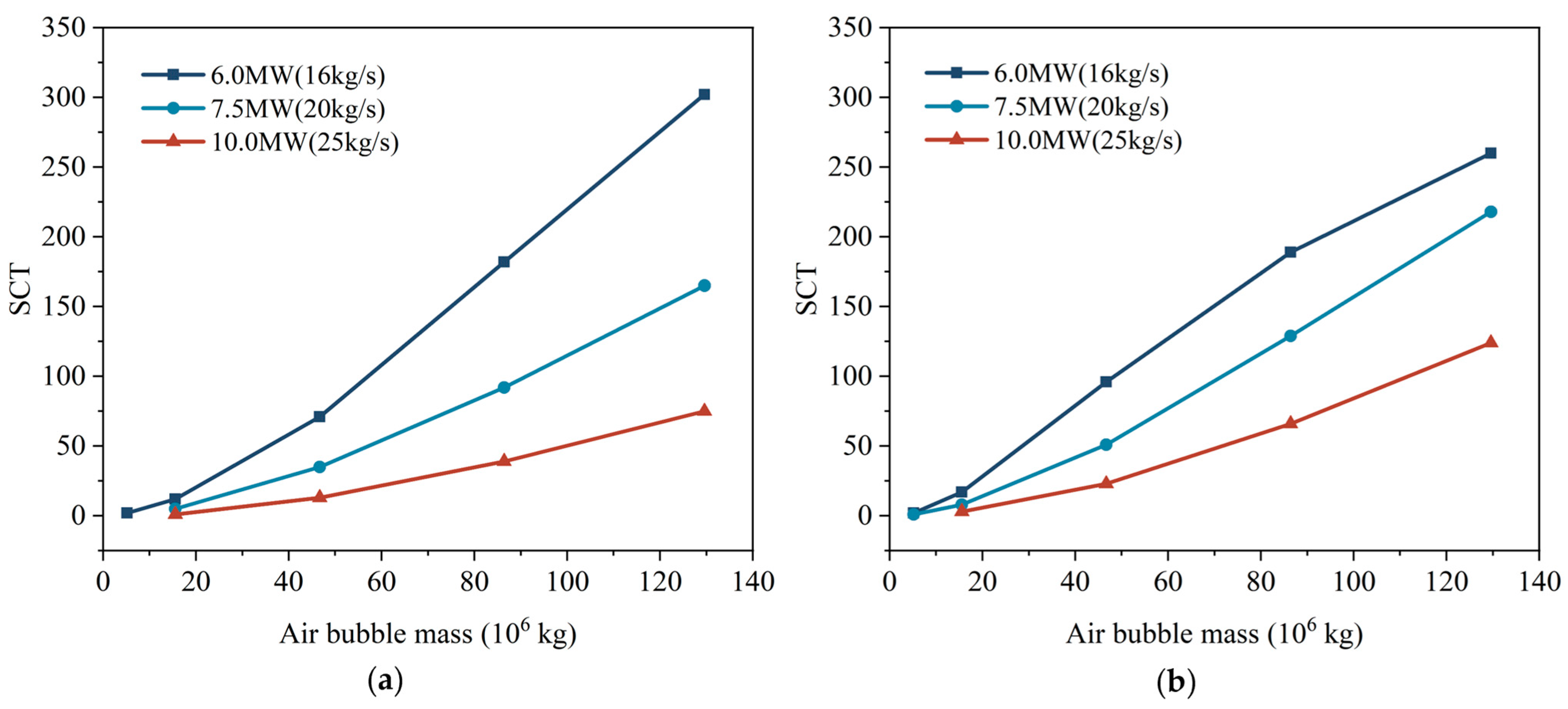
- Aquifer permeability, depth, and thickness impose a “physical upper limit” on energy storage scales. Simulation results indicate that the maximum achievable storage scale under given geological conditions is jointly constrained by aquifer permeability, depth, and thickness. Below this limit, increasing the bubble mass can approximately linearly enhance SCT. However, once this limit is exceeded, further increases in injected gas mass no longer yield additional performance gains.
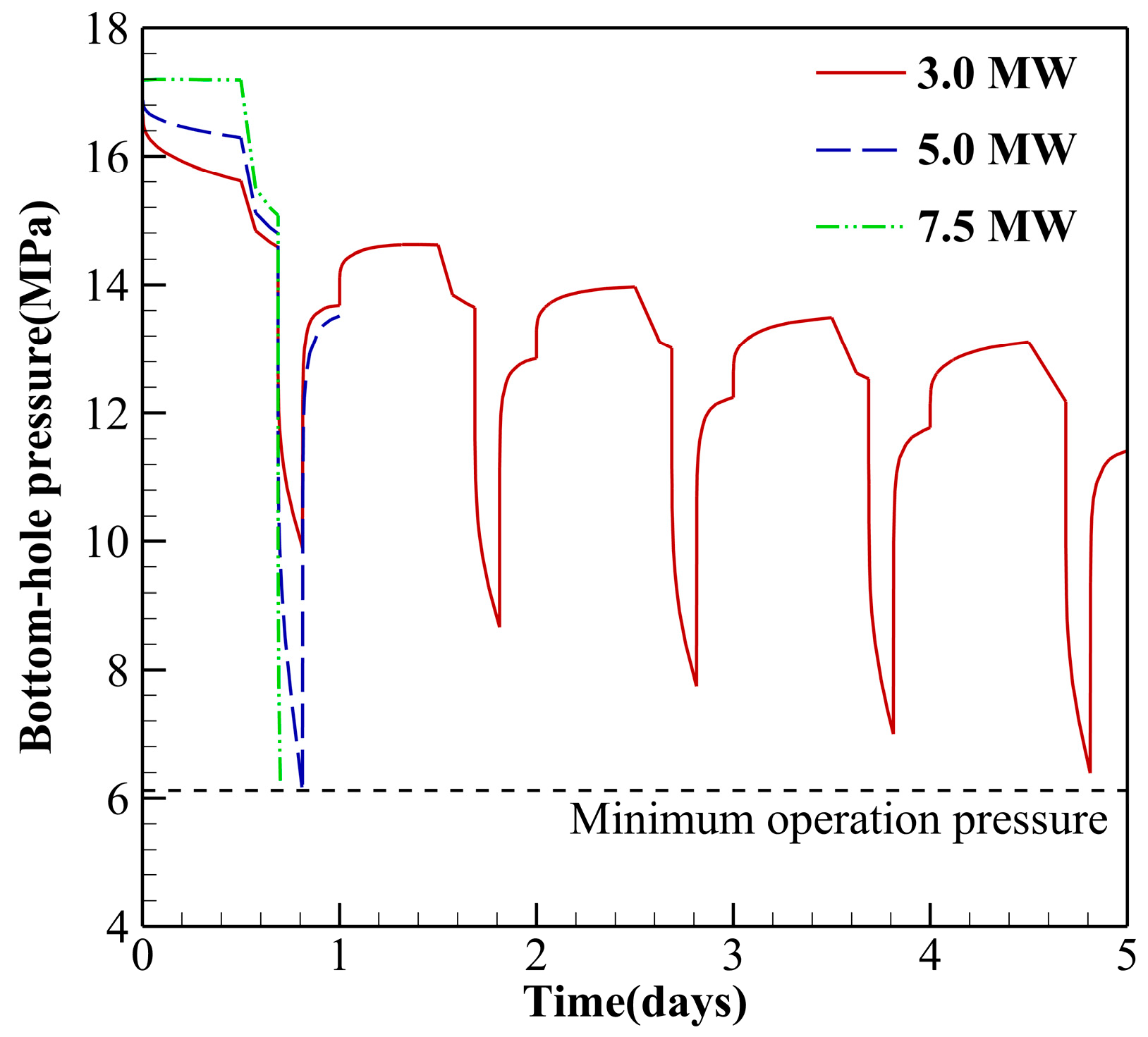
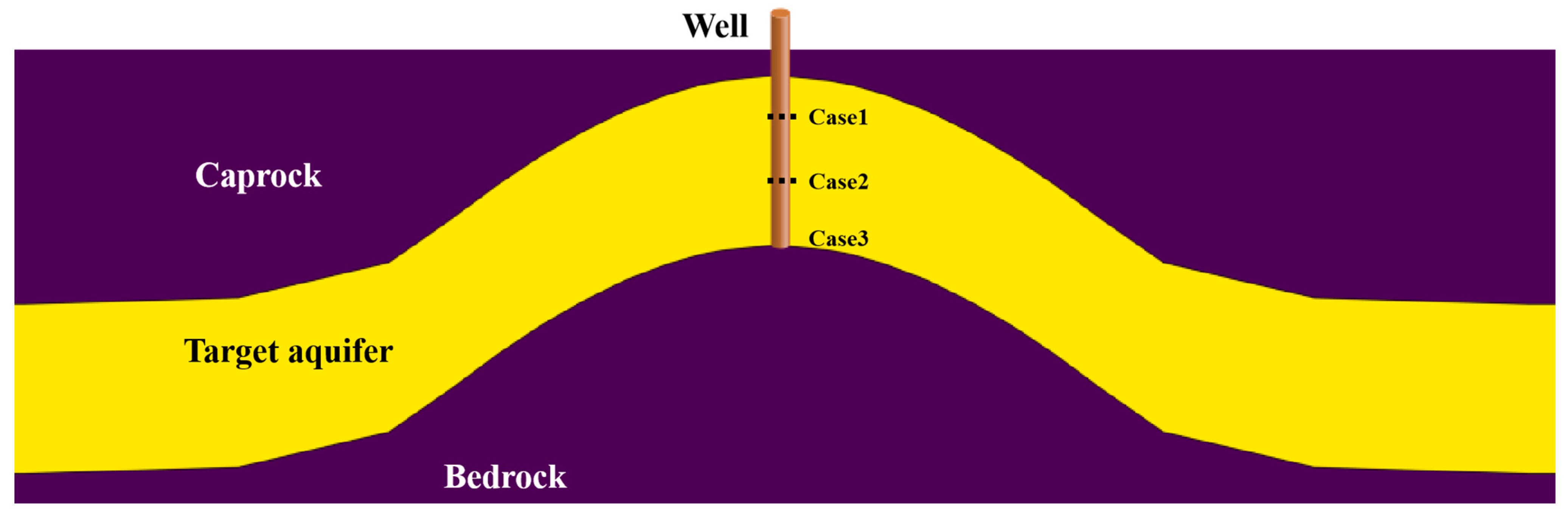
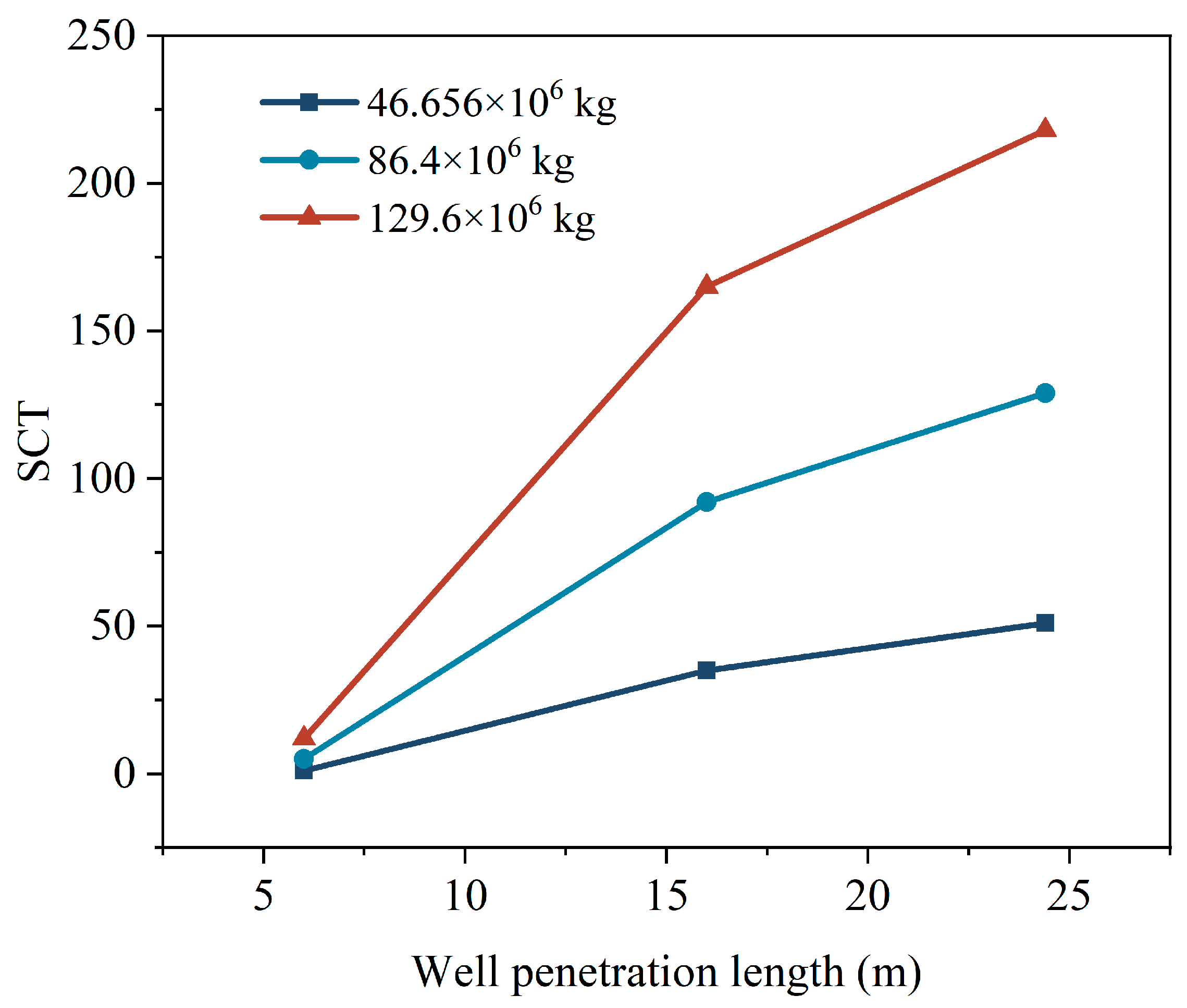
- A fully penetrating well increases the risk of water production, which can prematurely terminate the system cycle. Wellbore analysis demonstrates that extending the screen length to approximately 60% of the reservoir thickness can significantly enhance the SCT, with the effect being particularly pronounced in medium- to large-scale energy storage designs. Nevertheless, further extending the screen length (e.g., fully penetrating the aquifer) produces diminishing improvements in system performance while raising the risk of water production; hence, complete penetration is not recommended.
- In the basic model: For small-scale systems (1.5–3.0 MW), a cushion gas injection mass of 15.6 × 10⁶ kg is recommended, with an upper limit of 46.7 × 10⁶ kg. For medium-scale systems (8.0–16.0 MW), 86.4 × 10⁶ kg is suggested. For large-scale systems (20.0–25.0 MW), 129.6 × 10⁶ kg is the recommended value.
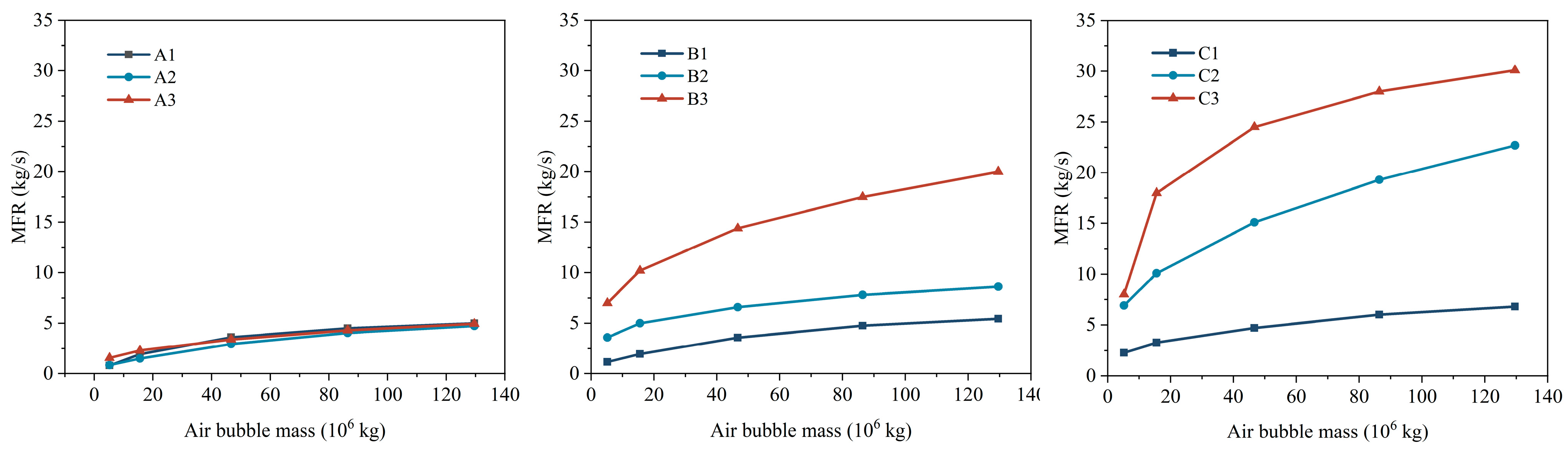
- Sensitivity analysis under varying geological conditions reveals that aquifer permeability and burial depth are the dominant factors affecting the maximum gas production rate. Under high-permeability and deeper burial conditions, increasing the cushion gas mass exerts a more significant impact on expanding the energy storage scale, thus justifying the use of larger injection masses (e.g., 129.6 × 10⁶ kg). Conversely, under low-permeability or shallow burial conditions, the injection mass should not exceed 86.4 × 10⁶ kg, in order to avoid ineffective injection and resource waste.
Author Contributions
Funding
Data Availability Statement
Conflicts of Interest
References
- Wang, Q.J.; Feng, G.F.; Wang, H.J.; Chang, C.P. The influence of political ideology on greenhouse gas emissions. Glob. Environ. Change 2022, 74, 102496. [Google Scholar] [CrossRef] [Scilit]
- Mohsin, M.; Kamran, H.W.; Nawaz, M.A.; Hussain, M.S.; Dahri, A.S. Assessing the impact of transition from nonrenewable to renewable energy consumption on economic growth-environmental nexus from developing Asian economies. J. Environ. Manag. 2021, 284, 111999. [Google Scholar] [CrossRef] [Scilit]
- Lin, T.-Y.; Chiu, Y.-H.; Chen, C.-H.; Ji, L. Renewable energy consumption efficiency, greenhouse gas emission efficiency, and climate change in Europe. Geoenergy Sci. Eng. 2025, 247, 213665. [Google Scholar] [CrossRef] [Scilit]
- Li, J.; She, Y.; Gao, Y.; Li, M.; Yang, G.; Shi, Y. Natural gas industry in China: Development situation and prospect. Nat. Gas Ind. B 2020, 7, 604–613. [Google Scholar] [CrossRef] [Scilit]
- Halkos, G.; Tsilika, K. Visual exploration of energy use in EU 28: Dynamics, patterns, policies. Energies 2021, 14, 7532. [Google Scholar] [CrossRef] [Scilit]
- Fengyun, W. Renewable Energy Development and Support Policies in Beijing. In IOP Conference Series: Earth and Environmental Science; IOP Publishing: Bristol, UK, 2019; Volume 233, p. 042001. [Google Scholar] [CrossRef] [Scilit]
- Golden, R.; Paulos, B. Curtailment of renewable energy in California and beyond. Electr. J. 2015, 28, 36–50. [Google Scholar] [CrossRef] [Scilit]
- Li, Y.; Liu, Y.; Cao, X. Compressed air energy storage in aquifers: Basic principles, considerable factors, and improvement approaches. Rev. Chem. Eng. 2021, 37, 561–584. [Google Scholar] [CrossRef] [Scilit]
- Allen, K. CAES: The underground portion. IEEE Trans. Power Appar. Syst. 1985, PAS-104, 809–812. [Google Scholar] [CrossRef] [Scilit]
- Allen, R.D.; Doherty, T.J.; Kannberg, L.D. Summary of Selected Compressed Air Energy Storage Studies; Pacific Northwest National Laboratory: Richland, WA, USA, 1985. [CrossRef] [Scilit]
- Oldenburg, C.M.; Pan, L. Porous media compressed-air energy storage (PM-CAES): Theory and simulation of the coupled wellbore–reservoir system. Transp. Porous Media 2013, 97, 201–221. [Google Scholar] [CrossRef] [Scilit]
- Oldenburg, C.M.; Pan, L. Utilization of CO2 as cushion gas for porous media compressed air energy storage. Greenh. Gases Sci. Technol. 2013, 3, 124–135. [Google Scholar] [CrossRef] [Scilit]
- Jarvis, A.-S. Feasibility Study of Porous Media Compressed Air Energy Storage in South Carolina, United States of America. Master’s Thesis, Clemson University, Clemson, SC, USA, 2015. [Google Scholar]
- Guo, C.; Zhang, K.; Li, C. Influence of permeability on the initial gas bubble evolution in compressed air energy storage in aquifers. In Proceedings of the TOUGH Symposium, Berkeley, CA, USA, 28–30 September 2015. [Google Scholar]
- Yang, L.; Cai, Z.; Li, C.; He, Q.; Ma, Y.; Guo, C. Numerical investigation of cycle performance in compressed air energy storage in aquifers. Appl. Energy 2020, 269, 115044. [Google Scholar] [CrossRef] [Scilit]
- Guo, C.; Zhang, K.; Li, C.; Wang, X. Modelling studies for influence factors of gas bubble in compressed air energy storage in aquifers. Energy 2016, 107, 48–59. [Google Scholar] [CrossRef] [Scilit]
- Electricity and Air Storage Enterprises LLC. Dallas Center Dome: Modeling Results and Planning Recommendations; Iowa Stored Energy Plant Agency: Traer, IA, USA, 2007.
- Berwig, D. Geologic Assessment of Compressed Air Storage Sites in Kansas. Final Report; Black and Veatch Consulting Engineers: Kansas City, MO, USA, 1978. [Google Scholar] [CrossRef] [Scilit]
- Li, Y.; Zhang, K.; Hu, L.; Wang, J. Numerical investigation of the influences of wellbore flow on compressed air energy storage in aquifers. Geofluids 2017, 2017, 9316506. [Google Scholar] [CrossRef] [Scilit]
- Yang, X.; Czapla, J.P.; Clennell, M.B.; Lu, C. Understanding the influence of aquifer properties on the performance of compressed air energy storage in aquifers: A numerical simulation study. J. Energy Storage 2024, 99, 113202. [Google Scholar] [CrossRef] [Scilit]
- Moridis, G.; King, M.; Jansen, J. Iowa Stored Energy Park Compressed-Air Energy Storage Project: Compressed-Air Energy Storage Candidate Site Selection Evaluation in Iowa: Dallas Center Feasibility Analysis. Prepared for the Iowa Stored Energy Plant Agency by the Hydrodynamics Group, LLC; Hydrodynamics Group, LLC: Edmonds, WA, USA, 2007; p. 46. [Google Scholar]
- Li, Y.; Liu, Y. Numerical study on the impacts of layered heterogeneity on the underground process in compressed air energy storage in aquifers. J. Energy Storage 2022, 46, 103837. [Google Scholar] [CrossRef] [Scilit]
- Heath, J.E.; Bauer, S.J.; Broome, S.T.; Dewers, T.A.; Rodriguez, M.A. Petrologic and Petrophysical Evaluation of the Dallas Center Structure, Iowa, for Compressed Air Energy Storage in the Mount Simon Sandstone; Sandia National Laboratories: Albuquerque, NM, USA, 2013. [CrossRef] [Scilit]
- DiPietro, J.A. Keys to the interpretation of geological history. In Landscape Evolution in the United States; Elsevier: Amsterdam, The Netherlands, 2013; pp. 327–344. [Google Scholar]
- Stottlemyre, J.A. Preliminary Stability Criteria for Compressed Air Energy Storage in Porous Media Reservoirs; Battelle Pacific Northwest Laboratories: Richland, WA, USA, 1978. [CrossRef] [Scilit]
- Guan, Y.; Wang, X.; Zhu, Y.; Li, W.; Zhang, Y.; Chen, H. Optimal design and research for nozzle governing turbine of compressed air energy storage system. J. Energy Storage 2024, 77, 109683. [Google Scholar] [CrossRef] [Scilit]
- Yu, X.; Zhang, Z.; Qian, G.; Jiang, R.; Wang, L.; Huang, R.; Li, Z. Evaluation of PCM thermophysical properties on a compressed air energy storage system integrated with packed-bed latent thermal energy storage. J. Energy Storage 2024, 81, 110519. [Google Scholar] [CrossRef] [Scilit]
- Bai, F.; Jia, C.; Hu, J.; Alsousy, A.; Lu, Y.; Sepehrnoori, K. Storage capacity comparison of hydrogen and carbon dioxide in heterogeneous aquifers. Gas Sci. Eng. 2024, 121, 205182. [Google Scholar] [CrossRef] [Scilit]
- Jung, Y.; Pau, G.S.H.; Finsterle, S.; Pollyea, R.M. TOUGH3: A new efficient version of the TOUGH suite of multiphase flow and transport simulators. Comput. Geosci. 2017, 108, 2–7. [Google Scholar] [CrossRef] [Scilit]
- Guo, C.; Zhang, K.; Pan, L.; Cai, Z.; Li, C.; Li, Y. Numerical investigation of a joint approach to thermal energy storage and compressed air energy storage in aquifers. Appl. Energy 2017, 203, 948–958. [Google Scholar] [CrossRef] [Scilit]
- Rahmati, H.; Jafarpour, M.; Azadbakht, S.; Nouri, A.; Vaziri, H.; Chan, D.; Xiao, Y. Review of sand production prediction models. J. Pet. Eng. 2013, 2013, 864981. [Google Scholar] [CrossRef] [Scilit]
- The Hydrodynamics Group. Iowa Stored Energy Plant Agency Compressed Air Energy Storage Project: Final Project Report-Dallas Center Mt. Simon Structure CAES System Performance Analysis; The Hydrodynamics Group: Des Moines, IA, USA, 2011. [Google Scholar]



| Formation | Contact Depth (m) | Porosity | Permeability (m2) Horizontal | Vertical | Description |
|---|---|---|---|---|---|
| Eau Claire | - | 0.02 | 1.00 × 10⁻¹⁹ | 1.00 × 10⁻¹⁹ | Caprock, dolomite |
| Mt. Simon | 886.7 | 0.18 | 3.20 × 10⁻¹³ | 1.16 × 10⁻¹³ | Reservoir |
| Pre-Cambrian | 911.1 | 0.02 | 1.00 × 10⁻¹⁹ | 1.00 × 10⁻¹⁹ | Bedrock, very low permeability |
| Basic Model Parameters | |
|---|---|
| Grain density | 2320 kg/m3 |
| Heat conductivity | 2.50 W/(m K) |
| Rock grain special heat | 800 J/kg°C |
| Permeability (horizontal) | 3.20 × 10⁻¹³ m2 |
| Permeability (vertical) | 1.16 × 10⁻¹³ m2 |
| Porosity | 0.18 |
| Penetrating well screens | 6 m penetration |
| Relative permeability function | van Genuchten-Mualem |
| Aqueous phase residual saturation | 0.1 |
| Gas phase residual saturation | 0.05 |
| Capillary pressure function | van Genuchten-Mualem |
| Maximum capillary pressure | 1.0 × 10⁵ Pa |
| Group | Permeability (D) | Depth (m) | Thickness (m) |
|---|---|---|---|
| A1 | 0.1 | 400 | 20 |
| A2 | 0.1 | 800 | 50 |
| A3 | 0.1 | 1200 | 70 |
| B1 | 0.5 | 400 | 50 |
| B2 | 0.5 | 800 | 70 |
| B3 | 0.5 | 1200 | 20 |
| C1 | 1.0 | 400 | 70 |
| C2 | 1.0 | 800 | 20 |
| C3 | 1.0 | 1200 | 50 |
| Energy Storage Scale (MW) | |||||
|---|---|---|---|---|---|
| 1.5 (4 kg/s) | 3.0 (8 kg/s) | 5.0 (13 kg/s) | 6.0 (16 kg/s) | 7.5 (20 kg/s) | 10.0 (25 kg/s) |
| Air Bubble Mass (106 kg) | ||||
|---|---|---|---|---|
| 5.184 | 15.552 | 46.656 | 86.4 | 129.6 |
| Physical Process | Governing Equation |
|---|---|
| Conservation of mass | |
| Conservation of mass | |
| Mass accumulation | |
| Heat accumulation | |
| Mass flux | |
| Heat flux |
| 3-h Continuous Air Pumping Rate (kg/s) | Energy Storage Scale (MW) | Suggested Range of Bubble Ma Ss (106 kg) | Explanation |
|---|---|---|---|
| 4.0 | 1.5 | 15.6~46.7 | An SCT of over 760 cycles can be achieved. |
| 8.0 | 3.0 | 46.7~86.4 | The SCT can reach approximately 150~400 cycles. |
| 13.0 | 5.0 | ~86.4 | It is recommended to increase the well penetration length to 16 m, which can support an SCT of over 180 cycles. |
| 16.0 | 6.0 | ~86.4 | It is recommended to increase the well penetration length to 16 m, which can support an SCT of over 180 cycles. |
| 20.0 | 7.5 | 86.4~129.6 | It is recommended to increase the well penetration length to 16 m, which can support an SCT of over 100 cycles. |
| 25.0 | 10.0 | ~129.6 | It is recommended to increase the well penetration length to 16 m, which can support an SCT of 75 cycles. |
| Permeability (mD) | Average MFRM Increase per 400 m Depth (kg/S) |
|---|---|
| 100 | 0.066 |
| 500 | 5.222 |
| 1000 | 8.557 |
| Factor | Level 1 | Level 2 | Level 3 | Range |
|---|---|---|---|---|
| Permeability (k) | 3.036 | 7.84 | 13.715 | 10.679 |
| Depth of aquifer (zd) | 3.716 | 7.991 | 12.883 | 9.167 |
| Aquifer thickness (h) | 10.602 | 9.301 | 4.688 | 5.914 |
| Explanation of Applicable Geological Conditions | Suggested Range of Bubble Mass (106 kg) | Explanation |
|---|---|---|
| low permeability (<0.1 D) | 46.7~86.4 | The changes in depth and thickness have little effect on MFRM |
| Medium-high permeability (~0.5 D) and medium depth (400 m~800 m); High permeability (>1.0 D) and shallow depth (<400 m) | 46.7~86.4 | Continuing to increase the air bubble has little effect on improving energy storage scale |
| Medium-high permeability (~0.5 D) and high depth (>1200 m); High permeability (>1.0 D) and medium-high depth (>800 m) | 86.4~129.6 | Continuing to increase the air bubble can still have a considerable impact on improving the MFRM |
Disclaimer/Publisher’s Note: The statements, opinions and data contained in all publications are solely those of the individual author(s) and contributor(s) and not of MDPI and/or the editor(s). MDPI and/or the editor(s) disclaim responsibility for any injury to people or property resulting from any ideas, methods, instructions or products referred to in the content. |
© 2025 by the authors. Licensee MDPI, Basel, Switzerland. This article is an open access article distributed under the terms and conditions of the Creative Commons Attribution (CC BY) license (https://creativecommons.org/licenses/by/4.0/).
Share and Cite
Li, Z.; Guo, C.; He, Q. Influence of Initial Bubble Mass on the Energy Storage Scale and the System Cycle Time in Compressed Air Energy Storage in Aquifers. Energies 2025, 18, 6445. https://doi.org/10.3390/en18246445
Li Z, Guo C, He Q. Influence of Initial Bubble Mass on the Energy Storage Scale and the System Cycle Time in Compressed Air Energy Storage in Aquifers. Energies. 2025; 18(24):6445. https://doi.org/10.3390/en18246445
Chicago/Turabian StyleLi, Zongyi, Chaobin Guo, and Qingcheng He. 2025. "Influence of Initial Bubble Mass on the Energy Storage Scale and the System Cycle Time in Compressed Air Energy Storage in Aquifers" Energies 18, no. 24: 6445. https://doi.org/10.3390/en18246445
APA StyleLi, Z., Guo, C., & He, Q. (2025). Influence of Initial Bubble Mass on the Energy Storage Scale and the System Cycle Time in Compressed Air Energy Storage in Aquifers. Energies, 18(24), 6445. https://doi.org/10.3390/en18246445