1. Introduction
The International Maritime Organization’s MEPC 80 session endorsed the 2023 GHG Reduction Strategy, introducing more stringent emission control objectives for global shipping [
1]. Hybrid vessels equipped with battery storage systems and optimized power management systems will help offset peak loads, improve engine response performance, reduce emissions and fuel consumption, and lower maintenance costs [
2]. These vessels are increasingly being applied in the fields of offshore engineering ships, ro-ro ships, cruise ships, and shuttle tankers [
3].
To respond to the increasingly stringent environmental protection requirements and mandatory emission reduction regulations globally, shipping companies in various countries are continuously promoting and expanding the application of green ship technologies in actual vessels [
4]. Fuel cell vessels offer advantages such as low emissions and high efficiency, but their dynamic response is relatively slow, making it difficult to provide continuous and stable power. Therefore, an energy storage system is needed to address this issue. Lithium batteries have high energy density but lower power density and slow charge–discharge rates, capable of providing low-frequency power and stable power supply for extended periods [
5]. In contrast, supercapacitors exhibit high power density and rapid charge–discharge capabilities, enabling them to deliver high-frequency power and short-term high-power compensation, despite their relatively low energy density [
6]. To address the unstable and intermittent power output of fuel cell-powered vessels, a hybrid energy storage system (HESS) integrating lithium batteries and supercapacitors is implemented [
7]. An optimal HESS configuration requires intelligent power allocation, where supercapacitors manage high-frequency transients and lithium batteries supply low-frequency steady-state power, achieving cost-effective, reliable, and sustainable operation.
Recent years have witnessed significant academic efforts worldwide addressing key challenges in hybrid energy storage systems, particularly regarding power allocation and capacity configuration, with notable progress being made in these research areas. Zhou et al. presents an Improved Low-Pass Filter (ILPF) to address the limitations of traditional Low-Pass Filters (LPFs), including phase-shift effects and charging state restrictions [
8]. However, low-pass filtering can attenuate or completely eliminate high-frequency components, which may lead to a loss of high-frequency details in the signal. To effectively address the issue of high-frequency resolution loss caused by low-pass filtering, Abdulmawjood et al. proposes a new method that combines Wavelet Packet Transform (WPT) with Empirical Mode Decomposition (EMD) [
9]. However, the performance of this method is highly dependent on the choice of wavelet basis and lacks universal selection criteria. The optimization Particle Swarm Optimization (PSO) algorithm proposed by Pan et al. [
10] and He et al. [
11], the profit distribution mechanism based on the improved Shapley value suggested by Zhang et al. [
12], and the EMD utilized by Li et al. all share a common disadvantage [
13]: they rely on experience for parameter tuning. Additionally, there is the unavoidable issue of modal aliasing present during EMD. Regarding the issues with EMD, Liu et al. proposes Variational Mode Decomposition (VMD) as an adaptive signal processing method that can effectively overcome the modal aliasing deficiencies of EMD [
14]. However, its decomposition performance still highly depends on parameter selection. To address the issue that decomposition performance is still highly dependent on parameter selection, Jin et al. proposed optimizing VMD using MVO [
15]. By utilizing MVO to optimize the decomposition parameters of VMD, a universal selection criterion can be achieved; however, this approach only performed one decomposition of the signal, resulting in insufficient accuracy. Kirubadevi et al. proposed an optimal photovoltaic (PV) and battery energy storage system with a hybrid approach design for electric vehicle charging stations (EVCS) [
16]. However, this system cannot operate in isolation. Based on the issues with traditional Low-Pass Filters (LPFs) in existing research, such as phase-shift effects and limitations related to charging states, as well as its inability to effectively handle high-frequency signals, and given that WPT and EMD are highly dependent on the selection of empirical parameters, this paper proposes a power distribution strategy for fuel cell ships with hybrid energy storage systems based on the MVO-CVMD algorithm. The MVO algorithm is used to adaptively optimize VMD parameters through two decompositions, leading to more accurate decomposition results. Subsequently, the powers obtained from decomposition are cross-allocated into high- and low-frequency components before being allocated to a HESS composed of supercapacitors and lithium batteries in order to provide more stable power to meet the power demands of load systems with a more precise power decomposition and lower capacity configuration costs.
The main research content of this article is as follows:
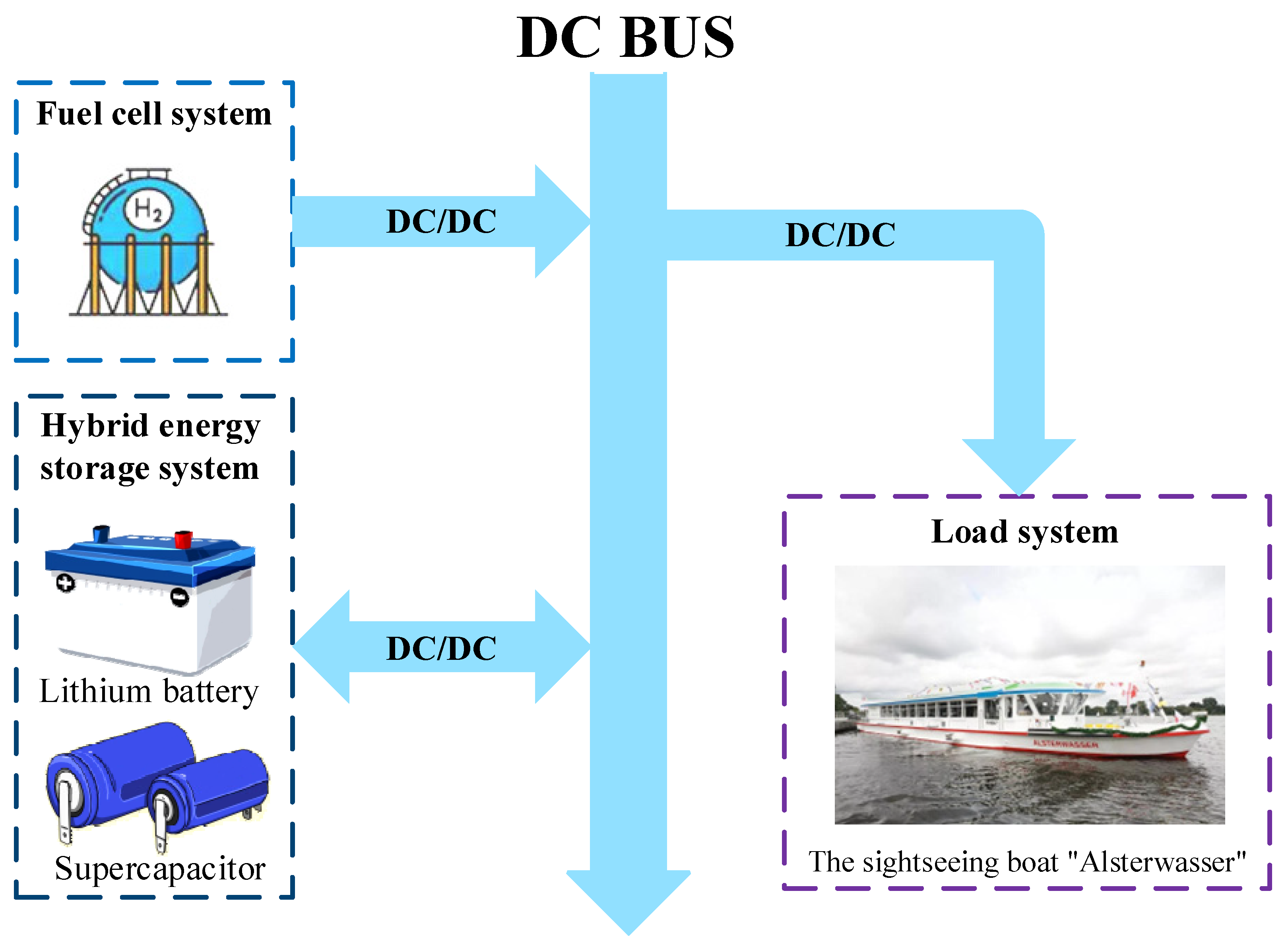
The schematic diagram of the fuel cell ship HESS has been established.
The proposed MVO-CVMD methodology enables effective power decomposition in hybrid energy storage systems.
An optimal HESS configuration strategy is formulated, incorporating full lifecycle cost analysis.
3. Power Allocation Strategy of HESS Based on MVO-CVMD Algorithm
Empirical Mode Decomposition (EMD) is an adaptive signal processing method, suitable for analyzing nonlinear and non-stationary signals [
19]. However, EMD is prone to issues such as the emergence of spurious components and modal aliasing. Variational Mode Decomposition (VMD), proposed by Dragomiretskiy and Zosso [
20], transforms the signal decomposition process into a mathematically constrained optimization problem through a variational optimization framework, overcoming the drawbacks of EMD.
3.1. VMD Principle
The VMD algorithm initially breaks down the target signal x into K intrinsic mode functions (IMFs) through modal decomposition. The corresponding constrained variational formulation can be expressed as:
where
represents the various components of the IMF;
represents the center frequency; and
represents the impulse function [
21].
The Lagrange multiplier
and the penalty factor
are used to solve for the optimal variational solution:
By iteratively solving the above equation using the Alternating Direction Method of Multipliers, we can obtain the following:
The stopping result for iterative solving can be expressed as the following:
3.2. Use of Multi-Verse Optimizer Algorithm
MVO (Multi-Verse Optimizer) is a parameter optimization algorithm proposed by Mirjalili et al. in 2016 [
22]. This method utilizes relevant rules of cosmology, where objects in each universe have different expansion rates, corresponding to the varying expansion rates of each universe. If the parameters of the VMD algorithm can be optimized and improved using MVO, this will be extremely beneficial for optimizing IMF components [
14].
The MVO algorithm theory gradually approaches the optimal position in the search space by leveraging relevant cosmological rules. It has the advantage of being less affected by data distribution structures. The specific implementation process is as follows:
Due to the differing expansion rates of individuals, objects in the universe can be transferred through white holes and black holes.
where
is the
i-th universe and its normalized expansion rate and
is a random number taken from [0, 1].
Without considering the size of the expansion rate, each universe establishes a wormhole with the currently optimal universe to exchange local objects.
where
represents the
-th dimension parameter of the
-th universe and
and
are the upper and lower limits of that dimension parameter, respectively. Additionally,
, and
are random numbers taken from within [0, 1]. In the MVO algorithm,
and
are key parameters representing wormhole existence rate and travel distance rate, respectively. During optimization iterations, with changes in
and
values, a more precise global or local search can be achieved in optimal universes.
where
represents the current number of iterations;
is the maximum number of iterations;
is the minimum value of
which indicates the minimum probability of wormhole existence;
refers to the maximum value of
indicating the maximum probability of wormhole existence; and
stands for
’s limiting parameter representing development precision in the algorithm.
3.3. MVO Optimization VMD Parameters
The performance of VMD is significantly influenced by two key parameters: the mode number and the penalty factor α. Early VMD studies determined values through empirical observation of center frequency distributions across IMF components, though this approach suffered from subjectivity and neglected optimization. Subsequent research demonstrated that employing optimization algorithms for parameter selection substantially enhances decomposition quality by simultaneously optimizing both and values.
This study employs the MVO fitness function to optimize VMD parameters
. The fuzzy entropy value reflects the feature information abundance contained in the source signal. A larger sample fuzzy entropy value indicates that the original signal is more random and contains more useless information; conversely, a smaller value suggests that the signal is more regular and contains less useless information. The MVO optimization VMD parameter settings are shown in
Table 1.
3.4. HESS Power Allocation Approach
The MVO-VMD method decomposes hybrid energy storage system power into
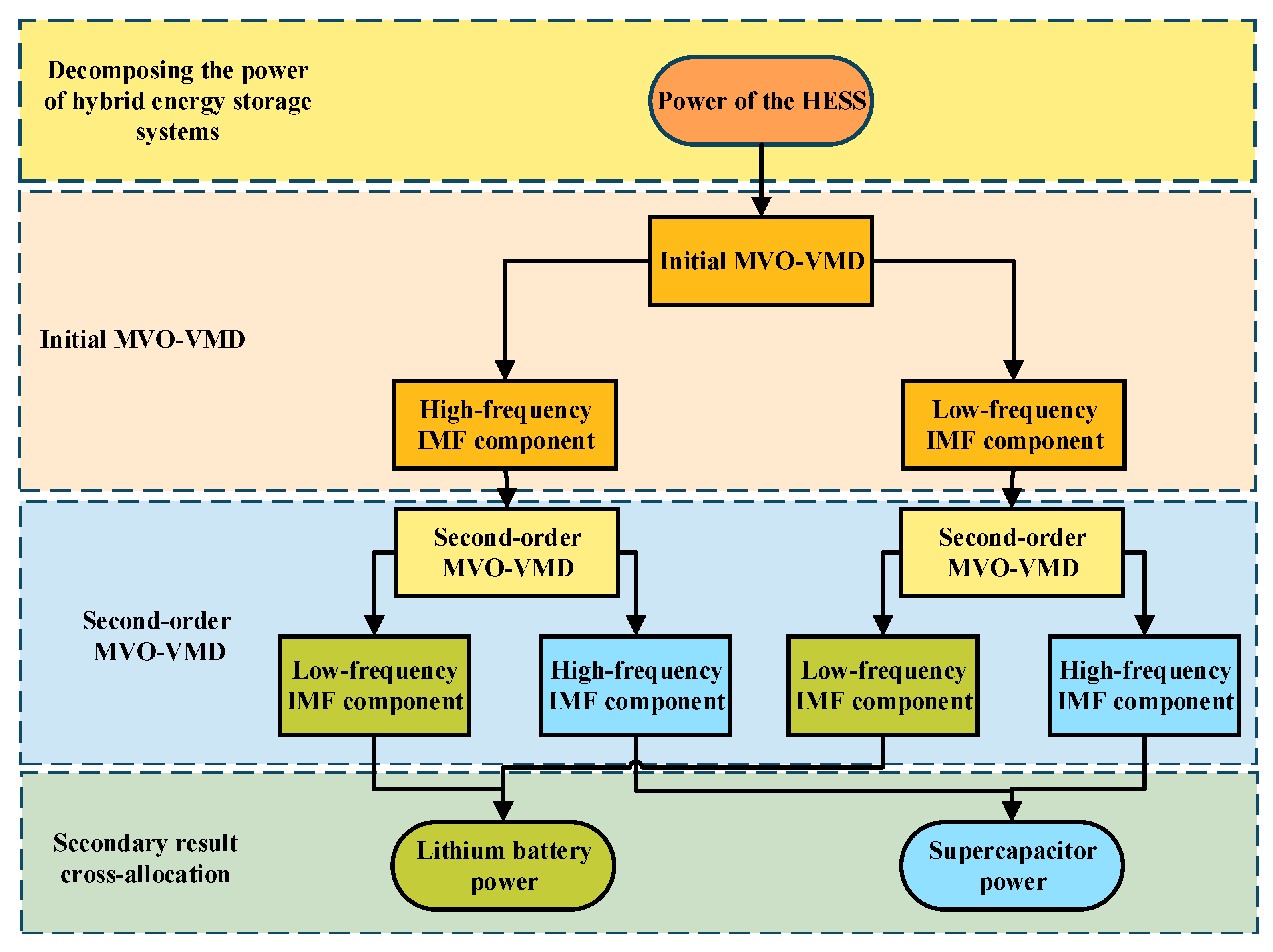
frequency-ordered intrinsic mode functions (IMFs), where components are sequentially arranged from low to high frequencies. The high- and low-frequency boundary is determined based on the degree of modal aliasing to obtain high- and low-frequency components. This paper further performs a secondary decomposition of the frequency components obtained from the first decomposition to obtain individual modal components. Based on the spectral characteristics of components and energy storage devices after secondary decomposition, cross-distribution is performed. The battery storage system is designated for low-frequency power components, whereas supercapacitors handle high-frequency power distribution.
where
denotes the cutoff frequency between high and low components in the initial VMD stage, and
indicates the quantity of intrinsic mode functions produced during this primary decomposition phase.
where
and
represent the modal components after secondary decomposition;
and
indicate the low- and high-frequency components obtained from the high frequency of secondary decomposition; and
and
refer to the low- and high-frequency components derived from the low-frequency component of secondary decomposition. The flow of the power allocation strategy is shown in
Figure 2.
To enhance power distribution precision, the modal components obtained from secondary MVO-VMD undergo cross-allocation. Given their distinct characteristics, lithium batteries—functioning as energy storage devices with limited power density—are assigned low-frequency power components. Conversely, supercapacitors—serving as power-oriented devices with constrained energy density—receive high-frequency power components.
4. HESS Capacity Design
The HESS is typically composed of power devices such as supercapacitors and energy devices like lithium batteries [
16]. Inadequate capacity may result in power supply disruptions, whereas excessive capacity could introduce unnecessary redundancy expenses.
Considering economic and technical factors including system costs and conversion losses, the annual operational cost objective function for the HESS is formulated using the following equations:
where
represents the total annual operating cost of the HESS;
indicates the annual capital expenditure for battery systems;
refers to the annual maintenance cost for batteries;
signifies the annual comprehensive cost of supercapacitors;
denotes the annual maintenance cost for supercapacitors;
f represents the discount rate;
,
, and
refer to the unit power cost, unit capacity cost, and operating maintenance costs of batteries, respectively; and
,
, and
respectively correspond to the unit power cost, unit capacity cost, and operation and maintenance costs of supercapacitors [
23].
where
is 5%, and
represent the service life of the equipment, which is taken to be 20 years [
23].
5. Case Analysis
This article takes the typical voyage of the “Alsterwasser” cruise ship as an example, with historical data on its sailing load referenced from reference [
24]. It uses Equations (2) and (3) to calculate the power of its HESS, then decomposes the power of the HESS. The optimized VMD parameters
obtained from the first-time MVO-VMD and secondary MVO-VMD are shown in
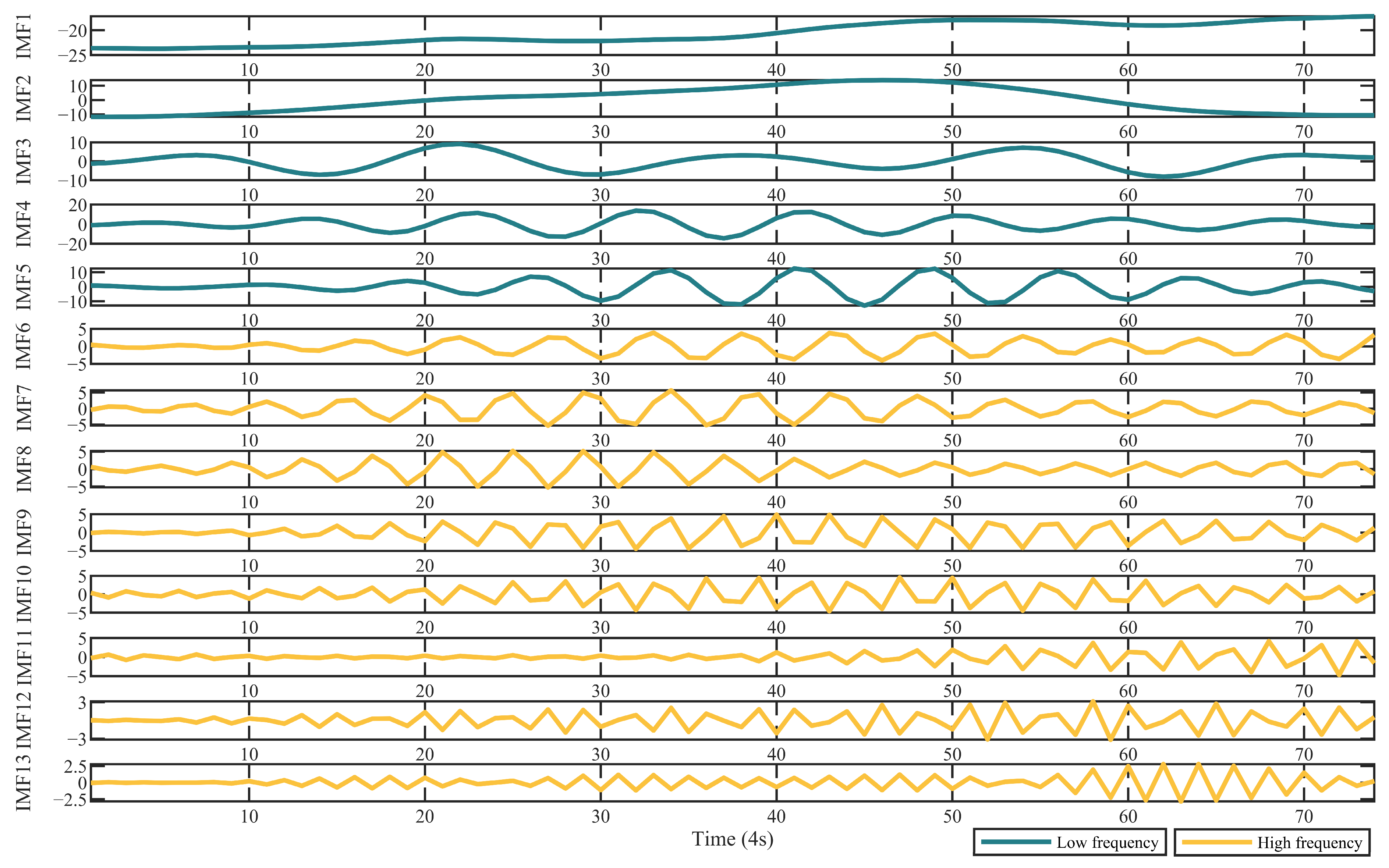
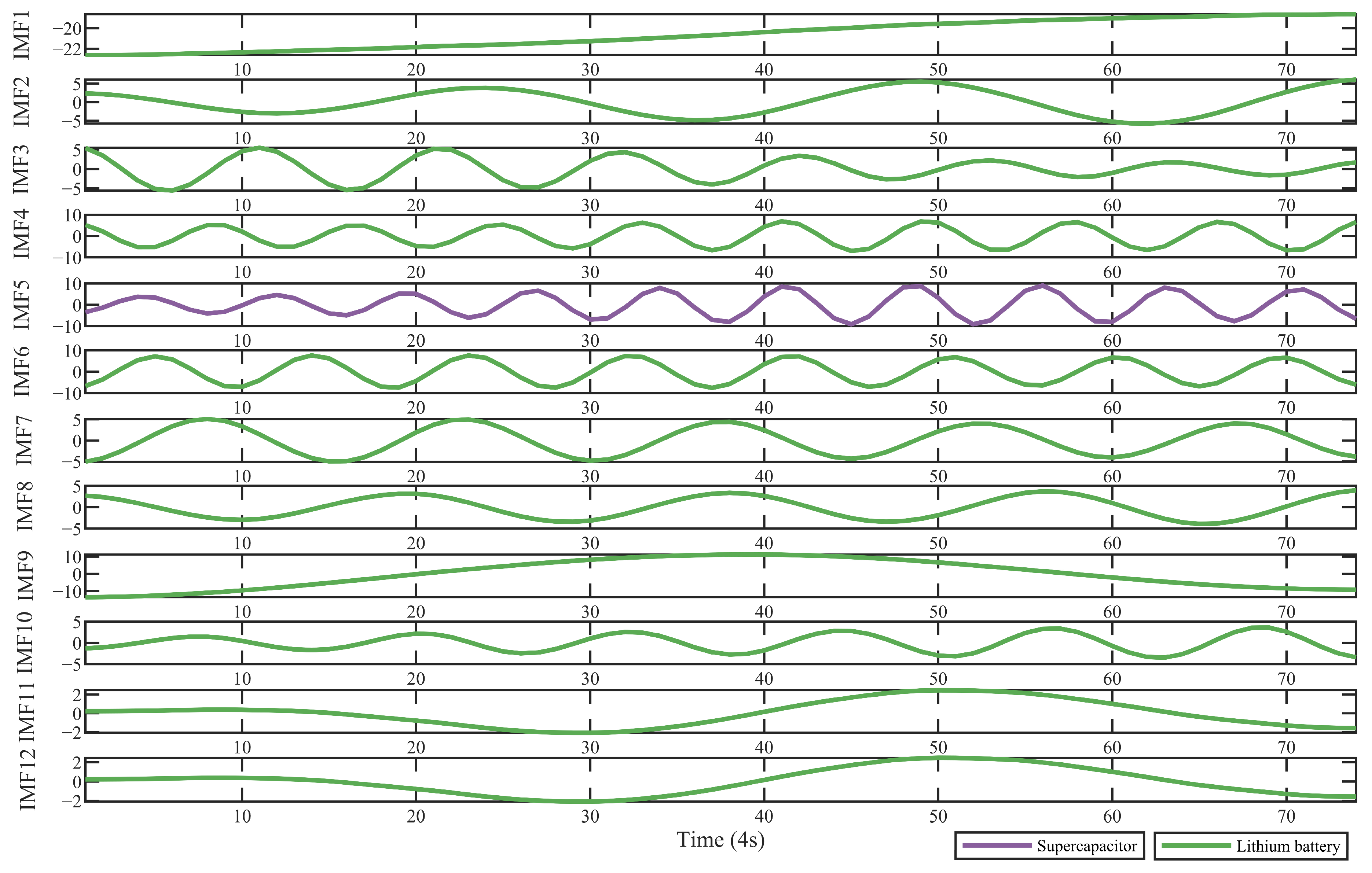
Table 2. The 13 components obtained from the preliminary decomposition are shown in
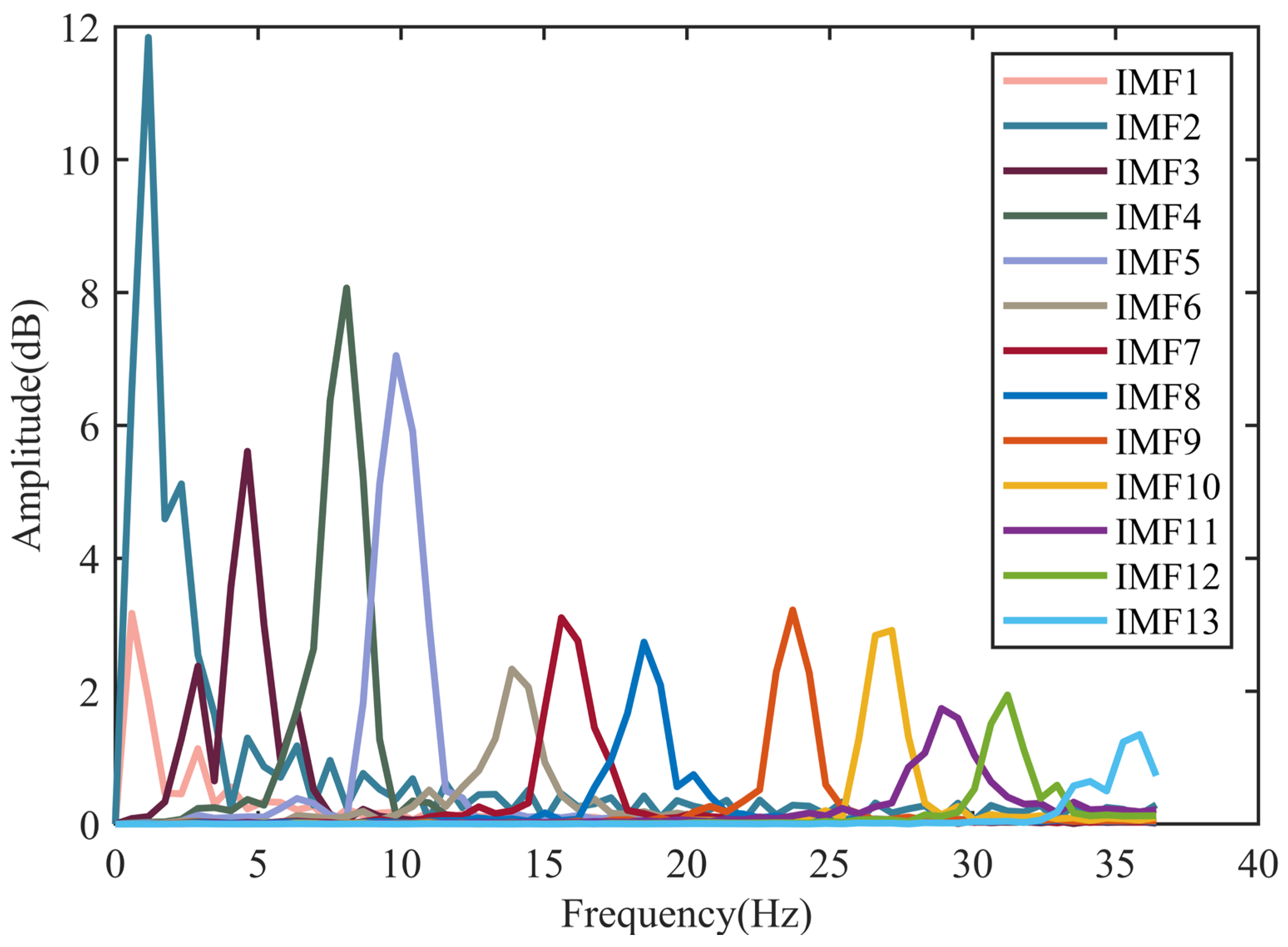
Figure 3, and their spectral characteristics are illustrated in
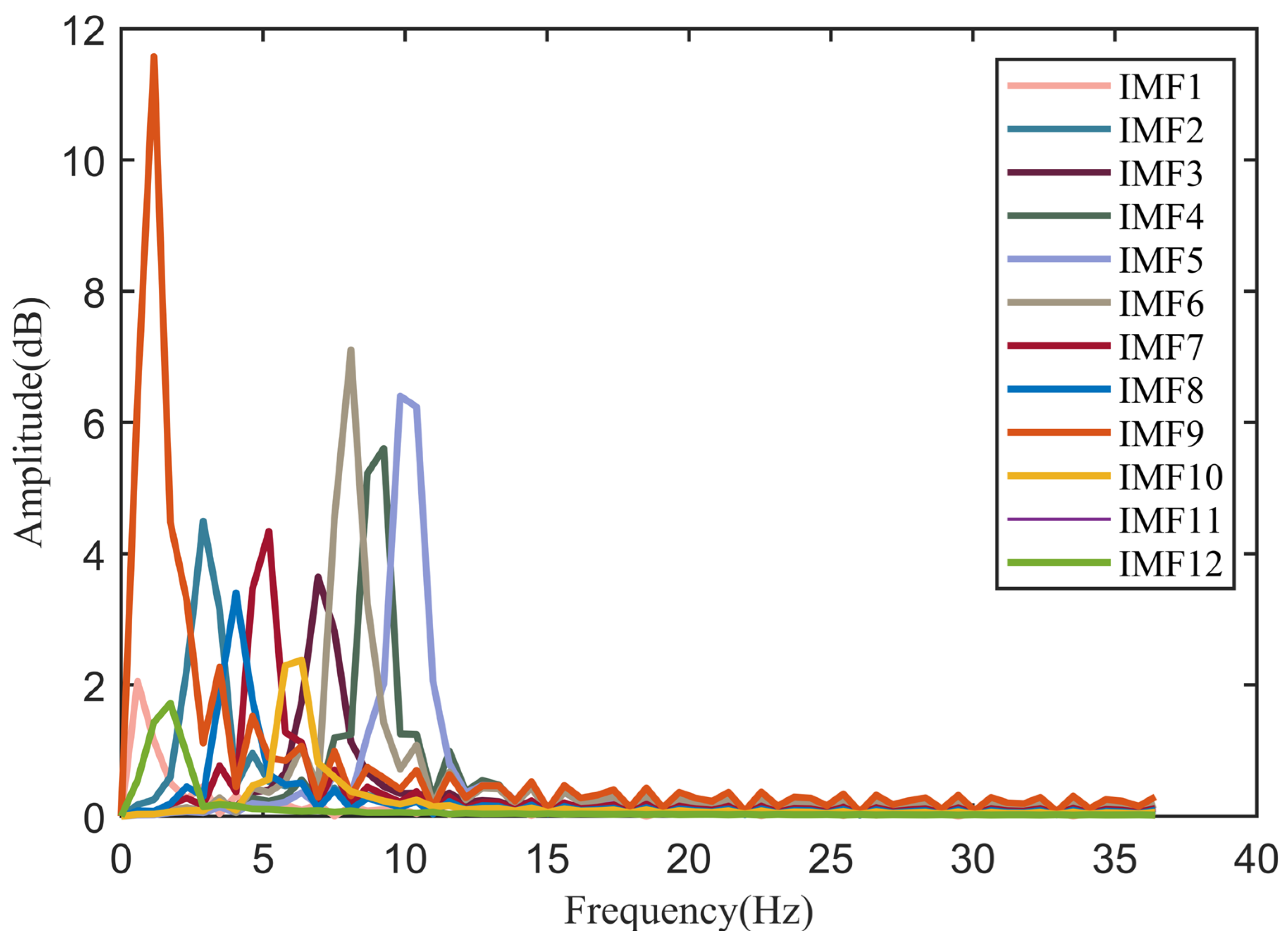
Figure 4. Based on the spectral characteristics of the initial decomposition results and the degree of mode mixing, these 13 components are divided into high-frequency and low-frequency groups. The low-frequency group obtained from the first decomposition undergoes a secondary decomposition, resulting in 12 components as shown in
Figure 5. The spectral characteristics of these components are illustrated in
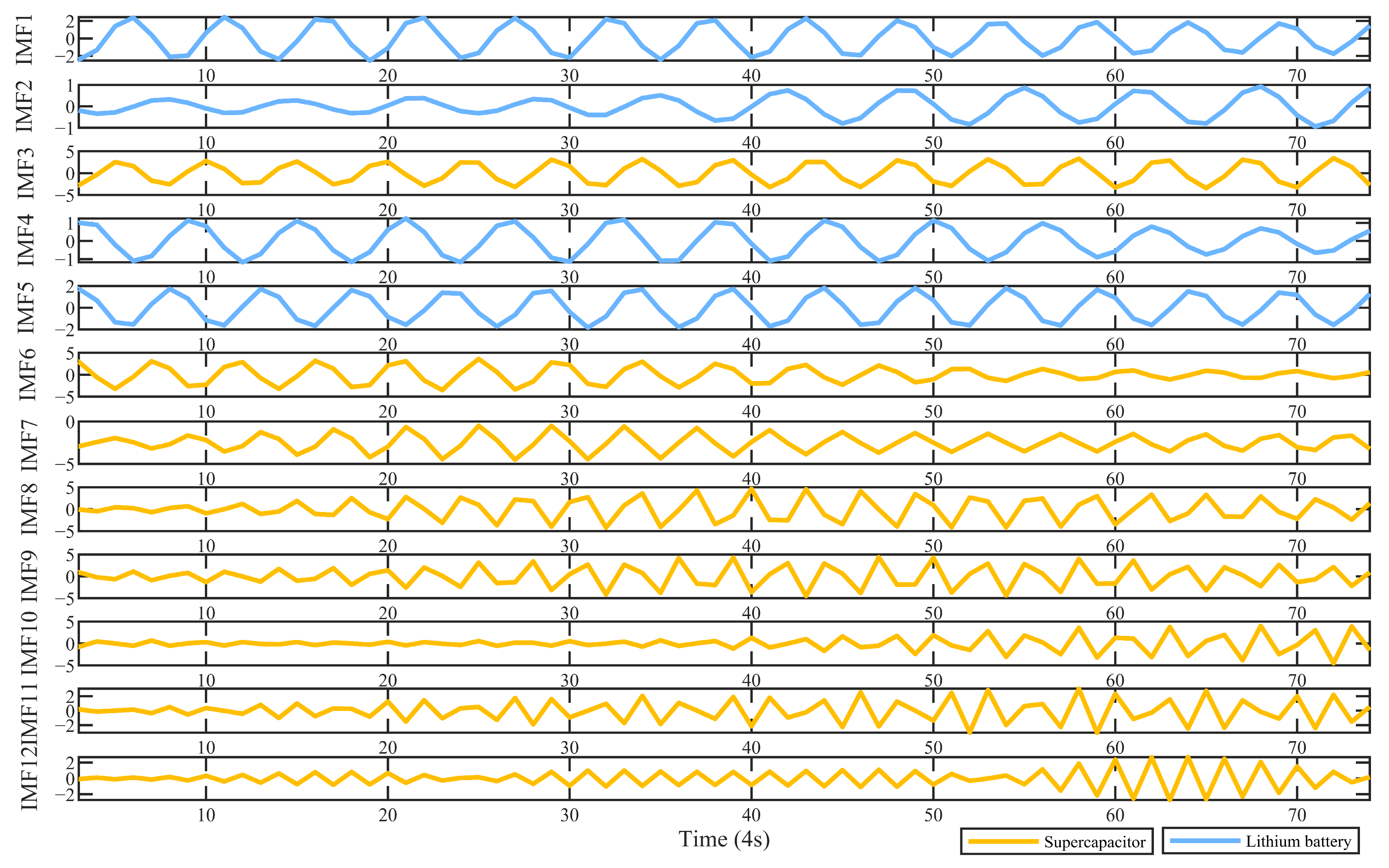
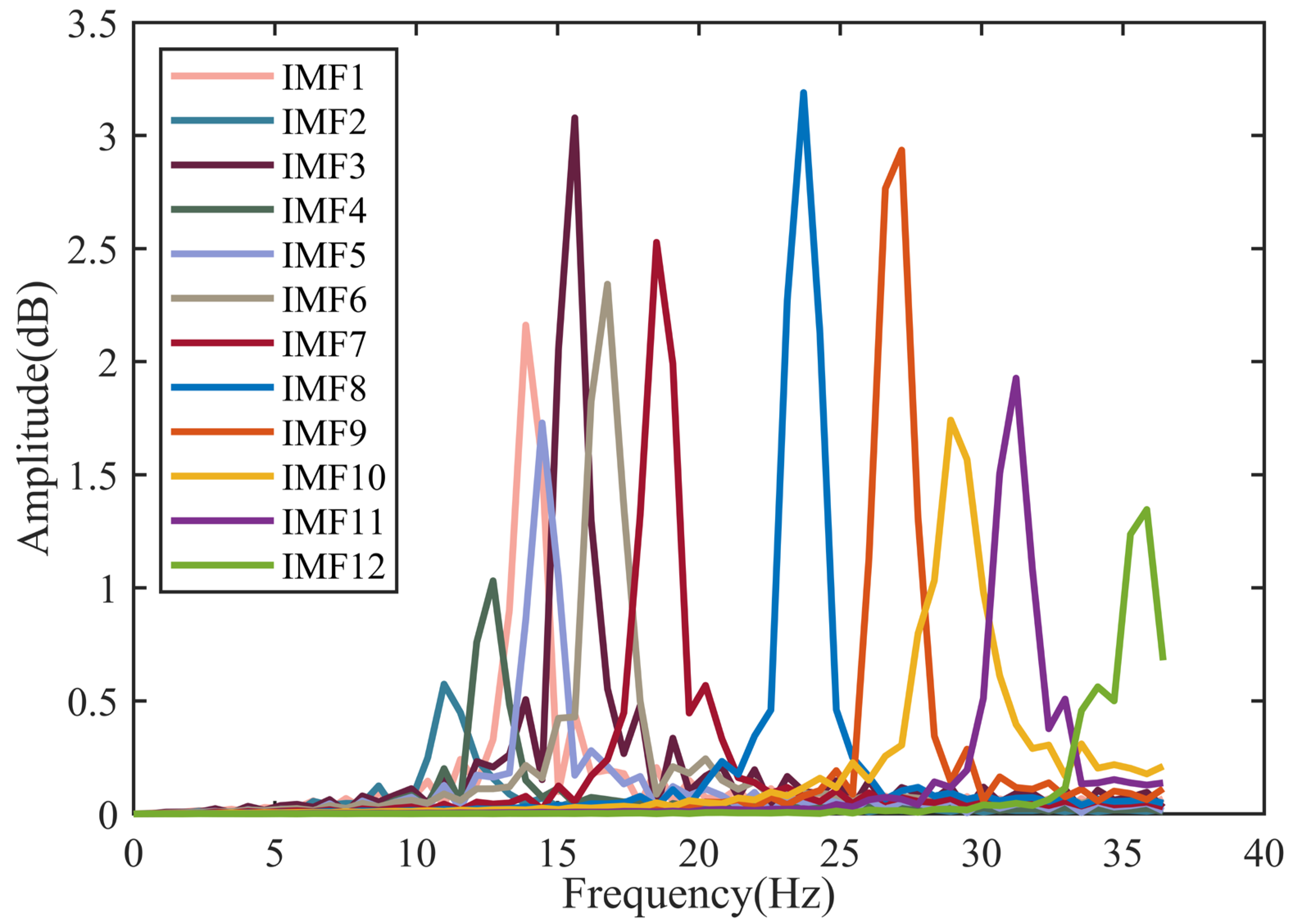
Figure 6. Similarly, the high-frequency group obtained from the first decomposition undergoes a secondary decomposition to generate another set of 12 components as shown in
Figure 7 with their spectral characteristics illustrated in
Figure 8.
Figure 3 shows the results of the initial MVO-VMD for power distribution in the HESS during a typical voyage of the “Alsterwasser” cruise ship.
Figure 4 shows the spectrum obtained from the initial MVO-VMD. The boundary points between high and low frequencies in the initial decomposition results can be determined based on the degree of mode mixing, as shown in
Table 3. In
Figure 3, the green curve represents the low-frequency component, while the yellow curve represents the high-frequency component.
The results of the secondary decomposition exhibit significant mode overlap, as shown in
Figure 6 and
Figure 8. High-frequency and low-frequency components cluster together, making it complicated to accurately identify frequency boundary points based on modal mixing degrees. This can lead to inaccurate allocation results; for example, due to the indistinguishability of component frequencies caused by modal overlap, there is a risk of mistakenly allocating components that should be assigned to supercapacitors to lithium batteries instead. Such misallocation not only causes fluctuations in output power but also shortens the lifespan of lithium batteries due to excessive charging and discharging cycles, thereby increasing costs. Therefore, the power distribution after secondary decomposition cannot be determined by the degree of modal aliasing but is allocated to lithium batteries or supercapacitors based on the differences in the center frequencies of the components obtained from secondary decomposition [
14]. Based on the central frequencies and degree of aliasing obtained from the components of secondary decomposition in
Figure 6 and
Figure 8, they are, respectively, assigned to lithium batteries and supercapacitors as illustrated in
Figure 5 and
Figure 7. The allocation results are presented in
Table 4. The green curve in
Figure 5 represents the lithium battery component, while the purple curve represents the supercapacitor component. In
Figure 7, the blue curve indicates the lithium battery component, and the yellow curve indicates the supercapacitor component.
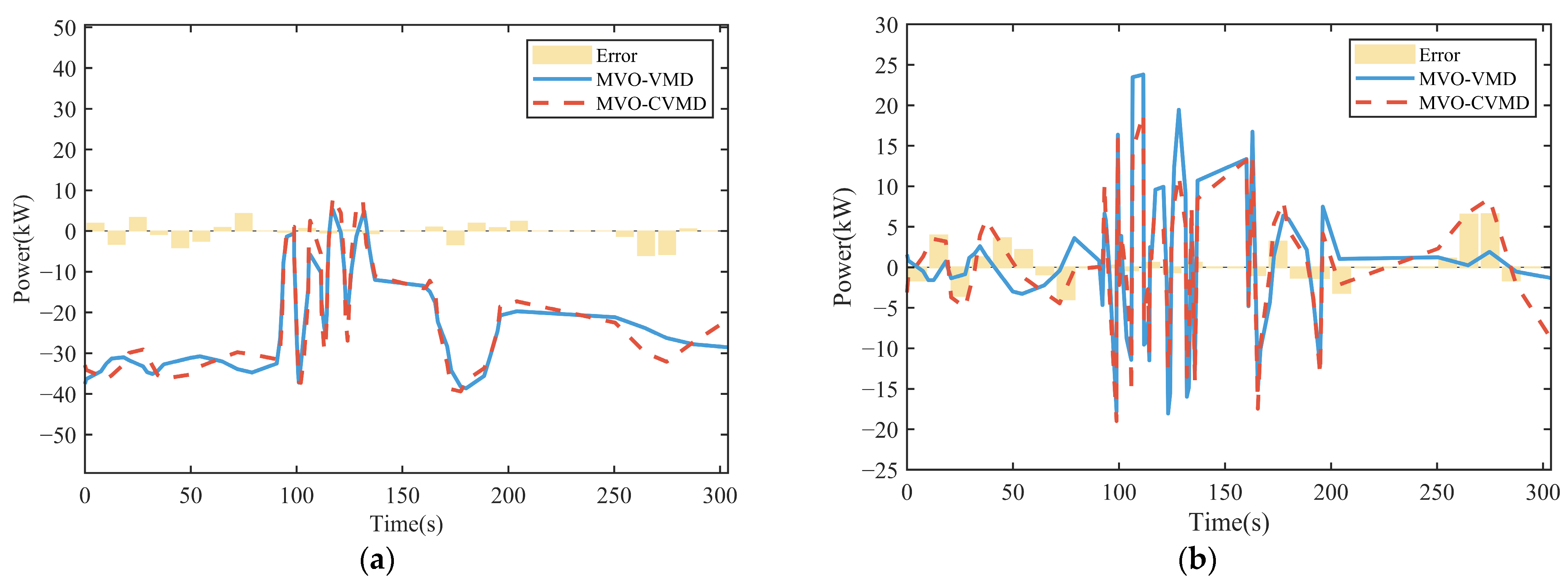
Based on the decomposition results mentioned above, we can derive the power variation curves of lithium batteries and supercapacitors under MVO-VMD and MVO-CVMD, as shown in
Figure 9.
Based on the power curves mentioned above and the parameter settings for lithium batteries and supercapacitors in reference [
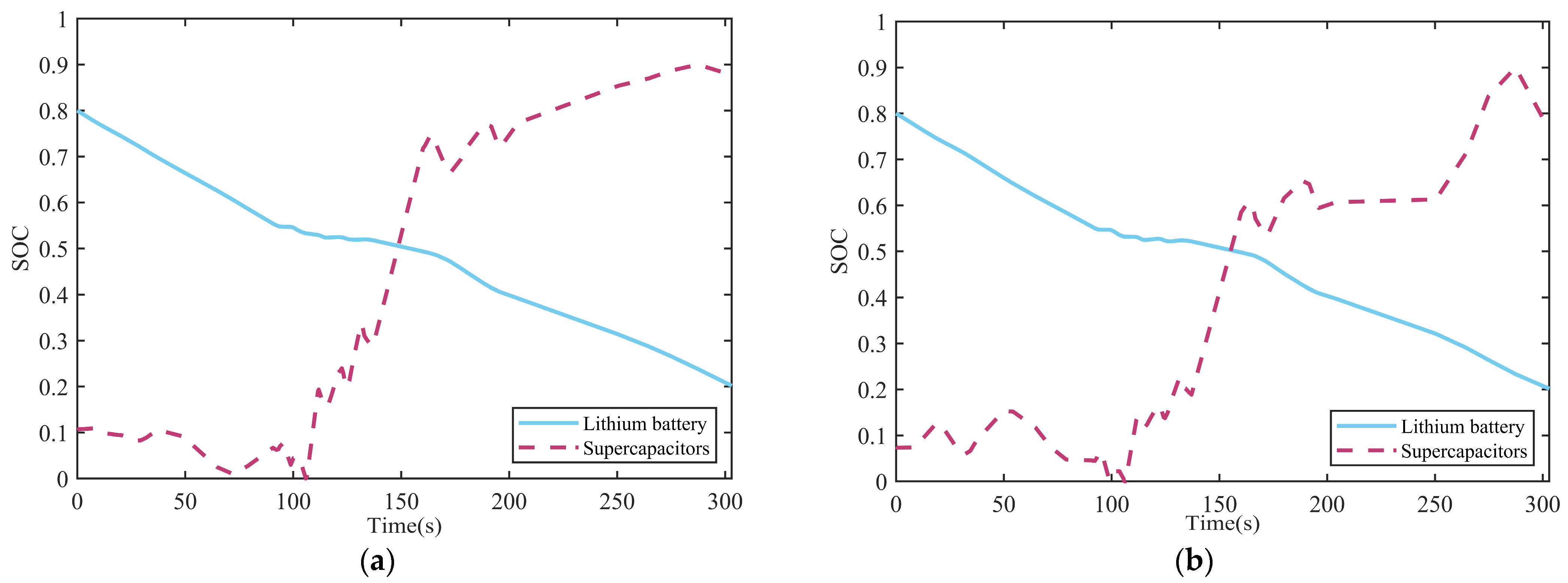
23], we can obtain the SOC curves of lithium batteries and supercapacitors during a typical voyage of the “Alsterwasser” cruise ship, as shown in
Figure 10.
From
Figure 9, the lithium battery exhibits smoother power output compared to the supercapacitor’s dynamic profile, consistent with their respective energy delivery characteristics—batteries provide stable discharge while supercapacitors enable instantaneous power response. Additionally, the power curve after decomposition using MVO-CVMD is smoother than the one after decomposition using MVO-VMD.
From
Figure 10, the SOC variation in the battery is relatively smoother compared to that of the supercapacitor. At the same time, when comparing
Figure 10b, it becomes clear that under MVO-CVMD mode decomposition, both charging and discharging processes for the battery and supercapacitor are more thorough than those under MVO-VMD mode decomposition; additionally, the discharge process of the supercapacitor is even more complete. It also reaffirms the rationale behind using MVO-CVMD modal decomposition for power allocation in HESS.
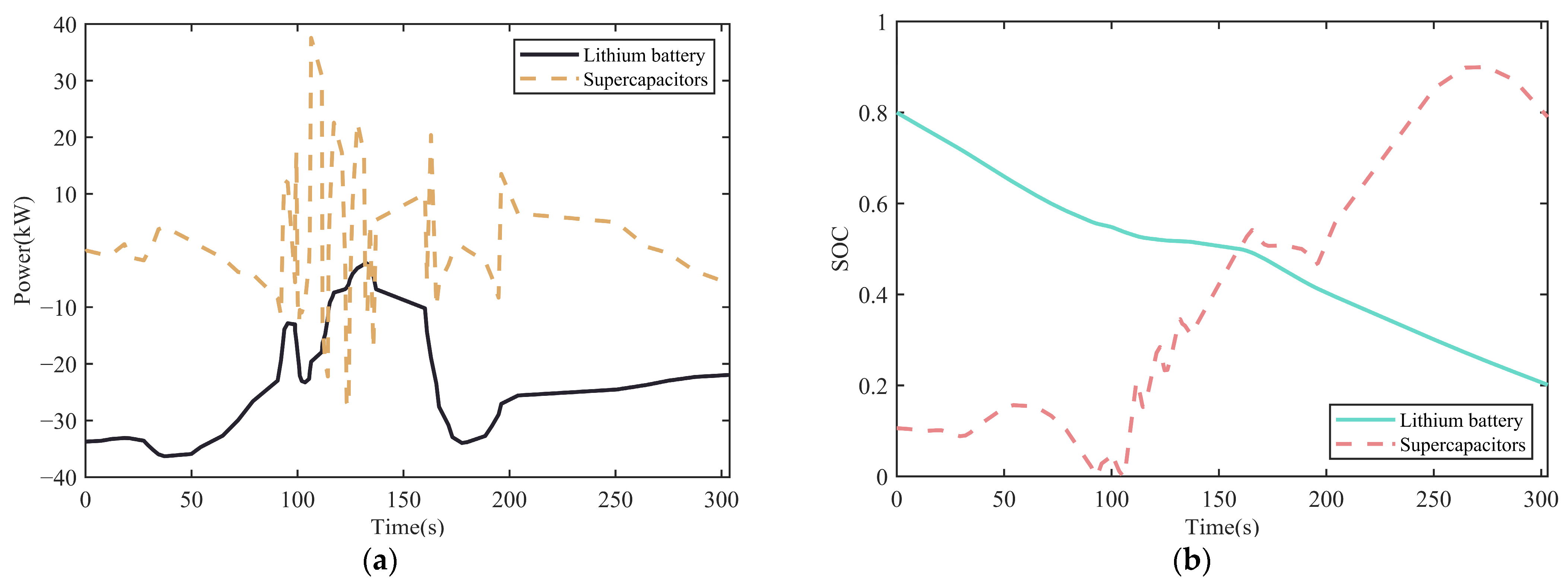
Through VMD power decomposition and capacity configuration of the aforementioned HESS, the power and SOC characteristics for both lithium batteries and supercapacitors were obtained for the “Alsterwasser” vessel, as illustrated in
Figure 11.
Due to the high dependence of traditional VMD on the selection of empirical parameters, it is not well-suited for power decomposition across various frequency ranges. As can be seen in
Figure 11a, its power decomposition is inadequate, resulting in an unreasonable power distribution and failure to fully leverage the characteristic of supercapacitors that allows them to provide short bursts of high power. Compared to
Figure 10, it is clear that the curve of the supercapacitor in
Figure 11b is smoother, which can easily lead to excessively fast charging and discharging of lithium batteries, thereby reducing their lifespan and increasing costs.
Analysis of Capacity Configuration Results
This study performed case validation of the proposed HESS capacity configuration methodology, deriving the respective power distribution profiles for lithium batteries and supercapacitors during characteristic operational phases of the “Alsterwasser” vessel. The capacity configuration results obtained based on the parameters of lithium batteries and supercapacitors provided from reference [
23] are shown in
Table 5.
From
Table 5, it can be seen that the HESS of fuel cell vessel configuration cost is reduced by 10.82% compared to VMD and by 4.05% compared to MVO-VMD. The traditional VMD heavily relies on the selection of empirical parameters, which can lead to insufficient accuracy in its decomposed structure and result in unreasonable capacity allocation. By introducing MVO to optimize the adaptive selection of parameters for VMD, this effectively addresses the issues in traditional VMD and enables reasonable capacity allocation, thereby reducing costs. Although the parameter issue has been resolved, a single MVO-VMD may result in inadequate accuracy of the obtained decomposed results and lead to modal aliasing. Due to the limitations of single-instance MVO-VMD, power is decomposed and cross-distributed twice. This approach addresses the problem of mode mixing, further enhances the accuracy of power distribution, and also reduces capacity configuration costs. The MVO-CVMD outperforms traditional VMD and single-instance MVO-VMD in both power decomposition and capacity allocation. Therefore, the MVO-VMD is better suited to handle high-frequency fluctuation signals and can achieve more efficient capacity allocation, ultimately leading to a reduction in the costs associated with capacity configuration. This will play an important role in promoting the development of fuel cell ships in the future, providing better strategies for power distribution and improved solutions for capacity configuration. It also has applicability in wind energy, photovoltaic storage, and other areas.
6. Discussion
The topic of this study uses the typical navigation behavior of the “Alsterwasser” cruise ship as a sample and focuses on a HESS composed of batteries and supercapacitors. This study develops an optimized power distribution approach for HESS using enhanced Variational Mode Decomposition (MVO-CVMD). The capacity configuration targets minimizing the HESS’s lifecycle expenditures through component-level cost reduction. Based on the above research, three key findings emerge from this investigation:
The MVO algorithm optimizes VMD parameters by minimizing sample entropy via iterative computation. The results of the first decomposition are [13, 1316], while the second decomposition yields [12, 1010] and [12, 2043]. Results demonstrate the MVO algorithm’s superior convergence speed and optimization precision.
The MVO-CVMD algorithm executes a two-stage decomposition process for the HESS’s power signals. Considering the distinct operational properties of individual energy storage elements, an optimized cross-power allocation strategy was implemented for the HESS. The state of charge (SOC) of the supercapacitor after MVO-CVMD is 80%, compared to 89% after MVO-VMD, indicating a discharge depth improvement of 10.11%. The supercapacitor discharges more thoroughly. The issues of incomplete decomposition and mode mixing have been effectively resolved.
The capacity configuration of the HESS is aimed at minimizing the total lifecycle cost of energy storage devices, resulting in different configuration costs under various allocation strategies. Through a comparison of costs, it has been verified that the MVO-CVMD used in this paper reduces costs by 10.82% compared to VMD and by 4.05% compared to MVO-VMD.
Based on the above findings, this article presents a power allocation and capacity configuration based on the MVO-CVMD algorithm, which can effectively improve the accuracy of power distribution while also significantly reducing costs. However, this method performs poorly in terms of real-time responsiveness and cannot respond promptly to changes in ship load. Additionally, when the signal contains strong noise, it can result in extracted components that include excessive noise information, which affects the accuracy of subsequent analysis.
In future research, there can be a deep integration with deep learning, which is the most promising direction. It is possible to train a deep neural network that directly learns the end-to-end mapping from raw signals to the optimal VMD parameter . Once the model training is complete, the process of parameter determination becomes almost instantaneous, thoroughly resolving computational bottlenecks and making real-time adaptive signal processing possible. The model can learn complex features from vast amounts of data that are difficult for humans to design.