


Critical Review of Advances and Numerical Modeling in Absorbers and Desorbers of Absorption Chillers: CFD Applications, Constraints, and Future Prospects
 ,
,  ,
,  ,
,  , , , ,
Abstract
1. Introduction
2. State-of-the-Art Literature Survey
3. Absorber and Desorber Technologies: CFD-Based Studies
3.1. Absorber and Desorber Technologies
3.1.1. Falling Film
3.1.2. Bubble
3.1.3. Membrane
3.2. General Discussion on the Different Sorption Exchanger Technologies
4. Artificial Intelligence Techniques for CFD Analysis in Absorption Refrigeration Systems
5. Final Critical Considerations for the Application of CFD Modeling to Absorbers and Desorbers
6. Conclusions and Recommendations
6.1. Conclusions
- It was found that the CFD techniques are essential for advancing the understanding of sorption processes, enabling detailed analysis of flow phenomena and the impact of operating parameters;
- AI integration—in particular, machine learning models—has shown potential for optimizing CFD simulations, reducing computational costs, and providing new insights into system behavior;
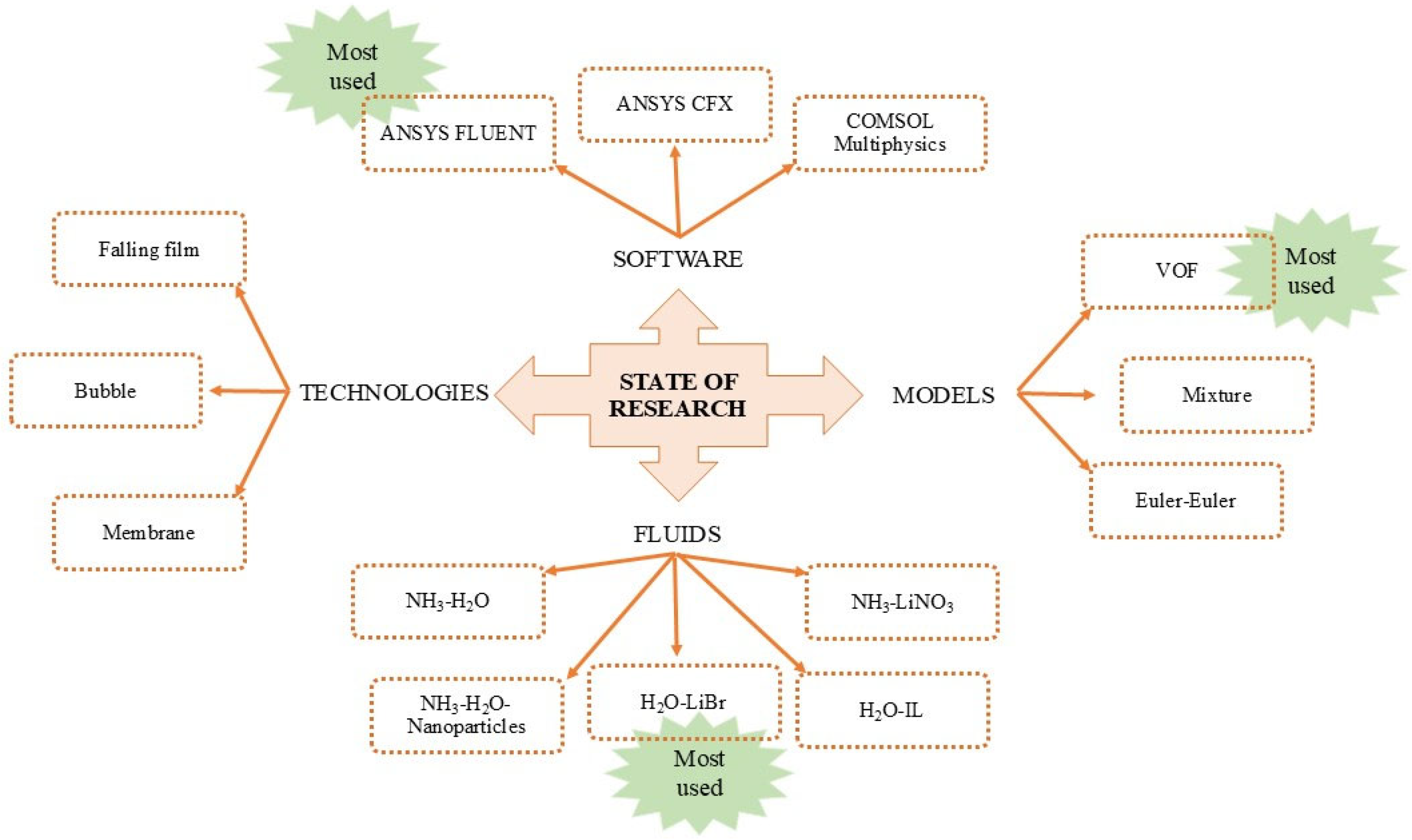
- Most studies have adopted the VOF method; however, when considering turbulence, the RNG κ-ε method is the most commonly used;
- The H2O-LiBr working fluid is the most extensively studied fluid for CFD-based studies on sorption exchangers for absorption refrigeration systems;
- The primary focus is optimizing absorption and desorption processes by enhancing exchangers and exploring new geometric configurations to improve the absorption or desorption flow of the binary fluid. Additionally, most research is aimed at understanding and enhancing the hydrodynamics of flows in heat and mass exchangers;
- Owing to its ease of implementation regarding flow characteristics, ANSYS FLUENT is widely used to simulate both the absorption and desorption processes, including those involving falling films, membranes, and bubbles. Furthermore, some researchers are developing proprietary codes to study the simultaneous transfer of heat and mass.
6.2. Recommendations
- ✓
- There is a significant need for the computational study of new technologies such as adiabatic absorbers and desorbers;
- ✓
- More CFD studies must be conducted with desorbers to explore and optimize the performance of these components. CFD modeling can help better understand the thermal phenomena and mass transfer occurring in the desorber, allowing for optimization of its performance and minimizing issues such as crystallization;
- ✓
- The role of new fluids in increasing absorption/desorption capacity is still an ongoing area of research, necessitating further studies in this field;
- ✓
- Potential research could be conducted to compare the behavior of absorption and desorption processes within heat exchangers by applying different multiphase and turbulence models. The goal would be to evaluate the models available in various software tools, identify any differences, and determine which model best represents real-world conditions;
- ✓
- The application of AI techniques, such as ANNs and machine learning algorithms, needs to be further explored, and also, the adaptation of CFD models for large-scale systems and the optimization of the results for industrial applications requires further investigation;
- ✓
- Advances have been evident in studies on the absorption process in absorbers and generators. However, gaps still need to be filled, such as models where thermophysical properties are varied, as well as a dynamic interface and more effective desorbent technology.
Author Contributions
Acknowledgments
Conflicts of Interest
References
- IEA Cooling. Available online: www.iea.org/reports/cooling (accessed on 3 December 2022).
- Chakravarty, K.H.; Sadi, M.; Chakravarty, H.; Sulaiman Alsagri, A.; James Howard, T.; Arabkoohsar, A. A Review on Integration of Renewable Energy Processes in Vapor Absorption Chiller for Sustainable Cooling. Sustain. Energy Technol. Assess. 2022, 50, 101822. [Google Scholar] [CrossRef]
- Kaneesamkandi, Z.; Almujahid, A.; Salim, B. Selection of an Appropriate Solar Thermal Technology for Solar Vapor Absorption Cooling—An MADM Approach. Energies 2022, 15, 1882. [Google Scholar] [CrossRef]
- Altamirano, A.; Stutz, B.; Le Pierrès, N. Review of Small-Capacity Single-Stage Continuous Absorption Systems Operating on Binary Working Fluids for Cooling: Compact Exchanger Technologies. Int. J. Refrig. 2020, 114, 118–147. [Google Scholar] [CrossRef]
- Nikbakhti, R.; Wang, X.; Hussein, A.K.; Iranmanesh, A. Absorption Cooling Systems—Review of Various Techniques for Energy Performance Enhancement. Alex. Eng. J. 2020, 59, 707–738. [Google Scholar] [CrossRef]
- Zhai, C.; Wu, W. Energetic, Exergetic, Economic, and Environmental Analysis of Microchannel Membrane-Based Absorption Refrigeration System Driven by Various Energy Sources. Energy 2022, 239, 122193. [Google Scholar] [CrossRef]
- Amaris, C.; Bourouis, M. Boiling Process Assessment for Absorption Heat Pumps: A Review. Int. J. Heat Mass Transf. 2021, 179, 121723. [Google Scholar] [CrossRef]
- Altamirano, A.; Stutz, B.; Pierrès, N. Le Experimental Characterization of a Three-Dimensional-Printed Adiabatic Desorber for Absorption Chillers. Heat Transf. Eng. 2022, 43, 1867–1884. [Google Scholar] [CrossRef]
- Zhai, C.; Wu, W. Experimental Study on Heat/Mass Transfer and Pressure Drop of Plate Heat Exchanger Desorber for Compact and Efficient Absorption Cooling. Int. J. Refrig. 2023, 145, 243–255. [Google Scholar] [CrossRef]
- Ibarra-Bahena, J.; Dehesa-Carrasco, U.; Galindo-Luna, Y.R.; Medina-Caballero, I.L.; Rivera, W. Experimental Performance of a Membrane Desorber with a H2O/LiCl Mixture for Absorption Chiller Applications. Membranes 2022, 12, 1184. [Google Scholar] [CrossRef] [PubMed]
- Lima, A.A.S.; Ochoa, A.A.V.; Da Costa, J.A.P.; Henríquez, J.R. CFD Simulation of Heat and Mass Transfer in an Absorber That Uses the Pair Ammonia/Water as a Working Fluid. Int. J. Refrig. 2019, 98, 514–525. [Google Scholar] [CrossRef]
- Wen, T.; Lu, L.; Luo, Y. Review on the Fundamentals and Investigations of Falling Film Dehumidification/Absorption Refrigeration Based on CFD Technology. Int. J. Heat Mass Transf. 2021, 171, 121042. [Google Scholar] [CrossRef]
- Narváez-Romo, B.; Chhay, M.; Zavaleta-Aguilar, E.W.; Simões-Moreira, J.R. A Critical Review of Heat and Mass Transfer Correlations for LiBr-H2O and NH3-H2O Absorption Refrigeration Machines Using Falling Liquid Film Technology. Appl. Therm. Eng. 2017, 123, 1079–1095. [Google Scholar] [CrossRef]
- Wirtz, M.; Stutz, B.; Phan, H.T.; Boudehenn, F. Numerical Modeling of Falling-Film Plate Generator and Rectifier Designed for NH3—H2O Absorption Machines. Heat Mass Transf./Waerme-Stoffuebertragung 2022, 58, 431–446. [Google Scholar] [CrossRef]
- Wirtz, M.; Stutz, B.; Phan, H.T.; Boudehenn, F. Performance Improvement of NH3–H2O Absorption Chiller with a Combined Generator. Int. J. Refrig. 2022, 144, 331–341. [Google Scholar] [CrossRef]
- Tao, X.; Thanganadar, D.; Patchigolla, K. Compact Ammonia/Water Absorption Chiller of Different Cycle Configurations: Parametric Analysis Based on Heat Transfer Performance. Energies 2022, 15, 6511. [Google Scholar] [CrossRef]
- Sehgal, S.; Alvarado, J.L.; Hassan, I.G.; Kadam, S.T. A Comprehensive Review of Recent Developments in Falling-Film, Spray, Bubble and Microchannel Absorbers for Absorption Systems. Renew. Sustain. Energy Rev. 2021, 142, 110807. [Google Scholar] [CrossRef]
- Lima, A.A.S.; Leite, G.d.N.P.; Ochoa, A.A.V.; Dos Santos, C.A.C.; da Costa, J.A.P.; Michima, P.S.A.; Caldas, A.M.A. Absorption Refrigeration Systems Based on Ammonia as Refrigerant Using Different Absorbents: Review and Applications. Energies 2021, 14, 48. [Google Scholar] [CrossRef]
- Amaris, C.; Vallès, M.; Bourouis, M. Vapour Absorption Enhancement Using Passive Techniques for Absorption Cooling/Heating Technologies: A Review. Appl. Energy 2018, 231, 826–853. [Google Scholar] [CrossRef]
- Ghasem, N. Combining CFD and AI/ML Modeling to Improve the Performance of Polypropylene Fluidized Bed Reactors. Fluids 2024, 9, 298. [Google Scholar] [CrossRef]
- Li, H.; Spelman, D.; Sansalone, J. Coupling Computational Fluid Dynamics and Artificial Intelligence for Sustainable Urban Water Management and Treatment. Environ. Sci. Proc. 2022, 21, 87. [Google Scholar]
- Usman, A.; Rafiq, M.; Saeed, M.; Nauman, A.; Almqvist, A.; Liwicki, M. Machine Learning Computational Fluid Dynamics. In Proceedings of the 2021 Swedish Artificial Intelligence Society Workshop (SAIS), Luleå, Sweden, 14–15 June 2021; IEEE: Piscataway, NJ, USA, 2021; pp. 1–4. [Google Scholar]
- Mao, R.; Zhang, M.; Wang, Y.; Li, H.; Xu, J.; Dong, X.; Zhang, Y.; Chen, Z.X. An Integrated Framework for Accelerating Reactive Flow Simulation Using GPU and Machine Learning Models. Proc. Combust. Inst. 2024, 40, 105512. [Google Scholar] [CrossRef]
- Ribeiro, M.D.; Rehman, A.; Ahmed, S.; Dengel, A. DeepCFD: Efficient Steady-State Laminar Flow Approximation with Deep Convolutional Neural Networks. arXiv 2021, arXiv:2004.08826. [Google Scholar]
- Panahizadeh, F.; Hamzehei, M.; Farzaneh-Gord, M.; Villa, A.A.O. Evaluation of Machine Learning-Based Applications in Forecasting the Performance of Single Effect Absorption Chiller Network. Therm. Sci. Eng. Progress. 2021, 26, 101087. [Google Scholar] [CrossRef]
- Sui, Z.; Sui, Y.; Wu, W. Multi-Objective Optimization of a Microchannel Membrane-Based Absorber with Inclined Grooves Based on CFD and Machine Learning. Energy 2022, 240, 122809. [Google Scholar] [CrossRef]
- May Tzuc, O.; Chan-González, J.J.; Castañeda-Robles, I.E.; Lezama-Zárraga, F.; Moheno-Barrueta, M.; Jiménez Torres, M.; Best, R. Multivariate Inverse Artificial Neural Network to Analyze and Improve the Mass Transfer of Ammonia in a Plate Heat Exchanger-Type Absorber with NH3/H2O for Solar Cooling Applications. Energy Explor. Exploit. 2022, 40, 1686–1711. [Google Scholar] [CrossRef]
- Mahamoudou, A.; Le Pierrès, N.; Ramousse, J. Review of Coupled Heat and Mass Transfer Studies in Falling Film Absorbers: Modeling, Experimental and Thermodynamic Approaches. Int. J. Refrig. 2022, 136, 229–244. [Google Scholar] [CrossRef]
- Zhao, C.Y.; Qi, D.; Ji, W.T.; Jin, P.H.; Tao, W.Q. A Comprehensive Review on Computational Studies of Falling Film Hydrodynamics and Heat Transfer on the Horizontal Tube and Tube Bundle. Appl. Therm. Eng. 2022, 202, 117869. [Google Scholar] [CrossRef]
- Zhai, C.; Wu, W.; Coronas, A. Membrane-Based Absorption Cooling and Heating: Development and Perspectives. Renew. Energy 2021, 177, 663–688. [Google Scholar] [CrossRef]
- Sui, Z.; Wu, W. A Comprehensive Review of Membrane-Based Absorbers/Desorbers towards Compact and Efficient Absorption Refrigeration Systems. Renew. Energy 2022, 201, 563–593. [Google Scholar] [CrossRef]
- Asfand, F.; Bourouis, M. A Review of Membrane Contactors Applied in Absorption Refrigeration Systems. Renew. Sustain. Energy Rev. 2015, 45, 173–191. [Google Scholar] [CrossRef]
- Anderson, D.A.; Tannehill, J.C.; Pletcher, R.H.; Munipalli, R.; Shankar, V. Computational Fluid Mechanics and Heat Transfer, 4th ed.; CRC Press: New York, NY, USA, 2021. [Google Scholar]
- Versteeg, H.K.; Malalasekera, W. An Introduction to Computational Fluid Dynamics: The Finite Volume Method; John Wiley & Sons Inc.: New York, NY, USA, 1995. [Google Scholar]
- Ansys Fluent Overview. Available online: https://www.ansys.com/products/fluids/ansys-fluent#tab1-1 (accessed on 4 April 2024).
- Ansys CFX Overview. Available online: https://www.ansys.com/products/fluids/ansys-cfx (accessed on 4 June 2024).
- OpenFOAM® Documentation. Available online: https://www.openfoam.com/documentation/overview (accessed on 11 September 2024).
- Medina, H.; Beechook, A.; Saul, J.; Porter, S.; Aleksandrova, S.; Benjamin, S. Open Source Computational Fluid Dynamics Using OpenFOAM. In Proceedings of the Royal Aeronautical Society, General Aviation Conference, London, UK, 9–10 June 2015. [Google Scholar]
- Yang, R.; Wang, Y.; Li, Y. Numerical Investigations on Flow Boiling Heat Transfer of Ammonia Water Binary Solution (NH3/H2O) in a Horizontal Microchannel. Int. J. Heat Mass Transf. 2021, 171, 121091. [Google Scholar] [CrossRef]
- Sui, Z.; Wu, W.; You, T.; Zheng, Z.; Leung, M. Performance Investigation and Enhancement of Membrane-Contactor Microchannel Absorber towards Compact Absorption Cooling. Int. J. Heat Mass Transf. 2021, 169, 120978. [Google Scholar] [CrossRef]
- Sui, Z.; Zhai, C.; Wu, W. Swirling Flow for Performance Improvement of a Microchannel Membrane-Based Absorber with Discrete Inclined Grooves. Int. J. Refrig. 2021, 130, 382–391. [Google Scholar] [CrossRef]
- Türkmen, U.; Atilgan, İ. Absorbsiyinlu Sogutma Sistemlerinde Mikro Kanallı Absorber ve Desorberin Sayısal Olarak Modellenmesi. J. Polytech. 2023, 27, 1823–1836. [Google Scholar] [CrossRef]
- Zhang, Z.; Hong, A.; Li, X.; Li, H.; Gao, X. Absorption and Desorption of Liquid Film Flowing over a Porous Layer. Int. Commun. Heat Mass Transf. 2019, 108, 104311. [Google Scholar] [CrossRef]
- Andersson, B.; Andersson, R.; Hakansson, L.; Mortensen, M.; Sudiyo, R.; Van Wachem, B. Computational Fluid Dynamics for Engineers; Cambridge University Press: Cambridge, UK, 2012. [Google Scholar]
- COMSOL Multiphysics Reference Manual. Available online: https://doc.comsol.com/5.4/doc/com.comsol.help.comsol/COMSOL_ReferenceManual.pdf (accessed on 14 October 2024).
- Dong, P.; Liu, G.; Liu, F.; Yan, G.; Wang, G. Effect of Structure and Operation Parameters on Heat and Mass Transfer Coefficients of Single-Bubble Absorption for Lithium Bromide Solution. Int. J. Heat Mass Transf. 2023, 201, 123587. [Google Scholar] [CrossRef]
- User Guide. Available online: https://www.openfoam.com/documentation/user-guide (accessed on 7 August 2024).
- Zapata, A.; Amaris, C.; Sagastume, A.; Rodríguez, A. CFD Modelling of the Ammonia Vapour Absorption in a Tubular Bubble Absorber with NH3/LiNO3. Case Stud. Therm. Eng. 2021, 27, 101311. [Google Scholar] [CrossRef]
- Altamirano, A.C. Development of a New Concept of Compact and Low-Cost Absorption Chillers: Application in Solar Cooling for Hot Climates; L’Université Savoie Mont Blanc: Chambéry, France, 2021. [Google Scholar]
- Subramaniam, V.; Chandrasekaran, S.; Garimella, S. A 2-D Numerical Analysis of Heat and Mass Transfer in Lithium Bromide-Water Falling Films and Droplets. Int. J. Heat Mass Transf. 2021, 177, 121518. [Google Scholar] [CrossRef]
- Keizer, C. Absorption Refrigeration Machines; Delft University of Technology: Delft, The Netherlands, 1982. [Google Scholar]
- Shi, Y.; Chen, G.; Wang, Q.; Chen, Q. Simulation on Falling Film Absorption Based on Lattice Boltzmann Method at Moderate Reynolds Number. Int. J. Heat Mass Transf. 2019, 128, 991–998. [Google Scholar] [CrossRef]
- Tahir, F.; Mabrouk, A.; Koç, M. CFD Analysis of Falling Film Hydrodynamics for a Lithium Bromide (LIBr) Solution over a Horizontal Tube. Energies 2020, 13, 307. [Google Scholar] [CrossRef]
- Vakilipour, S.; Hekmatkhah, R. Investigation of Water Vapour Absorption into Wavy Falling Films by Developing a Fully Coupled Interface Tracking Finite Volume Method. Int. J. Heat Mass Transf. 2022, 185, 122397. [Google Scholar] [CrossRef]
- Gao, H.; Mao, F.; Song, Y.; Hong, J.; Yan, Y. Effect of Adding Copper Oxide Nanoparticles on the Mass/Heat Transfer in Falling Film Absorption. Appl. Therm. Eng. 2020, 181, 115937. [Google Scholar] [CrossRef]
- Castro, J.; Oliet, C.; Rodríguez, I.; Oliva, A. Comparison of the Performance of Falling Film and Bubble Absorbers for Air-Cooled Absorption Systems. Int. J. Therm. Sci. 2009, 48, 1355–1366. [Google Scholar] [CrossRef]
- Wu, X.; Xu, S.; Jiang, M. Development of Bubble Absorption Refrigeration Technology: A Review. Renew. Sustain. Energy Rev. 2018, 82, 3468–3482. [Google Scholar] [CrossRef]
- Panahizadeh, F.; Hamzehei, M.; Farzaneh-Gord, M.; Villa, A.A.O. Numerical Study on Heat and Mass Transfer Behavior of Pool Boiling in LiBr/H2O Absorption Chiller Generator Considering Different Tube Surfaces. Therm. Sci. 2021, 25, 1599–1610. [Google Scholar] [CrossRef]
- Mohamed, S.A.; Karimi, N. Analysis and Optimization of Vapor Absorption Generator-Heat Exchanger Using Kern Method and Cfd. J. Therm. Eng. 2020, 6, 440–459. [Google Scholar] [CrossRef]
- Zapata, A.; Amaris, C.; Sagastume, A.; Rodríguez, A. Vapour Absorption Process in an NH3/LiNO3 Bubble Absorber Using an Optimized Cfd Model. Front. Heat Mass Transf. 2022, 19, 1–9. [Google Scholar] [CrossRef]
- Zerweck, K. Ein- oder mehrstufige Absorptions- oder Adsorptionsmaschine. Patent DE3009820A1, 19 March 1980. Available online: https://patents.google.com/patent/DE3009820A1/de (accessed on 20 December 2024).
- Ibarra-Bahena, J.; Raman, S.; Galindo-Luna, Y.R.; Rodríguez-Martínez, A.; Rivera, W. Role of Membrane Technology in Absorption Heat Pumps: A Comprehensive Review. Membranes 2020, 10, 216. [Google Scholar] [CrossRef] [PubMed]
- Sui, Z.; Zhai, C.; Wu, W. Parametric and Comparative Study on Enhanced Microchannel Membrane-Based Absorber Structures for Compact Absorption Refrigeration. Renew. Energy 2022, 187, 109–122. [Google Scholar] [CrossRef]
- Medina-Caballero, I.L.; Rivera, W.; Ituna-Yudonago, J.-F.; Ibarra-Bahena, J. Numerical Simulation of a Membrane Desorber with the H2O-LiBr Working Mixture for Absorption Cooling Systems. Therm. Sci. Eng. Progress. 2024, 48, 102399. [Google Scholar] [CrossRef]
- Ibrahim, N.I.; Yahiaoui, A.; Garkuwa, J.A.; Mansour, R.B.; Rehman, S. Solar Cooling with Absorption Chillers, Thermal Energy Storage, and Control Strategies: A Review. J. Energy Storage 2024, 97, 112762. [Google Scholar] [CrossRef]
- Wen, T.; Lu, L.; He, W.; Min, Y. Fundamentals and Applications of CFD Technology on Analyzing Falling Film Heat and Mass Exchangers: A Comprehensive Review. Appl. Energy 2020, 261, 114473. [Google Scholar] [CrossRef]
- Wang, Q.; Li, M.; Xu, W.; Yao, L.; Liu, X.; Su, D.; Wang, P. Review on Liquid Film Flow and Heat Transfer Characteristics Outside Horizontal Tube Falling Film Evaporator: Cfd Numerical Simulation. Int. J. Heat Mass Transf. 2020, 163, 120440. [Google Scholar] [CrossRef]
- Zhang, H.; Yin, D.; You, S.; Zheng, W.; Li, B.; Zhang, X. Numerical and Experimental Investigation on the Heat and Mass Transfer of Falling Film and Droplet Regimes in Horizontal Tubes LiBr-H2O Absorber. Appl. Therm. Eng. 2019, 146, 752–767. [Google Scholar] [CrossRef]
- Ahmed, R.; Mahadzir, S.; Erniza, B.; Rozali, N.; Biswas, K.; Matovu, F.; Ahmed, K. Artificial Intelligence Techniques in Refrigeration System Modelling and Optimization: A Multi-Disciplinary Review. Sustain. Energy Technol. Assess. 2021, 47, 101488. [Google Scholar] [CrossRef]
- Hosseini, P.; Nikbakht Naserabad, S.; Keshavarzzadeh, A.H.; Ansari, N. Artificial Intelligence-based Tri-objective Optimization of Different Demand Load Patterns on the Optimal Sizing of a Smart Educational Buildings. Int. J. Energy Res. 2022, 46, 21373–21396. [Google Scholar] [CrossRef]
- Sousa Alcântara, S.C.; Villa Ochoa, A.A.; da Costa, J.Â.P.; de Menezes, F.D.; de Novaes Pires Leite, G.; Arruda Michima, P.S.; da Silva Marques, A. Development of a Method for Predicting the Transient Behavior of an Absorption Chiller Using Artificial Intelligence Methods. Appl. Therm. Eng. 2023, 231, 120978. [Google Scholar] [CrossRef]
- Al-Rbaihat, R.; Alahmer, H.; Alahmer, A.; Altork, Y.; Al-Manea, A.; Awwad, K.Y.E. Energy and Exergy Analysis of a Subfreezing Evaporator Environment Ammonia-Water Absorption Refrigeration Cycle: Machine Learning and Parametric Optimization. Int. J. Refrig. 2023, 154, 182–204. [Google Scholar] [CrossRef]
- Ashouri, M.; Kheyrikoochaksarayee, N.; Chhokar, C.; Shabani, A.; Bahrami, M. A Big Data-Handling Machine Learning Model for Membrane-Based Absorber Reactors in Sorption Heat Transformers. Energy Convers. Manag. 2023, 292, 117376. [Google Scholar] [CrossRef]
- Zhai, C.; Sui, Y.; Wu, W. Machine Learning-Assisted Correlations of Heat/Mass Transfer and Pressure Drop of Microchannel Membrane-Based Desorber/Absorber for Compact Absorption Cycles. Int. J. Heat Mass Transf. 2023, 214, 124431. [Google Scholar] [CrossRef]
- Bard, A.; Qiu, Y.; Kharangate, C.R.; French, R. Consolidated Modeling and Prediction of Heat Transfer Coefficients for Saturated Flow Boiling in Mini/Micro-Channels Using Machine Learning Methods. Appl. Therm. Eng. 2022, 210, 118305. [Google Scholar] [CrossRef]
- Sundar, L.S.; Mewada, H.K.; Sangaraju, S. Experimental and Ensemble Machine Learning Analyses of Heat Transfer, Friction Factor and Thermal Performance Factor of RGO/Water Nanofluids in a Tube. Int. J. Thermofluids 2024, 21, 100557. [Google Scholar] [CrossRef]
- Dione, F.; Thiam, A.; Cisse, E.H.I.; Diouf, D.; Maiga, A.S. Theoretical Study of an NH3–H2O Absorption Chiller Powered by a Linear Fresnel System Modelled by Combining Ray Tracing and CFD. Results Eng. 2023, 20, 101410. [Google Scholar] [CrossRef]
- Sui, Z.; Wu, W. AI-Assisted Maldistribution Minimization of Membrane-Based Heat/Mass Exchangers for Compact Absorption Cooling. Energy 2023, 263, 125922. [Google Scholar] [CrossRef]
- Zhai, C.; Wu, W. Heat and Mass Transfer Performance Comparison of Various Absorbers/Desorbers towards Compact and Efficient Absorption Heat Pumps. Int. J. Refrig. 2021, 127, 203–220. [Google Scholar] [CrossRef]
- Wang, H.; Cao, Y.; Huang, Z.; Liu, Y.; Hu, P.; Luo, X.; Song, Z.; Zhao, W.; Liu, J.; Sun, J.; et al. Recent Advances on Machine Learning for Computational Fluid Dynamics: A Survey. arXiv 2024, arXiv:2408.12171. [Google Scholar]
- Haridas, A.; Vadlamani, N.R.; Minamoto, Y. Deep Neural Networks to Correct Sub-Precision Errors in CFD. Appl. Energy Combust. Sci. 2022, 12, 100081. [Google Scholar] [CrossRef]

| DOCUMENT TYPE | QUERY 1 | QUERY 2 | QUERY 3 |
|---|---|---|---|
| Article | 509 | 26 | 12 |
| Conference paper | 100 | 3 | 0 |
| Review | 18 | 2 | 0 |
| Conference Review | 13 | 3 | 1 |
| Book Chapter | 7 | 0 | 0 |
| Total | 647 | 34 | 13 |
| Software | Advantages | Disadvantages |
|---|---|---|
| ANSYS FLUENT [35] | High precision and robustness Intuitive interface Extensive technical support Student version (limited) | High license fee Significant computing resources required Steep learning curve |
| ANSYS CFX [36] | High license fee Limited compared to ANSYS FLUENT for certain types of flows Significant computing resources required | |
| COMSOL Multiphysics [37] | Easy integration with other physics (Multiphysics) Intuitive graphic interface Good documentation and technical support Student version (limited) | High license fee Requires powerful hardware for complex simulations Less specialized in pure CFD |
| Open Source (general) [38] | Usually free or at a low cost Open source allowing for user customization User community support Simulations are typically configured using text files, which allows for easy linking of the simulation configuration to third-party applications (e.g., for optimization tools) | Unintuitive graphical interfaces Advanced programming knowledge may be required The associated licenses may have detailed and complex requirements and restrictions Less formal technical support Some advanced features found in commercial software may be missing |
| Fluid | ANSYS FLUENT/CFX | COMSOL Multiphysics | OpenFOAM |
|---|---|---|---|
| H2O-LiBr | H2O properties included in its library [40]. The properties of H2O-LiBr must be defined by the user (typically through UDFs or manually entered data) [44]. | H2O properties included in its library [45]. The properties of H2O-LiBr must be defined by the user [46]. | H2O properties included in its library (initial configuration may be necessary) [47]. The properties of H2O-LiBr must be defined by the user [47]. |
| NH3-H2O | NH3 properties included in its library (it may be necessary to set up UDFs for specific properties) [11,48]. The properties of binary mixtures must be defined by the user (typically through UDFs or manually entered data) [44]. | NH3 properties must be defined by the user [45]. The properties of binary mixture must be defined by the user [46]. | NH3 properties included in its library (an initial configuration may be required) [47]. The properties of binary mixture must be defined by the user [47]. |
| NH3-LiNO3 |
| Ref. | Exchanger Technology | Operating Mode | Working Fluid | Objective |
|---|---|---|---|---|
| [50] | Falling film | Absorber | H2O-LiBr | Capture the key parameters’ impact on the film’s flow. |
| [52] | Simulate the distribution of wave speed and energy in the process of falling liquid film. | |||
| [54] | Examine the absorption characteristics of the fluid from a fully coupled ALE-IT algorithm. | |||
| [55] | H2O-(LiBr+nanoparticles) | Analyze the effect of adding copper oxide nanoparticles on the absorption performance of the falling film. | ||
| [53] | Absorber/Desorber | H2O-LiBr | Analyze the influence of liquid charge and concentration on the hydrodynamics of the solution film. | |
| [43] | NH3-H2O | Analyze how the existence of a porous substrate in the flow field affects the mass and momentum transfer performances. | ||
| [48] | Bubbles | Absorber | NH3-LiNO3 | Analyze and validate a double vertical absorber. |
| [60] | Analyze the performance considering global heat transfer parameters. | |||
| [11] | NH3-H2O | Predict the hydrodynamic behavior of flat plate absorbers. | ||
| [46] | H2O-LiBr | Study the absorption process under vacuum conditions. | ||
| [58] | Desorber | H2O-LiBr | Investigate the effect of using fins and grooves in copper tubes on the boiling heat transfer rate, comparing it with smooth tubes. | |
| [59] | Evaluate the spacing of the baffles inside the heat exchanger for the optimization of an exchanger. | |||
| [63] | Membrane | Absorber | H2O-LiBr | Analyze the effects of membrane parameters on the absorption process. |
| [40] | Discuss the influence of design variables on the absorption process. | |||
| [41] | Investigate improvement strategies to reduce the pressure drop of the solution side and improve the absorption characteristics of the equipment. | |||
| [42] | Absorber/Desorber | H2O-LiBr, H2O-LiBr/LiNO3/LiI/LiCl, H2O-[EMIM][OAc] and H2O-LiCl | Optimize absorbers and desorbers considering different design parameters. | |
| [64] | Desorber | H2O-LiBr | Study an air gap membrane desorber. |
| Ref. | Software | Properties | Basic Settings | Transport Phenomenon Models | Significant Findings | |
|---|---|---|---|---|---|---|
| Multi-Phase Models | Models and Complementary Equations | |||||
| [48] | ANSYS FLUENT | Constant properties (database + external ref.) | 3D, transient state | VOF model; mixture model; Eulerian model | Viscous models: laminar, k-epsilon, k-omega | The VOF + realizable κ-epsilon model was the most appropriate. The model identified temperature profiles on the solution side of the absorber; these gradients were not identified in experimental studies or one-dimensional simulations. |
| [50] | 2D/3D, steady state, laminar flow | VOF; continuous surface force method (CSF) | Species Transportation Model | The 2D model effectively tracked the impact of the various flow aspects on the heat and mass transfer processes. The computational cost and solution time of the 2D model are worth its use. | ||
| [53] | 2D, transient state, laminar flow | VOF; continuous surface force method (CSF) | No information on the energy equation; Adiabatic condition (no heat flow) | Heat transfer performance is better at lower concentrations due to lower film thickness, more recirculation, higher velocity, and lower thermal resistance. | ||
| [60] | 3D, transient state | VOF and mixture | Realizable κ-epsilon viscous models | The VOF model has a good performance in low-density mesh elements. The mixture model has better performance in smaller numbers of elements and smaller volumes. The absorbed mass flow and the heat transfer coefficient on the solution side are the most sensitive variables for CFD absorber performance. | ||
| [59] | Constant properties (external ref.) | 3D, laminar flow | Not informed | Calculation of the global heat transfer coefficient using the Kern method | Reducing the spacing of the baffles significantly increased the heat transfer coefficient in the wall, with a 48% increase when reducing the spacing from 137 mm to 101 mm. There was also an increase in velocity and a drop in static pressure. | |
| [58] | 2D, transient state | Two-phase Eulerian–Eulerian | RPI boiling model; extended RNG κ-ε turbulence model; energy equation is only determined for the liquid phase; the vapor phase is assumed to be at the saturation temperature | The use of finned tubes increases the boiling heat transfer coefficient, enhances the wettability of the solution, and increases the nucleation sites for bubbles, which leads to faster and more efficient boiling. | ||
| [43] | No information on fluid properties | 2D, pseudo-steady state | Hybrid model (VOF and Euler–Euler) | Sherwood correlations for gas absorption and desorption; transport of concentrated species; no information on the energy equation | When the liquid film flows over a porous substrate, a greater thickness of the liquid film leads to poorer mass transfer performance. A non-linear and complex relationship exists between the mass transfer rate of the liquid phase and the flow rate of the liquid, which is also affected by the properties of the porous medium. | |
| [63] | 2D, steady state, laminar flow | Single-phase simplified model approach with mass and heat sources | Transport of species | The porosity of the membrane had the greatest impact on the absorption rate, with a 32% increase in the absorption rate when increasing the porosity from 0.6 to 0.8. The introduction of inclined grooves significantly improved heat and mass transfer performance. Grid and inclined groove structures presented the best overall performance among the different groove geometries. | ||
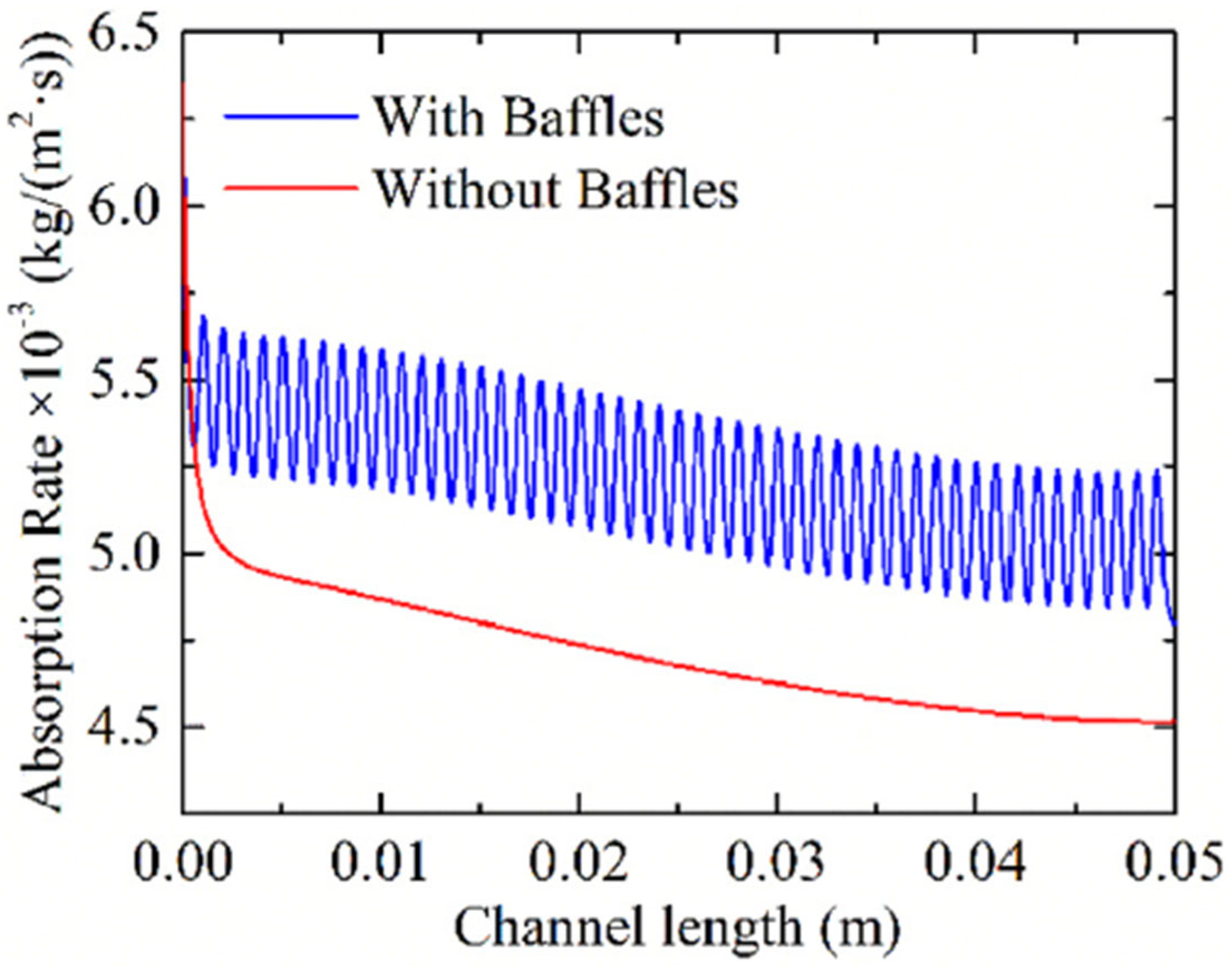
| [40] | 3D, steady state, laminar flow | Not informed | Species transport model with mass source terms | The average absorption rate increases with the inlet velocity of the solution, an ideal velocity of 0.004 m·s−1. As the thickness of the solution channel decreases, there is a decrease in the absorption rate and an increase in the pressure drop. A channel thickness of 0.5 mm is recommended for a balance between pump load and absorber performance. The addition of baffles increases the average absorption rate by around 20% and the volumetric cooling capacity by up to 3.3 times compared to conventional falling film absorbers. | ||
| [41] | 3D, steady state, laminar flow | The author considered a single-stage model | Knudsen number to evaluate water vapor transport; transport of concentrated species | The width of the solution channel has a negligible impact on heat and mass transfer but causes a 16.6% increase in pressure drop when reduced from 1.8 mm to 1.0 mm. Among the groove structures analyzed, the circular groove was the most efficient, reducing the solution pressure drop by 13.17% and improving the absorption rate by 0.57%. The circular groove structure proved to be more effective than thinner channels, improving the absorption rate with a slightly lower pressure drop, evidencing that groove structures are promising for optimizing the hydraulic and absorption performance of microchannel membrane-based absorbers. | ||
| [42] | 2D, steady state, laminar flow | Not specified | Species transport model with source terms; diffusion model; transport of concentrated species | Microchannels of 0.5 mm height performed better in absorbers and desorbers. The H2O-[EMIM][OAc] solution proved to be the most efficient in terms of absorption, while H2O-LiCl was the best for desorption. The optimum solution inlet velocity was 0.027 m·s−1. Different microchannel structures resulted in significant increases in absorption rates but also disadvantages in terms of pressure drop. | ||
| [64] | Properties (no information on whether the properties are constant or variable): database + external ref. | 3D, steady state | Not specified | Realizable k-epsilon; Poiseuille flow; Knudsen diffusion Stefan diffusion model; porous media model; chemical species transport model | There is a temperature difference between the volume and the membrane interface of up to 288.15 K. Stagnant areas in the solution channel caused velocity differences of up to 5 orders of magnitude compared to the midpoint in the solution channel. There was a concentration difference of up to 1.35% between the interface and the middle of the membrane. Desorption rate can be improved with geometric modifications to the membrane desorption device. | |
| [11] | ANSYS CFX | CFX library properties | 2D, steady state | Heterogeneous model; homogeneous model | - | Increases of 10% and 20% in the refrigerant vapor result in an increase of 0.93% and 1.7% of ammonia in the solution at the absorber outlet, respectively. Increases of 10% and 20% in the absorbent solution flow result in a 1% and 2% reduction in the mass fractions of ammonia in the absorbent solution. |
| [55] | COMSOL Multiphysics | External references | 2D, steady state, laminar flow, constant liquid film | Two-phase flow | Transport of concentrated species | Reducing the temperature of the inlet solution and increasing its concentration improves the mass transfer process. The mass transfer coefficient reaches a maximum near the inlet and gradually decreases downstream. The addition of copper oxide nanoparticles significantly increases the mass transfer flow. The effect of the nanoparticles is more pronounced under conditions of high temperature and low solution concentration at the inlet. |
| [46] | Variable property function of the solution temperature and concentration | 2D, laminar flow | Two-phase flow; phase field; | - | The diameter of the orifice and the speed of the bubble result in significant improvements in the transfer coefficients while increasing the concentration of the solution reduces them. The heat and mass transfer coefficients increase with increasing orifice diameter and bubble velocity but decrease with increasing LiBr solution concentration. | |
| [52] | Not informed | No information on the properties | 2D, laminar flow followed by wave flow | LBM for multiphase flow | Periodic and random perturbation methods (to simulate fluctuations at the interface of falling films) | The wavy flow has an apparent increase in heat and mass transfer. When the falling film tube reaches a certain length, the absorption capacity starts decreasing. |
| [54] | Constant properties (external ref.) | 2D, transient state, laminar flow | Simulating two-phase flow with a mobile interface using an ALE-IT algorithm | Transport of concentrated species | Unstable interfacial waves significantly enhance heat and mass transfer in the absorption process. Increasing the difference between the temperature of the inlet solution and the liquid sidewall resulted in higher interfacial heat and mass flow rates, both in stable and unstable flows. Varying the frequency of the inlet velocity oscillation affected the formation and dissipation of interfacial waves, directly impacting heat and mass transfer. | |
| Challenges | Proposed Solution | Justification | Ref. |
|---|---|---|---|
| Complexity of physical models | Steady State | Simplifies analysis by ignoring time variations. | [11,40,41,42,52,55,63,64] |
| Boundary conditions | Facilitates the problem definition and solution. | [11,55,58,63] | |
| Laminar flow | Facilitates mathematical modeling and reduces computing time. | [40,41,42,46,50,52,53,54,55,63,68] | |
| Stationary and non-slip walls | Reduces the need for detailed resolution near walls. | [40,48,63] | |
| Accurate representation of fluid properties | Constant fluid properties | Simplifies the energy and momentum equations. | [50,53,58,59,60] |
| Use of User-Defined Functions (UDFs) for property updates during simulations | Allows for dynamic updates of fluid properties, improving simulation accuracy. | [40,42] | |
| Incorporation of property libraries from experimental data or open-source databases | Enhances reliability by using validated data. | [11,46] | |
| The vapor–liquid interface is at equilibrium | Assumes that the thermodynamic properties of both phases at the interface can be determined directly from the phase equilibrium conditions, making it easier to simulate and analyze the system’s behavior. | [46,50,54,55] | |
| Incompressible fluid | Reduces the complexity of the mass conservation equation. | [46,50,64] | |
| Computational limitations | Use of symmetry | Reduces the computational domain and computing time. | [46,50,53] |
| Simplified mesh | Reduction in grid size or optimization of grid distribution in critical regions. | [40,50,53,55,64] | |
| Simplified geometry | Simplifies meshing and reduces computing time. | [11,46,48,50,53,55,58,59,60,68] |
| AUTHORS | OBJECTIVE |
|---|---|
| Panahizadeh et al. [25] | Optimize the best predictive model for the behavior of an absorption cooling system in a refinery, focusing on the COP and cooling capacity. This was achieved by applying three machine learning methods: Artificial Neural Networks (ANNs), support vector machines (SVM), and genetic programming. |
| Alcântara et al. [71] | Propose a methodological strategy to determine the transient behavior of a single-effect H2O-LiBr absorption chiller, utilizing machine learning techniques such as linear regression (LR), decision trees (DT), random forests (RF), and ANNs. |
| Al-Rbaihat et al. [72] | Employ a support vector machine regression method combined with particle swarm optimization to identify the optimal operational parameters of an NH3-H2O absorption chiller. |
| May Tzuc et al. [27] | Train an ANN to correlate the thermal properties of the solution and the absorption flow with easily measurable parameters, including concentrations, mass flow rates, pressures of saturated and diluted solutions, ammonia vapor flow and temperature, ambient temperature, and solution temperature. |
| Ashouri et al. [73] | Develop a multi-label machine learning model for membrane-based absorbers used in sorption heat exchangers, integrating the accuracy of numerical models with the efficiency of analytical models. |
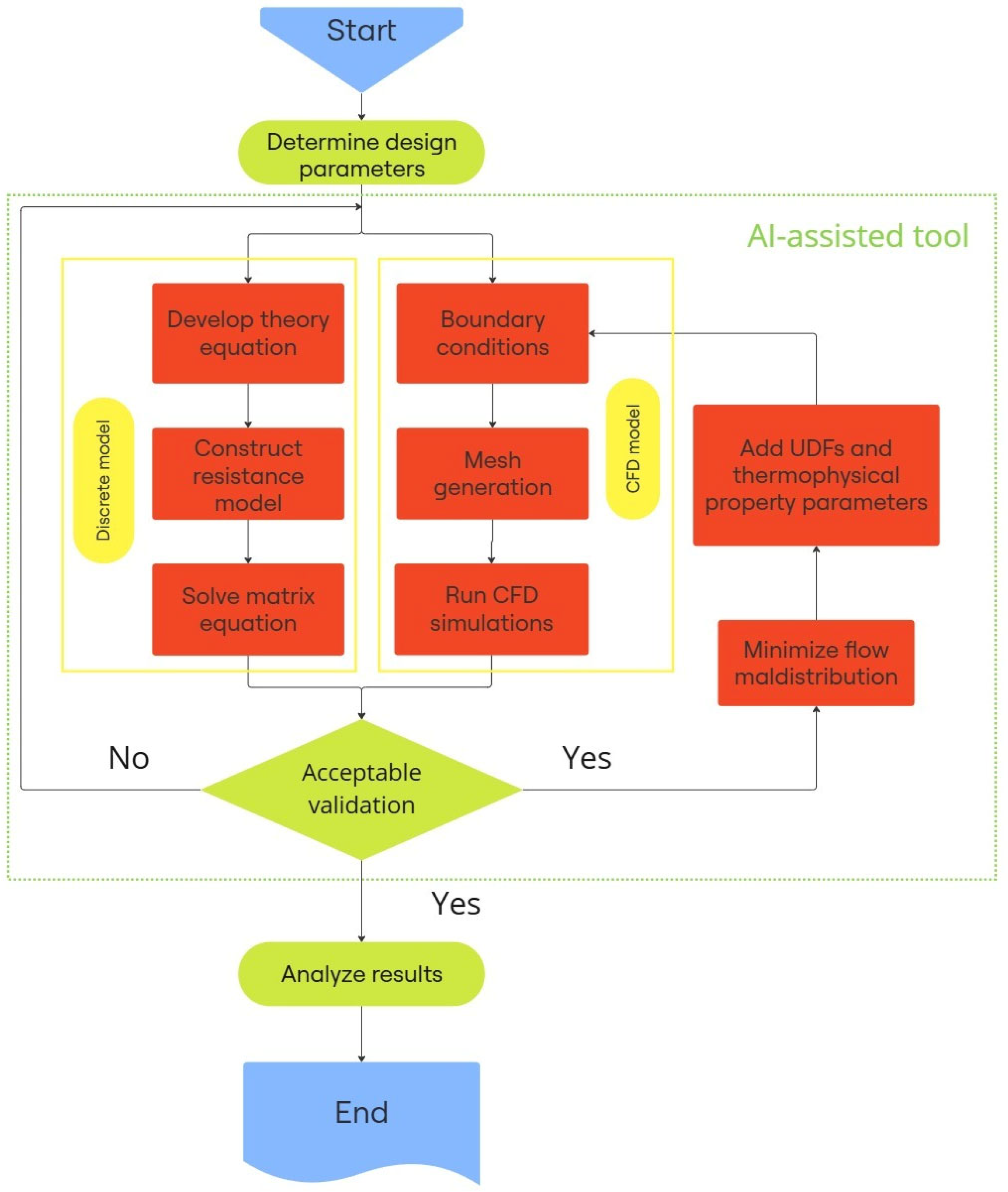
| Zhai et al. [74] | Utilize AI to develop more accurate models for heat and mass transfer, as well as pressure drop in the solution for microchannel membrane-based desorbers and absorbers in absorption refrigeration systems. |
Disclaimer/Publisher’s Note: The statements, opinions and data contained in all publications are solely those of the individual author(s) and contributor(s) and not of MDPI and/or the editor(s). MDPI and/or the editor(s) disclaim responsibility for any injury to people or property resulting from any ideas, methods, instructions or products referred to in the content. |
© 2025 by the authors. Licensee MDPI, Basel, Switzerland. This article is an open access article distributed under the terms and conditions of the Creative Commons Attribution (CC BY) license (https://creativecommons.org/licenses/by/4.0/).
Share and Cite
Alcântara, S.C.S.; da Costa, J.Â.P.; Ochoa, A.A.V.; Leite, G.d.N.P.; Lima, Á.A.S.; Silva, H.C.N.; Michima, P.S.A.; da Silveira, I.C.; de Araújo Caldas, A.M.; Altamirano, A. Critical Review of Advances and Numerical Modeling in Absorbers and Desorbers of Absorption Chillers: CFD Applications, Constraints, and Future Prospects. Energies 2025, 18, 314. https://doi.org/10.3390/en18020314
Alcântara SCS, da Costa JÂP, Ochoa AAV, Leite GdNP, Lima ÁAS, Silva HCN, Michima PSA, da Silveira IC, de Araújo Caldas AM, Altamirano A. Critical Review of Advances and Numerical Modeling in Absorbers and Desorbers of Absorption Chillers: CFD Applications, Constraints, and Future Prospects. Energies. 2025; 18(2):314. https://doi.org/10.3390/en18020314
Chicago/Turabian StyleAlcântara, Suellen Cristina Sousa, José Ângelo Peixoto da Costa, Alvaro Antonio Villa Ochoa, Gustavo de Novaes Pires Leite, Álvaro Augusto Soares Lima, Héber Claudius Nunes Silva, Paula Suemy Arruda Michima, Igor Cavalcanti da Silveira, Allysson Macário de Araújo Caldas, and Amín Altamirano. 2025. "Critical Review of Advances and Numerical Modeling in Absorbers and Desorbers of Absorption Chillers: CFD Applications, Constraints, and Future Prospects" Energies 18, no. 2: 314. https://doi.org/10.3390/en18020314
APA StyleAlcântara, S. C. S., da Costa, J. Â. P., Ochoa, A. A. V., Leite, G. d. N. P., Lima, Á. A. S., Silva, H. C. N., Michima, P. S. A., da Silveira, I. C., de Araújo Caldas, A. M., & Altamirano, A. (2025). Critical Review of Advances and Numerical Modeling in Absorbers and Desorbers of Absorption Chillers: CFD Applications, Constraints, and Future Prospects. Energies, 18(2), 314. https://doi.org/10.3390/en18020314


