


Abstract
Driven by the “Dual Carbon” objectives, integrated energy systems face an imperative to achieve synergistic optimization encompassing economic viability, low-carbon performance, and operational flexibility. To facilitate the low-carbon transition of combined heat and power (CHP) units, this study proposes an integrated optimization framework coupling CHP with diversified auxiliary installations. A multi-dimensional comprehensive evaluation is conducted on distinct coupling configurations incorporating electric boilers, heat pumps, thermal energy storage, and carbon capture and storage. Initially, an electro-thermal optimization model integrating multi-component devices—including CHP with carbon capture and storage (CHP-CCS), electric boilers, heat pumps, and thermal energy storage—is developed. A comprehensive evaluation index system is established across four dimensions: economic efficiency, operational flexibility, low-carbon performance, and technology readiness level. Subsequently, the Tanimoto coefficient is introduced to supersede the Euclidean distance in the conventional Technique for Order Preference by Similarity to Ideal Solution (TOPSIS) methodology, thereby refining the similarity measurement approach for optimal solution selection. Collectively, the configuration integrating CHP-CCS with electric boilers and heat pumps emerges as the optimal pathway. This configuration ensures reliable electricity and thermal load supply while substantially reducing system-level low-carbon transition costs and carbon emissions, concurrently enhancing renewable energy accommodation capacity.
1. Introduction
To realize China’s “Dual Carbon” goals, developing multi-energy systems (electro-thermal, integrated electricity, and gas) [1] with progressively increasing clean energy penetration is essential to enable large-scale optimal allocation of renewable power resources [2]. This imperative necessitates accelerating low-carbon transitions in integrated energy infrastructures. Focusing specifically on electro-thermal system transition pathways, this study grounds its investigation in China’s distinctive energy mix and the heat-determined electricity operation constraints of combined heat and power (CHP) units [3]. Enhancing renewable integration and deploying non-fossil thermal energy technologies constitute the fundamental approach to achieving low-carbon transformation in electro-thermal systems. Consequently, China has established a target of achieving 1200 GW of renewable power capacity by 2030 [4]. Nevertheless, the inherent intermittency of renewable generation and the operational constraints of CHP units’ heat-determined electricity production pose substantial challenges to renewable grid integration. This necessitates coupling components such as thermal energy storage installations and electric boilers to decouple the thermo-electric nexus of the CHP system [5], thereby enhancing peak-shaving flexibility. Simultaneously, the Action Plan for Promoting High-Quality Development of the Heat Pump Industry issued by the National Energy Administration underscores heat pumps as pivotal technological assets for low/zero-carbon heating. These systems synergistically harness low-grade thermal sources—including ambient air, hydro-resources, geothermal reservoirs, and industrial waste heat—to substantially curtail fossil fuel demand. Furthermore, retrofitting carbon capture and storage (CCS) infrastructure effectively mitigates carbon emissions from electro-thermal systems [6]. Hence, orchestrating synergistic operations among renewable sources, CHP units, and multi-faceted coupling devices assumes paramount importance for advancing sustainable decarbonization of integrated energy systems [7].
The strategic deployment of thermoelectric coupling devices constitutes the predominant pathway for achieving decoupling of thermal and electrical constraints within integrated energy systems. Refs. [8,9] established a coordinated dispatch model for integrated electric-thermal energy systems incorporating standalone thermal energy storage and electric boilers, demonstrating that the deployment of thermal energy storage and electric boilers significantly reduces aggregate operational expenditures while enhancing grid-level wind power integration capacity. Ref. [10] employed a multi-criteria assessment framework—including the Normalized Stratification Factor, modified MIX number, exergy, and exergy efficiency—to evaluate thermal stratification quality characteristics across diverse operating regimes. Ref. [11] integrated district heating network pipeline reconfiguration capabilities, mitigating transmission congestion and elevating wind energy utilization rates. Refs. [12,13] proposed novel cogeneration systems integrating organic Rankine cycles, absorption heat pumps, and compression heat pumps within CHP units. This configuration concurrently accommodates power generation loads and partial thermal loads, yielding substantial peak-shaving enhancements.
Ref. [14] developed a computable general equilibrium model incorporating granular power technology modules to systematically evaluate economy-wide impacts of multi-incentive policies on large-scale CCS deployment in the power sector. Refs. [15,16,17] introduced comprehensive flexible operation strategies for carbon capture power plants considering wind-solar synergy optimization, achieving low-carbon economic dispatch in power systems. Ref. [18] advanced the “extracting exergy to replace heat” paradigm based on sodium-based carbon capture, establishing an exergy-heat transfer network for CHP-coupled CCS systems that enables zero-energy carbon capture. Ref. [19] formulated a data-driven distributionally robust optimization model for day-ahead scheduling of park-level integrated energy systems coordinating CCS and CHP units. Results indicate this model simultaneously ensures operational robustness and optimizes economic performance and renewable energy accommodation capacity. Collectively, these analyses reveal that extant research predominantly focuses on techno-economic dimensions, with insufficient attention to systematic assessment methodologies for low-carbon transition pathways in electric-thermal coupled systems.
Given the inherent heterogeneity among operational parameters within integrated energy systems, multi-attribute decision-making (MADM) frameworks present a methodologically rigorous approach for comprehensive performance evaluation. To further dissect the contributions of individual system components and clarify the driving factors behind observed performance differences, attribution analysis methods can be integrated, offering valuable interpretability and diagnostic insights [20]. This study employs the TOPSIS methodology, with core analytical components encompassing indicator selection protocols and evaluation algorithms. Refs. [21,22] established a multi-dimensional assessment architecture incorporating security, efficiency, renewable penetration, carbon intensity, and operational flexibility metrics, thereby constructing a holistic quantitative framework for evaluating low-carbon transition trajectories in power systems. Ref. [23] proposed an enhanced methodology structured around “Planning-Retrieval-Screening-Reporting-Reflection” cycles, which systematically synthesizes existing performance assessment paradigms—including evaluation frameworks, indicators, and methodologies—while providing actionable guidance for future research directions. Ref. [24] developed an assessment mechanism for evaluating grid compatibility of source-grid-load-storage projects through the integrated application of Analytic Hierarchy Process (AHP), entropy weighting, and TOPSIS. Ref. [25] introduced the conceptual innovation of “vertical plane distance” via connection vectors to compute relative closeness coefficients within TOPSIS. Collectively, critical research gaps persist: Regarding evaluation metrics, standardized performance indicators for assessing coupling components in CHP configurations remain underexplored; methodologically, conventional Euclidean distance measures fail to account for inter-indicator covariance structures, thereby compromising the accurate characterization of complex attribute interdependencies.
This research centers on low-carbon transition pathway planning for CHP systems, with principal contributions and innovations articulated as follows:
A coordinated configuration optimization model was established, integrating CHP units with thermoelectric coupling devices while ensuring electrical-thermal supply-demand equilibrium. This model synergistically coordinates CHP-CCS units, electric boilers, heat pumps, and thermal energy storage systems.
For comprehensive thermoelectric system evaluation, a multi-criteria assessment framework was developed incorporating economic viability, operational flexibility, low-carbon performance, and technology readiness level. The TOPSIS was employed for multi-attribute decision-making, with the Tanimoto coefficient substituted for Euclidean distance to enhance model robustness by effectively addressing covariance representation deficiencies.
Finally, a real-world case study based on a practical system in Northwest China was conducted, yielding comparative performance evaluations across diverse configuration pathways.
2. Materials and Methods
2.1. Electro-Thermal Systems and Multi-Faceted Coupling Devices: Synergistic Effects Analysis
The low-carbon electro-thermal dispatch framework integrating the CHP unit with auxiliary heating devices—including electric boilers, heat pumps, and thermal energy storage units—developed in this study is schematically depicted in Figure 1. The system architecture incorporates conventional thermal power units, CHP plants, and wind farms, supplemented by electric boilers, heat pumps, and thermal storage installations as auxiliary heat sources for thermal load provision. CCS infrastructure is concurrently integrated to mitigate system-wide carbon emissions.
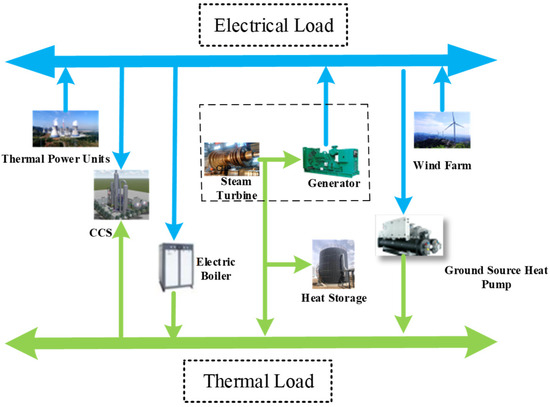
Figure 1.
Architectural Framework of the Integrated Electro-Thermal Energy System.
- (1)
- Functioning as quintessential electro-thermal coupling assets, electric boilers deliver critical operational flexibility through dual modalities. During nocturnal thermal demand peaks, they consume electrical energy to directly supply heating loads. Concurrently, under wind power surplus conditions, they absorb excess renewable generation to charge thermal storage units. This dual functionality simultaneously enhances renewable accommodation capacity while alleviating thermo-electric coupling constraints inherent in conventional CHP systems, thereby establishing electric boilers as indispensable components in low-carbon energy transitions.
- (2)
- Thermal energy storage installations significantly augment systemic flexibility via diurnal energy arbitrage strategies. During daylight periods characterized by diminished heating demand, these units store surplus thermal energy generated by CHP plants or electric boilers. Subsequently, during evening demand peaks, the stored energy is discharged to satisfy heating requirements. This strategic load-shifting capability not only optimizes thermal asset utilization but also creates essential grid headroom for enhanced nocturnal wind power integration, effectively transforming temporal energy mismatches into operational advantages.
- (3)
- Heat pumps constitute high-efficiency energy conversion platforms that upgrade low-grade thermal sources (ambient air, geothermal reservoirs, or industrial waste heat) to utilizable temperatures through minimal electricity consumption. Their deployment efficiently addresses residential and industrial heating demands while elevating overall energetic efficiency. Critically, expanded implementation of industrial waste heat recovery and geothermal/air-source systems can obviate new CHP construction [26]. By generating substantial thermal output per unit electrical input, heat pumps concurrently advance renewable integration and reduce fossil fuel dependence. When synergistically operated with electric boilers and thermal energy storage, these systems further amplify operational flexibility and decarbonization potential across integrated energy infrastructures.
- (4)
- Carbon capture installations serve dual functional purposes within electro-thermal systems. Primarily, they sequester substantial volumes from combustion processes, directly mitigating carbon emissions. Secondarily, their significant parasitic loads function as flexible demand resources that dynamically reduce net power output from thermal units. This inherent load-shifting capability provides crucial grid-balancing services during renewable intermittency events, while their operational flexibility complements the thermal decoupling achieved through boilers, heat pumps, and storage technologies—collectively forming a comprehensive flexibility portfolio for deep decarbonization. During CCS operation, the thermal energy demand per unit mass of captured is influenced by factors such as capture efficiency and flue gas composition. For the sake of computational feasibility, this study assumes a constant value for this parameter across the entire modeling framework.
The operational characteristics of the CHP unit are described by Equations (1) and (2).
where and denote the total electrical and thermal power output of the CHP unit at time t, respectively; represents the thermal power generated by the boiler; and signify the power generation efficiencies of the high/medium-pressure cylinders and low-pressure cylinder, respectively; designates the heat exchange efficiency; and indicates the proportion of low-pressure steam entering the heating network at time t.
The electrical and thermal power consumption of the carbon capture equipment during operation are described by Equations (3) and (4).
where denote the thermal power required for capturing a unit mass of .
2.2. Electro-Thermal System Operational Optimization Framework Incorporating Multi-Faceted Coupling Devices
The integrated optimization model for CHP units coupled with thermo-electrically coupled devices, established in this study, holistically incorporates thermal and electrical power balancing constraints, economic efficiency considerations, and low-carbon environmental objectives. Addressing the heat-governed electricity generation constraints inherent to the CHP unit, the model operates under a generation portfolio comprising conventional thermal power plants, a CHP system, and predetermined wind power capacity. The schematic representation of this framework is depicted in Figure 2.
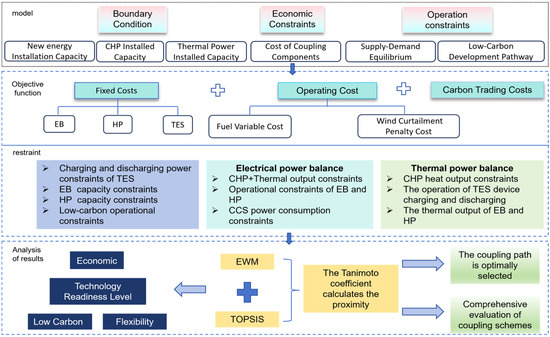
Figure 2.
Integrated Optimization Framework for Thermo-Electrically Coupled Pathways in CHP Unit.
2.2.1. Objective Function
The objective function, formulated to minimize the integrated operational expenditure of the electro-thermal system, encompasses coal consumption costs, wind curtailment penalties, carbon trading expenditures, and coupling component expenditures as expressed in Equation (5).
where denotes the comprehensive operational cost of the electro-thermal system; represents the system fuel consumption cost; is the wind curtailment penalty cost; signifies the carbon trading expenditure; indicates the composite cost of coupling components, with denoting the set.
The coal consumption cost of the system comprises fuel inputs from both conventional thermal units and CHP units, as expressed in Equations (6)–(8).
where denotes the coal price; and represent the coal consumption of CHP units and conventional thermal units at time t, respectively; indicates the electrical power output of thermal unit i at time t; , , are the coal consumption characteristic coefficients of conventional thermal units; and , , , , , denote the coal consumption characteristic coefficients of CHP units.
The cost of wind power curtailment of the system is shown in Equation (9).
where denotes the unit wind curtailment cost, represents the predicted wind power at time t, and indicates the grid-integrated wind power during period t.
The carbon trading mechanism achieves emission reduction through carbon allowance transactions. Negative carbon trading costs occur when the system sells surplus allowances to external entities. Under the principle of aggregate emission control, regulatory authorities allocate carbon allowances to emission entities within the system [27]. This study employs a free allocation scheme for distributing allowances to individual units. The resulting carbon allowance allocation for the electro-thermal system is described by Equation (10).
where denotes the carbon allowance allocated to the system, represents the unit free carbon emission allowance allocation rate, and signifies the characteristic operational parameter of the CHP units.
The actual carbon emissions of the system comprise emissions from conventional thermal units and CHP units, as formalized in Equations (11)–(13).
where denotes the total carbon emissions of the system, represents the carbon emissions from conventional thermal units, and indicates the carbon emissions from CHP units; , , are the carbon emission characteristic coefficients of conventional thermal units; and , , , , , denote the carbon emission characteristic coefficients of CHP units.
The carbon capture volume of CCS is described by Equation (14).
where denotes the carbon capture efficiency, represents the flue gas split ratio for CCS unit i at time t.
The carbon trading cost for the system is described by Equation (15).
The composite cost of coupling components comprises daily-amortized investment costs and maintenance costs. Maintenance costs are derived as an annual expenditure calculated as a fixed percentage of the initial investment cost, subsequently converted to daily operational expenses, as formalized in Equation (16).
where denotes the daily operational cost of the k-th electric boiler, and represent its unit power investment cost and configured power rating, and signifies the unit power maintenance cost; indicates the daily operational cost of the k-th heat pump, and correspond to its unit power investment cost and configured power rating, with being the unit power maintenance cost; defines the daily operational cost of the k-th thermal energy storage, and denote its unit power and unit capacity investment costs, and specify the configured power rating and storage capacity, and is the unit power maintenance cost; , , and designate the operational lifespans (years) of the k-th electric boiler, heat pump, and thermal energy storage, respectively.
2.2.2. System Operational Constraints
The operational constraints for conventional thermal power units are described by Equations (17) and (18).
where and denote the lower and upper bounds of the active power output for thermal units at time tt, respectively; and and represent the maximum ramp-down and ramp-up rates of the thermal units, respectively.
The CHP units are governed by the following technical constraints are described by Equations (19)–(22).
where and denote the lower and upper bounds of the electrical power output for CHP unit i, respectively; represents the upper limit of thermal power output for CHP unit i; and indicate the maximum ramp-down and ramp-up rates of electrical power for CHP unit i; and and signify the maximum ramp-down and ramp-up rates of thermal power for CHP units i.
The dispatched wind power must not exceed forecasted availability at any time interval, as formalized in Equation (23).
The thermal power output of electric boilers is given by Equation (24).
where denotes the thermal power output of electric boiler k at time t, represents the electrical power input to electric boiler kk at time t, and is the electro-thermal conversion efficiency of the electric boiler.
The electrical power input to electric boilers is bounded by their configured capacity, as formalized in Equation (25).
where B denotes the upper limit of electrical input power for electric boiler k.
The thermodynamic performance of heat pumps [28] is described by Equation (26).
where denotes the thermal power output of heat pump k at time t, represents the electrical power consumption of heat pump k, and signifies the coefficient of performance (COP), defined as the ratio of heat transferred from a low-temperature source to a high-temperature sink to the electrical energy input.
The electrical power input to heat pumps is constrained by their installed capacity, as formalized in Equation (27).
where denotes the lower bound of electrical input power for heat pump k, and represents its upper bound of electrical input power.
The operational constraints for thermal energy storage are described by Equations (28) and (29), governing their state-of-charge dynamics and power exchange limits.
where denotes the state-of-charge of thermal energy storage k at time t, represents its round-trip efficiency, and indicate the charging and discharging thermal power, respectively; and specify the minimum and maximum charging/discharging power limits. Crucially, charging and discharging processes are mutually exclusive within any time interval, and the storage state-of-charge resets cyclically between scheduling periods to ensure operational continuity.
2.2.3. Electro-Thermal System Supply-Demand Equilibrium
System-wide electricity balancing constraints is described by Equation (30).
where denotes the electrical load demand.
System-wide thermal balancing constraints is described by Equation (31).
where denotes the thermal load demand.
2.3. Integrated Optimization Framework for Electro-Thermal Systems with Multi-Device Coupling
2.3.1. Comprehensive Evaluation Metrics for Electro-Thermal System Optimization
The low-carbon transition of electro-thermal systems necessitates holistic integration of four dimensions: economic viability, operational flexibility, low-carbon performance, operations and technology readiness level. Consequently, a comprehensive evaluation of diverse CHP unit coupling pathways is imperative to identify optimal solutions. This study establishes four primary indicators corresponding to six secondary metrics, as delineated in Table 1.

Table 1.
Multi-Criteria Evaluation Metrics for Low-Carbon Transition Solutions in Electro-Thermal Systems.
- (1)
- Economic Viability Indicator
At the system level, the aggregate operational expenditure serves as the economic viability metric for assessing diverse electro-thermal coupling pathways.
- (2)
- Operational Flexibility Metrics
System flexibility is characterized by renewable energy accommodation capacity and abrupt load variation response capability. This work quantifies flexibility through wind power absorption performance () during system operation. Furthermore, the thermal source reserve margin is introduced as a critical indicator, with the nocturnal peak thermal demand period (02:00–05:00) serving as a test case to evaluate pathway-specific load disturbance resilience.
where denotes the aggregation of thermal energy supply units within the system; represents the maximum thermal output capacity of unit i; corresponds to the actual thermal output of unit ii during time interval t; and signifies the aggregate thermal demand of the system at time t.
From an energy structure perspective, the electric heating share within the thermal load profile quantifies the penetration level of electrical energy in district heating systems. This metric serves as a dual indicator of electro-thermal coupling intensity and systemic flexibility, thereby enabling comparative effectiveness evaluation across heterogeneous coupling pathways.
where denotes the electric heating penetration ratio within the thermal load, represents the electrically sourced thermal output, and signifies the aggregate thermal output of the system.
- (3)
- Low-Carbon Performance Indicator
At the environmental tier, aggregate carbon emissions accrued over a dispatch cycle serve as the primary metric for quantifying system-wide low-carbon operational performance.
- (4)
- Operations and Technology Readiness Level
To quantify the technical advancement and implementation readiness of each transition pathway, this study incorporates a Technology Readiness Level for assessing the developmental maturity and feasibility of the technologies. Quantitative metric allocations are detailed in Table A2.
2.3.2. Multi-Criteria Synthetic Evaluation Methodology
Given the inherent intercorrelations among the economic viability, operational flexibility, and low-carbon performance indicators—exemplified by carbon trading costs embedded within economic metrics and the inverse relationship between renewable energy absorption capacity and carbon emissions—this study employs an integrated TOPSIS-Tanimoto methodology with entropy-determined weights for multi-criteria pathway evaluation. The Tanimoto coefficient inherently integrates computational elements of vector norms and inner products, thereby enabling its application to effectively characterize inter-indicator correlations. Consequently, this coefficient demonstrates superior sensitivity when compared with conventional Euclidean distance metrics [29]. Consider two arrays denoted as and . The Tanimoto coefficient is described by Equation (36):
The vectorial form is presented in Equation (37).
Hence, the procedural framework for the TOPSIS-Tanimoto method incorporate ing entropy-weighted valuation is delineated as follows.
Step 1: Normalize sample data to mitigate scale discrepancies.
Step 2: Compute indicator weights via entropy weight method [30]: , and derive the weighted normalized matrix.
Step 3: Determine solution proximity by substituting Euclidean distance with Tanimoto coefficient; for each scheme i, calculate its Tanimoto coefficient relative to and , respectively.
where and denote the positive and negative ideal solutions, respectively, and represents the element at the i-th row and j-th column of the weighted normalized matrix.
At this stage, the dissimilarity indices relative to the positive and negative ideal solutions are formally expressed as Equation (40).
Step 4: Derive the comprehensive closeness coefficient.
The comprehensive closeness coefficient for each coupling pathway is subsequently computed as formalized in Equation (41).
Procedural details regarding computational weight assignment and dataset normalization reside within Appendix A.1.
3. Results and Discussions
This study investigates an isolated CHP system comprising two CHP units, two conventional thermal power units (400 MW maximum output each), with integrated wind farms, electric boilers (EB: 60 MW capacity, 0.98 electro-thermal efficiency), ground-source heat pumps (HP: 20 MW input limit, = 3.5), and thermal energy storage (TES: 70 MW power/300 MWh capacity, 0.90 charge-discharge efficiency). Capital expenditures include EBs at 1.0 million CNY/MW, HP at 2.8 million CNY/MW, and TES at 150,000 CNY/MWh (energy) + 35,000 CNY/MW (power), with respective maintenance costs of 18, 20, and 10.5 CNY/MW/day and lifespans of 20, 15, and 20 years. The carbon capture system requires 0.64 MWth/t at 90% efficiency. Economic parameters comprise coal (700 CNY/t), wind curtailment penalties (100 CNY/MWh), and carbon pricing (100 CNY/t). The carbon emission characteristic coefficients for conventional thermal units are specified as = 0.00312, = −0.24444, and = 10.33908. For CHP units, the coefficients = 0.00407, = −0.22635, = 0.00009, = −0.03395, = 0.00122, and = 30.5132 characterize their emission profile. A 24-h optimization horizon with 1-h dispatch intervals was implemented using wind/electrical/thermal load forecasts derived from hourly data from a typical day in western China is utilized as the system load values. CHP specifications are detailed in Table 2.
Table 2.
Technical specifications of CHP unit.
This study evaluates the benefits of CHP units assisted by electric boilers, heat pumps, and thermal storage through six comparative scenarios. Scenario M1 serves as the baseline without auxiliary devices to validate coupling path effectiveness. Scenarios M2 and M3 add carbon capture systems while separately testing electric boilers (M2) and heat pumps (M3) to compare their performance. Scenario M4 combines electric boilers and heat pumps, where boilers convert wind power to heat and heat pumps upgrade low-grade heat using electricity to improve clean energy utilization. Scenarios M5 and M6 integrate electric boilers or heat pumps with thermal energy storage, creating a flexible power-heat conversion and heat time-shift system that relaxes electro-thermal coupling constraints and increases clean heating share. The scheme design is shown in Table 3.
Table 3.
Example settings.
3.1. Analysis of Optimization Results
Optimization results are detailed in Table 4. All scenarios include CCS, resulting in negative carbon trading costs as the system sells carbon quotas. This environmental revenue represents income from carbon allowance sales. The baseline scenario M1 shows the highest fuel costs, wind curtailment costs, and lowest environmental revenue. Compared to M1, scenario M2 reduces wind curtailment costs by 65.19% while increasing environmental revenue by 25% and lowering total costs by 9.3%. Scenario M4 achieves more significant improvements with a 94% reduction in wind curtailment costs, 22.7% increase in environmental revenue, and 13.4% decrease in total costs. These results demonstrate the model’s effectiveness in enhancing renewable energy integration while reducing operational costs and carbon emissions.
Table 4.
Optimization results.
Figure 3 presents the power balance profiles over one dispatch cycle for scenarios M2 and M4. The operation of electric boilers and heat pumps exhibits significant temporal variations. In Figure 3a, which depicts the power balance with electric boilers alone, substantial wind curtailment persists during nocturnal heating peaks. Conversely, Figure 3b demonstrates that heat pumps maintain longer operational durations than electric boilers. This difference arises from the heat pumps’ superior economic and low-carbon performance, leading to their preferential dispatch for fulfilling thermal loads.
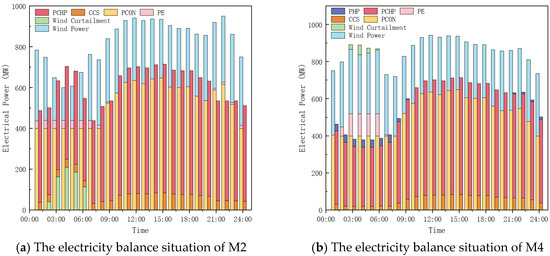
Figure 3.
Electricity balance under different schemes.
Figure 4 illustrates the operational profiles of thermal energy storage units in scenarios M5 and M6. The storage units supply heat for thermal loads and carbon capture systems during 21:00–6:00 while charging between 9:00 and 19:00. At approximately 9:00, the heat pumps in M6 deliver higher thermal output than the electric boilers in M5, resulting in superior charging efficiency for the M6 storage unit. Although daytime storage charging increases operational pressure on CHP units and raises fuel consumption, it enables thermal energy time-shifting that meets nocturnal heating demands. This reduces CHP thermal output at night, alleviates electro-thermal coupling constraints, enhances renewable energy accommodation capacity, and fulfills low-carbon operational requirements.
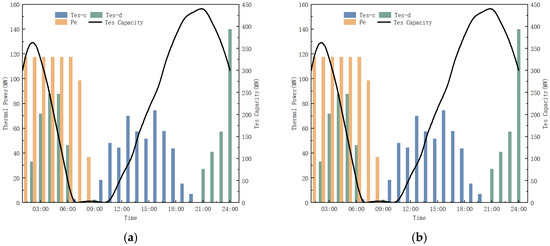
Figure 4.
Thermal energy storage operation under different schemes. (a) The operation status of the thermal energy storage in Scheme M5, (b) The operation status of the thermal energy storage in Scheme M6.
Figure 5 compares carbon emissions across scenarios M1, M2, and M4. The integration of power-to-heat components (electric boilers and heat pumps) significantly reduces system emissions during high-heat-demand periods (1:00–9:00). Conversely, during the 21:00–24:00 interval, the M2 electric boiler-only configuration demonstrates substantially lower emission reduction efficacy compared to the M4 combined boiler-heat pump system.
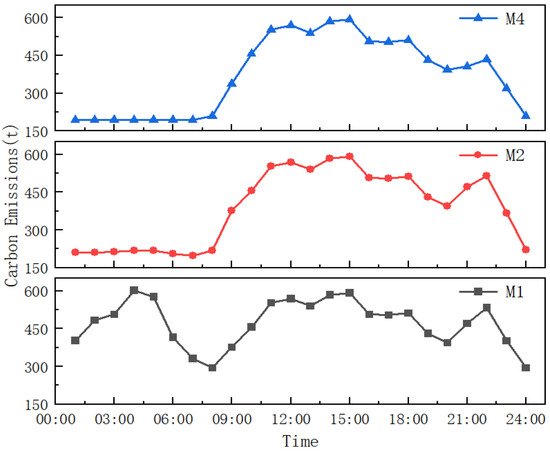
Figure 5.
Carbon emissions under different scenarios.
3.2. Analysis of Evaluation Results
Figure 6 presents the assigned weights for six selected indicators, where W1 to W6 correspond to , , , , , , respectively.
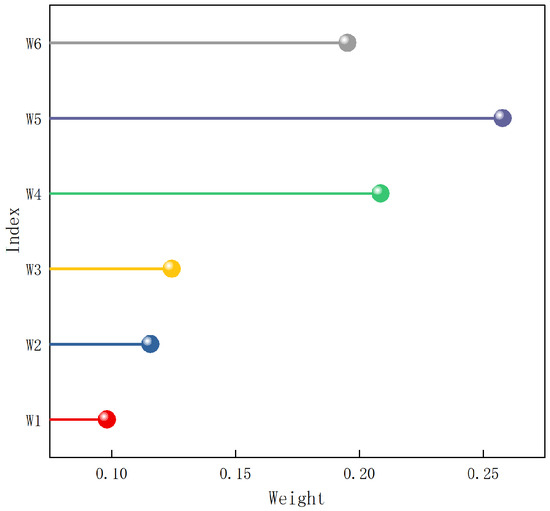
Figure 6.
Weight distribution of different indicators.
Figure 7 presents composite scores of coupling pathways evaluated via the TOPSIS methodology. As M1 demonstrated uniformly inferior metrics, it was excluded from scoring. The pathway ranking by descending composite score is M4 > M6 > M3 > M5 > M2.
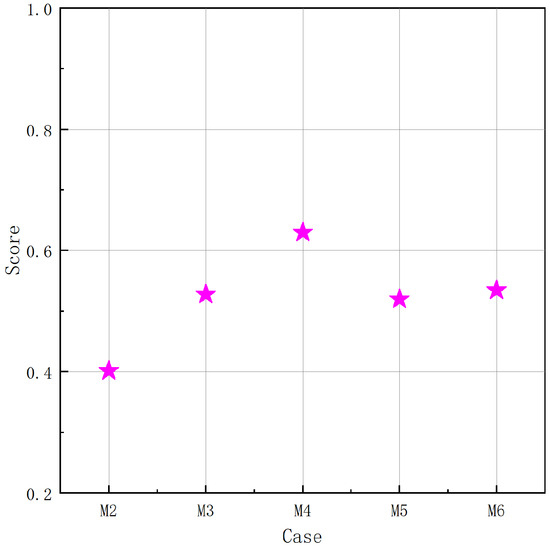
Figure 7.
Comprehensive scores of each coupling path.
M4 and M6 significantly outperform M2, indicating that multi-device configurations enhance system economy and flexibility more effectively than single-component solutions. Heat-pump-integrated pathways (M3, M4, M6) achieve higher scores, confirming their substantial contribution to low-carbon CHP transition. M4 superiority over M6 reveals that electric boilers better satisfy multidimensional system requirements than thermal energy storage. Consequently, M4 emerges as the optimal solution, achieving balanced optimization of economic viability, operational flexibility, and low-carbon performance.
3.3. Sensitivity Analysis
The capacity of coupling devices critically determines their contribution to electro-thermal system decarbonization. This subsection conducts sensitivity analysis on heat pump and electric boiler capacities in Scenario M4. Variations in total system cost and carbon emissions are shown in Figure 8, where the x-axis represents the ratio of auxiliary heat source capacity to the baseline configuration.
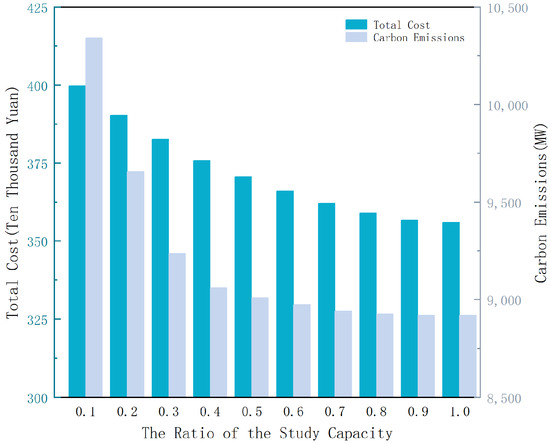
Figure 8.
Impact of auxiliary heat source capacity on system total cost and carbon emissions.
Figure 8 demonstrates that system total cost and carbon emissions progressively decrease as auxiliary heat source capacity increases. Beyond 80% of the baseline capacity, these metrics stabilize. This trend occurs because expanded heat pump and electric boiler capacities enhance wind energy utilization, increase thermal output for heating loads, and provide additional thermal power to carbon capture systems. However, after exceeding the 80% threshold, nocturnal wind curtailment is substantially eliminated. Further capacity expansion thus yields no additional cost or emission reductions. Consequently, optimal sizing of electric boilers and thermal storage proves essential to unify economic efficiency and low-carbon objectives.
Fluctuations in carbon pricing and coal costs significantly influence system-level carbon emission profiles, as evidenced by the correlative dynamics delineated in Figure 9.
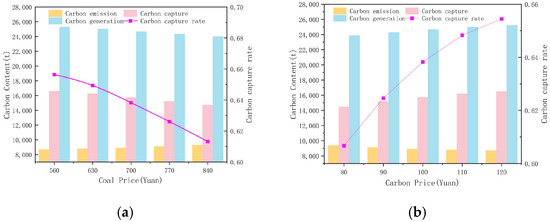
Figure 9.
Influence of coal price and carbon price on system-level carbon capture and carbon emissions. (a) Influence of coal price on system-level carbon capture and carbon emissions. (b) Influence of carbon price on system-level carbon capture and carbon emissions.
As evidenced in Figure 9a, rising coal prices induce a moderate reduction in system coal consumption. However, this fuel curtailment diminishes the electrical and thermal power allocated to CCS, consequently depressing the carbon capture rate and elevating carbon emissions. Figure 9b demonstrates that elevated carbon prices simultaneously amplify carbon generation and capture volumes while enhancing the carbon capture rate. Notably, a 10% increase in the unit carbon trading price correlates with a 2.9% reduction in carbon emissions, highlighting the critical importance of establishing and refining carbon trading mechanisms to augment capture efficiency, mitigate carbon emissions, and accelerate the low-carbon transition of energy systems.
This section conducts a parametric analysis examining the impact of backup thermal capacity on aggregate system expenditures and carbon emissions across Configurations M5 and M6 with integrated thermal storage. Comprehensive results are delineated in Table A4.
4. Conclusions
This study focuses on the low-carbon transition of thermal CHP systems, conducting a comprehensive assessment of coupling solutions—including electric boilers, heat pumps, and thermal storage units—across four dimensions: economic viability, operational flexibility, low-carbon performance, and technology readiness level. The proposed integrated evaluation framework demonstrates significant generalizability, enabling parametric simulation of diverse regional scenarios through adjustable inputs while maintaining adaptability to varying boundary conditions.
Integrating theoretical modeling and empirical analysis, three principal conclusions emerge.
Compared to configurations with only electric boilers, installing heat pumps or implementing multi-device collaborative operation more effectively improves system flexibility, reduces operational costs, enhances renewable energy accommodation, and decreases carbon emissions while ensuring reliable electricity and heat supply.
The comprehensive evaluation index system constructed across four dimensions—economic viability, operational flexibility, low-carbon performance, and technology readiness level—effectively reflects the strengths and weaknesses of each coupling pathway. The evaluation methodology accurately scores and ranks all pathways, demonstrating that the combined configuration of electric boilers and heat pumps represents the optimal solution.
The prices of coal and carbon have a certain impact on the carbon emissions of the system. Selecting appropriate capacities for coupling devices is essential to ensure system economic efficiency and low-carbon performance. In this study, total system cost and carbon emissions reach optimal levels when the installed capacity reaches 80% of the baseline capacity.
Author Contributions
Conceptualization, J.L.; methodology, J.L.; software, Q.H.; validation, Q.H.; formal analysis, N.Z.; investigation, R.H.; resources, R.H.; data curation, G.L.; writing—original draft, J.L.; writing—review and editing, Q.H. and G.L.; visualization, Q.H.; supervision, N.Z. and R.H.; project administration, N.Z. All authors have read and agreed to the published version of the manuscript.
Funding
This research was funded by the National Key Research and Development Plan “Energy Storage and Smart Grid Technology” Project (2024YFB2408400); Inner Mongolia Autonomous Region Science and Technology Breakthrough Project (2024KJTW0017) and Inner Mongolia Natural Science Foundation under Grant (2025MS05012).
Institutional Review Board Statement
Not applicable.
Informed Consent Statement
Not applicable.
Data Availability Statement
The original contributions presented in the study are included in the article, further inquiries can be directed to the corresponding author.
Conflicts of Interest
The authors declare no conflicts of interest.
Abbreviations
The following abbreviations are used in this manuscript:
| CHP | Combined heat and power |
| CCS | Carbon capture and storage |
| TOPSIS | Technique for order preference by similarity to ideal solution |
| EWM | Entropy weight method |
Appendix A
Appendix A.1
Normalize the sample data to eliminate dimensional effects.
where denotes an element within the decision matrix.
Determine indicator weights via the entropy weighting method. Calculate the indicator proportions as formalized in Equation (A2).
Calculate information entropy as specified in Equation (A3)
Calculate the weights as specified in Equation (A4).
Appendix A.2
Figure A1 illustrates CHP-CCS unit operation and wind power accommodation for scenarios M1, M2, and M4. M1 (no coupling devices) exhibits electrical output around 500 MW during nocturnal heating peaks (01:00–08:00) due to heat-led electricity generation constraints. Despite CCS power consumption, CHP unit high output causes significant wind curtailment.
M2 (with electric boilers) reduces CHP electrical output to approximately 450 MW during 01:00–08:00. CCS power consumption exceeds 30 MW, as boilers utilize surplus wind for heating, partially alleviating thermoelectric coupling and enabling greater CCS energy supply, thereby reducing actual carbon emissions.
M4 (electric boilers and heat pumps) further lowers total CHP output to 350 MW during the same period, with CCS power consumption dropping to 20 MW. Heat pumps convert low-grade heat from water/air into usable heat while utilizing wind power, minimizing CHP output. Consequently, inherent system emissions decrease, reducing CCS capture requirements.

Figure A1.
Perational performance of CHP-CCS under different schemes.
Appendix A.3
Figure A2 presents carbon emissions and capture rates across scenarios. Schemes with coupling devices (M2–M6) exhibit lower carbon emissions than M1 due to alleviated electro-thermal coupling and enhanced wind accommodation, all achieving >60% carbon capture. M4 (electric boilers + heat pumps) demonstrates the lowest carbon generation and emissions by utilizing renewable energy and ambient heat sources. M3 and M6 show lower carbon generation than M2 and M5, confirming heat pumps outperform electric boilers in low-carbon electro-thermal system operation.
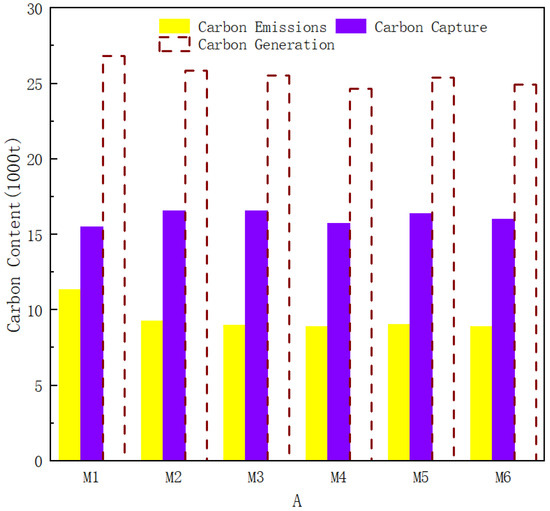
Figure A2.
Carbon flow under different schemes.
Appendix A.4
Figure A3 delineates the impact of auxiliary heating capacity incorporating thermal storage units on total system costs and carbon emissions. Subfigure (a) corresponds to configurations with electric boilers and thermal storage, while (b) represents systems integrating heat pumps with thermal storage. As evidenced, when auxiliary heating capacity exceeds 90%, the majority of curtailed wind power during nocturnal periods is effectively utilized. Consequently, further capacity expansion yields diminishing marginal returns for both cost reduction and emission mitigation.
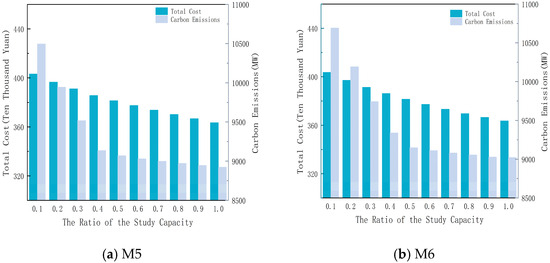
Figure A3.
Impact of auxiliary heat source capacity on system.
Appendix B
Table A1.
Evaluation indicator.
Table A1.
Evaluation indicator.
| Indicator | ||||||
|---|---|---|---|---|---|---|
| M1 | 411.09 | 5688.1 | 0 | 0 | 11335 | 9 |
| M2 | 372.6 | 7022 | 7.57% | 5.89% | 9290.5 | 9 |
| M3 | 370.59 | 6727.7 | 11.8% | 8.11% | 8986.8 | 8 |
| M4 | 355.96 | 7623.8 | 33.79% | 11.68% | 8920.6 | 7 |
| M5 | 363.63 | 7360.9 | 24.57% | 5.72% | 9022.6 | 8 |
| M6 | 363.44 | 7018.4 | 29.63% | 7.18% | 8923.2 | 7 |
The Technology Readiness Level (TRL) framework comprises nine distinct stages, wherein TRL 1–3 correspond to fundamental research, TRL 4–6 encompass technological development, and TRL 7–9 represent engineering application phases. The TRL classification of electric boilers, heat pumps, and thermal energy storage systems fundamentally arises from inherent disparities in their physical mechanisms and systemic complexity. Electric boilers attain the highest TRL (Level 9). This is attributable to their reliance on Joule’s law for direct electrical-to-thermal energy conversion, a process characterized by deterministic physical behavior requiring solely univariate power regulation. Heat pump technology, which elevates thermal energy quality via refrigerant phase-change cycles, exhibits significant operational sensitivity to working conditions and necessitates bivariate control of temperature and pressure parameters. Consequently, it achieves TRL 8. Thermal energy storage systems, governed by the stringent constraints of the Second Law of Thermodynamics during spatiotemporal heat transfer, demand coordinated regulation across three-dimensional variables: temperature field distribution, phase-change kinetics, and heat flux rates. Thus, they are classified at TRL7. The integration of electric boilers with thermal storage maintains univariate control characteristics owing to functional decoupling, resulting in a combined TRL of 8. Conversely, the coupling of heat pumps with thermal storage exhibits a reduced TRL (Level 7) relative to standalone heat pumps. This degradation stems from the heat pump’s operational variability and the inherent phase-change hysteresis within thermal storage media. Integrated systems combining electric boilers and heat pumps face intrinsic thermodynamic limitations: peak system efficiency is constrained by the Carnot efficiency boundary of heat pumps and the Joule efficiency ceiling of electric boilers, precluding simultaneous optimization of both subsystems. Given their limited industrial deployment, such configurations are assigned TRL 7.
This metric remains subject to calibrated modifications aligned with regional imperatives, thereby accommodating heterogeneous environmental constraints across diverse geographical contexts.
Table A2.
Indicator weight.
Table A2.
Indicator weight.
| Indicator | ||||||
|---|---|---|---|---|---|---|
| Weight | 0.0981 | 0.1156 | 0.1243 | 0.2087 | 0.2579 | 0.1953 |
Table A3.
Evaluation outcomes generated via modified TOPSIS-Tanimoto methodology.
Table A3.
Evaluation outcomes generated via modified TOPSIS-Tanimoto methodology.
| Case | Positive Ideal Solution Distance | Negative Ideal Solution Distance | Proximity | Rank |
|---|---|---|---|---|
| M2 | 0.8718 | 0.5851 | 0.4016 | 5 |
| M3 | 0.7757 | 0.8675 | 0.5279 | 3 |
| M4 | 0.5875 | 1.0000 | 0.6299 | 1 |
| M5 | 0.7883 | 0.8521 | 0.5195 | 4 |
| M6 | 0.8475 | 0.9725 | 0.5343 | 2 |
Table A4.
Evaluation outcomes derived from conventional TOPSIS methodology.
Table A4.
Evaluation outcomes derived from conventional TOPSIS methodology.
| Case | Positive Ideal Solution Distance | Negative Ideal Solution Distance | Proximity | Rank |
|---|---|---|---|---|
| M2 | 0.3725 | 0.1991 | 0.3483 | 5 |
| M3 | 0.2429 | 0.2489 | 0.5061 | 3 |
| M4 | 0.1953 | 0.3854 | 0.6637 | 1 |
| M5 | 0.2515 | 0.2458 | 0.4942 | 4 |
| M6 | 0.2672 | 0.2889 | 0.5195 | 2 |
As evidenced by Table A3 and Table A4, the evaluation outcomes derived from the conventional TOPSIS methodology align with those generated by the modified TOPSIS-Tanimoto approach, thereby validating the efficacy of the enhanced model. Owing to heightened sensitivity to intrinsic indicator variations within the modified Tanimoto coefficient framework, the computational determination of distances to positive and negative ideal solutions yields magnified disparities among alternative solutions.
References
- Zhang, S.; Zhang, X.; Zhang, R.; Gu, W.; Cao, G. N-1 Evaluation of Integrated Electricity and Gas System Considering Cyber-Physical Interdependence. IEEE Trans. Smart Grid 2025, 16, 3728–3741. [Google Scholar] [CrossRef]
- Chen, L.; Wang, C.; Wu, Z. Reinforcement Learning-Based Time of Use Pricing Design Toward Distributed Energy Integration in Low Carbon Power System. IEEE Trans. Netw. Sci. Eng. 2025, 12, 997–1010. [Google Scholar] [CrossRef]
- Lu, Z.G.; Shi, B.B.; He, L.G.; Li, X.P.; Guo, X.G.; Li, Y.L. Optimal Scheduling of Virtual Power Plant Based on Carbon Capture and Storage–Power to Gas–Electrolytic Molten Salt Synergy. Power Syst. Technol. 2023, 47, 3088–3103. [Google Scholar]
- Chang, X.; Wu, Z.; Wang, J.; Zhang, X.; Zhou, M.; Yu, T.; Wang, Y. The coupling effect of carbon emission trading and tradable green certificates under electricity marketization in China. Renew. Sustain. Energy Rev. 2023, 187, 113750. [Google Scholar] [CrossRef]
- National Development and Reform Commission (NDRC). The 14th Five-Year Plan for Renewable Energy Development; NDRC: Beijing, China, 2021. [Google Scholar]
- Yuan, G.L.; Liu, H.Q.; Yu, J.F.; Fang, F. Combined Heat and Power Optimal Dispatch of Virtual Power Plant with Carbon Capture Thermal Power Units. Proc. CSEE China 2022, 42, 4440–4449. [Google Scholar]
- Wang, C.; Wu, Z.; Wei, L.; Yang, L.; Zhang, Y.; Yuan, B.; Zhou, M. Evaluating the Externality Value of Distributed Photovoltaics: Industry-Specific Investment Decisions Under Diverse Pricing Schemes. Renew. Energy 2025, 247, 122986. [Google Scholar] [CrossRef]
- Liu, B.; Meng, K.; Dong, Z.Y.; Wei, W. Optimal dispatch of coupled electricity and heat system with independent thermal energy storage. IEEE Trans. Power Syst. 2019, 34, 3250–3263. [Google Scholar] [CrossRef]
- Chen, X.; McElroy, M.B.; Kang, C. Integrated energy systems for higher wind penetration in China: Formulation, implementation and impacts. IEEE Trans. Power Syst. 2018, 33, 1309–1319. [Google Scholar] [CrossRef]
- Huang, Y.; Chen, Q.; Zhang, Z.; Liu, X.; Tu, J.; Zhang, L. Optimal Scheduling of Combined Electric and Heating Considering the Control Process of CHP Unit and Electric Boiler. Processes 2023, 11, 753. [Google Scholar] [CrossRef]
- Thomas, B.; van Schalkwyk, P.; Engelbrecht, J.; Haase, P.; Maier, A.; Widmann, C.; Booysen, M. Thermodynamic analysis of stratification in thermal energy storages implemented in cogeneration systems. Appl. Therm. Eng. 2023, 232, 121015. [Google Scholar] [CrossRef]
- Xue, Y.; Shahidehpour, M.; Pan, Z.; Wang, B.; Zhou, Q.; Guo, Q.; Sun, H. Reconfiguration of District Heating Network for Operational Flexibility Enhancement in Power System Unit Commitment. IEEE Trans. Sustain. Energy 2020, 12, 1161–1173. [Google Scholar] [CrossRef]
- Sun, D.; Liu, Z.; Zhang, H.; Zhang, X. Performance Analysis of a New Cogeneration System with Efficient Utilization of Waste Heat Resources and Energy Conversion Capabilities. Energies 2024, 17, 3347. [Google Scholar] [CrossRef]
- Zhang, Y.; Ge, Z.; Yang, Y.; Hao, J.; Xu, L.; Du, X.; Træholt, C. Carbon reduction and flexibility enhancement of the CHP-based cascade heating system with integrated electric heat pump. Energy Convers. Manag. 2023, 280, 116801. [Google Scholar] [CrossRef]
- Guo, X.; Lou, S.; Wu, Y.; Wang, Y. Low-carbon operation of combined heat and power integrated plants based on solar-assisted carbon capture. J. Mod. Power Syst. Clean Energy 2022, 10, 1138–1151. [Google Scholar] [CrossRef]
- Cui, Y.; Deng, G.B.; Zeng, P.; Zhong, W.Z.; Zhao, Y.T.; Liu, X.Y. Multi-time scale source-load dispatch method of power system with wind power considering low-carbon characteristics of carbon capture power plant. Proc. CSEE China 2022, 42, 5869–5886+6163. [Google Scholar]
- Ding, C.; Zhou, Y.; Pu, G.; Zhang, H. Low carbon economic dispatch of power system at multiple time scales considering GRU wind power forecasting and integrated carbon capture. Front. Energy Res. 2022, 10, 953883. [Google Scholar] [CrossRef]
- Guo, P.; Xue, Q.; Wang, J.; Bai, P.; Gu, M.; Hua, J.; Duan, P. The exploration of the essential need for decarbonization and the achievement of zero energy consumption in the CHP + carbon capture system. Energy 2025, 316, 134534. [Google Scholar] [CrossRef]
- Wang, Y.; Gao, S.; Jia, W.; Ding, T.; Zhou, Z.; Wang, Z. Data-driven distributionally robust economic dispatch for park integrated energy systems with coordination of carbon capture and storage devices and combined heat and power plants. IET Renew. Power Gener. 2022, 16, 2617–2629. [Google Scholar] [CrossRef]
- Chen, Z.; Wu, Z.; Wei, L.; Yang, L.; Yuan, B.; Zhou, M. Understanding the synergy of energy storage and renewables in decarbonization via random forest-based explainable AI. Appl. Energy 2025, 390, 125891. [Google Scholar] [CrossRef]
- Liang, Y.; Dong, H.; Gao, Y.; Hu, L.; Gao, Y.; Lin, Z.; Zeng, F.; Xu, Y. A comprehensive evaluation index system for low-carbon development of power systems in a load-intensive city. Front. Energy Res. 2024, 12, 1453754. [Google Scholar] [CrossRef]
- Chi, C.; Zhao, H.; Han, J. Study on Quantitative Evaluation Index of Power System Frequency Response Capability. Energies 2022, 15, 9423. [Google Scholar] [CrossRef]
- Deng, D.Q.; Li, C.; Zu, Y.F.; Liu, L.Y.J.; Zhang, J.; Wen, S. A Systematic Literature Review on Performance Evaluation of Power System From the Per-spective of Sustainability. Front. Environ. Sci. 2022, 10, 925332. [Google Scholar] [CrossRef]
- Wang, X.L.; Pan, D.; Shi, T.C. A friendliness evaluation method for the source-network-load-storage integration project under the background of new power system. Power Syst. Clean Energy 2024, 40, 72–82. [Google Scholar]
- Huang, L.H.; Liu, C.W.; Wu, F.F. An Improved TOPSIS Multi-Attribute Decision-Making Method Based on the "Vertical Plane" Distance of Connection Vectors. Syst. Eng. 2019, 37, 119–129. [Google Scholar]
- Liu, S.; Guo, Y.; Wagner, F.; Liu, H.; Cui, R.Y.; Mauzerall, D.L. Diversifying heat sources in China’s urban district heating systems will reduce risk of carbon lock-in. Nat. Energy 2024, 9, 1021–1031. [Google Scholar] [CrossRef]
- Zhu, W.Y.; Luo, Y.; Hu, B. Optimized combined heat and power dispatch considering decreasing carbon emission by coordination of heat load elasticity and time-of-use demand response. Power Syst. Technol. 2021, 45, 3803–3812. [Google Scholar]
- Guo, Y.H.; Hu, B.; Wan, L.Y. Short-Term Optimal Economic Operation of a Combined Heat and Power Microgrid with Heat Pumps. Autom. Electr. Power Syst. 2015, 39, 16–22. [Google Scholar]
- Chang, Q.; Liu, D.H.; Yang, Y. An Improved TOPSIS Multi-Attribute Decision-Making Method. Ordn. Ind. Autom. 2024, 43, 49–55. [Google Scholar]
- Li, Z.; Qi, L.; Sun, Z.; Chen, S.; Liu, X.; Xiao, S.; Wang, Y.; Chen, J. Offshore Wind Power Transmission Decision-making Based on Grey Correlation and Topsis. J. Phys. Conf. Ser. 2023, 2659, 12021. [Google Scholar] [CrossRef]
Disclaimer/Publisher’s Note: The statements, opinions and data contained in all publications are solely those of the individual author(s) and contributor(s) and not of MDPI and/or the editor(s). MDPI and/or the editor(s) disclaim responsibility for any injury to people or property resulting from any ideas, methods, instructions or products referred to in the content. |
© 2025 by the authors. Licensee MDPI, Basel, Switzerland. This article is an open access article distributed under the terms and conditions of the Creative Commons Attribution (CC BY) license (https://creativecommons.org/licenses/by/4.0/).