


Abstract
Accounting for nearly 40% of final energy consumption, buildings are central to European energy policy. The Directive on Energy Performance of Buildings establishes a benchmarking system known as cost-optimality to set minimum energy performance requirements in new and existing buildings. This paper applies the cost-optimal methodology to an existing structure located in the Mediterranean area (Southern Italy). The building is composed of two units that have been considered for different uses: hotel and multi-residential. Several energy efficiency and renewable measures have been implemented both individually and as part of packages of measures. The cost-optimal solution has been identified as able to optimize energy consumption and costs from financial and macroeconomic perspectives. The first reference building (hotel use) shows a maximum reduction of primary energy and CO2 emission of about 42%, falling within the CasaClima energy class D, while the second reference building (residential use) achieves a value of 88% for primary energy and 85% for CO2 emissions, falling into class B. Thermal dispersions through the envelope can be limited using a suitable combination of insulating materials while a variety of technical variants are selected, such as VRF (variant refrigerant flow) systems, heat pumps with fan coils associated with controlled mechanical ventilation, solar thermal and photovoltaic. This paper illustrates the development of energy retrofit projects, in order to reach a balance between efficiency measures and costs for a building having two different uses, providing guidance to similar case studies related to a warm climate.
Highlights
Evaluation of cost-optimal solutions for existing building retrofit.
Analysis of two different intended building uses for the same structure.
Comparison between hotel and residential use for cost-optimal assessment.
Establishment of combination of variants for energy efficiency improvement.
Assessment of global costs for the identification of the cost-optimal configuration.
1. Introduction
Buildings account for nearly 40% of final energy consumption in Europe [1]. Considering the high energy consumption and high potential energy savings of this sector, European energy policies are aimed at improving energy efficiency and promoting renewable energy sources. The Energy Performance of Buildings Directive (EPBD, Directive 2002/91/EC), and its recast (EPBD recast, Directive 2010/31/EC) represent the core of energy efficiency promotion. The EPBD recast introduces the target of nearly zero energy buildings (nZEBs) from 2018 onwards [2]. However, achieving the nZEB target remains an open challenge in Europe, especially in existing buildings [3].
The EPBD recast also introduces the concept of cost-optimality that is strictly connected to nZEBs since the cost-optimal level represents the minimum level of ambition for nZEBs performance. The cost-optimal methodology is explained in the Delegated Regulation No. 244/2012 [4] and its guidelines [5]. According to the cost-optimal framework, Member States have to consider construction alternatives in terms of costs and energy performance to identify the combination of energy efficiency measures able to provide the best performance at the lowest cost. The methodology involves the definition of a reference building and the application of energy efficiency measures to reduce primary energy consumption [6] and address the choice of the most economically advantageous solutions. These refer to global costs [7], expressed in terms of net present value, obtained through financial or macroeconomic conditions. This configuration can be found in the lower part of the curve that reports global costs and energy consumption for each combination of measures.
The alternative measures have to be applied to a reference starting building, new or under renovation, to reduce its energy consumption and CO2 emissions. The building energy performance has to be evaluated according to the EPBD recast.
Cutting building energy consumption requires considering buildings with a new holistic approach, evaluating its lifecycle, impact on the environment as well as materials, and technological elements [8]. To reach this new building target, all the aspects of the building lifecycle, from design to demolition, have to be considered from an energy, environmental and economic perspective. For example, a building system performance has to be evaluated under varying boundary conditions and different climates, considering costs and energy sources availability, end-users behavior and facilities management [9].
Reaching the nZEBs target in new buildings appears to be feasible according to design studies [10]. Studies on energy performance optimization have been performed especially in new buildings [11,12,13,14,15]. However, the challenge of achieving energy efficiency targets in Europe remains for the existing built environment. The renovation rate of existing buildings is currently low due to the economic crisis which started in 2007. In 2011, the renovation rate of the European building stock has been assessed at between 0.5% and 2.5% per year [16]. Buildings dating between 1945 and 1980 have the largest energy demand. Moreover, the existing stock is characterized by a high heterogeneity in terms of uses, climatic areas, construction traditions and different system technologies [17].
Accommodation facilities (hotel, guesthouse, bed and breakfast) are characterized by high energy consumptions in comparison with other building uses. Hospitality accommodation consumes about the quadruple of residential houses. The high consumption is related to ventilation, heating, cooling, refrigeration, lighting, IT equipment and appliances [18].
This study applies the cost-optimal methodology to an existing structure composed of two units that have been evaluated for two different building uses: hotel and multi-residential. These buildings belong to Mediterranean climate and are in a degraded peripheral area.
The aim of the paper is to find the cost-optimal solutions for the renovation of this existing structure. Several energy efficiency measures have been selected and applied to the baseline reference buildings obtaining a combination of several technical variants organized in packages of measures. Natural and local materials have been preferred as emitting less CO2 compared with traditional materials. Energy performance and global costs have been evaluated for the obtained configurations. A financial and macroeconomic study has been carried out performing a sensitivity analysis to add robustness to the evaluation. The cost-optimal solution has been derived and discussed in terms of technical characteristics and potential savings. The purpose of this study is to illustrate how energy retrofit projects in the Mediterranean climate may be developed, finding the best choices in terms of minimum energy consumption and lowering costs for renovation.
1.1. Building Retrofit and Technology Innovation
The existing building stock is old, inefficient and is being only slowly renovated. In recent years, several studies have focused on this issue, pointing out solutions for building renovation and strategies to improve energy efficiency and street lighting quality [19].
The deep crisis that has been affecting the construction sector since 2007 has caused a reduction of investments in traditional buildings, reduced by 58.7% during the last decade. Therefore, the retrofit sector is predominant and attracts investments of around 115 billion euros compared to 51 billion euros related to the new construction sector. The decrease of investments in new buildings, and the increase of investments in retrofit, maintenance and renewable energy sources are the key dynamics that best characterize the recent economic crisis [20].
The decrease of investments in new buildings is a result of the large amount of buildings remaining unsold in previous years. Buildings built over the last decade have quickly become outdated with less innovative construction technologies and therefore not attractive as the innovative technologies spread during the recent retrofit market. It is desirable to renovate existing buildings with high energy efficiency solutions, in order to guarantee, also in future years, lower energy consumptions at lower costs, understanding and considering the whole building lifecycle including materials and technical systems [21].
The construction sector is evolving rapidly proposing new solutions to fulfill new building concepts which require innovation and information to be successful. Innovation is needed to make the building project technologically adequate. Information and training of the involved actors are important for proper installations as well as for skills, knowledge and expertise development.
Technology plays a major role in exploiting the massive potential benefits of reducing energy consumptions in buildings. The envelope represents a key element able to dynamically control the interaction between indoors and outdoors.
Mazzeo et al. [22] expose a methodology to describe walls behavior in summer and winter to lower energy consumption. The study highlights the importance to evaluate how the dynamic parameters are influenced by the variations of the external and internal loads, changing the operating mode of the technological system and the shortwave radiative heat fluxes. Several studies [23,24,25] have been carried out to define the characteristics of a high energy performant external envelope for a warm climate, highlighting the importance of heat storage capacity. It has been possible to note that external walls with high values of internal areal heat capacity can reduce significantly and delay temperature peaks inside the building. Material selection is crucial for reducing energy consumption. Eco-friendly elements are referred, highlighting non-toxic, renewable, recycled and locally sourced materials. The wall performance is verified monitoring thermal conductivity and thermal capacity, a low value of thermal conductivity improves insulation during winter and a high thermal capacity enables heat accumulation, a fundamental parameter in summer.
It is important to find which the most suitable technologies for renovation are and to reach the cost-optimal configuration for a specific building. Similar retrofit scenarios for two different types of buildings can be linked to compare two different possibilities of reuse.
1.2. Literature Overview
Non-residential buildings account for 25% of the European building stock. The hospitality sector accounts for 2% of the world’s CO2 emissions [26]. The number of non-residential buildings is about 4.3 million with a large part oriented towards the tertiary sector. About 61 thousand units are accommodation facilities, having a surface of 0.8 million square meters. From ENEA and ISTAT data, processed by CRESME, the average energy consumption of non-residential buildings is about 137 kWh/m2y (y = year), while hotels in Italy have a specific consumption of 182 kWh/m2y [27].
According to the retrofit strategy of the national stock (STREPIN, Strategia per la riqualificazione energetica del parco immobiliare nazionale) [28], average electricity and thermal consumptions related to 2015 amount to 110 and 150 kWh/m2y, respectively. The report shows that in Italy about 500 buildings are hotels (1.4 million square meters), resulting a potential energy savings up to 1167 GWh/y.
Non-residential buildings present large possibility of improvements in energy consumption. For example, the 85% of these buildings do not have renewable energy production, 1.4% underwent partial or total renovation, and 9% are abandoned. In order to comply with EU requirements, an efficient renovation of hotels is necessary. Several studies focus on the benefits that the renovation of existing stock implies. Santamouris et al. [29] analyze energy consumption of 158 existent Greek hotels and show possible retrofit solutions based on the envelope and technical systems, achieving energy savings of 20%.
According to CRESME [20], the stock of residential constructions total to 11.8 million in Italy. This sector consumes yearly almost 319 TWh both for thermal and electricity requirements, with an annual energy cost of about 45 billion euros.
In the residential sector, according to the scenarios of ANCE 2015, investments in new dwellings have been estimated to have reduced by 8.8% compared to 2014. The investments addressed to requalification of the housing stock shows a low increase of 2% [30].
If a mix of different interventions is applied to the residential building stock for climatic zone, it is possible to reduce energy consumption by over 39%, with a decrease of energy costs of about 8.8 billion euros per year and savings of about 5.7 billion euros. This allows a 12.6% energy consumption reduction corresponding to a reduction of about 9.5 million tons of CO2 emissions.
An estimation of the energy systems in Mediterranean regions has been carried out [31]. In particular, it has been pointed out the key role of climatic data in the predictions of photovoltaic system performance.
Ballarini et al. define a methodology for reference buildings identification for the residential sector in order to divide the existing stock into specific archetypes. The attention is focused on the potential reduction of energy consumption and CO2 emissions in the European residential building stock [32].
Martinopoulos et al. [33] compare different solutions of heating systems applied to new and existing residential buildings located in Mediterranean climate, paying attention to running costs.
Kolaitis et al. [34] define a comparative assessment between internal and external thermal insulation in energy efficient retrofits of residential buildings. The authors also consider water vapor condensation in internal materials and find a significant reduction of total energy requirements.
In this paper, the aim is to reach a balance between energy and cost-effective measures for two different intended uses: hotel and residential buildings. Section 2 reports the cost-optimal methodology, focusing on the variant measures, suitable for a warm climate. Subsequently, Section 3 shows the final values for each combination and finally Section 4 reports the conclusions.
2. Materials and Methods
The methodology implemented in this paper allows the identification of the cost-optimal level for an existing structure located in the Mediterranean climate. The case study has been analyzed comparing two different building uses to comply with the regulation requirements regarding the adoption of at least two reference buildings which differ for subcategories. Starting from the definition of the reference building, energy efficiency measures have been selected for envelope and systems. Technical variants, either individually or in combination (packages), have then been chosen and implemented in the building. The energy performance has been evaluated for each case to derive the differences among the variants and obtain the cost-optimal level. This has been found at the lowest point of the curve describing the solutions for different technical variants and packages.
2.1. The Cases Study
This paper reports the study of a building located near Lecce (South Italy). This site is part of the national climatic zone C (1153 degree-days) belonging to the Mediterranean area [35]. This climate is characterized by non-extreme winters, having an average temperature of about 13 °C, and hot and dry summers, having an average temperature of about 30.5 °C [36]. Rainfall is usually concentrated in autumn and winter, while spring and summer are arid [37]. In this region, the indoor temperature in a building is fixed at 20 °C during the heating period from November to March and 26 °C during the cooling period.
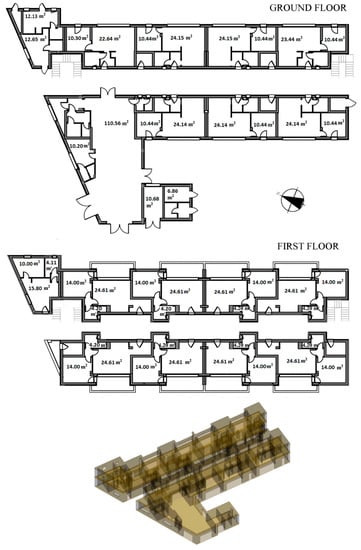
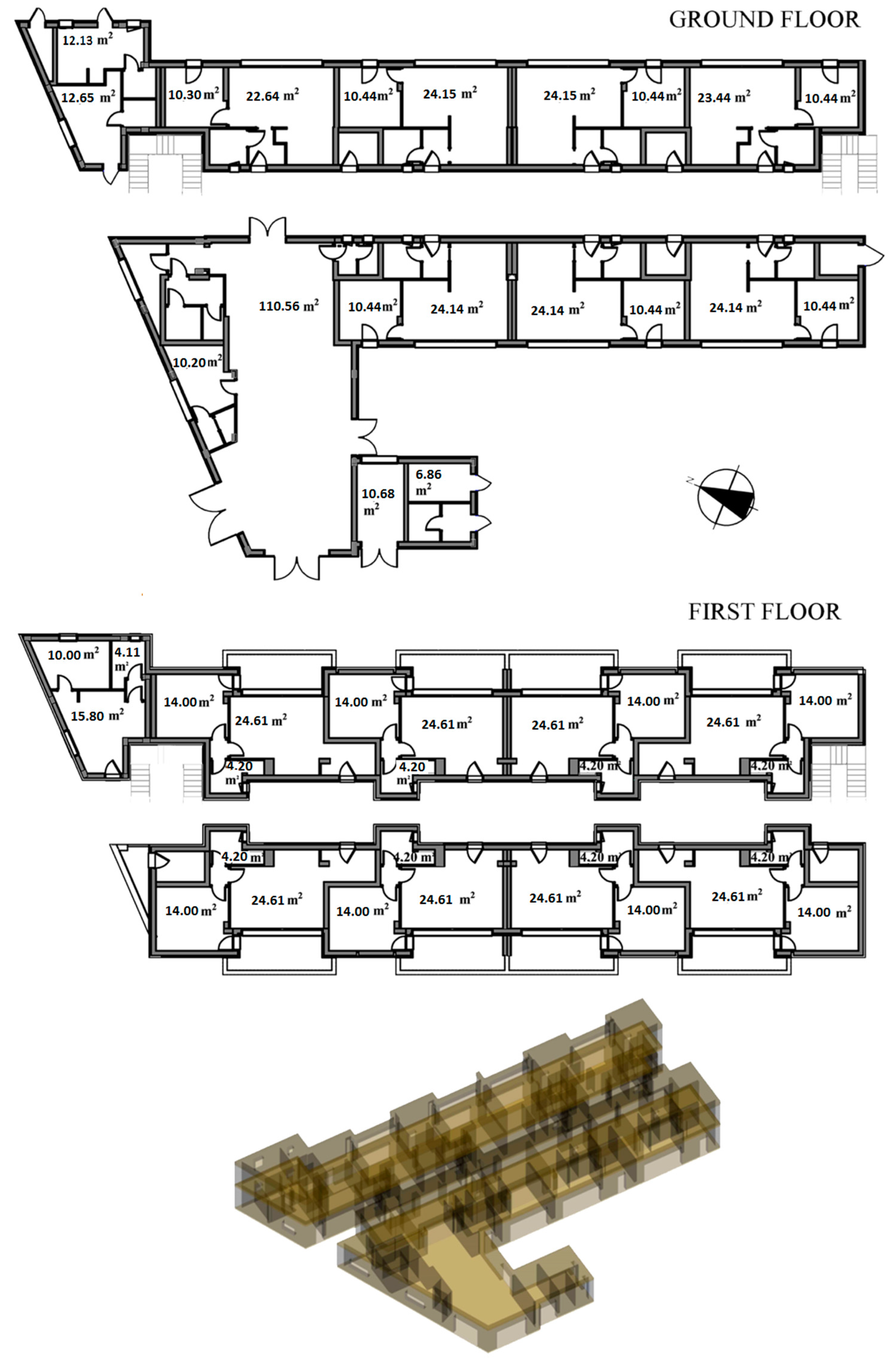
The studied building is composed of two units (Figure 1). Considering the building outer shell structure, the same geometrical features are considered for both the three-star hotel and the multi-residential building.
Figure 1.
Geometrical features and 3D view of the reference building.
The envelope materials are those typically used in local traditional constructions. In more detail, the external walls are composed of 25 cm thick bricks, slabs are made of bricks, the roof consists of reinforced concrete with a local limestone (Cursi Stone) and the floor is composed of gravel and tiles (Table 1).
Table 1.
Materials used in the existing building.
The selected reference building is a real existing building, located in a specific place. The analyzed building at the current status presents a skeleton structure, not equipped with windows and technological systems. Aluminum frames with no thermal breaks and single float glasses have been selected for all windows. A different system has been selected for the two different units. The main air conditioning season is summer, therefore the installation of splits is chosen for the cooling period, while boilers and radiators have been selected for residential use. Each housing unit consists of an entrance-living room, a cooking area, a bathroom and a bedroom. The building has been divided into two blocks having a shape factor (S/V) equal to 0.76 and 0.78, respectively. Renewable energy sources and controlled mechanical ventilation plants are not present in the building.
2.2. Energy Efficiency Measures
Different energy efficiency measures have been applied to walls, windows and technical systems, considered as technical variants to obtain several combinations to be compared.
The external walls have a huge impact on the energy performance of a building because they control the heat transmission between the indoors and the outdoors.
Eight wall typologies (Table 2) have been considered to improve the building efficiency.
Table 2.
Stratigraphy of walls variants.
In more details, walls 1 to 4 have 10 cm thickness insulating material. Walls 5 to 8 are characterized by the same materials but have 6 cm of insulating layer. The plaster variants are the lime gypsum (PL_1) and the natural hydraulic lime (PL_2). The insulating variants are rock wool (INS_1), polyurethane foam (INS_2), hemp fibers (INS_3) and wood combined with hemp fiber panels (INS_4). The matching of plaster and insulating materials has been chosen to combine together natural and non-natural materials.
Compared to the base scenario, a variation of the original layers has been considered for both slab and roof. In details, as shown in Table 3, the cover slab consists of plaster, slab, concrete screed, extruded polystyrene panel, sand and natural stone. The floor is made of tiles in grès, concrete, expanded polystyrene, igloo, concrete screed and gravel.
Table 3.
Slab and floor stratigraphy.
The windows are critical elements because they control solar gains, heat losses and thermal bridges [38]. Energy improvements can be reached using specific solutions to reduce heat transfer. Among them, the application of a gas layer having a thermal conductivity lower than air; the introduction of a low emissivity coating film; and the addition of buffering spaces with multi glazing systems, using materials such as Polyvinyl chloride (PVC), wood, and aluminum [39]. For this study, two different window types have been chosen as variants. As shown in Table 4, the windows are double glazed with argon; the spacer is made of aluminum. The difference between the WINDOW_01 and the WINDOW_02 is the material of the frame, PVC and wood, respectively.
Table 4.
Windows typologies adopted as variant.
Eight possible technical solutions have been evaluated to improve the energy efficiency of the reference buildings, both for REF 1 and REF 2 (Table 5). As mentioned above, the reference building is composed by two blocks.
Table 5.
Technical systems description.
Technical systems consist of different systems for: generation (GEN), emission (EMI), distribution (DIS) and ventilation (VEN). These are combined with renewable energy systems that use solar collector (SOL) and photovoltaic panels (PV) to produce domestic hot water and electricity.
For REF 1 (Table 6), in the first solution (TECH_01), the generation system consists of VRF (Variant Refrigerant Flow), an efficient solution that guarantees high energy savings.
Table 6.
Combination of technical solutions.
In relation to ventilation, controlled mechanical systems (CMV) have been chosen to guarantee a continuous air replacement in the building. A dedicated heat pump provides domestic hot water. These systems are combined with renewable energy sources through solar thermal and photovoltaic panels for electricity.
In the second solution (TECH_02), the generation and ventilation systems consist of active heat recoveries that expel the foul air and at the same time insert purified air. Emission and distribution systems consist of vents and canalized splits. In addition, in this case, there is a dedicated heat pump for domestic hot water. These systems use renewable sources through solar thermal and photovoltaic panels.
In the third and fourth solutions, the generation system involves heat pumps that extract heat from air (TECH_03) and through geothermal probes (TECH_04). In both these solutions the emission and distribution systems are composed of fan coils. Solar thermal and photovoltaic panels are used for domestic hot water and electricity. Technical solutions TECH_05 to TECH_08 differ from the solutions previously described for the variants related to the photovoltaic system.
For REF 2 (Table 5 and Table 6) in the first solution (TECH_01), the generation system consists of an air condensed heat pump. The emission and distribution systems include fan coils. In relation to ventilation, controlled mechanical ventilation systems (CMV) have been chosen to guarantee a continuous air replacement while a heat pump has been used for domestic hot water. These systems are combined with solar thermal and photovoltaic panels to produce hot water and electricity.
The second solution (TECH_02) is like the first except for the generation system that consists of a geothermal heat pump.
In the third solution (TECH_03), the generation system consists of an air heat pump; the emission and distribution systems consist of air duct systems (vents) and radiant panels. For ventilation, active heat recovery has been selected. These technical systems are combined with renewable energy sources, solar thermal and photovoltaic panels to produce hot water and electricity.
The fourth solution (TECH_04) is like the previous one, but the generation system is a geothermal pump. The other four technical solutions differ from the previously only for the photovoltaic system.
Table 7 presents a summary description of the several combinations obtained from a matrix calculation for a total of 128 variant solutions for each block of the reference buildings.
Table 7.
Summary description of variants combinations for each block of the reference buildings.
3. Results and Discussion
The results are presented in terms of energy efficiency and global costs, in accordance with the Methodology (Section 2). In particular, the primary energy and the global cost have been calculated for each block of the two reference buildings. The variants and packages have been combined applying a matrix calculation to obtain as much as possible of high efficiency solutions. Below the values of primary energy and global cost have been listed.
3.1. Energy Efficiency Improvements
The aim of the calculation is the evaluation of the annual energy primary demand, calculated using the software ProCasaClima 2015 ver. 3.0. This tool is equipped by a series of Standard UNI for the calculation of the energy, environmental and economic performances. The results obtained using this software can be compared to those calculated with other dynamic tools [40].
Standards UNI TS 11300 (parts 1 and 2) [6], UNI EN ISO 13370 [41], and UNI EN 15459 [7] have been used to calculate the final and primary energy consumption. The development of the energy requirements has been carried out starting from the calculation of the net thermal energy, from which thermal energy from solar collectors has been subtracted. The thermal energy, converted to energy carriers (electricity and fuel) for each use (heating and cooling of environments, hot water, lighting, and ventilation), has been reduced by subtracting the energy produced by photovoltaic panels. The last step has been included the evaluation of the global primary energy using national conversion factors.
The energy uses are heating, cooling, ventilation, hot water, and lighting. In addition, CO2 emissions have been estimated according to the variants and technical combinations of reference buildings 1 and 2. The reduction of both global primary energy consumption and CO2 emissions have been derived and compared to the base case. Table 8 and Table 9 show these results in detail: REF 1 block 1 + block 2, and REF 2 block 1 + block 2. The final values for each solution define the primary energy (PE, kWh/m2y) and the global cost (€/m2), which represents the abscissa and the ordinate of the global cost curve. The definition of the curve allows evaluating the lowest point, i.e., identifying the best solution.
Table 8.
Primary energy and CO2 emissions values for Reference building 1.
Table 9.
Primary energy and CO2 emissions values for Reference building 2.
3.2. Global Cost Evaluation
The software ProCasaClima 2015 ver.3.0 has been used to estimate global costs calculated as the sum of initial investments and annual costs. Initial investments are for the efficiency measures of the building envelope and technical systems, while annual costs consider replacement and operating costs. In accordance with the regulation [4], financial and macroeconomic calculations have been assessed. The financial analysis comprises final costs including Value-Added Tax (VAT) and all taxes without abatement costs of greenhouse gasses. The macroeconomic analysis considers CO2 emission costs and excludes taxes and incentives. Table 10 show the global costs of the two blocks for the reference building 1, while Table 11 refers to the reference building 2.
Table 10.
Global cost for Reference building 1.
Table 11.
Global cost for Reference building 2.
3.3. Cost-Optimal Solutions
The cost-optimal level has been derived in function of both primary energy (PE) and global costs from the financial and macroeconomic perspectives. The lowest point in the curve represents the cost-optimal solution out of the applied variants.
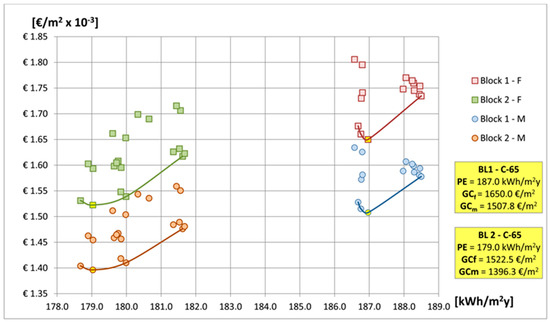
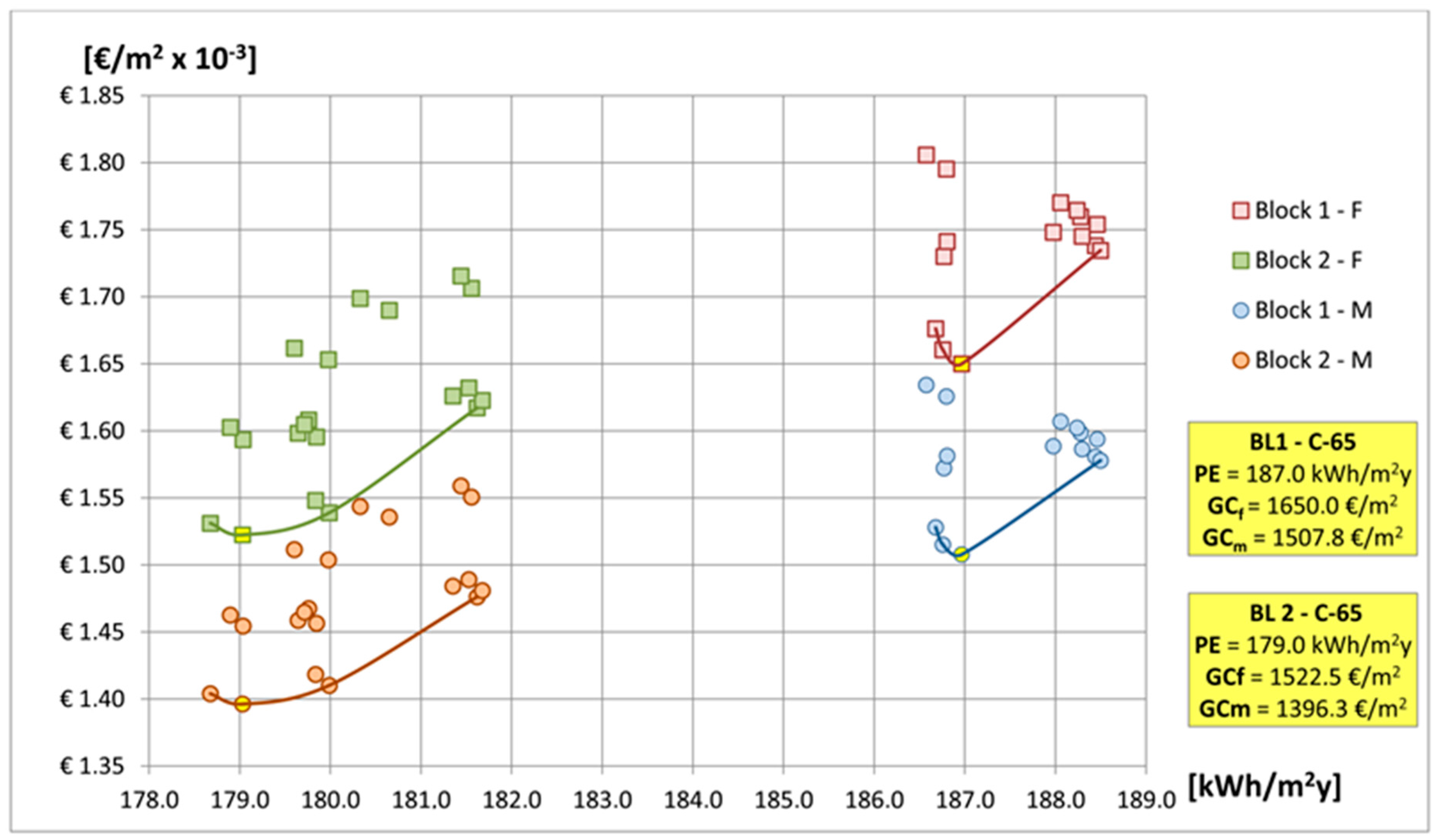
For the reference building 1, a total number of 256 combinations (128 for financial analysis and 128 for macroeconomic analysis) has been evaluated, both for blocks 1 and 2. REF 1 for block 1 has a primary energy consumption of 350 kWh/m2y and 116 kgCO2/m2y greenhouse gas emissions, falling within the CasaClima energy class G. As showed in Figure 2, which includes only the lowest values obtained for this reference, the cost-optimal solution for this block results the combination C-65, having a primary energy consumption of 187 kWh/m2y and a CO2 emissions of 62 kgCO2/m2y.
Figure 2.
Cost-optimal level and best solutions for reference building 1.
The average values of global costs of the two blocks are estimated at 1586.25 €/m2 for the financial analysis and 1452.05 €/m2 for the macroeconomic analysis. A primary energy reduction of 46% and CO2 emission reduction of 47% is obtained for this combination, which falls within the CasaClima energy class D. This best performing combination includes wall 5 that is characterized by a thermal transmittance equal to 0.39 W/m2k, surface mass of 246 kg/m2, time shift of 10.7 h and thickness of 35 cm. Rook wool of 6 cm thickness is selected as thermal insulator. The best window is type 1, characterized by a PVC frame with thermal transmittance of 1.3 W/m2k. Regarding the best technology, the generation system consists of VRF split, with split for emission and distribution systems and CMV for ventilation. Eight solar collectors and ten photovoltaic panels are the best RES configurations.
The base case of block 2 has a primary energy consumption of 334 kWh/m2y and CO2 emissions of 110 kgCO2/m2y, falling within the CasaClima energy class G. After the implementation of variants of energy efficiency measures, the cost-optimal solution obtained for this block is the combination C-65. This combination has a primary energy consumption of 179 kWh/m2y and CO2 emissions of 59 kgCO2/m2y. A reduction of 46% both for primary energy consumption and CO2 emissions is obtained for this combination, which falls within the CasaClima energy class D.
For the reference building 2, 256 combinations have been evaluated for blocks 1 and 2 (128 for the financial analysis and 128 for macroeconomic analysis).
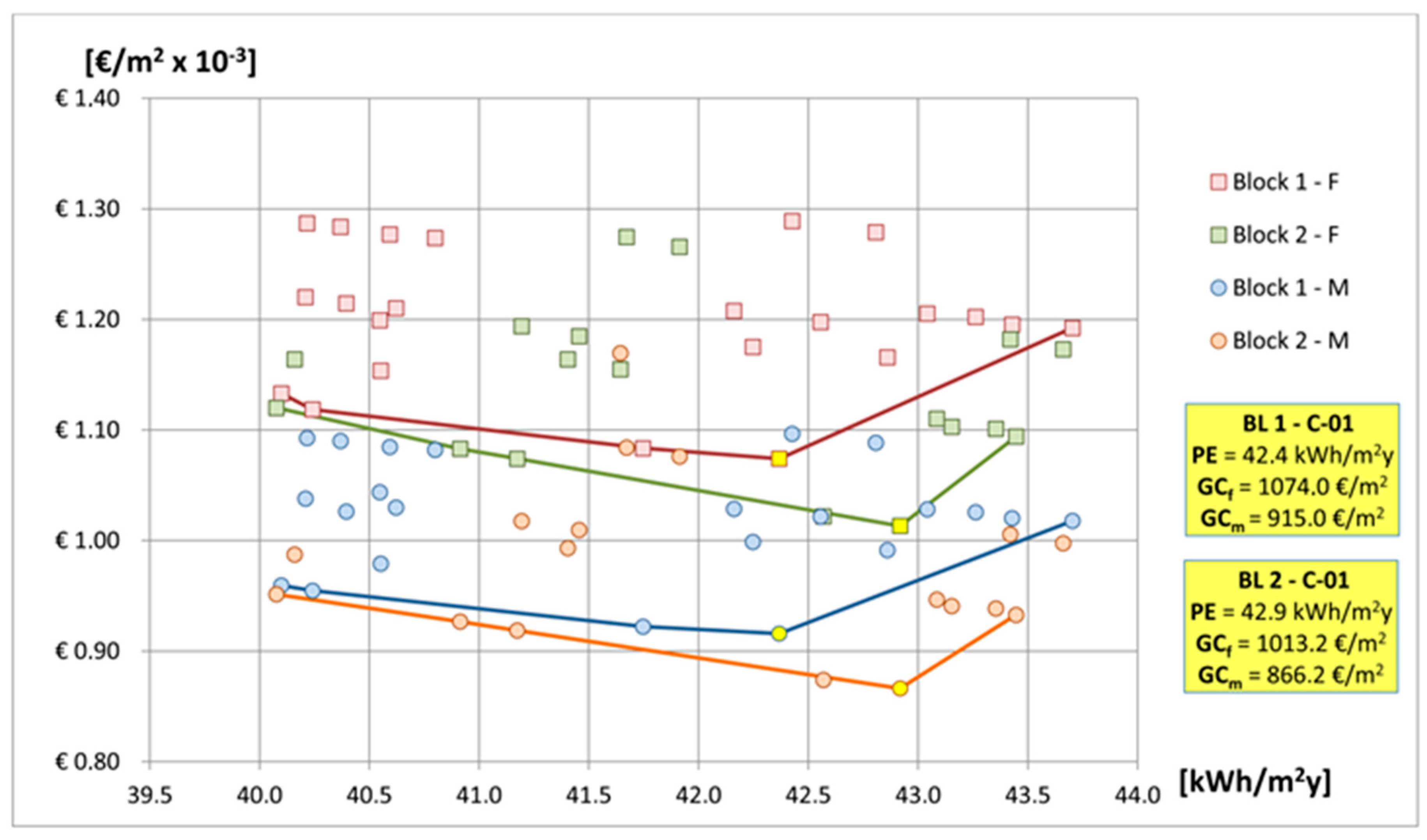
The block 1 has a primary energy consumption of 374 kWh/m2y and greenhouse gas emissions of 95 kgCO2/m2y, falling within the CasaClima energy class G. The cost-optimal solution for block 1 is the combination C-01 that shows primary energy consumption of 42.4 kWh/m2y and greenhouse gas emission of 14 kgCO2/m2y. Global costs are 1074 €/m2 and 915.8 €/m2 for financial and macroeconomic perspective, respectively. The primary energy reduction is assessed at 89% and CO2 emission reduction at 85%, falling within the CasaClima energy class B. The envelope consists of the wall 1 (U = 0.27 W/m2k; Ms = 249 kg/m2, Δt = 11.4 h and d = 39 cm). The selected rook wool is a natural element and it has a good insulating capacity. The windows adopted in this combination are windows WI_1 that have a PVC frame with thermal transmittance of Uf = 1.3 W/m2k. The systems of this combination are a heat pump with air heat source, and fan coils for the emission and distribution with controlled mechanical ventilation systems (CMV). The cost-optimal solution has 4 solar collectors and 12 photovoltaic panels.
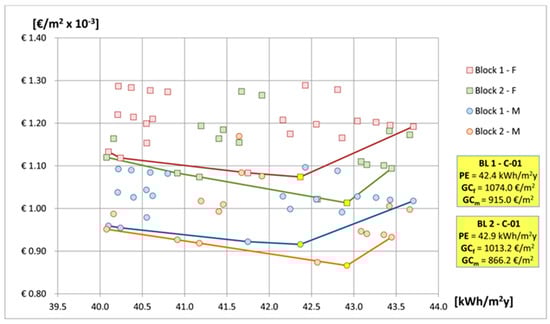
Block 2 has a primary energy consumption of 418 kWh/m2y and greenhouse gas emission of 106 kgCO2/m2y, falling within the CasaClima energy class G. The cost-optimal solution is the combination C-01 (Figure 3) as in block 1.
Figure 3.
Cost-optimal level and best solutions for reference building 2.
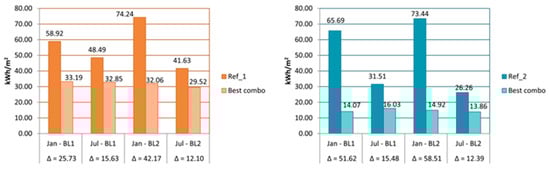
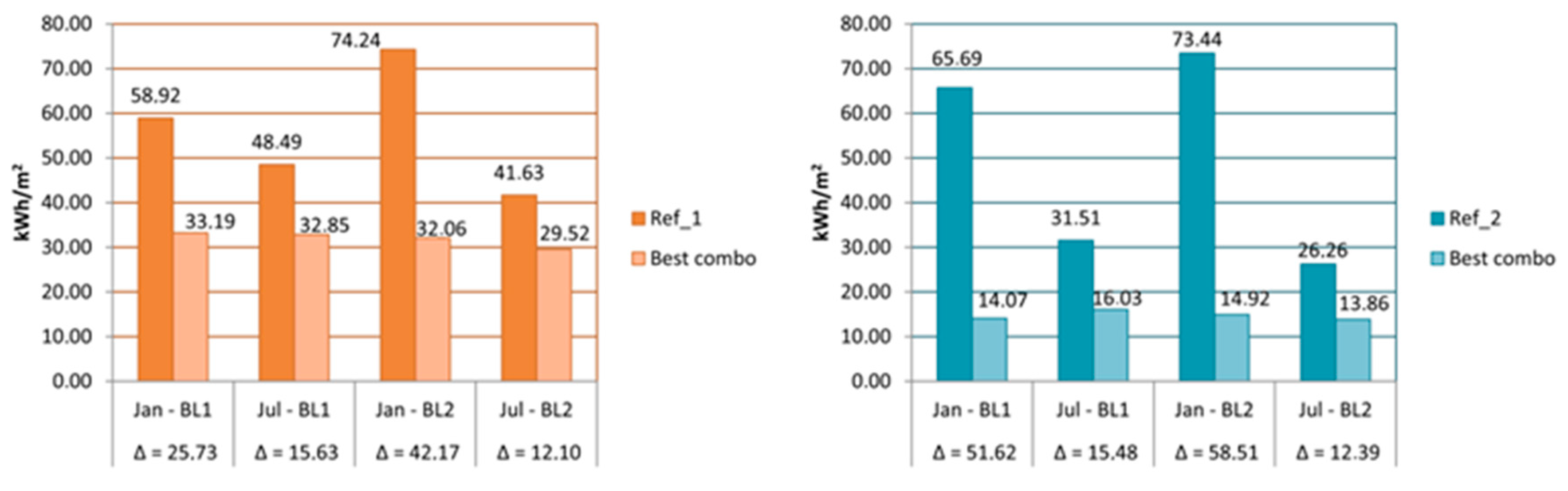
This solution has an average primary energy consumption of 42.65 kWh/m2y and greenhouse gas emission of 14 kgCO2/m2y, with an average global costs of 1043.6 €/m2 and 890.6 €/m2 for financial and macroeconomic perspective, respectively. A primary energy reduction of 90% and CO2 emission reduction of 87% has been obtained for this combination that falls within the CasaClima energy class B. Figure 4 shows the monthly primary energy demand of both reference buildings, focusing on the coldest month (January) and the hottest month (July). This analysis highlights the difference in terms of kWh/m2 between the reference building and the best solution, both for Ref_1 and Ref_2.
Figure 4.
Monthly primary energy demand of Reference buildings 1 and 2.
3.4. Sensitivity Analysis
Sensitivity analysis is an important instrument to detect the impact of price and rate variations in the calculated values. Different scenarios of prices have been applied to energy carriers and discount rates used to derive the cost-optimal solution.
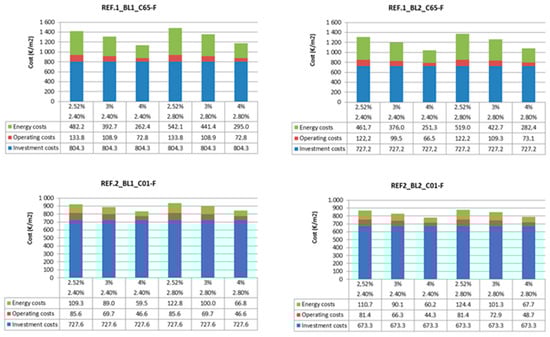
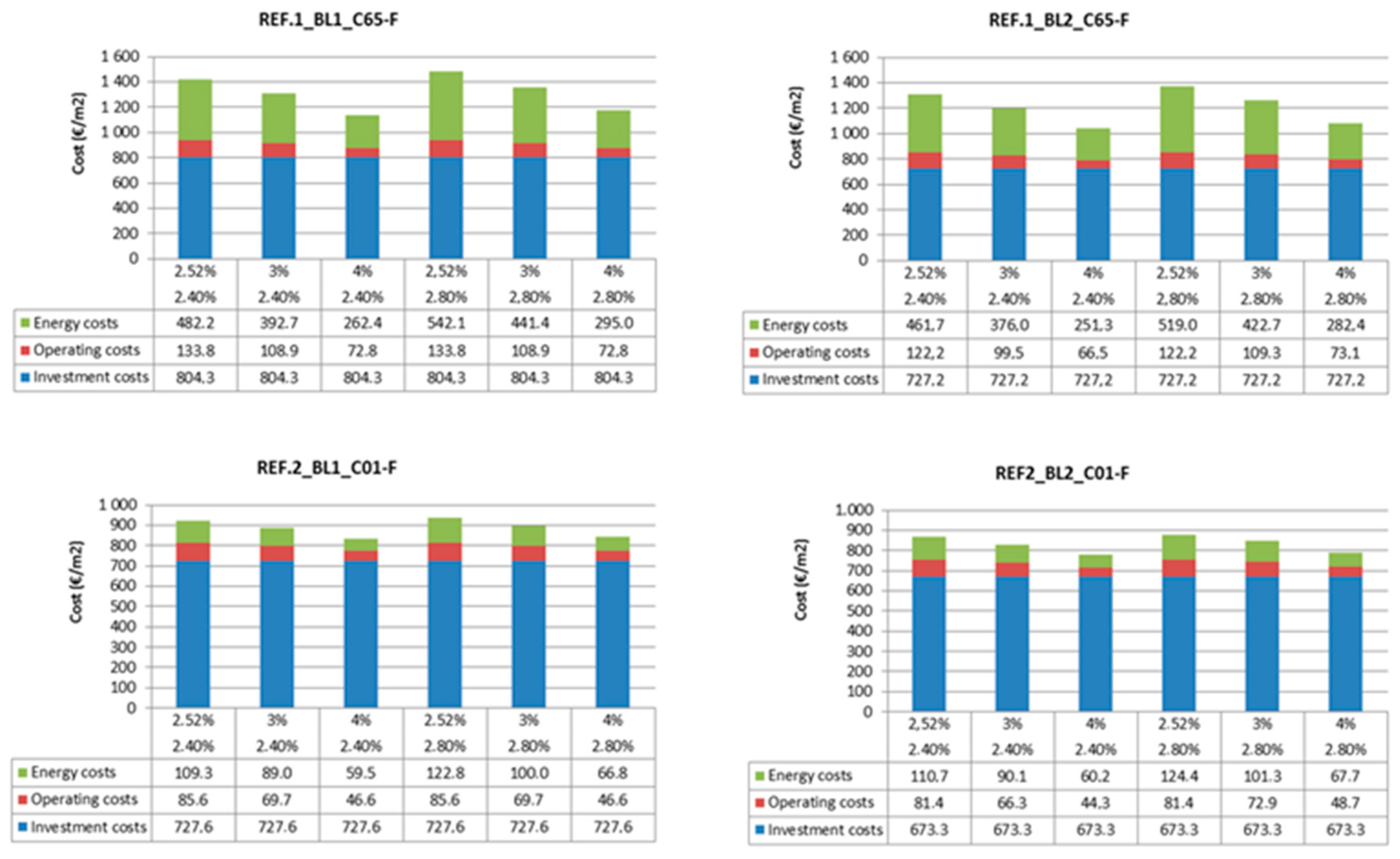
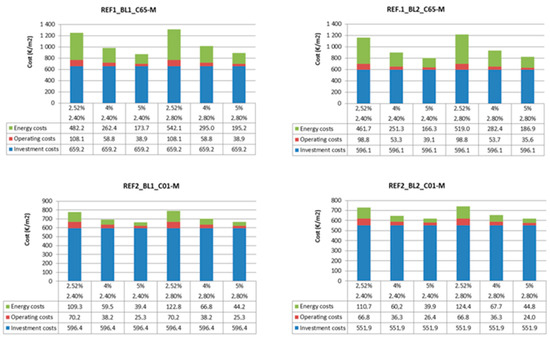
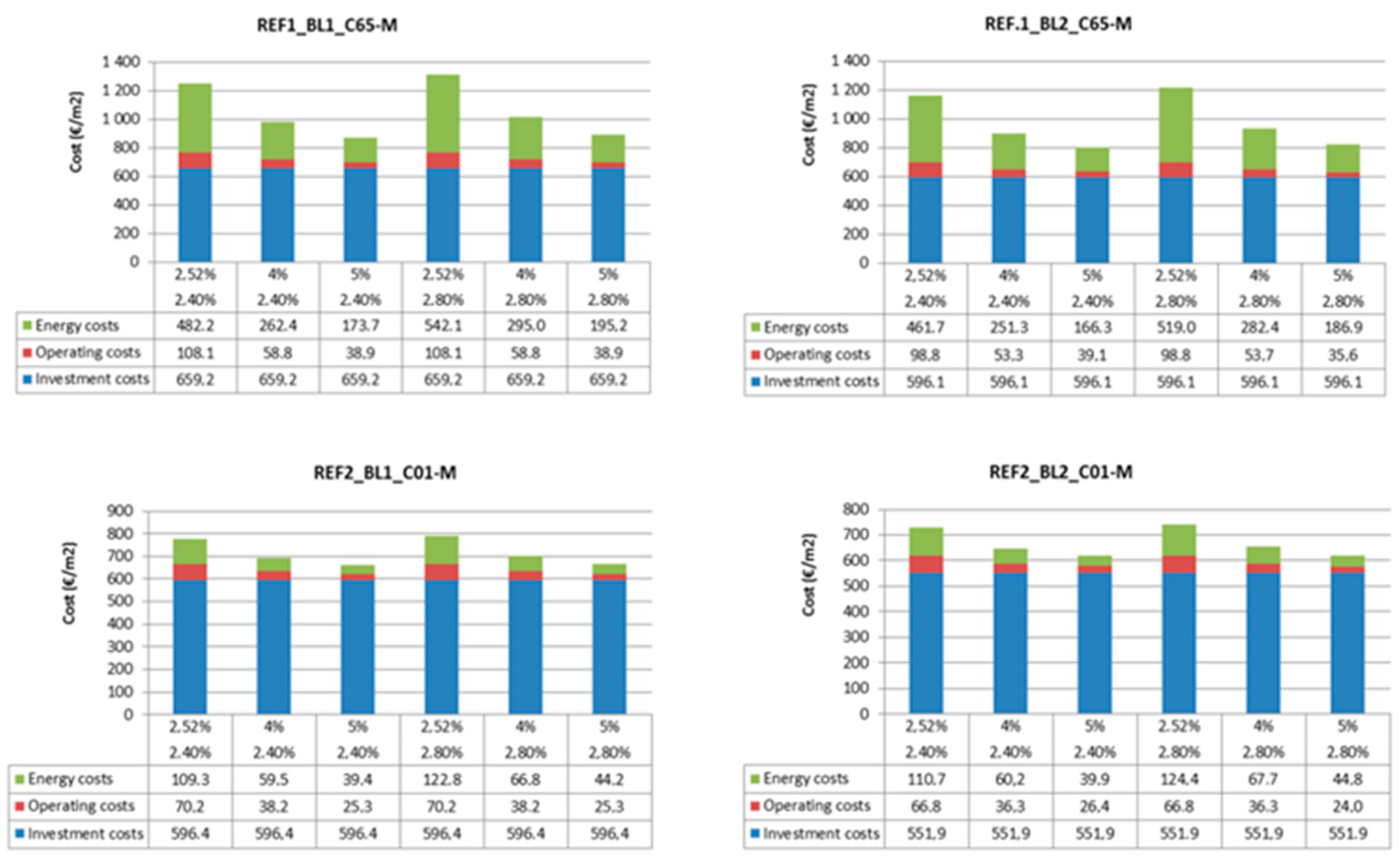
In this case study, in accordance with [4], electricity price variations have been set to 2.4% and 2.8%, while the real interest rate, which depends on the market interest rate, has been fixed to 2.52%, 3% and 4% for the financial analysis, and to 2.52%, 4% and 5% for the macroeconomic analysis. Investments, operating (inspection and cleaning) and energy costs are reported considering different discount rates and development in energy prices. This analysis shows that global costs decrease with the discount rate growth and they increase with the energy price rate (Figure 5 and Figure 6).
Figure 5.
Sensitivity analysis for Reference building 1.
Figure 6.
Sensitivity analysis for Reference building 2.
As shown in Figure 6, the costs of the energy consumption (green color) outline the different level of costs for each use. The energy cost for hotel use exceeds by 77% the residential one. It is evident the importance to act on the energy retrofit of accommodation facilities to reduce the global power consumption on a large scale.
4. Conclusions
The EPBD recast requires Member States to implement the cost-optimal methodology to derive minimum energy performance requirements that represent the minimum level of ambition for new and existing buildings. This requires assessing and comparing different energy efficiency and renewable measures both individually and in combination of packages to be applied to reference buildings.
This paper aims at finding the cost-optimal solution in an existing structure located in the Mediterranean climate. Two different building uses have been analyzed: a three-star hotel with a laundry, and a multi-residential building. The best performing solutions, in terms of energy consumption and costs, have been identified applying the cost-optimal methodology. Among the selected energy efficiency measures in relation to the envelope materials, the best solution employs a rook wool as the insulating material for the external walls. Furthermore, the slab structure has been changed to increase the insulating capacity and to decrease thermal losses, using extruded polystyrene panels, sand and natural stone. The improved solutions related to REF 1 (hotel use) belong to the energy class D while the REF 2 (residential use) has improved from the energy class G to B.
The lower point of the curve of global costs and energy performance represents the cost-optimal solution that balances costs and primary energy consumptions. A VRF system has been selected and is able to improve the energy performance of the two REF 1 unit. Heat pumps with fan coils associated with mechanical controlled ventilation (VMC) are selected in REF 2.
A comparison between the potential two building uses shows that different results are linked to several measures. The same variants are selected in REF 1 and REF 2 for the envelope, while for REF 1 a better performance is obtained with wall 5 (INS_5), which has an insulating material (rook wool) with 6 cm thickness. This solution is preferred from both an economic and an energy evaluation.
The final result shows a high difference of percentage reduction referred to the two intended uses, passing from an average value of 46% for the hotel to 89% for residential building.
The study highlights how different combinations of construction materials and technical systems have different impact on the building energy performance. The sensitivity analysis shows that global costs decrease with the discount rate growth and increase with the energy price rate, defining the importance to give priority to retrofit interventions on buildings with hotel and accommodation use, rather than residential buildings. On the other hand, the residential building stock is much larger than the hotel one, thus renovating this type of buildings leads to an overall higher reduction of global energy consumptions.
The study presented in this paper stresses the importance of the cost-optimal methodology for energy retrofit projects. The implementation and comparison of packages of energy efficiency measures allow the identification of the best combination of measures.
Acknowledgments
This work is part of a Collaboration Agreement between the University of Salento and the Joint Research Centre. The authors are grateful to Diana Rembges and Heinz Ossenbrink for the support during the research. They thank Robert Kenny for proofreading and Valentina Taurino for her support in doing the calculations.
Author Contributions
All authors participated in preparing the research during its phases, such as establishing research design, method and analysis. They discussed together and finalized the analysis results to prepare manuscript accordingly.
Conflicts of Interest
The authors declare that there are no conflicts of interest.
Abbreviations
| Nomenclature | |
| V | volume at controlled temperature |
| REF | reference building |
| INS | insulating |
| S | dissipating area |
| PL | plaster |
| WI | window |
| U | thermal transmittance (W/m2K) |
| GEN | generation system |
| EMI | emission system |
| c | specific heat capacity (kJ/kgK) |
| d | total thickness (m) |
| VEN | ventilation system |
| SOL | solar collector panels |
| PV | photovoltaic panels |
| CMV | controlled mechanical ventilation |
| DHW | domestic hot water |
| TECH | technology |
| q | air flow |
| SPF | specific power consumption |
| tB | daily service time |
| P | thermal capacity |
| Th/w | design heating/water temperature |
| Tst | average storage temperature |
| hst | daily hours with accumulation in temperature |
| COP | coefficient of performance |
| SEER | seasonal energy efficiency ratio |
| No | number of panels |
| Ppeak | peak power |
| fs | azimuth |
| fn | zenith |
| PE | primary energy |
| RES | renewable energy sources |
| GC | global cost |
| t | thickness |
| AN | panel area |
| s | thickness of metal spacer |
| Rd | discount rate |
| RR | real interest rate |
| Rp | rate of development of the price for products |
| Greek letters | |
| λ | design thermal conductivity(W/mK) |
| ρ | density (kg/m3) |
| η | efficiency |
| Ψ | linear transmittance (W/mK) |
| Subscripts | |
| w | winter |
| f | frame |
| w | window |
| e | emission |
| d | distribution |
| g | generation |
| r | regulation |
| e,w | dhw emission |
| d,w | dhw distribution |
| s,w | dhw storage |
| v,e | external air flow |
| v,tot | total air flow |
| Ɵw,d | winter thermal recovery |
| Ɵs,d | summer thermal recovery |
| s | storage |
| k | panels |
| Symbols | |
| ^ | complex amplitude |
| - | mean value |
References and Note
- European Union. Energy, Transport and Environment Indicators; EUROSTAT: Luxembourg, 2014. [Google Scholar]
- European Union. Directive 2010/31/EU of the European Parliament and of the Council of 19 May 2010 on the Energy Performance of Buildings (recast). Off. J. Eur. Union 2010, 18, 13–35. [Google Scholar]
- D’Agostino, D. Assessment of the progrèss towards the establishment of definitions of nearly zero energy buildings (nZEBs) in European Member States. J. Build. Eng. 2015, 1, 20–32. [Google Scholar] [CrossRef] [Scilit]
- European Union. Commission Delegated Regulation No 244/2012 of 16 January 2012 Supplementing Directive 2010/31/EU of the European Parliament and of the Council on the energy Performance of Buildings by Establishing a Comparative Methodology Framework for Calculating Cost-optimal Levels of Minimum Energy Performance Requirements for Buildings and Building Elements. Off. J. Eur. Union 2012, 5, 129–147. [Google Scholar]
- European Union. Guidelines Accompanying Commission Delegated Regulation (EU) No 244/2012 of 16 January 2012 Supplementing Directive 2010/31/EU of the European Parliament and of the Council on the energy performance of buildings by establishing a comparative methodology framework for calculating cost-optimal levels of minimum energy performance requirements for buildings and building elements. Off. J. Eur. Union 2012, 55, C115/37. [Google Scholar]
- UNI/TS 11300—Energy Performance of Buildings. Part 1 (2014): Evaluation of Energy Need for Space Heating and Cooling. Part 2 (2014): Evaluation of Primary Energy Need and of System Efficiencies for Space. Part 3 (2010): Evaluation of Primary Energy and System Efficiencies for Space Cooling. Part 4 (2012): Renewable Energy and other Generation Systems for Space Heating and Domestic Hot Water Production Heating, Domestic Hot Water Production, Ventilation and Lighting for Non-Residential Buildings Technical Regulation. Ente Italiano di Normazione: Milano, Italy.
- European Union. Energy Performance of Buildings, Economic Evaluation Procedure for Energy Systems in Buildings; UNI EN 15459; BSI: London, UK, 2007. [Google Scholar]
- D’Agostino, D.; Zangheri, P.; Castellazzi, L. Towards Nearly Zero Energy Buildings in Europe: A Focus on Retrofit in Non-Residential Buildings. Energies 2017, 10, 117. [Google Scholar] [CrossRef] [Scilit]
- Marco, F.; Almeida, M.G.; Ana, R.; da Silva, S.M. Comparing cost-optimal and net-zero energy targets in building retrofit. Build. Res. Inf. 2016, 44, 188–201. [Google Scholar]
- Lu, Y.; Wang, S.; Shan, K. Design optimization and optimal control of grid-connected and standalone nearly/net zero energy buildings. Appl. Energy 2015, 155, 463–477. [Google Scholar] [CrossRef] [Scilit]
- Baglivo, C.; Congedo, P.M.; D’Agostino, D.; Zacà, I. Cost-Optimal analysis and technical comparison between standard and high efficient mono-residential buildings in a warm climate. Energy 2015, 83, 560–575. [Google Scholar] [CrossRef] [Scilit]
- Zacà, I.; D’Agostino, D.; Congedo, P.M.; Baglivo, C. Assessment of Cost-Optimality and Technical Solutions in High Performance Multi-Residential Buildings in the Mediterranean Area. Energy Build. 2015, 102, 250–265. [Google Scholar] [CrossRef] [Scilit]
- Congedo, P.M.; Baglivo, C.; D’Agostino, D.; Zacà, I. Cost-optimal design for nearly zero energy office buildings located in warm climates. Energy 2015, 91, 967–982. [Google Scholar] [CrossRef] [Scilit]
- Congedo, P.M.; Baglivo, C.; Zacà, I.; D’Agostino, D. High Performance Solutions and Data for Nzebs Offices Located in Warm Climates. Data Br. 2015, 5, 502–505. [Google Scholar] [CrossRef] [Scilit] [PubMed]
- Ferrara, M.; Fabrizio, E.; Virgone, J.; Filippi, M. A simulation based optimization method for cost-optimal analysis. Energy Build. 2014, 84, 442–457. [Google Scholar] [CrossRef] [Scilit]
- Buildings Performance Institute Europe (BPIE). Europe’s Buildings under the Microscope. A Country-by-Country Review of the Energy Performance of Buildings; BPIE: Brussels, Belgium, 2011. [Google Scholar]
- Zebra 2020. Nearly Zero Energy Building Strategy 2020—Strategies for a Nearly Zero-Energy Building Market Transition in the European Union. Available online: http://zebra2020.eu/website/wp-content/uploads/2014/08/ZEBRA2020_Strategies-for-nZEB_07_LQ_single-pages-1.pdf (accessed on 18 October 2016).
- Mure, O. Energy Efficiency Trends and Policies in the Household and Tertiary Sectors, an Analysis Based on the Odysee-Mure Databases. 2015. Available online: http://www.odyssee-mure.eu/publications/br/energy-efficiency-in-buildings.html (accessed on 24 June 2015).
- Beccali, M.; Bonomolo, M.; Ciulla, G.; Galatioto, A.; Brano, V.L. Improvement of energy efficiency and quality of street lighting in South Italy as an action of Sustainable Energy Action Plans. The case study of Comiso (RG). Energy 2015, 92, 394–408. [Google Scholar] [CrossRef] [Scilit]
- Estratto Rapporto CRESME. RIUSO03—Ristrutturazione Edilizia, Riqualificazione Energetica, Rigenerazione Urbana. Available online: http://www.old.awn.it/AWN/Engine/RAServeFile.php/f/RAPPORTO_riuso03.pdf (accessed on 24 February 2014).
- Congedo, P.M.; D’Agostino, D.; Baglivo, C.; Tornese, G.; Zacà, I. Efficient solutions and cost-optimal analysis for existing school buildings. Energies 2016, 9, 851. [Google Scholar] [CrossRef] [Scilit]
- Mazzeo, D.; Oliveti, G.; Arcuri, N. Influence of internal and external boundary conditions on the decrement factor and time lag heat flux of building walls in steady periodic regime. Appl. Energy 2016, 164, 509–531. [Google Scholar] [CrossRef] [Scilit]
- Baglivo, C.; Congedo, P.M.; Fazio, A. Multi-criteria optimization analysis of external walls according to ITACA protocol for zero energy buildings in the Mediterranean climate. Build. Environ. 2014, 82, 467–480. [Google Scholar] [CrossRef] [Scilit]
- Baglivo, C.; Congedo, P.M. Design method of high performance precast external walls for warm climate by multi-objective optimization analysis. Energy 2015, 90, 1645–1661. [Google Scholar] [CrossRef] [Scilit]
- Baglivo, C.; Congedo, P.M.; Fazio, A.; Laforgia, D. Multi-Objective Optimization Analysis for High Efficiency External Walls Of Zero Energy Buildings (Zeb) in the Mediterranean Climate. Energy Build. 2014, 84, 483–492. [Google Scholar] [CrossRef] [Scilit]
- Tsoutsos, T.; Tournaki, S.; de Santos, C.A.; Vercellotti, R. Nearly Zero Energy Buildings Application in Mediterranean Hotels. Energy Procedia 2013, 42, 230–238. [Google Scholar] [CrossRef] [Scilit]
- Rapporto ONRE 2013—Regolamenti Edilizi Comunali e lo Scenario Dell’innovazione Energetica ed Ambientale in Italia, CRESME Ricerche S.p.a.—Legambiete. Available online: http://www.legambiente.it/sites/default/files/docs/sito_onre_2013_min.pdf (accessed on February 2013).
- Allegato 1—STREPIN, Strategia per la Riqualificazione Energetica del Parco Immobiliare Nazionale—ENEA Report, 13 November 2015. Available online: http://www.mise.gov.it/images/stories/documenti (accessed on 13 November 2015).
- Santamouris, M.; Balaras, C.A.; Dascalaki, E.; Argiriou, A.; Gaglia, A. Energy conservation and retrofitting potential in Hellenic hotels. Energy Build. 1996, 24, 65–75. [Google Scholar] [CrossRef] [Scilit]
- Rapporto 2015, Il Sistema Delle Costruzioni in Italia—Federcostruzioni, Federazione Delle Costruzioni. Available online: http://www.federcostruzioniweb.it/images/documenti/rapporto2015.pdf (accessed on 31 July 2015).
- Malvoni, M.; Fiore, M.C.; Maggiotto, G.; Mancarella, L.; Quarta, R.; Radice, V.; Congedo, P.M.; De Giorgi, M.G. Improvements in the predictions for the photovoltaic system performance of the Mediterranean regions. Energy Convers. Manag. 2016, 128, 191–202. [Google Scholar] [CrossRef] [Scilit]
- Ballarini, I.; Corgnati, S.P.; Corrado, V. Use of reference buildings to assess the energy saving potentials of the residential building stock: The experience of TABULA project. Energy Policy 2014, 68, 273–284. [Google Scholar] [CrossRef] [Scilit]
- Martinopoulos, G.; Papakostas, K.T.; Papadopoulos, A.M. Comparative analysis of various heating systems for residential buildings in Mediterranean climate. Energy Build. 2016, 124, 79–87. [Google Scholar] [CrossRef] [Scilit]
- Kolaitis, D.I.; Malliotakis, E.; Kontogeorgos, D.A.; Mandilaras, I.; Katsourinis, D.I.; Founti, M.A. Comparative assessment of internal and external thermal insulation systems for energy efficient retrofitting of residential buildings. Energy Build. 2013, 64, 123–131. [Google Scholar] [CrossRef] [Scilit]
- Italian Organisation for Stardardisation (UNI). Technical Regulation UNI 10349-3, Heating and Cooling of Buildings—Climatic Data, Part 3: Accumulated Temperature Differences (Degree-Days) and Other Indices; Ente Italiano di Normazione: Milan, Italy, 2016. [Google Scholar]
- D’Agostino, D.; Maria, C.P. CFD modeling and moisture dynamics implications of ventilation scenarios in historical buildings. Build. Environ. 2014, 79, 181–193. [Google Scholar] [CrossRef] [Scilit]
- D’Agostino, D. Moisture dynamics in an historical masonry structure: The Cathedral of Lecce (South Italy). Build. Environ. 2013, 63, 122–133. [Google Scholar] [CrossRef] [Scilit]
- Malvoni, M.; Baglivo, C.; Congedo, P.M.; Laforgia, D. CFD modeling to evaluate the thermal performances of window frames in accordance with the ISO 10077. Energy 2016, 111, 430–438. [Google Scholar] [CrossRef] [Scilit]
- Carletti, C.; Sciurpi, F.; Pierangioli, L. The Energy Upgrading of Existing Buildings: Window and Shading Device Typologies for Energy Efficiency Refurbishment. Sustainability 2014, 6, 5354–5377. [Google Scholar] [CrossRef] [Scilit]
- Rondoni, M.; Santa, U.; Klammsteiner, U. ProcasaClima 2015: CasaClima building simulation software. In Proceedings of the BSA 2015—Building Simulation Applications 2nd IBPSA-Italy Conference, Bozen-Bolzano, Italy, 4–6 February 2015. [Google Scholar]
- Thermal Performance of Buildings. Heat Transfer via the Ground. Calculation Methods; EN ISO 13370; Technical Committee, ISO/TC 163; International Organization for Standardization: Geneva, Switzerland, 2007. [Google Scholar]

© 2017 by the authors. Licensee MDPI, Basel, Switzerland. This article is an open access article distributed under the terms and conditions of the Creative Commons Attribution (CC BY) license (http://creativecommons.org/licenses/by/4.0/).