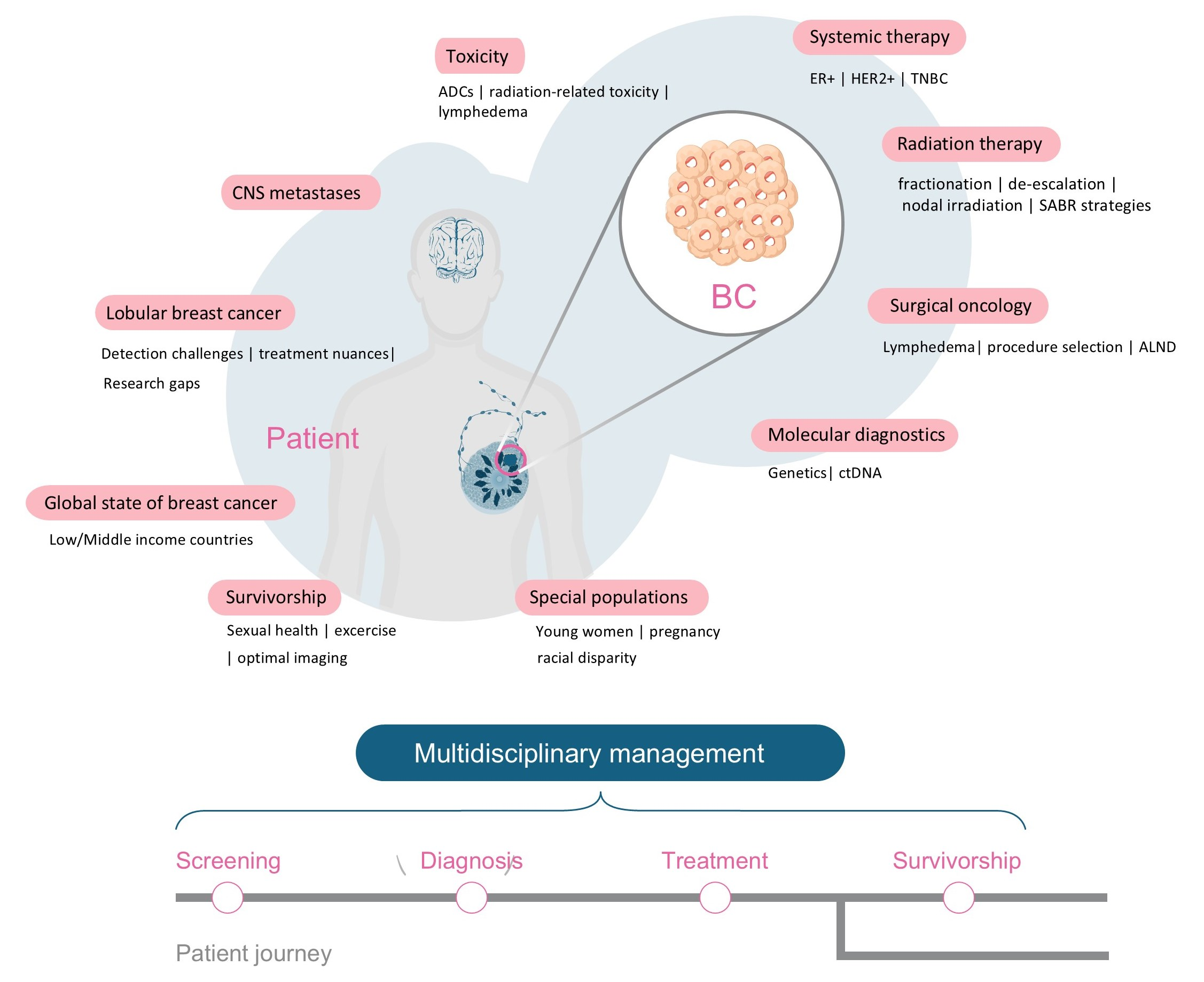
The Canadian Breast Cancer Symposium 2025: Meeting Report

 , ,
, ,
Simple Summary
Abstract
1. Introduction
2. Patient Voices—Pregnancy and Breast Cancer
2.1. Patient Voice I
2.2. Patient Voice II
3. Breast Cancer in 2025—Top Papers
3.1. Radiation Therapy
3.1.1. Europa [1]
3.1.2. Hypog-01 [2]
3.1.3. Trog 20.03 Avatar [3]
3.2. Surgical Oncology
3.2.1. Risk Reducing Surgeries in BRCA1/2 Mutation Carriers: More Is More [4]
3.2.2. Axillary Surgery in Breast Cancer—Insema: Less Is More [5]
3.2.3. Active Monitoring for Low-Risk DCIS—Comet: Less Is the Same [6]
3.3. Systemic Therapy of Breast Cancer
3.3.1. Mutational Mayhem in ER+, HER2-Low Metastatic Breast Cancer: Targeting PIK3CA/AKT, ESR1
3.3.2. Whats’s New with Old Foes—TNBC and HER2+: Doubling (Tripling) Down on Multiple Targets
3.3.3. Behind Enemy Lines: Brain Metastases—Some More Promise
4. Keynote Address
Global Health/Breast Cancer
5. Breast Cancer and Systemic Therapy Updates
 Section takeaways
- In early ER+ disease CDK4/6 inhibitors have redefined adjuvant care, oral SERDs are advancing into the early setting, ctDNA testing for minimal residual disease is promising, and the future direction is shifting toward tailored, biomarker-driven treatment.
- In metastatic ER+ disease, sequencing of CDK4/6 inhibitors is still an outstanding question, next-generation oral SERDs are promising options, the inavolisib triplet has shown OS benefit as PI3K-directed therapy, and ADC are being used as new options for later lines of therapy.
- In HER2+ disease, T-DXd is redefining initial management, efficacy of T-DXd has been established for brain metastases, and earlier use is under investigation. The PATINA regimen has shown benefit for triple-positive metastatic disease.
- In triple-negative disease, ADCs are transforming the landscape and offering chemo-free options in later lines of treatment. ADCs are also moving earlier in treatment, but immunotherapy remains essential for PD-L1+ disease.
5.1. Advances in ER+ Breast Cancer
5.1.1. Early Setting
5.1.2. Metastatic Setting
5.2. Advances in HER2+ Breast Cancer
5.3. Advances in TNBC
6. Debate: Is ctDNA Ready for Prime Time in the Management of Early Breast Cancer
6.1. No
6.2. Yes
7. The Latest Advances in…
Section takeaways- Expanding germline testing and integrating early results into care can guide preventive strategies, optimize systemic therapy, and enable cascade testing to reduce cancer risk in families.
- Modern trials support safe de-escalation of radiotherapy through shorter regimens, omission in selected low-risk patients, and re-evaluation of nodal radiation.
- Breast cancer screening strategies must evolve to address biologic aggressiveness in younger and minority women, integrate supplemental imaging and artificial intelligence, and close equity gaps in access and outcomes.
- Emerging trial data suggests that omission of breast or axillary surgery may be feasible in carefully selected patients after neoadjuvant therapy.
7.1. Radiology and Breast Screening
7.2. Radiation Oncology
7.3. Surgical Oncology
7.4. Genetics
8. Challenging Clinical Cases with a Debate
Section takeaways- Patient-specific factors often outweigh rigid adherence to treatment guidelines, underscoring the need for individualized decision-making.
8.1. Yes
8.2. No
8.3. Multidisciplinary Case Discussions—Management of Patients with Stage IV Disease
9. Surgical Symposium: Management of Lymphedema
Section takeaways- ILR with lymphovenous bypass can be used to reduce lymphedema risk by rerouting lymphatics during ALND. This method requires microsurgery expertise and specialized equipment.
- S-LYMPHA is an alternative to ILR that reconnect lymphatics to nearby veins using simple tools. This technique is more accessible and feasible in centres without microsurgical expertise.
- Structured surveillance protocols (pre-op to post-op) reduce lymphedema rates with early-stage cases being reversible. Tools like risk calculators are refining prevention strategies.
9.1. Immediate Lymphatic Reconstruction with Lymphovenous Bypass at the Time of ALND
9.2. The S-Lympha Procedure
9.3. Towards Prospective Surveillance and Preventive Management of Lymphedema in High-Risk Individuals
10. Optimization Strategies for Lobular Breast Cancer
Section takeaways- ILC is a common breast cancer subtype with clinical and pathological features dis-tinct from IDC. The linear growth pattern in ILC resulting from the loss of E-cadherin can be difficult to detect on routine mammograms, often leading to delayed diagnosis.
- Some evidence in lobular disease supports anthracycline-containing chemotherapy in high-risk N2/N3 patients, ET with an AI (letrozole/anastrozole) in the adjuvant set-ting, and CDK4/6 inhibitors in the metastatic setting.
- MRI for surgical planning and PET/CT for staging distant disease are important considerations in lobular breast cancer. Principles of surgical resection in ILC remain the same as those for IDC, both within the breast and the axilla. Neoadjuvant chemotherapy for surgical downgrading may have a role in selected patients.
- Emerging research priorities in lobular breast cancer aim to standardize diagnosis, advance imaging techniques for accurate detection and staging, identify better gene signatures as predictors for outcomes in ILC, and provide evidence-based treatment options for patients with lobular breast cancer.
10.1. The Patient Voice—Living with Lobular Breast Cancer
10.2. Systemic Therapy
10.3. Surgical Therapy
10.4. Emerging Research
11. Survivorship in Breast Cancer—Patient Advocate
Section takeaways- Sexual Health and Breast Cancer—Sexual dysfunction affects the vast majority of survivors (up to 84%), with 11% stopping therapy due to side effects, making sexual health management central to both QoL and treatment adherence.
- Breast Cancer During Pregnancy—With coordinated care, women can safely un-dergo surgery and chemotherapy after the first trimester, achieving outcomes comparable to non-pregnant women while protecting long-term child health.
- Exercise and Breast Cancer—Even modest exercise (90 min/week) improves tolerance to treatment, reduces side effects, and preserves fitness; trials suggest it may also enhance tumour response and reduce recurrence risk.
- Optimal Imaging in Breast Cancer—Mammography alone misses too many cancers in survivors; adding MRI, contrast-enhanced mammography, or ultrasound significantly improves detection, with Canadian data and ACR guidelines supporting combined approaches.
11.1. Sexual Health and Breast Cancer
11.2. Breast Cancer During Pregnancy
11.3. Exercise and Breast Cancer
11.4. Optimal Imaging in Breast Cancer
12. Best Poster Abstract Submission 2025
Section takeaways- Upfront TAS—TAS is increasingly replacing full axillary dissection in node-positive HR+/HER2− disease, sparing 77% of women from ALND while maintaining low short-term recurrence.
- Cost-Effectiveness of Breast Cancer Screening—Lifetime modelling shows start-ing mammography at 40 is not only life-saving but cost-saving, with annual screen-ing providing excellent value at <$25,000 per death averted.
- DCIS Margins and Re-excision—Women with margins of 1–1.9 mm who receive radiation have recurrence rates similar to those with ≥2 mm, suggesting re-excision can often be avoided, while margins <1 mm still warrant surgery.
12.1. Upfront Tailored Axillary Surgery for Clinically Node-Positive HR+/HER2− Breast Cancer: A Population-Based Cohort
12.2. Cost-Effectiveness of Breast Cancer Screening Using Digital Mammography in Canada
12.3. 10-Year Local Recurrence Rates Following Selective Omission of Re-Excision for Patients with DCIS and Margins <2 mm
13. Central Nervous System Metastases
Section takeaways- Post-operative radiation therapy with cavity SRS is recommended in all resected metastases. SRS alone followed with serial MRI is appropriate in non-surgical cases with good performance status and <10 lesions and WBRT should be considered in patients with >10 brain metastases, leptomeningeal disease, or pachymeningeal disease.
- Higher quality data are needed to guide clinical practice and determine whether screening for brain metastases can help patients with metastatic breast cancer live longer with improved QoL.
- Systemic therapies can be highly effective in treating both stable and active brain metastases for patients with HER2+ metastatic breast cancer. While there have been advances in clinical trial design to include patients with brain metastases, the inclusion criteria for certain breast cancer subtypes (e.g., TNBC) are still quite restrictive.
- Clinical trials to inform optimal sequencing of systemic and local therapies to treat patients with metastatic breast cancer and brain metastases are required.
13.1. Radiotherapy for the Management of Breast Cancer Brain Metastases
13.2. Screening (Why or Why Not?)
13.3. Brain Metastases Systemic Therapy Overview
14. Novel Advances in Breast Cancer
Section takeaways- New ADC are expanding targeted therapy options in breast cancer, showing activity across different tumour types and raising new questions about sequencing and toxicity.
- Recent advances in immunotherapy, including novel checkpoints, bispecific antibodies, and cell-based strategies, are offering new treatment avenues for breast cancer.
- Emerging technologies like tomosynthesis, contrast-enhanced mammography, and artificial intelligence-driven detection are improving breast cancer imaging by increasing diagnostic accuracy and addressing previous screening limitations.
14.1. Antibody-Drug Conjugates
14.2. Immunotherapy and Cell Therapy
14.3. Novel Imaging Techniques in Breast Cancer Diagnosis
15. Advocacy in Breast Cancer
Section takeaways- When experts, advocates, and communities unite, breast cancer care moves beyond treatment towards equity, empowerment, and real change.
15.1. Breast Cancer Canada/REAL Alliance
15.2. Rethink Breast Cancer
15.3. Patient Groups: Your Partners on the Ground
16. Concluding Remarks
Supplementary Materials
Author Contributions
Funding
Institutional Review Board Statement
Informed Consent Statement
Data Availability Statement
Acknowledgments
Conflicts of Interest
Abbreviations
| ALND | axillary lymph node dissection | LYMPHA | lymphatic microsurgical preventing healing approach |
| ARM | Axillary Reverse Mapping | MRD | minimal residual disease |
| ASCO | American Society of Clinical Oncology | MRI | magnetic resonance imaging |
| BCS | breast-conserving surgery | NCCN | National Comprehensive Cancer Network |
| BI-RADS | breast imaging reporting and data system 2 | NSCLC | non-small cell lung cancer |
| BMI | body mass index | OFS | ovarian function suppression |
| BRCA1/2 | breast cancer gene 1 or 2 | ORR | overall response rate |
| BSC | best support care | OS | overall survival |
| CBCS | Canadian Breast Cancer Symposium | PD-1 | programmed cell death protein 1 |
| CDK4/6i | cyclin-dependent kinase 4/6 inhibitor | PD-L1 | programmed cell death ligand 1 |
| CEM | contrast enhanced mammography | PET | positron emission tomography |
| CNS | central nervous system | PFS | progression-free survival rate |
| CPS | combined positive score | Pi3K | phosphatidylinositol 3-kinase |
| CRRM | contralateral risk-reducing mastectomy | PR | progesterone receptor |
| CT | computed tomography | QoL | quality of life |
| ctDNA | circulating tumour DNA | RRM | risk-reducing mastectomy |
| DBT | digital breast tomosynthesis | RRSO | risk-reducing salpingo-oophorectomy |
| DCIS | ductal carcinoma in situ | RT | radiotherapy |
| dato-DXd | datopotamab deruxtecan | SABR | stereotactic ablative body radiotherapy |
| DFS | disease-free survival | SEER | surveillance, epidemiology, and end results |
| ECOG | Eastern Cooperative Oncology Group | SERD | selective estrogen receptor degrader |
| ER+/- | estrogen receptor positive/negative | SG | sacituzumab govitecan |
| ESMO | European Society of Medical Oncology | SLNB | sentinel lymph node biopsy |
| ESR1 | estrogen receptor 1 | SRS | stereotactic radiosurgery |
| ET | Endocrine therapy | TAS | tailored axial surgery |
| gBRCA | germline breast cancer gene | T-DM1 | trastuzumab emtansine |
| HER2+/– | human epidermal growth factor receptor-2-negative/positive | T-DXd | trastuzumab deruxtecan |
| HF | hypofractionated | THP | taxane-trastuzumab-pertuzumab |
| HR | hazard ratio | TNBC | triple-negative breast cancer |
| HR+/- | hormone receptor-positive/negative | TROP2 | trophoblast cell surface antigen 2 |
| HRQOL | health-related quality of life | VEGF | vascular endothelial growth factor |
| HTA | health technology assessment | WBRT | whole-brain radiotherapy |
| IDC | invasive ductal carcinoma | ||
| IHC | immunohistochemistry | ||
| ILC | invasive lobular carcinoma | ||
| ILR | immediate lymphatic reconstruction | ||
| JAMA | Journal of the American Medical Association |
References
- Meattini, I.; De Santis, M.C.; Visani, L.; Scorsetti, M.; Fozza, A.; Meduri, B.; De Rose, F.; Bonzano, E.; Prisco, A.; Masiello, V.; et al. Single-Modality Endocrine Therapy versus Radiotherapy After Breast-Conserving Surgery in Women Aged 70 Years and Older with Luminal A-like Early Breast Cancer (EUROPA): A Preplanned Interim Analysis of a Phase 3, Non-Inferiority, Randomised Trial. Lancet Oncol. 2025, 26, 37–50. [Google Scholar] [CrossRef] [Scilit] [PubMed]
- Brion, T.; Ghodssighassemabadi, R.; Auzac, G.; Kirova, Y.; Racadot, S.; Benchalal, M.; Clavier, J.-B.; Brunaud, C.; Fouche-Chand, M.-E.; Argo-Leignel, D.; et al. Early Toxicity of Moderately Hypofractionated Radiation Therapy in Breast Cancer Patients Receiving Locoregional Irradiation: First Results of the UNICANCER HypoG-01 Phase III Trial. Radiother. Oncol. 2025, 207, 110849. [Google Scholar] [CrossRef] [Scilit] [PubMed]
- David, S.; Connolly, E.; Bressel, M.; Tan, J.; Hanna, G.G.; Alomran, R.; Yip, E.; Morton, C.; Siva, S.; White, M. Stereotactic Ablative Body Radiotherapy for Oligoprogressive Estrogen Receptor–Positive Breast Cancer (TROG 20.03 AVATAR): A Phase II Prospective Multicenter Trial. JCO Oncol. Adv. 2025, 2, e2500031. [Google Scholar] [CrossRef] [Scilit]
- Blondeaux, E.; Sonnenblick, A.; Agostinetto, E.; Bas, R.; Kim, H.J.; Franzoi, M.A.; Bernstein-Molho, R.; Linn, S.; Kwong, A.; Pogoda, K.; et al. Association between Risk-Reducing Surgeries and Survival in Young BRCA Carriers with Breast Cancer: An International Cohort Study. Lancet Oncol. 2025, 26, 759–770. [Google Scholar] [CrossRef] [Scilit]
- Reimer, T.; Stachs, A.; Veselinovic, K.; Kühn, T.; Heil, J.; Polata, S.; Marmé, F.; Müller, T.; Hildebrandt, G.; Krug, D.; et al. Axillary Surgery in Breast Cancer—Primary Results of the INSEMA Trial. N. Engl. J. Med. 2025, 392, 1051–1064. [Google Scholar] [CrossRef] [Scilit]
- Hwang, E.S.; Hyslop, T.; Lynch, T.; Ryser, M.D.; Weiss, A.; Wolf, A.; Norris, K.; Witten, M.; Grimm, L.; Schnitt, S.; et al. Active Monitoring with or Without Endocrine Therapy for Low-Risk Ductal Carcinoma In Situ: The COMET Randomized Clinical Trial. JAMA 2025, 333, 972. [Google Scholar] [CrossRef] [Scilit]
- Bidard, F.-C.; Mayer, E.L.; Park, Y.H.; Janni, W.; Ma, C.; Cristofanilli, M.; Bianchini, G.; Kalinsky, K.; Iwata, H.; Chia, S.; et al. First-Line Camizestrant for Emerging ESR1-Mutated Advanced Breast Cancer. N. Engl. J. Med. 2025, 393, 569–580. [Google Scholar] [CrossRef] [Scilit]
- Turner, N.C.; Im, S.-A.; Saura, C.; Juric, D.; Loibl, S.; Kalinsky, K.; Schmid, P.; Loi, S.; Thanopoulou, E.; Shankar, N.; et al. INAVO120: Phase III Trial Final Overall Survival (OS) Analysis of First-Line Inavolisib (INAVO)/Placebo (PBO) + Palbociclib (PALBO) + Fulvestrant (FULV) in Patients (Pts) with PIK3CA-Mutated, Hormone Receptor-Positive (HR+), HER2-Negative (HER2–), Endocrine-Resistant Advanced Breast Cancer (aBC). J. Clin. Oncol. 2025, 43, 1003. [Google Scholar] [CrossRef] [Scilit]
- Chia, S.K.L.; Redfern, A.D.; Ayoub, J.-P.M.; Chalchal, H.I.; Rayson, D.; Rushton, M.; Desbiens, C.; Sabanathan, D.; Raphael, J.; Chan, A.; et al. A Double-Blind Placebo Controlled Randomized Phase III Trial of Fulvestrant and Ipatasertib as Treatment for Advanced HER2-Negative and Estrogen Receptor Positive (ER+) Breast Cancer Following Progression on First Line CDK 4/6 Inhibitor and Aromatase Inhibitor: The CCTG/BCT MA.40/FINER Study (NCT04650581). J. Clin. Oncol. 2025, 43, LBA1005. [Google Scholar] [CrossRef] [Scilit]
- Hamilton, E.P.; De Laurentiis, M.; Jhaveri, K.L.; Hu, X.; Ladoire, S.; Patsouris, A.; Zamagni, C.; Cui, J.; Cazzaniga, M.; Cil, T.; et al. Vepdegestrant, a PROTAC Estrogen Receptor (ER) Degrader, vs Fulvestrant in ER-Positive/Human Epidermal Growth Factor Receptor 2 (HER2)–Negative Advanced Breast Cancer: Results of the Global, Randomized, Phase 3 VERITAC-2 Study. J. Clin. Oncol. 2025, 43, LBA1000. [Google Scholar] [CrossRef] [Scilit]
- Jhaveri, K.L.; Neven, P.; Casalnuovo, M.L.; Kim, S.-B.; Tokunaga, E.; Aftimos, P.; Saura, C.; O’Shaughnessy, J.; Harbeck, N.; Carey, L.A.; et al. Imlunestrant with or Without Abemaciclib in Advanced Breast Cancer. N. Engl. J. Med. 2025, 392, 1189–1202. [Google Scholar] [CrossRef] [Scilit] [PubMed]
- Dent, R.A.; Curigliano, G.; Hu, X.; Yonemori, K.; Barrios, C.H.; Wildiers, H.; Jacot, W.; Im, S.-A.; Sohn, J.; Ke, J.; et al. Exploratory Biomarker Analysis of Trastuzumab Deruxtecan (T-DXd) vs Physician’s Choice of Chemotherapy (TPC) in HER2-Low/Ultralow, Hormone Receptor–Positive (HR+) Metastatic Breast Cancer (mBC) in DESTINY-Breast06 (DB-06). J. Clin. Oncol. 2025, 43, 1013. [Google Scholar] [CrossRef] [Scilit]
- Tolaney, S.M.; De Azambuja, E.; Kalinsky, K.; Loi, S.; Kim, S.-B.; Yam, C.; Rapoport, B.L.; Im, S.-A.; Pistilli, B.; McHayleh, W.; et al. Sacituzumab Govitecan (SG) + Pembrolizumab (Pembro) vs Chemotherapy (Chemo) + Pembro in Previously Untreated PD-L1–Positive Advanced Triple-Negative Breast Cancer (TNBC): Primary Results from the Randomized Phase 3 ASCENT-04/KEYNOTE-D19 Study. J. Clin. Oncol. 2025, 43, LBA109. [Google Scholar] [CrossRef] [Scilit]
- Tolaney, S.M.; Jiang, Z.; Zhang, Q.; Barroso-Sousa, R.; Park, Y.H.; Rimawi, M.F.; Saura Manich, C.; Schneeweiss, A.; Toi, M.; Chae, Y.S.; et al. Trastuzumab Deruxtecan (T-DXd) + Pertuzumab (P) vs Taxane + Trastuzumab + Pertuzumab (THP) for First-Line (1L) Treatment of Patients (Pts) with Human Epidermal Growth Factor Receptor 2–Positive (HER2+) Advanced/Metastatic Breast Cancer (a/mBC): Interim Results from DESTINY-Breast09. J. Clin. Oncol. 2025, 43, LBA1008. [Google Scholar] [CrossRef] [Scilit]
- Schultz, A. General Session 2 Features Practice-Changing Findings, Including Late-Breaking Data from PATINA Trial. In Proceedings of the SABCS Meeting News 2024, San Antonio, TX, USA, 10–13 December 2024. [Google Scholar]
- Harbeck, N.; Ciruelos, E.; Jerusalem, G.; Müller, V.; Niikura, N.; Viale, G.; Bartsch, R.; Kurzeder, C.; Higgins, M.J.; Connolly, R.M.; et al. Trastuzumab Deruxtecan in HER2-Positive Advanced Breast Cancer with or Without Brain Metastases: A Phase 3b/4 Trial. Nat. Med. 2024, 30, 3717–3727. [Google Scholar] [CrossRef] [Scilit]
- Cancer Today. Available online: https://gco.iarc.who.int/today/ (accessed on 8 July 2025).
- Guida, F.; Kidman, R.; Ferlay, J.; Schüz, J.; Soerjomataram, I.; Kithaka, B.; Ginsburg, O.; Mailhot Vega, R.B.; Galukande, M.; Parham, G.; et al. Global and Regional Estimates of Orphans Attributed to Maternal Cancer Mortality in 2020. Nat. Med. 2022, 28, 2563–2572. [Google Scholar] [CrossRef] [Scilit]
- Story, H.L.; Love, R.R.; Salim, R.; Roberto, A.J.; Krieger, J.L.; Ginsburg, O.M. Improving Outcomes from Breast Cancer in a Low-Income Country: Lessons from Bangladesh. Int. J. Breast Cancer 2012, 2012, 423562. [Google Scholar] [CrossRef] [Scilit]
- Kumar, S.; Srivastava, A.; Srivastava, A.K.; Srivastava, V.; Nair, T.S.; Usmanova, G.; Singh, R.; Sood, B.; Ginsburg, O. Designing a Resource-stratified, Phased Implementation Strategy for Breast Health Care Services in India. Cancer 2020, 126, 2458–2468. [Google Scholar] [CrossRef] [Scilit]
- Operational Approach Based on 3 Pillars. Available online: https://www.who.int/initiatives/global-breast-cancer-initiative/operational-approach-based-on-3-pillars (accessed on 29 September 2025).
- Rastogi, P.; O’Shaughnessy, J.; Martin, M.; Boyle, F.; Cortes, J.; Rugo, H.S.; Goetz, M.P.; Hamilton, E.P.; Huang, C.-S.; Senkus, E.; et al. Adjuvant Abemaciclib Plus Endocrine Therapy for Hormone Receptor–Positive, Human Epidermal Growth Factor Receptor 2–Negative, High-Risk Early Breast Cancer: Results from a Preplanned monarchE Overall Survival Interim Analysis, Including 5-Year Efficacy Outcomes. J. Clin. Oncol. 2024, 42, 987–993. [Google Scholar] [CrossRef] [Scilit]
- Hortobagyi, G.N.; Lacko, A.; Sohn, J.; Cruz, F.; Ruiz Borrego, M.; Manikhas, A.; Hee Park, Y.; Stroyakovskiy, D.; Yardley, D.A.; Huang, C.-S.; et al. A Phase III Trial of Adjuvant Ribociclib plus Endocrine Therapy versus Endocrine Therapy Alone in Patients with HR-Positive/HER2-Negative Early Breast Cancer: Final Invasive Disease-Free Survival Results from the NATALEE Trial. Ann. Oncol. 2025, 36, 149–157. [Google Scholar] [CrossRef] [Scilit]
- Mayer, E.L.; Trapani, D.; Kim, S.E.; Faggen, M.G.; Sinclair, N.; Sanz-Altamira, P.M.; Battelli, C.; Berwick, S.; Lo, K.M.S.; Acevedo, J.; et al. The TRADE Study: A Phase 2 Trial to Assess the Tolerability of Abemaciclib Dose Escalation in Early-Stage HR+/HER2- Breast Cancer. J. Clin. Oncol. 2025, 43, 517. [Google Scholar] [CrossRef] [Scilit]
- Francis, P.A.; Fleming, G.F.; Pagani, O.; Walley, B.; Loi, S.; Colleoni, M.; Regan, M.M.; on behalf of SOFT and TEXT Investigators, IBCSG, BIG and North American BC Groups. 15-Year Outcomes for Women with Premenopausal Hormone Receptor-Positive Early Breast Cancer (BC) in the SOFT and TEXT Trials Assessing Benefits from Adjuvant Exemestane (E) + Ovarian Function Suppression (OFS) or Tamoxifen (T)+OFS. J. Clin. Oncol. 2025, 43, 505. [Google Scholar] [CrossRef] [Scilit]
- Loi, S.; Salgado, R.; Curigliano, G.; Romero Díaz, R.I.; Delaloge, S.; Rojas García, C.I.; Kok, M.; Saura, C.; Harbeck, N.; Mittendorf, E.A.; et al. Neoadjuvant Nivolumab and Chemotherapy in Early Estrogen Receptor-Positive Breast Cancer: A Randomized Phase 3 Trial. Nat. Med. 2025, 31, 433–441. [Google Scholar] [CrossRef] [Scilit] [PubMed]
- Cardoso, F.; O’Shaughnessy, J.; Liu, Z.; McArthur, H.; Schmid, P.; Cortes, J.; Harbeck, N.; Telli, M.L.; Cescon, D.W.; Fasching, P.A.; et al. Pembrolizumab and Chemotherapy in High-Risk, Early-Stage, ER+/HER2− Breast Cancer: A Randomized Phase 3 Trial. Nat. Med. 2025, 31, 442–448. [Google Scholar] [CrossRef] [Scilit]
- Kalinsky, K.; Accordino, M.K.; Chiuzan, C.; Mundi, P.S.; Sakach, E.; Sathe, C.; Ahn, H.; Trivedi, M.S.; Novik, Y.; Tiersten, A.; et al. Randomized Phase II Trial of Endocrine Therapy with or Without Ribociclib After Progression on Cyclin-Dependent Kinase 4/6 Inhibition in Hormone Receptor-Positive, Human Epidermal Growth Factor Receptor 2-Negative Metastatic Breast Cancer: MAINTAIN Trial. J. Clin. Oncol. 2023, 41, 4004–4013. [Google Scholar] [CrossRef] [Scilit]
- Kalinsky, K.; Bianchini, G.; Hamilton, E.; Graff, S.L.; Park, K.H.; Jeselsohn, R.; Demirci, U.; Martin, M.; Layman, R.M.; Hurvitz, S.A.; et al. Abemaciclib Plus Fulvestrant in Advanced Breast Cancer After Progression on CDK4/6 Inhibition: Results from the Phase III postMONARCH Trial. J. Clin. Oncol. 2025, 43, 1101–1112. [Google Scholar] [CrossRef] [Scilit]
- Oliveira, M.; Pominchuk, D.; Nowecki, Z.; Hamilton, E.; Kulyaba, Y.; Andabekov, T.; Hotko, Y.; Melkadze, T.; Nemsadze, G.; Neven, P.; et al. Camizestrant, a next-Generation Oral SERD, versus Fulvestrant in Post-Menopausal Women with Oestrogen Receptor-Positive, HER2-Negative Advanced Breast Cancer (SERENA-2): A Multi-Dose, Open-Label, Randomised, Phase 2 Trial. Lancet Oncol. 2024, 25, 1424–1439. [Google Scholar] [CrossRef] [Scilit]
- Bardia, A.; Cortés, J.; Bidard, F.-C.; Neven, P.; Garcia-Sáenz, J.; Aftimos, P.; O’Shaughnessy, J.; Lu, J.; Tonini, G.; Scartoni, S.; et al. Elacestrant in ER+, HER2- Metastatic Breast Cancer with ESR1-Mutated Tumors: Subgroup Analyses from the Phase III EMERALD Trial by Prior Duration of Endocrine Therapy plus CDK4/6 Inhibitor and in Clinical Subgroups. Clin. Cancer Res. 2024, 30, 4299–4309. [Google Scholar] [CrossRef] [Scilit]
- Campone, M.; Laurentiis, M.D.; Jhaveri, K.; Hu, X.; Ladoire, S.; Patsouris, A.; Zamagni, C.; Cui, J.; Cazzaniga, M.; Cil, T.; et al. Vepdegestrant, a PROTAC Estrogen Receptor Degrader, in Advanced Breast Cancer. N. Engl. J. Med. 2025, 393, 556–568. [Google Scholar] [CrossRef] [Scilit]
- Jhaveri, K.L.; Im, S.-A.; Saura, C.; Loibl, S.; Kalinsky, K.; Schmid, P.; Loi, S.; Thanopoulou, E.; Shankar, N.; Jin, Y.; et al. Overall Survival with Inavolisib in PIK3CA-Mutated Advanced Breast Cancer. N. Engl. J. Med. 2025, 393, 151–161. [Google Scholar] [CrossRef] [Scilit]
- Modi, S.; Jacot, W.; Yamashita, T.; Sohn, J.; Vidal, M.; Tokunaga, E.; Tsurutani, J.; Ueno, N.T.; Prat, A.; Chae, Y.S.; et al. Trastuzumab Deruxtecan in Previously Treated HER2-Low Advanced Breast Cancer. N. Engl. J. Med. 2022, 387, 9–20. [Google Scholar] [CrossRef] [Scilit] [PubMed]
- Bardia, A.; Hu, X.; Dent, R.; Yonemori, K.; Barrios, C.H.; O’Shaughnessy, J.A.; Wildiers, H.; Pierga, J.-Y.; Zhang, Q.; Saura, C.; et al. Trastuzumab Deruxtecan After Endocrine Therapy in Metastatic Breast Cancer. N. Engl. J. Med. 2024, 391, 2110–2122. [Google Scholar] [CrossRef] [Scilit] [PubMed]
- Bardia, A.; Jhaveri, K.; Im, S.-A.; Pernas, S.; Laurentiis, M.D.; Wang, S.; Jañez, N.M.; Borges, G.; Cescon, D.W.; Hattori, M.; et al. Datopotamab Deruxtecan Versus Chemotherapy in Previously Treated Inoperable/Metastatic Hormone Receptor–Positive Human Epidermal Growth Factor Receptor 2–Negative Breast Cancer: Primary Results from TROPION-Breast01. J. Clin. Oncol. 2025, 43, 285–296. [Google Scholar] [CrossRef] [Scilit] [PubMed]
- Rugo, H.S.; Bardia, A.; Marmé, F.; Cortés, J.; Schmid, P.; Loirat, D.; Trédan, O.; Ciruelos, E.; Dalenc, F.; Gómez Pardo, P.; et al. Overall Survival with Sacituzumab Govitecan in Hormone Receptor-Positive and Human Epidermal Growth Factor Receptor 2-Negative Metastatic Breast Cancer (TROPiCS-02): A Randomised, Open-Label, Multicentre, Phase 3 Trial. Lancet 2023, 402, 1423–1433. [Google Scholar] [CrossRef] [Scilit]
- Garrido-Castro, A.C.; Kim, S.E.; Desrosiers, J.; Nanda, R.; Carey, L.A.; Clark, A.S.; Sacks, R.L.; O’Connor, T.P.; Sinclair, N.F.; Lo, K.M.S.; et al. SACI-IO HR+: A Randomized Phase II Trial of Sacituzumab Govitecan with or Without Pembrolizumab in Patients with Metastatic Hormone Receptor-Positive/HER2-Negative Breast Cancer. J. Clin. Oncol. 2024, 42, LBA1004. [Google Scholar] [CrossRef] [Scilit]
- Cortés, J.; García-Mosquera, J.J.; Antonarelli, G.; Gennari, A.; Barrios, C.; Curigliano, G.; Rugo, H.; Gligorov, J.; Harbeck, N.; Tolaney, S.M.; et al. Abstract P5-03-11: DEMETHER: A Single-Arm Phase II Trial to Evaluate the Efficacy & Safety of Subcutaneous Pertuzumab & Trastuzumab Maintenance After Induction Treatment w/ Trastuzumab Deruxtecan (T-DXd) for Previously Untreated HER2-Positive Advanced Breast Cancer. Clin. Cancer Res. 2025, 31, P5-03-11. [Google Scholar] [CrossRef] [Scilit]
- Manna, M.; Gelmon, K.A.; Boileau, J.-F.; Brezden-Masley, C.; Cao, J.Q.; Jerzak, K.J.; Prakash, I.; Sehdev, S.; Simmons, C.; Bouganim, N.; et al. Guidance for Canadian Breast Cancer Practice: National Consensus Recommendations for the Systemic Treatment of Patients with HER2+ Breast Cancer in Both the Early and Metastatic Setting. Curr. Oncol. 2024, 31, 6536–6567. [Google Scholar] [CrossRef] [Scilit]
- Daiichi Sankyo. A Phase 3, Multicenter, Randomized, Open-Label, Active-Controlled Study of Trastuzumab Deruxtecan (T-DXd) Versus Trastuzumab Emtansine (T-DM1) in Participants with High-Risk HER2-Positive Primary Breast Cancer Who Have Residual Invasive Disease in Breast or Axillary Lymph Nodes Following Neoadjuvant Therapy (DESTINY-Breast05). Available online: https://clinicaltrials.gov/study/NCT04622319 (accessed on 29 September 2025).
- Bardia, A.; Hurvitz, S.A.; Tolaney, S.M.; Loirat, D.; Punie, K.; Oliveira, M.; Brufsky, A.; Sardesai, S.D.; Kalinsky, K.; Zelnak, A.B.; et al. Sacituzumab Govitecan in Metastatic Triple-Negative Breast Cancer. N. Engl. J. Med. 2021, 384, 1529–1541. [Google Scholar] [CrossRef] [Scilit]
- Bardia, A.; Pusztai, L.; Albain, K.; Ciruelos, E.M.; Im, S.-A.; Hershman, D.; Kalinsky, K.; Isaacs, C.; Loirat, D.; Testa, L.; et al. TROPION-Breast03: A Randomized Phase III Global Trial of Datopotamab Deruxtecan ± Durvalumab in Patients with Triple-Negative Breast Cancer and Residual Invasive Disease at Surgical Resection After Neoadjuvant Therapy. Ther. Adv. Med. Oncol. 2024, 16, 17588359241248336. [Google Scholar] [CrossRef] [Scilit]
- Merck Sharp & Dohme LLC. A Phase 3, Randomized, Open-Label, Study to Compare the Efficacy and Safety of Adjuvant MK-2870 in Combination With Pembrolizumab (MK-3475) Versus Treatment of Physician’s Choice (TPC) in Participants With Triple-Negative Breast Cancer (TNBC) Who Received Neoadjuvant Therapy and Did Not Achieve a Pathological Complete Response (pCR) at Surgery. Available online: https://clinicaltrials.gov/study/NCT06393374 (accessed on 29 September 2025).
- Tolaney, S.M.; DeMichele, A.; Takano, T.; Rugo, H.S.; Perou, C.; Lynce, F.; Parsons, H.A.; Santa-Maria, C.A.; Rocque, G.B.; Yao, W.; et al. OptimICE-RD: Sacituzumab Govitecan + Pembrolizumab vs Pembrolizumab (± Capecitabine) for Residual Triple-Negative Breast Cancer. Future Oncol. 2024, 20, 2343–2355. [Google Scholar] [CrossRef] [Scilit]
- Schmid, P.; Cortes, J.; Pusztai, L.; McArthur, H.; Kümmel, S.; Bergh, J.; Denkert, C.; Park, Y.H.; Hui, R.; Harbeck, N.; et al. Pembrolizumab for Early Triple-Negative Breast Cancer. N. Engl. J. Med. 2020, 382, 810–821. [Google Scholar] [CrossRef] [Scilit] [PubMed]
- Merck Sharp & Dohme LLC. A Phase 3, Randomized, Open-Label Study to Evaluate the Efficacy and Safety of Sac-TMT (Sacituzumab Tirumotecan, MK-2870) Followed by Carboplatin/Paclitaxel vs Chemotherapy, Both in Combination with Pembrolizumab as Neoadjuvant Therapy for High-Risk, Early-Stage, Triple-Negative Breast Cancer or Hormone Receptor-Low Positive/Human Epidermal Growth Factor Receptor-2 Negative Breast Cancer. Available online: https://clinicaltrials.gov/study/NCT06966700 (accessed on 29 September 2025).
- McArthur, H.L.; Tolaney, S.M.; Dent, R.; Schmid, P.; Asselah, J.; Liu, Q.; Meisel, J.L.; Niikura, N.; Park, Y.H.; Werutsky, G.; et al. TROPION-Breast04: A Randomized Phase III Study of Neoadjuvant Datopotamab Deruxtecan (Dato-DXd) plus Durvalumab Followed by Adjuvant Durvalumab versus Standard of Care in Patients with Treatment-Naïve Early-Stage Triple Negative or HR-Low/HER2- Breast Cancer. Ther. Adv. Med. Oncol. 2025, 17, 17588359251316176. [Google Scholar] [CrossRef] [Scilit] [PubMed]
- Palli, D.; Russo, A.; Saieva, C.; Ciatto, S.; Rosselli Del Turco, M.; Distante, V.; Pacini, P. Intensive vs Clinical Follow-up After Treatment of Primary Breast Cancer: 10-Year Update of a Randomized Trial. National Research Council Project on Breast Cancer Follow-Up. JAMA 1999, 281, 1586. [Google Scholar] [CrossRef] [Scilit] [PubMed]
- Khatcheressian, J.L.; Hurley, P.; Bantug, E.; Esserman, L.J.; Grunfeld, E.; Halberg, F.; Hantel, A.; Henry, N.L.; Muss, H.B.; Smith, T.J.; et al. Breast Cancer Follow-up and Management After Primary Treatment: American Society of Clinical Oncology Clinical Practice Guideline Update. J. Clin. Oncol. 2013, 31, 961–965. [Google Scholar] [CrossRef] [Scilit]
- Loibl, S.; André, F.; Bachelot, T.; Barrios, C.H.; Bergh, J.; Burstein, H.J.; Cardoso, M.J.; Carey, L.A.; Dawood, S.; Del Mastro, L.; et al. Early Breast Cancer: ESMO Clinical Practice Guideline for Diagnosis, Treatment and Follow-Up. Ann. Oncol. 2024, 35, 159–182. [Google Scholar] [CrossRef] [Scilit]
- Hunter, N.; Parsons, H.A.; Cope, L.; Canzoniero, J.V.; Denbow, R.; Navarro, F.; El-Refai, S.M.; Boyle, S.M.; Anampa, J.D.S.; Rimawi, M.; et al. Circulating Tumor DNA, Pathologic Response After Neoadjuvant Therapy, and Survival: First Results from TBCRC 040 (the PREDICT-DNA Trial). J. Clin. Oncol. 2025, 43, 1009. [Google Scholar] [CrossRef] [Scilit]
- Coldman, A.; Phillips, N.; Wilson, C.; Decker, K.; Chiarelli, A.M.; Brisson, J.; Zhang, B.; Payne, J.; Doyle, G.; Ahmad, R. Pan-Canadian Study of Mammography Screening and Mortality from Breast Cancer. J. Natl. Cancer Inst. 2014, 106, dju261. [Google Scholar] [CrossRef] [Scilit]
- Johansson, A.L.V.; Trewin, C.B.; Hjerkind, K.V.; Ellingjord-Dale, M.; Johannesen, T.B.; Ursin, G. Breast Cancer-Specific Survival by Clinical Subtype After 7 Years Follow-up of Young and Elderly Women in a Nationwide Cohort. Int. J. Cancer 2019, 144, 1251–1261. [Google Scholar] [CrossRef] [Scilit]
- Hendrick, R.E.; Monticciolo, D.L.; Biggs, K.W.; Malak, S.F. Age Distributions of Breast Cancer Diagnosis and Mortality by Race and Ethnicity in US Women. Cancer 2021, 127, 4384–4392. [Google Scholar] [CrossRef] [Scilit]
- Hussein, H.; Abbas, E.; Keshavarzi, S.; Fazelzad, R.; Bukhanov, K.; Kulkarni, S.; Au, F.; Ghai, S.; Alabousi, A.; Freitas, V. Supplemental Breast Cancer Screening in Women with Dense Breasts and Negative Mammography: A Systematic Review and Meta-Analysis. Radiology 2023, 306, e221785. [Google Scholar] [CrossRef] [Scilit]
- Comstock, C.E.; Gatsonis, C.; Newstead, G.M.; Snyder, B.S.; Gareen, I.F.; Bergin, J.T.; Rahbar, H.; Sung, J.S.; Jacobs, C.; Harvey, J.A.; et al. Comparison of Abbreviated Breast MRI vs Digital Breast Tomosynthesis for Breast Cancer Detection Among Women with Dense Breasts Undergoing Screening. JAMA 2020, 323, 746–756. [Google Scholar] [CrossRef] [Scilit] [PubMed]
- Jochelson, M.S.; Pinker, K.; Dershaw, D.D.; Hughes, M.; Gibbons, G.F.; Rahbar, K.; Robson, M.E.; Mangino, D.A.; Goldman, D.; Moskowitz, C.S.; et al. Comparison of Screening CEDM and MRI for Women at Increased Risk for Breast Cancer: A Pilot Study. Eur. J. Radiol. 2017, 97, 37–43. [Google Scholar] [CrossRef] [Scilit] [PubMed]
- START Trialists’ Group; Bentzen, S.M.; Agrawal, R.K.; Aird, E.G.A.; Barrett, J.M.; Barrett-Lee, P.J.; Bentzen, S.M.; Bliss, J.M.; Brown, J.; Dewar, J.A.; et al. The UK Standardisation of Breast Radiotherapy (START) Trial B of Radiotherapy Hypofractionation for Treatment of Early Breast Cancer: A Randomised Trial. Lancet 2008, 371, 1098–1107. [Google Scholar] [CrossRef] [Scilit] [PubMed]
- Whelan, T.J.; Pignol, J.-P.; Levine, M.N.; Julian, J.A.; MacKenzie, R.; Parpia, S.; Shelley, W.; Grimard, L.; Bowen, J.; Lukka, H.; et al. Long-Term Results of Hypofractionated Radiation Therapy for Breast Cancer. N. Engl. J. Med. 2010, 362, 513–520. [Google Scholar] [CrossRef] [Scilit]
- Brunt, A.M.; Cafferty, F.H.; Wheatley, D.; Sydenham, M.A.; Kirby, A.M.; Coles, C.E.; Patel, J.; Alhasso, A.; Chan, C.; Cleator, S.; et al. Patient- and Clinician-Assessed Five-Year Normal Tissue Effects Following One-Week versus Three-Week Axillary Radiotherapy for Breast Cancer: Results from the Phase III FAST-Forward Trial Randomised Nodal Sub-Study. Radiother. Oncol. 2025, 207, 110915. [Google Scholar] [CrossRef] [Scilit]
- Kunkler, I.H.; Williams, L.J.; Jack, W.J.L.; Cameron, D.A.; Dixon, J.M. Breast-Conserving Surgery with or Without Irradiation in Early Breast Cancer. N. Engl. J. Med. 2023, 388, 585–594. [Google Scholar] [CrossRef] [Scilit]
- Whelan, T.J.; Smith, S.; Parpia, S.; Fyles, A.W.; Bane, A.; Liu, F.-F.; Rakovitch, E.; Chang, L.; Stevens, C.; Bowen, J.; et al. Omitting Radiotherapy After Breast-Conserving Surgery in Luminal A Breast Cancer. N. Engl. J. Med. 2023, 389, 612–619. [Google Scholar] [CrossRef] [Scilit]
- Jagsi, R.; Griffith, K.A.; Harris, E.E.; Wright, J.L.; Recht, A.; Taghian, A.G.; Lee, L.; Moran, M.S.; Small, W.; Johnstone, C.; et al. Omission of Radiotherapy After Breast-Conserving Surgery for Women with Breast Cancer With Low Clinical and Genomic Risk: 5-Year Outcomes of IDEA. J. Clin. Oncol. 2024, 42, 390–398. [Google Scholar] [CrossRef] [Scilit]
- Mamounas, E.P.; Bandos, H.; White, J.R.; Julian, T.B.; Khan, A.J.; Shaitelman, S.F.; Torres, M.A.; Vicini, F.A.; Ganz, P.A.; McCloskey, S.A.; et al. Omitting Regional Nodal Irradiation After Response to Neoadjuvant Chemotherapy. N. Engl. J. Med. 2025, 392, 2113–2124. [Google Scholar] [CrossRef] [Scilit]
- Kuerer, H.M.; Smith, B.D.; Krishnamurthy, S.; Yang, W.T.; Valero, V.; Shen, Y.; Lin, H.; Lucci, A.; Boughey, J.C.; White, R.L.; et al. Eliminating Breast Surgery for Invasive Breast Cancer in Exceptional Responders to Neoadjuvant Systemic Therapy: A Multicentre, Single-Arm, Phase 2 Trial. Lancet Oncol. 2022, 23, 1517–1524. [Google Scholar] [CrossRef] [Scilit]
- Kuerer, H.M.; Valero, V.; Smith, B.D.; Krishnamurthy, S.; Diego, E.J.; Johnson, H.M.; Lin, H.; Shen, Y.; Lucci, A.; Shaitelman, S.F.; et al. Selective Elimination of Breast Surgery for Invasive Breast Cancer: A Nonrandomized Clinical Trial. JAMA Oncol. 2025, 11, 529–534. [Google Scholar] [CrossRef] [Scilit] [PubMed]
- Basik, M.; Cecchini, R.S.; De Los Santos, J.F.; Umphrey, H.R.; Julian, T.B.; Mamounas, E.P.; White, J.R.; Lucas, P.C.; Balanoff, C.R.; Tan, A.R.; et al. Breast Tumor-Bed Biopsy for Pathological Complete Response Prediction: The NRG-BR005 Nonrandomized Clinical Trial. JAMA Surg. 2025, 160, 723–731. [Google Scholar] [CrossRef] [Scilit] [PubMed]
- Tasoulis, M.K.; Lee, H.-B.; Yang, W.; Pope, R.; Krishnamurthy, S.; Kim, S.-Y.; Cho, N.; Teoh, V.; Rauch, G.M.; Smith, B.D.; et al. Accuracy of Post–Neoadjuvant Chemotherapy Image-Guided Breast Biopsy to Predict Residual Cancer. JAMA Surg. 2020, 155, e204103. [Google Scholar] [CrossRef] [Scilit] [PubMed]
- Cabioglu, N.; Koçer, H.B.; Karanlik, H.; Gülçelik, M.A.; Igci, A.; Müslümanoglu, M.; Uras, C.; Mantoglu, B.; Trabulus, D.C.; Akgül, G.; et al. De-Escalation of Nodal Surgery in Clinically Node-Positive Breast Cancer. JAMA Surg. 2025, 160, 257–266. [Google Scholar] [CrossRef] [Scilit]
- Boughey, J.C.; Yu, H.; Switalla, K.; Velle, L.; Lopes, A.; Wallace, A.M.; Lancaster, R.B.; Reyna, C.R.; Tuttle, T.M.; Jaskowiak, N.; et al. Oncologic Outcomes with De-Escalation of Axillary Surgery After Neoadjuvant Chemotherapy for Breast Cancer: Results from > 1500 Patients on the I-SPY2 Clinical Trial. Ann. Surg. Oncol. 2025, 32, 3278–3291. [Google Scholar] [CrossRef] [Scilit]
- Weber, E.; Carmona-Gonzalez, C.A.; Boucher, M.; Eisen, A.; Laing, K.; Melvin, J.; Schrader, K.A.; Sehdev, S.; Wong, S.M.; Gelmon, K.A. Canadian Recommendations for Germline Genetic Testing of Patients with Breast Cancer: A Call to Action. Curr. Oncol. 2025, 32, 290. [Google Scholar] [CrossRef] [Scilit]
- Metcalfe, K.; Lubinski, J.; Soukupová, J.; Bernstein-Molho, R.; Lee, M.; Gareth, E.; Irmejs, A.; Fruscio, R.; Garza, C.V.; Ngeow, J.; et al. Abstract GS02-04: Surgical Treatment of Women with Breast Cancer and a BRCA1 Mutation: An International Analysis of the Impact of Bilateral Mastectomy on Survival. Cancer Res. 2024, 84, GS02-04. [Google Scholar] [CrossRef] [Scilit]
- Geyer, C.E.; Garber, J.E.; Gelber, R.D.; Yothers, G.; Taboada, M.; Ross, L.; Rastogi, P.; Cui, K.; Arahmani, A.; Aktan, G.; et al. Overall Survival in the OlympiA Phase III Trial of Adjuvant Olaparib in Patients with Germline Pathogenic Variants in BRCA1/2 and High-Risk, Early Breast Cancer. Ann. Oncol. 2022, 33, 1250–1268. [Google Scholar] [CrossRef] [Scilit]
- Mamounas, E.P.; Anderson, S.J.; Dignam, J.J.; Bear, H.D.; Julian, T.B.; Geyer, C.E.; Taghian, A.; Wickerham, D.L.; Wolmark, N. Predictors of Locoregional Recurrence After Neoadjuvant Chemotherapy: Results from Combined Analysis of National Surgical Adjuvant Breast and Bowel Project B-18 and B-27. J. Clin. Oncol. 2012, 30, 3960–3966. [Google Scholar] [CrossRef] [Scilit]
- Moo, T.-A.; Edelweiss, M.; Hajiyeva, S.; Stempel, M.; Raiss, M.; Zabor, E.C.; Barrio, A.; Morrow, M. Is Low-Volume Disease in the Sentinel Node After Neoadjuvant Chemotherapy an Indication for Axillary Dissection? Ann. Surg. Oncol. 2018, 25, 1488–1494. [Google Scholar] [CrossRef] [Scilit]
- Moo, T.-A.; Pawloski, K.R.; Flynn, J.; Edelweiss, M.; Le, T.; Tadros, A.; Barrio, A.V.; Morrow, M. Is Residual Nodal Disease at Axillary Dissection Associated with Tumor Subtype in Patients with Low Volume Sentinel Node Metastasis After Neoadjuvant Chemotherapy? Ann. Surg. Oncol. 2021, 28, 6044–6050. [Google Scholar] [CrossRef] [Scilit] [PubMed]
- Giuliano, A.E.; Ballman, K.V.; McCall, L.; Beitsch, P.D.; Brennan, M.B.; Kelemen, P.R.; Ollila, D.W.; Hansen, N.M.; Whitworth, P.W.; Blumencranz, P.W.; et al. Effect of Axillary Dissection vs No Axillary Dissection on 10-Year Overall Survival Among Women with Invasive Breast Cancer and Sentinel Node Metastasis: The ACOSOG Z0011 (Alliance) Randomized Clinical Trial. JAMA 2017, 318, 918. [Google Scholar] [CrossRef] [Scilit] [PubMed]
- Donker, M.; van Tienhoven, G.; Straver, M.E.; Meijnen, P.; van de Velde, C.J.H.; Mansel, R.E.; Cataliotti, L.; Westenberg, A.H.; Klinkenbijl, J.H.G.; Orzalesi, L.; et al. Radiotherapy or Surgery of the Axilla After a Positive Sentinel Node in Breast Cancer (EORTC 10981-22023 AMAROS): A Randomised, Multicentre, Open-Label, Phase 3 Non-Inferiority Trial. Lancet Oncol. 2014, 15, 1303–1310. [Google Scholar] [CrossRef] [Scilit] [PubMed]
- De Boniface, J.; Filtenborg Tvedskov, T.; Rydén, L.; Szulkin, R.; Reimer, T.; Kühn, T.; Kontos, M.; Gentilini, O.D.; Olofsson Bagge, R.; Sund, M.; et al. Omitting Axillary Dissection in Breast Cancer with Sentinel-Node Metastases. N. Engl. J. Med. 2024, 390, 1163–1175. [Google Scholar] [CrossRef] [Scilit]
- Boughey, J.; Suman, V.; Hunt, K.J.; Haffty, B.G.; Buchholz, T.; Symmans, W.F.; Rieken, T.L.; Dockter, T.J.; Campbell, J.D.; Weiss, A.; et al. Abstract RF2-01: Factors Influencing Additional Nodal Disease and Pathologic Nodal Upstaging with Axillary Dissection in Patients with Residual Node-Positive Breast Cancer After Neoadjuvant Chemotherapy Enrolled on Alliance A011202 Clinical Trial. Clin. Cancer Res. 2025, 31, RF2-01. [Google Scholar] [CrossRef] [Scilit]
- Sakorafas, G.H.; Peros, G.; Cataliotti, L.; Vlastos, G. Lymphedema Following Axillary Lymph Node Dissection for Breast Cancer. Surg. Oncol. 2006, 15, 153–165. [Google Scholar] [CrossRef] [Scilit]
- Mehrara, B.J.; Zampell, J.C.; Suami, H.; Chang, D.W. Surgical Management of Lymphedema: Past, Present, and Future. Lymphat. Res. Biol. 2011, 9, 159–167. [Google Scholar] [CrossRef] [Scilit]
- Rockson, S.G. Lymphedema After Breast Cancer Treatment. N. Engl. J. Med. 2018, 379, 1937–1944. [Google Scholar] [CrossRef] [Scilit]
- Boccardo, F.; Casabona, F.; De Cian, F.; Friedman, D.; Villa, G.; Bogliolo, S.; Ferrero, S.; Murelli, F.; Campisi, C. Lymphedema Microsurgical Preventive Healing Approach: A New Technique for Primary Prevention of Arm Lymphedema After Mastectomy. Ann. Surg. Oncol. 2009, 16, 703–708. [Google Scholar] [CrossRef] [Scilit]
- Médor, M.C.; Churchill, I.F.; Pereira, D.; Roberts, A.; Cordeiro, E.; Findlay-Shirras, L.; Zhang, J.; Momtazi, M. Lymphovenous Bypass for Immediate Lymphatic Reconstruction in Breast Cancer Patients Undergoing Axillary Lymph Node Dissection: Minimizing the Risk of Upper Extremity Lymphedema. J. Reconstr. Microsurg. 2024, 40, 713–721. [Google Scholar] [CrossRef] [Scilit]
- Coriddi, M.; Dayan, J.; Bloomfield, E.; McGrath, L.; Diwan, R.; Monge, J.; Gutierrez, J.; Brown, S.; Boe, L.; Mehrara, B. Efficacy of Immediate Lymphatic Reconstruction to Decrease Incidence of Breast Cancer-Related Lymphedema: Preliminary Results of Randomized Controlled Trial. Ann. Surg. 2023, 278, 630–637. [Google Scholar] [CrossRef] [Scilit] [PubMed]
- Levy, A.S.; Murphy, A.I.; Ishtihar, S.; Peysakhovich, A.; Taback, B.; Grant, R.T.; Ascherman, J.A.; Feldman, S.; Rohde, C.H. Lymphatic Microsurgical Preventive Healing Approach for the Primary Prevention of Lymphedema: A 4-Year Follow-Up. Plast. Reconstr. Surg. 2023, 151, 413–420. [Google Scholar] [CrossRef] [Scilit] [PubMed]
- Boneti, C.; Korourian, S.; Diaz, Z.; Santiago, C.; Mumford, S.; Adkins, L.; Klimberg, V.S. Scientific Impact Award: Axillary Reverse Mapping (ARM) to Identify and Protect Lymphatics Draining the Arm during Axillary Lymphadenectomy. Am. J. Surg. 2009, 198, 482–487. [Google Scholar] [CrossRef] [Scilit] [PubMed]
- Guo, X.; Jiao, D.; Zhu, J.; Xiao, H.; Zhao, X.; Yang, Y.; Zhao, Y.; Liu, Z. The Effectiveness of Axillary Reverse Mapping in Preventing Breast Cancer-Related Lymphedema: A Meta-Analysis Based on Randomized Controlled Trials. Gland Surg. 2021, 10, 1447–1459. [Google Scholar] [CrossRef] [Scilit]
- Ozmen, T.; Lazaro, M.; Zhou, Y.; Vinyard, A.; Avisar, E. Evaluation of Simplified Lymphatic Microsurgical Preventing Healing Approach (S-LYMPHA) for the Prevention of Breast Cancer-Related Clinical Lymphedema After Axillary Lymph Node Dissection. Ann. Surg. 2019, 270, 1156–1160. [Google Scholar] [CrossRef] [Scilit]
- Bartels, S.A.L.; Donker, M.; Poncet, C.; Sauvé, N.; Straver, M.E.; van de Velde, C.J.H.; Mansel, R.E.; Blanken, C.; Orzalesi, L.; Klinkenbijl, J.H.G.; et al. Radiotherapy or Surgery of the Axilla After a Positive Sentinel Node in Breast Cancer: 10-Year Results of the Randomized Controlled EORTC 10981-22023 AMAROS Trial. J. Clin. Oncol. 2023, 41, 2159–2165. [Google Scholar] [CrossRef] [Scilit]
- Executive Committee. The Diagnosis and Treatment of Peripheral Lymphedema: 2016 Consensus Document of the International Society of Lymphology. Lymphology 2016, 49, 170–184. [Google Scholar]
- Rafn, B.S.; Christensen, J.; Larsen, A.; Bloomquist, K. Prospective Surveillance for Breast Cancer-Related Arm Lymphedema: A Systematic Review and Meta-Analysis. J. Clin. Oncol. 2022, 40, 1009–1026. [Google Scholar] [CrossRef] [Scilit]
- Wong, H.C.Y.; Wallen, M.P.; Chan, A.W.; Dick, N.; Bonomo, P.; Bareham, M.; Wolf, J.R.; van den Hurk, C.; Fitch, M.; Chow, E.; et al. Multinational Association of Supportive Care in Cancer (MASCC) Clinical Practice Guidance for the Prevention of Breast Cancer-Related Arm Lymphoedema (BCRAL): International Delphi Consensus-Based Recommendations. eClinicalMedicine 2024, 68, 102441. [Google Scholar] [CrossRef] [Scilit]
- Lin, C.; Su, J.; Wu, A.J.; Lin, N.; Hossack, M.-S.; Shi, W.; Xu, W.; Liu, F.-F.; Kwan, J.Y.Y. External Validation of a 5-Factor Risk Model for Breast Cancer–Related Lymphedema. JAMA Netw. Open 2025, 8, e2455383. [Google Scholar] [CrossRef] [Scilit]
- Kwan, J.Y.Y.; Famiyeh, P.; Su, J.; Xu, W.; Kwan, B.Y.M.; Jones, J.M.; Chang, E.; Yip, K.W.; Liu, F.-F. Development and Validation of a Risk Model for Breast Cancer-Related Lymphedema. JAMA Netw. Open 2020, 3, e2024373. [Google Scholar] [CrossRef] [Scilit] [PubMed]
- Earland, N.; Semenkovich, N.P.; Ramirez, R.J.; Gerndt, S.P.; Harris, P.K.; Gu, Z.; Hearn, A.I.; Inkman, M.; Szymanski, J.J.; Whitfield, D.; et al. Sensitive MRD Detection from Lymphatic Fluid After Surgery in HPV-Associated Oropharyngeal Cancer. Clin. Cancer Res. 2024, 30, 1409–1421. [Google Scholar] [CrossRef] [Scilit] [PubMed]
- Pramod, N.; Nigam, A.; Basree, M.; Mawalkar, R.; Mehra, S.; Shinde, N.; Tozbikian, G.; Williams, N.; Majumder, S.; Ramaswamy, B. Comprehensive Review of Molecular Mechanisms and Clinical Features of Invasive Lobular Cancer. Oncologist 2021, 26, e943–e953. [Google Scholar] [CrossRef] [Scilit] [PubMed]
- Mouabbi, J.A.; Hassan, A.; Lim, B.; Hortobagyi, G.N.; Tripathy, D.; Layman, R.M. Invasive Lobular Carcinoma: An Understudied Emergent Subtype of Breast Cancer. Breast Cancer Res. Treat. 2022, 193, 253–264. [Google Scholar] [CrossRef] [Scilit]
- Desmedt, C.; Zoppoli, G.; Gundem, G.; Pruneri, G.; Larsimont, D.; Fornili, M.; Fumagalli, D.; Brown, D.; Rothé, F.; Vincent, D.; et al. Genomic Characterization of Primary Invasive Lobular Breast Cancer. J. Clin. Oncol. 2016, 34, 1872–1881. [Google Scholar] [CrossRef] [Scilit]
- O’Connor, D.J.; Davey, M.G.; Barkley, L.R.; Kerin, M.J. Differences in Sensitivity to Neoadjuvant Chemotherapy Among Invasive Lobular and Ductal Carcinoma of the Breast and Implications on Surgery–A Systematic Review and Meta-Analysis. Breast 2022, 61, 1–10. [Google Scholar] [CrossRef] [Scilit]
- Geyer, C.E.; Bennett, J.; Tang, G.; Racz, J.M.; Russell, C.A.; Byun, J.S.; Foldi, J.; Baehner, F.L.; Petkov, V.I. SEER Analysis of 9-Year Breast Cancer Specific Mortality (BCSM) in Patients (Pts) with Invasive Lobular Breast Cancer (ILC) Assessed by the 21-Gene Breast Recurrence Score Assay. J. Clin. Oncol. 2023, 41, 554. [Google Scholar] [CrossRef] [Scilit]
- De Gregorio, A.; Janni, W.; Friedl, T.W.P.; Nitz, U.; Rack, B.; Schneeweiss, A.; Kates, R.; Fehm, T.; Kreipe, H.; Christgen, M.; et al. The Impact of Anthracyclines in Intermediate and High-Risk HER2-Negative Early Breast Cancer—A Pooled Analysis of the Randomised Clinical Trials PlanB and SUCCESS C. Br. J. Cancer 2022, 126, 1715–1724. [Google Scholar] [CrossRef] [Scilit]
- Metzger Filho, O.; Giobbie-Hurder, A.; Mallon, E.; Gusterson, B.; Viale, G.; Winer, E.P.; Thürlimann, B.; Gelber, R.D.; Colleoni, M.; Ejlertsen, B.; et al. Relative Effectiveness of Letrozole Compared with Tamoxifen for Patients With Lobular Carcinoma in the BIG 1-98 Trial. J. Clin. Oncol. 2015, 33, 2772–2779. [Google Scholar] [CrossRef] [Scilit]
- Strasser-Weippl, K.; Sudan, G.; Ramjeesingh, R.; Shepherd, L.E.; O’Shaughnessy, J.; Parulekar, W.R.; Liedke, P.E.R.; Chen, B.E.; Goss, P.E. Outcomes in Women with Invasive Ductal or Invasive Lobular Early Stage Breast Cancer Treated with Anastrozole or Exemestane in CCTG (NCIC CTG) MA.27. Eur. J. Cancer 2018, 90, 19–25. [Google Scholar] [CrossRef] [Scilit]
- Castellano, G.; Valenza, C.; Giugliano, F.; Schianca, A.C.; Battaiotto, E.; Pellizzari, G.; Gaudio, G.; Martino, E.; Crimini, E.; Scafetta, R.; et al. 236P Survival Outcomes of Patients (Pts) with Metastatic Lobular Breast Cancer (mLBC) Receiving Cyclin-Dependent Kinase 4/6 Inhibitors (CDK4/6i) and Endocrine Therapy (ET): A Retrospective Analysis. ESMO Open 2024, 9, 103257. [Google Scholar] [CrossRef] [Scilit]
- Oesterreich, S.; Nasrazadani, A.; Zou, J.; Carleton, N.; Onger, T.; Wright, M.D.; Li, Y.; Demanelis, K.; Ramaswamy, B.; Tseng, G.; et al. Clinicopathological Features and Outcomes Comparing Patients with Invasive Ductal and Lobular Breast Cancer. JNCI J. Natl. Cancer Inst. 2022, 114, 1511–1522. [Google Scholar] [CrossRef] [Scilit] [PubMed]
- Cocco, D.; ElSherif, A.; Wright, M.D.; Dempster, M.S.; Kruse, M.L.; Li, H.; Valente, S.A. Invasive Lobular Breast Cancer: Data to Support Surgical Decision Making. Ann. Surg. Oncol. 2021, 28, 5723–5729. [Google Scholar] [CrossRef] [Scilit] [PubMed]
- Mamtani, A.; King, T.A. Lobular Breast Cancer: Different Disease, Different Algorithms? Surg. Oncol. Clin. N. Am. 2018, 27, 81–94. [Google Scholar] [CrossRef] [Scilit]
- Muradali, D.; Fletcher, G.G.; Cordeiro, E.; Fienberg, S.; George, R.; Kulkarni, S.; Seely, J.M.; Shaheen, R.; Eisen, A. Preoperative Breast Magnetic Resonance Imaging: An Ontario Health (Cancer Care Ontario) Clinical Practice Guideline. Curr. Oncol. 2023, 30, 6255–6270. [Google Scholar] [CrossRef] [Scilit]
- Hogan, M.P.; Goldman, D.A.; Dashevsky, B.; Riedl, C.C.; Gönen, M.; Osborne, J.R.; Jochelson, M.; Hudis, C.; Morrow, M.; Ulaner, G.A. Comparison of 18F-FDG PET/CT for Systemic Staging of Newly Diagnosed Invasive Lobular Carcinoma Versus Invasive Ductal Carcinoma. J. Nucl. Med. 2015, 56, 1674–1680. [Google Scholar] [CrossRef] [Scilit]
- Hewitt, K.C.; Miller, P.; Piper, M.; Prionas, N.; Son, J.D.; Alvarado, M.; Esserman, L.J.; Wong, J.M.; Ewing, C.; Mukhtar, R.A. Positive Margins After Mastectomy in Patients with Invasive Lobular Carcinoma of the Breast: Incidence and Management Strategies. Am. J. Surg. 2022, 223, 699–704. [Google Scholar] [CrossRef] [Scilit]
- Gandhi, S.; Brackstone, M.; Hong, N.J.L.; Grenier, D.; Donovan, E.; Lu, F.-I.; Skarpathiotakis, M.; Lee, J.; Boileau, J.-F.; Perera, F.; et al. A Canadian National Guideline on the Neoadjuvant Treatment of Invasive Breast Cancer, Including Patient Assessment, Systemic Therapy, and Local Management Principles. Breast Cancer Res. Treat. 2022, 193, 1–20. [Google Scholar] [CrossRef] [Scilit]
- Pate, L.; Desmedt, C.; Metzger, O.; Burgess Hutcheson, L.; Turner, C.; Freeney, S.; Oesterreich, S. How Researchers, Clinicians and Patient Advocates Can Accelerate Lobular Breast Cancer Research. Cancers 2021, 13, 3094. [Google Scholar] [CrossRef] [Scilit]
- De Schepper, M.; Vincent-Salomon, A.; Christgen, M.; Van Baelen, K.; Richard, F.; Tsuda, H.; Kurozumi, S.; Brito, M.J.; Cserni, G.; Schnitt, S.; et al. Results of a Worldwide Survey on the Currently Used Histopathological Diagnostic Criteria for Invasive Lobular Breast Cancer. Mod. Pathol. 2022, 35, 1812–1820. [Google Scholar] [CrossRef] [Scilit]
- De Schepper, M.; Koorman, T.; Richard, F.; Christgen, M.; Vincent-Salomon, A.; Schnitt, S.J.; Van Diest, P.J.; Zels, G.; Mertens, F.; Maetens, M.; et al. Integration of Pathological Criteria and Immunohistochemical Evaluation for Invasive Lobular Carcinoma Diagnosis: Recommendations from the European Lobular Breast Cancer Consortium. Mod. Pathol. 2024, 37, 100497. [Google Scholar] [CrossRef] [Scilit] [PubMed]
- Oesterreich, S.; Pate, L.; Lee, A.V.; Chen, F.; Jankowitz, R.C.; Mukhtar, R.; Metzger, O.; Sikora, M.J.; Li, C.I.; Sotiriou, C.; et al. International Survey on Invasive Lobular Breast Cancer Identifies Priority Research Questions. npj Breast Cancer 2024, 10, 61. [Google Scholar] [CrossRef] [Scilit] [PubMed]
- Cozzi, A.; Di Leo, G.; Houssami, N.; Gilbert, F.J.; Helbich, T.H.; Álvarez Benito, M.; Balleyguier, C.; Bazzocchi, M.; Bult, P.; Calabrese, M.; et al. Preoperative Breast MRI Reduces Reoperations for Unilateral Invasive Lobular Carcinoma: A Patient-Matched Analysis from the MIPA Study. Eur. Radiol. 2025, 35, 3990–4000. [Google Scholar] [CrossRef] [Scilit] [PubMed]
- Azcona Sáenz, J.; Molero Calafell, J.; Román Expósito, M.; Vall Foraster, E.; Comerma Blesa, L.; Alcántara Souza, R.; Vernet Tomás, M.D.M. Preoperative Estimation of the Pathological Breast Tumor Size in Architectural Distortions: A Comparison of DM, DBT, US, CEM, and MRI. Eur. Radiol. 2025, 35, 5635–5645. [Google Scholar] [CrossRef] [Scilit]
- Zels, G.; Pabba, A.; De Schepper, M.; Geukens, T.; Van Baelen, K.; Maetens, M.; Mahdami, A.; Leduc, S.; Isnaldi, E.; Nguyen, H.-L.; et al. Histopathological Insights into Metastatic Breast Cancer Gained from Rapid Autopsies. Lab. Investig. 2025, 105, 104202. [Google Scholar] [CrossRef] [Scilit]
- Metzger Filho, O.; Cardoso, F.; Poncet, C.; Desmedt, C.; Linn, S.; Wesseling, J.; Hilbers, F.; Delaloge, S.; Pierga, J.-Y.; Brain, E.; et al. Survival Outcomes for Patients with Invasive Lobular Cancer by MammaPrint: Results from the MINDACT Phase III Trial. Eur. J. Cancer 2025, 217, 115222. [Google Scholar] [CrossRef] [Scilit]
- McCart Reed, A.E.; Lal, S.; Kutasovic, J.R.; Wockner, L.; Robertson, A.; de Luca, X.M.; Kalita-de Croft, P.; Dalley, A.J.; Coorey, C.P.; Kuo, L.; et al. LobSig Is a Multigene Predictor of Outcome in Invasive Lobular Carcinoma. npj Breast Cancer 2019, 5, 18. [Google Scholar] [CrossRef] [Scilit]
- Mouabbi, J.A.; Meric-Bernstam, F.; Nasrazadani, A.; Nelson, B.E.; Salem, B.; Kushnarev, V.; Tkachuk, A.; Sotova, M.; Polyakova, M.; Baranov, O.; et al. The Multiomic Tumor Microenvironment Landscape of Invasive Lobular Carcinoma of the Breast. J. Clin. Oncol. 2024, 42, 1044. [Google Scholar] [CrossRef] [Scilit]
- Lobo-Martins, S.; Agostinetto, E.; Duhoux, F.P.; Mourato, J.T.L.R.; Neven, P.; Brugere, C.C.; Canon, J.-L.; Coussy, F.; Taylor, D.; Fontaine, C.; et al. 192MO Primary Endpoint of ROSALINE: A Phase II Neoadjuvant Study of Endocrine Therapy (ET) and Entrectinib in Invasive Lobular Breast Carcinoma (ILBC). ESMO Open 2025, 10, 104746. [Google Scholar] [CrossRef] [Scilit]
- Loibl, S.; Martin, M.; Bonnefoi, H.; Untch, M.; Kim, S.-B.; Bear, H.D.; García-Sáenz, J.A.; Melé Olivé, M.; Mc Carthy, N.; Gelmon, K.; et al. Final Survival Results from the PENELOPE-B Trial Investigating Palbociclib versus Placebo for Patients with High-Risk HR+/HER2− Breast Cancer and Residual Disease After Neoadjuvant Chemotherapy. Ann. Oncol. 2025, 36, 832–837. [Google Scholar] [CrossRef] [Scilit]
- Tucker, P.E.; Bulsara, M.K.; Salfinger, S.G.; Tan, J.J.-S.; Green, H.; Cohen, P.A. Prevalence of Sexual Dysfunction After Risk-Reducing Salpingo-Oophorectomy. Gynecol. Oncol. 2016, 140, 95–100. [Google Scholar] [CrossRef] [Scilit] [PubMed]
- Hickey, M.; Trainer, A.H.; Krejany, E.O.; Brand, A.; Domchek, S.M.; Soo, V.P.; Braat, S.; Mishra, G.D. What Happens After Menopause? (WHAM): A Prospective Controlled Study of Vasomotor Symptoms and Menopause-Related Quality of Life 24 Months After Premenopausal Risk-Reducing Salpingo-Oophorectomy (RRSO). Gynecol. Oncol. 2024, 191, 201–211. [Google Scholar] [CrossRef] [Scilit] [PubMed]
- Moskalewicz, A.; Di Tomaso, A.; Kachura, J.J.; Scime, S.; Nisenbaum, R.; Lee, R.; Haq, R.; Derzko, C.; Brezden-Masley, C. Gynecologic Symptoms Among Hormone Receptor-Positive Breast Cancer Patients on Oral Endocrine Therapy: A Cross-Sectional Study. Curr. Oncol. 2022, 29, 1813–1827. [Google Scholar] [CrossRef] [Scilit] [PubMed]
- Coady, D.; Kennedy, V. Sexual Health in Women Affected by Cancer: Focus on Sexual Pain. Obs. Gynecol. 2016, 128, 775–791. [Google Scholar] [CrossRef] [Scilit]
- Beste, M.E.; Kaunitz, A.M.; McKinney, J.A.; Sanchez-Ramos, L. Vaginal Estrogen Use in Breast Cancer Survivors: A Systematic Review and Meta-Analysis of Recurrence and Mortality Risks. Am. J. Obs. Gynecol. 2025, 232, 262–270.e1. [Google Scholar] [CrossRef] [Scilit]
- Bouchard, C.; Ouellet, J.; Coté, I.; Dumas, M.; Dury, A. Beneficial Effects of Intrarosa® (Vaginal Prasterone) on the Vaginal Histology of Women with VVA Treated or Not with Aromatase Inhibitors: A Breakthrough in the Understanding of the Role of Androgens in Vaginal Health. J. Sex. Med. 2022, 19, S44–S45. [Google Scholar] [CrossRef] [Scilit]
- Senshio|European Medicines Agency (EMA). Available online: https://www.ema.europa.eu/en/medicines/human/EPAR/senshio (accessed on 16 September 2025).
- Summary Basis of Decision for Osphena. Available online: https://dhpp.hpfb-dgpsa.ca/review-documents/resource/SBD00564 (accessed on 16 September 2025).
- Amant, F.; Lefrère, H.; Borges, V.F.; Cardonick, E.; Lambertini, M.; Loibl, S.; Peccatori, F.; Partridge, A.; Schedin, P. The Definition of Pregnancy-Associated Breast Cancer Is Outdated and Should No Longer Be Used. Lancet Oncol. 2021, 22, 753–754. [Google Scholar] [CrossRef] [Scilit]
- Loibl, S.; Azim, H.A.; Bachelot, T.; Berveiller, P.; Bosch, A.; Cardonick, E.; Denkert, C.; Halaska, M.J.; Hoeltzenbein, M.; Johansson, A.L.V.; et al. ESMO Expert Consensus Statements on the Management of Breast Cancer during Pregnancy (PrBC). Ann. Oncol. 2023, 34, 849–866. [Google Scholar] [CrossRef] [Scilit]
- Van Hasselt, J.G.C.; Van Calsteren, K.; Heyns, L.; Han, S.; Mhallem Gziri, M.; Schellens, J.H.M.; Beijnen, J.H.; Huitema, A.D.R.; Amant, F. Optimizing Anticancer Drug Treatment in Pregnant Cancer Patients: Pharmacokinetic Analysis of Gestation-Induced Changes for Doxorubicin, Epirubicin, Docetaxel and Paclitaxel. Ann. Oncol. 2014, 25, 2059–2065. [Google Scholar] [CrossRef] [Scilit]
- Campbell, K.L.; Winters-Stone, K.M.; Wiskemann, J.; May, A.M.; Schwartz, A.L.; Courneya, K.S.; Zucker, D.S.; Matthews, C.E.; Ligibel, J.A.; Gerber, L.H.; et al. Exercise Guidelines for Cancer Survivors: Consensus Statement from International Multidisciplinary Roundtable. Med. Sci. Sports Exerc. 2019, 51, 2375–2390. [Google Scholar] [CrossRef] [Scilit]
- Courneya, K.S.; Vardy, J.L.; O’Callaghan, C.J.; Gill, S.; Friedenreich, C.M.; Wong, R.K.S.; Dhillon, H.M.; Coyle, V.; Chua, N.S.; Jonker, D.J.; et al. Structured Exercise After Adjuvant Chemotherapy for Colon Cancer. N. Engl. J. Med. 2025, 393, 13–25. [Google Scholar] [CrossRef] [Scilit] [PubMed]
- Schmidt, M.E.; Goldschmidt, S.; Kreutz, C.; Müller, J.; Schneeweiss, A.; May, A.M.; Rosenberger, F.; Wiskemann, J.; Steindorf, K. Effects of Aerobic or Resistance Exercise during Neoadjuvant Chemotherapy on Tumor Response and Therapy Completion in Women with Breast Cancer: The Randomized Controlled BENEFIT Trial. J. Sport Health Sci. 2025, 14, 101064. [Google Scholar] [CrossRef] [Scilit] [PubMed]
- Lu, W.L.; Jansen, L.; Post, W.J.; Bonnema, J.; Van de Velde, J.C.; De Bock, G.H. Impact on Survival of Early Detection of Isolated Breast Recurrences After the Primary Treatment for Breast Cancer: A Meta-Analysis. Breast Cancer Res. Treat. 2009, 114, 403–412. [Google Scholar] [CrossRef] [Scilit] [PubMed]
- Houssami, N.; Abraham, L.A.; Miglioretti, D.L.; Sickles, E.A.; Kerlikowske, K.; Buist, D.S.M.; Geller, B.M.; Muss, H.B.; Irwig, L. Accuracy and Outcomes of Screening Mammography in Women with a Personal History of Early-Stage Breast Cancer. JAMA 2011, 305, 790–799. [Google Scholar] [CrossRef] [Scilit]
- Rafferty, E.A.; Durand, M.A.; Conant, E.F.; Copit, D.S.; Friedewald, S.M.; Plecha, D.M.; Miller, D.P. Breast Cancer Screening Using Tomosynthesis and Digital Mammography in Dense and Nondense Breasts. JAMA 2016, 315, 1784–1786. [Google Scholar] [CrossRef] [Scilit]
- Weinstock, C.; Campassi, C.; Goloubeva, O.; Wooten, K.; Kesmodel, S.; Bellevance, E.; Feigenberg, S.; Ioffe, O.; Tkaczuk, K.H.R. Breast Magnetic Resonance Imaging (MRI) Surveillance in Breast Cancer Survivors. Springerplus 2015, 4, 459. [Google Scholar] [CrossRef] [Scilit]
- Fonseca, M.M.; Alhassan, T.; Nisha, Y.; Koszycki, D.; Schwarz, B.A.; Segal, R.; Arnaout, A.; Ramsay, T.; Lau, J.; Seely, J.M. Randomized Trial of Surveillance with Abbreviated MRI in Women with a Personal History of Breast Cancer– Impact on Patient Anxiety and Cancer Detection. BMC Cancer 2022, 22, 774. [Google Scholar] [CrossRef] [Scilit]
- Elder, K.; Matheson, J.; Nickson, C.; Box, G.; Ellis, J.; Mou, A.; Shadbolt, C.; Park, A.; Tay, J.; Rose, A.; et al. Contrast Enhanced Mammography in Breast Cancer Surveillance. Breast Cancer Res. Treat. 2023, 199, 221–230. [Google Scholar] [CrossRef] [Scilit]
- Gluskin, J.; Rossi Saccarelli, C.; Avendano, D.; Marino, M.A.; Bitencourt, A.G.V.; Pilewskie, M.; Sevilimedu, V.; Sung, J.S.; Pinker, K.; Jochelson, M.S. Contrast-Enhanced Mammography for Screening Women After Breast Conserving Surgery. Cancers 2020, 12, 3495. [Google Scholar] [CrossRef] [Scilit]
- Berg, W.A.; Zhang, Z.; Lehrer, D.; Jong, R.A.; Pisano, E.D.; Barr, R.G.; Böhm-Vélez, M.; Mahoney, M.C.; Evans, W.P.; Larsen, L.H.; et al. Detection of Breast Cancer with Addition of Annual Screening Ultrasound or a Single Screening MRI to Mammography in Women with Elevated Breast Cancer Risk. JAMA 2012, 307, 1394–1404. [Google Scholar] [CrossRef] [Scilit]
- Gordon, P.B.; Warren, L.J.; Seely, J.M. Cancers Detected on Supplemental Breast Ultrasound in Women with Dense Breasts: Update from a Canadian Centre. Can. Assoc. Radiol. J. 2025, 76, 497–507. [Google Scholar] [CrossRef] [Scilit]
- Weber, W.P.; Matrai, Z.; Hayoz, S.; Tausch, C.; Henke, G.; Zwahlen, D.R.; Gruber, G.; Zimmermann, F.; Seiler, S.; Maddox, C.; et al. Tailored Axillary Surgery in Patients with Clinically Node-Positive Breast Cancer: Pre-Planned Feasibility Substudy of TAXIS (OPBC-03, SAKK 23/16, IBCSG 57-18, ABCSG-53, GBG 101). Breast 2021, 60, 98–110. [Google Scholar] [CrossRef] [Scilit] [PubMed]
- Wilkinson, A.N.; Mainprize, J.G.; Yaffe, M.J.; Robinson, J.; Cordeiro, E.; Look Hong, N.J.; Williams, P.; Moideen, N.; Renaud, J.; Seely, J.M.; et al. Cost-Effectiveness of Breast Cancer Screening Using Digital Mammography in Canada. JAMA Netw. Open 2025, 8, e2452821. [Google Scholar] [CrossRef] [Scilit] [PubMed]
- Marinovich, M.L.; Azizi, L.; Macaskill, P.; Irwig, L.; Morrow, M.; Solin, L.J.; Houssami, N. The Association of Surgical Margins and Local Recurrence in Women with Ductal Carcinoma In Situ Treated with Breast-Conserving Therapy: A Meta-Analysis. Ann. Surg. Oncol. 2016, 23, 3811–3821. [Google Scholar] [CrossRef] [Scilit] [PubMed]
- Morrow, M.; Van Zee, K.J.; Solin, L.J.; Houssami, N.; Chavez-MacGregor, M.; Harris, J.R.; Horton, J.; Hwang, S.; Johnson, P.L.; Marinovich, M.L.; et al. Society of Surgical Oncology-American Society for Radiation Oncology-American Society of Clinical Oncology Consensus Guideline on Margins for Breast-Conserving Surgery with Whole-Breast Irradiation in Ductal Carcinoma In Situ. J. Clin. Oncol. 2016, 34, 4040–4046. [Google Scholar] [CrossRef] [Scilit]
- Kuksis, M.; Gao, Y.; Tran, W.; Hoey, C.; Kiss, A.; Komorowski, A.S.; Dhaliwal, A.J.; Sahgal, A.; Das, S.; Chan, K.K.; et al. The Incidence of Brain Metastases Among Patients with Metastatic Breast Cancer: A Systematic Review and Meta-Analysis. Neuro-Oncology 2021, 23, 894–904. [Google Scholar] [CrossRef] [Scilit]
- Patchell, R.A.; Tibbs, P.A.; Walsh, J.W.; Dempsey, R.J.; Maruyama, Y.; Kryscio, R.J.; Markesbery, W.R.; Macdonald, J.S.; Young, B. A Randomized Trial of Surgery in the Treatment of Single Metastases to the Brain. N. Engl. J. Med. 1990, 322, 494–500. [Google Scholar] [CrossRef] [Scilit]
- Vlachos, N.; Lampros, M.G.; Filis, P.; Voulgaris, S.; Alexiou, G.A. Stereotactic Radiosurgery versus Whole-Brain Radiotherapy after Resection of Solitary Brain Metastasis: A Systematic Review and Meta-Analysis. World Neurosurg. X 2023, 18, 100170. [Google Scholar] [CrossRef] [Scilit]
- Vellayappan, B.; Lim-Fat, M.J.; Kotecha, R.; De Salles, A.; Fariselli, L.; Levivier, M.; Ma, L.; Paddick, I.; Pollock, B.E.; Regis, J.; et al. A Systematic Review Informing the Management of Symptomatic Brain Radiation Necrosis After Stereotactic Radiosurgery and International Stereotactic Radiosurgery Society Recommendations. Int. J. Radiat. Oncol. Biol. Phys. 2024, 118, 14–28. [Google Scholar] [CrossRef] [Scilit]
- Id Said, B.; Chen, H.; Jerzak, K.J.; Warner, E.; Myrehaug, S.; Tseng, C.-L.; Detsky, J.; Husain, Z.; Sahgal, A.; Soliman, H. Trastuzumab Emtansine Increases the Risk of Stereotactic Radiosurgery-Induced Radionecrosis in HER2 + Breast Cancer. J. Neuro-Oncol. 2022, 159, 177–183. [Google Scholar] [CrossRef] [Scilit]
- Chao, S.T.; De Salles, A.; Hayashi, M.; Levivier, M.; Ma, L.; Martinez, R.; Paddick, I.; Régis, J.; Ryu, S.; Slotman, B.J.; et al. Stereotactic Radiosurgery in the Management of Limited (1-4) Brain Metasteses: Systematic Review and International Stereotactic Radiosurgery Society Practice Guideline. Neurosurgery 2018, 83, 345–353. [Google Scholar] [CrossRef] [Scilit] [PubMed]
- Patil, C.G.; Pricola, K.; Sarmiento, J.M.; Garg, S.K.; Bryant, A.; Black, K.L. Whole Brain Radiation Therapy (WBRT) Alone versus WBRT and Radiosurgery for the Treatment of Brain Metastases. Cochrane Database Syst. Rev. 2017, 9, CD006121. [Google Scholar] [CrossRef] [Scilit] [PubMed]
- Vaz Batista, M.; Pérez-García, J.M.; Garrigós, L.; García-Sáenz, J.Á.; Cortez, P.; Racca, F.; Blanch, S.; Ruiz-Borrego, M.; Fernández-Ortega, A.; Fernández-Abad, M.; et al. The DEBBRAH Trial: Trastuzumab Deruxtecan in HER2-Positive and HER2-Low Breast Cancer Patients with Leptomeningeal Carcinomatosis. Med 2025, 6, 100502. [Google Scholar] [CrossRef] [Scilit] [PubMed]
- André, F.; Cortés, J.; Curigliano, G.; Modi, S.; Li, W.; Park, Y.H.; Chung, W.-P.; Kim, S.-B.; Yamashita, T.; Pedrini, J.L.; et al. A Pooled Analysis of Trastuzumab Deruxtecan in Patients with Human Epidermal Growth Factor Receptor 2 (HER2)-Positive Metastatic Breast Cancer with Brain Metastases. Ann. Oncol. 2024, 35, 1169–1180. [Google Scholar] [CrossRef] [Scilit]
- Brufsky, A.M.; Mayer, M.; Rugo, H.S.; Kaufman, P.A.; Tan-Chiu, E.; Tripathy, D.; Tudor, I.C.; Wang, L.I.; Brammer, M.G.; Shing, M.; et al. Central Nervous System Metastases in Patients with HER2-Positive Metastatic Breast Cancer: Incidence, Treatment, and Survival in Patients from registHER. Clin. Cancer Res. 2011, 17, 4834–4843. [Google Scholar] [CrossRef] [Scilit]
- Lin, N.U.; Murthy, R.K.; Abramson, V.; Anders, C.; Bachelot, T.; Bedard, P.L.; Borges, V.; Cameron, D.; Carey, L.A.; Chien, A.J.; et al. Tucatinib vs Placebo, Both in Combination with Trastuzumab and Capecitabine, for Previously Treated ERBB2 (HER2)-Positive Metastatic Breast Cancer in Patients with Brain Metastases: Updated Exploratory Analysis of the HER2CLIMB Randomized Clinical Trial. JAMA Oncol. 2023, 9, 197. [Google Scholar] [CrossRef] [Scilit]
- Cagney, D.N.; Martin, A.M.; Catalano, P.J.; Brown, P.D.; Alexander, B.M.; Lin, N.U.; Aizer, A.A. Implications of Screening for Brain Metastases in Patients with Breast Cancer and Non–Small Cell Lung Cancer. JAMA Oncol. 2018, 4, 1001–1003. [Google Scholar] [CrossRef] [Scilit]
- Matos, L.; Van Ramshorst, M.; Müller, V.; Agostinetto, E.; Linn, S.; Lambertini, M.; Dieras, V.; Le Du, F.; Braga, S.; Criscitiello, C.; et al. Brain Imaging Screening in Metastatic Breast Cancer: Patients’ and Physicians’ Perspectives. Breast 2025, 84, 104558. [Google Scholar] [CrossRef] [Scilit]
- Jerzak, K.J.; Warner, E.; Knisely, J.P.S.; Sahgal, A. Brain Imaging Surveillance for Patients with Metastatic Breast Cancer: A Randomized Clinical Trial Is Required to Guide Practice. J. Clin. Oncol. 2025, 43, 3148–3151. [Google Scholar] [CrossRef] [Scilit]
- Miller, K.D.; Weathers, T.; Haney, L.G.; Timmerman, R.; Dickler, M.; Shen, J.; Sledge, G.W., Jr. Occult Central Nervous System Involvement in Patients with Metastatic Breast Cancer: Prevalence, Predictive Factors and Impact on Overall Survival. Ann. Oncol. 2003, 14, 1072–1077. [Google Scholar] [CrossRef] [Scilit]
- Corbett, K.; Sharma, A.; Pond, G.R.; Brastianos, P.K.; Das, S.; Sahgal, A.; Jerzak, K.J. Central Nervous System–Specific Outcomes of Phase 3 Randomized Clinical Trials in Patients With Advanced Breast Cancer, Lung Cancer, and Melanoma. JAMA Oncol. 2021, 7, 1062. [Google Scholar] [CrossRef] [Scilit]
- Murthy, R.K.; Loi, S.; Okines, A.; Paplomata, E.; Hamilton, E.; Hurvitz, S.A.; Lin, N.U.; Borges, V.; Abramson, V.; Anders, C.; et al. Tucatinib, Trastuzumab, and Capecitabine for HER2-Positive Metastatic Breast Cancer. N. Engl. J. Med. 2020, 382, 597–609. [Google Scholar] [CrossRef] [Scilit]
- Hurvitz, S.A.; Kim, S.-B.; Chung, W.-P.; Im, S.-A.; Park, Y.H.; Hegg, R.; Kim, M.-H.; Tseng, L.-M.; Petry, V.; Chung, C.-F.; et al. Trastuzumab Deruxtecan versus Trastuzumab Emtansine in HER2-Positive Metastatic Breast Cancer Patients with Brain Metastases from the Randomized DESTINY-Breast03 Trial. ESMO Open 2024, 9, 102924. [Google Scholar] [CrossRef] [Scilit] [PubMed]
- Moss, N.S.; Singh, J.M.; Reiner, A.S.; Drago, J.Z.; Modi, S.; Seidman, A.D.; Chandarlapaty, S.; Ross, D.S. Incidence of HER2-Expressing Brain Metastases in Patients with HER2-Null Breast Cancer: A Matched Case Analysis. npj Breast Cancer 2023, 9, 86. [Google Scholar] [CrossRef] [Scilit] [PubMed]
- Diéras, V.; Weaver, R.; Tolaney, S.M.; Bardia, A.; Punie, K.; Brufsky, A.; Rugo, H.S.; Kalinsky, K.; Traina, T.; Klein, L.; et al. Abstract PD13-07: Subgroup Analysis of Patients with Brain Metastases from the Phase 3 ASCENT Study of Sacituzumab Govitecan versus Chemotherapy in Metastatic Triple-Negative Breast Cancer. Cancer Res. 2021, 81, PD13-07. [Google Scholar] [CrossRef] [Scilit]
- Garrett, J.T.; Tendler, S.; Feroz, W.; Kilroy, M.K.; Yu, H. Emerging Importance of HER3 in Tumorigenesis and Cancer Therapy. Nat. Rev. Clin. Oncol. 2025, 22, 348–370. [Google Scholar] [CrossRef] [Scilit]
- Preusser, M.; Garde, J.; Gion, M.; Ruiz, M.; García-Mosquera, J.J.; Greil, R.; Valero, M.; Arumí, M.; Raimondi, G.; Campolier, M.; et al. Patritumab Deruxtecan (HER3-DXd) in Active Brain Metastases (BM) from Metastatic Breast (mBC) and Non–Small Cell Lung Cancers (aNSCLC), and Leptomeningeal Disease (LMD) from Advanced Solid Tumors: Results from the TUXEDO-3 Phase II Trial. J. Clin. Oncol. 2025, 43, 2005. [Google Scholar] [CrossRef] [Scilit]
- Xu, B.; Yin, Y.; Fan, Y.; Ouyang, Q.; Song, L.; Wang, X.; Li, W.; Li, M.; Yan, X.; Wang, S.; et al. Sacituzumab Tirumotecan (SKB264/MK-2870) in Patients (Pts) with Previously Treated Locally Recurrent or Metastatic Triple-Negative Breast Cancer (TNBC): Results from the Phase III OptiTROP-Breast01 Study. J. Clin. Oncol. 2024, 42, 104. [Google Scholar] [CrossRef] [Scilit]
- Oliveira, M.; Pascual, T.; Parraga, K.A.; Bofill, J.S.; González-Santiago, S.; Vila, C.M.; Cruz, J.; González-Farré, X.; Galve, E.; Henarejos, P.S.; et al. Abstract LB1-06: Primary Results of SOLTI VALENTINE: Neoadjuvant Randomized Phase II Trial of HER3-DXd Alone or in Combination with Letrozole for High-Risk Hormone Receptor Positive (HR+)/HER2-Negative (Neg) Early Breast Cancer (EBC). Clin. Cancer Res. 2025, 31, LB1-06. [Google Scholar] [CrossRef] [Scilit]
- Gion, M.; Blancas, I.; Cortez-Castedo, P.; Cortés-Salgado, A.; Marmé, F.; Blanch, S.; Morales, S.; Díaz, N.; Calvo-Plaza, I.; Recalde, S.; et al. Atezolizumab plus Paclitaxel and Bevacizumab as First-Line Treatment of Advanced Triple-Negative Breast Cancer: The ATRACTIB Phase 2 Trial. Nat. Med. 2025, 31, 2746–2754. [Google Scholar] [CrossRef] [Scilit]
- Ouyang, Q.; Wang, X.; Tian, C.; Shao, X.; Huang, J.; Chen, Z.-H.; Wang, Y.; Sun, T.; Yi, T.; Yu, X.; et al. 347MO The Safety and Efficacy of Ivonescimab in Combination with Chemotherapy as First-Line (1L) Treatment for Triple-Negative Breast Cancer (TNBC). Ann. Oncol. 2024, 35, S360–S361. [Google Scholar] [CrossRef] [Scilit]
- Wu, Y.-L.; Wang, Z.; Cheng, Y.; Fang, J.; Meng, X.; Pan, Y.; Zhao, H.; Zhao, Y.; Su, H.; Sun, M.; et al. 1255MO A Phase II Safety and Efficacy Study of PM8002/BNT327 in Combination with Chemotherapy in Patients with EGFR-Mutated Non-Small Cell Lung Cancer (NSCLC). Ann. Oncol. 2024, 35, S804. [Google Scholar] [CrossRef] [Scilit]
- Oliva, M.; Ochsenreither, S.; Tourneau, C.L.; Champiat, S.; Saleh, R.; Burkitt, K.; Nabell, L.; Steeghs, N.; Spreafico, A.; Minchom, A.R.; et al. 607O Interim Results of a Phase I Study of SGN-PDL1V (PF-08046054) in Patients with PDL1-Expressing Solid Tumors. Ann. Oncol. 2024, 35, S486. [Google Scholar] [CrossRef] [Scilit]
- Montero, A.; Wisinski, K.B.; Fang, B.; McCann, K.E.; Hurvitz, S.; Yeung, K.T.; Parajuli, R.; Chaves, J.; Brufsky, A.; Kaufman, P.A.; et al. Abstract PS8-09: Zanidatamab in Combination with Evorpacept in HER2-Positive and HER2-Low Metastatic Breast Cancer: Results from a Phase 1b/2 Study. Clin. Cancer Res. 2025, 31, PS8-09. [Google Scholar] [CrossRef] [Scilit]
- Reiss, K.A.; Angelos, M.G.; Dees, E.C.; Yuan, Y.; Ueno, N.T.; Pohlmann, P.R.; Johnson, M.L.; Chao, J.; Shestova, O.; Serody, J.S.; et al. CAR-Macrophage Therapy for HER2-Overexpressing Advanced Solid Tumors: A Phase 1 Trial. Nat. Med. 2025, 31, 1171–1182. [Google Scholar] [CrossRef] [Scilit]
- Smith, R.A.; Saslow, D.; Sawyer, K.A.; Burke, W.; Costanza, M.E.; Evans, W.P.; Foster, R.S.; Hendrick, E.; Eyre, H.J.; Sener, S.; et al. American Cancer Society Guidelines for Breast Cancer Screening: Update 2003. CA Cancer J. Clin. 2003, 53, 141–169. [Google Scholar] [CrossRef] [Scilit]
- Libesman, S.; Li, T.; Marinovich, M.L.; Seidler, A.L.; Tagliafico, A.S.; Houssami, N. Interval Breast Cancer Rates for Tomosynthesis vs Mammography Population Screening: A Systematic Review and Meta-Analysis of Prospective Studies. Eur. Radiol. 2025, 35, 1478–1489. [Google Scholar] [CrossRef] [Scilit]
- Kaiyin, M.; Lingling, T.; Leilei, T.; Wenjia, L.; Bin, J. Head-to-Head Comparison of Contrast-Enhanced Mammography and Contrast-Enhanced MRI for Assessing Pathological Complete Response to Neoadjuvant Therapy in Patients with Breast Cancer: A Meta-Analysis. Breast Cancer Res. Treat. 2023, 202, 1–9. [Google Scholar] [CrossRef] [Scilit]
- Gilbert, F.J.; Payne, N.R.; Allajbeu, I.; Yit, L.; Vinnicombe, S.; Lyburn, I.; Sharma, N.; Teh, W.; James, J.; Seth, A.; et al. Comparison of Supplemental Breast Cancer Imaging Techniques-Interim Results from the BRAID Randomised Controlled Trial. Lancet 2025, 405, 1935–1944. [Google Scholar] [CrossRef] [Scilit]
- Hernström, V.; Josefsson, V.; Sartor, H.; Schmidt, D.; Larsson, A.-M.; Hofvind, S.; Andersson, I.; Rosso, A.; Hagberg, O.; Lång, K. Screening Performance and Characteristics of Breast Cancer Detected in the Mammography Screening with Artificial Intelligence Trial (MASAI): A Randomised, Controlled, Parallel-Group, Non-Inferiority, Single-Blinded, Screening Accuracy Study. Lancet Digit. Health 2025, 7, e175–e183. [Google Scholar] [CrossRef] [Scilit]

| Top Papers in Radiation Therapy | |
| RT (~85% PBI) offers better HRQOL GHS preservation than ET as well as lower incidence of treatment-related AEs at 24 months |
| Moderately hypofractionated loco-regional RT showed mild early AEs with no safety concerns, supporting its use in women receiving nodal irradiation. |
| SABR should be considered for patients with oligoprogressive ER+/HER2– breast cancer as a strategy to safely delay changing systemic therapy, allowing continued benefit from CDK4/6 inhibitor plus AI treatment |
| Top Papers in Surgical Oncology | |
| RRM in gBRCA1/2 carriers with stage I-III invasive breast cancer is associated with a significant survival advantage |
| Omission of SLNB in cT1N0 HR+/HER2- breast cancer is associated with reduced arm morbidity |
| Women with low-risk DCIS participating in COMET and randomized to active monitoring did not have higher rates of invasive cancer at 2 years compared to those randomized to GCC |
| Top Papers in Systemic Therapy | |
| Our challenge is standardized biomarker testing and balancing efficacy with real-world tolerability |
| Growing trend toward dual- and triple-agent strategies will require thoughtful consideration of toxicity, treatment history, and individual patient factors |
| Choosing therapies based on intracranial vs. systemic progression remains nuanced, and real-world sequencing continues to be a clinical challenge |
| Should ctDNA Be Used in Early Breast Cancer? | |
|---|---|
| YES | NO |
|
|
|
|
|
|
|
|
Disclaimer/Publisher’s Note: The statements, opinions and data contained in all publications are solely those of the individual author(s) and contributor(s) and not of MDPI and/or the editor(s). MDPI and/or the editor(s) disclaim responsibility for any injury to people or property resulting from any ideas, methods, instructions or products referred to in the content. |
© 2025 by the authors. Licensee MDPI, Basel, Switzerland. This article is an open access article distributed under the terms and conditions of the Creative Commons Attribution (CC BY) license.
Share and Cite
Brezden-Masley, C.; Jerzak, K.J.; Nixon, N.A.; Koch, A.; Roberts, A.; Boileau, J.-F.; Quan, M.L.; DeCoteau, M.; Cil, T.D. The Canadian Breast Cancer Symposium 2025: Meeting Report. Curr. Oncol. 2026, 33, 15. https://doi.org/10.3390/curroncol33010015
Brezden-Masley C, Jerzak KJ, Nixon NA, Koch A, Roberts A, Boileau J-F, Quan ML, DeCoteau M, Cil TD. The Canadian Breast Cancer Symposium 2025: Meeting Report. Current Oncology. 2026; 33(1):15. https://doi.org/10.3390/curroncol33010015
Chicago/Turabian StyleBrezden-Masley, Christine, Katarzyna J. Jerzak, Nancy A. Nixon, Anne Koch, Amanda Roberts, Jean-François Boileau, May Lynn Quan, MJ DeCoteau, and Tulin D. Cil. 2026. "The Canadian Breast Cancer Symposium 2025: Meeting Report" Current Oncology 33, no. 1: 15. https://doi.org/10.3390/curroncol33010015
APA StyleBrezden-Masley, C., Jerzak, K. J., Nixon, N. A., Koch, A., Roberts, A., Boileau, J.-F., Quan, M. L., DeCoteau, M., & Cil, T. D. (2026). The Canadian Breast Cancer Symposium 2025: Meeting Report. Current Oncology, 33(1), 15. https://doi.org/10.3390/curroncol33010015