

Determining the Research Priorities for Adult Primary Brain Tumours in Australia and New Zealand: A Delphi Study with Consumers, Health Professionals, and Researchers

 , , , ,
  , , , , , , , ,
Abstract
1. Introduction
2. Materials and Methods
2.1. Study Design
2.2. Phase 1, Step 1 Survey
2.2.1. Participants
2.2.2. Survey Instrument
2.3. Phase 1, Step 2 Focus Groups
2.4. Phase 2 Delphi Process
2.4.1. Participants
2.4.2. Phase 2, Step 1
2.4.3. Phase 2, Step 2
2.5. Data Analysis
2.5.1. Phase 1
2.5.2. Phase 2
3. Results Phase 1
3.1. Phase 1, Step 1 Survey
3.2. Phase 1, Step 2 Focus Groups
4. Results Phase Two: Consensus on Research Priorities
4.1. Participants
4.2. Step 1 Survey—Research Priority Importance Ratings
4.3. Step 2 Survey—Ranking Research Priorities, Enablers, and Barriers
4.3.1. Sensitivity Analysis
4.3.2. Research Priorities and Rankings
4.3.3. Barriers
4.3.4. Enablers
5. Discussion
5.1. Recommendations
5.2. Limitations
6. Conclusions
Previous presentations
Supplementary Materials
Author Contributions
Funding
Institutional Review Board Statement
Informed Consent Statement
Data Availability Statement
Acknowledgments
Conflicts of Interest
References
- Australian Institute of Health and Welfare. Brain Cancer in Australia Statistics. 2020. Available online: https://www.canceraustralia.gov.au/affected-cancer/cancer-types/brain-cancer/statistics (accessed on 18 August 2020).
- Australian Institute of Health and Welfare. Brain and other Central Nervous System Cancers; Cat. no. CAN 106; AIHW: Canberra, Australia, 2017. [Google Scholar]
- Ostrom, Q.T.; Price, M.; Neff, C.; Cioffi, G.; Waite, K.A.; Kruchko, C.; Barnholtz-Sloan Jill, S. CBTRUS Statistical Report: Primary Brain and Other Central Nervous System Tumors Diagnosed in the United States in 2015–2019. Neuro-Oncology 2022, 24, v1–v95. [Google Scholar] [CrossRef] [PubMed]
- Johnson, D.R.; Ma, D.J.; Buckner, J.C.; Hammack, J.E. Conditional probability of long-term survival in glioblastoma: A population-based analysis. Cancer 2012, 118, 5608–5613. [Google Scholar] [CrossRef] [PubMed]
- Stupp, R.; Mason, W.; van den Bent, M.; Weller, M.; Fisher, B.; Taphoorn, M.; Belanger, K.; Brandes, A. Radiotherapy plus concomitant and adjuvant temozolomide for glioblastoma. N. Engl. J. Med. 2005, 352, 987–996. [Google Scholar] [CrossRef] [PubMed]
- Stupp, R.; Hegi, M.E.; Mason, W.P.; van den Bent, M.J.; Taphoorn, M.J.; Janzer, R.C.; Ludwin, S.K.; Allgeier, A.; Fisher, B.; Belanger, K.; et al. Effects of radiotherapy with concomitant and adjuvant temozolomide versus radiotherapy alone on survival in glioblastoma in a randomised phase III study: 5-year analysis of the EORTC-NCIC trial. Lancet Oncol. 2009, 10, 459–466. [Google Scholar] [CrossRef] [PubMed]
- National Cancer Institute. NCI Funded Research Portfolio: Cancer Funding Statistics. Available online: https://fundedresearch.cancer.gov/nciportfolio/stats.jsp (accessed on 9 August 2022).
- Eckhouse, S.; Lewison, G.; Sullivan, R. Trends in the global funding and activity of cancer research. Mol. Oncol. 2008, 2, 20–32. [Google Scholar] [CrossRef]
- Cancer Council NSW. Final Report Glioma Research Delphi (Strategic Research Partnership Program); Cancer Council NSW: Woolloomooloo, NSW, Australia, 2010. [Google Scholar]
- Australian Government Department of Health and Aged Care. Australian Brain Cancer Mission. Available online: https://www.health.gov.au/initiatives-and-programs/australian-brain-cancer-mission (accessed on 8 November 2022).
- Junger, S.; Payne, S.A.; Brine, J.; Radbruch, L.; Brearley, S.G. Guidance on Conducting and REporting DElphi Studies (CREDES) in palliative care: Recommendations based on a methodological systematic review. Palliat. Med. 2017, 31, 684–706. [Google Scholar] [CrossRef]
- Keeney, S.; McKenna, H.; Hasson, F. (Eds.) How to Get Started with the Delphi Technique; John Wiley & Sons, Incorporated: Chicester, UK, 2011; pp. 43–68. [Google Scholar]
- Butow, P.; Shaw, J.; Vaccaro, L.; Sharpe, L.; Dhillon, H.; Smith, B.; PoCoG FCR Interest Group. A research agenda for fear of cancer recurrence: A Delphi study conducted in Australia. Psychooncology 2019, 28, 989–996. [Google Scholar] [CrossRef]
- Cox, J.; Halkett, G.; Anderson, C.; Heard, R. A Delphi Study on research priorities in radiation therapy: The Australian perspective. Radiography 2010, 16, 26–39. [Google Scholar] [CrossRef]
- Breen, L.J.; O’Connor, M.; Calder, S.; Tai, V.; Cartwright, J.; Beilby, J.M. The health professionals’ perspectives of support needs of adult head and neck cancer survivors and their families: A Delphi study. Support. Care Cancer 2017, 25, 2413–2420. [Google Scholar] [CrossRef]
- Sullivan, R.; Ugalde, A.; Sinclair, C.; Breen, L.J. Developing a Research Agenda for Adult Palliative Care: A Modified Delphi Study. J. Palliat. Med. 2019, 22, 480–488. [Google Scholar] [CrossRef]
- Hay, A.; Hall, C.W.; Sealey, M.; Lobb, E.A.; Breen, L.J. Developing a practice-based research agenda for grief and bereavement care. Death Stud. 2021, 45, 331–341. [Google Scholar] [CrossRef]
- Cooperative Trials Group for Neuro-Oncology. Member Newsletter no. 37: Membership Update; COGNO: Sydney, Australia, 2021; Available online: https://www.cogno.org.au/docview.aspx?id=386 (accessed on 13 December 2022).
- Cancer Australia; Cancer Voices Australia. National Framework for Consumer Involvement in Cancer Control; Cancer Australia: Canberra, Australia, 2011. [Google Scholar]
- Miller, C.; Caruso, J.; Gancia, A.; Michelmore, A.; Keech, W.; Overton, J.; Kerrins, E. The Value of Consumer and Community Involvement in Health and Medical Research—A Narrative Review; South Australian Health and Medical Research Institute and Health Translation SA: Adelaide, Australia, 2020; Available online: https://ahra.org.au/wp-content/uploads/2021/07/The-value-of-CCI-report-v2.pdf (accessed on 13 December 2022).
- Cooperative Trials Group for Neuro-Oncology. Member Newsletter no. 38: Membership Update; COGNO: Sydney, Australia, 2021; Available online: https://cogno.org.au/docview.aspx?id=391 (accessed on 13 December 2022).
- Green, B.; Jones, M.; Hughes, D.; Williams, A. Applying the Delphi technique in a study of GPs’ information requirements. Health Soc. Care Community 1999, 7, 198–205. [Google Scholar] [CrossRef]
- Bengtsson, M. How to plan and perform a qualitative study using content analysis. Nurs. Open 2016, 2, 8–14. [Google Scholar] [CrossRef]
- Leblanc, T.W.; Abernethy, A.P. Patient-reported outcomes in cancer care—Hearing the patient voice at greater volume. Nat. Rev. Clin. Oncol. 2017, 14, 763–772. [Google Scholar] [CrossRef]
- Mazariego, C.; Jefford, M.; Chan, R.J.; Roberts, N.; Millar, L.; Anazodo, A.; Hayes, S.; Brown, B.; Saunders, C.; Webber, K.; et al. Priority recommendations for the implementation of patient-reported outcomes in clinical cancer care: A Delphi study. J. Cancer Surviv. 2022, 16, 33–43. [Google Scholar] [CrossRef]
- Brown, C.E.; Bucktrout, S.; Butterfield, L.H.; Futer, O.; Galanis, E.; Hormigo, A.; Lim, M.; Okada, H.; Prins, R.; Marr, S.S.; et al. The future of cancer immunotherapy for brain tumors: A collaborative workshop. J. Transl. Med. 2022, 20, 236. [Google Scholar] [CrossRef]
- Chuntova, P.; Chow, F.; Watchmaker, P.B.; Galvez, M.; Heimberger, A.B.; Newell, E.W.; Diaz, A.; DePinho, R.A.; Li, M.O.; Wherry, E.J.; et al. Unique challenges for glioblastoma immunotherapy-discussions across neuro-oncology and non-neuro-oncology experts in cancer immunology. Meeting Report from the 2019 SNO Immuno-Oncology Think Tank. Neuro-Oncology 2021, 23, 356–375. [Google Scholar] [CrossRef]
- Lim, M.; Xia, Y.; Bettegowda, C.; Weller, M. Current state of immunotherapy for glioblastoma. Nat. Rev. Clin. Oncol. 2018, 15, 422–442. [Google Scholar] [CrossRef]
- Khasraw, M.; Reardon, D.A.; Weller, M.; Sampson, J.H. PD-1 Inhibitors: Do they have a Future in the Treatment of Glioblastoma? Clin. Cancer Res. 2020, 26, 5287–5296. [Google Scholar] [CrossRef]
- Singh, K.; Batich, K.A.; Wen, P.Y.; Tan, A.C.; Bagley, S.J.; Lim, M.; Platten, M.; Colman, H.; Ashley, D.M.; Chang, S.M.; et al. Designing Clinical Trials for Combination Immunotherapy: A Framework for Glioblastoma. Clin. Cancer Res. 2022, 28, 585–593. [Google Scholar] [CrossRef]
- Jimenez-Morales, J.M.; Hernandez-Cuenca, Y.E.; Reyes-Abrahantes, A.; Ruiz-Garcia, H.; Barajas-Olmos, F.; Garcia-Ortiz, H.; Orozco, L.; Quinones-Hinojosa, A.; Reyes-Gonzalez, J.; Abrahantes-Perez, M.D.C. MicroRNA delivery systems in glioma therapy and perspectives: A systematic review. J. Control. Release 2022, 349, 712–730. [Google Scholar] [CrossRef] [PubMed]
- Panovska, D.; De Smet, F. Functional Precision Oncology: The Next Frontier to Improve Glioblastoma Outcome? Int. J. Mol. Sci. 2022, 23, 8637. [Google Scholar] [CrossRef] [PubMed]
- Banan, R.; Hartmann, C. The new WHO 2016 classification of brain tumors-what neurosurgeons need to know. Acta Neurochir. 2017, 159, 403–418. [Google Scholar] [CrossRef] [PubMed]
- Tesileanu, C.M.S.; Sanson, M.; Wick, W.; Brandes, A.A.; Clement, P.M.; Erridge, S.C.; Vogelbaum, M.A.; Nowak, A.K.; Baurain, J.F.; Mason, W.P.; et al. Temozolomide and Radiotherapy versus Radiotherapy Alone in Patients with Glioblastoma, IDH-wildtype: Post Hoc Analysis of the EORTC Randomized Phase III CATNON Trial. Clin. Cancer Res. 2022, 28, 2527–2535. [Google Scholar] [CrossRef] [PubMed]
- Aldape, K.; Amin, S.B.; Ashley, D.M.; Barnholtz-Sloan, J.S.; Bates, A.J.; Beroukhim, R.; Bock, C.; Brat, D.J.; Claus, E.B.; Costello, J.F.; et al. Glioma through the looking GLASS: Molecular evolution of diffuse gliomas and the Glioma Longitudinal Analysis Consortium. Neuro-Oncology 2018, 20, 873–884. [Google Scholar] [CrossRef]
- Kong, B.Y.; Sim, H.-W.; Nowak, A.K.; Yip, S.; Barnes, E.H.; Day, B.W.; Buckland, M.E.; Verhaak, R.; Johns, T.; Robinson, C.; et al. LUMOS—Low and Intermediate Grade Glioma Umbrella Study of Molecular Guided TherapieS at relapse: Protocol for a pilot study. BMJ Open 2021, 11, e054075. [Google Scholar] [CrossRef]
- Omico. Molecular Screening & Therapeutics (MoST) Study. Available online: https://www.omico.com.au/about-us/our-programs/molecular-screening-therapeutics-most-study/ (accessed on 13 September 2022).
- Center for Analysis of Rare Tumors. BioGrid and CART-WHEEL. Available online: https://www.cart-wheel.org/page/71/biogrid-and-cart-wheel (accessed on 13 September 2022).
- MacDonald, L.; on behalf of the Neuro-Oncology Group. Top 10 Priorities for Clinical Research in Primary Brain and Spinal Cord Tumours: Final Report of the James Lind Alliance Priority Setting Partnership in Neuro-Oncology; James Lind Alliance: Southampton, UK, 2015; Available online: https://www.jla.nihr.ac.uk/priority-setting-partnerships/neuro-oncology/ (accessed on 13 December 2022).
- Thompson, G.; Lawrie, T.A.; Kernohan, A.; Jenkinson, M.D. Interval brain imaging for adults with cerebral glioma. Cochrane Database Syst. Rev. 2019, 12, CD013137. [Google Scholar] [CrossRef]
- Abrigo, J.M.; Fountain, D.M.; Provenzale, J.M.; Law, E.K.; Kwong, J.S.; Hart, M.G.; Tam, W.W.S. Magnetic resonance perfusion for differentiating low-grade from high-grade gliomas at first presentation. Cochrane Database Syst. Rev. 2018, 1, CD011551. [Google Scholar] [CrossRef]
- Ellingson, B.M.; Kim, G.H.J.; Brown, M.; Lee, J.; Salamon, N.; Steelman, L.; Hassan, I.; Pandya, S.S.; Chun, S.; Linetsky, M.; et al. Volumetric measurements are preferred in the evaluation of mutant IDH inhibition in non-enhancing diffuse gliomas: Evidence from a phase I trial of ivosidenib. Neuro-Oncology 2022, 24, 770–778. [Google Scholar] [CrossRef]
- Hayes, A.R.; Jayamanne, D.; Hsiao, E.; Schembri, G.P.; Bailey, D.L.; Roach, P.J.; Khasraw, M.; Newey, A.; Wheeler, H.R.; Back, M. Utilizing 18F-fluoroethyltyrosine (FET) positron emission tomography (PET) to define suspected nonenhancing tumor for radiation therapy planning of glioblastoma. Pract. Radiat. Oncol. 2018, 8, 230–238. [Google Scholar] [CrossRef]
- Matsuyama, M.; Sachchithananthan, M.; Leonard, R.; Besser, M.; Nowak, A.K.; Truran, D.; Vajdic, C.M.; Zalcberg, J.R.; Gan, H.K.; Gedye, C.; et al. What matters for people with brain cancer? Selecting clinical quality indicators for an Australian Brain Cancer Registry. Neurooncol. Pract. 2022, 9, 68–78. [Google Scholar] [CrossRef] [PubMed]
- Sanai, N. Phase 0 Clinical Trial Strategies for the Neurosurgical Oncologist. Neurosurgery 2019, 85, E967–E974. [Google Scholar] [CrossRef] [PubMed]
- Hallal, S.; Azimi, A.; Wei, H.; Ho, N.; Lee, M.Y.T.; Sim, H.W.; Sy, J.; Shivalingam, B.; Buckland, M.E.; Alexander-Kaufman, K.L. A Comprehensive Proteomic SWATH-MS Workflow for Profiling Blood Extracellular Vesicles: A New Avenue for Glioma Tumour Surveillance. Int. J. Mol. Sci. 2020, 21, 4754. [Google Scholar] [CrossRef] [PubMed]
- Morokoff, A.; Jones, J.; Nguyen, H.; Ma, C.; Lasocki, A.; Gaillard, F.; Bennett, I.; Luwor, R.; Stylli, S.; Paradiso, L.; et al. Serum microRNA is a biomarker for post-operative monitoring in glioma. J. Neurooncol. 2020, 149, 391–400. [Google Scholar] [CrossRef] [PubMed]
- Halkett, G.K.; Lobb, E.A.; Rogers, M.M.; Shaw, T.; Long, A.P.; Wheeler, H.R.; Nowak, A.K. Predictors of distress and poorer quality of life in High Grade Glioma patients. Patient Educ. Couns. 2015, 98, 525–532. [Google Scholar] [CrossRef]
- Halkett, G.; Lobb, E.; Long, A.; Fournier, C.; Nowak, A. Carers of patients with HGG are more distressed than patients: Understanding the experience of caregivers. Asia-Pac. J. Clin. Oncol. 2012, 8, 350. [Google Scholar]
- Halkett, G.; Lobb, E.; Shaw, T.; Sinclair, M.; Miller, L.; Hovey, E.; Nowak, A. Do carer’s levels of unmet needs change over time when caring for patients diagnosed with high-grade glioma and how are these needs correlated with distress? Support. Care Cancer 2018, 26, 275–286. [Google Scholar] [CrossRef]
- Halkett, G.K.; Lobb, E.A.; Miller, L.; Phillips, J.L.; Shaw, T.; Moorin, R.; Long, A.; King, A.; Clarke, J.; Fewster, S.; et al. Protocol for the Care-IS Trial: A randomised controlled trial of a supportive educational intervention for carers of patients with high-grade glioma (HGG). BMJ Open 2015, 5, e009477. [Google Scholar] [CrossRef]
- Halkett, G.K.B.; Lobb, E.A.; Miller, L.; Shaw, T.; Moorin, R.; Long, A.; King, A.; Clarke, J.; Fewster, S.; Nowak, A.K. Feasibility Testing and Refinement of a Supportive Educational Intervention for Carers of Patients with High-Grade Glioma—A Pilot Study. J. Cancer Educ. 2018, 33, 967–975. [Google Scholar] [CrossRef]
- Halkett, G.K.B.; Berg, M.N.; Daudu, D.; Dhillon, H.M.; Koh, E.S.; Ownsworth, T.; Lobb, E.; Phillips, J.; Langbecker, D.; Agar, M.; et al. Supportive care of patients diagnosed with high grade glioma and their carers in Australia. J. Neurooncol. 2022, 157, 475–485. [Google Scholar] [CrossRef]
- Ownsworth, T.; Lion, K.; Sansom-Daly, U.M.; Pike, K.; Koh, E.S.; Halkett, G.K.B.; Pinkham, M.B.; Chan, R.J.; Dhillon, H.M.; Brains Program Investigators. Scoping the psychological support practices of Australian health professionals working with people with primary brain tumor and their families. Psychooncology 2022, 31, 1313–1321. [Google Scholar] [CrossRef]
- Ownsworth, T.; Chambers, S.; Damborg, E.; Casey, L.; Walker, D.G.; Shum, D.H. Evaluation of the making sense of brain tumor program: A randomized controlled trial of a home-based psychosocial intervention. Psychooncology 2015, 24, 540–547. [Google Scholar] [CrossRef]
- Piil, K.; Jakobsen, J.; Christensen, K.B.; Juhler, M.; Jarden, M. Health-related quality of life in patients with high-grade gliomas: A quantitative longitudinal study. J. Neurooncol. 2015, 124, 185–195. [Google Scholar] [CrossRef]
- Piil, K.; Jakobsen, J.; Christensen, K.B.; Juhler, M.; Guetterman, T.C.; Fetters, M.D.; Jarden, M. Needs and preferences among patients with high-grade glioma and their caregivers—A longitudinal mixed methods study. Eur. J. Cancer Care 2018, 27, e12806. [Google Scholar] [CrossRef]
- Piil, K.; Juhler, M.; Jakobsen, J.; Jarden, M. Daily Life Experiences of Patients with a High-Grade Glioma and Their Caregivers: A Longitudinal Exploration of Rehabilitation and Supportive Care Needs. J. Neurosci. Nurs. 2015, 47, 271–284. [Google Scholar] [CrossRef]
- Piil, K.; Laegaard Skovhus, S.; Tolver, A.; Jarden, M. Neuro-Oncological Symptoms: A Longitudinal Quantitative Study of Family Function, Perceived Support, and Caregiver Burden. J. Fam. Nurs. 2022, 28, 43–56. [Google Scholar] [CrossRef]
- Kerr, A.; Ross, E.; Jacques, G.; Cunningham-Burley, S. The sociology of cancer: A decade of research. Sociol. Health Illn. 2018, 40, 552–576. [Google Scholar] [CrossRef]
- MacFarlane, D.; Hurlstone, M.J.; Ecker, U.K.H. Protecting consumers from fraudulent health claims: A taxonomy of psychological drivers, interventions, barriers, and treatments. Soc. Sci. Med. 2020, 259, 112790. [Google Scholar] [CrossRef]
- Sarkaria, J.N.; Hu, L.S.; Parney, I.F.; Pafundi, D.H.; Brinkmann, D.H.; Laack, N.N.; Giannini, C.; Burns, T.C.; Kizilbash, S.H.; Laramy, J.K.; et al. Is the blood-brain barrier really disrupted in all glioblastomas? A critical assessment of existing clinical data. Neuro-Oncology 2018, 20, 184–191. [Google Scholar] [CrossRef]
- Mills, J.M.Z.; Januszewski, A.S.; Robinson, B.G.; Traill, C.L.; Jenkins, A.J.; Keech, A.C. Attractions and barriers to Australian physician-researcher careers. Intern. Med. J. 2019, 49, 171–181. [Google Scholar] [CrossRef]
- Halkett, G.K.B.; Berg, M.N.; Breen, L.J.; Cutt, D.; Davis, M.; Ebert, M.A.; Hegney, D.; House, M.; Kearvell, R.; Lester, L.; et al. Sustainability of the Australian radiation oncology workforce: A survey of radiation therapists and radiation oncology medical physicists. Eur. J. Cancer Care 2018, 27, e12804. [Google Scholar] [CrossRef] [PubMed]
- Crawford-Williams, F.; Koczwara, B.; Chan, R.J.; Vardy, J.; Lisy, K.; Morris, J.; Iddawela, M.; Mackay, G.; Jefford, M. Defining research and infrastructure priorities for cancer survivorship in Australia: A modified Delphi study. Support. Care Cancer 2022, 30, 3805–3815. [Google Scholar] [CrossRef] [PubMed]
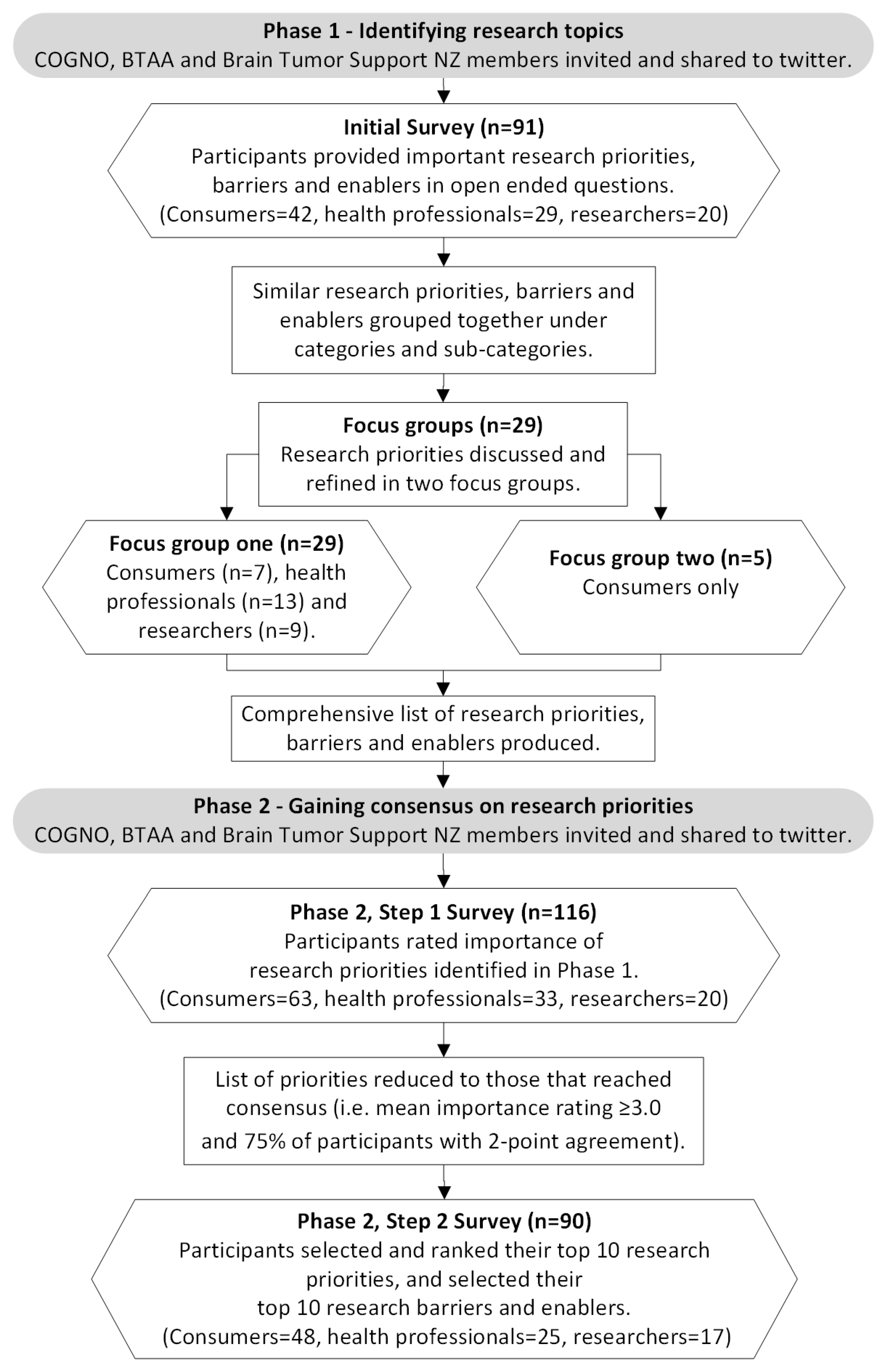
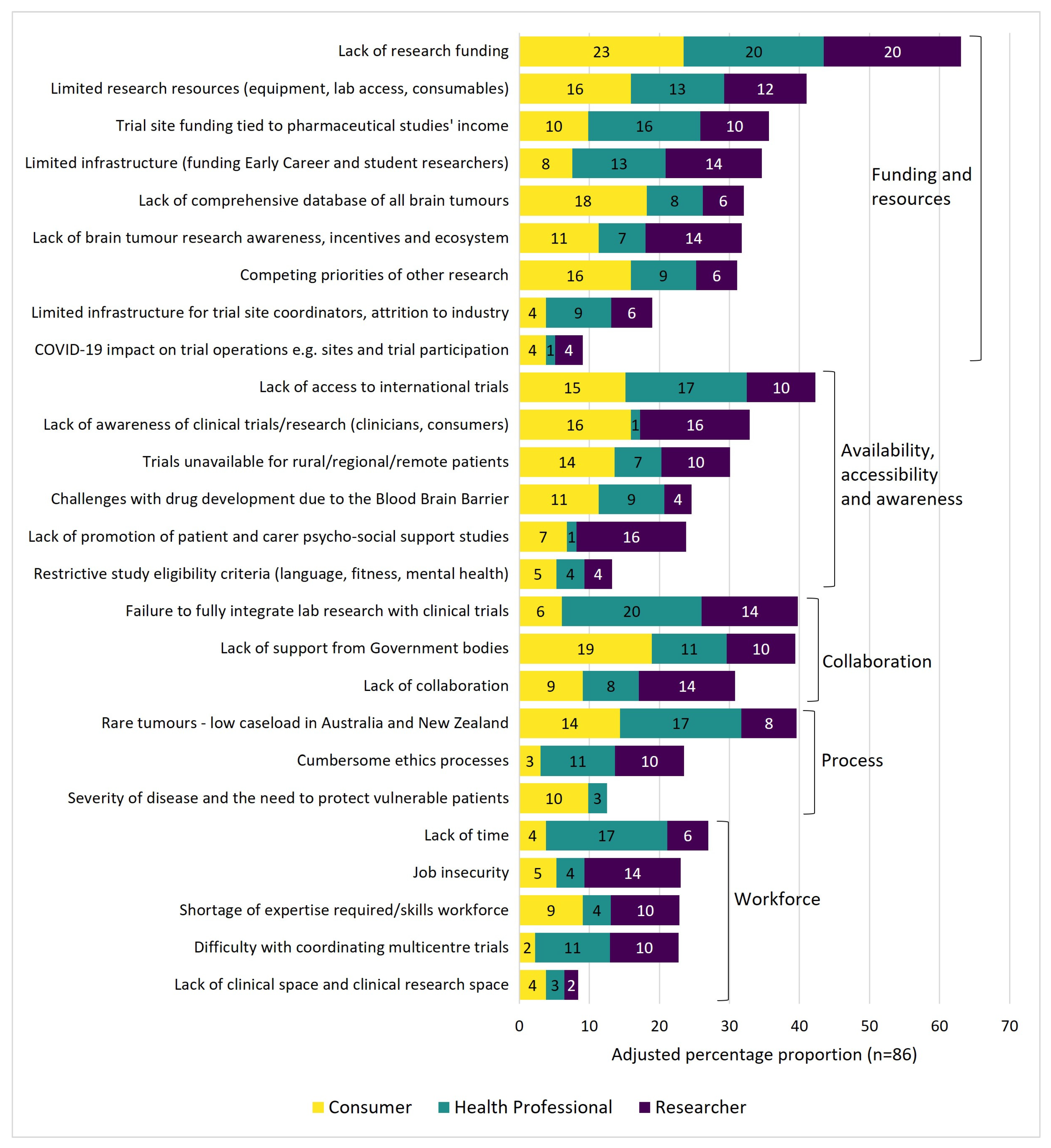
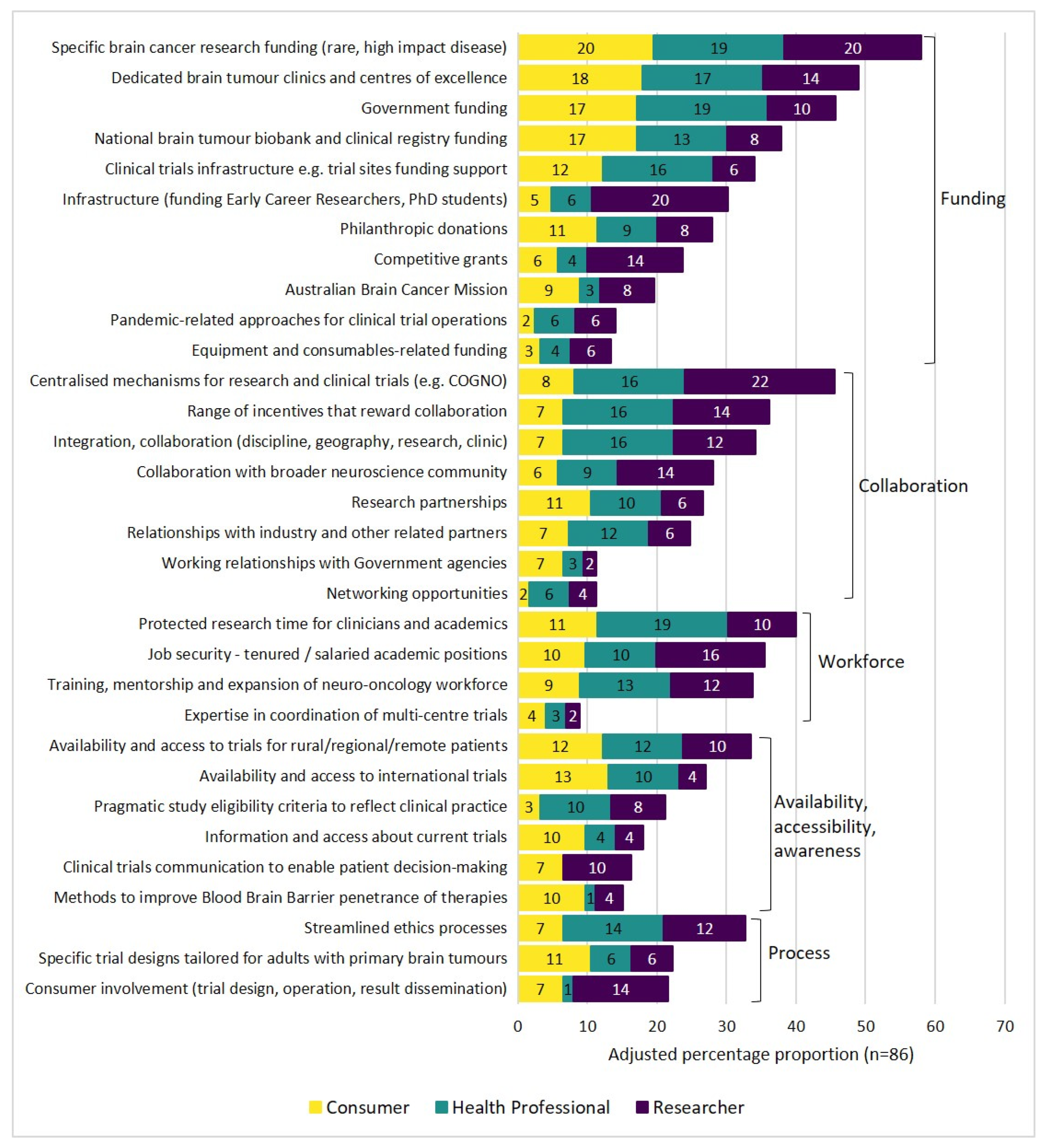

| Characteristic | Consumers a n = 40 (100%) | Health Professionals b n = 25 (100%) | Researchers n = 20 (100%) | Total n = 85 (100%) |
|---|---|---|---|---|
| Gender Male Female | ||||
| 11 (27.5) | 13 (52.0) | 7 (35.0) | 31 (36.5) | |
| 29 (72.5) | 12 (48.0) | 13 (65.0) | 54 (63.5) | |
| Location Type Major City Regional/Rural Remote | ||||
| 33 (82.5) | 22 (88.0) | 20 (100.0) | 75 (88.2) | |
| 7 (17.5) | 3 (12.0) | 0 (0) | 10 (11.8) | |
| 0 (0) | 0 (0) | 0 (0) | 0 (0) | |
| Location Australia New South Wales Victoria Queensland Western Australia Australian Capital Territory Tasmania South Australia New Zealand | ||||
| 35 (87.5) | 22 (88.8) | 19 (95.0) | 76 (89.4) | |
| 14 (40.0) | 10 (45.5) | 7 (36.8) | 31 (40.8) | |
| 8 (22.9) | 8 (36.4) | 2 (10.5) | 18 (23.7) | |
| 4 (11.4) | 3 (13.6) | 3 (15.8) | 10 (13.2) | |
| 2 (5.7) | 0 (0) | 6 (31.6) | 8 (10.5) | |
| 2 (5.7) | 0 (0) | 0 (0) | 2 (2.6) | |
| 3 (8.6) | 1 (4.5) | 0 (0) | 4 (5.3) | |
| 2 (5.7) | 0 (0) | 1 (5.3) | 3 (3.9) | |
| 5 (12.5) | 3 (12.0) | 1 (5.0) | 9 (10.6) | |
| Age c | Mean (SD) | Mean (SD) | Mean (SD) | Mean (SD) |
| 50.8 (10.8) | 49.3 (9.0) | 46.3 (11.0) | 49.3 (10.4) |
| Characteristic | Consumers n = 7 (100%) | Health Professionals n = 13 (100%) | Researchers n = 9 (100%) | Total n = 29 (100%) |
|---|---|---|---|---|
| Gender Male Female | ||||
| 4 (57.1) | 7 (53.8) | 4 (44.4) | 15 (51.7) | |
| 3 (42.9) | 6 (46.2) | 5 (55.6) | 14 (48.3) | |
| Location Type Major City Regional/Rural Remote | ||||
| 7 (100.0) | 11 (84.6) | 9 (100.0) | 27 (93.1) | |
| 0 (0) | 2 (15.4) | 0 (0) | 2 (6.9) | |
| 0 (0) | 0 (0) | 0 (0) | 0 (0) | |
| Location Australia New South Wales Victoria Queensland Western Australia Australian Capital Territory Tasmania South Australia New Zealand | ||||
| 5 (71.4) | 11 (84.6) | 9 (100.0) | 25 (86.2) | |
| 2 (40.0) | 4 (36.4) | 2 (22.2) | 8 (32.0) | |
| 1 (20.0) | 6 (54.5) | 2 (22.2) | 9 (36.0) | |
| 0 (0.0) | 0 (0.0) | 2 (22.2) | 2 (8.0) | |
| 1 (20.0) | 0 (0.0) | 3 (33.3) | 4 (16.0) | |
| 1 (20.0) | 0 (0.0) | 0 (0.0) | 1 (4.0) | |
| 0 (0.0) | 1 (9.1) | 0 (0.0) | 1 (4.0) | |
| 0 (0.0) | 0 (0.0) | 0 (0.0) | 0 (0.0) | |
| 2 (28.6) | 2 (15.4) | 0 (0.0) | 4 (13.8) | |
| Age | Mean (SD) | Mean (SD) | Mean (SD) | Mean (SD) |
| 52.9 (7.5) | 52.8 (9.6) | 46.9 (8.8) | 50.9 (9.0) |
| Characteristic | Step 1 | Step 2 | |||
|---|---|---|---|---|---|
| Consumers n = 63 (100%) | Health Professionals n = 33 (100%) | Researchers n = 20 (100%) | Total n = 116 (100%) | Total n = 90 (100%) | |
| Gender Male Female | |||||
| 16 (25.4) | 19 (57.6) | 6 (30.0) | 41 (35.3) | 26 (28.9) | |
| 47 (74.6) | 14 (42.4) | 14 (70.0) | 75 (64.7) | 64 (71.1) | |
| Location Type Major City Regional/Rural Remote | |||||
| 45 (71.4) | 31 (93.9) | 18 (90.0) | 94 (81.0) | 74 (82.2) | |
| 15 (23.8) | 2 (6.1) | 2 (10.0) | 19 (16.4) | 14 (15.6) | |
| 3 (4.8) | 0 (0.0) | 0 (0.0) | 3 (2.6) | 2 (2.2) | |
| Location Australia New South Wales Victoria Queensland Western Australia Australian Capital Territory Tasmania South Australia New Zealand | |||||
| 61 (96.8) | 29 (87.9) | 20 (100.0) | 110 (94.8) | 85 (94.4) | |
| 23 (37.7) | 9 (31.0) | 9 (45.0) | 41 (37.3) | 33 (38.8) | |
| 15 (24.6) | 11 (37.9) | 3 (15.0) | 29 (26.4) | 23 (27.1) | |
| 8 (13.1) | 4 (13.8) | 3 (15.0) | 15 (13.6) | 9 (10.6) | |
| 4 (6.6) | 1 (3.4) | 5 (25.0) | 10 (9.1) | 8 (9.4) | |
| 6 (9.8) | 2 (6.9) | 0 (0.0) | 8 (7.3) | 6 (7.1) | |
| 2 (3.3) | 2 (6.9) | 0 (0.0) | 4 (3.6) | 3 (3.5) | |
| 3 (4.9) | 0 (0.0) | 0 (0.0) | 3 (2.7) | 3 (3.5) | |
| 2 (3.2) | 4 (12.1) | 0 (0.0) | 6 (5.2) | 5 (5.6) | |
| Age | Mean (SD) | Mean (SD) | Mean (SD) | Mean (SD) | Mean (SD) |
| 53.9 (13.7) | 48.0 (10.2) | 45.7 (11.3) | 50.8 (12.8) | 51.3 (11.9) | |
| Refer-ence Number | Research Priority | Consumers n = 63 | Health Professionals n = 33 | Researchers n = 20 | Overall n = 116 | ||||||
|---|---|---|---|---|---|---|---|---|---|---|---|
| Mean (SD) | Agreement (2 Point) n (%) | Topic Retained | n | ||||||||
| Mean (SD) | n | Mean (SD) | n | Mean (SD) | n | ||||||
| 1 | Understanding the causes of adult brain tumour development | 3.5 (0.74) | 63 | 3.0 (0.77) | 33 | 3.5 (0.69) | 20 | 3.4 (0.76) | 98 (84.5) | Yes | 116 |
| 2 | Developing research questions around familial glioma syndromes | 3.1 (0.87) | 61 | 2.2 (0.68) | 33 | 2.8 (0.62) | 18 | 2.8 (0.87) | 80 (71.4) | No | 112 |
| 3 | Pre-clinical research to identify actionable drivers (and new molecular targets) for therapy | 3.6 (0.58) | 62 | 3.5 (0.71) | 33 | 3.2 (0.71) | 19 | 3.5 (0.65) | 108 (94.7) | Yes | 114 |
| 4 | Improved pre-clinical models of gliomas and other primary Central Nervous System malignancies | 3.5 (0.65) | 61 | 3.4 (0.74) | 33 | 3.3 (0.84) | 18 | 3.4 (0.71) | 104 (92.9) | Yes | 112 |
| 5 | Understanding the tumour microenvironment and immunosuppression to facilitate immunotherapy | 3.7 (0.53) | 61 | 3.5 (0.75) | 33 | 3.5 (0.62) | 17 | 3.6 (0.62) | 105 (94.6) | Yes | 111 |
| 6 | Pre-clinical models and strategies to enhance Blood Brain Barrier (BBB) penetration for novel drugs | 3.6 (0.60) | 62 | 3.1 (0.74) | 33 | 3.3 (0.59) | 18 | 3.4 (0.68) | 101 (89.4) | Yes | 113 |
| 7 | Novel therapeutic approaches with the ability to specifically target the stem cell-like population | 3.5 (0.68) | 59 | 3.2 (0.82) | 33 | 3.2 (0.79) | 18 | 3.4 (0.75) | 92 (83.6) | Yes | 110 |
| 8 | Cell surface proteomics analysis platforms to define novel and actionable receptors in brain tumours | 3.6 (0.57) | 58 | 3.2 (0.71) | 32 | 2.9 (0.72) | 16 | 3.4 (0.68) | 94 (88.7) | Yes | 106 |
| 9 | Investigating reasons for treatment resistance | 3.5 (0.65) | 59 | 3.5 (0.62) | 33 | 3.6 (0.51) | 20 | 3.5 (0.62) | 105 (93.8) | Yes | 112 |
| 10 | Further development of a network for biobanking for all brain tumours | 3.6 (0.62) | 61 | 3.3 (0.88) | 33 | 3.3 (0.45) | 19 | 3.4 (0.69) | 104 (92.0) | Yes | 113 |
| 11 | Brain tumour registry to track outcomes for all brain tumours | 3.6 (0.53) | 61 | 3.1 (0.75) | 32 | 3.5 (0.69) | 20 | 3.4 (0.65) | 103 (91.2) | Yes | 113 |
| 12 | Big data repositories/networks for radiation oncology and radiology innovation | 3.5 (0.65) | 60 | 3.0 (0.76) | 32 | 3.1 (0.85) | 19 | 3.3 (0.74) | 93 (83.8) | Yes | 111 |
| 13 | National benchmarking and quality indicators and outcomes of care (including surgery) | 3.6 (0.72) | 60 | 3.2 (0.75) | 32 | 3.4 (0.67) | 20 | 3.4 (0.73) | 100 (89.3) | Yes | 112 |
| 14 | Systems for genomic and proteomic profiling of brain tumours | 3.6 (0.57) | 58 | 3.4 (0.50) | 32 | 3.4 (0.62) | 17 | 3.5 (0.56) | 104 (97.2) | Yes | 107 |
| 15 | Phase 0 studies (imaging, blood, and tumour biomarker development for neoadjuvant therapy) | 3.4 (0.63) | 57 | 3.4 (0.55) | 32 | 3.2 (0.95) | 17 | 3.4 (0.67) | 97 (91.5) | Yes | 106 |
| 16 | Use of liquid biopsies for diagnosis and monitoring treatment and response | 3.5 (0.65) | 59 | 3.2 (0.64) | 31 | 3.1 (0.72) | 16 | 3.3 (0.67) | 94 (88.7) | Yes | 106 |
| 17 | Effectiveness of precision medicine/personalised treatment based on genomic profiling | 3.6 (0.67) | 59 | 3.4 (0.66) | 32 | 3.6 (0.50) | 18 | 3.5 (0.65) | 100 (91.7) | Yes | 109 |
| 18 | Role of theranostics in guiding treatment | 3.5 (0.71) | 56 | 3.0 (0.78) | 32 | 3.2 (0.73) | 17 | 3.3 (0.76) | 88 (83.8) | Yes | 105 |
| 19 | Clinical trials that include relevant patient-reported outcomes | 3.6 (0.58) | 59 | 3.3 (0.79) | 32 | 3.6 (0.69) | 19 | 3.5 (0.67) | 101 (91.8) | Yes | 110 |
| 20 | Implementation of research into improving primary care awareness, early diagnosis, and investigation of “red flag” symptoms | 3.4 (0.72) | 61 | 2.3 (0.88) | 32 | 3.1 (0.85) | 20 | 3.0 (0.93) | 80 (70.8) | No | 113 |
| 21 | Exploring support provided to patients pre-diagnosis and the role of care coordinators pre-diagnosis | 3.2 (0.85) | 59 | 2.5 (0.95) | 32 | 3.0 (0.86) | 20 | 2.9 (0.92) | 76 (68.5) | No | 111 |
| 22 | Devices/techniques to improve extent of surgical resection | 3.3 (0.69) | 58 | 2.8 (0.81) | 32 | 3.1 (0.76) | 18 | 3.2 (0.76) | 92 (85.2) | Yes | 108 |
| 23 | Clinical trials using immunotherapy agents | 3.6 (0.53) | 58 | 3.3 (0.73) | 32 | 3.3 (0.67) | 18 | 3.5 (0.63) | 102 (94.4) | Yes | 108 |
| 24 | Clinical trials using cellular therapies | 3.7 (0.47) | 56 | 3.1 (0.78) | 32 | 3.0 (0.65) | 15 | 3.4 (0.68) | 94 (91.3) | Yes | 103 |
| 25 | Correlation between chemoresistance and drug metabolism (metabolomics) | 3.4 (0.73) | 57 | 3.0 (0.62) | 32 | 2.9 (0.75) | 17 | 3.2 (0.73) | 91 (85.8) | Yes | 106 |
| 26 | Determining which drugs are radiation sensitisers and effective in managing brain tumours | 3.6 (0.52) | 59 | 2.9 (0.69) | 32 | 3.3 (0.69) | 18 | 3.4 (0.68) | 97 (89.0) | Yes | 109 |
| 27 | Drug repurposing studies in adult brain tumours | 3.5 (0.63) | 58 | 2.8 (0.87) | 32 | 3.2 (0.75) | 16 | 3.2 (0.78) | 87 (82.1) | Yes | 106 |
| 28 | Clinical trials using viral vectors | 3.5 (0.61) | 54 | 3.1 (0.78) | 32 | 2.7 (0.80) | 15 | 3.2 (0.74) | 83 (82.2) | Yes | 101 |
| 29 | Developing and trialling high throughput in vitro drug screening | 3.1 (0.74) | 46 | 2.8 (0.69) | 32 | 2.9 (0.81) | 16 | 2.9 (0.74) | 71 (75.5) | Yes | 94 |
| 30 | Trials to address radiation toxicity (acute and late effects)—techniques, survivorship, outcomes | 3.5 (0.60) | 58 | 2.8 (0.81) | 32 | 3.3 (0.81) | 19 | 3.3 (0.76) | 91 (83.5) | Yes | 109 |
| 31 | Conducting radiation therapy trials to improve outcomes for people with benign brain tumours | 3.3 (0.81) | 54 | 2.6 (0.88) | 32 | 3.1 (0.90) | 18 | 3.0 (0.90) | 72 (69.2) | No | 104 |
| 32 | Advanced neuro-oncology imaging for diagnosis and treatment response monitoring | 3.5 (0.63) | 58 | 3.3 (0.74) | 32 | 3.4 (0.51) | 19 | 3.4 (0.64) | 100 (91.7) | Yes | 109 |
| 33 | New effective therapies against rarer primary Central Nervous System tumours | 3.4 (0.63) | 56 | 2.9 (0.84) | 32 | 3.2 (0.62) | 18 | 3.2 (0.72) | 90 (84.9) | Yes | 106 |
| 34 | Pharmacological/other interventions to improve symptom management | 3.4 (0.69) | 58 | 2.8 (0.78) | 32 | 3.2 (0.88) | 18 | 3.2 (0.78) | 87 (80.6) | Yes | 108 |
| 35 | Developing treatment utilisation models for standards of care for each main treatment modality | 3.3 (0.69) | 56 | 2.6 (0.94) | 32 | 3.2 (0.88) | 18 | 3.1 (0.86) | 82 (77.4) | Yes | 106 |
| 36 | Optimal treatment and care pathways for people with brain tumours | 3.7 (0.58) | 57 | 3.0 (1.00) | 32 | 3.6 (0.60) | 20 | 3.4 (0.79) | 95 (87.2) | Yes | 109 |
| 37 | Identifying barriers to equitable outcomes for under-served populations (e.g., CALD, rural, ATSI) * | 3.4 (0.79) | 58 | 2.9 (0.82) | 32 | 3.8 (0.44) | 20 | 3.3 (0.80) | 91 (82.7) | Yes | 110 |
| 38 | Determining the impact and optimal models of care coordination | 3.3 (0.78) | 58 | 2.8 (0.88) | 32 | 3.3 (0.86) | 20 | 3.2 (0.85) | 85 (77.3) | Yes | 110 |
| 39 | Determining the impact and optimal models of telehealth | 3.0 (1.00) | 59 | 2.5 (0.84) | 32 | 3.2 (0.67) | 20 | 2.9 (0.93) | 73 (65.8) | No | 111 |
| 40 | Determining the impact and developing optimal models of teletrials | 3.0 (1.02) | 58 | 2.7 (0.97) | 32 | 3.2 (0.76) | 19 | 2.9 (0.97) | 78 (71.6) | No | 109 |
| 41 | Developing and testing interventions for cognitive, personality, and behaviour changes | 3.2 (0.83) | 59 | 2.7 (0.82) | 32 | 3.2 (0.83) | 20 | 3.1 (0.85) | 80 (72.1) | No | 111 |
| 42 | Developing and testing interventions for fatigue | 3.1 (0.88) | 59 | 2.7 (0.85) | 32 | 3.0 (0.97) | 20 | 3.0 (0.89) | 77 (69.4) | No | 111 |
| 43 | Effective rehabilitation interventions for patients and carers | 3.3 (0.74) | 58 | 2.9 (0.83) | 32 | 3.4 (0.77) | 19 | 3.2 (0.80) | 89 (81.7) | Yes | 109 |
| 44 | Exploring the impact of neuro-psychology interventions in brain tumour care | 3.2 (0.78) | 59 | 2.6 (0.80) | 32 | 3.1 (0.81) | 19 | 3.0 (0.82) | 78 (70.9) | No | 110 |
| 45 | Exploring patients’ and carers’ barriers and enablers in accessing timely palliative care | 3.2 (0.86) | 57 | 2.8 (0.84) | 32 | 3.2 (0.89) | 20 | 3.1 (0.88) | 81 (74.3) | No | 109 |
| 46 | Exploring and testing palliative care interventions | 3.2 (0.85) | 57 | 2.8 (0.76) | 32 | 3.2 (0.89) | 20 | 3.1 (0.85) | 81 (74.3) | No | 109 |
| 47 | Evaluating implementation of end-of-life care plans and advance care directives | 3.1 (0.98) | 56 | 2.7 (0.82) | 32 | 3.2 (0.88) | 20 | 3.0 (0.93) | 76 (70.4) | No | 108 |
| 48 | Evaluating implementation of increased assessment of patient and carer anxiety, distress, and quality of life | 3.3 (0.91) | 59 | 2.8 (0.86) | 32 | 3.3 (0.80) | 20 | 3.1 (0.89) | 82 (73.9) | No | 111 |
| 49 | Psychosocial interventions for patient/family unmet needs, anxiety, and distress following diagnosis | 3.3 (0.86) | 58 | 2.8 (0.78) | 32 | 3.4 (0.68) | 20 | 3.2 (0.83) | 84 (76.4) | Yes | 110 |
| 50 | Novel technologies for patients/carers, and their social networks, to support, monitor, and follow-up | 3.1 (0.90) | 57 | 2.8 (0.82) | 32 | 3.5 (0.69) | 20 | 3.1 (0.86) | 84 (77.1) | Yes | 109 |
| 51 | Exploring grief and loss for patients, carers, and their social networks | 3.1 (0.96) | 59 | 2.3 (0.74) | 32 | 3.0 (0.86) | 20 | 2.8 (0.94) | 70 (63.1) | No | 111 |
| 52 | Exploring patients’, carers’, and families’ survivorship needs following treatment | 3.1 (0.88) | 58 | 2.6 (0.76) | 32 | 3.1 (0.89) | 20 | 2.9 (0.87) | 76 (69.1) | No | 110 |
| 53 | Developing and testing survivorship-focused interventions to support patients, carers, and families following treatment | 3.1 (0.87) | 57 | 2.6 (0.83) | 32 | 3.3 (0.86) | 20 | 3.0 (0.89) | 76 (69.7) | No | 109 |
| 54 | Exploring the financial toxicity associated with brain tumour diagnosis, treatment, and follow-up care | 3.1 (0.85) | 58 | 2.3 (0.90) | 32 | 3.1 (0.64) | 20 | 2.9 (0.90) | 74 (67.3) | No | 110 |
| 55 | Exploring the cost-effectiveness of supportive care interventions for patients, carers, and their social networks | 3.0 (0.97) | 58 | 2.5 (0.80) | 32 | 3.1 (0.64) | 20 | 2.9 (0.90) | 73 (66.4) | No | 110 |
| 56 | Developing and testing decision support tools throughout treatment/care pathway to assist patients and carers/families to communicate with clinicians and decide on treatment and supportive care | 3.2 (0.96) | 59 | 2.4 (0.80) | 32 | 3.1 (0.91) | 20 | 2.9 (0.96) | 75 (67.6) | No | 111 |
| 57 | Trialling interventions to improve patient, carer, and family education about brain tumours, treatment options, disease progression, symptoms, side effects, and supportive care | 3.0 (0.91) | 59 | 2.7 (0.75) | 32 | 3.3 (0.73) | 20 | 3.0 (0.86) | 79 (71.2) | No | 111 |
| 58 | Determining the role of complementary therapies (e.g., meditation; relaxation; aromatherapy; acupuncture; reflexology; massage) in managing adult brain tumours and how these align with conventional therapies being undertaken | 3.1 (0.90) | 59 | 1.8 (0.78) | 32 | 2.4 (0.99) | 20 | 2.6 (1.05) | 63 (56.8) | No | 111 |
| 59 | Investigating the role of diet in improving treatment outcomes and managing symptoms and side effects of treatment | 3.1 (0.87) | 58 | 1.9 (0.78) | 32 | 2.4 (0.75) | 20 | 2.6 (0.98) | 70 (63.6) | No | 110 |
| 60 | Role of exercise: improving treatment outcomes, managing symptoms and treatment side effects | 3.3 (0.81) | 59 | 2.6 (0.79) | 32 | 3.0 (0.69) | 20 | 3.0 (0.84) | 83 (74.8) | No | 111 |
| Rank Posit-ion | Research Priority | Refer-ence Number in Step 1 | Top Ten Selections by Participants n = 89 | Ranking | ||||
|---|---|---|---|---|---|---|---|---|
| Selected | Not Selected | Consumers n = 42 | Health Professionals n = 23 | Researchers n = 17 | Average Mean n = 82 | |||
| n (%) | n (%) | Mean (SD) | Mean (SD) | Mean (SD) | Mean (SD) | |||
| 1 | Clinical trials that include relevant patient-reported outcomes | 19 | 38 (42.7) | 51 (57.3) | 3.5 (4.25)a, b | 1.3 (2.60) b | 4.8 (4.32)a | 3.2 (3.72) * |
| 2 | Understanding of tumour microenvironment and immunosuppression in immunotherapy | 5 | 43 (48.3) | 46 (51.7) | 3.1 (3.78) | 3.3 (3.63) | 2.7 (4.12) | 3.0 (3.84) |
| 3 | Effectiveness of precision medicine/personalised treatment based on genomic profiling | 17 | 42 (47.2) | 47 (52.8) | 2.9 (3.72) | 3.3 (3.58) | 2.2 (3.44) | 2.8 (3.58) |
| 4 | Pre-clinical research to identify actionable drivers (and new molecular targets) for therapy | 3 | 33 (37.1) | 56 (62.9) | 2.0 (3.39)b | 4.3 (4.09)a | 1.2 (2.46) b | 2.5 (3.31) * |
| 5 | Advanced neuro-oncology imaging for diagnosis and treatment response monitoring | 32 | 37 (41.6) | 52 (58.4) | 1.9 (3.17) | 3.0 (3.13) | 2.2 (2.84) | 2.4 (3.05) |
| 6 | Investigating reasons for treatment resistance | 9 | 31 (34.8) | 58 (65.2) | 2.0 (3.41) | 2.5 (3.68) | 2.1 (3.28) | 2.2 (3.46) |
| 7 | Brain tumour registry to track outcomes for all brain tumours | 11 | 40 (44.9) | 49 (55.1) | 2.9 (3.57) | 2.3 (4.05) | 1.5 (2.65) | 2.2 (3.42) |
| 8 | Pre-clinical models and strategies to enhance Blood Brain Barrier (BBB) penetration for novel drugs | 6 | 34 (38.2) | 55 (61.8) | 2.7 (3.32) | 2.0 (3.05) | 1.8 (2.99) | 2.2 (3.12) |
| 9 | National benchmarking and quality indicators and outcomes of care (including surgery) | 13 | 29 (32.6) | 60 (67.4) | 1.3 (2.65) | 2.5 (3.50) | 2.3 (3.69) | 2.0 (3.28) |
| 10 | Clinical trials using immunotherapy agents | 23 | 31 (34.8) | 58 (65.2) | 2.7 (3.87) | 1.3 (2.72) | 1.8 (3.36) | 1.9 (3.32) |
| 11 | Phase 0 studies (imaging, blood, and tumour biomarker development for neoadjuvant therapy) | 15 | 24 (27.0) | 65 (73.0) | 0.8 (1.96) b | 4.1 (4.38) a | 0.7 (2.20) b | 1.9 (2.85) ** |
| 12 | Understanding the causes of adult brain tumour development | 1 | 32 (36.0) | 57 (64.0) | 3.6 (3.96) a | 0.0 (0.00) b | 1.8 (3.17) a, b | 1.8 (2.38) ** |
| 13 | Use of liquid biopsies for diagnosis and monitoring treatment and response | 16 | 28 (31.5) | 61 (68.5) | 1.5 (2.95) b | 3.0 (3.21) a | 0.8 (1.79) b | 1.8 (2.65) * |
| 14 | Psychosocial interventions patient/family unmet needs, anxiety, and distress following diagnosis | 49 | 28 (31.5) | 61 (68.5) | 1.3 (2.24) a, b | 0.3 (0.93) b | 3.6 (4.53)a | 1.8 (2.57) * |
| 15 | Optimal treatment and care pathways for people with brain tumours | 36 | 25 (28.1) | 64 (71.9) | 1.5 (2.82) | 0.6 (2.21) | 2.7 (3.67) | 1.6 (2.90) |
| 16 | Improved pre-clinical models of gliomas and other primary Central Nervous System malignancies | 4 | 22 (24.7) | 67 (75.3) | 1.1 (2.55) | 2.2 (3.41) | 1.4 (2.29) | 1.5 (2.75) |
| 17 | Further development of a network for biobanking for all brain tumours | 10 | 28 (31.5) | 61 (68.5) | 1.9 (3.06) | 2.3 (3.51) | 0.4 (1.06) | 1.5 (2.54) |
| 18 | Clinical trials using cellular therapies | 24 | 20 (22.5) | 69 (77.5) | 2.2 (3.59) | 1.2 (2.48) | 1.1 (3.01) | 1.5 (3.03) |
| 19 | Systems for genomic and proteomic profiling of brain tumours | 14 | 17 (19.1) | 72 (80.9) | 0.7 (1.94) | 1.5 (2.81) | 1.8 (3.36) | 1.3 (2.70) |
| 20 | Identifying barriers to equitable outcomes for under-served populations (e.g., CALD, rural, ATSI) | 37 | 19 (21.3) | 70 (78.7) | 1.0 (2.44) | 1.0 (2.57) | 1.9 (2.64) | 1.3 (2.55) |
| 21 | Determining the impact and optimal models of care coordination | 38 | 16 (18.0) | 73 (82.0) | 0.7 (2.13) b | 0.3 (1.25) b | 2.6 (3.77)a | 1.2 (2.38)** |
| 22 | Determining which drugs are radiation sensitisers and effective in managing brain tumours | 26 | 24 (27.0) | 65 (73.0) | 1.3 (2.59) | 0.6 (1.44) | 1.6 (2.55) | 1.2 (2.19) |
| 23 | New effective therapies against rarer primary Central Nervous System tumours | 33 | 19 (21.3) | 70 (78.7) | 1.0 (2.74) | 1.2 (2.29) | 1.2 (2.70) | 1.2 (2.58) |
| 24 | Trials to address radiation toxicity (acute and late effects)—techniques, survivorship, outcomes | 30 | 25 (28.1) | 64 (71.9) | 1.0 (2.06) | 1.1 (2.68) | 1.2 (1.95) | 1.1 (2.23) |
| 25 | Drug repurposing studies in adult brain tumours | 27 | 21 (23.6) | 68 (76.4) | 2.0 (3.04)a | 0.4 (1.34) b | 0.5 (2.18) b | 1.0 (2.19) ** |
| 26 | Cell surface proteomics analysis platforms to define novel and actionable receptors in brain tumours | 8 | 18 (20.2) | 71 (79.8) | 0.8 (1.68) | 1.7 (2.96) | 0.5 (1.74) | 1.0 (2.13) |
| 27 | Novel therapeutic approaches with the ability to specifically target the stem cell-like population | 7 | 20 (22.5) | 69 (77.5) | 1.2 (2.43) | 1.0 (1.89) | 0.7 (2.11) | 1.0 (2.14) |
| 28 | Effective rehabilitation interventions for patients and carers | 43 | 15 (16.9) | 74 (83.1) | 1.0 (2.51) | 0.2 (0.65) | 1.5 (2.76) | 0.9 (1.97) |
| 29 | Role of theranostics in guiding treatment | 18 | 16 (18.0) | 73 (82.0) | 0.1 (0.48) b | 1.8 (3.35) a | 0.7 (1.69) a, b | 0.9 (1.84) ** |
| 30 | Clinical trials using viral vectors | 28 | 15 (16.9) | 74 (83.1) | 1.0 (2.37) | 1.1 (2.58) | 0.3 (1.21) | 0.8 (2.05) |
| 31 | Devices/techniques to improve the extent of surgical resection | 22 | 18 (20.2) | 71 (79.8) | 1.0 (2.19) | 1.0 (2.43) | 0.3 (0.99) | 0.7 (1.87) |
| 32 | Novel technologies for patients/carers, and their social networks, to support, monitor, and follow-up | 50 | 14 (15.7) | 75 (84.3) | 0.4 (1.03) | 0.2 (0.65) | 1.6 (3.04) | 0.7 (1.57) |
| 33 | Big data repositories/networks for radiation oncology and radiology innovation | 12 | 11 (12.4) | 78 (87.6) | 0.5 (1.77) | 0.8 (2.26) | 0.8 (2.11) | 0.7 (2.05) |
| 34 | Role of exercise: improving treatment outcomes, managing symptoms and treatment side effects | 60 | 19 (21.3) | 70 (78.7) | 1.0 (2.28) | 0.2 (0.74) | 0.8 (1.63) | 0.7 (1.55) |
| 35 | Pharmacological/other interventions to improve symptom management | 34 | 15 (16.9) | 74 (83.1) | 0.6 (1.56) | 0.3 (1.26) | 0.8 (2.33) | 0.6 (1.72) |
| 36 | Developing treatment utilisation models for standards of care for each main treatment modality | 35 | 10 (11.2) | 79 (88.8) | 0.1 (0.37) | 0.4 (1.88) | 1.1 (2.71) | 0.5 (1.65) |
| 37 | Correlation between chemoresistance and drug metabolism (metabolomics) | 25 | 13 (14.6) | 76 (85.4) | 0.6 (1.94) | 0.7 (1.75) | 0.0 (0.00) | 0.4 (1.23) |
Publisher’s Note: MDPI stays neutral with regard to jurisdictional claims in published maps and institutional affiliations. |
© 2022 by the authors. Licensee MDPI, Basel, Switzerland. This article is an open access article distributed under the terms and conditions of the Creative Commons Attribution (CC BY) license (https://creativecommons.org/licenses/by/4.0/).
Share and Cite
Halkett, G.K.B.; Breen, L.J.; Berg, M.; Sampson, R.; Sim, H.-W.; Gan, H.K.; Kong, B.Y.; Nowak, A.K.; Day, B.W.; Harrup, R.; et al. Determining the Research Priorities for Adult Primary Brain Tumours in Australia and New Zealand: A Delphi Study with Consumers, Health Professionals, and Researchers. Curr. Oncol. 2022, 29, 9928-9955. https://doi.org/10.3390/curroncol29120781
Halkett GKB, Breen LJ, Berg M, Sampson R, Sim H-W, Gan HK, Kong BY, Nowak AK, Day BW, Harrup R, et al. Determining the Research Priorities for Adult Primary Brain Tumours in Australia and New Zealand: A Delphi Study with Consumers, Health Professionals, and Researchers. Current Oncology. 2022; 29(12):9928-9955. https://doi.org/10.3390/curroncol29120781
Chicago/Turabian StyleHalkett, Georgia K. B., Lauren J. Breen, Melissa Berg, Rebecca Sampson, Hao-Wen Sim, Hui K. Gan, Benjamin Y. Kong, Anna K. Nowak, Bryan W. Day, Rosemary Harrup, and et al. 2022. "Determining the Research Priorities for Adult Primary Brain Tumours in Australia and New Zealand: A Delphi Study with Consumers, Health Professionals, and Researchers" Current Oncology 29, no. 12: 9928-9955. https://doi.org/10.3390/curroncol29120781
APA StyleHalkett, G. K. B., Breen, L. J., Berg, M., Sampson, R., Sim, H.-W., Gan, H. K., Kong, B. Y., Nowak, A. K., Day, B. W., Harrup, R., James, M., Saran, F., Mcfarlane, B., Tse, C., & Koh, E.-S. (2022). Determining the Research Priorities for Adult Primary Brain Tumours in Australia and New Zealand: A Delphi Study with Consumers, Health Professionals, and Researchers. Current Oncology, 29(12), 9928-9955. https://doi.org/10.3390/curroncol29120781

