


Abstract
Background: Swimming is a common goal for children with disability, and the most popular sport for children in Australia. This study explored swimming and rehabilitation professionals’ perceptions of swimming for Australian children with disability. Methods: Rehabilitation and swimming professionals with recent experience working with children with disability completed an online survey. Quantitative data from binary and Likert-scale questions were analysed descriptively. Qualitative data from open-ended questions was evaluated using reflexive thematic analysis and mapped to the family of Participation-Related Constructs (fPRC). Results: Ninety-one swimming and 55 rehabilitation professionals (n = 146) responded. Most were confident supporting children with disability with swimming goals (rehabilitation = 71.6%, swimming = 73.8%) but had neutral–very low knowledge of para-swimming eligibility and classification (rehabilitation = 75%, swimming = 77.7%). Ten themes (33 code groups) covering all core elements of the fPRC were identified. Barriers/facilitators included pool accessibility (physical and sensory); program availability; affordability; acceptability (of content and culture); and having accommodating professionals and programs. Professionals believed that swimming programs should develop children’s confidence, water-safety, swimming skills, and fitness. Conclusion: Rehabilitation and swimming professionals should review existing programs to ensure they meet the needs of children with disability. Further research is needed to create an action plan to improve swimming participation for Australian children with disability.
1. Introduction
Participation in physical activity during childhood is a key protective health factor associated with improved physical and mental health outcomes [1]. Additionally, children who are more physically active at school age are more likely to be active adults [2]. Many children with disability and their families face significant barriers to participation in physical activities and therefore participate less and in a smaller range of activities than typically developing children [3].
Swimming is the most popular sport for children in Australia [4] and remains a popular option for being physically active throughout adulthood internationally [5,6,7]. There is emerging evidence that swimming is beneficial for children with a variety of disabilities [8,9,10,11], as it provides a weight-supported environment for exercise [12] and teaches children specific water-safety skills to reduce their elevated risk of drowning [13,14].
Most published research on water-based activities focuses on hydrotherapy for children with disability [15,16,17]. While children with disability may start working on swimming and water safety skills with aquatic therapists in a hydrotherapy context [18], the focus of hydrotherapy is typically on physical therapeutic goals such as strength, postural control, or land-based functional goals. In comparison, swimming (including learn-to-swim programs, recreational swimming for physical health and fitness, and competitive swimming) provides children with life-long opportunities to participate in regular physical activity known to improve cardiorespiratory endurance, muscle strength, and gross motor skills [19,20,21]. Compared to a therapeutic environment, participation within a community setting provides opportunities for social interaction, peer-modelling [22] and increased acceptance of children with disability by their peers without disability [23].
The family of Participation-Related Constructs (fPRC) [24] provides a framework to communicate commonly reported barriers to swimming participation for children with disability, as well as potential facilitators for improved community programs. It includes factors relating to the individual (activity competence, sense-of self, and preferences) and those external to the individual that relate to their environment and context [24]. Environmental barriers to participation in community sports for children with disability include physical access or social acceptance, or personal barriers including decreased motivation or lacking confidence or knowledge of how to get involved [3,25]. Compared to land-based sports, swimming presents additional barriers to participation due to the unique aquatic environment in which it is performed [26]. Access to the physical pool environment is essential to participation, and children with disability may require increased time and support to participate compared to their typically developing peers [27,28,29]. In addition to physical access, community swimming programs may not always be equipped to safely support the unique needs of children with disability in terms of provider knowledge and skills and/or provision of individualised support or adjustments [12]. This means that research specific to aquatic environments is important to understand and address the barriers experienced by children with disability who wish to participate in swimming.
Swimming teachers represent the primary delivery agents of community-based swimming programs, while rehabilitation professionals such as physiotherapists and occupational therapists may introduce children with disability to swimming as they incorporate this activity into therapeutic interventions and physical activity goal setting. The perspectives of both professional groups regarding current practice in swimming for children with disability in Australia offer complementary viewpoints from community and clinical contexts. To our knowledge, there has not been a study that has explored these experiences. This survey study aimed to identify the current state of practice for swimming participation of children with disability in Australia, from the perspective of swimming teachers and rehabilitation professionals. It addresses three key research questions:
- 1.
- What is the availability and content of swimming interventions and/or activities provided to children with disability in Australia?
- 2.
- What are the facilitators and barriers to participation in community swimming activities for children with disability in Australia, as perceived by swimming teachers and rehabilitation professionals?
- 3.
- What are the facilitators and barriers to providing swimming-focused interventions and/or activities to children with disability, as perceived by swimming teachers and rehabilitation professionals?
2. Materials and Methods
2.1. Design and Setting
The SPLASH I survey (Swimming Participation: Linking Australian Swimming & Health Sectors) was a cross-sectional survey study conducted between August 2023 and March 2024. This study was approved by the University of Queensland Ethics Committee (2023/HE000929).
A mixed-methods design was selected for the survey to leverage the strengths of both quantitative and qualitative approaches [30]. Quantitative questions captured measurable, generalizable data about participants’ qualifications, experience and the contexts in which swimming interventions were provided. Quantitative data served to contextualise complementary qualitative data, where open-ended questions were critical for capturing the depth and nuance of participants’ experiences relating to swimming for children with disability. By incorporating qualitative items, the survey created space for unanticipated insights to emerge and minimized the influence of preconceptions in question design.
2.2. Participants
Participants were recruited via purposive convenience sampling. Surveys were distributed to rehabilitation and swimming professionals via (i) governing bodies and employing organisations of rehabilitation and swimming professionals (e.g., Cerebral Palsy Alliance, AustSWIM), (ii) individual swim schools, or (iii) social media.
Organisations were identified through online directories and the research team’s professional contacts in rehabilitation and the swimming industry. Organisations distributed surveys to current staff and trainees to facilitate diversity of experience.
Inclusion Criteria: Participants were eligible if they held registration with the Australian Health Practitioner Regulation Agency (AHPRA) or professional swimming registration bodies (e.g., SWIM Coaches and Teachers Australia, AustSwim, Swimming Australia National Coaching Framework).
Exclusion Criteria: Participants were excluded if they could not answer the survey in English or had not provided relevant physical activity (rehabilitation professionals) or swimming (swimming professionals) services to children under the age of 18 years in the last 10 years. This criterion was used to ensure that responses reflected the current state of Australian swimming.
Sample Size: Power calculations were not appropriate due to the exploratory nature of this research. Sample size was determined pragmatically, aiming to capture a wide range of experiences and insights within the constraints of the study timeline and participant availability.
2.3. Measures
The SPLASH I survey (Appendix A) was a purpose-designed survey developed by the research team with experience in clinical rehabilitation, swimming research, and lived experience of neurodivergence.
The survey included 30–32 questions (depending on question branching) and was estimated to take participants approximately 20 min. Quantitative questions (5-point Likert scale, n = 11–14; binary yes/no questions, n = 6–7) examined qualifications, experience, knowledge and confidence with qualitative open-ended questions (n = 12) to explore the extent and nature of facilitators and barriers to swimming participation in more detail. Initial questions confirmed eligibility (n = 4) and collected demographic information relating to participants’ professional experience (n = 6–7). Questions then explored participants’ experiences of swimming activities for children with disability in Australia (n = 15–17), perceptions of the facilitators and barriers to participation in community swimming activities for children with disability in Australia (n = 3), and experiences of facilitators and barriers when providing or choosing not to provide swimming-focused interventions and/or activities to children with disability (n = 2).
2.4. Procedures
Participants accessed the survey anonymously through an online survey platform (Qualtrics). Potential participants who clicked on the electronic link to the research were provided with an overview of the study, completed screening and demographic questions to confirm eligibility, and provided consent prior to proceeding to the survey questions.
The survey was open from August 2023 to May 2024. Recruitment ceased when no additional responses were received for a 2-month period, indicating that further recruitment was unlikely.
2.5. Analysis
Quantitative data were analysed using descriptive statistics (e.g., frequency, mean, and median). When reporting numbers of responses, the following descriptors were used to communicate the extent of agreement: “almost all” >90%; “most” for 75–90%, “many” for 50–74%, “some” for 25–49% and “few” for <25% of responses [31,32].
Open-ended responses were analysed using reflexive thematic analysis [33] by two investigators from the research team (KG & GC) with significant clinical experience in aquatic physiotherapy and swimming-focused interventions for children with disability, lived experience of neurodivergence, and research experience in qualitative and quantitative research relating to sports-focused interventions (GC).
Latent codes and themes were initially independently developed, and semantic codes directly reflecting participants’ responses were grouped with related codes to form initial code groups. Code groups were developed from the data relating to activity type, and facilitators and barriers to children’s participation or professionals’ service provision. These code groups were subsequently mapped to the broader fPRC framework across its three primary domains: participation, encompassing attendance and involvement; intrinsic person-related factors including activity competence, sense of self and preferences; and environmental or contextual factors addressing accessibility, availability, accommodability, acceptability and affordability [34].
Regular meetings were held to discuss researchers’ perspectives, consider personal biases, and reach agreement regarding codes, code groups, and themes. Once code groups and themes were developed (by KG & GC), results were discussed with a third (LJ) and fourth (KO) author. Finally, the data were checked by the first author (KG) to ensure that previously classified codes were consistent with developed themes, and that the frequency of these codes was accurate where relevant. Consistent with reflexive thematic analysis principles, code frequencies were not routinely reported, as significance of themes is determined by their meaning and relevance to the research question rather than occurrence frequency [33].
3. Results
Of 146 eligible participants who completed the survey between August 2023 and March 2024, 91 were swimming professionals, and 55 were rehabilitation professionals. Due to the use of multiple distribution channels, the total number of professionals who received the survey invitation was not available to calculate a response rate.
3.1. Participant Demographics (Appendix B, Table A2)
3.1.1. Swimming Professionals
Almost all (n = 86/91) swimming professionals listed their swimming qualifications from one of four organisations (AustSWIM n = 76, Swimming Coaches and Teachers Australia [SCTA] n = 7, Royal Lifesaving Australia n = 3, or Lifesaving Victoria n = 4), while few reported having degrees from higher education institutes (n = 5). Most swimming professionals had experience engaging with a person with disability outside of a swimming context, including through other work (n = 26), family members or friends with disability (n = 22), sport and community groups (n = 9), or their own lived experience of disability (n = 5). Experience teaching swimming to children with disability was equally distributed with approximately one-third of swimming professionals with 16 or more years of experience (n = 31), 6–15 years of experience (n = 27) or five or less years of experience (n = 30). Many swimming professionals (n = 55) had completed disability-specific swimming training in addition to their swimming qualification, and some had completed other disability training not related to swimming (n = 21). Swimming-specific disability training was primarily received from three organisations: AustSWIM (n = 35), Deaf Children Australia (n = 9) and Swimming Coaches and Teachers Australia (n = 3). Most training provided education about a range of disabilities (n = 43); however, impairment or diagnosis-specific training was reported for deaf/hard of hearing children (Deaf Children Australia (n = 9)), autistic children (variety of organisations (n = 8)), and children with vision impairment (Vision Victoria course (n = 1)). The level of education received regarding disability included professional development or work-based training (n = 13), University-level education (e.g., a full degree) (n = 7), diplomas with disability units (n = 5), or other disability training (n = 7).
3.1.2. Rehabilitation Professionals
Of the 55 rehabilitation professionals, 53 were physiotherapists, one was an occupational therapist, and one did not specify their qualification. Rehabilitation professional participants were more experienced working with children with disability than swimming professional participants, with most having >5 years of experience (6–15 years: n = 17 and ≥16 years n = 16) and few (n = 7) having 1–5 years of experience. Many rehabilitation professionals had experience with swimming outside of a disability/rehabilitation context (n = 24) including participating in swimming (n = 17) or surf lifesaving (n = 1) themselves, providing swim coaching (n = 8) or surf coaching/volunteering (n = 2) to others, or as a parent of a para-swimmer (n = 1). Many of the participants (n = 20) had not completed any swimming education, some (n = 15) had completed swimming education for children with disability, and few (n = 5) had completed only general swimming education (i.e., swimming and water safety coaching courses without a specific disability focus).
3.2. Service Provision (Appendix C, Table A3)
Swimming professionals reported seeing more children per week, with most swimming professionals (77.3%) and only some rehabilitation professionals (37.5%) providing physical activity intervention or swimming activities for >15 children per week. When providing activities for children with disabilities, rehabilitation professionals were more likely to provide individual activities (rehabilitation 95%, swimming 38.6%), whereas swimming professionals were more likely to provide small-group activities (rehabilitation 5%, swimming 51.8%). Large-group (>6 participants) sessions were the least commonly reported group size (rehabilitation 2.3%, swimming professional 16.3%), although many swimming teachers (65.9%) reported commonly delivering large group sessions to typically developing children.
Swimming and rehabilitation professionals reported working with children with a diverse range of disabilities including neurodivergence, physical disabilities, intellectual disabilities, and children with sensory loss (e.g., blindness or low vision). Almost all professionals worked with autistic children (rehabilitation 92.7%, swimming 96.5%) and children with ADHD (rehabilitation 81.8%, swimming 91.8%) and most worked with children with intellectual disability (rehabilitation 87.3%, swimming 68.2%). A greater proportion of rehabilitation professionals saw children with neuromuscular (rehabilitation 69.1%, swimming 27.1%) and neurological conditions (rehabilitation 96.4%, swimming 64.7%), blindness/low vision (rehabilitation 67.3%, swimming 35.3%), and chromosomal conditions (rehabilitation 87.3%, swimming 50.6%), whereas swimming professionals reported seeing more children with limb deficiencies or amputations (rehabilitation 8.2%, swimming 52.9%) or deaf/hard-of-hearing children (rehabilitation 38.6%, swimming 60%).
3.3. Knowledge and Confidence
Many swimming (73.8%) and rehabilitation (69.1%) professionals reported having high or very high knowledge of supporting children with disability with swimming goals, with 25% of swimming professionals and 18.2% of rehabilitation professionals reporting very high knowledge (Figure 1a). Confidence in supporting children with swimming goals had similar distribution for both groups, with most swimming professionals (79.3%) and many rehabilitation professionals (72.7%) reporting being somewhat confident to very confident (Figure 1b). Many rehabilitation professionals (70.9%) and most swimming professionals (77.7%) reported having neutral or low knowledge of eligibility for para swimming (Figure 2a) or how classification works (Figure 2b; rehabilitation 74.1%, swimming 85.8%).
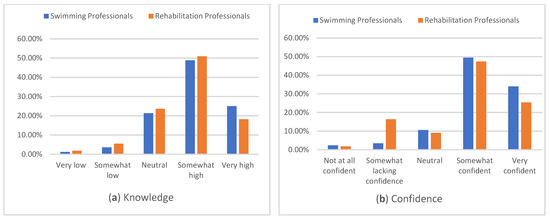
Figure 1.
Knowledge and Confidence in Supporting Children with Disability with Swimming Goals.
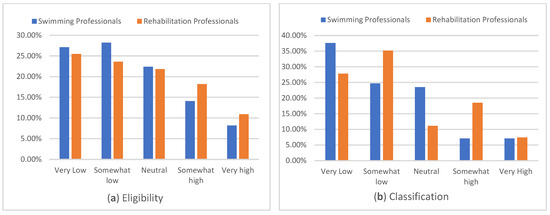
Figure 2.
Knowledge of para-swimming classification and eligibility.
3.4. Qualitative Results
DTen themes were developed from 33 code groups and mapped across all three domains of the fPRC (Table 1). These are presented in Figure 3, where the relationship between the environment (represented by the pool water) and individual factors (represented by ‘splash bubbles’ formed by the person’s swimming stroke) are shown to influence attendance and involvement in swimming. The distribution of themes and codes according to specific survey question and participant group (i.e., swimming or rehabilitation professional) can be found in Appendix D.

Table 1.
Themes and Code Groups from SPLASH survey mapped to the fPRC.
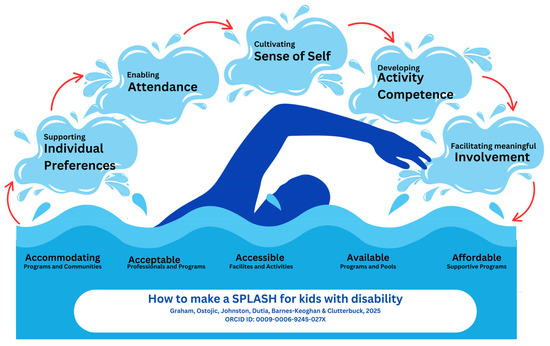
Figure 3.
Environmental, Individual and Participation factors in swimming.
3.4.1. Environment
Physical and Sensory Accessibility
Many professionals considered physical and sensory accessibility to be essential to participation. Physical accessibility related to pool entry (e.g., ramps and hoists), changing facilities, pool characteristics (e.g., depth), and equipment (e.g., floatation devices). Sensory accessibility related to temperature of the pool water and surroundings, noise levels, and lighting. Many swimming and rehabilitation professionals reported that the absence of accessible facilities was a barrier which prevented children with disability participating in community swimming activities, particularly in rural areas. One swimming professional described multiple overlapping accessibility barriers: “The environment—typically the centres are noisy, bright and overwhelming, access to changing facilities—there is often only one accessible room for older children, access into the pool—requires more support than the child has OR there is not a way for kids with severe physical disability to get into the pool.”
Acceptable and Accommodating Swimming Programs
Swimming and rehabilitation professionals described a variety of acceptable and accommodating swimming programs in Australia. These included mainstream classes or centres, therapy services and supports (e.g., occupational therapy input to swimming programs), disability-specific swimming programs or clubs such as Rainbow Club [35], individual lessons, therapist-led swimming interventions (e.g., aquatic physiotherapy) and informal swimming activities (e.g., attending the pool with a support worker). Both professional groups reported that individual lessons were most likely to be able to accommodate for the different needs of children with disability, particularly when children first commenced swimming (rehabilitation 25%, swimming 27.4%). Swimming professionals were more likely to suggest mainstream group classes as an acceptable option (swimming = 41.1%, rehabilitation 25%) whereas rehabilitation professionals were more likely to suggest therapist-led swimming interventions (rehabilitation = 29.5%, swimming = 8.2%).
Acceptable and Accommodating Professionals
Swimming and rehabilitation professionals highlighted the importance of both individual professionals and their broader organisations being accommodating to the needs of children with disability. This included fostering an inclusive culture, being willing and able to provide individualised activities and supports, accommodating for parents and families, and collaborating with services. One swimming professional highlighted the importance of “Understanding, lots of fun chatter, more inclusion…” and another swimming professional mentioned “Being aware of facilities that offer extra guidance and help.” The importance of accommodating professionals was particularly highlighted during transitions, such as when starting or changing swimming activities. Regardless of the type of program, a lack of accommodating professionals and organisations was reported to be a barrier to participation in swimming for children with disability and their families.
Availability of Accommodating Family Supports
Both groups of professionals highlighted that supports to help families to facilitate swimming participation for children with disability would improve participation. Suggestions included education or resources to improve families’ knowledge of swimming programs and pathways in recreational or competitive swimming for children with disability, providing accommodating services that facilitate family/caregivers to participate in activities and support their swimmer in the water, and ensuring professionals are available to liaise with families and other providers.
Availability of Education and Resources for Professionals
Swimming and rehabilitation professionals also reported that opportunities to undertake professional development to improve their knowledge and/or skills relating to swimming for children with disability were not readily available. Participants associated the availability of training, resources and allied health support with being able to provide more accommodating supports, and their absence as a significant barrier to being able to provide acceptable services. One swimming professional described the gap in professional development pathways: “Lack of training, time and the fact that after these kids can swim well, there’s nowhere for them to go, as our programs are really full and most just don’t fit into mainstream squads. So, it’s difficult to know what to do with them after they get to a certain skill level.”
Availability of Swimming Programs
Despite many acceptable and accommodating programs and services being described, and both swimming and rehabilitation professionals demonstrating an understanding of what makes pool facilities accessible, the limited availability of programs for children with disability in pools was reported as a major barrier. Participants reported poor availability of disability-specific clubs and programs and accessible facilities, especially in non-metropolitan areas. Where programs did exist, professionals frequently reported long waitlists and fluctuating seasonal availability of pools.
Affordability of Programs
Affordability was commonly identified as a barrier to participation in swimming. Professionals reported that families experience several financial pressures when accessing swimming, including taking time away from paid employment to transport their child to- and from swimming, as well as costs relating to transport, pool entry, and programs. Both professional groups identified that lack of funding (e.g., through the National Disability Insurance Scheme) posed a significant barrier to swimming participation for children with disability who may require more intensive, or individualised supports, and that financial support for both providers and participants was essential to ensure that appropriate programs were available and affordable for this population.
3.4.2. Individual Factors
Supporting Individual Needs and Preferences During Swimming Programs: Developing Activity Competence and Sense of Self
Professionals highlighted the importance of acknowledging the individual factors that may motivate or prevent a child from participating in swimming. Many swimming and rehabilitation professionals reported that activity competence goals (e.g., swimming or water-safety skills) were most common for children with disability. Goals relating to physical activity or developing sense of self through improved confidence in the water were reported less often, though one rehabilitation professional emphasized the importance of creating appropriate environments for building confidence: “Access to a pool that is less scary—not so loud with variable depth options, so that the child can comfortably explore moving their own body through water.” A few rehabilitation professionals also mentioned the importance of assessing physical activity competence so that activities provided are at the appropriate level for the child, while swimming professionals listed individual needs and preferences (e.g., behaviours or fear of the water) as potential barriers. When describing program content, one rehabilitation professional explained they focus on “Water confidence and water safety skills like following instructions around water, floating, returning to the wall if they fall in towards some form of swimming stroke(s).”
3.4.3. Participation in Swimming
Few professionals mentioned participation as a swimming-related goal for children with disability. Those that did focused on attending classes, competition and other water sports. Very few elaborated on children’s experiences of involvement, with these participants listing broad goals relating to children’s enjoyment of the water, social and community engagement.
4. Discussion
Swimming and rehabilitation professionals who participated in the survey perceived that environmental factors are most impactful for the participation of children with disability in swimming. The availability of accessible pools and acceptable and accommodating professionals and programs, as well as the affordability of these, were considered foundational to participation. Swimming and rehabilitation professionals suggested that supportive environments that adapt to the needs and preferences of children with disability would provide opportunities for them and their families to choose to attend swimming lessons and be involved in programs, improve activity competence, support the development of their confidence in the water (sense of self), and engage in events, therefore influencing their participation. While the term participation was not explicitly reported frequently, there was a clear underlying emphasis on developing environments and supports that would improve participation outcomes. This was shown in the way participation was alluded to through social or community engagement and connections, or the transactions between individual factors and participation. Professionals’ responses in this survey demonstrated clear insight into the elements of the fPRC within their sphere of influence and control, emphasising actionable ways that they could improve environments and contexts for children with disability in swimming. The following discussion explores these themes with a focus on those which professionals highlighted as having the greatest impact if addressed in practice.
The limited availability of accessible pools reported in our survey aligns with global findings of a lack of accessible facilities restricting participation in swimming and other sports programs of children with disability [36]. Pools need to be accessible, both from a physical perspective (entry to buildings, change rooms, and supported access to pools when required) and a sensory perspective (lighting, sound, and identifying times when pools are less busy). While Australian swimming pool regulations mandate accessible pool entry (entry via ramp, zero depth entry with an aquatic wheelchair, or platform or sling-style swimming pool lift) based on characteristics of the building and pool [37,38], they do not offer further guidance on other accessibility features. For example, pool depth and temperature are both important considerations for people with disability which are not addressed. This focus on standards for safe entry without guidance on broader accessibility is common in both high-, and low- and middle-income countries [39]. Research emphasises the value of sensory accessibility guidelines [40]; however, at present, these are limited to informal guidelines published by individual advocates and organisations [41,42,43].
Despite professionals reporting high levels of knowledge and confidence in supporting children with disability in swimming programs in quantitative questions, they continued to report barriers to providing swimming activities for children with disability when asked about their experiences. Barriers included lack of experience, support, knowledge of certain disabilities or competitive sports pathways and poor availability of therapists. Swimming professionals were more likely to see children with limb differences or amputations and deaf or hard-of-hearing children, while children with more complex physical disability, such as neurological or neuromuscular conditions, were more likely to be seen by a rehabilitation professional. This is consistent with international findings that swimming teachers tend to be more comfortable teaching children with mild disability and do not feel adequately equipped to provide acceptable and accommodating supports to children with more complex disability [44,45,46]. Youth with complex or multiple disability such as neurological disability in conjunction with intellectual disability or neurodivergence require tailored multidisciplinary swimming interventions to accommodate their needs and reduce the risk of adverse events in the pool [47]. This suggests that swimming teachers and rehabilitation professionals would benefit from education and resources which improve (i) their knowledge and skills supporting children with more complex disability in swimming activities, (ii) collaboration between rehabilitation and swimming professionals in practice, and (iii) knowledge regarding para-swimming, including classification and eligibility.
Even when accommodating programs led by confident and competent professionals are available in accessible pools, they are often unaffordable for many individuals and families. Affordability includes both program and pool access costs, as well as the financial and time cost of transport [12,48]. This travel time is a significant issue in Australia and other countries with geographically dispersed populations, where access to pools in general, and particularly pools with specific accessibility features is limited. The Australian Bureau of Statistics reports that a higher percentage of people with disability live in regional areas than in city centres [49]. While the National Disability Insurance Scheme aims to improve the affordability of many disability-specific services in Australia, funding for swimming lessons is not included. Other funding sources, such as those for people with low incomes, can be difficult to access due to their variability between states, inconsistent availability, and complex application processes. Given the limited government support for swimming education access, volunteer-run programs similar to Canada’s Swimming With a Mission program [50] may offer a potential solution for children with disability in Australia. While these programs may reduce financial barriers accessing swimming, their success relies on the capacity of the organisations providing them and the availability of volunteers to support them. It is important that a comprehensive approach to ensuring affordable access to swimming programs that considers the unique barriers to access and affordability in rural areas is implemented across Australia for children with disability.
Compared to environmental considerations, children’s swimming activity competence was less frequently discussed. Professionals did, however, highlight the importance of assessing swimming and water-safety skills and setting goals for intervention, which often related to attaining specific swimming or water safety skills. Despite professionals’ desire to assess these skills for children with disability, they felt ill-prepared to do so, and were often unaware of what tools may be used to assess swimming and water safety in this population. While there are a small number of assessment tools that have demonstrated validity and reliability for measuring swimming and water safety skills for children with disability [51,52], and some assessments designed for children without disability have been adapted or modified for use with specific populations [20,53,54], there is little information available to professionals to assist with selection or guide their use in practice. Future research should include a review of the psychometric properties of tools available to measure swimming and water safety skills for children with disability with the view of developing a practical guide for professionals working with this population, for example by way of a decision tree [55,56].
Limitations and Future Directions
This study has several strengths and limitations. The research team included physiotherapists with experience working with children with disability and supporting them in swimming. Reflexive thematic analysis methods were used to acknowledge the way in which the research team and recruitment strategy influenced the data, including that the professional backgrounds of researchers influenced the way that data were analysed and the choice of the fPRC as a guiding framework.
The survey distribution method attempted to recruit a wide range of participants from rehabilitation and swimming backgrounds. Due to the multi-faceted recruitment approach, it was not possible to calculate a precise response rate, as the number of individuals who were aware of the survey could not be determined. Individuals who had greater experience or interest in working with children with disability may have been more likely to respond to the survey, compared to the overall population of rehabilitation and swimming professionals. This may explain the reports of high confidence working with children with disability on swimming goals. The findings should be considered within the context of the absent data of professionals who did not participate due to interest, awareness or capacity.
Finally, this research reported on the perspectives of rehabilitation and swimming professionals. Future research should include meaningful connection with the disability community regarding their unique experiences and opinions in relation to swimming in Australia. This should be used alongside this paper’s findings relating to rehabilitation and swimming professionals’ experiences, and the perspectives of people with lived experience of disability that have been gathered in the United States of America and Canada [57,58]. Future research should also include the codesign of comprehensive guidelines to address the commonly reported barriers of availability and awareness of accessible facilities, and develop education and resources with the disability community to improve the knowledge and skills of professionals providing swimming interventions for children with disabilities.
5. Conclusions
Meaningful participation in swimming activities has the potential to increase swimming and water safety activity competence for children with disability, support the development of their sense of self by improving their confidence in the water and increase their physical activity participation. The barriers to swimming participation for children with disability identified in the SPLASH I survey underscore the need for significant change in the swimming industry to enhance participation opportunities for children with disability. Key barriers include inadequate physical and sensory accessibility, limited affordability, and poor availability of inclusive programs with accommodating professionals, particularly in rural areas. Critical steps to address these issues include improving professional education, fostering stronger connections between swimming and rehabilitation professionals, establishing clear pathways to para-swimming eligibility, expanding access to affordable, inclusive programs, and improving accessibility standards of swimming pools. Achieving these outcomes will require collaboration among swimming and rehabilitation professionals, industry stakeholders, and the disability community.
Author Contributions
K.G.: Conceptualization, Methodology, Formal Analysis, Investigation, Data Curation, Writing (Original Draft, Review and Editing), Visualization, Project Administration. K.O.: Validation, Writing (Review and Editing), Visualization. L.J.: Writing (Review and Editing), Visualization. I.D.: Conceptualization, Methodology, Writing (Review and Editing), Visualization. E.B.-K.: Conceptualization, Methodology, Writing (Review and Editing). G.L.C.: Conceptualization, Methodology, Formal Analysis, Investigation, Resources, Data Curation, Writing (Review and Editing), Visualization, Supervision, Project Administration, Funding Acquisition. All authors have read and agreed to the published version of the manuscript.
Funding
This research received no specific grant from any funding agency in the public, commercial, or not-for-profit sectors beyond a scholarship for PhD tuition fees and part-time Research Training Program stipend scholarship for the corresponding author.
Institutional Review Board Statement
This study was conducted in accordance with the Declaration of Helsinki and approved by the Ethics Committee of The University of Queensland (reference number HE000929, approved 29 June 2023) for low and negligible risk studies involving humans.
Informed Consent Statement
Informed consent was obtained from all subjects involved in the study.
Data Availability Statement
Acknowledgments
The authors acknowledge the institutional support provided by the University of Queensland and the University of Sydney.
Conflicts of Interest
Karen Graham and Elizabeth Barnes-Keoghan are practicing clinical physiotherapists that work with clients on hydrotherapy and swimming goals. The authors declare no other potential conflicts of interest.
Abbreviations
The following abbreviations are used in this manuscript:
| fPRC | Family of participation-related constructs |
Appendix A
Table A1.
Survey Questions.
Table A1.
Survey Questions.
| Swimming Professionals | Rehabilitation Professionals |
|---|---|
| Are you based in Australia? | |
| Have you provided swimming activities to children in the last 5 years? Yes/No | Have you provided physical activity interventions for children with disabilities in the last 5 years? PA interventions may target participation in physical activity through many different mechanisms such as: therapeutic exercise, environmental modification, physical skill training, connection to community organisations etc. Yes/No |
| Do you have a current qualification/registration with the SWIM Coaches and Teachers Australia, AustSwim, Swimming Australia National Coaching Framework, or equivalent? Yes/No | Do you have a current qualification/registration with the Australian Health Practitioner Regulation Agency Yes/No |
| What swimming education and/or qualifications have you completed? Please include the qualification and the governing body. | What is your qualification related to rehabilitation? |
How long have you been providing swimming activities to children?
| How long have you been providing physical activity interventions to children with disabilities?
|
How many children do you provide swimming activities to?
| How many children with disabilities do you provide physical activity interventions to?
|
In what size group/s do you conduct swimming activities? (choose all that apply)
| In what size group/s do you provide physical activity interventions to children with disability? (choose all that apply)
|
In what size groups do you most frequently conduct swimming activities?
| In what size group/s do you most frequently provide intervention to children with disability?
|
When working with children with disabilities, what kinds of diagnoses have they had? (choose all that apply)
| |
What do you think your knowledge of supporting children with disabilities with swimming goals is?
| |
What is your confidence in supporting children with disabilities with swimming goals?
| |
How would you rate your knowledge of who is eligible to compete in Para swimming?
| |
How would you rate your knowledge of what classification in Para swimming is and how it works?
| |
| Do you have any experience with people with disability outside of a swimming context? | Do you have any experience with swimming outside of a rehabilitation context? |
In the last 5 years, have you provided swimming activities for children with disabilities?
| In the last 5 years, have you provided swimming activities for children with disabilities?
|
Have you completed any education relating to disability?
| Have you completed any education relating to swimming for children with disability?
|
In what size groups have you taught children with disabilities to swim? (choose all that apply)
| In what size group/s do you provide physical activity interventions to children with disability? (choose all that apply)
|
In what size groups have you most frequently taught children with disabilities to swim?
| In what size group/s do you most frequently provide physical activity interventions to children with disability?
|
When working with children with disabilities, do you typically have groups of children with and without disabilities, or disability-specific groups?
| When providing physical activities interventions, do you typically have groups of children with and without disabilities, or disability-specific groups?
|
| What swimming activities are you aware of for children with disabilities to learn to swim, or continue swimming participation? | |
| In this section, we’d like you to describe your experience teaching children with disabilities to swim. There are no wrong answers, this is about your perceptions and experiences and does not have to reflect the experiences of other swimming instructors. | |
| What type of swimming, or water-based goals do the children with disabilities that you work with have? | |
| When working with children with disabilities on swimming goals, what types of activities do you include? Please describe in detail the type of support you provide and if/how this differs from what you would provide to typically developing children or children with different diagnoses. | When working with children with disabilities on swimming goals, what types of activities do you include? |
| In your experience, what type of programs do children with disabilities and swimming goals access? | |
| What do you think are the barriers that stop children with disabilities from participating in swimming activities? | |
| What do you think makes it easier for children with disabilities to participate in swimming activities? | |
| What kind of support do you think children with disabilities would most benefit from at the start of their swimming journey? | |
| What kind of support do you think children with disabilities would most benefit from after they are established swimmers, to continue to participate in swimming? | |
| As a swimming professional, what makes it hard for you to provide swimming activities for children with disabilities? | As a rehabilitation professional, what makes it hard for you to provide swimming activities for children with disabilities? |
| As a swimming professional, what makes it easier for you to provide swimming activities for children with disabilities? | As a rehabilitation professional, what makes it easier for you to provide swimming activities for children with disabilities? |
| Would you like to be contacted to participate in research related to swimming for children with disabilities in the future? | |
Appendix B
Table A2.
Demographics.
Table A2.
Demographics.
| QUESTIONS | Responses | Total | Swimming | Rehab | |||
|---|---|---|---|---|---|---|---|
| Have you provided swimming activities(swimming professionals) or physical activity interventions (rehab professionals)to children in the last 5 years? (n = 158, S = 98, R = 60) | Yes | 155 | 98.1% | 95 | 96.9% | 60 | 100% |
| No | 3 | 1.9% | 3 | 3.1% | 0 | 0 | |
| Do you have a current qualification/registration with the SWIM Coaches and Teachers Australia, AustSwim, Swimming Australia National Coaching Framework, or equivalent (swimming professionals) or with the Australian Health Practitioner Regulation Agency (rehab professionals)? (n = 155, S = 95, R = 60) | Yes | 146 | 94.2% | 91 | 95.8% | 55 | 91.7% |
| No | 9 | 5.8% | 4 | 4.2% | 5 | 8.3% | |
| What Swimming education and/or qualifications have you completed? (n = 86, S = 86) * | AustSWIM | 76 | 88.4% | ||||
| SCTA | 7 | 8.1% | |||||
| Royal Lifesaving Australia | 3 | 3.4% | |||||
| Lifesaving Australia | 4 | 4.6% | |||||
| Bachelor/Associate Degree | 5 | 5.8% | |||||
| Do you have anyexperience with people with disability outside of a swimming context? (n = 85, S = 85) | Yes | 65 | 76.5% | ||||
| No | 20 | 23.5% | |||||
| Have you completed education regarding disability? (n = 84, S = 84) | No | 14 | 16.7% | ||||
| Yes, swimming-specific training | 49 | 58.3% | |||||
| Yes, a short course, not related to swimming | 9 | 10.7% | |||||
| Yes, a diploma or bachelor-level course | 9 | 10.7% | |||||
| Yes, a postgraduate course | 3 | 3.6% | |||||
| Please give details of your education relating to disability (n = 66, S = 66) * | Disability swimming course | 55 | 83.3% | ||||
| Disability training—other | 7 | 10.6% | |||||
| Work-based training or experience | 13 | 19.7% | |||||
| Higher education institutions | 12 | 18.2% | |||||
| Lived experience (parent) | 1 | 1.5% | |||||
| Do you have any experience with Swimming outside of a disability/rehabilitation context? (n = 41, R = 41) | Yes | 24 | 58.5% | ||||
| No | 17 | 41.5% | |||||
| Have you completed any education relating to swimming for children with disability? (n = 40, R = 40) | No | 20 | 50% | ||||
| Yes, swimming in general | 5 | 12.5% | |||||
| Yes, swimming for children with disability | 15 | 37.5% | |||||
| Please describe the education you have relating to swimming for children with disability (n = 20, R = 20) * | Austswim general/water safety training: | 4 | 20% | ||||
| Austswim TAI course: | 3 | 15% | |||||
| Aquatic physio/hydro course: | 6 | 30% | |||||
| Halliwick | 5 | 25% | |||||
| PD short course/webinar | 5 | 25% | |||||
| How long have you been providing swimming activities for children (swimming professionals)/physical activity interventions for children with disabilities (rehab professionals) for? (n = 128, S = 88, R = 40) | <1 year | 3 | 2.3% | 3 | 3.4% | 0 | 0% |
| 1–5 years | 34 | 26.6% | 27 | 30.7% | 7 | 17.5% | |
| 6–10 years | 32 | 25% | 18 | 20.5% | 14 | 35% | |
| 11–15 years | 12 | 9.4% | 9 | 10.2% | 3 | 7.5% | |
| >16 years | 47 | 36.7% | 31 | 35.2% | 16 | 40% | |
* for questions where participants may have selected more than one response.
Appendix C
Table A3.
Service Provision.
Table A3.
Service Provision.
| QUESTIONS (total; Swimming; Rehab) | Responses | Total | Swimming | Rehab | |||
|---|---|---|---|---|---|---|---|
| Number of children providing swimming activities (swimming professionals) or physical activity interventions (rehab professionals) for (n = 128; S = 88; R = 40) | <1 per month | 8 | 6.25% | 7 | 8% | 1 | 2.5% |
| 1–3 per month | 6 | 4.7% | 3 | 3.4% | 3 | 7.5% | |
| 1–5 per week | 7 | 5.4% | 2 | 2.3% | 5 | 12.5% | |
| 6–15 per week | 24 | 18.75% | 8 | 9% | 16 | 40% | |
| >15 per week | 83 | 64.8% | 68 | 77.3% | 15 | 37.5% | |
| In what size groups do you provide swimming activities for children (select all that apply) (n = 88; S = 88) * | 1:1 individual sessions | 57 | 64.8% | ||||
| Small-group (2–5 children) | 77 | 87.5% | |||||
| Large-group (6–10 children) | 53 | 60.2% | |||||
| More than 10 children | 18 | 20.5% | |||||
| Other | 4 | 4.5% | |||||
| In what size groups have you most frequently provided swimming activities for children? (n = 83, S = 83)* | 1:1 individual sessions | 6 | 6.8% | ||||
| Small-group (2–5 children) | 66 | 75% | |||||
| Large-group (6–10 children) | 11 | 12.5% | |||||
| More than 10 children | 4 | 4.5% | |||||
| Other | 1 | 1.2% | |||||
| In what size group/s do you provide swimming activities (swimming professionals) or physical activity interventions (rehab professionals) to children with disability? (choose all that apply) (n = 127, S = 83; R = 44) * | 1:1 individual sessions | 106 | 83.5% | 67 | 80.7% | 39 | 88.6% |
| Small-group (2–5 children) | 89 | 70.1% | 67 | 80.7% | 22 | 50% | |
| Large-group (6–10 children) | 19 | 15% | 18 | 21.7% | 1 | 2.3% | |
| More than 10 children | 6 | 4.7% | 6 | 7.2% | 0 | 0% | |
| Other | 3 | 2.4% | 3 | 3.6% | 0 | 0% | |
| In what size groups do you most frequently conduct swimming activities (swimming teachers) or physical activity interventions (rehab professionals) to children with disability? (n = 123, S = 83; R = 40) | 1:1 individual session | 70 | 56.9% | 32 | 38.6% | 38 | 95% |
| Small-group (2–5 children) | 45 | 36.6% | 43 | 51.8% | 2 | 5% | |
| Large-group (6–10 children) | 4 | 3.3% | 4 | 4.8% | 0 | 0% | |
| More than 10 children | 2 | 1.6% | 2 | 2.4% | 0 | 0% | |
| Other | 2 | 1.6% | 2 | 2.4% | 0 | 0% | |
| In the last 5 years, have you provided swimming activities for children with disabilities or physical activity interventions to children with disabilities? (n = 124, S = 85, R = 39) | No | 4 | 3.2% | 2 | 2.4% | 2 | 5.15% |
| Yes, but rarely (<10% of my swimming activities) | 27 | 21.8% | 13 | 15.3% | 14 | 35.9% | |
| Yes, but only occasionally (10–29% of my swimming activities) | 39 | 31.5% | 30 | 35.3% | 9 | 23% | |
| Yes, sometimes (30–49% of my swimming activities) | 22 | 17.7% | 12 | 14.1% | 10 | 25.6% | |
| Yes, often (50–69% of my swimming activities) | 13 | 10.5% | 11 | 12.9% | 2 | 5.15% | |
| Yes, almost always (70–99% of my swimming activities) | 12 | 9.7% | 11 | 12.9% | 1 | 2.6% | |
| Yes, I only provide swimming activities to children with disabilities (100%) | 7 | 5.6% | 6 | 7.1% | 1 | 2.6% | |
| When working with children with disabilities, do you typically have groups of children with and without disabilities, or disability-specific groups? (n = 118, S = 82, R = 36) | Only groups with both children with and without disability | 32 | 27.1% | 30 | 36.5% | 2 | 5.6% |
| Only groups with children with disability | 40 | 33.9% | 13 | 15.9% | 27 | 75% | |
| Group make-up varies, depending on the individual child | 46 | 39% | 39 | 47.6% | 7 | 19.4% | |
| When working with children with disabilities, what kinds of diagnoses have they had? (choose all that apply)(n = 140, S = 85, R = 55) * | Autism Spectrum Disorder | 133 | 95% | 82 | 96.5% | 51 | 92.7% |
| Attention Deficit Hyperactivity Disorder | 123 | 87.9% | 78 | 91.8% | 45 | 81.8% | |
| Neurological conditions | 108 | 77.1% | 55 | 64.7% | 53 | 96.4% | |
| Intellectual impairment | 106 | 75.7% | 58 | 68.2% | 48 | 87.3% | |
| Chromosomal conditions | 91 | 65% | 43 | 50.6% | 48 | 87.3% | |
| Deafness/hard-of-hearing | 83 | 59.3% | 51 | 60% | 32 | 38.6% | |
| Blindness/low-vision | 67 | 47.9% | 30 | 35.3% | 37 | 67.3% | |
| Neuromuscular conditions | 61 | 43.6% | 23 | 27.1% | 38 | 69.1% | |
| Amputation or limb deficiency | 49 | 35% | 45 | 52.9% | 4 | 8.2% | |
| Other | 22 | 15.7% | 11 | 12.9% | 11 | 20% | |
| I don’t know | 7 | 5% | 7 | 8.2% | 0 | 0% | |
* for questions where participants may have selected more than one response.
Appendix D
Table A4.
What type of swimming, or water-based goals do the children with disabilities that you work with have?
Table A4.
What type of swimming, or water-based goals do the children with disabilities that you work with have?
| Code Group | Codes | Rehab (n = 47) | Swimming (n = 78) |
|---|---|---|---|
| Developing activity competence—swimming-specific skills | Learn to Swim | 8 | 10 |
| Water skill development | 5 | 7 | |
| Breath control | 4 | 1 | |
| Submersion | 3 | ||
| Propulsion through water | 7 | 4 | |
| Stroke development/modification | 8 | 11 | |
| Developing activity competence—water safety | Water safety | 24 | 46 |
| Entry-exit from the pool | 5 | 1 | |
| Moving in the water | 7 | 9 | |
| Water rescues | 5 | ||
| Knowledge and understanding | 3 | 7 | |
| Survival skills | 2 | 10 | |
| Independence in/around water | 4 | 6 | |
| Developing confidence in the water and sense of self | Water confidence | 12 | 19 |
| Decrease fear of water | 4 | ||
| Attending classes and competitions | Integration into mainstream classes/squads | 4 | 7 |
| Performance/competition | 3 | 3 | |
| Supporting true participation by creating opportunities to attend and be involved in swimming and water sports | Social/community engagement/connection | 8 | 4 |
| Supporting individual preferences to choose and comply with swimming activities | Autonomy | 3 | |
| Relaxation/pain-relief | 3 | 2 | |
| Physical Activity/Exercise | 2 | 3 | |
| Therapy-based goals | 5 | 3 | |
| Fun/recreation | 4 | 6 | |
| Developing activity competence through working on body structures and functions | Strength | 9 | 2 |
| Endurance | 3 | ||
| Speech/respiratory | 1 | ||
| Sensory | 8 | 3 | |
| Flexibility/mobility | 4 | 1 | |
| Fitness | 4 | 2 | |
| Developing activity competence outside of the swimming pool | Balance/postural control | 5 | 1 |
| Land mobility/other gross motor skill development | 4 | ||
| Coordination | 1 | 2 |
Table A5.
When working with children on swimming goals, what sort of activities do you include?
Table A5.
When working with children on swimming goals, what sort of activities do you include?
| Code Group | Codes | Rehab (n = 46) | Swimming (n = 72) |
|---|---|---|---|
| Assessing activity competence | Assessment of aquatic skills | 1 | |
| Classification | 2 | ||
| Task analysis | 2 | ||
| Developing activity competence—water safety and familiarisation | Water confidence | 12 | 11 |
| Safe entry/exit | 7 | 8 | |
| Getting to the step/side of the pool | 2 | 1 | |
| Submersion | 6 | 3 | |
| Floating | 10 | 11 | |
| Recovery to standing/rotational control | 7 | 2 | |
| Monkeying along wall | 1 | 1 | |
| Duck diving | 3 | 1 | |
| Knowledge and Understanding | 7 | 9 | |
| Developing activity competence—movement in water | Walking/mobility in the water | 8 | 9 |
| Swimming with equipment support | 8 | 5 | |
| Jumping | 2 | ||
| Balance exercises | 3 | 1 | |
| Developing activity competence—swimming skills | Swimming/Stroke skill development | 11 | 8 |
| Push-off and glide | 4 | 2 | |
| Breath control | 9 | 8 | |
| Kicking/propulsion | 14 | 6 | |
| Accommodating for different needs and preferences to provide individualised activities and supports | Activities adjusted according to need | 9 | 34 |
| Goal-directed activities | 1 | 7 | |
| Task break-down | 3 | 3 | |
| Rest or motivational activity breaks | 7 | ||
| Social stories/story boards | 3 | ||
| Repetition | 2 | ||
| Accommodating for different needs and preferences by providing therapy supports | Strengthening activities | 9 | 2 |
| Endurance activities | 2 | ||
| Coordination activities | 2 | 1 | |
| Range of motion/stretching | 5 | ||
| Therapy activities | 8 | 4 | |
| Seaweeding | 1 | 1 | |
| Providing acceptable activities | Keeping it fun | 7 | 5 |
| Allowing extra time | 10 | ||
| Positive, emotionally supportive approach | 7 | ||
| Games | 6 | ||
| Play-based approach | 3 | ||
| Shorter lessons or activities | 1 | ||
| Providing accessible activities | Providing additional Demonstration | 2 | 6 |
| Signing | 6 | ||
| Use of visuals/communication cards | 3 | 9 | |
| Simplified instruction/communication | 2 | 14 | |
| Providing Physical assistance in the water | 10 | 10 | |
| Use of a Variety of Equipment | 8 | 13 | |
| Collaboration to provide acceptable services | Connections between allied health and community programs | 8 | 2 |
| Home programs/encouragement of practice with carers. | 3 | ||
| Connections with school swimming | 1 | ||
| Referral to Rainbow Club | 2 | ||
| Parent/carer involvement | 1 | 5 |
Table A6.
What Swimming activities are you aware of in the community for children with disabilities to learn to swim, or continue swimming participation?
Table A6.
What Swimming activities are you aware of in the community for children with disabilities to learn to swim, or continue swimming participation?
| Code Group | Codes | Rehab (n = 44) | Swimming (n = 74) |
|---|---|---|---|
| Acceptable disability-specific programs | Disability swim classes/Disability swim schools/squads | 8 | 7 |
| Disabled surfing | 2 | ||
| Swimming Clubs (eg Parastart, Special Olympics, Rainbow club) | 9 | 19 | |
| Affordable programs | Government-funded lessons | 1 | |
| NDIS-funded buddy program or groups | 3 | ||
| Accommodating for individual support | NDIS-funded private lessons | 1 | 3 |
| Individual lessons | 11 | 7 | |
| Acceptable school swimming programs | School swimming programs (government-funded) | 3 | 5 |
| School swimming programs for additional needs students | 1 | 1 | |
| Special school programs | 1 | 2 | |
| Acceptable mainstream swimming programs | Inclusive mainstream swim schools | 4 | 8 |
| Inclusive swimming clubs/squads | 1 | 10 | |
| Nippers | 2 | ||
| Learn to swim/water safety/swimming lessons | 6 | 17 | |
| Accommodating for different needs with therapy services and supports | Physiotherapists/hydrotherapy | 4 | 3 |
| Occupational Therapists | 1 | ||
| Therapist support at swimming club | 1 | ||
| Specialist knowledge providing accessible supports | Swim schools with specialist knowledge | 3 | 6 |
| Specialist coaches (who are difficult to find/identify/may not have capacity) | 11 | 2 | |
| Unavailability of programs | Lack of services/a few programs | 8 | 25 |
| Individual lessons cost-prohibitive | 3 | ||
| Non-inclusive school lessons | 1 |
Table A7.
In your experience, what type of programs do children with disabilities and swimming goals access?
Table A7.
In your experience, what type of programs do children with disabilities and swimming goals access?
| Code Group | Codes | Rehab (n = 44) | Swimming (n = 73) |
|---|---|---|---|
| Acceptable mainstream classes or centres | Group lessons/learn to swim | 11 | 30 |
| Squad/clubs/competitions | 1 | 4 | |
| School swimming programs | 2 | 7 | |
| Accommodating for different needs and preferences with therapy services and supports | Aquatic physiotherapy/hydrotherapy | 13 | 6 |
| Accommodating for individual support | 1:1 Swimming Lessons | 11 | 20 |
| Available disability-specific swimming classes/programs/clubs | Specialised programs/small group lessons at community pools | 5 | 11 |
| Rainbow Club | 6 | 2 | |
| Special Olympics | 2 | 2 | |
| CPA | 1 | ||
| NDIS-funded supportive programs | 2 | 6 | |
| Acceptable informal swimming/not programs | Going to the pool with a support worker (not programs) | 1 | 3 |
| Swimming/surfing with family | 1 | 1 | |
| Lack of acceptable, accessible, accommodating and available programs, poor affordability. | Teachers not supported to build their skills | 1 | 1 |
| Lack of awareness/limited availability of community programs/teachers | 7 | 8 | |
| Demand for private lessons > supply | 2 | ||
| Location | 1 | ||
| NDIS funding not available for individual swimming lessons | 1 | 2 |
Table A8.
What do you think are the barriers that stop children with disabilities from participating in swimming activities?
Table A8.
What do you think are the barriers that stop children with disabilities from participating in swimming activities?
| Code Group | Codes | Rehab (n = 73) | Swimming (n = 43) |
|---|---|---|---|
| Affordability of programs | Cost to the individual/family | 15 | 22 |
| lack of NDIS or government funding | 5 | 6 | |
| Acceptability of swimming as an activity for families (family/caregiver capacity) | Parent mental health/worries | 3 | 4 |
| Parent swimming ability | 2 | ||
| Concerns of needs not being met | 2 | 3 | |
| Fear of judgement/shame | 2 | 4 | |
| Lack of knowledge (or importance of swimming and of available programs) | 6 | ||
| Availability of Families to Engage in Swimming | Lack of opportunity | 3 | 2 |
| Lack of access to support workers | 2 | ||
| Time | 5 | 2 | |
| Accessibility of swimming pools | Sensory overwhelm/overload | 5 | 5 |
| Busy/crowded environment | 2 | 3 | |
| Physical access to pool or beach | 12 | 11 | |
| Pool characteristics | 2 | 2 | |
| Changing facilities | 11 | 3 | |
| Lack of appropriate equipment for use in the pool | 2 | 2 | |
| Availability of swimming pools and clubs | Lack of availability of pools/classes | 6 | 9 |
| Rural pool access/availability | 4 | 3 | |
| Lack of inclusive swimming schools/clubs | 3 | 2 | |
| Seasonal pool availability | 2 | ||
| Availability of professionals to provide accommodating programs | Lack of teachers with appropriate knowledge and skills | 25 | 21 |
| Lack of trained swim teachers (in general) | 1 | 7 | |
| Teachers’ low expectations of students | 1 | ||
| Teachers’ Lack of ability to extend beyond water safety | 2 | ||
| Lack of knowledge of swimming programs to refer to | 1 | 1 | |
| Lack of teacher understanding of needs | 1 | 7 | |
| Lack of experienced therapists | 3 | ||
| Lack of availability of classification | 2 | ||
| Insufficient knowledge of pool staff | 2 | 1 | |
| Acceptability of available programs | Lack of modification of programs | 2 | 4 |
| Class size | 1 | 2 | |
| Lack of specific disability programs and waitlists for programs that are available | 3 | 2 | |
| Lack of group lessons make it less fun. | 2 | ||
| Length of lesson insufficient for children with disabilities | 1 | ||
| Lack/decreased availability of 1:1 support | 5 | 12 | |
| Individual factors—sense of self | Behaviours that cause safety issues or issues for learning of other children | 1 | |
| Fear of water/lack of confidence | 4 | ||
| Individual factors—activity competence | Communication difficulties | 1 | |
| Processing difficulties | 2 | ||
| Risk of illness (e.g., winter) | 1 | ||
| Aspiration risk | 1 | ||
| Lack of acceptable inclusive culture | Stigma of children with extra needs | 3 | |
| Poor understanding of other parents/public | 2 | 4 | |
| Lack of awareness poor inclusion is a problem | 1 | ||
| Bullying | 1 |
Table A9.
What makes it hard for you to provide swimming activities for children with disabilities?
Table A9.
What makes it hard for you to provide swimming activities for children with disabilities?
| Code Group | Codes | Rehab (n = 38) | Swimming (n = 72) |
|---|---|---|---|
| Lack of acceptable services—service provision barriers | Lack of time | 4 | 17 |
| Not set up to provide swimming | 3 | ||
| Cost of service/facility provision and training | 3 | 5 | |
| Prioritising other services/interventions | 2 | ||
| Travel time/local access | 2 | 2 | |
| Promotion of programs to target population/group | 2 | ||
| Staffing issues | 1 | 5 | |
| Lack of facility/management support | 1 | 5 | |
| Availability | Appropriate program availability | 2 | 8 |
| Seasonal availability | 1 | ||
| Pool availability/pool space | 15 | 8 | |
| Accessibility | Physical accessibility of pools | 8 | 9 |
| Changing facilities | 5 | 1 | |
| Lack of appropriate equipment | 3 | ||
| Overwhelming, busy pools | 2 | 3 | |
| Pool characteristics | 2 | 1 | |
| Affordability | Funding/pricing | 2 | 3 |
| Lack of NDIS funding | 2 | ||
| Adequate in-water support | Appropriate adult: child ratios | 8 | |
| Individual needs require more attention | 2 | ||
| Available and acceptable family supports | Communication between family and teachers | 2 | |
| Parent attitude | 2 | ||
| Alternate family priorities | 5 | 1 | |
| Goal development issues | 1 | 2 | |
| Acceptable service collaboration | Lack of access to allied health professionals | 2 | |
| Lack of access to supports | 2 | ||
| Communication difficulties with education department | 1 | ||
| Acceptable levels of professional knowledge or skills | Rehab professional lack of swimming knowledge/confidence | 15 | |
| Rehab professional lack of stroke development and progression | 2 | ||
| Lack of resources/Lack of ongoing training | 3 | 13 | |
| Swim teacher lack of knowledge/skill | 12 | ||
| Lack of acceptable inclusive culture | Mixture of ability/disability | 3 | |
| Lack of understanding from parents of other children | 1 | ||
| Non inclusive swimming schools | 1 | 1 | |
| Individual factors—lack of knowledge of child’s preferences or sense of self | Behavioural issues | 3 | |
| Lack of child-specific knowledge | 1 | ||
| Activity competence of the individual | Physical support requirements | 3 |
Table A10.
What kind of support do you think children with disabilities would most benefit from at the start of their swimming journey?
Table A10.
What kind of support do you think children with disabilities would most benefit from at the start of their swimming journey?
| Code Group | Codes | Rehab (n = 43) | Swimming (n = 74) |
|---|---|---|---|
| Availability of the right opportunity to participate | Time in the water | 2 | 7 |
| Welcoming swim schools | 1 | ||
| Fun programs/activities | 4 | 5 | |
| Timing of lessons | 1 | ||
| Flexible programs | 4 | 1 | |
| Transport/local access | 2 | 4 | |
| Access from a young age | 1 | ||
| Support for developing activity competence | Water safety skills | 3 | 3 |
| Propulsion through water | 1 | ||
| Developing confidence in the water | 2 | 3 | |
| Individualised programs | 2 | ||
| Moving in the water | 2 | ||
| Social inclusion | 4 | 4 | |
| Availability of professionals to provide accommodating programs | Adequate teacher training and support | 8 | 4 |
| Knowledgeable/Disability-trained swimming teacher | 5 | 11 | |
| Teacher continuity | 3 | ||
| Positive, emotionally supportive approach | 4 | 16 | |
| Develop connections | 5 | ||
| Understanding child’s support needs | 6 | 14 | |
| Accommodating transition support to ensure that services are acceptable to individuals | Goal development | 1 | 5 |
| Meet & greet with teacher/tour of the facility | 4 | ||
| Communication between teacher and parents | 6 | ||
| Connection between allied health and swimming providers | 3 | 3 | |
| Training of support and pool staff | 3 | 4 | |
| 1:1 then progress to small groups | 2 | 1 | |
| Developing inclusive culture/increasing understanding | 2 | 1 | |
| Accommodating in-water support | 1:1 support/lessons | 9 | 14 |
| 1:1 with aquatic physiotherapist | 3 | ||
| Small groups/low ratios | 2 | 9 | |
| Support workers | 4 | ||
| Available and accommodating family supports | Parental/family support | 2 | 4 |
| Educate about supports and programs to families | 3 | 2 | |
| Parent involvement/teaching of parents | 2 | 3 | |
| Take-home resources for families | 2 | ||
| Availability of effective education for professionals | Education on pathways to swim as a physical activity | 4 | 2 |
| Education around classification and pathways | 2 | ||
| Clear progression for development of swimming | 2 | ||
| Resources for teachers on how to adapt mainstream swim programs | 3 | ||
| Affordability of Programs | NDIS to support/fund swimming/water safety lessons | 2 | 3 |
| Assist with funding options | 2 | 2 | |
| Grants to ensure lessons are affordable | 2 | ||
| Accessible pools/environments | Quieter/Calm environment | 4 | 3 |
| Supportive/specialist communication | 2 | ||
| Access to appropriate equipment/toys | 2 | ||
| Pool characteristics | 1 | 1 | |
| Physical access to pools/change rooms | 5 | 5 |
Table A11.
What kind of support do you think children with disabilities would most benefit from after they are established swimmers, to continue to participate in swimming?
Table A11.
What kind of support do you think children with disabilities would most benefit from after they are established swimmers, to continue to participate in swimming?
| Code Group | Codes | Rehab (n = 43) | Swimming (n = 73) |
|---|---|---|---|
| Availability of the right opportunity to participate | Opportunity to go to the pool/time in the water | 7 | 5 |
| Lesson timing | 1 | ||
| Availability of/access to quality programs | 4 | 10 | |
| Encouraging enjoyment/fun | 1 | 6 | |
| Smaller group classes | 1 | ||
| Social inclusion/peer interaction | 4 | 18 | |
| Family support of swimmer | 1 | 3 | |
| Understanding pool staff/lifeguards | 1 | ||
| Availability of the right opportunity to progress | Multi-class competition/Multi-class events | 1 | 11 |
| Inclusive swimming clubs/groups/classes/squad | 12 | 15 | |
| Disability swimming group/club | 5 | 2 | |
| Appropriate level of challenge | 1 | 5 | |
| Well-being focused programs | 2 | 1 | |
| Accessibility of pools | Accessible facilities (physical and sensory) | 5 | 2 |
| Communication support | 1 | ||
| Equipment access | 1 | 3 | |
| Support workers (for changing/transport) | 4 | 1 | |
| Affordability of programs | NDIS funding | 1 | 3 |
| Discounts/subsidies/concessions | 1 | 2 | |
| Financial support to access competitions | 1 | ||
| Accommodating interprofessional communication | Allied Health support to swim teachers | 1 | 1 |
| High-school support | 1 | ||
| Acceptable services through transition support | Pathways for participation/progression | 4 | 6 |
| Service collaboration | 1 | 1 | |
| Classification and competition education/support | 6 | 1 | |
| Supported transition to group swimming | 2 | 2 | |
| Bridging programs | 2 | ||
| Pathways for other water sports | 2 | 2 | |
| Acceptable program content | Supporting confidence and independence | 1 | 3 |
| Individualised/flexible programs and support | 1 | 11 | |
| Structure and routine | 1 | ||
| Water safety | 1 | ||
| Availability of professionals who provide accommodating programs | Knowledgeable/disability-trained swimming teacher | 7 | 9 |
| Be understanding and supportive | 3 | 6 | |
| Consistent swim teacher | 1 | 2 | |
| Education (pathways/resources) for swim teachers | 5 | ||
| Paralympic trainers/coaches | 2 | 3 |
Table A12.
What makes it easier for you to provide swimming activities for children with disabilities?
Table A12.
What makes it easier for you to provide swimming activities for children with disabilities?
| Code Group | Codes | Rehab (n = 35) | Swimming (n = 72) |
|---|---|---|---|
| Availability of the right opportunity to participate | Pool availability/pool space at the right time | 4 | 4 |
| Knowledge of availability | 1 | 1 | |
| Quality programs/lessons available | 9 | ||
| Private lessons/Smaller class sizes | 12 | ||
| Flexibility | 3 | ||
| Accessible pools | Pool accessibility | 8 | 3 |
| Changing facilities | 5 | ||
| Pool characteristics | 3 | ||
| Maintenance of equipment | 3 | ||
| Equipment in the water | 3 | ||
| Sensory accessibility | 2 | 1 | |
| Affordability of providing services | NDIS funding | 1 | 2 |
| Sponsorship | 1 | 1 | |
| Government support | 1 | ||
| Acceptability through promoting inclusive culture | Inclusive swim schools/pools | 2 | 10 |
| Inclusive community | 2 | 3 | |
| Disability advocacy | 1 | ||
| Welcoming pool patrons | 1 | ||
| Availability of professionals who provide accommodating programs | Knowledge/experience of teachers | 10 | |
| Understanding of needs | 5 | 9 | |
| Lived experience | 2 | ||
| Passionate providers | 3 | 3 | |
| Planning/reflection time | 2 | ||
| Rehabilitation skill | 1 | ||
| Disability knowledge/experience | 3 | ||
| Availability of effective education for professionals | Training/education | 2 | 9 |
| Availability of resources | 4 | ||
| Qualifications | 3 | 4 | |
| Accommodating for Parents and Families | Supportive/motivated families and carers | 3 | 6 |
| Partnership with families/parental understanding | 2 | 8 | |
| Carer in the water | 1 | ||
| Accommodating Interprofessional Communication | Support/communication between swimming professionals and allied health | 2 | 4 |
| Connections with supervisors/mentors/colleagues | 1 | 8 | |
| Swimmer individual preferences | Choosing to learn to swim | 3 | 1 |
| Swimmer sense of self | Comfort of swimmer in the water | 1 | 2 |
| Enhancing involvement in swimming programs | Motivation and engagement of children | 2 | |
| Enjoyment of swimming | 2 |
References
- King, A.C.; Whitt-Glover, M.C.; Marquez, D.X.; Buman, M.P.; Napolitano, M.A.; Jakicic, J.; Fulton, J.E.; Tennant, B.L. Physical Activity Promotion: Highlights from the 2018 Physical Activity Guidelines Advisory Committee Systematic Review. Med. Sci. Sports Exerc. 2019, 51, 1340–1353. [Google Scholar] [CrossRef] [PubMed]
- Telama, R.; Yang, X.; Viikari, J.; Välimäki, I.; Wanne, O.; Raitakari, O. Physical activity from childhood to adulthood: A 21-year tracking study. Am. J. Prev. Med. 2005, 28, 267–273. [Google Scholar] [CrossRef] [PubMed]
- Shields, N.; Synnot, A. Perceived barriers and facilitators to participation in physical activity for children with disability: A qualitative study. BMC Pediatr. 2016, 16, 9. [Google Scholar] [CrossRef] [PubMed]
- Australian Sports Commission. State of Play Report—Swimming; AusPlay, Ed.; Australian Government: Canberra, Australian, 2019. [Google Scholar]
- AusPlay. AusPlay National Sport and Physical Activity Participation Report; Australian Sports Commission, Ed.; Australian Government: Canberra, Australian, 2022. [Google Scholar]
- Eime, R.; Charity, M.; Owen, K. The changing nature of how and where Australians play sport. BMC Public Health 2024, 24, 3165. [Google Scholar] [CrossRef]
- Brilliant, S.L.; Claver, M.; LaPlace, P.; Schlesinger, C. Physical Activity and Aging: Exploring Motivations of Masters Swimmers. Gerontol. Geriatr. Med. 2021, 7, 23337214211044658. [Google Scholar] [CrossRef]
- Naczk, A.; Gajewska, E.; Naczk, M. Effectiveness of swimming program in adolescents with down syndrome. Int. J. Environ. Res. Public Health 2021, 18, 7441. [Google Scholar] [CrossRef]
- Martin, C.; Dillenburger, K. Behavioural Water Safety and Autism: A Systematic Review of Interventions. Rev. J. Autism Dev. Disord. 2019, 6, 356–366. [Google Scholar] [CrossRef]
- Declerck, M.; Verheul, M.; Daly, D.; Sanders, R. Benefits and enjoyment of a swimming intervention for youth with cerebral palsy: An RCT study. Pediatr. Phys. Ther. 2016, 28, 162–169. [Google Scholar] [CrossRef]
- Silva, L.A.D.; Doyenart, R.; Henrique Salvan, P.; Rodrigues, W.; Felipe Lopes, J.; Gomes, K.; Thirupathi, A.; Pinho, R.A.; Silveira, P.C. Swimming training improves mental health parameters, cognition and motor coordination in children with Attention Deficit Hyperactivity Disorder. Int. J. Environ Health Res. 2020, 30, 584–592. [Google Scholar] [CrossRef]
- Ananthapavan, V.; Peden, A.E.; Angell, B.; Macniven, R. Barriers to preschool aged children’s participation in swimming lessons in New South Wales, Australia. Health Promot. J. Aust. 2023, 35, 770–783. [Google Scholar] [CrossRef]
- Bista, S.; Michaels, N.L. A Descriptive Study of Fatal Drownings Among Children and Adolescents in the United States, With a Focus on Retention Pond Deaths, 2004–2020. PLoS Glob. Public Health 2025, 5, e0004106. [Google Scholar] [CrossRef]
- E Peden, A.; Willcox-Pidgeon, S. Autism Spectrum Disorder and Unintentional Fatal Drowning of Children and Adolescents in Australia: An Epidemiological Analysis. Arch. Dis. Child. 2020, 105, 869–874. [Google Scholar] [CrossRef]
- Bairaktaridou, A.; Lytras, D.; Kottaras, A.; Iakovidis, P.; Chatziprodromidou, I.P.; Moutaftsis, K. The effect of hydrotherapy on the functioning and quality of life of children and young adults with cerebral palsy. Int. J. Adv. Res. Med. 2021, 3, 21–24. [Google Scholar] [CrossRef]
- Getz, M.; Hutzler, Y.; Vermeer, A. Effects of aquatic interventions in children with neuromotor impairments: A systematic review of the literature. Clin. Rehabil. 2006, 20, 927–936. [Google Scholar] [CrossRef]
- Gorter, J.W.; Currie, S.J. Aquatic exercise programs for children and adolescents with cerebral palsy: What do we know and where do we go? Int. J. Pediatr. 2011, 2011, 712165. [Google Scholar] [CrossRef] [PubMed]
- Ennis, B.; Danzl, M.; Countryman, K.; Hurst, C.; Riney, M.; Senn, A.; Walker, E.; Young, K. Aquatic Intervention for Core Strength, Balance, Gait Speed, and Quality of Life in Children With Neurological Conditions: A Case Series. J. Aquat. Phys. Ther. 2018, 26, 35–43. [Google Scholar]
- Fragala-Pinkham, M.; Haley, S.M.; O’neil, M.E. Group aquatic aerobic exercise for children with disabilities. Dev. Med. Child Neurol. 2008, 50, 822–827. [Google Scholar] [CrossRef]
- Fragala-Pinkham, M.; O’NEil, M.E.; Haley, S.M. Summative evaluation of a pilot aquatic exercise program for children with disabilities. Disabil. Health J. 2010, 3, 162–170. [Google Scholar] [CrossRef]
- Vascakova, T.; Kudlacek, M.; Barrett, U. Halliwick Concept of Swimming and its Influence on Motoric Competencies of Children with Severe Disabilities. Eur. J. Adapt. Phys. Act. 2015, 8, 44–49. [Google Scholar] [CrossRef]
- Conaster, P.J.; James, E.; Karabulut, U. Adapted Aquatics for Children with Severe Motor Impairments. Int. J. Aquat. Res. Educ. 2019, 10, 3. [Google Scholar]
- Oriel, K.N.; Marchese, V.G.; Shirk, A.; Wagner, L.; Young, E.; Miller, L. The psychosocial benefits of an inclusive community-based aquatics program. Pediatr. Phys. Ther. 2012, 24, 361–367. [Google Scholar] [CrossRef]
- Imms, C.; Granlund, M.; Wilson, P.H.; Steenbergen, B.; Rosenbaum, P.L.; Gordon, A.M. Participation, both a means and an end: A conceptual analysis of processes and outcomes in childhood disability. Dev. Med. Child Neurol. 2017, 59, 16–25. [Google Scholar] [CrossRef]
- Comella, A.; Hassett, L.; Hunter, K.; Cole, J.; Sherrington, C. Sporting Opportunities for People With Physical Disabilities: Mixed Methods Study of Web-based Searches and Sport Provider Interviews. Health Promot. J. Aust. 2018, 30, 180–188. [Google Scholar] [CrossRef] [PubMed]
- Willcox-Pidgeon, S.M.; Peden, A.E.; Scarr, J. Exploring children’s participation in commercial swimming lessons through the social determinants of health. Health Promot. J. Aust. 2021, 32, 172–181. [Google Scholar] [CrossRef] [PubMed]
- Menzies, A.; Mazan, C.; Borisoff, J.F.; Mattie, J.L.; Ben Mortenson, W. Outdoor recreation among wheeled mobility users: Perceived barriers and facilitators. Disabil. Rehabilitation: Assist. Technol. 2021, 16, 384–390. [Google Scholar] [CrossRef]
- Kraft, E. Examining the Perceived Impacts of Recreational Swimming Lessons for Children With Autism Spectrum Disorder. Int. J. Aquat. Res. Educ. 2019, 10, 6. [Google Scholar] [CrossRef]
- Dutia, I.; Curran, D.; Donohoe, A.; Beckman, E.; Tweedy, S.M. Time cost associated with sports participation for athletes with high support needs: A time-motion analysis of tasks required for para swimming. BMJ Open Sport Exerc. Med. 2022, 8, e001418. [Google Scholar] [CrossRef] [PubMed]
- Halcomb, E.; Hickman, L. Mixed Methods Research. Nurs. Stand. 2015, 29, 41–47. [Google Scholar] [CrossRef]
- Clutterbuck, G.L.; Auld, M.L.; Johnston, L.M. SPORTS STARS: A practitioner-led, peer-group sports intervention for ambulant, school-aged children with cerebral palsy. Parent and physiotherapist perspectives. Disabil. Rehabil. 2022, 44, 956–965. [Google Scholar] [CrossRef]
- Clutterbuck, G.; Gent, M.; Thomson, D. It takes a ‘spark’. Exploring parent perception of long-term sports participation after a practitioner-led, peer-group sports intervention for ambulant, school-aged children with cerebral palsy. JSAMS Plus 2025, 5, 100087. [Google Scholar] [CrossRef]
- Braun, V.; Clarke, V. Reflecting on reflexive thematic analysis. Qual. Res. Sport Exerc. Health 2019, 11, 589–597. [Google Scholar] [CrossRef]
- Maxwell, G.; Alves, I.; Granlund, M. Participation and environmental aspects in education and the ICF and the ICF-CY: Findings from a systematic literature review. Dev. Neurorehabilit. 2012, 15, 63–78. [Google Scholar] [CrossRef]
- Rainbow Club Australia. 2025. Available online: https://www.myrainbowclub.org.au/ (accessed on 6 February 2025).
- Willis, C.E.; Reid, S.; Elliott, C.; Nyquist, A.; Jahnsen, R.; Rosenberg, M.; Girdler, S. ‘It’s important that we learn too’: Empowering parents to facilitate participation in physical activity for children and youth with disabilities. Scand. J. Occup. Ther. 2019, 26, 135–148. [Google Scholar] [CrossRef] [PubMed]
- AS 1428.1-2009; Design for Access and Mobility—General Requirements for Access—New Building Work. Standards Australia: Sydney, Australia, 2009.
- Eltringham, P. NCC 2019 Requirements for Access to and Into Swimming Pools Associated with Class 1b, 2, 3, 5, 7, 8 or 9 Buildings, in Access Insight; Association of Consultants in Access Australia Inc: Geelong, Australia, 2021; pp. 26–29. [Google Scholar]
- Fitri, M.; Abidin, N.E.Z.; Novan, N.A.; Kumalasari, I.; Haris, F.; Mulyana, B.; Khoo, S.; Yaacob, N. Accessibility of Inclusive Sports Facilities for Training and Competition in Indonesia and Malaysia. Sustainability 2022, 14, 14083. [Google Scholar] [CrossRef]
- Clément, M.-A.; Lee, K.; Park, M.; Sinn, A.; Miyake, N. The Need for Sensory-Friendly “Zones”: Learning From Youth on the Autism Spectrum, Their Families, and Autistic Mentors Using a Participatory Approach. Front. Psychol. 2022, 13, 883331. [Google Scholar] [CrossRef] [PubMed]
- Matusiak, M. How to Create an Autism-Friendly Environment. Available online: https://livingautism.com/create-autism-friendly-environment/ (accessed on 25 January 2025).
- Winegarner, B. Sensory Accessibility Checklist. Sensitive Enough 2020. Available online: https://static1.squarespace.com/static/598a0b909f7456df89609231/t/5ffcabf2d35b0b28545bf00a/1610394610566/Sensory+Accessibility+Checklist.pdf (accessed on 27 January 2025).
- Amaze. Amaze Position Statement—Accessible Environments for Autistic People. 2018. Available online: https://www.amaze.org.au/wp-content/uploads/2019/06/Amaze-Accessible-environments-March-2018.pdf (accessed on 25 January 2025).
- Carter, B.C.; Koch, L. Swimming Lessons for Children With Autism: Parent and Teacher Experiences. OTJR Occup. Particip. Health 2023, 43, 245–254. [Google Scholar] [CrossRef]
- Conatser, P. International Perspective of Aquatic Instructors’ Attitudes Toward Teaching Swimming to Children With Disa-bilities. Int. J. Aquat. Res. Educ. 2008, 2, 3. [Google Scholar]
- Conatser, P.; Block, M.; Lepore, M. Aquatic instructors’ attitudes toward teaching students with disabilities. Adapt. Phys. Act. Q. 2000, 17, 197–207. [Google Scholar] [CrossRef]
- Dutia, I.M.; Connick, M.; Beckman, E.; Johnston, L.; Wilson, P.; Macaro, A.; O’SUllivan, J.; Tweedy, S. The power of Para sport: The effect of performance-focused swimming training on motor function in adolescents with cerebral palsy and high support needs (GMFCS IV)—A single-case experimental design with 30-month follow-up. Br. J. Sports Med. 2024, 58, 777–784. [Google Scholar] [CrossRef]
- Westerbeek, H.; Eime, R.; Owen, K. The costs of participation in and delivery of community sport in Australia—A narrative review. Front. Sports Act. Living 2025, 7, 1641527. [Google Scholar] [CrossRef]
- Australian Bureau of Statistics (ABS). Disability, Ageing and Carers, Australia: Summary of Findings. 2022. Available online: https://www.abs.gov.au/statistics/health/disability/disability-ageing-and-carers-australia-summary-findings/latest-release (accessed on 22 August 2025).
- SWAM. Swimming with a Mission. 2024. Available online: https://www.swam.org/ (accessed on 20 October 2025).
- Tirosh, R.; Katz-Leurer, M.; Getz, M.D. Halliwick-Based Aquatic Assessments: Reliability and Validity. Int. J. Aquat. Res. Educ. 2008, 2, 4. [Google Scholar] [CrossRef]
- Sundan, J.; Haga, M.; Lorås, H. Development and Content Validation of the Swimming Competence Assessment Scale (SCAS): A Modified Delphi Study. Percept. Mot. Ski. 2023, 130, 1762–1780. [Google Scholar] [CrossRef]
- Alaniz, M.L.; Rosenberg, S.S.; Beard, N.R.; Rosario, E.R. The Effectiveness of Aquatic Group Therapy for Improving Water Safety and Social Interactions in Children with Autism Spectrum Disorder: A Pilot Program. J. Autism Dev. Disord. 2017, 47, 4006–4017. [Google Scholar] [CrossRef] [PubMed]
- Chacham-Guber, A.; Sapir, Y.; Goral, A.; Hutzler, Y. Assessing Aquatic Readiness as a Health-Enhancing Measure in Young Swimmers with Physical Disabilities: The Revised Aquatic Independence Measure (AIM-2). Int. J. Environ. Res. Public Health 2025, 22, 421. [Google Scholar] [CrossRef]
- Weerackody, S.C.; Clutterbuck, G.L.; Johnston, L.M. Measuring psychological, cognitive, and social domains of physical literacy in school-aged children with neurodevelopmental disabilities: A systematic review and decision tree. Disabil. Rehabil. 2023, 45, 3456–3475. [Google Scholar] [CrossRef]
- Clutterbuck, G.L.; Auld, M.L.; Johnston, L.M. High-level motor skills assessment for ambulant children with cerebral palsy: A systematic review and decision tree. Dev. Med. Child Neurol. 2020, 62, 693–699. [Google Scholar] [CrossRef]
- Teng, M.; Xie, K.; Engleson, J.; Angadi, K.; Wong, A.; Lee, M.; Jarus, T. Inclusive Community Aquatics Programming for Children with Developmental Challenges: A Community Participatory Action Research. Prog. Community Health Partnerships Res. Educ. Action 2023, 17, 25–35. [Google Scholar] [CrossRef] [PubMed]
- Lawson, L.M.; D’aDamo, J.; Campbell, K.; Hermreck, B.; Holz, S.; Moxley, J.; Nance, K.; Nolla, M.; Travis, A. A Qualitative Investigation of Swimming Experiences of Children With Autism Spectrum Disorders and Their Families. Clin. Med. Insights Pediatr. 2019, 13, 1179556519872214. [Google Scholar] [CrossRef] [PubMed]
Disclaimer/Publisher’s Note: The statements, opinions and data contained in all publications are solely those of the individual author(s) and contributor(s) and not of MDPI and/or the editor(s). MDPI and/or the editor(s) disclaim responsibility for any injury to people or property resulting from any ideas, methods, instructions or products referred to in the content. |
© 2025 by the authors. Licensee MDPI, Basel, Switzerland. This article is an open access article distributed under the terms and conditions of the Creative Commons Attribution (CC BY) license (https://creativecommons.org/licenses/by/4.0/).