Job Satisfaction of Nurses in the Context of Clinical Supervision: A Systematic Review

 , , ,
, , ,
Abstract
1. Introduction
2. Materials and Methods
2.1. Search Strategy and Eligibility Criteria
2.2. Inclusion and Exclusion Criteria
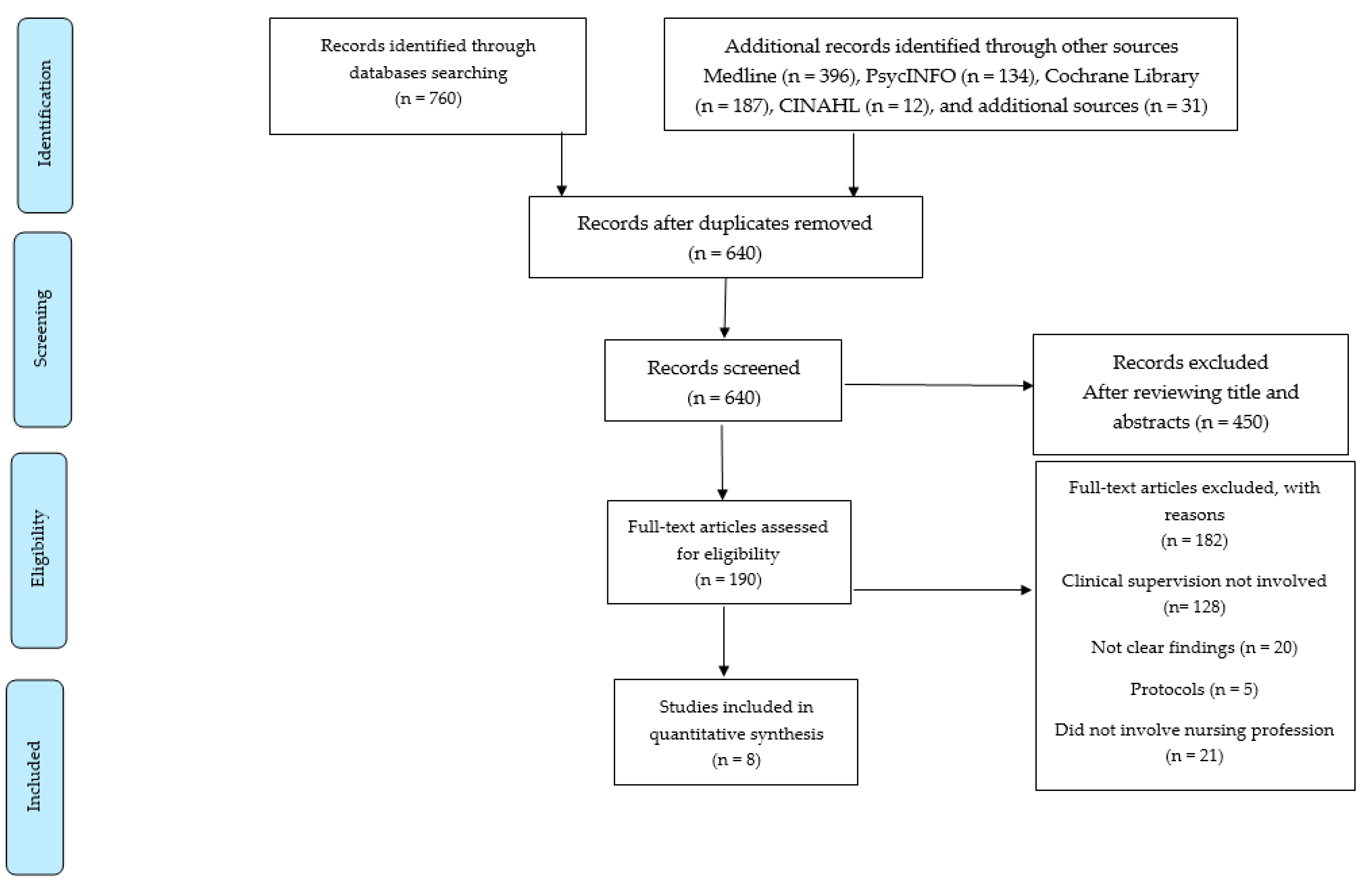
2.3. Search Outcomes
2.4. Data Extraction
2.5. Data Synthesis
2.6. Appraisal of the Included Studies
3. Results
3.1. Study Selection
3.2. Study Characteristics and Quality Assessment
3.3. Synthesize the Outcomes
3.3.1. How Does Clinical Supervision Affect Job Satisfaction, Burnout, and Distress Levels?
3.3.2. The Frequency and Lasting Impacts of Clinical Supervision
3.3.3. The Significance of Reflection in Practical Application
4. Discussion
4.1. How Does Clinical Supervision Affect Job Satisfaction, Burnout, and Distress Levels?
4.2. The Frequency and Lasting Impacts of Clinical Supervision
4.3. The Significance of Reflection in Practical Application
4.4. Strengths and Weaknesses
4.5. Limitations
4.6. Implications
5. Conclusions
Author Contributions
Funding
Institutional Review Board Statement
Informed Consent Statement
Data Availability Statement
Conflicts of Interest
References
- Milne, D. An Empirical Definition of Clinical Supervision. Br. J. Clin. Psychol. 2007, 46, 437–447. [Google Scholar] [CrossRef] [Scilit] [PubMed]
- Couper, K.; Kimani, P.K.; Abella, B.S.; Chilwan, M.; Cooke, M.W.; Davies, R.P.; Field, R.A.; Gao, F.; Quinton, S.; Stallard, N.; et al. The System-Wide Effect of Real-Time Audiovisual Feedback and Postevent Debriefing for In-Hospital Cardiac Arrest: The Cardiopulmonary Resuscitation Quality Improvement Initiative*. Crit. Care Med. 2015, 43, 2321–2331. [Google Scholar] [CrossRef] [Scilit] [PubMed]
- Martino, S.; Paris, M.; Añez, L.; Nich, C.; Canning-Ball, M.; Hunkele, K.; Olmstead, T.A.; Carroll, K.M. The Effectiveness and Cost of Clinical Supervision for Motivational Interviewing: A Randomized Controlled Trial. J. Subst. Abuse Treat. 2016, 68, 11–23. [Google Scholar] [CrossRef] [Scilit] [PubMed]
- Wolfe, H.; Zebuhr, C.; Topjian, A.A.; Nishisaki, A.; Niles, D.E.; Meaney, P.A.; Boyle, L.; Giordano, R.T.; Davis, D.; Priestley, M.; et al. Interdisciplinary ICU Cardiac Arrest Debriefing Improves Survival Outcomes*. Crit. Care Med. 2014, 42, 1688–1695. [Google Scholar] [CrossRef] [Scilit] [PubMed]
- Accurso, E.C.; Taylor, R.M.; Garland, A.F. Evidence-Based Practices Addressed in Community-Based Children’s Mental Health Clinical Supervision. Train. Educ. Prof. Psychol. 2011, 5, 88–96. [Google Scholar] [CrossRef] [Scilit] [PubMed]
- Dorsey, S.; Pullmann, M.D.; Kerns, S.E.U.; Jungbluth, N.; Meza, R.; Thompson, K.; Berliner, L. The Juggling Act of Supervision in Community Mental Health: Implications for Supporting Evidence-Based Treatment. Adm. Policy Ment. Health 2017, 44, 838–852. [Google Scholar] [CrossRef] [Scilit]
- Rothwell, C.; Kehoe, A.; Farook, S.F.; Illing, J. Enablers and Barriers to Effective Clinical Supervision in the Workplace: A Rapid Evidence Review. BMJ Open 2021, 11, e052929. [Google Scholar] [CrossRef] [Scilit]
- AhnAllen, C.; Karel, M.; Topor, D. Developing as a Clinical Supervisor: Competence, Style, and Self-Awareness. MedEdPORTAL J. Teach. Learn. Resour. 2013, 9, 9557. [Google Scholar] [CrossRef] [Scilit]
- Carroll, M. Counselling Supervision: Theory, Skills and Practice; Cassell: London, UK, 1996; ISBN 978-0-304-32938-0. [Google Scholar]
- Hawkins, P.; Shohet, R. Supervision in the Helping Professions: An Individual, Group, and Organizational Approach; Open University Press: London, UK, 1989; ISBN 978-0-335-09854-5. [Google Scholar]
- Proctor Enabling and Ensuring: Supervision in Practice. Available online: https://scholar.google.com/scholar_lookup?title=Enabling%20and%20ensuring%3A%20supervision%20in%20practice&pages=21-34&publication_year=1986&author=Proctor%2CB (accessed on 2 September 2023).
- Brunero, S.; Stein-Parbury, J. The Effectiveness of Clinical Supervision in Nursing: An Evidenced Based Literature Review. Aust. J. Adv. Nurs. 2008, 25, 86–94. [Google Scholar]
- Vasan, A.; Mabey, D.C.; Chaudhri, S.; Brown Epstein, H.-A.; Lawn, S.D. Support and Performance Improvement for Primary Health Care Workers in Low- and Middle-Income Countries: A Scoping Review of Intervention Design and Methods. Health Policy Plan. 2017, 32, 437–452. [Google Scholar] [CrossRef] [Scilit]
- Abdullah Mohamed, H.; Abdelbaset Hamed Awad, S.; ELsaid ELsabahy, H. The Effect of a Clinical Supervision-Enhancing Strategy for Head Nurses on Their Professional Identity. Egypt. J. Health Care 2021, 12, 1693–1709. [Google Scholar] [CrossRef] [Scilit]
- Edwards, D.; Burnard, P.; Hannigan, B.; Cooper, L.; Adams, J.; Juggessur, T.; Fothergil, A.; Coyle, D. Clinical Supervision and Burnout: The Influence of Clinical Supervision for Community Mental Health Nurses. J. Clin. Nurs. 2006, 15, 1007–1015. [Google Scholar] [CrossRef] [Scilit] [PubMed]
- Buus, N.; Delgado, C.; Traynor, M.; Gonge, H. Resistance to Group Clinical Supervision: A Semistructured Interview Study of Non-Participating Mental Health Nursing Staff Members. Int. J. Ment. Health Nurs. 2018, 27, 783–793. [Google Scholar] [CrossRef] [Scilit] [PubMed]
- Borders, L.D. Best Practices in Clinical Supervision: Another Step in Delineating Effective Supervision Practice. Am. J. Psychother. 2014, 68, 151–162. [Google Scholar] [CrossRef] [Scilit] [PubMed]
- Bishop, V. Clinical Governance and Clinical Supervision: Protecting Standards of Care. J. Res. Nurs. 2008, 13, 3–5. [Google Scholar] [CrossRef] [Scilit]
- Mills, J.E.; Francis, K.L.; Bonner, A. Mentoring, Clinical Supervision and Preceptoring: Clarifying the Conceptual Definitions for Australian Rural Nurses. A Review of the Literature. Rural Remote Health 2005, 5, 410. [Google Scholar] [CrossRef] [Scilit] [PubMed]
- Hyrkäs, K.; Appelqvist-Schmidlechner, K.; Paunonen-Ilmonen, M. Expert Supervisors’ Views of Clinical Supervision: A Study of Factors Promoting and Inhibiting the Achievements of Multiprofessional Team Supervision. J. Adv. Nurs. 2002, 38, 387–397. [Google Scholar] [CrossRef] [Scilit] [PubMed]
- Almadani Does Clinical Supervision Improve Job Satisfaction for Qualified Nurses in Primary Health Care in Jeddah, Saudi Arabia?—ProQuest. Available online: https://www.proquest.com/docview/2411468152?pq-origsite=gscholar&fromopenview=true (accessed on 1 September 2023).
- White, E.; Winstanley, J. A Randomised Controlled Trial of Clinical Supervision: Selected Findings from a Novel Australian Attempt to Establish the Evidence Base for Causal Relationships with Quality of Care and Patient Outcomes, as an Informed Contribution to Mental Health Nursing Practice Development. J. Res. Nurs. 2010, 15, 151–167. [Google Scholar] [CrossRef] [Scilit]
- Gonge, H.; Buus, N. Is It Possible to Strengthen Psychiatric Nursing Staff’s Clinical Supervision? RCT of a Meta-Supervision Intervention. J. Adv. Nurs. 2015, 71, 909–921. [Google Scholar] [CrossRef] [Scilit]
- Cross, W.; Moore, A.; Ockerby, S. Clinical Supervision of General Nurses in a Busy Medical Ward of a Teaching Hospital. Contemp. Nurse 2010, 35, 245–253. [Google Scholar] [CrossRef] [Scilit]
- Koivu, A.; Saarinen, P.I.; Hyrkas, K. Does Clinical Supervision Promote Medical–Surgical Nurses’ Well-Being at Work? A Quasi-Experimental 4-Year Follow-up Study. J. Nurs. Manag. 2012, 20, 401–413. [Google Scholar] [CrossRef] [Scilit] [PubMed]
- Rocha, I.A.d.R.e.S.; Pinto, C.M.C.B.; Carvalho, A.L.R.F. Impact of Clinical Supervision on Job Satisfaction and Emotional Competence of Nurses. Rev. Bras. Enferm. 2021, 74, e20210125. [Google Scholar] [CrossRef] [Scilit] [PubMed]
- Gonge, H.; Buus, N. Model for Investigating the Benefits of Clinical Supervision in Psychiatric Nursing: A Survey Study. Int. J. Ment. Health Nurs. 2011, 20, 102–111. [Google Scholar] [CrossRef] [Scilit] [PubMed]
- Berry, S.; Robertson, N. Burnout within Forensic Psychiatric Nursing: Its Relationship with Ward Environment and Effective Clinical Supervision? J. Psychiatr. Ment. Health Nurs. 2019, 26, 212–222. [Google Scholar] [CrossRef] [Scilit] [PubMed]
- Hawker, S.; Payne, S.; Kerr, C.; Hardey, M.; Powell, J. Appraising the Evidence: Reviewing Disparate Data Systematically. Qual. Health Res. 2002, 12, 1284–1299. [Google Scholar] [CrossRef] [Scilit] [PubMed]
- Nguyen, Q.D.; Fernandez, N.; Karsenti, T.; Charlin, B. What Is Reflection? A Conceptual Analysis of Major Definitions and a Proposal of a Five-Component Model. Med. Educ. 2014, 48, 1176–1189. [Google Scholar] [CrossRef] [Scilit]
- Buonomo, I.; Ferrara, B.; Pansini, M.; Benevene, P. Job Satisfaction and Perceived Structural Support in Remote Working Conditions—The Role of a Sense of Community at Work. Int. J. Environ. Res. Public Health 2023, 20, 6205. [Google Scholar] [CrossRef] [Scilit]
- Zhenjing, G.; Chupradit, S.; Ku, K.Y.; Nassani, A.A.; Haffar, M. Impact of Employees’ Workplace Environment on Employees’ Performance: A Multi-Mediation Model. Front. Public Health 2022, 10, 890400. [Google Scholar] [CrossRef] [Scilit]
- Heaven, C.; Clegg, J.; Maguire, P. Transfer of Communication Skills Training from Workshop to Workplace: The Impact of Clinical Supervision. Patient Educ. Couns. 2006, 60, 313–325. [Google Scholar] [CrossRef] [Scilit]
- Berg, A.; Hansson, U.W.; Hallberg, I.R. Nurses’ Creativity, Tedium and Burnout during 1 Year of Clinical Supervision and Implementation of Individually Planned Nursing Care: Comparisons between a Ward for Severely Demented Patients and a Similar Control Ward. J. Adv. Nurs. 1994, 20, 742–749. [Google Scholar] [CrossRef] [Scilit]
- Berg, A.; Hallberg, I.R. Effects of Systematic Clinical Supervision on Psychiatric Nurses’ Sense of Coherence, Creativity, Work-Related Strain, Job Satisfaction and View of the Effects from Clinical Supervision: A Pre-Post Test Design. J. Psychiatr. Ment. Health Nurs. 1999, 6, 371–381. [Google Scholar] [CrossRef] [Scilit] [PubMed]
- Hallberg, I.R. Systematic Clinical Supervision in a Child Psychiatric Ward: Satisfaction with Nursing Care, Tedium, Burnout, and the Nurses’ Own Report on the Effects of It. Arch. Psychiatr. Nurs. 1994, 8, 44–52. [Google Scholar] [CrossRef] [Scilit] [PubMed]
- Kavanagh, D.J.; Spence, S.H.; Strong, J.; Wilson, J.; Sturk, H.; Crow, N. Supervision Practices in Allied Mental Health: Relationships of Supervision Characteristics to Perceived Impact and Job Satisfaction. Ment. Health Serv. Res. 2003, 5, 187–195. [Google Scholar] [CrossRef] [Scilit] [PubMed]
- Severinsson, E.I.; Kamaker, D. Clinical Nursing Supervision in the Workplace--Effects on Moral Stress and Job Satisfaction. J. Nurs. Manag. 1999, 7, 81–90. [Google Scholar] [CrossRef] [Scilit] [PubMed]
- Long, C.G.; Harding, S.; Payne, K.; Collins, L. Nursing and Health-Care Assistant Experience of Supervision in a Medium Secure Psychiatric Service for Women: Implications for Service Development. J. Psychiatr. Ment. Health Nurs. 2014, 21, 154–162. [Google Scholar] [CrossRef] [Scilit]
- Alhawsawi, A.O.; Alahmdi, A.M.; Aly, S.M. Nurse Manager’s Perception about Clinical Supervision at Madinah Hospitals in Saudi Arabia. Nurs. Commun. 2022, 6, e2022032. [Google Scholar] [CrossRef] [Scilit]
- Mann, K.; Gordon, J.; MacLeod, A. Reflection and Reflective Practice in Health Professions Education: A Systematic Review. Adv. Health Sci. Educ. Theory Pract. 2009, 14, 595–621. [Google Scholar] [CrossRef] [Scilit]
- Andrade, C. Sample Size and Its Importance in Research. Indian J. Psychol. Med. 2020, 42, 102–103. [Google Scholar] [CrossRef] [Scilit]
- Fincham, J.E. Response Rates and Responsiveness for Surveys, Standards, and the Journal. Am. J. Pharm. Educ. 2008, 72, 43. [Google Scholar] [CrossRef] [Scilit]
- Gray, J.; Grove, S.K.; Sutherland, S. Burns and Grove’s the Practice of Nursing Research: Appraisal, Synthesis, and Generation of Evidence, 8th ed.; Elsevier: St. Louis, MO, USA, 2017; ISBN 0-323-37758-0. [Google Scholar]


| Inclusion Criteria | Exclusion Criteria | Keywords | Database Searched | Number of Studies |
|---|---|---|---|---|
| Studies that examined the effectiveness of supervising qualified nurses or nurse managers. | Studies involving health-care professionals other than nurses. | Qualified Nurses OR Registered Nurses OR Mental Health Nurses OR Psychiatric Nurses OR Nurses Managers OR Nurse Directors AND Clinical Supervision OR Clinical Oversight OR Mentorship OR CS* AND Job Satisfaction OR Work Satisfaction OR Reducing Stress OR Reducing Burnout OR Improving quality care. | Medline | 396 |
| Various types of studies and evaluations, including quantitative, qualitative, and mixed methods. | Studies not addressing the specific PICO question. | PsycInfo | 134 | |
| Studies written in English language. | Books. | Cochrane Library | 187 | |
| Studies published between January 2010 and May 2023. | Opinion articles. | CINAHL | 12 | |
| Studies published before 2010. | Google Scholar | 31 | ||
| Total: 760 |
| Author Name/Year/Country/Time Frame | Study Aim | Design | Study Sample | Methodology Process | Number of Sessions/Frequency/Duration | Outcomes |
|---|---|---|---|---|---|---|
| RCT (Two Studies) | ||||||
| [22] Australia Between July 2007 and January 2009 | To investigate the effectiveness of clinical supervision (CS) in mental health settings in Queensland, Australia, and to contribute to the evidence base regarding the relationship between CS and quality of care and patient outcomes in mental health nursing. | A randomized controlled trial. | At the beginning of the study, the intervention group consisted of 139 Community Mental Health Nurses, 24 Clinical Supervisor Trainees who participated in the 4-day Clinical Supervision Course, 115 Supervisors, 82 Patients, and 43 Unit Staff. These participants were recruited from nine different tertiary care hospital sites. The control group included 71 Community Mental Health Nurses, 88 Patients, and 11 Unit Staff who were selected randomly over a period of 12 months. Among the 24 supervisors, 17 were female, accounting for 71% of the group. Two supervisors withdrew from the study after completing the Clinical Supervision course. Internal Validity Concern: Purposive sampling There is no report of power analysis. | A semi-structured interview was carried out with a senior nursing manager and other non-participating members of the nursing staff, totaling 17 individuals. Thematic content analysis was employed to analyze the data obtained from monthly diaries collected from 24 trainees, amounting to a total of 139 entries. For the assessment of mental health nurses’ performance, a quantitative tool was utilized both at baseline and after one year of continuous service. This tool comprised various measures, including the general health questionnaire, Manchester clinical supervisory scale (MCSS), Maslach burnout inventory (MBI), short form health survey, nursing work index, and mental health problems perception questionnaire. Internal Validity Concern: Reliability and validity of instruments did not report. External Validity Concern: Response rate: Not reported. | Once a month for 12 months. | 1. Participants in the CS courses and supervisory training agreed that taking part in them had a positive impact on their workplace. 2. 139 CS trainee diary accounts were analyzed along with qualitative data collected from 17 non-involved participants. |
| [23] Denmark January 2012–February 2013 | To test the effects of a meta-supervision intervention in terms of participation, effectiveness, and benefits of clinical supervision of psychiatric nursing staff. | A randomized controlled trial. | A total of 83 nursing staff members working in three general psychiatric wards were randomly assigned to either an intervention group (n = 40) or a control group (n = 43). Internal Validity Concern: Randomization sampling There is no report of power analysis. | Efficacy and benefits of clinical supervision were assessed at baseline using self-reported questionnaires. A prospective study of clinical supervision participation was conducted over a period of three months following the intervention. External Validity Concern: Response rate at baseline 77.1%, and in the final statistical analysis was 55.4%. | -10 sessions. -For three months. -lasted on average 100 min (range 60–180 min) | Compared to individuals in the control group, participants in the intervention group showed a considerably higher level of motivation for workers to engage in continuous supervision sessions. Promoting critical reflection among staff during supervision fosters their personal growth and facilitates the development of adaptive strategies tailored to their individual needs. |
| Qualitative Study (One Study) | ||||||
| [24] February 2006–June 2006 | To address the high stress, depersonalization, burnout, and job dissatisfaction often experienced by nursing managers through the use of clinical supervision as a strategy to reduce these issues. | Qualitative exploratory study. | The study included a focus group of six associate nurse unit managers in a busy medical ward of a tertiary teaching hospital, and four staff members (66%) who participated in the study. | Focus group interview. | -15 sessions. -An hour weekly. -For six months. | The nurses’ psychological distress was reduced and their confidence in sharing their issues increased when they shared their experiences in CS sessions. |
| Quasi-experimental studies (three studies) | ||||||
| [21] Saudi Arabia Between March 2016 and October 2016 | To investigate whether clinical supervision improves job satisfaction for qualified nurses in primary health care in Jeddah, Saudi Arabia. | Quasi-experimental design (non-equivalent control group pre-test and post-test). | The study comprised (n = 91) nurses from six selected PHC centers in Jeddah, SA. care, for the intervention (n = 43) and non-intervention (n = 48). Internal Validity Concern: - Sample size: There is report of power analysis. 80%. -Convenience sampling. |
-Instrumentations: Not a problem. External Validity Concern: -Response rate = 85%. | -Once per month, with each session lasting two hours, for a cumulative maximum of 12 h. | The qualitative results indicated that participants in the intervention group experienced higher levels of job satisfaction than those in the control group. From a qualitative point of view, a significant proportion of participants demonstrated enhanced job satisfaction after 6 months of clinical supervision. The findings of this study indicate that, in this particular context, clinical supervision has the potential to enhance the job satisfaction of qualified primary health care nurses. This conclusion is drawn from the observation that job satisfaction improved after a six-month follow-up period. |
| [25] Finland Between 2003 and 2007 | To investigate the impact of clinical supervision (CS) on the enhancement of well-being among medical-surgical nurses in their workplace. | Quasi experimental study | The study population consisted of medical-surgical nurses working in a Finnish university hospital. The research was conducted over a 4-year period, from 2003 to 2007. A total of 166 nurses participated in the study, and they were divided into three groups: nurses who received effective clinical supervision (n = 41), nurses who found their clinical supervision less effective (n = 43), and nurses who did not attend clinical supervision (n = 82). Questionnaire surveys were used to assess the nurses’ perceptions of work and health. Internal Validity Concern: -There is no report of power analysis. -Convenience sampling. |
-Instrumentations: Not a problem. External Validity Concern: - Response rate: Not reported. | Not stated. | The results showed that nurses who received efficient clinical supervision reported having more job and personal resources, higher motivation, and a stronger commitment to the organization compared to their peers. However, they scored lower on the dimension of professional inefficacy, which is a component of burnout, compared to other nurses. This suggests that clinical supervision can be seen as an additional job resource that contributes to overall well-being at work. Efficient clinical supervision may serve as both an antecedent and a consequence of well-being in the workplace. The study concluded that the advantages of clinical supervision included positive outcomes such as enhanced professional autonomy and self-efficacy, which were achieved through critical reflection and transformative learning. |
| [26] Portugal The study was developed from 2017 to 2019 | To assess the impact of implementing the SafeCare clinical supervision model on the job satisfaction of nurses and their emotional competence profile. | A quasi-experimental study (pre-test post-test type, with no control group). | The study was aimed to recruit 44 nurses or expert nurses, but for some reasons such as absenteeism related to unsafe pregnancy (n = 6; 13,6%), service transfer (n = 4; 9,1%), health institution relocating (n = 3; 6,8%), and long-term sickness absenteeism (n = 3; 6,8%), the study only completed by 28 nurses. Internal Validity Concern: -There is no report of power analysis. -Convenience sampling. |
1. Job Satisfaction Scale: Cronbach’s alpha = 0.96 2. Veiga Emotional Competence Scale: Cronbach’s alpha = 0.94 3. Descriptive statistical analysis and the Wilcoxon Test were conducted. Internal Validity Concern: -Instrumentations: Not a problem. External Validity Concern: - Response rate: Not reported. | Not stated. | The results indicate that there is no noteworthy difference in the job satisfaction of nurses between the pre-test and the post-test, as the p-value is 0.12. The emotional competence profile of nurses did not exhibit any significant statistical differences before and after the intervention, as indicated by a p-value of 0.93. The research findings indicate that the SafeCare Model requires enhancements, proposing an increase in the duration of training provided to nurses and reinforcing the health-care facility’s connection to the Model. |
| Cross-sectional surveys (Two Studies) | ||||||
| [27] Denmark 2011 | To investigate the associations between participation in clinical supervision, its effectiveness, and various benefits such as job satisfaction, vitality, coping, and reduced stress and burnout. | Quantitative Cross-sectional survey. | This study consisted of 136 nursing staff members in permanent employment. They were selected from nine general psychiatric wards and four community mental health centers at a Danish psychiatric university hospital. 145 of 239 people responded, which is a moderate response rate (60.7%). |
Internal Validity Concern: Instrumentations: Not a problem. External Validity Concern: Response rate = 60.7%. | -Number of sessions: N/S -Group sessions were the format used for all the clinical supervision sessions. Additionally, the most common duration for these sessions was 90 min. | The outcomes of the study suggested that participation in clinical supervision was associated with the effectiveness of clinical supervision, as measured by the Manchester Clinical Supervision Scale (MCSS). Higher MCSS scores were associated with various benefits, including increased job satisfaction, vitality, rational coping, and reduced stress, emotional exhaustion, and depersonalization. The study supported the proposed model for investigating the benefits of clinical supervision, highlighting the importance of participation, effectiveness, and individual and workplace factors in determining the positive outcomes of clinical supervision in psychiatric nursing. |
| [28] UK Between April 2014 and June 2014 | To explore burnout, the perceived effectiveness of clinical supervision, and the ward environment in a medium secure forensic psychiatric unit in the United Kingdom. The study aimed to investigate the predictors of burnout in this setting, specifically examining the relationship between burnout and factors such as support and the ward environment. | A cross-sectional design. | The sample population of this study consisted of nursing staff working in a medium secure forensic psychiatric unit in the United Kingdom. The total number of participants in the study was 137. Internal Validity Concern: -Convenience sampling. |
-Instrumentations: Not a problem. External Validity Concern: -Response rate = 87.42%. | Not stated. | The study revealed that approximately 10% of the nursing staff encountered burnout. Age and the hospital ward’s working environment emerged as significant factors that strongly influenced burnout. Interestingly, clinical supervision showed only a minimal correlation with reducing burnout. These findings raise concerns about the effectiveness of clinical supervision as an intervention for burnout. Instead, the study proposes that interventions should focus on establishing a positive and supportive environment within the wards. Furthermore, the study emphasized the vulnerability of younger nursing staff to burnout, underscoring the necessity of tailored support and resources for their well-being. |
| Author | Abstract/Title | Introduction/Aims | Method/Data | Sampling | Analysis | Ethics/Bias | Results | Transferability/Generalizability | Implications | Total | Grade |
|---|---|---|---|---|---|---|---|---|---|---|---|
| [22] | 4 | 4 | 2 | 2 | 4 | 4 | 4 | 3 | 4 | 31 | Good (A) |
| A well-organized summary containing comprehensive details and a concise heading. | Provide concise background and state the aims of the study clearly. | The provided explanation on the methodology for data gathering lacks comprehensiveness. Although a detailed description of the instruments used has been provided, there is no mention or reporting of the reliability and validity of these instruments. | While sampling is mentioned, there are limited specific descriptive details provided. | A concise explanation of the analysis methodology employed is provided, along with a description of how the themes were derived. | The matters concerning confidentiality and consent were duly acknowledged and dealt with. | There is an ample amount of data available to substantiate the findings. | While certain aspects of the context and setting are outlined, additional information is required to facilitate replication or comparison of the study with others. | They proposed a clinical implication. | |||
| [23] | 4 | 4 | 4 | 2 | 4 | 4 | 4 | 3 | 4 | 33 | Good (A) |
| The title is clear, and the abstract is well-structured. | The introduction was presented clearly and succinctly, and the statement of aims was clear. | The description was presented clearly and explicitly. | The description of the recruited participants in the study is satisfactory. However, there is a lack of reporting regarding power analysis. | The process of data analysis was clearly outlined. | Ethical considerations and potential biases were appropriately acknowledged and dealt with. | There is an ample amount of data available to substantiate the findings. | It is necessary to compare the described setting with other studies. | They put forward a clinical implication. | |||
| [24] | 4 | 4 | 4 | 2 | 4 | 2 | 4 | 2 | 4 | 30 | Good (A) |
| The abstract is well-organized, containing comprehensive information and a clear title. | Present a succinct background and explicitly state the objectives of the study. | Provide precise information regarding data collection and recording procedures. | Although sampling is mentioned, there is a lack of descriptive details. | Explain how the themes were derived in a clear manner. | Briefly address the issues at hand. | The results directly align with the stated aims of the study. | The description of the context or setting is minimal. | Offer suggestions for future research ideas”. | |||
| [21] | 4 | 4 | 4 | 4 | 4 | 4 | 4 | 4 | 4 | 36 | Good (A) |
| The abstract is well-organized, containing comprehensive information and a clear title. | The discussion is succinct in its back-ground. Furthermore, the study has identified areas of knowledge that are lacking. | The selected approach is appro-priate and has been clearly elucidated. | The sample size used in the study was justified. | There is a clear description of the data analysis methodology. | The issues of confidentiality and consent were appropri-ately addressed. | The findings are explicitly stated, easy to com-prehend, and follow a logical progression. The results are effectively explained in both the text and tables. | The context and set-ting of the study are adequately described, allowing for mean-ingful comparisons with other contexts and settings. | The study suggests practical implications. | |||
| [25] | 4 | 4 | 4 | 2 | 4 | 4 | 4 | 4 | 4 | 34 | Good (A) |
| The abstract is well-structured, containing com-plete infor-mation and a clearly defined title. | The background of the discussion is concise. Furthermore, the study identified gaps in knowledge. | The chosen methodology is suitable and explained clearly. | Sampling mentioned but few descriptive details. | There is a clear description of the data analysis methodology. | The issues of confidentiality and consent were appropri-ately addressed. | The findings are clearly articulated, easily com-prehensible, and presented in a logical se-quence. Additionally, the results are effectively explained both in the text and supported by well-designed tables. | The study provides an adequate description of the context and setting, enabling meaningful comparisons with other con-texts and settings. | Proposes clinical implications. | |||
| [26] | 3 | 4 | 4 | 3 | 3 | 4 | 4 | 4 | 4 | 33 | Good (A) |
| The abstract contains the majority of the necessary information. | Present a clear background with a concise statement of the study objective. | The selected approach is appropriate and has been elucidated with clarity. | The sample size is adequately justified. While most information is provided, some details such as race and context are missing. Moreover, there is no report of power analysis. | The analysis is discussed in a descriptive manner. | The issues of confidentiality and consent were appropriately addressed. | The findings are explicitly stated, easy to understand, and follow a logical progression. The results are effectively explained in both the text and tables. | The context and setting of the study are described sufficiently to allow for comparisons with other contexts and settings. | The study suggests ideas for further research. | |||
| [27] | 4 | 4 | 4 | 4 | 4 | 4 | 4 | 4 | 4 | 36 | Good (A) |
| The abstract is well-structured, containing comprehensive information and a clear title. | Present a clear background along with a concise statement of the study objective. | The chosen methodology is suitable and explained clearly. | Detailed information regarding the participants and their recruitment process was provided. | There is a clear description of how the analysis was conducted. | The issues of participants’ confidentiality were appropriately addressed. | The findings are explicitly stated, easy to understand, and follow a logical progression. The results are effectively explained in both the text and tables. | The context and setting of the study are described sufficiently to allow for comparisons with other contexts and settings. | The study suggests practical implications for practice. | |||
| [28] | 3 | 4 | 4 | 4 | 4 | 4 | 4 | 4 | 4 | 35 | Good (A) |
| The abstract incorporates most of the essential information. | Offer a concise background and clearly state the aims of the study. | The chosen methodology is suitable and explained clearly. | Detailed information regarding the participants and their recruitment process was provided. | There is a clear description of how the analysis was conducted. | The issues of confidentiality and consent were appropriately addressed. | The findings are explicitly stated, easy to understand, and follow a logical progression. The results are effectively explained in both the text and tables. | The context and setting of the study are described sufficiently to allow for comparisons with other contexts and settings. | The study suggests ideas for further research. |
Disclaimer/Publisher’s Note: The statements, opinions and data contained in all publications are solely those of the individual author(s) and contributor(s) and not of MDPI and/or the editor(s). MDPI and/or the editor(s) disclaim responsibility for any injury to people or property resulting from any ideas, methods, instructions or products referred to in the content. |
© 2023 by the authors. Licensee MDPI, Basel, Switzerland. This article is an open access article distributed under the terms and conditions of the Creative Commons Attribution (CC BY) license (https://creativecommons.org/licenses/by/4.0/).
Share and Cite
Hudays, A.; Gary, F.; Voss, J.G.; Hazazi, A.; Arishi, A.; Al-sakran, F. Job Satisfaction of Nurses in the Context of Clinical Supervision: A Systematic Review. Int. J. Environ. Res. Public Health 2024, 21, 6. https://doi.org/10.3390/ijerph21010006
Hudays A, Gary F, Voss JG, Hazazi A, Arishi A, Al-sakran F. Job Satisfaction of Nurses in the Context of Clinical Supervision: A Systematic Review. International Journal of Environmental Research and Public Health. 2024; 21(1):6. https://doi.org/10.3390/ijerph21010006
Chicago/Turabian StyleHudays, Ali, Faye Gary, Joachim G. Voss, Ahmed Hazazi, Amal Arishi, and Fatimah Al-sakran. 2024. "Job Satisfaction of Nurses in the Context of Clinical Supervision: A Systematic Review" International Journal of Environmental Research and Public Health 21, no. 1: 6. https://doi.org/10.3390/ijerph21010006
APA StyleHudays, A., Gary, F., Voss, J. G., Hazazi, A., Arishi, A., & Al-sakran, F. (2024). Job Satisfaction of Nurses in the Context of Clinical Supervision: A Systematic Review. International Journal of Environmental Research and Public Health, 21(1), 6. https://doi.org/10.3390/ijerph21010006