


Study on the Global Sustainability of the Korean Construction Industry Based on the GRI Standards



Abstract
1. Introduction
- −
- Understanding the concepts and characteristics of the construction industry, sustainability, and sustainability management standards and systems through the literature;
- −
- Analysis of major issues and agendas in ESG materiality evaluation by South Korean and global construction companies;
- −
- Classification of major issues and agendas according to GRI Standards;
- −
- Deriving insights and relationships between sustainability and ESG in the construction industry, focusing on classified issues.
2. ESG and Sustainability Management in Construction Industry
2.1. ESG and Sustainability
2.2. GRI Standards and Evaluation of Global Materiality
2.3. Sustainability Management and K-ESG of the Construction Industry
3. Sustainability Analysis of the Construction Industry According to GRI Standards
3.1. Analysis Design
3.2. ESG Sustainability Issues of Construction Companies through GRI Standards
3.3. Comparison of Sustainability Issues between Global and South Korean Construction Companies
3.4. Correlation between Sustainability and ESG in Construction Industry
4. Discussion
5. Conclusions
Author Contributions
Funding
Institutional Review Board Statement
Informed Consent Statement
Acknowledgments
Conflicts of Interest
References
- Choi, E.J. ESG Management Status and Countermeasures in Construction Industry; Construction & Economy Research Institute of Korea: Seoul, Republic of Korea, 2022. [Google Scholar]
- Asia Time. Business and Economy-ESG Trend in the Construction Market. Available online: https://www.asiatime.co.kr/article/20211230500157 (accessed on 11 August 2022).
- Henri, R.; Livnat, J.; Pfeifer, P.; Stumpp, M. Integrating ESG in portfolio construction. J. Portf. Manag. 2019, 45, 67–81. [Google Scholar]
- Kotsantonis, S.; Pinney, C.; Serafeim, G. ESG integration in investment management: Myths and realities. J. Appl. Corp. Financ. 2016, 28, 10–16. [Google Scholar]
- Abhayawansa, S.; Tyagi, S. Sustainable investing: The black box of environmental, social, and governance (ESG) Ratings. J. Wealth Manag. 2021, 24, 49–54. [Google Scholar] [CrossRef] [Scilit]
- Sokolov, A.; Mostovoy, J.; Ding, J.; Seco, L. Building machine learning systems for automated ESG scoring. J. Impact ESG Invest. Spring 2021, 1, 39–50. [Google Scholar] [CrossRef] [Scilit]
- Zhang, L. ESG and Cost of Debt; Stanford University, Graduate School of Business: Stanford, CA, USA, 2021. [Google Scholar]
- Li, T.; Wang, K.; Sueyoshi, T.; Wang, D. ESG: Research progress and future prospects. Sustainability 2021, 13, 11663. [Google Scholar] [CrossRef] [Scilit]
- Park, J.H.; Han, H.W.; Kim, N.R. Exploring domestic ESG research trends: Focusing on domestic research on ESG from 2012 to 2021. Asia-Pac. J. Bus. Ventur. Entrep. 2022, 17, 191–211. [Google Scholar]
- Korea Chamber of Commerce and Industry. Easy to Understand ESG for CEOs of Small and Medium-Sized Enterprises; Korea Chamber of Commerce and Industry: Seoul, Republic of Korea, 2022. [Google Scholar]
- Ministry of Environment. Environmental Education Terminology Dictionary; National Environmental Education Center: Sejongsi, Republic of Korea, 2022.
- Ministry of Environment. International Background for Sustainable Development; Sustainable Development: Sejongsi, Republic of Korea, 2022.
- Han, M.J. European union response and trends under the ESG regime–focused on response to climate crisis. Sogang J. Law Bus. 2021, 11, 3–36. [Google Scholar] [CrossRef] [Scilit]
- Global Reporting Initiative. GRI 101: Foundation; Global Sustainability Standards Board: Amsterdam, The Netherlands, 2021. [Google Scholar]
- Woozoo. Share House Woozoo. Available online: https://www.woozoo.kr/about#tab:introduce (accessed on 10 July 2022).
- Posco. Posco Steel Village Changes Global Social Contribution Activities Paradigm. Available online: https://newsroom.posco.com/kr (accessed on 11 July 2022).
- KT. Giga Story-Start of GiGA Story to Benefit the World with ICT. Available online: https://blog.kt.com/975 (accessed on 10 July 2022).
- Hyundai Engineering & Construction. Sustainability Report. Available online: https://www.hdec.kr/en/newsroom/news_view.aspx?NewsSeq=332&NewsType=LATEST&NewsListType=news_list#.Y-HTOy_P11g (accessed on 21 November 2021).
- Daewoo E&C. 2021 Daewoo E&C Sustainability Report. Available online: https://www.daewooenc.com/Resources/ENG/file/contribution/2021_daewooenc_SR_en.pdf (accessed on 20 November 2021).
- Samsung C&T. 2021 Samsung C&T Sustainable Report. Available online: https://www.samsungcnt.com/eng/esg/resource/report/sustainability.do (accessed on 22 November 2021).
- Hyundai Construction. Sustainability Report 2021. Available online: https://www.hyundai-ce.com/en/about/sustainability/report?page=1 (accessed on 22 November 2021).
- GS E&C. Grow with Green Sustainability–GS E&C Integrated Report 2021. Available online: https://www.unglobalcompact.org/participation/report/cop/create-and-submit/advanced/454688 (accessed on 22 November 2021).
- Posco E&C. Corporate Citizenship Report 2020. Available online: https://www.posco.co.kr/homepage/docs/eng6/jsp/dn/irinfo/posco_report_2020.pdf (accessed on 22 November 2021).
- Lotte E&C. 2021 Sustainability Report. Available online: https://www.lotte.co.kr/upload/report/enc/lottecon_SR_eng_full_2020.pdf (accessed on 22 November 2021).
- DL E&C. 2021 DL Sustainability Report. Available online: https://www.dlenc.co.kr/eng/sustain/manage/Report01.do (accessed on 22 November 2021).
- SK Ecoplant. SK Ecoplant 2020 Sustainability Report. Available online: https://www.skecoplant.com/en/contents/contents?menuCode=M3103 (accessed on 22 November 2021).
- ACS. Integrated Report of ACS Group. 2020. Available online: https://www.grupoacs.com/ficheros_editor/File/03_accionistas_inversores/03_informe_anual/2020/INFORME%20INTEGRADO%202020_ENG.pdf (accessed on 20 February 2022).
- Bouygues. 2020 Universal Registration Document. Available online: https://www.bouygues.com/wp-content/uploads/2020/12/2020-universal-registration-document_bouygues.pdf (accessed on 19 February 2022).
- Ferrovial Corporacion SA. Integrated Annual Report. 2020. Available online: https://www.ferrovial.com/en/ir-shareholders/financial-information/integrated-annual-report/ (accessed on 10 February 2022).
- Hochtief. Group Report 2020. Available online: https://www.hochtief.com/investor-relations/financial-reports-and-presentations (accessed on 20 February 2022).
- Skanska AB. 2020 Annual and Sustainability Report. Available online: https://annual-and-sustainability-report-2020.skanska.com/ (accessed on 22 February 2022).
- Strabag SE. Annual Report 2020. Available online: https://www.strabag.com/databases/internet/_public/content.nsf/web/EN-STRABAG.COM-gb2020.html (accessed on 11 February 2022).
- Vinci. 2020 Universal Registration Document. Available online: https://www.vinci.com/publi/vinci/vinci-2020-universal-registration-document.pdf (accessed on 24 February 2022).

| Standards | Supervisors | Details |
|---|---|---|
| GRI Standards | UN (United Nations) |
|
| UN SDGs | UN (United Nations) |
|
| Global Compact | UN (United Nations) |
|
| ISO 26000 | ISO (International Organization for Standardization) |
|
| TCFD recommendation | TCFD (Task Force on Climate-Related Financial Disclosures) |
|
| Step | Detailed Analysis | Content of Analysis | |
|---|---|---|---|
| 1 | Select material issues (analyze internal and external environments) | External environment analysis | Laws, regulations, international agreements, or voluntary agreements of strategic significance to the organization and its stakeholders |
| Media analysis | Reasonably estimable economic, environmental, and/or social impacts (such as climate change, HIV-AIDS, or poverty) identified through sound investigation by people with recognized expertise or by expert bodies with recognized credentials | ||
| Management strategy analysis | The main topics and future challenges for a sector, as identified by peers and competitors | ||
| International metrics and standards review | Metrics such as GRI Standards | ||
| 2 | Prioritize | Stakeholders’ interests survey |
|
| Business impact assessment |
| ||
| 3 | Internal review | Insider review |
|
| Performing Organizations | Project Name | Description |
|---|---|---|
| PJT OK | Share House WOOZOO 2013 [15] | Social housing is supplied through corporate share house business. Provision of various types of residential space at a lower price than general rental housing. Short-term contracts such as two months and six months are available, providing an alternative for those seeking short-term temporary housing. Furthermore, this project contributes to solving the housing problem by providing another option for increasing single-person households. |
| POSCO | POSCO Steel Village, 2014 [16] | A global activity to improve the poor living environment by building houses and bridges in poor areas overseas using steel materials and construction methods. |
| KT | GIGA Story, 2014 [17] | This activity started with “Giga Island No. 1” in Imjado, Shinan-gun, Jeollanam-do, to bridge the information gap and build wireless communication infrastructure, such as installing Internet networks and providing IT solutions in mountainous and island regions at home and abroad. |
| Hyundai E&C | H-CONTECH Overseas Technical Volunteer Group, 2017 [18] | Technical exchange-type volunteers are dispatched overseas to improve the village and school environments and hold technology exchange seminars. |
| Daewoo E&C | Habitat, 2018 [19] | A home repair volunteer group. Residential environment improvement activities such as wallpapering old houses, replacing flooring and sinks, and insulating work. |
| Classification | Analysis Information | |
|---|---|---|
| South Korea [19,20,21,22,23,24,25,26] | Global [27,28,29,30,31,32,33] | |
| Sample criteria | Top 10 companies based on construction capability evaluation (announced by the Ministry of Land, Infrastructure, and Transport in 2021) | Top 10 companies by Engineering News-Record (ENR): a US weekly magazine providing news, analysis, data, and opinion on the global construction industry |
| Sample target | Nine major construction companies in the top 10 (excluding companies that have not disclosed ESG management reports) | Seven major construction companies in the top 10 (excluding companies that have not disclosed ESG management reports (3 Chinese companies)) |
| Collection period | 16 November 2021∼1 December 2021 (12 weekdays) | 7 February 2022~27 February 2022 |
| Collected information | Sustainability reports of nine companies (Report period: January–December 2020)
| Integrated annual reports of seven companies
|
| Detailed information gathered from the reports |
|
|
| Analysis Process | Main Analysis Details |
|---|---|
| 1. Analysis of issues about sustainability management materiality evaluation in the construction industry | Subject of analysis: materiality evaluation issues of each company
|
| 2. Analysis of global core issues of sustainability in the construction industry | Subject of analysis: top 5 core issues that have been recategorized
|
| 3. Correlation between sustainability and ESG in the construction industry | Subject of analysis: top 5 core issues that have been recategorized
|
| Construction Company | Issue Ranking | ESG Issues of Construction Company A | GRI Index Matching Information for Conversion into Unified Information | GRI Standards |
|---|---|---|---|---|
| Construction Company A | 1 | Climate change response | Recycling | 301. Materials |
| New and renewable energy Energy efficiency improvement | 302. Energy | |||
| Water recycling | 303. Water and Effluents | |||
| Greenhouse gas reduction | 305. Emissions | |||
| Construction Company A | 2 | Employee safety and health | Realization of zero severe disaster | 403. Occupational Health and Safety |
| Construction Company A | 3 | Responsible supply chain management | Compliance with labor and human rights laws | 408. Child Labor |
| Human rights protection | 409. Forced or Compulsory Labor | |||
| Workplace human rights inspection | 412. Human Rights Assessment | |||
| Supplier human rights inspection | 414. Supplier Social Assessment | |||
| Construction Company A | 4 | Securing new growth engines | New technology R&D and innovation | 103. Management Approach |
| Construction Company A | 5 | Establish a good corporate culture for work | Reward activation | 401. Employment |
| Leadership coaching training | 404. Training and Education | |||
| Construction Company A | 6 | Strengthen ethical management | Anti-corruption guide | 205. Anti-Corruption |
| Construction Company A | 7 | Strengthen responsibility for products and services | Prevention of physical harm to customers | 416. Customer Health and Safety |
| Construction Company A | 8 | Human resources development and fair performance compensation | Job performance evaluation and compensation Retirement and job change support | 401. Employment |
| Job competency improvement training programs | 404. Training and Education | |||
| Construction Company A | 9 | Responsible board composition and operation | Independent board of directors Diversity of board members Professional board Disclosure of the composition of the board Disclosure of the operation of the board | 102. General Disclosures |
| Construction Company A | 10 | Integrated management of financial and non-financial risks | Risk management by an expert committee or board of directors | 102. General Disclosures |
| Construction Company | Materiality Evaluation Issues of Construction Company B | GRI Standards |
|---|---|---|
| Construction Company B | Responsibility with local communities | 103. Management Approach |
| 413. Local Communities | ||
| Construction Company B | Efficient management of resources | 103. Management Approach |
| 301. Materials | ||
| 302. Energy | ||
| 303. Water and Effluents | ||
| 306. Waste | ||
| Construction Company B | Development and talent of diversity | 103. Management Approach |
| 404. Training and Education | ||
| Construction Company B | Ethical and responsible companies | 103. Management Approach |
| 205. Anti-corruption | ||
| 206. Anti-competitive Behavior | ||
| Construction Company B | The climate: A global concern responsible | 305. Emissions |
| Construction Company B | Zero accidents objective | 103. Management Approach |
| 403. Occupational Health and Safety | ||
| Construction Company B | Responsible supply chain | 103. Management Approach |
| 204. Procurement Practices | ||
| 308. Supplier Environmental Assessment | ||
| 414. Supplier Social Assessment |
| GRI Standards | ||||||||
|---|---|---|---|---|---|---|---|---|
| Code. Item Name | Global | South Korea | Code. Item Name | Global | South Korea | Code. Item Name | Global | South Korea |
| 102. General Disclosures | O | O | 304. Biodiversity | O | O | 408. Child Labor | O | O |
| 103. Management Approach | O | O | 305. Emissions | O | O | 409. Forced or Compulsory Labor | O | O |
| 201. Economic Performance | O | O | 306. Waste | O | O | 410. Security Practices | O | X |
| 202. Market Presence | X | X | 307. Environmental Compliance | O | O | 411. Rights of Indigenous Peoples | O | X |
| 203. Indirect Economic Impacts | O | O | 308. Supplier Environmental Assessment | O | O | 412. Human Rights Assessment | O | O |
| 204. Procurement Practices | O | O | 401. Employment | O | O | 413. Local Communities | O | O |
| 205. Anti-corruption | O | O | 402. Labor/Management Relations | O | X | 414. Supplier Social Assessment | O | O |
| 206. Anti-competitive Behavior | O | O | 403. Occupational Health and Safety | O | O | 415. Public Policy | X | X |
| 207. Tax | O | X | 404. Training and Education | O | O | 416. Customer Health and Safety | O | O |
| 301. Materials | O | O | 405. Diversity and Equal Opportunity | O | O | 417. Marketing and Labeling | O | O |
| 302. Energy | O | O | 406. Non-discrimination | O | O | 418. Customer Privacy | O | O |
| 303. Water and Effluents | O | O | 407. Freedom of Association and Collective Bargaining | O | X | 419. Socioeconomic Compliance | O | O |
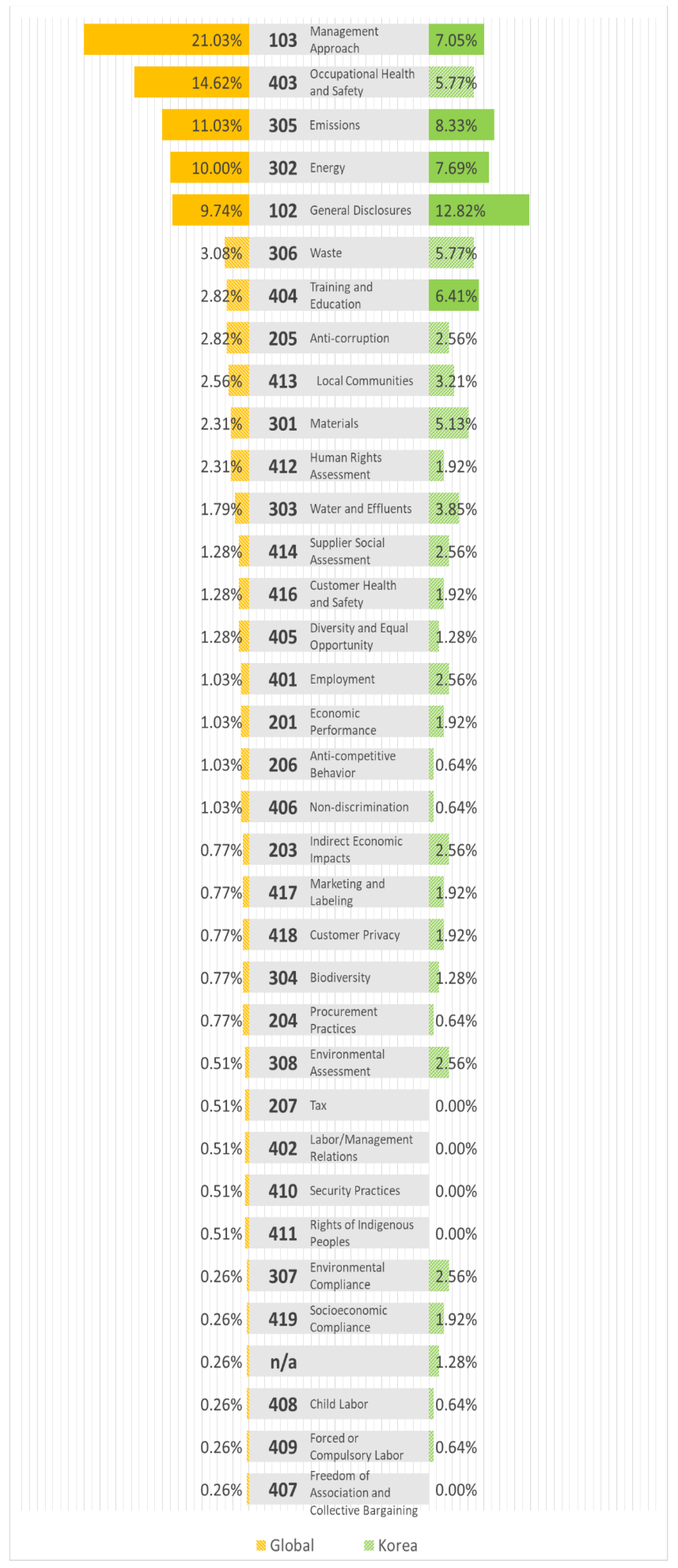
| GRI Code | GRI Content | Global Ranking (Frequency (%)) | South Korean Ranking (Frequency (%)) |
|---|---|---|---|
| 103 | Management Approach
| 1 (21.03) | 4 (7.05) |
| 403 | Occupational Health and Safety
| 2 (14.62) | (6) |
| 305 | Emissions
| 3 (11.03) | 2 (8.33) |
| 302 | Energy
| 4 (10) | 3 (7.69) |
| 102 | General Disclosures
| 5 (9.74) | 1 (12.82) |
| 404 | Training and Education
| (7) | 5 (6.41) |
| Ranking | GRI | Corporate Issues (Number of Appearances) | Core Contents (Keywords) |
|---|---|---|---|
| 1 | 102 General Disclosures | Composition and operation of the responsible board of directors/Integrated management of financial and non-financial risks/Nurturing new growth businesses and discovering promising future businesses/Improving customer satisfaction and creating customer value/Improving business performance and creating economic value (2)/Product, service, and quality innovation/Promotion of ethical and compliance management and anti-corruption/Mutual growth and win-win cooperation with partners/Strengthening government policies/regulations and violation of laws/Community Climate change/Safety and health/Supply chain/Improvement of labor-management culture and working conditions/Sound governance/Establishment of fair trade/Mutual growth and win-win cooperation/Improvement of labor-management culture and working conditions/Establishment of fair competition and fair trade | Value creation Fair trade Win-win Business growth |
| 2 | 305 Emissions | Response to climate change (3)/Promotion of eco-friendly management and reduction of environmental impact/Reduction in construction waste emissions/Demand for the introduction of eco-friendly technology and materials/Eco-friendly technology/Climate change (2)/Energy/Air pollution/Wastewater and waste/Development of eco-friendly technology | Emissions reduction Development of eco-friendly technology |
| 3 | 302 Energy | Response to climate change/Fostering new growth businesses and discovering promising future businesses/Enhancing competitiveness in eco-friendly technology, design, and construction/Reduction in construction waste emissions/Requesting introduction of eco-friendly technologies and materials/Development of eco-friendly construction methods and renewable energy technologies/Climate change/Eco-friendly technologies/Energy/Reinforcement of technological capabilities (R&D)/Energy saving/Development of eco-friendly technology | New business New technology Eco-friendliness |
| 4 | 103 Management Approach | Securing new growth engines/Strengthening government policies and regulations and violations/Product responsibility/Wastewater and waste/Eco-friendly technology/Community (2)/Climate change/Innovative technology/Personnel management/Response to climate change | Eco-friendly technology Climate change Community |
| 5 | 404 Training and Education | Establishment of a good corporate culture for work/Human resources development and fair performance compensation (2)/Product, service, and quality innovation/Promotion of eco-friendly management and reduction of environmental impact/Intensifying competition for talent acquisition/Employee competency development/Personnel management/Improvement of labor-management culture and working conditions/Response to climate change | Fair Compensation Performance Human resources development |
| Ranking | GRI | Corporate Issues (Number of Appearances) | Core Contents (Keywords) |
|---|---|---|---|
| 1 | 103 Management Approach | Responsibility with local communities/Efficient management of resources/Development and talent of diversity/Ethical and responsible companies/Zero accidents objective/Responsible supply chain/Safety and health/Innovation management/Digital transformation/Sustainable cities and mobility/Talent attraction and training/Climate change/Energy environment/Business ethics/Circular economy/Natural environments/Quality of customer and user experience/Client satisfaction/Digitalization and innovation/Occupational safety/Health protection/Strategic human resource development/Fair competition/Materials/Waste and circularity/Energy and emissions/Employment/Climate change: Adaptation/Diversity, inclusiveness, and non-discrimination/Customer and user satisfaction/Health, safety, and wellbeing of employees and contractors/Career development, diversity, and inclusion in the workplace | Safety Health Development Climate change Diversity |
| 2 | 403 Occupational Health and Safety | Zero accidents objective/Safety and health/Health, safety, and security of employees, temporary staff, and subcontractors/Health and safety, and quality of life at work/Occupational safety/Occupational health and safety | Safety Health Occupational |
| 3 | 305 Emissions | The climate: a global concern responsible/Climate change/Climate risk/New uses and adaptability of business models/Energy and emissions Climate change: GHG emissions/Climate change: Adaptation/Climate change | New energy Greenhouse gas (GHG) reduction Climate change |
| 4 | 302 Energy | Efficient management of resources/Energy environment/Climate change/Climate risk/Innovation capacity/New uses and adaptability of business models/Energy and emissions/Energy/Climate change: Adaptation/Climate change | Climate change Energy conservation Energy-efficient |
| 5 | 102 General Disclosures | Health, safety, and security of employees, temporary staff, and subcontractors/Employability and skills development/Human rights/Business ethics/Relations with suppliers and subcontractors/The group’s socio-economic footprint in regions (socio-economic contribution to regions)/Business ethics, respect for human rights, and compliance/Quality of customer and user experience/Innovation capacity/Innovation applied to business/Customer and user satisfaction/Health, safety, and wellbeing of employees and contractors/Climate change/Good corporate governance/Ethical behavior | For employees Subcontractors Human rights Ethics Customer Management innovation |
| Global Construction Companies | South Korean Construction Companies | ||||||
|---|---|---|---|---|---|---|---|
| Frequency Ranking | GRI Code | GRI Item | ESG | Frequency Ranking | GRI Code | GRI Item | ESG |
| 1 | 103 | Management Approach | G | 1 | 102 | General Disclosures | G |
| 2 | 403 | Occupational health services | S | 2 | 305 | Emissions | E |
| 3 | 305 | Emissions | E | 3 | 302 | Energy | E |
| 4 | 302 | Energy | E | 4 | 103 | Management Approach | G |
| 5 | 102 | General Disclosures | G | 5 | 404 | Training and Education | S |
| Sustainability Strategy | Main Issue |
|---|---|
| Reducing greenhouse gas emissions from environmental sources |
|
| Renewable energy and eco-friendly industries |
|
| Wastewater and waste |
|
| Safety and health |
|
| Management approach |
|
| GRI | Global | South Korea |
|---|---|---|
| 102 | Subcontractors For employees Human rights Ethics Customer Management innovation | Win-win Value creation Fair trade Business growth |
| 103 | Development Climate change Safety Health Diversity | Eco-friendly technology Climate change Community |
| 302 | Climate change Energy conservation Energy-efficient | Eco-friendly New business New technology |
| 305 | New energy Climate change Responsible Adaptability Greenhouse gas (GHG) reduction | Eco-friendly technology development Emissions reduction |
Disclaimer/Publisher’s Note: The statements, opinions and data contained in all publications are solely those of the individual author(s) and contributor(s) and not of MDPI and/or the editor(s). MDPI and/or the editor(s) disclaim responsibility for any injury to people or property resulting from any ideas, methods, instructions or products referred to in the content. |
© 2023 by the authors. Licensee MDPI, Basel, Switzerland. This article is an open access article distributed under the terms and conditions of the Creative Commons Attribution (CC BY) license (https://creativecommons.org/licenses/by/4.0/).
Share and Cite
Park, E.; Kim, Y.; Lee, A.; Kim, J.; Kong, H. Study on the Global Sustainability of the Korean Construction Industry Based on the GRI Standards. Int. J. Environ. Res. Public Health 2023, 20, 4231. https://doi.org/10.3390/ijerph20054231
Park E, Kim Y, Lee A, Kim J, Kong H. Study on the Global Sustainability of the Korean Construction Industry Based on the GRI Standards. International Journal of Environmental Research and Public Health. 2023; 20(5):4231. https://doi.org/10.3390/ijerph20054231
Chicago/Turabian StylePark, Eunsoo, Younghyun Kim, Anyong Lee, Jieun Kim, and Hyunseok Kong. 2023. "Study on the Global Sustainability of the Korean Construction Industry Based on the GRI Standards" International Journal of Environmental Research and Public Health 20, no. 5: 4231. https://doi.org/10.3390/ijerph20054231
APA StylePark, E., Kim, Y., Lee, A., Kim, J., & Kong, H. (2023). Study on the Global Sustainability of the Korean Construction Industry Based on the GRI Standards. International Journal of Environmental Research and Public Health, 20(5), 4231. https://doi.org/10.3390/ijerph20054231

