



Systematic Review and Meta-Analysis of Metabolic Syndrome and Its Components in Latino Immigrants to the USA

 , ,
, , 
Abstract
1. Introduction
2. Materials and Methods
2.1. Protocol
- Population: Immigrants from Latin America, residing in the USA, aged >18 years;
- Intervention/Exposure: Immigration;
- Comparator(s)/control: US-born Latino population;
- Outcomes: MetS and/or its components (primary) and sleep disorders (secondary).
2.2. Definition of Disease and Disease Codes
2.3. Search Strategy
2.4. Study Selection
- Cross-sectional, cohort, or case–control type study;
- Involving adults (>18 years);
- Investigating immigrant Latinos residing in the USA;
- Published during the period 1980–2020 in any language.
2.5. Data Extraction
- Study characteristics: authors, year of publication, author affiliations, e-mail of corresponding author, and study title;
- Study population: total number of participants, total number of women and men, whether study stratified analyses by Brazilian immigrants, immigrant group studies, age, country of origin, comparative group, and length of residence in the USA;
- Study design: design type and study period;
- Exposures;
- Other risk factors: work, shift work, documented or otherwise, and health insurance;
- Outcomes: MetS, hypertension or high blood pressure, type 2 diabetes or high fasting glucose, low HDL-c, high triglycerides, abdominal obesity or BMI > 30 kg/m2 (primary), and sleep disorders (secondary).
2.6. Risk of Bias
- ≥70% “yes” answers: low risk of bias;
- 50–69% “yes” answers: moderate risk of bias;
- <50% “yes” answers: high risk of bias.
2.7. Analysis and Presentation of Results
3. Results
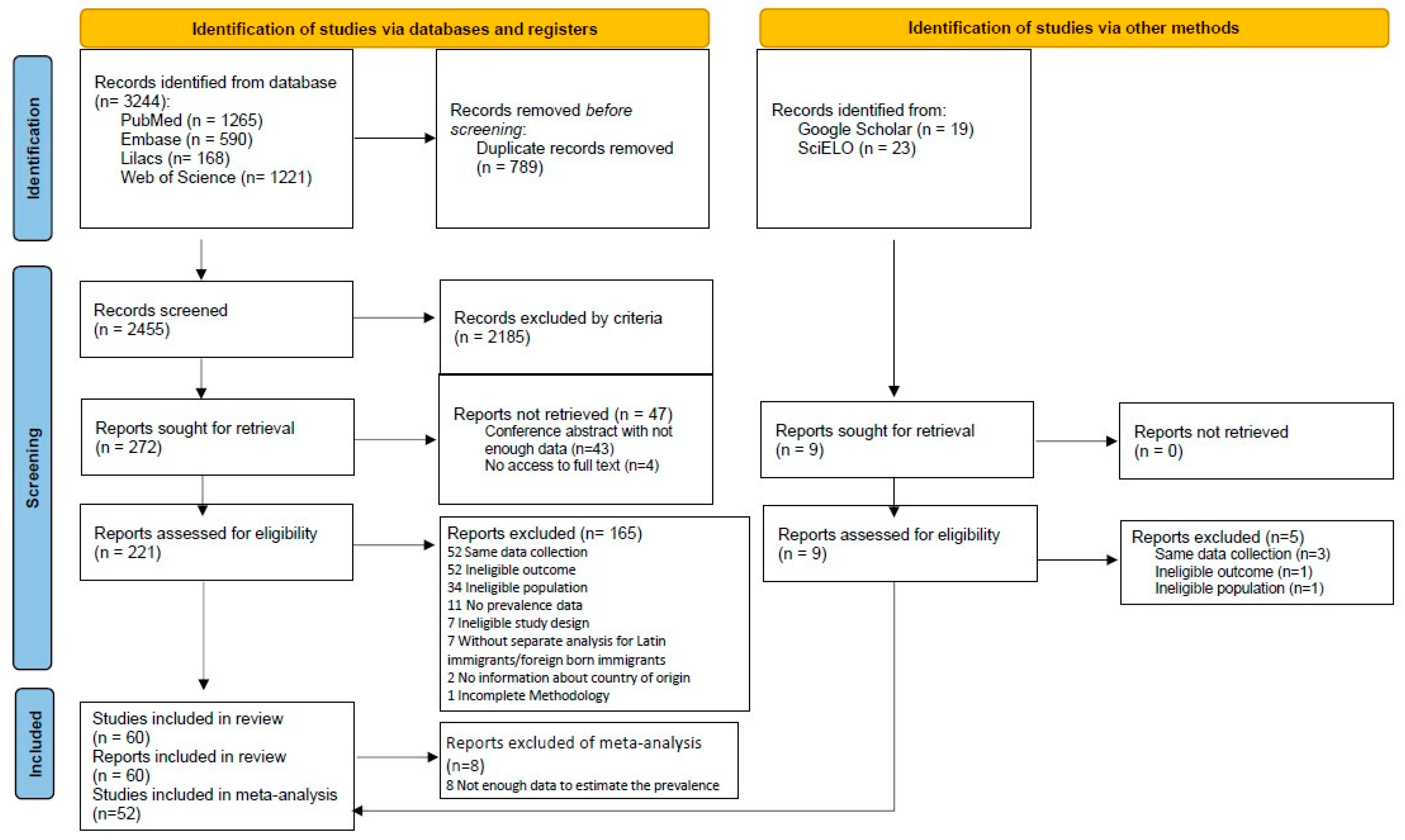
3.1. Study Selection
3.2. Study Characteristics
3.3. Risk of Bias
3.4. Findings
3.4.1. Outcomes for Latinos in the USA
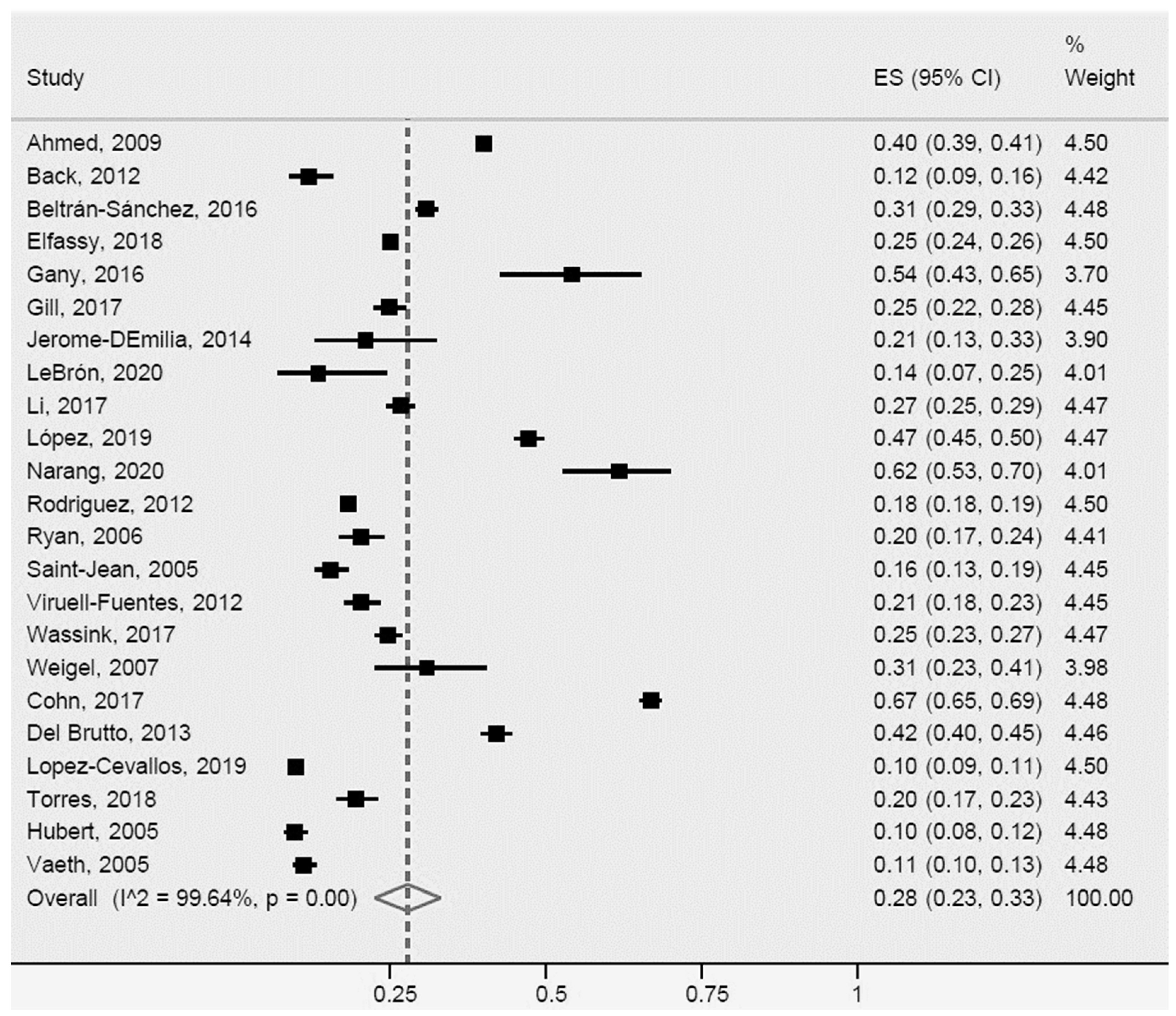
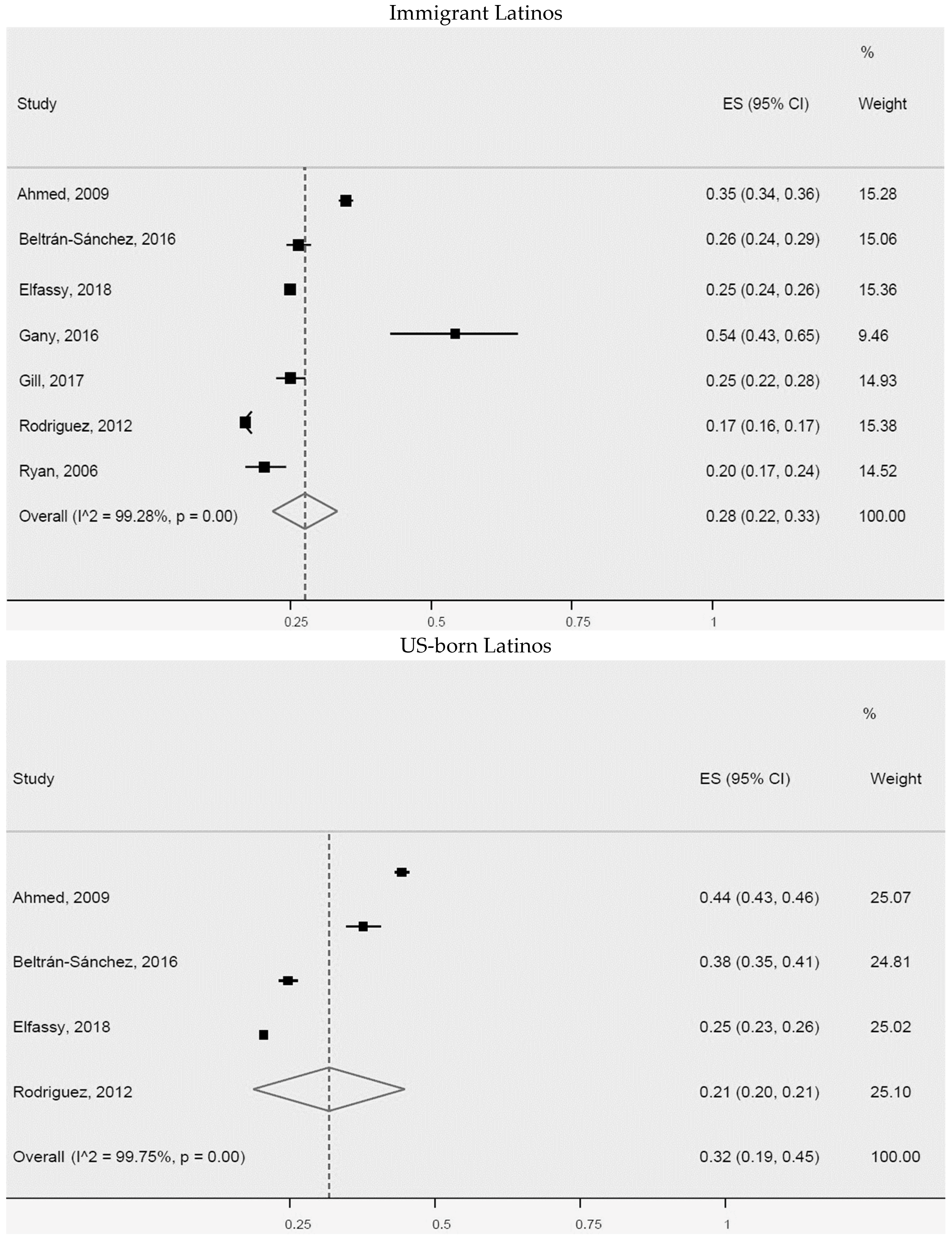
Arterial Hypertension or High Blood Pressure for Latinos in the USA
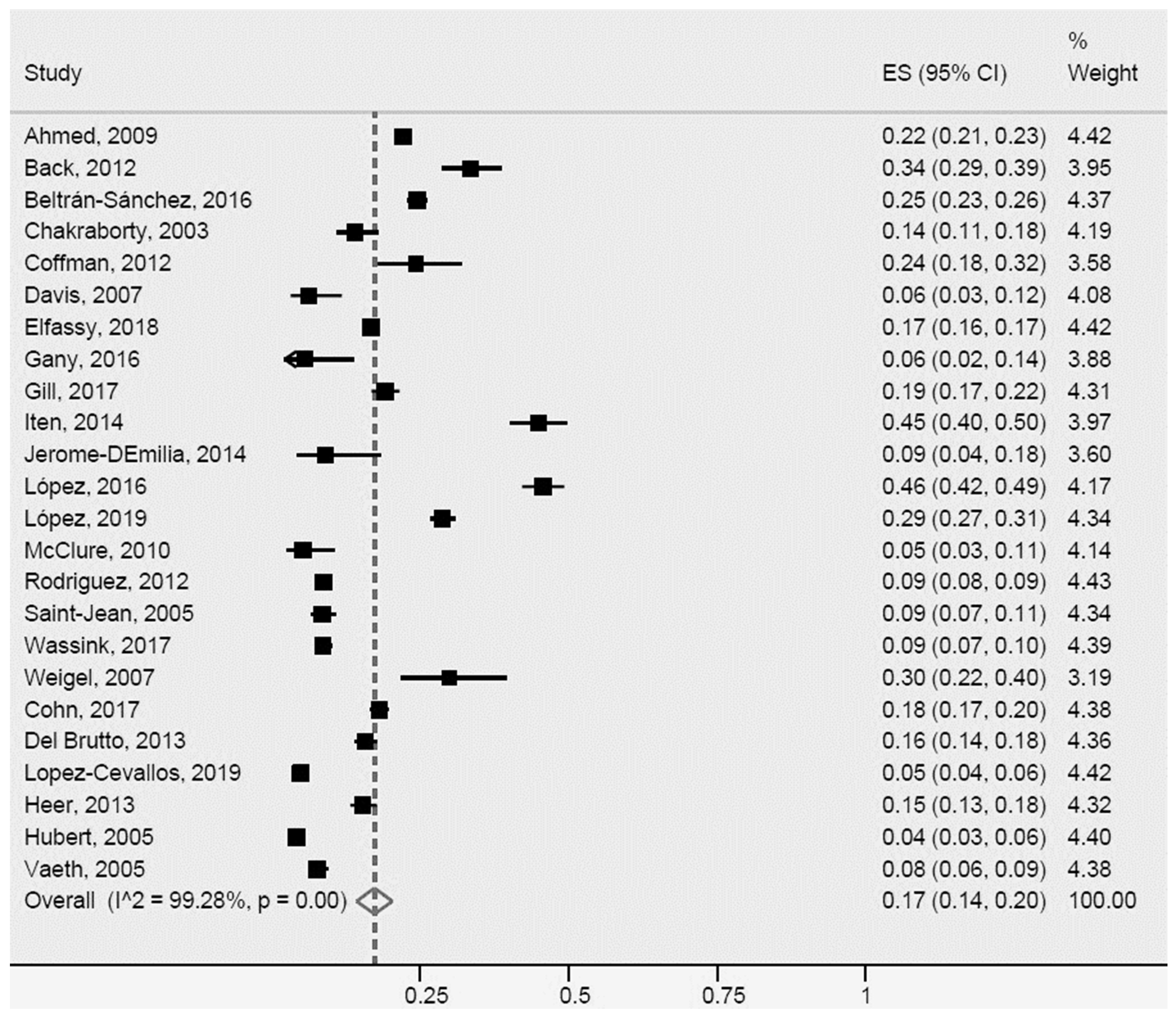
Type 2 Diabetes Mellitus or High Blood Glucose for Latinos in the USA
General Obesity and Abdominal Obesity for Latinos in the USA
HDL Cholesterol and Triglycerides for Latinos in the USA
Metabolic Syndrome for Latinos in the USA
3.4.2. Further Sensitivity Analyses
3.4.3. Quality of Evidence
4. Discussion
4.1. Summary of Evidence
4.2. Comparison with Previous Systematic Reviews and Meta-Analyses
4.3. Limitations
5. Conclusions
Supplementary Materials
Author Contributions
Funding
Institutional Review Board Statement
Informed Consent Statement
Data Availability Statement
Acknowledgments
Conflicts of Interest
References
- Omran, A.R. The Epidemiologic Transition: A Theory of the Epidemiology of Population Change. Milbank Q 2005, 83, 731–757. [Google Scholar] [CrossRef] [Scilit] [PubMed]
- World Health Organization. Obesity: Preventing and Managing the Global Epidemic: Report of a WHO Consultation; WHO Technical Report Series; World Health Organization: Geneva, Switzerland, 2000; ISBN 978-92-4-120894-9. [Google Scholar]
- World Health Organization. Obesity and Overweight. Available online: https://www.who.int/news-room/fact-sheets/detail/obesity-and-overweight (accessed on 25 August 2022).
- Zimmet, P.; Magliano, D.; Matsuzawa, Y.; Alberti, G.; Shaw, J. The Metabolic Syndrome: A Global Public Health Problem and a New Definition. J. Atheroscler. Thromb. 2005, 12, 295–300. [Google Scholar] [CrossRef] [Scilit] [PubMed]
- Hruby, A.; Hu, F.B. The Epidemiology of Obesity: A Big Picture. PharmacoEconomics 2015, 33, 673–689. [Google Scholar] [CrossRef] [Scilit]
- Reaven, G.M. Role of Insulin Resistance in Human Disease. Diabetes 1988, 37, 1595–1607. [Google Scholar] [CrossRef] [Scilit] [PubMed]
- NCEP. Third Report of the National Cholesterol Education Program (NCEP) Expert Panel on Detection, Evaluation, and Treatment of High Blood Cholesterol in Adults (Adult Treatment Panel III) Final Report. Circulation 2002, 106, 3143–3421. [Google Scholar] [CrossRef] [Scilit]
- Grundy, S.M.; Cleeman, J.I.; Daniels, S.R.; Donato, K.A.; Eckel, R.H.; Franklin, B.A.; Gordon, D.J.; Krauss, R.M.; Savage, P.J.; Smith, S.C.; et al. Diagnosis and Management of the Metabolic Syndrome: An American Heart Association/National Heart, Lung, and Blood Institute Scientific Statement. Circulation 2005, 112, 2735–2752. [Google Scholar] [CrossRef] [Scilit] [PubMed]
- World Health Organization. Definition, Diagnosis and Classification of Diabetes Melittus and Its Complications. Part 1: Diagnosis and Classification of Diabetes Melittus. Geneva. 1999. Available online: https://apps.who.int/iris/handle/10665/66040 (accessed on 16 September 2022).
- Shi, T.H.; Wang, B.; Natarajan, S. The Influence of Metabolic Syndrome in Predicting Mortality Risk Among USA Adults: Importance of Metabolic Syndrome Even in Adults with Normal Weight. Prev. Chronic Dis. 2020, 17, 200020. [Google Scholar] [CrossRef] [Scilit]
- Malik, V.S.; Willett, W.C.; Hu, F.B. Global Obesity: Trends, Risk Factors and Policy Implications. Nat. Rev. Endocrinol. 2013, 9, 13–27. [Google Scholar] [CrossRef] [Scilit] [PubMed]
- CDC. BRFSS Prevalence & Trends Data. Available online: https://www.cdc.gov/brfss/brfssprevalence/ (accessed on 7 July 2022).
- US Census Bureau. USA Census Bureau: Explore Data. Available online: https://data.census.gov/mdat/#/ (accessed on 2 January 2023).
- Ahmed, A.T.; Quinn, V.P.; Caan, B.; Sternfeld, B.; Haque, R.; Van Den Eeden, S.K. Generational Status and Duration of Residence Predict Diabetes Prevalence among Latinos: The California Men’s Health Study. BMC Public Health 2009, 9, 392. [Google Scholar] [CrossRef] [Scilit]
- Beltrán-Sánchez, H.; Palloni, A.; Riosmena, F.; Wong, R. SES Gradients Among Mexicans in the United States and in Mexico: A New Twist to the Hispanic Paradox? Demography 2016, 53, 1555–1581. [Google Scholar] [CrossRef] [Scilit]
- Hubert, H.; Snider, J.; Winkleby, M. Health Status, Health Behaviors, and Acculturation Factors Associated with Overweight and Obesity in Latinos from a Community and Agricultural Labor Camp Survey. Prev. Med. 2005, 40, 642–651. [Google Scholar] [CrossRef] [Scilit] [PubMed]
- Delavari, M.; Sønderlund, A.L.; Swinburn, B.; Mellor, D.; Renzaho, A. Acculturation and Obesity among Migrant Populations in High Income Countries--a Systematic Review. BMC Public Health 2013, 13, 458. [Google Scholar] [CrossRef] [Scilit] [PubMed]
- Oza-Frank, R.; Cunningham, S.A. The Weight of USA Residence among Immigrants: A Systematic Review. Obes. Rev. 2010, 11, 271–280. [Google Scholar] [CrossRef] [Scilit] [PubMed]
- Brasil. Ministério Da Saúde. Secretaria de Vigilância Em Saúde. Vigitel Brasil: Vigilância de Fatores de Risco e Proteção Para Doenças Crônicas Por Inquérito Telefônico. Publicações 2010–2020. Available online: https://www.gov.br/saude/pt-br/centrais-de-conteudo/publicacoes/publicacoes-svs/vigitel (accessed on 5 July 2022).
- United States Census Bureau. Hispanic or Latino Origin. Available online: https://www.census.gov/acs/www/about/why-we-ask-each-question/ethnicity/ (accessed on 19 September 2022).
- Page, M.J.; McKenzie, J.E.; Bossuyt, P.M.; Boutron, I.; Hoffmann, T.C.; Mulrow, C.D.; Shamseer, L.; Tetzlaff, J.M.; Akl, E.A.; Brennan, S.E.; et al. The PRISMA 2020 Statement: An Updated Guideline for Reporting Systematic Reviews. BMJ 2021, 372, n71. [Google Scholar] [CrossRef] [Scilit] [PubMed]
- WHO. ICD-10 Version: 2019; WHO: Geneva, Switzerland, 2019. [Google Scholar]
- Ouzzani, M.; Hammady, H.; Fedorowicz, Z.; Elmagarmid, A. Rayyan-a Web and Mobile App for Systematic Reviews. Syst. Rev. 2016, 5, 210. [Google Scholar] [CrossRef] [Scilit]
- Moola, S.; Munn, Z.; Tufanaru, C.; Aromataris, E.; Sears, K.; Sfetcu, R.; Currie, M.; Qureshi, R.; Mattis, P.; Lisy, K.; et al. Chapter 7: Systematic Reviews of Etiology and Risk. In JBI Manual for Evidence Synthesis; Aromataris, E., Munn, Z., Eds.; JBI: Adelaide, Australia, 2020. [Google Scholar]
- Goldet, G.; Howick, J. Understanding GRADE: An Introduction. J. Evid. Based Med. 2013, 6, 50–54. [Google Scholar] [CrossRef] [Scilit]
- Albrecht, S.S.; Diez Roux, A.V.; Aiello, A.E.; Schulz, A.J.; Abraido-Lanza, A.F. Secular Trends in the Association between Nativity/Length of USA Residence with Body Mass Index and Waist Circumference among Mexican-Americans, 1988–2008. Int. J. Public Health 2013, 58, 573–581. [Google Scholar] [CrossRef] [Scilit]
- Altman, C.E.; Van Hook, J.; Gonzalez, J. Becoming Overweight without Gaining a Pound: Weight Evaluations and the Social Integration of Mexicans in the United States. Int. Migr. Rev. 2017, 51, 3–36. [Google Scholar] [CrossRef] [Scilit]
- Angel, R.J.; Angel, J.L.; Hill, T.D. A Comparison of the Health of Older Hispanics in the United States and Mexico: Methodological Challenges. J. Aging Health 2008, 20, 3–31. [Google Scholar] [CrossRef] [Scilit]
- Antecol, H.; Bedard, K. Unhealthy Assimilation: Why Do Immigrants Converge to American Health Status Levels? Demography 2006, 43, 337–360. [Google Scholar] [CrossRef] [Scilit]
- Anzman-Frasca, S.; Economos, C.D.; Tovar, A.; Boulos, R.; Sliwa, S.; Gute, D.M.; Pirie, A.; Must, A. Depressive Symptoms and Weight Status Among Women Recently Immigrating to the US. Matern. Child Health J. 2016, 20, 1578–1585. [Google Scholar] [CrossRef] [Scilit] [PubMed]
- Boggess, B.; Bogue, H.O. The Health of U.S. Agricultural Worker Families: A Descriptive Study of over 790,000 Migratory and Seasonal Agricultural Workers and Dependents. J. Health Care Poor Underserved 2016, 27, 778–792. [Google Scholar] [CrossRef] [Scilit] [PubMed]
- Caspi, C.E.; Tucker-Seeley, R.D.; Adamkiewicz, G.; Roberto, C.A.; Stoddard, A.M.; Sorensen, G.C. Food Hardship and Obesity in a Sample of Low-Income Immigrants. J. Immigr. Minor. Health 2017, 19, 130–137. [Google Scholar] [CrossRef] [Scilit] [PubMed]
- Castañeda, S.F.; Rosenbaum, R.P.; Holscher, J.T.; Madanat, H.; Talavera, G.A. Cardiovascular Disease Risk Factors Among Latino Migrant and Seasonal Farmworkers. J. Agromed. 2015, 20, 95–104. [Google Scholar] [CrossRef] [Scilit]
- Chakraborty, B.M.; Mueller, W.H.; Reeves, R.; Poston, W.S.C.; Holscher, D.M.; Quill, B.; Hanis, C.L.; Foreyt, J.P. Migration History, Health Behaviors, and Cardiovascular Disease Risk Factors in Overweight Mexican-American Women. Ethn. Dis. 2003, 13, 94–108. [Google Scholar]
- Choi, J.Y. Prevalence of Overweight and Obesity Among USA Immigrants: Results of the 2003 New Immigrant Survey. J. Immigr. Minor. Health 2012, 14, 1112–1118. [Google Scholar] [CrossRef] [Scilit]
- Coffman, M.J.; Norton, C.K.; Beene, L. Diabetes Symptoms, Health Literacy, and Health Care Use in Adult Latinos with Diabetes Risk Factors. J. Cult. Divers. 2012, 19, 4–9. [Google Scholar]
- Davis, E.E.; Huffman, F.G. Differences in Coronary Heart Disease Risk Markers among Apparently Healthy Individuals of African Ancestry. J. Natl. Med. Assoc. 2007, 99, 658–664. [Google Scholar]
- Elfassy, T.; Mossavar-Rahmani, Y.; Van Horn, L.; Gellman, M.; Sotres-Alvarez, D.; Schneiderman, N.; Daviglus, M.; Beasley, J.M.; Llabre, M.M.; Shaw, P.A.; et al. Associations of Sodium and Potassium with Obesity Measures Among Diverse USA Hispanic/Latino Adults: Results from the Hispanic Community Health Study/Study of Latinos: Sodium, Potassium, and Obesity. Obesity 2018, 26, 442–450. [Google Scholar] [CrossRef] [Scilit]
- Gany, F.; Bari, S.; Gill, P.; Ramirez, J.; Ayash, C.; Loeb, R.; Aragones, A.; Leng, J. Step On It! Workplace Cardiovascular Risk Assessment of New York City Yellow Taxi Drivers. J. Immigr. Minor. Health 2016, 18, 118–134. [Google Scholar] [CrossRef] [Scilit]
- Gill, R.M.; Khan, S.A.; Jackson, R.T.; Duane, M. Prevalence of the Metabolic Syndrome in Central and South American Immigrant Residents of the Washington, DC, Area. J. Nutr. Metab. 2017, 2017, 9531964. [Google Scholar] [CrossRef] [Scilit] [PubMed]
- Giuntella, O.; Stella, L. The Acceleration of Immigrant Unhealthy Assimilation: Immigrant Obesity Assimilation. Health Econ. 2017, 26, 511–518. [Google Scholar] [CrossRef] [Scilit] [PubMed]
- Glick, J.E.; Yabiku, S.T. A Moving Paradox: A Binational View of Obesity and Residential Mobility. J. Immigr. Minor. Health 2015, 17, 489–497. [Google Scholar] [CrossRef] [Scilit]
- Iten, A.E.; Jacobs, E.A.; Lahiff, M.; Fernández, A. Undocumented Immigration Status and Diabetes Care Among Mexican Immigrants In Two Immigration “Sanctuary” Areas. J. Immigr. Minor. Health 2014, 16, 229–238. [Google Scholar] [CrossRef] [Scilit]
- Jackson, C.L.; Hu, F.B.; Redline, S.; Williams, D.R.; Mattei, J.; Kawachi, I. Racial/Ethnic Disparities in Short Sleep Duration by Occupation: The Contribution of Immigrant Status. Soc. Sci. Med. 2014, 118, 71–79. [Google Scholar] [CrossRef] [Scilit]
- Jaranilla, J.; DeFor, T.; Vazquez Benitez, G.; Kottke, T.E. Lipid Abnormalities in Foreign-Born and US-Born Patients in a Medical Group. J. Clin. Lipidol. 2014, 8, 77–85. [Google Scholar] [CrossRef] [Scilit] [PubMed]
- Jerome-D’Emilia, B.; Dunphy Suplee, P.; Gardner, M.R. Understanding Access to Care and Health Needs of Hispanic Women From an Urban Community. Hisp. Health Care Int. 2014, 12, 71–80. [Google Scholar] [CrossRef] [Scilit] [PubMed]
- Klabunde, R.A.; Neto, F.L.; Louzada, A.; de Moura, R.F.; Calixto, F.M.; Danaei, G.; Castro, M.C. Prevalence and Predictors of Overweight and Obesity in Brazilian Immigrants in Massachusetts. BMC Public Health 2020, 20, 42. [Google Scholar] [CrossRef] [Scilit]
- LeBrón, A.M.W.; Schulz, A.J.; Mentz, G.; Reyes, A.G.; Gamboa, C.; Israel, B.A.; Viruell-Fuentes, E.A.; House, J.S. Impact of Change over Time in Self-Reported Discrimination on Blood Pressure: Implications for Inequities in Cardiovascular Risk for a Multi-Racial Urban Community. Ethn. Health 2020, 25, 323–341. [Google Scholar] [CrossRef] [Scilit]
- Li, K.; Wen, M.; Henry, K.A. Ethnic Density, Immigrant Enclaves, and Latino Health Risks: A Propensity Score Matching Approach. Soc. Sci. Med. 2017, 189, 44–52. [Google Scholar] [CrossRef] [Scilit]
- López, L.; Swett, K.; Rodriguez, F.; Kizer, J.R.; Penedo, F.; Gallo, L.; Allison, M.; Arguelles, W.; Gonzalez, F.; Kaplan, R.C.; et al. Association of Acculturation with Cardiac Structure and Function among Hispanics/Latinos: A Cross-Sectional Analysis of the Echocardiographic Study of Latinos. BMJ Open 2019, 9, e028729. [Google Scholar] [CrossRef] [Scilit] [PubMed]
- Martínez, A.D.; Juon, H.; Levine, D.M.; Lyford-Pike, V.; Peters, S. The Association between Nutrition Transition Score and Measures of Obesity: Results from a Cross-Sectional Study among Latina/o Immigrants in Baltimore. Glob. Health 2014, 10, 57. [Google Scholar] [CrossRef] [Scilit] [PubMed]
- McClure, H.H.; Snodgrass, J.J.; Martinez, C.R.; Eddy, J.M.; Jiménez, R.A.; Isiordia, L.E. Discrimination, Psychosocial Stress, and Health among Latin American Immigrants in Oregon. Am. J. Hum. Biol. 2010, 22, 421–423. [Google Scholar] [CrossRef] [Scilit]
- Narang, B.; Mirpuri, S.; Kim, S.Y.; Jutagir, D.R.; Gany, F. Lurking in Plain Sight: Hypertension Awareness and Treatment among New York City Taxi/For-hire Vehicle Drivers. J. Clin. Hypertens. 2020, 22, 962–969. [Google Scholar] [CrossRef] [Scilit]
- Rodriguez, F.; Hicks, L.S.; López, L. Association of Acculturation and Country of Origin with Self-Reported Hypertension and Diabetes in a Heterogeneous Hispanic Population. BMC Public Health 2012, 12, 768. [Google Scholar] [CrossRef] [Scilit] [PubMed]
- Ryan, A.M.; Gee, G.C.; Laflamme, D.F. The Association between Self-Reported Discrimination, Physical Health and Blood Pressure: Findings from African Americans, Black Immigrants, and Latino Immigrants in New Hampshire. J. Health Care Poor Underserved 2006, 17, 116–132. [Google Scholar] [CrossRef] [Scilit]
- Saint-Jean, G.; Crandall, L.A. Utilization of Preventive Care by Haitian Immigrants in Miami, Florida. J. Immigr. Minor. Health 2005, 7, 283–292. [Google Scholar] [CrossRef] [Scilit]
- Shelley, D.; Tseng, T.-Y.; Andrews, H.; Ravenell, J.; Wu, D.; Ferrari, P.; Cohen, A.; Millery, M.; Kopal, H. Predictors of Blood Pressure Control Among Hypertensives in Community Health Centers. Am. J. Hypertens. 2011, 24, 1318–1323. [Google Scholar] [CrossRef] [Scilit]
- Shi, L.; Zhang, D.; van Meijgaard, J.; MacLeod, K.E.; Fielding, J.E. The Interaction Between an Individual’s Acculturation and Community Factors on Physical Inactivity and Obesity: A Multilevel Analysis. Am. J. Public Health 2015, 105, 1460–1467. [Google Scholar] [CrossRef] [Scilit]
- Singh-Franco, D.; Perez, A.; Wolowich, W.R. Improvement in Surrogate Endpoints by a Multidisciplinary Team in a Mobile Clinic Serving a Low-Income, Immigrant Minority Population in South Florida. J. Health Care Poor Underserved 2013, 24, 67–77. [Google Scholar] [CrossRef] [Scilit]
- Tehranifar, P.; Protacio, A.; Schmitt, K.M.; Desperito, E.; Oskar, S.; Potter, A.J.; Engmann, N.J.; Terry, M.B. The Metabolic Syndrome and Mammographic Breast Density in a Racially Diverse and Predominantly Immigrant Sample of Women. Cancer Causes Control 2015, 26, 1393–1403. [Google Scholar] [CrossRef] [Scilit] [PubMed]
- Villarejo, D.; McCurdy, S.A.; Bade, B.; Samuels, S.; Lighthall, D.; Williams, D. The Health of California’s Immigrant Hired Farmworkers. Am. J. Ind. Med. 2010, 53, 387–397. [Google Scholar] [CrossRef] [Scilit] [PubMed]
- Viruell-Fuentes, E.A.; Ponce, N.A.; Alegría, M. Neighborhood Context and Hypertension Outcomes Among Latinos in Chicago. J. Immigr. Minor. Health 2012, 14, 959–967. [Google Scholar] [CrossRef] [Scilit] [PubMed]
- Wassink, J.; Perreira, K.M.; Harris, K.M. Beyond Race/Ethnicity: Skin Color and Cardiometabolic Health Among Blacks and Hispanics in the United States. J. Immigr. Minor. Health 2017, 19, 1018–1026. [Google Scholar] [CrossRef] [Scilit] [PubMed]
- Weigel, M.M.; Armijos, R.X. Food Insecurity, Cardiometabolic Health, and Health Care in U.S.-Mexico Border Immigrant Adults: An Exploratory Study. J. Immigr. Minor. Health 2019, 21, 1085–1094. [Google Scholar] [CrossRef] [Scilit]
- Weigel, M.M.; Armijos, R.X.; Hall, Y.P.; Ramirez, Y.; Orozco, R. The Household Food Insecurity and Health Outcomes of U.S.–Mexico Border Migrant and Seasonal Farmworkers. J. Immigr. Minor. Health 2007, 9, 157–169. [Google Scholar] [CrossRef] [Scilit]
- Wolin, K.Y.; Colangelo, L.A.; Chiu, B.C.-H.; Gapstur, S.M. Obesity and Immigration among Latina Women. J. Immigr. Minor. Health 2009, 11, 428–431. [Google Scholar] [CrossRef] [Scilit]
- Dawson, A.Z.; Walker, R.J.; Gregory, C.; Egede, L.E. Relationship between Social Determinants of Health and Systolic Blood Pressure in United States Immigrants. Int. J. Cardiol. Hypertens. 2019, 2, 100011. [Google Scholar] [CrossRef] [Scilit]
- Cohn, T.; Miller, A.; Fogg, L.; Braun, L.T.; Coke, L. Impact of Individual and Neighborhood Factors on Cardiovascular Risk in White Hispanic and Non-Hispanic Women and Men: Ethnicity and Individual and Neighborhood Cardiovascular Risk. Res. Nurs. Health 2017, 40, 120–131. [Google Scholar] [CrossRef] [Scilit]
- Del Brutto, O.H.; Dong, C.; Rundek, T.; Elkind, M.S.V.; Del Brutto, V.J.; Sacco, R.L. Cardiovascular Health Status Among Caribbean Hispanics Living in Northern Manhattan and Ecuadorian Natives/Mestizos in Rural Coastal Ecuador: A Comparative Study. J. Community Health 2013, 38, 634–641. [Google Scholar] [CrossRef] [Scilit]
- López-Cevallos, D.F.; Escutia, G.; González-Peña, Y.; Garside, L.I. Cardiovascular Disease Risk Factors among Latino Farmworkers in Oregon. Ann. Epidemiol. 2019, 40, 8–12.e1. [Google Scholar] [CrossRef] [Scilit] [PubMed]
- Pickering, R.P.; Grant, B.F.; Chou, S.P.; Compton, W.M. Are Overweight, Obesity, and Extreme Obesity Associated With Psychopathology?: Results From the National Epidemiologic Survey on Alcohol and Related Conditions. J. Clin. Psychiatry 2007, 68, 998–1009. [Google Scholar] [CrossRef] [Scilit] [PubMed]
- Rodriguez, C.B.; Wei, Y.; Terry, M.B.; Wyka, K.; Athilat, S.; Albrecht, S.S.; Tehranifar, P. Associations of Nativity, Age at Migration, and Percent of Life in the U.S. with Midlife Body Mass Index and Waist Size in New York City Latinas. Int. J. Environ. Res. Public Health 2020, 17, 2436. [Google Scholar] [CrossRef] [Scilit] [PubMed]
- Slattery, M.L.; Sweeney, C.; Edwards, S.; Herrick, J.; Murtaugh, M.; Baumgartner, K.; Guiliano, A.; Byers, T. Physical Activity Patterns and Obesity in Hispanic and Non-Hispanic White Women. Med. Sci. Sport. Exerc. 2006, 38, 33–41. [Google Scholar] [CrossRef] [Scilit] [PubMed]
- Torres, J.M.; Deardorff, J.; Gunier, R.B.; Harley, K.G.; Alkon, A.; Kogut, K.; Eskenazi, B. Worry About Deportation and Cardiovascular Disease Risk Factors Among Adult Women: The Center for the Health Assessment of Mothers and Children of Salinas Study. Ann. Behav. Med. 2018, 52, 186–193. [Google Scholar] [CrossRef] [Scilit]
- de Heer, H.D.; Salinas, J.; Lapeyrouse, L.M.; Heyman, J.; Morera, O.F.; Balcazar, H.G. Binational Utilization and Barriers to Care among Mexican American Border Residents with Diabetes. Rev. Panam. Salud Pública 2013, 34, 147–154. [Google Scholar] [PubMed]
- Vega Briones, G. Problemas actuales de sobrepeso entre los migrantes mexicanos. Migr. Int. 2016, 8, 201–230. [Google Scholar]
- Nelson, T.; Perez, A.; Alcaraz, J.; Talavera, G.; McCarthy, J.J. Family History of Diabetes, Acculturation, and the Metabolic Syndrome among Mexican Americans: Proyecto SALSA. Metab. Syndr. Relat. Disord. 2007, 5, 262–269. [Google Scholar] [CrossRef] [Scilit]
- Vaeth, P.A.C.; Willett, D.L. Level of Acculturation and Hypertension among Dallas County Hispanics: Findings from the Dallas Heart Study. Ann. Epidemiol. 2005, 15, 373–380. [Google Scholar] [CrossRef] [Scilit]
- Chrisman, M.; Chow, W.-H.; Daniel, C.R.; Wu, X.; Zhao, H. Associations between Language Acculturation, Age of Immigration, and Obesity in the Mexican American Mano A Mano Cohort. Obes. Res. Clin. Pract. 2017, 11, 544–557. [Google Scholar] [CrossRef] [Scilit]
- López, L.; Grant, R.W.; Marceau, L.; Piccolo, R.; McKinlay, J.B.; Meigs, J.B. Association of Acculturation and Health Literacy with Prevalent Dysglycemia and Diabetes Control Among Latinos in the Boston Area Community Health (BACH) Survey. J. Immigr. Minor. Health 2016, 18, 1266–1273. [Google Scholar] [CrossRef] [Scilit] [PubMed]
- Salinas, J.J.; Abdelbary, B.; Rentfro, A.; Fisher-Hoch, S.; McCormick, J. Cardiovascular Disease Risk Among the Mexican American Population in the Texas-Mexico Border Region, by Age and Length of Residence in United States. Prev. Chronic Dis. 2014, 11, 130253. [Google Scholar] [CrossRef] [Scilit] [PubMed]
- Back, E.E.; Bachwani, A.S.; Strogatz, D.S.; Sherman, Z.M.V. Profile of Diabetes Mellitus among Immigrants from Guyana: Epidemiology and Implications for Community Action. Ethn. Dis. 2012, 22, 473–478. [Google Scholar] [PubMed]
- US Census Bureau. ACS 5-Year Estimates Public Use Microdata Sample. Available online: https://data.census.gov/mdat/#/search?ds=ACSPUMS5Y2019&cv=ANC1P(360)&rv=ucgid&wt=PWGTP&g=0400000US05,06,08,09,10,11,12,13,15,16,17,18,19,20,21,22,23,24,25,26,27,28,29,30,31,32,33,34,35,36,37,38,39,40,41,42,44,45,46,47,48,49,50,51,53,54,55,56 (accessed on 22 August 2022).
- Rowland, M.L. Self-Reported Weight and Height. Am. J. Clin. Nutr. 1990, 52, 1125–1133. [Google Scholar] [CrossRef] [Scilit] [PubMed]
- Stone, J.; Gurunathan, U.; Glass, K.; Munn, Z.; Tugwell, P.; Doi, S.A.R. Stratification by Quality Induced Selection Bias in a Meta-Analysis of Clinical Trials. J. Clin. Epidemiol. 2019, 107, 51–59. [Google Scholar] [CrossRef] [Scilit] [PubMed]

| Immigration-Related | Immigrant-Related | Health-, Dietary-, and Lifestyle-Related | Community-Related |
|---|---|---|---|
| generational status [14] | nativity [26,35,42,54,72] | health behaviors [16,34] | immigrant concentration [49,68] |
| length of residence in USA [14,26,36,39,47,72,81] | agricultural work [31,33,61] | health assimilation; health literacy; nutrition transition; dietary characteristics [41,47,51,80] | community factors [58,68] |
| migration history [34] | income; sociodemographic factors [31,32,47,53,68,70] | healthcare services access and utilization [56,62] | |
| immigration [15,27,28,29,30,31,45,82] | ethnicity [37,44] | food insecurity [64,65] | |
| acculturation [16,50,54,58,66,73,78,79,80] | occupation [44] | lifestyle; environment; lifestyle predictors; physical activity patterns [53,69,73] | |
| age at immigration [79] | age [81] | hypertension; type 2 diabetes; MetS; family history of type 2 diabetes; cardiovascular risk factors [57,60,68,75,77] | |
| migrant status [43,44,81] | social determinants of health [67] | psychiatric disorders; substance use [71] | |
| discrimination [48,52,55] | worry about deportation [74] | ||
| residential mobility [42] | health status [16] |
| Study ID | Total Study Participants | Female | Male | Age Group | Country of Birth | Comparison Group | Time in the USA | Study Design | Study Period | Exposures | Immigrant Worker | Occupation | Documentation | Insurance |
|---|---|---|---|---|---|---|---|---|---|---|---|---|---|---|
| Ahmed, 2009 [14] | 70,110 | 0 | 70,110 | 45–69 | US-born black and white | <10 y; 11–15 y; 16–25 y; >25 y | cohort | 2002–2003 | generational status; length of residency in the US | No | ||||
| Albrecht, 2013 [26] | 8149 | 3914 | 4235 | 20–64 | Mexico | US-born Mexicans | <10 y; >10 y | cross-sectional | 1988–1994; 1999–2008 | nativity; length of residency in the US | No | |||
| Altman, 2017 [27] | 25,499 | 25,499 | 0 | 20–64 | Mexico | Mexicans in Mexico; US-born Mexicans; US-born non-Hispanics whites/blacks | cross-sectional | 1999–2009 NHANES (US); 2006 ENSANUT (Mexico) | immigration | No | ||||
| Angel, 2008 [28] | 1975 | 1153 | 822 | 20—not specified | non-Hispanic whites, blacks, and Asians | <10 y; >10 y | cross-sectional | June–December 2004 | immigration | No | Yes | |||
| Antecol, 2006 [29] | 490,806 | 258,718 | 232,088 | 20–64 | natives (Hispanics, whites, and blacks) | 0–4 y; 5–9 y; 10–14 y; 15 y+ | cross-sectional | 1989–1996 | immigration | No | ||||
| Anzman-Frasca, 2016 [30] | 345 | 345 | 0 | 20–55 | Brazil; Haiti; El Salvador; Colombia; Guatemala; Dominican Republic; Honduras | between groups | <10 y | cross-sectional | March and June 2010 (first wave); May and June 2011 (second wave) | immigration | No | |||
| Back, 2012 [82] | 1096 | 441 | 655 | 30—not specified | Guyana; other | case–control | 1 May 2004–30 April 2006 | immigration | No | |||||
| Beltrán-Sánchez, 2016 [15] | 15,957 | 9022 | 6935 | 20–50+ | Mexico | US-born Mexican-American; Mexican living in Mexico; non-Hispanic whites | cross-sectional | ENSANUT 2006; NHANES 1999–2000 and 2009–2010 | immigration | No | ||||
| Boggess, 2016 [31] | 793,188 | 427,528 | 365,660 | 18–60+ | cross-sectional | 2012 | agricultural work (seasonal and migratory); immigration; low income | Yes | agricultural workers (seasonal or migratory) | Yes | ||||
| Briones, 2016 [76] | 31,305 | 11,402 | 19,903 | <35–65+ | Mexico | cross-sectional | 2010 | No | Yes | |||||
| Caspi, 2017 [32] | 800 | 636 | 164 | 18–60+ | Puerto Rico; Haiti; other | Us-born | 0–5 y; 5–10 y; 10 y+ | cross-sectional | February 2007 and June 2009 | low-income immigrants | No | |||
| Castañeda, 2015 [33] | 282 | 163 | 118 | migrant or seasonal status | cross-sectional | 2002–2004 | migrant or seasonal status | Yes | farmworkers | Yes | ||||
| Chakraborty, 2003 [34] | 390 | 390 | 0 | 18–65 | Mexico; other | <5 y; 5–9 y; 10 y+ | cross-sectional | 1993 | migration history; health behavior changes—mediator | No | ||||
| Choi, 2012 [35] | 7786 | 4287 | 3499 | Central and South America | origin | <1 y; 1–4 y; 5–9 y; 10 y+ | cross-sectional | 2003 | nativity | No | ||||
| Chrisman, 2017 [79] | 18,298 | 14,048 | 4250 | 21–94 | Mexico | US-born | cohort | Start year 2001 | language acculturation; age at immigration | No | ||||
| Coffman, 2012 [36] | 144 | 113 | 31 | Mexico; Central and South America; other | cross-sectional | recent Latino immigrants | No | Yes | ||||||
| Cohn, 2017 [68] | 3317 | 1523 | 1794 | 30–74 | mon-Hispanic whites | cross-sectional | 2010 (US Census); 2012–2013 (hospital data) | CVD risk factors (individual factors); median household income and Hispanic concentration (neighborhood-level) | Yes | Yes | ||||
| Davis, 2007 [37] | 189 | 98 | 91 | 18–40 | Central America | African-American; US-born African Caribbean | cross-sectional | ethnicity | No | Yes | ||||
| Dawson, 2019 [67] | 181 | 120 | 61 | 18–64 | Mexico; Central America | Mean 21.6 (16.2); Median 19 | cross-sectional | social determinants of health | Yes | |||||
| Del Brutto, 2013 [69] | 3850 | 2413 | 1437 | 40—not specified | Dominic Republic; Puerto Rico; Cuba; other | coastal Ecuador population (Atahualpa) | cross-sectional | 1993–2001; June–October 2012 | lifestyle; environment | No | ||||
| Elfassy, 2018 [38] | 16,156 | 8498 | 7658 | Central and South America | between groups | <10 y; >10 y | cross-sectional | 2008–2011 | No | |||||
| Gany, 2016 [39] | 413 | 1 | 412 | 18–60+ | Central and South America | <10 y; >10 y; US-born | cross-sectional | September–October 2011 | length of residence in the US | Yes | taxi drivers | Yes | ||
| Gill, 2017 [40] | 1042 | 704 | 338 | 18–87 | El Salvador; Honduras; Peru; Guatemala; Bolivia | between groups | Mean: 8.8 years | cross-sectional | No | Yes | ||||
| Giuntella, 2017 [41] | 729,793 | 387,502 | 342,291 | 25–64 | US born | <10 y; 10–15 y; 15–20 y; >20 y | cross-sectional | 1989–2014 | health assimilation | Yes | ||||
| Glick, 2015 [42] | 525 | 372 | 153 | 18–60 | Mexico | Mexicans in Mexico | <10 y; 10 y+ speaking Spanish; 10 y+ English or bilingual; US-born | cross-sectional | March 2009 (US); May–June 2009 (Mexico) | nativity; residential mobility | No | |||
| Heer, 2013 [75] | 1002 | 660 | 342 | Mexico | Mexican-Americans without diabetes | Diabetes: mean 40.9 y (SD 18.6) No diabetes: mean 33.0 y (SD 17.5) | cross-sectional | November 2009–May 2010 | diabetes | No | Yes | |||
| Hubert, 2005 [16] | 1005 | 380 | 521 | 18–64 | Mexico; other | Mean | cross-sectional | July–December 2000 | health status; health behaviors; acculturation | Yes | skilled professional; semiskilled white-collar, clerical; semiskilled blue-collar; unskilled service, laborer; farmworker; homemaker; unemployed or student | |||
| Iten, 2014 [43] | 401 | 207 | 194 | Mexico | US-born Mexican-Americans; documented Mexican immigrants | cross-sectional | 2008–2009 | immigrant status | Yes | Yes | ||||
| Jackson, 2014 [44] | 175,244 | 28,730 | 30,484 | 18–65+ | non-Hispanic whites and blacks | <15 y; 15 y+ | cross-sectional | 2004–2011 (NHIS) | immigrant status; race/ethnicity occupation | Yes | professional/management; support services | |||
| Jaranilla, 2014 [45] | 59,791 | 33,025 | 26,766 | 20–65+ | Central and South America | US born | cross-sectional | January–December 2010 | immigration | No | Yes | |||
| Jerome-D’Emilia, 2014 [46] | 66 | 66 | 0 | 21–79 | Puerto Rico; Dominican Republic; Mexico; other | between groups | cross-sectional | Yes | Yes | Yes | ||||
| Klabunde 2020 [47] | 361 | 191 | 170 | 18–74 | Brazil | Mean: 12.7 (SD 6.7) | cross-sectional | December 2013–March 2014 | socio-demographic factors; dietary characteristics; length of residence in the US | Yes | ||||
| LeBrón, 2020 [48] | 213 | 138 | 75 | non-Hispanic whites and blacks | cross-sectional | 2002–2003 2007–2008 | discrimination | No | ||||||
| Li, 2017 [49] | 1563 | 1080 | 483 | 18–91 | Puerto Rico; Mexico; other | cross-sectional | 2006–2008 (Survey) 2005–2009 (ACS) | immigrant concentration; Latino density | No | Yes | ||||
| Lopez-Cevallos, 2019 [70] | 3382 | 673 | 2709 | 18–74 | 0–5 y; 6–9 y; >10 y | cross-sectional | 2004–2012 | sociodemographic factors | Yes | farmworkers | ||||
| López, 2016 [80] | 744 | 405 | 339 | 30–72 | Puerto Rico; Dominican Republic; other | 5–10 y; 10–15 y; 15–20 y; >20 y | cohort | January 2010–March 2012 | acculturation; health literacy | No | Yes | |||
| López, 2019 [50] | 1818 | 1187 | 631 | 45—not specified | <5 y; 5–10 y; 11–20 y; >20 y | cross-sectional | acculturation | No | ||||||
| Martínez, 2014 [51] | 149 | 98 | 51 | 20–77 | Mexico; Central and South America | Mean: 10.24 (SD 10.12) | cross-sectional | 2011 | nutrition transition | No | ||||
| McClure, 2010 [52] | 132 | 86 | 46 | Mexico | US population | Women: 9.5 (SD 6.9); Men: 13.5 (SD 9.4) | cross-sectional | discrimination | No | |||||
| Narang, 2020 [53] | 983 | 0 | 983 | 19–76 | ≤2 y; 3–9 y; 10–15 y; ≥16 y | cross-sectional | December 2010–November 2017 | demographic factors; lifestyle predictors | Yes | taxi drivers; for-hire vehicle drivers | ||||
| Nelson, 2007 [77] | 205 | Mexico | Mean 25.7 (SD 16.4) | cross-sectional | April 2004–October 2005 | family history of diabetes | No | |||||||
| Pickering, 2007 [71] | 43,093 | 24,575 | 18,518 | 18–65+ | cross-sectional | 2001–2002 | psychiatric disorders (mood, anxiety, and personality disorders); substance use (alcohol, drugs, and nicotine) | No | ||||||
| Rodriguez, 2012 [54] | 160,081 | 81,164 | 78,917 | Mexico; Central and South America; other | US-born Hispanics; non-Hispanic white | ≤1–4 y; 5–9 y; 10–14 y; >15 y | cross-sectional | 2001, 2003, 2005, and 2007 | acculturation; nativity | No | Yes | |||
| Rodriguez, 2020 [72] | 787 | 787 | 0 | 40–65 | Dominican Republic; Puerto Rico; Cuba; Mexico | US-born | cross-sectional | 2012–2018 | nativity; migration timing | No | ||||
| Ryan, 2006 [55] | 666 | 453 | 213 | African-Americans | Latino Immigrants: mean 4.47 | cross-sectional | 2002–2003 | discrimination | Yes | Yes | ||||
| Saint-Jean, 2005 [56] | 680 | 340 | 340 | 0–75+ | Haiti | with and without insurance | <5 y; 5–10 y; 11–14 y; 15 y+ | cross-sectional | 2001 | health services utilization | No | Yes | ||
| Salinas, 2014 [81] | 1936 | 1302 | 634 | 18–80 | Mexico | US born | ≤10 y; >10 y; US-born | cohort | 2004–2007 | immigrant status; length of residence in the US; age | No | |||
| Shelley, 2011 [57] | 2585 | 1592 | 993 | non-Hispanic whites and blacks | cross-sectional | 2007–2008 | hypertension | No | Yes | |||||
| Shi, 2015 [58] | 15,471 | 8049 | 7422 | 18–65+ | White | 0–4 y; 5–10 y; 10 y+; US-born | cross-sectional | 2005 and 2007 | acculturation; community factors | No | ||||
| Singh-Franco, 2013 [59] | 114 | 85 | 29 | non-Haitians | cross-sectional | January 2003–May 2008 | intervention of a multidisciplinary team | No | ||||||
| Slattery, 2006 [73] | 2039 | 2039 | 0 | <40–79 | non-Hispanic whites | cross-sectional | language acculturation; physical activity patterns | No | ||||||
| Tehranifar, 2015 [60] | 373 | 373 | 0 | 40–64 | with and without MetS | cross-sectional | November 2012 and May 2014 | MetS | No | |||||
| Torres, 2018 [74] | 545 | 545 | 0 | Mexico | <15 y; 16–20 y; >21 y; USA born | cross-sectional | March 2012 August 2014 | worry about deportation | No | |||||
| Vaeth, 2005 [78] | 1163 | 624 | 539 | 18–65 | Mexico; El Salvador; Guatemala; Honduras | <5 y; 5–10 y; 10 y+ | cross-sectional | July 2000–October 2002 | acculturation | No | Yes | |||
| Villarejo, 2010 [61] | 654 | 238 | 416 | Mexico; other | males and females | Males: median 14 Females: median 9 | cross-sectional | 1999 | agricultural work | Yes | farmworkers | Yes | ||
| Viruell-Fuentes, 2012 [62] | 804 | 456 | 348 | cross-sectional | May 2001–March 2003 | access to care; neighborhood effects | No | |||||||
| Wassink, 2017 [63] | 3731 | 1921 | 1810 | 24–32 | Mexico; Cuba; Central and South America | migrant generation, blacks | cross-sectional | Phase I (1994–1995), III (2001–2002) and IV (2008–2009). | No | Yes | ||||
| Weigel, 2019 [64] | 75 | 67 | 8 | 40–84 | Mexico | food insecure; food secure | Mean: 19.9 ± 15 | cross-sectional | April-May 2015 | food insecurity | Yes | |||
| Weigel, 2007 [65] | 100 | 43 | 57 | 18–61+ | Mexico | ≤10 y | cross-sectional | 10-month period in 2003 | food insecurity | No | ||||
| Wolin, 2009 [66] | 388 | 388 | 0 | 40–77 | Mexico; other | ≤10 y; 11–20 y; >20 y | cross-sectional | November 2000 and June 2002 (Phase I); May 2003 and June 2004 (Phase II) | acculturation | Yes | homemaker; other |
| Albrecht 2013 | Altman 2017 | Angel 2008 | Antecol 2006 | Anzman-Frasca 2016 | Beltrán-Sánchez 2016 | Boggess 2016 | Briones 2016 | Caspi 2017 | Castañeda 2015 | Chakraborty 2003 | Choi 2012 | Coffman 2012 | Cohn 2017 | Davis 2007 | ||
| 1. Were the criteria for inclusion in the sample clearly defined? | Y | Y | Y | Y | Y | Y | Y | U | Y | Y | Y | Y | Y | Y | Y | |
| 2. Were the study subjects and the setting described in detail? | Y | Y | Y | Y | Y | Y | Y | Y | Y | Y | Y | Y | Y | N | Y | |
| 3. Was the exposure measured in a valid and reliable way? | Y | Y | Y | Y | Y | Y | Y | U | Y | Y | Y | Y | Y | Y | Y | |
| 4. Were objective, standard criteria used for measurement of the condition? | Y | Y | Y | Y | Y | Y | Y | U | Y | Y | Y | Y | Y | Y | Y | |
| 5. Were confounding factors identified? | Y | Y | Y | Y | Y | Y | N | N | Y | Y | Y | U | U | U | N | |
| 6. Were strategies to deal with confounding factors stated? | Y | Y | Y | Y | Y | Y | N | N | Y | Y | Y | U | U | U | N | |
| 7. Were the outcomes measured in a valid and reliable way? | Y | Y | Y | Y | Y | Y | Y | U | Y | Y | Y | Y | Y | Y | Y | |
| 8. Was appropriate statistical analysis used? | Y | Y | Y | Y | Y | Y | Y | Y | Y | Y | Y | Y | Y | Y | Y | |
| % of “yes” | 100% | 100% | 100% | 100% | 100% | 100% | 75% | 25% | 100% | 100% | 100% | 75% | 75% | 62.5% | 75% | |
| Risk of bias | low | low | Low | low | low | low | low | high | low | low | low | low | low | moderate | low | |
| Dawson 2019 | Del Brutto 2013 | Elfassy 2018 | Gany 2016 | Gill 2017 | Giuntella 2017 | Glick 2015 | Heer 2013 | Hubert 2005 | Iten 2014 | Jackson 2014 | Jaranilla 2014 | Jerome-D’Emilia 2014 | Klabunde 2020 | LeBrón 2020 | Li 2017 | |
| 1. Were the criteria for inclusion in the sample clearly defined? | Y | Y | Y | N | Y | Y | Y | Y | Y | Y | Y | Y | Y | Y | Y | Y |
| 2. Were the study subjects and the setting described in detail? | Y | Y | Y | N | Y | Y | Y | Y | Y | Y | Y | Y | Y | Y | Y | Y |
| 3. Was the exposure measured in a valid and reliable way? | Y | Y | Y | Y | Y | Y | Y | Y | Y | Y | Y | Y | U | Y | Y | Y |
| 4. Were objective, standard criteria used for measurement of the condition? | Y | Y | Y | Y | Y | NA | Y | Y | Y | Y | Y | Y | U | Y | Y | Y |
| 5. Were confounding factors identified? | U | Y | Y | Y | Y | Y | Y | Y | U | Y | Y | Y | N | Y | Y | Y |
| 6. Were strategies to deal with confounding factors stated? | U | Y | Y | Y | Y | Y | Y | Y | U | Y | Y | Y | N | Y | Y | Y |
| 7. Were the outcomes measured in a valid and reliable way? | Y | Y | Y | Y | Y | Y | Y | Y | Y | Y | Y | Y | U | Y | Y | Y |
| 8. Was appropriate statistical analysis used? | Y | Y | Y | Y | Y | Y | Y | Y | Y | Y | Y | Y | Y | Y | Y | Y |
| % of “yes” | 75% | 100% | 100% | 75% | 100% | 87.5% | 100% | 100% | 75% | 100% | 100% | 100% | 37.5% | 100% | 100% | 100% |
| Risk of bias | low | low | low | low | low | low | low | low | low | low | low | low | high | low | low | low |
| Lopez-Cevallos 2019 | López 2019 | Martínez 2014 | McClure 2010 | Narang 2020 | Nelson 2007 | Pickering 2007 | Rodriguez 2012 | Rodriguez 2020 | Ryan 2006 | Saint-Jean 2005 | Shelley 2011 | |||||
| 1. Were the criteria for inclusion in the sample clearly defined? | Y | Y | Y | N | Y | Y | Y | Y | Y | Y | Y | Y | ||||
| 2. Were the study subjects and the setting described in detail? | Y | Y | Y | N | N | Y | Y | Y | Y | Y | Y | Y | ||||
| 3. Was the exposure measured in a valid and reliable way? | Y | Y | Y | Y | Y | Y | Y | Y | Y | Y | Y | U | ||||
| 4. Were objective, standard criteria used for measurement of the condition? | Y | Y | Y | Y | Y | Y | Y | Y | Y | Y | Y | Y | ||||
| 5. Were confounding factors identified? | Y | Y | Y | Y | Y | Y | Y | Y | Y | Y | U | U | ||||
| 6. Were strategies to deal with confounding factors stated? | Y | Y | Y | Y | Y | Y | Y | Y | Y | Y | U | U | ||||
| 7. Were the outcomes measured in a valid and reliable way? | Y | Y | Y | Y | Y | Y | Y | Y | Y | Y | Y | Y | ||||
| 8. Was appropriate statistical analysis used? | Y | Y | N | Y | Y | Y | Y | Y | Y | Y | Y | Y | ||||
| % of “yes” | 100% | 100% | 87.5% | 75% | 87.5% | 100% | 100% | 100% | 100% | 100% | 75% | 62.5% | ||||
| Risk of bias | low | low | low | low | low | low | low | low | low | low | low | moderate | ||||
| Shi 2015 | Singh-Franco 2013 | Slattery 2006 | Tehranifar 2015 | Torres 2018 | Villarejo 2010 | Vaeth 2005 | Viruell-Fuentes 2012 | Wassink 2017 | Weigel 2019 | Weigel 2007 | Wolin 2009 | |||||
| 1. Were the criteria for inclusion in the sample clearly defined? | Y | Y | Y | Y | Y | Y | Y | Y | Y | Y | Y | Y | ||||
| 2. Were the study subjects and the setting described in detail? | Y | Y | Y | Y | Y | Y | Y | Y | Y | Y | Y | Y | ||||
| 3. Was the exposure measured in a valid and reliable way? | Y | Y | Y | Y | Y | Y | Y | U | Y | Y | Y | Y | ||||
| 4. Were objective, standard criteria used for measurement of the condition? | Y | Y | Y | Y | Y | Y | Y | Y | Y | Y | Y | Y | ||||
| 5. Were confounding factors identified? | Y | Y | Y | Y | Y | Y | Y | U | Y | Y | Y | Y | ||||
| 6. Were strategies to deal with confounding factors stated? | Y | Y | Y | Y | Y | Y | Y | U | Y | Y | Y | Y | ||||
| 7. Were the outcomes measured in a valid and reliable way? | Y | Y | Y | Y | Y | Y | Y | U | Y | Y | Y | Y | ||||
| 8. Was appropriate statistical analysis used? | Y | Y | Y | Y | Y | Y | Y | Y | Y | Y | Y | Y | ||||
| % of “yes” | 100% | 100% | 100% | 100% | 100% | 100% | 100% | 50% | 100% | 100% | 100% | 100% | ||||
| Risk of bias | low | low | low | low | low | Low | low | moderate | low | low | low | low | ||||
| Ahmed 2009 | Chrisman 2017 | López 2016 | Salinas 2014 | |
|---|---|---|---|---|
| 1. Were the two groups similar and recruited from the same population? | Y | Y | Y | Y |
| 2. Were the exposures measured similarly to assign people to both exposed and unexposed groups? | Y | N | Y | Y |
| 3. Was the exposure measured in a valid and reliable way? | Y | Y | Y | Y |
| 4. Were confounding factors identified? | Y | Y | Y | U |
| 5. Were strategies to deal with confounding factors stated? | Y | Y | Y | U |
| 6. Were the groups/participants free of the outcome at the start of the study (or at the moment of exposure)? | U | U | N | U |
| 7. Were the outcomes measured in a valid and reliable way? | Y | Y | Y | Y |
| 8. Was the follow-up time reported and sufficient to be long enough for outcomes to occur? | N | Y | Y | Y |
| 9. Was follow-up complete, and if not, were the reasons to loss to follow-up described and explored? | Y | N | N | N |
| 10. Were strategies to address incomplete follow-up utilized? | NA | N | N | N |
| 11. Was appropriate statistical analysis used? | Y | Y | Y | Y |
| % of “yes” | 73% | 64% | 73% | 54.5% |
| Risk of bias | low | moderate | low | moderate |
| Back 2012 | |
|---|---|
| 1. Were the groups comparable other than the presence of disease in cases or the absence of disease in controls? | Y |
| 2. Were cases and controls matched appropriately? | N |
| 3. Were the same criteria used for identification of cases and controls? | Y |
| 4. Was exposure measured in a standard, valid, and reliable way? | Y |
| 5. Was exposure measured in the same way for cases and controls? | Y |
| 6. Were confounding factors identified? | Y |
| 7. Were strategies to deal with confounding factors stated? | Y |
| 8. Were outcomes assessed in a standard, valid, and reliable way for cases and controls? | Y |
| 9. Was the exposure period of interest long enough to be meaningful? | Y |
| 10. Was appropriate statistical analysis used? | Y |
| % of “yes” | 90% |
| Risk of bias | low |
| Study ID | Primary Outcomes | Secondary Outcomes |
|---|---|---|
| Ahmed, 2009 [14] | HTN; DM; obesity | |
| Albrecht, 2013 [26] | Obesity; AO | |
| Altman, 2017 [27] | Obesity | |
| Angel, 2008 [28] | HTN | |
| Antecol, 2006 [29] | Obesity | |
| Anzman-Frasca, 2016 [30] | Obesity | |
| Back, 2012 [82] | HTN; DM | |
| Beltrán-Sánchez, 2016 [15] | HTN; DM; obesity; AO; low HDL; high TGL; MetS | |
| Boggess, 2016 [31] | HTN; DM; overweight or obesity | |
| Briones, 2016 [76] | Obesity | |
| Caspi, 2017 [32] | Obesity | |
| Castañeda, 2015 [33] | HTN; DM; obesity | |
| Chakraborty, 2003 [34] | DM; obesity; high TGL | sleep duration |
| Choi, 2012 [35] | Obesity | |
| Chrisman, 2017 [79] | Obesity | |
| Coffman, 2012 [36] | DM | |
| Cohn, 2017 [68] | HTN; DM | |
| Davis, 2007 [37] | DM; obesity; low HDL | |
| Dawson, 2019 [67] | HTN; DM; obesity | |
| Del Brutto, 2013 [69] | HTN; DM | |
| Elfassy, 2018 [38] | HTN; DM | |
| Gany, 2016 [39] | HTN; DM; AO | |
| Gill, 2017 [40] | HTN; DM; obesity; low HDL; high TGL; MetS | |
| Giuntella, 2017 [41] | Obesity | |
| Glick, 2015 [42] | Obesity | |
| Heer, 2013 [75] | DM | |
| Hubert, 2005 [16] | HTN; DM; obesity; MetS (2 or 3 factors) | |
| Iten, 2014 [43] | DM; obesity | |
| Jackson, 2014 [44] | HTN; DM2; obesity | sleep duration |
| Jaranilla, 2014 [45] | Low HDL; high TGL | |
| Jerome-D’Emilia, 2014 [46] | HTN; DM2; obesity | |
| Klabunde, 2020 [47] | Obesity | |
| LeBrón, 2020 [48] | HTN | |
| Li, 2017 [49] | HTN | |
| Lopez-Cevallos, 2019 [70] | HTN; DM2; obesity | |
| López, 2016 [80] | DM2 | |
| López, 2019 [50] | HTN; DM2; obesity | |
| Martínez, 2014 [51] | Obesity | |
| McClure, 2010 [52] | Obesity; DM2 | |
| Narang, 2020 [53] | HTN | |
| Nelson, 2007 [77] | HTN; DM2; AO; low HDL, high TGL; MetS | |
| Pickering, 2007 [71] | Obesity | |
| Rodriguez, 2012 [54] | HTN; DM2; obesity | |
| Rodriguez, 2020 [72] | Obesity; AO | |
| Ryan, 2006 [55] | HTN | |
| Saint-Jean, 2005 [56] | HTN; DM2 | |
| Salinas, 2014 [81] | HTN | |
| Shelley, 2011 [57] | HTN; DM2 | |
| Shi, 2015 [58] | HTN; obesity | |
| Singh-Franco, 2013 [59] | HTN; DM2 | |
| Slattery, 2006 [73] | Obesity | |
| Tehranifar, 2015 [60] | HTN; DM2; obesity; AO; low HDL; high TGL; MetS | |
| Torres, 2018 [74] | HTN; obesity | |
| Vaeth, 2005 [78] | HTN; DM2; obesity | |
| Villarejo, 2010 [61] | HTN; DM2; obesity | |
| Viruell-Fuentes, 2012 [62] | HTN | |
| Wassink, 2017 [63] | HTN; DM2; obesity | |
| Weigel, 2019 [64] | HTN; DM2; obesity; AO; MetS | |
| Weigel, 2007 [65] | HTN; DM2; obesity; AO; low HDL; high TGL; MetS | |
| Wolin, 2009 [66] | Obesity |
| Systematic Review of the Metabolic Syndrome and Its Components in USA Immigrants | ||||
|---|---|---|---|---|
| Population: Latin American Immigrants ≥18 Years Old Settings: USA Exposure: Immigration Comparator: US-Born Population | ||||
| Outcomes | Prevalence Estimate (%) (95% CI) | No. of Latino Participants (Studies) | GRADE Evidence Level | Comments |
| Hypertension | 28 (23–33) | 84.047 | ⊕⊕⊝⊝ a,b,c,g,h low | The available evidence is sufficient to determine the prevalence, but confidence in the estimate is limited. As more information becomes available, the observed prevalence could change, and this change may be large enough to alter the conclusion. |
| Type 2 Diabetes Mellitus | 17 (14–20) | 83.423 | ⊕⊕⊝⊝ a,b,c,g,h low | The available evidence is sufficient to determine the prevalence, but confidence in the estimate is limited. As more information becomes available, the observed prevalence could change, and this change may be large enough to alter the conclusion. |
| Obesity (BMI > 30 kg/m2) | 37 (33–40) | 237.035 | ⊕⊕⊝⊝ a,b,c,g,h low | The available evidence is sufficient to determine the prevalence, but confidence in the estimate is limited. As more information becomes available, the observed prevalence could change, and this change may be large enough to alter the conclusion. |
| Abdominal Obesity | 54 (48–59) | 20.073 | ⊕⊕⊝⊝ a,b,c,g,h low | The available evidence is sufficient to determine the prevalence, but confidence in the estimate is limited. As more information becomes available, the observed prevalence could change, and this change may be large enough to alter the conclusion. |
| High Triglycerides | - x | 4.867 | ⊕⊝⊝⊝ a,b,d,f,h very low | The available evidence is insufficient to determine a reliable prevalence, and confidence in the estimate is limited. More information may allow for a more accurate estimation. |
| Low HDL-c | - x | 4.605 | ⊕⊝⊝⊝ a,b,d,f,h very low | The available evidence is insufficient to determine a reliable prevalence, and confidence in the estimate is limited. More information may allow for a more accurate estimation. |
| MetS | - x | 2.604 | ⊕⊝⊝⊝ a,d,e,f,h very low | The available evidence is insufficient to determine a reliable prevalence, and confidence in the estimate is limited. More information may allow for a more accurate estimation. |
| CI: confidence interval | ||||
| GRADE quality of evidence ratings High quality: We are very confident that the effect in the study reflects the actual effect. Moderate quality: We are quite confident that the effect in the study is close to the true effect, but it is also possible that it is substantially different. Low quality: The true effect may differ significantly from the estimate. Very low quality: The true effect is likely to be substantially different from the estimated effect. | ||||
Disclaimer/Publisher’s Note: The statements, opinions and data contained in all publications are solely those of the individual author(s) and contributor(s) and not of MDPI and/or the editor(s). MDPI and/or the editor(s) disclaim responsibility for any injury to people or property resulting from any ideas, methods, instructions or products referred to in the content. |
© 2023 by the authors. Licensee MDPI, Basel, Switzerland. This article is an open access article distributed under the terms and conditions of the Creative Commons Attribution (CC BY) license (https://creativecommons.org/licenses/by/4.0/).
Share and Cite
Paixão, T.M.; Teixeira, L.R.; Andrade, C.A.F.d.; Sepulvida, D.; Martinez-Silveira, M.; Nunes, C.; Siqueira, C.E.G. Systematic Review and Meta-Analysis of Metabolic Syndrome and Its Components in Latino Immigrants to the USA. Int. J. Environ. Res. Public Health 2023, 20, 1307. https://doi.org/10.3390/ijerph20021307
Paixão TM, Teixeira LR, Andrade CAFd, Sepulvida D, Martinez-Silveira M, Nunes C, Siqueira CEG. Systematic Review and Meta-Analysis of Metabolic Syndrome and Its Components in Latino Immigrants to the USA. International Journal of Environmental Research and Public Health. 2023; 20(2):1307. https://doi.org/10.3390/ijerph20021307
Chicago/Turabian StylePaixão, Talita Monsores, Liliane Reis Teixeira, Carlos Augusto Ferreira de Andrade, Debora Sepulvida, Martha Martinez-Silveira, Camila Nunes, and Carlos Eduardo Gomes Siqueira. 2023. "Systematic Review and Meta-Analysis of Metabolic Syndrome and Its Components in Latino Immigrants to the USA" International Journal of Environmental Research and Public Health 20, no. 2: 1307. https://doi.org/10.3390/ijerph20021307
APA StylePaixão, T. M., Teixeira, L. R., Andrade, C. A. F. d., Sepulvida, D., Martinez-Silveira, M., Nunes, C., & Siqueira, C. E. G. (2023). Systematic Review and Meta-Analysis of Metabolic Syndrome and Its Components in Latino Immigrants to the USA. International Journal of Environmental Research and Public Health, 20(2), 1307. https://doi.org/10.3390/ijerph20021307

