


Effect of Rural Clinical Placements on Intention to Practice and Employment in Rural Australia: A Systematic Review

Abstract
1. Introduction
- What is the influence of rural CP on intention to practice rurally?
- What is the influence of rural CP on future rural practice?
- What theoretical frameworks are used in research to explore these relationships?
2. Materials and Methods
2.1. Search Strategy
2.2. Article Selection
2.3. Assessment of Methodological Quality
2.4. Data Extraction and Synthesis
3. Results
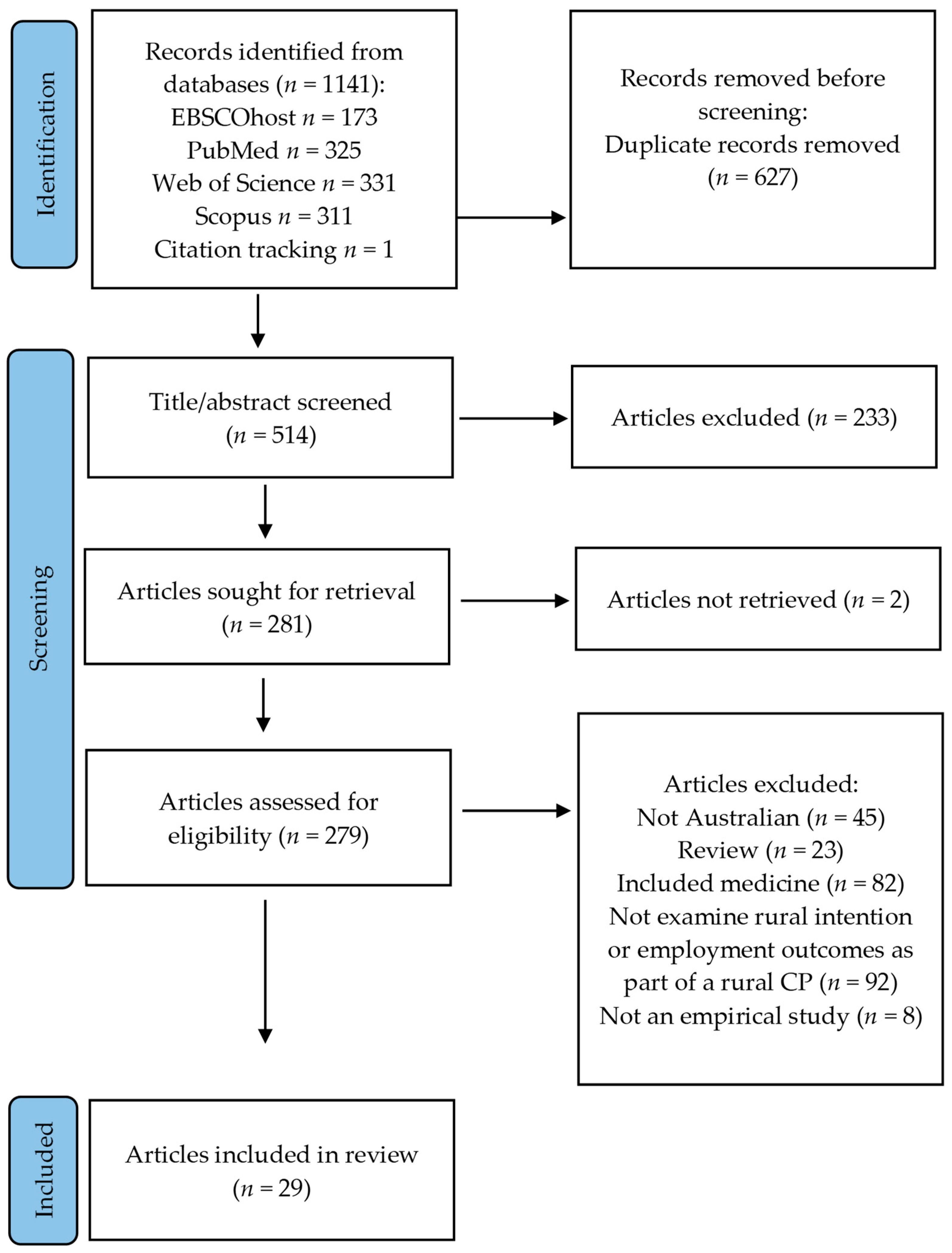
3.1. Identification and Selection of Articles
3.2. Characteristics of Included Studies
3.3. Methodological Quality
3.4. Review Findings
3.4.1. Rural CP Influence on Intentions and Attitudes towards Rural Practice
3.4.2. Rural CP Influence on Rural Practice
3.4.3. Use of Theoretical Frameworks to Inform Study Design
4. Discussion
- (1)
- Are an avenue for reinforcing or transforming students’ views of rural practice, though this may not necessarily be positive,
- (2)
- When high-quality, can positively influence students to undertake rural practice early in their career, although evidence is limited by self-selection of students into rural training experiences, and
- (3)
- Have scarcely been examined through explicit engagement with theoretical frameworks to inform study methodology. Situated learning theory was the most common theoretical framework employed.
Limitations
5. Conclusions
Author Contributions
Funding
Institutional Review Board Statement
Informed Consent Statement
Data Availability Statement
Acknowledgments
Conflicts of Interest
Appendix A
References
- WHO. Increasing Access to Health Workers in Remote and Rural Areas through Improved Retention: Global Policy Recommendations. Available online: https://apps.who.int/iris/handle/10665/44369 (accessed on 20 February 2022).
- Lyle, D.; Greenhill, J. Two decades of building capacity in rural health education, training and research in Australia: University Departments of Rural Health and Rural Clinical Schools. Aust. J. Rural Health 2018, 26, 314–322. [Google Scholar] [CrossRef] [Scilit] [PubMed]
- Holst, J. Increasing Rural Recruitment and Retention through Rural Exposure during Undergraduate Training: An Integrative Review. Int. J. Environ. Res. Public Health 2020, 17, 6423. [Google Scholar] [CrossRef] [Scilit] [PubMed]
- Walsh, S.; Lyle, D.M.; Thompson, S.C.; Versace, V.L.; Browne, L.J.; Knight, S.; Pit, S.W.; Jones, M. The role of national policies to address rural allied health, nursing and dentistry workforce maldistribution. Med. J. Aust. 2020, 213, S18. [Google Scholar]
- Jackson, D. Re-conceptualising graduate employability: The importance of pre-professional identity. High. Educ. Res. Dev. 2016, 35, 925–939. [Google Scholar] [CrossRef] [Scilit]
- Billett, S. The practices of using and integrating practice-based learning in higher education. In Practice-Based Learning in Higher Education; Kennedy, M., Billett, S., Gherardi, S., Grealish, L., Eds.; Springer: Dordrecht, The Netherlands, 2015; pp. 15–30. [Google Scholar]
- Battye, K.; Sefton, C.; Thomas, J.M.; Smith, J.; Springer, S.; Skinner, I.; Callander, E.; Butler, S.; Wilkins, R.; Gordon, J. Independent Evaluation of the Rural Health Multidisciplinary Training Program: Final Report to the Commonwealth Department of Health; KBC Australia: Orange, NSW, Australia, 2020. [Google Scholar]
- Moran, A.; Nancarrow, S.; Cosgrave, C.; Griffith, A.; Memery, R. What works, why and how? A scoping review and logic model of rural clinical placements for allied health students. BMC Health Serv. Res. 2020, 20, 1–18. [Google Scholar] [CrossRef] [Scilit] [PubMed]
- McGrath, C.; Liljedahl, M.; Palmgren, P.J. You say it, we say it, but how do we use it? Communities of practice: A critical analysis. Med. Educ. 2019, 54, 188–195. [Google Scholar] [CrossRef] [Scilit]
- Rees, C.E.; Monrouxe, L.V. Theory in medical education research: How do we get there? Med. Educ. 2010, 44, 334–339. [Google Scholar] [CrossRef] [Scilit]
- O’Brien, B.C.; Battista, A. Situated learning theory in health professions education research: A scoping review. Adv. Health Sci. Educ. 2020, 25, 483–509. [Google Scholar] [CrossRef] [Scilit]
- Malatzky, C.; Bourke, L. Re-producing rural health: Challenging dominant discourses and the manifestation of power. J. Rural Stud. 2016, 45, 157–164. [Google Scholar] [CrossRef] [Scilit]
- Roberts, C.; Daly, M.; Held, F.; Lyle, D. Social learning in a longitudinal integrated clinical placement. Adv. Health Sci. Educ. 2017, 22, 1011–1029. [Google Scholar] [CrossRef] [Scilit]
- Roberts, P.; Cosgrave, C.; Gillespie, J.; Malatzky, C.; Hyde, S.; Hu, W.C.; Bailey, J.; Yassine, T.; Downes, N. ‘Re-placing’ professional practice. Aust. J. Rural. Health 2021, 29, 301–305. [Google Scholar] [CrossRef] [Scilit] [PubMed]
- Page, M.J.; McKenzie, J.E.; Bossuyt, P.M.; Boutron, I.; Hoffmann, T.C.; Mulrow, C.D.; Shamseer, L.; Tetzlaff, J.M.; Akl, E.A.; Brennan, S.E. The PRISMA 2020 statement: An updated guideline for reporting systematic reviews. BMJ 2021, 372, 105906. [Google Scholar]
- Beks, H.; Walsh, S.; Alston, L.; Jones, M.; Smith, T.; Maybery, D.; Sutton, K.; Versace, V.L. Approaches Used to Describe, Measure, and Analyze Place of Practice in Dentistry, Medical, Nursing, and Allied Health Rural Graduate Workforce Research in Australia: A Systematic Scoping Review. Int. J. Environ. Res. Public Health 2022, 19, 1438. [Google Scholar] [CrossRef] [Scilit] [PubMed]
- Australian Bureau of Statistics (ABS). 1270.0.55.005-Australian Statistical Geography Standard (ASGS): Volume 5—Remoteness Structure, July 2016. 2018. Available online: https://www.abs.gov.au/AUSSTATS/abs@.nsf/Lookup/1270.0.55.005Main+Features1July%202016?OpenDocument (accessed on 16 February 2022).
- Hong, Q.N.; Fàbregues, S.; Bartlett, G.; Boardman, F.; Cargo, M.; Dagenais, P.; Gagnon, M.-P.; Griffiths, F.; Nicolau, B.; O’Cathain, A.; et al. The Mixed Methods Appraisal Tool (MMAT) version 2018 for information professionals and researchers. Educ. Inf. 2018, 34, 285–291. [Google Scholar] [CrossRef] [Scilit]
- Amorin-Woods, L.G.; Losco, B.E.; Leach, M.J. A mixed-method study of chiropractic student clinical immersion placements in nonmetropolitan Western Australia: Influence on student experience, professional attributes, and practice destination. J. Chiropr. Educ. 2019, 33, 30–39. [Google Scholar] [CrossRef] [Scilit]
- Bazen, J.; Kruger, E.; Dyson, K.; Tennant, M. An innovation in Australian dental education: Rural, remote and Indigenous pre-graduation placements. Rural Remote Health 2007, 7, 703. [Google Scholar] [CrossRef] [Scilit]
- Brockwell, D.; Wielandt, T.; Clark, M. Four years after graduation: Occupational therapists’ work destinations and perceptions of preparedness for practice. Aust. J. Rural Health 2009, 17, 71–76. [Google Scholar] [CrossRef] [Scilit]
- Brown, L.; Smith, T.; Wakely, L.; Wolfgang, R.; Little, A.; Burrows, J. Longitudinal Tracking of Workplace Outcomes for Undergraduate Allied Health Students Undertaking Placements in Rural Australia. J. Allied Health 2017, 46, 79–87. [Google Scholar]
- Brown, L.; Smith, T.; Wakely, L.; Little, A.; Wolfgang, R.; Burrows, J. Preparing Graduates to Meet the Allied Health Workforce Needs in Rural Australia: Short-Term Outcomes from a Longitudinal Study. Educ. Sci. 2017, 7, 64. [Google Scholar] [CrossRef] [Scilit]
- Campbell, N.; Farthing, A.; Lenthall, S.; Moore, L.; Anderson, J.; Witt, S.; Rissel, C. Workplace locations of allied health and nursing graduates who undertook a placement in the Northern Territory of Australia from 2016 to 2019: An observational cohort study. Aust. J. Rural Health 2021, 29, 947–957. [Google Scholar] [CrossRef] [Scilit]
- Campbell, N.; Moore, L.; Farthing, A.; Anderson, J.; Witt, S.; Lenthall, S.; Petrovic, E.; Lyons, C.; Rissel, C. Characteristics of nursing and allied health student placements in the Northern Territory over time (2017–2019) and placement satisfaction. Aust. J. Rural Health 2021, 29, 354–362. [Google Scholar] [CrossRef] [Scilit] [PubMed]
- Courtney, M.; Edwards, H.; Smith, S.; Finlayson, K. The impact of rural clinical placement On Student Nurses’ Employment Intentions. Collegian 2002, 9, 12. [Google Scholar] [CrossRef] [Scilit]
- Dalton, L.M.; Routley, G.K.; Peek, K.J. Rural placements in Tasmania: Do experiential placements and background influence undergraduate health science student’s attitudes toward rural practice? Rural. Remote Health 2008, 8, 11. [Google Scholar] [CrossRef] [Scilit]
- Farrugia, L.; Smith, T.; Depczynski, J. Factors influencing medical radiation science graduates’ early career principal place of practice: A retrospective cohort study. J. Med. Radiat. Sci. 2021, 1–9. [Google Scholar] [CrossRef] [Scilit] [PubMed]
- Johnson, G.E.; Blinkhorn, A.S. Student opinions on a rural placement program in New South Wales, Australia. Rural Remote Health 2011, 11, 12. [Google Scholar] [CrossRef] [Scilit]
- Johnson, G.; Blinkhorn, A. Assessment of a dental rural teaching program. Eur. J. Dent. 2012, 6, 235–243. [Google Scholar] [CrossRef] [Scilit]
- Johnson, G.; Blinkhorn, A. The influence of a clinical rural placement programme on the work location of new dental graduates from the U niversity of S ydney, NSW, A ustralia. Eur. J. Dent. Educ. 2013, 17, 229–235. [Google Scholar] [CrossRef] [Scilit]
- Johnson, G.; Wright, F.A.C.; Foster, K. A longitudinal evaluation of the Rural Clinical Placement Program at the University of Sydney Dental School. Eur. J. Dent. Educ. 2019, 23, e59–e70. [Google Scholar] [CrossRef] [Scilit]
- Johnson, G.; Byun, R.; Foster, K.; Wright, F.; Blinkhorn, A.; Wright, F.A.C. A longitudinal workforce analysis of a Rural Clinical Placement Program for final year dental students. Aust. Dent. J. 2019, 64, 181–192. [Google Scholar] [CrossRef] [Scilit]
- Johnson, G.; Blinkhorn, A.; Byun, R.; Foster, K.; Wright, F.A.C. The workforce outcomes of dental graduates from a metropolitan school ‘Rural Clinical Placement Program’ versus a ‘Rural Clinical School’. Int. Dent. J. 2020, 70, 214–226. [Google Scholar] [CrossRef] [Scilit]
- Kirschbaum, M.; Khalil, H.; Talyor, S.; Page, A.T. Pharmacy students’ rural career intentions: Perspectives on rural background and placements. Curr. Pharm. Teach. Learn. 2016, 8, 615–621. [Google Scholar] [CrossRef] [Scilit]
- Koedyk, C.; Satur, J.; Vaughan, B. What do dental students value about their rural placements—Is clinical experience enough? Aust. J. Rural Health 2021, 29, 670–677. [Google Scholar] [CrossRef] [Scilit] [PubMed]
- Lea, J.; Cruickshank, M.; Paliadelis, P.; Parmenter, G.; Sanderson, H.; Thornberry, P. The lure of the bush: Do rural placements influence student nurses to seek employment in rural settings? Collegian 2008, 15, 77–82. [Google Scholar] [CrossRef] [Scilit] [PubMed]
- Playford, D.; Larson, A.; Wheatland, B. Going country: Rural student placement factors associated with future rural employment in nursing and allied health. Aust. J. Rural Health 2006, 14, 14–19. [Google Scholar] [CrossRef] [Scilit] [PubMed]
- Playford, D.; Moran, M.C.; Thompson, S. Factors associated with rural work for nursing and allied health graduates 15-17 years after an undergraduate rural placement through the University Department of Rural Health program. Rural Remote Health 2020, 20, 7. [Google Scholar] [CrossRef] [Scilit] [PubMed]
- Skinner, T.C.; Semmens, L.; Versace, V.; Bish, M.; Skinner, I.K. Does undertaking rural placements add to place of origin as a predictor of where health graduates work? Aust. J. Rural. Health 2021, 1–7. [Google Scholar] [CrossRef] [Scilit]
- Sutton, K.; Depczynski, J.; Smith, T.; Mitchell, E.; Wakely, L.; Brown, L.J.; Waller, S.; Drumm, D.; Versace, V.L.; Fisher, K.; et al. Destinations of nursing and allied health graduates from two Australian universities: A data linkage study to inform rural placement models. Aust. J. Rural Health 2021, 29, 191–200. [Google Scholar] [CrossRef] [Scilit]
- Taylor, S.J.; Maharaj, P.; Williams, K.; Sheldrake, C. Pharmacy students’ intention to practise in a rural setting: Measuring the impact of a rural curriculum, rural campus and rural placement on a predominantly metropolitan student cohort. Aust. J. Rural Health 2009, 17, 305–309. [Google Scholar] [CrossRef] [Scilit]
- Taylor, S.M.; Lindsay, D.; Glass, B.D. Rural pharmacy workforce: Influence of curriculum and clinical placement on pharmacists’ choice of rural practice. Aust. J. Rural Health 2019, 27, 132–138, Erratum in Aust. J. Rural Health 2019, 27, 469. [Google Scholar] [CrossRef] [Scilit]
- Thackrah, R.D.; Hall, M.; Fitzgerald, K.; Thompson, S.C. Up close and real: Living and learning in a remote community builds students’ cultural capabilities and understanding of health disparities. Int. J. Equity Health 2017, 16, 10. [Google Scholar] [CrossRef] [Scilit]
- Thackrah, R.D.; Thompson, S.C. Learning from follow-up of student placements in a remote community: A small qualitative study highlights personal and workforce benefits and opportunities. BMC Med. Educ. 2019, 19, 331. [Google Scholar] [CrossRef] [Scilit] [PubMed]
- Thomas, J.; Butler, S.; Battye, K.; Sefton, C.; Smith, J.; Skinner, I.; Springer, S.; Callander, E. Rural placements during undergraduate training promote future rural work by nurses, midwives and allied health professionals. Aust. J. Rural Health 2021, 29, 253–258. [Google Scholar] [CrossRef] [Scilit] [PubMed]
- Wolfgang, R.; Wakely, L.; Smith, T.; Burrows, J.; Little, A.; Brown, L.J. Immersive placement experiences promote rural intent in allied health students of urban and rural origin. J. Multidiscip. Health 2019, 12, 699–710. [Google Scholar] [CrossRef] [Scilit] [PubMed]
- Sutton, K.P.; Beauchamp, A.; Smith, T.; Waller, S.; Brown, L.; Fisher, K.; Woodfield, M.; Major, L.; Depczynski, J.; Versace, V.L.; et al. Rationale and protocol for the Nursing and Allied Health Graduate Outcomes Tracking (NAHGOT) study: A large-scale longitudinal investigation of graduate practice destinations. Rural Remote Health 2021, 21, 6407. [Google Scholar] [CrossRef] [Scilit] [PubMed]
- Cosgrave, C. The Whole-of-Person Retention Improvement Framework: A Guide for Addressing Health Workforce Challenges in the Rural Context. Int. J. Environ. Res. Public Health 2020, 17, 2698. [Google Scholar] [CrossRef] [Scilit] [PubMed]
- Green, E.; Quilliam, C.; Sheepway, L.; Hays, C.A.; Moore, L.; Rasiah, R.L.; Bailie, J.; Howard, C.; Hyde, S.; Inyang, I.; et al. Identifying features of quality in rural placements for health students: Scoping review. BMJ Open 2022, 12, e057074. [Google Scholar] [CrossRef] [Scilit] [PubMed]

| Inclusion Criteria | Exclusion Criteria |
|---|---|
| Students in tertiary-level health professions degrees including medical radiation science, occupational therapy, dentistry, speech pathology/therapy, physiotherapy, nursing, pharmacy, nutrition and dietetics, podiatry, social work, oral health, audiology, orthotics and prosthetics, midwifery, paramedics, psychology, optometry, chiropractic, exercise physiology, and other health courses | Sample included medical or non-health students, where practice intention or employment results were not separable for non-medicine health students |
| Australian rural, regional, or remote CP studied | Research was not about CP experiences (e.g., simulation, community visits) |
| CP were not defined as rural, regional, or remote. CP location was outside of Australia | |
| Report outcomes included rural practice intentions (including ‘interest’ or ‘attractiveness’), and/or rural employment directly attributed to a rural, regional, or remote CP experience | Outcomes were not specific to rural CP. Other outcomes examined only (e.g., placement enjoyment, course progress) |
| Peer reviewed journal articles of all original study designs | Literature reviews and theses, grey literature, text, and opinion papers |
| Published between 2000 and 2022 | Papers published outside the stated publication range |
| English language papers | Papers in languages other than English |
| Discipline | Total Number of Studies |
|---|---|
| Occupational therapy | 14 |
| Dentistry | 12 |
| Physiotherapy | 11 |
| Medical radiation science (incl. radiography, nuclear science, radiation therapy, medical imaging) | 10 |
| Nursing | 10 |
| Pharmacy | 10 |
| Nutrition and dietetics | 9 |
| Speech pathology/therapy | 9 |
| Podiatry | 7 |
| Oral health | 5 |
| Social work | 5 |
| Audiology | 4 |
| Midwifery | 4 |
| Paramedicine | 4 |
| Psychology | 4 |
| Chiropractic | 2 |
| Exercise physiology | 2 |
| Other health courses | 8 |
| Studies | Duration of Rural CP | Disciplines of CP | Study Design | Report Quality | |
|---|---|---|---|---|---|
| MMAT Rating | MMAT Criteria Met | ||||
| A mixed-method study of chiropractic student clinical immersion placements in nonmetropolitan Western Australia: influence on student experience, professional attributes, and practice destination [19] | 1–2 weeks | Chiropractic | Mixed methods | Low | None |
| An innovation in Australian dental education: rural, remote, and Indigenous pre-graduation placements [20] | 3 weeks | Dentistry | Quantitative descriptive | Low | 4.3 |
| Four years after graduation: occupational therapists’ work destinations and perceptions of preparedness for practice [21] | NR | Occupational therapy | Mixed methods | Medium | 5.2, 5.3, 5.4 |
| Longitudinal tracking of workplace outcomes for undergraduate allied health students undertaking placements in rural Australia [22] | Short-term CP (<8 weeks), medium-term (8 to 18 weeks), or long-term (semester long or full year) CP | Diagnostic radiography, nuclear science, nutrition and dietetics, occupational therapy, physiotherapy, radiation therapy, and speech pathology | Mixed methods | Low | 5.1 |
| Preparing graduates to meet the allied health workforce needs in rural Australia: short-term outcomes from a longitudinal study [23] | Short-term (<8 weeks), medium-term (8 to 18 weeks), or long-term (semester long or full year) CP | Diagnostic radiography, nuclear science, nutrition and dietetics, occupational therapy, physiotherapy, and speech pathology | Mixed methods | Low | 5.1 |
| Workplace locations of allied health and nursing graduates who undertook a placement in the Northern Territory of Australia from 2016 to 2019: an observational cohort study [24] | Shorter (2–10 weeks), or longer (10–47 weeks) CP | Nursing, midwifery, audiology, dentistry/oral health, dietetics/nutrition, disability, medical imaging, occupational therapy, optometry, orthotics and prosthetics, paramedicine, pharmacy, physiotherapy, podiatry, psychology, radiation science, social work, speech pathology, and other | Quantitative non-randomized | High | 3.1, 3.3, 3.4, 3.5 # |
| Characteristics of nursing and allied health student placements in the Northern Territory over time (2017–2019) and placement satisfaction [25] | 1 ≤ 2 weeks, >2–4 weeks, >4–12 weeks, >12 weeks | Nursing, midwifery, audiology, dentistry, oral health, dietetics/nutrition, disability, medical imaging, occupational therapy, optometry, orthotics and prosthetics, paramedicine, pharmacy, physiotherapy, podiatry, psychology, radiation science, social work, speech pathology, and other | Quantitative non-randomized | High | 3.2, 3.3, 3.4, 3.5 |
| The impact of rural clinical placement on student nurses’ employment intentions [26] | 4 weeks | Nursing | Quantitative non-randomized | Low | 3.1, 3.3 # |
| Rural placements in Tasmania: do experiential placements and background influence undergraduate health science student’s attitudes toward rural practice? [27] | NR | Nursing, pharmacy, audiology, nutrition and dietetics, occupational therapy, podiatry, physiotherapy, speech therapy, prosthetics, and social work (also medicine). | Quantitative descriptive | Low | 4.1, 4.2 |
| Factors influencing medical radiation science graduates’ early-career principal place of practice: a retrospective cohort study [28] | 0 days, 1–25 days, 26–50 days, 51+ days | Medical radiation science | Quantitative non-randomized | High | All |
| Student opinions on a rural placement program in New South Wales, Australia [29] | 1 month | Dentistry | Qualitative | Low | None |
| Assessment of a dental rural teaching program [30] | 1 month | Dentistry | Quantitative non-randomized | Low | 3.1, 3.3 # |
| The influence of a clinical rural placement program on the work location of new dental graduates from the University of Sydney, NSW, Australia [31] | 1 month | Dentistry | Quantitative non-randomized | Medium | 3.1, 3.2, 3.3 # |
| A longitudinal evaluation of the Rural Clinical Placement Program at the University of Sydney Dental School [32] | 1 month | Dentistry | Mixed methods | Low | 5.4 |
| A longitudinal workforce analysis of a Rural Clinical Placement Program for final-year dental students [33] | 1 month | Dentistry | Quantitative non-randomized | High | All # |
| The workforce outcomes of dental graduates from a metropolitan school ‘Rural Clinical Placement Program’ versus a ‘Rural Clinical School’ [34] | 1 month | Dentistry | Mixed methods | Low | 5.1 |
| Pharmacy students’ rural career intentions: perspectives on rural background and placements [35] | 2 or 12 weeks | Pharmacy | Mixed methods | Low | None |
| What do dental students value about their rural placements—Is clinical experience enough? [36] | 5 weeks | Dentistry and oral health | Qualitative | Medium | 1.3, 1.4, 1.5 |
| The lure of the bush: do rural placements influence student nurses to seek employment in rural settings? [37] | NR | Nursing | Mixed methods | Low | 5.4 |
| Going country: rural student placement factors associated with future rural employment in nursing and allied health [38] | >2 weeks | Dietetics, environmental health, health information management, health promotion, medical imaging, nursing, occupational therapy, occupational health and safety, physiotherapy, podiatry, social work, and speech therapy | Quantitative non-randomized | High | 3.1, 3.2, 3.4, 3.5 # |
| Factors associated with rural work for nursing and allied health graduates 15–17 years after an undergraduate rural placement through the University Department of Rural Health program [39] | 2–18 weeks | Dietetics, environmental health, health promotion, health information management, health promotion, medical imaging, nursing, occupational therapy, occupational health and safety, pharmacy, physiotherapy, podiatry, social work, and speech therapy | Quantitative non-randomized | High | All # |
| Does undertaking rural placements add to place of origin as a predictor of where health graduates work? [40] | Duration NR: cumulative days and number of placements calculated, ratio to metro placement days | Dentistry, midwifery, nursing, oral health, occupational therapy, paramedicine, pharmacy physiotherapy, podiatry, and psychology. Nursing analyzed separately. | Quantitative non-randomized | High | 3.1, 3.2, 3.3, 3.4 # |
| Destinations of nursing and allied health graduates from two Australian universities: a data linkage study to inform rural placement models. [41] | Cumulative placement days (0 days, 20 days or less, 21–40 days, more than 40 days) and number of placements calculated | Nursing, occupational therapy, pharmacy, physiotherapy, and medical radiation science | Quantitative non-randomized | High | All # |
| Pharmacy students’ intention to practice in a rural setting: measuring the impact of a rural curriculum, rural campus, and rural placement on a predominantly metropolitan student cohort [42] | 2 or 12 weeks | Pharmacy | Quantitative non-randomized | High | All |
| Rural pharmacy workforce: influence of curriculum and clinical placement on pharmacists’ choice of rural practice [43] | NR | Pharmacy | Mixed methods | Low | 5.1 |
| Up close and real: living and learning in a remote community builds students’ cultural capabilities and understanding of health disparities [44] | 2–5 weeks | Speech pathology, occupational therapy, social work, exercise physiology, and generalist health science | Qualitative | Medium | 1.3, 1.4 1.5 |
| Learning from follow-up of student placements in a remote community: a small qualitative study highlights personal and workforce benefits and opportunities [45] | 3–5 weeks | Occupational therapy, speech pathology, and generalist health science | Qualitative | Medium | 1.1, 1.3, 1.4 |
| Rural placements during undergraduate training promote future rural work by nurses, midwives, and allied health professionals [46] | Zero weeks of rural CP compared to 19.4 (nursing)/20.6 (allied health) weeks or greater | Nursing and midwifery, and allied health (analyzed separately) comprising physiotherapy, occupational therapy, social work, speech pathology, dietetics, pharmacy, exercise physiology, psychology, paramedicine, podiatry, radiography, medical laboratory science, audiology, radiation therapy, sonography, optometry, dentistry, oral health, other allied health | Quantitative non-randomized | Low | 3.4, 3.4 # |
| Immersive placement experiences promote rural intent in allied health students of urban and rural origin [47] | 1 week to 12 months | Medical radiation science, nutrition and dietetics, occupational therapy, physiotherapy, and speech pathology | Mixed methods | High | 5.1, 5.2, 5.3, 5.4 |
| Studies | Theory or Conceptual Framework | Rural Background/Interest Incl. in Analysis | Intention and/or Employment Examined | Outcome Indicator | Results |
|---|---|---|---|---|---|
| A mixed-method study of chiropractic student clinical immersion placements in nonmetropolitan Western Australia: Influence on student experience, professional attributes, and practice destination [19] | NR | No | Intention and employment | More likely to consider practicing in a rural or remote setting as a result of CP and rurality of employment locations | Graduates who were working in a rural location were more likely to have voluntarily undertaken a rural CP during their degree. |
| An innovation in Australian dental education: rural, remote, and Indigenous pre-graduation placements [20] | NR | No | Intention | Consideration of rural practice | Most students reported considering rural practice prior to the CP at similar levels to post-CP, despite most not having experienced rural living before placement. |
| Four years after graduation: occupational therapists’ work destinations and perceptions of preparedness for practice [21] | NR | No | Employment | Described influence of rural CP experiences on rural or metro employment location | Rural CP enticed some of the rural-practicing graduates towards rural practice, while all seven of the non-rural-practicing graduates reported their rural CP had a dissuading effect. |
| Longitudinal tracking of workplace outcomes for undergraduate allied health students undertaking placements in Rural Australia [22] | NR | Yes | Intention | Pre- and post-CP rural work intentions | “38.3% positive change” between allied health students’ retrospective self-assessment of rural practice intention pre-CP to their post-CP rating, with 55% of students with no rural background having a higher rating. |
| Preparing graduates to meet the allied health workforce needs in rural Australia: short-term outcomes from a longitudinal study [23] | NR | Yes | Employment | Influence of CP on current rural or metro employment, employment location one year after graduation | Students from a non-rural background were significantly more likely to have indicated that their CP influenced their decision and be practicing rurally. No significant difference was found among rural students. One-third of allied health students who indicated that their CP experience influenced them to take up their graduate position were employed in a city location. |
| Workplace locations of allied health and nursing graduates who undertook a placement in the Northern Territory of Australia from 2016 to 2019: an observational cohort study [24] | NR | Yes | Employment | Whether employed in a rural area ^, whether rural placement influenced consideration of rural practice, intention to work as a rural or remote health professional within the first 5 years following graduation (0 = no intention; 50 = 50/50 probability; 100 = absolute certainty) | Graduates who spent more than 10 weeks on CP were more likely to be working rurally. Three-quarters of respondents reported that placement influenced their consideration of rural practice and were more likely to be practicing rurally. Those who indicated they were ‘already committed’ to rural practice had highest rates of rural practice and highest mean intention of being in rural work in five years’ time. |
| Characteristics of nursing and allied health student placements in the Northern Territory over time (2017–2019) and placement satisfaction [25] | NR | Partially. Prior consideration of rural work examined | Intention | Placement has encouraged consideration of living and working in a rural or remote location | Those who reported prior consideration of rural living and working were more likely to be encouraged by CP, as were those who reported satisfaction with educational resources and overall. Rural background and placement length not significant in univariate tests. |
| The impact of rural clinical placement on student nurses’ employment intentions [26] | NR | Partially | Intention | Intention to seek work in a rural area | Proportion of students intending to practice rurally was significantly higher among those who chose a rural CP than among those who chose a metro CP. This difference in intention between groups was significantly higher both pre- and post-CP. No significant change in the proportion of students intending to practice rurally post-CP. |
| Rural placements in Tasmania: do experiential placements and background influence undergraduate health science student’s attitudes toward rural practice? [27] | Situated learning | Yes (but not separated by discipline) | Intention | Pre- and post-CP rural work intention ratings | Participants of all disciplines areas and geographical backgrounds increased their mean rural work intention ratings. This was significant in all groups except pharmacy and rural classification areas, which had sample sizes of seven or less |
| Factors influencing medical radiation science graduates’ early-career principal place of practice: a retrospective cohort study [28] | NR | Yes | Employment | Rural employment 2 years after graduation | Multivariate analysis found rural background the sole predictor of rural practice; neither number of CP nor cumulative CP days were significant beyond univariate models. |
| Student opinions on a rural placement program in New South Wales, Australia [29] | NR | Partially | Intention | Intention to work rurally, pre- and post-CP, description of how CP raised interest | Factors of the rural CP experience reported to raise interest in rural practice, including positive experiences with the rural community and patients, a broader range of clinical procedures, a shorter commute to work, quality supervision, and clinical mentors. |
| Assessment of a dental rural teaching program [30] | NR | Yes | Intention | Intention to work rurally, pre- and post-CP | 55% of pre-CP participants were interested in working rurally after they graduate with the rest undecided. All post-CP participants, apart from one, were interested (97%). |
| The influence of a clinical rural placement programme on the work location of new dental graduates from the University of Sydney, NSW, Australia [31] | NR | No | Employment | Rural employment location two and three years after graduation | Participants in the voluntary rural CP were significantly more likely to be practicing rurally. |
| A longitudinal evaluation of the Rural Clinical Placement Program at the University of Sydney Dental School [32] | NR | Partially | Employment | Rural employment location, whether rural CP had a positive influence on employment location | Participants in the voluntary rural CP had higher likelihood of being employed rurally at follow-up, approaching significance at the 5% alpha level. Respondents who agreed their rural CP experience influenced their working location were more likely to be working rurally. |
| A longitudinal workforce analysis of a Rural Clinical Placement Program for final year dental students [33] | NR | Yes | Employment | Rural employment location at two time points | Participants in the voluntary rural CP were significantly more likely to be working rurally than non-participants at initial follow-up but not at the second follow-up two years later, although these graduates were significantly more likely to be retained rurally between years. |
| The workforce outcomes of dental graduates from a metropolitan school ‘Rural Clinical Placement Program’ versus a ‘Rural Clinical School’ [34] | NR | Yes (for quantitative component only) | Employment | Rural employment location, positive influence of rural CP on employment location | Participants in the voluntary rural CP had higher likelihood of being employed in rural practice, approaching significance at the 5% alpha level. Graduates who indicated that the rural CP influenced their work location were significantly more likely to be working rurally; 50% of those who responded that it did impact their work location were working in a metropolitan area. |
| Pharmacy students’ rural career intentions: perspectives on rural background and placements [35] | NR | Yes | Intention | Rating whether rural CP increased likelihood of working in a rural area | High agreeance from students who have undertaken at least one rural CP reporting it as a valuable learning experience and made them more likely to work in a rural area. No difference by whether they had a rural background or not. |
| What do dental students value about their rural placements—is clinical experience enough? [36] | NR | Partially (predominately metro sample) | Intention | Interest in rural practice post-placement | Most would consider rural living and working after CP predominately because of the practice opportunities, with responses focused on their positive CP experience. Those who did not described social connections to city and city lifestyle as reasons. |
| The lure of the bush: do rural placements influence student nurses to seek employment in rural settings? [37] | NR | Partially | Intention | Whether would consider working rurally, whether would consider working rurally on graduation | Rural CP gave students “good insight” on what a graduate year might look like in a rural hospital, although this could have both negative and positive impacts on practice considerations. No clear numbers reported. |
| Going country: rural student placement factors associated with future rural employment in nursing and allied health [38] | NR | Yes | Employment | Rural employment one year after graduation | The two CP factors that were significantly, positively associated with future rural practice when controlling for rural background were where the CP was rated by students as ‘excellent’ for their professional development as well as those whose rural CP was for four weeks or less. |
| Factors associated with rural work for nursing and allied health graduates 15-17 years after an undergraduate rural placement through the University Department of Rural Health program [39] | NR | Yes | Employment | Rural employment at one and 15–17 years after graduation | No rural CP characteristics significantly associated with long-term rural practice, only whether the first job after graduation was in a rural location. Rural background also non-significant. |
| Does undertaking rural placements add to place of origin as a predictor of where health graduates work? [40] | NR | Yes | Employment | Employment in metropolitan, regional, rural, or remote areas in early years of practice | Higher ratio of metro to rural CP significantly, negatively associated with rurality of practice. Rural background was significant and positive, accounting for the greatest amount of variance in rural practice. |
| Destinations of nursing and allied health graduates from two Australian universities: a data linkage study to inform rural placement models [41] | NR | Yes | Employment | Rural practice in second year post-graduation | 0–20 cumulative days of placement—not significantly different from zero rural CP, 21–40 days—double likelihood of rural practice than zero CP, more than 40 days—associated with 4.5 times the likelihood of rural CP with the rural background indicator returning similarly high odds. |
| Pharmacy students’ intention to practise in a rural setting: measuring the impact of a rural curriculum, rural campus and rural placement on a predominantly metropolitan student cohort [42] | NR | Yes | Intention | Intention to practice rurally | Rural CP is positively associated with rural practice intention but is only approaching significance. Rural background is the only significant factor found. |
| Rural pharmacy workforce: influence of curriculum and clinical placement on pharmacists’ choice of rural practice [43] | NR | Yes | Employment | Choice to practice rurally, how placement influenced this choice | Pharmacists reported their rural CP experiences as “predominately positively influencing their choice of rural career” (p. 134), with the opportunity to experience a rural lifestyle indicated as a significant influence by most. |
| Up close and real: living and learning in a remote community builds students’ cultural capabilities and understanding of health disparities [44] | Interprofessional learning, experiential and situated learning | Partially | Intention and employment | Graduate feedback on CP impact, rural employment proportion | Placement ‘reaffirmed’ students’ existing interest in practicing rurally. Six of eight employed recent graduates were working rurally. One student interested in working remotely in the long-term. |
| Learning from follow-up of student placements in a remote community: a small qualitative study highlights personal and workforce benefits and opportunities [45] | Experiential and situated learning frameworks, place-based social processes | Yes | Intention | Graduates’ retrospective assessment of CP influence on their rural practice intentions | Rural CP experience was perceived to provide substantial professional development for students which positively influenced or reinforced existing positive attitudes. |
| Rural placements during undergraduate training promote future rural work by nurses, midwives, and allied health professionals [46] | NR | Yes | Employment | Hours worked in rural practice within the last week (1–14 years after graduation) | Health professionals who reported the highest quintile of rural CP weeks during their studies reported working significantly longer hours in rural practice than those who undertook no placement. |
| Immersive placement experiences promote rural intent in allied health students of urban and rural origin [47] | NR | Yes | Intention | Cross-sectional before and after CP rural work intention ratings | Intention rated higher for both rural background and non-rural background students, but only significantly higher among non-rural students. Significantly higher ratings were found for all CP lengths and disciplines, except for medical radiation which had existing high ratings. |
Publisher’s Note: MDPI stays neutral with regard to jurisdictional claims in published maps and institutional affiliations. |
© 2022 by the authors. Licensee MDPI, Basel, Switzerland. This article is an open access article distributed under the terms and conditions of the Creative Commons Attribution (CC BY) license (https://creativecommons.org/licenses/by/4.0/).
Share and Cite
Seaman, C.E.; Green, E.; Freire, K. Effect of Rural Clinical Placements on Intention to Practice and Employment in Rural Australia: A Systematic Review. Int. J. Environ. Res. Public Health 2022, 19, 5363. https://doi.org/10.3390/ijerph19095363
Seaman CE, Green E, Freire K. Effect of Rural Clinical Placements on Intention to Practice and Employment in Rural Australia: A Systematic Review. International Journal of Environmental Research and Public Health. 2022; 19(9):5363. https://doi.org/10.3390/ijerph19095363
Chicago/Turabian StyleSeaman, Claire Ellen, Elyce Green, and Kate Freire. 2022. "Effect of Rural Clinical Placements on Intention to Practice and Employment in Rural Australia: A Systematic Review" International Journal of Environmental Research and Public Health 19, no. 9: 5363. https://doi.org/10.3390/ijerph19095363
APA StyleSeaman, C. E., Green, E., & Freire, K. (2022). Effect of Rural Clinical Placements on Intention to Practice and Employment in Rural Australia: A Systematic Review. International Journal of Environmental Research and Public Health, 19(9), 5363. https://doi.org/10.3390/ijerph19095363

