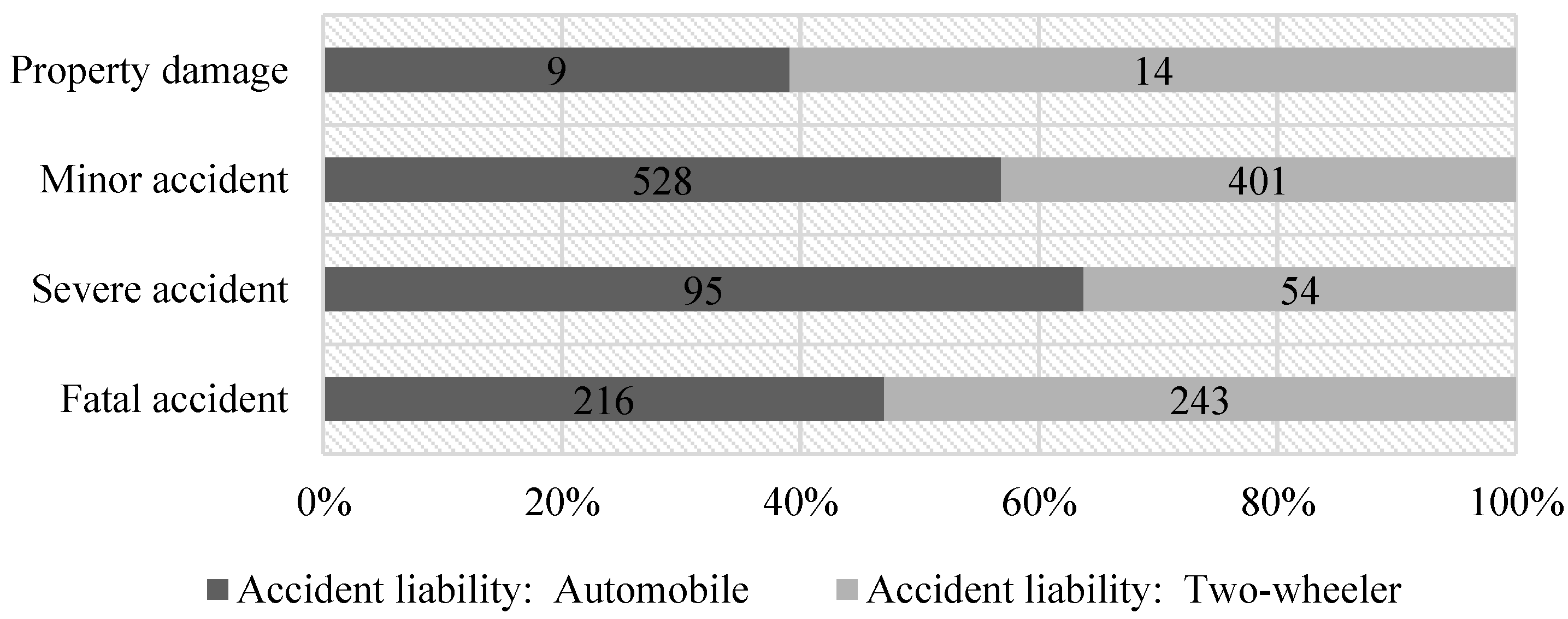
Key Factors Analysis of Severity of Automobile to Two-Wheeler Traffic Accidents Based on Bayesian Network


Abstract
:1. Introduction
2. Literature Review
3. Data Description
3.1. Data Sources
3.2. Descriptive Analysis
3.3. Sample Set Quantization and Data Discretization
4. Methodology
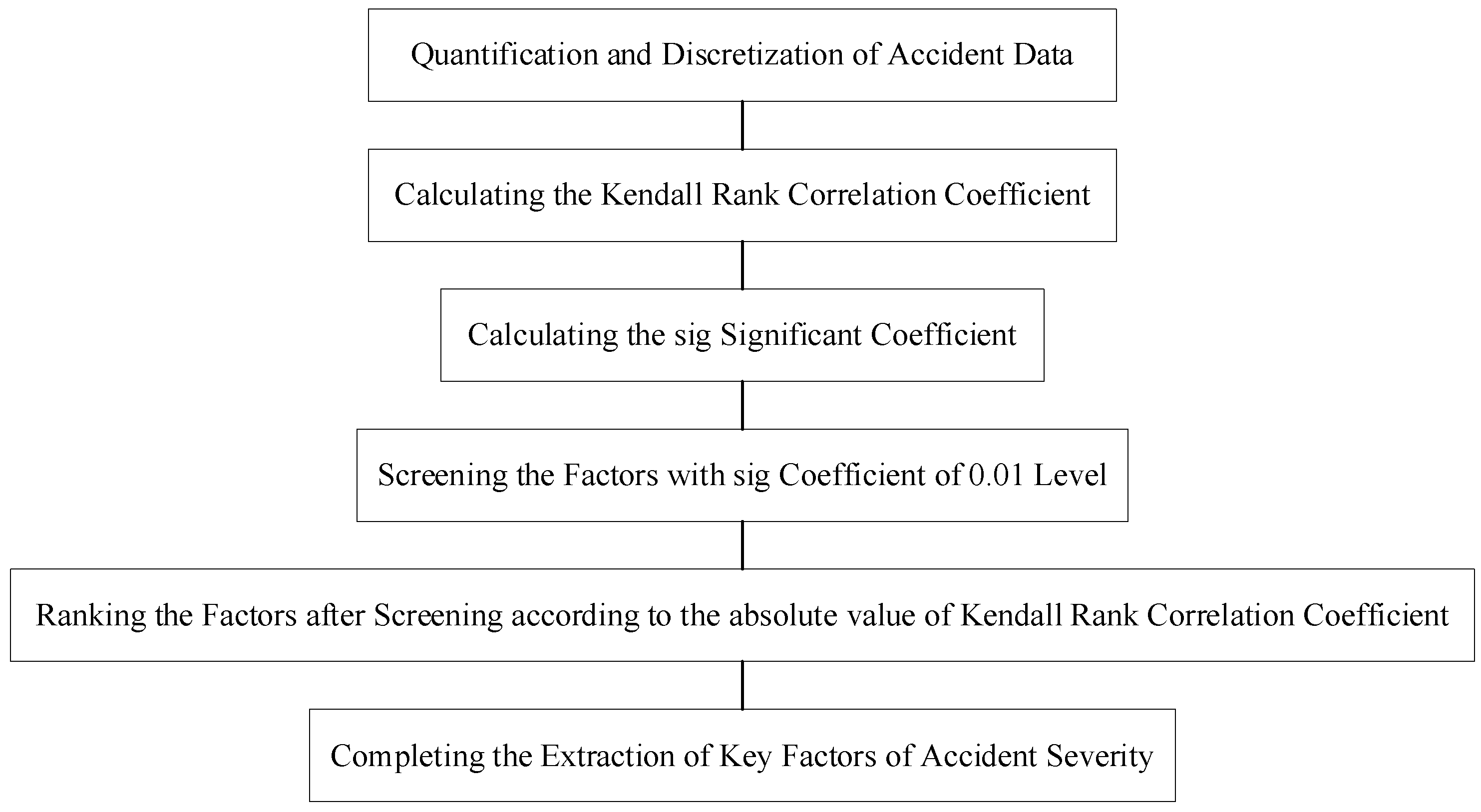
4.1. Kendall Rank Correlation Coefficient Analysis Method for Determining the Key Factors
4.2. Bayesian Network Accident Severity Analysis Modeling
4.2.1. Learning Bayesian Network Structure Based on CH Scoring Method and K2 Algorithm
4.2.2. Learning Bayesian Network Parameters Based on Bayesian Estimation
5. Results
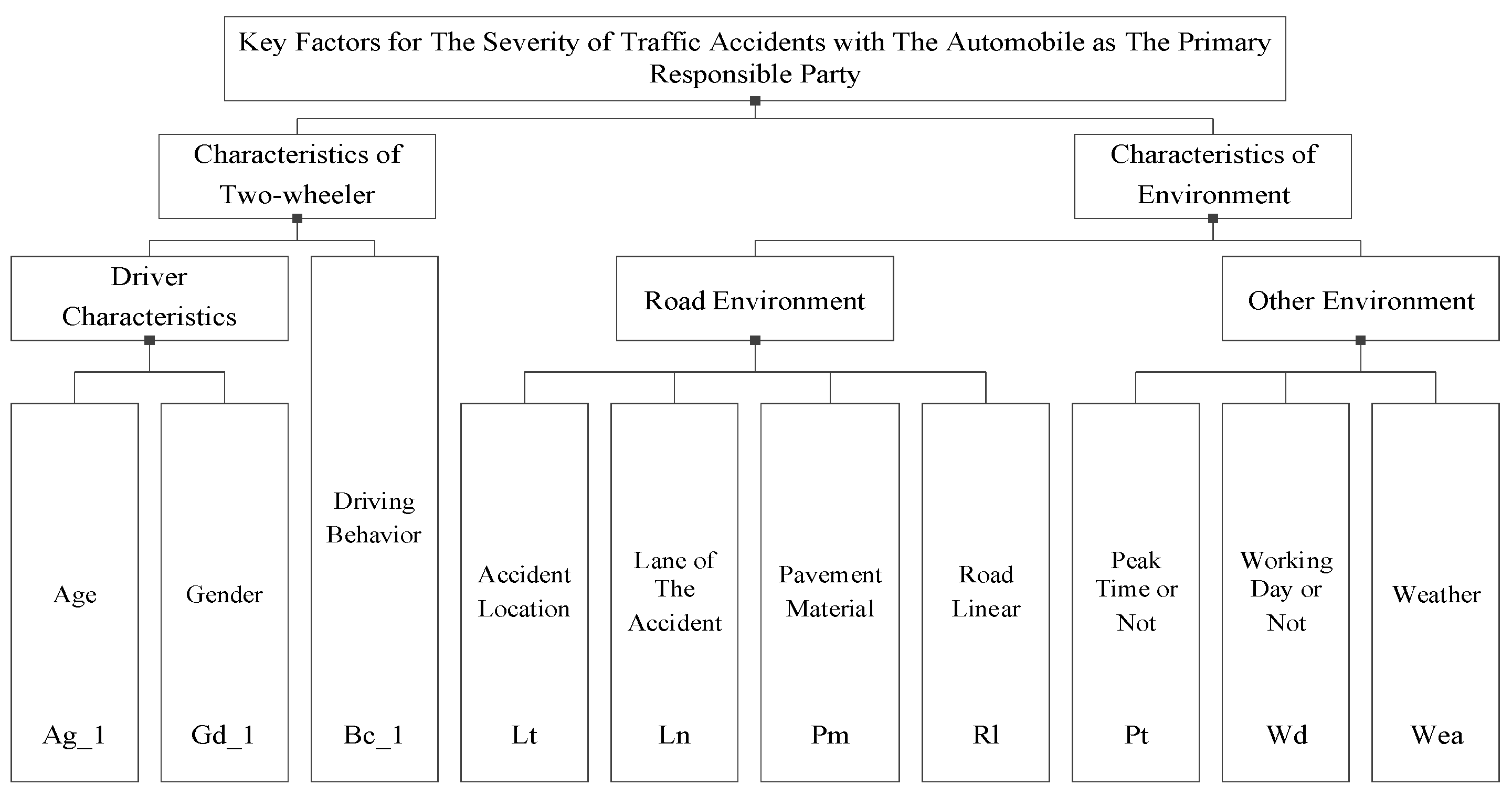
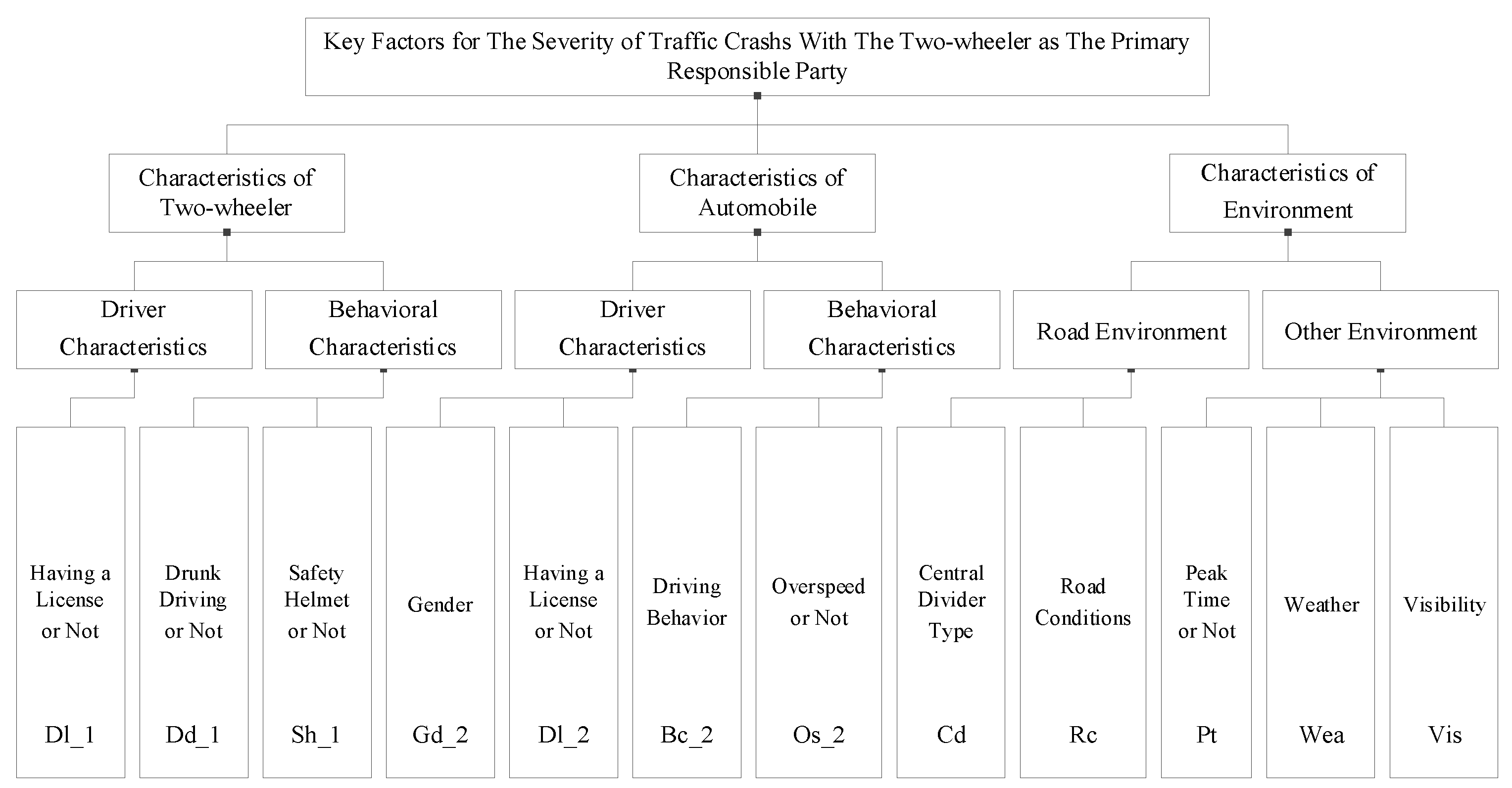
5.1. Identification Results of Key Factors of Two Types of Traffic Accidents
5.2. Bayesian Network Modeling Results of the Severity of Two Types of Traffic Accidents
- (i).
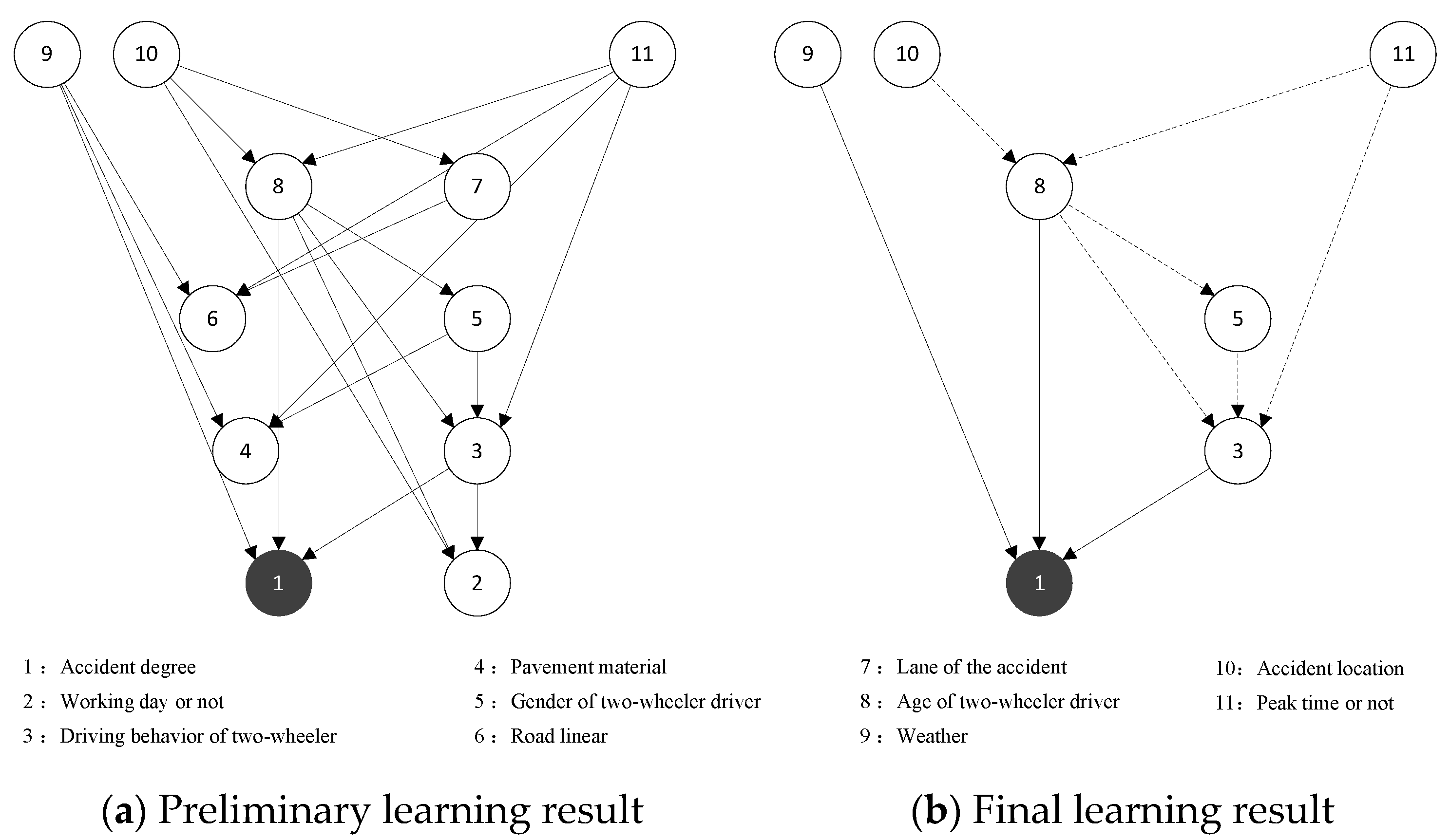
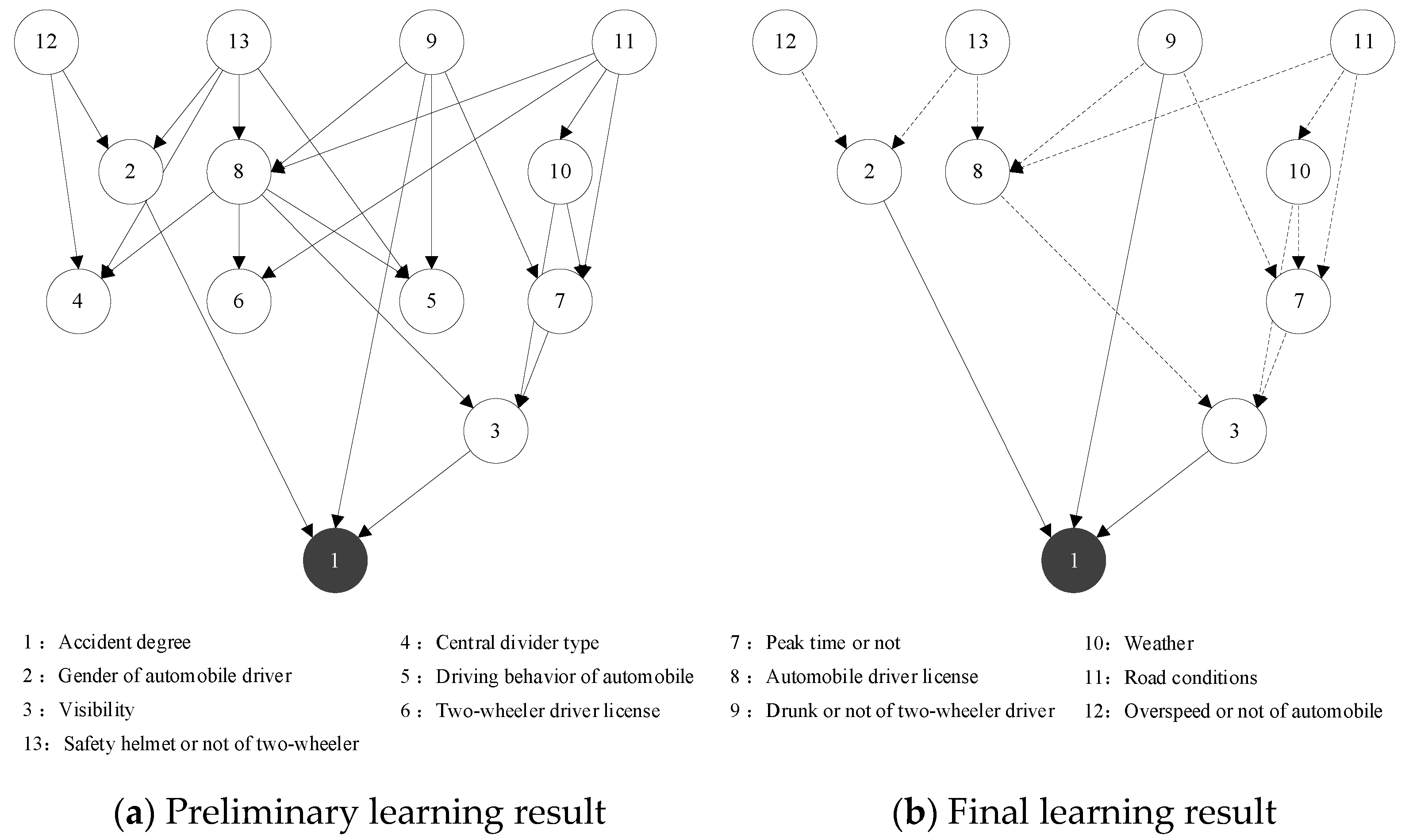
- Bayesian Network Structure LearningResults
- The direct influential factors: driving behavior of the two-wheeler, age of two-wheeler driver, and weather.
- The longest influential factor sequences: peak time or not → age of two-wheeler driver → gender of two-wheeler driver → driving behavior of two-wheeler → accident degree; accident location → age of two-wheeler driver → gender of two-wheeler driver → driving behavior of two-wheeler → accident degree.
- The direct influential factors: gender of the automobile driver, visibility, and drunk or not of the two-wheeler driver.
- The longest influential factor sequences: road conditions → weather → peak time or not → visibility → accident degree.
- (ii).
- Bayesian Network Parameter Learning Results
- (iii).
- Combination Ranking Results of Traffic Accident Severity Factors
- (iv).
- Model Validity Test Results
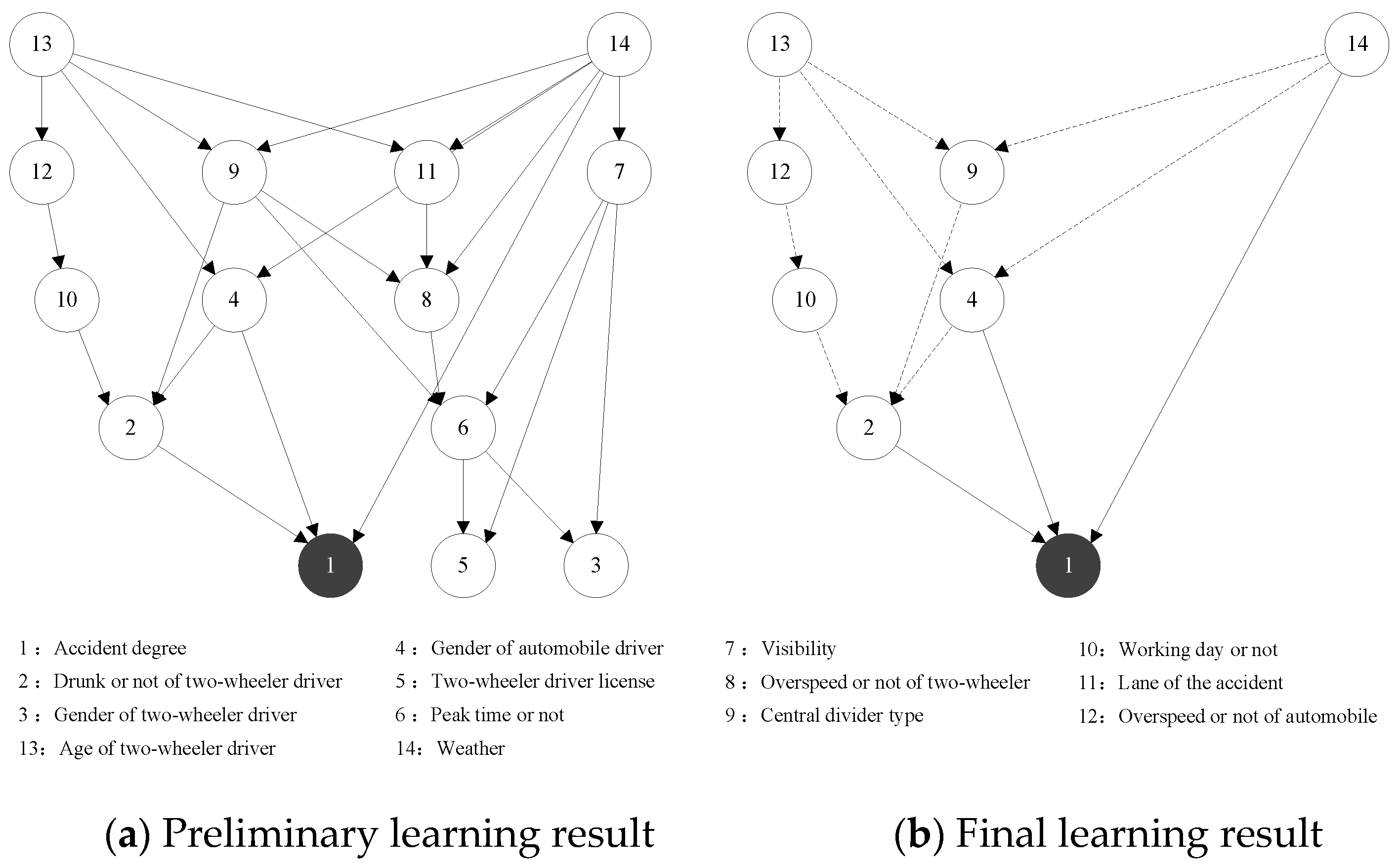
5.3. Comparison with Unclassified Bayesian Network Model
- The direct influential factors: drunk or not of two-wheeler driver, gender of automobile driver, and weather.
- The longest influential factor sequences: age of two-wheeler driver → speeding or not of automobile driver → working day or not → drunk or not of two-wheeler driver → accident degree.
6. Discussion and Conclusions
- The direct factors that affect the severity of traffic accidents in which the automobile is the primary responsible party are the driving behavior of two-wheelers, the age of two-wheeler drivers, and weather. For traffic accidents which the two-wheeler is the primary responsible party, the direct factors are the gender of the automobile driver, visibility, and drunk driving or not of the two-wheeler driver. Under the influence of a single factor, in the traffic accident where the automobile is the primary responsible party, the biggest factor that causes death is weather. The probability of death under different weather conditions fluctuates by 32.2%. The age of the two-wheeler driver is the factor that affects the occurrence of death and serious injuries the most. For traffic accidents in which two-wheelers are the primary responsible party, visibility is the biggest factor leading to death or serious injury. Under the influence of visibility, the probability of death event fluctuates by 27.23%, and the probability of combined death and serious injury accidents fluctuates by 22.37%.
- The key influencing factors of traffic accidents for different accident responsible parties are very different. Only whether peak time and weather factors are the common key factors affecting the severity of traffic accidents for both the automobile and the two-wheeler as the main responsible party. When the automobile is mainly responsible for traffic accidents, the severity of the accident does not depend on the physical characteristics of the vehicle driver, but more depends on the road environment, road conditions, natural environment, and the physical capacity of the two wheeled vehicle driver. Therefore, the critical factors affecting the traffic accident severity are concentrated on the characteristics of the driving environment and the two-wheeler driver. However, for traffic accidents in which a two-wheeler is the primary responsible party, the severity of the accident often depends on the driving ability of the two-wheeler driver and the stress behavior of the vehicle driver when the vehicle is pre-crashed. In addition to driving environmental factors, automobile driver characteristics, automobile driving behavior characteristics, self-driving behavior, and self-driving ability would also affect the severity of the accident.
- Through the combination analysis of key factors, the probability distribution of accident severity under different factor scenarios can be inferred. For traffic accidents where the automobile is the primary responsible party, when the combined sequence of the factors status is {Off-Peak Period → Driver of Two-Wheeler: The elderly → Driving Behavior of Two-Wheeler: Parking}, the probability of death is the largest, as high as 67.9%. Among the traffic accidents in which the two-wheeler is the primary responsible party, the accidents under the combination of factors {Drunk Driving Two-Wheeler → Having a License of Automobile → Visibility: 50 m~100 m} are the most likely to cause death and the probability is 63.59%. The reasonable analysis of this series of status sequences can provide sufficient theoretical support for the active prevention of serious traffic accidents. By applying state sequence to medical aid systems and traffic law enforcement systems, a data-driven and scenario-driven intelligent coordination system can be constructed. Taking the high-risk sequence {Drunk Driving Two-Wheeler → Having a License of Automobile → Visibility: 50 m~100 m} as an example, if the current visibility is 50 m~100 m, the traffic safety administration department should focus on the investigation of drunk driving behavior of two-wheeled vehicles and the inspection of automobile driving licenses, so as to avoid serious traffic accidents as much as possible.
Author Contributions
Funding
Institutional Review Board Statement
Informed Consent Statement
Data Availability Statement
Acknowledgments
Conflicts of Interest
References
- World Health Organization. Global Status Report on Road Safety 2015: Supporting a Decade of Action; World Health Organization: Geneva, Switzerland, 2015. [Google Scholar]
- National Bureau of Statistics. Road Traffic Accidents Statistical Annual Report of the People’s Republic of China 2019; National Bureau of Statistics: Beijing, China, 2019. [Google Scholar]
- Wang, T.; Xie, S.; Ye, X.; Yan, X.; Chen, J.; Li, W. Analyzing E-Bikers’ Risky Riding Behaviors, Safety Attitudes, Risk Perception, and Riding Confidence with the Structural Equation Model. Int. J. Environ. Res. Public Health 2020, 17, 4763. [Google Scholar] [CrossRef] [PubMed]
- Störmann, P.; Klug, A.; Nau, C.; Verboket, R.D.; Leiblein, M.; Müller, D.; Schweigkofler, U.; Hoffmann, R.; Marzi, I.; Lustenberger, T. Characteristics and Injury Patterns in Electric-Scooter Related Accidents—A Prospective Two-Center Report from Germany. J. Clin. Med. 2020, 9, 1569. [Google Scholar] [CrossRef] [PubMed]
- Robartes, E.; Chen, T.D. The effect of crash characteristics on cyclist injuries: An analysis of Virginia automobile-bicycle crash data. Accid. Anal. Prev. 2017, 104, 165–173. [Google Scholar] [CrossRef] [PubMed]
- Chen, H.; Zhao, Y.; Ma, X. Critical factors analysis of severe traffic accidents based on Bayesian network in China. J. Adv. Transp. 2020, 2020, 8878265. [Google Scholar] [CrossRef]
- Atalar, D.; Thomas, P. Powered two-wheeler crash scenario development. Accid. Anal. Prev. 2019, 125, 198–206. [Google Scholar] [CrossRef] [Green Version]
- Han, Y.; Xu, J.; Shi, L.; Gao, X.; Qian, Y.; Yang, Z. Uncertainty Analysis of Head Injury via Reconstruction of Electric Two-wheeler Accidents. China J. Highw. Transp. 2020, 33, 172–180,190. [Google Scholar]
- Ona, J.D.; Mujalli, R.O.; Calvo, F.J. Analysis of traffic accident injury severity on Spanish rural highways using Bayesian networks. Accid. Anal. Prev. 2011, 43, 402–411. [Google Scholar] [CrossRef]
- Chen, C.; Zhang, G.; Tarefder, R.A.; Ma, J.; Wei, H.; Guan, H. A multinomial logit model-Bayesian network hybrid approach for driver injury severity analyses in rear-end crashes. Accid. Anal. Prev. 2015, 80, 76–88. [Google Scholar] [CrossRef]
- Deguchi, M. Modeling of a motorcycle for collision simulation. In Proceedings of the International Technical Conference on the Enhanced Safety of Vehicles; National Highway Traffic Safety Administration: Washington, DC, USA, 2003. [Google Scholar]
- Deguchi, M. Simulation of motorcycle-car collision. In Proceedings of the 19th International Technical Conference on the Enhanced Safety of Vehicles, Washington, DC, USA, 6–9 June 2005. [Google Scholar]
- Husher, S.; Smith, T.; Hermitte, T. Computational analysis of motorcycle crash tests: A basis for motorcycle accident reconstruction. In Proceedings of the 4th International Motorcycle Conference, Munich, Germany, 20–22 September 2002. [Google Scholar]
- Allen, T.; Newstead, S.; Lenné, M.G.; McClure, R.; Hillard, P.; Symmons, M.; Day, L. Contributing factors to motorcycle injury crashes in Victoria, Australia. Transp. Res. Part F Psychol. Behav. 2017, 45, 157–168. [Google Scholar] [CrossRef]
- Hu, L.; Fang, S.; Huang, J.; Chen, Q. In-depth analysis on cycle-vehicle crash accident based on logistic regression. Automot. Eng. 2016, 38, 1288–1293. [Google Scholar]
- Hu, L.; Fang, S.; Huang, J.; Chen, Q. A Research on the Parameter Influences of the Accident Reconstruction for a Car-motorcycle Collision Based on Orthogonal Experiments. Automot. Eng. 2016, 38, 567–573. [Google Scholar]
- Faried, A.; Bachani, A.M.; Sendjaja, A.N.; Hung, Y.W.; Arifin, M.Z. Characteristics of Moderate and Severe Traumatic Brain Injury of Motorcycle Crashes in Bandung, Indonesia. World Neurosurg. 2017, 100, 195–200. [Google Scholar] [CrossRef] [PubMed]
- Boele-Vos, M.J.; Van Duijvenvoorde, K.; Doumen, M.; Duivenvoorden, C.; Louwerse, W.; Davidse, R. Crashes involving cyclists aged 50 and over in the Netherlands: An in-depth study. Accid. Anal. Prev. 2017, 105, 4–10. [Google Scholar] [CrossRef] [PubMed]
- Liu, Y.; Fu, C.; Wang, W. Modeling the interference on motorized vehicles caused by non—motorized vehicles using Bayesian Logistic models. J. Saf. Environ. 2020, 6, 2045–2051. [Google Scholar]
- Ye, X.; Zhu, Y.; Wang, T.; Yan, X.; Chen, J.; Ran, B. Level of Service Model of the Non-Motorized Vehicle Crossing the Signalized Intersection Based on Riders’ Perception Data. Int. J. Environ. Res. Public Health 2022, 19, 4534. [Google Scholar] [CrossRef] [PubMed]
- Ye, X.; Yang, C.; Wang, T.; Yan, X.; Li, S.; Chen, J. Research on parking app choice behavior based on MNL. Travel Behaviour and Society 2021, 25, 174–182. [Google Scholar] [CrossRef]
- Wen, H.; Zhang, X.; Zeng, Q.; Sze, N.N. Bayesian spatial-temporal model for the main and interaction effects of roadway and weather characteristics on freeway crash incidence. Accid. Anal. Prev. 2019, 132, 105249. [Google Scholar] [CrossRef]
- Chen, T.; Wong, Y.D.; Shi, X.; Yang, Y. A data-driven feature learning approach based on Copula-Bayesian Network and its application in comparative investigation on risky lane-changing and car-following maneuvers. Accid. Anal. Prev. 2021, 154, 106061. [Google Scholar] [CrossRef]
- Ye, X.; Yan, X.; Chen, J.; Wang, T.; Yang, Z. Impact of Curbside Parking on Bicycle Lane Capacity in Nanjing, China. Transp. Res. Rec. 2018, 2672, 120–129. [Google Scholar] [CrossRef]
- Aghaabbasi, M.; Asadi-Shekari, Z.; Shah, M.Z.; Olakunle, O.; Armaghani, D.J.; Moeinaddini, M. Predicting the use frequency of ride-sourcing by off-campus university students through random forest and Bayesian network techniques. Transp. Res. Part A Policy Pr. 2020, 136, 262–281. [Google Scholar] [CrossRef]
- Islam, M.; Alnawmasi, N.; Mannering, F. Unobserved heterogeneity and temporal instability in the analysis of work-zone crash-injury severities. Anal. Methods Accid. Res. 2020, 28, 100130. [Google Scholar] [CrossRef]
- Liu, J.; Hainen, A.; Li, X.; Nie, Q.; Nambisan, S. Pedestrian injury severity in motor vehicle crashes: An integrated spatio-temporal modeling approach. Accid. Anal. Prev. 2019, 132, 105272. [Google Scholar] [CrossRef] [PubMed]
- Huang, H.; Chang, F.; Zhou, H.; Lee, J. Modeling unobserved heterogeneity for zonal crash frequencies: A Bayesian multivariate random-parameters model with mixture components for spatially correlated data. Anal. Methods Accid. Res. 2019, 24, 100105. [Google Scholar] [CrossRef]
- Li, X.; Liu, J.; Zhang, Z.; Parrish, A.; Jones, S. A spatiotemporal analysis of motorcyclist injury severity: Findings from 20 years of crash data from Pennsylvania. Accid. Anal. Prev. 2020, 151, 105952. [Google Scholar] [CrossRef] [PubMed]


| Accident Number | Accident Degree | Accident Characteristics | Accident Causes | Accident Liability | Automobile Information | Two-Wheeler Information |
|---|---|---|---|---|---|---|
| 45030272 01500013 | 1 | 2015/3/17 23:20 Working days; the peak hour; 100 m north of Jiashan Road | Driving an automobile after drinking alcohol | 1 | Drunk driving; not exceeding the speed limit | Not exceeding the speed limit; 30 years old |
| Variable Classification | Variables | Symbol | Variables Assignment | Kendall Correlation | ||||
|---|---|---|---|---|---|---|---|---|
| Dependent | Accident degree | Ad | 1 = Fatal accident | 2 = Severe accident | Two-wheeler | Auto mobile | ||
| 3 = Minor accident | 4 = Property damage | |||||||
| Driving Behavior and Driver Characteristics of Two-Wheeler | Behavioral characteristics | Bc_1 | 1 = Go Straight | 2 = Turn Left | - | −0.138 | ||
| 3 = Turn Right | 4 = Parking | |||||||
| 5 = Cross Street | ||||||||
| Gender | Gd_1 | 1 = Male | 2 = Female | - | 0.120 | |||
| Age | Ag_1 | 1 = Minor | 2 = Youth (18–35) | - | −0.089 | |||
| 3 = Wrinkly (36–55) | 4 = The elderly (>55) | |||||||
| Having a license or not | Dl_1 | 1 = Yes | 2 = No | 0.102 | - | |||
| Drunk driving or not | Dd_1 | 1 = Yes | 2 = No | 0.090 | - | |||
| Speeding or not | Os_1 | 1 = Yes | 2 = No | - | - | |||
| Safety helmet or not | Sh_1 | 1 = Yes | 2 = No | 0.073 | - | |||
| Driving Behavior and Driver Characteristics of Automobile | Behavioral characteristics | Bc_2 | 1 = Go Straight | 2 = Turn Left | 0.132 | - | ||
| 3 = Turn Right | 4 = Parking | |||||||
| 5 = Cross Street | ||||||||
| Gender | Gd_2 | 1 = Man | 2 = Woman | 0.184 | - | |||
| Age | Ag_2 | 1 = Minor | 2 = Youth (18–35) | - | - | |||
| 3 = Wrinkly (36–55) | 4 = The elderly (>55) | |||||||
| Having a license or not | Dl_2 | 1 = Yes | 2 = No | 0.099 | - | |||
| Drunk driving or not | Dd_2 | 1 = Yes | 2 = No | - | - | |||
| Speeding or not | Os_2 | 1 = Yes | 2 = No | 0.079 | - | |||
| Characteristics of Road Type | Accident location | Lt | 1 = Segment | - | −0.076 | |||
| 2 = Intersection with Control | ||||||||
| 3 = Intersection without Control | ||||||||
| Lane of the accident | Ln | 1 = Vehicular Lane | 2 = Other Lane | - | 0.093 | |||
| Central divider type | Cd | 1 = No Barrier | 2 = Barrier | −0.132 | - | |||
| 3 = Green Belt | ||||||||
| Pavement material | Pm | 1 = Pitch | 2 = Cement | - | 0.132 | |||
| Road conditions | Rc | 1 = Intact | 2 = Broken | 0.086 | - | |||
| Road linear | Rl | 1 = Linear | 2 = Non-Linear | - | −0.098 | |||
| Characteristics of Peak Time and Environment | Working day or not | Wd | 1 = Yes | 2 = No | - | −0.142 | ||
| Peak time or not | Pt | 1 = Off-peak time | 2 = Peak time | 0.102 | 0.067 | |||
| Lighting condition | Lc | 1 = Daytime | 2 = Nighttime | - | - | |||
| Weather | Wea | 1 = Sunny | 2 = Cloudy | 3 = Rainy | −0.087 | 0.079 | ||
| Visibility | Vis | 1 = <50 m | 2 = 50 m~100 m | 0.144 | - | |||
| 3 = 100 m~200 m | 4 = >200 m | |||||||
| Accident Type | Sequential Sequence of the Kendall Correlation Coefficients | |||||||||||
|---|---|---|---|---|---|---|---|---|---|---|---|---|
| Automobile as the Primary Responsible Party | 1 | Wd | 2 | Bc_1 | 3 | Pm | 4 | Gd_1 | 5 | Rl | 6 | Ln |
| 7 | Ag_1 | 8 | Wea | 9 | Lt | 10 | Pt | |||||
| Two-Wheeler as the Primary Responsible Party | 1 | Gd_2 | 2 | Vis | 3 | Bc_2 | 4 | Cd | 5 | Pt | 6 | Dl_1 |
| 7 | Dl_2 | 8 | Dd_1 | 9 | Wea | 10 | Rc | 11 | Os_2 | 12 | Sh_1 | |
| Influencing Factors Variable | Probability of Different Accident Levels | Influence Degree | Ranking | ||||
|---|---|---|---|---|---|---|---|
| Fatal Accident | Severe Accident | Minor Accident | Property Damage | ||||
| Driving Behavior of Two-Wheeler | Go Straight | 0.2080 | 0.1188 | 0.6640 | 0.0093 | 0.3675 | 2 |
| Turn Left | 0.3118 | 0.2866 | 0.3873 | 0.0143 | |||
| Turn Right | 0.4145 | 0.1344 | 0.3166 | 0.1344 | |||
| Parking | 0.1675 | 0.0634 | 0.3507 | 0.4185 | |||
| Across Street | 0.4033 | 0.1034 | 0.4783 | 0.0150 | |||
| Gender of Two-Wheeler | Man | 0.2523 | 0.1342 | 0.5946 | 0.0189 | 0.0711 | 4 |
| Woman | 0.2025 | 0.1129 | 0.6373 | 0.0474 | |||
| Age of Two-Wheeler | Minor | 0.4268 | 0.3889 | 0.1067 | 0.0776 | 0.5108 | 1 |
| Youth (18–35) | 0.1946 | 0.1468 | 0.6334 | 0.0252 | |||
| Wrinkly (36–55) | 0.1750 | 0.1299 | 0.6628 | 0.0322 | |||
| The elderly (>55) | 0.4162 | 0.0586 | 0.5210 | 0.0042 | |||
| Accident Location | Segment | 0.2317 | 0.1206 | 0.6251 | 0.0226 | 0.0309 | 6 |
| Intersection with Ctrl | 0.2647 | 0.1185 | 0.5942 | 0.0226 | |||
| Intersection no Ctrl | 0.2416 | 0.1371 | 0.5941 | 0.0272 | |||
| Peak Time or Not | Off-Peak Period | 0.2513 | 0.1283 | 0.5967 | 0.0236 | 0.0336 | 5 |
| Peak Period | 0.2133 | 0.1327 | 0.6247 | 0.0294 | |||
| Weather | Sunny | 0.2447 | 0.1789 | 0.5451 | 0.0314 | 0.3332 | 3 |
| Cloudy | 0.1043 | 0.0562 | 0.8299 | 0.0096 | |||
| Rainy | 0.4263 | 0.0674 | 0.4798 | 0.0265 | |||
| Influencing Factors Variable | Probability of Different Accident Levels | Influence Degree | Ranking | ||||
|---|---|---|---|---|---|---|---|
| Fatal Accident | Severe Accident | Minor Accident | Property Damage | ||||
| Drunk Driving or Not of Two-Wheeler | Yes | 0.4678 | 0.0899 | 0.3967 | 0.0456 | 0.1579 | 3 |
| No | 0.2996 | 0.1002 | 0.5904 | 0.0098 | |||
| Safety Helmet or Not of Two-Wheeler | Yes | 0.3452 | 0.1012 | 0.5382 | 0.0154 | 0.0121 | 7 |
| No | 0.3367 | 0.0976 | 0.5476 | 0.0181 | |||
| Gender of Automobile | Man | 0.3486 | 0.1021 | 0.5359 | 0.0134 | 0.2145 | 2 |
| Woman | 0.1929 | 0.0433 | 0.6879 | 0.0759 | |||
| Having a License or Not of Automobile | Yes | 0.3594 | 0.097 | 0.5223 | 0.0213 | 0.0283 | 6 |
| No | 0.3299 | 0.0982 | 0.5553 | 0.0166 | |||
| Speeding or Not of Automobile | Yes | 0.3367 | 0.0973 | 0.5487 | 0.0173 | 0.0014 | 8 |
| No | 0.3375 | 0.0979 | 0.5467 | 0.0179 | |||
| Road Conditions | Intact | 0.3373 | 0.0981 | 0.5467 | 0.0179 | 0.0007 | 9 |
| Broken | 0.3516 | 0.0831 | 0.5471 | 0.0182 | |||
| Peak Time or Not | Off-Peak Period | 0.3504 | 0.0961 | 0.5341 | 0.0194 | 0.0590 | 5 |
| Peak Period | 0.2821 | 0.1054 | 0.6013 | 0.0112 | |||
| Weather | Sunny | 0.3178 | 0.1062 | 0.5589 | 0.0171 | 0.1091 | 4 |
| Cloudy | 0.2922 | 0.1058 | 0.5864 | 0.0156 | |||
| Rainy | 0.4434 | 0.0637 | 0.4705 | 0.0224 | |||
| Visibility | <50 m | 0.5147 | 0.0197 | 0.4459 | 0.0197 | 0.2237 | 1 |
| 50 m~100 m | 0.5169 | 0.0582 | 0.3928 | 0.0321 | |||
| 100 m~200 m | 0.2446 | 0.1068 | 0.6344 | 0.0142 | |||
| >200 m | 0.2629 | 0.1262 | 0.5980 | 0.0129 | |||
| Accident Type | Multi-factor Combination Sequence | Fatal Accident | |
|---|---|---|---|
| Probability | Ranking | ||
| Automobile as the Primary Responsible Party | Off-Peak Period → Driver of Two-Wheeler: The elderly → Driving Behavior of Two-Wheeler: Parking | 0.6790 | 1 |
| Intersection without Control → Driver of Two-Wheeler: The elderly → Driving Behavior of Two-Wheeler: Across Street | 0.6672 | 2 | |
| Driver of Two-Wheeler: The elderly → Driving Behavior of Two-Wheeler: Across Street | 0.6672 | 3 | |
| Intersection without Control → Driver of Two-Wheeler: The elderly → Driving Behavior of Two-Wheeler: Turn Left | 0.5587 | 4 | |
| Off-Peak Period → Driver of Two-Wheeler: Minor →Driving Behavior of Two-Wheeler: Go Straight | 0.4790 | 5 | |
| Two-Wheeler as the Primary Responsible Party | Drunk Driving Two-Wheeler → Having a License of Automobile → Visibility: 50 m~100 m | 0.6359 | 1 |
| Drunk Driving Two-Wheeler → Off-Peak Period → Visibility: 50 m~100 m | 0.6336 | 2 | |
| Safety Helmet of Two-Wheeler → Having no License of Automobile → Visibility: <50 m | 0.5967 | 3 | |
| Road Broken → Off-Peak Period → Visibility: <50 m | 0.5776 | 4 | |
| Road Broken → Rainy → Visibility: <50 m | 0.5313 | 5 | |
| Direct Influencing Factors | Result Variable: Accident Degree | ||||||||||||
|---|---|---|---|---|---|---|---|---|---|---|---|---|---|
| Fatal Accident | Severe Accident | Minor Accident | Property Damage | ||||||||||
| Bayes | Real Value | Absolute Error | Bayes | Real Value | Absolute Error | Bayes | Real Value | Absolute Error | Bayes | Real Value | Absolute Error | ||
| Bc_1 | 1 | 0.208 | 0.2128 | 0.0048 | 0.1188 | 0.1135 | 0.0053 | 0.664 | 0.6667 | 0.0027 | 0.0093 | 0.0071 | 0.0022 |
| 2 | 0.3118 | 0.2500 | 0.0618 | 0.2866 | 0.1875 | 0.0991 | 0.3873 | 0.5625 | 0.1752 | 0.0143 | 0.0000 | 0.0143 | |
| 3 | 0.4145 | 0.5000 | 0.0855 | 0.1344 | 0.0000 | 0.1344 | 0.3166 | 0.5000 | 0.1834 | 0.1344 | 0.0000 | 0.1344 | |
| 4 | 0.1675 | 0.2000 | 0.0325 | 0.0634 | 0.0000 | 0.0634 | 0.3507 | 0.6000 | 0.2493 | 0.4185 | 0.2000 | 0.2185 | |
| 5 | 0.4033 | 0.4762 | 0.0729 | 0.1034 | 0.0952 | 0.0082 | 0.4783 | 0.4286 | 0.0497 | 0.0150 | 0.0000 | 0.0150 | |
| Ag_1 | 1 | 0.4268 | 0.5000 | 0.0732 | 0.3889 | 0.3333 | 0.0556 | 0.1067 | 0.1667 | 0.0600 | 0.0776 | 0.0000 | 0.0776 |
| 2 | 0.1946 | 0.1884 | 0.0062 | 0.1468 | 0.1159 | 0.0309 | 0.6334 | 0.6812 | 0.0478 | 0.0252 | 0.0145 | 0.0107 | |
| 3 | 0.1750 | 0.1781 | 0.0031 | 0.1299 | 0.1233 | 0.0066 | 0.6628 | 0.6849 | 0.0221 | 0.0322 | 0.0137 | 0.0185 | |
| 4 | 0.4162 | 0.4615 | 0.0453 | 0.0586 | 0.0513 | 0.0073 | 0.5210 | 0.4872 | 0.0338 | 0.0042 | 0.0000 | 0.0042 | |
| Wea | 1 | 0.2447 | 0.2752 | 0.0305 | 0.1789 | 0.1651 | 0.0138 | 0.5451 | 0.5413 | 0.0038 | 0.0314 | 0.0183 | 0.0131 |
| 2 | 0.1043 | 0.0870 | 0.0173 | 0.0562 | 0.0435 | 0.0127 | 0.8299 | 0.8696 | 0.0397 | 0.0096 | 0.0000 | 0.0096 | |
| 3 | 0.4263 | 0.4063 | 0.0200 | 0.0674 | 0.0313 | 0.0361 | 0.4798 | 0.5625 | 0.0827 | 0.0265 | 0.0000 | 0.0265 | |
| Average Error: | 0.0520 | Average Error after Removing Extreme Scenes: | 0.0283 | ||||||||||
| Direct Influencing Factors | Result Variable: Accident Degree | ||||||||||||
|---|---|---|---|---|---|---|---|---|---|---|---|---|---|
| Fatal Accident | Severe Accident | Minor Accident | Property Damage | ||||||||||
| Bayes | Real Value | Absolute Error | Bayes | Real Value | Absolute Error | Bayes | Real Value | Absolute Error | Bayes | Real Value | Absolute Error | ||
| Dd_1 | 1 | 0.4678 | 0.4444 | 0.0234 | 0.0899 | 0.0833 | 0.0066 | 0.3967 | 0.4167 | 0.0200 | 0.0456 | 0.0556 | 0.0100 |
| 2 | 0.2553 | 0.3040 | 0.0044 | 0.1002 | 0.0960 | 0.0042 | 0.5904 | 0.5920 | 0.0016 | 0.0098 | 0.0080 | 0.0018 | |
| Gd_2 | 1 | 0.3002 | 0.3533 | 0.0047 | 0.1021 | 0.1000 | 0.0021 | 0.5359 | 0.5333 | 0.0026 | 0.0134 | 0.0134 | 0.0000 |
| 2 | 0.2651 | 0.0909 | 0.1020 | 0.0433 | 0.0000 | 0.0433 | 0.6879 | 0.8182 | 0.1303 | 0.0759 | 0.0909 | 0.0150 | |
| Vis | 1 | 0.2924 | 0.5294 | 0.0147 | 0.0197 | 0.0000 | 0.0197 | 0.4459 | 0.4706 | 0.0247 | 0.0197 | 0.0000 | 0.0197 |
| 2 | 0.2472 | 0.5000 | 0.0169 | 0.0582 | 0.0588 | 0.0006 | 0.3928 | 0.4118 | 0.0190 | 0.0321 | 0.0294 | 0.0027 | |
| 3 | 0.1723 | 0.2414 | 0.0032 | 0.1068 | 0.1034 | 0.0034 | 0.6344 | 0.6207 | 0.0137 | 0.0142 | 0.0345 | 0.0203 | |
| 4 | 0.3449 | 0.2593 | 0.0036 | 0.1262 | 0.1235 | 0.0027 | 0.5980 | 0.6049 | 0.0069 | 0.0129 | 0.0123 | 0.0006 | |
| Average Error: | 0.0170 | Average Error after Removing Extreme Scenes: | 0.0091 | ||||||||||
| Accident Type | Sequential Sequence of the Kendall Correlation Coefficients | ||||||
|---|---|---|---|---|---|---|---|
| Complete Automobile to Two-Wheeler Traffic Accident | 1 | 2 | 3 | 4 | 5 | 6 | 7 |
| Dd_1 | Gd_1 | Gd_2 | Dl_1 | Pt | Vis | Os_1 | |
| 8 | 9 | 10 | 11 | 12 | 13 | ||
| Cd | Wd | Ln | Os_2 | Ag_1 | Wea | ||
Publisher’s Note: MDPI stays neutral with regard to jurisdictional claims in published maps and institutional affiliations. |
© 2022 by the authors. Licensee MDPI, Basel, Switzerland. This article is an open access article distributed under the terms and conditions of the Creative Commons Attribution (CC BY) license (https://creativecommons.org/licenses/by/4.0/).
Share and Cite
Liu, L.; Ye, X.; Wang, T.; Yan, X.; Chen, J.; Ran, B. Key Factors Analysis of Severity of Automobile to Two-Wheeler Traffic Accidents Based on Bayesian Network. Int. J. Environ. Res. Public Health 2022, 19, 6013. https://doi.org/10.3390/ijerph19106013
Liu L, Ye X, Wang T, Yan X, Chen J, Ran B. Key Factors Analysis of Severity of Automobile to Two-Wheeler Traffic Accidents Based on Bayesian Network. International Journal of Environmental Research and Public Health. 2022; 19(10):6013. https://doi.org/10.3390/ijerph19106013
Chicago/Turabian StyleLiu, Lining, Xiaofei Ye, Tao Wang, Xingchen Yan, Jun Chen, and Bin Ran. 2022. "Key Factors Analysis of Severity of Automobile to Two-Wheeler Traffic Accidents Based on Bayesian Network" International Journal of Environmental Research and Public Health 19, no. 10: 6013. https://doi.org/10.3390/ijerph19106013
APA StyleLiu, L., Ye, X., Wang, T., Yan, X., Chen, J., & Ran, B. (2022). Key Factors Analysis of Severity of Automobile to Two-Wheeler Traffic Accidents Based on Bayesian Network. International Journal of Environmental Research and Public Health, 19(10), 6013. https://doi.org/10.3390/ijerph19106013