


Non-Invasive Physiological Monitoring for Physical Exertion and Fatigue Assessment in Military Personnel: A Systematic Review

 ,
,  ,
, 
 ,
, 
Abstract
1. Introduction
2. Methods
3. Results
3.1. Articles Selection
3.2. Overall Findings
3.3. Risk of Bias and Quality of Results
3.4. Characteristics of the Included Studies
4. Discussion
4.1. Monitoring in Field Context
4.2. Physiological Information
4.3. Current Trends and Future Perspectives
4.4. Limitations
5. Conclusions
Author Contributions
Funding
Institutional Review Board Statement
Informed Consent Statement
Data Availability Statement
Acknowledgments
Conflicts of Interest
Appendix A

| Categories | No. | Assessment Questions | Selected Studies | |||||||||||||||||||
|---|---|---|---|---|---|---|---|---|---|---|---|---|---|---|---|---|---|---|---|---|---|---|
| [64] | [57] | [58] | [47] | [51] | [61] | [59] | [48] | [62] | [46] | [52] | [53] | [60] | [56] | [63] | [54] | [55] | [49] | [45] | [50] | |||
| Study design | 1 | Were the aims and objectives defined clearly? | Y | Y | Y | Y | Y | Y | Y | Y | Y | Y | Y | Y | Y | Y | Y | Y | Y | Y | Y | Y |
| 2 | Were the aims and design of the study set in the context of existing knowledge? | Y | Y | Y | Y | Y | Y | Y | Y | Y | Y | Y | Y | Y | Y | Y | Y | Y | Y | Y | Y | |
| 3 | Were the outcome measures defined clearly? | Y | Y | Y | Y | Y | Y | Y | Y | Y | Y | Y | Y | Y | Y | Y | Y | Y | Y | Y | Y | |
| 4 | Was there a control group? | N | N | N | Y | N | N | N | Y | N | N | N | N | N | N | N | N | N | N | N | N | |
| 5 | Was the research design suitable to answer the research question? | Y | Y | Y | Y | Y | Y | Y | Y | Y | Y | Y | Y | Y | Y | Y | Y | Y | Y | Y | Y | |
| 6 | Was there a clear description of the applied methods and equipment? | Y | Y | Y | Y | Y | Y | Y | Y | Y | Y | Y | Y | Y | Y | Y | Y | Y | Y | Y | Y | |
| 7 | Were the methods of statistical analysis described? | Y | Y | Y | Y | Y | Y | Y | Y | Y | Y | Y | Y | Y | Y | Y | Y | Y | Y | Y | Y | |
| Participants | 8 | Were ethical standards met? (including informed consent and ethical approval) | Y | Y | Y | Y | Y | Y | Y | Y | Y | Y | Y | Y | Y | Y | Y | U | Y | Y | Y | Y |
| 9 | Was the sample selection adequate and justified? (e.g., power calculation) | N | Y | N | Y | Y | Y | Y | Y | Y | Y | Y | Y | Y | Y | Y | N | N | N | Y | Y | |
| 10 | Was a method of randomisation performed? | N | N | N | N | N | Y | Y | N | N | N | N | N | N | Y | N | N | N | N | N | N | |
| 11 | Were the groups similar at baseline regarding the most important prognostic indicators? | Y | Y | Y | Y | Y | Y | Y | Y | Y | Y | Y | Y | Y | Y | Y | Y | Y | Y | Y | Y | |
| 12 | Was the number of subjects representative to assure the statistical power of the study? | N | Y | N | Y | Y | Y | Y | Y | Y | Y | Y | Y | Y | Y | Y | N | N | N | N | Y | |
| Data sources | 13 | Was the study developed in a regular operational or training military context? | Y | Y | Y | Y | Y | Y | Y | Y | Y | Y | Y | Y | Y | Y | Y | Y | Y | Y | Y | Y |
| 14 | Did all subjects complete all testing? | N | N | N | N | U | Y | N | N | N | N | N | N | N | N | Y | N | N | Y | Y | N | |
| Reporting bias | 15 | Were the sample characteristics adequately provided? | Y | Y | Y | Y | Y | Y | Y | Y | Y | Y | N | N | Y | Y | Y | Y | Y | Y | Y | Y |
| 16 | Was there a description of withdrawals and dropouts? | Y | Y | N | Y | N | U | Y | Y | Y | N | N | N | Y | N | N | Y | Y | U | Y | N | |
| 17 | Were statements and numerical data supported by the literature’s citations? | Y | Y | Y | Y | Y | Y | Y | Y | Y | Y | Y | Y | Y | Y | Y | Y | Y | Y | Y | Y | |
| 18 | Did the study provide complete outcome data for each main outcome, including attrition and exclusions from the analysis? | Y | Y | Y | Y | Y | Y | Y | Y | Y | Y | Y | Y | Y | Y | Y | Y | Y | Y | Y | Y | |
| 19 | Were tables, figures and retrospective analyses presented clearly? | Y | Y | Y | Y | Y | Y | Y | Y | Y | Y | Y | Y | Y | Y | Y | Y | Y | Y | Y | Y | |
| 20 | Did the data support the authors’ conclusions? | Y | Y | Y | Y | Y | Y | Y | Y | Y | Y | Y | Y | Y | Y | Y | Y | Y | Y | Y | Y | |
| Limitations | 21 | Were the limitations of the study objectively defined? | N | N | Y | Y | N | Y | Y | Y | Y | Y | N | Y | Y | Y | N | Y | Y | N | Y | N |
| Generalisability | 22 | Does the study allow generalisation? Did data lead to conclusive results? | Y | Y | Y | Y | Y | Y | Y | Y | Y | Y | Y | Y | Y | Y | Y | Y | N | Y | Y | Y |
| Potential sources of bias | 23 | Was the withdrawal/drop-out rate unlikely to cause bias? | Y | Y | Y | Y | Y | Y | Y | Y | Y | Y | Y | Y | Y | Y | Y | Y | N | Y | Y | Y |
| 24 | Was the number of missing values unable to compromise a meaningful analysis? | N | Y | Y | Y | Y | Y | Y | Y | Y | Y | Y | Y | Y | Y | Y | Y | N | Y | Y | Y | |
| 25 | Were practical difficulties (e.g., in recruitment or loss to follow-up) unable to lead to major compromises in study implementation compared with the study protocol? | Y | Y | Y | Y | Y | Y | Y | Y | Y | Y | Y | Y | Y | Y | U | N | Y | Y | Y | Y | |
Appendix B
| Study | Control Group or Basal Comparison | Context | Heart Rate–Derived Variables | Equipment |
|---|---|---|---|---|
| [49] | Basal comparison | Military field exercises | Mean heart rate (bpm), peak heart rate (bpm), maximum heart rate (bpm) | Polar Sport tester heart rate monitors at 1 min intervals |
| [45] | Basal comparison | Recruit training course | Mean heart rate (bpm), resting heart rate (bpm), maximum heart rate (bpm), maximal heart rate (%), heart rate reserve (%) | Polar Team System Polar, Kempele, Finland |
| [51] | Basal comparison | Course of physical education instructors of the army | Mean heart rate (bpm), maximal heart rate (%) | Heart rate transmitter belt Polar Electro, Kempele, Finland |
| [54] | Basal comparison | Three dismounted missions | Mean heart rate (bpm) | Equivital EQ-01 Hidalgo, Cambridge, United Kingdom (15 s intervals) |
| [55] | Basal comparison | Military field exercises | Maximal heart rate (%), mean heart rate (bpm), maximum heart rate (bpm) | Lab: Polar S610, Polar Electro, Kempele, Finland Military tasks: Suunto t6, Suunto, Finland |
| [56] | Basal comparison | Army basic military training | Mean heart rate (bpm) | Heart rate monitors: Suunto Smartbelt and Comfortbelt; Suunto, Vantaa, Finland |
| [57] | Basal comparison | Marine initial training course | Mean heart rate (bpm), heart rate reserve (bpm) | EquivitalTM EQ02 Life Monitor; Hidalgo Limited, Cambridge, UK |
| [58] | Basal comparison | Three CBRNE training events | Mean heart rate (bpm) | Equivital EQ02, Hidalgo Ltd., Cambridge, UK (15 s intervals) |
| [59] | Basal comparison | Captivity survival training | Mean heart rate (bpm) | EquiVital type 1 Sensor Electronics Module Hidalgo LTD., Cambridge, U.K. (256 samples per second) |
| [47] | Control group | Aerobic training/regular military operations | Mean heart rate (bpm), theoretical maximal heart rate (%) | Monitor wrist receptor RC3 GPS, Polar, Kempele, Finland |
| [61] | Basal comparison | Army Ranger training courses | Resting heart rate (bpm), mean heart rate (bpm), maximal heart rate (%) | Memory belt, Suunto, Finland, (acquisition frequency: 10 s) |
| [48] | Control group | Aerobic training programme/usual outdoor military activities | Resting heart rate (bpm), mean heart rate (bpm) | Polar RC3 GPS, Kempele, Finland |
| [62] | Basal comparison | Standard entry basic military training | Heart rate reserve (%), minimal and maximal heart rate (bpm), mean heart rate (bpm) | Heart rate monitor Polar Team Pro, Polar, Finland |
| [46] | Basal comparison | International crisis management operation | Absolute and relative mean heart rate (bpm), minimum and peak heart rate (bpm) | Memory belt, Suunto, Vantaa, Finland |
| [64] | Basal comparison | Laboratory testing/MWCW training | Mean heart rate (bpm), maximal heart rate (bpm), maximal heart rate (%), peak heart rate (bpm) | Heart rate monitor Polar USA, Lake Success, NY (in 5 s epochs) |
| Study | Control Group or Basal Comparison | Context | Physical Activity Variables | Equipment |
|---|---|---|---|---|
| [50] | Basal comparison | Combat training | Activity counts estimated duration and fragmentation of sleep (h) | Motionlogger Actigraphs, model BMA-32; Precision Control Devices, Ft. Walton Beach, Florida |
| [51] | Basal comparison | Course of physical education instructors of the army | Acceleration counts, velocity, distance, position, direction, number and intensity of impacts | Triaxial built-in accelerometer with an operational sampling rate of 100 Hz; GPS |
| [52] | Basal comparison | Basic combat training | Acceleration counts, average daily time (min) in sedentary, light-, moderate- and vigorous-intensity activities, time asleep vs. time awake, time in each body position, time in each type of physical activity | ActiGraph GT3X triaxial accelerometer, Pensacola, FL. PAtracker. Army-developed direct observation tool |
| [53] | Basal comparison | Basic combat training | Acceleration counts, average daily time (min) in sedentary, light-, moderate- and vigorous-intensity activities, time asleep vs. time awake, time in each body position, time in each type of physical activity | ActiGraph GT3X triaxial accelerometer, Pensacola, FL. PAtracker. Army-developed direct observation tool |
| [54] | Basal comparison | Three dismounted missions | Accelerometry counts | Equivital EQ-01 (Hidalgo, Cambridge, United Kingdom) |
| [56] | Basal comparison | Army basic military training | Hip acceleration counts, step counts, backpack acceleration data | GT1M (ActiGraph, Fort Walton Beach, Florida) and PARTwear (HuCE microLab, Biel, Switzerland) (at 2 s intervals) |
| [57] | Basal comparison | Marine initial training course | Acceleration counts | EquivitalTM EQ02 Life Monitor; Hidalgo Limited, Cambridge, United Kingdom |
| [46] | Basal comparison | International crisis management operation | Metabolic equivalent intensities (MET), step counts | Tri-axial accelerometer (at a frequency of 100 Hz) Hookie AM20, Traxmeet, Espoo, Finland |
| [60] | Basal comparison | Captivity survival training | Sleep, rest and activity periods (min) based on acceleration counts | Wrist actigraph Ambulatory Monitoring, Inc., Ardsley, NY, USA |
| [63] | Basal comparison | Military training | Acceleration counts, length (m) and intensity of physical movement (METs) | ActiGraph GT1M (1 min intervals) |
References
- Halson, S.L. Monitoring training load to understand fatigue in athletes. Sports Med. 2014, 44, 139–147. [Google Scholar] [CrossRef] [Scilit]
- Ream, E.; Richardson, A. Fatigue: A concept analysis. Int. J. Nurs. Stud. 1996, 33, 519–529. [Google Scholar] [CrossRef] [Scilit]
- Hallowell, M.R. Worker Fatigue: Managing Concerns in Rapid Renewal Highway Construction Projects. Prof. Saf. 2010, 55, 18–26. Available online: http://elcosh.org/record/document/2087/d001102.pdf (accessed on 10 March 2021).
- ISO; IOFS. ISO 6385: 2016 Ergonomic Principles in the Design of Work Systems; ISO: Geneva, Switzerland, 2004. [Google Scholar]
- Friedl, K.E. Military applications of soldier physiological monitoring. J. Sci. Med. Sport 2018, 21, 1147–1153. [Google Scholar] [CrossRef] [Scilit] [PubMed]
- Belenky, G.; Lamp, A.; Hemp, A.; Zaslona, J.L. Fatigue in the Workplace, in Sleep Deprivation and Disease; Springer: New York, NY, USA, 2014; pp. 243–268. [Google Scholar]
- Friedl, K.E. Predicting Human Limits: The Special Relationship between Physiology Research and the Army Mission. In Military Quantitative Physiology: Problems and Concepts in Military Operational Medicine; Friedl, K.E., Santee, W.R., Eds.; Office of The Surgeon General United States Army: Fort Detrick, MD, USA, 2012; pp. 1–38. Available online: https://www.worldcat.org/title/military-quantitative-physiology-problems-and-concepts-in-military-operational-medicine/oclc/1001883316 (accessed on 10 March 2021).
- Taverniers, J.; De Boeck, P. Force-on-Force Handgun Practice: An Intra-Individual Exploration of Stress Effects, Biomarker Regulation, and Behavioral Changes. Hum. Factors 2013, 56, 403–413. [Google Scholar] [CrossRef] [Scilit] [PubMed]
- Parnell, N.; Rye, K.; Greenberg, N. Health and well-being management in the military: A systematic review of genetic studies. J. R. Army Med. Corps 2018, 164, 302–308. [Google Scholar] [CrossRef] [Scilit]
- Jones, T.E.; Hoyt, R.W.; Baker, C.J.; Hintlian, C.B.; Walczak, P.S. Voluntary Consumption of a Liquid Carbohydrate Supplement by Special Operations Forces during a High Altitude Cold Weather Field Training Exercise; Army Research Institute of Environmental Medicine: Natick, MA, USA, 1990. [Google Scholar]
- Cline, A.D.; Tharion, W.J.; Tulley, R.T.; Hotson, N.; Lieberman, H.R. Influence of a Carbohydrate Drink on Nutritional Status, Body Composition and Mood during Desert Training. Aviat. Space Environ. Med. 2000, 71, 37–44. Available online: https://europepmc.org/article/med/10632129 (accessed on 10 March 2021). [PubMed]
- Manning, E.P.; Wilson, B. Dehydration in extreme temperatures while conducting stability and support operations in a combat zone. Mil. Med. 2007, 172, 972–976. [Google Scholar] [CrossRef] [Scilit]
- Booth, C.; Coad, R.; Forbes-Ewan, C.; Thomson, G.; Niro, P. The Effect of Consumption of Australian Combat Rations on Military Personnel after a Medium-Term Field Exercise; Defence Science and Technology Organisation Victoria (Australia) Aeronautical and Maritime Research Lab., Fishermens Bend: Victoria, Australia, 2001. [Google Scholar]
- Booth, C.; Coad, R.; Roberts, W. Evaluation of an Australian Combat Ration Pack as a Sole Nutrition Source during 23 Days of Military Adventurous Training in the Tropics. Nutr. Diet. 2003, 60, 239–247. Available online: https://dietitiansaustralia.org.au/wp-content/uploads/2016/12/60-4-nutritional-assessment.pdf (accessed on 20 March 2021).
- Edwards, J.S.; Roberts, D.E.; Mutter, S.H.; Moore, R.J. A Comparison of the Meal, Ready-To-Eat VIII with Supplemental Pack and the Ration, Cold Weather Consumed in an Arctic Environment; Army Research Institute of Environmental Medicine: Natick, MA, USA, 1990. [Google Scholar]
- Drain, J.; Billing, D.; Neesham-Smith, D.; Aisbett, B. Predicting physiological capacity of human load carriage—A review. Appl. Ergon. 2016, 52, 85–94. [Google Scholar] [CrossRef] [Scilit]
- Looney, D.P.; Santee, W.R.; Blanchard, L.A.; Karis, A.J.; Carter, A.J.; Potter, A.W. Cardiorespiratory responses to heavy military load carriage over complex terrain. Appl. Ergon. 2018, 73, 194–198. [Google Scholar] [CrossRef] [Scilit] [PubMed]
- Olsen, O.K.; Pallesen, S.; Torsheim, T.; Espevik, R. The effect of sleep deprivation on leadership behaviour in military officers: An experimental study. J. Sleep Res. 2016, 25, 683–689. [Google Scholar] [CrossRef] [Scilit] [PubMed]
- Tassone, E.C.; Baker, B.A. Body weight and body composition changes during military training and deployment involving the use of combat rations: A systematic literature review. Br. J. Nutr. 2017, 117, 897–910. [Google Scholar] [CrossRef] [Scilit]
- Henning, P.C.; Park, B.-S.; Kim, J.-S. Physiological decrements during sustained military operational stress. Mil. Med. 2011, 176, 991–997. [Google Scholar] [CrossRef] [Scilit] [PubMed]
- Umer, W.; Li, H.; Yantao, Y.; Antwi-Afari, M.F.; Anwer, S.; Luo, X. Physical exertion modeling for construction tasks using combined cardiorespiratory and thermoregulatory measures. Autom. Constr. 2020, 112, 103079. [Google Scholar] [CrossRef] [Scilit]
- Brewer, B.W.; Schwartz, L.O.; Cornelius, A.E.; Van Raalte, J.L.; Urbina, E.L.; Stubbs, J.S. It’s about time: Effects of physical exertion on duration estimates. J. Funct. Morphol. Kinesiol. 2019, 4, 6. [Google Scholar] [CrossRef] [Scilit]
- Chahal, H.S.; Mostofsky, E.; Mittleman, M.A.; Suskin, N.; Speechley, M.; Skanes, A.C.; Leong-Sit, P.; Manlucu, J.; Yee, R.; Klein, G.J.; et al. Aerobic Fitness and Risk of Ventricular Arrhythmia Following Physical Exertion. Can. J. Cardiol. 2016, 32, 533–538. [Google Scholar] [CrossRef] [Scilit]
- Abaji, J.P.; Curnier, D.; Moore, R.D.; Ellemberg, D. Persisting Effects of Concussion on Heart Rate Variability during Physical Exertion. J. Neurotrauma 2015, 33, 811–817. [Google Scholar] [CrossRef] [Scilit]
- Zhang, L.; Diraneyya, M.M.; Ryu, J.; Haas, C.T.; Abdel-Rahman, E.M. Jerk as an indicator of physical exertion and fatigue. Autom. Constr. 2019, 104, 120–128. [Google Scholar] [CrossRef] [Scilit]
- Giles, G.E.; Hasselquist, L.; Caruso, C.M.; Eddy, M.D. Load Carriage and Physical Exertion Influence Cognitive Control in Military Scenarios. Med. Sci. Sports Exerc. 2019, 51, 2540–2546. Available online: https://journals.lww.com/acsm-msse/Fulltext/2019/12000/Load_Carriage_and_Physical_Exertion_Influence.15.aspx (accessed on 20 April 2021). [CrossRef] [Scilit]
- Cariappa, M.P.; Dutt, M.; Reddy, K.P.; Mukherji, S. ‘Health, Environment and Training’: Guidance on conduct of physical exertion in hot and humid climates. Med. J. Armed. Forces India 2018, 74, 346–351. [Google Scholar] [CrossRef] [Scilit]
- Taylor, M.K.; Sausen, K.P.; Mujica-Parodi, L.R.; Potterat, E.G.; Yanagi, M.A.; Kim, H. Neurophysiologic methods to measure stress during survival, evasion, resistance, and escape training. Aviat. Space Environ. Med. 2007, 78, B224–B230. Available online: https://www.ingentaconnect.com/content/asma/asem/2007/00000078/a00105s1/art00031 (accessed on 10 March 2021).
- Middleton, K.J.; Carstairs, G.L.; Caldwell, J.N.; Billing, D.C.; Beck, B. The sensitivity of a military-based occupational fitness test of muscular strength. Appl. Ergon. 2017, 60, 255–259. [Google Scholar] [CrossRef] [Scilit] [PubMed]
- Paul, S.; Bhattacharyya, D.; Chatterjee, T.; Pal, M.S.; Majumdar, D.; Singh, S.N.; Majumdar, D. Physiological and biochemical responses during incremental uphill load carriage. Int. J. Ind. Ergon. 2015, 50, 26–33. [Google Scholar] [CrossRef] [Scilit]
- DeBusk, H.; Hill, C.M.; Chander, H.; Knight, A.C.; Babski-Reeves, K. Influence of military workload and footwear on static and dynamic balance performance. Int. J. Ind. Ergon. 2018, 64, 51–58. [Google Scholar] [CrossRef] [Scilit]
- Tenan, M.S.; LaFiandra, M.E.; Ortega, S.V. The Effect of Soldier Marching, Rucksack Load, and Heart Rate on Marksmanship. Hum. Factors 2016, 59, 259–267. [Google Scholar] [CrossRef] [Scilit] [PubMed]
- Stacey, M.J.; Hill, N.; Woods, D. Physiological Monitoring for Healthy Military Personnel. J. R. Army Med. Corps. 2018, 164, 290–292. [Google Scholar] [CrossRef] [Scilit] [PubMed]
- Martin, K.; Périard, J.; Rattray, B.; Pyne, D.B. Physiological Factors Which Influence Cognitive Performance in Military Personnel. Hum. Factors 2019, 62, 93–123. [Google Scholar] [CrossRef] [Scilit] [PubMed]
- Moher, D.; Liberati, A.; Tetzlaff, J.; Altman, D.G.; Prisma Group. Preferred Reporting Items for Systematic Reviews and Meta-Analyses: The PRISMA Statement. PLoS Med. 2009, 6, e1000097. [Google Scholar] [CrossRef] [Scilit]
- Moher, D.; Shamseer, L.; Clarke, M.; Ghersi, D.; Liberati, A.; Petticrew, M.; Shekelle, P.; Stewart, L.A.; Prisma-P Group. Preferred Reporting Items for Systematic Review and Meta-analysis Protocols (PRISMA-P) 2015 Statement. Syst. Rev. 2015, 4, 1. [Google Scholar] [CrossRef]
- Shamseer, L.; Moher, D.; Clarke, M.; Ghersi, D.; Liberati, A.; Petticrew, M.; Shekelle, P.; Stewart, L.A.; Prisma-P Group. Preferred reporting items for systematic review and meta-analysis protocols (PRISMA-P) 2015: Elaboration and Explanation. BMJ 2015, 349, g7647. [Google Scholar] [CrossRef] [Scilit] [PubMed]
- Bustos, D.; Guedes, J.C.C.; Costa, J.T. Fatigue assessment through non-invasive physiological monitoring in military performance: Protocol for a Systematic Review. Int. J. Occup. Environ. Saf. 2018, 2, 75–83. [Google Scholar] [CrossRef] [Scilit]
- Wohlin, C. Guidelines for snowballing in systematic literature studies and a replication in software engineering. In Proceedings of the 18th International Conference on Evaluation and Assessment in Software Engineering, New York, NY, USA, 13–14 May 2014; pp. 1–10. [Google Scholar] [CrossRef] [Scilit]
- Higgins, J.P.; Altman, D.G.; Gøtzsche, P.C.; Jüni, P.; Moher, D.; Oxman, A.D.; Savović, J.; Schulz, K.F.; Weeks, L.; Sterne, J.A. The Cochrane Collaboration’s tool for assessing risk of bias in randomised trials. BMJ 2011, 343, d5928. [Google Scholar] [CrossRef] [Scilit]
- Du Prel, J.-B.; Röhrig, B.; Blettner, M. Critical appraisal of scientific articles: Part 1 of a series on evaluation of scientific publications. Dtsch. Arztebl. Int. 2009, 106, 100–105. [Google Scholar] [CrossRef] [Scilit] [PubMed]
- Jadad, A.R.; Moore, R.A.; Carroll, D.; Jenkinson, C.; Reynolds, D.J.M.; Gavaghan, D.J.; McQuay, H.J. Assessing the quality of reports of randomized clinical trials: Is blinding necessary? Control. Clin. Trials 1996, 17, 1–12. [Google Scholar] [CrossRef] [Scilit]
- Spencer, L.; Ritchie, J.; Lewis, J.; Dillon, L. Quality in Qualitative Evaluation: A Framework for Assessing Research Evidence. 2003. Available online: https://www.cebma.org/wp-content/uploads/Spencer-Quality-in-qualitative-evaluation.pdf (accessed on 10 March 2021).
- Verhagen, A.P.; De Vet, H.C.; De Bie, R.A.; Kessels, A.G.; Boers, M.; Bouter, L.M.; Knipschild, P.G. The Delphi list: A criteria list for quality assessment of randomized clinical trials for conducting systematic reviews developed by Delphi consensus. J. Clin. Epidemiol. 1998, 51, 1235–1241. [Google Scholar] [CrossRef] [Scilit]
- Fallowfield, J.L.; Blacker, S.D.; Willems, M.E.; Davey, T.; Layden, J. Neuromuscular and cardiovascular responses of Royal Marine recruits to load carriage in the field. Appl. Ergon. 2012, 43, 1131–1137. [Google Scholar] [CrossRef] [Scilit]
- Pihlainen, K.; Santtila, M.; Vasankari, T.; Häkkinen, K.; Kyröläinen, H. Evaluation of occupational physical load during 6-month international crisis management operation. Int. J. Occup. Med. Environ. Health 2018, 31, 185–197. [Google Scholar] [CrossRef] [Scilit]
- Charlot, K.; Tardo-Dino, P.E.; Buchet, J.F.; Koulmann, N.; Bourdon, S.; Lepetit, B.; Roslonski, M.; Jousseaume, L.; Malgoyre, A. Short-term, low-volume training improves heat acclimatization in an operational context. Front. Physiol. 2017, 8, 419. [Google Scholar] [CrossRef] [Scilit] [PubMed]
- Malgoyre, A.; Tardo-Dino, P.E.; Koulmann, N.; Lepetit, B.; Jousseaume, L.; Charlot, K. Uncoupling psychological from physiological markers of heat acclimatization in a military context. J. Therm. Biol. 2018, 77, 145–156. [Google Scholar] [CrossRef] [Scilit] [PubMed]
- Amos, D.; Hansen, R.; Lau, W.M.; Michalski, J.T. Physiological and cognitive performance of soldiers conducting routine patrol and reconnaissance operations in the tropics. Mil. Med. 2000, 165, 961–966. [Google Scholar] [CrossRef] [Scilit]
- Lieberman, H.R.; Bathalon, G.P.; Falco, C.M.; Kramer, F.M.; Morgan, C.A., III; Niro, P. Severe decrements in cognition function and mood induced by sleep loss, heat, dehydration, and undernutrition during simulated combat. Biol. Psychiatry 2005, 57, 422–429. [Google Scholar] [CrossRef] [Scilit] [PubMed]
- Clemente-Suárez, V.L.; Robles-Pérez, J.J. Mechanical, physical, and physiological analysis of symmetrical and asymmetrical combat. J. Strength Cond. Res. 2013, 27, 2420–2426. [Google Scholar] [CrossRef] [Scilit]
- Redmond, J.E.; Cohen, B.S.; Simpson, K.; Spiering, B.A.; Sharp, M.A. Measuring Physical Activity during US Army Basic Combat Training: A Comparison of 3 Methods. US Army Med. Dep. J. 2013. Available online: https://pubmed.ncbi.nlm.nih.gov/24146242/ (accessed on 10 March 2021).
- Simpson, K.; Redmond, J.E.; Cohen, B.S.; Hendrickson, N.R.; Spiering, B.A.; Steelman, R.; Knapik, J.J.; Sharp, M.A. Quantification of Physical Activity Performed during US Army Basic Combat Training. US Army Med. Dep. J. 2013, 55–65. Available online: http://search.ebscohost.com/login.aspx?direct=true&AuthType=ip,uid&db=a9h&AN=96354982&lang=pt-pt&site=ehost-live&scope=site (accessed on 10 March 2021).
- Welles, A.P.; Buller, M.J.; Margolis, L.; Economos, D.; Hoyt, R.W.; Richter, M.W. Thermal-work strain during Marine rifle squad operations in Afghanistan. Mil. Med. 2013, 178, 1141–1148. [Google Scholar] [CrossRef] [Scilit] [PubMed]
- Pihlainen, K.; Santtila, M.; Häkkinen, K.; Lindholm, H.; Kyröläinen, H. Cardiorespiratory responses induced by various military field tasks. Mil. Med. 2014, 179, 218–224. [Google Scholar] [CrossRef] [Scilit] [PubMed]
- Wyss, T.; Roos, L.; Hofstetter, M.C.; Frey, F.; Maäder, U. Impact of training patterns on injury incidences in 12 Swiss Army basic military training schools. Mil. Med. 2014, 179, 49–55. [Google Scholar] [CrossRef] [Scilit]
- Binsch, O.; Banko, K.M.; Veenstra, B.J.; Valk, P.J. Examining the relationship between mental, physical, and organizational factors associated with attrition during maritime forces training. J. Strength Cond. Res. 2015, 29, S187–S191. [Google Scholar] [CrossRef] [Scilit] [PubMed]
- Buller, M.J.; Tharion, W.J.; Duhamel, C.M.; Yokota, M. Real-time core body temperature estimation from heart rate for first responders wearing different levels of personal protective equipment. Ergonomics 2015, 58, 1830–1841. [Google Scholar] [CrossRef] [Scilit]
- Lieberman, H.R.; Farina, E.K.; Caldwell, J.; Williams, K.W.; Thompson, L.A.; Niro, P.J.; Grohmann, K.A.; McClung, J.P. Cognitive function, stress hormones, heart rate and nutritional status during simulated captivity in military survival training. Physiol. Behav. 2016, 165, 86–97. [Google Scholar] [CrossRef] [Scilit]
- Ralph, C.S.; Vartanian, O.; Lieberman, H.R.; Morgan, C.A., III; Cheung, B. The effects of captivity survival training on mood, dissociation, PTSD symptoms, cognitive performance and stress hormones. Int. J. Psychophysiol. 2017, 117, 37–47. [Google Scholar] [CrossRef] [Scilit]
- Colosio, A.L.; Pogliaghi, S. Quantification of energy expenditure of military loaded runs: What is the performance of laboratory-based equations when applied to the field environment? J. R. Army Med. Corps 2018, 164, 253–258. [Google Scholar] [CrossRef] [Scilit] [PubMed]
- O’Leary, T.J.; Saunders, S.C.; McGuire, S.J.; Venables, M.C.; Izard, R.M. Sex differences in training loads during British Army basic training. Med. Sci. Sports Exerc. 2018, 50, 2565–2574. [Google Scholar] [CrossRef] [Scilit] [PubMed]
- Zemánek, J.; Přidalová, M. Energy balance amongst soldiers in the armed forces of the Czech Republic, the course of a normal week and continuous training. J. Phys. Educ. Sport 2018, 18, 1685–1691. [Google Scholar] [CrossRef]
- Beals, K.; Perlsweig, K.A.; Haubenstriker, J.E.; Lovalekar, M.; Beck, C.P.; Yount, D.L.; Darnell, M.E.; Allison, K.; Nindl, B.C. Energy deficiency during cold weather mountain training in NSW seal qualification students. Int. J. Sport Nutr. Exerc. Metab. 2019, 29, 315–321. [Google Scholar] [CrossRef] [Scilit] [PubMed]
- Howley, E.T. Type of activity: Resistance, aerobic and leisure versus occupational physical activity. Med. Sci. Sports Exerc. 2001, 33, S364–S369. [Google Scholar] [CrossRef] [Scilit] [PubMed]
- Pihlainen, K.; Häkkinen, K.; Santtila, M.; Raitanen, J.; Kyröläinen, H. Differences in Training Adaptations of Endurance Performance during Combined Strength and Endurance Training in a 6-Month Crisis Management Operation. Int. J. Environ. Res. Public Health 2020, 17, 1688. [Google Scholar] [CrossRef] [Scilit]
- Keramidas, M.E.; Gadefors, M.; Nilsson, L.O.; Eiken, O. Physiological and psychological determinants of whole-body endurance exercise following short-term sustained operations with partial sleep deprivation. Eur. J. Appl. Physiol. 2018, 118, 1373–1384. [Google Scholar] [CrossRef] [Scilit]
- Salonen, M.; Huovinen, J.; Kyröläinen, H.; Piirainen, J.M.; Vaara, J.P. Neuromuscular Performance and Hormonal Profile during Military Training and Subsequent Recovery Period. Mil. Med. 2019, 184, e113–e119. [Google Scholar] [CrossRef] [Scilit]
- Achten, J.; Jeukendrup, A.E. Heart rate monitoring. Sports Med. 2003, 33, 517–538. [Google Scholar] [CrossRef] [Scilit]
- Cilhoroz, B.; Giles, D.; Zaleski, A.; Taylor, B.; Fernhall, B.; Pescatello, L. Validation of the Polar V800 heart rate monitor and comparison of artifact correction methods among adults with hypertension. PLoS ONE 2020, 15, e0240220. [Google Scholar] [CrossRef] [Scilit]
- Hernando, D.; Garatachea, N.; Almeida, R.; Casajús, J.A.; Bailón, R. Validation of heart rate monitor Polar RS800 for heart rate variability analysis during exercise. J. Strength Cond. Res. 2018, 32, 716–725. [Google Scholar] [CrossRef] [Scilit] [PubMed]
- Akintola, A.A.; van de Pol, V.; Bimmel, D.; Maan, A.C.; van Heemst, D. Comparative analysis of the equivital EQ02 lifemonitor with holter ambulatory ECG device for continuous measurement of ECG, heart rate, and heart rate variability: A validation study for precision and accuracy. Front. Physiol. 2016, 7, 391. [Google Scholar] [CrossRef] [Scilit]
- Liu, Y.; Zhu, S.H.; Wang, G.H.; Ye, F.; Li, P.Z. Validity and reliability of multiparameter physiological measurements recorded by the Equivital LifeMonitor during activities of various intensities. J. Occup. Environ. Hyg. 2013, 10, 78–85. [Google Scholar] [CrossRef] [Scilit]
- Laukkanen, R.M.; Virtanen, P.K. Heart rate monitors: State of the art. J. Sports Sci. 1998, 16 (Suppl. S1), 3–7. [Google Scholar] [CrossRef] [Scilit] [PubMed]
- Garber, C.E.; Blissmer, B.; Deschenes, M.R.; Franklin, B.A.; Lamonte, M.J.; Lee, I.M.; Nieman, D.C.; Swain, D.P. Quantity and quality of exercise for developing and maintaining cardiorespiratory, musculoskeletal, and neuromotor fitness in apparently healthy adults: Guidance for prescribing exercise. Med. Sci. Sports Exerc. 2011, 1334–1359. [Google Scholar] [CrossRef] [Scilit] [PubMed]
- Edwards, S. High performance training and racing. Heart Rate Monit. Book 1993, 349, 113–123. [Google Scholar] [CrossRef] [Scilit]
- Tanaka, H.; Monahan, K.D.; Seals, D.R. Age-Predicted Maximal Heart Rate Revisited. J. Am. Coll. Cardiol. 2001, 37, 153–156. [Google Scholar] [CrossRef] [Scilit]
- De Pinho Ferreira, N.; Gehin, C.; Massot, B. A Review of Methods for Non-Invasive Heart Rate Measurement on Wrist. IRBM 2021, 42, 4–18. [Google Scholar] [CrossRef] [Scilit]
- Seravalle, G.; Trevano, F.Q.; Grassi, G. Heart rate as a predictor of cardiovascular risk. Minerva Med. 2021, 112, 130–143. [Google Scholar] [CrossRef] [Scilit] [PubMed]
- Yang, C.-C.; Hsu, Y.-L. A review of accelerometry-based wearable motion detectors for physical activity monitoring. Sensors 2010, 10, 7772–7788. [Google Scholar] [CrossRef] [Scilit]
- O’Driscoll, R.; Turicchi, J.; Beaulieu, K.; Scott, S.; Matu, J.; Deighton, K.; Finlayson, G.; Stubbs, J. How well do activity monitors estimate energy expenditure? A systematic review and meta-analysis of the validity of current technologies. Br. J. Sports Med. 2020, 54, 332–340. [Google Scholar] [CrossRef] [Scilit] [PubMed]
- ISO; IOFS. ISO 9886: 2004 Ergonomics—Evaluation of Thermal Strain by Physiological Measurements; International Standards Institution: Geneva, Switzerland, 2004. [Google Scholar]
- Sagui, E.; Beighau, S.; Jouvion, A.; Trichereau, J.; Cornet, D.; Berthelot, R.C.; Canini, F.; Grélot, L. Thermoregulatory Response to Exercise After Exertional Heat Stroke. Mil. Med. 2017, 182, e1842–e1850. [Google Scholar] [CrossRef] [Scilit] [PubMed]
- Nutong, R.; Mungthin, M.; Hatthachote, P.; Ukritchon, S.; Imjaijit, W.; Tengtrakulcharoen, P.; Panichkul, S.; Putwatana, P.; Prapaipanich, W.; Rangsin, R. Personal risk factors associated with heat-related illness among new conscripts undergoing basic training in Thailand. PLoS ONE 2018, 13, e0203428. [Google Scholar] [CrossRef] [Scilit] [PubMed]
- Cuddy, J.S.; Buller, M.; Hailes, W.S.; Ruby, B.C. Skin Temperature and Heart Rate Can Be Used to Estimate Physiological Strain during Exercise in the Heat in a Cohort of Fit and Unfit Males. Mil. Med. 2013, 178, e841–e847. [Google Scholar] [CrossRef] [Scilit]
- Hunt, A.P.; Billing, D.C.; Patterson, M.J.; Caldwell, J.N. Heat strain during military training activities: The dilemma of balancing force protection and operational capability. Temperature 2016, 3, 307–317. [Google Scholar] [CrossRef] [Scilit] [PubMed]
- Cheshire, W.P. Thermoregulatory disorders and illness related to heat and cold stress. Auton. Neurosci. 2016, 196, 91–104. [Google Scholar] [CrossRef] [Scilit]
- Nicolò, A.; Marcora, S.M.; Sacchetti, M. Respiratory frequency is strongly associated with perceived exertion during time trials of different duration. J. Sports Sci. 2016, 34, 1199–1206. [Google Scholar] [CrossRef] [Scilit]
- Nicolò, A.; Massaroni, C.; Passfield, L. Respiratory frequency during exercise: The neglected physiological measure. Front. Physiol. 2017, 8, 922. [Google Scholar] [CrossRef] [Scilit]
- Nicolò, A.; Bazzucchi, I.; Haxhi, J.; Felici, F.; Sacchetti, M. Comparing continuous and intermittent exercise: An “isoeffort” and “isotime” approach. PLoS ONE 2014, 9, e94990. [Google Scholar] [CrossRef] [Scilit]
- Liu, S.; Gao, R.X.; Freedson, P.S. Computational methods for estimating energy expenditure in human physical activities. Med. Sci. Sports Exerc. 2012, 44, 2138–2146. [Google Scholar] [CrossRef] [Scilit]
- Zhang, W.; Thurow, K.; Stoll, R. A Context-Aware mHealth System for Online Physiological Monitoring in Remote Healthcare. Int. J. Comput. Commun. Control 2015, 11, 142–156. [Google Scholar] [CrossRef] [Scilit]
- Savell, C.T.; Borsotto, M.; Reifman, J.; Hoyt, R.W. Life sign decision support algorithms. Medinfo 2004, 107, 1453–1457. [Google Scholar] [CrossRef] [Scilit]
- Anwer, S.; Li, H.; Antwi-Afari, M.F.; Umer, W.; Wong, A.Y. Cardiorespiratory and Thermoregulatory Parameters Are Good Surrogates for Measuring Physical Fatigue during a Simulated Construction Task. Int. J. Environ. Res. Public Health 2020, 17, 5418. [Google Scholar] [CrossRef] [Scilit] [PubMed]
- Chen, S.; Xu, K.; Zheng, X.; Li, J.; Fan, B.; Yao, X.; Li, Z. Linear and nonlinear analyses of normal and fatigue heart rate variability signals for miners in high-altitude and cold areas. Comput. Methods Programs Biomed. 2020, 196, 105667. [Google Scholar] [CrossRef] [Scilit]
- Konrad, J.; Gagnon, D.; Serresse, O.; Oddson, B.; Leduc, C.; Dorman, S.C. Effect of a Simulated Mine Rescue on Physiological Variables and Heat Strain of Mine Rescue Workers. J. Occup. Environ. Med. 2019, 61, 251–261. [Google Scholar] [CrossRef] [Scilit] [PubMed]
- Tian, Y.; He, Z.H.; Zhao, J.X.; Tao, D.L.; Xu, K.Y.; Earnest, C.P.; McNaughton, L.R. Heart Rate Variability Threshold Values for Early-Warning Nonfunctional Overreaching in Elite Female Wrestlers. J. Strength Cond. Res. 2013, 27, 1511–1519. [Google Scholar] [CrossRef] [Scilit] [PubMed]
- Jeklin, A.T.; Perrotta, A.S.; Davies, H.W.; Bredin, S.S.; Paul, D.A.; Warburton, D.E. The association between heart rate variability, reaction time, and indicators of workplace fatigue in wildland firefighters. Int. Arch. Occup. Environ. Health 2021, 94, 823–831. [Google Scholar] [CrossRef] [Scilit]
- Anwer, S.; Li, H.; Antwi-Afari, M.F.; Umer, W.; Wong, A.Y.L. Evaluation of Physiological Metrics as Real-Time Measurement of Physical Fatigue in Construction Workers: State-of-the-Art Review. J. Constr. Eng. Manag. 2021, 147, 03121001. [Google Scholar] [CrossRef] [Scilit]
- Aryal, A.; Ghahramani, A.; Becerik-Gerber, B. Monitoring fatigue in construction workers using physiological measurements. Autom. Constr. 2017, 82, 154–165. [Google Scholar] [CrossRef] [Scilit]
- Cho, H.; Brzozowski, S.; Knudsen, É.N.A.; Steege, L.M. Changes in Fatigue Levels and Sleep Measures of Hospital Nurses during Two 12-Hour Work Shifts. J. Nurs. Adm. 2021, 51, 128–134. [Google Scholar] [CrossRef] [Scilit]
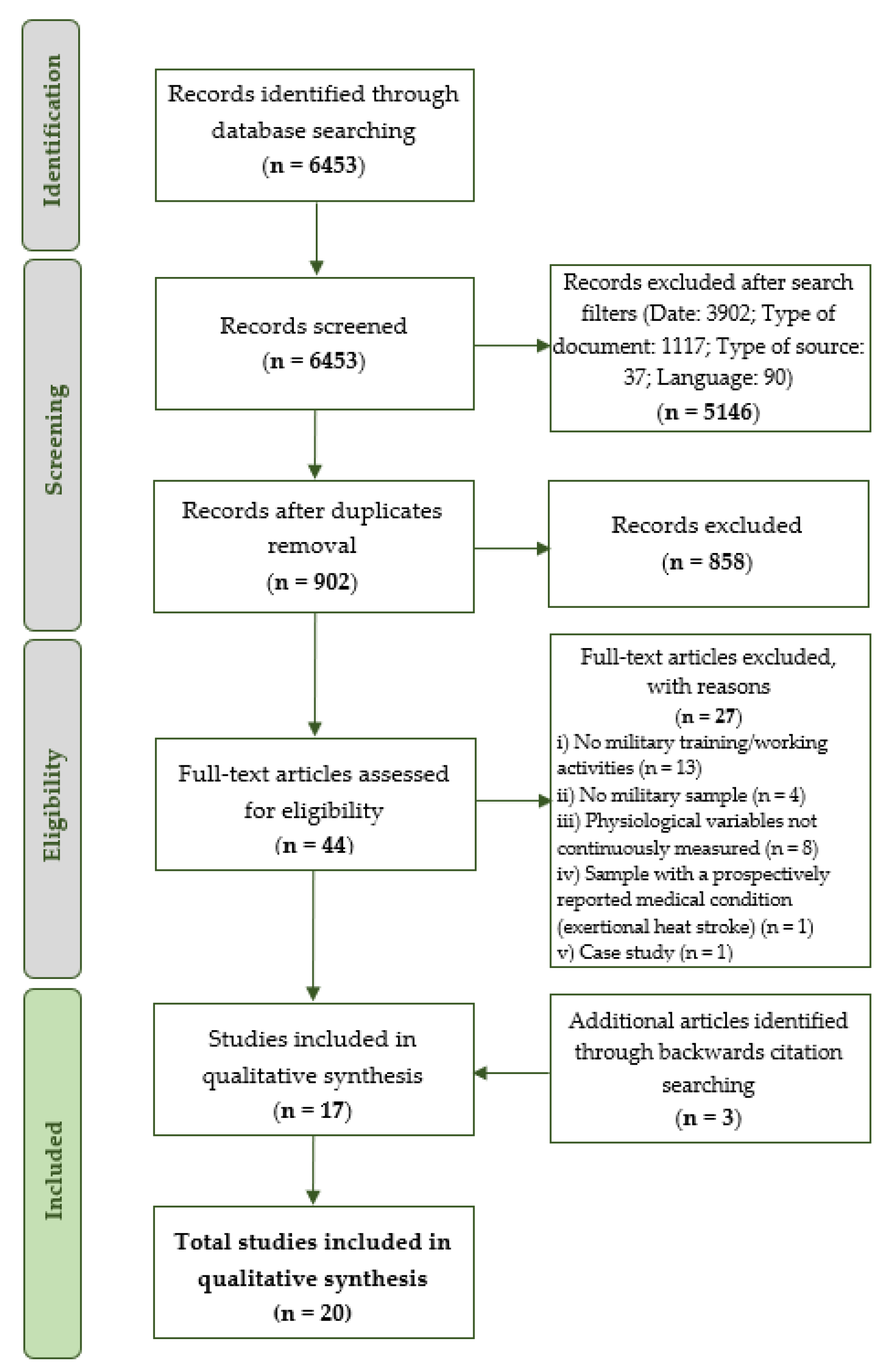
| Database | Total Number of Identified Articles | Summary of Rejected Articles | Total Number of Selected Articles | |||
|---|---|---|---|---|---|---|
| Date | Type of Document | Type of Source | Language | |||
| Scopus | 5929 | 3650 | 1071 | 37 | 87 | 1084 |
| PubMed | 120 | 64 | 0 | 0 | 2 | 54 |
| ScienceDirect | 380 | 174 | 44 | 0 | 1 | 161 |
| Web of Science | 24 | 14 | 2 | 0 | 0 | 8 |
| Total | 6453 | 3902 | 1117 | 37 | 90 | 1307 |
| Study/ Country | Study Objective | Study Design (Baseline/Intervention) | Duration | Non-Invasive Physiological Variables | Other Monitored Variables |
|---|---|---|---|---|---|
| [49]/Australia | To examine physiological and psychological responses to heat strain during operations in the tropics | Baseline comparison | 3 days | Heart rate, rectal temperature *, skin temperature (thigh position) * | Environmental conditions; oxygen consumption, water consumption, and fluid balance; cognitive and psychological performance; weight loss |
| [50]/USA | To examine cognitive and physiologic effects of brief but intense stressors | Baseline comparison | 5 days of a three-phase training | Accelerometer-based physical activity (estimated duration, sleep hours) | Cognitive performance; mood, vigor, fatigue, confusion, depression, and tension; cortisol, testosterone, and melatonin; body composition and hydration status |
| [45]/UK | To quantify the cardiovascular strain of a load carriage event | Baseline comparison | 1 day (270 min) | Heart rate | Body composition, maximal aerobic capacity, estimated oxygen consumption; speed of movement, altitude, and distance covered; neuromuscular performance and effects of load carriage; environmental conditions |
| [51]/Spain | To examine physical, mechanical, and physiological responses to prove that symmetrical and asymmetrical combats are different | Baseline comparison | 2 days | Heart rate, Accelerometer-based physical activity | Speed, sprints, distances, impact, body load parameters; body composition; environmental conditions |
| [52]/USA | To compare 3 methods for measuring physical activity | Baseline comparison | 8 weeks | Accelerometer-based physical activity | No additional variables |
| [53]/USA | To compare physical activity variables in two training sites | Baseline comparison | 4 months | Accelerometer-based physical activity | No additional variables |
| [54]/USA | To quantify thermal work strain and predict its effects during another mission | Baseline comparison | 2 months | Heart rate, core temperature, physical activity based on accelerometry counts | Meteorological data: air temperature, dew point and black globe temperature; clothing insulation and vapour permeability; height, body weight, waist circumference at the navel, fighting weight; metabolic rate and body fat |
| [55]/Finland | To examine cardiorespiratory responses during military tasks with loads | Baseline comparison | 20 days | Heart rate, respiratory patterns * | Rates of perceived exertion; distances moved, altitude differences and velocities; body composition; oxygen consumption |
| [56]/Switzerland | To investigate the impact of training on injury incidences | Baseline comparison | 18 weeks | Heart rate, physical activity-related variables (hip acceleration counts, step counts) | Physical activity energy expenditure, distance covered on foot; time spent on physically demanding material handling activities, sport-related PT, inactivity night rest; monotony and development in weekly training load variables; injury log and training reports |
| [57]/The Netherlands | To implement a monitoring assessment system and to establish a set of determinants that best predict attrition in infantry training | Baseline comparison | 24 weeks | Heart rate, frequency of breath, skin body temperature, acceleration counts | Cognitive performance, anthropometric measurements, somatotyping, psychological determinants |
| [58]/USA | To evaluate the performance of a core temperature estimation algorithm | Baseline comparison | 6 days | Heart rate, core temperature | No additional variables |
| [59]/USA | To assess cognitive, affective, hormonal, and heart-rate responses to survival training | Baseline comparison | 3 weeks | Heart rate | Biochemical stress markers in blood and saliva; cognitive performance, mood states |
| [47]/France | To assess the effects of adding a 5-day acclimatisation training programme before mission | Intervention (control group) | 7 days | Heart rate, rectal temperature * | Sweat loss and osmolality, thermal discomfort, weight, environmental conditions |
| [60]/Canada | To examine effects of captivity survival training | Baseline comparison | 4 days | Activity, sleep, and rest periods based on actigraphy data | Mood, fatigue, PTSD symptoms, dissociation, short-term memory and working memory; biochemical stress markers in blood and saliva |
| [61]/Italy | To compare energy expenditure equations and heart rate-based estimates of army loaded runs | Baseline comparison | 6 months | Heart rate | Estimated energy expenditure, environmental conditions, body weight, mean speed and distance |
| [48]/France | To assess the effects of adding a 15-day acclimatisation training programme before a mission | Intervention (control group) | 17 days | Heart rate, rectal temperature *, facial skin temperature * | Osmolality, sweat loss, thermal discomfort; rates of perceived exertion; environmental conditions |
| [62]/UK | To determine sex differences in training loads during basic training | Baseline comparison | 14 weeks | Heart rate | Distance, training impulse; rates of perceived exertion; energy expenditure |
| [46]/Finland | To investigate changes in physiological and biochemical markers during military management operation | Baseline comparison | 6 months | Heart rate and physical activity counts from accelerometry | Average ambient temperature; biochemical stress markers in blood and saliva; rates of perceived exertion; body composition |
| [63]/Czech Republic | To determine if energy balance remained steady during training | Baseline comparison | 1 week | Physical activity based on actigraphy | Energy expenditure, energy intake |
| [64]/USA | To examine energy demands of training to improve fueling conditions | Baseline comparison | 3 days | Heart rate | Energy intake, body composition changes, aerobic capacity, lactate threshold |
| Study | Study Design | Participants | Data Sources | Reporting Bias | Limitations | Generalisability | Potential Other Sources of Bias | Score (0–7): |
|---|---|---|---|---|---|---|---|---|
| [49] | 0.86 | 0.40 | 1.00 | 0.83 | 0.00 | 1.00 | 1.00 | 5.09 |
| [50] | 0.86 | 0.80 | 0.50 | 0.83 | 0.00 | 1.00 | 1.00 | 4.99 |
| [45] | 0.86 | 0.60 | 1.00 | 1.00 | 1.00 | 1.00 | 1.00 | 6.46 |
| [51] | 0.86 | 0.80 | 0.50 | 0.83 | 0.00 | 1.00 | 1.00 | 4.99 |
| [52] | 0.86 | 0.80 | 0.50 | 0.67 | 0.00 | 1.00 | 1.00 | 4.82 |
| [53] | 0.86 | 0.80 | 0.50 | 0.67 | 1.00 | 1.00 | 1.00 | 5.82 |
| [54] | 0.86 | 0.20 | 0.50 | 1.00 | 1.00 | 1.00 | 0.67 | 5.22 |
| [55] | 0.86 | 0.40 | 0.50 | 1.00 | 1.00 | 0.00 | 0.33 | 4.09 |
| [56] | 0.86 | 1.00 | 0.50 | 0.83 | 1.00 | 1.00 | 1.00 | 6.19 |
| [57] | 0.86 | 0.80 | 0.50 | 1.00 | 0.00 | 1.00 | 1.00 | 5.16 |
| [58] | 0.86 | 0.40 | 0.50 | 0.83 | 1.00 | 1.00 | 1.00 | 5.59 |
| [59] | 0.86 | 1.00 | 0.50 | 1.00 | 1.00 | 1.00 | 1.00 | 6.36 |
| [47] | 1.00 | 0.80 | 0.50 | 1.00 | 1.00 | 1.00 | 1.00 | 6.30 |
| [60] | 0.86 | 0.80 | 0.50 | 1.00 | 1.00 | 1.00 | 1.00 | 6.16 |
| [61] | 0.86 | 1.00 | 1.00 | 0.83 | 1.00 | 1.00 | 1.00 | 6.69 |
| [48] | 1.00 | 0.80 | 0.50 | 1.00 | 1.00 | 1.00 | 1.00 | 6.30 |
| [62] | 0.86 | 0.80 | 0.50 | 1.00 | 1.00 | 1.00 | 1.00 | 6.16 |
| [46] | 0.86 | 0.80 | 0.50 | 0.83 | 1.00 | 1.00 | 1.00 | 5.99 |
| [63] | 0.86 | 0.80 | 1.00 | 0.83 | 0.00 | 1.00 | 0.67 | 5.16 |
| [64] | 0.86 | 0.40 | 0.50 | 1.00 | 0.00 | 1.00 | 0.67 | 4.42 |
| Study | Quality Score | Assessment Goals | Reference Assessment Variables | Non-invasive Physiological Variables (Objective Fatigue Variables) | Subjective Fatigue Assessment | Outcomes |
|---|---|---|---|---|---|---|
| [61] | 6.69 | Energy expenditure determination | Equation-based estimates of energy expenditure | Heart rate (resting, mean, %maximal) | None | ✓ Equation-based estimates of energy expenditure during heavy-intensity activities were not significantly different from and highly correlated with heart rate-based estimates ✓ There was a small and non-significant bias and good precision between methods ✓ The mean absolute and relative heart rates during the 10, 15 and 20 km loaded runs suggested a physical effort between “vigorous” and “near to maximal” intensity |
| [45] | 6.46 | Level of physical exertion (neuromuscular function) | Vertical jump power, vertical jump height | Maximal heart rate (%), and heart rate reserve (%) | None | ✓ Lighter individuals were disadvantaged when carrying absolute loads, as they experienced higher cardiovascular strain (% heart rate reserve) and greater decreases in neuromuscular function (body jump decrease) ✓ Cardiovascular strain corresponded to a “hard” exercise intensity |
| [59] | 6.36 | Effects of training | Biochemical stress markers in blood and saliva (cortisol, dehydroepiandrosterone-sulfate DHEA-s, epinephrine, norepinephrine, soluble transferrin receptors sTfR, neuropeptide-Y NPY, prolactin, testosterone) | Heart rate (mean) | None | ✓ When exposed to simulated captivity, stress hormones, heart rate, cognition, mood and nutritional status were simultaneously altered, and each of them subsequently recovered at different rates ✓ Cortisol, DHEA-s, prolactin and testosterone were significantly lower ✓ Epinephrine, norepinephrine and neuropeptide-Y, and heart rate increased ✓ Heart rate increased by 42% and 81% (from baseline) during the two interrogation phases of training |
| [47] | 6.30 | Effects of acclimatisation | Rectal temperature | Heart rate (mean, % theoretical maximal heart rate) | Borg’s RPE scale | ✓ Heart rate, thermal discomfort at rest and at the end of the exercise, rates of perceived exertion and sweat loss and osmolality decreased following heat acclimatisation ✓ Decreases in rectal temperature were not significant ✓ Adding short (<60 min) daily moderate-intensity training sessions during mission in a hot and dry environment accelerated heat acclimatisation induced changes at rest and during exercise over 5 days |
| [48] | 6.30 | Effects of acclimatisation | Rectal temperature | Heart rate (resting, mean), facial skin temperature | Modified Borg’s RPE scale | ✓ Heat metabolic strain decreased during acclimatisation, as evidenced by the decrease in both rectal temperature and heart rate ✓ Overall, a low-volume training regimen in a hot and dry environment has a modest impact on physiological adaptation ✓ Decreases in facial temperature evolved similarly to thermal discomfort and ratings of perceived exertion in both groups during the heat acclimatisation process |
| [56] | 6.19 | Impact of training on injury incidences | Numbers of injury incidences | Heart rate (mean) and physical activity-related variables | None | ✓ Multiple linear regression evidenced that high physical demands, monotony in weekly physical demands, decreasing the development of distances covered on foot, little time for night rest, and little time spent on sport-related physical training were significant risk factors for injuries (together, they described 98.8% of the incidences) |
| [60] | 6.16 | Effects of training | Biochemical stress markers in blood and saliva (cortisol, dehydroepiandrosterone-DHEA) | Sleep, rest and activity periods (min) based on acceleration counts | Multidimensional Fatigue Inventory (MFI) | ✓ All the variables were degraded during training but recovered after its completion ✓ Almost all measures were most degraded in the more intense interrogation scenario ✓ The training induced significant but reversible effects on psychological and physiological function—necessary preconditions for stress inoculation training |
| [62] | 6.16 | Sex differences in training loads | NA | Heart rate | Modified Borg’s RPE scale | ✓ Daily rate of perceived exertion demonstrated good agreement with heart rate ✓ Women spent more time in the “hard” and “very hard” heart rate zones. However, average daily heart rate values and rates of perceived exertion were not different between sexes |
| [46] | 5.99 | Level of physical exertion | Biochemical stress markers in blood and saliva (testosterone, sex hormone-binding globulin, cortisol and insulin-like growth factor, α-amylase) | Heart rate (absolute, relative, mean, peak), physical activity (metabolic equivalent intensities, step counts) | Borg’s RPE scale | ✓ Low quantity of physical activity, low heart rate values, and subjective ratings of exertion proved a “light” physical workload during mission ✓ Stress biomarkers and heart rate responses were proportional and presented no significant changes ✓ No signs of physical overload due to the calm operative nature of the working environment |
| [53] | 5.82 | Comparison of physical activity from two training sites | NA | Accelerometer-based physical activity | None | ✓ Recruits from two training sites showed similar amounts of time in physical activity variables, regardless of site and measurement method (accelerometers, physical activity logs and trackers) |
| [58] | 5.59 | Heat strain assessment | Core temperature | Heart rate (mean) | None | ✓ Average values reached 140 bpm for heart rate and 39 °C for core temperature ✓ The proposed algorithm had a small bias (0.02 °C) ✓ The overall root mean square error was lower than previous studies comparing different measures of core temperature |
| [54] | 5.22 | Heat stress assessment, level of physical exertion | Core temperature | Heart rate (mean), accelerometry counts | None | ✓ Changes in mean heart rate and peak heart rate values proportionally increased during heat strain (when core temperature was >38 °C) |
| [57] | 5.16 | Physiological and mental workload | NA | Heart rate, frequency of breath, skin body temperature, acceleration counts | None | ✓ Attrition was predicted by physiological and mental determinants |
| [63] | 5.16 | Energy balance during training | NA | Accelerometer-based physical activity (frequency, length and intensity of physical movement) | None | ✓ The average daily number of steps in one week of continuous training was determined as “regular moderately intensive” movement without any competitive sports ✓ During continuous training, a positive energy balance resulted in saving excess energy as fat reserves |
| [49] | 5.09 | Heat strain assessment | Rectal temperature, rate of fluid loss, weight loss | Heart rate (peak), skin temperature (thigh position) | None | ✓ Peak heart rate (160 bpm) responded to heat stress reported by rectal temperature (38.4 °C) during patrol activities ✓ Recovery periods did not achieve basal heart rate during the hot exposure ✓ Skin temperature decreased significantly during recovery and rose during exertion |
| Level of physical exertion | Oxygen consumption | Heart rate (mean) | None | ✓ Mean values of heart rate from 140 to 160 bpm were reached during the highly intense patrol activities (3 mL/min) ✓ Mean values of heart rate corresponded to the oxygen consumption during the physical activity | ||
| [50] | 4.99 | Sleep deprivation, physical activity, work–rest cycle, cognitive degradation | Melatonin | Actigraphy (activity counts, number of sleep periods and time) | None | ✓ During the field testing, subjects slept 3.0 ± 0.3 h, with a mean number of sleep intervals of 14.4 ± 1.0 ✓ These results showed a correlation with the low levels of melatonin during the field testing |
| [51] | 4.99 | Level of physical exertion in different combat techniques | NA | Heart rate, accelerometer-based physical activity | None | ✓ Differences between symmetrical and asymmetrical combat were evident ✓ Heart rate values during symmetrical and asymmetrical combat conditions were less than 80% of maximal heart rate |
| [53] | 4.82 | Comparison of physical activity assessments | NA | Accelerometer-based physical activity | None | ✓ The ActiGraph gave the best measure of the recruits’ physical activity intensity ✓ The physical activity tracker and daily physical activity log were best for body position and type of physical activity ✓ The use of multiple physical activity measurement instruments was necessary to characterise the physical demands of training best |
| [64] | 4.42 | Intensity of physical activity | Maximal oxygen consumption, lactate threshold | Heart rate (mean, % maximal) | None | ✓ % of the maximal theoretical heart rate reaching “moderate” to “high” intensity levels during hiking with loads ✓ Outcomes suggest a decrease in work output, early-onset fatigue and increased risk of injury |
| [55] | 4.09 | Level of physical exertion | Oxygen consumption | Heart rate (mean, maximum, maximal) | Borg’s RPE scale | ✓ No significant correlations were observed between oxygen consumption and heart rate in the selected military tasks ✓ The significant increase in heart rate is not related to respective oxygen consumption values measured during the last hour of loaded marching |
Publisher’s Note: MDPI stays neutral with regard to jurisdictional claims in published maps and institutional affiliations. |
© 2021 by the authors. Licensee MDPI, Basel, Switzerland. This article is an open access article distributed under the terms and conditions of the Creative Commons Attribution (CC BY) license (https://creativecommons.org/licenses/by/4.0/).
Share and Cite
Bustos, D.; Guedes, J.C.; Vaz, M.P.; Pombo, E.; Fernandes, R.J.; Costa, J.T.; Baptista, J.S. Non-Invasive Physiological Monitoring for Physical Exertion and Fatigue Assessment in Military Personnel: A Systematic Review. Int. J. Environ. Res. Public Health 2021, 18, 8815. https://doi.org/10.3390/ijerph18168815
Bustos D, Guedes JC, Vaz MP, Pombo E, Fernandes RJ, Costa JT, Baptista JS. Non-Invasive Physiological Monitoring for Physical Exertion and Fatigue Assessment in Military Personnel: A Systematic Review. International Journal of Environmental Research and Public Health. 2021; 18(16):8815. https://doi.org/10.3390/ijerph18168815
Chicago/Turabian StyleBustos, Denisse, Joana C. Guedes, Mário P. Vaz, Eduardo Pombo, Ricardo J. Fernandes, José Torres Costa, and João Santos Baptista. 2021. "Non-Invasive Physiological Monitoring for Physical Exertion and Fatigue Assessment in Military Personnel: A Systematic Review" International Journal of Environmental Research and Public Health 18, no. 16: 8815. https://doi.org/10.3390/ijerph18168815
APA StyleBustos, D., Guedes, J. C., Vaz, M. P., Pombo, E., Fernandes, R. J., Costa, J. T., & Baptista, J. S. (2021). Non-Invasive Physiological Monitoring for Physical Exertion and Fatigue Assessment in Military Personnel: A Systematic Review. International Journal of Environmental Research and Public Health, 18(16), 8815. https://doi.org/10.3390/ijerph18168815

