A Systematic Review of the Accuracy of Crowns Designed Using Artificial Intelligence Versus CAD/CAM and Traditional Methods

Abstract
1. Introduction
2. Materials and Methods
2.1. Registration Protocol
2.2. Research Question and Eligibility Criteria
2.3. Search Strategy, Study Selection, and Data Extraction
2.4. Synthesis of Results
2.5. Quality Assessment
2.6. Assessment of Strength of Evidence
3. Results
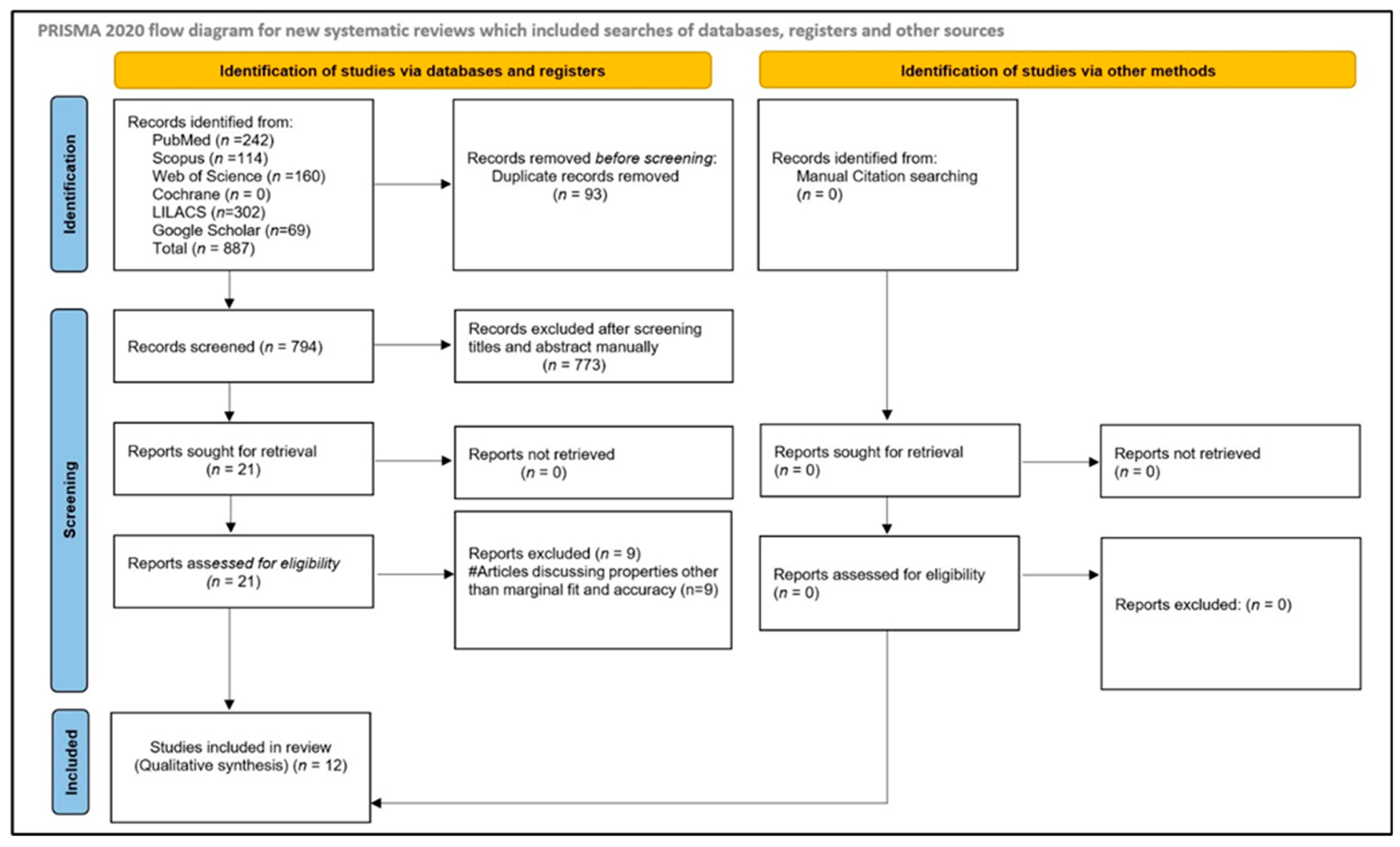
3.1. Identification and Screening
3.2. Quality Assessment of Included Studies
3.3. Quality of Evidence (GRADE Evaluation)

| S.No. | Outcomes Evaluated | Inconsistency | Indirectness | Imprecision | Risk of Bias | Publication Bias | Strength of Evidence |
|---|---|---|---|---|---|---|---|
| 1 | Marginal Fit | Not Present | Not Present | Not Present | Present | Suspected | Moderate (⬤⬤⬤◯) |
| 2 | Internal Fit | Not Present | Not Present | Not Present | Present | Suspected | Moderate (⬤⬤⬤◯) |
| 3 | Occlusal Contact Points | Not Present | Not Present | Not Present | Present | Suspected | Moderate (⬤⬤⬤◯) |
3.4. Overview of Included Studies
3.5. Marginal Fit/Accuracy and Internal Fit
3.6. Occlusal Contact Accuracy
4. Discussion
5. Conclusions
Supplementary Materials
Funding
Institutional Review Board Statement
Informed Consent Statement
Data Availability Statement
Acknowledgments
Conflicts of Interest
References
- Gao, S.; Wang, X.; Xia, Z.; Zhang, H.; Yu, J.; Yang, F. Artificial Intelligence in Dentistry: A Narrative Review of Diagnostic and Therapeutic Applications. Med. Sci. Monit. 2025, 31, e946676. [Google Scholar] [CrossRef]
- DaSilva, A.F.; Robinson, M.A.; Shi, W.; McCauley, L.K. The forefront of dentistry—Promising technological innovations and new treatments. JDR Clin. Trans. Res. 2022, 7, 16S–24S. [Google Scholar]
- Topdagi, B.; Guler, C.C.; Sultanoglu, E.G. Marginal and internal fit accuracy of single-crown restorations: The impact of digital and conventional impression techniques. BMC Oral Health 2025, 26, 79. [Google Scholar] [CrossRef]
- Rani, S.; Dhawan, P.; Gupta, J.; Singhla, J. A paradigm shift in prosthodontics: Analog to digital. J. Sci. Soc. 2024, 51, 177–182. [Google Scholar] [CrossRef]
- Yakubova, I.I.; Krupnyk, N.M.; Krupnyk, A.A.; Ostrianko, V.I. Digital dentistry in action: Analysis of clinical outcomes of CAD/CAM, three-dimensional printing, and artificial intelligence in tooth defect rehabilitation. Wiad. Lek. 2025, 78, 2540–2547. [Google Scholar] [CrossRef] [PubMed]
- Meshni, A.A.; Jain, S.; Osaysi, H.N.M.; Hezam, K.N.; Adlan, S.S.G. The Comparison of Accuracy of Post Space Digital Impressions Made by Three Different Intraoral Scanners: An In Vitro Study. Diagnostics 2024, 14, 2893. [Google Scholar] [CrossRef]
- Islam, K.Z.; Khan, M.A.A.; Mohsina, N. The role of CAD-CAM in prosthodontics: A review article. Sch. J. Dent. Sci. 2025, 12, 81–89. [Google Scholar] [CrossRef]
- Goodacre, C.J.; Garbacea, A.; Naylor, W.P.; Daher, T.; Marchack, C.B.; Lowry, J. CAD/CAM fabricated complete dentures: Concepts and clinical methods of obtaining required morphological data. J. Prosthet. Dent. 2012, 107, 34–46. [Google Scholar] [CrossRef]
- Mörmann, W.H.; Bindl, A. CAD/CAM in dentistry: A review. Quintessence Int. 2010, 41, 387–398. [Google Scholar]
- Fasbinder, D.J. Materials for CAD/CAM restorations. J. Am. Dent. Assoc. 2016, 147, S19–S26. [Google Scholar]
- Mühlemann, S.; Benic, G.I.; Fehmer, V.; Hämmerle, C.H.F.; Sailer, I. Clinical quality and efficiency of monolithic glass ceramic crowns in the posterior area: Digital compared with conventional workflows. Int. J. Comput. Dent. 2018, 21, 215–223. [Google Scholar]
- Mühlemann, S.; Lamperti, S.T.; Stucki, L.; Hämmerle, C.H.F.; Thoma, D.S. Time efficiency and efficacy of a centralized CAD/CAM workflow for implant crown fabrication: A prospective controlled clinical study. J. Dent. 2022, 127, 104332. [Google Scholar] [CrossRef] [PubMed]
- Alqahtani, F. Marginal fit of all-ceramic crowns fabricated using two extraoral CAD/CAM systems compared with the conventional technique. Clin. Cosmet. Investig. Dent. 2017, 9, 13–18. [Google Scholar] [CrossRef]
- Lee, S.J.; Jamjoom, F.Z.; Le, T.; Radics, A.; Gallucci, G.O. Digital scanning versus conventional impression making for implant-supported prostheses: A crossover clinical trial. J. Prosthet. Dent. 2022, 128, 42–48. [Google Scholar] [CrossRef] [PubMed]
- Abdullah, A.O.; Tsitrou, E.A.; Pollington, S. Comparative in vitro evaluation of CAD/CAM versus conventional provisional crowns. J. Appl. Oral Sci. 2016, 24, 258–263. [Google Scholar] [CrossRef]
- Nagata, K.; Inoue, E.; Nakashizu, T.; Seimiya, K.; Atsumi, M.; Kimoto, K.; Kuroda, S.; Hoshi, N. Verification of the accuracy and design time of crowns designed with artificial intelligence. J. Adv. Prosthodont. 2025, 17, 1–10. [Google Scholar] [CrossRef]
- Kong, H.J.; Kim, Y.L. Application of artificial intelligence in dental crown prosthesis: A scoping review. BMC Oral Health 2024, 24, 937. [Google Scholar] [CrossRef]
- Ibraheem, W.I.; Jain, S.; Ayoub, M.N.; Namazi, M.A.; Alfaqih, A.I.; Aggarwal, A.; Meshni, A.A.; Almarghlani, A.; Alhumaidan, A.A. Assessment of the Diagnostic Accuracy of Artificial Intelligence Software in Identifying Common Periodontal and Restorative Dental Conditions (Marginal Bone Loss, Periapical Lesion, Crown, Restoration, Dental Caries) in Intraoral Periapical Radiographs. Diagnostics 2025, 15, 1432. [Google Scholar] [CrossRef] [PubMed]
- Castiglioni, I.; Rundo, L.; Codari, M.; Di Leo, G.; Salvatore, C.; Interlenghi, M.; Gallivanone, F.; Cozzi, A.; D’AMico, N.C.; Sardanelli, F. AI applications to medical images: From machine learning to deep learning. Phys. Med. 2021, 83, 9–24. [Google Scholar] [CrossRef]
- Choi, J.H.; Ahn, J.; Park, J.M. Deep learning-based automated detection of the dental crown finish line: An accuracy study. J. Prosthodont. Res. 2024, 132, e1-1286.e1–e1-1286.e9. [Google Scholar]
- Meshram, P.; Kharat, S.; Gangde, P.; Khan, M.R.; Tambe, N.; Gavade, O. Comparative evaluation of the internal and marginal fit of dental crowns designed using CAD and AI-based software. J. Chem. Health Risks 2025, 15, 2757–2762. [Google Scholar]
- Wu, Z.; Zhang, C.; Ye, X.; Dai, Y.; Zhao, J.; Zhao, W.; Zheng, Y. Comparison of the efficacy of artificial intelligence-powered software in crown design: An in vitro study. Int. Dent. J. 2025, 75, 127–134. [Google Scholar] [CrossRef]
- Chen, Y.; Lee, J.K.Y.; Kwong, G.; Pow, E.H.N.; Tsoi, J.K.H. Morphology and fracture behavior of lithium disilicate dental crowns designed by human and knowledge-based AI. J. Mech. Behav. Biomed. Mater. 2022, 131, 105256. [Google Scholar] [CrossRef]
- Moher, D.; Liberati, A.; Tetzlaff, J.; Altman, D.G.; PRISMA Group. Preferred reporting items for systematic reviews and meta-analyses: The PRISMA statement. PLoS Med. 2009, 6, e1000097. [Google Scholar] [CrossRef]
- Moher, D.; Shamseer, L.; Clarke, M.; Ghersi, D.; Liberati, A.; Petticrew, M.; Shekelle, P.; Stewart, L.A.; PRISMA-P Group. Preferred reporting items for systematic review and meta-analysis protocols (PRISMA-P) 2015 statement. Syst. Rev. 2015, 4, 1. [Google Scholar] [CrossRef] [PubMed]
- Nejatidanesh, F.; Shakibamehr, A.H.; Savabi, O. Comparison of marginal and internal adaptation of CAD/CAM and conventional implant-supported crowns. Implant. Dent. 2016, 25, 103–108. [Google Scholar] [CrossRef] [PubMed]
- Mostafa, N.Z.; Ruse, N.D.; Ford, N.L.; Carvalho, R.M.; Wyatt, C.C.L. Marginal fit of lithium disilicate crowns fabricated using conventional and digital methodology: A three-dimensional analysis. J. Prosthodont. 2018, 27, 145–152. [Google Scholar] [CrossRef]
- Cheng, C.W.; Ye, S.Y.; Chien, C.H.; Chen, C.J.; Papaspyridakos, P.; Ko, C.C. Randomized clinical trial of conventional and digital workflows for interim crowns. J. Prosthet. Dent. 2021, 125, 73–81. [Google Scholar] [CrossRef]
- Cho, J.H.; Yi, Y.; Choi, J.; Ahn, J.; Yoon, H.-I.; Yilmaz, B. Time efficiency, occlusal morphology, and internal fit of crowns designed by GAN-powered software. J. Dent. 2023, 138, 104739. [Google Scholar] [CrossRef]
- Ding, H.; Cui, Z.; Maghami, E.; Chen, Y.; Matinlinna, J.P.; Pow, E.H.N.; Fok, A.S.L.; Burrow, M.F.; Wang, W.; Tsoi, J.K.H. Morphology and mechanical performance of dental crowns designed by 3D-DCGAN. Dent. Mater. 2023, 39, 320–332. [Google Scholar] [CrossRef] [PubMed]
- Bae, E.-B.; Cho, W.-T.; Park, D.-H.; Hwang, S.-H.; Lee, S.-H.; Yun, M.-J.; Jeong, C.-M.; Huh, J.-B. Comparison of fit and trueness of zirconia crowns fabricated by different combinations of open CAD-CAM systems. J. Adv. Prosthodont. 2023, 15, 155–170. [Google Scholar] [CrossRef]
- Cho, J.H.; Çakmak, G.; Yi, Y.; Yoon, H.-I.; Yilmaz, B.; Schimmel, M. Tooth morphology, internal fit, occlusion and proximal contacts of crowns designed by deep learning-based software. J. Dent. 2024, 141, 104830. [Google Scholar] [CrossRef]
- Cho, J.-H.; Çakmak, G.; Choi, J.; Lee, D.; Yoon, H.-I.; Yilmaz, B.; Schimmel, M. Deep learning-designed implant-supported posterior crowns. J. Dent. 2024, 147, 105142. [Google Scholar] [CrossRef] [PubMed]
- Kızılkaya, A.R.; Kara, A. Impact of different CAD software programs on marginal and internal fit of provisional crowns: An in vitro study. Heliyon 2024, 10, e24205. [Google Scholar] [CrossRef]
- Ren, S.; Wu, T.; Zhou, D.; Jiang, X.; Di, P. A deep learning system on monolithic implant-supported crown design. J. Prosthodont. 2025. online ahead of print. [Google Scholar] [CrossRef] [PubMed]
- Win, T.T.; Mai, H.-N.; Kim, S.-Y.; Cho, S.-H.; Kim, J.-E.; Srimaneepong, V.; Kaenploy, J.; Lee, D.-H. Fit accuracy of complete crowns fabricated by generative artificial intelligence: A comparative clinical study. J. Adv. Prosthodont. 2025, 17, 224. [Google Scholar] [CrossRef]
- Faggion, C.M., Jr. Guidelines for reporting pre-clinical in vitro studies on dental materials. J. Evid. Based Dent. Pract. 2012, 12, 182–189. [Google Scholar] [CrossRef] [PubMed]
- Moola, S.; Munn, Z.; Tufanaru, C.; Aromataris, E.C.; Sears, K.; Sfetc, R.; Currie, M.J.; Lisy, K.; Qureshi, R.; Mattis, P.; et al. Systematic reviews of etiology and risk. In Joanna Briggs Institute Reviewer’s Manual; Aromataris, E., Munn, Z., Eds.; JBI: Adelaide, Australia, 2017. [Google Scholar]
- Munn, Z.; Moola, S.; Lisy, K.; Riitano, D.; Tufanaru, C. Methodological guidance for systematic reviews of observational epidemiological studies reporting prevalence and incidence data. Int. J. Evid. Based Healthc. 2015, 13, 147–153. [Google Scholar] [CrossRef]
- Cohen, J. A coefficient of agreement for nominal scales. Educ. Psychol. Meas. 1960, 20, 37–46. [Google Scholar] [CrossRef]
- Granholm, A.; Alhazzani, W.; Møller, M.H. Use of the GRADE approach in systematic reviews and guidelines. Br. J. Anaesth. 2019, 123, 554–559. [Google Scholar] [CrossRef]
- Kong, H.J.; Kim, Y.L. Accuracy of artificial intelligence-designed dental crowns: A scoping review of in vitro studies. Appl. Sci. 2025, 15, 9866. [Google Scholar]
- Son, K.; Lee, S.; Kang, S.H.; Park, J.; Lee, K.-B.; Jeon, M.; Yun, B.-J. Comparison of marginal and internal fit assessment methods for fixed dental prostheses. J. Clin. Med. 2019, 8, 785. [Google Scholar] [CrossRef]
- Di Fiore, A.; Zuccon, A.; Carraro, F.; Basilicata, M.; Bollero, P.; Bruno, G.; Stellini, E. Assessment methods for marginal and internal fit of restorations: A systematic review. J. Clin. Med. 2023, 12, 5048. [Google Scholar] [PubMed]
- Baig, M.R.; Tan, K.B.; Nicholls, J.I. Evaluation of the marginal fit of a zirconia ceramic CAM crown system. J. Prosthet. Dent. 2010, 104, 216–227. [Google Scholar] [CrossRef] [PubMed]
- Pak, H.S.; Han, J.S.; Lee, J.B.; Kim, S.H.; Yang, J.H. Influence of porcelain veneering on marginal fit of CAD/CAM zirconia crowns. J. Adv. Prosthodont. 2010, 2, 33–38. [Google Scholar]
- Ayres, G.; Parize, H.; Mendonca, L.M.; Kubata, B.R.; Tirapelli, C. Is the digital workflow more efficient for partial-coverage restorations? J. Prosthet. Dent. 2025, 133, 1438–1447. [Google Scholar] [CrossRef]
- Jacobs, M.S.; Windeler, A.S. Dental luting cement solubility as a function of marginal gap. J. Prosthet. Dent. 1991, 65, 436–442. [Google Scholar] [CrossRef]
- Contrepois, M.; Soenen, A.; Bartala, M.; Laviole, O. Marginal adaptation of ceramic crowns: A systematic review. J. Prosthet. Dent. 2013, 110, 447–454.e10. [Google Scholar] [CrossRef]
- de Kok, P.; Liao, P.; Chien, E.C.; Morgano, S. Meta-analysis of measuring techniques for marginal and internal gap evaluation. J. Prosthet. Dent. 2025, 134, 42–49. [Google Scholar] [PubMed]
- Choi, J.; Ahn, J.; Park, J.M. Deep learning-based automated detection of dental crown finish lines. J. Prosthet. Dent. 2024, 132, 1286. [Google Scholar] [CrossRef]
- Abduo, J.; Bennamoun, M.; Tennant, M.; McGeachie, J. Effect of prosthodontic planning on intercuspal occlusal contacts. Comput. Biol. Med. 2015, 60, 143–150. [Google Scholar] [CrossRef] [PubMed]
- Liu, C.M.; Lu, T.Y.; Wang, C.S.; Feng, S.W.; Lin, Y.C.; Lee, S.Y.; Lin, W.C. Evaluation of the accuracy, occlusal contact and clinical applications of zirconia crowns using artificial intelligence design versus human design. J. Dent. Sci. 2025, 20, 1665–1672. [Google Scholar] [CrossRef]
- Gu, Z.; Wu, Z.; Dai, N. Image generation technology for functional occlusal pits and fissures using conditional GAN. PLoS ONE 2023, 18, e0291728. [Google Scholar] [CrossRef]
- Wang, Y.; Li, Y.; Xu, M.; Liu, F. Comparative analysis of full crown morphology designed by artificial intelligence and dental technicians. J. Dent. 2025, 163, 106131. [Google Scholar] [CrossRef]
- D´Albis, G.; Capodiferro, S. AI in oral surgery: Promise and prudence. Br. Dent. J. 2026, 240, 12. [Google Scholar] [CrossRef]
- Zhang, L.; Li, W.; Lv, J.; Xu, J.; Zhou, H.; Li, G.; Ai, K. Advancements in oral and maxillofacial surgery medical images segmentation techniques: An overview. J. Dent. 2003, 138, 104727. [Google Scholar] [CrossRef] [PubMed]
- Mörch, C.M.; Atsu, S.; Cai, W.; Li, X.; Madathil, S.A.; Liu, X.; Mai, V.; Tamimi, F.; Dilhac, M.A.; Ducret, M. Artificial Intelligence and Ethics in Dentistry: A Scoping Review. J. Dent. Res. 2021, 100, 1452–1460. [Google Scholar] [CrossRef]
- Page, M.J.; McKenzie, J.E.; Bossuyt, P.M.; Boutron, I.; Hoffmann, T.C.; Mulrow, C.D.; Shamseer, L.; Tetzlaff, J.M.; Akl, E.A.; Brennan, S.E.; et al. The PRISMA 2020 statement: An updated guideline for reporting systematic reviews. BMJ 2021, 372, n71. [Google Scholar] [CrossRef] [PubMed]

| Elements | Contents |
|---|---|
| Population (P) |
|
| Intervention (I) | AI-based dental crowns. |
| Comparator (C) | CAD-CAM-designed crowns and technician-designed crowns. |
| Outcome (O) | Marginal and internal adaptation/fit, occlusal contact accuracy. |
| Studies (S) | Randomized controlled trial (RCT), experimental studies, observation studies. |
| Database | Search Strings |
|---|---|
| PubMed | (Artificial intelligence) AND (dental crowns); (((deep learning) AND (dental crown)) AND (design)) AND (accuracy); (((deep learning) AND (dental crown)) AND (design)); ((Deep Learning) AND (Dental Crown designing)) AND (Accuracy); ((Marginal fit) AND (Artificial Intelligence)) AND (Dental Crowns); (((((artificial intelligence) OR (machine learning)) AND (Dental Crowns)) NOT (implant crowns)) NOT (endo crowns)) NOT (systematic review); (((((neural network) OR (automated design)) AND (dental crowns)) NOT (implant crowns)) NOT (systematic reviews)) NOT (endocrowns) ((CAD-CAM) AND (Marginal accuracy)) AND (Dental Crown); (((CAD CAM) AND (Dental Crowns)) AND (Marginal Fit)) NOT (Systematic Review); ((CAD CAM) AND (Dental Crowns)) AND (Occlusion); ((CAD CAM) AND (Dental Crowns)) AND (Internal Fit); ((((dental crowns) AND (CAD CAM)) AND (internal fit)) NOT (implant crowns)) NOT (endocrowns); ((dental crowns) AND (CAD CAM)) AND (occlusal contact accuracy) ((dental technician) AND (dental crowns)) AND (marginal fit); (laboratory technician designed crowns) AND (accuracy); ((dental technician) AND (dental crown design)) AND (occlusal contact accuracy) ((((CAD CAM) AND (ARTIFICIAL INTELLIGENCE)) OR (AI)) AND (Dental crowns)) AND (marginal accuracy); (((((((CAD CAM) AND (Artificial Intelligence)) OR (AI)) OR (Machine Learning)) AND (Dental Technician)) OR (Lab Technician)) AND (Denta Crowns designing)) AND (Marginal Fit) |
| Scopus | (TITLE-ABS-KEY (Artificial Intelligence) OR TITLE-ABS-KEY (Machine Learning) OR TITLE-ABS-KEY (Neural network) AND TITLE-ABS-KEY (Marginal Accuracy of Dental Crowns)) AND PUBYEAR = 2025 AND (LIMIT-TO (LANGUAGE, “English”)); (TITLE-ABS-KEY (Artificial Intelligence) OR TITLE-ABS-KEY (Machine Learning) OR TITLE-ABS-KEY (Neural network) AND TITLE-ABS-KEY (Marginal Accuracy of Dental Crowns)) AND PUBYEAR = 2025 AND (LIMIT-TO (LANGUAGE, “English”)); (TITLE-ABS-KEY (Artificial Intelligence) OR TITLE-ABS-KEY (Machine Learning) AND TITLE-ABS-KEY (Marginal Accuracy of Dental Crowns)) AND PUBYEAR = 2025 AND (LIMIT-TO (LANGUAGE, “English”)); (TITLE-ABS-KEY (Artificial Intelligence) AND TITLE-ABS-KEY (Dental Crowns) AND TITLE-ABS-KEY (occlusal contact)) AND PUBYEAR = 2025 AND (LIMIT-TO (LANGUAGE, “English”)); (TITLE-ABS-KEY (Artificial Intelligence) AND TITLE-ABS-KEY (Dental Crowns) AND TITLE-ABS-KEY (accuracy assessment)) AND PUBYEAR = 2025 AND (LIMIT-TO (LANGUAGE, “English”)); (TITLE-ABS-KEY (Artificial Intelligence) AND TITLE-ABS-KEY (Dental Crowns) AND TITLE-ABS-KEY (Marginal Fit)) AND PUBYEAR = 2025 AND (LIMIT-TO (LANGUAGE, “English”)); (TITLE-ABS-KEY (Artificial Intelligence) AND TITLE-ABS-KEY (Dental Crowns) AND TITLE-ABS-KEY (Marginal Accuracy)) AND PUBYEAR = 2025 AND (LIMIT-TO (LANGUAGE, “English”)); (TITLE-ABS-KEY(CAD CAM) AND TITLE-ABS-KEY(Dental Crowns) AND TITLE-ABS-KEY(Marginal Fit)) AND PUBYEAR > 2009 AND PUBYEAR < 2026; (TITLE-ABS-KEY (CAD CAM) AND TITLE-ABS-KEY (Dental Crowns) AND TITLE-ABS-KEY (accuracy assessment)) AND PUBYEAR > 2011 AND PUBYEAR < 2026; (TITLE-ABS-KEY(CAD CAM) AND TITLE-ABS-KEY(Dental Crowns) AND TITLE-ABS-KEY(Occlusal contact)) AND PUBYEAR > 2009 AND PUBYEAR < 2026 AND (LIMIT-TO (LANGUAGE, “English”)) (TITLE-ABS-KEY(Dental Technician) OR TITLE-ABS-KEY(laboratory technician) OR TITLE-ABS-KEY(conventional techniques) AND TITLE-ABS-KEY(Dental crown designing) AND TITLE-ABS-KEY(marginal fit)) AND PUBYEAR > 2009 AND PUBYEAR < 2026 AND (LIMIT-TO (LANGUAGE, “English”)); (TITLE-ABS-KEY(Dental Technician) OR TITLE-ABS-KEY(laboratory technician) OR TITLE-ABS-KEY(conventional techniques) AND TITLE-ABS-KEY(Dental crown designing) AND TITLE-ABS-KEY(marginal accuracy)) AND PUBYEAR > 2009 AND PUBYEAR < 2026 AND (LIMIT-TO (LANGUAGE, “English”)); (TITLE-ABS-KEY(Dental Technician) OR TITLE-ABS-KEY(laboratory technician) OR TITLE-ABS-KEY(conventional techniques) AND TITLE-ABS-KEY(Dental crown designing) AND TITLE-ABS-KEY(occlusal contact)) AND PUBYEAR > 2009 AND PUBYEAR < 2026 AND (LIMIT-TO (LANGUAGE, “English”)); |
| Web Of Science | TS=(“Artificial Intelligence” OR “Machine Learning”) AND TS=(“Dental crowns”) AND TS=(“Accuracy”); TS=(“AI-assisted” OR “machine learning”)) AND TS=(“marginal fit” OR “internal fit”); TS=(“Artificial Learning” OR “ Neural Network” OR “Deep Learning”) AND TS=(“Dental Crowns”) AND TS=(“Occlusal Contact”) TS=(“CAD-CAM”) AND TS=(“Dental crowns”) AND TS=(“Marginal Accuracy”); TS=(“CAD-CAM”) AND TS=(“marginal fit” OR “internal fit”); TS=(“CAD-CAM”) AND TS=(“Dental Crowns”) AND TS=(“Occlusal Morphology”) TS=(“Dental Technician” OR “laboratory technician” OR “Conventional”) AND TS=(“Dental crowns”) AND TS=(“Accuracy”); TS=(“Dental Technician” OR “laboratory technician” OR “Conventional”) AND TS=(“marginal fit” OR “internal fit”); TS=(“Dental Technician” OR “laboratory technician” OR “Conventional”) AND TS=(“Dental Crowns”) AND TS=(“Occlusal Contact Accuracy”) |
| Cochrane | (“Dental Crown” OR “Single crown” OR “Fixed dental prosthesis”) AND (“Artificial intelligence” OR “Machine learning” OR “Deep learning” OR “Neural network” OR “Generative adversarial network” OR “AI-assisted design”) AND (“CAD-CAM” OR “Computer-aided design” OR “Digital dentistry” OR “Technician-designed”) AND (“Marginal fit” OR “Marginal adaptation” OR “Internal fit” OR “Internal adaptation” OR “Occlusal contact” OR “Occlusal accuracy”) |
| Lilacs | (Artificial Intelligence) AND (Dental Crowns) AND (Marginal Accuracy); (Artificial Intelligence) AND (Dental Crowns) AND (Marginal Fit); (Artificial Intelligence) AND (Dental Crowns) AND (Accuracy assessment); (Artificial Intelligence) AND (Dental Crowns) AND (Occlusal contact morphology); (Artificial Intelligence) AND (Dental Crowns) AND (Internal Fit); (Artificial Intelligence) AND (Dental Crowns) AND (Precision); (Artificial Intelligence) OR (Machine learning) AND (Dental Crowns) AND (accuracy); (Artificial Intelligence) OR (Machine learning) AND (Dental Crowns) AND (Marginal Fit); (Artificial Intelligence) OR (Machine learning) AND (Dental Crowns) AND (Occlusal Contact); (Artificial Intelligence) OR (Machine learning) OR (Neural Network) AND (Dental crown designing) AND (Marginal Accuracy) (CAD CAM) AND (Dental Crowns) AND (Marginal Accuracy); (CAD CAM) AND (Dental Crowns) AND (Marginal Fit); (CAD CAM) AND (Dental Crowns) AND (Internal Fit) |
| Author | Study Design | Sample Size | Comparative Groups | Outcomes Evaluated | Method of Evaluation | Relevant Findings |
|---|---|---|---|---|---|---|
| Nejatidanesh et al., 2016 [26] | In vitro study | 40 cement-retained ISCs | CAD-CAM-E-max CAD (Cerec AC system), zirconia-based (Cercon system) v/s conventional technique—IPS e-max Press, and metal–ceramic restorations. | Accuracy, marginal/internal fit | Silicone replica technique and stereomicroscope | All restorations showed clinically acceptable gaps, with CAD/CAM crowns exhibiting better marginal fit. |
| Mostafa et al., 2018 [27] | In vitro study | 45 lithium disilicate crowns | Digital imaging and digital manufacturing (DD), digital imaging and pressing (DP), and traditional impression and pressing (TP). | Marginal fit in terms of marginal gap (MG) and vertical gap (VG) | Microcomputed tomography (micro-CT) | Compared with the DP and TP groups, the DD group exhibited significantly lower vertical MG; nevertheless, mean values across all groups were clinically acceptable. |
| Cheng et al., 2021 [28] | Randomized clinical trial (RCT) | 40 provisional crowns | Interim single crowns (SCs) fabricated via conventional procedure and CAD-CAM. | Prosthesis fabrication time, marginal fit, proximal contact, occlusal contact and crown morphology | Clinical evaluation | The digital workflow produced better occlusal contacts, with no significant differences in marginal fit, proximal contact, or crown morphology compared with the conventional workflow. |
| Cho et al., 2023 [29] | In vitro study | 30 datasets | AI-based deep learning generative adversarial network (GAN)-based software (Dentbird Crown; Imagoworks Inc.) vs CAD-CAM (3Shape Dental System; 3Shape) | Time efficiency, occlusal morphology, internal fit | Superimposition analysis | Compared with conventional software, the GAN-based AI method demonstrated greater time efficiency, reduced occlusal morphology deviation after optimization, and improved internal fit. |
| Ding et al., 2023 [30] | In vitro study | 600 datasets | AI-based3D deep convolutional generative adversarial network (3D-DCGAN), natural tooth (NT), CEREC bio generic individual design (BI), and technician CAD (TD) | Cusp angle, 3D similarity, occlusal contact, and dynamic finite element assessment (FEA) | Superimposition via Geomagic Software | 3D-DCGAN-generated crowns showed greater similarity to NT morphology and biomechanics than BI and TD designs. |
| Bae et al., 2023 [31] | In vitro study | 360 zirconia crowns | 3 CAD software—EZIS VR (DDS, Seoul, Korea), 3Shape Dental System (3Shape, Copenhagen, Denmark), and Exocad (Exocad, Darmstadt, Germany). | Fit and trueness | Silicone replica technique and 3D metrology software | Fit and trueness varied with the CAD/CAM system used; all systems produced clinically acceptable results. |
| Cho et al., 2024 (J Dent 141) [32] | In vitro study | 30 datasets | AI-assisted deep learning (DL)-based two software—anatomy aware (AA) and automated design (AD) v/s CAD-CAM based designing (NC). | Tooth morphology, internal fit, occlusion, proximal contact | 3D geometric analysis | DL-based dental software produced crowns with optimized morphology, internal fit, cusp angle, and occlusal contacts, requiring minimal modification and representing a viable alternative to technician-based posterior crown design. |
| Cho et al., 2024 (J Dent 147) [33] | In vitro comparative digital study | 20 resin-based casts for implant-supported crowns (ISCs) | Conventional CAD/CAM vs AI-based utilizing DL software. | Morphology, occlusal contact, emergence profile, proximal contacts | Modeling software (PowerShape; Autodesk) and inspection software (Geomagic Control X; 3D Systems) | A DL-based method enables efficient posterior ISC design with morphological outcomes comparable to conventional CAD-CAM. |
| Kızılkaya et al., 2024 [34] | In vitro study | 30 provisional crowns | CAD software programs: Dentbird, Exocad and Inlab 20. | Marginal fit and internal fit | 3D analysis software | Dentbird CAD software program provided the most accurate fit values that closely matched the design. |
| Nagata et al., 2025 [16] | In vitro study | 20 crowns | AI-assisted CAD v/s conventional CAD. | Design time, marginal fit, proximal contact intensity | Superimposition via Geomagic Software | AI-assisted CAD significantly reduced design time and maintained accurate fit and occlusal outcomes vs non-AI CAD. |
| Ren et al., 2025 [35] | Digital simulation study | 291 casts obtained from patients requiring ISC | CAD-CAM (ExoCad and 3Shape) based v/s AI-generated v/s technician designed-crowns | Fit, morphology, occlusal, and proximal contact accuracy | 3D surface superimposition, digital gap analysis, and virtual contact evaluation techniques | AI-generated implant-supported crowns more closely matched clinically validated technician designs than conventional CAD crowns, particularly in contour, occlusal morphology, and emergence profile. |
| Win et al., 2025 [36] | Prospective comparative clinical study | 124 provisional crowns | 3D generative artificial intelligence design (GAID) v/s conventional computer-aided design (CCAD) method. | Fit accuracy | Triple-scan technique | AI-designed crowns demonstrated comparable fit accuracy relative to conventional crowns. |
| Author (Year) | Comparison Group | Marginal Fit/Accuracy and/or Internal Fit (µm) | Occlusal Contact Accuracy (points/mm2/RMS) | Overall Conclusion |
|---|---|---|---|---|
| Cho et al., 2023 [29] | AI v/s CAD-CAM | AI-designed crowns have better internal fit (55.4 ± 17 µm) than CAD-CAM designed (85.6 ± 29.6 µm). | Not recorded. | AI-assisted crown design demonstrates a statistically superior internal fit to the prepared abutment compared with CAD-CAM-based design workflows. |
| Ding et al., 2023 [30] | AI v/s CAD-CAM | Not recorded. | The number and area of contact points measured with 100 μm and 200 μm articulating papers were similar for AI- and CAD-CAM-generated crowns, showing no significant differences. | Occlusal contact points and areas for 3D-DCGAN and CAD-CAM crowns are comparable and closely replicate the occlusal relationships of natural teeth. |
| Cho et al., 2024 (J Dent 141) [32] | AI v/s CAD-CAM | The AA group showed the largest internal gap (lowest fit, p < 0.001), while the AD group had the smallest gap (highest fit), not significantly different from the NC group (p = 0.037). | AI-based crowns showed 44 (10.3%) & 37 (8.6%) of the planned contacts (+20 μm to 0 μm;), whereas CAD-CAM crowns showed 83 (19.4%). Heavy premature contact (less than −20 μm,) was 22 (5.1%) & 2 (0.5%) for AI-based crowns and 5 (1.2%) for CAD-CAM crowns. | DL-based software-generated crowns with internal fit and occlusal contact accuracy comparable to those of conventional CAD-CAM designs, requiring minimal clinical adjustment. |
| Cho et al., 2024 (J Dent 147) [33] | AI v/s CAD-CAM | Not recorded. | DL-based crowns showed 31.5% (75) of planned contacts (+20 μm to 0 μm;), whereas CAD-CAM crowns showed only 21.6% (62) of planned contacts. Light contacts (0 μm to −20 μm) were more with CAD-CAM crowns (13.4%—32 contacts) as compared to DL-designed crowns (1.3%—3 contacts). | DL-based crowns achieve more precise occlusal contacts than CAD-CAM crowns, reducing occlusal discrepancies and the need for adjustments. |
| Kızılkaya et al., 2024 [34] | AI v/s CAD-CAM | Palatal and distal marginal fit differed significantly between AI- and CAD-CAM-based crowns (p < 0.05), whereas buccal and mesial surfaces showed no significant differences. Internal fit differed significantly for occlusal, buccal, and distal surfaces (p < 0.05), but not for palatal or mesial surfaces (p > 0.05). | Not recorded. | The best fit values were observed for the AI-based Dentbird software program. |
| Nagata et al., 2025 [16] | AI v/s CAD-CAM | No significant difference was observed for marginal fits between AI-based and CAD-CAM-based crowns. | The occlusal surface accuracy measured 275.5 ± 116.8 μm for the conventional CAD system, compared with 25.7 ± 13 μm for the AI-enabled CAD system. | AI-designed crowns demonstrated favorable occlusal surface accuracy and satisfactory marginal fit. |
| Win et al., 2025 [36] | AI v/s CAD-CAM | Equivalence analysis demonstrated negligible marginal fit differences between AI and CAD-CAM-based crowns across regions, with mean differences of −2.8 μm (buccal), −1.16 μm (mesial), and 2.0 μm (distal). For internal fit, the mean internal gap across all surfaces ranged from 82 to 98 μm for both AI-based and CAD-CAM-designed crowns. | AI-designed crowns showed greater occlusal contact discrepancies (149 ± 66 μm) than CAD-CAM fabricated crowns (105 ± 63 μm). | Generative AI-designed crowns showed clinically acceptable fit accuracy comparable to conventional CAD designs; however, occlusal contact discrepancies were greater in the AI-designed crowns. |
| Ren et al., 2025 [35] | AI v/s CAD-CAM v/s technician-designed | Not recorded. | Most AI-designed crowns (16/20) showed clinically acceptable adjustable contacts with few premature contacts (3/20), comparable to technician-designed crowns, whereas CAD-CAM crowns exhibited substantially more premature contacts (3Shape: 10/20; Exocad: 17/20). | AI-assisted crown design provides occlusal contact accuracy comparable to technician-generated designs and significantly superior to CAD-CAM-generated crowns. |
| Author | 1 | 2 | 3 | 4 | 5 | 6 | 7 | 8 | 9 | 10 | 11 | 12 | 13 | 14 | Overall Risk of Bias |
|---|---|---|---|---|---|---|---|---|---|---|---|---|---|---|---|
| Nejatidanesh et al., 2016 [26] | Yes | Yes | Yes | Yes | No | No | No | No | No | Yes | Yes | Yes | Yes | No | Moderate–High |
| Mostafa et al., 2018 [27] | Yes | Yes | Yes | Yes | No | No | No | No | No | Yes | Yes | Yes | Yes | No | Moderate–High |
| Bae et al., 2023 [31] | Yes | Yes | Yes | Yes | No | Unclear | No | No | No | Yes | Yes | Yes | Yes | No | Moderate |
| Cho et al., 2023 [29] | Yes | Yes | Yes | Yes | No | No | No | No | No | Yes | Yes | Yes | Yes | No | Moderate |
| Ding et al., 2023 [30] | Yes | Yes | Yes | Yes | No | No | No | No | No | Yes | Yes | Yes | Yes | No | Moderate |
| Cho et al., 2024 (J Dent 141) [32] | Yes | Yes | Yes | Yes | No | Unclear | No | No | No | Yes | Yes | Yes | Yes | No | Moderate |
| Cho et al., 2024 (Implant; J Dent 147) [33] | Yes | Yes | Yes | Yes | No | Unclear | No | No | No | Yes | Yes | Yes | Yes | No | Moderate |
| Kızılkaya & Kara, 2024 [34] | Yes | Yes | Yes | Yes | No | No | No | No | No | Yes | Yes | Yes | Yes | No | Moderate |
| Nagata et al., 2025 [16] | Yes | Yes | Yes | Yes | No | Unclear | No | No | No | Yes | Yes | Yes | Yes | No | Moderate |
| Ren et al., 2025 [35] | Yes | Yes | Yes | Yes | No | Unclear | No | No | No | Yes | Yes | Yes | Yes | No | Moderate |
| S.No. | JBI Tool | Assessment (Yes/No/Unclear) |
|---|---|---|
| 1 | Was true randomization used for assignment of participants to treatment groups? | Yes |
| 2 | Was allocation to treatment groups concealed? | Unclear |
| 3 | Were treatment groups similar at the baseline? | Yes |
| 4 | Were participants blind to treatment assignment? | No |
| 5 | Were those delivering treatment blind to treatment assignment? | No |
| 6 | Were outcomes assessors blind to treatment assignment? | Unclear |
| 7 | Were treatment groups treated identically other than the intervention of interest? | Yes |
| 8 | Was follow up complete and if not, were differences between groups in terms of their follow up adequately described and analyzed? | Yes |
| 9 | Were participants analyzed in the groups to which they were randomized? | Yes |
| 10 | Were outcomes measured in the same way for treatment groups? | Yes |
| 11 | Were outcomes measured in a reliable way? | Yes |
| 12 | Was appropriate statistical analysis used? | Yes |
| 13 | Was the trial design appropriate, and any deviations from the standard RCT design (individual randomization, parallel groups) accounted for in the conduct and analysis of the trial? | Yes |
| Overall Assessment | Moderate Risk |
| S.No. | JBI Item | Assessment (Yes/No/Unclear) |
|---|---|---|
| 1 | Is it clear in the study what is the “cause” and what is the “effect”? | Yes |
| 2 | Were the participants included in any comparisons similar? | Yes |
| 3 | Were the participants included in any comparisons receiving similar treatment/care, other than the exposure or intervention of interest? | Yes |
| 4 | Was there a control group? | Yes |
| 5 | Were there multiple measurements of the outcome both pre and post the intervention/exposure? | No |
| 6 | Was follow-up complete and if not, were differences between groups in terms of their follow-up adequately described and analyzed? | Unclear |
| 7 | Were the outcomes of participants included in any comparisons measured in the same way? | Yes |
| 8 | Were outcomes measured in a reliable way? | Yes |
| Overall Assessment | Low Risk |
Disclaimer/Publisher’s Note: The statements, opinions and data contained in all publications are solely those of the individual author(s) and contributor(s) and not of MDPI and/or the editor(s). MDPI and/or the editor(s) disclaim responsibility for any injury to people or property resulting from any ideas, methods, instructions or products referred to in the content. |
© 2026 by the author. Published by MDPI on behalf of the Lithuanian University of Health Sciences. Licensee MDPI, Basel, Switzerland. This article is an open access article distributed under the terms and conditions of the Creative Commons Attribution (CC BY) license.
Share and Cite
Alfaifi, M.A. A Systematic Review of the Accuracy of Crowns Designed Using Artificial Intelligence Versus CAD/CAM and Traditional Methods. Medicina 2026, 62, 567. https://doi.org/10.3390/medicina62030567
Alfaifi MA. A Systematic Review of the Accuracy of Crowns Designed Using Artificial Intelligence Versus CAD/CAM and Traditional Methods. Medicina. 2026; 62(3):567. https://doi.org/10.3390/medicina62030567
Chicago/Turabian StyleAlfaifi, Mohammed A. 2026. "A Systematic Review of the Accuracy of Crowns Designed Using Artificial Intelligence Versus CAD/CAM and Traditional Methods" Medicina 62, no. 3: 567. https://doi.org/10.3390/medicina62030567
APA StyleAlfaifi, M. A. (2026). A Systematic Review of the Accuracy of Crowns Designed Using Artificial Intelligence Versus CAD/CAM and Traditional Methods. Medicina, 62(3), 567. https://doi.org/10.3390/medicina62030567