


Ocular Complications after COVID-19 Vaccination: A Systematic Review

 , , , , and
Abstract
1. Background
2. Material and Methods
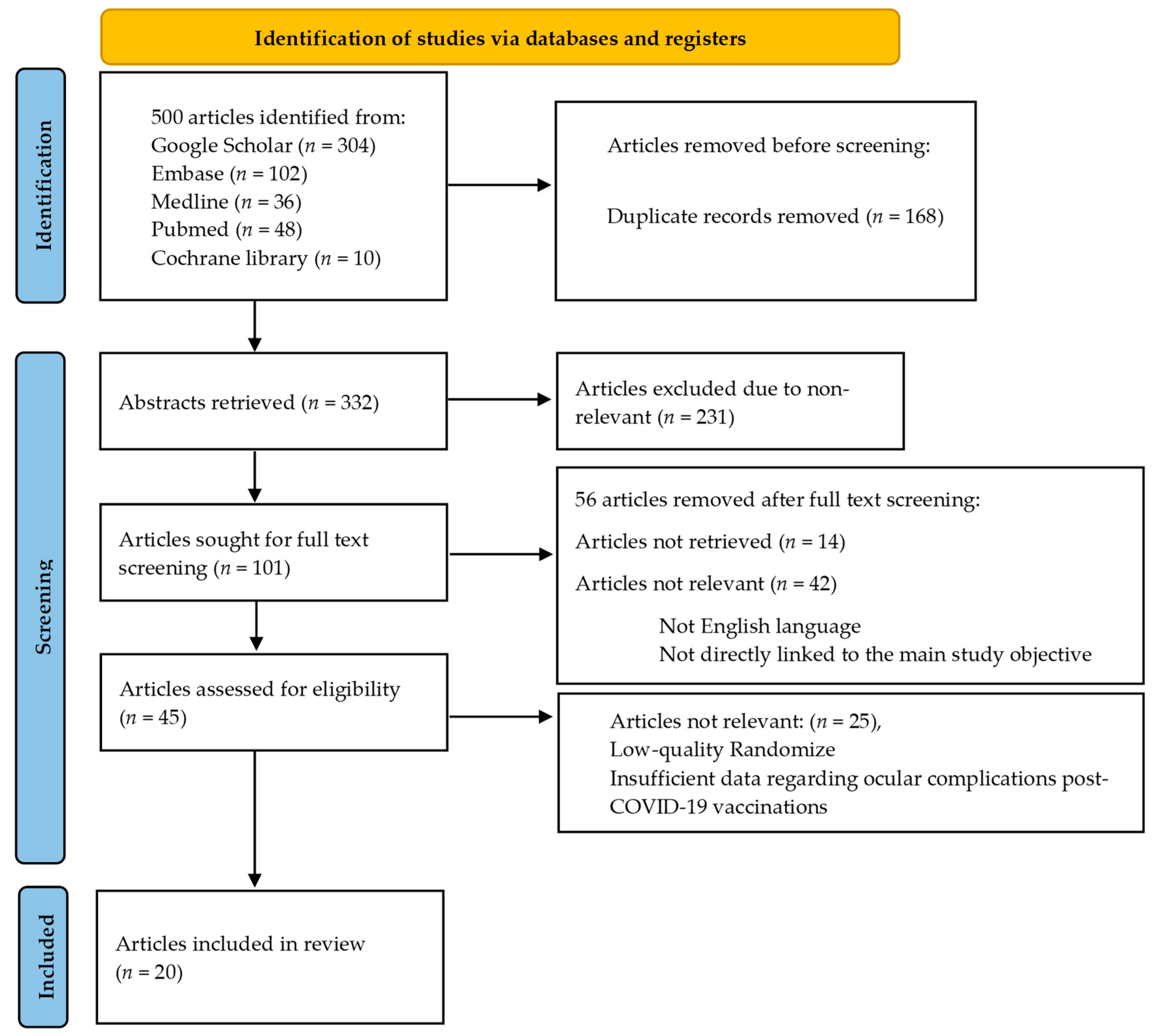
Research Strategy
3. Results
4. Discussion
5. Conclusions and Recommendations
Author Contributions
Funding
Institutional Review Board Statement
Informed Consent Statement
Data Availability Statement
Conflicts of Interest
References
- Le, T.T.; Andreadakis, Z.; Kumar, A.; Román, R.G.; Tollefsen, S.; Saville, M.; Mayhew, S. The COVID-19 vaccine development landscape. Nat. Rev. Drug Discov. 2020, 19, 305–306. [Google Scholar] [CrossRef] [Scilit]
- Saeed, B.Q.; Al-Shahrabi, R.; Alhaj, S.S.; Alkokhardi, Z.M.; Adrees, A.O. Side effects and perceptions following Sinopharm COVID-19 vaccination. Int. J. Infect. Dis. 2021, 111, 219–226. [Google Scholar] [CrossRef] [Scilit]
- Polack, F.P.; Thomas, S.J.; Kitchin, N.; Absalon, J.; Gurtman, A.; Lockhart, S.; Perez, J.L.; Pérez Marc, G.; Moreira, E.D.; Zerbini, C.; et al. Safety and efficacy of the BNT162b2 mRNA COVID-19 vaccine. N. Engl. J. Med. 2020, 383, 2603–2615. [Google Scholar] [CrossRef] [Scilit] [PubMed]
- Pulendran, B.; Li, S.; Nakaya, H.I. Systems Vaccinology. Immunity 2010, 33, 516–529. [Google Scholar] [CrossRef] [Scilit] [PubMed]
- Eleiwa, T.K.; Gaier, E.D.; Haseeb, A.; ElSheikh, R.H.; Sallam, A.B.; Elhusseiny, A.M. Adverse Ocular Events following COVID-19 Vaccination. Inflamm. Res. 2021, 70, 1005–1009. [Google Scholar] [CrossRef] [Scilit]
- Yu, S.; Ritterband, D.C.; Mehta, I.D. Acute Corneal Transplant Rejection after Severe Acute Respiratory Syndrome Coronavirus 2 mRNA-1273 Vaccination. Cornea 2022, 41, 257–259. [Google Scholar] [CrossRef] [Scilit] [PubMed]
- Yeo, S.; Kim, H.; Lee, J.; Yi, J.; Chung, Y.-R. Retinal vascular occlusions in COVID-19 infection and vaccination: A literature review. Graefe’s Arch. Clin. Exp. Ophthalmol. 2023, 261, 1793–1808. [Google Scholar] [CrossRef] [Scilit] [PubMed]
- Duran, M.; Aykaç, S. Optic neuritis after COVID-19 infection: A case report. J. Fr. D’ophtalmologie 2023, 46, e4–e7. [Google Scholar] [CrossRef] [Scilit] [PubMed]
- Roy, M.; Chandra, A.; Roy, S.; Shrotriya, C. Optic neuritis following COVID-19 vaccination: Coincidence or side-effect?-A case series. Indian J. Ophthalmol. 2022, 70, 679–683. [Google Scholar] [CrossRef] [Scilit] [PubMed]
- Alvarez, L.M.; Ning Neo, Y.; Davagnanam, I.; Ashenhurst, M.; Acheson, J.; Abdel-Hay, A.; Alshowaeir, D.; Bakheet, M.; Balaguer, O.; Batra, R.; et al. Post Vaccination Optic Neuritis: Observations from the SARS-CoV-2 Pandemic. SSRN Electron J. 2021; preprint. [CrossRef] [Scilit]
- ElSheikh, R.H.; Haseeb, A.; Eleiwa, T.K.; Elhusseiny, A.M. Acute Uveitis following COVID-19 Vaccination. Ocul. Immunol. Inflamm. 2021, 29, 1207–1209. [Google Scholar] [CrossRef] [Scilit]
- Younus, O.; Mulla, U. Posterior Scleritis Following COVID-19 Vaccination: A Case Report. Ocul. Immunol. Inflamm. 2022, 31, 638–640. [Google Scholar] [CrossRef] [Scilit]
- Testi, I.; Agrawal, R.; Pavesio, C.; Brandão-De-Resende, C.; Steeples, L.; Balasubramaniam, B.; McCluskey, P.; Pichi, F.; Agarwal, A.; Herbort, C.; et al. Ocular inflammatory events following COVID-19 vaccination: A multinational case series. J. Ophthalmic Inflamm. Infect. 2022, 12, 4. [Google Scholar] [CrossRef] [Scilit] [PubMed]
- Bolletta, E.; Iannetta, D.; Mastrofilippo, V.; De Simone, L.; Gozzi, F.; Croci, S.; Bonacini, M.; Belloni, L.; Zerbini, A.; Adani, C.; et al. Uveitis and Other Ocular Complications Following COVID-19 Vaccination. J. Clin. Med. 2021, 10, 5960. [Google Scholar] [CrossRef] [Scilit] [PubMed]
- Cohen, S.; Olshaker, H.; Fischer, N.; Vishnevskia-Dai, V.; Hagin, D.; Rosenblatt, A.; Zur, D.; Habot-Wilner, Z. Herpetic Eye Disease Following the SARS-CoV-2 Vaccinations. Ocul. Immunol. Inflamm. 2022, 31, 1151–1162. [Google Scholar] [CrossRef] [Scilit] [PubMed]
- Pang, K.; Pan, L.; Guo, H.; Wu, X. Case Report: Associated Ocular Adverse Reactions With Inactivated COVID-19 Vaccine in China. Front. Med. 2022, 8, 823346. [Google Scholar] [CrossRef] [Scilit] [PubMed]
- Amin, M.A.; Nahin, S.; Dola, T.A.; Afrin, S.; Hawlader, M.D.H. Retinal hemorrhage of late post-COVID-19 and post-vaccine-related pathogenic mechanisms: A new challenge for ophthalmologist in COVID era. Clin. Case Rep. 2022, 10, e05471. [Google Scholar] [CrossRef] [Scilit] [PubMed]
- Rallis, K.I.; Fausto, R.; Ting, D.S.J.; Al-Aqaba, M.A.; Said, D.G.; Dua, H.S. Manifestation of Herpetic Eye Disease after COVID-19 Vaccine: A UK Case Series. Ocul. Immunol. Inflamm. 2022, 30, 1136–1141. [Google Scholar] [CrossRef] [Scilit] [PubMed]
- Crnej, A.; Khoueir, Z.; Cherfan, G.; Saad, A. Acute corneal endothelial graft rejection following COVID-19 vaccination. J. Fr. D’ophtalmologie 2021, 44, e445–e447. [Google Scholar] [CrossRef] [Scilit]
- Alam Khan, T.; Sidhu, N.; Khan, L.M.; Sen, S.; Hussain, N.; Tandon, R.M.; Gupta, N.M. Bilateral Immune-Mediated Keratolysis after Immunization with SARS-CoV-2 Recombinant Viral Vector Vaccine. Cornea 2021, 40, 1629–1632. [Google Scholar] [CrossRef] [Scilit]
- Penbe, A. Peripheral Ulcerative Keratitis Secondary to the Inactive COVID-19 Vaccine-CoronaVac. Ocul. Immunol. Inflamm. 2022, 31, 536–540. [Google Scholar] [CrossRef] [Scilit]
- Farrell, D.A.; Deacon, S.; Mauger, T. Marginal keratitis following COVID 19 vaccination. IDCases 2022, 29, e01536. [Google Scholar] [CrossRef] [Scilit]
- Lee, J.Y.; Han, S.B. Case report of transient corneal edema after immunization with adenovirus-vectored COVID-19 vaccine. Medicine 2022, 101, e30041. [Google Scholar] [CrossRef] [Scilit]
- Cunha, L.P.; Atalla, Â.; Costa-Neto, J.d.M.; Costa-Cunha, L.V.F.; Preti, R.C.; Zacharias, L.C.; Monteiro, M.L.R. Multiple attacks of transient monocular visual loss in a previously healthy man: A possible complication after COVID-19 vaccination? Int. J. Retin. Vitr. 2022, 8, 43. [Google Scholar] [CrossRef] [Scilit]
- Lee, D.Y.; Wu, H.; Cheng, K.; Chang, Y. Disc edema in one eye and central serous chorioretinopathy in the other eye shortly after AstraZeneca COVID-19 vaccination. Kaohsiung J. Med. Sci. 2022, 38, 283–285. [Google Scholar] [CrossRef] [Scilit]
- Ferrand, N.; Accorinti, M.; Agarwal, M.; Spartalis, C.; Manni, P.; Stuebiger, N.; Zierhut, M. COVID-19 Vaccination and Uveitis: Epidemiology, Clinical Features and Visual Prognosis. Ocul. Immunol. Inflamm. 2022, 30, 1265–1273. [Google Scholar] [CrossRef] [Scilit]
- Kumari, S.; Anand, R.; Sambyal, B.; Singh, Y.; Rangappa, P.; Jha, S. Ocular adverse effects of COVID-19 vaccines: A systematic review. J. Fam. Med. Prim. Care 2022, 11, 5041–5054. [Google Scholar] [CrossRef] [Scilit]
- Pillar, S.; Weinberg, T.; Amer, R. Posterior ocular manifestations following BNT162b2 mRNA COVID-19 vaccine: A case series. Int. Ophthalmol. 2022, 43, 1677–1686. [Google Scholar] [CrossRef] [Scilit]
- Elnahry, A.G.; Al-Nawaflh, M.Y.; Eldin, A.A.G.; Solyman, O.; Sallam, A.B.; Phillips, P.H.; Elhusseiny, A.M. COVID-19 Vaccine-Associated Optic Neuropathy: A Systematic Review of 45 Patients. Vaccines 2022, 10, 1758. [Google Scholar] [CrossRef] [Scilit]
- Cheng, J.Y.; Margo, C.E. Ocular adverse events following vaccination: Overview and update. Surv. Ophthalmol. 2022, 67, 293–306. [Google Scholar] [CrossRef] [Scilit]
- Koganti, R.; Yadavalli, T.; Shukla, D. Current and Emerging Therapies for Ocular Herpes Simplex Virus Type-1 Infections. Microorganisms 2019, 7, 429. [Google Scholar] [CrossRef] [Scilit]
- Sonawane, N.; Yadav, D.; Kota, A.; Singh, H. Central retinal vein occlusion post-COVID-19 vaccination. Indian J. Ophthalmol. 2022, 70, 308–309. [Google Scholar] [CrossRef] [Scilit]
- Kuziez, L.; Eleiwa, T.K.; Chauhan, M.Z.; Sallam, A.B.; Elhusseiny, A.M.; Saeed, H.N. Corneal Adverse Events Associated with SARS-CoV-2/COVID-19 Vaccination: A Systematic Review. Vaccines 2023, 11, 166. [Google Scholar] [CrossRef] [Scilit]
- Amouzegar, A.; Chauhan, S.K.; Dana, R. Alloimmunity and Tolerance in Corneal Transplantation. J. Immunol. 2016, 196, 3983–3991. [Google Scholar] [CrossRef] [Scilit]
- Tahvildari, M.; Inomata, T.; Amouzegar, A.; Dana, R. Regulatory T Cell Modulation of Cytokine and Cellular Networks in Corneal Graft Rejection. Curr. Ophthalmol. Rep. 2018, 6, 266–274. [Google Scholar] [CrossRef] [Scilit]
- Dugan, S.P.; Mian, S.I. Impact of vaccination on keratoplasty. Curr. Opin. Ophthalmol. 2022, 33, 296–305. [Google Scholar] [CrossRef] [Scilit]
- Phylactou, M.; Li, J.-P.O.; Larkin, D.F.P. Characteristics of endothelial corneal transplant rejection following immunisation with SARS-CoV-2 messenger RNA vaccine. Br. J. Ophthalmol. 2021, 105, 893–896. [Google Scholar] [CrossRef] [Scilit]
- Di Zazzo, A.; Lee, S.-M.; Sung, J.; Niutta, M.; Coassin, M.; Mashaghi, A.; Inomata, T. Variable Responses to Corneal Grafts: Insights from Immunology and Systems Biology. J. Clin. Med. 2020, 9, 586. [Google Scholar] [CrossRef] [Scilit]
- Sahin, U.; Muik, A.; Vogler, I.; Derhovanessian, E.; Kranz, L.M.; Vormehr, M.; Quandt, J.; Bidmon, N.; Ulges, A.; Baum, A.; et al. BNT162b2 vaccine induces neutralizing antibodies and poly-specific T cells in humans. Nature 2021, 595, 572–577. [Google Scholar] [CrossRef] [Scilit]
- Lockington, D.M.; Lee, B.; Jeng, B.H.; Larkin, D.F.P.M.; Hjortdal, J. Survey of Corneal Surgeons’ Attitudes regarding Keratoplasty Rejection Risk Associated with Vaccinations. Cornea 2021, 40, 1541–1547. [Google Scholar] [CrossRef] [Scilit]
- Qazi, Y.; Hamrah, P. Corneal Allograft Rejection: Immunopathogenesis to Therapeutics. J. Clin. Cell. Immunol. 2013, 2013, 6. [Google Scholar] [CrossRef]
- Shah, A.P.M.; Dzhaber, D.; Kenyon, K.R.; Riaz, K.M.; Ouano, D.P.; Koo, E.H. Acute Corneal Transplant Rejection after COVID-19 Vaccination. Cornea 2022, 41, 121–124. [Google Scholar] [CrossRef] [Scilit]

| N | Author/Study Country | Type of Study | Population/Cases Number | Age/Sex | Vaccine | Time from Vaccines to Complications Occurrence | Ocular Complication |
|---|---|---|---|---|---|---|---|
| 1 | (Yu, Ritterband, & Mehta, 2022) [6] Kyoto/Japan | Case Report | 1 | 51/M | Moderna mRNA | Three days after immunization | Full-thickness corneal graft rejection with corneal edema, leading to transplant failure. |
| 2 | (Yeo, Kim, Lee, Yi, & Chung, 2023) [7] Suwon, Korea. | Retrospective | 26 | The mean age is 57 y range (27–76) M&F | either mRNA or adenoviral vector vaccines | Three weeks after vaccination | Thirty RVO cases, 14 RAO cases, and one case presented bilateral AMN and PAMM after the COVID-19 vaccine. |
| 3 | (Duran, & Aykac, 2023) [8] France | Case Report | 1 | 30/F | a single dose of BNT162b2 mRNA (Pfizer-BioNTech) | One year ago, | Optic neuritis (ON) |
| 4 | (Roy, Chandra, Roy, & Shrotriya, 2022) [9] India | Case Report | 3 | 27/F 48/F 40/M | Covishield vaccine AstraZeneca | 5–12 days after vaccination | Optic Neuritis (ON) |
| 5 | (Alvarez et al., 2021) [10] Birmingham/England | Observational. Cohort Study | 55 | Average age—45 years (range: 18–75) M&F | AstraZeneca, 38/55 Pfizer-BioNTech, 13/55 Sinovac, 4/55 | Average: 18 days (range: 1–69) | Optic Neuritis (ON); in all cases, 55 patients were diagnosed with (ON) after the COVID-19 vaccination |
| 6 | (ElSheikh, Hasee, Eleiwa, & Elhusseiny, 2021) [11] (NA) | A Retrospective Case Reports | 1 | 18/F | Sinopharm | Five days after the second dose of the Sinopharm | Bilateral anterior uveitis |
| 7 | Younus & Mulla (2022) [12] Glasgow, United State | Case Report | 1 | 78/F | COVID-19 vaccine | after the second dose. | Posterior Scleritis |
| 8 | (Testi et al., 2022) [13] London | A Multinational Case Series | 70 | The mean age was 51 years (range, 19–84 years) | Pfizer 40/ Astra-Zeneca, 17/Moderna10/ Sinopharm2, and Covaxin1 | 14 days following the COVID-19 vaccination The mean time to event was five days and six days (range, 1–14 days) after the first and second doses of the vaccine, respectively | ocular inflammatory event Anterior uveitis (n = 41, 58.6%), posterior uveitis (n = 9, 12.9%), and scleritis (n = 7, 10.0%) |
| 9 | (Bolletta et al., 2021) [14] Italy | Retrospective Study | 34 14 M 20 F | a mean age of 49.8 years (range 18–83 years) | Pfizer23/ Astra-Zeneca7/, Moderna3/, Janseen (Ad26.COV2)1. | (Range 1–30 days). | Uveitis and other ocular complications. The cases were (3) herpetic keratitis, (2) anterior scleritis, (5) anterior uveitis (AU), (3) toxoplasma retinochoroiditis, (2) Vogt-Koyanagi-Harada (VKH) disease reactivations, (2) pars planitis, (2) retinal vasculitis, (1) bilateral panuveitis in new-onset Behçet’s disease, (3) multiple, evanescent white dot syndromes (MEWDS), (1) acute macular neuroretinopathy (AMN), (5) retinal vein occlusions (RVO), (1) non-arteritic ischemic optic neuropathy (NAION), (3) activations of quiescent choroidal neovascularization (CNV) secondary due to myopia or uveitis, and (1) central serous chorioretinopathy (CSCR) |
| 10 | (Cohen et al., 2022) [15] Israel | A Retrospective Study | 24 (a cohort of 5 patients and 19 literature cases) | NA | Pfizer BioNTech BNT162b2mRNA | 28 days post-vaccination | Herpetic ocular infections |
| 11 | (Pang, Pan, Guo, & Wu, 2022) [16] China | Case Report | 9 7 F 2 M | The mean (SD) age was 44.7 ± 16.5 years (range, 19–78 years) | inactivated COVID-19 vaccine. | Average 7.1 days (within a range of 1–14 days). post-vaccination | 4 cases of keratitis, 1 case of choroiditis, 1 case of uveitis, 1 case of scleritis, 1 case of acute retinal necrosis, and 1 case of iridocyclitis |
| 12 | (Amin et al., 2022) [17] Bangladesh | Case Report | 1 | 41/M | a live virus vector (COVISHIELD vaccine-AstraZeneca) | average five months | retinal hemorrhage. |
| 13 | (Rallis, et al., 2022) [18] (UK) | Retrospective Analysis | 10 | NA | Pfizer Astra-Zeneca, Moderna, Sinopharm, and Covaxin | Twenty-eight days after the first dose of the COVID-19 vaccination. | Herpetic Eye Disease |
| 14 | Crnej, Khoueir, Cherfan, & Saad, 2021) [19] (NA) | Case Reports | 1 | 71/M | BNT162b2 mRNA (BioNTech/Pfizer) | seven days after the first vaccination dosage. | Corneal endothelial transplant rejection |
| 15 | (Khan et al., 2021) [20] (NA) | Case Report | 1 | 48/M | AstraZeneca | Five weeks following the initial dosage | Bilateral immune-mediated corneal melting and necrosis |
| 16 | (Penbe, 2022) [21] Turkey | Case Report | 1 | 67/M | inactive vaccine for SARS-CoV-2 | NA | Peripheral ulcerative keratitis (PUK) with nodular scleritis |
| 17 | Farrell, Deacon, & Mauger, 2022) [22] (USA) | Case Report | 1 | 68/F | Moderna | 2.5 weeks after the first dose | Marginal keratitis |
| 18 | (Lee & Han, 2022) [23] Korea | Case Report | 1 | 55/F | AstraZeneca | Six days after | Bilateral transient corneal edema |
| 19 | Cunha et al., 2022) [24] Brazil | Case Report | 1 | 50/M | Pfizer-BioNTech | Two weeks after | Recurrent transitory monocular visual loss attacks |
| 20 | Lee, Wu, Cheng, & Chang, 2022) [25] Taiwan | Case Report | 1 | 41/F | Vaxzevria, AstraZeneca | Two days after | Central serous chorioretinopathy with disc edema in the other eye |
| Ocular Complication | Percent | Number |
|---|---|---|
| Ocular inflammatory complications include “uveitis, anterior uveitis, posterior uveitis, scleritis, posterior scleritis, choroiditis, keratitis, acute retinal necrosis, and iridocyclitis” | (47.3%) | 115 |
| “Optic neuritis” | (24.3%) | 59 |
| “Herpetic eye disease” | (14%) | 34 |
| Retinal artery occlusion, retinal vein occlusion, acute macular neuroretinopathy, paracentral acute middle maculopathy | (10.7%) | 26 |
| Corneal endothelial transplant rejection | (0.4%) | 1 |
| Full-thickness corneal graft rejection leads to transplant failure | (0.4%) | 1 |
| Retinal hemorrhage. | (0.4%) | 1 |
| Bilateral immune-mediated corneal melting and necrosis | (0.4%) | 1 |
| Marginal keratitis | (0.4%) | 1 |
| Peripheral ulcerative keratitis (PUK) with nodular scleritis | (0.4%) | 1 |
| Bilateral transient corneal edema | (0.4%) | 1 |
| Recurrent transitory monocular visual loss attacks | (0.4%) | 1 |
| Central serous chorioretinopathy with disc edema in the other eye | (0.4%) | 1 |
| Ocular Complications | Vaccine Type | Cases Number (Total = 243) | Cases Percent % |
|---|---|---|---|
| Ocular inflammatory complications “Uveitis, Anterior uveitis, posterior uveitis, scleritis, Posterior Scleritis, Choroiditis, keratitis acute retinal necrosis and iridocyclitis” | Pfizer Astrazeneca, Moderna (Ad26.COV2) Sinopharm Covaxin Janssen Inactivated COVID-19 vaccine. | 63 24 13 9 3 1 1 1 | 25.9% 9.9% 5.3% 3.7% 1.2% 0.41% 0.41% 0.41% |
| “Optic Neuritis” | AstraZeneca Pfizer Sinovac | 41 14 4 | 16.9% 5.8% 1.6% |
| Retinal artery occlusion, Retinal vein occlusion, acute macular neuroretinopathy, and Paracentral acute middle maculopathy | mRNA and adenoviral vector vaccines | 26 | 10.7% |
| “Herpetic eye disease” | Pfizer Pfizer, Astra-Zeneca, Moderna, Sinopharm, and Covaxin | 24 10 | 9.9% 4.1% |
| Corneal endothelial transplant rejection | Pfizer | 1 | 0.41% |
| Full-thickness corneal graft rejection leads to transplant failure | Moderna | 1 | 0.41% |
| Retinal hemorrhage | AstraZeneca | 1 | 0.41% |
| Bilateral immune-mediated corneal melting and necrosis | AstraZeneca | 1 | 0.41% |
| Marginal keratitis | Moderna | 1 | 0.41% |
| Peripheral ulcerative keratitis (PUK) with nodular scleritis | inactive vaccine | 1 | 0.41% |
| Bilateral transient corneal edema | AstraZeneca | 1 | 0.41% |
| Recurrent transitory monocular visual loss attacks | Pfizer | 1 | 0.41% |
| Central serous chorioretinopathy with disc edema in the other eye | AstraZeneca | 1 | 0.41% |
Disclaimer/Publisher’s Note: The statements, opinions and data contained in all publications are solely those of the individual author(s) and contributor(s) and not of MDPI and/or the editor(s). MDPI and/or the editor(s) disclaim responsibility for any injury to people or property resulting from any ideas, methods, instructions or products referred to in the content. |
© 2024 by the authors. Licensee MDPI, Basel, Switzerland. This article is an open access article distributed under the terms and conditions of the Creative Commons Attribution (CC BY) license (https://creativecommons.org/licenses/by/4.0/).
Share and Cite
Hurissi, E.A.; Abuallut, I.I.; Dibaji, M.Q.; Jaly, A.; Alhazmi, A.H.; Abuageelah, B.M.; Alameer, K.M.; Alyami, Y.M. Ocular Complications after COVID-19 Vaccination: A Systematic Review. Medicina 2024, 60, 249. https://doi.org/10.3390/medicina60020249
Hurissi EA, Abuallut II, Dibaji MQ, Jaly A, Alhazmi AH, Abuageelah BM, Alameer KM, Alyami YM. Ocular Complications after COVID-19 Vaccination: A Systematic Review. Medicina. 2024; 60(2):249. https://doi.org/10.3390/medicina60020249
Chicago/Turabian StyleHurissi, Eman A., Ismail I. Abuallut, Mohammed Qassem Dibaji, Abdulaziz Jaly, Abdulaziz H. Alhazmi, Bandar M. Abuageelah, Khalid M. Alameer, and Yousef M. Alyami. 2024. "Ocular Complications after COVID-19 Vaccination: A Systematic Review" Medicina 60, no. 2: 249. https://doi.org/10.3390/medicina60020249
APA StyleHurissi, E. A., Abuallut, I. I., Dibaji, M. Q., Jaly, A., Alhazmi, A. H., Abuageelah, B. M., Alameer, K. M., & Alyami, Y. M. (2024). Ocular Complications after COVID-19 Vaccination: A Systematic Review. Medicina, 60(2), 249. https://doi.org/10.3390/medicina60020249

