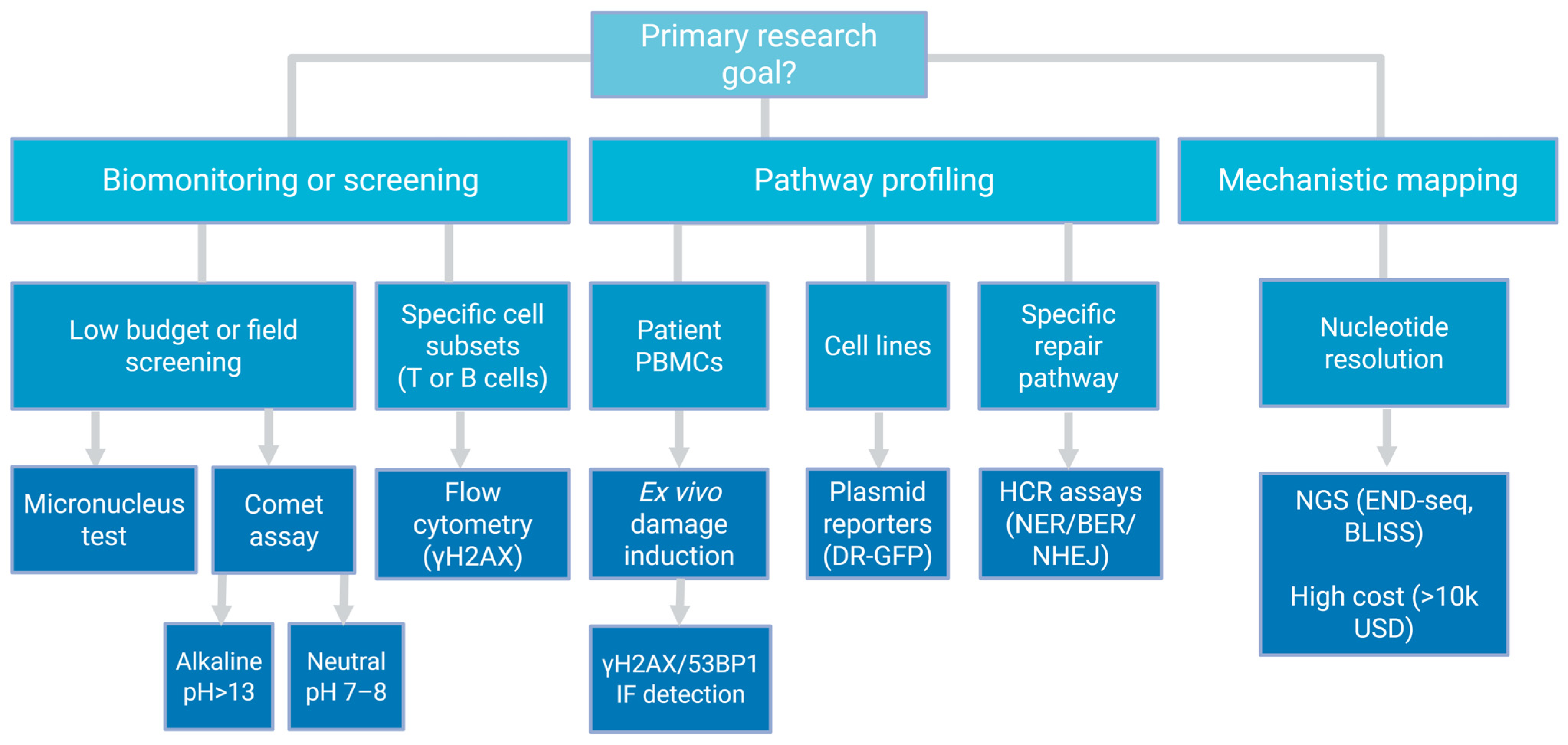
Functional DNA Repair Profiling in Translational Medicine: Benchmarking Comet, γH2AX, and NGS Assays Against Clinical Constraints

 ,
,
Abstract
1. Introduction: The Translational Gap in DNA Repair Profiling
2. The Gold Standard Revisited: Comet Assay Variants and Applications
2.1. Alkaline vs. Neutral: What You Detect Depends on What You Dissolve
2.2. Enzyme-Modified Comets: Unmasking Oxidative Damage
2.3. Metrics, Throughput, and the Tail Length Fallacy
2.4. From Damage Measurement to Repair Capacity: The Challenge Assay
2.5. Quantification of Repair Kinetics: Metrics and Temporal Considerations
3. Surrogate Markers of Signaling: γH2AX and 53BP1 Analysis
3.1. The Biology of γH2AX: Amplification and Its Consequences
3.2. Pathway Choice: The 53BP1/BRCA1 Antagonism
3.3. Imaging Approaches: Resolution, Throughput, and Their Trade-Offs
4. Beyond the Microscope: NGS-Based Break Mapping
4.1. Nucleotide-Resolution Break Mapping
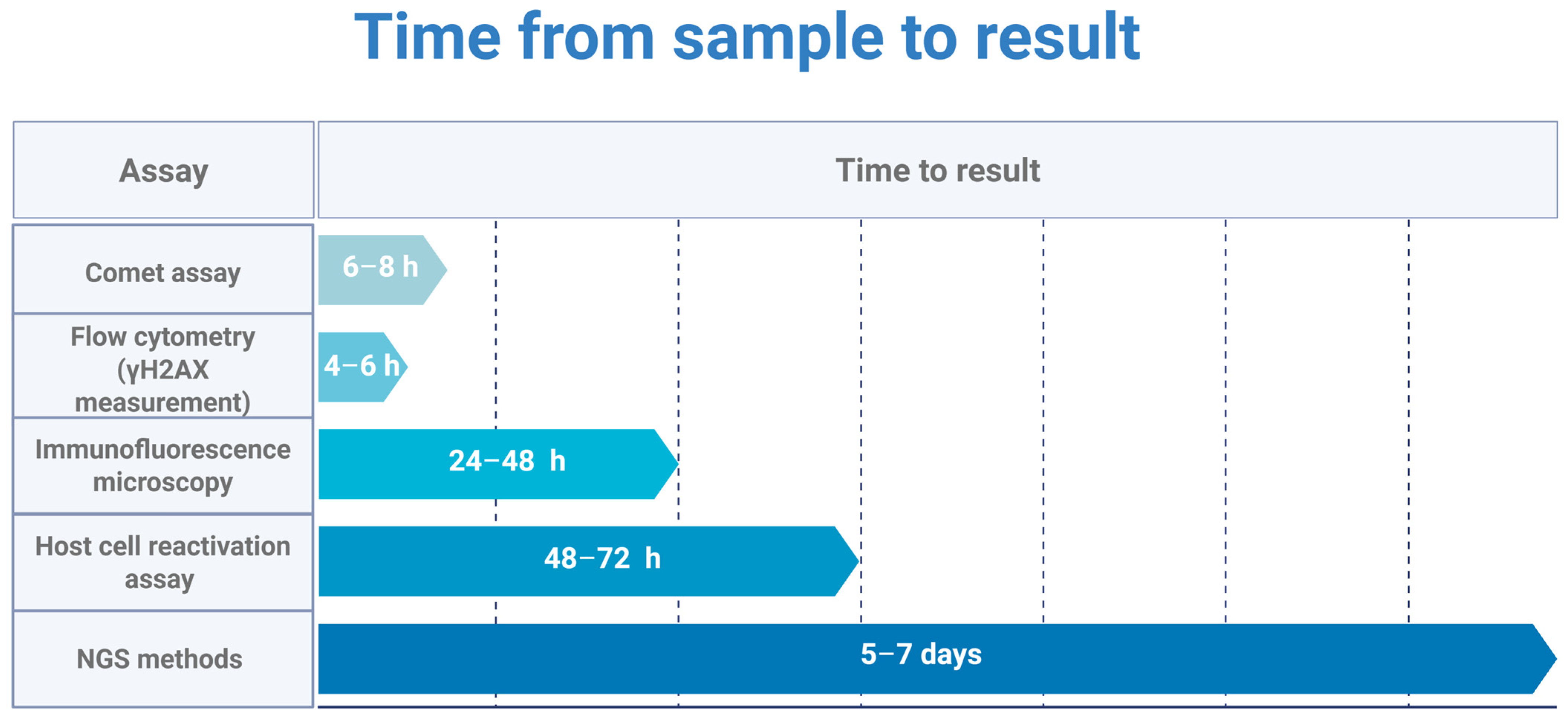
4.2. Practical Barriers: Why NGS Remains a Research Tool
5. The Clinical Minefield: Pre-Analytical Variables and Confounders
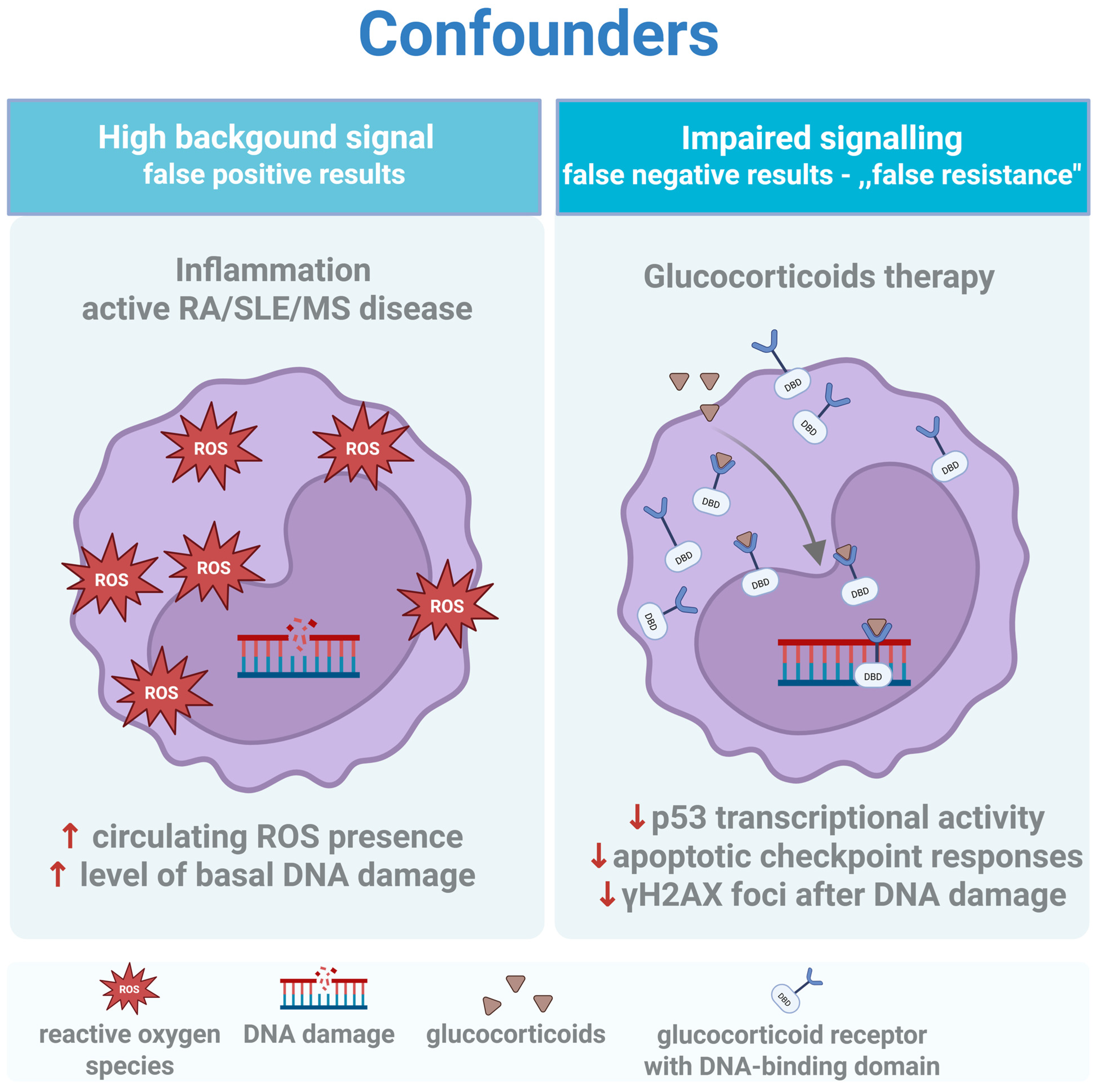
5.1. Pharmacological and Inflammatory Confounders
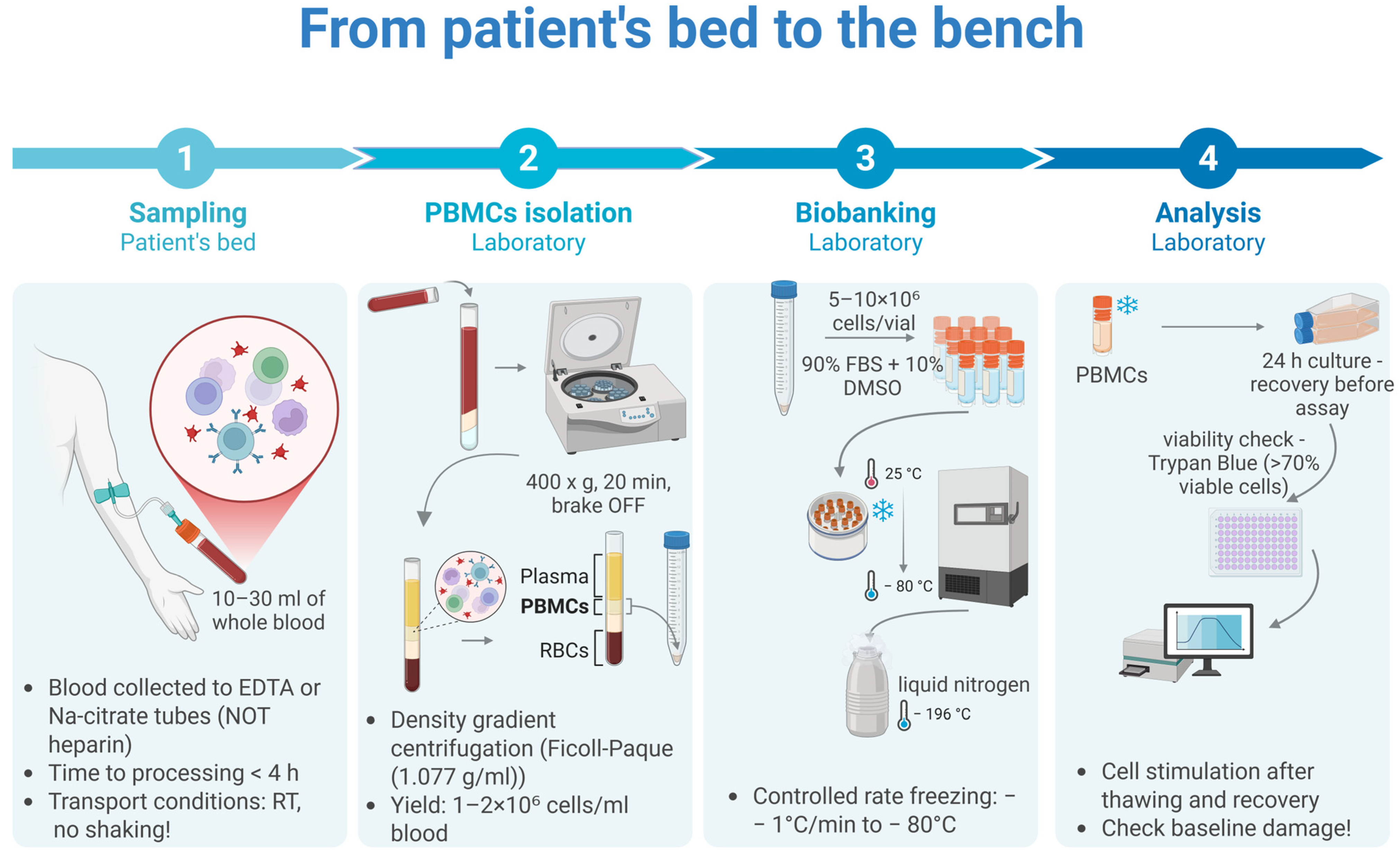
5.2. Biobanking for Functional Assays: From Passive Storage to DDR Fidelity
5.3. Post-Thaw Handling: The Recovery Imperative and the “Ghost” Artifact
6. Towards Standardization: Validation, Reporting, and Regulatory Compliance
6.1. The Variability Crisis and the hComet Response
6.2. Regulatory Hurdles: The Absence of Certified Reference Materials
6.3. A Minimum Reporting Standard for DRC Studies
7. Conclusions and Future Perspectives
- For researchers: We recommend adopting challenge-recovery designs over static measurements, reporting all pre-analytical variables, and employing Internal Quality Controls with appropriate normalization. Manuscripts should provide sufficient methodological detail to enable replication—undisclosed critical methods undermine the field’s credibility and slow clinical translation.
- For journals: We encourage requiring MIDRP-compliant reporting as a condition of publication. Manuscripts claiming clinical relevance should document sample handling to a standard that allows critical evaluation of potential confounders.
- For biobanks: Functional assays demand different quality standards than molecular extraction. We recommend implementing sentinel vial QC protocols and documenting ischemia thresholds as part of routine biobanking practice.
- For regulators: Investment in Certified Reference Material development is essential. Without CRMs, DRC assays cannot achieve the evidentiary standard required for companion diagnostic approval—a gap that currently blocks clinical translation.
Author Contributions
Funding
Institutional Review Board Statement
Informed Consent Statement
Data Availability Statement
Conflicts of Interest
Abbreviations
| 53BP1 | p53-Binding Protein 1 |
| ATM | Ataxia Telangiectasia Mutated |
| ATR | Ataxia Telangiectasia and Rad3-Related |
| AUC | Area Under the Curve |
| BER | Base Excision Repair |
| BLISS | Breaks Labeling In Situ and Sequencing |
| BRCA1/2 | Breast Cancer Gene 1/2 |
| CLIA | Clinical Laboratory Improvement Amendments |
| CRM | Certified Reference Material |
| CtIP | C-terminal Binding Protein Interacting Protein |
| CV | Coefficient of Variation |
| DDR | DNA Damage Response |
| DMARD | Disease-Modifying Antirheumatic Drug |
| DMSO | Dimethyl Sulfoxide |
| DNA-PKcs | DNA-dependent Protein Kinase Catalytic Subunit |
| DRC | DNA Repair Capacity |
| DSB | Double-Strand Break |
| Fpg | Formamidopyrimidine DNA Glycosylase |
| GR | Glucocorticoid Receptor |
| H2O2 | Hydrogen Peroxide |
| HCS | High-Content Screening |
| HCR | Host Cell Reactivation |
| hOGG1 | Human 8-Oxoguanine DNA Glycosylase 1 |
| HR | Homologous Recombination |
| HRD | Homologous Recombination Deficiency |
| IF | Immunofluorescence |
| IQC | Internal Quality Control |
| ISO | International Organization for Standardization |
| JRA | Juvenile Rheumatoid Arthritis |
| MDM2 | Mouse Double Minute 2 Homolog |
| MFI | Mean Fluorescence Intensity |
| MIDRP | Minimum Information for DNA Repair Profiling |
| MRN | Mre11-Rad50-Nbs1 Complex |
| MS | Multiple Sclerosis |
| MTX | Methotrexate |
| MUTYH | MutY DNA Glycosylase |
| NEIL3 | Nei-Like DNA Glycosylase 3 |
| NER | Nucleotide Excision Repair |
| NGS | Next-Generation Sequencing |
| NHEJ | Non-Homologous End Joining |
| NSAID | Non-Steroidal Anti-Inflammatory Drug |
| Nth | Endonuclease III |
| PARP | Poly(ADP-Ribose) Polymerase |
| PBMC | Peripheral Blood Mononuclear Cell |
| PHA | Phytohemagglutinin |
| PI | Propidium Iodide |
| QC | Quality Control |
| RA | Rheumatoid Arthritis |
| RAD51 | RAD51 Recombinase |
| RIF1 | Replication Timing Regulatory Factor 1 |
| ROS | Reactive Oxygen Species |
| RPA | Replication Protein A |
| SCGE | Single Cell Gel Electrophoresis |
| SLE | Systemic Lupus Erythematosus |
| SSB | Single-Strand Break |
| TBH | tert-Butyl Hydroperoxide |
| TNF-α | Tumor Necrosis Factor Alpha |
| UNG | Uracil DNA Glycosylase |
| WGS | Whole-Genome Sequencing |
| γH2AX | Phosphorylated Histone H2AX (Ser139) |
References
- De Soto, J.A.; Wang, X.; Tominaga, Y.; Wang, R.-H.; Cao, L.; Qiao, W.; Li, C.; Xu, X.; Skoumbourdis, A.P.; Prindiville, S.A.; et al. The Inhibition and Treatment of Breast Cancer with Poly (ADP-Ribose) Polymerase (PARP-1) Inhibitors. Int. J. Biol. Sci. 2006, 2, 179–185. [Google Scholar] [CrossRef][Green Version]
- Farmer, H.; McCabe, N.; Lord, C.J.; Tutt, A.N.J.; Johnson, D.A.; Richardson, T.B.; Santarosa, M.; Dillon, K.J.; Hickson, I.; Knights, C.; et al. Targeting the DNA Repair Defect in BRCA Mutant Cells as a Therapeutic Strategy. Nature 2005, 434, 917–921. [Google Scholar] [CrossRef] [PubMed]
- Bryant, H.E.; Schultz, N.; Thomas, H.D.; Parker, K.M.; Flower, D.; Lopez, E.; Kyle, S.; Meuth, M.; Curtin, N.J.; Helleday, T. Specific Killing of BRCA2-Deficient Tumours with Inhibitors of Poly(ADP-Ribose) Polymerase. Nature 2005, 434, 913–917, Addendum in Nature 2007, 447, 346. [Google Scholar] [CrossRef]
- Ludwig, T.; Fisher, P.; Ganesan, S.; Efstratiadis, A. Tumorigenesis in Mice Carrying a Truncating Brca1 Mutation. Genes Dev. 2001, 15, 1188–1193. [Google Scholar] [CrossRef]
- Esteller, M.; Silva, J.M.; Dominguez, G.; Bonilla, F.; Matias-Guiu, X.; Lerma, E.; Bussaglia, E.; Prat, J.; Harkes, I.C.; Repasky, E.A.; et al. Promoter Hypermethylation and BRCA1 Inactivation in Sporadic Breast and Ovarian Tumors. J. Natl. Cancer Inst. 2000, 92, 564–569. [Google Scholar] [CrossRef]
- Murai, J.; Pommier, Y. BRCAness, Homologous Recombination Deficiencies, and Synthetic Lethality. Cancer Res. 2023, 83, 1173–1174. [Google Scholar] [CrossRef] [PubMed]
- Jackson, S.P.; Bartek, J. The DNA-Damage Response in Human Biology and Disease. Nature 2009, 461, 1071–1078. [Google Scholar] [CrossRef]
- Fenton, M.; Bone, N.; Sinclair, A.J. The Efficient and Rapid Import of a Peptide into Primary B and T Lymphocytes and a Lymphoblastoid Cell Line. J. Immunol. Methods 1998, 212, 41–48. [Google Scholar] [CrossRef] [PubMed]
- Piett, C.G.; Pecen, T.J.; Laverty, D.J.; Nagel, Z.D. Large-Scale Preparation of Fluorescence Multiplex Host Cell Reactivation (FM-HCR) Reporters. Nat. Protoc. 2021, 16, 4265–4298. [Google Scholar] [CrossRef]
- Nasrallah, N.A.; Zhou, H.; Smith, P.A.; Sears, C.R. DNA Repair Capacity for Personalizing Risk and Treatment Response—Assay Development and Optimization in Human Peripheral Blood Mononuclear Cells (PBMCs). DNA Repair 2022, 111, 103274. [Google Scholar] [CrossRef]
- Rübe, C.E.; Grudzenski, S.; Kühne, M.; Dong, X.; Rief, N.; Löbrich, M.; Rübe, C. DNA Double-Strand Break Repair of Blood Lymphocytes and Normal Tissues Analysed in a Preclinical Mouse Model: Implications for Radiosensitivity Testing. Clin. Cancer Res. 2008, 14, 6546–6555. [Google Scholar] [CrossRef] [PubMed]
- Galita, G.; Sarnik, J.; Zajac, G.; Brzezinska, O.; Budlewski, T.; Poplawska, M.; Przybyłowska-Sygut, K.; Makowska, J.S.; Poplawski, T. The Association between Inefficient Repair of Oxidative DNA Lesions and Common Polymorphisms of the Key Base Excision Repair Genes as Well as Their Expression Levels in Patients with Rheumatoid Arthritis. Arch. Med. Sci. 2025, 21, 1010–1017. [Google Scholar] [CrossRef] [PubMed]
- Micheli, C.; Parma, A.; Tani, C.; Di Bello, D.; Falaschi, A.; Chiaramonte, A.; Testi, S.; Mosca, M.; Scarpato, R. UCTD and SLE Patients Show Increased Levels of Oxidative and DNA Damage Together with an Altered Kinetics of DSB Repair. Mutagenesis 2021, 36, 429–436. [Google Scholar] [CrossRef] [PubMed]
- Souliotis, V.L.; Vlachogiannis, N.I.; Pappa, M.; Argyriou, A.; Ntouros, P.A.; Sfikakis, P.P. DNA Damage Response and Oxidative Stress in Systemic Autoimmunity. Int. J. Mol. Sci. 2019, 21, 55. [Google Scholar] [CrossRef]
- Lonkar, P.; Dedon, P.C. Reactive Species and DNA Damage in Chronic Inflammation: Reconciling Chemical Mechanisms and Biological Fates. Int. J. Cancer 2011, 128, 1999–2009. [Google Scholar] [CrossRef]
- Mak, A.; Kow, N.Y. The Pathology of T Cells in Systemic Lupus Erythematosus. J. Immunol. Res. 2014, 2014, 419029. [Google Scholar] [CrossRef]
- Perl, A. Oxidative Stress in the Pathology and Treatment of Systemic Lupus Erythematosus. Nat. Rev. Rheumatol. 2013, 9, 674–686. [Google Scholar] [CrossRef]
- Marino, M.; Gigliotti, L.; Møller, P.; Riso, P.; Porrini, M.; Del Bo, C. Impact of 12-Month Cryopreservation on Endogenous DNA Damage in Whole Blood and Isolated Mononuclear Cells Evaluated by the Comet Assay. Sci. Rep. 2021, 11, 363. [Google Scholar] [CrossRef]
- Bausinger, J.; Speit, G. The Impact of Lymphocyte Isolation on Induced DNA Damage in Human Blood Samples Measured by the Comet Assay. Mutagenesis 2016, 31, 567–572. [Google Scholar] [CrossRef]
- Fauci, A.S.; Dale, D.C. The Effect of in Vivo Hydrocortisone on Subpopulations of Human Lymphocytes. J. Clin. Investig. 1974, 53, 240–246. [Google Scholar] [CrossRef]
- Collins, A.; Møller, P.; Gajski, G.; Vodenková, S.; Abdulwahed, A.; Anderson, D.; Bankoglu, E.E.; Bonassi, S.; Boutet-Robinet, E.; Brunborg, G.; et al. Measuring DNA Modifications with the Comet Assay: A Compendium of Protocols. Nat. Protoc. 2023, 18, 929–989. [Google Scholar] [CrossRef] [PubMed]
- Møller, P.; Azqueta, A.; Collia, M.; Bakuradze, T.; Richling, E.; Bankoglu, E.E.; Stopper, H.; Bastos, V.C.; Langie, S.A.S.; Jensen, A.; et al. Inter-Laboratory Variation in Measurement of DNA Damage by the Alkaline Comet Assay in the hCOMET Ring Trial. Mutagenesis 2023, 38, 283–294. [Google Scholar] [CrossRef]
- Singh, N.P.; McCoy, M.T.; Tice, R.R.; Schneider, E.L. A Simple Technique for Quantitation of Low Levels of DNA Damage in Individual Cells. Exp. Cell Res. 1988, 175, 184–191. [Google Scholar] [CrossRef]
- Tice, R.R.; Agurell, E.; Anderson, D.; Burlinson, B.; Hartmann, A.; Kobayashi, H.; Miyamae, Y.; Rojas, E.; Ryu, J.C.; Sasaki, Y.F. Single Cell Gel/Comet Assay: Guidelines for in Vitro and in Vivo Genetic Toxicology Testing. Environ. Mol. Mutagen. 2000, 35, 206–221. [Google Scholar] [CrossRef]
- Bivehed, E.; Hellman, B.; Fan, Y.; Haglöf, J.; Buratovic, S. DNA Integrity under Alkaline Conditions: An Investigation of Factors Affecting the Comet Assay. Mutat. Res. Genet. Toxicol. Environ. Mutagen. 2023, 891, 503680. [Google Scholar] [CrossRef]
- Choucroun, P.; Gillet, D.; Dorange, G.; Sawicki, B.; Dewitte, J.D. Comet Assay and Early Apoptosis. Mutat. Res. 2001, 478, 89–96. [Google Scholar] [CrossRef]
- Zheng, C.; Shaposhnikov, S.; Collins, A.; Brunborg, G.; Oancea, F.; Van Schooten, F.-J.; Godschalk, R. Comparison of Comet-Based Approaches to Assess Base Excision Repair. Arch. Toxicol. 2023, 97, 2273–2281. [Google Scholar] [CrossRef]
- Collins, A.R. The Comet Assay for DNA Damage and Repair: Principles, Applications, and Limitations. Mol. Biotechnol. 2004, 26, 249–261. [Google Scholar] [CrossRef] [PubMed]
- Collins, A.R.; El Yamani, N.; Lorenzo, Y.; Shaposhnikov, S.; Brunborg, G.; Azqueta, A. Controlling Variation in the Comet Assay. Front. Genet. 2014, 5, 359. [Google Scholar] [CrossRef] [PubMed]
- Meintières, S.; Nesslany, F.; Pallardy, M.; Marzin, D. Detection of Ghost Cells in the Standard Alkaline Comet Assay Is Not a Good Measure of Apoptosis. Environ. Mol. Mutagen. 2003, 41, 260–269. [Google Scholar] [CrossRef]
- Collins, A.R. Measuring Oxidative Damage to DNA and Its Repair with the Comet Assay. Biochim. Biophys. Acta 2014, 1840, 794–800. [Google Scholar] [CrossRef]
- Azqueta, A.; Shaposhnikov, S.; Collins, A.R. DNA Oxidation: Investigating Its Key Role in Environmental Mutagenesis with the Comet Assay. Mutat. Res. 2009, 674, 101–108. [Google Scholar] [CrossRef]
- Azqueta, A.; Slyskova, J.; Langie, S.A.S.; O’Neill Gaivão, I.; Collins, A. Comet Assay to Measure DNA Repair: Approach and Applications. Front. Genet. 2014, 5, 288. [Google Scholar] [CrossRef] [PubMed]
- McCurdy, D.; Tai, L.Q.; Frias, S.; Wang, Z. Delayed Repair of DNA Damage by Ionizing Radiation in Cells from Patients with Juvenile Systemic Lupus Erythematosus and Rheumatoid Arthritis. Radiat. Res. 1997, 147, 48–54. [Google Scholar] [CrossRef] [PubMed]
- Muruzabal, D.; Langie, S.A.S.; Pourrut, B.; Azqueta, A. The Enzyme-Modified Comet Assay: Enzyme Incubation Step in 2 vs 12-Gels/Slide Systems. Mutat. Res. Genet. Toxicol. Environ. Mutagen. 2019, 845, 402981. [Google Scholar] [CrossRef]
- Johansson, C.; Møller, P.; Forchhammer, L.; Loft, S.; Godschalk, R.W.L.; Langie, S.A.S.; Lumeij, S.; Jones, G.D.D.; Kwok, R.W.L.; Azqueta, A.; et al. An ECVAG Trial on Assessment of Oxidative Damage to DNA Measured by the Comet Assay. Mutagenesis 2010, 25, 125–132. [Google Scholar] [CrossRef]
- Muruzabal, D.; Sanz-Serrano, J.; Sauvaigo, S.; Treillard, B.; Olsen, A.-K.; López de Cerain, A.; Vettorazzi, A.; Azqueta, A. Validation of the in Vitro Comet Assay for DNA Cross-Links and Altered Bases Detection. Arch. Toxicol. 2021, 95, 2825–2838. [Google Scholar] [CrossRef]
- El Yamani, N.; Rundén-Pran, E.; Collins, A.R.; Longhin, E.M.; Elje, E.; Hoet, P.; Vinković Vrček, I.; Doak, S.H.; Fessard, V.; Dusinska, M. The Miniaturized Enzyme-Modified Comet Assay for Genotoxicity Testing of Nanomaterials. Front. Toxicol. 2022, 4, 986318. [Google Scholar] [CrossRef]
- Kumaravel, T.S.; Jha, A.N. Reliable Comet Assay Measurements for Detecting DNA Damage Induced by Ionising Radiation and Chemicals. Mutat. Res. 2006, 605, 7–16. [Google Scholar] [CrossRef]
- Møller, P.; Azqueta, A.; Boutet-Robinet, E.; Koppen, G.; Bonassi, S.; Milić, M.; Gajski, G.; Costa, S.; Teixeira, J.P.; Costa Pereira, C.; et al. Minimum Information for Reporting on the Comet Assay (MIRCA): Recommendations for Describing Comet Assay Procedures and Results. Nat. Protoc. 2020, 15, 3817–3826. [Google Scholar] [CrossRef] [PubMed]
- Ersson, C.; Møller, P.; Forchhammer, L.; Loft, S.; Azqueta, A.; Godschalk, R.W.L.; van Schooten, F.-J.; Jones, G.D.D.; Higgins, J.A.; Cooke, M.S.; et al. An ECVAG Inter-Laboratory Validation Study of the Comet Assay: Inter-Laboratory and Intra-Laboratory Variations of DNA Strand Breaks and FPG-Sensitive Sites in Human Mononuclear Cells. Mutagenesis 2013, 28, 279–286. [Google Scholar] [CrossRef]
- Forchhammer, L.; Johansson, C.; Loft, S.; Möller, L.; Godschalk, R.W.L.; Langie, S.A.S.; Jones, G.D.D.; Kwok, R.W.L.; Collins, A.R.; Azqueta, A.; et al. Variation in the Measurement of DNA Damage by Comet Assay Measured by the ECVAG Inter-Laboratory Validation Trial. Mutagenesis 2010, 25, 113–123. [Google Scholar] [CrossRef]
- Lee, T.; Lee, S.; Sim, W.Y.; Jung, Y.M.; Han, S.; Won, J.-H.; Min, H.; Yoon, S. HiComet: A High-Throughput Comet Analysis Tool for Large-Scale DNA Damage Assessment. BMC Bioinform. 2018, 19, 44, Correction in BMC Bioinform. 2018, 19, 170. https://doi.org/10.1186/s12859-018-2186-2.. [Google Scholar] [CrossRef]
- Gyori, B.M.; Venkatachalam, G.; Thiagarajan, P.S.; Hsu, D.; Clement, M.-V. OpenComet: An Automated Tool for Comet Assay Image Analysis. Redox Biol. 2014, 2, 457–465, Corrigendum in Redox Biol. 2021, 40, 101876. https://doi.org/10.1016/j.redox.2021.101876.. [Google Scholar] [CrossRef] [PubMed]
- Collins, A.R.; Oscoz, A.A.; Brunborg, G.; Gaivão, I.; Giovannelli, L.; Kruszewski, M.; Smith, C.C.; Stetina, R. The Comet Assay: Topical Issues. Mutagenesis 2008, 23, 143–151. [Google Scholar] [CrossRef]
- Galita, G.; Brzezińska, O.; Gulbas, I.; Sarnik, J.; Poplawska, M.; Makowska, J.; Poplawski, T. Increased Sensitivity of PBMCs Isolated from Patients with Rheumatoid Arthritis to DNA Damaging Agents Is Connected with Inefficient DNA Repair. J. Clin. Med. 2020, 9, 988. [Google Scholar] [CrossRef]
- Paz-Elizur, T.; Krupsky, M.; Blumenstein, S.; Elinger, D.; Schechtman, E.; Livneh, Z. DNA Repair Activity for Oxidative Damage and Risk of Lung Cancer. J. Natl. Cancer Inst. 2003, 95, 1312–1319. [Google Scholar] [CrossRef]
- Au, W.W.; Giri, A.K.; Ruchirawat, M. Challenge Assay: A Functional Biomarker for Exposure-Induced DNA Repair Deficiency and for Risk of Cancer. Int. J. Hyg. Environ. Health 2010, 213, 32–39. [Google Scholar] [CrossRef] [PubMed]
- Filipek, B.; Macieja, A.; Binda, A.; Szelenberger, R.; Gorniak, L.; Miller, E.; Swiderek-Matysiak, M.; Stasiolek, M.; Majsterek, I.; Poplawski, T. Oxidative DNA Damage and Repair Dynamics in Multiple Sclerosis: Insights from Comet Assay Kinetics, Base Excision Repair Gene Expression, and Genotype Analysis. Biomolecules 2025, 15, 756. [Google Scholar] [CrossRef] [PubMed]
- Del Bo’, C.; Fracassetti, D.; Lanti, C.; Porrini, M.; Riso, P. Comparison of DNA Damage by the Comet Assay in Fresh versus Cryopreserved Peripheral Blood Mononuclear Cells Obtained Following Dietary Intervention. Mutagenesis 2015, 30, 29–35. [Google Scholar] [CrossRef] [PubMed]
- Vandghanooni, S.; Eskandani, M. Comet Assay: A Method to Evaluate Genotoxicity of Nano-Drug Delivery System. Bioimpacts 2011, 1, 87–97. [Google Scholar] [CrossRef]
- Brunborg, G.; Jackson, P.; Shaposhnikov, S.; Dahl, H.; Azqueta, A.; Collins, A.R.; Gutzkow, K.B. High Throughput Sample Processing and Automated Scoring. Front. Genet. 2014, 5, 373. [Google Scholar] [CrossRef]
- Karbaschi, M.; Ji, Y.; Mujawar, M.A.; Mendoza, M.; Marquez, J.S.; Sonawane, A.; Shah, P.; Ross, C.; Bhansali, S.; Cooke, M.S. Development of a Novel, Automated High-Throughput Device for Performing the Comet Assay. Int. J. Mol. Sci. 2023, 24, 7187. [Google Scholar] [CrossRef] [PubMed]
- Sykora, P.; Witt, K.L.; Revanna, P.; Smith-Roe, S.L.; Dismukes, J.; Lloyd, D.G.; Engelward, B.P.; Sobol, R.W. Next Generation High Throughput DNA Damage Detection Platform for Genotoxic Compound Screening. Sci. Rep. 2018, 8, 2771. [Google Scholar] [CrossRef]
- El-Zein, R.A.; Monroy, C.M.; Cortes, A.; Spitz, M.R.; Greisinger, A.; Etzel, C.J. Rapid Method for Determination of DNA Repair Capacity in Human Peripheral Blood Lymphocytes amongst Smokers. BMC Cancer 2010, 10, 439. [Google Scholar] [CrossRef] [PubMed]
- Trzeciak, A.R.; Barnes, J.; Evans, M.K. A Modified Alkaline Comet Assay for Measuring DNA Repair Capacity in Human Populations. Radiat. Res. 2008, 169, 110–121. [Google Scholar] [CrossRef] [PubMed][Green Version]
- Schermerhorn, K.M.; Delaney, S. A Chemical and Kinetic Perspective on Base Excision Repair of DNA. Acc. Chem. Res. 2014, 47, 1238–1246. [Google Scholar] [CrossRef]
- Dianov, G.L.; Hübscher, U. Mammalian Base Excision Repair: The Forgotten Archangel. Nucleic Acids Res. 2013, 41, 3483–3490. [Google Scholar] [CrossRef]
- Karanam, K.; Kafri, R.; Loewer, A.; Lahav, G. Quantitative Live Cell Imaging Reveals a Gradual Shift between DNA Repair Mechanisms and a Maximal Use of HR in Mid-S Phase. Mol. Cell 2012, 47, 320–329. [Google Scholar] [CrossRef]
- Her, J.; Bunting, S.F. How Cells Ensure Correct Repair of DNA Double-Strand Breaks. J. Biol. Chem. 2018, 293, 10502–10511. [Google Scholar] [CrossRef]
- Mao, Z.; Bozzella, M.; Seluanov, A.; Gorbunova, V. Comparison of Nonhomologous End Joining and Homologous Recombination in Human Cells. DNA Repair 2008, 7, 1765–1771. [Google Scholar] [CrossRef]
- Rothkamm, K.; Krüger, I.; Thompson, L.H.; Löbrich, M. Pathways of DNA Double-Strand Break Repair during the Mammalian Cell Cycle. Mol. Cell Biol. 2003, 23, 5706–5715. [Google Scholar] [CrossRef] [PubMed]
- Galita, G.; Sarnik, J.; Brzezinska, O.; Budlewski, T.; Poplawska, M.; Sakowski, S.; Dudek, G.; Majsterek, I.; Makowska, J.; Poplawski, T. The Association between Inefficient Repair of DNA Double-Strand Breaks and Common Polymorphisms of the HRR and NHEJ Repair Genes in Patients with Rheumatoid Arthritis. Int. J. Mol. Sci. 2024, 25, 2619. [Google Scholar] [CrossRef]
- Ward, I.M.; Chen, J. Histone H2AX Is Phosphorylated in an ATR-Dependent Manner in Response to Replicational Stress. J. Biol. Chem. 2001, 276, 47759–47762. [Google Scholar] [CrossRef]
- Fragkos, M.; Choleza, M.; Papadopoulou, P. The Role of γH2AX in Replication Stress-Induced Carcinogenesis: Possible Links and Recent Developments. Cancer Diagn. Progn. 2023, 3, 639–648. [Google Scholar] [CrossRef]
- Firsanov, D.V.; Solovjeva, L.V.; Svetlova, M.P. H2AX Phosphorylation at the Sites of DNA Double-Strand Breaks in Cultivated Mammalian Cells and Tissues. Clin. Epigenet 2011, 2, 283–297. [Google Scholar] [CrossRef]
- Katsube, T.; Mori, M.; Tsuji, H.; Shiomi, T.; Wang, B.; Liu, Q.; Nenoi, M.; Onoda, M. Most Hydrogen Peroxide-Induced Histone H2AX Phosphorylation Is Mediated by ATR and Is Not Dependent on DNA Double-Strand Breaks. J. Biochem. 2014, 156, 85–95. [Google Scholar] [CrossRef]
- Tanaka, T.; Kajstura, M.; Halicka, H.D.; Traganos, F.; Darzynkiewicz, Z. Constitutive Histone H2AX Phosphorylation and ATM Activation Are Strongly Amplified during Mitogenic Stimulation of Lymphocytes. Cell Prolif. 2007, 40, 1–13. [Google Scholar] [CrossRef] [PubMed]
- Noordermeer, S.M.; Adam, S.; Setiaputra, D.; Barazas, M.; Pettitt, S.J.; Ling, A.K.; Olivieri, M.; Álvarez-Quilón, A.; Moatti, N.; Zimmermann, M.; et al. The Shieldin Complex Mediates 53BP1-Dependent DNA Repair. Nature 2018, 560, 117–121. [Google Scholar] [CrossRef]
- Mirman, Z.; Lottersberger, F.; Takai, H.; Kibe, T.; Gong, Y.; Takai, K.; Bianchi, A.; Zimmermann, M.; Durocher, D.; de Lange, T. 53BP1-RIF1-Shieldin Counteracts DSB Resection through CST- and Polα-Dependent Fill-In. Nature 2018, 560, 112–116. [Google Scholar] [CrossRef] [PubMed]
- Prakash, R.; Zhang, Y.; Feng, W.; Jasin, M. Homologous Recombination and Human Health: The Roles of BRCA1, BRCA2, and Associated Proteins. Cold Spring Harb. Perspect. Biol. 2015, 7, a016600. [Google Scholar] [CrossRef]
- Bunting, S.F.; Callén, E.; Wong, N.; Chen, H.-T.; Polato, F.; Gunn, A.; Bothmer, A.; Feldhahn, N.; Fernandez-Capetillo, O.; Cao, L.; et al. 53BP1 Inhibits Homologous Recombination in Brca1-Deficient Cells by Blocking Resection of DNA Breaks. Cell 2010, 141, 243–254. [Google Scholar] [CrossRef]
- Mukhopadhyay, A.; Elattar, A.; Cerbinskaite, A.; Wilkinson, S.J.; Drew, Y.; Kyle, S.; Los, G.; Hostomsky, Z.; Edmondson, R.J.; Curtin, N.J. Development of a Functional Assay for Homologous Recombination Status in Primary Cultures of Epithelial Ovarian Tumor and Correlation with Sensitivity to Poly(ADP-Ribose) Polymerase Inhibitors. Clin. Cancer Res. 2010, 16, 2344–2351. [Google Scholar] [CrossRef]
- Graeser, M.; McCarthy, A.; Lord, C.J.; Savage, K.; Hills, M.; Salter, J.; Orr, N.; Parton, M.; Smith, I.E.; Reis-Filho, J.S.; et al. A Marker of Homologous Recombination Predicts Pathologic Complete Response to Neoadjuvant Chemotherapy in Primary Breast Cancer. Clin. Cancer Res. 2010, 16, 6159–6168. [Google Scholar] [CrossRef]
- Sedelnikova, O.A.; Pilch, D.R.; Redon, C.; Bonner, W.M. Histone H2AX in DNA Damage and Repair. Cancer Biol. Ther. 2003, 2, 233–235. [Google Scholar] [CrossRef]
- Goodarzi, A.A.; Noon, A.T.; Deckbar, D.; Ziv, Y.; Shiloh, Y.; Löbrich, M.; Jeggo, P.A. ATM Signaling Facilitates Repair of DNA Double-Strand Breaks Associated with Heterochromatin. Mol. Cell 2008, 31, 167–177. [Google Scholar] [CrossRef] [PubMed]
- Rothkamm, K.; Barnard, S.; Ainsbury, E.A.; Al-Hafidh, J.; Barquinero, J.-F.; Lindholm, C.; Moquet, J.; Perälä, M.; Roch-Lefèvre, S.; Scherthan, H.; et al. Manual versus Automated γ-H2AX Foci Analysis across Five European Laboratories: Can This Assay Be Used for Rapid Biodosimetry in a Large Scale Radiation Accident? Mutat. Res. 2013, 756, 170–173. [Google Scholar] [CrossRef] [PubMed]
- Moquet, J.; Barnard, S.; Staynova, A.; Lindholm, C.; Monteiro Gil, O.; Martins, V.; Rößler, U.; Vral, A.; Vandevoorde, C.; Wojewódzka, M.; et al. The Second Gamma-H2AX Assay Inter-Comparison Exercise Carried out in the Framework of the European Biodosimetry Network (RENEB). Int. J. Radiat. Biol. 2017, 93, 58–64. [Google Scholar] [CrossRef] [PubMed]
- Barnard, S.; Ainsbury, E.A.; Al-hafidh, J.; Hadjidekova, V.; Hristova, R.; Lindholm, C.; Monteiro Gil, O.; Moquet, J.; Moreno, M.; Rößler, U.; et al. The First Gamma-H2AX Biodosimetry Intercomparison Exercise of the Developing European Biodosimetry Network RENEB. Radiat. Prot. Dosim. 2015, 164, 265–270. [Google Scholar] [CrossRef]
- Ivashkevich, A.N.; Martin, O.A.; Smith, A.J.; Redon, C.E.; Bonner, W.M.; Martin, R.F.; Lobachevsky, P.N. γH2AX Foci as a Measure of DNA Damage: A Computational Approach to Automatic Analysis. Mutat. Res. 2011, 711, 49–60. [Google Scholar] [CrossRef]
- Yan, W.X.; Mirzazadeh, R.; Garnerone, S.; Scott, D.; Schneider, M.W.; Kallas, T.; Custodio, J.; Wernersson, E.; Li, Y.; Gao, L.; et al. BLISS Is a Versatile and Quantitative Method for Genome-Wide Profiling of DNA Double-Strand Breaks. Nat. Commun. 2017, 8, 15058. [Google Scholar] [CrossRef]
- Canela, A.; Sridharan, S.; Sciascia, N.; Tubbs, A.; Meltzer, P.; Sleckman, B.P.; Nussenzweig, A. DNA Breaks and End Resection Measured Genome-Wide by End Sequencing. Mol. Cell 2016, 63, 898–911. [Google Scholar] [CrossRef] [PubMed]
- Gresch, O.; Engel, F.B.; Nesic, D.; Tran, T.T.; England, H.M.; Hickman, E.S.; Körner, I.; Gan, L.; Chen, S.; Castro-Obregon, S.; et al. New Non-Viral Method for Gene Transfer into Primary Cells. Methods 2004, 33, 151–163. [Google Scholar] [CrossRef]
- Chicaybam, L.; Sodre, A.L.; Curzio, B.A.; Bonamino, M.H. An Efficient Low Cost Method for Gene Transfer to T Lymphocytes. PLoS ONE 2013, 8, e60298. [Google Scholar] [CrossRef]
- Joshi, I.; DeRycke, J.; Palmowski, M.; LeSuer, R.; Feng, W. Genome-Wide Mapping of DNA Double-Strand Breaks from Eukaryotic Cell Cultures Using Break-Seq. STAR Protoc. 2021, 2, 100554. [Google Scholar] [CrossRef] [PubMed]
- Lensing, S.V.; Marsico, G.; Hänsel-Hertsch, R.; Lam, E.Y.; Tannahill, D.; Balasubramanian, S. DSBCapture: In Situ Capture and Sequencing of DNA Breaks. Nat. Methods 2016, 13, 855–857. [Google Scholar] [CrossRef] [PubMed]
- Bouwman, B.A.M.; Agostini, F.; Garnerone, S.; Petrosino, G.; Gothe, H.J.; Sayols, S.; Moor, A.E.; Itzkovitz, S.; Bienko, M.; Roukos, V.; et al. Genome-Wide Detection of DNA Double-Strand Breaks by in-Suspension BLISS. Nat. Protoc. 2020, 15, 3894–3941. [Google Scholar] [CrossRef]
- Bivehed, E.; Hellman, B. Flash-Comet Assay. MethodsX 2020, 7, 101161. [Google Scholar] [CrossRef]
- Firsanov, D.; Solovjeva, L.; Lublinskaya, O.; Zenin, V.; Kudryavtsev, I.; Serebryakova, M.; Svetlova, M. Rapid Detection of γ-H2AX by Flow Cytometry in Cultured Mammalian Cells. Methods Mol. Biol. 2017, 1644, 129–138. [Google Scholar] [CrossRef]
- Head, S.R.; Komori, H.K.; LaMere, S.A.; Whisenant, T.; Van Nieuwerburgh, F.; Salomon, D.R.; Ordoukhanian, P. Library Construction for Next-Generation Sequencing: Overviews and Challenges. Biotechniques 2014, 56, 61–64, 66, 68, passim. [Google Scholar] [CrossRef]
- Cervera, R.; Khamashta, M.A.; Font, J.; Sebastiani, G.D.; Gil, A.; Lavilla, P.; Mejía, J.C.; Aydintug, A.O.; Chwalinska-Sadowska, H.; de Ramón, E.; et al. Morbidity and Mortality in Systemic Lupus Erythematosus during a 10-Year Period: A Comparison of Early and Late Manifestations in a Cohort of 1,000 Patients. Medicine 2003, 82, 299–308. [Google Scholar] [CrossRef]
- Cooke, M.S.; Evans, M.D.; Dizdaroglu, M.; Lunec, J. Oxidative DNA Damage: Mechanisms, Mutation, and Disease. FASEB J. 2003, 17, 1195–1214. [Google Scholar] [CrossRef]
- Yoshinori, K.; Akihiro, W.; Yasuharu, N.; Kouichiro, Y.; Daishiro, M.; Kimie, Y.; Keiko, H.; Tokutaro, M. The Micronucleus Test Using Peripheral Blood Reticulocytes from Methotrexate-Treated Mice. Mutat. Res. Genet. Toxicol. 1992, 278, 145–151. [Google Scholar] [CrossRef]
- Poliezhaieva, T.; Ermolaeva, M.A. DNA Damage in Protective and Adverse Inflammatory Responses: Friend of Foe? Mech. Ageing Dev. 2017, 165, 47–53. [Google Scholar] [CrossRef]
- Haider, L.; Fischer, M.T.; Frischer, J.M.; Bauer, J.; Höftberger, R.; Botond, G.; Esterbauer, H.; Binder, C.J.; Witztum, J.L.; Lassmann, H. Oxidative Damage in Multiple Sclerosis Lesions. Brain 2011, 134, 1914–1924. [Google Scholar] [CrossRef]
- Hitchon, C.A.; El-Gabalawy, H.S. Oxidation in Rheumatoid Arthritis. Arthritis Res. Ther. 2004, 6, 265–278. [Google Scholar] [CrossRef] [PubMed][Green Version]
- Planey, S.L.; Litwack, G. Glucocorticoid-Induced Apoptosis in Lymphocytes. Biochem. Biophys. Res. Commun. 2000, 279, 307–312. [Google Scholar] [CrossRef] [PubMed]
- Rogatsky, I.; Trowbridge, J.M.; Garabedian, M.J. Glucocorticoid Receptor-Mediated Cell Cycle Arrest Is Achieved through Distinct Cell-Specific Transcriptional Regulatory Mechanisms. Mol. Cell Biol. 1997, 17, 3181–3193. [Google Scholar] [CrossRef] [PubMed]
- Chabner, B.A.; Allegra, C.J.; Curt, G.A.; Clendeninn, N.J.; Baram, J.; Koizumi, S.; Drake, J.C.; Jolivet, J. Polyglutamation of Methotrexate. Is Methotrexate a Prodrug? J. Clin. Investig. 1985, 76, 907–912. [Google Scholar] [CrossRef]
- Harris, R.E. Cyclooxygenase-2 (Cox-2) Blockade in the Chemoprevention of Cancers of the Colon, Breast, Prostate, and Lung. Inflammopharmacology 2009, 17, 55–67. [Google Scholar] [CrossRef]
- Mittal, M.; Siddiqui, M.R.; Tran, K.; Reddy, S.P.; Malik, A.B. Reactive Oxygen Species in Inflammation and Tissue Injury. Antioxid. Redox Signal. 2014, 20, 1126–1167. [Google Scholar] [CrossRef]
- Betsou, F.; Lehmann, S.; Ashton, G.; Barnes, M.; Benson, E.E.; Coppola, D.; DeSouza, Y.; Eliason, J.; Glazer, B.; Guadagni, F.; et al. Standard Preanalytical Coding for Biospecimens: Defining the Sample PREanalytical Code. Cancer Epidemiol. Biomark. Prev. 2010, 19, 1004–1011. [Google Scholar] [CrossRef]
- Santos, N.C.; Figueira-Coelho, J.; Martins-Silva, J.; Saldanha, C. Multidisciplinary Utilization of Dimethyl Sulfoxide: Pharmacological, Cellular, and Molecular Aspects. Biochem. Pharmacol. 2003, 65, 1035–1041. [Google Scholar] [CrossRef] [PubMed]
- Mazur, P. Freezing of Living Cells: Mechanisms and Implications. Am. J. Physiol. 1984, 247, C125–C142. [Google Scholar] [CrossRef]
- Azqueta, A.; Collins, A.R. The Essential Comet Assay: A Comprehensive Guide to Measuring DNA Damage and Repair. Arch. Toxicol. 2013, 87, 949–968. [Google Scholar] [CrossRef] [PubMed]
- Milić, M.; Ceppi, M.; Bruzzone, M.; Azqueta, A.; Brunborg, G.; Godschalk, R.; Koppen, G.; Langie, S.; Møller, P.; Teixeira, J.P.; et al. The hCOMET Project: International Database Comparison of Results with the Comet Assay in Human Biomonitoring. Baseline Frequency of DNA Damage and Effect of Main Confounders. Mutat. Res. Rev. Mutat. Res. 2021, 787, 108371. [Google Scholar] [CrossRef]
- Redon, C.E.; Nakamura, A.J.; Martin, O.A.; Parekh, P.R.; Weyemi, U.S.; Bonner, W.M. Recent Developments in the Use of γ -H2AX as a Quantitative DNA Double-Strand Break Biomarker. Aging 2011, 3, 168–174. [Google Scholar] [CrossRef]
- Pradella, M. Divergences between IFCC Recommendations for Internal Quality Control and ISO Standards. Clin. Chim. Acta 2025, 574, 120334. [Google Scholar] [CrossRef]
- Grote-Koska, D.; Klauke, R.; Kaiser, P.; Kramer, U.; Macdonald, R.; Lerche, D.; Staaden, A.; Brand, K.; Schumann, G. Total Haemoglobin—A Reference Measuring System for Improvement of Standardisation. Clin. Chem. Lab. Med. 2020, 58, 1314–1321. [Google Scholar] [CrossRef] [PubMed]
- Lindahl, T. Instability and Decay of the Primary Structure of DNA. Nature 1993, 362, 709–715. [Google Scholar] [CrossRef]
- Center for Drug Evaluation and Research. Biomarker Qualification: Evidentiary Framework. Available online: https://www.fda.gov/regulatory-information/search-fda-guidance-documents/biomarker-qualification-evidentiary-framework (accessed on 29 December 2025).
- Brazma, A.; Hingamp, P.; Quackenbush, J.; Sherlock, G.; Spellman, P.; Stoeckert, C.; Aach, J.; Ansorge, W.; Ball, C.A.; Causton, H.C.; et al. Minimum Information about a Microarray Experiment (MIAME)-toward Standards for Microarray Data. Nat. Genet. 2001, 29, 365–371. [Google Scholar] [CrossRef] [PubMed]
- Mallone, R.; Mannering, S.I.; Brooks-Worrell, B.M.; Durinovic-Belló, I.; Cilio, C.M.; Wong, F.S.; Schloot, N.C. Isolation and Preservation of Peripheral Blood Mononuclear Cells for Analysis of Islet Antigen-Reactive T Cell Responses: Position Statement of the T-Cell Workshop Committee of the Immunology of Diabetes Society. Clin. Exp. Immunol. 2011, 163, 33–49. [Google Scholar] [CrossRef] [PubMed]
- Lord, C.J.; Ashworth, A. Mechanisms of Resistance to Therapies Targeting BRCA-Mutant Cancers. Nat. Med. 2013, 19, 1381–1388. [Google Scholar] [CrossRef] [PubMed]



| Method/Assay | Target Lesion and Resolution | LOD (Sensitivity Limit) | Input Material (Cells/Sample) | Throughput (Samples/Day) | Cost Est. (USD/Sample) | Regulatory Status (QC Feasibility) | Critical Technical Limitation |
|---|---|---|---|---|---|---|---|
| Alkaline Comet Assay | SSBs, DSBs, Alkali-labile sites. Single-cell resol. | ~0.05 Gy equation (~50 breaks/cell). | Low. ~10,000 cells (ideal for scarce samples). | 20–40 (Manual)100+ (Automated) | USD 15–25 (Labor-intensive) | RUO. High inter-lab CV (>30%). Requires internal calibration standards (hComet). | Specificity. Cannot distinguish SSBs from DSBs without enzyme modification. “S-phase ghosts” mimic damage. |
| Neutral Comet Assay | DSBs primarily. Single-cell resol. | ~1–2 Gy equation (Lower sensitivity than alkaline). | Low. ~10,000 cells. | 20–40 | USD 15–25 | RUO. Lacks standardized lysis buffers compared to alkaline (OECD 489). | Quantification. Halo/Tail boundaries are often diffuse; high operator bias in manual scoring. |
| γH2AX Foci (Microscopy) | DSB Signaling (p-Ser139). Spatiotemporal foci. | 1 Focus ≈ 1 DSB. Ultimate sensitivity. | Medium. 50,000–100,000 (Cytospin loss). | 10–20 (Confocal)200+ (High-Content Screening) | USD 40–60 (Antibodies + Imaging time) | Validatable. ISO 15189 compliance possible with automated counting algorithms. | Indirect Readout. Measures chromatin remodeling, not physical breaks. Pan-staining in apoptosis/S-phase. |
| γH2AX (Flow Cytometry) | DSB Signaling (Population MFI). | Global Shift. Requires >10% shift in MFI vs. control. | Medium. 100,000+ (Required for gating). | High. >200 (96-well plate format). | USD 10–20 (Efficient for cohorts). | High Potential. Standardized beads allow instrument cross-calibration. | No Spatial Resolution. Cannot distinguish 10 cells with 1 focus vs. 1 cell with 10 foci. |
| Plasmid Reporters (e.g., HCR) | Specific pathway kinetics (NHEJ/HR). | High. Dependent on transfection efficiency. | N/A for PBMCs. Requires transfection (poor in primary cells). | Low/Medium. | USD 50+ (Transfection reagents). | Basic Research Only. Artificial plasmid substrates do not reflect chromatin context. | Clinical Incompatibility. Not feasible for routine PBMC screening without viral transduction (safety risks). |
| NGS Mapping (e.g., END-seq) | Physical DSB ends at nucleotide resolution. | Base-pair resolution. Maps exact genomic location. | Very High. 1–5 million cells required. | Very Low. TAT: 2–3 weeks. | >USD 500 (Library prep + Sequencing). | RUO. Bioinformatics complexity and cost prohibit routine diagnostic use. | “Scars vs. Breaks”. Standard WGS sees mutations; specialized Break-seq is too complex for routine use. |
| Clinical Context/Drug Class | Mechanism of Action (MoA) | Recommended Assay Config. | Diagnostic Signature (Expected Readout) | Critical Interpretation Pitfall |
|---|---|---|---|---|
| Glucocorticoids (e.g., Prednisone, Dexamethasone) | Anti-inflammatory; Modulation of apoptotic thresholds and p53 signaling. | Flow Cytometry (γH2AX) + Annexin V. | Reduced basal γH2AX intensity; Blunted response to IR challenge. | False Resistance. Lower signaling may mimic “efficient repair” but actually reflects suppressed DDR signaling or elimination of damaged cells via silent apoptosis. |
| Alkylating Agents (e.g., Cyclophosphamide, Cisplatin) | DNA Crosslinking (Interstrand/Intrastrand); Stall replication forks. | Modified Comet Assay (Retardation assay). | Reduced Tail Moment. Crosslinks prevent DNA migration, creating “smaller” comets than control. | The “Zero Damage” Illusion. Standard alkaline comet will show less damage (shorter tails) despite lethal genotoxicity. Must compare to H2O2-treated control to see migration inhibition. |
| Topoisomerase II Inhibitors (e.g., Etoposide, Doxorubicin) | Stabilizes cleavable complex (DSB formation). | Neutral Comet or TARDIS (Trapped in Agarose DNA Immunostaining). | Rapid formation of DSB “tails” or trapped protein-DNA complexes. | Reversibility. Topo-lesions are rapidly reversed upon drug washout. Timing is critical (measure at peak concentration, not 24 h later). |
| PARP Inhibitors (e.g., Olaparib) | Inhibition of SSB repair → DSB accumulation in HR-deficient cells (Syntethic Lethality). | γH2AX/RAD51 Foci (Dual Staining). | High γH2AX + Low RAD51 = HR Deficiency (Responder). | Proliferation Bias. PARPi toxicity is replication-dependent. Non-cycling PBMCs (resting) will show minimal signal regardless of HR status. Requires ex vivo stimulation. |
| Chronic Inflammation (SLE, RA, Sepsis) | ROS-induced oxidative stress (8-oxoG accumulation). | Alkaline Comet + Fpg enzyme. | Significant tail increase only after Fpg digestion (oxidative lesions) vs. buffer control. | SSB vs. DSB Confusion. High alkaline comet signal often misinterpreted as “breaks”. Without Neutral Comet confirmation, this is usually just base damage/alkali-labile sites, not frank DSBs. |
| Category/Domain | Reporting Requirement (Checklist) |
|---|---|
| A. Pre-Analytical Variables (Sample Provenance) |
|
| B. Clinical Confounders (The Meta-Data) |
|
| C. Assay Specifications (Technical Rigor) |
Comet Assay:
|
| D. QC and Statistics |
|
Disclaimer/Publisher’s Note: The statements, opinions and data contained in all publications are solely those of the individual author(s) and contributor(s) and not of MDPI and/or the editor(s). MDPI and/or the editor(s) disclaim responsibility for any injury to people or property resulting from any ideas, methods, instructions or products referred to in the content. |
© 2026 by the authors. Licensee MDPI, Basel, Switzerland. This article is an open access article distributed under the terms and conditions of the Creative Commons Attribution (CC BY) license.
Share and Cite
Macieja, A.; Poplawska, M.; Przybylowska-Sygut, K.; Makowska, J.; Poplawski, T. Functional DNA Repair Profiling in Translational Medicine: Benchmarking Comet, γH2AX, and NGS Assays Against Clinical Constraints. Curr. Issues Mol. Biol. 2026, 48, 149. https://doi.org/10.3390/cimb48020149
Macieja A, Poplawska M, Przybylowska-Sygut K, Makowska J, Poplawski T. Functional DNA Repair Profiling in Translational Medicine: Benchmarking Comet, γH2AX, and NGS Assays Against Clinical Constraints. Current Issues in Molecular Biology. 2026; 48(2):149. https://doi.org/10.3390/cimb48020149
Chicago/Turabian StyleMacieja, Anna, Marta Poplawska, Karolina Przybylowska-Sygut, Joanna Makowska, and Tomasz Poplawski. 2026. "Functional DNA Repair Profiling in Translational Medicine: Benchmarking Comet, γH2AX, and NGS Assays Against Clinical Constraints" Current Issues in Molecular Biology 48, no. 2: 149. https://doi.org/10.3390/cimb48020149
APA StyleMacieja, A., Poplawska, M., Przybylowska-Sygut, K., Makowska, J., & Poplawski, T. (2026). Functional DNA Repair Profiling in Translational Medicine: Benchmarking Comet, γH2AX, and NGS Assays Against Clinical Constraints. Current Issues in Molecular Biology, 48(2), 149. https://doi.org/10.3390/cimb48020149