
Elevated Allele Frequency and Male-Predominance of a Common LAG3 Germline Variant in Multiple Myeloma
 ,
,  and
and 
Abstract
1. Introduction
2. Materials and Methods
2.1. Gene Sequence and Risk Analysis
2.2. Clinical Data
3. Results
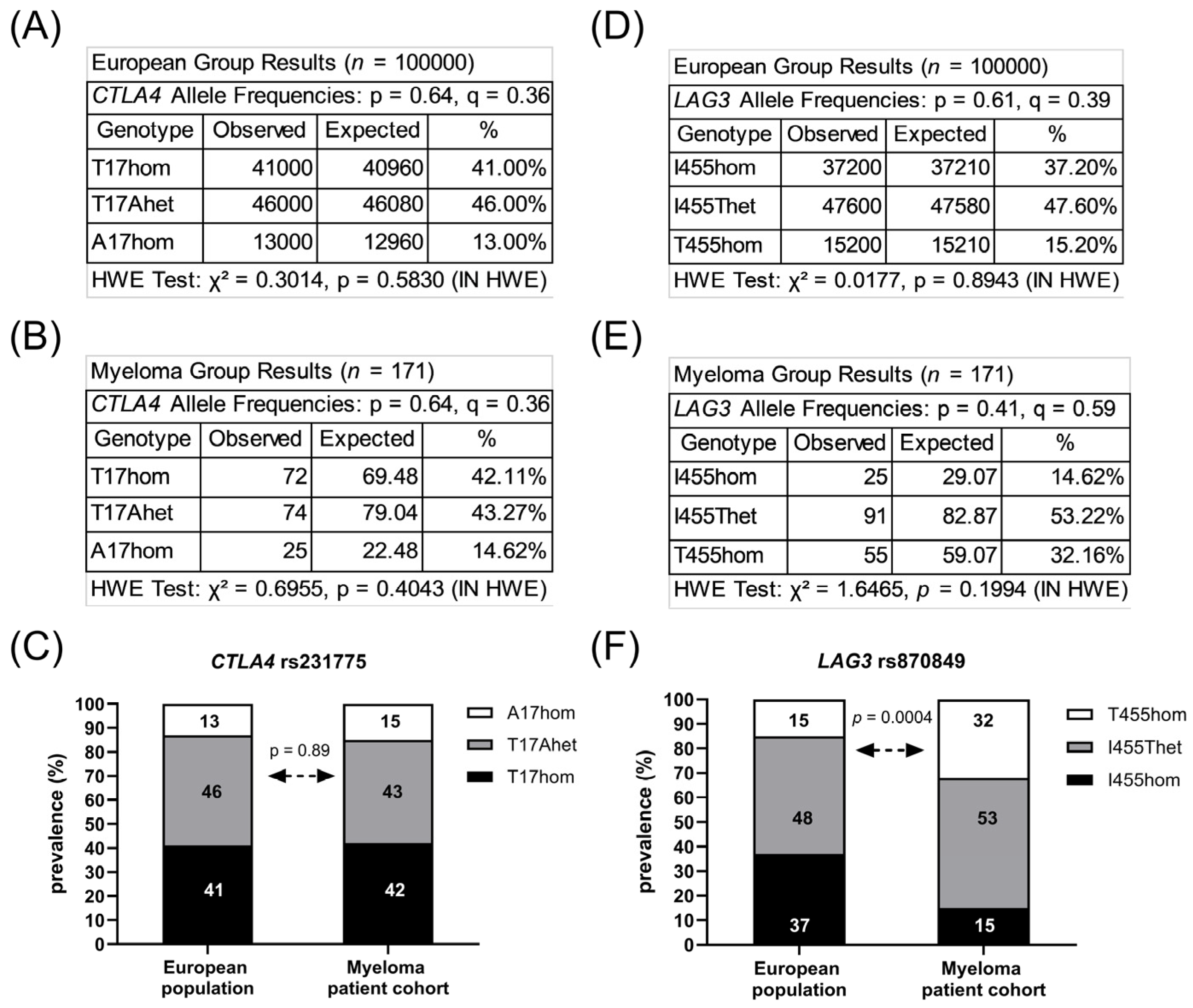
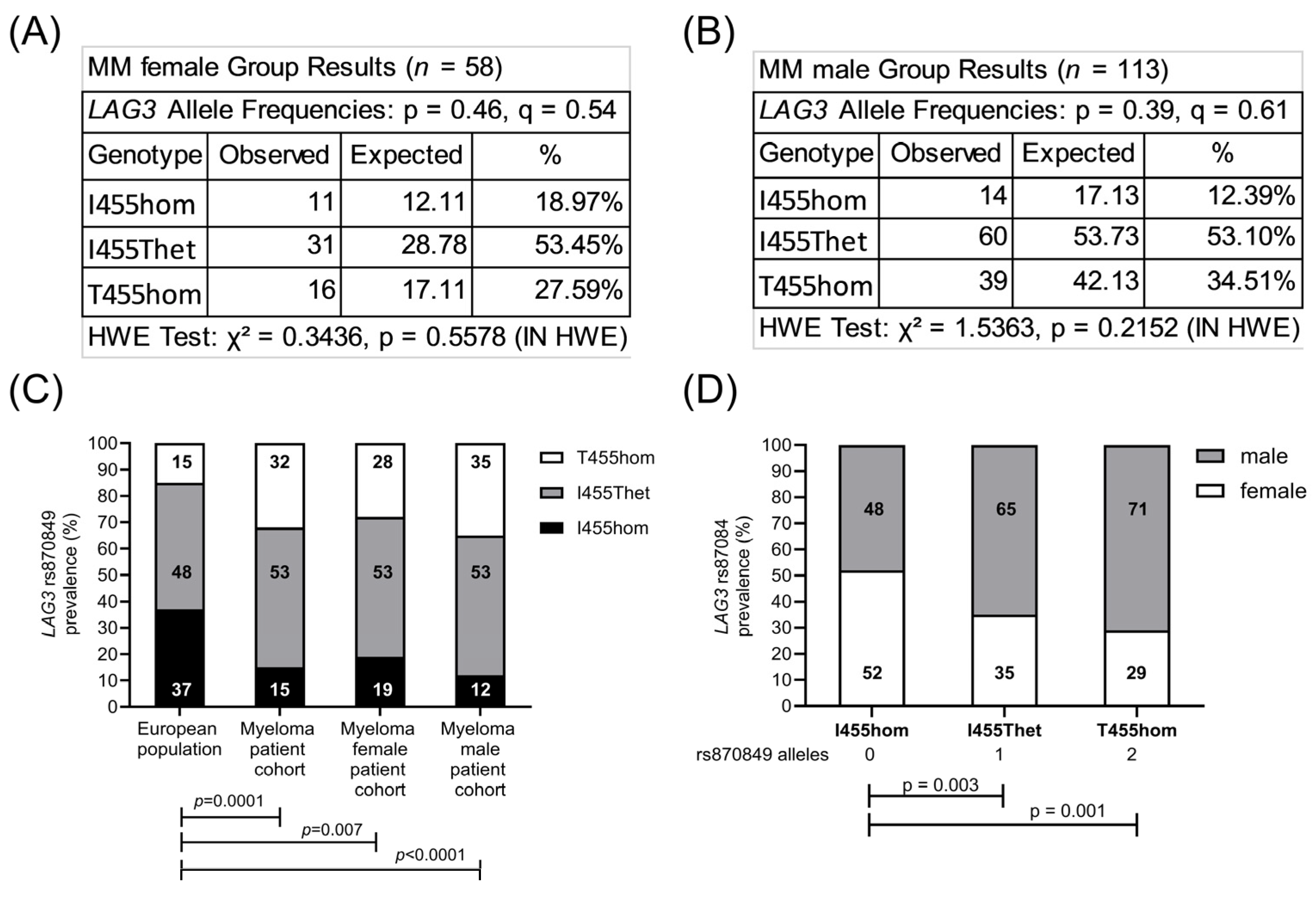
3.1. Elevated Allele Frequency of LAG3 rs870849 in Patients with Multiple Myeloma
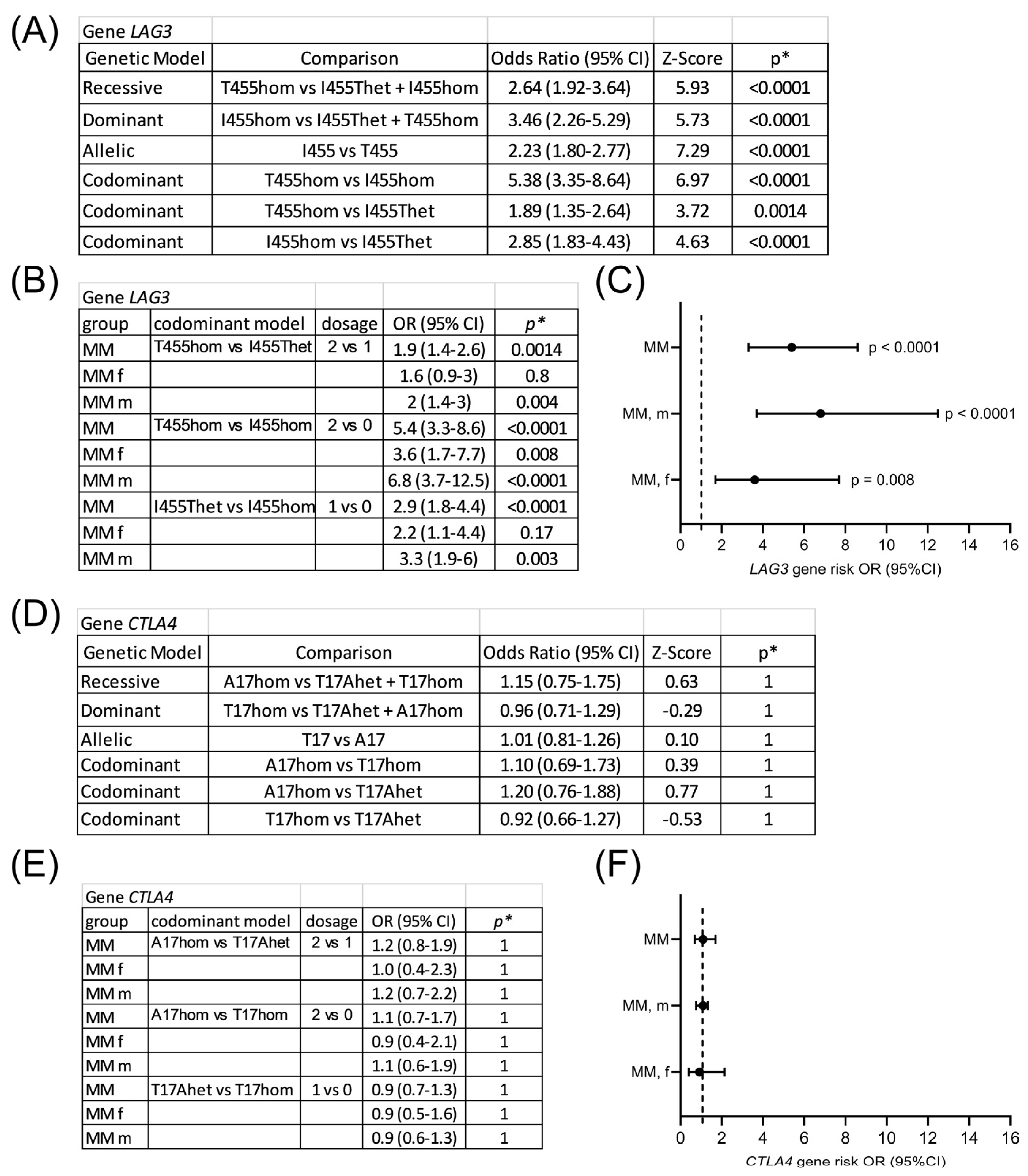
3.2. Gene Risk Analysis


3.3. Clinical Characteristics in the Myeloma Cohort According to LAG3 rs870849

| All Patients (N = 171) | I455hom (N = 25) | I455Thet (N = 91) | T455hom (N = 55) | p-Value | |
|---|---|---|---|---|---|
| Sex ratio (m/f) | 1.8 | 0.92 | 1.84 | 2.44 | 0.02 |
| Female, n (%) | 61 (36%) | 13 (52%) | 32 (35%) | 16 (29%) | 0.14 |
| Male, n (%) | 110 (64%) | 12 (48%) | 59 (65%) | 39 (71%) | |
| Age at ID, median (range) | 60 (33–78) | 56 (42–73) | 60 (39–78) | 60 (33–74) | 0.07 |
| Initial disease stage (ISS) | N = 159 | N = 23 | N = 85 | N = 51 | 0.59 |
| I | 50 (31%) | 9 (39%) | 25 (30%) | 16 (31%) | 0.67 |
| II | 59 (38%) | 10 (44%) | 30 (35%) | 19 (38%) | 0.74 |
| III | 50 (31%) | 4 (17%) | 30 (35%) | 16 (31%) | 0.19 |
| Cytogenetic risk category | N = 120 | N = 18 | N = 62 | N = 40 | 0.36 |
| high risk * | 34 (28%) | 6 (33%) | 20 (32%) | 8 (20%) | |
| standard risk | 86 (72%) | 12 (67%) | 42 (68%) | 32 (80%) | |
| Cytogenetic aberrations | N = 120 | N = 18 | N = 62 | N = 40 | 0.85 |
| −13 | 34 (28%) | 6 (33%) | 21 (34%) | 7 (18%) | 0.17 |
| −14 | 8 (7%) | 1 (6%) | 4 (6%) | 3 (8%) | 0.99 |
| −16 | 5 (4%) | 2 (11%) | 3 (5%) | 0 | 0.11 |
| +1 q | 41 (34%) | 8 (44%) | 19 (31%) | 14 (35%) | 0.54 |
| del17p * | 13 (11%) | 1 (6%) | 8 (13%) | 4 (10%) | 0.78 |
| t(4;14) * | 19 (16%) | 3 (17%) | 12 (19%) | 4 (10%) | 0.48 |
| t(14;16) * | 8 (7%) | 2 (11%) | 5 (8%) | 1 (3%) | 0.31 |
| t(11;14) | 27 (23%) | 3 (17%) | 16 (26%) | 8 (20%) | 0.72 |
| Paraprotein-type | 0.18 | ||||
| Heavy chain IgG | 111 (65%) | 19 (76%) | 64 (70%) | 28 (51%) | 0.03 |
| Heavy chain IgA | 33 (19%) | 4 (16%) | 16 (17%) | 13 (24%) | 0.64 |
| Light chain only | 26 (15%) | 2 (8%) | 10 (12%) | 14 (25%) | 0.05 |
| Light chain kappa | 112 (66%) | 15 (60%) | 60 (66%) | 37 (67%) | 0.86 |
| Light chain lambda | 59 (34%) | 10 (40%) | 31 (34%) | 18 (33%) | 0.86 |
| Anemia | N = 143 | N = 23 | N = 75 | N = 45 | |
| Hb (g/L), median (range) | 109 (46–167) | 114 (70–148) | 109 (46–164) | 106 (71–167) | 0.87 |
| Hb < 110 g/L, n (%) | 72 (51%) | 8 (35%) | 38 (51%) | 26 (58%) | 0.21 |
| Hypercalcemia | N = 117 | N = 18 | N = 62 | N = 37 | |
| Ca (mmol/L), median (range) | 2.42 (1.4–4.2) | 2.35 (2.1–2.8) | 2.45 (1.4–4.2) | 2.43 (2.1–4.2) | 0.13 |
| >2.6 mmol/L, n (%) | 24 (21%) | 1 (6%) | 14 (23%) | 9 (24%) | 0.24 |
| Beta-2-microglobulin | N = 143 | N = 23 | N = 74 | N = 46 | |
| B2M (mg/L), median (range) | 3.3 (1.18–38) | 3.2 (1.8–7.3) | 3.4 (1.18–30) | 3.1 (1.51–38) | 0.77 |
| >2.2 mg/L, n (%) | 104 (73%) | 20 (87%) | 54 (73%) | 30 (65%) | 0.16 |
| Lactate-dehydrogenase | N = 103 | N = 21 | N = 49 | N = 33 | |
| LDH (U/L), median (range) | 274 (110–1366) | 272 (162–644) | 276 (110–1366) | 259 (145–526) | 0.46 |
| >480 U/L, n (%) | 11 (11%) | 2 (10%) | 5 (10%) | 4 (12%) | 0.99 |
| Serum albumin | N = 133 | N = 22 | N = 70 | N = 41 | |
| g/dL, median (range) | 3.6 (1.8–29) | 3.6 (1.8–8) | 3.4 (1.8–29) | 3.6 (2.5–5) | 0.45 |
| <3.5 g/dL, n (%) | 62 (47%) | 7 (32%) | 35 (50%) | 14 (34%) | 0.16 |
| Bone marrow infiltration | N = 167 | N = 25 | N = 89 | N = 53 | |
| Percent, median (range) | 60 (3–100) | 60 (10–90) | 70 (5–100) | 55 (3–100) | 0.37 |
| 40–100%, n (%) | 122 (73%) | 19 (76%) | 68 (76%) | 35 (66%) | 0.39 |
| Osteolytic lesions | 122 (74%) | 16 (67%) | 65 (73%) | 41 (79%) | 0.52 |
| Renal dysfunction | 51 (40%) | 6 (33%) | 26 (37%) | 20 (50%) | 0.04 |
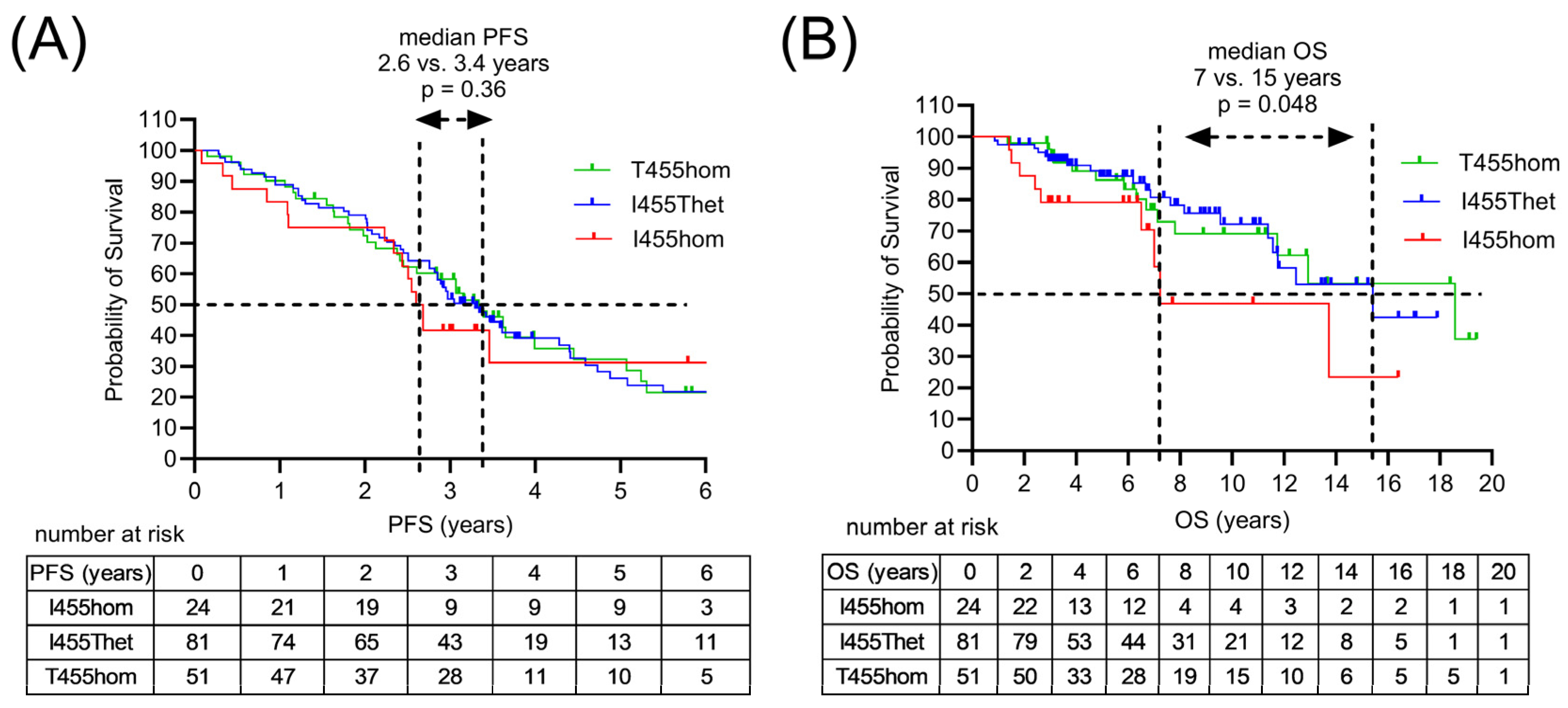
3.4. Clinical Response to HDCT/ASCT According to LAG3 rs870849
4. Discussion
Author Contributions
Funding
Institutional Review Board Statement
Informed Consent Statement
Data Availability Statement
Acknowledgments
Conflicts of Interest
Abbreviations
References
- Mafra, A.; Laversanne, M.; Marcos-Gragera, R.; Chaves, H.V.S.; Mcshane, C.; Bray, F.; Znaor, A. The Global Multiple Myeloma Incidence and Mortality Burden in 2022 and Predictions for 2045. J. Natl. Cancer Inst. 2025, 117, 907–914. [Google Scholar] [CrossRef] [Scilit]
- Ansarian, M.A.; Fatahichegeni, M.; Ren, J.; Wang, X. Sex and Gender in Myeloid and Lymphoblastic Leukemias and Multiple Myeloma: From Molecular Mechanisms to Clinical Outcomes. Curr. Oncol. 2025, 32, 204. [Google Scholar] [CrossRef] [Scilit]
- Georgakopoulou, R.; Fiste, O.; Sergentanis, T.N.; Andrikopoulou, A.; Zagouri, F.; Gavriatopoulou, M.; Psaltopoulou, T.; Kastritis, E.; Terpos, E.; Dimopoulos, M.A. Occupational Exposure and Multiple Myeloma Risk: An Updated Review of Meta-Analyses. J. Clin. Med. 2021, 10, 4179. [Google Scholar] [CrossRef] [Scilit] [PubMed]
- Rajkumar, S.V. Multiple Myeloma: 2020 Update on Diagnosis, Risk-Stratification and Management. Am. J. Hematol. 2020, 95, 548–567. [Google Scholar] [CrossRef] [Scilit]
- Rajkumar, S.V.; Kumar, S. Multiple Myeloma Current Treatment Algorithms. Blood Cancer J. 2020, 10, 94. [Google Scholar] [CrossRef] [Scilit] [PubMed]
- Lopes, R.; Caetano, J.; Ferreira, B.; Barahona, F.; Carneiro, E.A.; João, C. The Immune Microenvironment in Multiple Myeloma: Friend or Foe? Cancers 2021, 13, 625. [Google Scholar] [CrossRef] [Scilit]
- Visram, A.; Dasari, S.; Anderson, E.; Kumar, S.; Kourelis, T.V. Relapsed Multiple Myeloma Demonstrates Distinct Patterns of Immune Microenvironment and Malignant Cell-Mediated Immunosuppression. Blood Cancer J. 2021, 11, 45. [Google Scholar] [CrossRef] [Scilit] [PubMed]
- Kündgen, L.J.; Akhoundova, D.; Hoffmann, M.; Legros, M.; Shaforostova, I.; Seipel, K.; Bacher, U.; Pabst, T. Prognostic Value of Post-Transplant MRD Negativity in Standard Versus High- and Ultra-High-Risk Multiple Myeloma Patients. Cancers 2025, 17, 1565. [Google Scholar] [CrossRef] [Scilit]
- Brechbühl, S.; Bacher, U.; Jeker, B.; Pabst, T. Real-World Outcome in the Pre-CAR-T Era of Myeloma Patients Qualifying for CAR-T Cell Therapy. Mediterr. J. Hematol. Infect. Dis. 2021, 13, e2021012. [Google Scholar] [CrossRef] [Scilit]
- Andrews, L.P.; Marciscano, A.E.; Drake, C.G.; Vignali, D.A.A. LAG3 (CD223) as a Cancer Immunotherapy Target. Immunol. Rev. 2017, 276, 80–96. [Google Scholar] [CrossRef] [Scilit]
- Maruhashi, T.; Sugiura, D.; Okazaki, I.-M.; Okazaki, T. LAG-3: From Molecular Functions to Clinical Applications. J. Immunother. Cancer 2020, 8, e001014. [Google Scholar] [CrossRef] [Scilit] [PubMed]
- Wang, J.; Sanmamed, M.F.; Datar, I.; Su, T.T.; Ji, L.; Sun, J.; Chen, L.; Chen, Y.; Zhu, G.; Yin, W.; et al. Fibrinogen-like Protein 1 Is a Major Immune Inhibitory Ligand of LAG-3. Cell 2019, 176, 334–347.e12. [Google Scholar] [CrossRef] [Scilit]
- Ninkovic, S.; Purton, L.E.; Harrison, S.J.; Quach, H. Multiplex Immunohistochemistry Elucidates Increased Distance between Cytotoxic T Cells and Plasma Cells in Relapsed Myeloma, and Identifies Lag-3 as the Most Common Checkpoint Receptor on Cytotoxic T Cells of Myeloma Patients. Haematologica 2024, 109, 1487–1500. [Google Scholar] [CrossRef] [Scilit] [PubMed]
- Chen, M.; Zhu, J.; Yang, X.; Yao, J.; Liu, Y.; Liu, Q. PD-1 and LAG-3-Positive T Cells Are Associated with Clinical Outcomes of Relapsed/Refractory Multiple Myeloma Patients. Eur. J. Med. Res. 2022, 27, 296. [Google Scholar] [CrossRef] [Scilit]
- Botta, C.; Perez, C.; Larrayoz, M.; Puig, N.; Cedena, M.-T.; Termini, R.; Goicoechea, I.; Rodriguez, S.; Zabaleta, A.; Lopez, A.; et al. Large T Cell Clones Expressing Immune Checkpoints Increase During Multiple Myeloma Evolution and Predict Treatment Resistance. Nat. Commun. 2023, 14, 5825. [Google Scholar] [CrossRef] [Scilit] [PubMed]
- Cruz, D.; Rodríguez-Romanos, R.; González-Bartulos, M.; García-Cadenas, I.; de la Cámara, R.; Heras, I.; Buño, I.; Santos, N.; Lloveras, N.; Velarde, P.; et al. LAG3 Genotype of the Donor and Clinical Outcome after Allogeneic Transplantation from HLA-Identical Sibling Donors. Front. Immunol. 2023, 14, 1066393. [Google Scholar] [CrossRef] [Scilit]
- Sun, Y.; Cao, Q.; Zhao, X.; Liu, C.; Shao, Z. Lymphocyte Activation Gene 3 Single-Nucleotide Polymorphisms in Bone Marrow Failure Diseases. Anal. Cell Pathol. 2022, 2022, 3528598. [Google Scholar] [CrossRef] [Scilit]
- Seipel, K.; Shaforostova, I.; Nilius, H.; Bacher, U.; Pabst, T. Clinical Impact of CTLA-4 Single-Nucleotide Polymorphism in DLBCL Patients Treated with CAR-T Cell Therapy. Curr. Oncol. 2025, 32, 425. [Google Scholar] [CrossRef] [Scilit]
- Seipel, K.; Spahr, S.M.; Shaforostova, I.; Bacher, U.; Nilius, H.; Pabst, T. Clinical Impact of LAG3 Single-Nucleotide Polymorphism in DLBCL Treated with CAR-T Cell Therapy. Int. J. Mol. Sci. 2025, 26, 9905. [Google Scholar] [CrossRef] [Scilit]
- Seipel, K.; Abbühl, M.; Bacher, U.; Nilius, H.; Daskalakis, M.; Pabst, T. Clinical Impact of Single Nucleotide Polymorphism in CD-19 on Treatment Outcome in FMC63-CAR-T Cell Therapy. Cancers 2023, 15, 3058. [Google Scholar] [CrossRef] [Scilit]
- Cai, L.; Li, Y.; Tan, J.; Xu, L.; Li, Y. Targeting LAG-3, TIM-3, and TIGIT for Cancer Immunotherapy. J. Hematol. Oncol. 2023, 16, 101, Erratum in J. Hematol. Oncol. 2023, 16, 105. https://doi.org/10.1186/s13045-023-01503-8. [Google Scholar] [CrossRef] [Scilit]
- Anderson, A.C.; Joller, N.; Kuchroo, V.K. Lag-3, Tim-3, and TIGIT: Co-Inhibitory Receptors with Specialized Functions in Immune Regulation. Immunity 2016, 44, 989–1004. [Google Scholar] [CrossRef] [Scilit]
- Tawbi, H.A.; Schadendorf, D.; Lipson, E.J.; Ascierto, P.A.; Matamala, L.; Castillo Gutiérrez, E.; Rutkowski, P.; Gogas, H.J.; Lao, C.D.; De Menezes, J.J.; et al. Relatlimab and Nivolumab versus Nivolumab in Untreated Advanced Melanoma. N. Engl. J. Med. 2022, 386, 24–34. [Google Scholar] [CrossRef] [Scilit] [PubMed]
- Sudershan, A.; Singh, K.; Kumar, P. GeneRiskCalc: A Web-Based Tool for Genetic Risk Association Analysis in Case–Control Studies. BMC Bioinform. 2025, 26, 213. [Google Scholar] [CrossRef] [Scilit]
- Seipel, K.; Veglio, N.Z.; Nilius, H.; Jeker, B.; Bacher, U.; Pabst, T. Rising Prevalence of Low-Frequency PPM1D Gene Mutations after Second HDCT in Multiple Myeloma. Curr. Issues Mol. Biol. 2024, 46, 8197–8208. [Google Scholar] [CrossRef] [Scilit] [PubMed]
- Dungan, J.R.; Qin, X.; Gregory, S.G.; Cooper-Dehoff, R.; Duarte, J.D.; Qin, H.; Gulati, M.; Taylor, J.Y.; Pepine, C.J.; Hauser, E.R.; et al. Sex-Dimorphic Gene Effects on Survival Outcomes in People with Coronary Artery Disease. Am. Heart J. Plus 2022, 17, 100152. [Google Scholar] [CrossRef] [Scilit]
- Joo, J.; Himes, B. Gene-Based Analysis Reveals Sex-Specific Genetic Risk Factors of COPD. AMIA Annu. Symp. Proc. 2021, 2021, 601–610. [Google Scholar]
- Thompson, C.L.; Plummer, S.J.; Acheson, L.S.; Tucker, T.C.; Casey, G.; Li, L. Association of Common Genetic Variants in SMAD7 and Risk of Colon Cancer. Carcinogenesis 2009, 30, 982–986. [Google Scholar] [CrossRef] [Scilit] [PubMed]
- Pertesi, M.; Went, M.; Hansson, M.; Hemminki, K.; Houlston, R.S.; Nilsson, B. Genetic Predisposition for Multiple Myeloma. Leukemia 2020, 34, 697–708. [Google Scholar] [CrossRef] [Scilit]
- Janz, S.; Zhan, F.; Sun, F.; Cheng, Y.; Pisano, M.; Yang, Y.; Goldschmidt, H.; Hari, P. Germline Risk Contribution to Genomic Instability in Multiple Myeloma. Front. Genet. 2019, 10, 424. [Google Scholar] [CrossRef] [Scilit]
- Scionti, F.; Agapito, G.; Caracciolo, D.; Riillo, C.; Grillone, K.; Cannataro, M.; Di Martino, M.T.; Tagliaferri, P.; Tassone, P.; Arbitrio, M. Risk Alleles for Multiple Myeloma Susceptibility in ADME Genes. Cells 2022, 11, 189. [Google Scholar] [CrossRef] [Scilit]
- Fang, L.; Liu, K.; Liu, C.; Wang, X.; Ma, W.; Xu, W.; Wu, J.; Sun, C. Tumor Accomplice: T Cell Exhaustion Induced by Chronic Inflammation. Front. Immunol. 2022, 13, 979116. [Google Scholar] [CrossRef] [Scilit]
- Zelle-Rieser, C.; Thangavadivel, S.; Biedermann, R.; Brunner, A.; Stoitzner, P.; Willenbacher, E.; Greil, R.; Jöhrer, K. T Cells in Multiple Myeloma Display Features of Exhaustion and Senescence at the Tumor Site. J. Hematol. Oncol. 2016, 9, 116. [Google Scholar] [CrossRef] [Scilit] [PubMed]
- Chung, D.J.; Pronschinske, K.B.; Shyer, J.A.; Sharma, S.; Leung, S.; Curran, S.A.; Lesokhin, A.M.; Devlin, S.M.; Giralt, S.A.; Young, J.W. T-Cell Exhaustion in Multiple Myeloma Relapse after Autotransplant: Optimal Timing of Immunotherapy. Cancer Immunol. Res. 2016, 4, 61–71. [Google Scholar] [CrossRef] [Scilit] [PubMed]
- Stettler, J.; Novak, U.; Baerlocher, G.M.; Seipel, K.; Mansouri Taleghani, B.; Pabst, T. Autologous Stem Cell Transplantation in Elderly Patients with Multiple Myeloma: Evaluation of Its Safety and Efficacy. Leuk. Lymphoma 2017, 58, 1076–1083. [Google Scholar] [CrossRef] [Scilit] [PubMed]
- Baumhardt, T.M.; Amoah, A.; Hoenicka, M.; Liebold, A.; Sakk, V.; Soller, K.; Vollmer, A.; Kull, M.; Kronke, J.; Mallm, J.-P.; et al. Functional and Molecular Analyses Reveal Impaired HSPCs in Multiple Myeloma Patients Post-Induction. Stem Cells Transl. Med. 2025, 14, szaf061. [Google Scholar] [CrossRef] [Scilit]

| All Patients (N = 171) | I455hom (N = 25) | I455Thet (N = 91) | T455hom (N = 55) | p-Value | |
|---|---|---|---|---|---|
| Induction therapy | 0.24 | ||||
| VRD | 70 (41%) | 13 (52%) | 39 (43%) | 18 (33%) | |
| VCD | 45 (27%) | 7 (28%) | 24 (26%) | 14 (25%) | |
| VD | 18 (10%) | 2 (8%) | 10 (11%) | 6 (11%) | |
| Dara-VRD | 18 (10%) | 3 (12%) | 10 (11%) | 5 (9%) | |
| Other | 20 (12%) | 0 | 8 (9%) | 12 (22%) | |
| Response to induction therapy | 0.22 | ||||
| CR | 18 (10%) | 0 | 12 (13%) | 6 (11%) | |
| PR | 109 (64%) | 22 (88%) | 53 (58%) | 34 (62%) | |
| SD/PD | 8 (5%) | 0 | 5 (6%) | 3 (5%) | |
| Not reported | 36 (21%) | 3 (12%) | 21 (23%) | 12 (22%) | |
| Number of Relapses, n (%) | 0.32 | ||||
| 0 | 46 (27%) | 8 (32%) | 22 (24%) | 16 (29%) | |
| 1–2 | 49 (29%) | 6 (24%) | 29 (32%) | 14 (25%) | |
| 3–4 | 43 (25%) | 4 (16%) | 26 (29%) | 13 (24%) | |
| 5–8 | 33 (19%) | 7 (28%) | 14 (15%) | 12 (22%) | |
| Response to HDCT/ASCT | N = 156 | N = 22 | N = 91 | N = 43 | 0.82 |
| CR | 92 (59%) | 12 (55%) | 52 (57%) | 28 (65%) | |
| PR | 31 (20%) | 5 (23%) | 17 (19%) | 9 (21%) | |
| SD/PD | 2 (1%) | 0 | 2 (2%) | 0 | |
| Not reported | 31 (20%) | 5 (23%) | 20 (22%) | 6 (14%) | |
| Radiotherapy | 69 (40%) | 7 (28%) | 39 (43%) | 23 (42%) | 0.41 |
| PFS, years, median | 3.1 | 2.6 | 3.3 | 3.4 | 0.36 |
| OS, years, median | 14 | 7 | 15 | 18 | 0.048 |
| PFS | OS | |||
|---|---|---|---|---|
| Predictors | HR | p | HR | p |
| LAG3 I455 hom vs. I455Thet | 0.98 | 0.97 | 0.92 | 0.90 |
| LAG3 I455hom vs. T455hom | 1.19 | 0.67 | 0.97 | 0.97 |
| ISS3 vs. ISS1 | 1.30 | 0.31 | 1.39 | 0.47 |
| Cytogenetic risk high vs. standard | 1.35 | 0.43 | 2.41 | 0.14 |
| Age at diagnosis >60 y vs. <60 y | 0.90 | 0.65 | 2.41 | 0.06 |
Disclaimer/Publisher’s Note: The statements, opinions and data contained in all publications are solely those of the individual author(s) and contributor(s) and not of MDPI and/or the editor(s). MDPI and/or the editor(s) disclaim responsibility for any injury to people or property resulting from any ideas, methods, instructions or products referred to in the content. |
© 2025 by the authors. Licensee MDPI, Basel, Switzerland. This article is an open access article distributed under the terms and conditions of the Creative Commons Attribution (CC BY) license.
Share and Cite
Seipel, K.; Mena, A.; Horum, P.; Hoffmann, M.; Shaforostova, I.; Bacher, U.; Pabst, T. Elevated Allele Frequency and Male-Predominance of a Common LAG3 Germline Variant in Multiple Myeloma. Curr. Issues Mol. Biol. 2026, 48, 5. https://doi.org/10.3390/cimb48010005
Seipel K, Mena A, Horum P, Hoffmann M, Shaforostova I, Bacher U, Pabst T. Elevated Allele Frequency and Male-Predominance of a Common LAG3 Germline Variant in Multiple Myeloma. Current Issues in Molecular Biology. 2026; 48(1):5. https://doi.org/10.3390/cimb48010005
Chicago/Turabian StyleSeipel, Katja, Alina Mena, Pinar Horum, Michele Hoffmann, Inna Shaforostova, Ulrike Bacher, and Thomas Pabst. 2026. "Elevated Allele Frequency and Male-Predominance of a Common LAG3 Germline Variant in Multiple Myeloma" Current Issues in Molecular Biology 48, no. 1: 5. https://doi.org/10.3390/cimb48010005
APA StyleSeipel, K., Mena, A., Horum, P., Hoffmann, M., Shaforostova, I., Bacher, U., & Pabst, T. (2026). Elevated Allele Frequency and Male-Predominance of a Common LAG3 Germline Variant in Multiple Myeloma. Current Issues in Molecular Biology, 48(1), 5. https://doi.org/10.3390/cimb48010005