

Current Landscape of Chronic Inflammatory Dermatoses: Where We Are and Where We Are Heading


1. Introduction
2. Traditional Systemic Therapies: Limitations and Challenges
3. The Advent of Biologics: A Paradigm Shift in Treatment
4. Future Directions: Towards Precision Medicine in Dermatology
Author Contributions
Funding
Conflicts of Interest
References
- Biedermann, T.; Röcken, M.; Carballido, J.M. TH1 and TH2 lymphocyte development and regulation of TH cell-mediated immune responses of the skin. J. Investig. Dermatol. Symp. Proc. 2004, 9, 5–14. [Google Scholar] [CrossRef] [Scilit]
- Boffa, M.J.; Chalmers, R.J. Methotrexate for psoriasis. Clin. Exp. Dermatol. 1996, 21, 399–408. [Google Scholar] [CrossRef] [Scilit]
- Mozzanica, N.; Pigatto, P.D.; Finzi, A.F. Cyclosporin in psoriasis: Pathophysiology and experimental data. Dermatology 1993, 187 (Suppl. S1), 3–7. [Google Scholar] [CrossRef] [Scilit]
- Wang, C.; Lin, A. Efficacy of topical calcineurin inhibitors in psoriasis. J. Cutan. Med. Surg. 2014, 18, 8–14. [Google Scholar] [CrossRef] [Scilit]
- Di Martino, V.; Verhoeven, D.W.; Verhoeven, F.; Aubin, F.; Avouac, J.; Vuitton, L.; Lioté, F.; Thévenot, T.; Wendling, D. Busting the myth of methotrexate chronic hepatotoxicity. Nat. Rev. Rheumatol. 2022, 19, 96–110. [Google Scholar] [CrossRef] [Scilit]
- Brouhard, B.H.; Graham, R.M. Cyclosporine: Mechanisms of action and toxicity. Clevel. Clin. J. Med. 1994, 61, 308–313. [Google Scholar] [CrossRef] [Scilit]
- Oray, M.; Samra, K.A.; Ebrahimiadib, N.; Meese, H.; Foster, C.S. Long-term side effects of glucocorticoids. Expert Opin. Drug Saf. 2016, 15, 457–465. [Google Scholar] [CrossRef] [Scilit]
- Chamian, F.; Lowes, M.A.; Lin, S.-L.; Lee, E.; Kikuchi, T.; Gilleaudeau, P.; Sullivan-Whalen, M.; Cardinale, I.; Khatcherian, A.; Novitskaya, I.; et al. Alefacept reduces infiltrating T cells, activated dendritic cells, and inflammatory genes in psoriasis vulgaris. Proc. Natl. Acad. Sci. USA 2005, 102, 2075–2080. [Google Scholar] [CrossRef] [Scilit]
- Rodgers, M.; Epstein, D.; Bojke, L.; Yang, H.; Craig, D.; Fonseca, T.; Myers, L.; Bruce, I.; Chalmers, R.; Bujkiewicz, S.; et al. Etanercept, infliximab and adalimumab for the treatment of psoriatic arthritis: A systematic review and economic evaluation. Health Technol. Assess. 2011, 15, 1–329. [Google Scholar] [CrossRef] [Scilit]
- Gisondi, P.; Geat, D.; Conti, A.; Dapavo, P.; Piaserico, S.; De Simone, C.; Bianchi, L.; Costanzo, A.; Malagoli, P.; Malara, G.; et al. TNF-α inhibitors biosimilars as first line systemic treatment for moderate-to-severe chronic plaque psoriasis. Expert Rev. Clin. Immunol. 2020, 16, 591–598. [Google Scholar] [CrossRef] [Scilit]
- Wride, A.M.; Chen, G.F.; Spaulding, S.L.; Tkachenko, E.; Cohen, J.M. Biologics for Psoriasis. Dermatol. Clin. 2024, 42, 339–355. [Google Scholar] [CrossRef] [Scilit]
- Koskeridis, F.; Evangelou, E.; Ntzani, E.E.; Kostikas, K.; Tsabouri, S. Treatment with Dupilumab in Patients with Atopic Dermatitis: Systematic Review and Meta-Analysis. J. Cutan. Med. Surg. 2022, 26, 613–621. [Google Scholar] [CrossRef] [Scilit]
- Seegräber, M.; Srour, J.; Walter, A.; Knop, M.; Wollenberg, A. Dupilumab for treatment of atopic dermatitis. Expert Rev. Clin. Pharmacol. 2018, 11, 467–474. [Google Scholar] [CrossRef] [Scilit]
- Simpson, E.L.; Paller, A.S.; Siegfried, E.C.; Boguniewicz, M.; Sher, L.; Gooderham, M.J.; Beck, L.A.; Guttman-Yassky, E.; Pariser, D.; Blauvelt, A.; et al. Efficacy and Safety of Dupilumab in Adolescents with Uncontrolled Moderate to Severe Atopic Dermatitis: A Phase 3 Randomized Clinical Trial. JAMA Dermatol. 2020, 156, 44–56. [Google Scholar] [CrossRef] [Scilit]
- Kim, R.W.; Lam, M.; Abuabara, K.; Simpson, E.L.; Drucker, A.M. Targeted Systemic Therapies for Adults with Atopic Dermatitis: Selecting from Biologics and JAK Inhibitors. Am. J. Clin. Dermatol. 2024, 25, 179–193. [Google Scholar] [CrossRef] [Scilit]
- Kimball, A.B.; Okun, M.M.; Williams, D.A.; Gottlieb, A.B.; Papp, K.A.; Zouboulis, C.C.; Armstrong, A.W.; Kerdel, F.; Gold, M.H.; Forman, S.B.; et al. Two Phase 3 Trials of Adalimumab for Hidradenitis Suppurativa. N. Engl. J. Med. 2016, 375, 422–434. [Google Scholar] [CrossRef] [Scilit]
- Zouboulis, C.C.; Okun, M.M.; Prens, E.P.; Gniadecki, R.; Foley, P.A.; Lynde, C.; Weisman, J.; Gu, Y.; Williams, D.A.; Jemec, G.B. Long-term adalimumab efficacy in patients with moderate-to-severe hidradenitis suppurativa/acne inversa: 3-year results of a phase 3 open-label extension study. J. Am. Acad. Dermatol. 2019, 80, 60–69.e2. [Google Scholar] [CrossRef] [Scilit]
- Kimball, A.B.; Jemec, G.B.E.; Sayed, C.J.; Kirby, J.S.; Prens, E.; Ingram, J.R.; Garg, A.; Gottlieb, A.B.; Szepietowski, J.C.; Bechara, F.G.; et al. Efficacy and safety of bimekizumab in patients with moderate-to-severe hidradenitis suppurativa (BE HEARD I and BE HEARD II): Two 48-week, randomised, double-blind, placebo-controlled, multicentre phase 3 trials. Lancet 2024, 403, 2504–2519. [Google Scholar] [CrossRef] [Scilit]
- Kimball, A.B.; Jemec, G.B.E.; Alavi, A.; Reguiai, Z.; Gottlieb, A.B.; Bechara, F.G.; Paul, C.; Bourboulis, E.J.G.; Villani, A.P.; Schwinn, A.; et al. Secukinumab in moderate-to-severe hidradenitis suppurativa (SUNSHINE and SUNRISE): Week 16 and week 52 results of two identical, multicentre, randomised, placebo-controlled, double-blind phase 3 trials. Lancet 2023, 401, 747–761. [Google Scholar] [CrossRef] [Scilit]
- Jabbari, A.; Sansaricq, F.; Cerise, J.; Chen, J.; Bitterman, A.; Ulerio, G.; Borbon, J.; Clynes, R.; Christiano, A.; Mackay-Wiggan, J. An Open-Label Pilot Study to Evaluate the Efficacy of Tofacitinib in Moderate to Severe Patch-Type Alopecia Areata, Totalis, and Universalis. J. Investig. Dermatol. 2018, 138, 1539–1545. [Google Scholar] [CrossRef] [Scilit]
- Lee, H.; Park, S.H.; Lew, B.-L.; Park, H. The new era of JAK inhibitors: Impelling updates in Alopecia Areata Guideline. J. Eur. Acad. Dermatol. Venereol. 2023, 38, e602–e606. [Google Scholar] [CrossRef] [Scilit] [PubMed]
- Miot, H.A.; Criado, P.R.; de Castro, C.C.S.; Ianhez, M.; Talhari, C.; Ramos, P.M. JAK-STAT pathway inhibitors in dermatology. An. Bras. Dermatol. 2023, 98, 656–677. [Google Scholar] [CrossRef] [Scilit] [PubMed]
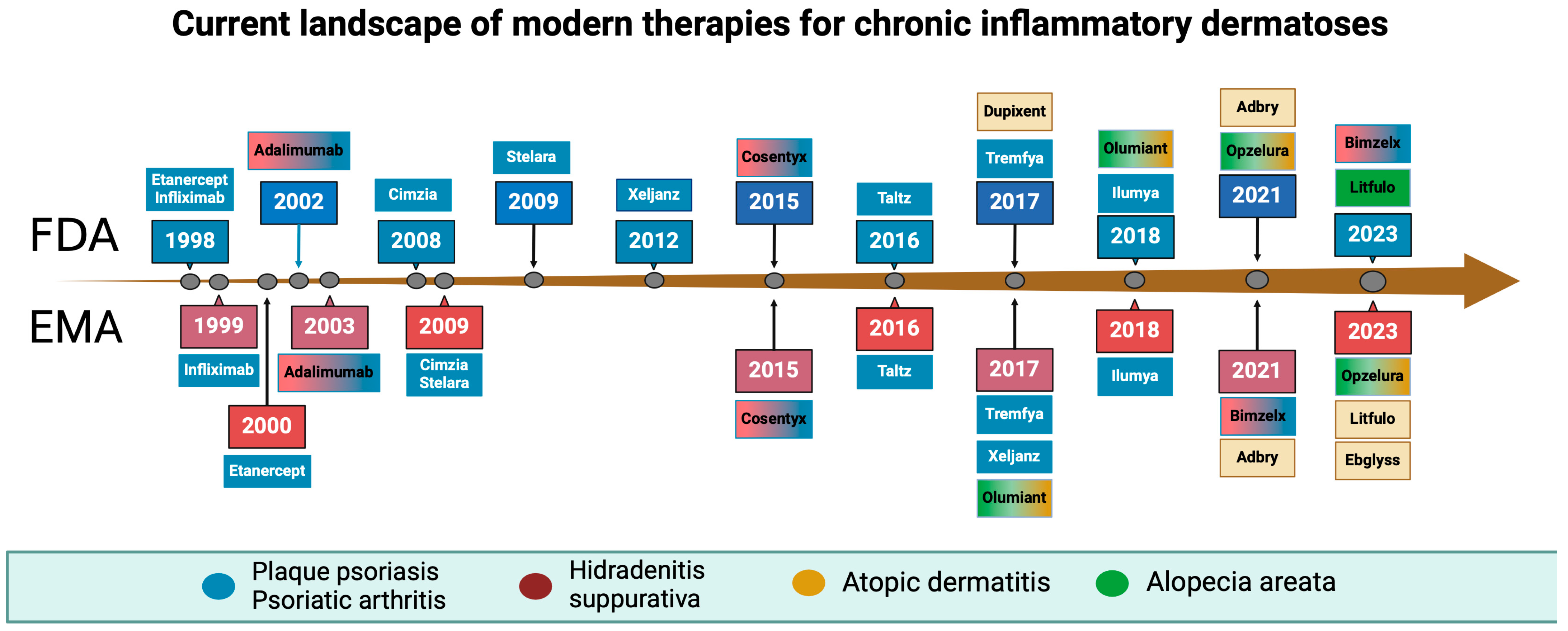

| Drug Name | Product Name | Mechanism | FDA Approval Year | EMA Approval Year | Indications |
|---|---|---|---|---|---|
| Etanercept | Enbrel | TNF-α inhibitor | 1998 | 2000 | Plaque psoriasis, Psoriatic arthritis |
| Infliximab | Remicade | TNF-α inhibitor | 1998 | 1999 | Plaque psoriasis, Psoriatic arthritis |
| Adalimumab | Humira | TNF-α inhibitor | 2002 | 2003 |
Plaque psoriasis, Psoriatic arthritis, Hidradenitis suppurativa |
| Certolizumab Pegol | Cimzia | TNF-α inhibitor | 2008 | 2009 |
Plaque psoriasis, Psoriatic arthritis, |
| Ustekinumab | Stelara | IL-12/23 inhibitor | 2009 | 2009 |
Plaque psoriasis, Psoriatic arthritis |
| Guselkumab | Tremfya | IL-23 inhibitor | 2017 | 2017 |
Plaque psoriasis, Psoriatic arthritis |
| Tildrakizumab | Ilumya | IL-23 inhibitor | 2018 | 2018 | Plaque psoriasis |
| Secukinumab | Cosentyx | IL-17A inhibitor | 2015 | 2015 | Plaque psoriasis, Psoriatic arthritis, Hidradenitis suppurativa |
| Ixekizumab | Taltz | IL-17A inhibitor | 2016 | 2016 | Plaque psoriasis, Psoriatic arthritis |
| Bimekizumab | Bimzelx | IL-17A/F inhibitor | 2023 | 2021 | Plaque psoriasis, Psoriatic arthritis, Hidradenitis suppurativa |
| Dupilumab | Dupixent | IL-4/13 inhibitor | 2017 | 2017 |
Atopic dermatitis, Prurigo nodularis |
| Tralokinumab | Adbry | IL-13 inhibitor | 2021 | 2021 | Atopic dermatitis |
| Lebrikizumab | Ebglyss | IL-13 inhibitor | Submitted | 2023 | Atopic dermatitis |
| Tofacitinib | Xeljanz | JAK inhibitor | 2012 | 2017 | Psoriatic arthritis |
| Ruxolitinib | Opzelura | JAK inhibitor | 2021 | 2023 | Atopic dermatitis, Vitiligo, Alopecia areata |
| Baricitinib | Olumiant | JAK inhibitor | 2018 | 2017 | Atopic dermatitis, Alopecia areata |
| Ritlecitinib | Litfulo | JAK inhibitor | 2023 | 2023 | Alopecia areata |
Disclaimer/Publisher’s Note: The statements, opinions and data contained in all publications are solely those of the individual author(s) and contributor(s) and not of MDPI and/or the editor(s). MDPI and/or the editor(s) disclaim responsibility for any injury to people or property resulting from any ideas, methods, instructions or products referred to in the content. |
© 2024 by the authors. Licensee MDPI, Basel, Switzerland. This article is an open access article distributed under the terms and conditions of the Creative Commons Attribution (CC BY) license (https://creativecommons.org/licenses/by/4.0/).
Share and Cite
Sójka, A.; Krajewski, P.K. Current Landscape of Chronic Inflammatory Dermatoses: Where We Are and Where We Are Heading. Curr. Issues Mol. Biol. 2024, 46, 10259-10263. https://doi.org/10.3390/cimb46090611
Sójka A, Krajewski PK. Current Landscape of Chronic Inflammatory Dermatoses: Where We Are and Where We Are Heading. Current Issues in Molecular Biology. 2024; 46(9):10259-10263. https://doi.org/10.3390/cimb46090611
Chicago/Turabian StyleSójka, Aleksandra, and Piotr K. Krajewski. 2024. "Current Landscape of Chronic Inflammatory Dermatoses: Where We Are and Where We Are Heading" Current Issues in Molecular Biology 46, no. 9: 10259-10263. https://doi.org/10.3390/cimb46090611
APA StyleSójka, A., & Krajewski, P. K. (2024). Current Landscape of Chronic Inflammatory Dermatoses: Where We Are and Where We Are Heading. Current Issues in Molecular Biology, 46(9), 10259-10263. https://doi.org/10.3390/cimb46090611

