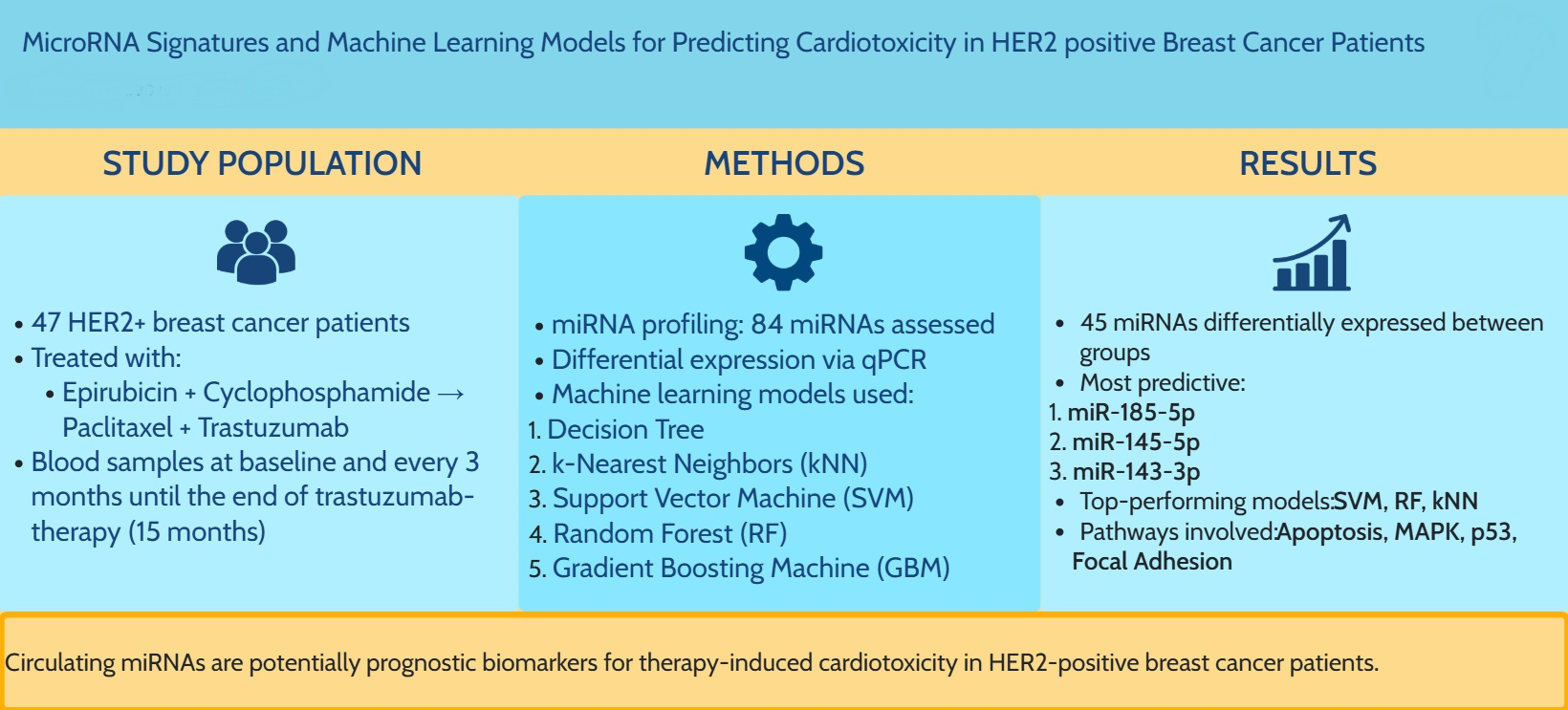
MicroRNA Signatures and Machine Learning Models for Predicting Cardiotoxicity in HER2-Positive Breast Cancer Patients
 ,
,  , ,
, ,  , ,
, ,  , , , ,
Abstract
1. Introduction
2. Results
2.1. Differential MiRNA Expression
2.2. Association of Top Deregulated miRNAs with Cardiotoxicity
2.3. Machine Learning Models
2.4. Pathway Analysis
3. Discussion
4. Material and Methods
4.1. Patients and Blood Samples
4.2. MiRNA Expression
4.3. Machine Learning Modeling Approach
4.4. MiRNA Pathway Analysis
4.5. Statistical Analysis
5. Conclusions
Supplementary Materials
Author Contributions
Funding
Institutional Review Board Statement
Informed Consent Statement
Data Availability Statement
Conflicts of Interest
References
- Cardinale, D.; Colombo, A.; Bacchiani, G.; Tedeschi, I.; Meroni, C.A.; Veglia, F.; Civelli, M.; Lamantia, G.; Colombo, N.; Curigliano, G.; et al. Early detection of anthracycline cardiotoxicity and improvement with heart failure therapy. Circulation 2015, 131, 1981–1988. [Google Scholar] [CrossRef] [PubMed]
- Farolfi, A.; Melegari, E.; Aquilina, M.; Scarpi, E.; Ibrahim, T.; Maltoni, R.; Sarti, S.; Cecconetto, L.; Pietri, E.; Ferrario, C.; et al. Trastuzumab-induced cardiotoxicity in early breast cancer patients: A retrospective study of possible risk and protective factors. Heart 2013, 99, 634–639. [Google Scholar] [CrossRef] [PubMed]
- Slamon, D.J.; Leyland-Jones, B.; Shak, S.; Fuchs, H.; Paton, V.; Bajamonde, A.; Fleming, T.; Eiermann, W.; Wolter, J.; Pegram, M.; et al. Use of chemotherapy plus a monoclonal antibody against HER2 for metastatic breast cancer that overexpresses HER2. N. Engl. J. Med. 2001, 344, 783–792. [Google Scholar] [CrossRef] [PubMed]
- Advani, P.P.; Ballman, K.V.; Dockter, T.J.; Colon-Otero, G.; Perez, E.A. Long-Term Cardiac Safety Analysis of NCCTG N9831 (Alliance) Adjuvant Trastuzumab Trial. J. Clin. Oncol. 2016, 34, 581–587. [Google Scholar] [CrossRef]
- de Azambuja, E.; Procter, M.J.; van Veldhuisen, D.J.; Agbor-Tarh, D.; Metzger-Filho, O.; Steinseifer, J.; Untch, M.; Smith, I.E.; Gianni, L.; Baselga, J.; et al. Trastuzumab-associated cardiac events at 8 years of median follow-up in the Herceptin Adjuvant trial (BIG 1-01). J. Clin. Oncol. 2014, 32, 2159–2165. [Google Scholar] [CrossRef]
- Cameron, D.; Piccart-Gebhart, M.J.; Gelber, R.D.; Procter, M.; Goldhirsch, A.; de Azambuja, E.; Castro, G., Jr.; Untch, M.; Smith, I.; Gianni, L.; et al. 11 years’ follow-up of trastuzumab after adjuvant chemotherapy in HER2-positive early breast cancer: Final analysis of the HERceptin Adjuvant (HERA) trial. Lancet 2017, 389, 1195–1205. [Google Scholar] [CrossRef]
- Venkatesh, P.; Kasi, A. Anthracyclines. In StatPearls [Internet]; StatPearls Publishing: Treasure Island, FL, USA, 2025; (NBK538187). [Google Scholar]
- Vogelsang, T.W.; Jensen, R.J.; Hesse, B.; Kjaer, A. BNP cannot replace gated equilibrium radionuclide ventriculography in monitoring of anthracycline-induced cardiotoxity. Int. J. Cardiol. 2008, 124, 193–197. [Google Scholar] [CrossRef]
- Pavo, N.; Raderer, M.; Hulsmann, M.; Neuhold, S.; Adlbrecht, C.; Strunk, G.; Goliasch, G.; Gisslinger, H.; Steger, G.G.; Hejna, M.; et al. Cardiovascular biomarkers in patients with cancer and their association with all-cause mortality. Heart 2015, 101, 1874–1880. [Google Scholar] [CrossRef]
- Mathew, P.; Suarez, W.; Kip, K.; Bayar, E.; Jasty, R.; Matloub, Y.; Raisch, D. Is there a potential role for serum cardiac troponin I as a marker for myocardial dysfunction in pediatric patients receiving anthracycline-based therapy? A pilot study. Cancer Investig. 2001, 19, 352–359. [Google Scholar] [CrossRef]
- Zardavas, D.; Suter, T.M.; Van Veldhuisen, D.J.; Steinseifer, J.; Noe, J.; Lauer, S.; Al-Sakaff, N.; Piccart-Gebhart, M.J.; de Azambuja, E. Role of Troponins I and T and N-Terminal Prohormone of Brain Natriuretic Peptide in Monitoring Cardiac Safety of Patients With Early-Stage Human Epidermal Growth Factor Receptor 2-Positive Breast Cancer Receiving Trastuzumab: A Herceptin Adjuvant Study Cardiac Marker Substudy. J. Clin. Oncol. 2017, 35, 878–884. [Google Scholar] [CrossRef]
- Michel, L.; Mincu, R.I.; Mahabadi, A.A.; Settelmeier, S.; Al-Rashid, F.; Rassaf, T.; Totzeck, M. Troponins and brain natriuretic peptides for the prediction of cardiotoxicity in cancer patients: A meta-analysis. Eur. J. Heart Fail. 2020, 22, 350–361. [Google Scholar] [CrossRef] [PubMed]
- Hinrichs, L.; Mrotzek, S.M.; Mincu, R.I.; Pohl, J.; Roll, A.; Michel, L.; Mahabadi, A.A.; Al-Rashid, F.; Totzeck, M.; Rassaf, T. Troponins and Natriuretic Peptides in Cardio-Oncology Patients-Data From the ECoR Registry. Front. Pharmacol. 2020, 11, 740. [Google Scholar] [CrossRef] [PubMed]
- Cardinale, D.; Sandri, M.T.; Colombo, A.; Colombo, N.; Boeri, M.; Lamantia, G.; Civelli, M.; Peccatori, F.; Martinelli, G.; Fiorentini, C.; et al. Prognostic value of troponin I in cardiac risk stratification of cancer patients undergoing high-dose chemotherapy. Circulation 2004, 109, 2749–2754. [Google Scholar] [CrossRef] [PubMed]
- Bartel, D.P. MicroRNAs: Genomics, biogenesis, mechanism, and function. Cell 2004, 116, 281–297. [Google Scholar] [CrossRef]
- Ovchinnikova, E.S.; Schmitter, D.; Vegter, E.L.; ter Maaten, J.M.; Valente, M.A.E.; Liu, L.C.Y.; van der Harst, P.; Pinto, Y.M.; de Boer, R.A.; Meyer, S.; et al. Signature of circulating microRNAs in patients with acute heart failure. Eur. J. Heart Fail. 2016, 18, 414–423. [Google Scholar] [CrossRef]
- Cheng, M.; Yang, J.; Zhao, X.; Zhang, E.; Zeng, Q.; Yu, Y.; Yang, L.; Wu, B.; Yi, G.; Mao, X.; et al. Circulating myocardial microRNAs from infarcted hearts are carried in exosomes and mobilise bone marrow progenitor cells. Nat. Commun. 2019, 10, 959. [Google Scholar] [CrossRef]
- Zile, M.R.; Mehurg, S.M.; Arroyo, J.E.; Stroud, R.E.; DeSantis, S.M.; Spinale, F.G. Relationship between the temporal profile of plasma microRNA and left ventricular remodeling in patients after myocardial infarction. Circ. Cardiovasc. Genet. 2011, 4, 614–619. [Google Scholar] [CrossRef]
- Yadi, W.; Shurui, C.; Tong, Z.; Suxian, C.; Qing, T.; Dongning, H. Bioinformatic analysis of peripheral blood miRNA of breast cancer patients in relation with anthracycline cardiotoxicity. BMC Cardiovasc. Disord. 2020, 20, 43. [Google Scholar] [CrossRef]
- Rigaud, V.O.; Ferreira, L.R.; Ayub-Ferreira, S.M.; Avila, M.S.; Brandao, S.M.; Cruz, F.D.; Santos, M.H.; Cruz, C.B.; Alves, M.S.; Issa, V.S.; et al. Circulating miR-1 as a potential biomarker of doxorubicin-induced cardiotoxicity in breast cancer patients. Oncotarget 2017, 8, 6994–7002. [Google Scholar] [CrossRef]
- Ruggeri, C.; Gioffre, S.; Achilli, F.; Colombo, G.I.; D’Alessandra, Y. Role of microRNAs in doxorubicin-induced cardiotoxicity: An overview of preclinical models and cancer patients. Heart Fail. Rev. 2018, 23, 109–122. [Google Scholar] [CrossRef]
- Gioffre, S.; Chiesa, M.; Cardinale, D.M.; Ricci, V.; Vavassori, C.; Cipolla, C.M.; Masson, S.; Sandri, M.T.; Salvatici, M.; Ciceri, F.; et al. Circulating MicroRNAs as Potential Predictors of Anthracycline-Induced Troponin Elevation in Breast Cancer Patients: Diverging Effects of Doxorubicin and Epirubicin. J. Clin. Med. 2020, 9, 1418. [Google Scholar] [CrossRef] [PubMed]
- Zhang, S.; Wang, Y.; Wang, Y.; Peng, J.; Yuan, C.; Zhou, L.; Xu, S.; Lin, Y.; Du, Y.; Yang, F.; et al. Serum miR-222-3p as a Double-Edged Sword in Predicting Efficacy and Trastuzumab-Induced Cardiotoxicity for HER2-Positive Breast Cancer Patients Receiving Neoadjuvant Target Therapy. Front. Oncol. 2020, 10, 631. [Google Scholar] [CrossRef] [PubMed]
- Feng, Q.; Ren, Y.; Hou, A.; Guo, J.; Mao, Z.; Liu, S.; Wang, B.; Bai, Z.; Hou, X. MicroRNA-130a Increases and Predicts Cardiotoxicity during Adjuvant Chemotherapy in Human Epidermal Growth Factor Receptor-2-Positive Breast Cancer. J. Breast Cancer 2021, 24, 153–163. [Google Scholar] [CrossRef] [PubMed]
- Lakhani, H.V.; Pillai, S.S.; Zehra, M.; Dao, B.; Tirona, M.T.; Thompson, E.; Sodhi, K. Detecting early onset of anthracyclines-induced cardiotoxicity using a novel panel of biomarkers in West-Virginian population with breast cancer. Sci. Rep. 2021, 11, 7954. [Google Scholar] [CrossRef]
- Pillai, S.S.; Pereira, D.G.; Bonsu, G.; Chaudhry, H.; Puri, N.; Lakhani, H.V.; Tirona, M.T.; Sodhi, K.; Thompson, E. Biomarker panel for early screening of trastuzumab -induced cardiotoxicity among breast cancer patients in west virginia. Front. Pharmacol. 2022, 13, 953178. [Google Scholar] [CrossRef]
- Pizzamiglio, S.; Ciniselli, C.M.; de Azambuja, E.; Agbor-Tarh, D.; Moreno-Aspitia, A.; Suter, T.M.; Trama, A.; De Santis, M.C.; De Cecco, L.; Iorio, M.V.; et al. Circulating microRNAs and therapy-associated cardiac events in HER2-positive breast cancer patients: An exploratory analysis from NeoALTTO. Breast Cancer Res. Treat. 2024, 206, 285–294. [Google Scholar] [CrossRef]
- Pivatto Junior, F.; Santos, A.B.S.; Englert, E.F.; Mazzutti, G.; Costa, G.O.M.; Saffi, M.A.L.; Siebert, M.; Liedke, P.E.R.; Fritsch, V.H.; Biolo, A. MicroRNA Expression Pre-Trastuzumab Treatment in HER-2+ Early Breast Cancer Patients as a Predictor of Cancer Therapy-Related Cardiac Dysfunction: A Pilot Cohort Study. Cardiology 2025, 1–8. [Google Scholar] [CrossRef]
- Alexandraki, A.; Papageorgiou, E.; Zacharia, M.; Keramida, K.; Papakonstantinou, A.; Cipolla, C.M.; Tsekoura, D.; Naka, K.; Mazzocco, K.; Mauri, D.; et al. New Insights in the Era of Clinical Biomarkers as Potential Predictors of Systemic Therapy-Induced Cardiotoxicity in Women with Breast Cancer: A Systematic Review. Cancers 2023, 15, 3290. [Google Scholar] [CrossRef]
- Qin, X.; Chang, F.; Wang, Z.; Jiang, W. Correlation of circulating pro-angiogenic miRNAs with cardiotoxicity induced by epirubicin/cyclophosphamide followed by docetaxel in patients with breast cancer. Cancer Biomark. 2018, 23, 473–484. [Google Scholar] [CrossRef]
- Wan, G.; Chen, P.; Sun, X.; Cai, X.; Yu, X.; Wang, X.; Cao, F. Weighted gene co-expression network-based approach to identify key genes associated with anthracycline-induced cardiotoxicity and construction of miRNA-transcription factor-gene regulatory network. Mol. Med. 2021, 27, 142. [Google Scholar] [CrossRef]
- Li, C.C.; Qiu, X.T.; Sun, Q.; Zhou, J.P.; Yang, H.J.; Wu, W.Z.; He, L.F.; Tang, C.E.; Zhang, G.G.; Bai, Y.P. Endogenous reduction of miR-185 accelerates cardiac function recovery in mice following myocardial infarction via targeting of cathepsin K. J. Cell Mol. Med. 2019, 23, 1164–1173. [Google Scholar] [CrossRef] [PubMed]
- Lin, R.; Rahtu-Korpela, L.; Szabo, Z.; Kemppi, A.; Skarp, S.; Kiviniemi, A.M.; Lepojarvi, E.S.; Halmetoja, E.; Kilpio, T.; Porvari, K.; et al. MiR-185-5p regulates the development of myocardial fibrosis. J. Mol. Cell Cardiol. 2022, 165, 130–140. [Google Scholar] [CrossRef] [PubMed]
- Degerli, E.; Torun, V.; Cansaran-Duman, D. miR-185-5p response to usnic acid suppresses proliferation and regulating apoptosis in breast cancer cell by targeting Bcl2. Biol. Res. 2020, 53, 19. [Google Scholar] [CrossRef] [PubMed]
- Chen, Y.; Xu, Y.; Deng, Z.; Wang, Y.; Zheng, Y.; Jiang, W.; Jiang, L. MicroRNA expression profiling involved in doxorubicin-induced cardiotoxicity using high-throughput deep-sequencing analysis. Oncol. Lett. 2021, 22, 560. [Google Scholar] [CrossRef]
- Zhang, X.; Liu, F.; Wang, Q.; Geng, Y. Overexpressed microRNA-506 and microRNA-124 alleviate H2O2-induced human cardiomyocyte dysfunction by targeting kruppel-like factor 4/5. Mol. Med. Rep. 2017, 16, 5363–5369. [Google Scholar] [CrossRef]
- Liu, Y.; Li, Y.; Ni, J.; Shu, Y.; Wang, H.; Hu, T. MiR-124 attenuates doxorubicin-induced cardiac injury via inhibiting p66Shc-mediated oxidative stress. Biochem. Biophys. Res. Commun. 2020, 521, 420–426. [Google Scholar] [CrossRef]
- Rosenfeld, R.; Riondino, S.; Formica, V.; Torino, F.; Martuscelli, E.; Roselli, M. MiRNAs and circRNAs for the Diagnosis of Anthracycline-Induced Cardiotoxicity in Breast Cancer Patients: A Narrative Review. J. Pers. Med. 2022, 12, 1059. [Google Scholar] [CrossRef]
- Chen, L.; Xu, Y. MicroRNAs as Biomarkers and Therapeutic Targets in Doxorubicin-Induced Cardiomyopathy: A Review. Front. Cardiovasc. Med. 2021, 8, 740515. [Google Scholar] [CrossRef]
- Gorbatenko, A.; Sokilde, R.; Sorensen, E.E.; Newie, I.; Persson, H.; Morancho, B.; Arribas, J.; Litman, T.; Rovira, C.; Pedersen, S.F. HER2 and p95HER2 differentially regulate miRNA expression in MCF-7 breast cancer cells and downregulate MYB proteins through miR-221/222 and miR-503. Sci. Rep. 2019, 9, 3352. [Google Scholar] [CrossRef]
- Haryana, S.M.; Oktriani, R.; Faiha, D.K.; Conara, F.C.; Dafip, M.; Setiasari, D.W. miR-143-3p: A Critical Regulator of KRAS and HRAS with Potential for Targeted Therapies in Breast Cancer. Trends Sci. 2025, 22, 9630. [Google Scholar] [CrossRef]
- Zhou, Y.; Yuan, Y.; Li, L.; Wang, X.; Quan, Y.; Liu, C.; Yu, M.; Hu, X.; Meng, X.; Zhou, Z.; et al. HER2-intronic miR-4728-5p facilitates HER2 expression and accelerates cell proliferation and migration by targeting EBP1 in breast cancer. PLoS ONE 2021, 16, e0245832. [Google Scholar] [CrossRef]
- Pattanayak, B.; Garrido-Cano, I.; Adam-Artigues, A.; Tormo, E.; Pineda, B.; Cabello, P.; Alonso, E.; Bermejo, B.; Hernando, C.; Martinez, M.T.; et al. MicroRNA-33b Suppresses Epithelial-Mesenchymal Transition Repressing the MYC-EZH2 Pathway in HER2+ Breast Carcinoma. Front. Oncol. 2020, 10, 1661. [Google Scholar] [CrossRef]
- Huang, T.H.; Wu, F.; Loeb, G.B.; Hsu, R.; Heidersbach, A.; Brincat, A.; Horiuchi, D.; Lebbink, R.J.; Mo, Y.Y.; Goga, A.; et al. Up-regulation of miR-21 by HER2/neu signaling promotes cell invasion. J. Biol. Chem. 2009, 284, 18515–18524. [Google Scholar] [CrossRef]
- Newie, I.; Sokilde, R.; Persson, H.; Grabau, D.; Rego, N.; Kvist, A.; von Stedingk, K.; Axelson, H.; Borg, A.; Vallon-Christersson, J.; et al. The HER2-encoded miR-4728-3p regulates ESR1 through a non-canonical internal seed interaction. PLoS ONE 2014, 9, e97200. [Google Scholar] [CrossRef]
- Yin, C.; Zhang, G.; Sun, R.; Pan, X.; Wang, X.; Li, H.; Sun, Y. miR-185-5p inhibits F-actin polymerization and reverses epithelial mesenchymal transition of human breast cancer cells by modulating RAGE. Mol. Med. Rep. 2018, 18, 2621–2630. [Google Scholar] [CrossRef]
- Lyon, A.R.; Lopez-Fernandez, T.; Couch, L.S.; Asteggiano, R.; Aznar, M.C.; Bergler-Klein, J.; Boriani, G.; Cardinale, D.; Cordoba, R.; Cosyns, B.; et al. 2022 ESC Guidelines on cardio-oncology developed in collaboration with the European Hematology Association (EHA), the European Society for Therapeutic Radiology and Oncology (ESTRO) and the International Cardio-Oncology Society (IC-OS). Eur. Heart J. Cardiovasc. Imaging 2022, 23, e333–e465. [Google Scholar] [CrossRef]
- Pliakou, E.; Lampropoulou, D.I.; Dovrolis, N.; Chrysikos, D.; Filippou, D.; Papadimitriou, C.; Vezakis, A.; Aravantinos, G.; Gazouli, M. Circulating miRNA Expression Profiles and Machine Learning Models in Association with Response to Irinotecan-Based Treatment in Metastatic Colorectal Cancer. Int. J. Mol. Sci. 2022, 24, 46. [Google Scholar] [CrossRef] [PubMed]




| Characteristics | Cardiac Toxicity (Ν = 15) | Non-Cardiac Toxicity (Ν = 32) | p-Value |
|---|---|---|---|
| Age (years) | 56.9 ± 12.9 | 56.3 ± 11.8 | 0.88 |
| Staging (pTNM) | |||
| I | 8 (53.3) | 14 (43.8) | 0.80 |
| II | 5 (33.3) | 14 (43.8) | |
| III | 2 (13.3) | 4 (12.5) | |
| Radiotherapy | 14 (93.3) | 25 (78.1) | 0.28 |
| Systolic arterial pressure (mmHg) | 119 ± 19 | 116 ± 18 | 0.67 |
| Diastolic arterial pressure (mmHg) | 78 ± 13 | 80 ± 11 | 0.73 |
| Arterial Hypertension | 4 (26.6) | 11 (34.4) | 0.51 |
| Dyslipidemia | 6 (39.9) | 13 (40.6) | 0.97 |
| Diabetes mellitus | 1 (6.6) | 4 (12.5) | 0.67 |
| Non-smokers | 10 (66.6) | 21 (65.6) | 0.91 |
| Past smokers | 2 (13.3) | 6 (18.8) | |
| Active Smokers | 3 (20) | 5 (15.6) | |
| Body mass index (kg/m2) | 28.13 ± 4.63 | 25.94 ± 4.59 | 0.13 |
| Trastuzumab | 11 (73.3) | 27 (84.4) | 0.34 |
| Total dose epirubicin (mg/m2) | 515 ± 51 | 516 ± 49 | 0.97 |
| Categorical variables are presented as N (%). Continuous variables are presented as mean ± SD | |||
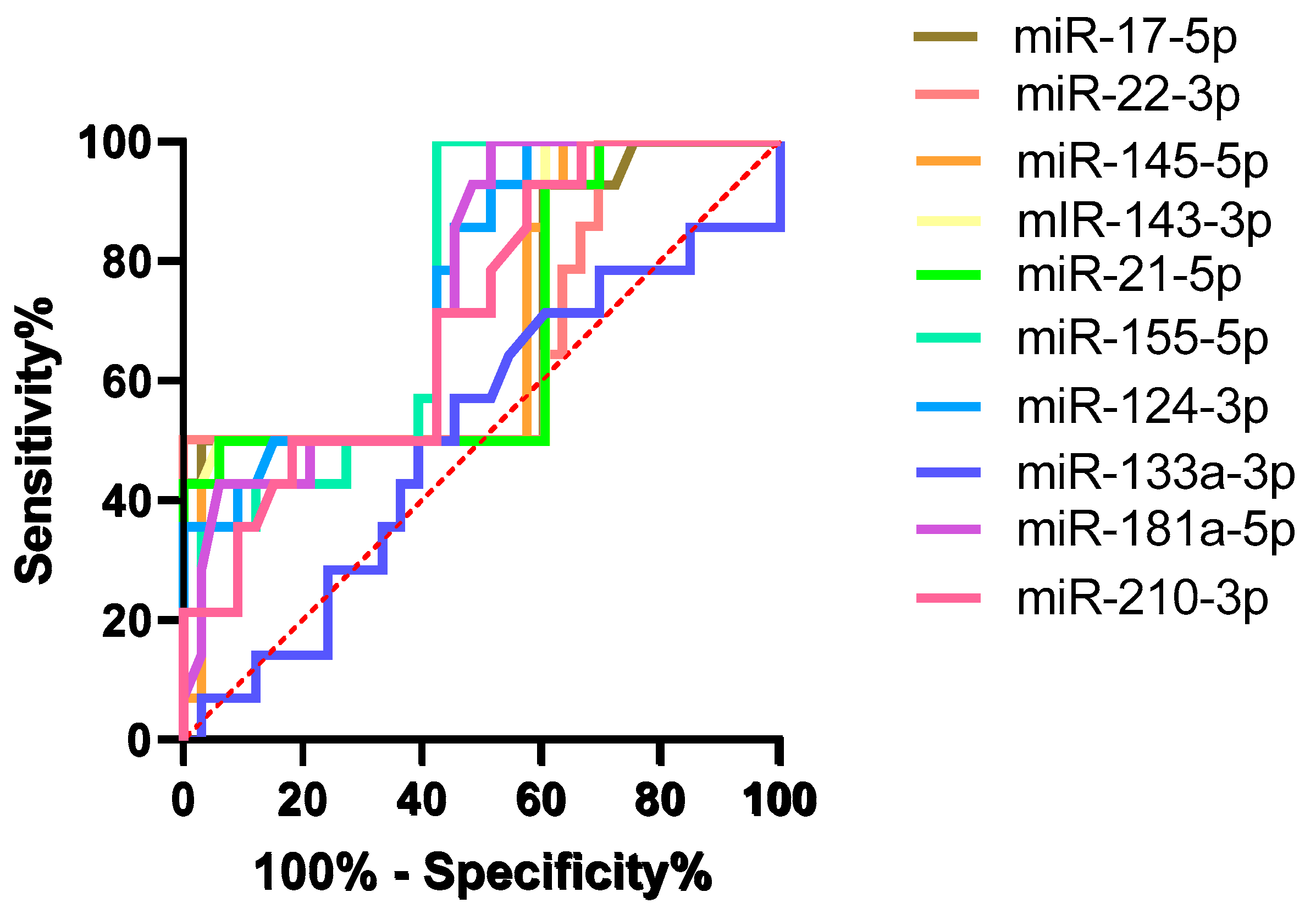
| miR | OR (95% CI) | p-Value | AUROC | p-Value |
|---|---|---|---|---|
| hsa-miR-17-5p | 0.92 (0.83–1.03) | 0.16 | 0.69 | 0.047 |
| hsa-miR-22-3p | 0.92 (0.82–1.03) | 0.15 | 0.68 | 0.06 |
| hsa-miR-145-5p | 0.93 (0.84–1.04) | 0.19 | 0.69 | 0.041 |
| hsa-miR-143-3p | 0.93 (0.84–1.04) | 0.19 | 0.69 | 0.037 |
| hsa-miR-21-5p | 0.93 (0.84–1.04) | 0.20 | 0.69 | 0.045 |
| hsa-miR-155-5p | 1.12 (1.01–1.23) | 0.03 | 0.76 | 0.006 |
| hsa-miR-124-3p | 1.11 (1.01–1.24) | 0.03 | 0.75 | 0.007 |
| hsa-miR-133a-3p | 1.02 (0.92–1.12) | 0.73 | 0.51 | 0.89 |
| hsa-miR-181a-5p | 1.10 (0.99–1.22) | 0.056 | 0.75 | 0.008 |
| hsa-miR-210-3p | 1.10 (0.99–1.22) | 0.057 | 0.71 | 0.025 |
| Model | Accuracy | Precision | Recall | F1 | Kappa | Sensitivity | Specificity |
|---|---|---|---|---|---|---|---|
| k-Nearest Neighbors | 0.89 | 0.88 | 0.87 | 0.88 | 1.00 | 0.83 | 0.88 |
| Support Vector Machine | 0.92 | 0.91 | 0.90 | 0.91 | 1.00 | 0.83 | 1 |
| Random Forest | 0.91 | 0.90 | 0.89 | 0.90 | 1.00 | 0.83 | 0.88 |
| Gradient Boosting | 0.93 | 0.92 | 0.91 | 0.92 | 0.64 | 1 | 0.88 |
| Decision Tree | 0.75 | 1.00 | 0.50 | 0.67 | 0.50 | 0.50 | 1 |
| Derived from the test dataset (20% of the total sample) | |||||||
| Comparison | Mean Difference in Accuracy (95% CI) | p-Value |
|---|---|---|
| GBM vs. Decision Tree | 0.18 (−0.04, 0.40) | 0.13 |
| kNN vs. Decision Tree | 0.22 (0.01, 0.44) | 0.045 |
| RF vs. Decision Tree | 0.24 (0.02, 0.45) | 0.03 |
| SVM vs. Decision Tree | 0.24 (0.03, 0.46) | 0.02 |
| kNN vs. GBM | 0.04 (−0.18, 0.26) | 0.98 |
| RF vs. GBM | 0.06 (−0.16, 0.27) | 0.94 |
| SVM vs. GBM | 0.06 (−0.15, 0.28) | 0.90 |
| RF vs. kNN | 0.02 (−0.20, 0.23) | 0.99 |
| SVM vs. kNN | 0.02 (−0.19, 0.24) | 0.99 |
| SVM vs. RF | 0.01 (−0.21, 0.23) | 0.99 |
Disclaimer/Publisher’s Note: The statements, opinions and data contained in all publications are solely those of the individual author(s) and contributor(s) and not of MDPI and/or the editor(s). MDPI and/or the editor(s) disclaim responsibility for any injury to people or property resulting from any ideas, methods, instructions or products referred to in the content. |
© 2025 by the authors. Licensee MDPI, Basel, Switzerland. This article is an open access article distributed under the terms and conditions of the Creative Commons Attribution (CC BY) license (https://creativecommons.org/licenses/by/4.0/).
Share and Cite
Anastasiou, M.; Oikonomou, E.; Theofilis, P.; Gazouli, M.; Papamikroulis, G.-A.; Goliopoulou, A.; Tsigkou, V.; Skandami, V.; Margoni, A.; Cholidou, K.; et al. MicroRNA Signatures and Machine Learning Models for Predicting Cardiotoxicity in HER2-Positive Breast Cancer Patients. Pharmaceuticals 2025, 18, 1908. https://doi.org/10.3390/ph18121908
Anastasiou M, Oikonomou E, Theofilis P, Gazouli M, Papamikroulis G-A, Goliopoulou A, Tsigkou V, Skandami V, Margoni A, Cholidou K, et al. MicroRNA Signatures and Machine Learning Models for Predicting Cardiotoxicity in HER2-Positive Breast Cancer Patients. Pharmaceuticals. 2025; 18(12):1908. https://doi.org/10.3390/ph18121908
Chicago/Turabian StyleAnastasiou, Maria, Evangelos Oikonomou, Panagiotis Theofilis, Maria Gazouli, George-Angelos Papamikroulis, Athina Goliopoulou, Vasiliki Tsigkou, Vasiliki Skandami, Angeliki Margoni, Kyriaki Cholidou, and et al. 2025. "MicroRNA Signatures and Machine Learning Models for Predicting Cardiotoxicity in HER2-Positive Breast Cancer Patients" Pharmaceuticals 18, no. 12: 1908. https://doi.org/10.3390/ph18121908
APA StyleAnastasiou, M., Oikonomou, E., Theofilis, P., Gazouli, M., Papamikroulis, G.-A., Goliopoulou, A., Tsigkou, V., Skandami, V., Margoni, A., Cholidou, K., Psyrri, A., Tsioufis, K., Zagouri, F., Siasos, G., & Tousoulis, D. (2025). MicroRNA Signatures and Machine Learning Models for Predicting Cardiotoxicity in HER2-Positive Breast Cancer Patients. Pharmaceuticals, 18(12), 1908. https://doi.org/10.3390/ph18121908